

Sample Category Title
Sunrise Market Commentary
Markets
US and EMU bond markets took a wait-and-see attitude yesterday ahead of a series of key eco data later this week that will help shape expectations on central bank policy going forward (EMU June CPI on Wednesday, US consumer confidence & JOLTS job data today, US manufacturing ISM and ADP job report on Wednesday and US payrolls on Thursday). US yields yesterday changed less than 2 bps across the curve. German yields rose marginally (2-y +2.3 bps, 30-y +0.4 bps). Brent oil ($73/72 area) is holding near the post-war lows even as military action over the weekend underscored the fragility of the ceasefire ahead of new talks scheduled for this week. At the same time, Iran indicated that still aims to keep control over any traffic through the Strait of Hormuz (with or without the cooperation of Oman). US equity markets regained their composure, rebounding from tech-related uncertainty last week (S&P +1.17%, Nasdaq +2.07%). On FX markets, the dollar was still in some kind of consolidation mode after a strong run since mid-June (supported by Fed Chair Warsh anti-inflation commitment at the June 17 Fed meeting). EUR/USD tried to regain the 1.14 market (close 1.1422, but returning back below 1.14 this morning). USD/JPY yesterday extensively tested the key 161.95 2024 top with a break higher to a four-decade yen low this morning (162.2). Until now, Japanese authorities didn't show up with more than verbal interventions to act against further yen erosion.
Yesterday evening after the close of the European markets, Chair Lagarde at the ECB forum in Sintra elaborated both on the reaction of the EMU economy and at the same time on the ECB reaction function in this new era. In the first place, the EMU economy showed resilience to a series of shocks over the previous years. This has reduced the need to use unconventional or forceful policy measures. The reaction of authorities to shocks often caused the outcome to be different from what it was in the past. Lagarde also assessed that these shocks have the capacity to escalate sharply, but also to swiftly unwind. This often put the CBs, including the ECB, in an intermediate zone between shocks they can look through and those they must react to forcefully. In this context, Lagarde also elaborated on the values of scenario analysis as core part of the decision making process with the bank having moved from 'forward guidance' to 'framework guidance'. As the market apparently understood the reaction function of the ECB quite well as the energy shock this year developed, it allowed the bank to take some more time to take robust decisions. This has created the space for monetary policy to go back to the basics: stabilising inflation with policy rates as a primary tool, acting in a measured way, and taking decisions meeting by meeting. Maybe in some way, there is also some kind of link/resemblance with Fed Chair Warsh pointing to the market reaction/value of market pricing as an important input for CB policy. Market current still prices one additional ECB rate hike by e.o.y.
News & Views
Shop price inflation in the UK was 1.2% y/y in June, the same as in May, the UK's British Retail Consortium said today. Food inflation decelerated from 2.7% to 2.4%, which BRC's chief executive Dickinson said was thanks to bumper crops and strong competition. Non-food prices rose 0.6%, slightly up from the 0.5% last month. Promotions across summer essentials in clothing have helped to keep a lid on this category. Dickinson warned that while a competitive market is keeping overall inflation in check right now, retailers are facing "mounting cost pressures, including higher National Insurance, the triple packaging tax and higher input costs from extreme weather and geopolitical tensions".
The US Supreme Court yesterday in a majority decision limited the president's power to remove Fed governors when doing so for "good reason". After being accused of mortgage fraud, president Trump sought to fire Fed governor Cook on the basis of "good reason". The Supreme Court considered this wasn't the case, allowing Cook to stay on board while the case is being resolved. However, the Court handed the president an important victory in a second ruling, which states that federal agencies that wield executive power must be ultimately answerable to the president. That means Rebecca Slaughter, the Democratic official at the Federal Trade Commission who was fired by Trump last year and at the center of the Supreme Court case, remains permanently dismissed. In a broader perspective, the ruling cleared the way for POTUS to fire, without cause, officials from many other similar agencies, including key ones such as the Securities and Exchange Commission.
European Currencies Enter Consolidation Ahead of Key Macroeconomic Data
Following the US dollar's notable strength last week, European currencies have entered a period of consolidation. Investors and market participants have temporarily reduced trading activity ahead of a series of key macroeconomic releases from the euro area, the UK and the US, which could determine the next direction for EUR/USD and GBP/USD. At the same time, markets continue to monitor developments in the Middle East, as easing geopolitical tensions have somewhat reduced demand for safe-haven assets, allowing investors to shift their focus back to economic fundamentals.
Investor sentiment has also been supported by reports suggesting that the US and Iran may be close to reaching an agreement to halt mutual strikes and resume negotiations. The restoration of shipping through the Strait of Hormuz has reduced concerns over disruptions to global oil supplies and contributed to greater stability across financial markets. Nevertheless, ongoing disagreements over the situation in the Strait of Hormuz and conflicting statements from Iranian officials indicate that geopolitical risks have not yet fully subsided.
EUR/USD
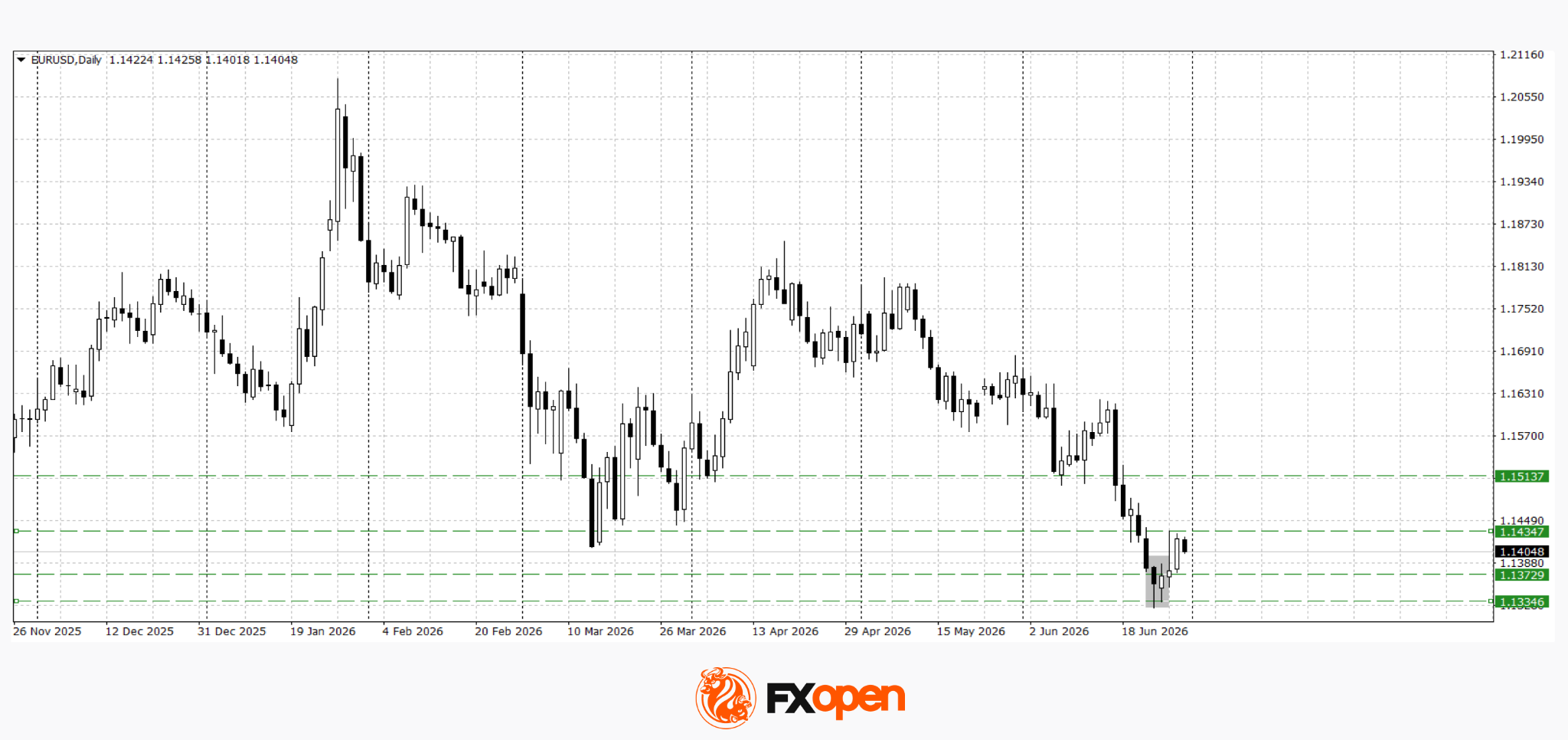
Following a test of the March low, a bullish Piercing Line candlestick pattern formed on the daily timeframe. Technical analysis suggests that EUR/USD is trading within a sideways range between 1.1340 and 1.1430. Price action around these boundaries, together with the incoming macroeconomic data, should provide further clues regarding the pair's next directional move.
Key events for EUR/USD:
- Today at 09:45 (GMT+3): France CPI.
- Today at 15:00 (GMT+3): Germany CPI.
- Today at 17:00 (GMT+3): US JOLTS Job Openings.
GBP/USD
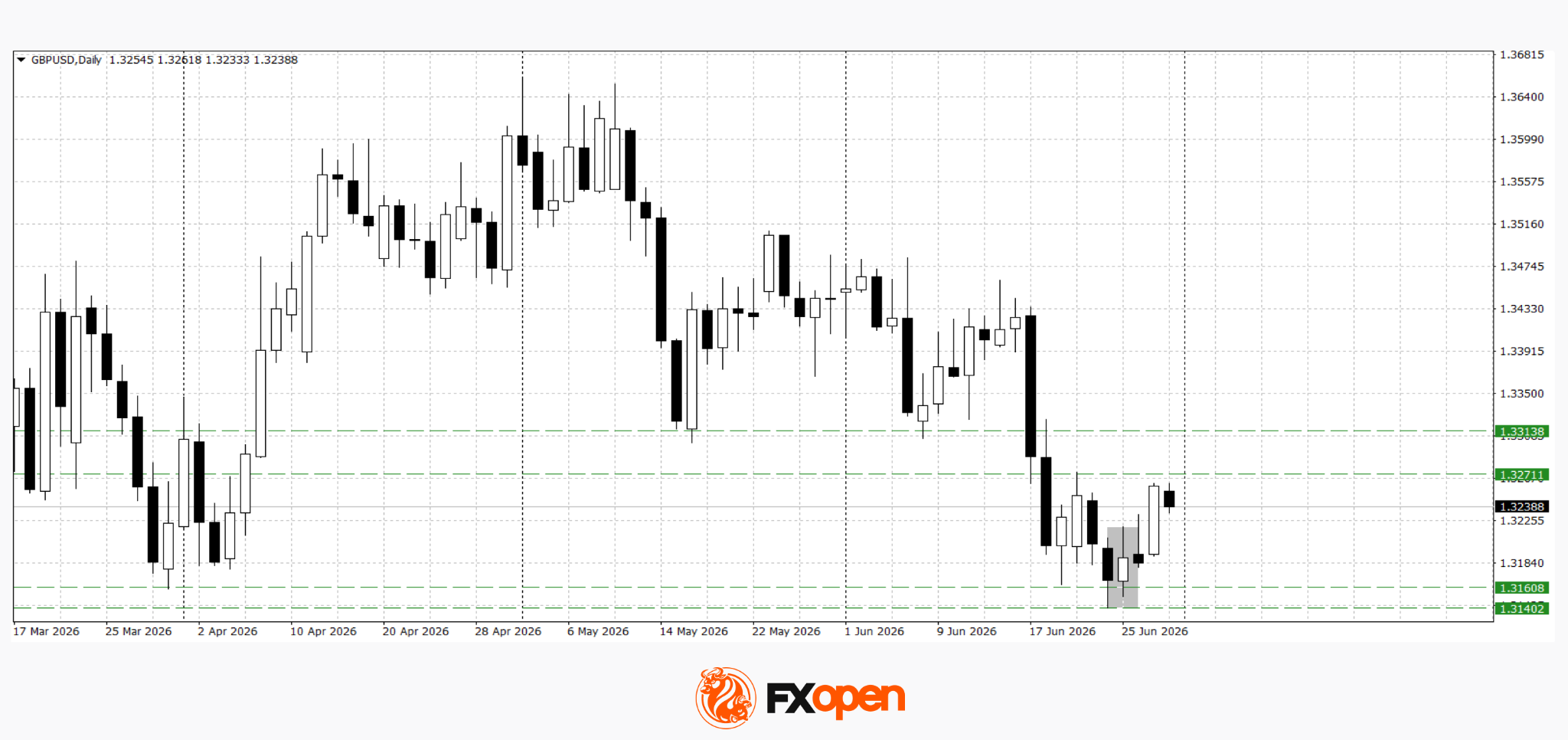
After testing this year's March low at 1.3160, sterling buyers regained the initiative and formed a bullish Piercing Line candlestick pattern. The pair has since rebounded towards 1.3270, although any further upside is likely to depend on incoming macroeconomic data. Technical analysis suggests the pair may retest the 1.3270 level. A decisive break and close above this resistance could pave the way for further gains towards 1.3300–1.3310, while rejection from current resistance may trigger a decline back towards the 1.3140–1.3160 area.
Key events for GBP/USD:
- Today at 09:00 (GMT+3): UK GDP.
- Today at 13:40 (GMT+3): Speech by Bank of England Financial Policy Committee member Sarah Breeden.
- Today at 17:00 (GMT+3): US CB Consumer Confidence Index.
Following the sharp moves seen in recent sessions, the foreign exchange market has entered a wait-and-see mode. The release of key economic data on both sides of the Atlantic is likely to determine whether the current consolidation becomes the starting point for a recovery in European currencies or gives way to a renewed strengthening of the US dollar.
Trade over 50 forex markets 24 hours a day with FXOpen. Take advantage of low commissions, deep liquidity, and spreads from 0.0 pips (additional fees may apply). Open your FXOpen account now or learn more about trading forex with FXOpen.
This article represents the opinion of the Companies operating under the FXOpen brand only. It is not to be construed as an offer, solicitation, or recommendation with respect to products and services provided by the Companies operating under the FXOpen brand, nor is it to be considered financial advice.
Preview of RBNZ: Keep Calm and Focus on the Data
- We expect the RBNZ to leave the OCR at 2.25% at the 8 July Review.
- Much has changed over the past six weeks. Therefore, while three MPC members had voted for a rate hike in May, we think the "on hold" decision may well be reached by consensus.
- Forward guidance should remain consistent with a lift in the OCR this year. However, the message is expected to be more data dependent than came across at the May Statement.
- The press release will likely reaffirm that the timing of OCR increases will depend on what data and other developments suggest about the outlook for medium-term inflation pressures.
"What we're saying is it's likely we'll see OCR hikes at coming meetings, but we're not being, you know, exact... how much and at what meeting because we will consider, you know, the incoming data and how the inflation outlook evolves. So, if we see oil prices falling really much more than expected, if we see much much weaker growth, then we may not hike."
- Governor Anna Breman, Heather du Plessis-Allan Drive interview, 27 May 2026
RBNZ Decision and Communication
We expect the OCR to remain at 2.25% at next week's 8 July policy meeting. A tightening bias will remain in place that will be explicitly data dependent. In determining when that bias might be acted upon, key factors cited will be the extent of second round pricing pressures, wages pressures and evidence of increasing medium to long term inflation expectations. Evidence that the economic recovery is resuming and the output gap narrowing would also prompt policy tightening at some stage, as was the RBNZ's forecast in the February Statement. The language pointing to OCR increases as likely in coming meetings could be kept but with a more explicit rider that these are conditional on evidence warranting those increases.
While three MPC members voted for a rate hike in May, the significant developments over the past six weeks make it quite possible that a vote is not required on this occasion. It would be perfectly reasonable for those previously hawkish members to change their view given the relatively quick resolution of the Iran tensions have caught most if not all commentators by surprise. Data dependence is a virtue not a failing in a well-functioning MPC.
Should a vote be needed, then we expect only a small minority of external members to support an OCR increase in July. We don't think any of the doves from the May meeting will want to join the hawkish group. There is also a strong prospect that the hawks from last time will be happy to review the key data that will be released in the weeks that follow the July meeting and raise the case for an OCR rise at the September meeting, should that data support that stance.
The discussion will aim to redirect market attention on upcoming data to justify future OCR hikes. Markets became unduly fixated on a July hike after the May meeting and saw it as relatively independent of incoming data and developments in the Middle East, which was unfortunate. We expect the MPC to take the opportunity to correct that impression.
Prospects for a normalisation of the OCR will remain a feature of the RBNZ's communication. But we expect the Bank to shift the frame of reference towards the view the MPC held pre-war. This envisaged a single OCR hike no sooner than the end of this year. As inflation is still higher than anticipated back in February, we think they will signal bringing forward of the date of lift off in the OCR to September but suggest a gradual trajectory from there if second-round inflation pressures from the Middle East supply shock remain in check. The option of consecutive increases in the OCR from September might still be a possibility but would not be presented as base case and would be dependent on data warranting a less gradual cadence of OCR increases. We don't expect the MPC to present a September OCR increase as a given. A slow bounce back of economic activity and evidence of weak underlying inflation pressures in the June quarter CPI could justify delaying to December and thus moving the RBNZ's stance all the way back to that communicated in the February 2026 Statement. Reintroducing data dependence into the MPC's future decision-making framework will aim to preserve the option to push the tightening cycle back to December should data suggest that appropriate.
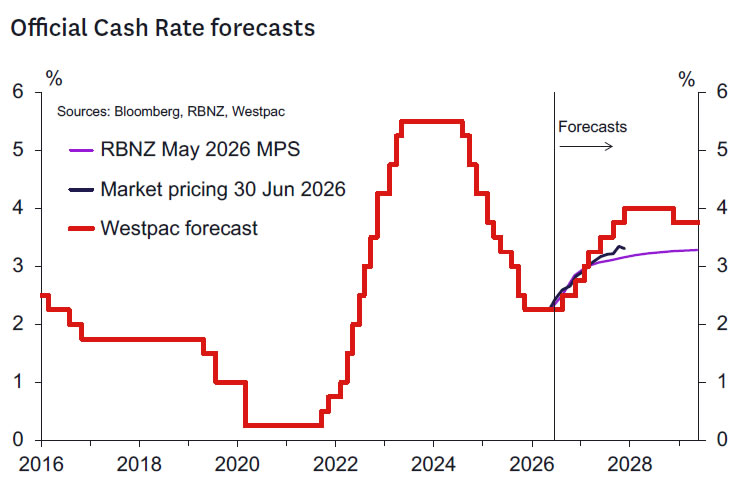
We expect market pricing to take a bit more out of the amount of tightening expected for 2026 and move to a situation where markets price between one and two 25bp increases by year end. From there the data will determine how market pricing evolves.
Arguments in Favour of a Hike
The most prominent argument we have heard among market participants expecting a July hike is that this was more-or-less promised in the May Statement. It's certainly the case that the RBNZs Q3 2026 assumption of an average OCR of 2.51% is most consistent with a July hike and for some members a July hike may have been the presumption in the absence of a marked change in the inflation outlook. But we certainly don't agree that a hike was in any way promised.
The Governor described OCR increases "in coming meetings", which was deliberately and appropriately vague given the uncertain nature of the environment. The quote we included on the front page of this note illustrates the conditionality of the policy outlook. The Governor explicitly noted in a radio interview after the May meeting that "... if we see oil prices falling really much more than expected, if we see much much weaker growth, then we may not hike". And in various speaking engagements the Governor has referred to a desire to see evidence of second-round pricing dynamics, rising wage pressures and increasing inflation expectations to confirm that any earlier hike in the OCR was necessary. No such evidence has accumulated since May. Similarly, in her public appearances, Assistant Governor Silk has noted that all options were on the table for the July meeting, including a "hold". We think that the near $30/bbl decline in oil prices since the May meeting was probably beyond even the most optimistic scenario that Silk might have envisaged when she made that comment.
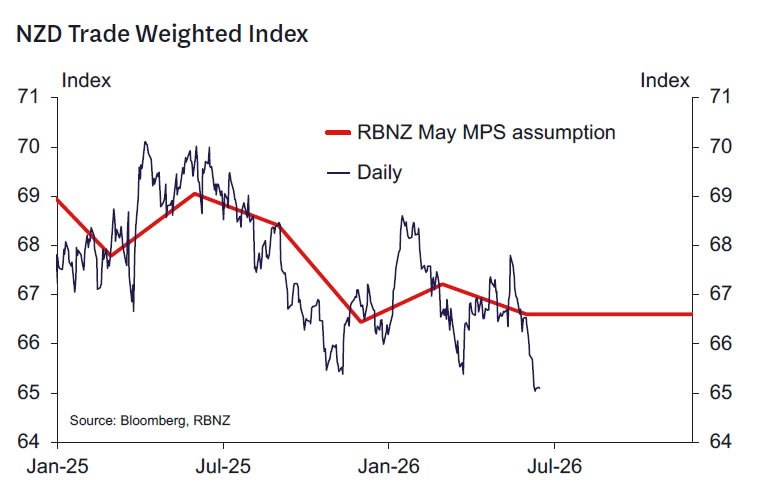
Another argument is the weakening in the exchange rate in the face of wide interest rate differentials. It is the case that the US dollar has been stronger since the FOMC shifted towards a tightening bias at their last meeting. Similarly, the Reserve Bank of Australia Board sent a message in their last meeting that cash rate increases were still possible. The associated weakening in the NZD has added to inflation pressures. But it's still unclear how persistent these will prove to be in much the same way we don't know how persistent energy related costs pressures will be. More generally the weaker NZD is a positive economic influence as it is assisting the competitive parts of the economy that are the key drivers of economic recovery. It's also useful additional pressure on less competitive parts of the economy to adjust (for example import demand, the construction and real estate sectors). The risks of FX depreciation are more likely better managed by retaining the view that the OCR will eventually need to return to developed country norm levels, adjusted for risk premia, as opposed to justify what might be premature OCR increases.
The resolution of at least some of the uncertainty associated with the Iran war will be a fillip to growth in the second half of 2026. The RBNZ has modest expectations for Q3 GDP (0.2% growth) that should be revised higher. Similarly, forecasts for later quarters could be revised higher in line with the stronger anticipated terms of trade now energy prices are lower. Business and consumer confidence, along with housing market prospects, should bounce as the Iran war uncertainty is reduced. Indeed, there is some evidence of this in today's monthly business confidence survey that shows general business confidence rising in June. We think there is some merit to these arguments. But importantly it seems very unlikely that future upgrades to the growth outlook will be sufficient to restore the RBNZ's February Statement growth outlook, when recall the RBNZ forecast no more than one 25bp hike in the OCR this year. Today's business survey also shows that its very much early days in the business sector recovery given that backward looking measures of activity suggest still weakening growth momentum. Also the level of business confidence, while higher than that seen in May, is some distance below the levels seen in early 2026, when the RBNZ saw OCR increases coming at the end of 2026.
Arguments in Favour of No Change
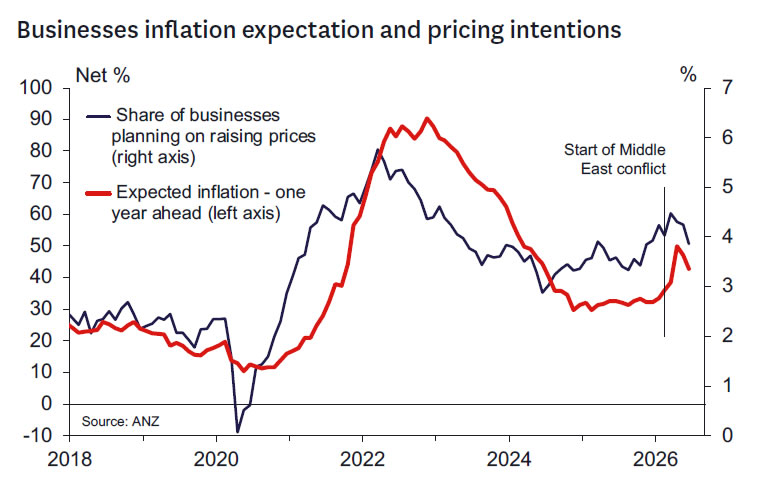
No further evidence on second round inflation impacts, rising wages pressures or increasing inflation expectations has accumulated since the May meeting. Indeed, short term inflation expectations appear to have reduced in business and consumer surveys as energy prices have fallen and will likely continue to decline if current energy price levels are sustained. Westpac's employment confidence survey shows a still fragile labour market that seems unlikely to support upward pressure on wages.
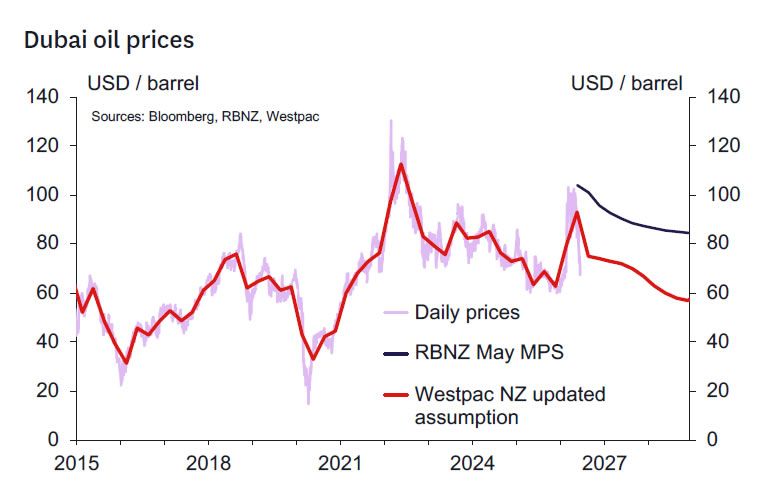
The Iran war has resolved (at least for now) unexpectedly quickly. A $30/bbl decline in oil prices is big news, sufficient to change the medium-term outlook, just as a $30/bbl increase was on the way up. With oil and refined fuels prices now well below the levels assumed in prior forecasts (including the RBNZ's May forecasts), forecasts of peak and end year inflation are being revised lower. For example, Westpac now sees CPI inflation peaking a quarter earlier in the June quarter at 4% and ending 2026 at 3.5%. The risks of prolonged inflation dynamics - such as those that had clearly bothered MPC member Prasanna Gai - taking hold must have a much lower probability now compared to that contemplated back in May. Similarly risks to inflation expectations have reduced.
Importantly, further key information will be available soon. The June quarter CPI (released 21 July) will show how widespread inflation pressures are. The monthly indicators provide little insight but to the extent they do, they have shown less inflation than previously feared. The June quarter QSBO will be available in a week and will similarly provide indicators on businesses' pricing and margins as well as activity indicators. The June quarter labour market reports due early August will shed light on the strength of the labour market and wage pressures. The best measures of inflation expectations are also available in August. This avalanche of relevant data scheduled between the July and September meetings always made a July hike a courageous move. With the sharp decline in energy prices significantly reducing the merit of pre-emptive action we suspect even the hawkish MPC members will now be content to see what this data reveals.
Activity data seemingly confirm a stagnant economy in the June quarter. Most indicators suggest little growth occurred in the June quarter, hence the output gap should have widened. Q1 GDP data was pretty much in line with RBNZ views once revisions are considered (the economy was just 0.1% larger than assumed in the May MPS).
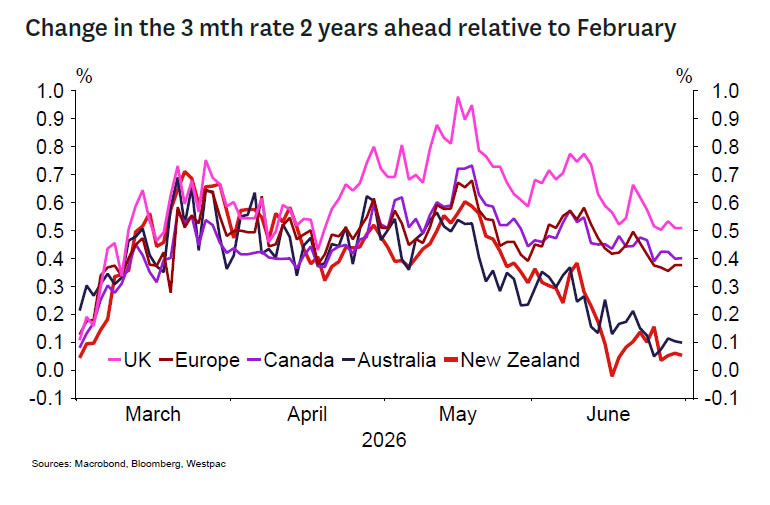
It's also useful to remember that global views on the need for interest rate increases have generally pulled back noticeably (with the key exception of the United States). Market pricing of the expected change in 90-day rates in the coming 2 years has pulled back across most peer economies with the adjustment to Australasian interest rate expectations being greater than for most. We note that the Bank of Canada remains cool on the potential for interest rate increases this year. This is interesting as Canada seems to be the closest comparator to New Zealand in that both countries are operating with a negative output gap and have similar monetary policy frameworks.
Scenarios
More hawkish and dovish possibilities exist including:
- A hawkish scenario where the OCR is increased and language suggesting the RBNZs views haven't shifted much. Markets would rationally assume at least 3, possibly 4 hikes in aggregate for 2026. We see this as implausible and assign a 10% probability to it.
- A dovish scenario that seriously questions a hike before December. The forward guidance could be omitted noting that inflation risks seem much less prominent relative to the still large level of excess capacity. Evidence of strong core inflation and broadening second-round inflation pressures would need to be seen to justify a lift in the OCR, and the statement could note that such evidence is lacking at this stage. The February MPS forecasts could be explicitly referred to as being nearer to the MPC's current frame of reference. This is more plausible and we attach a 30% probability to this scenario.
Kelly's Take
This is an easy decision. While I advocated for an increase in May, there seems much to be gained from waiting to see the outcome of the June quarter CPI. Certainly, the risks of prolonged second-round price impacts are lower than thought earlier given the Iran conflict seems to have resolved much sooner than expected and energy prices have declined far sooner than expected.
Higher interest rates are in prospect in time. But the urgency to begin the process now when such critical evidence is available just around the corner is gone. I suspect a gradual approach of 25bp increases in September and December should prove sufficient for now. The economy will continue to recover through the second half of the year, calling for a return of the OCR to hopefully not much higher than neutral levels (in the high 3s in my view) next year.
I see the risk that the exchange rate will depreciate further over the balance of the year given steep negative interest rate differentials. But if this occurs, this will aid the needed rebalancing of the economy. The market needs to be reminded of the importance of data dependence in determining future OCR adjustments.
Elliott Wave View: GBPJPY Advancing to Finish Five Wave Diagonal
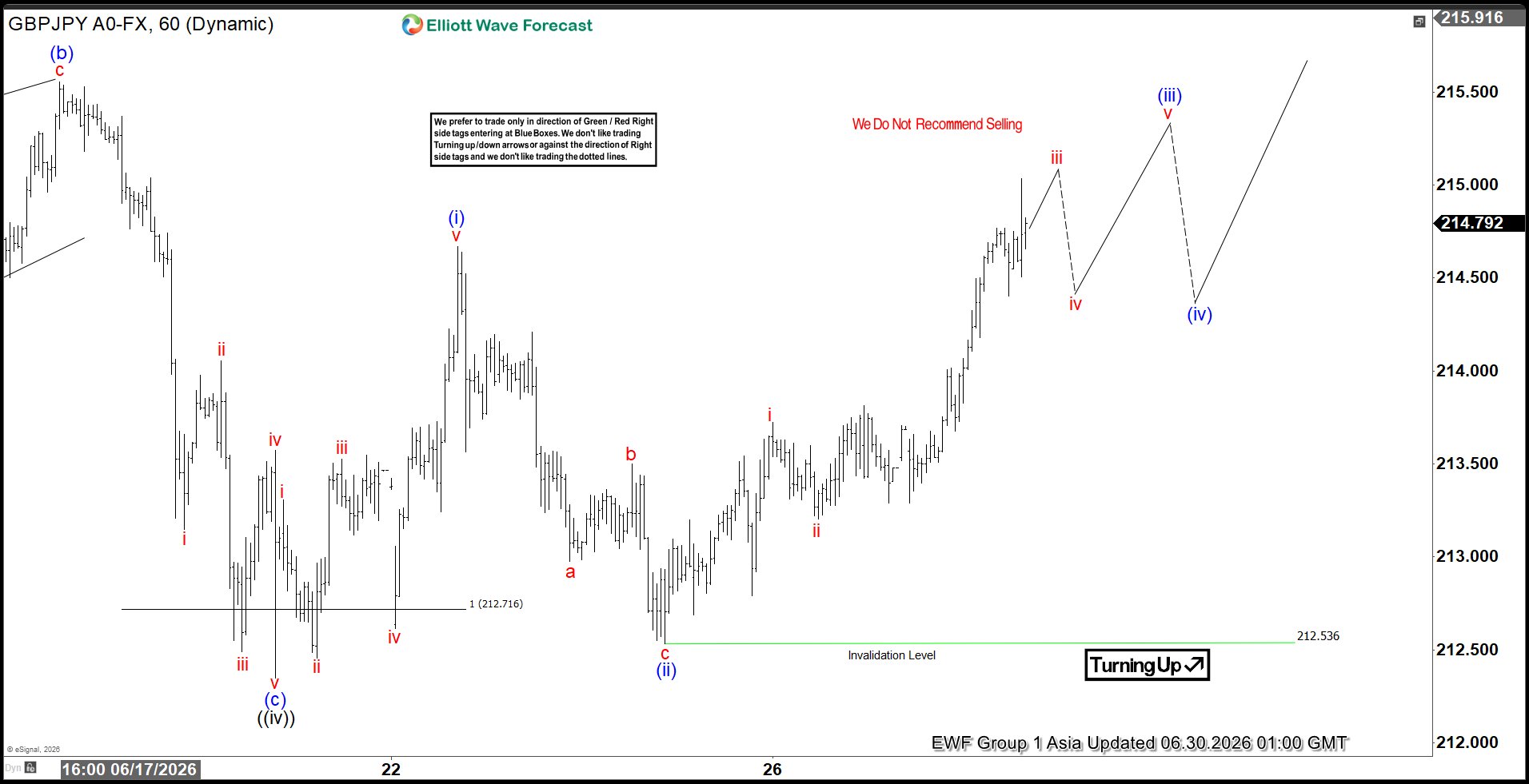
The short‑term Elliott Wave view in GBPJPY shows the cycle from the April 30, 2026 low unfolding as a diagonal. From that low, wave ((i)) ended at 214.05, followed by a corrective pullback in wave ((ii)) that reached 211.18. The pair then advanced in wave ((iii)) toward 215.6. A retracement in wave ((iv)) completed at 212.34, as reflected in the one‑hour chart. This sequence sets the foundation for wave ((v)), which is developing as a five‑wave structure.
From the end of wave ((iv)), wave (i) advanced to 214.67. The subsequent pullback in wave (ii) concluded at 212.53. In the near term, as long as the pivot at 212.53 remains intact, pullbacks should find support in either a three‑swing or seven‑swing corrective sequence. This support is expected to guide the pair higher, completing wave ((v)) of wave 1 at a larger degree.
Once wave 1 finishes, GBPJPY should enter a corrective phase in wave 2. That retracement will correct the cycle from the April 30 low and is likely to unfold in three or seven swings. Such a correction would reset conditions, preparing the market for another rally. The structure emphasizes the importance of the 212.53 pivot. Holding above this level sustains the bullish bias and supports the view that the diagonal pattern is progressing toward completion.
GBPJPY 60-Minute Elliott Wave Chart
GBPJPY Elliott Wave Video:
https://www.youtube.com/watch?v=X7T0fQ9Bodo
AUD/USD Falls Despite Hawkish RBA Minutes as Markets Doubt August Hike
The Australian Dollar barely reacted to the hawkish sets of RBA minutes. Instead, AUD/USD drifted lower in Asian trading, suggesting investors are no longer judging the Reserve Bank by what it says, but by what they believe it can realistically do.
On paper, the minutes kept August very much alive. Policymakers reiterated that monetary policy "needed to remain restrictive" and made clear they were prepared to raise the cash rate again "if necessary." Yet markets had already priced in that rhetoric. What stood out instead was the Board's emphasis on using time to assess how previous tightening is flowing through the economy. Investors interpreted that not as a prelude to another hike, but as confirmation that the RBA is firmly in watch-and-wait mode.
The market's skepticism reflects growing concern about Australia's domestic economy rather than any loss of confidence in the RBA's commitment to fighting inflation. Consumer sentiment remains close to its weakest level in half a century, while the housing market is showing increasingly clear signs of cooling after three rate hikes this year. Those conditions raise the economic cost of further tightening. As a result, many investors view the RBA's tough language as a form of "open-mouth operations"—using hawkish communication to restrain inflation expectations without necessarily intending to follow through with another immediate rate increase.
That leaves the Australian Dollar dependent on developments abroad rather than at home. Thursday's US Non-Farm Payrolls report may prove far more important for AUD/USD than the RBA minutes themselves. A strong payrolls report would reinforce the Dollar's advantage and could push the pair through the key 0.6832 support level. A weaker report, however, could allow AUD/USD to stabilize, although a sustained recovery may still require investors to regain confidence that the RBA is capable—not just willing—to tighten policy again.
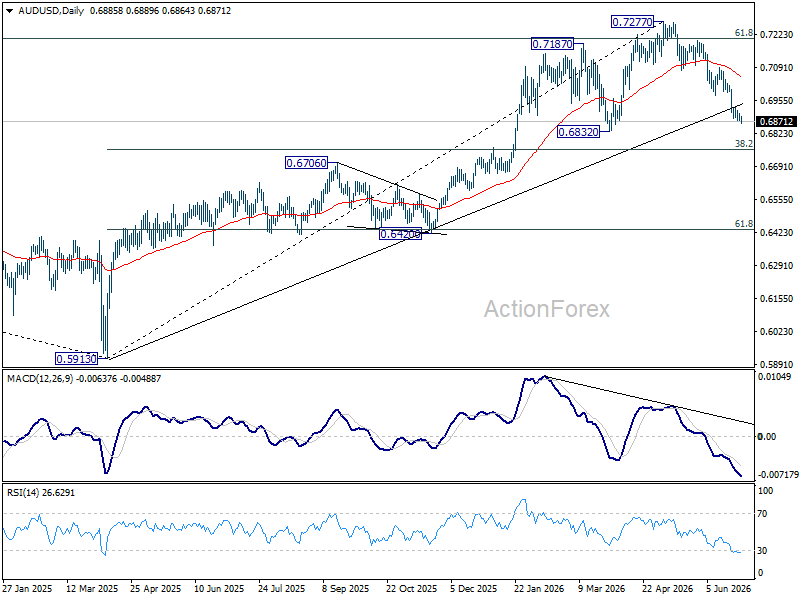
Technically, the decline from the 0.7277 medium-term high remains in progress, with 0.6832 acting as the next major support level. A decisive break there would expose 38.2% retracement of 0.5913 to 0.7277 at 0.6756.
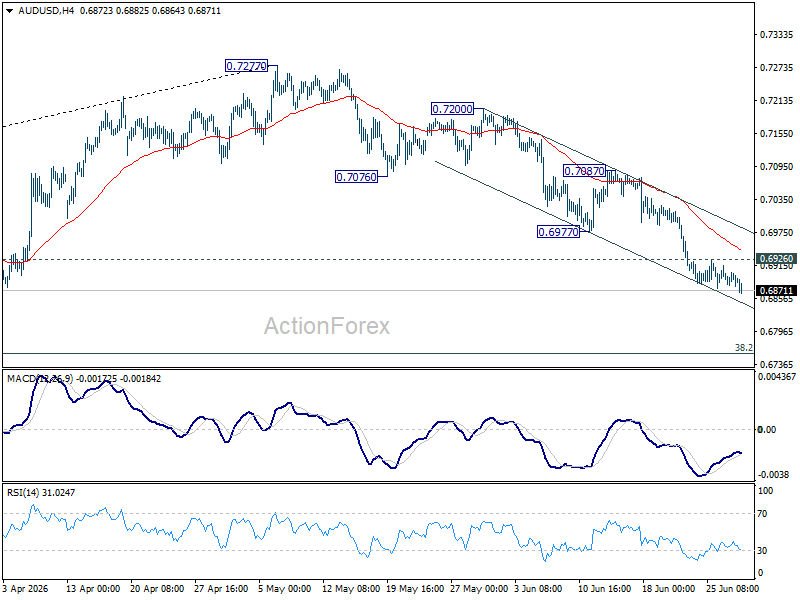
For now, however, the broader pullback is still viewed as a correction within the larger uptrend from the 2024 low at 0.5913, suggesting strong buying interest could emerge around the 0.6756 area. Initial resistance is seen at 0.6926, while 0.6977, a former support level, is expected to cap any recovery.
First Impressions: NZ Business Confidence, June 2026 — Inflation Pressures Easing Ahead of RBNZ Interest Rate Review
Business confidence continues to recover as cost pressures ease. This reinforces our expectations for an on-hold decision from the RBNZ next week.
Key Results, June 2026
- Business confidence: 36.6 (Prev: 10.0)
- Expectations for own activity: 36.9 (Prev: 25.6)
- Activity vs same month one year ago: 9.0 (Prev: 14.8)
- Inflation expectations: 3.36% (Prev: 3.63%)
- Pricing intentions: 50.7 (Prev: 56.7)
Activity Expectations Continuing to Recover
The June business outlook survey pointed to a further decline in the proportion of firms reporting an increase in activity from year-earlier levels. However, encouragingly, confidence in the economic outlook has continued to recover in the latest survey, as have businesses expectations for their own trading activity over the coming year. That improvement comes against the backdrop of easing global tensions and a related sharp fall in oil prices.
The survey's activity gauges, including those for trading activity, hiring and investment spending, all remain noticeably below the levels we saw in February before the Middle East conflict. However, they have retraced much of their recent declines. That's consistent with the economy gradually regaining momentum as we enter the second half of the year.
Pricing Pressures Easing…
Importantly, the survey's various inflation gauges have been dropping back. That includes expectations for inflation over the year ahead which fell from 3.63% in May back to 3.36% this month. We also saw a fall in the number of firms who are planning on raising prices. Firms' forecasts for wage growth remained at subdued levels in June.
…Which Will Help to Assuage the RBNZ's Concerns About the Inflation Outlook Ahead of Next Week's Interest Rate Meeting
All of the survey's inflation measures remain higher than the levels we saw prior to the Middle East conflict, which is consistent with the still high level of domestic fuel prices.
However, the easing in these measures over the past couple of months is still important for the RBNZ. At the time of the RBNZ's last policy meeting, several members of the Monetary Policy Committee voted to keep rates on hold and wanted to see if the rise in fuel costs was going to lead to a more widespread and persistent lift in inflation. With oil prices down sharply and gauges of businesses pricing plans dropping back, the RBNZ is likely to be less concerned about a lift in longer term inflation. As a result, we continue to expect the RBNZ will keep the OCR on hold at next week's interest rate review.
As we noted in our recent forecast update, we still expect the OCR will rise over the coming months, but at a gradual data-dependent pace. We expect 25bp hikes in September and December.
RBA Minutes: Board Chose Patience, Not a Policy Pivot
Minutes of the Reserve Bank of Australia's June meeting showed policymakers opted to leave the cash rate unchanged not because the inflation battle has been won, but because they wanted more time to assess how previous tightening and recent oil supply disruptions are feeding through the economy. The Board unanimously kept the cash rate at 4.35%, describing the decision as the best way to balance its inflation and employment objectives amid heightened uncertainty.
The minutes reiterated that inflation remains the central concern. Members observed that "inflation was still materially above the Board's target" and that staff continued to expect "underlying inflation to increase in the June quarter." They also noted that labour and non-labour cost pressures remained widespread, adding that monetary policy "needed to remain restrictive to unwind current excess demand through a period of below-trend growth." While members acknowledged that Australian financial conditions had become "somewhat restrictive," they judged it was still too early to fully assess the cumulative effects of policy tightening since February.
The Board also devoted considerable attention to developments in the Middle East. Although members acknowledged "the emergence of a potential path to resolution of the conflict," they cautioned that commodity supply constraints would take time to unwind even if peace proves durable. As a result, they concluded the conflict still posed "material upside risks for inflation and downside risks for growth," warning that sustained high oil prices could continue to influence firms' pricing decisions and wage-setting behaviour even after fuel prices moderate.
Looking ahead, the minutes left little doubt that the tightening cycle has not necessarily ended. Members agreed there was merit in "using the space provided by the Board's earlier decisions" to assess how the economy adjusts, but they also reaffirmed the Board would "do what it considers necessary to achieve" price stability and full employment, "including increasing the cash rate target if necessary." The minutes therefore reinforce the view that the June pause represented patience rather than a policy pivot, with incoming data likely to determine whether another rate increase becomes necessary in the months ahead.
Bitcoin Looks Vulnerable as Downside Risks Continue to Mount
Key Highlights
- Bitcoin extended losses below $60,000 before it found some support.
- BTC/USD could be following a bearish flag with resistance at $61,500 on the 4-hour chart.
- Ethereum settled well below $1,650 with a bearish angle.
- XRP tested the $1.00 support and shows signs of consolidation.
Bitcoin Price Technical Analysis
Bitcoin price extended losses and traded below $60,000 against the US Dollar. BTC tested the $58,000 zone and recently started a minor recovery wave.
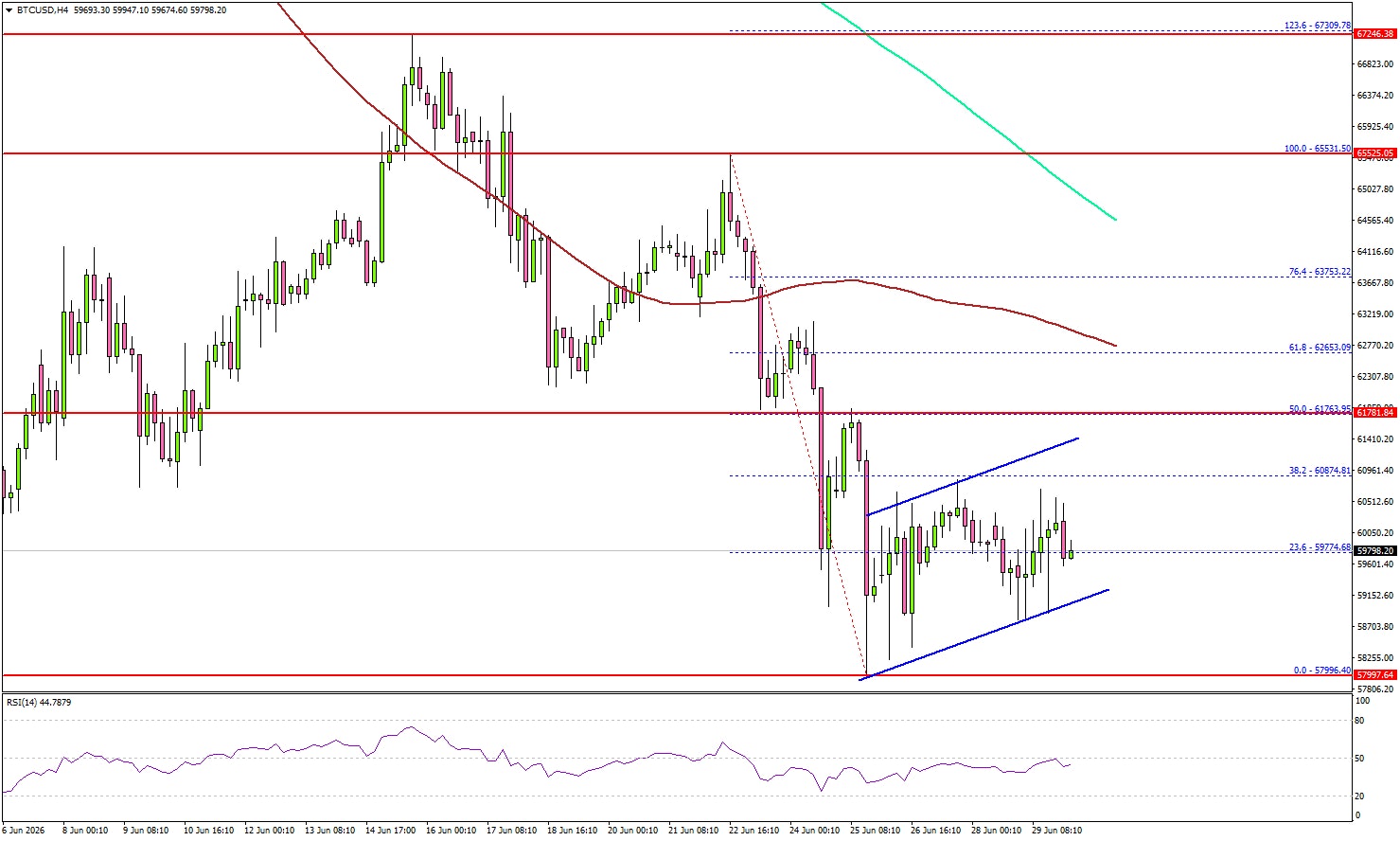
Looking at the 4-hour chart, the price settled well below $62,000, the 100 simple moving average (red, 4-hour), and the 200 simple moving average (green, 4-hour). The price started a minor recovery wave above the 23.6% Fib retracement level of the downward move from the $65,531 swing high to the $57,996 low.
However, the bears might remain active below the $62,000 pivot level. On the upside, an immediate resistance could be $60,850. The first major resistance might be $61,500.
There is also a bearish flag forming with resistance at $61,500. The main resistance sits near $62,000 and the 50% Fib retracement level. A close above $62,000 could send the price toward $62,800. Any more gain might call for a test of $65,000.
If there is a fresh decline, immediate support might be $59,000. The first key support could be $58,200. The main breakdown support could be $58,000. A downside break below $58,000 might start another decline. The next major support might be $56,500, below which BTC could decline toward $55,000.
Looking at Ethereum, the price started a consolidation phase and could face many hurdles near $1,620 and $1,650.
Today’s Key Economic Releases
- US Housing Price Index for April 2026 (MoM) - Forecast +0.1%, versus +0.1% previous.
- Chicago Purchasing Manager’s Index for June 2026 – Forecast 60.0, versus 62.7 previous.
(RBA) Minutes of the Monetary Policy Meeting of the Reserve Bank Board
Sydney – 15 and 16 June 2026
Members present
Michele Bullock (Governor and Chair), Andrew Hauser (Deputy Governor and Deputy Chair), Marnie Baker AM, Renée Fry-McKibbin, Ian Harper AO, Carolyn Hewson AO, Bruce Preston, Iain Ross AO, Jenny Wilkinson PSM
Others present
Sarah Hunter (Assistant Governor, Economic), Christopher Kent (Assistant Governor, Financial Markets)
Anthony Dickman (Secretary), David Norman (Deputy Secretary)
Meredith Beechey Osterholm (Head, Monetary Policy Strategy), David Jacobs (Head, Domestic Markets Department), Michael Plumb (Head, Economic Analysis Department), Michelle Wright (Deputy Head, Communications Department)
Financial conditions
Members observed that financial conditions abroad had eased somewhat since the previous meeting, in response to progress towards resolving the conflict in the Middle East. Expectations for central bank policy rates had generally declined, oil prices had fallen significantly and equity prices had risen in many countries. Members acknowledged the indications of a potential resolution of the conflict but noted the ongoing uncertainty over the final outcome and the implications for energy markets.
Even after the recent easing in financial conditions, policy interest rate expectations across many advanced economies remained higher than before the start of the conflict in the Middle East. Members noted that the European Central Bank and Norges Bank had both raised interest rates to contain the second-round effects of higher oil prices and address broader concerns about above-target inflation. The US Federal Reserve and Bank of England – both of which had been expected by financial market participants before the conflict to have lowered their policy rates by now – had decided to maintain their policy rates. Financial market participants expected both to lift these rates later in 2026. More generally, financial markets continued to expect that many advanced economy central banks would tighten monetary policy before the end of 2026 in response to above-target inflation and concerns about the inflationary effects of the conflict.
Bond yields in many advanced economies, including Australia, had unwound some of their earlier increase since the previous meeting. These falls were in response to both lower oil prices and the flow of economic data. However, yields had risen in the United States and Japan, reflecting stronger economic data. Short-term inflation compensation measures had generally eased but remained higher than before the onset of the conflict in the Middle East. Longer term market expectations for inflation had remained generally stable and consistent with central banks’ targets.
The Australian dollar had depreciated a little since the previous meeting, in line with a decline in yield differentials (particularly against the United States) and a modest fall in commodity prices. The trade-weighted exchange rate nevertheless had remained comparable to its level at the onset of the conflict and broadly consistent with its estimated long-run equilibrium level.
Equity prices had risen in most advanced economies and spreads on corporate bonds had remained tight. These outcomes had been supported by strong earnings expectations, most notably in the United States. In contrast, Australian equity prices had remained flat, as they had been for some time, reflecting only modest upward revisions to the outlook for company earnings. Members noted that this was likely to reflect a range of factors, including limited productivity growth, recent increases in the cash rate target, the expected impact of announced tax changes on bank lending and the more limited participation by Australian companies in the artificial intelligence (AI) boom compared with companies in some other countries.
In China, the household and property sectors both remained weak, which was weighing on household borrowing. The authorities’ economic strategy appeared to be prioritising strategic sectors, including AI, rather than providing additional support to domestic activity more broadly.
Turning to Australia, members noted that financial conditions had tightened since the start of the year following three increases in the cash rate target. However, financial market participants’ expectations for the future path of monetary policy had eased noticeably since May in response to lower global oil prices and weaker-than-expected data for both the labour market and headline inflation in Australia in April.
Members agreed that financial conditions were now probably somewhat restrictive. They discussed updates made by the staff to some models of the neutral rate, noting that these did not materially alter their assessment of financial conditions. The cash rate target sat at around the top of the range of these model estimates, and above the range of market economists’ estimates of the neutral rate. Members observed that estimates of the real neutral rate had risen over preceding years – consistent with a global trend, which probably reflected factors such as increased investment in the energy transition, defence and, more recently, data centres – and were a little higher than when the cash rate target was previously at its current level. Members nevertheless emphasised that assessments of the neutral rate are inherently uncertain and do not provide a direct guide for monetary policy.
Members continued their assessment of the tightness of financial conditions by considering evidence from a broader range of indicators. These generally showed that the tightening in monetary policy was starting to be transmitted to the economy through various channels. Conditions in the established housing market had softened and housing credit growth looked set to slow in the period ahead. This reflected the pass-through of monetary policy tightening and, more recently, tax changes for housing investors announced in the Australian Government budget. Business debt growth had remained relatively strong over prior months, some of which reflected syndicated lending for the construction of data centres.
Banks had passed the higher cash rate through to lending and deposit rates, and scheduled mortgage payments had risen. Compared with household disposable incomes, scheduled mortgage payments were a little lower than the previous episode when the cash rate was at current levels, reflecting the fact that growth in income had outpaced growth in credit in the intervening period. Members discussed how to assess the net impact on the economy of monetary policy easing in 2025 and tightening in 2026, noting the lags in the effect of monetary policy.
Members noted that the cash rate target was widely expected by market participants to remain on hold at the present meeting. Market pricing at the time implied a 50 per cent chance of a further 25 basis points increase in the cash rate by the end of 2026, having priced in about 40 basis points of increase immediately after the May meeting. Some market economists expected the cash rate to be increased again in 2026 because of ongoing inflationary pressures from both domestic and international factors. Others expected monetary policy to remain on hold in 2026 and then to be eased from around mid-2027, given restrictive financial conditions currently, signs of a slowing in aggregate demand and an anticipated decline in inflation.
Economic conditions
Members observed that the latest domestic data for the March quarter had confirmed that capacity pressures remained elevated in that period, albeit at a slightly lower level than previously assessed, and inflation was still above target. Indicators of economic activity since March had been mixed but appeared to show the economy easing broadly as expected.
Members discussed the March quarter national accounts. As expected, GDP had increased by 2.5 per cent over the year to the March quarter. Underlying momentum in household consumption had started to ease before the onset of the conflict in the Middle East, and public demand growth had been weaker than anticipated in the quarter. However, private business investment had been much stronger than expected, largely driven by investment in data centres. Members discussed the broader implications of the strength in investment in data centres, noting that such spending can be difficult to forecast and that in the United States it had repeatedly surprised analysts. Members noted that, while much investment in data centre requires imported components, it also requires some domestic inputs. They discussed the potential for continued strength in such activity to exacerbate capacity pressures and skills shortages in other parts of the economy.
Members noted that the national accounts had revealed further weakness in economy-wide productivity growth. They discussed both the associated measurement challenges and the broader implications for the supply side of the economy. Regarding wages, members noted that growth in the Wage Price Index had been in line with expectations. Measures of average earnings from the national accounts had been a little softer than anticipated, but weak productivity growth meant that growth in unit labour costs remained above its average over the inflation-targeting period.
Members turned to developments in the global economy. The recent announcement of an interim peace agreement between the United States and Iran was a welcome development but this was only the first stage of resolving the conflict in the Middle East. The associated decline in global energy prices had left the oil price futures curve broadly in line with the May baseline forecast assumptions. Members noted that inventory drawdowns and increased supply from elsewhere had continued to buffer the impact of energy supply disruptions in the Middle East on global energy markets. Domestic retail fuel prices had been a little lower than expected, though some of the recent decline would be reversed if the temporary fuel excise reduction expired on 30 June as currently legislated. Members noted that, even if a lasting agreement to end the conflict were reached, it would take some time for global production and distribution of oil and affected commodities to return to more typical levels.
Growth in Australia’s major trading partners had been resilient and broadly as expected, supported by AI-related spending. In China, exports had been resilient but growth in domestic activity had slowed in April. Higher energy prices had pushed headline inflation up in most countries in April. Although the extent of the increase varied, in part because of differing policy responses, inflation was above central bank targets in around two-thirds of countries. Producer prices had generally increased by more than consumer prices, and surveys suggested some margin pressures for firms. Core consumer price inflation in most countries had been little changed but was expected to increase in coming months as cost pressures are passed through.
Returning to the domestic economy, members noted that timely data had been somewhat mixed but broadly consistent with the May baseline forecasts, which incorporated a slowing in demand growth this year.
Underlying CPI inflation in April had been consistent with the staff’s earlier expectation for the June quarter. Within that total, market services, rent and durable goods price inflation were all broadly in line with expectations, groceries inflation was lower, and new dwellings price inflation was considerably higher as firms passed on some of the cost impost of higher oil prices. By contrast, headline inflation had been weaker than expected by market economists, reflecting weakness in international travel prices and a larger-than-expected decline in fuel prices. Business surveys and liaison pointed to elevated and broad-based cost pressures, and there were signs that some firms were passing these on to higher prices of their goods and services. Members noted that short-term inflation expectations had increased in prior months, notwithstanding a small decrease in the weeks preceding the meeting; this increase had been larger than would be expected from their past relationship with inflation and fuel prices. Longer term measures had remained consistent with achieving the inflation target, although unions’ long-term inflation expectations were an exception, having picked up sharply in May, as they had in 2022.
Members discussed the labour market data for April. Some key indicators had been weaker than expected (most notably the unemployment rate and total employment), while others (such as total hours worked and the underemployment rate) pointed to more resilient labour market conditions. Leading indicators, such as job ads, suggested labour demand had been broadly stable. On balance, the staff assessed that labour market conditions were a little weaker than had been expected in May but cautioned against reading too much into monthly data outcomes, which can be volatile. Members also discussed the Fair Work Commission’s announced increase in all modern award wages from 1 July. Although the outcome was moderately higher than had been assumed in the staff’s May forecasts, members noted that the increase applied to the lowest wage earners. Views differed on the extent to which the outcome might indirectly influence other wage negotiations, but members agreed that this would depend in part on the tightness of the labour market and expectations for inflation.
Members concluded their discussion of domestic economic conditions by considering the momentum in activity. Despite consumer sentiment remaining very low, household spending growth had not softened materially; members noted that, historically, the relationship between these two variables was quite weak and typically close to contemporaneous, suggesting that weak consumer sentiment does not necessarily signal future weakness in consumption. Likewise, business confidence had been weak but surveyed business conditions and capacity utilisation had declined only modestly and investment intentions had been revised a little higher. Recent federal and state budgets had not significantly altered the staff’s outlook for public demand. However, members noted that conditions in the housing market had eased by more than expected, reflecting the recent increases in the cash rate, tax changes announced in the Australian Government budget and the broader economic environment.
Considerations for monetary policy
Turning to considerations for the monetary policy decision, members noted that information received since the previous meeting had supported the view that the economy was operating with excess demand and widespread inflationary pressures. Inflation was still materially above the Board’s target and the staff’s expectation remained for underlying inflation to increase in the June quarter. Labour and non-labour cost pressures remained widespread. Consumer and business sentiment remained very weak but members agreed that the overall data on activity implied that economic growth was easing broadly as expected.
Members acknowledged the emergence of a potential path to resolution of the conflict in the Middle East but observed that this was still at an early stage. Global oil prices had eased in prior weeks but remained higher than before the onset of the conflict. Members agreed that even if the resolution proves enduring, global commodity supply constraints would take some time to resolve.
Members judged that Australian financial conditions were now somewhat restrictive, although this remained uncertain. It would take some time to assess the ultimate impact on the economy of the tightening in monetary policy since February but, at this stage, it appeared to be having broadly the expected effect. Housing demand had eased, which also reflected the broader economic environment and recently proposed tax changes.
In light of these observations, members agreed that leaving the cash rate target unchanged at this meeting would best balance the Board’s inflation and employment objectives. Inflation remained materially above the Board’s target, and members noted that the staff’s May forecasts (which were based on available data and conditioned on market expectations for interest rates at that time) envisaged that it would be a further two years before inflation returned sustainably to target. Against that backdrop, members agreed that monetary policy needed to remain restrictive to unwind current excess demand through a period of below-trend growth. While the most recent data and forward-looking indicators suggested somewhat mixed signals about how quickly momentum in economic activity was slowing, members judged the easing in growth to be broadly in line with earlier expectations.
Members agreed that leaving the cash rate target unchanged was appropriate given the ongoing uncertainty related to developments in the Middle East. They noted that, if the emerging path to resolution of the conflict proves enduring, it could reduce the extent to which firms pass on higher costs to consumer prices. However, they acknowledged that, even in that case, it was still likely that underlying inflation would increase to some extent in response to recent fuel supply disruptions.
Taking these considerations together, members judged that there was merit in using the space provided by the Board’s earlier decisions to raise the cash rate target to assess how the economy was adjusting and the impact of disruptions to oil supply.
After deciding to keep the cash rate target unchanged at this meeting, members discussed the main risks that could have a bearing on future decisions.
One set of risks related to developments in the Middle East. Members noted that there were still credible scenarios for the evolution of the conflict that could result in higher inflation and lower activity than in the May baseline forecasts. Members noted the potential for sustained high oil prices to feed through more fully into price- and wage-setting behaviour, even if fuel prices subsequently abate. Moreover, they agreed that it would take considerable time to restore oil supply to its pre-conflict level, even if the current resolution proves enduring, and noted that demand for oil could be buoyed for a time if countries seek to rebuild their inventories. These considerations led members to assess that the Middle East conflict still posed material upside risks for inflation and downside risks for growth.
A second set of risks discussed by members was domestically focused. Members noted the implications of persistently weak productivity growth for the economy’s supply capacity and sustainable growth rate. While members expressed somewhat differing views about the extent of current capacity pressures, they agreed that persistently weaker-than-expected productivity growth could impede progress on returning inflation to target. Members also noted the risks associated with a potentially material weakening in housing markets, including if this were to inhibit growth in consumption.
In finalising its statement, the Board agreed to remain attentive to the data and the evolving assessment of the outlook and risks when making its decisions. The Board will remain focused on its mandate to deliver price stability and full employment and will do what it considers necessary to achieve that outcome, including increasing the cash rate target if necessary.
The decision
The Board decided unanimously to leave the cash rate target unchanged at 4.35 per cent.
Framework for additional monetary policy tools
Following discussion and in-principle approval of the framework for additional monetary policy tools at the previous meeting, and subsequent feedback from the RBA’s Governance Board, the Board approved the final version of the framework. Members noted that the Governance Board had viewed the governance and risk elements of the framework as appropriate, while emphasising that the framework and any future advice to use specific tools should clearly identify the materiality of the use of that tool’s potential impact on the RBA’s balance sheet.
Members approved the framework and agreed to it being published alongside a speech by the Assistant Governor (Financial Markets) at the end of June. They noted that future work would focus on further developing aspects related to risk management and operational readiness.
China PMIs Edge Higher as Export Demand Offsets Weak Domestic Recovery
China's manufacturing activity expanded at a slightly faster pace in June, with official data pointing to a modest improvement in both factory and services sectors. The NBS PMI Manufacturing rose from 50.0 to 50.3, slightly above expectations of 50.2, while the Non-Manufacturing PMI edged up from 50.1 to 50.2, beating forecasts of 49.9. The Composite PMI also improved from 50.5 to 50.6, indicating the economy continued to expand at a moderate pace.
The improvement in manufacturing was supported primarily by resilient export demand, as overseas buyers accelerated orders amid uncertainty surrounding the Middle East conflict and the earlier surge in oil prices. However, that tailwind may prove temporary. With the US and Iran reaching a peace agreement and oil prices retreating to pre-conflict levels, the urgency to front-load imports is likely to diminish, potentially reducing external support for Chinese manufacturers in the coming months.
Separate industrial profit data released over the weekend underscored the uneven nature of China's recovery. Profits continued to grow strongly in upstream industries, as well as sectors linked to artificial intelligence and renewable energy, while downstream manufacturers remained under pressure from subdued domestic demand. Together, the latest data suggest exports continue to underpin growth, but a broader and more durable recovery will likely require a stronger improvement in household consumption and domestic spending.
| Indicator | Previous | Latest | Consensus |
|---|---|---|---|
| NBS PMI Manufacturing | 50.0 | 50.3 | 50.2 |
| NBS PMI Non-Manufacturing | 50.1 | 50.2 | 49.9 |
| NBS PMI Composite | 50.5 | 50.6 | — |