Sample Category Title

Trade Idea Update: GBP/USD – Sell at 1.3500

GBP/USD - 1.3400

Original strategy :

Sell at 1.3500, Target: 1.3380, Stop: 1.3535

Position : -

Target :  -

Stop : -

New strategy  :

Sell at 1.3500, Target: 1.3380, Stop: 1.3535

Position : -

Target :  -

Stop : -

As cable has rebounded after falling to 1.3364 earlier today, suggesting minor consolidation above this level would be seen and corrective bounce to 1.3455-60 cannot be ruled out, however, reckon upside would be limited to 1.3500 and bring another decline later, below said support at 1.3364 would extend recent decline from 1.3658 top to 1.3345-50 (61.8% Fibonacci retracement of 1.3153-1.3658) and possibly towards previous resistance at 1.3329. 

In view of this, would not chase this fall here and would be prudent to sell cable on further recovery as 1.3500 should hold. Above resistance at 1.3514 would defer and risk a stronger rebound to 1.3535-40 but resistance at 1.3571 should remain intact.

Trade Idea Update: EUR/USD – Sell at 1.1810

EUR/USD - 1.1725

Original strategy  :

Sell at 1.1830, Target: 1.1720, Stop: 1.1865

Position : -

Target :  -

Stop : -

New strategy  :

Sell at 1.1830, Target: 1.1720, Stop: 1.1865

Position : -

Target :  -

Stop : -

As the single currency has fallen again after brief recovery to 1.1811, adding credence to our bearish view that the decline from .2093 top is still in progress and downside bias remains for further weakness to 1.1720 (1.236 times projection of 1.2093-1.1838 measuring from 1.2035), then 1.1700, however, loss of downward momentum should prevent sharp fall below previous support at 1.1662 and bring rebound later.

In view of this, we are looking to sell euro on recovery, above the Kijun-Sen (now at 1.1765) would bring recovery to said resistance at 1.1811, however, previous support at 1.1832-38 (now resistance) should hold and bring another decline later. Above resistance at 1.1862 would abort and signal low is formed instead, bring a stronger rebound to 1.1896 (another previous support). 

USD/JPY Mid-Day Outlook

Daily Pivots: (S1) 111.65; (P) 112.06; (R1) 112.63; More...

USD/JPY's rise from 107.31 resumes by taking out 112.71 resistance and hits as high as 113.22 so far. Intraday bias is back on the upside for 114.49 resistance next. The break of medium term channel resistance argues that correction from 118.65 is already completed with three waves down to 107.31. Break of 114.49 will confirm this bullish case and target a test on 118.65 next. On the downside, break of 111.46 support is needed to indicate short term topping. Otherwise, near term outlook will remain cautiously bullish in case of retreat.

In the bigger picture, rise from 98.97 (2016 low) is seen as the second leg of the corrective pattern from 125.85 (2015 high). It's unclear whether this this second leg has completed at 118.65 or not. But medium term outlook will be mildly bearish as long as 114.49 resistance holds. And, there is prospect of breaking 98.97 ahead. Meanwhile, break of 114.49 will bring retest of 125.85 high. But even in that case, we don't expect a break there on first attempt.

Dollar Rally Extends after Strong Durable Goods Orders, Look into Trump’s Tax Plan Now

Dollar's rally extends in early US session after solid economic data. Headline durable goods orders rose 1.7% in August, versus consensus of 1.0%. Ex-transport orders rose 0.2%, in line with expectation. Dollar traders are keenly looking forward to US President Donald Trump's announcement of tax reform (or just tax cuts?). It's reported that corporate tax rate would be brought down from 35% to 20% level. Top individual income tax rate will also brought down from 39.6% to 35%. Trump is scheduled to deliver a speech in Indianapolis later in the afternoon to promote his plan.

The greenback is also supported by Fed Chair Janet Yellen's speech yesterday. In short, while there are concerns over inflation, Yellen still expect Fed to continue with gradual adjustments in the stance of monetary policy. And she also warned that adjustments in the stance of monetary policy, inflation will rise and stabilize at around 2 percent over the medium term." And, "without further modest increases in the federal funds rate over time, there is a risk that the labor market could eventually become overheated, potentially creating an inflationary problem down the road that might be difficult to overcome without triggering a recession." Hence, "we should be wary of moving too gradually."

German Merkel facing difficulties in forming coalition

It's a know that German Chancellor Angela Merkel is having much difficulty in forming a coalition government after the election. The business-friendly FDP is the highly likely partner. Its leader Christian Lindner warned Merkel that "politics is not mathematics", and issues like immigration could derail an agreement of Merkel's CDU/CSU, FDP and Greens. CDU's sister party CSU is pushing for an annual cap of 200k migrant arrivals, but Merkel objects to a limit. FDP is asking for a Canadian like point based system but Greens will insist on family reunions. And if

The relationship with France and position on Euro reforms is also a key factors to consider. French President Emmanuel Macron delivered a high profile speech yesterday, outlining his visions for tighter integration of EU. But Macron has already drew mixed reactions from Germany. CDU's Eckhardt Rehberg poured cold water to Macron and said "the problem in Europe is not a lack of money". And EU already has enough instruments to boost investments. Ifo head Clemens Fuest also criticized that Macron's plans for the Eurozone are "wrong". A common finance minister won't or a joint budget won't solve the problems. Fuest said it's " more important to ensure more stability in the financial sector and to reconcile liability and control in economic and financial policy."

Released from Europe, Eurozone M3 rose 5.0% yoy in August. Swiss UBS consumption indicator rose to 1.53 in August. UK CBI realized sales rose to 42 in September.

RBNZ to stand pat

RBNZ rate decision in a major focus in the upcoming Asian session. There is little chance for a move considering firstly, a new acting Governor Grant Spencer is in place. There are much political uncertainties after the general election last weekend. The central bank is widely expected to stand pat and keep the OCR unchanged at 1.75%. And, RBZN will likely also reiterate the concerns over the exchange rate. Technically, NZD/USD's decline accelerates this week on the back of Kiwi weakness and Dollar strength. The development suggests that fall from 0.7557 is not completed yet. Further downside should be seen to 0.7130 first, and then 100% projection of 0.7557 to 0.7130 from 0.7432 at 0.7005 in near term.

USD/JPY Mid-Day Outlook

Daily Pivots: (S1) 111.65; (P) 112.06; (R1) 112.63; More...

USD/JPY's rise from 107.31 resumes by taking out 112.71 resistance and hits as high as 113.22 so far. Intraday bias is back on the upside for 114.49 resistance next. The break of medium term channel resistance argues that correction from 118.65 is already completed with three waves down to 107.31. Break of 114.49 will confirm this bullish case and target a test on 118.65 next. On the downside, break of 111.46 support is needed to indicate short term topping. Otherwise, near term outlook will remain cautiously bullish in case of retreat.

In the bigger picture, rise from 98.97 (2016 low) is seen as the second leg of the corrective pattern from 125.85 (2015 high). It's unclear whether this this second leg has completed at 118.65 or not. But medium term outlook will be mildly bearish as long as 114.49 resistance holds. And, there is prospect of breaking 98.97 ahead. Meanwhile, break of 114.49 will bring retest of 125.85 high. But even in that case, we don't expect a break there on first attempt.

Economic Indicators Update

GMT Ccy Events Actual Forecast Previous Revised
06:00 CHF UBS Consumption Indicator Aug 1.53 1.38 1.46
08:00 EUR Eurozone M3 Y/Y Aug 5.00% 4.70% 4.50%
10:00 GBP CBI Realized Sales Sep 42 8 -10
12:30 USD Durable Goods Orders Aug P 1.70% 1.00% -6.80%
12:30 USD Durables Ex Transportation Aug P 0.20% 0.20% 0.60%
14:00 USD Pending Home Sales M/M Aug -0.50% -0.80%
14:30 USD Crude Oil Inventories 4.6M
20:00 NZD RBNZ Rate Decision 1.75% 1.75%

Trade Idea Update: USD/JPY – Buy at 112.65

USD/JPY - 113.21

Original strategy  :

Buy at 112.50, Target: 113.50, Stop: 112.15

Position :  -

Target :  -

Stop : -

New strategy  :

Buy at 112.65, Target: 113.65, Stop: 112.30

Position :  -

Target :  -

Stop : -

As the greenback has surged again and broke above previous resistance at 112.72, confirming recent upmove has resumed and upside bias remains for further gain to 113.25-30 (1.236 times projection of 107.32-111.04 measuring from 109.55) and then towards previous resistance at 113.58, however, near term overbought condition should prevent sharp move beyond 113.75-80 and reckon 114.00-10 would hold from here, risk from there has increased for a retreat later.

In view of this, we are looking to reinstate long on pullback as previous resistance at 112.53 should limit downside. Below 112.25-30 would defer and suggest an intra-day top is formed, brig correction towards the lower Kumo (now at 111.80) which is likely to hold on first testing. 

EUR/CAD Elliott Wave Analysis

EUR/CAD – 1.4555


Although the single currency rebounded earlier this month after finding support at 1.4441, as indicated resistance at 1.4765 capped euro’s upside and the pair has retreated again, retaining our bearishness and consolidation with downside bias remains for another fall towards said support at 1.4441, break there would confirm recent decline from 1.5259 has resumed and extend weakness to 1.4400 and possibly towards 1.4345-50 (61.8% Fibonacci retracement of 1.3784-1.5259), however, reckon downside would be limited to 1.4290-95 (100% projection of 1.5259-1.4478 measuring from 1.5076) and 1.4190-00 should hold, price should stay above 1.4110-15 (1.236 times projection), bring rebound later due to near term oversold condition.  


Our latest preferred count is that larger degree wave [C] from 1.3289 as well as circle wave B ended at 1.7509 in Dec 2008 with (A): 1.6325, (B): 1.4719 followed by wave (C) at 1.7509, hence circle wave C is unfolding with wave 1 ended at 1.5186 (diagonal wave 1), wave 2 at 1.6096, impulsive wave 3 has ended at 1.2451, followed by wave 4 at 1.4380, in view of recent strong rebound, we are now treating the wave 5 as well as larger degree circle wave C has ended at 1.2129, hence (A)-(B)-(C) correction has commenced from there with impulsive wave (C) now unfolding and indicated initial upside target at 1.6000 had been met and reckon 1.6500 would hold.


On the upside, whilst initial recovery to 1.4600-10 cannot be ruled out, reckon upside would be limited and as long as said resistance at 1.4765 holds, bearishness remains for another decline later. Above 1.4765 would risk rebound to resistance at 1.4810-15 but only break there would signal low is formed instead, bring further gain too 1.4900, having said that, price should falter below 1.5000 and bring another decline later. 


Recommendation: Hold short entered at 1.4665 for 1.4465 with stop above 1.4765.

On the bigger picture, our long-term count on the monthly chart is that a big sideways consolidation from 2000 low of 1.2557 has possibly ended at 1.7509 as circle wave B with [A]: 1.6976 ( (A): 1.4513, (B): 1.2612, (C): 1.6976), wave [B]: 1.3289 is a double three with 1st a-b-c: 1.5384, x: 1.6709 and 2nd a-b-c: 1.3289. As indicated above, the wave [C] has ended at 1.7509. The selloff from there is now unfolding which itself should be labeled as an impulsive wave with wave 1: 1.5186 (diagonal wave 1), followed by wave 2: 1.6096 and wave 3: 1.2451, wave 4: 1.4380, wave 5 as well as larger degree circle wave C has possibly ended at 1.2129 and major correction has possibly commenced for retracement of recent decline towards 1.4000, then 1.4180-90 (38.2% Fibonacci retracement of 1.7509-1.2129). Below said support at 1.2129 would risk weakness to psychological support at 1.2000 and then 1.1851 (50% projection of 1.7509-1.2451 measuring from 1.4380) but reckon 1.1500 would remain intact, bring reversal later.


AUD/USD Elliott Wave Analysis

AUD/USD     –  0.7857


Although aussie staged a strong rebound last week to 0.8103 (we recommended to sell at 0.8070 and a short position was entered), renewed selling interest did emerge there and the pair has slipped again in line with our bearish expectation, retaining our view that top has been formed at 0.8125 earlier and our indicated downside target at 0.7870 was met (with 200 points profit) as price fell to as low as 0.7836 today, this anticipated decline adds credence to our view that top has been formed at 0.8125 and mild downside bias remains for this fall from there to bring retracement of recent rise to 0.7808, break there would extend weakness to 0.7740-50 and possibly towards previous resistance at 0.7712 but reckon downside would be limited to 0.7640-50, bring rebound later.

We are keeping our count that top has been formed at 1.1081 (wave 5 of V) and major correction (A-B-C-X-A-B-C) has commenced, indicated downside targets at 0.7945 (61.8% Fibonacci retracement of entire rise from 0.6007-1.1081) and 0.7750 had been met and downside bias is seen for further weakness to 0.6800, then 0.6700 but reckon 0.6500 would hold from here.


Our preferred count is that the rally from 0.6007 to 0.7270 (7 Jan 2009) is marked as wave A, the retreat to 0.6248 (2 Feb 2009) is wave B and the subsequent upmove is labeled as wave C with wave (iii) and wave (iv) ended at 0.8265 and 0.7700 respectively and wave (v) as well as 3 ended at 0.9407, then wave 4 ended at 0.8066 (instead of 0.8578). The wave 5 has met our indicated projection target of 1.1060 and could ended at 1.1081, this level is now treated as the peak of wave (C) as well as larger degree wave B, hence major fall in wave C has commenced, our initial downside target at psychological support at 0.7000 has just been met and further weakness to 0.6500 would be seen later.


On the upside, whilst initial recovery to 0.7900 cannot be ruled out, reckon upside would be limited to 0.7930-40 and bring another decline later to aforesaid downside targets. Above 0.8020 would defer and suggest first leg of decline from 0.8125 top has ended instead, risk a stronger rebound to 0.8080 but said resistance at 0.8103 should hold. Only a break of this last week’s high would signal correction from 0.8125 has ended, bring retest of this level, break there would extend recent upmove to previous resistance at 0.8163, then 0.8200 but 0.8260-65 (61.8% projection of 0.7329-0.8066 measuring from 0.7808) should hold.

Recommendation: Short entered at 0.8070 met target at 0.7870 with 200 points profit and would sell again at 0.7925 for 0.7725 with stop above 0.8025.


Our alternate count on the daily chart treated the top formed in 2008 at 0.9851 could be a larger degree wave I and was followed by a deep and sharp correction in wave II to 0.6007 and wave III is unfolding from there.

The long-term uptrend started from 0.4775 (2 Apr 2001) with an impulsive structure. Wave I is labeled as 0.4775 to 0.9851 (15 Jul 2008), wave II has ended at 0.6007 (Oct 2008) and wave III is still in progress which may extend further gain to 1.1265.

CAC Edges Higher as German Election Fallout Subsides

The CAC index has posted slight gains in Wednesday trade. Currently, the index is at 5,279.30, up 0.20% on the day. There are no major eurozone events on the schedule.

German industrial giant Siemens AG announced on Tuesday that it would merge rail operations with Alstom SA, a French train manufacturer. The merger is aimed as a response to growing competition in the rail transport sector, particularly from the Chinese state-owned railroad, CRRC. The merger still needs to be approved by regulators, but is already being hailed by French President Emmanuel Macron, who wants to strengthen economic ties between France and Germany, the two largest economies in the eurozone. On Tuesday, Macron came out in favor of stronger European integration and also called for the eurozone to have its own budget and finance minister. Macron went as far as proposing that Germany and French completely integrate their markets and corporate rules by 2024. However, Macron may find serious resistance to his plan in post-election Germany, where a weakened Angela Merkel will have her work cut out cobbling together a coalition. The pro-business FDP, a possible junior partner for Merkel, responded to Macron's speech by rejecting his call for a eurozone budget.

ECB President Mario Draghi was careful not to make headlines on Monday, in his testimony before the European Parliament Economic and Monetary Affairs Committee. Draghi acknowledged that there was uncertainty regarding the inflation outlook, adding that recent volatility in the exchange rate would require monitoring. Draghi remains committed to the ECB's loose monetary policy, saying that "ample" accommodation is still needed in order to raise inflation levels. Some policymakers have come out in favor of tightening monetary policy, with the eurozone economy continuing to grow and unemployment falling. However, inflation remains well below the ECB target of just below 2 percent. Draghi told lawmakers that he is confident that the inflation target will be met, but that would require avoiding any hasty changes to current monetary policy and declared that the ECB would remain "patient and persistent".

Dollar Surge Pushes USDJPY Higher

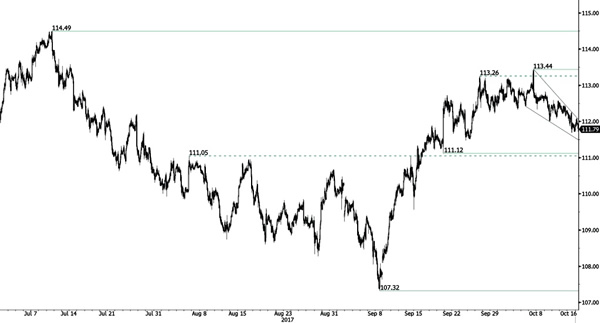
The US dollar has moved to an 11-week trading high against the Japanese Yen during the European session, hitting 112.96, as the U.S dollar surges higher, boosted by optimism over the upcoming proposed tax reforms by the Trump administration.

Going forward, the USDJPY pair may also react to new economic data coming from the United States later today, as we see the release of U.S core durable goods orders and pending U.S home sales.

The USDJPY remains strongly bullish on all-time frames, with the pair now trading above all major long-term moving averages, although short-term indicators suggest the USDJPY is now becoming slightly overbought.

Key intraday support is now located at the recent swing price-lows, at 112.80 and 112.66. Below the 112.66 level, further support is found at 112.28 and 111.90.

To the upside, further resistance above the 112.96 level is located at 113.20 and 113.66.

Above the 113.66 level, the 113.80 and 114.10 levels are key weekly resistance points before the July monthly price-high, at 114.49.

GBPUSD Bounces from Major Support

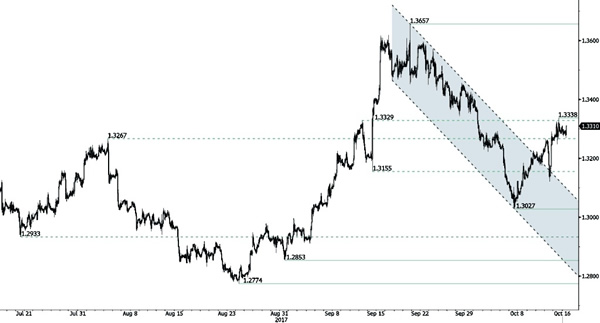
The British pound has rebounded back above the 1.3400 level against the U.S dollar, after finding strong intraday buying demand from its key 200-week moving average, located at the 1.3363 level.

Earlier, the GBPUSD pair declined sharply from its opening price, at 1.3440, as the U.S dollar index soared higher across the board, climbing well above the 93.00 handle.

Today's technical re-test of the GBPUSD pairs 200-week moving average, may have provided the pullback British pound buyers required. If the 1.3363 level now manages to hold, it may signal an important trading low going into the October BOE meeting, where the Bank of England is widely expected to hike interest rates.

Key technical support is now located at 1.3400, 1.3378 and the key 1.3363 level. Should the 1.3363 level become breached, a further decline to 1.3340 and 1.3300 may be seen.

Upside resistance is now seen at 1.3440, 1.3463 and the key 1.3490 level. Above 1.3490, further resistance is seen at 1.3510 and 1.3553.