Sample Category Title

Year Ahead – Euro Might Finally Outperform the Pound in 2025

  • Trump’s agenda and Fed to set the tone for 2025
  • Eurozone politics, a dovish ECB and weak growth in the spotlight
  • The UK is in better shape, but the budget could prove a major headwind
  • Pound strength may persist in early 2025, the euro might find its moment later on

If the stars align, 2025 could be a dream year for the euro

It has been a year to forget for the euro area. Political crises in both France and Germany, continued weak growth - with Germany expected to contract for a second consecutive year - and an active conflict near its eastern borders have all impacted economic momentum. As a result, the euro weakened considerably against both the dollar and the pound.

Going into 2025, the outlook remains clouded. While the world adjusts to Trump’s second term and the Fed’s monetary policy stance, the euro area is leaderless. The new German Chancellor is expected to take office by mid-March, and French President Macron is under constant pressure following the June European election disaster.

Aggressive ECB easing to continue

Meanwhile, the European Central Bank (ECB) is expected to further ease its monetary policy stance by around 130bps in 2025, thus decisively contributing to a potential growth pick up. However, the ECB cannot turn the current situation around on its own. Expansionary fiscal policy could be extremely effective at this stage, but, with the COVID pandemic in the rearview mirror, euro area governments have returned to a stricter fiscal doctrine, removing one of the key tailwinds of the economy.

Most market analysts are fairly pessimistic about the euro's performance in 2025. However, there is an avenue for a brighter performance in 2025 if the euro area manages to return to more respectable growth rates, boosted by consistent wage growth and increased consumer spending, outperforming both the US and UK.

Three external factors could determine euro’s performance

This scenario depends heavily on three factors: (a) Trump’s trade agenda, (b) the Ukraine-Russia conflict, and (c) China’s growth pickup. Should any of these factors prove unfavourable for the euro area, then the euro will most likely remain under pressure during 2025.

Having said that, should global economic performance prove below par in 2025, the ECB’s decisive stance and front-loading strategy could pay some dividends at a time when other major central banks also rush to support their economies, thus inadvertently weakening their currencies.

The pound’s good fortunes could reverse in the latter part of 2025

The pound exhibited solid strength during 2024, outperforming the euro for a second consecutive year and barely underperforming against the mighty dollar. The UK Labour party’s comfortable victory in the July 2024 general election and the measured dovish strategy by the Bank of England (BoE) contributed to the pound’s performance. However, both events could come back to haunt the pound during 2025.

While the world prepares for Trump’s second tenure in the White House, the UK is expected to escape relatively unscathed from the newly imposed trade tariffs. However, while the UK might be less affected from a potential deterioration in global trade due to its dominant services sector, the eurozone's anemic growth means the UK's economic outlook is not exactly rosy.

The UK budget remains a key unknown for 2025

Domestically, the impact of the 2025 budget is still uncertain. There are increasing concerns that the new tax measures, particularly the rise in employer’s national insurance, could prove counterproductive, hitting both employment and consumption, especially if the government insists on fully implementing these measures. However, there is a non-negligible possibility of amendments if PM Starmer succumbs to pressure from various industry groups, thus easing the overall impact. Meanwhile, the housing sector might be preparing for brighter days ahead, boosting consumer sentiment.

Amidst this environment, the BoE is forecast to continue supporting growth and consumer spending with further rate cuts. The market is currently pricing in 75bps of rate cuts, far less than the 130bps of easing expected by the ECB, which is surprising considering the BoE’s dovish pedigree. Having said that, another trade war could unsettle the BoE’s strategy, especially if core inflation fails to record a sizeable downward trend during 2025.

Pound’s strength could linger in early 2025

Putting everything together, the pound may experience a strong start to the year as the rest of the world scrambles to adjust to Trump’s “America First” agenda. However, this outperformance could moderate later in 2025 if the budget has a damaging effect on consumption, and the world divides into trading blocks, substantially hitting global growth momentum.

Sunset Market Commentary

Markets

Very few market-moving data in the US and EMU today. US markets are counting down to tomorrow’s US payrolls. This report, together with the US November CPI data (to be released on Dec 11), will provide concluding data evidence for the Dec 18 Fed policy meeting. US markets still only discount about 75% of a 25 bps cut, which we still see as the most likely scenario. Even so, US yields in technical trading add between 3.2 (2-y) and 1.5 bps (30-y) even as jobless claims printed slightly higher (worse) than expected (224k from 215k). German yields also add between 6.5 bps (5-y) and 2.0 bps (30-y). The rise gained some momentum on headlines from French RN Marine Le Pen as she said in an interview with Bloomberg that a budget was still possible if Macron and/or the next PM eases the stance on the debt path. This also triggered further intraday euro gains, with EUR/USD currently changing hands near 1.057. First short-term resistance is coming in at 1.0597/1.0610. EMU equities gain modestly (EuroStoxx50 + 0.5%). The S&P 500 is holding at record levels (little changed after open).

Sterling today is holding strong against the dollar (Cable 1.274) but meets resistance against the euro after recent rally (EUR/GBP 0.8785). The Monthly Decision Maker Panel survey of the Bank of England shows that UK CFO’s estimate year ahead own price inflation to be 3.7%, 0.2% higher compared to the previous survey. Expected year ahead wage growth was seen at 4.0% holding near its recent average. However, on a new question regarding the firms’ response to the increase in the employer National Insurance contribution announced in the budget, 54% of firms expects to raise prices and a similar group sees lower employment. 59% sees lower profit margins and 38% say they expects to pay lower wages than they otherwise would have done. This probably isn’t what the government wants to see, but also doesn’t make help the BoE to step up the pace of easing.

CE currencies (especially the forint and to a lesser extent the zloty) earlier this month face quite an uphill battle, but this week finally enjoyed some breathing space. This is partially due to the global market context, but domestic regional factors are also in play. On the global scene, the European risk-off eased at least temporarily. US interest rates are capped for now as the Fed will likely continue a process of gradual (25 bps) easing on Dec 18. A pause in the dollar rally also removed some pressure from regional currencies. At the same time, the Hungarian (MNB), Czech (CNB) and Polish central bank are in/heading to a pauze in their easing cycle. This for sure won’t be enough to shield local FX in a context of heightened risk-off, but helps in the current lower volatility intermezzo. At EUR/PLN 4.262, the zloty is closing in on the strongest levels against the euro since end September. At the press conference after yesterday’s NBP decision, governor Glapinski indicated that the debate on a rate cut might be delayed to October 2025, as Polish CPI might spike again in late 2025. The Czech koruna yesterday develop a similar pattern and today holds is gains (EUR/CZK 25.14). CNB governor Michl rather unambiguously closed the door for a December rate cut as wages continue to rise faster than expected. The forint end last week touched weakest levels since December 2022 (EUR/HUF 415 area) but currently also tries a (short-term?) reversal (EUR/HUF 411.9 currently).

News & Views

Swedish inflation accelerated slightly less than expected in November, by 0.3% M/M (from 0.2%) for the headline reading and by 0.5% M/M (from 0.4%) for the CPIF-gauge (using a fixed rate) preferred by the Swedish Riksbank. In annual terms, overall CPI stabilized at 1.6% with the CPIF measure rising from 1.5% to 1.9%, the highest level since May but remaining below the Swedish Riksbank 2% inflation target ever since. More detailed information and definitive figures will be available on December 12. Yesterday, a private survey by Prospera on behalf of the Riksbank showed consumer inflation expectations 1y, 2y and 5y ahead broadly unchanged compared with September: CPIF 1.7%-1.9%-2% from 1.7%-1.8%-2%. Inflation numbers won’t derail the central bank from implementing another rate cut at their final policy meeting of the year, albeit a smaller (25 bps) one than in November. The Swedish krone today rebounds off first technical resistance at EUR/SEK 11.49.

OPEC+ pushed back an increase in oil production planned for January by three months until the end of March. The full amount will be returned over a period of 18 months instead of the previously indicated 12 months. It’s the same gradual rollback of 2.2mn b/day of voluntary curbs which had already been delayed twice. Oil prices traded volatile but are unchanged in the end (Brent crude $72.5/b) given that the delay was broadly expected.

USD/JPY Mid-Day Outlook

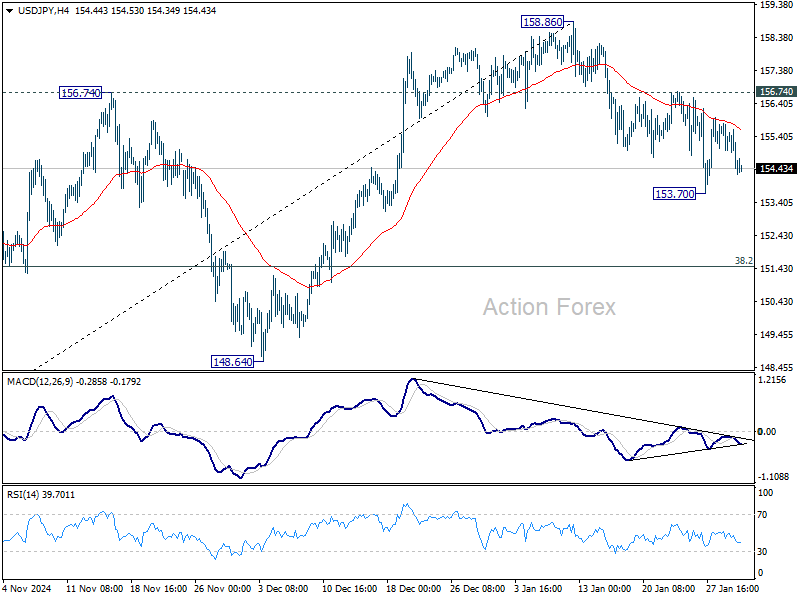
Daily Pivots: (S1) 149.68; (P) 150.46; (R1) 151.39; More...

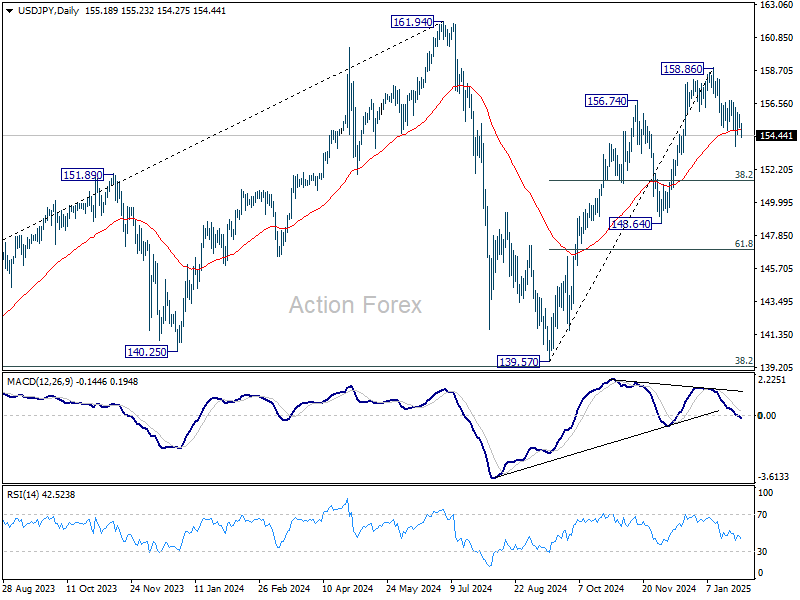
Intraday bias in USD/JPY remains neutral and more consolidations could be seen above 148.64. On the downside, break of 148.64 will strengthen the case that rise from 139.57 has already completed at 156.754. Deeper fall should then be seen to 61.8% retracement of 139.57 to 156.74 at 146.12 next. Nevertheless, firm break of 151.94 resistance will revive near term bullishness and bring retest of 156.74 high.

In the bigger picture, price actions from 161.94 are seen as a corrective pattern to rise from 102.58 (2021 low). The range of medium term consolidation should be set between 38.2% retracement of 102.58 to 161.94 at 139.26 and 161.94. Nevertheless, sustained break of 139.26 would open up deeper medium term decline to 61.8% retracement at 125.25.
USD/CHF Mid-Day Outlook

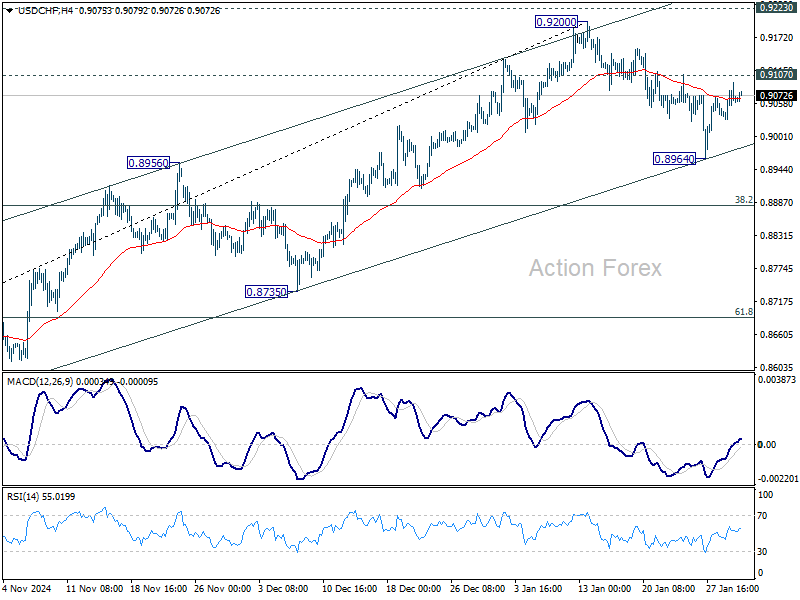
Daily Pivots: (S1) 0.8821; (P) 0.8851; (R1) 0.8874; More

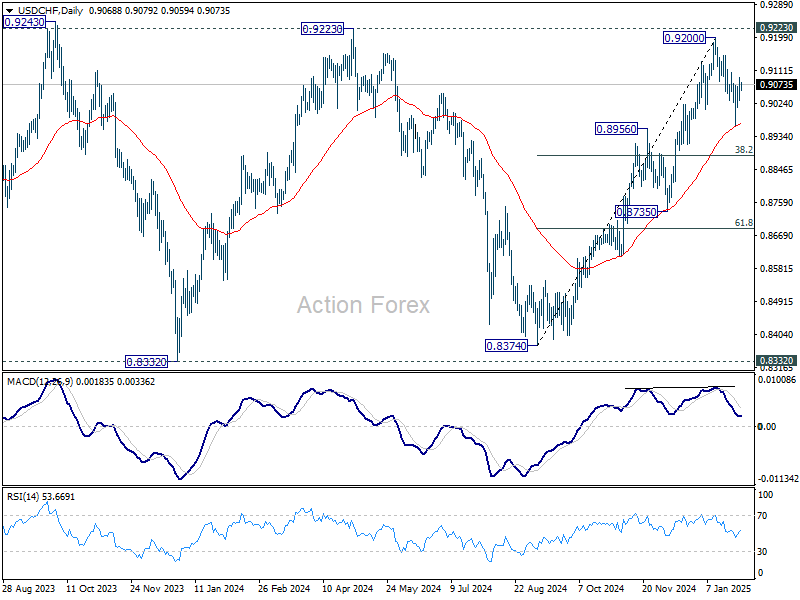
Immediate focus is now on 0.8800 support in USD/CHF with today's decline. Decisive break there will confirm short term topping at 08956. Intraday bias will be turned back to the downside for 55 D EMA (now at 0.8736). On the upside, break of 0.8956 will resume the rally from 0.8374, and target 0.9223 key resistance next.

In the bigger picture, price actions from 0.8332 (2023 low) are currently seen as a medium term corrective pattern. Rise from 0.8374 is seen as the third leg. Overall outlook will continue to stay bearish as long as 0.9223 resistance holds. Break of 0.8332 low is in favor at a later stage when the consolidation completes.

EUR/USD Mid-Day Outlook

Daily Pivots: (S1) 1.0474; (P) 1.0509; (R1) 1.0546; More...

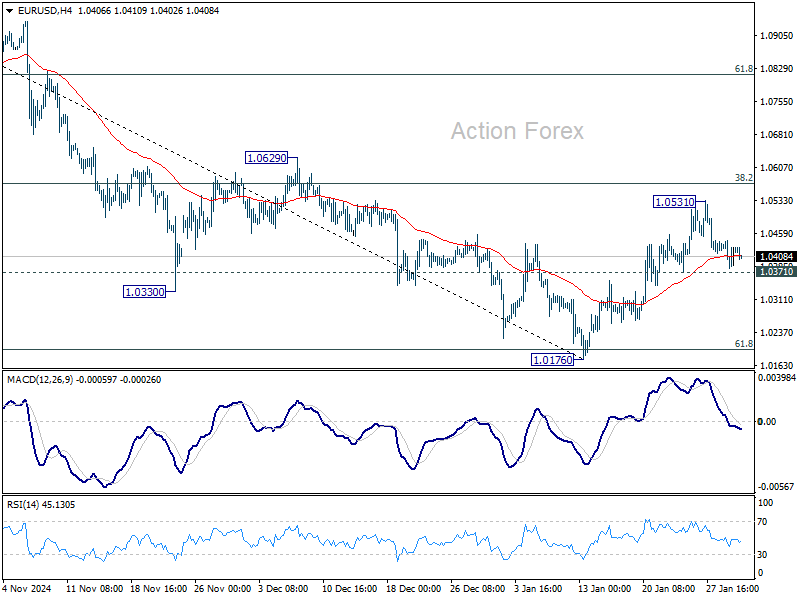
No change in EUR/USD's outlook as it's still staying below 1.0609 resistance. Intraday bias stays neutral for the moment. On the downside, firm break of 1.0609 resistance will resume the rebound from 1.0330 to 1.0760 support turned resistance. On the downside, break of 1.0330 will resume the fall from 1.1213. Also, sustained trading below 1.0404 key fibonacci level will carry larger bearish implication.

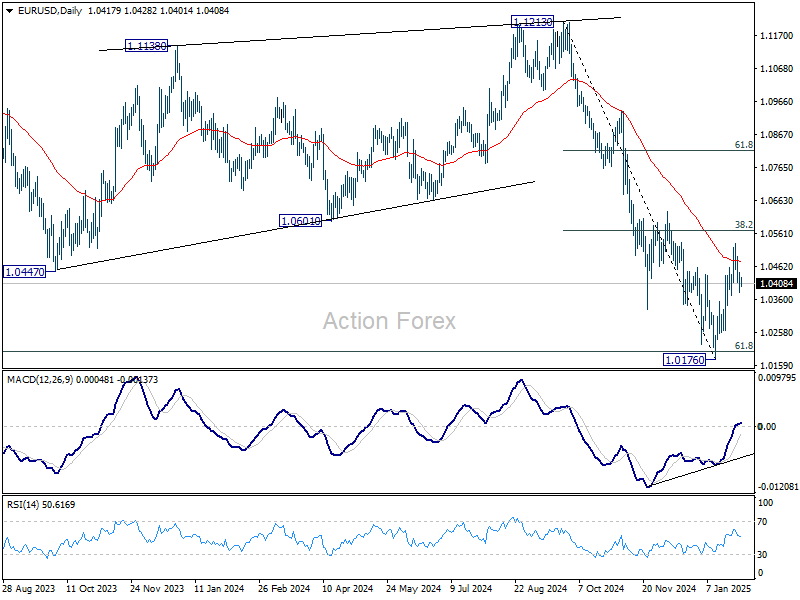
In the bigger picture, immediate focus is now on 50% retracement of 0.9534 (2022 low) to 1.1274 at 1.0404. Strong rebound from this level will keep price actions from 1.1273 (2023 high) as a medium term consolidation pattern only. However, sustained break of 1.0404 will raise the chance that whole up trend from 0.9534 has reversed. That would pave the way to 61.8% retracement at 1.0199 first. Firm break there will target 0.9534 low again.

Canadian Trade Posts Eighth Consecutive Deficit

Canada’s merchandise trade balance tallied a $942 million deficit in October, registering in the red ink for the eighth consecutive month. The deficit narrowed from September's $1.3 billion deficit.

Merchandise exports rose by 1.1% month-on-month (m/m) in October, partially reversing the past three months of declines. The highly volatile metallic and non-metallic minerals product group contributed to most of the trade gain (+10.6% m/m). Exports of consumer goods (+4.7% m/m) also provided an assist. Aside from that, 8 of 11 sectors registered declines on the month.

Total merchandise imports also increased, by 0.5% m/m in October, with the biggest gains coming from metal ores and non-metallic minerals (+46.1% m/m) and energy products (+6.2% m/m).

In volume terms, merchandise exports rose by 0.4% m/m and imports were up by 0.7% m/m.

Canada's merchandise trade surplus with the United States narrowed to $6.2 billion in October from $7.9 billion the month prior.

Key Implications

Statistics Canada has cautioned that a new digital initiative will subject October's data to heavy revisions, making this report tough to read. For what it's worth, export volumes are tracking higher than imports putting the growth contribution to Q4 GDP in positive territory.

Trade data has taken on increased importance as President-elect Trump takes office in January. Our base case is that Canada largely avoids Trump's blanket 25% tariff across all goods exports, but we acknowledge that any tariff policy levied against Canada will come with negative economic consequences. There may be signs that manufacturers and retailers are front-running potential tariffs, as total import and export volumes have risen modestly over the last three months, although it's still too early to tell if this is the start of a trend.

GBP/USD Mid-Day Outlook

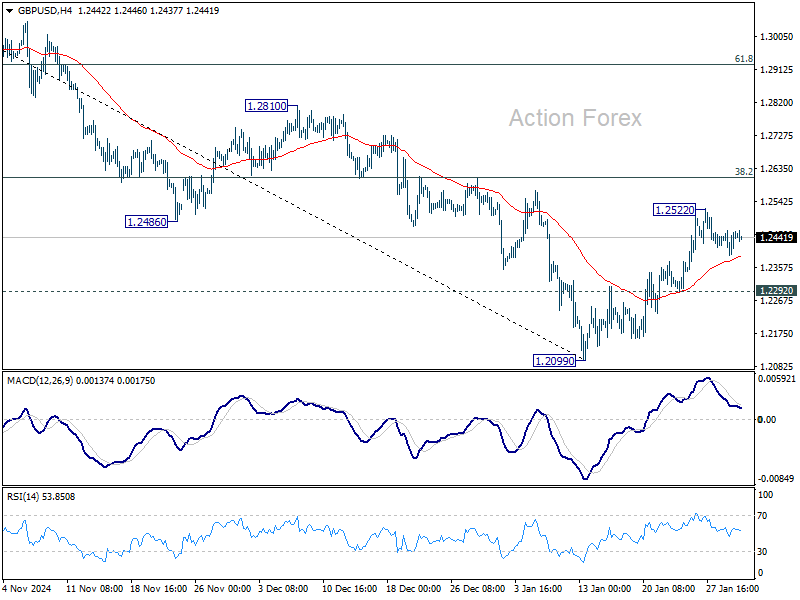
Daily Pivots: (S1) 1.2646; (P) 1.2684; (R1) 1.2737; More...

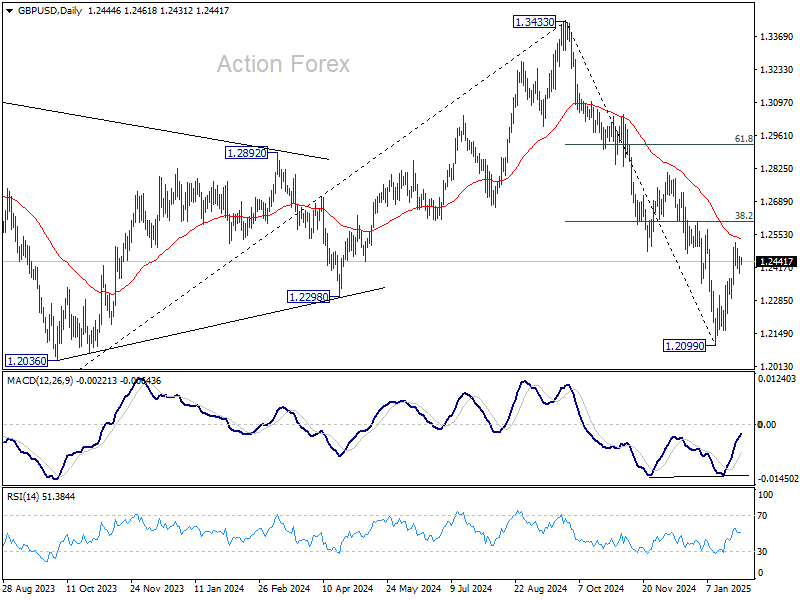
GBP/USD's rebound from 1.2486 resumes by breaking 1.2749 resistance today. Intraday bias is back on the upside for stronger rally to 55 D EMA (now at 1.2853). Strong resistance is expected there to limit upside, and bring resumption of whole fall from 1.3433. On the downside, below 1.2615 minor support will bring retest of 1.2486 low first. However, sustained break of 55 D EMA will argue that the near term trend has reversed, and targets 1.3047 resistance for confirmation.

In the bigger picture, a medium term top should be in place at 1.3433, and price actions from there are correcting whole up trend from 1.0351 (2022 low). Deeper decline is now expected as long as 55 D EMA (now at 1.2853) holds, to 38.2% retracement of 1.0351 to 1.3433 at 1.2256, which is close to 1.2298 structural support. Strong support should be seen there to bring rebound.

GBP Strengthens on Conflicting BoE Survey Data, Highlighting Monetary Policy Dilemmas

Sterling rallied broadly today, driven by BoE’s Monthly Decision Maker Panel survey, which underscored a complex economic outlook that reinforces the central bank’s cautious approach to policy easing. The survey revealed a mixed picture of inflationary and deflationary pressures. Notably, 54% of businesses anticipate raising prices in response to National Insurance contribution hikes outlined in the new government’s first budget. However, an equal proportion also expects to reduce staffing levels, signaling growing concerns about employment.

Additionally, 38% of firms indicated plans to pay lower wages than previously intended, contributing to a deceleration in expected pay growth to 3.8% from 4.1%. Meanwhile, inflation expectations among businesses ticked higher, with consumer price inflation projected at 2.7% for the year ahead, up from 2.6% in October. For November alone, inflation expectations jumped to 2.8% from 2.5%, suggesting persistent cost pressures despite softening wage growth. These mixed signals present a challenging picture for BoE as it deliberates its next steps.

Overall for the day, though, Euro led gains among major currencies, as markets digest the latest developments in France’s political sphere. Prime Minister Michel Barnier has resigned following a no-confidence vote against his government, with President Emmanuel Macron expected to address the nation later today. Sterling ranks as the second strongest currency of the day, followed by the Swiss Franc, marking a rebound for European currencies after recent underperformance. On the other hand, Yen is underperforming, followed by the Dollar. Commodity-linked currencies, including Aussie, Kiwi and Loonie, are positioning in the middle.

Technically, GBP/USD's break of 1.2749 resistance is a sign that Dollar's near term pullback is resuming, at least against Europeans. Focus will now be on 1.0609 resistance in EUR/USD and 0.8800 support in USD/CHF. Firm break of these levels should confirm that deeper decline in the greenback is underway. But still, the next big move would still be subject to tomorrow's US non-farm payroll report.

In Europe, at the time of writing, FTSE i down -0.01%. DAX is up 0.37%. CAC is up 0.18%. UK 10-year yield is up 0.0231 at 4.273. Germany 10-year yield is up 0.055 at 2.116. Earlier in Asia, Nikkei rose 0.30%. Hong Kong HSI fell -0.92%. China Shanghai SSE rose 0.12%. Singapore Strait Times rose 0.60%. Japan 10-year JGB yield rose 0.0198 to 1.073.

US initial jobless claims rises 9k to 224k, vs exp 215k

US initial jobless claims rose 9k to 224k in the week ending November 30, above expectation of 215k. Four-week moving average of initial claims rose 750 to 218k.

Continuing claims fell -25k to 1871k in the week ending November 23. Four-week moving average of continuing claims fell -3k to 1884k.

Canada’s trade deficit narrows to CAD - 0.9B as exports rebound in October

Canada's merchandise trade deficit with the world narrowed to CAD -0.9B in October from September's CAD -1.3B, driven by a 1.1% mom rise in exports. This marks a rebound following three consecutive monthly declines. Imports also increased, albeit at a slower pace, rising 0.5% mom.

Despite the headline growth in exports, declines were recorded in 8 of the 11 product sections. The increase was partly attributed to higher prices, with export volumes rising modestly by 0.4% mom in real terms.

Eurozone retail sales fall -0.5%Q mom in Oct, EU down -0.3% mom

Eurozone retail sales volume declined by -0.5% mom in October, underperforming expectations of a -0.4% mom contraction. Breaking down the data, sales for food, drinks, and tobacco edged up 0.1% mom, while non-food products (excluding automotive fuel) slumped -0.9% mom, and automotive fuel sales in specialized stores dropped -0.3% mom.

Across the broader European Union, retail sales volume fell by -0.3% mom. Among member states, the sharpest monthly declines were seen in Belgium (-1.7%), Germany (-1.4%), and Denmark and Cyprus (both -1.1%). Conversely, Luxembourg led with a strong 2.4% increase, followed by Poland at 2.2% and Lithuania at 1.5%.

BoJ’s Nakamura skeptical on wage and inflation sustainability

BoJ board member Toyoaki Nakamura expressed a cautious stance on monetary policy adjustments, emphasizing the need for careful calibration aligned with Japan's economic recovery.

"We are at a state where it’s important to adjust the degree of monetary easing carefully in accordance with the economic recovery by assessing a broad array of data," Nakamura said.

As a known dove on the BoJ board, Nakamura raised doubts about the durability of current wage hikes, saying he is "not confident" about their sustainability. He also flagged concerns about inflation, noting the possibility that the annual rate "may not reach 2% from fiscal 2025 onwards."

In a related development, a Jiji Press report indicated growing hesitation within BoJ regarding a premature rate increase. Market expectations for a December rate hike have fallen sharply, with traders now pricing in only a 36% chance, down from 66% at the end of last week.

GBP/USD Mid-Day Outlook

Daily Pivots: (S1) 1.2646; (P) 1.2684; (R1) 1.2737; More...

GBP/USD's rebound from 1.2486 resumes by breaking 1.2749 resistance today. Intraday bias is back on the upside for stronger rally to 55 D EMA (now at 1.2853). Strong resistance is expected there to limit upside, and bring resumption of whole fall from 1.3433. On the downside, below 1.2615 minor support will bring retest of 1.2486 low first. However, sustained break of 55 D EMA will argue that the near term trend has reversed, and targets 1.3047 resistance for confirmation.

In the bigger picture, a medium term top should be in place at 1.3433, and price actions from there are correcting whole up trend from 1.0351 (2022 low). Deeper decline is now expected as long as 55 D EMA (now at 1.2853) holds, to 38.2% retracement of 1.0351 to 1.3433 at 1.2256, which is close to 1.2298 structural support. Strong support should be seen there to bring rebound.

Economic Indicators Update

GMT CCY EVENTS ACT F/C PP REV
00:30 AUD Trade Balance (AUD) Oct 5.95B 4.58B 4.61B 4.53B
06:45 CHF Unemployment Rate Nov 2.60% 2.70% 2.60%
07:00 EUR Germany Factory Orders M/M Oct -1.50% -2.00% 4.20%
07:45 EUR France Industrial Output M/M Oct -0.10% 0.30% -0.90% -0.80%
09:30 GBP Construction PMI Nov 55.2 53.6 54.3
10:00 EUR Eurozone Retail Sales M/M Oct -0.50% -0.40% 0.50%
12:30 USD Challenger Job Cuts Y/Y Nov 26.80% 50.90%
13:30 USD Initial Jobless Claims (Nov 29) 224K 215K 213K 215K
13:30 USD Trade Balance (USD) Oct -73.8B -75.7B -84.4B -83.8B
13:30 CAD Trade Balance (CAD) Oct -0.9B -0.6B -1.3B
15:00 CAD Ivey PMI Nov 53.1 52
15:30 USD Natural Gas Storage -38B -2B


Bitcoin Has Hit a New Milestone. Is Ethereum Next?

Market Picture

The crypto market has risen by more than 3% in the last 24 hours to reach $3.69 trillion, this time thanks to the euphoria surrounding Bitcoin.

The price of the first cryptocurrency surpassed $100,000, a psychologically important milestone. The price then stabilised at $102.4K. It took almost two weeks from approaching this level to crossing it, during which time altcoins became the market driver. Perhaps the pendulum of interest will swing back to bitcoin for a while.

Powell, the Fed chairman, once again referred to Bitcoin as the digital analogue of gold, which was seen as a bullish signal to overcome resistance. While we believe Powell was the reason for the recent momentum, we attribute it to his upbeat comments on the economy, which supported risk appetite. Next, automatic stop orders came into play, pulling the market higher in thin Asian trading.

Ethereum’s next important level for the cryptocurrency markets could be $4,000, which it failed to consolidate above earlier this year.

News Background

Grayscale Investments has filed with the SEC to convert the GSOL Trust into a Solana Spot ETF. Canary, VanEck, 21Shares, and Bitwise are also pending applications to launch Solana ETFs.

Paul Atkins, whom the media have touted as a leading candidate for the position of SEC chairman, has been interviewed by President-elect Donald Trump. However, according to CoinDesk, the position is not attractive to Atkins due to the amount of work involved.

BNB hit a new all-time high above $790 after DEX PancakeSwap unveiled Springboard, a platform for issuing meme coins on the BNB chain.

According to QCP Capital, the main driver of altcoin growth was the proposal to abolish the capital gains tax on cryptocurrencies, which representatives of US companies drafted. The market expects this will create a more favourable regulatory environment for the crypto industry.

Canada’s trade deficit narrows to CAD – 0.9B as exports rebound in October

Canada's merchandise trade deficit with the world narrowed to CAD -0.9B in October from September's CAD -1.3B, driven by a 1.1% mom rise in exports. This marks a rebound following three consecutive monthly declines. Imports also increased, albeit at a slower pace, rising 0.5% mom.

Despite the headline growth in exports, declines were recorded in 8 of the 11 product sections. The increase was partly attributed to higher prices, with export volumes rising modestly by 0.4% mom in real terms.

Full Canada trade balance release here.