Sample Category Title
Swiss Franc Overtaking Yen as the Strongest as European Stocks Fall on Risk Aversion
Yen and Swiss Franc remain the strongest major currencies today with US-North Korean tensions as the main theme of the markets. Japan Nikkei suffered steep selloff today by losing -1.29% to close at 19738.71. Major European indices follow with FTSE down -0.8%, DAX down -1.5% and CAC down -1.8% at the time of writing. Among the currencies, risk sensitive Aussie and Canadian Dollar are hardest hit, followed by Sterling and Euro. Risk aversion pushes gold to as high as 1282.4 so far today as recent rebound resumes. WTI continues to tread water between 48.5 and 49.0.
Weakness in European equities is giving the Franc an extra push as CHF/JPY is staging a rebound after hitting 112.94, a recent low, earlier today. CHF/JPY is now back pressing 114 handle. It's now likely that a short term bottom is formed at 112.94, ahead of 112.48 key support, on bullish convergence condition in 4 hour MACD. CHF/JPY should be heading back to 114.789 resistance and possibly further to 38.2% retracement of 118.59 to 112.94 at 115.09 and above.

US Tillerson: Trump just used language that Kim can understand?
This episode of US-North Korea started on reports that North Korea is ready to give US a ""severe lesson" as it's examining plans to strike US territory Guam. US President warned that North Korea "best not make any more threats to the United States". And, Trump said that "they will be met with fire, fury and, frankly, power the likes of which this world has never seen before.
US Secretary of State Rex Tillerson tried to talk down the tension and said that there is no "imminent threat" from North Korea and "Americans should sleep well at night". Also he noted that "nothing that I have seen and nothing that I know of would indicate that the situation has dramatically changed in the last 24 hours." He said that Trump's "met with fire and fury like the world has never seen" was for "sending a strong message to North Korea in language that Kim Jong Un can understand". And Tillerson said that because "he doesn't seem to understand diplomatic language". From the context, Tillerson should be talking about Kim as illiterate on so called diplomatic language.
China growth to ease in 2H
China's trade and inflation data surprised to the downside in July, likely drive by the government's targeted tightening monetary policy. GDP growth is expected to slow in second half of the year. Yet, given the strong readings in the first half, with the economy expanding 6.9% in both the first and second quarters, GDP growth should be able to meet government's target of "around 6.5%". We believe the government would continue its tightening monetary policy in order to prevent and resolve systematic risks, and to curb excessive strength in property prices. Meanwhile, as ultra accommodative monetary policies across major central banks are coming to an end, with the Fed and BOC raising interest rates, while ECB will begin discussing reduction of asset purchases, it would be detrimental to the renminbi if the central bank pledges to maintain monetary easing. This would exacerbate capital outflow from China. More in China Watch – July Trade And CPI Disappoint, Growth To Ease In 2H As Government Tightens.
Also released earlier today, Japan M2 rose 4.0% yoy in July. Machine tool orders rose 26.3% yoy in July. Australia Westpac consumer confidence dropped -1.2% in August, home loans rose 0.5% in June.
RBA Kent: Aussie strength due to unwinding of Trump trade
RBA Assistant Governor Christopher Kent said that recent appreciation in the Australian exchange is mainly due to unwinding of so-called "Trump Trade". He noted that investors have initially anticipated US President Donald Trump's fiscal stimulus, which could be inflationary. That pushed Dollar and US yields higher after last year's election. But "gradually that's just been unwinding". Also, he noted that there's been a bit weaker inflation in the US. Together "that's a large part of the Australian dollar appreciation story of late."
Regarding the shrinking yield gap between US and Australia, Ken noted that "one might imagine that if the rest of the world is experiencing increasingly better conditions, better inflation, that underpins a pickup in yields, then that yield differential will come back and our estimates suggest that will potentially have some impact on the Australian dollar."
RBNZ to stand pat
RBNZ rate decision will be a major focus in the upcoming Asian session. The central bank is widely expected to keep the OCR unchanged at record low of 1.75%. New Zealand Dollar has been soft this month as markets are cautious that RBNZ governor Graeme Wheeler might turn a bit dovish in his statement. NZD/JPY accelerates lower today as also pressured by risk aversion. Follow up on our analysis earlier in the week, 55 day EMA is firmly taken out. The development confirmed that whole rise from 75.65 has completed at 83.90, after failing to sustain above 83.76 resistance. Deeper fall should now be seen back to 61.8% retracement of 75.65 to 83.90 at 78.80 and below before getting support for rebound. In any case, near term outlook will stay bearish as long as 81.62 resistance holds.

USD/CHF Mid-Day Outlook
Daily Pivots: (S1) 0.9708; (P) 0.9741; (R1) 0.9772; More...
USD/CHF dropped to as low as 0.9611 so far. It's staying above 0.9594 support and intraday bias remains neutral first. But outlook is turned a bit mixed as the pair is bounded inside medium term falling channel. The pair was also limited below 38.2% retracement of 1.0342 to 0.9437 at 0.9783. Firm break of 0.9594 will dampen our bullish view and turn bias back to the downside for 0.9437. This could also extend the fall through 1.0342 through 0.9437/43 key support level. On the upside, above 0.9772 will revive the bullish case and turn bias back to the upside.
In the bigger picture, current development argues that USD/CHF has successfully defended 0.9443 key support level. And long term range trading in 0.9443/1.0342 is extending with another rise. At this point, there is no sign of an up trend yet. Hence, while further rise is expected in USD/CHF, we'll start to be cautious on loss of momentum above 61.8% retracement of 1.0342 to 0.9437 at 0.9996.


Economic Indicators Update
| GMT | Ccy | Events | Actual | Forecast | Previous | Revised |
|---|---|---|---|---|---|---|
| 23:50 | JPY | Japan Money Stock M2+CD Y/Y Jul | 4.00% | 3.90% | 3.90% | |
| 00:30 | AUD | Westpac Consumer Confidence Aug | -1.20% | 0.40% | ||
| 01:30 | CNY | CPI Y/Y Jul | 1.40% | 1.50% | 1.50% | |
| 01:30 | CNY | PPI Y/Y Jul | 5.50% | 5.60% | 5.50% | |
| 01:30 | AUD | Home Loans Jun | 0.50% | 1.50% | 1.00% | 1.10% |
| 06:00 | JPY | Machine Tool Orders Y/Y Jul P | 26.30% | 31.10% | ||
| 12:30 | CAD | Building Permits M/M Jun | 2.50% | -1.90% | 8.90% | |
| 12:30 | USD | Non-Farm Productivity Q2 P | 0.90% | 0.80% | 0.00% | |
| 12:30 | USD | Unit Labor Costs Q2 P | 0.60% | 1.10% | 2.20% | |
| 14:00 | USD | Wholesale Inventories Jun F | 0.60% | 0.60% | ||
| 14:30 | USD | Crude Oil Inventories | -1.5M | |||
| 21:00 | NZD | RBNZ Rate Decision | 1.75% | 1.75% |
War Rhetoric Has Dollar, Bonds And Gold Bid, Stocks lower
Wednesday August 9: Five things the markets are talking about
Capital Markets are on the defence as a risk-off tone dominates proceedings overnight, with gold ($1,268.34) and the Japanese yen (¥109.70) advancing and sovereign bond prices edging higher as tension grows between the U.S and North Korea.
Gold prices are heading for its largest gain this month while JPY and CHF remain the biggest winners among G-10 currency pairs after President Trump issued a warning yesterday that if North Korea escalates the nuclear threat, “they will be met with fire and fury like the world has never seen.” Global equities are slumping while oil prices retreat on ‘oversupply' concerns.
In retaliation, North Korean's state-run media issued a statement saying, “U.S war hysteria will bring a miserable end.” The market is concerned that North Korea could strike before any preemptive attack by the U.S.
Note: North Korea said it was examining an operational plan for firing a ballistic missile toward Guam, a U.S territory in the Pacific Ocean.
1. Stocks Sea of red
In Japan, the Nikkei skidded to a 2-1/2 month low on rising North Korea risk. The index dropped -1.3% overnight, the weakest closing level since May 31, but defence equipment makers attracted buyers. The broader Topix Japan's Topix index fell -1.1%, the most since May 18.
In Hong Kong, shares ended lower, but developers provided support. The Hang Seng index fell -0.4%, easing away from its two-year high print on Tuesday, while the China Enterprises Index lost -1.1%.
In China, financials dragged stock markets lower amid concerns that regulators will continue to clamp down on debt risks, but strong gains in consumer staples left major indexes only slightly lower on the day. The blue-chip CSI300 was unchanged, while the Shanghai Composite Index dipped -0.2%.
The outlier was Australia's S&P/ASX 200 Index resisted the region-wide downward trend to add +0.4%.
Note: The CBOE Volatility Index (VIX) closed at 10.96, its highest in about a month, while the CBOE SKEW INDEX, or “black swan” index, which measures the likelihood of extreme moves in the S&P 500 based on how traders are pricing the index's options is at 140.03 ahead of the U.S open. In July, it traded mostly between 120-140.
In Europe, regional bourses have opened down and have continued in the same direction ahead of the open stateside. Gold is higher, but is not translating into support for materials.
U.S stocks are set to open deep in the red (-0.3%).
Indices: Stoxx50 -1.1% at 3,476, FTSE -0.6% at 7,496, DAX -1.0% at 12,168, CAC-40 -1.2% at 5,155, IBEX-35 -0.9% at 10,643, FTSE MIB -1.1% at 21,809, SMI -1.3% at 9,040, S&P 500 Futures -0.3%

2. Oil steady ahead of U.S inventory report, gold higher
Oil prices are holding their own ahead of the U.S open after yesterday's weekly API inventory reported a large drop in U.S crude stocks countered balanced industry doubts that compliance with OPEC-led supply cuts will increase.
Note: U.S crude inventories last week fell by -7.8m barrels, more than expected, but gasoline inventories rose unexpectedly.
Brent crude is unchanged at +$52.14, after two days of decline, while U.S. West Texas Intermediate (WTI) crude added +4c at +$49.21.
The market will takes its cue from today's EIA report (10:30 am EDT) to see whether it confirms the yesterday's API release. The market is looking for crude stocks to have fallen by -2.7m barrels and gasoline by -1.5m barrels.
Note: OPEC in Abu Dhabi this week in an effort to boost producers' adherence to the supply cuts. The post meeting joint statement said the “conclusions reached would help boost compliance.” However, OPEC was short on details.
Gold prices remain better bid (+0.4% to $1,265.70 per ounce) amid rising tensions between the U.S and North Korea after the North responded to warnings from U.S. President Donald Trump with a threat to strike the U.S. territory of Guam.
Note: Stronger-than-expected U.S JOLTS jobs data weighed on gold Tuesday, dragging prices to the lowest since July 26 at +$1,251.01 an ounce.

3. Sovereign G7 yields fall on safe haven play
Geopolitics is supporting G7 government bond prices as investors rush to safer-assets after U.S President Trump warned North Korea that it will face “fire and fury” if it keeps threatening the U.S.
Yields on 10-year Bunds have dropped -1.3 bps to +0.46% in early European trading, while U.S 10-year Treasuries have declined -1 bps to +2.25% ahead of their session.
In the U.K, issuance of new Gilts is scheduled to resume Aug. 23. Until then, lack of supply should make it difficult for gilt yields to rise and this should also help gilts out-perform U.S treasuries in the near term.
The medium-term outlook depends on the BoE – Governor Carney and company is expected to find it difficult to hike policy rate given the downside risks to growth. Yields on 10-year gilts dropped -2 bps to +1.13%, the lowest in six-weeks.

4. Dollar finds risk aversion support
It's only natural that risk aversion currencies have benefited now that President Trump has raised his rhetoric against North Korea to an unprecedented level.
USD/JPY (¥109.84) fell to a fresh two-month low of ¥109.65, while USD/CHF was lower by over -1% to test below €0.9630, while EUR/CHF cross edged away from its recent three-month highs atop of €1.15 to dip below the psychological €1.13 level.
The ZAR is down outright ($13.4470), reversing yesterday's gains, as President Zuma has survived another no-confidence vote (his seventh). The rand rallied Monday given expectations that Zuma's eight-year term will be voted out in a secret ballot. Expect ongoing medium term political volatility for the rand.
Down-under, RBA Assistant Governor Kent reiterated that a further rise in AUD (A$0.7888) would result in slightly lower domestic growth – AUD currency appreciation has been more about “dollar weakness and not linked to commodity prices.”

5. China inflation undershot expectations
Data overnight from China showed that China's producer price gains held steady on surging commodity prices, as demand stayed resilient and the government's drive to reduce industrial capacity takes hold.
The Producer Price Index (PPI) rose +5.5% in July y/y vs. a market estimate of +5.6%. On a month-on-month basis, the PPI rose +0.2% last month, after three months in the red.
While the Consumer Price Index increased +1.4% vs. a forecast of +1.5% – well below the government ceiling of +3%.
Note: Analysts say given expectations of deeper capacity cuts heading into Q4, keeping supply tight and prices up, operating margins for businesses will probably remain solid in a boost to the bottom line.

Dollar Strength Weighs On Euro | Sterling Posts Another Low Against Euro
The Dollar Index Bounce Strongly On Cards
Euro Weaker Against Dollar But Strong Against Sterling
The Dollar Index Bounce Strongly On Cards
The US JOLTS data also gave traders hopes that the US firms will keep employing and the pace of hiring would be solid. At the same time, there are less people who are quitting their jobs, a measure which the Fed keeps a close eye on. This confirms that the health of the US jobs market is sturdy and the dollar moved higher on the back of that. However, James Bullard, the St Louis Fed president, had a very dovish tone because he thinks that the inflation is not strong enough. Neel Khaskari, who is also a voting member of the Fed committee has the same dovish stance and he doesn't not favour another rate hike.
We need to break the level of 94 for the dollar index in order to have a firm confirmation that the trend has changed. The dollar index also needs to stay above the 100-day moving average. The technicals are favouring that we are going to break to the upside.

Euro Weaker Against Dollar But Strong Against Sterling
The Euro is losing its mojo against the dollar but is still strong against the Sterling. The French trade balance data confirmed that the French economy has improved. Similarly, the German economy is in the healthy territory. However, the recent strength in the euro surely presents a much larger threat to export. The upcoming GDP number for Germany is also expected to print a more positive reading. That would put more pressure on the ECB to start the process of tapering. Tapering doesn't necessarily mean that the Euro would move higher because if the ECB shows that they are concerned about the Euro strength, they would surely knock its strength down.
Daily Technical Analysis: EURUSD, GBPUSD, USDJPY, USDCHF
EURUSD
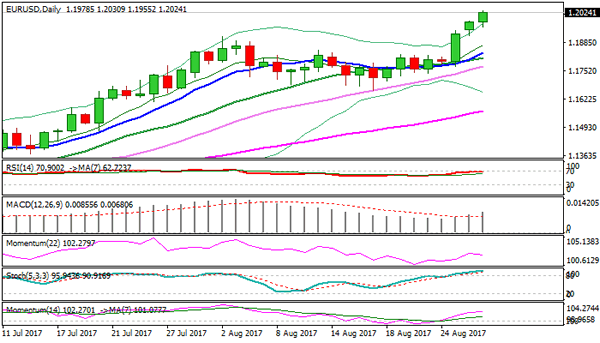
The EURUSD had a bearish momentum yesterday bottomed at 1.1715 but closed a little bit higher at 1.1752. The bias is bearish in nearest term testing the minor trend line support as you can see on my daily chart below which is a good place to buy with a tight stop loss below 1.1650 support area. Immediate resistance is seen around 1.1785. A clear break above that area could trigger further bullish pressure testing 1.1820/50 area. Overall I remain bullish and price is still moving above the daily EMA 200, but a clear break below 1.1650 key support would activate my neutral mode as price enters a corrective zone.

GBPUSD
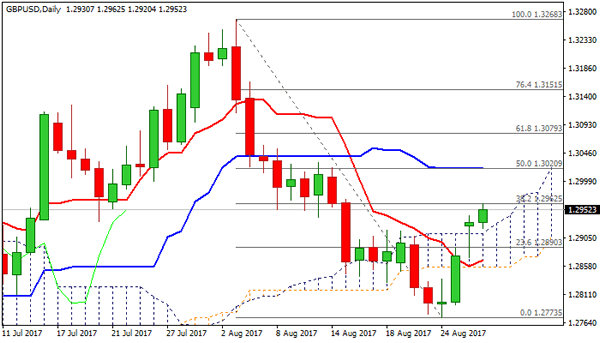
The GBPUSD had a bearish momentum yesterday bottomed at 1.2952 and closed just below 1.3000 resistance. The bias is bearish in nearest term testing 1.2930 – 1.2865 region. Immediate resistance is seen around 1.3050. A clear break above that area could lead price to neutral zone in nearest term testing 1.3100/25 region which need to be clearly broken to the upside to reactivate my bullish mode retesting 1.3265 region or higher.

USDJPY
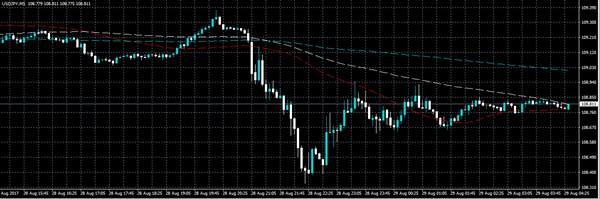
The USDJPY had a bearish momentum yesterday bottomed at 110.25 and hit 109.79 earlier today in Asian session. The bias is bearish in nearest term testing the trend line support and 109.50/00 region which remains a good place to buy with a tight stop loss. Immediate resistance is seen around 110.35. A clear break above that area could lead price to neutral zone in nearest term testing 111.00 region. On the downside, a clear break and daily close below 109.00/50 would activate my bearish mode.

USDCHF
The USDCHF attempted to push higher yesterday topped at 0.9772 but closed lower at 0.9740 and hit 0.9705 earlier today in Asian session. Overall price is still in a bullish phase but still respects 0.9765 – 0.9807 key resistance. The bias is bearish in nearest term testing 0.9660 – 0.9620 area. Immediate resistance is seen around 0.9742 (current high). A clear break above that area could lead price to neutral zone in nearest term retesting 0.9765 – 0.9807 key resistance which remains a good place to sell.

Will The RBNZ Shift To A More Cautious Stance?
During the late US trading session today, the RBNZ will announce its policy decision and the forecast is for the Bank to remain on hold once again. Economic developments have been relatively downbeat since the latest meeting. The CPI rate for Q2 declined and now lies well below the RBNZ's own forecasts.
Meanwhile the jobs market underperformed during the quarter, with the labor force participation rate dropping significantly. To make matters worse, the Kiwi is trading higher than it was back then.
We believe that these soft data will probably prevent the Bank from turning hawkish anytime soon. In case the RBNZ appears less optimistic on the economy and/or if it revises down its economic forecasts, the latest pullback in NZD could continue. Last but not least, we think there is a probability that the
RBNZ expresses a greater discomfort with the strength of NZD, especially if we take into account the latest soft data. Having said that though, this week's pullback in the currency may have brought the probability of NZD-jawboning down.
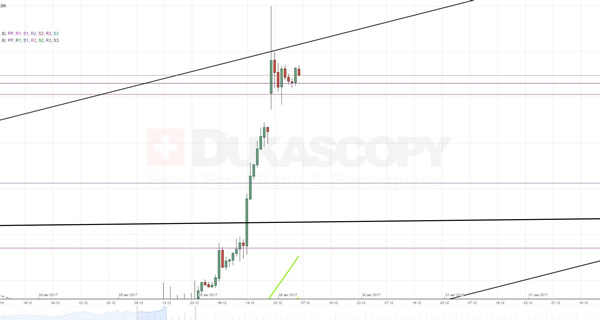
NZD/USD continued trading south yesterday, breaking below the support (now turned into resistance) of 0.7330 (R1). In our view, Monday's dip below the crossroads of the 0.7400 (R2) key barrier and the uptrend line taken from the low of the 11th of May has signaled a short-term trend reversal. Therefore, we expect the pair to continue drifting lower and perhaps challenge the 0.7260 (S1) soon, where a clear dip could open the way for our next support of 0.7200 (S2). The catalyst for another leg down, at least towards 0.7260 (S1) could be a more-dovish-than-previously RBNZ tonight. Even if the Bank does not sound as dovish as expected and the pair rebounds, as long as the recovery remains limited below 0.7400 (R2), we would treat it as a corrective move.
Switching to the daily chart, we see that the rate is back within the longer-term sideways range between 0.6880 and 0.7400 (R2). This combined with the negative divergence between our daily oscillators and the price action increases the likelihood for further declines within the aforementioned range.
Trump warns North Korea with 'fire and fury'
Yesterday, a media report suggested that North Korea is developing nuclear weapons capable of striking the US at a much faster rate than expected. This was soon followed by comments from US President Trump, who warned North Korea that it 'will be met with fire and fury like the world has never seen' should it threaten the US. The situation quickly escalated further, with North Korea warning that it could carry out a pre-emptive operation once the US shows signs of provocation. The result was a general risk-off reaction in markets, as safe haven assets such as gold, JPY and CHF rallied, while riskier assets, like stocks, tumbled.
Moving forward, we expect market attention to remain on any headlines regarding this subject. Should tensions between the two nations rise further in the coming days, we would expect to see similar moves across the aforementioned asset classes. In addition, any such moves could be abnormally large, considering the thin-liquidity trading environment in August.
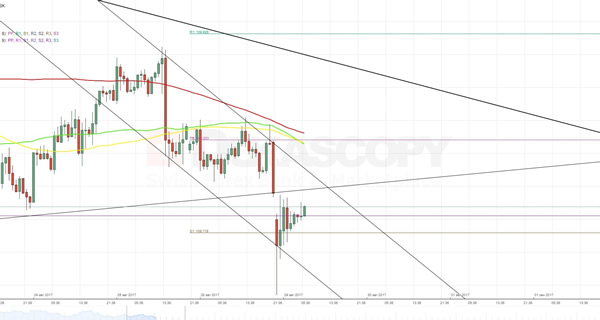
EUR/JPY tumbled yesterday after it hit resistance at 130.70 (R3) to stop fractionally above 128.60 (S1). The price structure on the 4-hour chart suggests a sideways range between these two barriers and therefore we remain flat with regards to the short-term picture for now. Having said that though, if the North Korea situation escalates further in the following days, the pair could break below the lower end of the range and initially aim for the 128.00 (S2) support level. On the other hand, if the dust starts to settle down, we believe that the bulls may drive the rate higher, and perhaps target once again the upper bound of the range, at 130.70 (R3).
Today's economic indicators:
The economic calendar is very light today. From Canada, we get housing starts and building permits for July and June respectively. In the US, the preliminary labor costs index for Q2 will be in focus.
NZD/USD

Support: 0.7260 (S1), 0.7200 (S2), 0.7165 (S3)
Resistance: 0.7330 (R1), 0.7400 (R2), 0.7460 (R3)
EUR/JPY

Support: 128.60 (S1), 128.00 (S2), 127.40 (S3)
Resistance: 129.50 (R1), 130.15 (R2), 130.70 (R3)
Market Update – European Session: Risk Aversion Finds Some Legs
Notes/Observations
Trump raised his rhetoric against North Korea to an unprecedented level, triggering broad risk-off moves through Asian hours
Inflation focus stays; China inflation undershot expectations; Fed's Dudley speech eyed on Thursday, US CPI data on Friday
Overnight
Asia:
China July inflation data remains steady CPI Y/Y: 1.4% v 1.5%e; PPI Y/Y: 5.5% v 5.6%e; data suggesting that monetary policy can't be tightened further
RBA Assistant Gov Kent reiterated further rise in A$ would result in slightly lower domestic growth. AUD currency appreciation was more about dollar weakness and not linked to commodity prices
North Korea now making missile-ready nuclear weapons
President Trump: North Korea better not make any more threats to US; North Korea will be met with fire, fury like the world has never seen if it threatens US
Europe:
South Africa President Zuma survived a no-confidence vote. Parliament voted against no confidence motion via secret ballot
Energy:
Weekly API Oil Inventories: Crude: -7.84M v +1.78M prior
OPEC spokesperson: OPEC and partners held 'fruitful' compliance talks; producers remain steadfast in commitment to agreed upon output cuts
Economic Calendar
(NL) Netherlands Jun Manufacturing Production M/M: -0.3% v +1.2% prior; Y/Y: 3.3 v 3.9% prior; Industrial Sales Y/Y: 5.2 v 9.0% prior
(JP) Japan July Preliminary Machine Tool Orders Y/Y: 26.3% v 31.1% prior
(FR) Bank of France July Business Sentiment (beat): 105 v 103e
(CZ) Czech July CPI (beat) M/M: 0.5% v 0.3%e; Y/Y: 2.5% v 2.3%e
(GR) Greece July CPI Y/Y: 1.0% v 1.0% prior; CPI EU Harmonized Y/Y: 0.9% v 0.8%e
Fixed Income Issuance:
(IN) India sold total INR170B vs. INR170B indicated in 3-month and 6-month Bills
(DK) Denmark sold total DKK2.74B in 2020 and 2027 bonds
SPEAKERS/FIXED INCOME/FX/COMMODITIES/ERRATUM
Equities
Indices [Stoxx50 -1.1% at 3,476, FTSE -0.6% at 7,496, DAX -1.0% at 12,168, CAC-40 -1.2% at 5,155, IBEX-35 -0.9% at 10,643, FTSE MIB -1.1% at 21,809, SMI -1.3% at 9,040, S&P 500 Futures -0.3%]
Market Focal Points/Key Themes: European stocks open down and continued in the same direction though the morning; risk sentiment off given geopolitical concerns; gold higher, but didn't translate into support for materials; emerging markets among biggest decliners; Worldpay being acquired by Vantive; Telit Communications declines further after CEO takes leave of absence; upcoming US session earnings include Weibo, Office Depot, Avnet and Mylan
Equities
Consumer discretionary [G4S [GFS.UK] -5% (Earnings)]
Consumer Staples [Ahold Delhaize [AD.NL] -2.2% (Earnings)]
Materials: [SGL Carbon [SGL.DE] +1.0% (Earnings, Divestment),
Industrials: [E.ON [EOAN.DE] -2.0% (Earnings), Brenntag [BNR.DE] -5.5% (Earnings), Interserve [IRV.UK] -4.0% (Earnings)]
Financials: [Legal & General [LGEN.UK] -1.9% (Earnings)]
Telecom: [Telit Communications [TCM.UK] -31% (CEO takes leave amid speculation historical indictments)]
Healthcare: [Novo Nordisk [NOVOB.DK] +4% (Earnings)]
Speakers
BoE Prudential Regulator Authority (PRA) Woods: urged lawmakers to allow financial firms an implementation period to adjust after Brexit - letter to Treasury
BOE Agents Summary: Consumer spending growth had eased slightly further in values term. Manufacturing output growth had risen again, with exports supported by the past fall in sterling. Recruitment difficulties had edged higher and broadened slightly.
Philippines Economic Planning Sec Pernia reiterated view that Q2 GDP growth likely to have been faster than Q1
Currencies
Risk aversion currencies and gold benefited from the Korean Peninsula after President Trump raised his rhetoric against North Korea to an unprecedented level. Geopolitics helping core bond yields move lower, give gold a bid. - USD/JPY fell to a 2-month low of 109.65
USD/CHF was lower by over 1% to test below 0.9630 while EUR/CHF cross edged away from its recent 2 1/2 highs near 1.15 to dipped below the 1.13 level.
Fixed Income
Bund futurestrades at 163.66 up 50 ticks as risk-off sentiment pushes through markets. Downside targets 162.67 followed by 162.56. To the upside the 165.00 to 165.20 remains key resistance.
Gilt futurestrades at 127.26 up 32 ticks as risk aversion hits across all markets. A continuation to the upside eyeing 127.75 then 128.25. A move back above 126.51 targets 125.97
Wednesday's liquidity report showed Tuesday's use of the marginal lending facility fell to €197M from €257M prior.
Corporate issuancesaw $19.5B come to market via 5 issuers headlined by BAT $17.25B 8 part offering, which was the second largest bond offering of the year.
Looking Ahead
(MX) Mexico July ANTAS Same-store Sales: 5.8%e v 5.4% prior
05:30 (DE) Germany to sell €4.0B in 0% Oct 2022 BOBL
06:00 (PT) Portugal Jun Trade Balance: No est v -€1.4B prior
06:00 (PT) Portugal Q2 Unemployment Rate: No est v 10.1% prior
06:00 (IE) Ireland Jun Property Prices M/M: No est v 2.2% prior; Y/Y: No est v 11.9% prior
06:00 (RU) Russia to sell combined RUB40B in 2024 and 2033 OFZ bonds
06:45 (US) Daily Libor Fixing
07:00 (US) MBA Mortgage Applications w/e Aug 4th: no est v -2.8% prior
07:00 Czech Central Bank to comment on CPI data
08:00 (BR) Brazil July IBGE Inflation IPCA M/M: +0.2%e v -0.2% prior; Y/Y: 2.7%e v 3.0% prior
08:00 (UK) Baltic Dry Bulk Index
08:15 (CA) Canada July Annualized Housing Starts: 205.0Ke v 213.2K prior (revised from 212.7K)
08:30 (US) Q2 Preliminary Nonfarm Productivity: 0.7%e v 0.0% prior; Unit Labor Costs: 1.1%e v 2.2% prior
08:30 (CA) Canada Jun Building Permits M/M: -1.9%e v +8.9% prior
08:30 (CL) Central Bank's Traders Survey
09:00 (MX) Mexico July CPI M/M: 0.3%e v 0.3% prior; Y/Y: 6.4%e v 6.3% prior; CPI Core M/M: 0.3%e v 0.3% prior
10:00 (US) Jun Final Wholesale Inventories M/M: 0.6%e v 0.6% prelim; Wholesale Trade Sales M/M: No est v -0.5% prior
10:30 (US) Weekly DOE Crude Oil Inventories
11:30 (BR) Brazil weekly Currency Flows Weekly
12:00 (CA) Canada to sell 2-year bonds
13:00 (US) Treasury to sell $23B in 10-year notes
17:00 (NZ) New Zealand Central Bank (RBNZ) Interest Rate Decision: Expected to leave the Official Cash Rate (OCR) unchanged at 1.75%
Chinese Inflation Ticks Down, Producer Prices Steady
Following a slowdown in Chinese exports in July, Chinese factory prices remained steady in the same month, in what could be a positive sign for industrial profits, while consumer prices experienced weaker growth.
The National Bureau of Statistics of China released on Wednesday the consumer price (CPI) and the producer price (PPI) indices for the month of July. According to the numbers, the PPI stood flat for the third consecutive month at 5.5%, as expected, on a yearly basis. Month-on-month the index rose for the first time in three months by 0.2%, supported mainly by increasing commodity prices, including steel and non-ferrous metals. In June, the monthly PPI contracted by 0.2%. With yearly PPI remaining unchanged, Chinese companies' profits are expected to grow solidly as the effects of the capacity cuts are projected to emerge during winter.
Regarding the CPI, the index grew by 1.4% year-on-year, missing the forecast of 1.5% which was also June's mark. On a monthly basis, the price of goods and services recovered from a downfall of 0.2% in the prior month, rising by 0.1%, while analysts anticipated a higher growth of 0.2%. Among the price categories, food prices, which weigh significantly on the index, declined by 1.1% year-on-year, though this was less than the 1.3% pullback observed in June.

Since inflation is still far below the PBOC target of 3% and GDP continues to grow steadily at (6.9% y/y in Q2), analysts expect the PBOC to either maintain policy on hold or to tighten it in order to reduce the leverage among the largest companies which are currently heavily indebted. Note that, the PBOC has kept interest rates at a record low of 4.35% since October 2015.
There was a limited reaction to the data as geopolitical tension and a weaker dollar was the overriding themes in forex markets today. The yuan hit another 10-month high, reaching 6.6773 per dollar today. The Australian dollar meanwhile plummeted by 0.5% to $0.7873 after the RBA Governor, Christofer Kent, in a Q&A session said that an unwillingly stronger aussie on the back of a weaker dollar would harm the Australian economy’s competitiveness. The mixed Chinese data, as well as disappointing figures on Australian consumer sentiment (-1.2% August vs 0.4% July) and home loans (0.5% m/m June vs 1.1% May), released today also pressured the aussie.
EURJPY Shifting From Neutral To Bearish On Increasing Downside Pressure
EURJPY is shifting from neutral to bearish on the 4-hour chart. Downside risk increased after the pair retreated from the multi-month high of 131.17 and fell below the key 130.00 psychological level.
The RSI indicator is giving a bearish signal since it has dropped below the 50 level and is sloping down. Furthermore, prices fell below the Ichimoku cloud and the negatively aligned Tenkan-sen and Kijun-sen lines are adding to the bearish view.
Immediate support lies at the July 19 low of 128.57. The price is approaching this level which if broken would result in a full retracement of the recent uptrend from 128.57 to 131.17. Following such a move, the outlook for EURJPY could turn increasingly bearish with scope to reach the next major low at 127.43 (June 30).
Only a move back above the 50% Fibonacci and key 130.00 level would weaken downside pressure for a move to 130.76 and 131.17. From this point, the longer-term bullish trend would resume. Otherwise, the short-term bias remains to the downside while the bigger technical picture would risk shifting from neutral to bearish.

Gold And USD Turn Higher After Trump’s North Korea Statement
Gold Remains Sensitive to U.S. dollar strengthening. After falling to a nearly two-week low on Tuesday gold prices turned higher after unease over North Korea, reversing the downward move after the jobs data pushed the dollar away of its 13-mnt low. While the U.S. dollar remains a headwind for gold, gold is seeing less pressure from bond markets. U.S. 10-year bond yields remain relatively low last trading at 2.28%. Gold as a non-yield asset is sensitive to higher interest rates.
U.S. Dollar Holds Gains. The dollar pared gains slightly after Trump's North Korea comments, still supported by the job market data which underscored the view that the Federal Reserve has ammunition to continue on its tighter monetary policy path. A strong jobs report last Friday gave the dollar index its strongest daily performance this year. The job data were the latest metric to highlight tightening labor market conditions in the U.S. and to that extent that's a dollar-positive data.
Oil prices settled lower after OPEC meeting. After the news on increasing exports from key OPEC producers and lower crude shipments from Saudi Arabia oil traded much lower. After U.S. inventories fell more than expected last week crude briefly pared losses in late trading. U.S. crude fell 0.55 percent to $49.12 per barrel and Brent was last at $52.03, down 0.65 percent on the day.
Risk Aversion Seen As US, North Korean Tensions Escalate
- Gold, yen and Swiss franc benefit from safe haven flows;
- Will EIA data be the trigger for further gains in oil after API report large drawdown;
- US productivity and labour costs of interest ahead of Friday's inflation report.
We're seeing significant risk aversion in the markets on Wednesday, with the escalation in tensions between the US and North Korea triggering moves into safe haven assets.
Equity markets in Europe are down more than 1% in most cases and Wall Street is also facing a negative open, as investors turn away from perceived riskier instruments in favour of the traditional safe havens. Gold – the ultimate safe haven instrument – is up around 0.6% so far on the day and could extend these gains if investor sentiment continues to deteriorate.
The yen, despite Japan being in the thick of it, is also seeing plenty of safe haven flows although it's the Swiss Franc which is proving to be the biggest winner in all of this, trading around 1% higher against the US dollar, euro and pound. It will be interesting to see if the yen maintains its safe haven status should this continue to escalate into something far more serious than just the war of words it currently is.
Oil is trading a little higher again on the day, possibly spurred on a little by the latest verbal sparring between Donald Trump and North Korea. Still, it continues to trade a little off the highs of the last week or so, with $53 still proving a strong barrier to the upside in Brent and $50 doing likewise in WTI. EIA may provide the necessary catalyst for a test of this later on in the day, especially if we see a number in line with last night's API report.
US data is looking a little light once again, although as we saw on Tuesday, even numbers that aren't typically associated with big market moves can take their toll. The JOLTS number further highlighted the diminishing slack in the US labour market that should drive higher wages in the not too distant future, although it's worth noting that this is something the Fed has been expecting for some time as the unemployment number has continued to decline. Today's numbers from the US come in the form of non-farm productivity and unit labour costs, both of which should theoretically, at least, be a key indicator of future wage and inflation trend. More good numbers here could trigger similar moves to those we saw yesterday, particularly with the dollar continuing to look very oversold.