Sample Category Title

Forex Market Pauses Ahead of US Retail Sales, UK GDP

The forex market entered a phase of relative calm during Asian session today, with major currency pairs and crosses having limited movement. The Dollar softened slightly overnight with to retreat in US Treasury yields, but the losses have been minimal. The greenback found support from Fed Chair Jerome Powell's comments that Fed is not in a hurry to cut interest rates. Market are now turning attention to upcoming US retail sales data, which will provide insights into consumer demand and could influence inflationary pressure.

Despite the modest pullback, Dollar remains the clear leader in currency performance for the week. Canadian Dollar holds a distant second place . The Swiss Franc also ranks among the stronger currencies. In contrast, Japanese Ten continues to underperform as the week's worst performer. Political stability in Japan has not translated into currency strength. British pound is the second weakest, with investors awaiting UK's GDP. Australian and New Zealand Dollars are tied as the third weakest currencies while Euro sits in the middle of the performance spectrum.

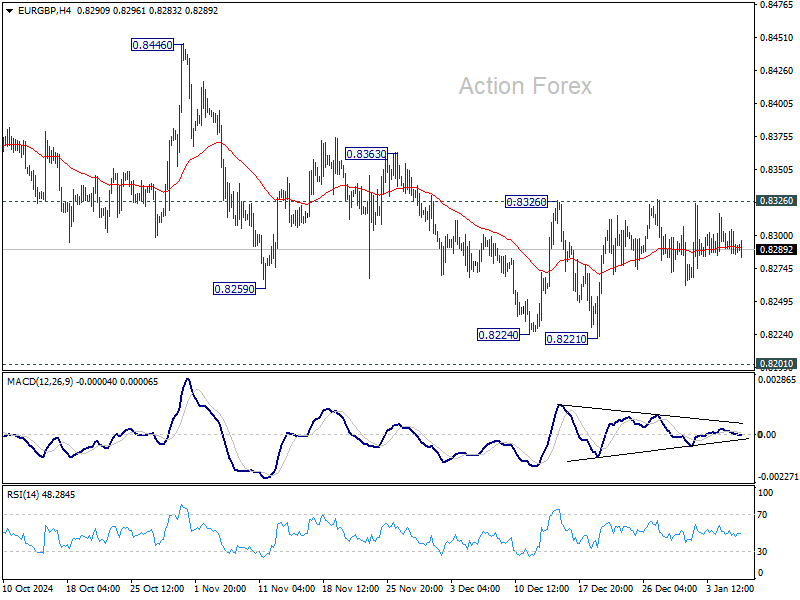
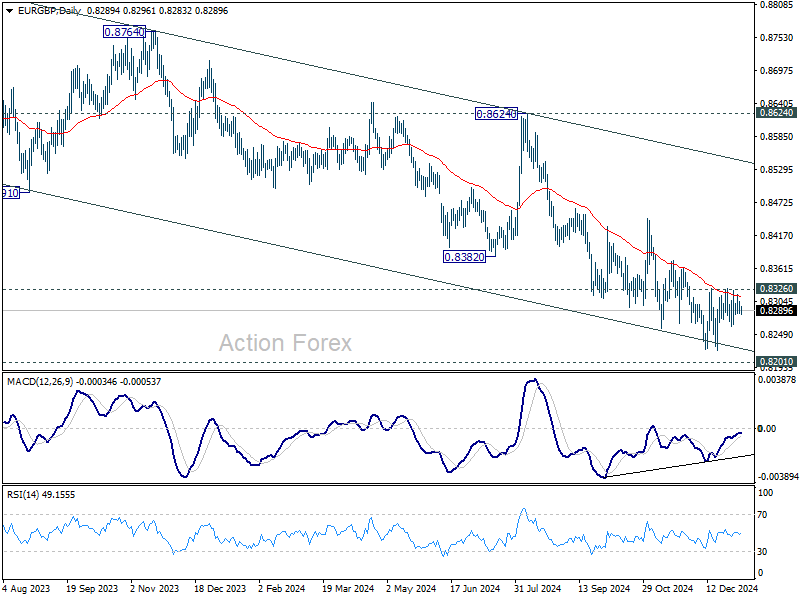
Technically, EUR/GBP is now in an interesting spot. It's close to 0.8201 key long term support (2022 low). So even in case of another fall, downside potential might be limited. However, there is no clear buying momentum to push it through 0.8446 resistance to confirm short term bottom yet. Hence, in case of some volatility today, quick range trading strategy would be more appropriate.

In Asia, Nikkei rose 0.50%. Hong Kong HSI is up 0.37%. China Shanghai SSE is down -0.71%. Singapore Strait Times is up 0.12%. Japan 10-year JGB yield is up 0.0117 at 1.075. Overnight, DOW fell -0.47%. S&P 500 fell -0.60%. NASDAQ fell -0.64%. 10-year yield fell -0.033 to 4.418.

Fed’s Powell: Rate moving towards neutral, but no rush to cuts

Fed Chair Jerome Powell conveyed in a speech overnight that the central bank sees no immediate need to reduce interest rates quickly. He added that with an "appropriate recalibration" of monetary policy, Fed believes it can sustain economic growth and robust employment while guiding inflation back down to its 2% target in a sustainable manner.

He highlighted that the risks to achieving the Fed's employment and inflation objectives are "roughly in balance," and emphasized that policymakers remain "attentive to the risks to both sides."

Powell noted that Fed is gradually moving policy toward a "more neutral setting". However, he stressed that the path to reaching this neutral rate is "not preset.".

Importantly, Powell remarked that "the economy is not sending any signals that we need to be in a hurry to lower rates." The prevailing economic strength provides Fed with the ability to approach monetary decisions "carefully."

Japan's real GDP growth slows to 0.9% annualized, robust consumption but weak investment

Japan's economy expanded by 0.2% qoq in Q3 2024, aligning with market expectations but indicating a slowdown from the previous quarter's momentum. On an annualized basis, GDP grew by 0.9%, surpassing the anticipated 0.7%, yet decelerating from a downwardly revised 2.2% growth in Q2.

The second straight quarter of expansion was largely propelled by robust private consumption, which accounts for over half of the nation's GDP. Private consumption increased by 0.9% qoq, up from revised 0.7% in the prior quarter, driven by solid demand for automobiles and the influence of wage increases. Despite persistent high inflation, consumers are channeling funds into spending as a result of wage gains.

However, the economy faces challenges as capital investment declined by -0.2% qoq after previous growth, reflecting the impact of a global economic slowdown on sectors like chipmaking equipment. Exports inched up by 0.4% qoq, indicating some resilience in external demand. In contrast, imports surged by 2.1% qoq, which negatively affected GDP by subtracting 0.4 percentage points from growth.

China's industrial growth and investment lag, while retail sales outperform in Oct

China’s economic data for October showed a mixed performance, with retail sales surpassing expectations while industrial production and fixed asset investment slightly underperformed.

Industrial production grew by 5.3% yoy, just shy of the expected 5.4% yoy and holding steady from the prior month. Fixed asset investment also slowed, increasing by 3.4% ytd yoy compared to the forecasted 3.5%.

Real estate investment continued to struggle, declining by -10.3% from the previous year’s level over the January-October period, marking the sharpest annualized contraction since August 2021. This steeper drop reflects ongoing pressures in China’s real estate sector.

In contrast, retail sales surged 4.8% yoy, beating expectations of 3.8% yoy and accelerating from September’s 3.2% yoy. This stronger retail activity was largely driven by a week-long national holiday and an early start to the Singles' Day shopping festival, which boosted consumer spending.

NZ BNZ manufacturing falls to 45.8, further contraction but new orders show signs of recovery

New Zealand’s BusinessNZ Performance of Manufacturing Index dropped from 47.0 to 45.8 in, marking its lowest point since July and extending the sector's contraction for a 20th straight month. The reading underscores continued struggles in the manufacturing sector, despite recent RBNZ rate cuts.

A breakdown of the report reveals broad weakness across production and employment indicators, with production slipping from 47.9 to 44.5, and employment declining from 46.8 to 45.8. Deliveries also fell to 44.6 from 45.6, and finished stocks modestly increased to 47.4. However, new orders provided a rare bright spot, rising from 47.9 to 49.0, the highest level since May 2023.

Encouragingly, the proportion of negative comments from respondents fell to 53.5% in October, a marked improvement from the previous months, where negative sentiment had peaked at 76.3% in June.

BNZ’s Senior Economist Doug Steel noted, “Despite lower interest rates, the manufacturing sector continues to face significant headwinds. Recent business surveys show a sharp contrast between improved expectations for activity and weak current conditions.”

Looking ahead

UK will release GDP, production and trade balance in European session. Swiss will release PPI.

Later in the day, US retail sales will be the main focus. Empire state manufacturing, import prices, industrial production and business inventories will also be published. Canada will release manufacturing sales and wholesale sales.

USD/CAD Daily Outlook

Daily Pivots: (S1) 1.4010; (P) 1.4038; (R1) 1.4087; More...

Intraday bias in USD/CAD remains on the upside for the moment. Current rally is part of the larger up trend. Next target is 61.8% projection of 1.3418 to 1.3958 from 1.3841 at 1.4175. On the downside, below 1.3993 minor support will turn intraday bias neutral and bring consolidations first. But outlook will stay bullish as long as 1.3841 support holds, in case of retreat.

In the bigger picture, up trend from 1.2005 (2021) is resuming with break of 1.3976 key resistance (2022 high). Next target is 61.8% projection of 1.2401 to 1.3976 from 1.3418 at 1.4391. Now, medium term outlook will remain bullish as long as 1.3418 support holds, even in case of deep pullback.

Economic Indicators Update

GMT CCY EVENTS ACT F/C PP REV
21:30 NZD Business NZ PMI Oct 45.8 46.9 47
23:50 JPY GDP Q/Q Q3 P 0.20% 0.20% 0.70%
23:50 JPY GDP Deflator Y/Y Q3 P 2.50% 2.90% 3.20%
02:00 CNY Industrial Production Y/Y Oct 5.30% 5.40% 5.40%
02:00 CNY Retail Sales Y/Y Oct 4.80% 3.80% 3.20%
02:00 CNY Fixed Asset Investment YTD Y/Y Oct 3.40% 3.50% 3.40%
04:30 JPY Tertiary Industry Index M/M Sep -0.20% 0.20% -1.10%
04:30 JPY Industrial Production M/M Sep F 1.60% 1.40% 1.40%
07:00 GBP GDP M/M Sep 0.20% 0.20%
07:00 GBP GDP Q/Q Q3 P 0.20% 0.50%
07:00 GBP Industrial Production M/M Sep 0.20% 0.50%
07:00 GBP Industrial Production Y/Y Sep -1.60%
07:00 GBP Manufacturing Production M/M Sep 0.00% 1.10%
07:00 GBP Manufacturing Production Y/Y Sep -0.30%
07:00 GBP Goods Trade Balance (GBP) Sep -16.5B -15.1B
07:30 CHF PPI M/M Oct 0.10% -0.10%
07:30 CHF PPI Y/Y Oct -1.30%
13:30 CAD Manufacturing Sales M/M Sep -0.70% -1.30%
13:30 CAD Wholesale Sales M/M Sep 0.20% -0.60%
13:30 USD Empire State Manufacturing Index Nov 3.6 -11.9
13:30 USD Retail Sales M/M Oct 0.30% 0.40%
13:30 USD Retail Sales ex Autos M/M Oct 0.20% 0.50%
13:30 USD Import Price Index M/M Oct -0.10% -0.40%
14:15 USD Industrial Production M/M Oct -0.20% -0.30%
14:15 USD Capacity Utilization Oct 77.10% 77.50%
15:00 USD Business Inventories Sep 0.20% 0.30%


Cliff Notes: Burgeoning Confidence

Key insights from the week that was.

In Australia, the latest Westpac-MI Consumer Sentiment Survey provided another encouraging update on the health of the consumer. An impressive 11.8% rebound over the past two months has left the headline index at 94.6, the strongest reading in over two-and-a-half years and well within striking distance of a ‘neutral’ reading. Most of the improvement in sentiment has been centred on forward-looking measures, namely year-ahead views on the economy (+23% vs. Sep) and family finances (+7.3% vs. Sep).

While the sub-indexes tracking ‘family finances versus a year ago’ and ‘time to buy a major household item’ have seen some improvement, they both remain at historically weak levels – consistent with evidence from card activity data that points to a limited pick-up in spending following the introduction of the Stage 3 tax cuts. An added complication was the reaction to the US Presidential Election, which saw sentiment deteriorate notably over the course of the survey week – the net effect being greater-than-usual uncertainty about how the rapid recovery in confidence may evolve as the year draws to a close.

Consumers remain confident in the jobs outlook – unsurprising given the strong growth in employment evinced by the labour force survey. Coming off a multi-month above-trend performance, employment growth slowed in October, printing a modest gain of 15.9k. However, that was still enough to keep the employment-to-population ratio unchanged at a record high of 64.4% – a signal employment is still keeping pace with historic population growth. A marginal easing in labour force participation also left the unemployment rate at 4.1% for a third consecutive month. These results, together with little-change in average hours worked and other broader measures of labour underutilisation, imply the labour market remains in robust health, with slack building only at the margin. If sustained, this trend will see nominal wages growth continue to moderate through 2025, but enough momentum persist to deliver further modest real income gains. The outlook for wages, inflation and RBA policy was discussed at length this week by Westpac Chief Economist Luci Ellis.

Before moving offshore, the latest NAB business survey provided further confirmation of a stabilisation in business conditions, the index marking time at +7 points in October. This is consistent with our view that economic growth is current at or near its nadir, having slowed to 1.0%yr mid-year. With consumers having begun to receive their tax cuts and monetary policy easing around the corner, businesses are becoming more optimistic on the outlook, confidence up seven points to +5 in the month. Westpac sees GDP growth accelerating to 1.5%yr by year-end, then 2.4%yr by December 2025.

Globally, financial markets this week continued to assess the implications of a second Trump presidency, attempting to ascertain the President-elect’s priorities through appointment announcements for the incoming administration. The US dollar rallied and longer-dated Treasury yields meanwhile rose as a Republican majority, albeit a slim one, was confirmed for the House of Representatives, giving President Trump more freedom to implement his agenda, centred around lowering taxes, deregulation and reducing immigration.

As we discussed this week, while an extension of the household income tax cuts due to expire next year should be easily achievable, agreement on other tax changes might prove more difficult and/or time-intensive to achieve, with views on next steps for tax policy varied even amongst Republicans. Import tariffs, another critical piece of Trump’s agenda, should support an expansion of domestic manufacturing activity, but only gradually and not without negative effects on consumers, with the price of imported and local production to lift. Note as well there is a timing difference too: tariffs will impact inflation and spending long before investment in new domestic supply can be planned, built and commissioned. We expect these policies to have a meaningful and sustained effect in consumer inflation which the FOMC will have to respond to in late-2026 when we have two 25bp rate hikes forecast – for full detail see Westpac Economics’ Market Outlook November 2024.

Between now and late-2025, the current disinflationary trend is expected to persist however, allowing the FOMC to reduce the fed funds rate to 3.375% by September 2025, a rate we regard to be broadly neutral for the economy. This week, October’s CPI report again confirmed that inflation pressures are benign, 0.2%mth and 0.3%mth increases in headline and core prices in line with the prior month as well as market expectations. Shelter is now the one significant laggard for inflation, with annualised and annual growth near 5%. The FOMC continue to show little-to-no concern over this item however, given rental growth for current agreements is close to zero. As the shelter component of the CPI factors these results in, annual headline inflation will tend from 2.6%yr currently towards the FOMC’s medium-term target of 2.0%yr.

Turning to Asia, just released October activity data for China showed authorities shift towards pro-active support is paying dividends, but more so that additional stimulus is necessary. Retail sales surprised to the upside, the annual rate accelerating from 3.2%yr in September to 4.8%yr in October, although year-to-date the pickup was considerably more timid, from 3.3%ytd to 3.5%ytd. House prices also responded to authorities’ directives, new and existing home price declines slowing abruptly, from -0.7%mth and -0.9%mth in September to -0.5% in October. Growth in fixed asset investment and industrial production was little changed though, at 3.4%ytd and 5.8%ytd.

Late last Friday, China’s run of policy announcements continued, a debt swap package already mooted detailed to the market. CNY10trn in new special bond issuance will be made available through two programs over 3 and 5 years to local governments to refinance 'hidden debt' onto public balance sheets. The primary benefit is an expected CNY600bn reduction in interest payments over 5 years. The measures will also aid the bring forward of infrastructure spending into late-2024 and early-2025 and ready local governments to buy up housing assets and land from 2025, another initiative previously announced, and intended to provide lasting support to home prices and construction. Authorities clearly remain focused on strengthening the financial position of both the public and private sector, removing impediments to growth and encouraging new activity. But by refraining from announcing outright stimulus, they continue to disappoint the market and, potentially, are putting confidence amongst consumers and business at risk.

Note though, last Friday, Finance Minister Lan Fo'an reportedly promised "more forceful" fiscal stimulus next year and, while discussing today’s data the NBS spokesperson pledged to achieve 2024’s annual growth target of 5.0%. As such, outright stimulus is arguably a matter of time, the length of the waiting period likely to depend on the evolution of US trade policy and global economic uncertainty.

The Real Wage Overhang Hangover

Wages growth has peaked and started declining. At current rates, even quite low productivity growth would be compatible with inflation being sustained at target. So why is the RBA so worried?

The Wage Price Index increased 0.8% in the September quarter and 3.5% over the year. This was in line with our expectations but – as Westpac Economics Senior Economist Justin Smirk pointed out – slightly below consensus expectations. The extent of the step down in the year-ended growth rate was well anticipated, because it reflected the dropping out of the outsized 2023 National Wage Case and related decisions from the calculation.

The RBA does not publish a full quarterly wages forecast profile, only the forecasts for year-ended growth as at June and December quarters. So, we do not know exactly what they expected for the September quarter. However, it would now need to see a bounce back in quarterly growth to around 1% for the December quarter for its end-2024 forecast to come true. Even allowing for some recent health-care agreements, we consider such a bounce to be beyond the bounds of plausibility given how smooth this series tends to be. There are no strong reasons for a change of direction of this kind, either. Surveys, data on awards and enterprise agreements and feedback from our own customers would all suggest that a sudden bounce back in wages growth is not happening.

We therefore expect that the RBA will have to revise down its near-term wages growth forecasts again in February, having already done so in November.

Forecasting is hard, so some revisions and near-term misses are par for the course. Even so, is there something going on with the way some observers think about domestic labour costs, that could be affecting their interpretation of the economic outlook? And in the case of the RBA, could this be affecting its monetary policy decision-making?

Some insights can be gleaned from the following passage from the latest Statement on Monetary Policy:

At current rates of productivity growth, WPI growth remains somewhat above rates that can be sustained in the long term without putting upward pressure on inflation. All else equal, when productivity growth is positive, WPI growth is able to outpace inflation while still being consistent with inflation at the midpoint of the target range. As trend growth in labour productivity is likely below its rate in previous decades, the sustainable WPI growth rate is probably lower than in the past and below the current rate of growth. That suggests it would be difficult to sustain wages growth at its current pace in the longer term without a higher pace of trend productivity growth.

There are a few things worth noting about this passage.

First, this reasoning comes from the markup model for forecasting inflation. As explained in a previous note, this model starts from the presumption that prices are a (roughly stable) markup over costs, including labour costs. A bit of algebra later leads to a relationship that states that wages growth minus productivity growth is approximately equal to inflation (prices growth). As discussed in that previous note, there are a lot of assumptions underlying the use of this relationship for forecasting. But more fundamentally, the WPI is not the measure of labour cost growth that maps most closely to the one implied in that relationship. Rather, the more volatile average earnings measures from the national accounts are more relevant.

Presumably the RBA has used the smoother WPI measure for ease of exposition. In that case, though, one should be even more circumspect about how tightly the relationship should hold.

Second, there are some interesting implied choices of time period used in that paragraph. For example, it is stated that future trend productivity growth is expected to be slower than the average of previous decades. This is not controversial: the late 1990s was a period of strong productivity growth globally, largely because of the adoption of personal computers and other new technologies. More recent productivity growth was slower, but not zero. The real question is whether future productivity growth will be slower than the average of more recent times, such as the years leading up to the pandemic. Perhaps this is true, but the reasons for a further slowdown have not been elucidated. While any boost from AI and other technology will indeed take time to show up in the productivity figures, just as PCs did, a further decline in global trend productivity growth is not the base case for the profession more broadly.

Third, even granting the reduced noise from using the WPI, and assuming a further slowdown in global productivity, there is the question of why the RBA repeatedly referenced the sustainability of the current rate of growth. At the time of publication, this was the year to the June quarter figure of 4.1%, not the year to September quarter figure of 3.5% just reported. Yet the RBA surely anticipated the step down in growth that was already baked in to awards and many enterprise agreements. Why the focus on the sustainability of a growth rate that everyone knew was not going to be sustained? The question also arises of how we reconcile wages growth having already rolled over, to annualised rates in the low 3s, with the RBA’s view that the labour market is still tight.

Later in the document, the step down in unit labour cost growth from 7% annualised to 3½% annualised in just six months was noted (as we had previously expected and written about). So why the implication that growth in labour costs was much stickier than that?

The deeper question is: with wages growth tracking in the low 3s and productivity growth not being zero, why has the RBA focused so much on the risk that wages growth is unsustainable?

I can’t help thinking that this partly reflects deep-seated narratives about the Australian economy not being competitive. These narratives stemmed from the so-called ‘real wage overhang’ that emerged in the 1970s following the policy-induced wages breakout then. Another bout of this belief system emerged after the mining boom and attendant strong income growth. Since then, restoring competitiveness by crimping wages growth has been a common go-to in the policy discourse in Australia, far more than elsewhere in my observation. It is as if people forget that exchange rates tend to move much faster than domestic labour costs.

In any case, even if productivity growth averages a touch lower than 1% (worse than recent history), then by the RBA’s own figuring, WPI growth averaging 3.2% (the annualised rate of the past three quarters) is well and truly consistent with inflation averaging 2½% or below. Perhaps we need to let go of the pandemic-era hangover.

China’s industrial growth and investment lag, while retail sales outperform in Oct

China’s economic data for October showed a mixed performance, with retail sales surpassing expectations while industrial production and fixed asset investment slightly underperformed.

Industrial production grew by 5.3% yoy, just shy of the expected 5.4% yoy and holding steady from the prior month. Fixed asset investment also slowed, increasing by 3.4% ytd yoy compared to the forecasted 3.5%.

Real estate investment continued to struggle, declining by -10.3% from the previous year’s level over the January-October period, marking the sharpest annualized contraction since August 2021. This steeper drop reflects ongoing pressures in China’s real estate sector.

In contrast, retail sales surged 4.8% yoy, beating expectations of 3.8% yoy and accelerating from September’s 3.2% yoy. This stronger retail activity was largely driven by a week-long national holiday and an early start to the Singles' Day shopping festival, which boosted consumer spending.

Japan’s real GDP growth slows to 0.9% annualized, robust consumption but weak investment

Japan's economy expanded by 0.2% qoq in Q3 2024, aligning with market expectations but indicating a slowdown from the previous quarter's momentum. On an annualized basis, GDP grew by 0.9%, surpassing the anticipated 0.7%, yet decelerating from a downwardly revised 2.2% growth in Q2.

The second straight quarter of expansion was largely propelled by robust private consumption, which accounts for over half of the nation's GDP. Private consumption increased by 0.9% qoq, up from revised 0.7% in the prior quarter, driven by solid demand for automobiles and the influence of wage increases. Despite persistent high inflation, consumers are channeling funds into spending as a result of wage gains.

However, the economy faces challenges as capital investment declined by -0.2% qoq after previous growth, reflecting the impact of a global economic slowdown on sectors like chipmaking equipment. Exports inched up by 0.4% qoq, indicating some resilience in external demand. In contrast, imports surged by 2.1% qoq, which negatively affected GDP by subtracting 0.4 percentage points from growth.

USD/JPY Extends Gains: Is More Upside Ahead?

Key Highlights

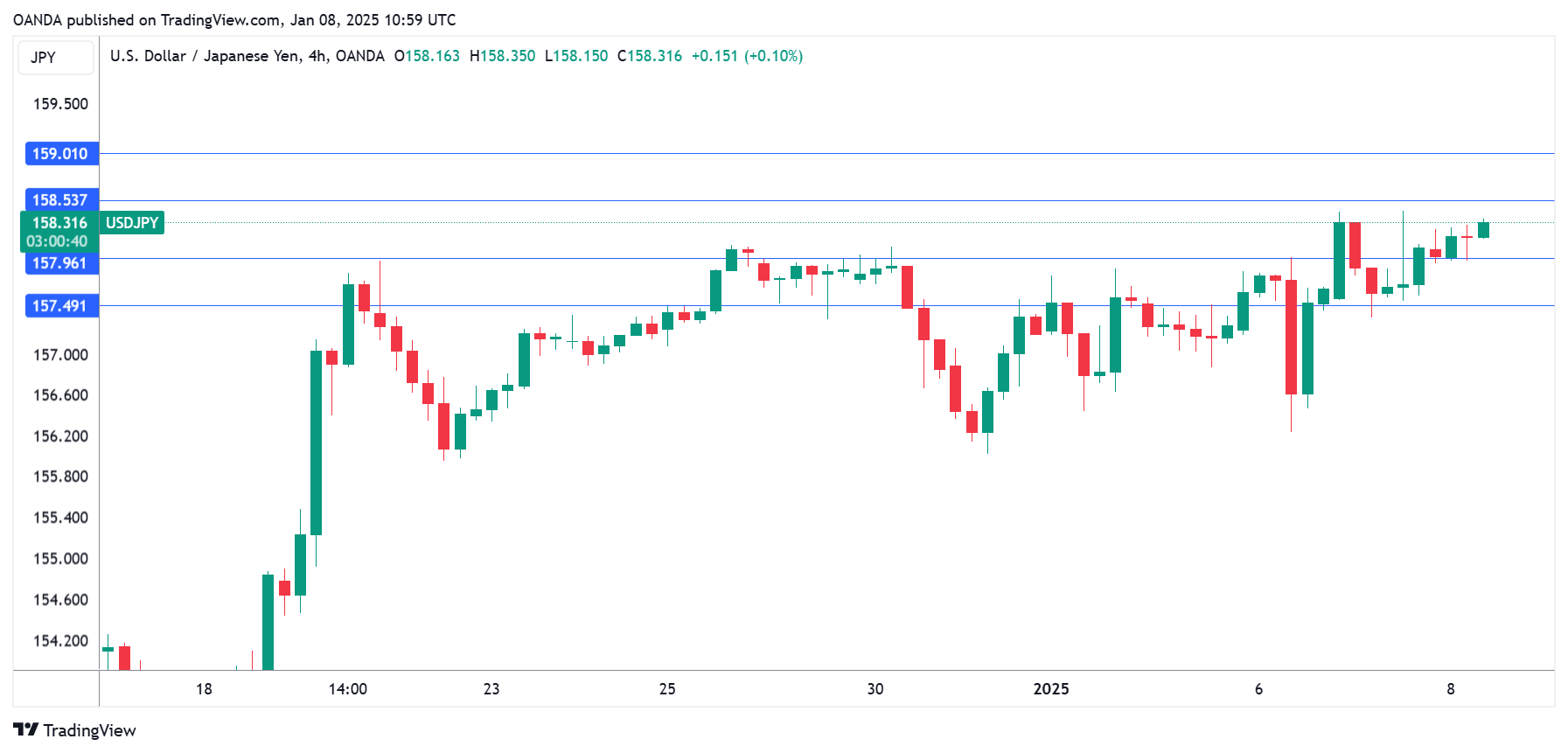
  • USD/JPY started another increase above the 154.65 resistance.
  • A key bullish trend line is forming with support at 155.25 on the 4-hour chart.
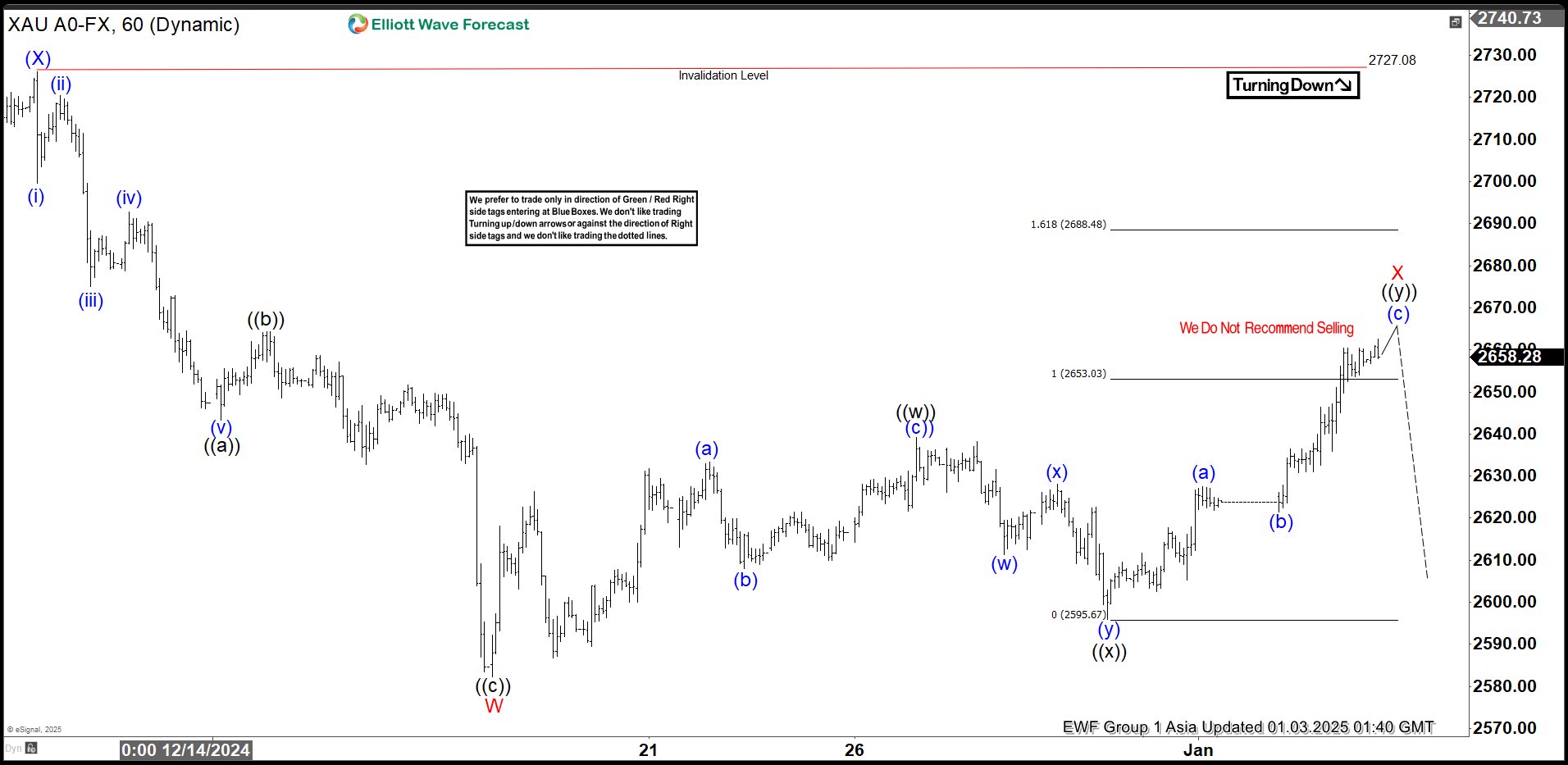
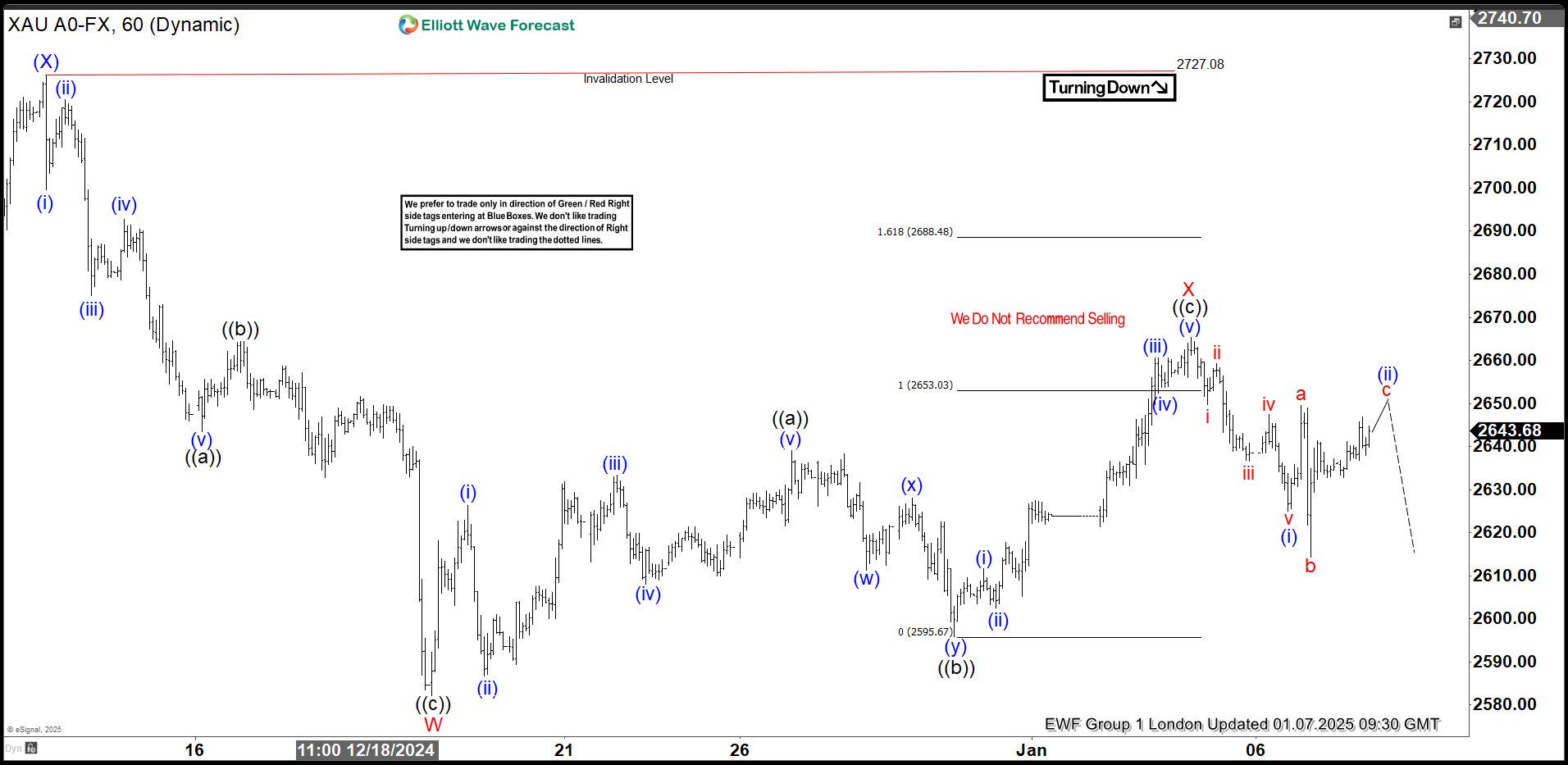
  • Gold extended losses and traded below the $2,600 support.
  • Oil is consolidating and facing hurdles near the $70.00 resistance.

USD/JPY Technical Analysis

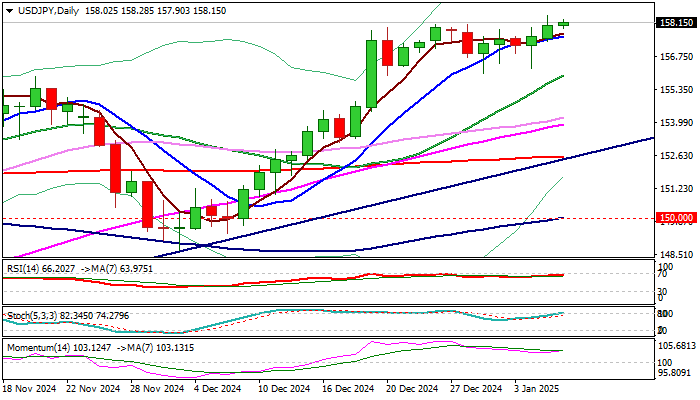
The US Dollar started a fresh increase from the 152.35 zone against the Japanese Yen. USD/JPY cleared the 153.50 and 154.50 resistance levels to move into a positive zone.

Looking at the 4-hour chart, the pair settled above the 155.65 barrier, the 100 simple moving average (red, 4-hour), and the 200 simple moving average (green, 4-hour). There was also a move above the 156.00 level.

The pair is now showing signs of strength and might continue to rise above 156.25. On the upside, the pair could face resistance near the 156.85 level.

The first key resistance is near the 157.50 level. A close above the 157.50 level could set the tone for another increase. The next major resistance could be 158.80, above which the price could accelerate higher toward the 160.00 resistance.

On the downside, immediate support sits near the 155.25 level. There is also a key bullish trend line forming with support at 155.25 on the same chart.

The next key support sits near the 154.65 level. Any more losses could send the pair toward the 153.80 level or even 152.50 in the near term.

Looking at Gold, the bears gained strength, and they were able to push the price below the $2,620 and $2,600 support levels.

Upcoming Economic Events:

  • US Retail Sales for Oct 2024 (MoM) – Forecast +0.3%, versus +0.4% previous.
  • NY Empire State Manufacturing Index for Nov 2024 – Forecast -0.7, versus -11.9 previous.

NZ BNZ manufacturing falls to 45.8, further contraction but new orders show signs of recovery

New Zealand’s BusinessNZ Performance of Manufacturing Index dropped from 47.0 to 45.8 in, marking its lowest point since July and extending the sector's contraction for a 20th straight month. The reading underscores continued struggles in the manufacturing sector, despite recent RBNZ rate cuts.

A breakdown of the report reveals broad weakness across production and employment indicators, with production slipping from 47.9 to 44.5, and employment declining from 46.8 to 45.8. Deliveries also fell to 44.6 from 45.6, and finished stocks modestly increased to 47.4. However, new orders provided a rare bright spot, rising from 47.9 to 49.0, the highest level since May 2023.

Encouragingly, the proportion of negative comments from respondents fell to 53.5% in October, a marked improvement from the previous months, where negative sentiment had peaked at 76.3% in June.

BNZ’s Senior Economist Doug Steel noted, “Despite lower interest rates, the manufacturing sector continues to face significant headwinds. Recent business surveys show a sharp contrast between improved expectations for activity and weak current conditions.”

Full NZ BNZ PMI release here.

Fed’s Powell: Rate moving towards neutral, but no rush to cuts

Fed Chair Jerome Powell conveyed in a speech overnight that the central bank sees no immediate need to reduce interest rates quickly. He added that with an "appropriate recalibration" of monetary policy, Fed believes it can sustain economic growth and robust employment while guiding inflation back down to its 2% target in a sustainable manner.

He highlighted that the risks to achieving the Fed's employment and inflation objectives are "roughly in balance," and emphasized that policymakers remain "attentive to the risks to both sides."

Powell noted that Fed is gradually moving policy toward a "more neutral setting". However, he stressed that the path to reaching this neutral rate is "not preset.".

Importantly, Powell remarked that "the economy is not sending any signals that we need to be in a hurry to lower rates." The prevailing economic strength provides Fed with the ability to approach monetary decisions "carefully."

Full speech of Fed's Powell here.

Trading USD/CHF: What to Expect After US Dollar’s Multi-Month Highs

  • USD/CHF is facing resistance at the 0.8900 handle after breaking above the 200-day MA.
  • The US Dollar Index (DXY) is also at multi-month resistance, raising questions about a potential pullback.
  • The Swiss Franc’s recent weakness will be welcomed by Swiss exporters and eases pressure on the Swiss National Bank (SNB).

USD/CHF has run into resistance around the 0.8900 handle having broken above the 200-day MA for the first time since late July. The recent US Dollar rally drove the pair higher as the CHF has faced headwinds due to a lack of safe haven flows in recent weeks.

The USD Index itself has risen to levels last seen in November 2023 around the 107.00 handle. Market participants are no doubt hoping for a pause around this level with a bit of weakness evident in today’s US session with the DXY retreating from multi-month resistance to trade around 106.55 at the time of writing.

US Dollar Index (DXY) Daily Chart, November 14, 2024

Source: TradingView (click to enlarge)

Fundamental Backdrop

The weakness in CHF is not the worst thing in the world, especially where Swiss exporters are concerned. The Swiss economy and businesses in general had made a plea a few months ago to the Central Bank as the Swiss Franc benefitted from safe haven flows to strengthen to multi month highs against G7 counterparts. This had a negative impact on many sectors of the Swiss economy which rely on exports as prices rose.

US data this week has also done little to ease concerns that the Fed may not cut rates as much as expected in 2025. An uptick in PPI data as the labor market appears to be cooling is not really a positive sign as inflationary fears have risen following the election of Donald Trump. For the first time since April 2023, Core PPI and CPI inflation are back above 3.0%.

Ahead we have Fed Chair Powell speaking later in the US session, will we get any change in rate cut expectations? I do doubt any change will take place as I expect the Fed Chair to keep up the rhetoric that the data will decide policy. I take that as the Fed will wait to gauge the impact of incoming President Donald Trump’s policy on tariffs etc and see what the actual impact will be on inflation moving forward.

We wrap up the week with US retail sales tomorrow.

Technical Analysis

From a technical standpoint, USD/CHF has broken above the inner and outer trendline as well as the 200-day MA. USD/CHF has rallied some 500 pips since October 1 but has paused at the resistance level around the 0.8900 handle.

Given the strength of the trend i would expect the bulls to push through this level but there are warning signs flashing that a retracement may be imminent. Looking at the DXY, it has run into multi-month resistance at the 107.00 handle while also hovering in overbought territory. This is a mirror of the USD/CHF which is also now trading overbought territory based on the 14 period RSI and has run into resistance as well.

A lot will hinge on how the DXY navigates the resistance level at 107.00.

If USD/CHF experiences a pullback, immediate support rests at the 200-day MA around 0.8819 with further support offered at 0.8757.

Conversely, a move higher from here will be eyeing the psychological 0.9000 handle before resistance at 0.9040 and 0.9087 come into focus. Based on the rules around trendline, the 0.9040 handle is a key area as it was the second point of contact for the descending trendline and could prove a tough nut to crack.

USD/CHF Daily Chart, November 14, 2024

Source: TradingView (click to enlarge)

Support

  • 0.8819
  • 0.8757
  • 0.8633

Resistance

  • 0.8890
  • 0.9000
  • 0.9040

GBPUSD Wave Analysis

    GBPUSD reversed from strong support level 1.2665

  •  Likely to rise to resistance level 1.2840

GBPUSD currency pair recently reversed up from the strong support level 1.2665 (former monthly low from August), standing close to the lower daily Bollinger Band and the 61.8% Fibonacci correction of the upward impulse from April.

The upward reversal from the support level 1.2665 created the daily Japanese candlesticks reversal pattern Hammer Doji.

Given the strength of the support level 1.2665 and the oversold daily Stochastic, GBPUSD currency pair can be expected to rise to the next resistance level 1.2840, former support from the end of October.