Sample Category Title
Dollar Consolidates Ahead of Nonfarm Payrolls: Possible Scenarios
In anticipation of the release of one of the most important reports, the NonFarm Payrolls, the US currency has suffered losses across almost all fronts. Earlier this week, the EUR/USD currency pair tested and settled above 1.0800, GBP/USD traded above 1.2700, and USD/CAD fell back to 1.3610.
Today, we might see either continued corrective pullbacks or a resumption of medium-term trends if the employment data deviates from expectations. So, what should we expect?
- Experts forecast a decline in average earnings to 0.3% (if the figure comes in at last month's level or higher, it could strengthen the US currency).
- The number of new jobs in June is expected to be 194K (if the figure is significantly higher or lower than the forecast, it could cause volatility in major currency pairs).
USD/CAD
Dollar buyers in the USD/CAD pair failed to overcome resistance at 1.3750. A rebound from this level led to the formation of a "bearish engulfing" pattern on the daily timeframe. According to the technical analysis of USD/CAD, the price has approached the lower boundary of the medium-term flat corridor at 1.3610. If the price consolidates below this level in the coming trading sessions, the downward movement could continue towards 1.3520-1.3480. A rebound from 1.3610 could lead to a retest of 1.3700-1.3660.
EUR/USD
Technical analysis of EUR/USD suggests the potential for continued growth towards 1.0900, as the price has exited the medium-term flat corridor of 1.0760-1.0650. A break in the upward impulse is possible if the price returns to the specified corridor and consolidates below 1.0760. Besides the publication of US employment data, the following events are worth noting today:
- At 10:00 (GMT +3:00) a speech by the President of the German Bundesbank, Nagel.
- At 12:00 (GMT +3:00) the release of retail sales volumes in the Eurozone for May.
Trade over 50 forex markets 24 hours a day with FXOpen. Take advantage of low commissions, deep liquidity, and spreads from 0.0 pips. Open your FXOpen account now or learn more about trading forex with FXOpen.
This article represents the opinion of the Companies operating under the FXOpen brand only. It is not to be construed as an offer, solicitation, or recommendation with respect to products and services provided by the Companies operating under the FXOpen brand, nor is it to be considered financial advice.
Market Analysis: Gold and Oil Prices Soar, More Gains Ahead?
Gold price started a fresh increase above the $2,342 resistance level. Crude oil prices are gaining bullish momentum and might soon test $85.00.
Important Takeaways for Gold and Oil Prices Analysis Today
- Gold price started a steady increase from the $2,320 zone against the US Dollar.
- A connecting bullish trend line is forming with support near $2,355 on the hourly chart of gold at FXOpen.
- Crude oil prices extended gains above the $82.00 and $83.00 resistance levels.
- There is a key bullish trend line forming with support at $82.75 on the hourly chart of XTI/USD at FXOpen.
Gold Price Technical Analysis
On the hourly chart of Gold at FXOpen, the price found support near the $2,320 zone. The price formed a base and started a fresh increase above the $2,330 level.
There was a decent move above the 50-hour simple moving average and $2,335. The bulls pushed the price above the $2,355 resistance zone. Finally, the bears appeared near $2,365. A high was formed near $2,364.89 and the price is now consolidating gains.
The price dipped a few points and tested the 23.6% Fib retracement level of the upward move from the $2,319 swing low to the $2,365 high. The RSI is still above 55 and the price could aim for more gains.
Immediate resistance is near the $2,365 level. The next major resistance is near the $2,372 level. An upside break above the $2,372 resistance could send Gold price toward $2,380. Any more gains may perhaps set the pace for an increase toward the $2,400 level.
Initial support on the downside is near the $2,355 zone. There is also a connecting bullish trend line forming with support near $2,355. If there is a downside break below the $2,355 support, the price might decline further.
In the stated case, the price might drop toward the $2,335 support or the 61.8% Fib retracement level of the upward move from the $2,319 swing low to the $2,365 high. The next major support sits at $2,320.
Oil Price Technical Analysis
On the hourly chart of WTI Crude Oil at FXOpen, the price started a major upward move from $80.45 against the US Dollar. The price gained bullish momentum after it broke the $82.00 resistance.
The bulls pushed the price above the $82.30 and $82.75 resistance levels. The recent high was formed at $83.50 and the price settled above the 50-hour simple moving average. The RSI is now near the 50 level and the price is trading below the 23.6% Fib retracement level of the upward move from the $81.95 swing low to the $83.52 high.
If the price climbs higher again, it could face resistance near $83.50. The next major resistance is near the $83.75 level. Any more gains might send the price toward the $85.00 level.
Conversely, the price might correct gains and test the 50% Fib retracement level of the upward move from the $81.95 swing low to the $83.52 high at $82.75. There is also a key bullish trend line forming with support at $82.75.
The next major support on the WTI crude oil chart is near the $82.30 zone, below which the price could test the $82.00 zone. If there is a downside break, the price might decline toward $80.85. Any more losses may perhaps open the doors for a move toward the $78.50 support zone.
Start trading commodity CFDs with tight spreads. Open your trading account now or learn more about trading commodity CFDs with FXOpen.
This article represents the opinion of the Companies operating under the FXOpen brand only. It is not to be construed as an offer, solicitation, or recommendation with respect to products and services provided by the Companies operating under the FXOpen brand, nor is it to be considered financial advice.
Anything But a Significant NFP Beat Probably Triggers Higher Bond Prices and Weaker Dollar
Markets
An uneventful session yesterday put the UK elections in the spotlights. It’s already clear by now that Labour won enough seats to secure a majority (at least 326 seats of the 650 up for grabs) after being in the opposition for 14 years. Exit polls taken after voting booths closed at 10 PM yesterday suggested it’s going to be a huge one with estimates going as high as 410, making it a victory comparable to the 1997 landslide under Tony Blair. Outgoing PM Sunak’s Conservative Party simply imploded. Voter turnout was close to a record low. As Labour’s Starmer is ready to move in to Downing Street 10, market attention shifts towards the new government’s policy plans. There’s a feeling that things can only get better in the UK with a hoped-for end to years of political drama that included Conservative infighting, BYOB lockdown scandals, Scotland’s independence referendum and of course Brexit. Labour’s typically has spending ambitions though markets assume the Truss-Kwarteng bond crash brought a sense of fiscal awareness. Chancellor-to-be Rachel Reeves also said that the administration does not plan to raise three key UK taxes on wages and goods. All that have yet to be formalized in a first official budget though, which could take until October. Sterling barely budged on the widely anticipated Labour win. EUR/GBP eked out a small gain yesterday to close at 0.8474. Trading for the next couple of days, perhaps weeks, could remain technically inspired as summer liquidity conditions kick in.
The US returns today after having enjoyed the day off for the 4th of July. They are immediately treated with important data. The June labour market report is due with the bar set at for a 190k job creation. Hourly earnings are expected to roll in at 0.3% m/m (3.9% y/y), easing from the 0.4% the month before. Unemployment would stabilize at 4%. The labour market gained in importance after several Fed governors showed increasing concerns that it may be nearing an inflection point. Upcoming data would now have to prove them otherwise. Markets will react accordingly with anything but a significant beat probably triggering higher bond prices and a weaker US dollar. The US 2-yr yield is trading a few basis points above the June lows of 4.65%. A break lower paves the way for a return to 4.58-4.60%. Longer maturities including the 10-yr have a bit more wiggle room ahead of similar support areas. EUR/USD topped the 1.08 yesterday. Next resistance is located at 1.087 before 1.09 shows up. But this may be a bridge too far for now this weekend’s second round in the French elections looming.
News & Views
Japanese consumer spending in May showed an unexpected steep decline, the statistical bureau said. Spending still rose 1.4% Y/Y in nominal terms but was 1.8% lower in real terms while contracting 0.3% M/M. Consensus expected real spending to have stayed in positive territory (0.3% Y/Y expected from 0.5% in April). The decline originated from food (-3.1%), housing (-3.5%), utilities (-9.7%) but also from lower discretionary spending in furniture and utensils (- 10.0%) and spending on culture and recreation (-8.4%). Positive growth was registered for education (9.3%) and medical care (6.4%). If confirmed by other data, the decline would complicated BOJ policy normalization as it seeks an upward spiral of higher real wages and gradual price rises to support domestic spending. Today’s data are a factor for the BOJ to wait with a rate hike at the upcoming July 31 meeting. USD/JPY (160.75) this morning eases of multi-decade highs just below 162 reached earlier this week, but this at least partially due to USD softness.
The NBP of Poland last Wednesday as expected left its policy rate unchanged at 5.75%. In new projections, inflation expectations were upwardly revised for this year (3.7% from 3.55%) and specially for next year (5.25% from 3.6%). In the press briefing commenting the decision yesterday, the new forecast caused governor Glapinski to conclude that expectations for a rate hike anytime soon are out of question. Inflation might again reach 5.0% at the end of this year and might even accelerated further on higher energy prices at the start of 2025. In this context, he concluded that a possibility to cut rates might only take place in 2026 at earliest. The zloty extended this week’s gains with EUR/PLN closing at EUR/PLN 4.2825).
Graphs
GE 10y yield
The ECB cut its key policy rates by 25 bps at the June policy meeting. A more bumpy inflation path in H2 2024, the EMU economy gradually regaining traction and the Fed’s higher for longer US strategy make follow-up moves difficult. Markets are coming to terms with that. Meanwhile, much of the save haven bids were reversed after the first round in the French elections. The 2.34%-2.4% support zone looks solid.
US 10y yield
The Fed needs more evidence than just one slower-than-expected (May) CPI is providing. Upgraded inflation forecasts and a higher neutral rate complicate the timing of a first cut further. June dots suggest one move in 2024 and four next year. The long end of the curve is supported by increased odds of a Trump presidency after the debate with Biden. The spectre of increased spending (risk premia) pulled the 10-yr away from the 4.2% support area.
EUR/USD
EUR/USD is stuck in the 1.06-1.09 range. The desynchronized rate cut cycle with the ECB exceptionally taking the lead, strong US May payrolls and a swing to the right in European elections pulled the pair away from 1.09. The Fed meeting balanced the weaker than expected US CPI outcome. The increased probability of a hung French parliament after the first round offered the euro some relief.
EUR/GBP
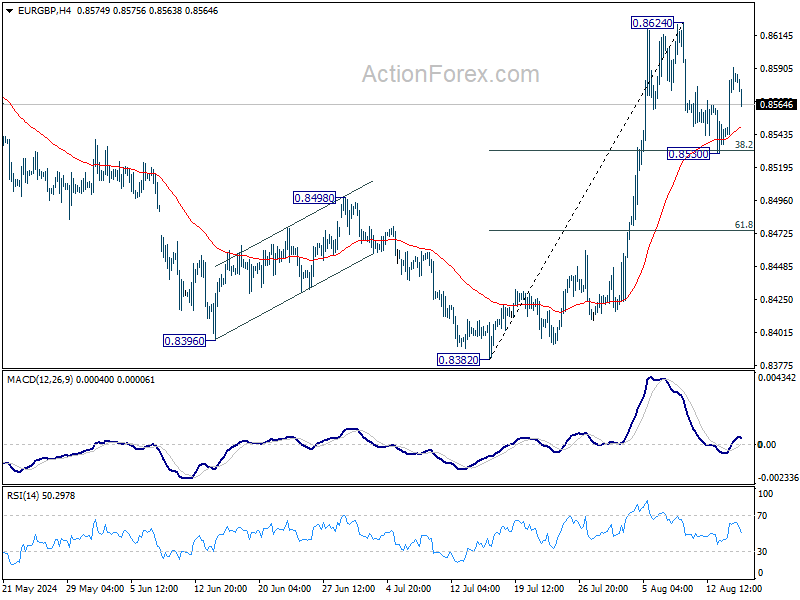
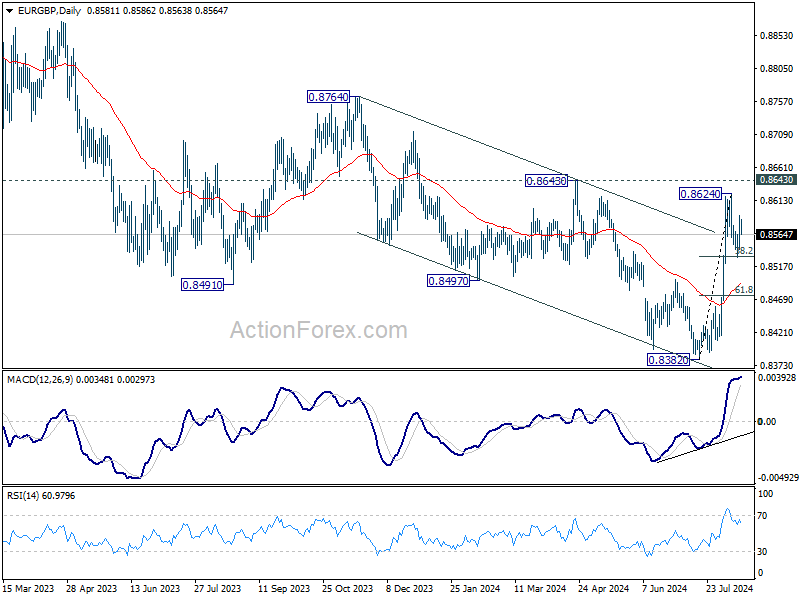
Debate at the BOE is focused at the timing of rate cuts. May headline inflation returned to 2%, but core measures weren’t in line with inflation sustainably returning to target any time soon. Still some BoE members at the June meeting appeared moving closer to a rate cut. This might cap further sterling gains. Labour has yet to reveal its policy plans after securing a landslide election victory. EUR/GBP 0.84 is solid support.
USD/CAD Daily Outlook
Daily Pivots: (S1) 1.3610; (P) 1.3648; (R1) 1.3679; More...
Intraday bias in USD/CAD remains neutral first. Break of 1.3589 will resume the corrective fall from 1.3845 to 100% projection of 1.3845 to 1.3589 from 1.3790 at 1.3534. Strong support would be seen there to bring rebound. On the upside, above 1.3686 minor resistance will turn bias back to the upside for 1.3790 resistance instead.
In the bigger picture, price actions from 1.3976 (2022 high) are viewed as a corrective pattern. In case of another fall, strong support should emerge above 1.2947 resistance turned support to bring rebound. Firm break of 1.3976 will confirm up resumption of whole up trend from 1.2005 (2021 low). Next target is 61.8% projection of 1.2401 to 1.3976 from 1.3176 at 1.4149.
AUD/USD Daily Report
Daily Pivots: (S1) 0.6708; (P) 0.6720; (R1) 0.6738; More...
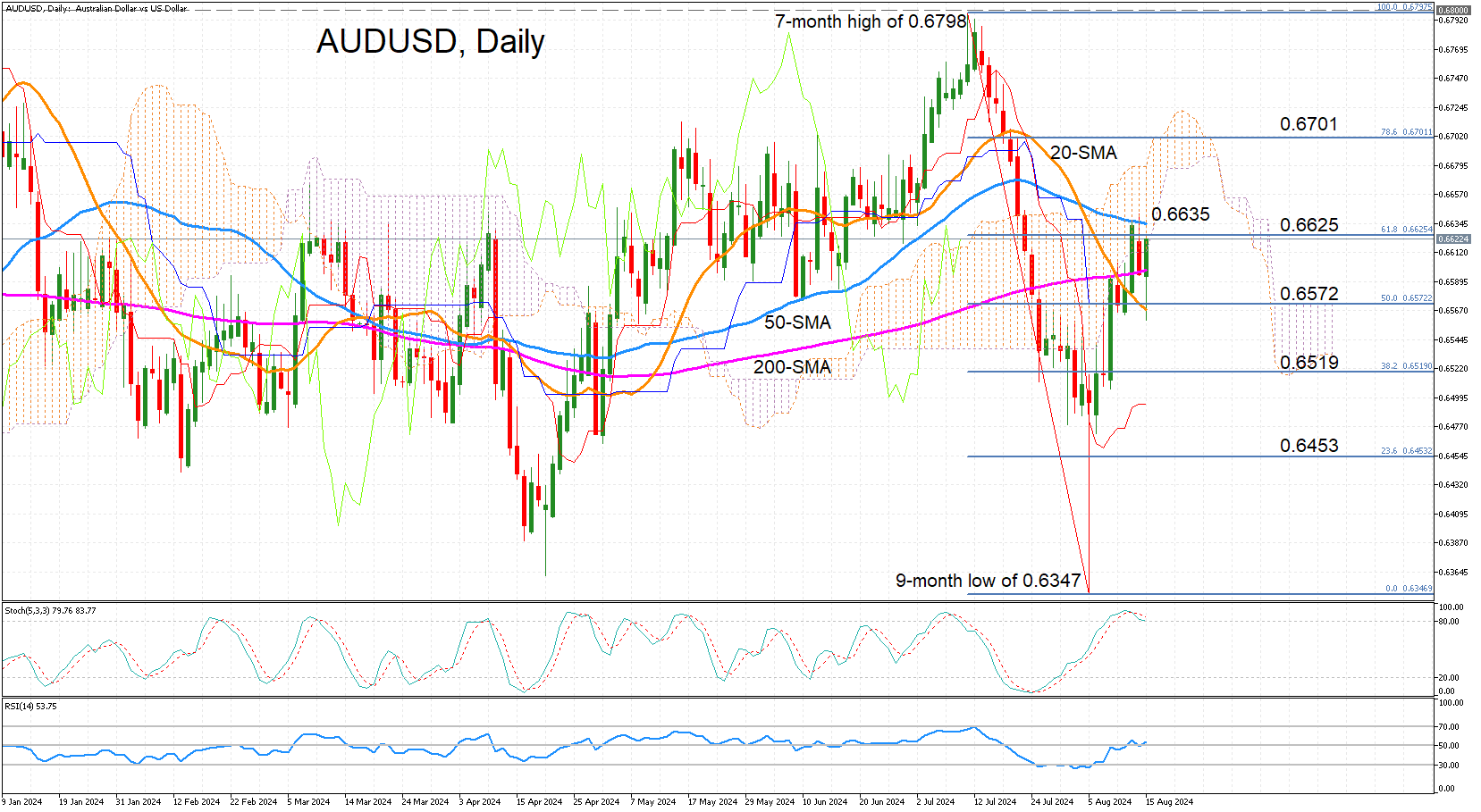
AUD/USD's rally is in progress and intraday bias stays on the upside. Current rise from 0.6361 should target 61.8% projection of 0.6361 to 0.6713 from 0.6619 at 0.6837 next. On the downside, below 0.6699 minor support will turn intraday bias neutral first. But, near term outlook will stay bullish as long as 0.6619 support holds, in case of retreat.
In the bigger picture, price actions from 0.6169 (2022 low) are seen as a medium term corrective pattern to the down trend from 0.8006 (2021 high). Fall from 0.7156 (2023 high) is seen as the second leg, which could have completed at 0.6269 already. Rise from there is seen as the third leg which is now trying to resume through 0.6870 resistance.
USD/JPY Daily Outlook
Daily Pivots: (S1) 160.92; (P) 161.30; (R1) 161.66; More...
Intraday bias in USD/JPY remains neutral for the moment and some more consolidations could be seen first. Further rally is expected as long as 160.25 minor support holds. Break of 161.94 will resume larger up trend to 61.8% projection of 146.47 to 160.20 from 154.53 at 163.01. Nevertheless, break of 160.25 will turn bias to the downside for deeper pullback.
In the bigger picture, long term up trend is still in progress. Further rise is expected as long as 154.53 support holds. Next target is 100% projection of 127.20 (2023 low) to 151.89 (2023 high) from 140.25 at 164.94.
USD/CHF Daily Outlook
Daily Pivots: (S1) 0.8983; (P) 0.9012; (R1) 0.9031; More…
USD/CHF is staying consolidation below 0.9049 and intraday bias remains neutral. Further rise is mildly in favor as long as 0.8956 support holds. Above 0.9049 will affirm the case that corrective fall from 0.9223 has completed at 0.8825. Further rally would then be seen to 0.9157 resistance next. However, firm break of 0.8956 will bring retest of 0.8825 support instead.
In the bigger picture, focus remains is now on 0.9223/9243 resistance zone. Decisive break there would complete a head and shoulder bottom pattern (ls: 0.8551; h: 0.8332; rs: 0.8825). That would indicate larger bullish trend reversal. Nevertheless, rejection by 0.9223/43 will keep medium term outlook neutral at best, for more range trading between 0.8332/9243 first.
EUR/USD Daily Outlook
Daily Pivots: (S1) 1.0791; (P) 1.0804; (R1) 1.0825; More....
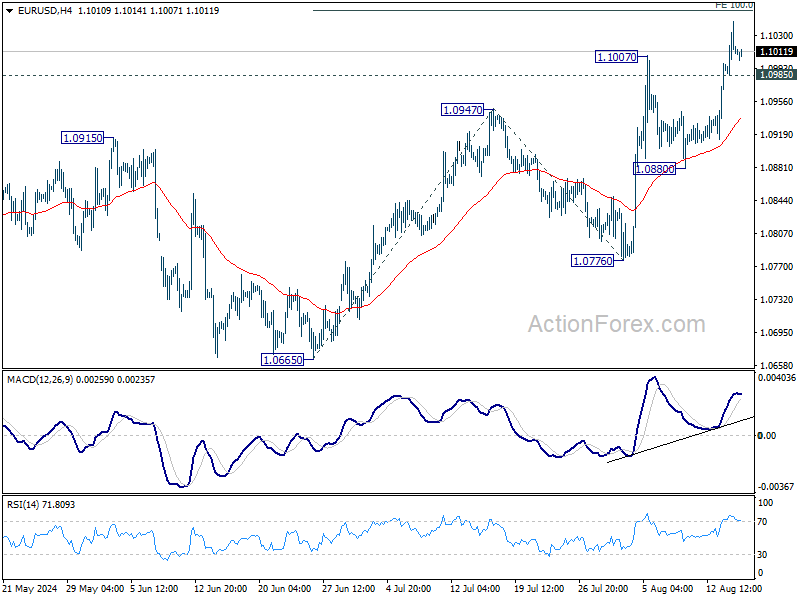
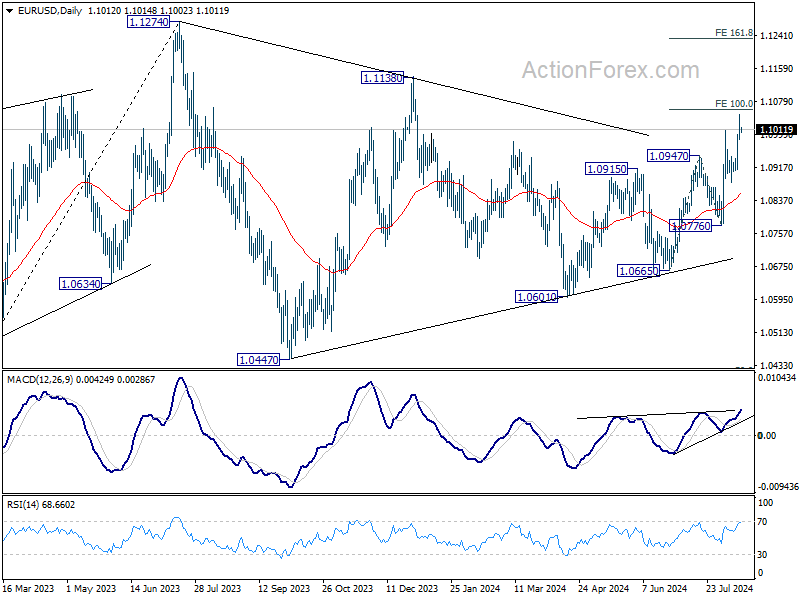
EUR/USD's rebound from 1.0665 is still in progress and intraday bias stays on the upside. Further rally would be seen to 1.0915 resistance next. On the downside, below 1.0775 minor support will turn intraday bias neutral first.
In the bigger picture, price actions from 1.1274 are viewed as a corrective pattern that's still in progress. Break of 1.0601 will target 1.0447 support and possibly below. On the upside, firm break of 1.0915 resistance will start another rising leg back to 1.1138 resistance instead.
Euro and Sterling Up, USD Down Ahead of US Jobs Data
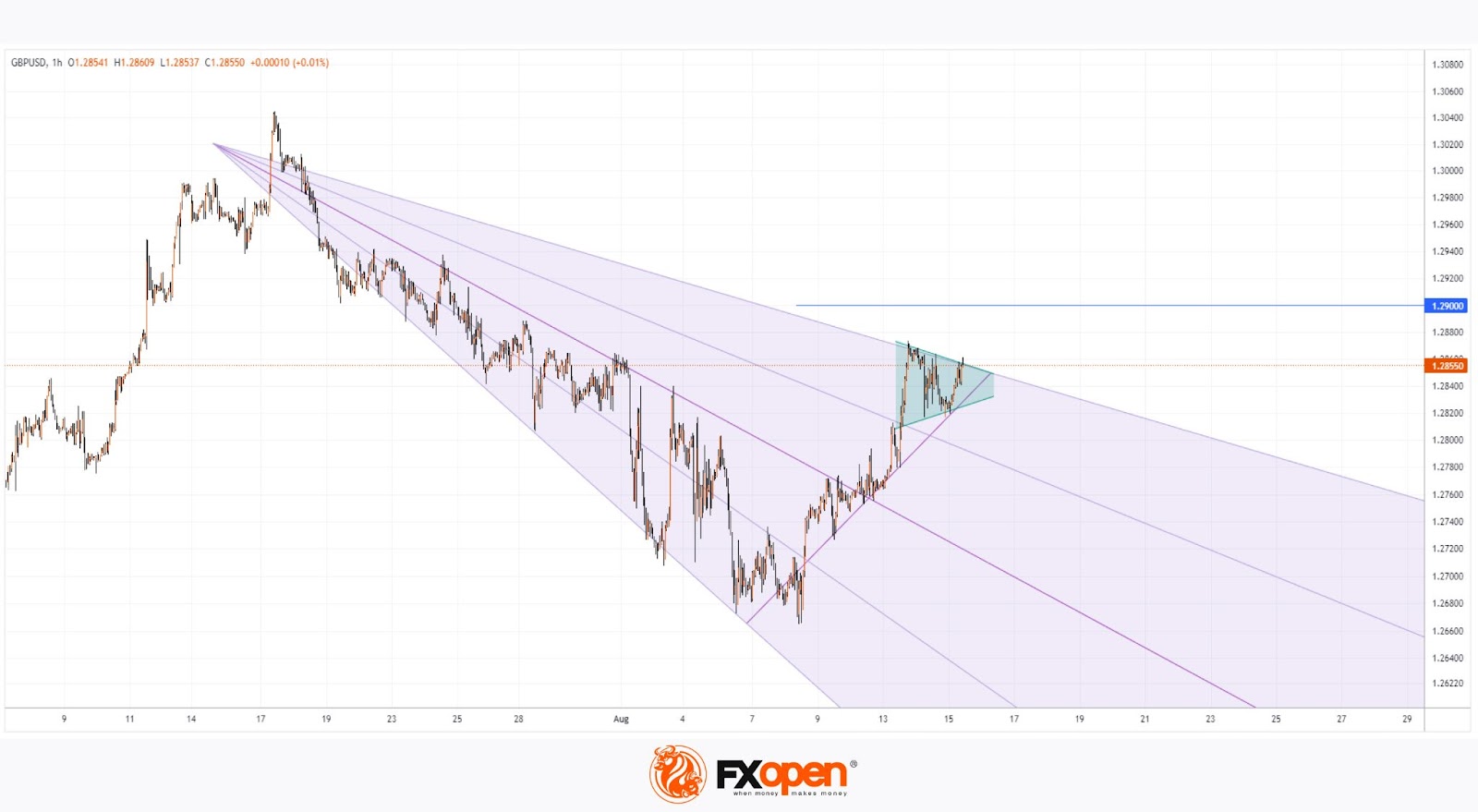
The UK’s Labour Party is set to win a highly anticipated landslide victory in the general election. Cable is upbeat near 1.2770 and the FTSE futures are pointing at a positive start to the session.
With the general election behind us - and more political uncertainty and hopefully less scandals ahead - the Labour win is seen as being net positive for the pound and the British stocks. Cable fell from near 1.50 pre-Brexit to almost parity at the peak of the Tory disillusion with Liz Truss mini budget crisis, the changing government gives hope that at least a part of the weakness could be recovered. For stocks, the small and medium sized stocks are expected to perform stronger than the FTSE 100 – which is more exposed to the global economic dynamics due to its high concentration of energy and mining stocks. But both should see the benefits of the upcoming rate cut from the Bank of England (BoE) – and additionally the other major central banks into the year end. The FTSE 100 was up by 0.86% yesterday on Labour victory vibes and should easily throw itself above the 50-DMA before the weekly closing bell.
In France, the situation looks better from a market perspective, as well. The latest polls suggest that Marine Le Pen’s National Rally could fall ‘well short’ of a majority at this weekend’s second and final tour of legislative elections. The party is forecasted to win between 190 to 250 seats out of 577, which will leave it significantly below the 289 majority needed to pass bills easily. As such, the French will probably not see their taxes lowered as promised by Le Pen and investors will hopefully not see the French debt levels explode irresponsibly following this chaotic ‘snap election’ parentheses. Investors are now in a hurry to return to French assets and the euro at discounted prices not to miss the post-election rally next Monday. The spread between the German and French 10-year yield fell below 70 from last week’s peak of 86, the CAC 40 jumped past the 200-DMA yesterday and is testing a major Fibonacci level to the upside before the weekly closing bell. The index remains well below the 8000 mark where it was trading when Macron announced the snap election, it will probably shrug off the election fear with a further recovery but in the medium run, a hung government will prevent the French from moving forward with any reforms : that’s positive when you think of unsustainable tax cuts but that’s not necessarily positive for the long term growth as other reforms will also be blocked. Anyway, the EURUSD extends gains past 1.0820 this morning, and given the FOMO a post-election rally in the euro, we might see further gains before the weekly closing bell.
Jobs day
The US will reveal its latest jobs figures today and the Federal Reserve (Fed) doves are waiting in ambush to boost their rate cut bets. The US economy is expected to have added around 190K new nonfarm jobs in June, down from 272K printed a month earlier and the wages growth is seen weaker. A weaker-than-expected set of data should further fuel the Fed rate cut bets, weigh on the yields and the US dollar, while a positive surprise should get the Fed doves to scale back their rate cut bets – that have been rising lately thanks to a set of soft economic data and dovish Fed comments - and throw a floor under the yields and back the dollar. The US dollar slipped below its 50-DMA yesterday on the back of the rising dovish Fed voices and a political-led rebound in euro and the pound. The US dollar index is getting ready to test the 105 support to the downside. The major support to this year’s bullish trend is at a distant 104.20 level – meaning that the dollar has room to soften if the data satisfies the Fed doves.
For equities, a soft data – if not too soft – wouldn’t be bad. The thing is the major US indices do not reflect – not even a bit – the underlying economic dynamics right now. They are mostly decoupled from the economic reality of high inflation and slowing growth. The only thing that matters right now is the strength of appetite for technology stocks and that remains very strong – and is supported by the expectation of upcoming rate cuts.
TSM just hit the 1000 mark this week in Taiwan for the first time in history, after more than doubling its stock price since the beginning of last year. Nvidia is responsible for a whopping 30% of gains that the S&P500 printed this year, while the Dutch ASML accounted for around 38% of the gains of the Stoxx 50 this year. As such, a chart from Bloomberg shows how the correlations between the stocks in the US and the European markets have never been this low since more than a decade. This is alarming, mind you, because the lower correlation, the lower the diversification within the index, and the lower diversification the higher the risk of a sudden and a sharp downturn. The question is: when.
Cliff Notes: Assurance Over Inflation a Matter of Time
Key insights from the week that was.
In Australia, the Minutes from the RBA June Meeting provided more colour around the Board’s deliberations, in particular its considerations for monetary policy in the context of lingering inflation pressures. The case for another rate hike was premised largely on the RBA’s assessment that demand had continued to outstrip supply and that this imbalance could continue –the former could hold up better than expected, or the latter could be more constrained than currently assumed – increasing the possibility that inflation will take longer to sustainably return to target. The case for leaving policy unchanged was deemed stronger, the Board of the view that “the economy was still broadly tracking on a path consistent with returning inflation to target in 2026, while preserving as many of the gains in employment as possible.”
Chief Economist Luci Ellis highlighted that it is the ‘gaps’ between demand and supply, whether that be in the labour market or the broader economy, that are receiving a greater focus in the Board’s policy deliberations. Here, it is noted that both labour market tightness and the output gap are assessed as narrowing, but given the difficulty in precisely estimating such dynamics, there remains uncertainty in judging when the ‘gaps’ might actually close. For now, the Board expects inflation to continue decelerating towards target as demand and supply come into better balance, but it needs more confidence in this view before debating the timing and scale of easing. Last week’s partial inflation data may have unnerved market participants but it had no impact on our inflation forecasts nor our view on the interest rate outlook. We continue to believe the Board will have this confidence by November, allowing the RBA to embark on a measured rate cutting cycle, 25bps per quarter to 3.10% in Q4 2025.
Other data received this week were largely focused on the consumer and housing. On the former, retail sales beat expectations, rising 0.6% (1.7%yr). However, most of the strength can largely be attributed to inflation and population growth, with real per capita sales likely tracking in the realm –2.5% to –3.0%. Meanwhile, growth in dwelling prices continues to forge ahead at a solid pace, up 0.7% across the nation’s eight major capital cities. While the latest increase in dwelling approvals was certainly welcome, the outlook for new dwelling investment remains fragile, at odds with needs of a rapidly growing economy.
Offshore, the focus was on the US with the June ISM PMIs. The ISM non-manufacturing index fell 5pts in June from 53.8 to 48.8. This is the second sub-50 reading in three months, but more importantly the June read is almost 7.5pts below the decade average. The employment index also fell back to April's weak level (6pts below average) after rebounding in May. Business activity and new orders also dropped sharply in June. The level of these sub-components speak to the risk of outright contraction against our base expectation of modest growth, warranting close monitoring ahead. The ISM manufacturing survey edged lower from 48.7 to 48.5 against expectations for a modest lift to 49.1. Production deteriorated, from 50.2 to 48.5, but new orders gained in the month, from 45.4 to 49.3. Both sub-indexes are below their respective six-month averages, signalling a continuation of the sector's deceleration. At 49.3, the employment sub-index was again consistent with outright job loss. Prices paid fell back to 52.1 in the month, below both the six-month and long-run historic averages.
The FOMC also released its minutes for the June meeting which were consistent with the Committee's positive forecasts for the economy. Policy is viewed as restrictive and as working toward bringing about desired inflation outcomes in time. That said, there were some notes of caution over momentum in the labour market, in particular "several" participants noted that nonfarm payrolls may be overstating job creation. Anecdotes on the labour market and consumer behaviour were also used to justify the view that both wage inflation and consumer inflation is continuing to decelerate. That said, “some” participants were willing to raise rates should inflation remain elevated. That raising rates was not considered and inflation looks to be on its downward trajectory suggests this scenario remains improbable. Despite the shift to only one cut this year in its published forecasts, the Committee looks to be ready to begin easing as incoming data give confidence in inflation's downtrend and/or should downside risks materialise. We maintain our view that rate cuts will begin in September 2024. For more detail, see our latest edition of Market Outlook, published earlier today on WestpacIQ.
The June JOLTS survey provided further evidence of labour demand and supply coming into balance. The job opening count was a touch higher than the market expected at 8.14mn, but the job opening rate was little changed from May and within 0.5% of the pre-pandemic level. The hiring, separation and quit rates were also all near their pre-pandemic averages.
In Europe, the European Central Bank held its annual conference in Sintra, the key event being a panel with ECB President Lagarde, FOMC Chair Powell and Bank of Brazil's Campos Neto. Lagarde and Powell's remarks were both constructive on inflation and the health of their respective economies. Powell in particular noted that the US is back on a "disinflationary path", but that further confidence is necessary amongst Committee members before acting. Powell also made clear that the risks the US faces are increasingly balanced, with downside risks to the labour market coming into view.
Euro Area inflation was as expected in June, prices rising 0.2% in the month and 2.5% over the year. Core inflation was a touch stronger than consensus at 2.9%yr as services inflation held around 4%yr, a rate held since the start of this year. Overall, this flash release indicates goods remain the predominant disinflationary force and further progress on services will be needed for inflation to remain sustainably at target. The unemployment rate remained at 6.4% in May. Labour market conditions are heterogenous across the region with services-oriented industries seeing labour market tightness persist while others see slack building.
In Asia, the Bank of Japan's Q2 Tankan Survey reflected a constructive outlook with some risks emerging on the horizon. The outlook on general prices remains little-changed around 2.0% for the 3-year and 5-year horizons, suggesting inflation expectations are holding firm. Forecasts for employment conditions declined further, suggesting businesses are expecting it to be difficult to secure labour ahead. Persistent sentiment around labour scarcity will support wage negotiations ahead. Expectations for investment continue to grow – at present they sit around where they were prior to the Asian Financial Crisis when capacity was expanding rapidly. Profits however are expected to decline. This creates risk to both the investment and wages outlook as strong profitability has supported both over the last year. Wages and investment need to remain strong for inflation to persist and for policy to normalise further.