Sample Category Title
GBP/USD Daily Outlook
Daily Pivots: (S1) 1.2743; (P) 1.2769; (R1) 1.2790; More...
GBP/USD's rebound from 1.2664 extends higher today but stays below 1.2839 resistance. Intraday bias stays neutral for the moment. On the downside, break of 1.2664 will resume the fall from 1.3043 to 1.2612 support. Decisive break there should confirm that rise from 1.2298 has completed, and target this support next. However, break of 1.2839 resistance will argue that the pull back from 1.3043 has completed and turn bias back to the upside.
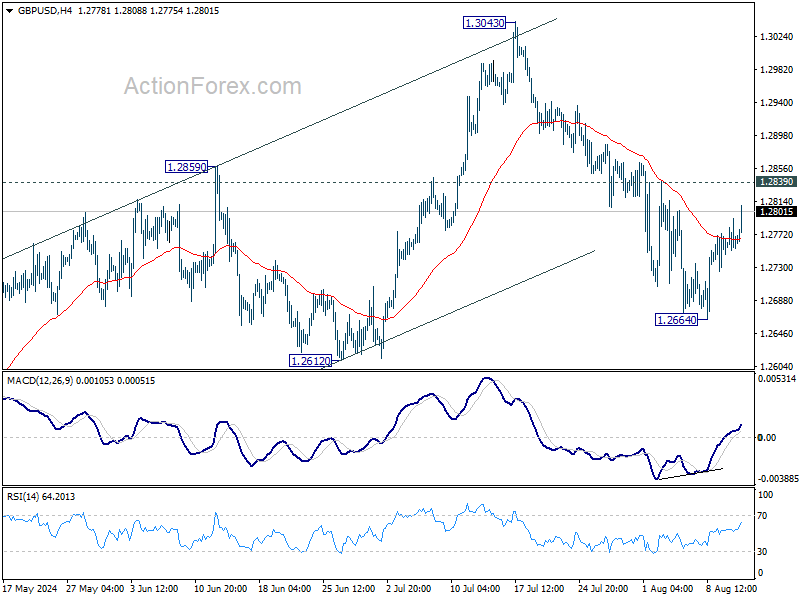
In the bigger picture, current development suggests that corrective pattern from 1.3141 is extending with fall from 1.3043 as another leg. Break of 1.2612 support would strengthen this case. But still, downside should be contained by 1.2036/2298 support zone even in case of deep decline. Rise from 1.0351 (2022 low) remains in favor to resume at a later stage.
Pound Strengthens on UK Jobs Data, But Eyes Further Economic Releases
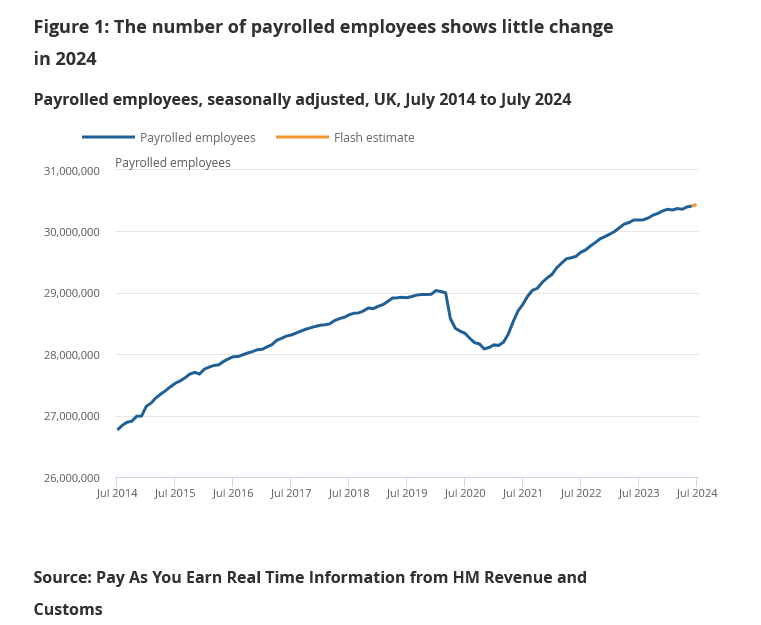
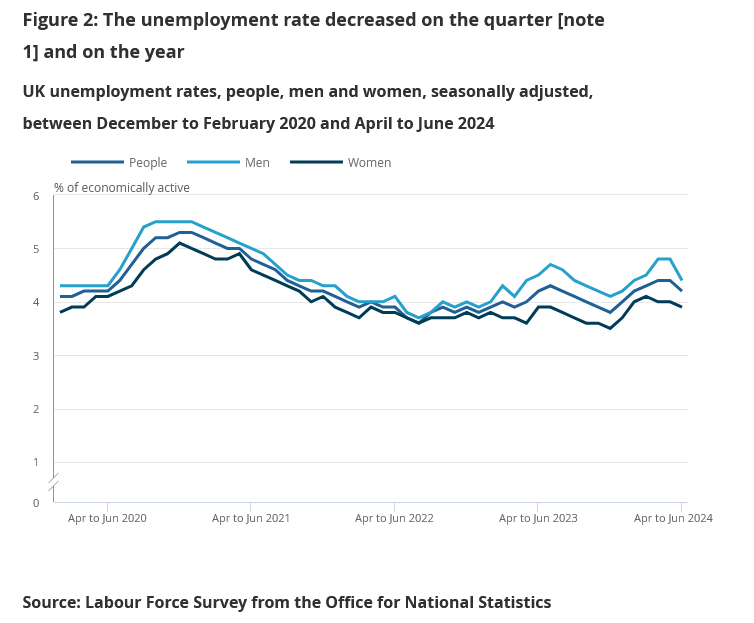
Sterling is making notable gains after UK employment data revealed an unexpected drop in the unemployment rate for June. Additionally, July's figures showed continued growth in payrolled employment and a rebound in wage growth. This robust set of data strengthens the position of the hawks within BoE's MPC, who incline to maintain a cautious stance on further interest rate cuts. However, the Pound's ride may not be smooth this week, with key economic data still to come, including tomorrow's UK CPI, Thursday's GDP, and Friday's retail sales. These upcoming reports could lead to considerable volatility for the currency.
Elsewhere in the forex markets, trading activity remains subdued. Although Yen and Swiss Franc weakened yesterday, there has been no significant follow-through in selling. Euro is also struggling to extend its rebound against Dollar, while commodity currencies are confined to tight ranges. Market participants are now turning their attention to today's US PPI data, which could spark some brief volatility, but the primary focus remains on tomorrow's US CPI report.
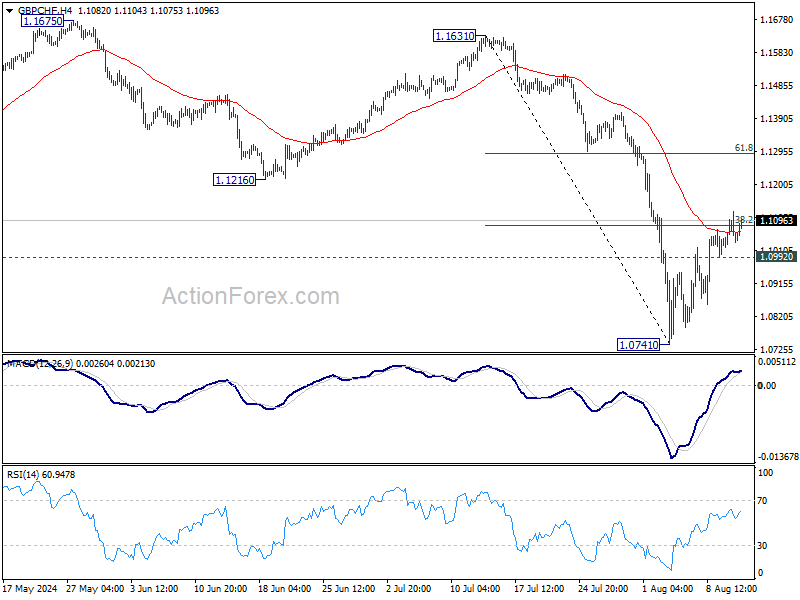
Technically, following up on GBP/CHF, while rebound from 1.0741 extends higher, it's still struggling to get rid of 38.2% retracement of 1.1631 to 1.0741 at 1.1108 cleanly. Nonetheless, further rise is mildly in favor as long as 1.0992 minor support holds. Sustained trading above 1.1108 will pave the way to 1.1216 support turned resistance. However, break of 1.0092 will retain near term bearishness and bring retest of 1.0741 low next.
In Asia Nikkei closed up 3.45%. Hong Kong HSI is down -0.02%. China Shanghai SSE is down -0.38%. Singapore Strait Times is up 0.72%. Japan 10-year JGB yield fell -0.0041 to 0.854. Overnight, DOW fell -0.36%. S&P 500 rose 0.00%. NASDAQ rose 0.21%. 10-year yield fell -0.033 to 3.909.
UK payrolled employment grows 24k in Jul, unemployment rate falls to 4.2% in Jun
UK payrolled employment rose 24k or 0.1% mom in July. Median monthly pay increased by 5.6% up sharply from June's 3.8% yoy, but below May's 6.0% yoy. Claimant count jumped 135k versus expectation of 14.5k.
In the three months to June, unemployment fell from 4.4% to 4.2%, versus expectation of a rise to 4.5%. Average earnings including bonus rose 5.4% yoy, slowed from 5.7% but beat expectation of 4.6%. Average earnings excluding bonus slowed to 4.5% yoy, down from 5.7%, below expectation of 4.6%.
Japan's PPI rises to 3% yoy as Yen weakness fuels import costs surge
Japan's Producer Price Index rose by 3.0% yoy in July, aligning with market expectations and slightly up from June's 2.9% yoy increase. This marks the sixth consecutive month of acceleration and the fastest rate of increase in 11 months.
A significant driver of this rise was the 10.8% yoy increase in yen-denominated costs for imported materials, which accelerated from a revised 10.6% yoy rise in June. This highlights the ongoing impact of the weak Yen on import prices, contributing to higher overall production costs.
On a month-over-month basis, PPI rose by 0.3%, again matching consensus estimates.
Australia's wage growth slows in 0.8% qoq in Q2, with private sector lagging
Australia's wage price index rose by 0.8% qoq in Q2, slightly down from the previous quarter's 0.9% qoq increase and falling short of expectations for another 0.9% qoq rise. On an annual basis, wage growth remained steady at 4.1%, unchanged from Q1.
In the private sector, wage growth slowed to 0.7% qoq, down from 0.9% in the previous quarter. This marks the lowest increase for a second quarter since 2021 and ties for the lowest growth for any quarter since Q4 2021.
On the other hand, public sector wages grew by 0.9% qoq, up from 0.6% previously, making it the strongest June quarter increase since 2012. This stronger rise in the public sector was attributed to the newly synchronized timing of Commonwealth public sector agreement increases.
Australia's Westpac consumer sentiment edges up amid small relief over steady rates
Australia's Westpac Consumer Sentiment Index saw a modest increase of 2.8% mom in August, rising from 82.7 to 85.0. Westpac attributed this uptick to a "small sigh of relief" from consumers after RBA decided to keep interest rates unchanged, coupled with the positive effects of tax cuts and other fiscal measures.
However, despite the rise, the index remains historically weak, hovering within the 78–86 range that has persisted for over two years. Westpac's analysis highlighted ongoing concerns among consumers about the cost of living and potential future rate hikes, which continue to "weigh heavily" on sentiment.
Looking ahead to RBA's next meeting on September 23-24, Westpac noted that data flow leading up to the meeting is unlikely to provide significant new insights into inflation trends. With RBA having already ruled out near-term rate cuts, it is expected that the central bank will maintain its current interest rate at the upcoming meeting.
Looking ahead
Germany will release ZEW economic sentiment in European session. Later in the day, US PPI will take center stage.
GBP/USD Daily Outlook
Daily Pivots: (S1) 1.2743; (P) 1.2769; (R1) 1.2790; More...
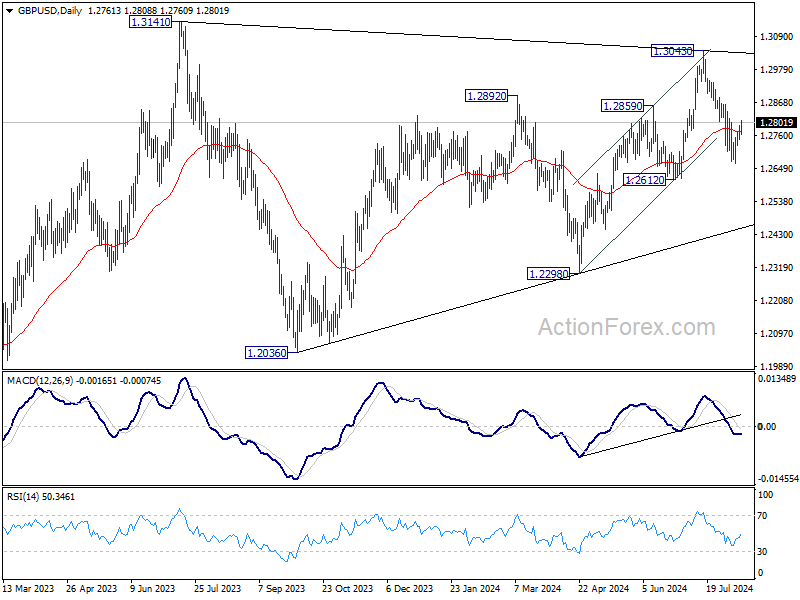
GBP/USD's rebound from 1.2664 extends higher today but stays below 1.2839 resistance. Intraday bias stays neutral for the moment. On the downside, break of 1.2664 will resume the fall from 1.3043 to 1.2612 support. Decisive break there should confirm that rise from 1.2298 has completed, and target this support next. However, break of 1.2839 resistance will argue that the pull back from 1.3043 has completed and turn bias back to the upside.
In the bigger picture, current development suggests that corrective pattern from 1.3141 is extending with fall from 1.3043 as another leg. Break of 1.2612 support would strengthen this case. But still, downside should be contained by 1.2036/2298 support zone even in case of deep decline. Rise from 1.0351 (2022 low) remains in favor to resume at a later stage.
Economic Indicators Update
| GMT | Ccy | Events | Actual | Forecast | Previous | Revised |
|---|---|---|---|---|---|---|
| 23:50 | JPY | PPI Y/Y Jul | 3.00% | 3.00% | 2.90% | |
| 00:30 | AUD | Westpac Consumer Confidence Aug | 2.80% | -1.10% | ||
| 01:30 | AUD | Wage Price Index Q/Q Q2 | 0.80% | 0.90% | 0.80% | 0.90% |
| 01:30 | AUD | NAB Business Conditions Jul | 1.00% | 4 | ||
| 01:30 | AUD | NAB Business Confidence Jul | 6 | 4 | ||
| 06:00 | JPY | Machine Tool Orders Y/Y Jul | -2.10% | 9.70% | ||
| 06:00 | GBP | Claimant Count Change Jul | 135.0K | 14.5K | 32.3K | 36.2K |
| 06:00 | GBP | ILO Unemployment Rate (3M) Jun | 4.20% | 4.50% | 4.40% | |
| 06:00 | GBP | Average Earnings Including Bonus 3M/Y Jun | 5.40% | 4.60% | 5.70% | |
| 06:00 | GBP | Average Earnings Excluding Bonus 3M/Y Jun | 4.50% | 4.60% | 5.70% | |
| 09:00 | EUR | Germany ZEW Economic Sentiment Aug | 30.6 | 41.8 | ||
| 09:00 | EUR | Germany ZEW Current Situation Aug | -68.9 | |||
| 09:00 | EUR | Eurozone ZEW Economic Sentiment Aug | 35.4 | 43.7 | ||
| 10:00 | USD | NFIB Business Optimism Index Jul | 91.7 | 91.5 | ||
| 12:30 | USD | PPI M/M Jul | 0.20% | 0.20% | ||
| 12:30 | USD | PPI Y/Y Jul | 2.30% | 2.60% | ||
| 12:30 | USD | PPI ex Food & Energy M/M Jul | 0.20% | 0.40% | ||
| 12:30 | USD | PPI ex Food & Energy Y/Y Jul | 2.70% | 3.00% |
UK payrolled employment grows 24k in Jul, unemployment rate falls to 4.2% in Jun
UK payrolled employment rose 24k or 0.1% mom in July. Median monthly pay increased by 5.6% up sharply from June's 3.8% yoy, but below May's 6.0% yoy. Claimant count jumped 135k versus expectation of 14.5k.
In the three months to June, unemployment fell from 4.4% to 4.2%, versus expectation of a rise to 4.5%. Average earnings including bonus rose 5.4% yoy, slowed from 5.7% but beat expectation of 4.6%. Average earnings excluding bonus slowed to 4.5% yoy, down from 5.7%, below expectation of 4.6%.
Investors’ Focus Set on PPI and CPI
In focus today
Today is light in terms of tier-1 data releases. Hence, focus will be on the German ZEW figures coming at 11.00 CET, where analysts expect -74.0 for the current situation figure, and 35.0 for the expectations figure. Both mark lower prints and as such less optimistic conditions than what was seen in July. This is also what the downbeat Euro Sentix data suggests.
This morning, we also get both the 3M average unemployment figure as well as the 3M average y/y seasonally adjusted wage growth (ex-bonus) figures out of the United Kingdom. Both are scheduled for release at 08.00 CET. Analysts expect unemployment to come in at 4.5% (slightly up from last month's 4.4%), whereas wage growth (ex-bonus) is expected to come in at 5.4% (slightly down from last month's 5.7%).
In the US we get PPI numbers for July at 14.30 CET. Analysts expect both the headline and core figures to stand at 0.2% m/m. The measure could provide the market with early clues on how inflationary pressures have developed into the late summer. NFIB's small business survey is also due for release today, and its price plans measure has been a decent leading indicator for the CPI as well.
Fed's Bostic (voting member) speaks tonight at 19.15 CET.
Overnight the Reserve Bank of New Zealand announce their cash rate. We expect them to keep it unchanged at 5.50%, but it will be a close call between a hold and a 25bp cut.
Economic and market news
What happened overnight
US equity futures look mostly flat this morning, reiterating that investors are gearing up for inflation numbers to come. In the commodity space, Brent oil is down around 1% this morning trading at around USD81.5/bbl.
What happened yesterday
In Denmark, CPI inflation came in at 1.1% y/y (prior 1.8% y/y). The low print and rather big drop from last month was expected given how the 2023H1 electricity tax break is no longer present, and as such skewing, the y/y figures.
In the US both 2- and 10-year yields dropped a few basis points. In the (very) short end of the curve yields were also slightly lower on the session albeit more modestly. The moves in yields to kick off the week wane in comparison to last week's market moves, as investors have their eyes set on today's PPI as well as tomorrow's CPI. They will be looking out for signals as to what to expect next from the economy, after recession fears got hold of markets last week.
Elliott Wave Intraday Analysis: FTSE should Continue Higher
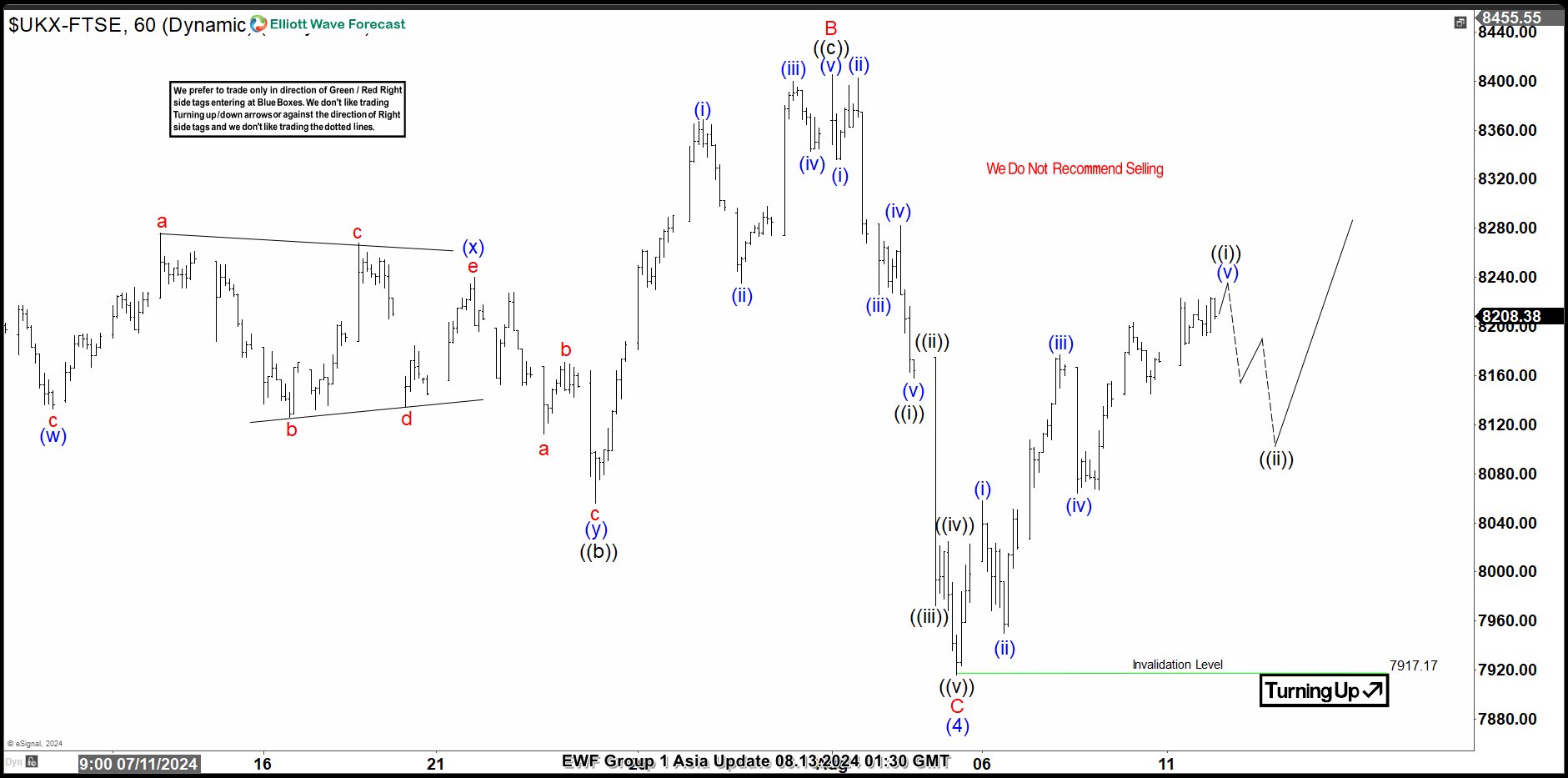
Short Term Elliott Wave in FTSE suggests that the index has completed a bearish sequence from 5.15.2024 high. The decline made a zig zag Elliott Wave structure. Down from 5.15.2024 high, wave A ended at 8106.79 low. Rally in wave B ended at 8405.24 high with internal subdivision as an expanded flat structure. Up from wave A, wave ((a)) ended at 8279.75 and wave ((b)) ended at 8056.01. Wave ((c)) higher ended at 8405.24 which completed wave B in higher degree.
Then, FTSE turned lower in wave C with internal subdivision as an impulse structure. Down from wave B, wave ((i)) ended at 8158.03 low and wave ((ii)) ended slightly up at 8174.71 high. Wave ((iii)) lower ended at 7972.35 and wave ((iv)) ended at 8024.83 high. Final leg wave ((v)) ended at 7915.94 low which completed wave C and (4) in higher degree. The current rally is in progress expecting to continue higher as wave (5). Near term, we are calling an impulse structure as wave ((i)) from wave (4) low. This wave ((i)) should be completed very soon and we are expecting a retracement in 3, 7 or 11 swings as wave ((ii)) before resuming the rally. The view is valid as price action remains above 7915.94 low.
FTSE 60 Minutes Elliott Wave Chart
FTSE Elliott Wave Video
https://www.youtube.com/watch?v=Prh4Sf7YhTs
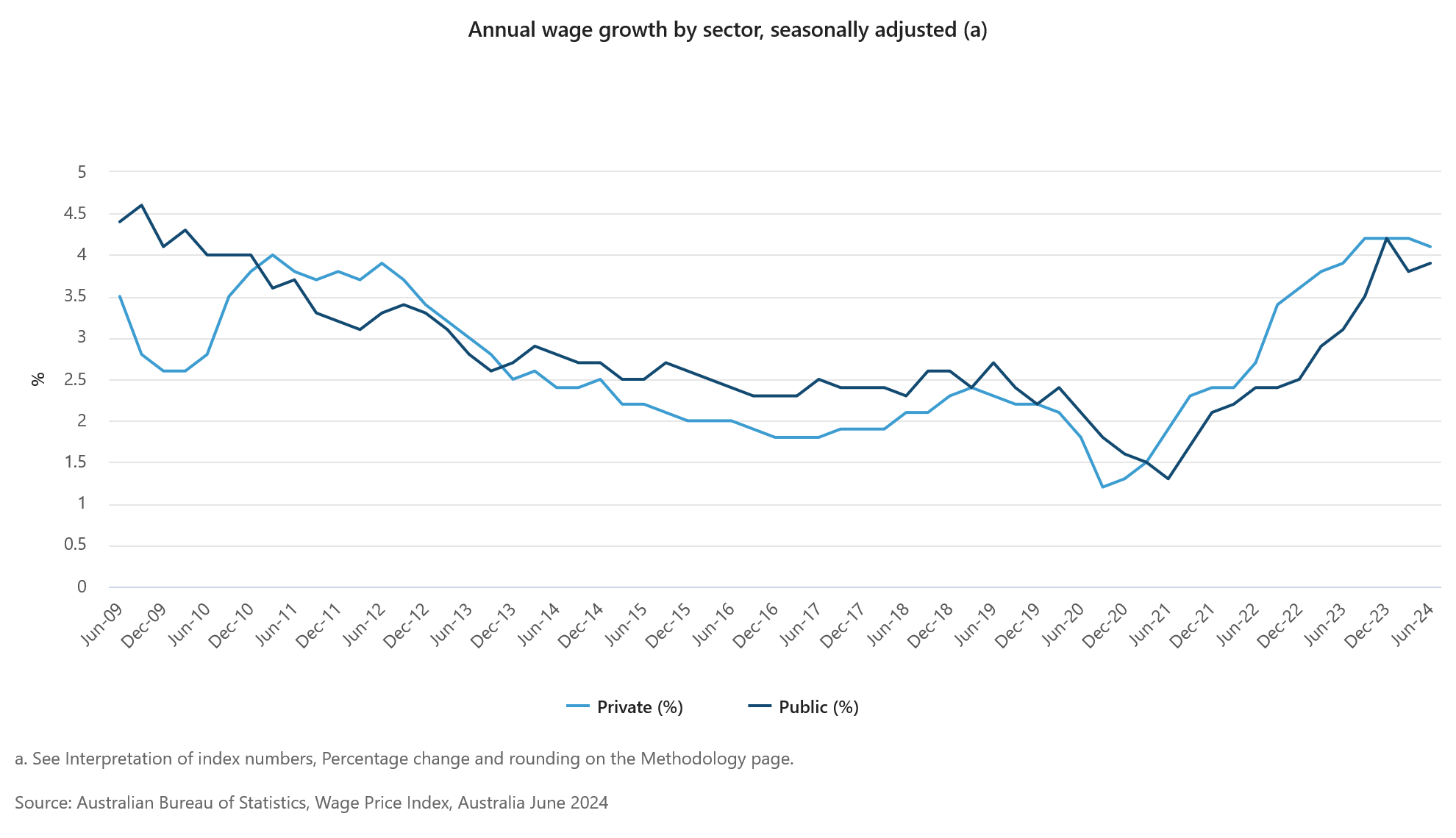
Australia’s wage growth slows in 0.8% qoq in Q2, with private sector lagging
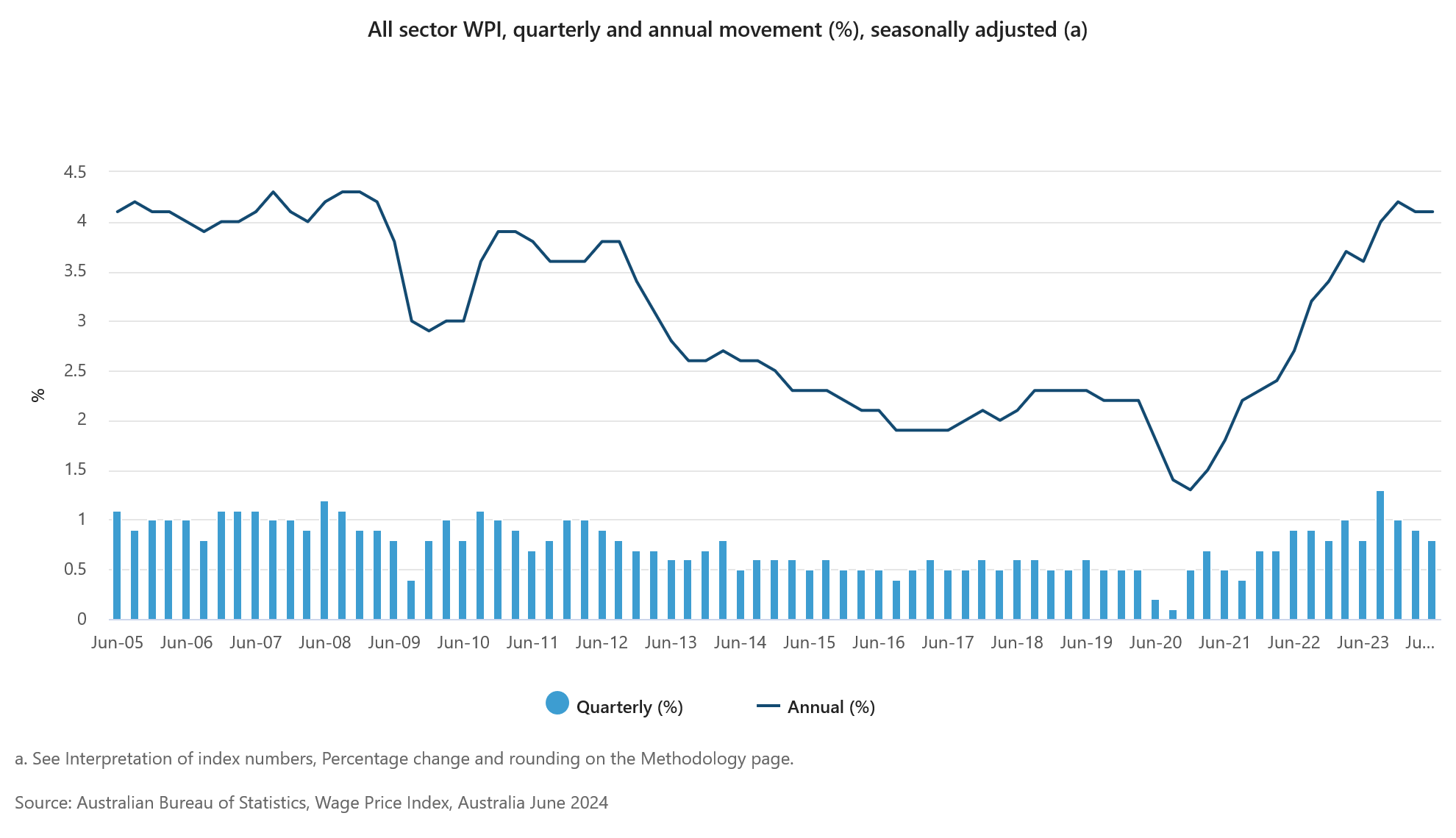
Australia's wage price index rose by 0.8% qoq in Q2, slightly down from the previous quarter's 0.9% qoq increase and falling short of expectations for another 0.9% qoq rise. On an annual basis, wage growth remained steady at 4.1%, unchanged from Q1.
In the private sector, wage growth slowed to 0.7% qoq, down from 0.9% in the previous quarter. This marks the lowest increase for a second quarter since 2021 and ties for the lowest growth for any quarter since Q4 2021.
On the other hand, public sector wages grew by 0.9% qoq, up from 0.6% previously, making it the strongest June quarter increase since 2012. This stronger rise in the public sector was attributed to the newly synchronized timing of Commonwealth public sector agreement increases.
Australia’s Westpac consumer sentiment edges up amid small relief over steady rates
Australia's Westpac Consumer Sentiment Index saw a modest increase of 2.8% mom in August, rising from 82.7 to 85.0. Westpac attributed this uptick to a "small sigh of relief" from consumers after RBA decided to keep interest rates unchanged, coupled with the positive effects of tax cuts and other fiscal measures.
However, despite the rise, the index remains historically weak, hovering within the 78–86 range that has persisted for over two years. Westpac's analysis highlighted ongoing concerns among consumers about the cost of living and potential future rate hikes, which continue to "weigh heavily" on sentiment.
Looking ahead to RBA's next meeting on September 23-24, Westpac noted that data flow leading up to the meeting is unlikely to provide significant new insights into inflation trends. With RBA having already ruled out near-term rate cuts, it is expected that the central bank will maintain its current interest rate at the upcoming meeting.
Japan’s PPI rises to 3% yoy as Yen weakness fuels import costs surge
Japan's Producer Price Index rose by 3.0% yoy in July, aligning with market expectations and slightly up from June's 2.9% yoy increase. This marks the sixth consecutive month of acceleration and the fastest rate of increase in 11 months.
A significant driver of this rise was the 10.8% yoy increase in yen-denominated costs for imported materials, which accelerated from a revised 10.6% yoy rise in June. This highlights the ongoing impact of the weak Yen on import prices, contributing to higher overall production costs.
On a month-over-month basis, PPI rose by 0.3%, again matching consensus estimates.
GBP/USD Eyes Recovery: Key Hurdles In The Way
Key Highlights
- GBP/USD started a recovery wave from the 1.2665 zone.
- It broke a major bearish trend line with resistance at 1.2750 on the 4-hour chart.
- Gold prices could again aim for a move above the $2,500 resistance.
- The UK Claimant count could change by 14.5K in July 2024.
GBP/USD Technical Analysis
The British Pound found support near 1.2665 after heavy losses against the US Dollar. GBP/USD formed a base and started a recovery wave above 1.2700.
Looking at the 4-hour chart, the pair broke a major bearish trend line with resistance at 1.2750. There was a move above the 23.6% Fib retracement of the downward move from the 1.3044 swing high to the 1.2664 low.
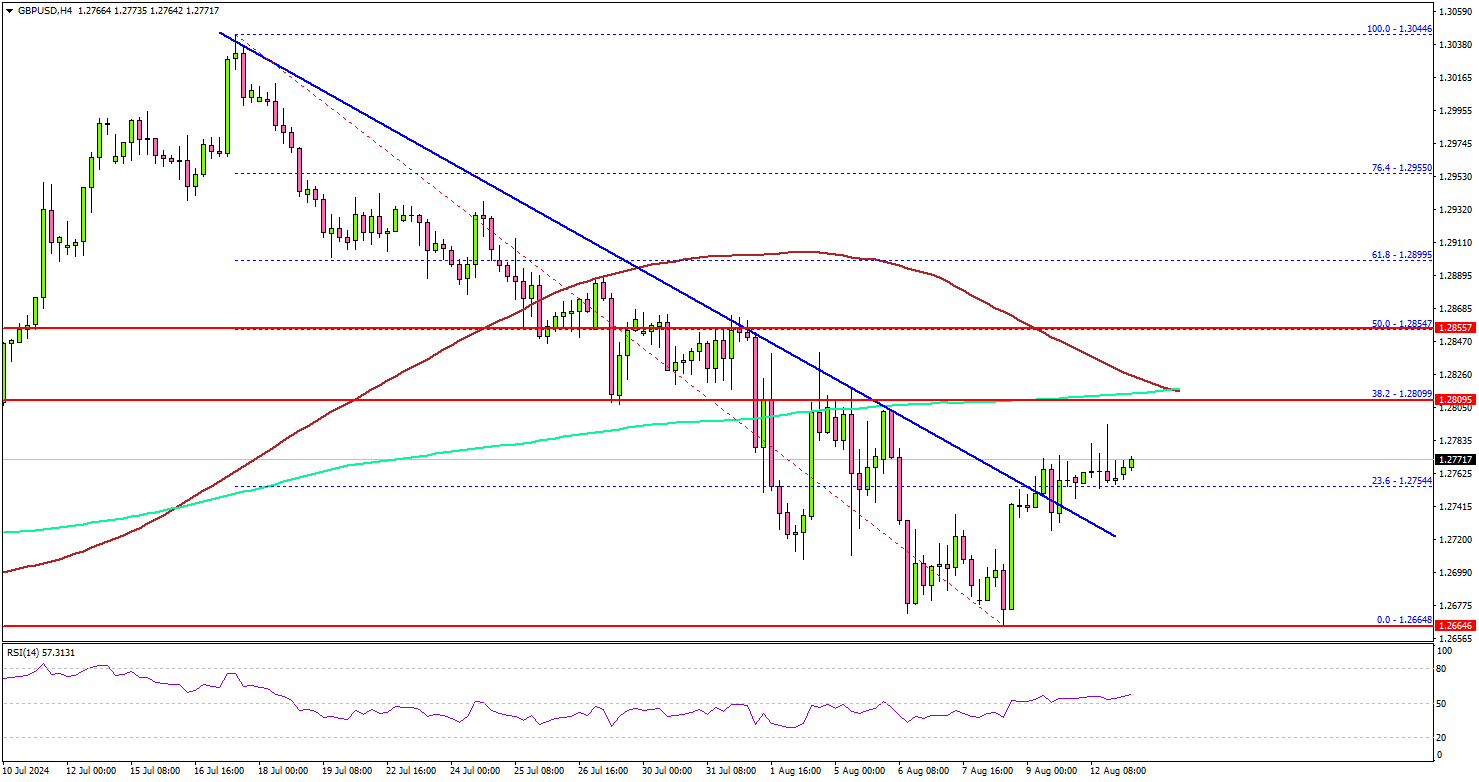
However, the pair could face many hurdles on the upside. The first key resistance sits near the 1.2800 zone, the 200 simple moving average (green, 4-hour), and the 100 simple moving average (red, 4-hour).
The 50% Fib retracement of the downward move from the 1.3044 swing high to the 1.2664 low is also near the 1.2800 zone. The next resistance sits at 1.2850. A clear move above 1.2850 could open the door to more gains.
In the stated case, the pair could rise and test 1.2955. Any more gains could send the pair toward the 1.3050 level. Immediate support is near the 1.2740 level.
The next major support is near the 1.2680 level. A downside break and close below the 1.2680 support zone could open the doors for more losses. In the stated case, GBP/USD might decline toward the 1.2550 level.
Looking at Gold, the price started a fresh increase and there are chances that the bulls might aim for a move above the $2,500 level.
Economic Releases
- UK Claimant Count Change for July 2024 – Forecast 14.5K, versus 32.3K previous.
- UK ILO Unemployment Rate for June 2024 (3M) – Forecast 4.5%, versus 4.4% previous.
FTSE 100 Index Analysis
- FTSE 100 index reversed from support zone
- Likely to rise to resistance level 8300.00
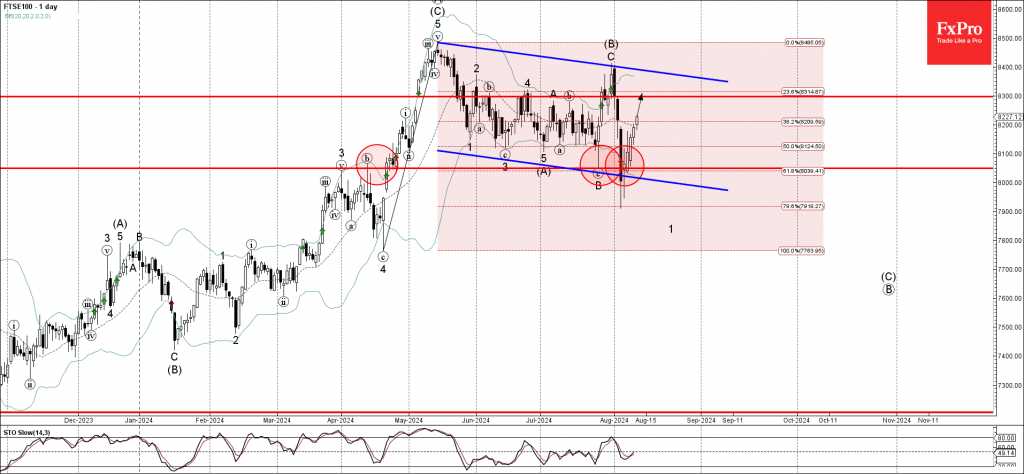
FTSE 100 index recently reversed up from the support area located between the pivotal support level 8050.00 (former monthly low from July), lower daily Bollinger Band and the support trendline of the daily down channel from May.
This support area was further strengthened by the 61.8% Fibonacci correction of the previous sharp upward impulse from the middle of April.
Given the clear daily uptrend, FTSE 100 index can be expected to rise further toward the next resistance level 8300.00.