Sample Category Title

Hand in Hand is the Surer Way to Land

Households are cutting consumption in a textbook response to higher interest rates. This, and a likely future of inflationary supply shocks, warrants a more coherent design to fiscal and monetary policy frameworks.

This week saw the RBA Board minutes observe that many households have been pulling back on spending even when their incomes have not been falling. We also saw a similar implication from the May release of the Westpac–Melbourne Institute Consumer Sentiment Survey.

As Westpac Economics colleague Matt Hassan noted, most households who expect to receive a tax cut plan to save most or all of it. Altogether, around 80% of the increase in post-tax income is planned to be saved. Plans do not always pan out and the households that do not expect to receive the tax cut might spend that pleasant surprise. Even still, these results tilt more to saving than did the responses to surveys concerning previous rounds of stimulus.

That households plan to save more out of the extra income than in previous episodes should not come as a surprise. It is the expected implication of contractionary monetary policy. One of the main ways that monetary policy dampens demand is by changing the incentive to save versus borrow or spend. It does not need to reduce people’s incomes to change their behaviour. The RBA minutes referred to this as ‘simply choosing’ to spend less, but there is no mystery behind the choice. It is what economists call the ‘intertemporal substitution channel’. People ‘simply choose’ to respond to the incentives created by higher interest rates.

Intertemporal substitution is likely to be more powerful than the ‘cash flow channel’ working via lowering the incomes of households with mortgages, not least because it affects everyone. In the Australian context, though, it is often forgotten. Because variable-rate mortgages predominate in the Australian market, the mortgage cash flow channel receives far more attention than its overall impact warrants. The commentary in the RBA minutes and the downward revision to its consumption forecasts suggest that the RBA, too, might have over-focused on the cash flow channel in its recent analysis.

Higher mortgage rates have been a struggle for many households recently. Across the whole household sector, though, they have not been as big a drag on incomes as inflation itself or the resulting tax bracket creep. As we have been highlighting for some time, higher tax payments have done more to weigh on real household incomes than higher net interest payments have done. And as we have also been highlighting, this additional fiscal squeeze distinguishes Australia from some peer economies, including the United States and Canada where tax brackets are CPI-indexed. It means that one cannot read across from those countries’ experiences to infer how much monetary contraction is needed here, or for how long. It matters if fiscal and monetary policy are working hand in hand or not.

Such a policy alignment contrasts with the common presumption that monetary policy needs to offset fiscal policy, in a macro-policy version of Newton’s Third Law. Post-Budget commentary arguing that additional spending would need to be met with higher rates falls into this camp. It assumes that there is no spare capacity in the economy when the spending occurs, so inflation must rise if it is not offset. It also tends to understate the role of automatic stabilisers relative to conscious policy decisions. In fact, so-called ‘parameter variations’ – in other words, the economy turning out differently than expected – have typically shifted budget outcomes more than explicit policy decisions have.

In the same vein, if monetary policy is poised to become a bit less contractionary late this year, it would make sense for fiscal policy to be set with a similar stance. It would certainly make fiscal and monetary policy more coherent – and the impact less uneven – than choosing this moment to achieve a significant fiscal consolidation, in the name of long-term sustainability or demand-shock absorption.

Treating monetary and fiscal policy purely as counterbalances rather than working in the same direction also sits oddly with the likely future of climate and supply-driven inflation shocks. If Australia and the world are indeed facing a more inflationary environment – or as the RBA Governor put it, ‘shock after shock after shock’ – surely it would make sense to refine the economic policy architecture to be more resistant to inflationary surges. And again, it would make sense for fiscal policy and monetary policy to operate hand in hand. This can be achieved by good system design as well as conscious coordination, without necessarily detracting from the independence of the central bank.

One obvious improvement would be stop indexing administered prices such as education fees and subsidised medicines to the CPI. This simply propagates a surge in inflation into the following year. Indexing by 2½%, the midpoint of the RBA’s inflation target, would avoid this issue.

Another refinement that would improve the response to inflation surges would be to index tax brackets by 2½%, as we have previously advocated. Fixed tax brackets lean against inflationary surges via bracket creep. This form of automatic stabilisation has its advantages. However, as we have seen in Australia recently, it can overdo the negative consumption response to inflation surges, leaving other sectors such as public demand or business investment relatively untouched. And without periodic tax cuts, the share of income paid in tax will rise forever. On the other hand, indexing brackets to CPI, as the US and Canadian tax systems do, means monetary policy and explicit fiscal actions must shoulder the load of inflation control. Lifting tax thresholds at a fixed rate retains the stabilisation properties of fixed brackets while avoiding the bias to higher taxation over time.

Indexing by 2½% would be preferable to CPI indexation in a range of other domains, too. Governments and others could build a preference for contract bids with escalation clauses fixed at 2½% annually, not CPI-linked indexation clauses. Capital gains could be taxed at the full marginal rate on a ‘real’ return using a 2½% annual inflation rate. This would remove the tax preference for capital gains over rental income – a significant distortion in the housing market – without the complexity of the pre-1999 system and without having to touch negative gearing. And all of these policy refinements would help anchor inflation expectations by keeping that 2½% figure front of mind.

There are, of course, other refinements that would help make the system more resistant to inflationary surges. Enhancing the automatic stabilisers in fiscal policy is one, for example by targeting welfare payments appropriately (though Australia is already much further down this road than peer economies). Efforts to make the supply side more resilient to shocks would also help. And fiscal austerity now, to minimise government debt and create space for stimulus later, might be less useful if future shocks are more likely to be supply-driven and inflationary, rather than demand shocks.

Achieving a soft landing after a large shock cannot be left to one policy tool that operates unevenly across the community and is not well tuned to all kinds of shock. Policies working hand in hand are a surer way to land.

USD/JPY Restarts Increase But Lacks Bullish Momentum

Key Highlights

  • USD/JPY started a fresh increase above the 156.00 resistance.
  • It broke a major contracting triangle with resistance at 156.10 on the 4-hour chart.
  • Gold price declined heavily and moved in the red zone below $2,380.
  • Oil prices are still struggling to recover above the $80.00 resistance.

USD/JPY Technical Analysis

The US Dollar formed a base above 153.50 and started a decent increase against the US Dollar. USD/JPY broke the 154.80 and 155.50 resistance levels to move into a positive zone.

Looking at the 4-hour chart, the pair even settled above the 200 simple moving average (green, 4-hour) and the 100 simple moving average (red, 4-hour). The pair broke a major contracting triangle with resistance at 156.10.

There was also a move above the last swing high at 156.78. On the upside, the first major resistance is near 157.50. A clear move above the 157.50 resistance might send it toward the 158.50 level.

Any more gains might call for a move toward the 160.00 level in the near term. If there is no move above the 157.50 resistance, the pair might correct gains.

Immediate support is near the 156.50 level. The next major support is at 156.20. If there is a downside break below the 156.20 support, the pair might test the 100 simple moving average (red, 4-hour) at 155.50. Any more losses might send the pair toward the 154.20 level.

Looking at Gold, the bears took control and there was a sharp decline below the $2,380 support zone. The next major support sits at $2,300.

Economic Releases

  • US Durable Goods Orders for April 2024 – Forecast -0.8% versus +2.6% previous.
  • US Durable Goods Orders ex Defense for April 2024 – Forecast -0.4% versus +2.3% previous.

NASDAQ 100 Index Wave Analysis

  • NASDAQ 100 Index reversed from round resistance level 19000.00
  • Likely to fall to support level 18500.00

NASDAQ 100 Index today reversed down from the resistance area located between the round resistance level 19000.00 and the upper daily Bollinger Band.

The resistance level 19000.00 was strengthened by the resistance trendline of the daily up channel from the end of April.

Given the strength of the resistance level 19000.00 and the overbought daily Stochastic, NASDAQ 100 Index can be expected to fall further to the next support level 18500.00.

EURGBP Wave Analysis

  • EURGBP reversed from long-term support level 0.8500
  • Likely to test resistance level 0.8550

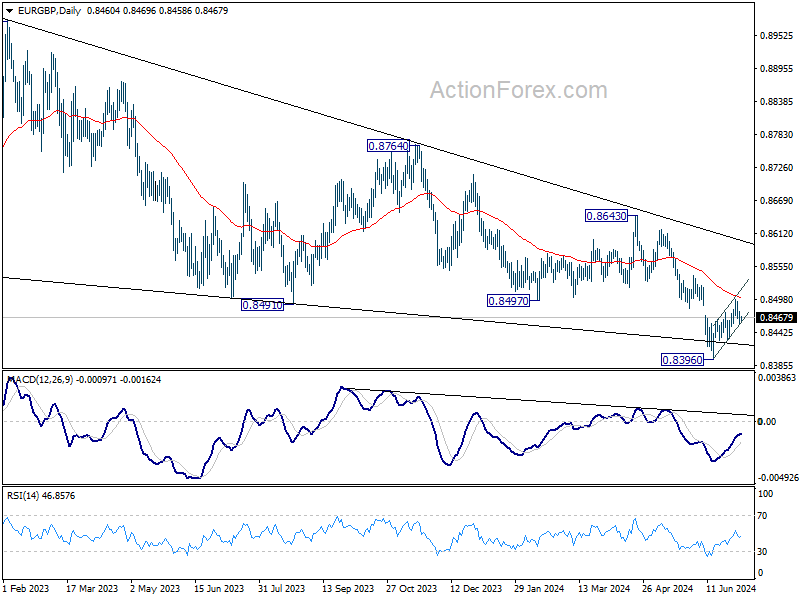
EURGBP currency pair today reversed up from the major long-term support level 0.8500 (which has been steadily reversing all downward impulse of this pair from July of 2023) intersecting with the lower daily Bollinger Band.

The upward reversal from the support level 0.8500 stopped the previous impulse waves 3 and (3).

Given the strength of the support level 0.8500 and the oversold daily Stochastic, EURGBP currency pair can be expected to rise further to the next resistance level 0.8550.

Eco Data 5/24/24

GMT Ccy Events Actual Consensus Previous Revised
22:45 NZD Trade Balance (NZD) Apr 91M -202M 588M 476M
23:01 GBP GfK Consumer Confidence May -17 -18 -19
23:30 JPY National CPI Y/Y Apr 2.50% 2.70%
23:30 JPY National CPI ex Fresh Food Y/Y Apr 2.20% 2.20% 2.60%
23:30 JPY National CPI ex Food & Energy Y/Y Apr 2.40% 2.90%
06:00 GBP Retail Sales M/M Apr -2.30% -0.60% 0.00%
06:00 EUR Germany GDP Q/Q Q1 F 0.20% 0.20% 0.20%
12:30 CAD Retail Sales M/M Mar -0.20% -0.10% -0.10%
12:30 CAD Retail Sales ex Autos M/M Mar -0.60% -0.20% -0.30%
12:30 USD Durable Goods Orders Apr 0.70% 0.50% 2.60% 0.90%
12:30 USD Durable Goods Orders ex Transportation Apr 0.40% 0.10% 0.20% 0.00%
14:00 USD Michigan Consumer Sentiment May 69.1 67.4 67.4
GMT Ccy Events
22:45 NZD Trade Balance (NZD) Apr
    Actual: 91M Forecast: -202M
    Previous: 588M Revised: 476M
23:01 GBP GfK Consumer Confidence May
    Actual: -17 Forecast: -18
    Previous: -19 Revised:
23:30 JPY National CPI Y/Y Apr
    Actual: 2.50% Forecast:
    Previous: 2.70% Revised:
23:30 JPY National CPI ex Fresh Food Y/Y Apr
    Actual: 2.20% Forecast: 2.20%
    Previous: 2.60% Revised:
23:30 JPY National CPI ex Food & Energy Y/Y Apr
    Actual: 2.40% Forecast:
    Previous: 2.90% Revised:
06:00 GBP Retail Sales M/M Apr
    Actual: -2.30% Forecast: -0.60%
    Previous: 0.00% Revised:
06:00 EUR Germany GDP Q/Q Q1 F
    Actual: 0.20% Forecast: 0.20%
    Previous: 0.20% Revised:
12:30 CAD Retail Sales M/M Mar
    Actual: -0.20% Forecast: -0.10%
    Previous: -0.10% Revised:
12:30 CAD Retail Sales ex Autos M/M Mar
    Actual: -0.60% Forecast: -0.20%
    Previous: -0.30% Revised:
12:30 USD Durable Goods Orders Apr
    Actual: 0.70% Forecast: 0.50%
    Previous: 2.60% Revised: 0.90%
12:30 USD Durable Goods Orders ex Transportation Apr
    Actual: 0.40% Forecast: 0.10%
    Previous: 0.20% Revised: 0.00%
14:00 USD Michigan Consumer Sentiment May
    Actual: 69.1 Forecast: 67.4
    Previous: 67.4 Revised:

EUR/USD: Recovery Needs Further Positive Signals to Resume

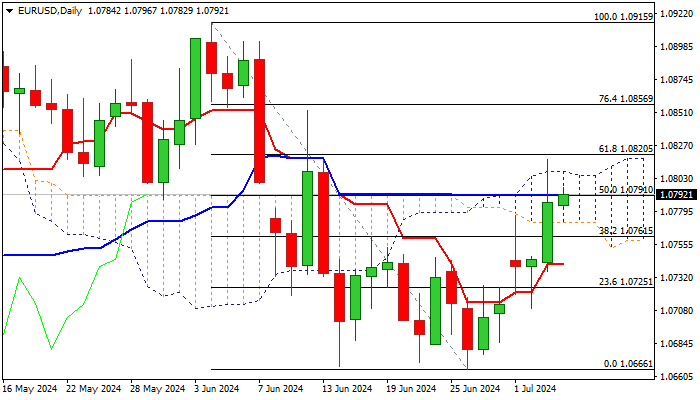
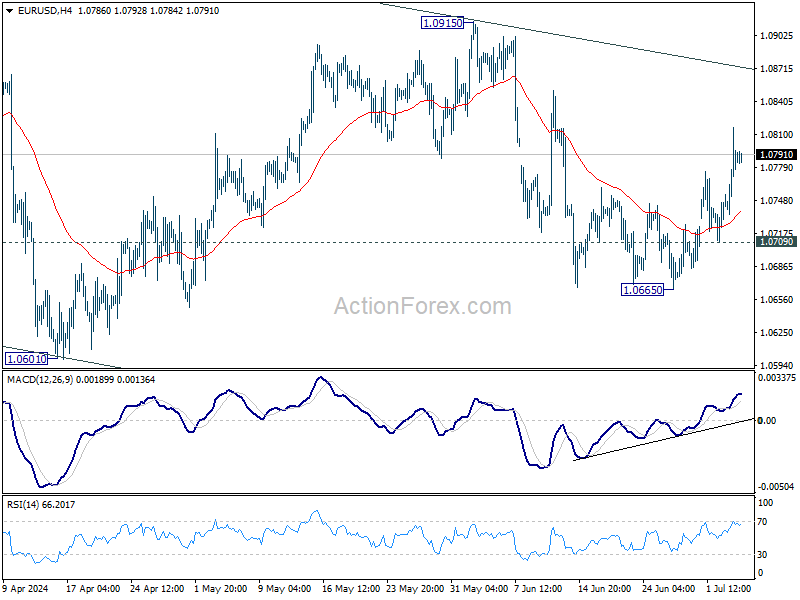
The Euro regained traction and bounced 0.3%, after pullback from 1.0895 (May 16 high) was repeatedly rejected at 100DMA (1.0814), generating initial signal of a double-bottom and potential end of corrective phase.

Fresh strength so far retraced over 50% of 1.0895/1.0812 pullback and on track complete bullish engulfing pattern on daily chart, which would reinforce reversal signal.

Daily MA’s returned to bullish setup, with 10/200DMA golden cross and converged 20/200DMA’s about to form another cross, while positive momentum remains strong and adds to improved technical picture.

Better than expected May PMI data from Germany and Eurozone, released earlier today, positively impacted the single currency by adding to bets for ECB’s June rate cut, however, upbeat US PMI data partially offset the positive impact.

Daily close above broken 50% retracement level (1.0853) will be a minimum requirement to keep fresh bulls intact for further recovery and possible attack at key near-term barriers at 1.0891/95 (Fibo 76.4% / May 16 peak.

On the other hand, dip and close below rising 10DMA (1.0838) would weaken near-term structure and risk renewed attack at key 100DMA support, loss of which would shift near-term focus to the downside.

Res: 1.0838; 1.0885; 1.0891; 1.0942.
Sup: 1.0838; 1.0814; 1.0786; 1.0760.

Sunset Market Commentary

Markets

European May PMIs were generally speaking good. The services reading stabilized at a decent 53.3 in May but a better-than-expected improvement in the admittedly still struggling manufacturing sector (from 45.7 to 47.4) lifted the composite figure to the highest in a year (52.3). S&P Global estimates Q2 growth at 0.3% while projecting an annual 1% growth (with upside) risks for 2024. Faster increases in private sector business activity, new orders and employment were recorded. Services continued to compensate for manufacturing in every of the aforementioned components. That said, the rate of contraction in manufacturing output (nearing stabilization) and new orders was the slowest since long. Business confidence hit a 27-month high. Meanwhile, rates of inflation of both input costs and output prices softened from April. That’s little reason to cheer though as they remained above pre-pandemic averages in each case. In addition, the widely anticipated outcome of the Q1 negotiated wages defied expectations for a decline and instead picked up from 4.5% to 4.7%. That matched the 2023Q3 three-decade high. The ECB, among those anticipating a slowdown as well, did its best to downplay the result in a blog post. They attributed it to (German) one-offs and said that based on a range of indicators, including its own tracker, wage growth would decelerate in 2024 from current elevated levels. Be that as it may, ECB policymakers themselves have highlighted the importance of today’s outcome for future policy (after a June cut) numerous times and it’s all too easy to be splitting hairs afterwards. German Bunds naturally underperform US Treasuries today. Yields in the country rise up to 6.2 bps at the front with the 2-yr yield hitting new YtD highs. The European swap counterpart is coming close. Money markets pared conviction on three ECB rate cuts this year to less than 50%. US rates in choppy trading trade flat to slightly higher (+/- 1bp) after another strong weekly jobless claims reading (215k vs 220k expected) erased earlier (small) losses. Gilt yields initially extended yesterday’s CPI driven surge before reversing course following the PMIs (see below). They currently trade 0.4-1.2 bps lower.

The euro takes the upper hand against the dollar, bringing the EUR/USD pair from 1.0823 to 1.086 currently. Technically nothing has changed though with first resistance levels at 1.0895 never having come under pressure. The common currency also got some respite against the British pound. EUR/GBP rebounded from an important support level around 0.85 to change hands in the 0.852 area with the move gaining traction after the UK PMIs. Equity markets trade in positive territory, helped by stellar Nvidia results released yesterday after US trading hours. The EuroStoxx50 adds 0.5%, Wall Street opens with about 1% gains for the Nasdaq.

News & Views

The Turkish central bank (CBRT) kept its policy rate unchanged at 50% and sticks with a tightening bias in case a significant and persistent deterioration in inflation is foreseen. Recent indicators point to a slowdown in domestic demand compared to Q1 2024. In addition to the high level of and the stickiness in services inflation, inflation expectations, geopolitical risks, and food prices keep inflationary pressures alive. Considering the lagged effects of the monetary tightening, the Committee decided to keep the policy rate unchanged, but reiterated that it remains highly attentive to those inflation risks. The Turkish lira keeps near historically low levels around EUR/TRY 35.

The UK Composite PMI unexpectedly declined from 54.1 to 52.8 in May while consensus was looking for a stabilization. A revival in manufacturing production (51.3 from 49.1; 22-month high) couldn’t make up for a setback in services (52.9 from 55; 6-month low). Business activity growth was again accompanied by a rise in new order volumes and an uptick in export sales, but ongoing hiring challenges meant that the rate of job creation remained only marginal. At the same time, UK businesses reported the softest increase in average selling prices for over three years, partly linked to a slowdown in input cost inflation after April’s steep rise. Survey respondents highlighted a softening of labour cost pressures following the increase in the National Living Wage, with services firms especially seeing a drop in input price inflation. Today’s survey data are consistent with GDP rising around 0.3% in Q2.

Graphs

German 2-yr yield hits new YtD high in the wake of improving PMIs and …

... record-matching wage growth in the EMU (2024Q1 data). ECB’s manouvring room after a June cut becomes increasingly limited.

EUR/GBP rebounds after nearing critical support around 0.85. A setback in UK services PMI weighs on sterling.

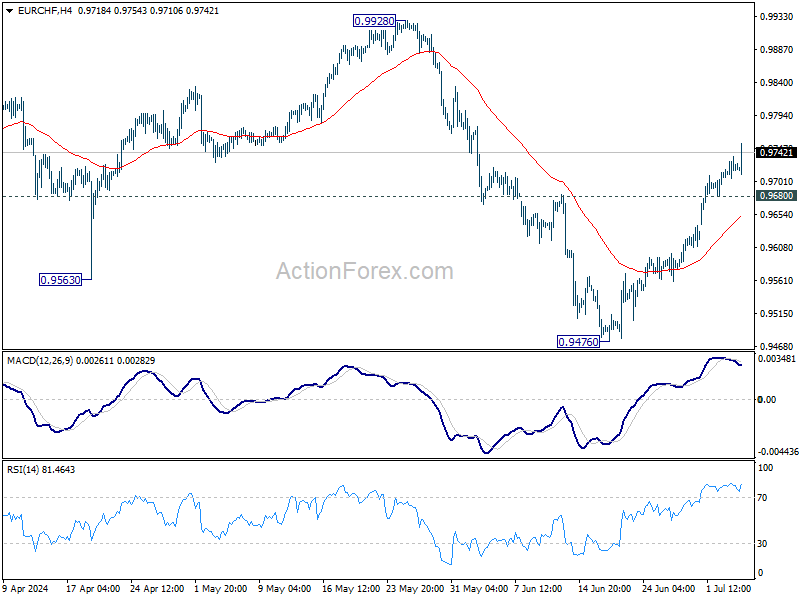
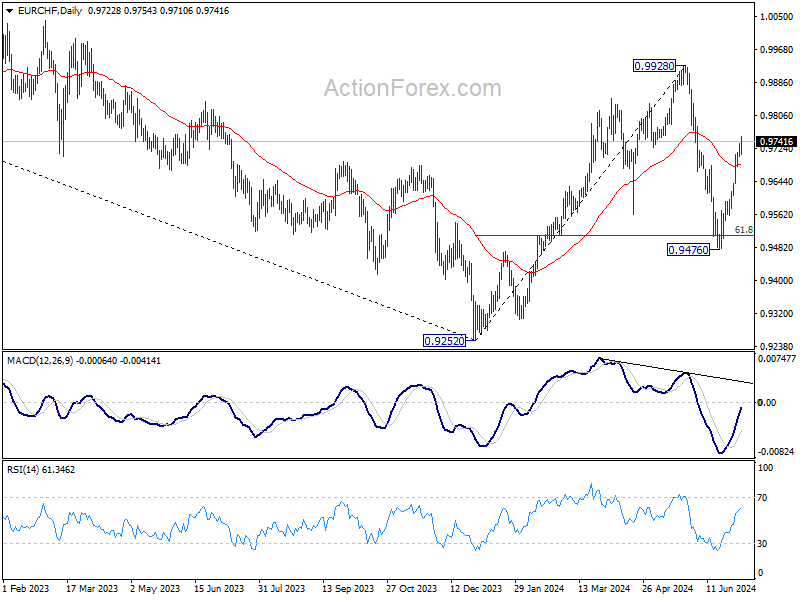
EUR/CHF nearing parity as scope for rate cuts in Switzerland contrasts with Europe

US PMI composite jumps to 25-month high, upturn accelerates again

US PMI Manufacturing rose from 50.0 to 50.9 in May. PMI Services rose fro 51.3 to 54.8, a 12-month high. PMI Composite rose from 51.3 to 54.4, a 25-month high.

Chris Williamson, Chief Business Economist at S&P Global Market Intelligence said:

"The US economic upturn has accelerated again after two months of slower growth, with the early PMI data signalling the fastest expansion for just over two years in May. The data put the US economy back on course for another solid GDP gain in the second quarter.

"Not only has output risen in response to renewed order book growth, but business confidence has lifted higher to signal brighter prospects for the year ahead. However, companies remain cautious with respect to the economic outlook amid uncertainty over the future path of inflation and interest rates, and continue to cite worries over geopolitical instabilities and the presidential election.

"Selling price inflation has meanwhile ticked higher and continues to signal modestly above-target inflation. What's interesting is that the main inflationary impetus is now coming from manufacturing rather than services, meaning rates of inflation for costs and selling prices are now somewhat elevated by pre-pandemic standards in both sectors to suggest that the final mile down to the Fed's 2% target still seems elusive."

Full US PMI release here.

USD/JPY Steady as Japanese PMIs Mixed

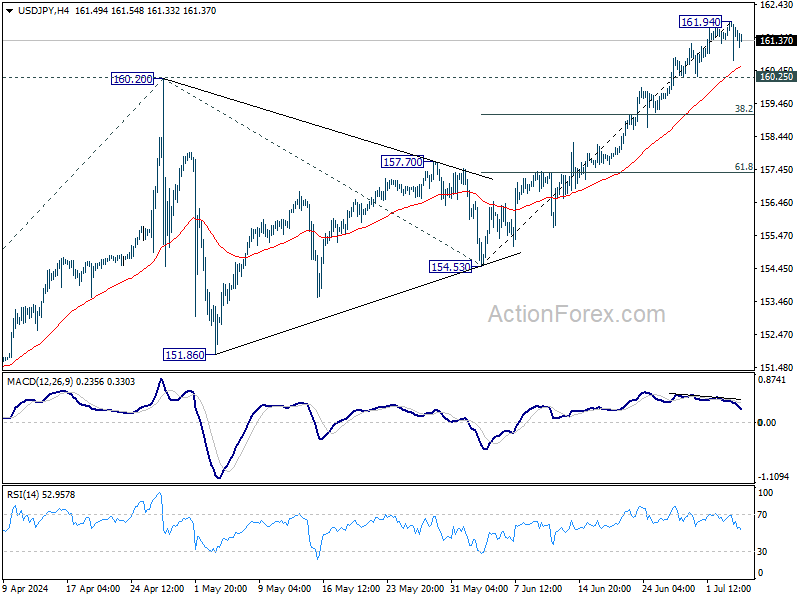
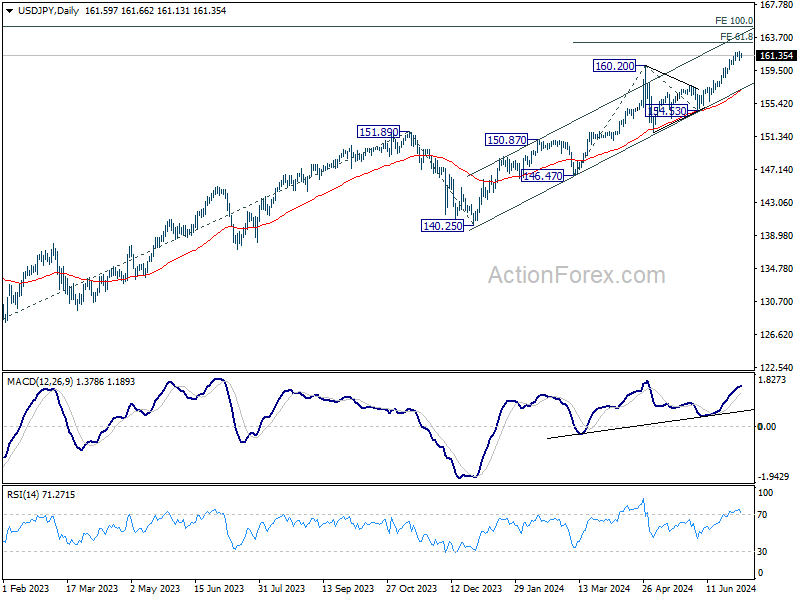
The Japanese yen is slightly lower on Thursday. USD/JPY is trading at 156.70, down 0.08% on the day at the time of writing.

Japan’s PMIs for April were a mixed bag and the yen didn’t show much reaction. Services PMI dipped to 53.6, down from 54.3 in March and just shy of the forecast of 53.8. This was the smallest growth in services since February.

Manufacturing PMI showed improvement and rose to 50.5, up from 49.6 in March and above the market estimate of 49.7. This was the first growth since May 2023 as manufacturing has been in a prolonged slump. The 50 level separates contraction from growth.

The Japanese economy is showing signs of improving after first-quarter GDP declined. Inflation has been easing, which could hamper the ability of the Bank of Japan to increase rates without reigniting deflation.

FOMC minutes: Fed considered a rate hike at May meeting

With inflation falling around the globe, major central banks have been under pressure to lower interest rates. The central banks remain cautious, however, and the Fed minutes indicated that there was a discussion to raise rates at the May 1st meeting. Other central banks are also unclear about their rate path – the Reserve Banks of Australia and New Zealand held rates at their most recent meetings but also considered hiking rates.

The FOMC minutes noted that policy makers are not confident about lowering rates at this stage and want to see more evidence that inflation will continue to drop and remain sustainable around the 2% target. This message is consistent with what we have been hearing from a host of Fed members, although the markets have priced in a September rate cut.

USD/JPY Technical

  • USD/JPY tested support at 156.02 earlier. Below, there is support at 156.33
  • 157.07 and 157.32 are the next resistance lines

EUR/USD Mid-Day Outlook

Daily Pivots: (S1) 1.0805; (P) 1.0834; (R1) 1.0852; More...

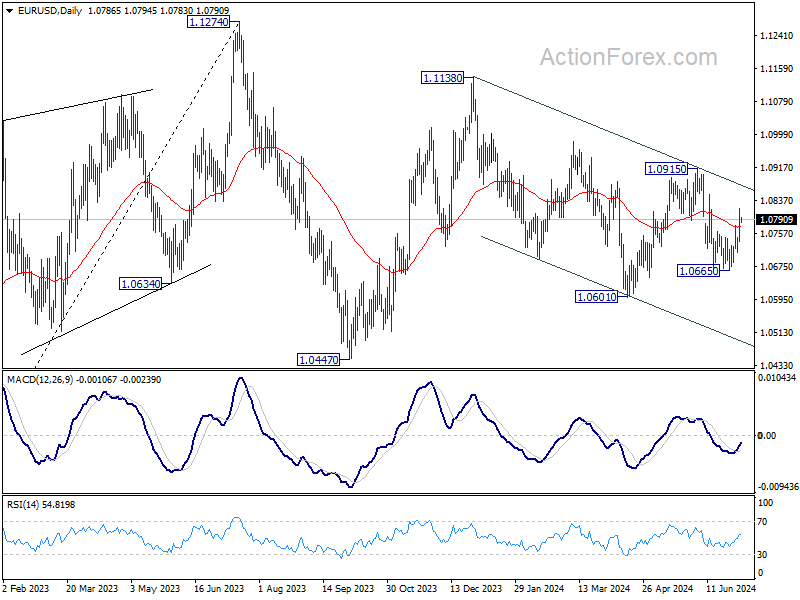
EUR/USD recovers ahead of 1.0810 resistance turned support. Intraday bias stays neutral at this point. On the upside, break of 1.0894 will resume the rise from 1.0601 to 1.0980 resistance. Decisive break there will confirm that whole fall from 1.1138 has completed at 1.0601 already. However, firm break of 1.0810 will dampen this bullish case, and turn bias back to the downside for 55 D EMA (now at 1.0791) and below.

In the bigger picture, price actions from 1.1274 are viewed as a corrective pattern. Fall from 1.1138 is seen as the third leg and could have completed. Firm break of 1.1138 will argue that larger up trend from 0.9534 (2022 low) is ready to resume through 1.1274 high. On the downside, break of 1.0601 will extend the corrective pattern instead.