Thu, Apr 09, 2026 20:33 GMT
More

    Sample Category Title

    Chart Alert: Silver 13% Flash Crash Has Not Damaged Its Bullish Trend

    Key takeaways

    • Silver’s bullish trend remains intact despite volatility: A sharp 13% flash crash failed to break the ascending trendline from early January, with prices holding above the key US$99.39 support, preserving the short-term bullish bias.
    • Top-performing asset YTD, driven by macro tailwinds: Silver is up ~52.5% YTD, outperforming gold by a wide margin, supported by a weaker US dollar and heightened geopolitical risk that amplifies its higher-beta characteristics.
    • Momentum and relative strength still favour upside: RSI indicators remain above key support levels, while Silver continues to outperform Gold on a relative basis, keeping higher resistance targets in play unless US$99.39 decisively breaks.

    Silver is the top asset performer so far

    Fig. 1: Year-to-date performances of major cross assets as of 26 Jan 2026 (Source: MacroMicro)

    Silver (XAG/USD) has soared as expected, cleared above the highlighted US$90.90 trigger level, and hit our intermediate resistance level of US$101.15 as highlighted in our previous analysis.

    Among the major cross-asset classes, Silver has emerged as the top-performing asset. Based on year-to-date performance as of Monday, 26 January 2026, spot Silver (London Bullion Market Association) has recorded a stellar gain of 52.3% (see Fig. 1).

    It even surpassed spot Gold (+16.6%) by around three times due to its higher beta factor, supported by a continuation of the weakening US dollar trend since 15 January 2026 and elevated geopolitical risk premium reinforced by an expansionary/aggressive US White House’s foreign policy.

    On Monday, 26 January US session, Silver (XAG/USD) soared to a fresh intraday all-time high of US$117.54 before it tumbled swiftly 13% in the next four hours to hit an intraday low of US$102.52 on Tuesday, 27 January Asian session.

    Silver (XAG/USD) has recovered partially with an intraday gain of 8.6% to trade at US$112.72 at the time of writing.

    Let’s now dissect the latest short-term (1to 3 days) trajectory of Silver (XAG/USD) from a technical analysis perspective.

    Short-term trend bias (1 to 3 days): Bullish; remains supported by ascending trendline

    Fig. 2: Silver (XAG/USD) minor trend as of 27 Jan 2026 (Source: TradingView)

    Fig. 3: Silver (XAG/USD) medium-term trend as of 14 Jan 2026 (Source: TradingView)

    Despite the latest 13% plunge, Silver (XAG/USD) has continued to trade above a key minor ascending trendline in place since the 8 January 2026 low of US$73.84, now acting as a support at around US$99.39.

    Hence, watch the 99.39 short-term pivotal support to maintain the minor bullish impulsive up move sequence for the next intermediate resistances to come in at US$119.54/121.61 and US$126.12/127.62 (Fibonacci extension clusters) (see Fig. 2).

    On the other hand, a break and an hourly close below US$99.39 invalidates the bullish tone to open scope for a deeper minor corrective decline sequence to expose the next intermediate support at US$95.88 before the medium-term pivotal support zone of US$92.24/87.72 (also the 20-day moving average).

    Key elements to support the bullish bias

    • Both the 1-hour and 4-hour RSI momentum indicators of Silver (XAG/USD) have continued to remain above their respective key ascending supports, holding above the 50 level. Bullish momentum remains intact.
    • The 4-hour relative strength ratio of Silver/Gold has continued to trend higher above its 20-day moving average, which suggests potential continuation of Silver’s outperformance against Gold in the medium-term time horizon (see Fig. 3).

    USD/JPY on Pause: Yen Slows After Sharp Rally

    USD/JPY settled at 154.29 on Tuesday, with the yen pausing its rally after a notable surge of nearly 3.2% in the previous two sessions. This move was driven by growing concerns about a possible coordinated currency intervention between Japan and the US.

    The market was boosted by news that the Federal Reserve Bank of New York had requested USD/JPY levels from dealers on Friday. At the same time, Japanese officials confirmed that they were in close communication with the US on currency policy and potential market actions.

    However, Bank of Japan (BoJ) data suggested that the sharp yen appreciation on Friday was unlikely to be due to direct intervention. This speculation intensified the market’s reaction and speculative positioning.

    The yen continued to receive support from the broader weakness of the US dollar, driven by rising geopolitical risks and trade uncertainties, as well as expectations that US President Donald Trump might replace Fed Chairman Jerome Powell with a softer candidate, further pressuring the US currency.

    Technical Analysis

    On the H4 chart, USD/JPY has formed a correction wave following the previous decline. A continuation of the growth wave to the 155.00 level is possible today. After this rise, a rebound from the resistance level is expected, with the first target for a further decline at 153.00, followed by 152.00. This scenario is confirmed by the MACD indicator, as the histogram is below zero and rising, with the signal line likely to cross the histogram and turn upwards soon.

    On the H1 chart, USD/JPY is testing the 153.80 mark and forming a growth wave. If the price tests the 155.00 level and rebounds, further declines could be expected, with the first support at 153.00 USD. The Stochastic oscillator supports this, as its signal lines continue to decline towards the 50.0 level. A break of this level would signal a continuation of the downward trend.

    Conclusion

    USD/JPY has paused its rapid ascent amid speculation of potential currency intervention. Despite a weaker US dollar and geopolitical risks, the yen’s recent strength is being tested. Technically, while the immediate outlook points to a possible short-term rise to 155.00, a rebound and subsequent decline towards 153.00 could be on the horizon, depending on how market sentiment evolves.

    GBP/JPY Daily Outlook

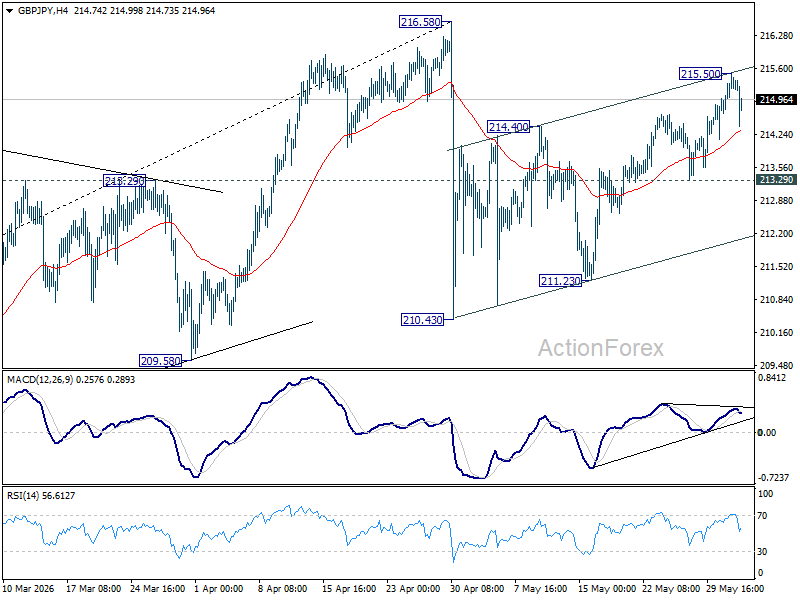
    Daily Pivots: (S1) 209.68; (P) 210.88; (R1) 212.15; More...

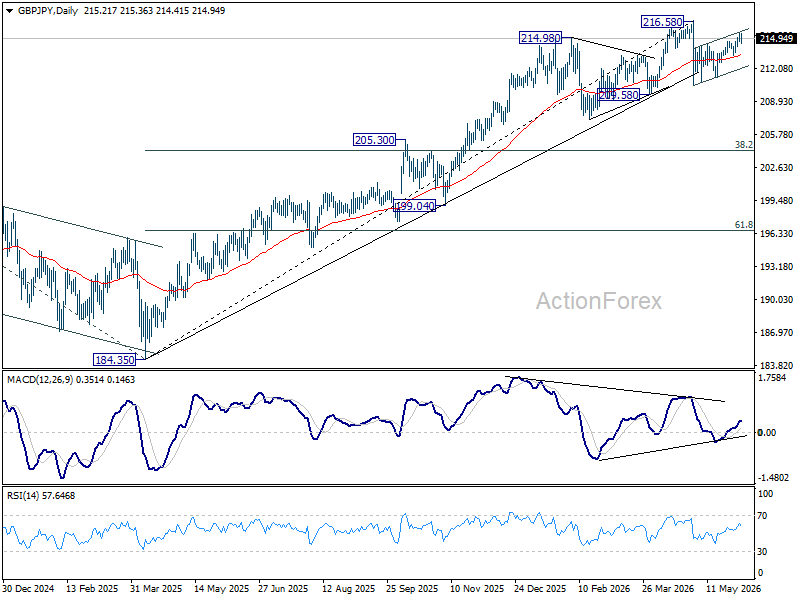
    Intraday bias in GBP/JPY stays on the downside for 55 D EMA (now at 208.99). Sustained break there will argue that it's correcting whole rise from 184.35 and target 38.2% retracement of 184.35 to 214.83 at 203.18. For now, risk will stay on the downside as long as 214.83 holds, in case of recovery.

    In the bigger picture, up trend from 123.94 (2020 low) is in progress. Next target is 61.8% projection of 148.93 (2022 low) to 208.09 (2024 high) from 184.35 at 220.90. On the downside, break of 205.30 resistance turned support is needed to indicate medium term topping. Otherwise, outlook will stay bullish even in case of deep pullback.

    EUR/JPY Daily Outlook

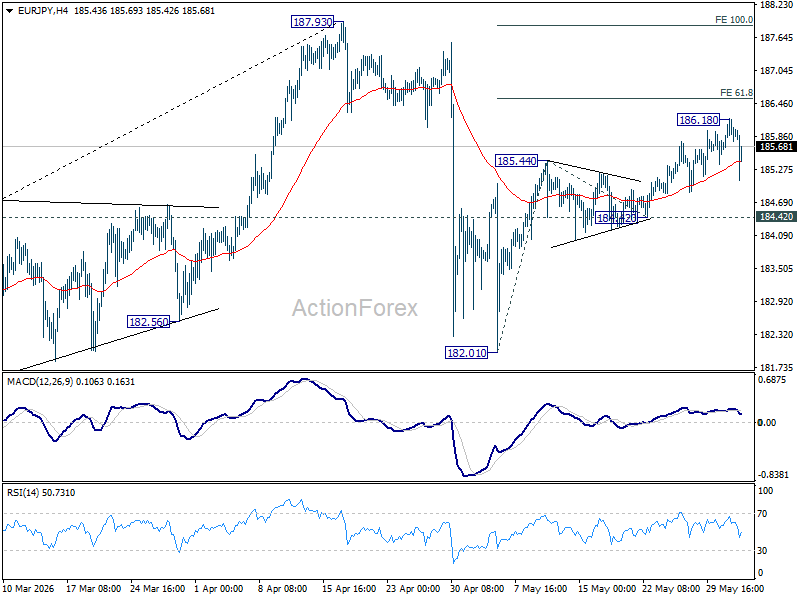
    Daily Pivots: (S1) 181.95; (P) 183.03; (R1) 184.26; More...

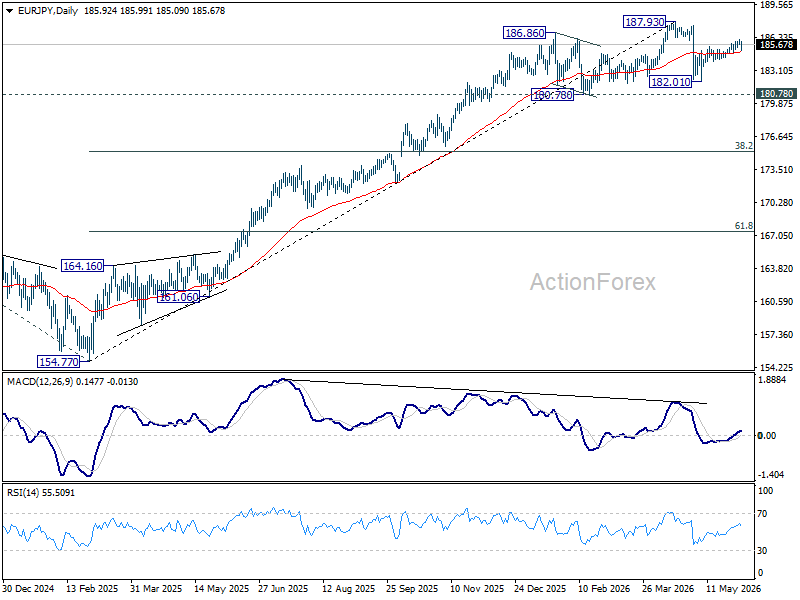
    Intraday bias in EUR/JPY remains on the downside for the moment. Sustained trading below 55 D EMA (now at 182.10) should solidify the case that fall from 186.86 medium term top is correcting whole rise from 154.77. Deeper decline should then be seen to 38.2% retracement of 154.77 to 186.86 at 174.60. For now, risk will stay on the downside as long as 186.86 holds, in case of recovery.

    In the bigger picture, up trend from 114.42 (2020 low) is in progress and and met 61.8% projection of 124.37 to 175.41 from 154.77 at 186.31. Considering bearish divergence condition in D MACD, upside could be capped by 186.31 on first attempt. Still, outlook will stay bullish as long as 55 W EMA (now at 173.32) holds, even in case of deep pullback. Sustained break of 186.31 will pave the way to 78.6% projection at 194.88 next.

    EUR/GBP Daily Outlook

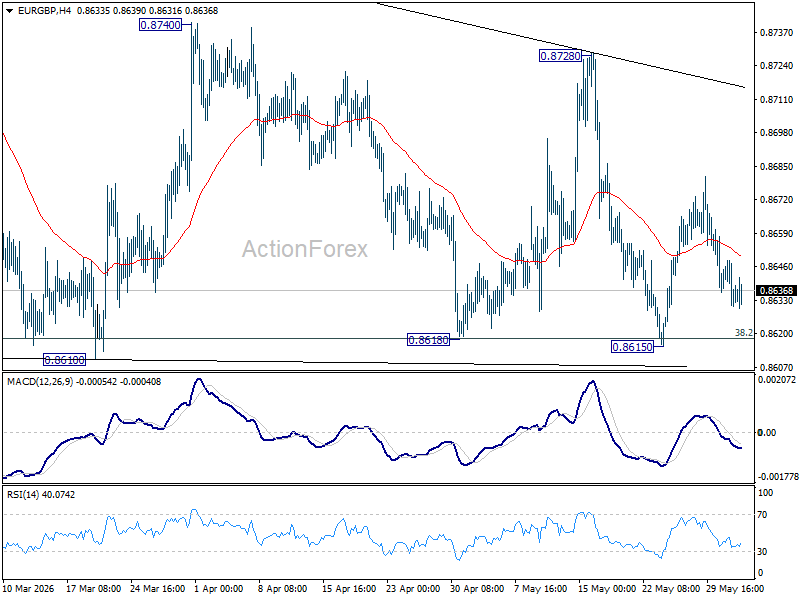
    Daily Pivots: (S1) 0.8670; (P) 0.8683; (R1) 0.8699; More…

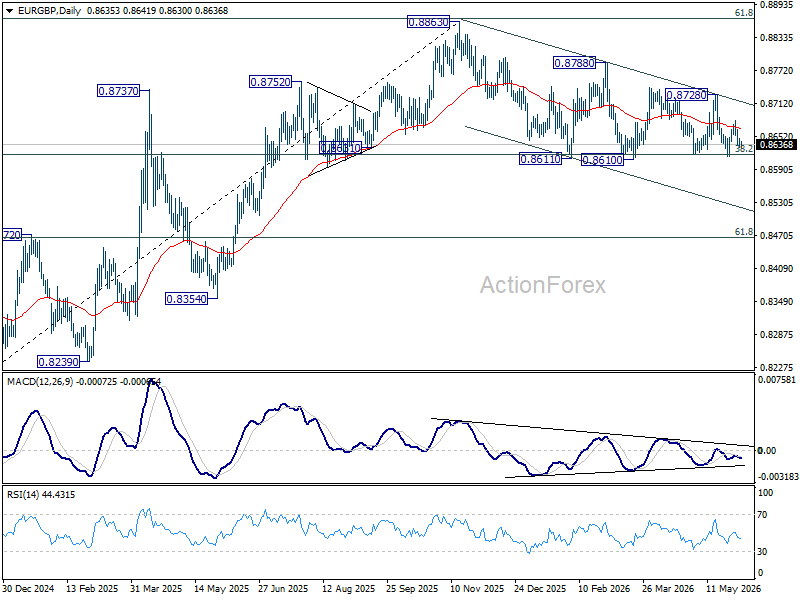
    Intraday bias in EUR/GBP is turned neutral first with current recovery. But risk will remain on the downside as long as 0.8744 resistance holds. Further decline is expected to 0.8631 cluster support (38.2% retracement of 0.8221 to 0.8663 at 0.8618). Decisive break there will carry larger bearish implications and pave the way to 61.8% retracement at 0.8466.

    In the bigger picture, rise from 0.8221 medium term bottom (2024 low) is seen as a corrective move. Upside should be limited by 61.8% retracement of 0.9267 to 0.8221 at 0.8867. Sustained trading below 55 W EMA (now at 0.8625) should confirm that this corrective bounce has completed. In this case, deeper fall would be seen back to 0.8201/21 key support zone. However, decisive break of 0.8867 will suggest that EUR/GBP is already reversing whole decline from 0.9267 (2022 high). That should pave the way back to 0.9267.

    EUR/AUD Daily Outlook

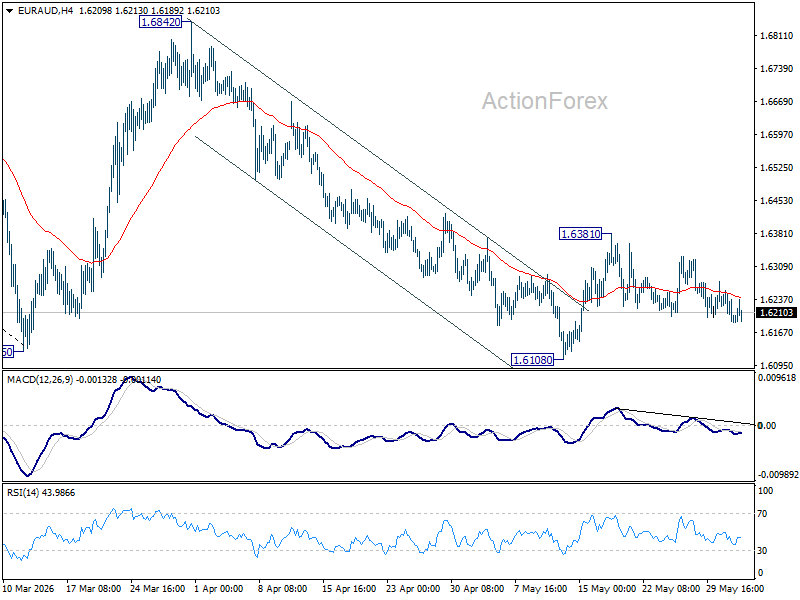
    Daily Pivots: (S1) 1.7127; (P) 1.7161; (R1) 1.7210; More...

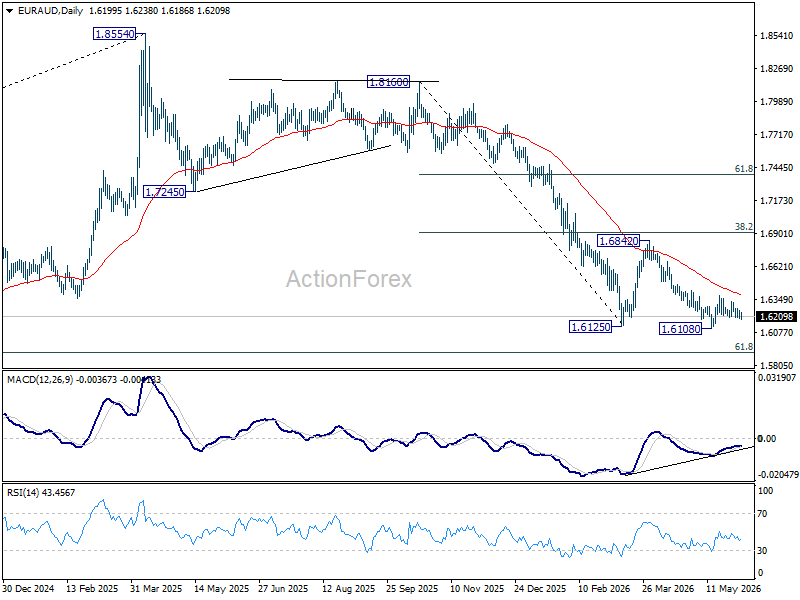
    Intraday bias in EUR/AUD is turned neutral first with current recovery and some consolidations would be seen. Further decline is expected as long as 1.7287 support turned resistance holds. Fall from 1.8160 is seen as the third leg of the corrective pattern from 1.8554. Below 1.7096 will target 100% projection of 1.8554 to 1.7245 from 1.8160 at 1.6851.

    In the bigger picture, the break of 55 W EMA (now at 1.7464) argues that fall from 1.8554 medium term top is correcting whole up trend from 1.4281 (2022 low). Deeper decline is in favor to 38.2% retracement of 1.4281 to 1.8554 at 1.6922, and possibly below. Risk will stay on the downside as long as 55 D EMA (now at 1.7537) holds, in case of strong rebound.

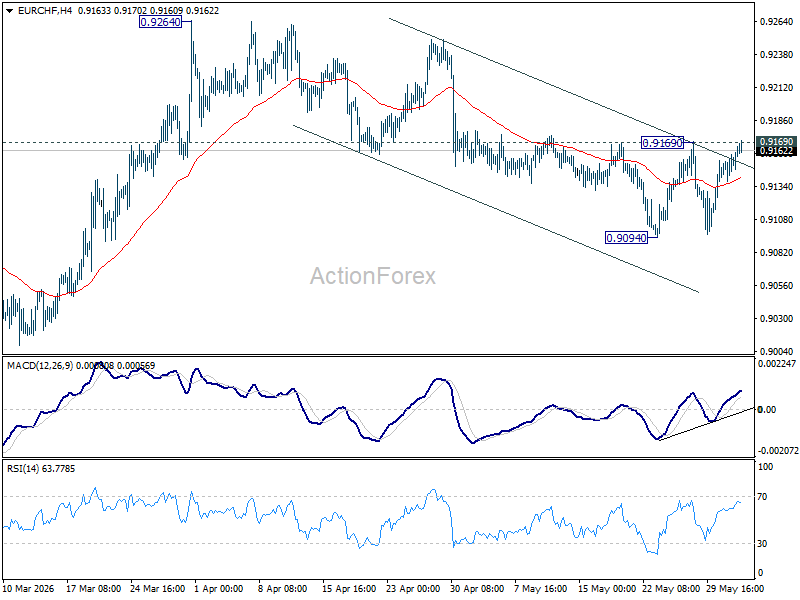
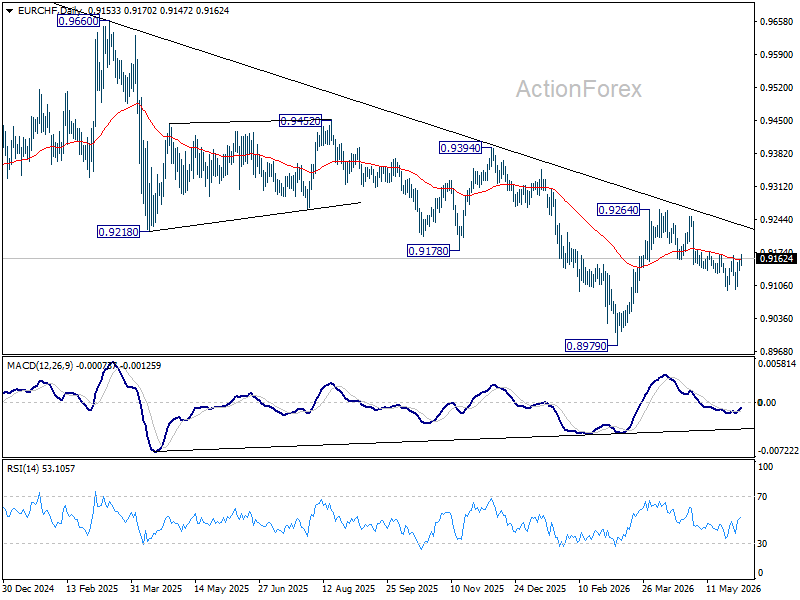
    EUR/CHF Daily Outlook

    Daily Pivots: (S1) 0.9206; (P) 0.9219; (R1) 0.9244; More....

    Intraday bias in EUR/CHF is turned neutral first with current recovery and some consolidations would be seen first. Further fall is expected as long as 0.9268 support turned resistance holds. Below 0.9192 will bring retest of 0.9178 low. Firm break there will resume larger down trend.

    In the bigger picture, another rejection by 55 W EMA (now at 0.9350) keeps outlook bearish. Downtrend from 1.2004 (2018 high) is still in progress. Firm break of 0.9178 will target 61.8% projection of 1.1149 to 0.9407 from 0.9928 0.8851. Outlook will stay bearish as long as 0.9394 resistance holds, in case of recovery.

    Risk-on, But Not for Crypto

    Market Overview

    The crypto market capitalisation grew by 0.67% over the past day to $2.99 trillion. Bulls are seeking to take advantage of increased risk appetite in traditional markets but are facing increased selling pressure as they approach the $3 trillion mark. Of course, this is not one big ‘battle for crypto,’ but a series of separate battles in cryptocurrencies, where the flagships are doing slightly better, with Ethereum, BNB, XRP, and Solana gaining about 1.5% over the past 24 hours.

    Bitcoin is up 0.6% on the day, trading above $88K, having encountered increased selling pressure over the last two days in attempts to climb above $89K, despite the collapse of the dollar, which has already helped the stock and metals markets. At times, it seems that speculators’ capital and attention are now focused exclusively on precious metals (mainly gold and silver), and there is simply no strength left for crypto.

    XRP has stabilised at $1.9, a horizontal support level where the coin’s sell-off has been halted since December 2024. A breakdown of this support could lead to a more profound decline in the market to the $0.5 area, which is the most important long-term support. If XRP manages to form a bottom, this will open the way to the $3.10-3.50 area.

    News Background

    The largest outflow from global crypto ETFs since mid-November 2025 was likely fuelled by lower expectations of interest rate cuts, according to CoinShares. This indicates that investor sentiment has still not improved since the price collapse on 10 October 2025.

    Investors’ realised losses on Bitcoin reached $4.5 billion, a three-year high. CryptoQuant calls what is happening a market capitulation. The last time this happened was after an annual correction, when Bitcoin was trading at $28,000.

    The key danger to the Bitcoin blockchain is posed by ‘ambitious opportunists’ seeking to change the protocol, said Strategy founder Michael Saylor. This could refer to developers promoting controversial use cases for the network, such as NFT issuance or image storage.

    The hash rate of the largest mining pool, Foundry USA, has fallen by 60%. Data centre operators in the US are shutting down equipment en masse due to extreme weather caused by winter storm Fern.

    US Dollar Index (DXY) Falls to Its Lowest Level Since September

    As the DXY chart shows, the US dollar index is trading today at its lowest level since September 2025. From this month’s peak, the decline has exceeded 2%.

    Why Is the Dollar Weakening?

    → The Fed factor. The interest rate decision is due tomorrow. Markets are expecting dovish rhetoric from Jerome Powell to offset economic risks stemming from tariff wars. It cannot be ruled out that the Fed Chair may soften his stance under unprecedented pressure from the White House administration, including threats of criminal prosecution.

    → Loss of safe-haven status. The dollar is losing appeal as a defensive asset amid geopolitical tensions (the US–EU dispute over Greenland and strained relations with Canada). Capital is actively flowing out of fiat currencies into real assets, as confirmed by yesterday’s historic breakout in gold prices above $5,000.

    That said, the technical picture offers some grounds for optimism among bulls.

    Technical Analysis of the DXY Chart

    On 20 January, when analysing the US Dollar Index (DXY), we:

    → updated the descending channel (marked in red);

    → suggested that the downtrend could continue, with a move towards the channel median.

    However, bears exceeded our expectations and, after testing the upper boundary on 21 January (as shown by the arrow), pushed the price towards the lower boundary of the channel, which tends to act as support.

    Moreover, the DXY index is now hovering near a long-term support zone from which the price rebounded twice in the second half of 2025.

    This suggests that the aggressive downward momentum may be running out of steam, with the market likely to shift into a wait-and-see mode ahead of the Fed’s decision. Be prepared for spikes in volatility tomorrow between 22:00 and 22:30 GMT+3.

    Trade global index CFDs with zero commission and tight spreads (additional fees may apply). Open your FXOpen account now or learn more about trading index CFDs with FXOpen.

    This article represents the opinion of the Companies operating under the FXOpen brand only. It is not to be construed as an offer, solicitation, or recommendation with respect to products and services provided by the Companies operating under the FXOpen brand, nor is it to be considered financial advice.

    Nasdaq 100 Advances Ahead of Tech Giants’ Earnings

    As early as tomorrow, after the close of the main trading session, quarterly results will be released by Microsoft (MSFT), Meta Platforms (META) and Tesla (TSLA), with Apple (AAPL) scheduled to report on Thursday.

    As the chart shows, the Nasdaq 100 index (US Tech 100 mini on FXOpen) climbed today to its highest level since early November, rising above 25,900. Since the start of the week, the index has gained around 1.8%. This appears to reflect a shift in market sentiment:

    → Geopolitical risks are fading. Market participants seem to have adapted to the news flow surrounding tariffs and Greenland. After the initial shock, current political rhetoric is increasingly viewed as a negotiating stance rather than a genuine threat to business.

    → Confidence in market leaders. Prices are factoring in expectations that tech giants will outline roadmaps showing how their record AI spending will begin to generate net profits as early as this year.

    Technical Analysis of the Nasdaq 100 Chart

    Price action in the Nasdaq 100 index (US Tech 100 mini on FXOpen) points to demand-side dominance:

    → the downward trajectory seen between 16 and 21 January was broken by bulls on the 22nd, with a spike in volatility (visible on the ATR indicator) highlighting a sharp change in market behaviour;

    → recent fluctuations have formed an ascending channel (shown in blue);

    → the market has confidently recovered from the bearish gap seen at the start of the week;

    → the broad bullish candle on Monday, 26 January, signals a demand imbalance, with the rally zone showing signs of support (marked by a rectangle).

    From the supply-side perspective:

    → the move above the 13 January high could turn out to be a false bullish breakout (another one, judging by Nasdaq 100 price action over recent months);

    → price is currently hovering near the upper boundary of the existing channel.

    A modest technical pullback in the coming days cannot be ruled out, although the key driver is likely to be market reactions to upcoming corporate earnings.

    Trade global index CFDs with zero commission and tight spreads (additional fees may apply). Open your FXOpen account now or learn more about trading index CFDs with FXOpen.

    This article represents the opinion of the Companies operating under the FXOpen brand only. It is not to be construed as an offer, solicitation, or recommendation with respect to products and services provided by the Companies operating under the FXOpen brand, nor is it to be considered financial advice.