

Sample Category Title
EUR/GBP Weekly Outlook
EUR/GBP remains bounded in range last week and outlook is unchanged. Initial bias stays neutral this week first. On the downside, firm break of 0.8529 support will argue that the corrective recovery from 0.8497 has completed at 0.8601. Intraday bias will be back on the downside for retesting 0.8497 low next. On the upside, break of 0.8601 will resume the rebound instead.
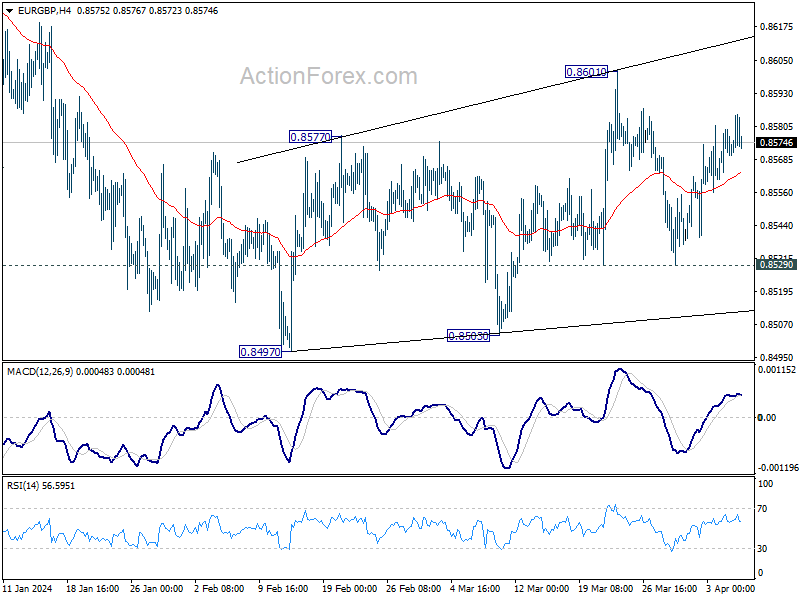
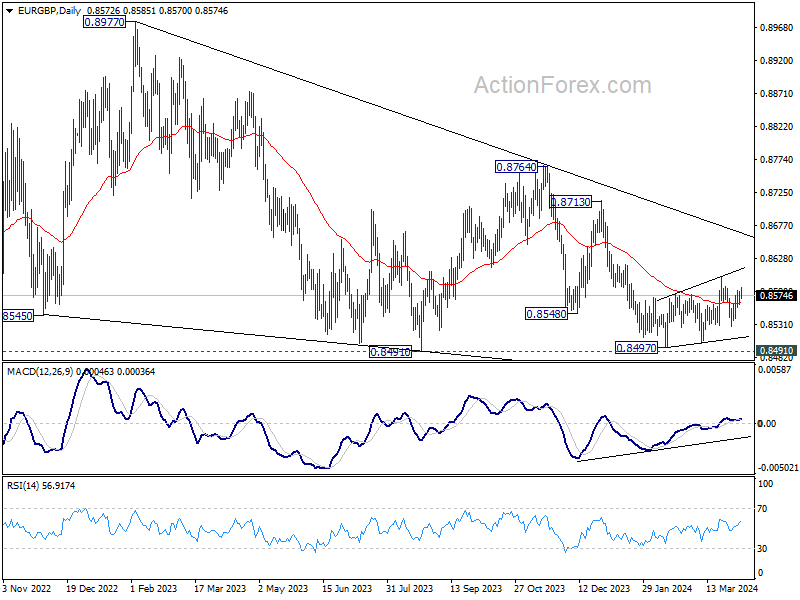
In the bigger picture, there is no clear sign that down trend from 0.9267 has completed, despite loss of downside momentum as seen in D MACD. As long as 0.8713 resistance holds, the down trend will remain in favor to resume through 0.8491 low at la later stage.
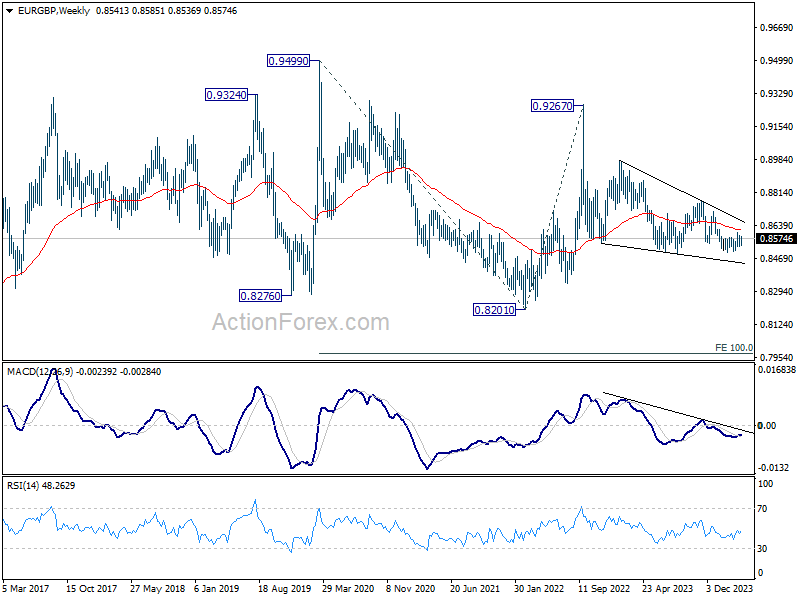
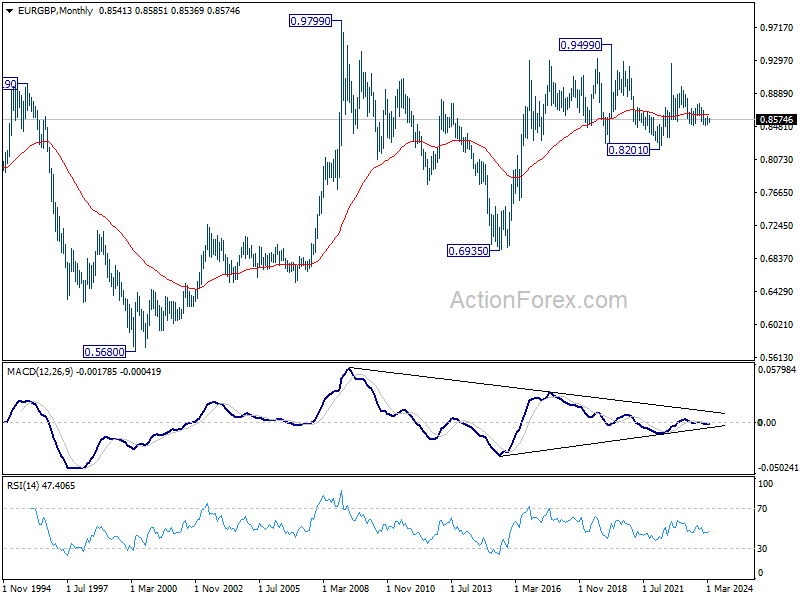
In the long term picture, price action from 0.9499 (2020 high) is seen as part of the long term range pattern from 0.9799 (2008 high). Fall from 0.9267 is the third leg of the pattern from 0.9499. Break of 0.8201 (2022 low) will target 100% projection of 0.9499 to 0.8201 from 0.9267 at 0.7969.
EUR/AUD Weekly Outlook
EUR/AUD dipped to 1.6412 last week but recovered since then. Initial bias remains neutral this week first. On the downside, break of 1.6412 and sustained trading below 1.6439 support will argue that whole rebound from 1.6127 has completed, and turn near term outlook bearish for this support again. Nevertheless, strong rebound from current level, followed by break of 1.6561 minor resistance, will turn bias back to the upside for retesting 1.6742.
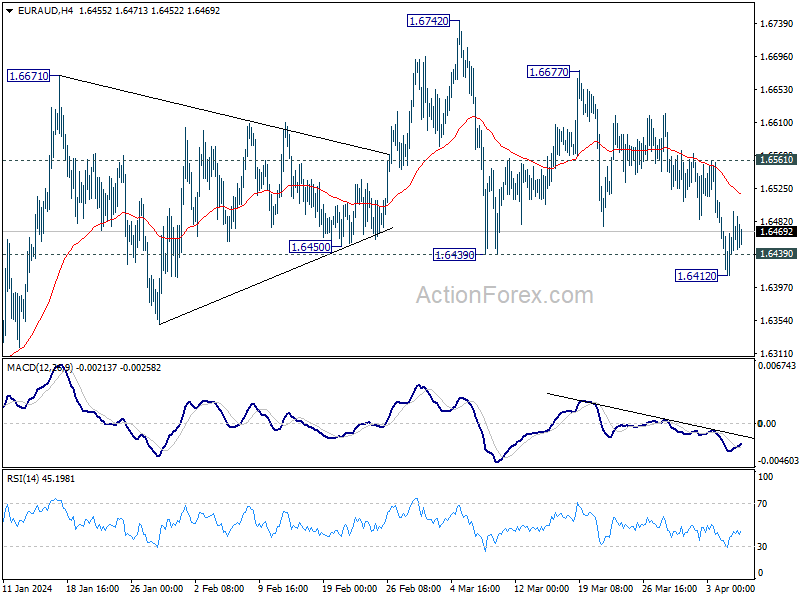
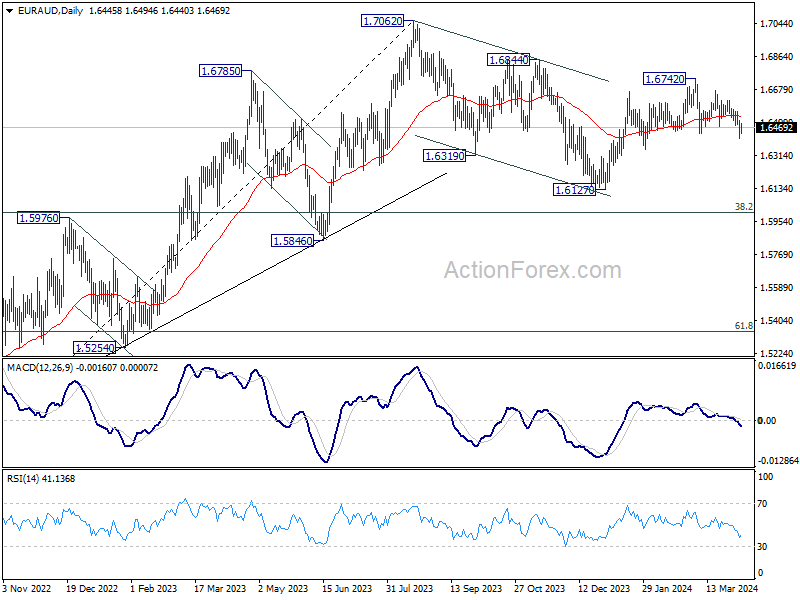
In the bigger picture, fall from 1.7062 medium term top is seen as a correction to the up trend from 1.4281 (2022 low). Break of 1.6844 resistance will argue that this up trend is ready to resume through 1.7062 high. In case of another fall, strong support should be seen around 1.5846 and 38.2% retracement of 1.4281 to 1.7062 at 1.6000 to bring rebound.
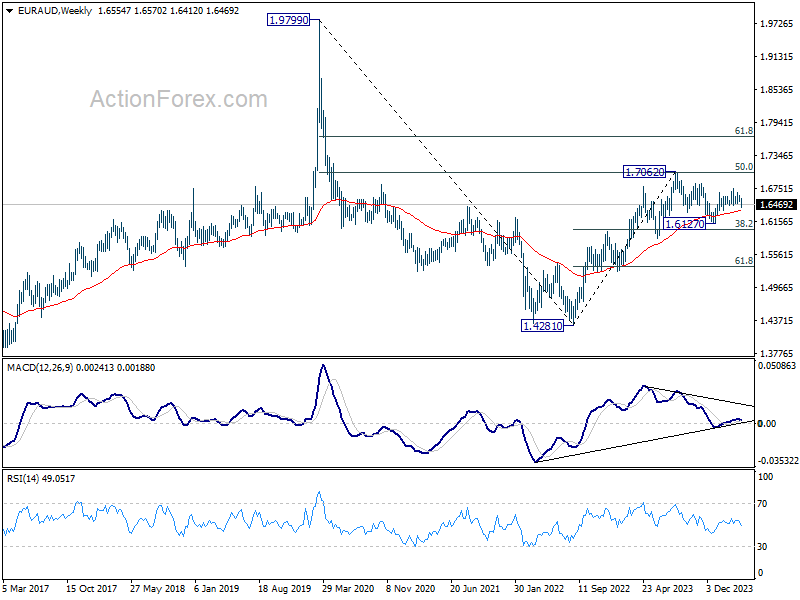
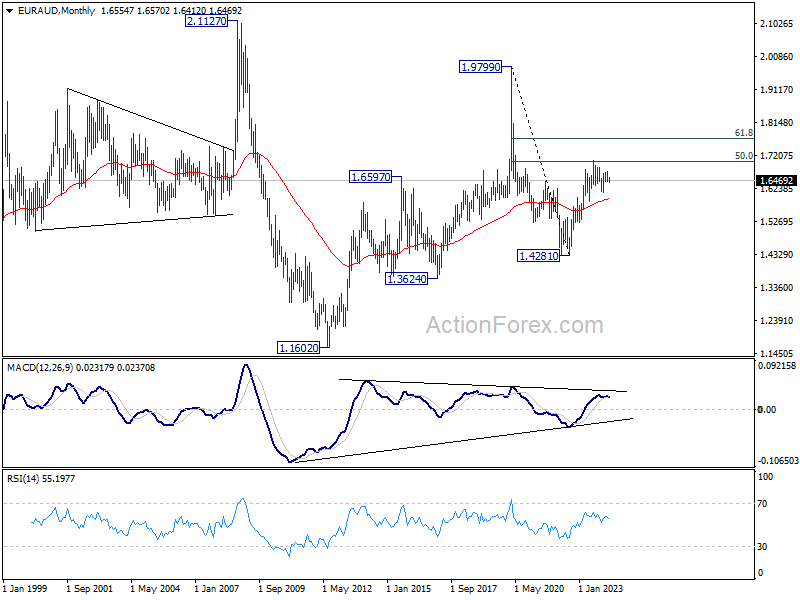
In the longer term picture, price actions from 1.9799 (2020 high) are seen as a long term decline at the same scale as the rise from 1.1602 (2012 low). Rebound from 1.4281 is seen as the second leg. As long as 55 M EMA (now at 1.5950) holds, this second leg could still extend higher. However, sustained trading below 55 M EMA will open up the bearish case for extending the decline through 1.4281 low.
EUR/CHF Weekly Outlook
EUR/CHF's up trend extended to 0.9847 last week but retreated since then. Initial bias is turned neutral this week for consolidation first. But near term outlook will stay bullish as long as 0.9709 support holds. However, considering bearish divergence condition in 4H MACD, break of 0.9709 will confirm short term topping, and turn bias back to the downside for deeper pullback.
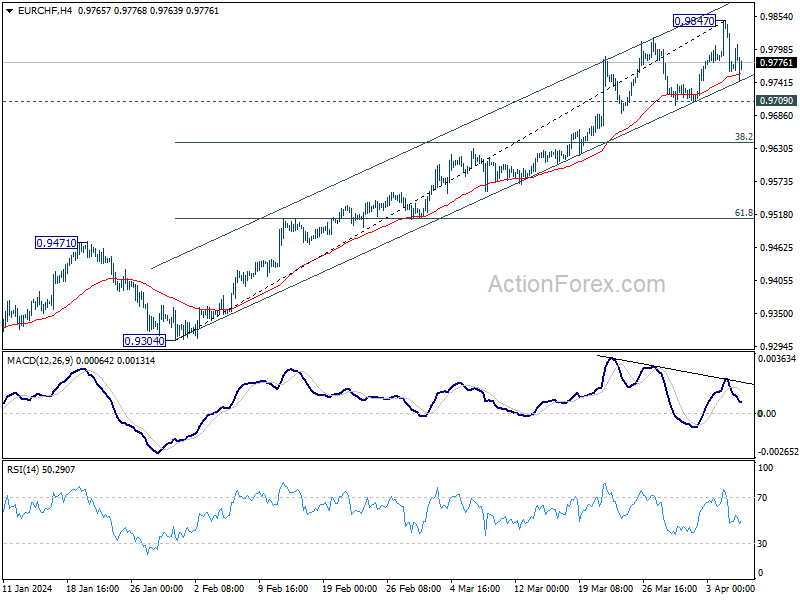
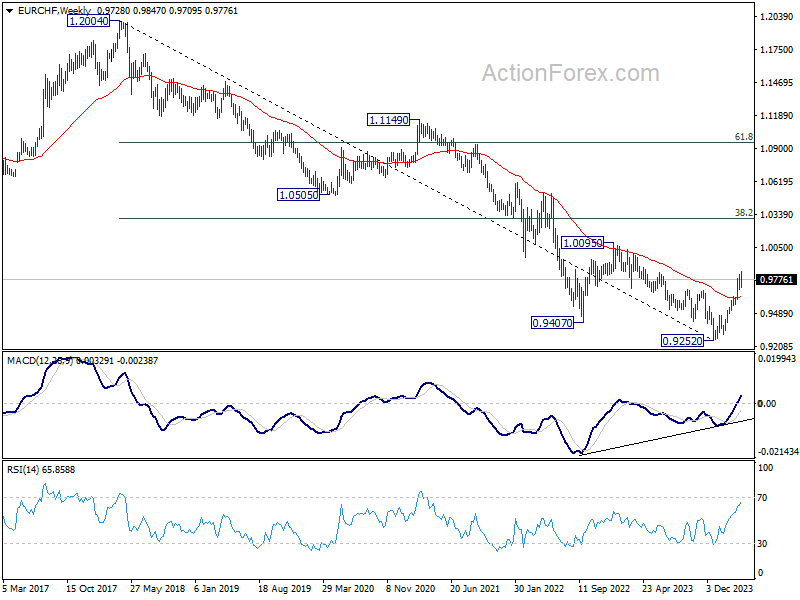
In the bigger picture, a medium term bottom should be in place at 0.9252 already, on bullish convergence condition in W MACD. Rise from there would now target 38.2% retracement of 1.2004 (2018 high) to 0.9252 (2023 low) at 1.0303, even as a correction to the down trend from 1.2004. This will remain the favored case as long as 55 D EMA (now at 0.9603) holds.
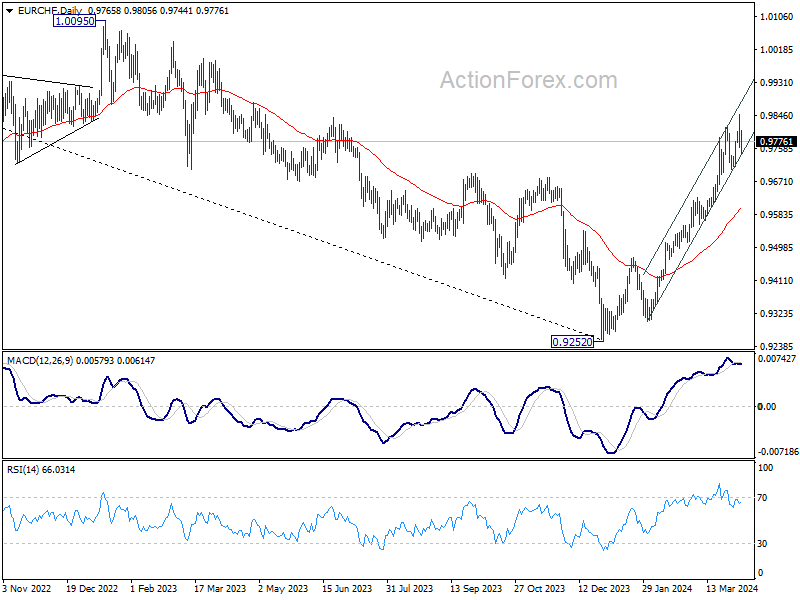
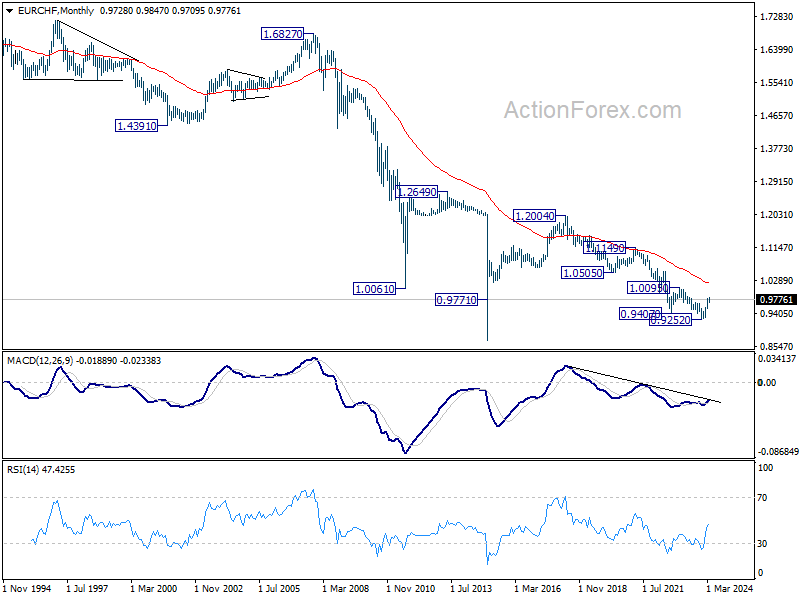
In the long term picture, fall from 1.2004 (2018 high) is part of the multi-decade down trend. Firm break of 1.0095 resistance is needed to be the first sign of long term bottoming. Otherwise, outlook will remain bearish.
Summary 4/8 – 4/12
Monday, Apr 8, 2024
| GMT | Ccy | Events | Consensus | Previous |
|---|---|---|---|---|
| 23:30 | JPY | Labor Cash Earnings Y/Y Feb | 1.80% | 2.00% |
| 23:50 | JPY | Current Account (JPY) Feb | 1.99T | 2.73T |
| 05:00 | JPY | Eco Watchers Survey: Current Mar | 51.6 | 51.3 |
| 05:45 | CHF | Unemployment Rate Mar | 2.20% | 2.20% |
| 06:00 | EUR | Germany Industrial Production M/M Feb | 0.60% | 1.00% |
| 06:00 | EUR | Germany Trade Balance (EUR) Feb | 25.1B | 27.5B |
| 08:30 | EUR | Eurozone Sentix Investor Confidence Apr | -8.3 | -10.5 |
| 22:00 | NZD | NZIER Business Confidence Q1 | -2 | |
| 23:01 | GBP | BRC Like-For-Like Retail Sales Y/Y Mar | 1.80% | 1.00% |
| GMT | Ccy | Events | |
|---|---|---|---|
| 23:30 | JPY | Labor Cash Earnings Y/Y Feb | |
| Forecast: 1.80% | Previous: 2.00% | ||
| 23:50 | JPY | Current Account (JPY) Feb | |
| Forecast: 1.99T | Previous: 2.73T | ||
| 05:00 | JPY | Eco Watchers Survey: Current Mar | |
| Forecast: 51.6 | Previous: 51.3 | ||
| 05:45 | CHF | Unemployment Rate Mar | |
| Forecast: 2.20% | Previous: 2.20% | ||
| 06:00 | EUR | Germany Industrial Production M/M Feb | |
| Forecast: 0.60% | Previous: 1.00% | ||
| 06:00 | EUR | Germany Trade Balance (EUR) Feb | |
| Forecast: 25.1B | Previous: 27.5B | ||
| 08:30 | EUR | Eurozone Sentix Investor Confidence Apr | |
| Forecast: -8.3 | Previous: -10.5 | ||
| 22:00 | NZD | NZIER Business Confidence Q1 | |
| Forecast: | Previous: -2 | ||
| 23:01 | GBP | BRC Like-For-Like Retail Sales Y/Y Mar | |
| Forecast: 1.80% | Previous: 1.00% | ||
Tuesday, Apr 9, 2024
| GMT | Ccy | Events | Consensus | Previous |
|---|---|---|---|---|
| 00:30 | AUD | Westpac Consumer Confidence Apr | -1.80% | |
| 01:30 | AUD | NAB Business Confidence Mar | 0 | |
| 01:30 | AUD | NAB Business Conditions Mar | 10 | |
| 05:00 | JPY | Consumer Confidence Mar | 39.7 | 39.1 |
| 06:00 | JPY | Machine Tool Orders Y/Y Mar P | -8.00% | |
| 06:45 | EUR | France Trade Balance (EUR) Feb | -7.0B | -7.4B |
| 10:00 | USD | NFIB Business Optimism Index Mar | 90.2 | 89.4 |
| 23:50 | JPY | Bank Lending Y/Y Mar | 3.10% | 3.00% |
| 23:50 | JPY | PPI Y/Y Mar | 0.80% | 0.60% |
| GMT | Ccy | Events | |
|---|---|---|---|
| 00:30 | AUD | Westpac Consumer Confidence Apr | |
| Forecast: | Previous: -1.80% | ||
| 01:30 | AUD | NAB Business Confidence Mar | |
| Forecast: | Previous: 0 | ||
| 01:30 | AUD | NAB Business Conditions Mar | |
| Forecast: | Previous: 10 | ||
| 05:00 | JPY | Consumer Confidence Mar | |
| Forecast: 39.7 | Previous: 39.1 | ||
| 06:00 | JPY | Machine Tool Orders Y/Y Mar P | |
| Forecast: | Previous: -8.00% | ||
| 06:45 | EUR | France Trade Balance (EUR) Feb | |
| Forecast: -7.0B | Previous: -7.4B | ||
| 10:00 | USD | NFIB Business Optimism Index Mar | |
| Forecast: 90.2 | Previous: 89.4 | ||
| 23:50 | JPY | Bank Lending Y/Y Mar | |
| Forecast: 3.10% | Previous: 3.00% | ||
| 23:50 | JPY | PPI Y/Y Mar | |
| Forecast: 0.80% | Previous: 0.60% | ||
Wednesday, Apr 10, 2024
| GMT | Ccy | Events | Consensus | Previous |
|---|---|---|---|---|
| 02:00 | NZD | RBNZ Rate Decision | 5.50% | 5.50% |
| 08:00 | EUR | Italy Retail Sales M/M Feb | 0.20% | -0.10% |
| 12:30 | CAD | Building Permits M/M Feb | -3.50% | 13.50% |
| 12:30 | USD | CPI M/M Mar | 0.30% | 0.40% |
| 12:30 | USD | CPI Y/Y Mar | 3.40% | 3.20% |
| 12:30 | USD | CPI Core M/M Mar | 0.30% | 0.40% |
| 12:30 | USD | CPI Core Y/Y Mar | 3.70% | 3.80% |
| 13:45 | CAD | BoC Rate Decision | 5.00% | 5.00% |
| 14:00 | USD | Wholesale Inventories Feb F | 0.50% | 0.50% |
| 14:30 | USD | Crude Oil Inventories | 3.2M | |
| 15:30 | CAD | BoC Press Conference | ||
| 18:00 | USD | FOMC Minutes | ||
| 23:01 | GBP | RICS Housing Price Balance Mar | -6% | -10% |
| 23:50 | JPY | Money Supply M2+CD Y/Y Mar | 2.40% | 2.50% |
| GMT | Ccy | Events | |
|---|---|---|---|
| 02:00 | NZD | RBNZ Rate Decision | |
| Forecast: 5.50% | Previous: 5.50% | ||
| 08:00 | EUR | Italy Retail Sales M/M Feb | |
| Forecast: 0.20% | Previous: -0.10% | ||
| 12:30 | CAD | Building Permits M/M Feb | |
| Forecast: -3.50% | Previous: 13.50% | ||
| 12:30 | USD | CPI M/M Mar | |
| Forecast: 0.30% | Previous: 0.40% | ||
| 12:30 | USD | CPI Y/Y Mar | |
| Forecast: 3.40% | Previous: 3.20% | ||
| 12:30 | USD | CPI Core M/M Mar | |
| Forecast: 0.30% | Previous: 0.40% | ||
| 12:30 | USD | CPI Core Y/Y Mar | |
| Forecast: 3.70% | Previous: 3.80% | ||
| 13:45 | CAD | BoC Rate Decision | |
| Forecast: 5.00% | Previous: 5.00% | ||
| 14:00 | USD | Wholesale Inventories Feb F | |
| Forecast: 0.50% | Previous: 0.50% | ||
| 14:30 | USD | Crude Oil Inventories | |
| Forecast: | Previous: 3.2M | ||
| 15:30 | CAD | BoC Press Conference | |
| Forecast: | Previous: | ||
| 18:00 | USD | FOMC Minutes | |
| Forecast: | Previous: | ||
| 23:01 | GBP | RICS Housing Price Balance Mar | |
| Forecast: -6% | Previous: -10% | ||
| 23:50 | JPY | Money Supply M2+CD Y/Y Mar | |
| Forecast: 2.40% | Previous: 2.50% | ||
Thursday, Apr 11, 2024
| GMT | Ccy | Events | Consensus | Previous |
|---|---|---|---|---|
| 01:00 | AUD | Consumer Inflation Expectations Apr | 4.30% | |
| 01:30 | CNY | CPI Y/Y Mar | 0.40% | 0.70% |
| 01:30 | CNY | PPI Y/Y Mar | -2.80% | -2.70% |
| 08:00 | EUR | Italy Industrial Output M/M Feb | 0.50% | -1.20% |
| 12:15 | EUR | ECB Main Refinancing Operations Rate | 4.50% | 4.50% |
| 12:15 | EUR | ECB Rate On Deposit Facility | 4.00% | 4.00% |
| 12:30 | USD | PPI M/M Mar | 0.30% | 0.60% |
| 12:30 | USD | PPI Y/Y Mar | 2.30% | 1.60% |
| 12:30 | USD | PPI Core M/M Mar | 0.20% | 0.30% |
| 12:30 | USD | PPI Core Y/Y Mar | 2.30% | 2.00% |
| 12:30 | USD | Initial Jobless Claims (Apr 5) | 215K | 221K |
| 12:45 | EUR | ECB Press Conference | ||
| 14:30 | USD | Natural Gas Storage | -37B | |
| 22:30 | NZD | Business NZ PMI Mar | 49.3 |
| GMT | Ccy | Events | |
|---|---|---|---|
| 01:00 | AUD | Consumer Inflation Expectations Apr | |
| Forecast: | Previous: 4.30% | ||
| 01:30 | CNY | CPI Y/Y Mar | |
| Forecast: 0.40% | Previous: 0.70% | ||
| 01:30 | CNY | PPI Y/Y Mar | |
| Forecast: -2.80% | Previous: -2.70% | ||
| 08:00 | EUR | Italy Industrial Output M/M Feb | |
| Forecast: 0.50% | Previous: -1.20% | ||
| 12:15 | EUR | ECB Main Refinancing Operations Rate | |
| Forecast: 4.50% | Previous: 4.50% | ||
| 12:15 | EUR | ECB Rate On Deposit Facility | |
| Forecast: 4.00% | Previous: 4.00% | ||
| 12:30 | USD | PPI M/M Mar | |
| Forecast: 0.30% | Previous: 0.60% | ||
| 12:30 | USD | PPI Y/Y Mar | |
| Forecast: 2.30% | Previous: 1.60% | ||
| 12:30 | USD | PPI Core M/M Mar | |
| Forecast: 0.20% | Previous: 0.30% | ||
| 12:30 | USD | PPI Core Y/Y Mar | |
| Forecast: 2.30% | Previous: 2.00% | ||
| 12:30 | USD | Initial Jobless Claims (Apr 5) | |
| Forecast: 215K | Previous: 221K | ||
| 12:45 | EUR | ECB Press Conference | |
| Forecast: | Previous: | ||
| 14:30 | USD | Natural Gas Storage | |
| Forecast: | Previous: -37B | ||
| 22:30 | NZD | Business NZ PMI Mar | |
| Forecast: | Previous: 49.3 | ||
Friday, Apr 12, 2024
| GMT | Ccy | Events | Consensus | Previous |
|---|---|---|---|---|
| 03:00 | CNY | Trade Balance (USD) Mar | 70.2B | 125.2B |
| 04:30 | JPY | Industrial Production M/M Feb F | -0.10% | -0.10% |
| 06:00 | EUR | Germany CPI M/M Mar F | 0.40% | 0.40% |
| 06:00 | EUR | Germany CPI Y/Y Mar F | 2.20% | 2.20% |
| 06:00 | GBP | GDP M/M Feb | 0.10% | 0.20% |
| 06:00 | GBP | Manufacturing Production M/M Feb | 0.20% | 0.00% |
| 06:00 | GBP | Manufacturing Production Y/Y Feb | 2% | |
| 06:00 | GBP | Industrial Production M/M Feb | 0.00% | -0.20% |
| 06:00 | GBP | Industrial Production Y/Y Feb | 0.50% | |
| 06:00 | GBP | Goods Trade Balance (GBP) Feb | -14.5B | -14.5B |
| 11:00 | GBP | NIESR GDP Estimate Mar | 0.00% | |
| 12:30 | USD | Import Price Index M/M Mar | 0.40% | 0.30% |
| 14:00 | USD | Michigan Consumer Sentiment Index Apr P | 79.0 | 79.4 |
| GMT | Ccy | Events | |
|---|---|---|---|
| 03:00 | CNY | Trade Balance (USD) Mar | |
| Forecast: 70.2B | Previous: 125.2B | ||
| 04:30 | JPY | Industrial Production M/M Feb F | |
| Forecast: -0.10% | Previous: -0.10% | ||
| 06:00 | EUR | Germany CPI M/M Mar F | |
| Forecast: 0.40% | Previous: 0.40% | ||
| 06:00 | EUR | Germany CPI Y/Y Mar F | |
| Forecast: 2.20% | Previous: 2.20% | ||
| 06:00 | GBP | GDP M/M Feb | |
| Forecast: 0.10% | Previous: 0.20% | ||
| 06:00 | GBP | Manufacturing Production M/M Feb | |
| Forecast: 0.20% | Previous: 0.00% | ||
| 06:00 | GBP | Manufacturing Production Y/Y Feb | |
| Forecast: | Previous: 2% | ||
| 06:00 | GBP | Industrial Production M/M Feb | |
| Forecast: 0.00% | Previous: -0.20% | ||
| 06:00 | GBP | Industrial Production Y/Y Feb | |
| Forecast: | Previous: 0.50% | ||
| 06:00 | GBP | Goods Trade Balance (GBP) Feb | |
| Forecast: -14.5B | Previous: -14.5B | ||
| 11:00 | GBP | NIESR GDP Estimate Mar | |
| Forecast: | Previous: 0.00% | ||
| 12:30 | USD | Import Price Index M/M Mar | |
| Forecast: 0.40% | Previous: 0.30% | ||
| 14:00 | USD | Michigan Consumer Sentiment Index Apr P | |
| Forecast: 79.0 | Previous: 79.4 | ||
The Weekly Bottom Line: Don’t Bet on June
U.S. Highlights
- Treasury yields shot higher this week, as expectations for a June rate cut fell.
- The U.S. economy had another strong month of hiring in March – adding 303k jobs – while the unemployment rate ticked down to 3.8%.
- Seven voting FOMC members were out speaking this week and the messaging was consistent: policymakers are in no rush to cut rates.
Canadian Highlights
- Canada’s labour market lost some more steam in March, with the unemployment rate on the rise again. However, wages continue to show signs of stickiness.
- In contrast, international trade data as well as business and consumer sentiment are pointing to an improved economic backdrop after months of stall-speed growth.
- Interest rate relief is on the horizon, but the Bank of Canada is unlikely to move off its current policy stance at next week’s meeting.
U.S. – Don’t Bet on June
The first trading week of the second quarter saw Treasury yields push higher as market participants continued to dial back expectations on the timing of the first-rate cut. According to CME Fed futures, a June cut is only 53% priced, and expectations are now for a total of 60 basis points (bps) of cuts by year-end – a far cry from the 150-bps priced at the beginning of the year. Higher readings on inflation, a resilient economy, and a cautious FOMC have all been factors reinforcing the recent recalibration of expectations. At the time of writing, the 10-year Treasury yield is up 15 bps for the week (to 4.35%) and has risen nearly 50 bps since the beginning of the year.
It was a very busy week on the economic data calendar, but the headline release was Friday’s employment report. The U.S. economy added 303k jobs in March, well ahead of the consensus forecast. Meanwhile, the household survey showed strong gains in both the labor force and civilian employment, with the net effect being the unemployment rate ticking down to 3.8%.
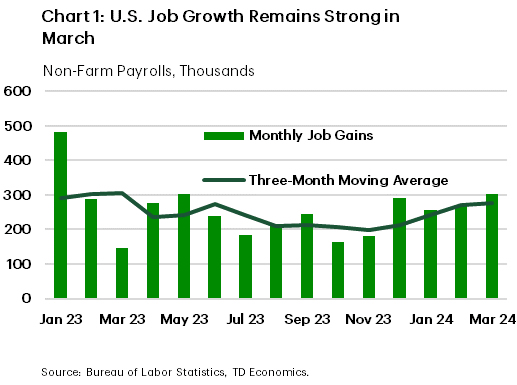
On aggregate, the labor market remains healthy and has yet to show any meaningful signs of cooling. Over the past three months, job gains have averaged 276k – slightly stronger than the 251k averaged in 2023 (Chart 1). With job openings still elevated, and increased immigration alleviating some of the pressure on labor supply, job growth could conceivably run in the 150k-200k range for the rest of the year. This would go a long way in rebalancing the labor market, without necessitating any meaningful increase in the unemployment rate.
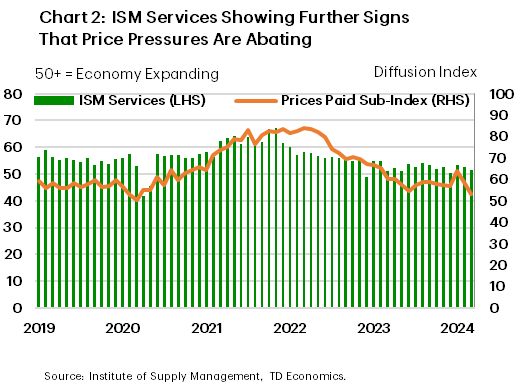
Other economic data out this week also brought encouraging news on the state of the economy. The ISM manufacturing index unexpectedly broke above the 50 mark – the threshold of expansion territory – for the first time in sixteen months. The release showed manufacturing activity is finding a firmer footing alongside an uptick in current production and a rebound in new orders. Meanwhile, the ISM services index slipped to a three-month low. The pullback reflected some softening in new-orders and a sharp decline in the prices paid sub-index, which fell to the lowest level since March 2020 (Chart 2). On the surface, this is an encouraging development for Fed officials who are struggling to rein in still elevated service inflation. However, the fact that 13 industries are still reporting an increase in prices suggests that even with some recent stabilization in the rate of price growth, elevated price pressures remain a concern.
This is why all seven voting FOMC officials out speaking this week maintained a cautious tone on the timing of rate cuts. In a speech delivered on Wednesday, Chair Powell stuck to the script, reiterating that he still believes, ‘rate cuts are likely to be appropriate at some point this year’ though decisions will be made on a ‘meeting by meeting’ basis. With the Fed waiting for further evidence of cooling inflationary pressures, next week’s CPI release will offer further insight on whether the recent uptick in inflation a speed bump, or perhaps something more meaningful.
Canada – Gearing Up For The Bank of Canada Decision
The Bank of Canada (BoC) had no shortage of new developments to digest this week. Labour market updates for the month of March highlighted the string of releases, though a pulse check on business and consumer sentiment as well as international trade data were also on watch. As the dust settles on the week’s data, markets have increased their bets that the BoC will pull the trigger in June. However, we think a July cut is more likely, which will allow the Bank a bit more time to compile evidence that inflation is moving durably back to 2%.
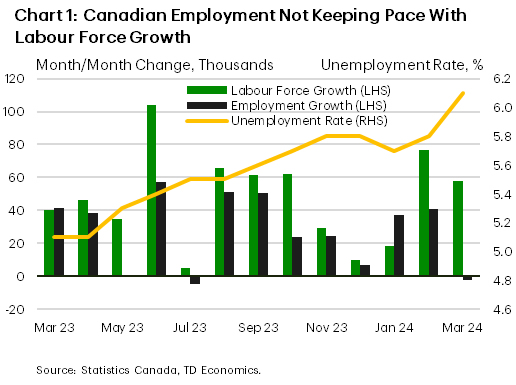
The Canadian economy lost a few jobs in March (-2.2k) against expectations for a trend-like gain. The details of the report were weak and consistent with a continued cooling in the labour market. The unemployment rate moved up sharply to 6.1% as employment struggles to keep pace with population-driven labour force growth (Chart 1). Meanwhile, hours worked fell slightly, suggesting economic activity for March moderated after a hot start to the year. However, wage growth remains a thorn in the BoC’s side, having been stuck above 5% y/y for the past year. More progress on this front is likely desired by the BoC, but there is clear evidence that current policy is doing its part in lowering the temperature on Canada’s job market.
However, on the growth side, February’s international trade data supported an acceleration in economic activity in the first quarter. Export and import volumes both surged after a weak prior month with current tracking suggesting trade will be another tailwind for Q1 growth. We do expect some give back in trade activity in March, especially in imports, as spending patterns weaken over the coming quarters.
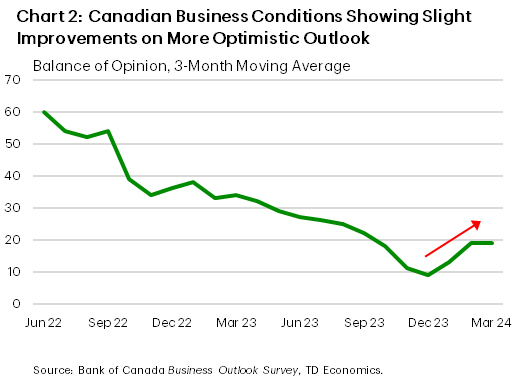
Meanwhile, business and consumer sentiment of the economy has improved slightly per the BoC’s Business Outlook Survey (BOS) and the parallel Canadian Survey of Consumer Expectations (CSCE). While demand remains under pressure due to high inflation and interest rates, expectations for lower interest rates provide more confidence about the future economic outlook (Chart 2).
The focus now shifts to the April 10th interest rate announcement where the BoC will release a fresh set of forecasts in their Monetary Policy Report (MPR). These updates may start to lay the foundation for interest rate cuts. Notably, since the last MPR released in January, inflation for Q1-2024 is coming in a touch lower than projected (3.1% vs 3.2% y/y), while growth should see a significant upgrade from the current flat-GDP projection. The BoC has held the policy rate at 5.00% for the last nine months, which has helped inflation on its path back to 2%. Indeed, headline inflation has now been in the high-end of the Bank’s 1–3 percent inflation target range for two consecutive months. However, we expect that the Bank will need to see a few more constructive inflation prints to ensure their mandate is being met.
Weekly Economic & Financial Commentary: Strong Jobs Numbers Diminish Urgency for Rate Cuts
Summary
United States: Strong Jobs Numbers Diminish Urgency for Rate Cuts
- Nonfarm payrolls expanded 303K in March, surpassing all estimates submitted to Bloomberg. The continued strength in hiring suggests less urgency for policymakers at the Federal Reserve to lower the target range of the fed funds rate. Recent comments from FOMC members have homed in on the jobs market's underlying momentum as justification to wait and allow for more inflation data.
- Next week: Small Business Optimism (Tue.), Consumer Price Index (Wed.)
International: Springtime Sentiment Data in Asian Economies Show Buds of Optimism
- This week saw the release of important economic sentiment data from both G10 and emerging economies. In Japan, the Bank of Japan's Q1 Tankan survey—a closely watched measure of business sentiment—showed signs that Japan’s economy may be able to gradually recover this year. In China, official March PMIs for the manufacturing and non-manufacturing sectors surprised to the upside, suggesting the economy started 2024 on a fairly solid note.
- Next week: Mexico CPI (Tue.), Bank of Canada Policy Rate (Wed.), European Central Bank Policy Rate (Thu.)
Credit Market Insights: Nothing But Net: Household Net Worth Climbed in the Fourth Quarter
- Household net worth climbed in the fourth quarter across all wealth cohorts. When indexed to 2000, household net worth is now at a fresh all-time high, sitting above its initial post-COVID peak from Q1-22. The biggest driver of the increase was a rise in corporate equities and mutual fund shares.
Topic of the Week: FY 2024 Budget Complete, but Fiscal Fights Still Loom
- On March 23, President Biden signed into law the last remaining appropriations bill for fiscal year 2024, completing a budget process that dragged on for nearly a year and included four short-term continuing resolutions to keep the government open and operating. That said, federal fiscal fights are anything but over.
BoC to Hold the Line on Interest Rates on Mixed Economic Data
The Bank of Canada is widely expected to leave interest rates unchanged for a sixth consecutive policy decision on Wednesday. We expect the wording of the policy statement to leave options open for how long it plans to leave interest rates at current levels before pivoting to cuts.
Economic data since the last interest rate decision have been mixed. Gross domestic product growth in early 2024 is tracking substantially above the central bank’s forecast in January for a 0.5% Q1 increase. But that follows a string of softer readings by our count. GDP per person declined for six straight quarters to Q4 in 2023. Labour markets have continued to soften with the unemployment rate rising to 6.1% in March and job openings declining. Business bankruptcies have spiked higher, mounting debt service costs are cutting into household purchasing power, and wage growth has shown further signs of slowing.
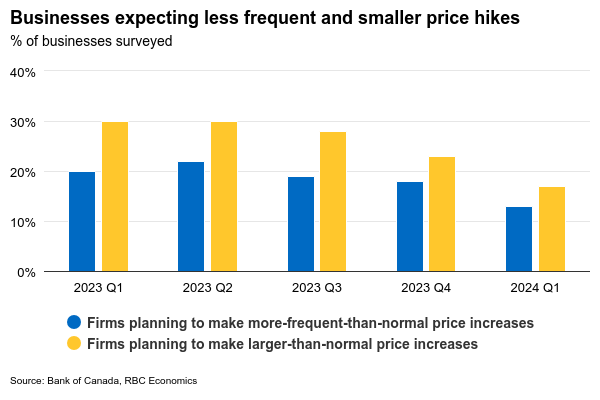
Most importantly for the BoC, inflation numbers have looked significantly better. Price growth year-over-year held below the top end of the 1% to 3% target range for a second straight month in February. The closely watched three-month rolling average of the central bank’s preferred core median and trim measures slowed to an annualized 2.2%. The Q1 Business Outlook Survey showed businesses expected inflation to continue to edge lower with further signs that business pricing strategies (planned frequency and magnitude of price changes) are normalizing. Resilience in early-2024 GDP data gives the BoC time to hold the line on interest rates for a little longer, but with most other economic data showing signs of softening, our base case assumption is that the BoC will be in a position to shift to cuts around mid-year.
Week ahead data watch
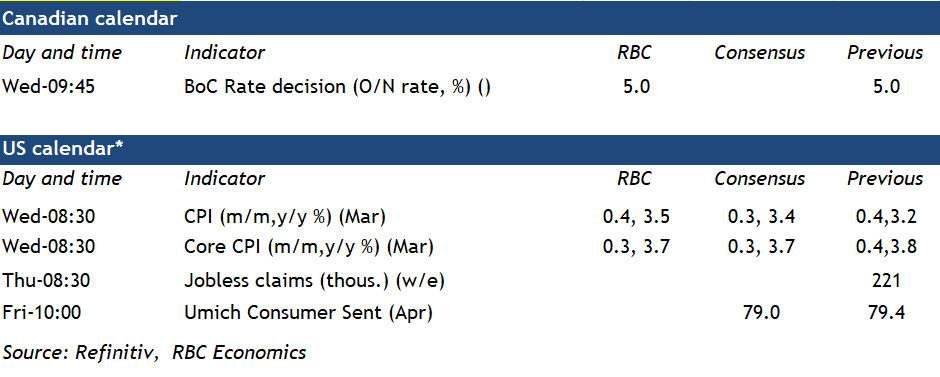
The U.S. Federal Reserve will be watching Wednesday’s March inflation print closely for signs that a resilient U.S. economy is reigniting inflation pressures following upside surprises in February and January. We expect a tick higher in year-over-year price growth to 3.5% (from 3.2% in February) but driven largely by an increase in gasoline prices. We expect core (excluding food and energy) price growth to edge down to 3.7% from 3.8% on a 0.3% month-over-month (seasonally adjusted) increase.
Why is Gold Defying Gravity?
- Gold stays in rally mode, even when dollar and yields rise
- Central banks and geopolitics among the main drivers
- Chinese demand and inflation hedging add extra support
Is it a bird? Is it a plane? No, it’s gold!
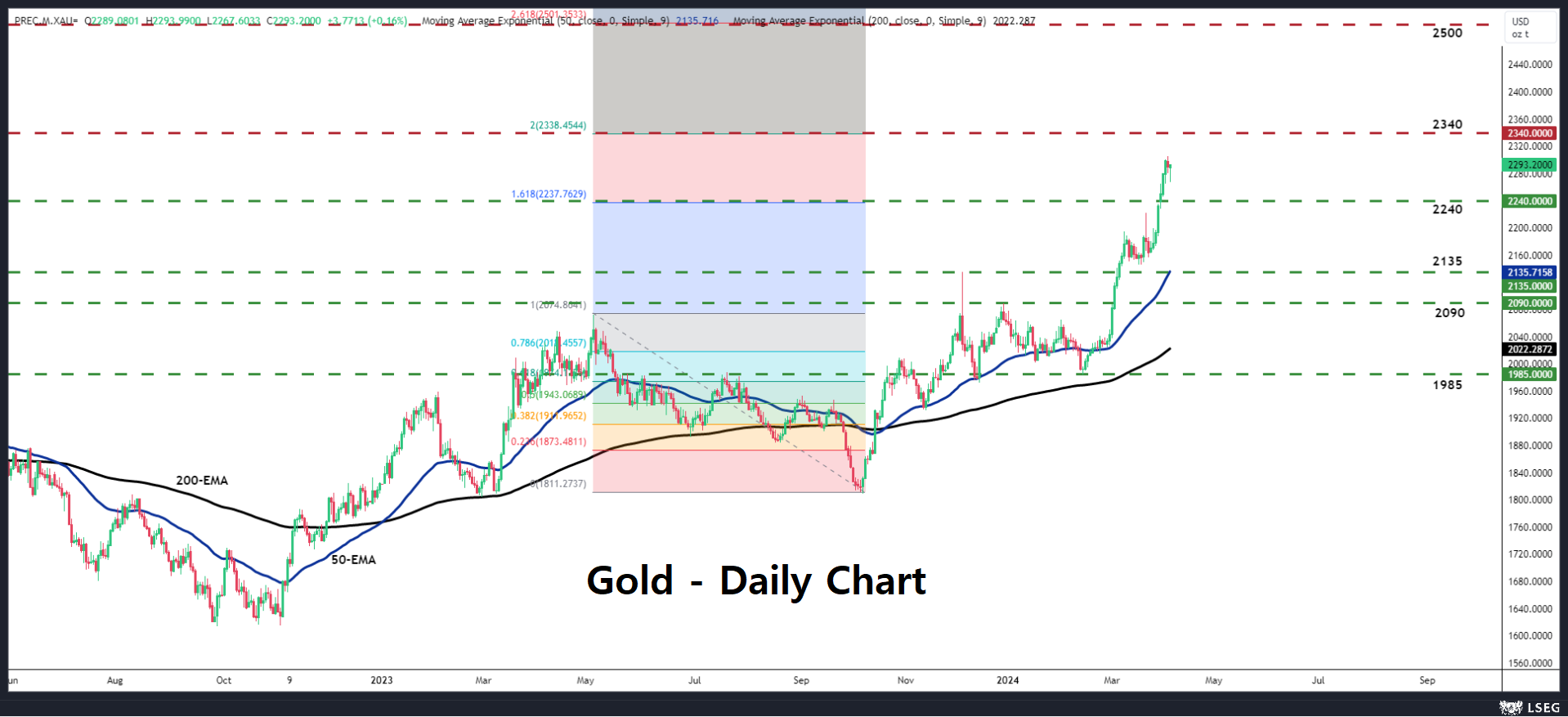
Gold entered a flying mode at the beginning of March, surpassing its previous record high of $2,135 hit on March 7. The metal consolidated only for a while thereafter before rallying again during the last days of the month to continue conquering uncharted territory. And all this even during periods when the dollar and Treasury yields were rising on the back of easing bets about Fed rate cuts.
From pricing in around 160bps worth of reductions at the turn of the year, the market now believes that by December, Fed officials will lower borrowing costs by only around 70 basis points, even fewer than the Fed’s projection of 75. This was the result of stickier-than-expected inflation and data pointing to solid economic performance in the US.
What are the buying forces?
But why did gold traders remain indifferent to such developments? Why has the inverse correlation of gold with the dollar and yields broken down?
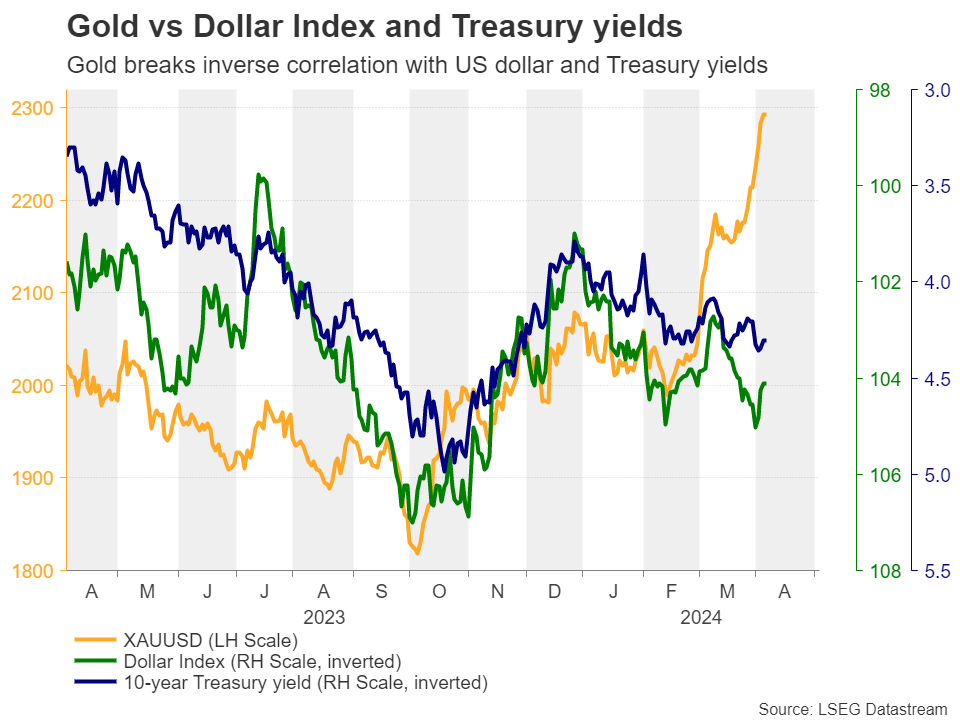
The fact that gold did not materially slide between December and February, when the dollar was outperforming all its major counterparts, suggests that there are other forces keeping the precious metal supported.
Central bank purchases
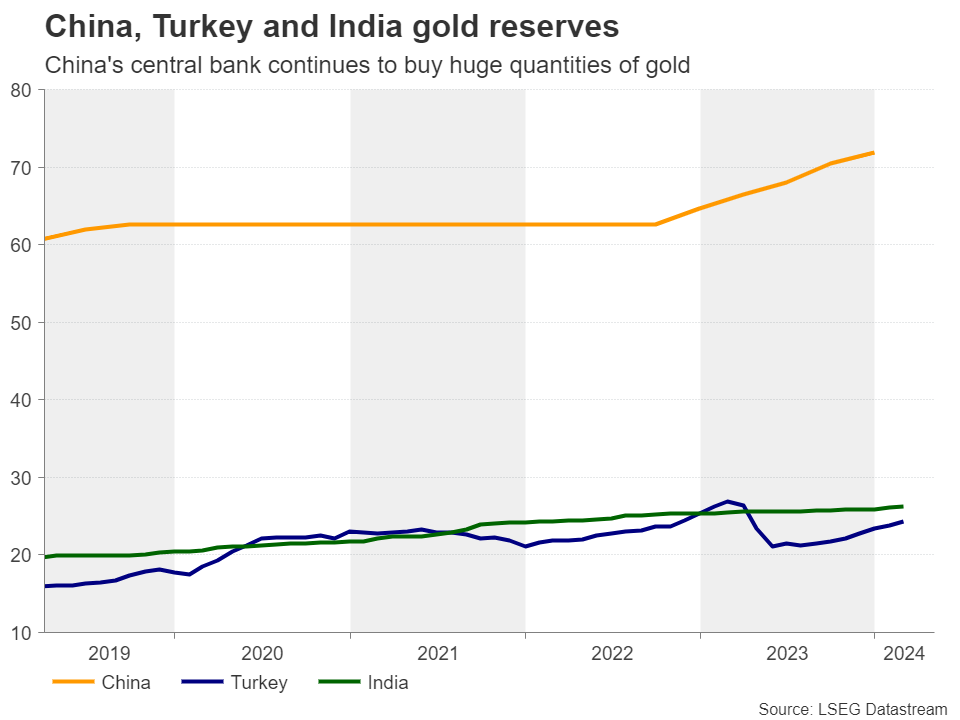
One may be the continued purchases by central banks, with the frontrunners being China, Turkey, and India. Although the latest publicly available data is for February points to a notable slowdown in central bank buying from January, those three central banks continued their purchases at an elevated pace, with China holding a long distance from the other two. Whether the overall central bank buying accelerated during March, when the precious metal skyrocketed, will be confirmed in the first few days of May.
Safe-haven flows
The geopolitical uncertainty may also be a reason for investors to canalize flows into gold. The Israeli strikes on the Iranian consulate in Syria with Iran promising payback, as well as Ukraine’s attacks on Russia’s oil infrastructures, are far from suggesting that the conflicts are nearing resolution. And with the yen staying wounded even after the BoJ’s decision to lift interest rates, gold may be the only safe haven in town.
Chinese demand
Traditionally, India is also a helping hand during the first few months of the year, as demand in the world’s second largest consumer for the precious metal increases due to the wedding season. However, as gold prices already hit a record in December, demand was dampened this year, with India’s imports likely plunging by more than 90% in March according to a government official.
Considering that China and India account for more than half of total global gold demand, the yellow metal may be drawing bigger support from the world’s second-largest economy. With the Chinese stock market suffering and cryptos being banned there, the options for vehicles that local investors can profit from become very limited, and that’s maybe one of the reasons for increasing demand for gold. Indeed, the Shanghai benchmark gold price has been rising faster than international prices for the last couple of years.

Risk of Fed rate cut delay
As for expectations regarding the Fed’s future course of action, delayed rate cuts may not be much of a concern for gold investors whose horizons are likely longer than those of forex traders. The fact that the Fed’s next policy move is likely to be a cut may be more than enough, as it keeps the upside potential in Treasury yields limited. And with inflation data suggesting that prices in the US are stickier than previously expected lately, some participants may have viewed gold as a hedging vehicle against inflation for now.
Will the rally continue?
Moving ahead, the prospect of lower interest rates in the US, the elevated demand from China, and the uncertainty surrounding the geopolitical landscape are likely to keep gold supported for a while longer. With no prior highs or inside swing lows to mark potential resistance levels on the metal’s way higher, the next zone that could play such a role may be the 200% extension level of the May – October 2023 decline, at around $2,340. A break higher may encourage traders to aim for the psychological level of $2,500, which I the 261.8% Fibonacci extension level of the aforementioned slide.
For the outlook to change
For the picture to darken, the precious metal may need to slide below $2,135, a level which now coincides with the 50-day exponential moving average (EMA). That said, for such a fall to materialize, some fundamental themes may need to change.
For example, the Chinese economy may need to improve to the point where local investors feel more confident to divert flows to the Chinese stock market. Or tensions between the world’s two largest economies – the US and China – may need to diminish, something that may prompt the PBoC (People’s Bank of China) to slow substantially its gold purchases. After all, the PBoC’s gold buying rampage is driven by a desire to weaken its dollar dependency. Other narratives that could weigh on gold may be the resolution of the geopolitical conflicts in the Middle East and Ukraine, or a fading out of all the basis points worth of Fed rate cuts for this year. Having said all that though, all these changes seem unlikely to happen anytime soon.
RBNZ May Start Laying Groundwork for a Rate Cut
- A dovish shift seems to be underway at the Reserve Bank of New Zealand
- Technical recession and falling inflation may pave way for 2024 rate cut
- Is a dovish hold on the cards at Wednesday’s meeting (02:00 GMT)?
Weaker economy has been good news for inflation
New Zealand’s economy shrunk in the final three months of 2023, entering a technical recession for the second time in 15 months. In the bigger picture, economic growth appears to have stagnated, much like in Europe and the United Kingdom. For policymakers, this is probably seen as a necessary price for bringing inflation under control, and all the indications are that it is working.
Inflation fell to 4.7% in Q4 and there was likely a further drop in the consumer price index in the first few months of 2024 as the RBNZ’s own measures of inflation expectations continued to decline in the first quarter.
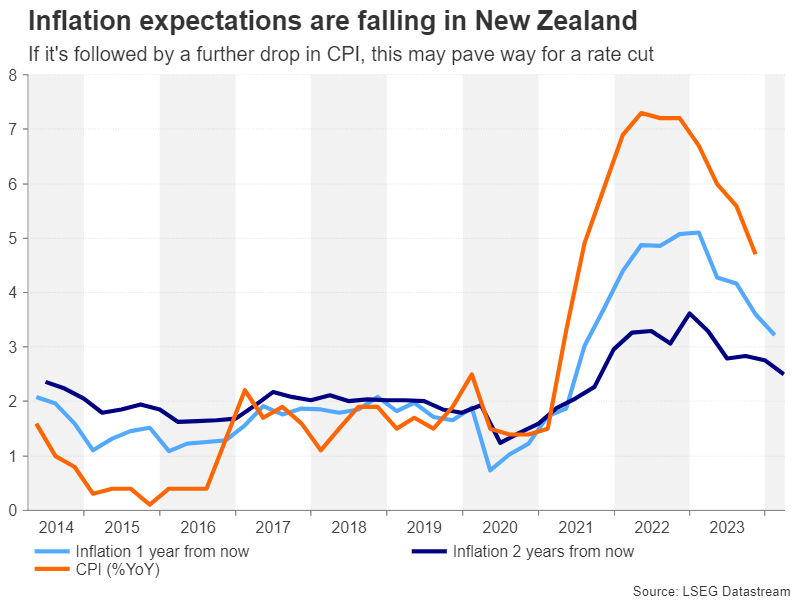
Things have also been moving in a ‘satisfactory’ direction for the labour market. Worker shortages started to ease after more migrants were allowed to enter the country following the reopening of the borders in 2022. The unemployment rate has been steadily edging higher, reaching 4.0% in Q4 versus the post-pandemic low of 3.2%. More importantly, wage growth has been moderating, falling to 3.9% in Q4.
Rate cuts may come sooner than anticipated
Governor Adrian Orr even went as far as acknowledging in recent remarks that the conditions for cutting rates are becoming more apparent. Meanwhile. the Bank’s chief economist, Paul Conway, signalled back in March that a Fed rate cut towards the end of this year would make it easier for the RBNZ to follow suit if it leads to an appreciation in the New Zealand dollar versus the greenback.
At the last meeting, policymakers had projected that rates could begin to fall sometime in the middle of 2025, significantly later than the current market pricing of August 2024 for a 25-basis-point cut. There will be no updated forecasts at the April meeting, nor a press conference by Orr, but there’s likely to be some clues in the statement about whether or not committee members are becoming more optimistic about inflation falling within the 1-3% target band sooner than anticipated.
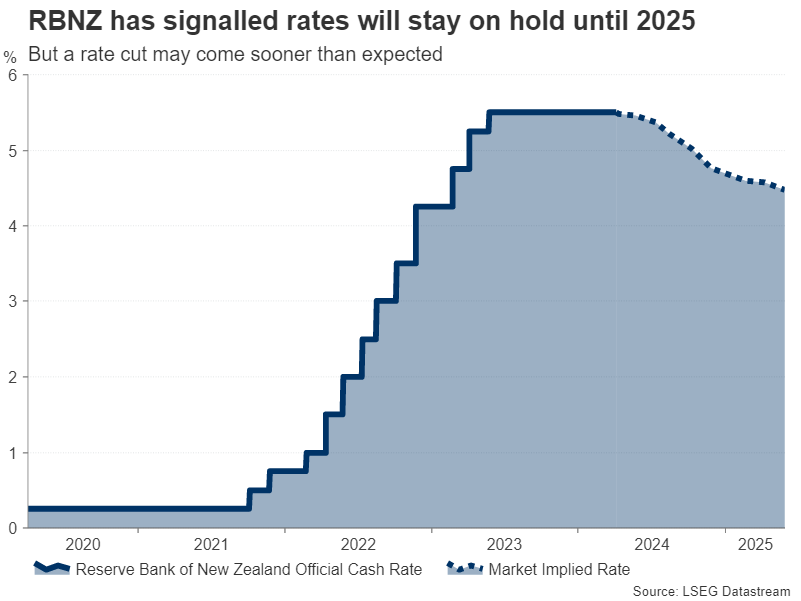
Specifically, the language will possibly reveal whether the expected decision to keep the policy rate unchanged at 5.50% will signal another dovish tilt after the Bank adopted a somewhat more neutral stance at the February meeting.
Kiwi on the slide
And this will likely determine the market reaction in the local dollar. The kiwi has come under pressure lately, slipping to four-and-a-half-month lows against the US dollar. Should the language of the statement be more dovish than expected, the kiwi could breach the April 1 low of $0.5938 and head for the $0.5900 mark. A drop below this level would bring $0.5860 into view before targeting the $0.5800 area that supported prices in October 2023.
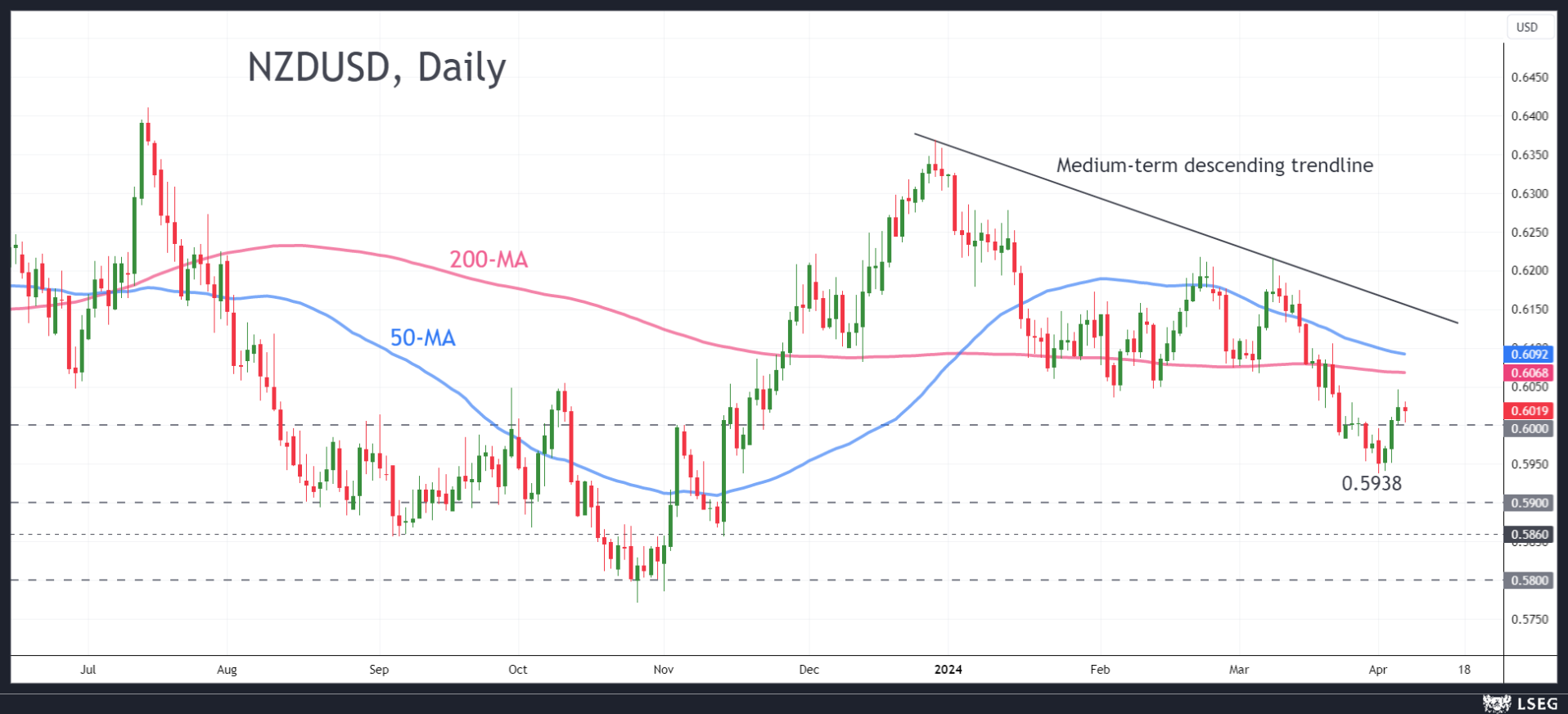
However, if policymakers maintain their caution over the inflation outlook and the need for a prolonged period of restrictive policy, the kiwi could rebound towards its 200-day moving average, currently at $0.6068, before aiming for the medium-term descending trendline.
Yet, for the kiwi to stage a meaningful rebound, the Fed would first have to start its easing cycle and additionally, China’s economic recovery would have to gather more pace. This would create the ideal conditions for a rally, potentially offsetting any selling pressure from a more dovish RBNZ.
Week Ahead – ECB Decision and US Inflation to Fuel FX Volatility
- Central bank decisions in Eurozone, Canada, and New Zealand
- Highlight will be the ECB - likely to signal a rate cut in June
- In US, the dollar will be driven by inflation stats and Fed minutes
ECB meeting - Nearly time to cut
The Eurozone economy has gone through a rough patch over the last year. Growth has been almost stagnant, held back by Germany, which fell into contraction as a slowdown in global trade suppressed demand for exports and crippled the nation’s manufacturing sector.
On the bright side, the economic stagnation has helped dampen inflationary pressures. Inflation fell to 2.4% in March, pushing the European Central Bank one step closer to cutting interest rates. Most ECB officials have pointed to a cut in June as the most likely scenario.
Investors share this view. A June rate cut is already fully priced into money markets, reflecting the slower growth pulse and the cooldown in inflation. The unemployment rate has also risen a touch this year, reinforcing hopes that inflation is headed lower.
Therefore, the ECB will likely use the meeting on Thursday as a stepping stone, setting the stage for summer rate cuts. President Lagarde could highlight the progress on inflation and argue that lowering rates soon would help minimize the risk of a recession.
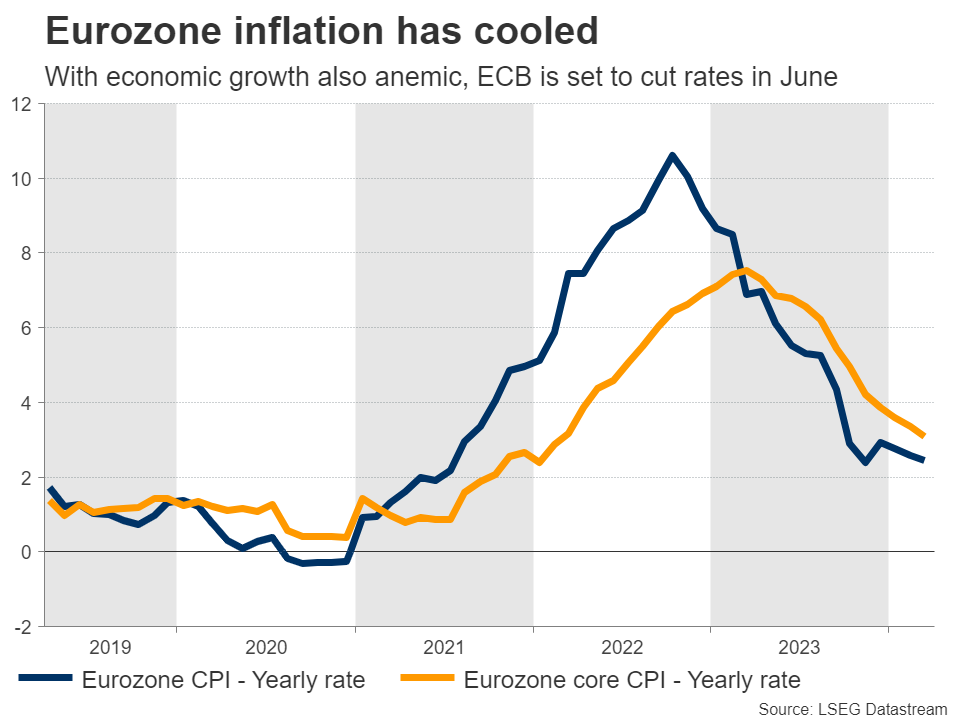
As for the euro, its gloomy economic fundamentals paint a negative picture. One reason the single currency has been so resilient over the past year has been the collapse in natural gas prices, which benefited the euro through the trade channel. The euphoric tone in stock markets also helped, by pinning down the safe-haven US dollar.
So the euro has been kept afloat not by economic performance, but rather by developments in other financial markets. This is a double-edged sword, because it implies that any change in these trends could remove a big pillar of support for the currency.
In other words, the euro needs low gas prices and rising stock markets to remain above water. Otherwise, traders might start focusing on the anemic growth outlook and rate cuts.
US inflation and Fed minutes in focus
Over in the United States, the spotlight will fall on CPI inflation data and the minutes of the latest Fed meeting, both on Wednesday. These will help investors decide whether the Fed will cut rates in June, which markets currently assign a 70% probability to.
Forecasts suggest inflation reaccelerated, with the CPI rate seen at 3.4% in March from 3.2% previously. However, the core rate is anticipated to tick down to 3.7%. The difference most likely reflects the rally in oil during the month, as the core figure excludes the effects of energy prices.
This would translate into a mixed report for the Fed. A decline in the core rate would suggest the broader trend of disinflation continues, even if rising energy prices are keeping headline inflation elevated.
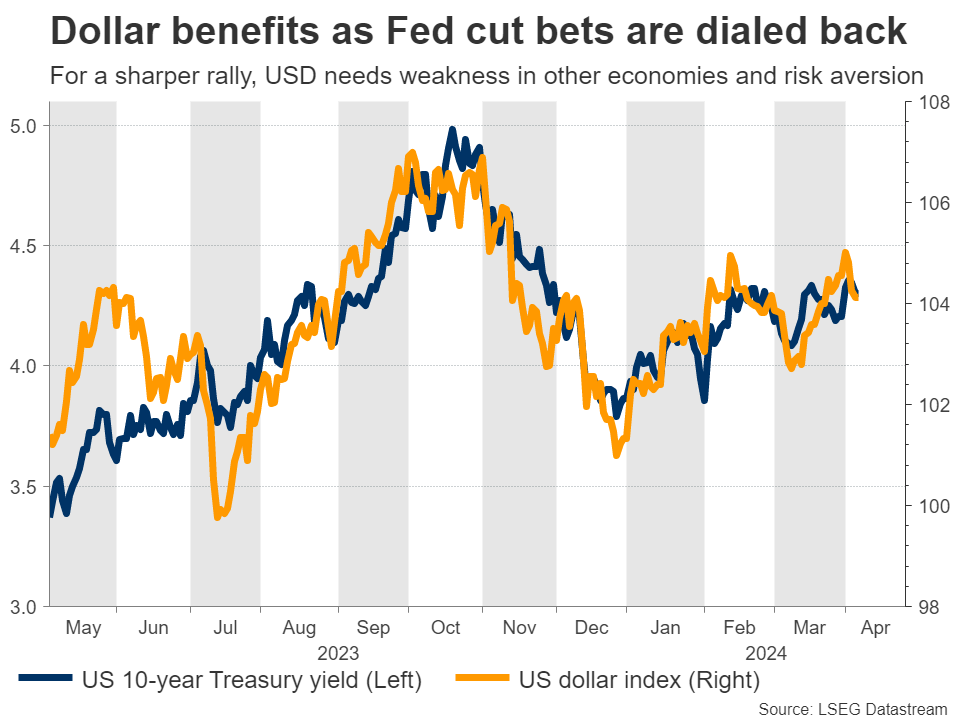
Meanwhile, the minutes will cover the March meeting, where FOMC officials upgraded their growth and inflation forecasts but still projected three rate cuts for this year. It will be interesting to see the discussions behind the scenes. That said, this release is unlikely to contain any groundbreaking revelations, as most officials have spoken several times since this meeting.
As for the dollar, it went for a wild ride this week, losing ground after a disappointing ISM services survey but then recovering with some help from risk aversion amid fears of an Iranian attack against Israel.
Overall, US economic fundamentals seem stronger than most regions. For instance, GDP growth is on track to hit 2.5% this quarter according to the Atlanta Fed. Therefore, the broader outlook seems positive, although for the reserve currency to stage a lasting rally, it might need more signs of weakness in foreign economies or a risk-off atmosphere that fuels demand for haven assets.
Rate decisions in Canada and New Zealand
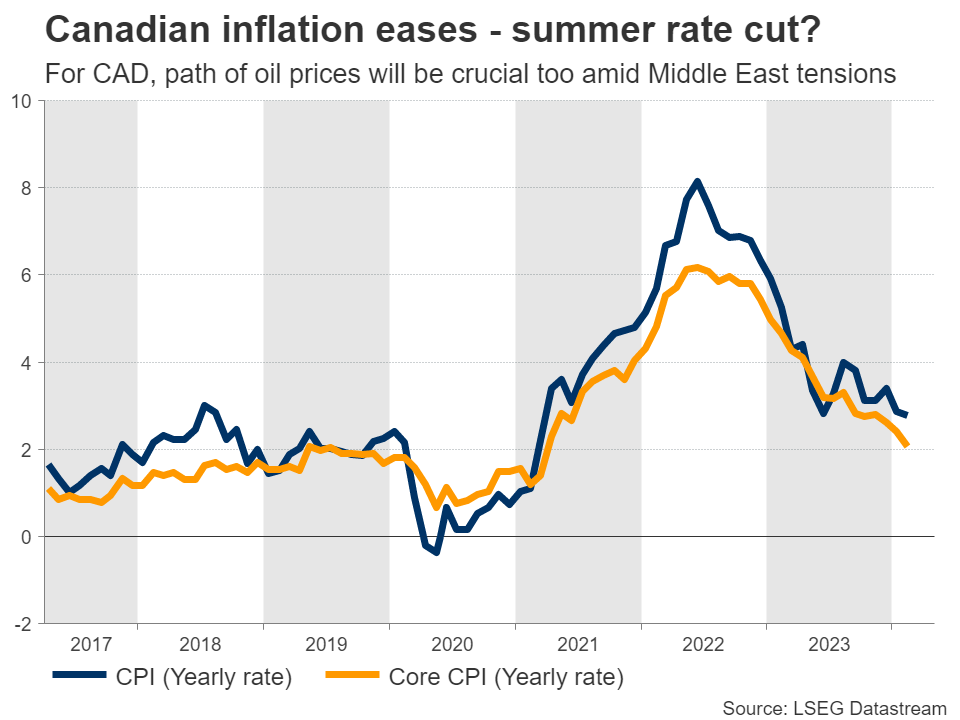
In Canada, the central bank meets on Wednesday and markets assign a 15% chance for an immediate rate cut, as core inflation has declined steadily. Massive population growth has helped to loosen labor market conditions, dampening concerns about wage-fueled inflation. The negative side of that is housing shortages, which are keeping shelter inflation hot.
As such, the Bank of Canada is unlikely to slash rates at this meeting, although it might provide clearer signals that cuts are coming this summer. The Canadian dollar will also be driven by oil prices, with any escalation in the Middle East likely to benefit the oil-exporting currency.
Crossing into New Zealand, the local currency has been on the ropes this year, losing more than 4% against the US dollar. The economy fell into a minor technical recession late last year, which has weighed on consumer and business confidence. But inflation remains elevated, so markets don’t expect any move from the Reserve Bank when it meets on Wednesday.
For the New Zealand dollar to mount a sustainable comeback, it will probably need a meaningful recovery in China that boosts demand for the nation’s commodity exports.
In this sense, China’s trade data for March will be closely watched on Friday for any signs of a rebound. Other notable releases on Friday include monthly GDP stats from the United Kingdom.