Sample Category Title
GBP Consolidates Amid Concerns Over Economic Growth and Wage Trends
The GBP/USD pair is currently consolidating, hovering around the 1.2631 mark. This consolidation phase follows recent reports highlighting a slowdown in the expansion plans of British businesses for workforce and wage growth, raising concerns about future economic dynamics and inflationary pressures.
A key report from the Lloyds Bank Business Barometer indicates a noticeable dip in the hiring outlook among companies. The differential between firms looking to hire and those planning cuts fell to 27% from a peak of 36% in February. This level is only slightly above the long-term average of 22%. Moreover, there has also been a marginal decline in the proportion of businesses anticipating wage increases in the next year.
Despite these trends, Bank of England (BoE) data provides a somewhat optimistic outlook, showing that British borrowers manage the high-interest environment relatively well. The incidence of problematic debt remains significantly lower than levels seen following the 2008 financial crisis, underscoring the resilience of the UK's economic system and indicating signs of GDP recovery.
Catherine Mann, a member of the BoE's Monetary Policy Committee, has called for a more realistic assessment of monetary policy expectations, suggesting that market predictions for substantial interest rate cuts by the BoE might be overly optimistic. Current market sentiment suggests a high probability of a rate reduction at the BoE's August meeting.
Technical analysis of GBP/USD
The H4 chart analysis for GBP/USD shows ongoing consolidation around 1.2626. A breakout above this range could signal a potential corrective rise to 1.2700. Conversely, a move below this level may indicate a downward trend towards 1.2450 as an initial target. A potential correction to 1.2626 could follow, with a possible further decline to 1.2355. The MACD oscillator's position below zero supports the possibility of continued downward movement.
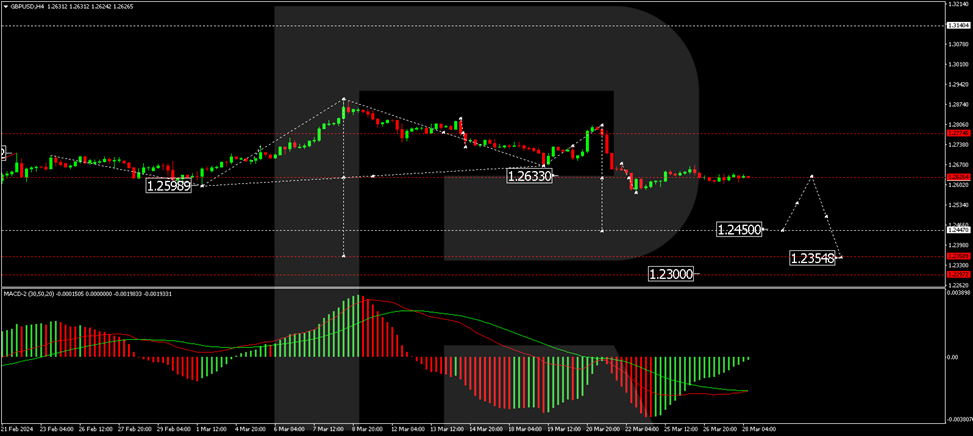
On the H1 chart, the pair is forming a consolidation range around 1.2626, with no definitive trend. An upward breakout might lead to a corrective move towards 1.2676, while a downward breakout could signal the continuation of a decline to 1.2545 and potentially to 1.2450. The Stochastic oscillator, currently below 80 and trending downwards, aligns with the likelihood of a continued decline.
USD/CHF Mid-Day Outlook
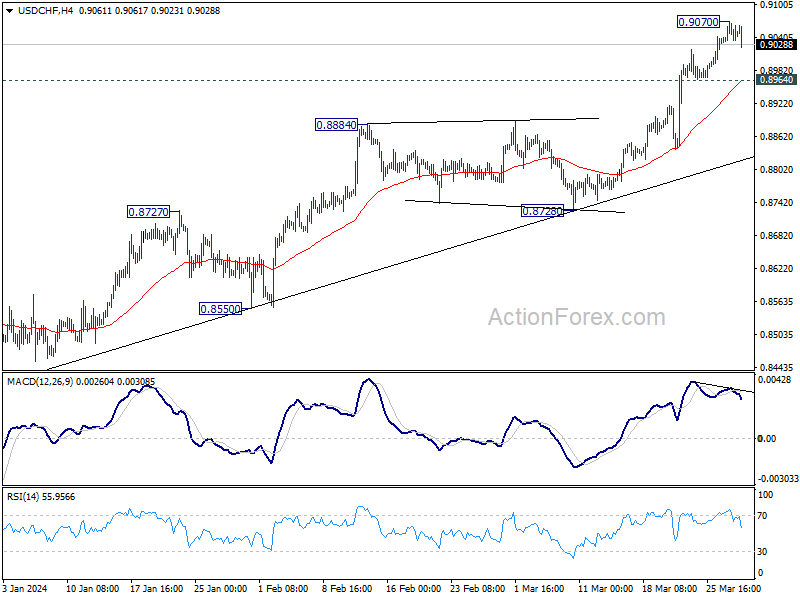
Daily Pivots: (S1) 0.9019; (P) 0.9046; (R1) 0.9064; More....
Intraday bias in USD/CHF is turned neutral with current retreat and some consolidations could be seen. But further rally is expected as long as 0.8964 support holds. Firm break of 0.9070 will resume larger rise from 0.8332 towards 0.9243 key resistance next.
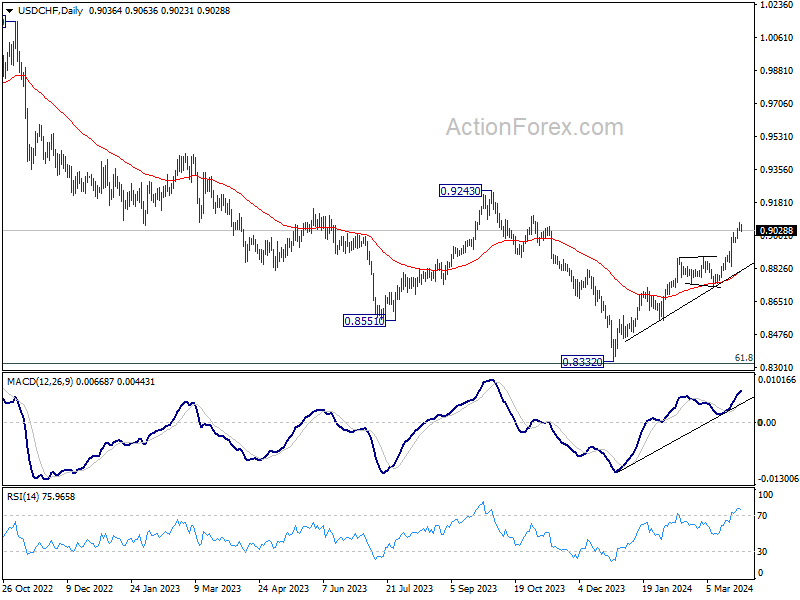
In the bigger picture, price actions from 0.8332 medium term bottom as tentatively seen as developing into a corrective pattern to the down trend from 1.0146 (2022 high). Further rise would be seen as long as 0.8728 support holds. But upside should be limited by 0.9243 resistance, at least on first attempt.
USD/JPY Mid-Day Outlook
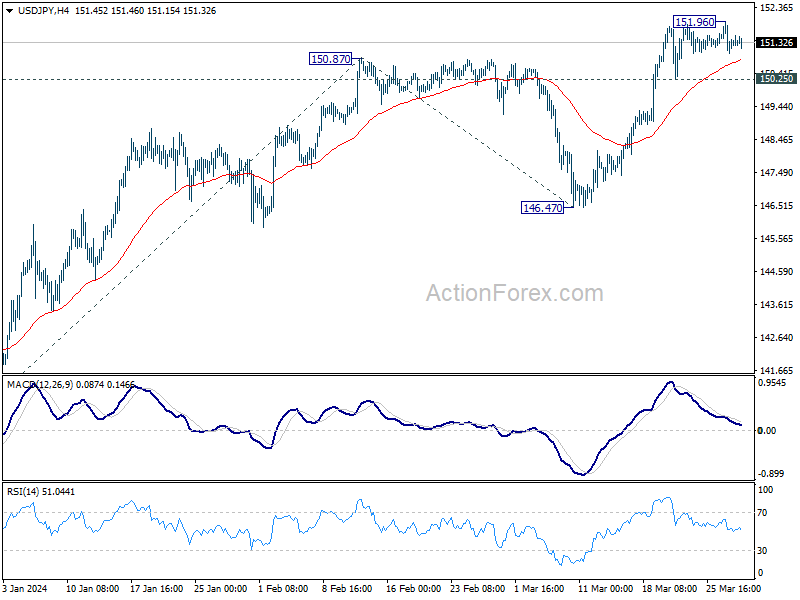
Daily Pivots: (S1) 150.91; (P) 151.44; (R1) 151.85; More...
Range trading continues in USD/JPY and intraday bias stays neutral. On the downside, break of 150.25 support should confirm short term topping, and turn bias back to the downside for 55 D EMA (now at 149.01). Nevertheless, sustained break of 151.93 key resistance will confirm long term up trend resumption. Next near term target will be 61.8% projection of 140.25 to 150.87 from 146.47 at 153.03.
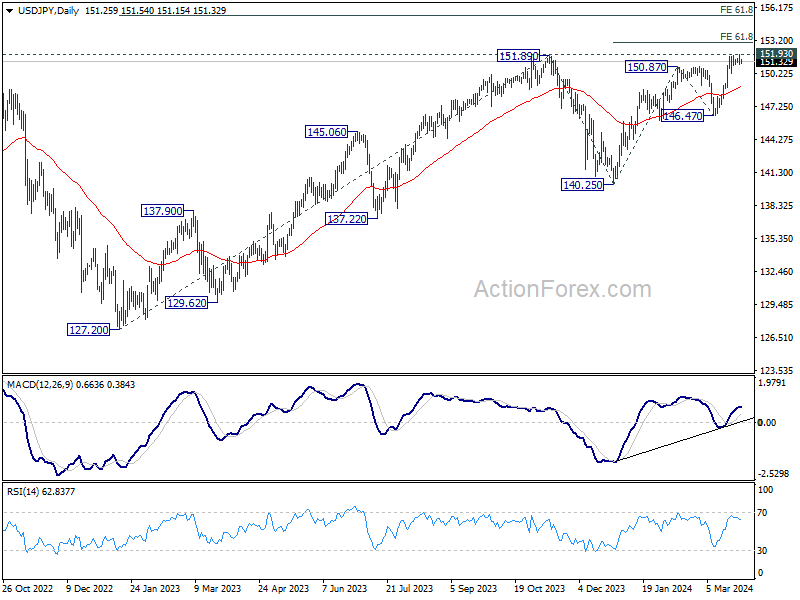
In the bigger picture, correction from 151.87 (2023) high could have completed at 140.25 already. Rise from 127.20 (2023 low), as part of the long term up trend, is probably ready to resume. Decisive break of 151.93 resistance (2022 high) will confirm this bullish case. Next medium term target will be 61.8% projection of 127.20 to 151.89 from 140.25 at 155.20. This will remain the favored case as long as 146.47 support holds, in case of another pullback.
GBP/USD Mid-Day Outlook
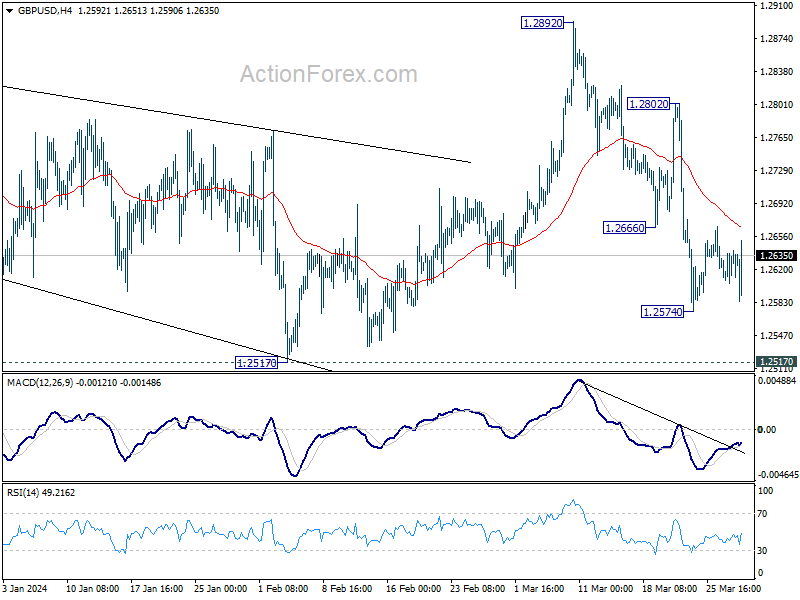
Daily Pivots: (S1) 1.2617; (P) 1.2629; (R1) 1.2653; More...
Range trading continues in GBP/USD and intraday bias remains neutral. Risk stays on the downside as long as 55 4H EMA (now at 1.2667) holds. Below 1.2574 will resume the fall from 1.2892 to 1.2517 structural support first. Decisive break there will suggest that rise from 1.2036 has completed at 1.2892 already, and turn near term outlook bearish.
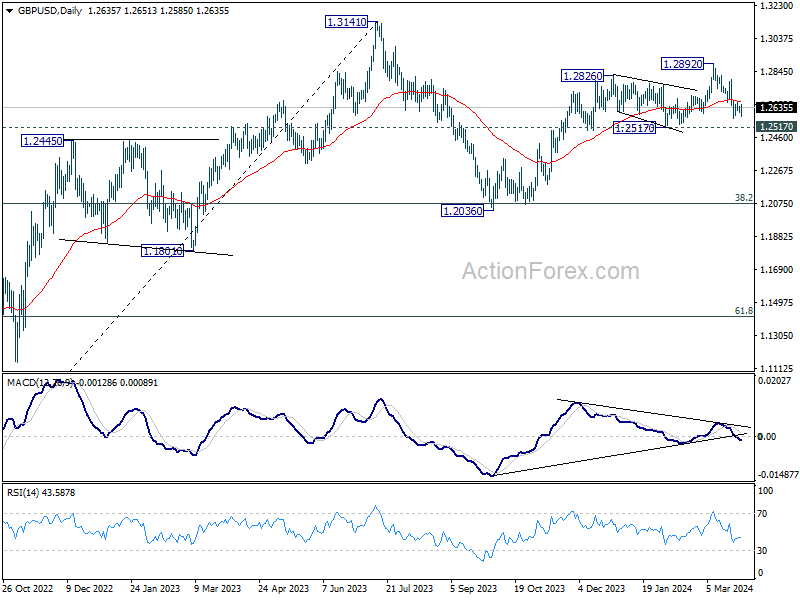
In the bigger picture, price actions from 1.3141 medium term top are seen as a corrective pattern to up trend from 1.0351 (2022 low). Rise from 1.2036 is seen as the second leg, which might still be in progress. But upside should be limited by 1.3141 to bring the third leg of the pattern. Meanwhile, break of 1.2517 support will argue that the third leg has already started for 38.2% retracement of 1.0351 (2022 low) to 1.3141 at 1.2075 again.
Canada’s Economy Boosted in January, Strong Gain Expected for February
The Canadian economy kicked off the year on a positive note, growing by 0.6% on a month-on-month (m/m) basis in January. This print comes in above Statistics Canada's advanced guidance and market expectations for a 0.4% m/m gain. The flash estimate for February points to another healthy advance of 0.4% m/m.
January's reading was broad-based, with output expanding in 18 of 20 industries. The gain was primarily services driven (0.7% m/m), while the goods sector still eked out a 0.2% m/m advance.
The services side gain was carried by a robust 6% m/m rebound in the education sector, reversing the effects of the November and December Quebec strikes. Also contributing to the gain was a 0.8% m/m advanced in the healthcare sector and 0.4% m/m move in the real estate sector.
On the goods side, manufacturing's 0.9% m/m increase fully recouped December's decline, while the utilities sector provided an assist, growing by 3.2% m/m. Offsetting some of the goods side growth was a 1.9% m/m drop in the mining, quarrying and oil & gas sector, driven by a 4.2% m/m decline in oil and gas extraction.
The advanced reading of 0.4% m/m growth in February is expected to come from a rebound in oil & gas, with further gains coming out of manufacturing and the finance and insurance sectors.
Key Implications
January's GDP print surprised to the upside against expectations that the economy would advance at a more modest pace. Importantly, if the expected carry forward of growth into February is realized, this would put growth in both months as the strongest since January 2023. With today's print and next month's guidance, first-quarter GDP is tracking well above potential growth and significantly higher than the Bank of Canada's current forecast of 0.5% quarter-on-quarter annualized.
Make no mistake, these growth figures are robust, and presents a more difficult challenge for the BoC. Over the past two months, the Bank has received solid evidence that inflation is cooperating, but strong GDP data prints like today's will keep them on their toes. Market pricing is still hopeful of a first interest rate cut happening in June, though we think a July cut is more likely. Excluding the education sector rebound, growth in January still presented a solid 0.3% m/m gain, while a seasonally warm winter may be contributing to the heating up of economic activity.
EUR/USD Mid-Day Outlook
Daily Pivots: (S1) 1.0813; (P) 1.0826; (R1) 1.0841; More...
EUR/USD's fall from 1.0980 resumed by breaking through temporary low. Intraday bias is back on the downside for 1.0694 support first. Break there will resume the whole decline from 1.1138 and target 100% projection of 1.1138 to 1.0694 from 1.0980 at 1.0536. Nevertheless, break of 1.0863 minor resistance will turn intraday bias neutral again.
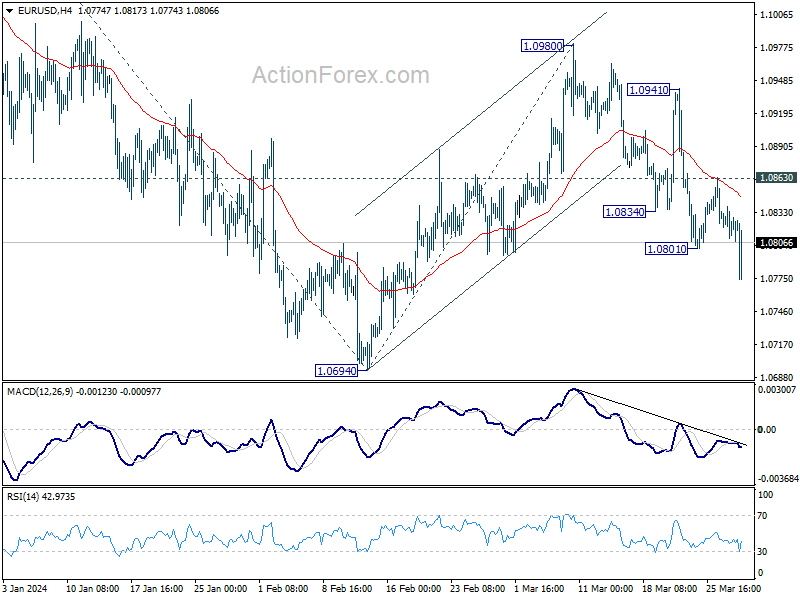
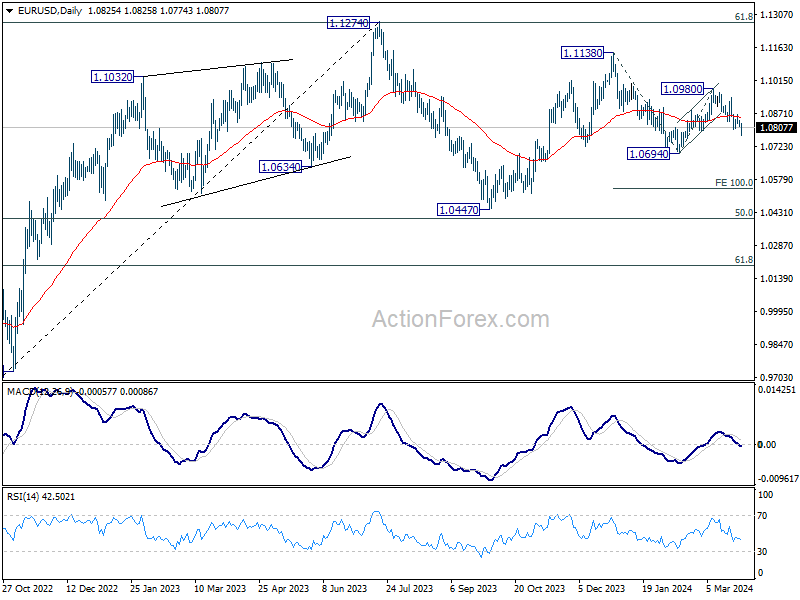
In the bigger picture, price actions from 1.1274 are viewed as a corrective pattern to rise from 0.9534 (2022 low). Rise from 1.0447 is seen as the second leg. While further rally could cannot be ruled out, upside should be limited by 1.1274 to bring the third leg of the pattern. Meanwhile, sustained break of 1.0694 support will argue that the third leg has already started for 1.0447 and possibly below.
Dollar’s Momentary Rise Fades Amid Market Caution
Dollar initially gained momentum in European session and breaks through near term resistance against Euro. However, the greenback then saw a swift reversal as the market transitioned into US session.
Despite a stronger final reading for US Q4 GDP, the impact on the greenback was muted, attributed largely to the data's perceived obsolescence given the current date nearing the end of March. Furthermore, initial jobless claims aligning largely with market expectations did little to sway the currency's trajectory.
The market's hesitancy is apparent as traders seem reluctant to commit to their positions throughthe long weekend.
Amidst this backdrop, Sterling is staying as the strongest currency for the week. Canadian Dollar trails behind, receiving a lift from unexpectedly strong monthly GDP growth figures. Yen is trading the third strongest, benefitting from Japan's verbal interventions.
Conversely, Swiss Franc remains at the bottom of the performance ladder, with Kiwi and Aussie also underperforming. Dollar and Euro find themselves in a middle ground.
In Europe, at the time of writing, FTSE is up 0.28%. DAX is up 0.07%. CAC is up 0.24%. UK 10-year yield is up 0.010 at 3.944. Germany 10-year yield is up 0.013 at 2.308. Earlier in Asia, Nikkei fell -1.46%. Hong Kong HSI rose 0.91%. China Shanghai SSE rose 0.59%. Singapore Strait Times fell -0.85%. Japan 10-year JGB yield is down -0.0126 at 0.712.
US initial jobless claims falls to 210k, vs exp 211k
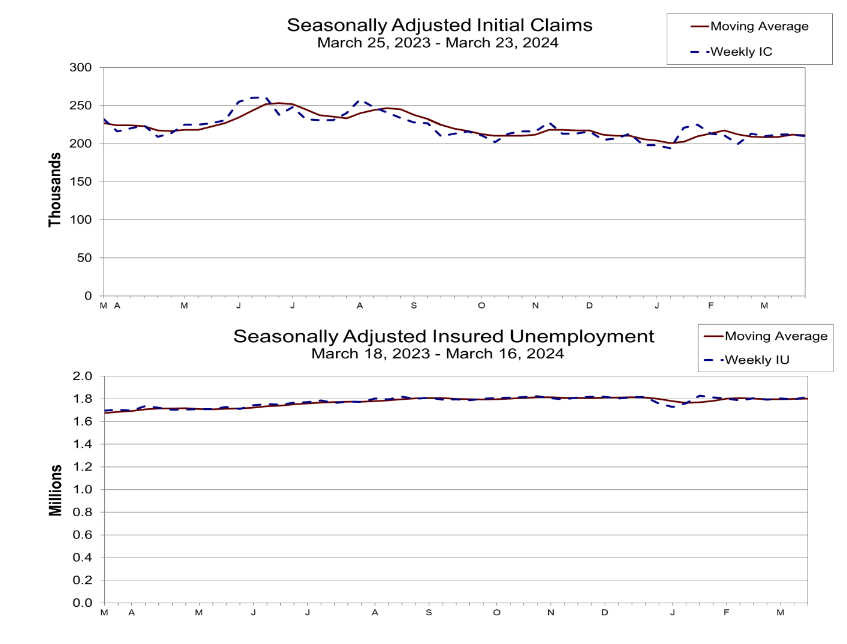
US initial jobless claims fell -2k to 210k in the week ending March 23, slightly below expectation of 211k. Four-week moving average of initial claims fell -750 to 211k.
Continuing claims rose 24k to 1819k in the week ending March 16. Four-week moving average of continuing claims rose 3.5k to 1803k.
Canada's GDP expands 0.6% mom in Jan, above exp 0.4% mom
Canada's GDP grew 0.6% mom in January, above expectation of 0.4% mom. Services-producing industries increased 0.7% mom. Goods-producing industries were up 0.2% mom. Overall, there was broad-based growth with 18 of 20 sectors increasing.
Advance information indicates that GDP rose 0.4% mom in February. Broad-based increases, with main contributions from mining, quarrying, and oil and gas extraction, manufacturing, and finance and insurance, were partially offset by decreases in utilities.
ECB's Panetta: Conditions for monetary easing are materializing
In a speech delivered in Rome, ECB Governing Council member Fabio Panetta acknowledged the impact of restrictive policies on demand, attributing these measures, alongside the falling energy prices, as key factors in the "rapid fall in inflation".
More importantly, Panetta highlighted "risks to price stability have diminished". Hence, and the "conditions are materializing to launch monetary easing."
Swiss KOF falls to 101.5, yet outlook remains positive
Swiss KOF Economic Barometer fell from 102.0 to 101.5 in March, below expectation of 102.3. Despite this minor setback, the barometer continues to hover above its long-term average, indicating a positive outlook for the Swiss economy in the coming months.
The decline can primarily be attributed to weaker performances in the construction sector and private consumption. However, finance and insurance sector emerged as a bright spot, with indicators pointing to slight improvements.
BoJ opinions: Board emphasizes caution in historic shift away from negative rate
At last week's policy meeting, which marked the conclusion of Japan's extensive easing program and its first interest rate hike since 2007, BoJ board members underscored the importance of a cautious approach. The Summary of Opinions from this pivotal gathering highlighted board members' perspectives on the delicate balance required in this new phase of monetary policy.
One member stressed the necessity of maintaining a "cautious stance", especially in light of ending the negative interest rate policy, pointing out that "Japan's economy is not in a state where rapid policy interest rate hikes are necessary."
Furthermore, clarity and communication were emphasized as crucial elements in this transitional period. "It is important to clearly communicate through the use of various methods that the changes in the monetary policy framework proposed at this monetary policy meeting will not be a regime shift toward monetary tightening," another member articulated.
The summary also conveyed concerns about the potential impact of premature expectations on Japan's economic stability. A member warned of the risks associated with policy changes sparking speculative expectations misaligned with economic fundamentals, which could inadvertently destabilize financial conditions. Such volatility could "dampen the momentum of the virtuous cycle operating in Japan's economy and delay the achievement of the inflation target."
NZ ANZ business confidence fall to 22.9, inflation expectations down to 3.8%
New Zealand ANZ Business Confidence fell from 34.7 to 22.9 in March. Own Activity Outlook fell from 29.5 to 22.5. Inflation expectations fell from 4.03% to 3.80%. Cost expectations rose from 73.5 to 74.6. Pricing intentions fell from 48.2 to 45.1. Profit expectations fell from 5.3 to -3.8. Wage expectations rose from 78.9 to 80.5. Employment intentions fell sharply from 6.2 to 3.5.
ANZ acknowledged the solid progress being made, such as narrowing current account deficit and downward trend in inflation. However, concerns are raised about "stickiness" of some inflation measures and persistent uncertainty around inflation outlook. The bank's message emphasizes caution, stating, "It's certainly too soon to declare victory. But eyes on the prize; we're getting there."
EUR/USD Mid-Day Outlook
Daily Pivots: (S1) 1.0813; (P) 1.0826; (R1) 1.0841; More...
EUR/USD's fall from 1.0980 resumed by breaking through temporary low. Intraday bias is back on the downside for 1.0694 support first. Break there will resume the whole decline from 1.1138 and target 100% projection of 1.1138 to 1.0694 from 1.0980 at 1.0536. Nevertheless, break of 1.0863 minor resistance will turn intraday bias neutral again.
In the bigger picture, price actions from 1.1274 are viewed as a corrective pattern to rise from 0.9534 (2022 low). Rise from 1.0447 is seen as the second leg. While further rally could cannot be ruled out, upside should be limited by 1.1274 to bring the third leg of the pattern. Meanwhile, sustained break of 1.0694 support will argue that the third leg has already started for 1.0447 and possibly below.
Economic Indicators Update
| GMT | Ccy | Events | Actual | Forecast | Previous | Revised |
|---|---|---|---|---|---|---|
| 23:50 | JPY | BoJ Summary of Opinions | ||||
| 00:00 | NZD | ANZ Business Confidence Mar | 22.9 | 34.7 | ||
| 00:00 | AUD | Consumer Inflation Expectations Mar | 4.30% | 4.50% | ||
| 00:30 | AUD | Retail Sales M/M Feb | 0.30% | 0.40% | 1.10% | |
| 00:30 | AUD | Private Sector Credit M/M Feb | 0.50% | 0.40% | 0.40% | |
| 07:00 | EUR | Germany Retail Sales M/M Feb | -1.90% | 0.30% | -0.40% | |
| 07:00 | GBP | GDP Q/Q Q4 F | -0.30% | -0.30% | -0.30% | |
| 07:00 | GBP | Current Account (GBP) Q4 | -21.2B | -21.5B | -17.2B | -18.5B |
| 08:00 | CHF | KOF Economic Barometer Mar | 101.5 | 102.3 | 101.6 | 102 |
| 08:55 | EUR | Germany Unemployment Rate Mar | 5.90% | 5.90% | 5.90% | |
| 08:55 | EUR | Germany Unemployment Change Mar | 4K | 10K | 11K | |
| 09:00 | EUR | Eurozone M3 Money Supply Y/Y Feb | 0.40% | 0.30% | 0.10% | |
| 12:30 | CAD | GDP M/M Jan | 0.60% | 0.40% | 0.00% | |
| 12:30 | USD | Initial Jobless Claims (Mar 22) | 210K | 211K | 210K | 212K |
| 12:30 | USD | GDP Annualized Q4 F | 3.40% | 3.20% | 3.20% | |
| 12:30 | USD | GDP Price Index Q4 F | 1.60% | 1.70% | 1.70% | |
| 13:45 | USD | ChicagoPMI Mar | 46.4 | 44 | ||
| 14:00 | USD | Pending Home Sales M/M Feb | -2.00% | -4.90% | ||
| 14:00 | USD | Michigan Consumer Sentiment Mar F | 76.5 | 76.5 | ||
| 14:30 | USD | Natural Gas Storage | -26B | 7B |
US initial jobless claims falls to 210k, vs exp 211k
US initial jobless claims fell -2k to 210k in the week ending March 23, slightly below expectation of 211k. Four-week moving average of initial claims fell -750 to 211k.
Continuing claims rose 24k to 1819k in the week ending March 16. Four-week moving average of continuing claims rose 3.5k to 1803k.
Canada’s GDP expands 0.6% mom in Jan, above exp 0.4% mom
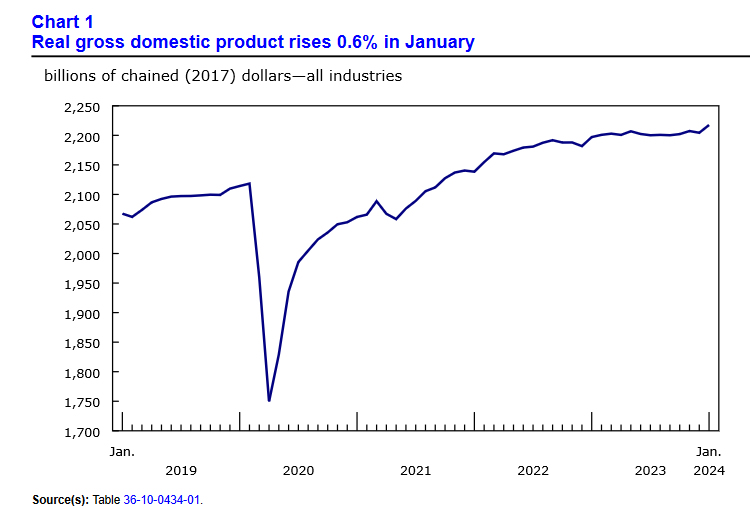
Canada's GDP grew 0.6% mom in January, above expectation of 0.4% mom. Services-producing industries increased 0.7% mom. Goods-producing industries were up 0.2% mom. Overall, there was broad-based growth with 18 of 20 sectors increasing.
Advance information indicates that GDP rose 0.4% mom in February. Broad-based increases, with main contributions from mining, quarrying, and oil and gas extraction, manufacturing, and finance and insurance, were partially offset by decreases in utilities.
EUR/USD: Bears Probe Through Key Support Zone
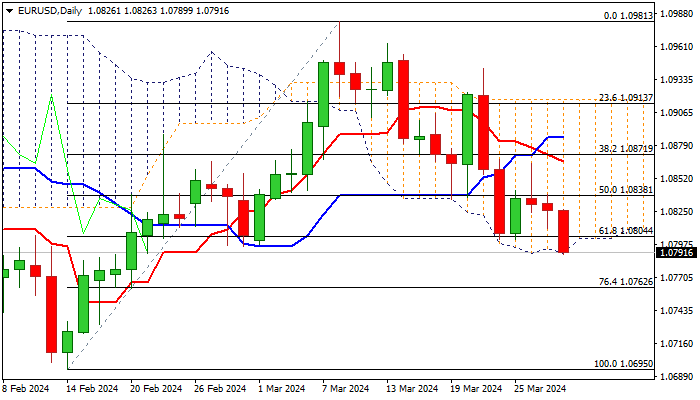
The Euro holds in red for the third consecutive day and accelerates lower in early Thursday, cracking pivotal supports at 1.0800/1.0790 zone (former higher base / Fibo 61.8% of 1.0695/1.0981 / base of thick daily Ichimoku cloud).
Technical picture is firmly bearish on daily chart (rising negative momentum / Tenkan / Kijun-sen bear-cross) and maintains pressure, with close below cloud base to confirm negative signal and open way for continuation of the downtrend from 1.0981 (Mar 8 top).
Fibo level at 1.0762 (76.4% of 1.0695/1.0981) marks initial target and the sole obstacle en-route towards key short-term support at 1.0695 (2024 low, posted on Feb 14).
Near-term bias is expected to remain with bears while the price stays below broken 200DMA (1.0835) which reverted to solid resistance.
Res: 1.0804; 1.0835; 1.0850; 1.0875.
Sup: 1.0762; 1.0732; 1.0695; 1.0611.