

Sample Category Title
EURUSD: Seeking Liquidity in Weekly Selling Zones. Key Intraday Levels
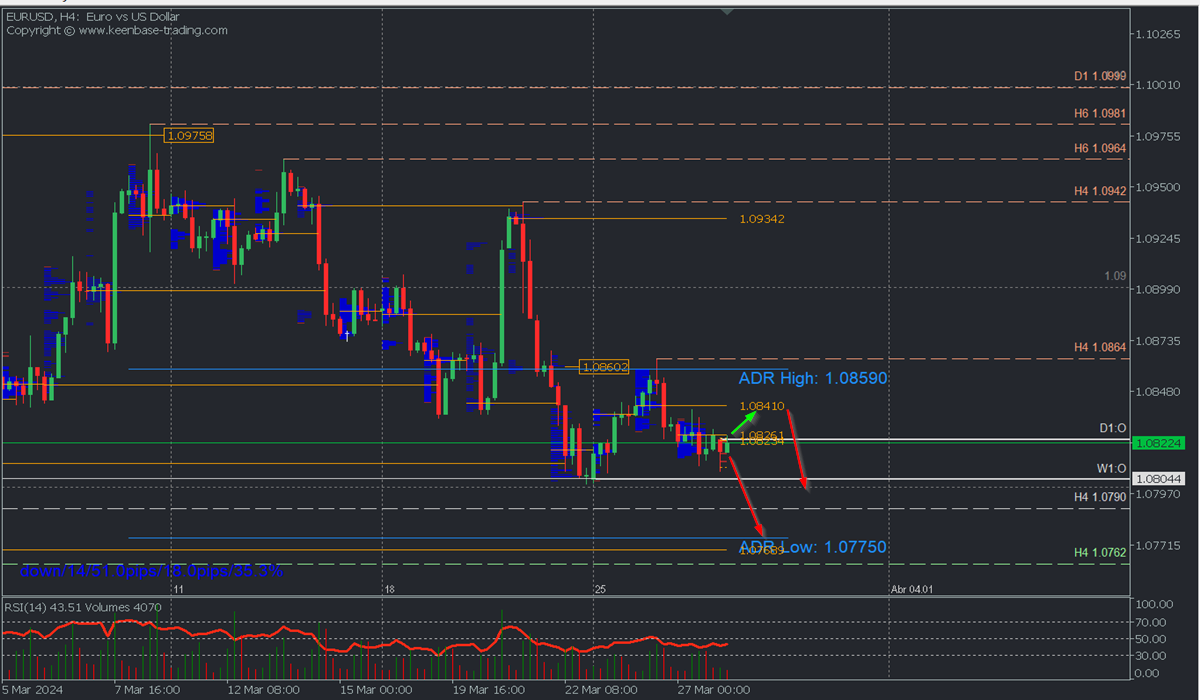
- Bearish scenario: Sell below 1.0820 / 1.0841 with TP1: 1.0804, TP2: 1.0790, and TP3: 1.0775 with S.L. above 1.0834 (entry below 1.0820) or 1.0861 (entry around 1.0841) or at least 1% of account capital*.
- Bullish scenario: Buy above 1.0827 with TP: 1.0841 and TP2: 1.0850, with S.L. below 1.0820 or at least 1% of account capital*. Apply trailing stop.
Scenario from H4 chart:
EURUSD trades in Monday's buying zones and below the uncovered POC* from Wednesday and Tuesday at 1.0826 and 1.0841 respectively, the most recent selling zones, so if the price remains below them or at least with tepid breakouts, a bearish continuation is expected, especially considering the price below 1.0820, to challenge Monday's buying zone and the possible extension of sales towards 1.08, 1.0790, and the bearish range at 1.0775 more extensively.
However, failure to break below 1.0810 and the breakout of yesterday's POC at 1.0826 will expand purchases towards 1.0841, from where to consider new sales with the already indicated targets, as long as this selling zone is not decisively broken. The RSI below 50 continues to show bearish momentum.
*Uncovered POC: POC = Point of Control: It is the level or zone where the highest volume concentration occurred. If there was a bearish movement from it previously, it is considered a selling zone and forms a resistance zone. On the contrary, if there was previously a bullish impulse, it is considered a buying zone, usually located at lows, thus forming support zones.
**Consider this risk management suggestion
**It is essential that risk management is based on capital and traded volume. For this, a maximum risk of 1% of capital is recommended. It is suggested to use risk management indicators such as the Easy Order.
XAUUSD: In Supply Zone. How Far to Consider the Next Retracement?
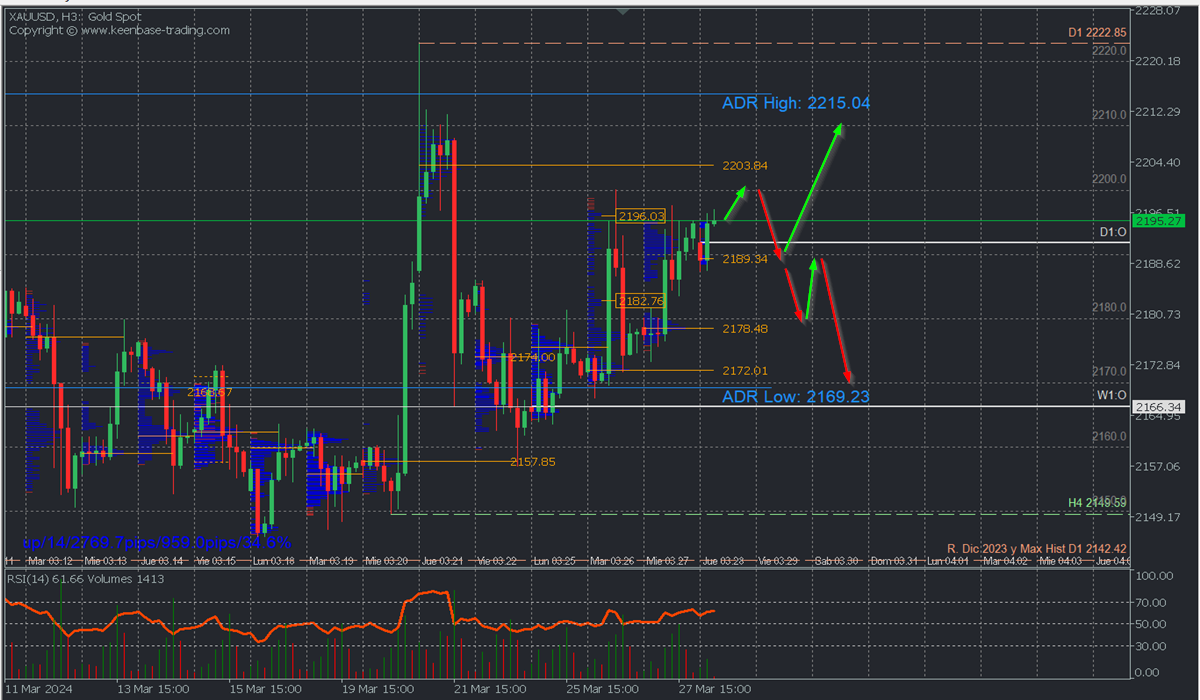
- Bearish scenario: Sell below 2200 / 2194 with TP1: 2190, TP2: 2180, and TP3: 2172 with S.L. above 2204 or at least 1% of account capital*.
- Nearest bullish scenario: Buy above 2197 with TP: 2200 and TP2: 2203, with S.L. below 2195 or at least 1% of account capital*. Apply trailing stop.
- Bullish scenario after retracement: Consider buys around each indicated demand zone or Round Number: 2190, 2180, and 2172 with a target of 20 to 30 pips, and S.L. of at least 1% of account capital*. Apply trailing stop.
Scenario from H3 chart:
XAUUSD consolidates around 2196, Tuesday's selling zone, hence, we do not rule out a possible additional rally towards the round level 2200 and the Uncovered POC* at 2203.84 more extensively, from where to consider new sales of the pair towards the Asian buying zone at 2189.34.
With the new entry of bulls in the indicated Asian buying zone, a new rally towards 2203.84 can be expected, whose decisive breakout will expand purchases towards 2210. The RSI in positive territory confirms the bullish momentum accompanied by increasing volume.
However, the breakout of the buying zone at 2189.34 will pave the way for more extended sales towards the following weekly buying zones at 2178.48 and 2172 more extensively.
*Uncovered POC: POC = Point of Control: It is the level or zone where the highest volume concentration occurred. If there was a bearish movement from it previously, it is considered a selling zone and forms a resistance zone. On the contrary, if there was previously a bullish impulse, it is considered a buying zone, usually located at lows, thus forming support zones.
**Consider this risk management suggestion
**It is essential important that risk management is based on capital and traded volume. For this, a maximum risk of 1% of capital is recommended. It is suggested to use risk management indicators such as the Easy Order.
Nasdaq 100 (NQ) Potential Support Area
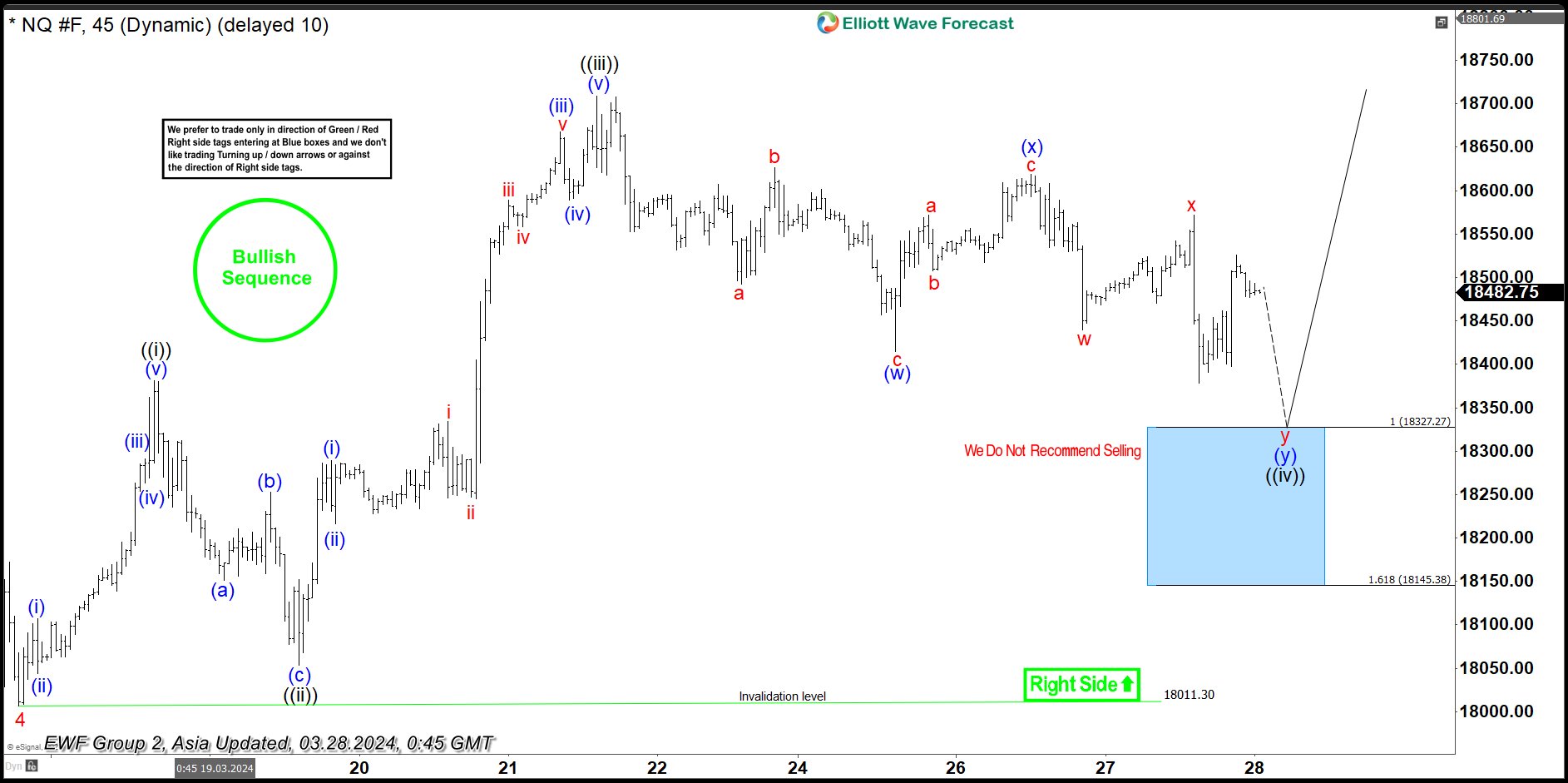
Short Term Elliott Wave view in Nasdaq 100 (NQ) suggests that pullback to 18011.3 ended wave 4. The Index has turned higher in wave 5. Internal subdivision of wave 5 is unfolding as a diagonal. Up from wave 4, wave (i) ended at 18106.75 and wave (ii) ended at 18044. Wave (iii) higher ended at 18289.25 and wave (iv) ended at 18263.25. Final leg wave (v) ended at 18381 which completed wave ((i)). Pullback in wave ((ii)) ended at 18053.25 as a zigzag. The Index then resumed higher in wave ((iii)). Up from wave ((ii)), wave (i) ended at 18289.25 and wave (ii) ended at 18216.5. Wave (iii) higher ended at 18667.25 and wave (iv) ended at 18589.25. Final leg wave (v) ended at 18709 which completed wave ((iii)) in higher degree.
Wave ((iv)) pullback is in progress with internal subdivision as a double three. Down from wave ((iii)), wave a ended at 18492, wave b ended at 18626, and wave c lower ended at 18414.75. This completed wave (w) in higher degree. Rally in wave (x) ended at 18619 as a zigzag structure. Down from wave (x), wave w ended at 18439.25, and wave x ended at 18571.75. Expect the Index to extend lower in wave y to 18145 -18327 (blue box area) to complete wave (y) of ((iv)). From this area, the Index should resume higher or rally in 3 waves at least.
NQ 45 Minutes Elliott Wave Chart
Nasdaq 100 (NQ) Elliott Wave Video
https://www.youtube.com/watch?v=0QpMXKbj3HI
EUR/JPY Daily Outlook
Daily Pivots: (S1) 163.32; (P) 163.87; (R1) 164.30; More...
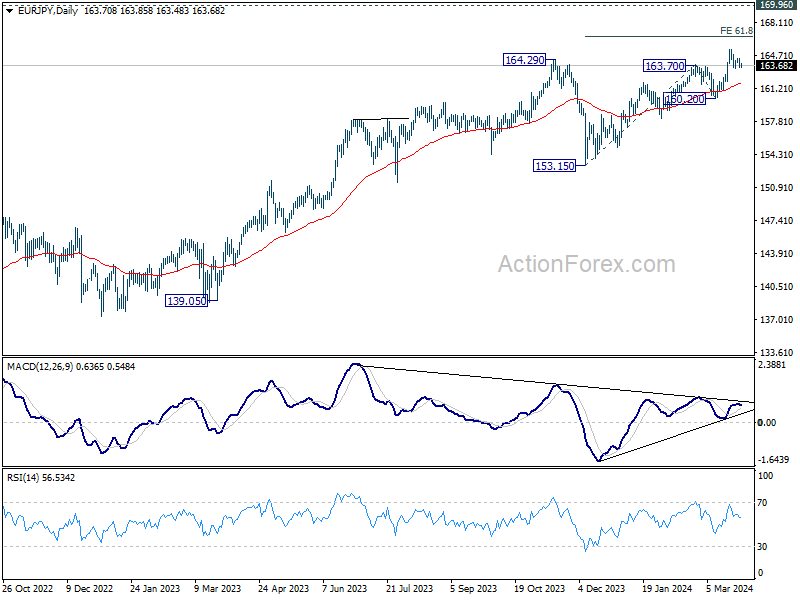
Intraday bias in EUR/JPY remains neutral for the moment. Strong support is still expected from 55 4H EMA (now at 163.58) to bring rebound. On the upside, break of 165.33 will resume larger up trend to 61.8% projection of 153.15 to 163.70 from 160.20 at 166.71. However, sustained break of 55 4H EMA will turn bias to the downside for deeper fall to 160.20 support instead.
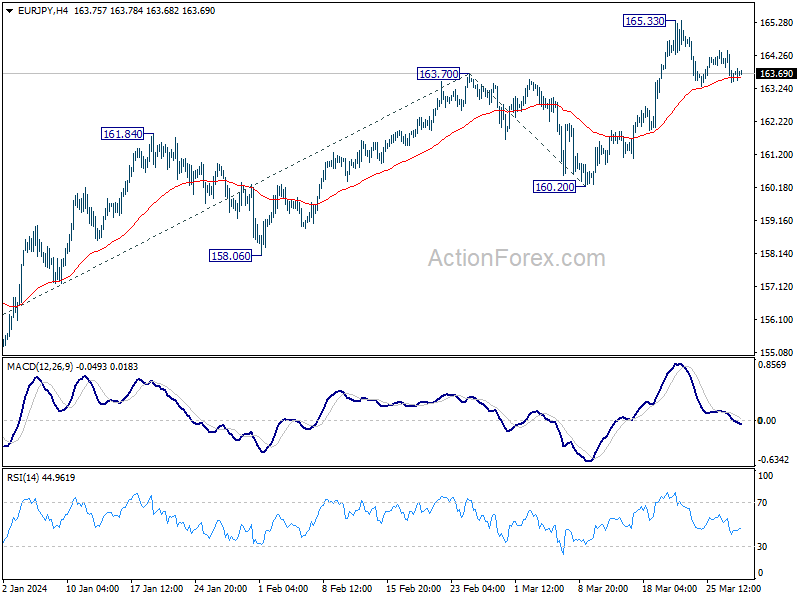
In the bigger picture, current rally is part of the up trend from 114.42 (2020 low), which is still in progress. Next target is 169.96 (2008 high). Break of 160.20 support is needed to be the first sign of medium term topping. Otherwise, outlook will stay bullish in case of retreat.
Nikkei Takes Hit from Japan’s Vigorous Yen Verbal Intervention, But Yen’s Gain Lacks Strength
Nikkei tumbled sharply in Asian session today, largely in response to Yen's rebound late yesterday, which followed strong verbal interventions by Japanese officials aimed at curbing the currency's recent weakness. Additionally, profit-taking activities could be another factor as markets gear up for an extended holiday weekend.
Yen's rebound,while notable, has not yet demonstrated strong momentum, reflecting the perception that BoJ is not yet embarking on a definitive tightening path. Even when BoJ decide to raise rates again, it's anticipated to proceed with gradual and cautious steps, a sentiment echoed in the Summary of Opinions from BoJ's historic meeting last week.
In the wider currency markets, a general trend of range trading prevails, with the notable exception of the Swiss Franc, which has emerged as the weakest currency of the week. Dollar, meanwhile, trails as the second worst for the week, although prospects for an upside breakout remain favorable, albeit slightly postponed by the holiday atmosphere. Zealand Dollar is also underperforming.
Sterling is currently the strongest, followed by Canadian and Australian Dollars. These three currencies, typically sensitive to risk sentiment, have been buoyed by another day of robust rallies in US stock indexes overnight.
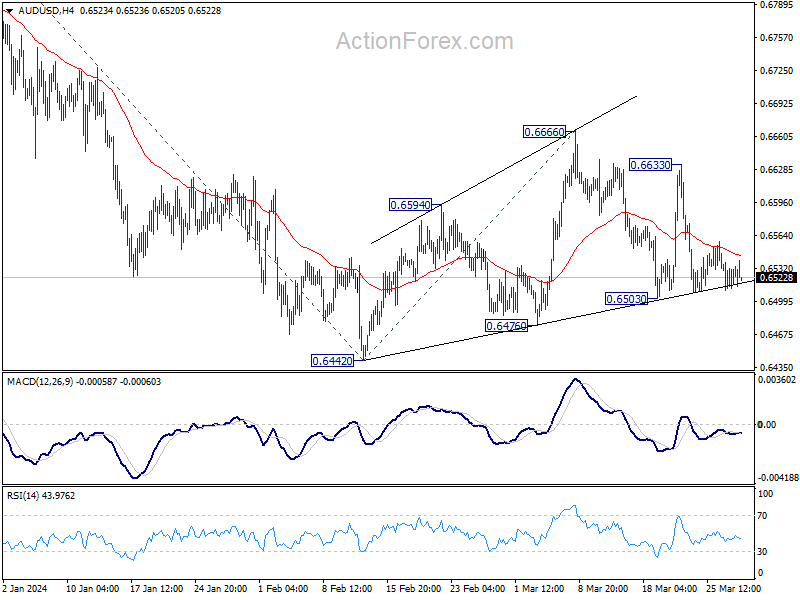
Technically, it's unsure if the greenback is ready to have upside breakouts before, or after the holiday break. Key levels to watch include 1.0801 support in EUR/USD, 1.2574 support in GBP/USD, 0.6503 support in AUD/USD, and 1.3612 resistance in USD/CAD.
In Asia, Nikkei closed down -1.46%. Hong Kong HSI is up 1.49%. China Shanghai SSE is up 0.96%. Singapore Strait Times is down -0.58%. Japan 10-year JGB yield is down -0.0164 at 0.708. Overnight, DOW rose 1.22%, S&P 500 rose 0.86%. NASDAQ rose 0.51%. 10-year yield fell -0.038 to 4.196.
BoJ opinions: Board emphasizes caution in historic shift away from negative rate
At last week's policy meeting, which marked the conclusion of Japan's extensive easing program and its first interest rate hike since 2007, BoJ board members underscored the importance of a cautious approach. The Summary of Opinions from this pivotal gathering highlighted board members' perspectives on the delicate balance required in this new phase of monetary policy.
One member stressed the necessity of maintaining a "cautious stance", especially in light of ending the negative interest rate policy, pointing out that "Japan's economy is not in a state where rapid policy interest rate hikes are necessary."
Furthermore, clarity and communication were emphasized as crucial elements in this transitional period. "It is important to clearly communicate through the use of various methods that the changes in the monetary policy framework proposed at this monetary policy meeting will not be a regime shift toward monetary tightening," another member articulated.
The summary also conveyed concerns about the potential impact of premature expectations on Japan's economic stability. A member warned of the risks associated with policy changes sparking speculative expectations misaligned with economic fundamentals, which could inadvertently destabilize financial conditions. Such volatility could "dampen the momentum of the virtuous cycle operating in Japan's economy and delay the achievement of the inflation target."
NZ ANZ business confidence fall to 22.9, inflation expectations down to 3.8%
New Zealand ANZ Business Confidence fell from 34.7 to 22.9 in March. Own Activity Outlook fell from 29.5 to 22.5. Inflation expectations fell from 4.03% to 3.80%. Cost expectations rose from 73.5 to 74.6. Pricing intentions fell from 48.2 to 45.1. Profit expectations fell from 5.3 to -3.8. Wage expectations rose from 78.9 to 80.5. Employment intentions fell sharply from 6.2 to 3.5.
ANZ's acknowledged the solid progress being made, such as narrowing current account deficit and downward trend in inflation. However, concerns are raised about "stickiness" of some inflation measures and persistent uncertainty around inflation outlook. The bank's message emphasizes caution, stating, "It's certainly too soon to declare victory. But eyes on the prize; we're getting there."
Fed's Waller: Latest data confirm no rush for interest rate cuts
In a speech overnight, Fed Governor Christopher Waller articulated that Fed is in "no rush" to initiate interest rate cuts. This position comes in light of recent economic developments, suggesting that interest rates may need to be maintained at their current restrictive levels "longer than previously thought."
Waller acknowledged the significant strides made in curbing inflation last year and the substantial improvement in labor market balance. Yet, he expressed reservations about the pace of continued progress, stating, "the data we have received so far this year has made me uncertain about the speed of continued progress."
This uncertainty has been fueled by economic indicators over the past month, with Waller highlighting February's robust job growth of 275k and a three-month average job growth of 265k, alongside persistently high inflation metrics.
Particularly concerning to Waller is a notable jump in Core PCE inflation to 0.4% on a monthly basis in January, a significant increase from an average of around 0.1% in the fourth quarter. These observations have solidified Waller's belief that there is "no rush to cut the policy rate," advocating for a continuation of the Fed's current restrictive stance, "for longer than previously thought."
Waller remains optimistic about making further progress towards disinflation, which could eventually justify a reduction in the federal funds rate target range within the year. But he asserts "until that progress materializes, I am not ready to take that step."
SNB Schlegel: No target for Franc exchange rate, intervenes as necessary
SNB Vice President, Martin Schlegel, clarified overnight that the central bank does not adhere to a specific target for Swiss Franc's exchange rate. Instead, Schlegel reiterated the usual stance that the bank "monitors the exchange rate closely and intervenes in the foreign-exchange market as necessary."
Separately, in its Quarterly Bulletin, SNB noted that "Many economic indicators suggest that economic activity was slightly more dynamic in the first quarter of 2024 than in the preceding quarters."
The report attributed this "moderate" growth primarily to the service sector's resilience, while highlighting continued stagnation in the manufacturing sector. SNB acknowledged that "persistently weak global demand" remains a significant hurdle for manufacturing, with Swiss Franc's exchange rate increasingly being cited by companies as a contributing challenge.
Looking ahead
UK GDP final, German retail sales and unemployment, Eurozone M3and Swiss KOF economic barometer will be released in European session. Later in the day, Canada GDP, US GDP final, jobless claims, Chicago PMI and pending home sales will be released.
EUR/JPY Daily Outlook
Daily Pivots: (S1) 163.32; (P) 163.87; (R1) 164.30; More...
Intraday bias in EUR/JPY remains neutral for the moment. Strong support is still expected from 55 4H EMA (now at 163.58) to bring rebound. On the upside, break of 165.33 will resume larger up trend to 61.8% projection of 153.15 to 163.70 from 160.20 at 166.71. However, sustained break of 55 4H EMA will turn bias to the downside for deeper fall to 160.20 support instead.
In the bigger picture, current rally is part of the up trend from 114.42 (2020 low), which is still in progress. Next target is 169.96 (2008 high). Break of 160.20 support is needed to be the first sign of medium term topping. Otherwise, outlook will stay bullish in case of retreat.
Economic Indicators Update
| GMT | Ccy | Events | Actual | Forecast | Previous | Revised |
|---|---|---|---|---|---|---|
| 23:50 | JPY | BoJ Summary of Opinions | ||||
| 00:00 | NZD | ANZ Business Confidence Mar | 22.9 | 34.7 | ||
| 00:00 | AUD | Consumer Inflation Expectations Mar | 4.30% | 4.50% | ||
| 00:30 | AUD | Retail Sales M/M Feb | 0.30% | 0.40% | 1.10% | |
| 00:30 | AUD | Private Sector Credit M/M Feb | 0.50% | 0.40% | 0.40% | |
| 07:00 | EUR | Germany Retail Sales M/M Feb | 0.30% | -0.40% | ||
| 07:00 | GBP | GDP Q/Q Q4 F | -0.30% | -0.30% | ||
| 07:00 | GBP | Current Account (GBP) Q4 | -21.5B | -17.2B | ||
| 08:00 | CHF | KOF Economic Barometer Mar | 102.3 | 101.6 | ||
| 08:55 | EUR | Germany Unemployment Rate Mar | 5.90% | 5.90% | ||
| 08:55 | EUR | Germany Unemployment Change Mar | 10K | 11K | ||
| 09:00 | EUR | Eurozone M3 Money Supply Y/Y Feb | 0.30% | 0.10% | ||
| 12:30 | CAD | GDP M/M Jan | 0.40% | 0.00% | ||
| 12:30 | USD | Initial Jobless Claims (Mar 22) | 211K | 210K | ||
| 12:30 | USD | GDP Annualized Q4 F | 3.20% | 3.20% | ||
| 12:30 | USD | GDP Price Index Q4 F | 1.70% | 1.70% | ||
| 13:45 | USD | ChicagoPMI Mar | 46.4 | 44 | ||
| 14:00 | USD | Pending Home Sales M/M Feb | -2.00% | -4.90% | ||
| 14:00 | USD | Michigan Consumer Sentiment Mar F | 76.5 | 76.5 | ||
| 14:30 | USD | Natural Gas Storage | -26B | 7B |
Crude Oil Price Holds Gains and Eyes Fresh Rally
Key Highlights
- Crude oil bulls gained pace above the $80.00 resistance.
- A connecting bearish trend line is forming with resistance at $82.35 on the 4-hour chart.
- Gold prices consolidated gains above the $2,150 resistance zone.
- Bitcoin price faced heavy resistance near the $71,500 zone.
Crude Oil Price Technical Analysis
After forming a base above the $76.80 level, Crude oil prices started a major increase. The bulls pushed the price above the $80.00 resistance zone.
Looking at the 4-hour chart of XTI/USD, there was a steady drift above the $81.20 level, the 200 simple moving average (green, 4-hour), and the 100 simple moving average (red, 4-hour).
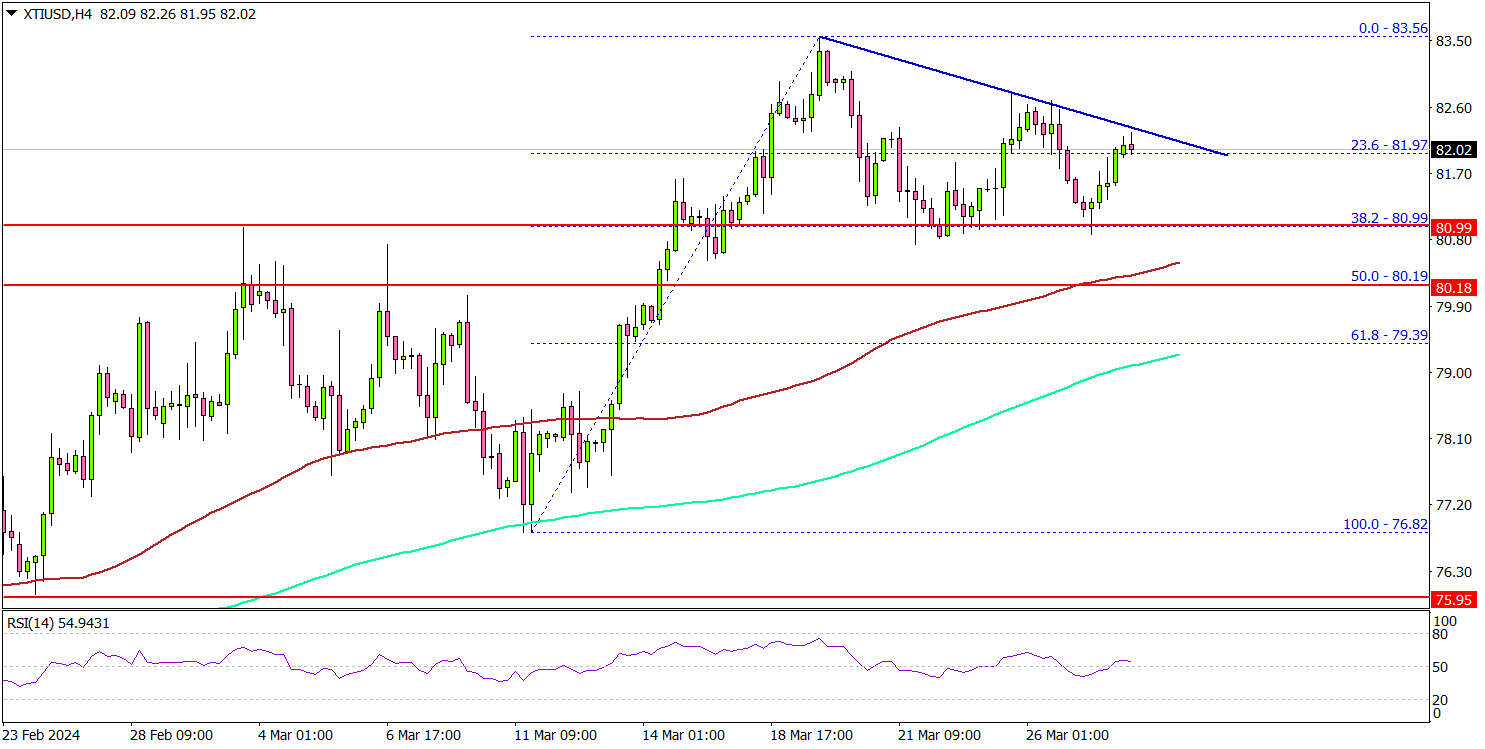
A new multi-week high was formed at $83.56 before the price started a minor downside correction. There was a move below the $82.50 support zone. The price declined below the 23.6% Fib retracement level of the upward move from the $76.82 swing low to the $83.56 high.
However, the bulls are active near the $81.00 zone and the 100 simple moving average (red, 4-hour). On the upside, the price is facing hurdles near the $82.50 level.
The next major resistance is near the $83.50 zone, above which the price may perhaps accelerate higher. In the stated case, it could even visit the $85.00 resistance.
If not, the price might correct lower and test the $80.20 support. The first major support on the downside is near the $79.40 level. The next major support is at $78.80, below which the price might test $77.20. Any more losses might send oil prices toward $75.00.
Looking at Gold, the price started a downside correction below the $2,200 level but the bulls remain in control for more upsides.
Economic Releases to Watch Today
- US Initial Jobless Claims - Forecast 215K, versus 210K previous.
- US Pending Home Sales for Feb 2024 (YoY) - Forecast +1.5%, versus -4.9% previous.
NZ ANZ business confidence fall to 22.9, inflation expectations down to 3.8%
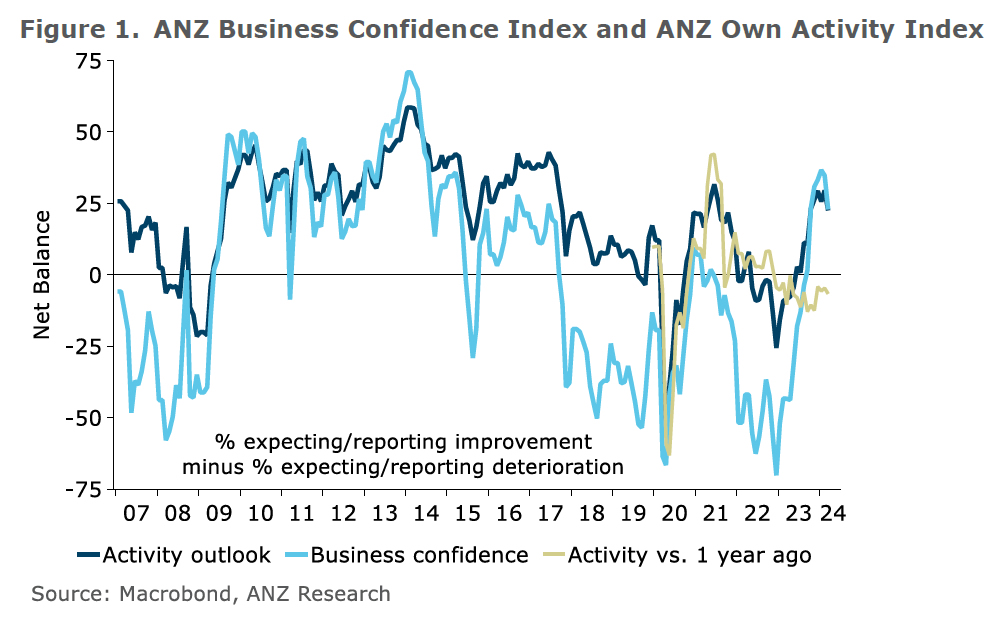
New Zealand ANZ Business Confidence fell from 34.7 to 22.9 in March. Own Activity Outlook fell from 29.5 to 22.5. Inflation expectations fell from 4.03% to 3.80%. Cost expectations rose from 73.5 to 74.6. Pricing intentions fell from 48.2 to 45.1. Profit expectations fell from 5.3 to -3.8. Wage expectations rose from 78.9 to 80.5. Employment intentions fell sharply from 6.2 to 3.5.
ANZ's acknowledged the solid progress being made, such as narrowing current account deficit and downward trend in inflation. However, concerns are raised about "stickiness" of some inflation measures and persistent uncertainty around inflation outlook. The bank's message emphasizes caution, stating, "It's certainly too soon to declare victory. But eyes on the prize; we're getting there."
BoJ opinions: Board emphasizes caution in historic shift away from negative rate
At last week's policy meeting, which marked the conclusion of Japan's extensive easing program and its first interest rate hike since 2007, BoJ board members underscored the importance of a cautious approach. The Summary of Opinions from this pivotal gathering highlighted board members' perspectives on the delicate balance required in this new phase of monetary policy.
One member stressed the necessity of maintaining a "cautious stance", especially in light of ending the negative interest rate policy, pointing out that "Japan's economy is not in a state where rapid policy interest rate hikes are necessary."
Furthermore, clarity and communication were emphasized as crucial elements in this transitional period. "It is important to clearly communicate through the use of various methods that the changes in the monetary policy framework proposed at this monetary policy meeting will not be a regime shift toward monetary tightening," another member articulated.
The summary also conveyed concerns about the potential impact of premature expectations on Japan's economic stability. A member warned of the risks associated with policy changes sparking speculative expectations misaligned with economic fundamentals, which could inadvertently destabilize financial conditions. Such volatility could "dampen the momentum of the virtuous cycle operating in Japan's economy and delay the achievement of the inflation target."
Fed’s Waller: Latest data confirm no rush for interest rate cuts
In a speech overnight, Fed Governor Christopher Waller articulated that Fed is in "no rush" to initiate interest rate cuts. This position comes in light of recent economic developments, suggesting that interest rates may need to be maintained at their current restrictive levels "longer than previously thought."
Waller acknowledged the significant strides made in curbing inflation last year and the substantial improvement in labor market balance. Yet, he expressed reservations about the pace of continued progress, stating, "the data we have received so far this year has made me uncertain about the speed of continued progress."
This uncertainty has been fueled by economic indicators over the past month, with Waller highlighting February's robust job growth of 275k and a three-month average job growth of 265k, alongside persistently high inflation metrics.
Particularly concerning to Waller is a notable jump in Core PCE inflation to 0.4% on a monthly basis in January, a significant increase from an average of around 0.1% in the fourth quarter. These observations have solidified Waller's belief that there is "no rush to cut the policy rate," advocating for a continuation of the Fed's current restrictive stance, "for longer than previously thought."
Waller remains optimistic about making further progress towards disinflation, which could eventually justify a reduction in the federal funds rate target range within the year. But he asserts "until that progress materializes, I am not ready to take that step."
SNB Schlegel: No target for Franc exchange rate, intervenes as necessary
SNB Vice President, Martin Schlegel, clarified overnight that the central bank does not adhere to a specific target for Swiss Franc's exchange rate. Instead, Schlegel reiterated the usual stance that the bank "monitors the exchange rate closely and intervenes in the foreign-exchange market as necessary."
Separately, in its Quarterly Bulletin, SNB noted that "Many economic indicators suggest that economic activity was slightly more dynamic in the first quarter of 2024 than in the preceding quarters."
The report attributed this "moderate" growth primarily to the service sector's resilience, while highlighting continued stagnation in the manufacturing sector. SNB acknowledged that "persistently weak global demand" remains a significant hurdle for manufacturing, with Swiss Franc's exchange rate increasingly being cited by companies as a contributing challenge.