Sample Category Title
NZ employment grows 0.4% in Q4, unemployment rate ticks up to 4%
New Zealand's employment grew 0.4% qoq in Q4, slightly above expectation of 0.3% qoq. Unemployment rate ticked up from 3.9% to 4.0%, below expectation of 4.3%. Labor force participation rate fell from 72.0% to 71.9%.
Labor cost index for salary and wage rates, inclusive of overtime, recorded a 4.3% yoy increase, maintaining the same annual growth rate observed in the preceding three quarters of the year.
The Quarterly Employment Survey revealed a notable 6.9% yoy increase in average ordinary time hourly earnings, with public sector wages leading the charge.
Public sector hourly earnings surged by 7.4% yoy, marking the largest annual increase since March 2006 quarter, up from previous quarter's 5.4%. In contrast, private sector had a slight deceleration to 6.6% yoy, down from 7.1% yoy in previous quarter.
BoC’s Macklem: Path to 2% inflation slow and risks remain
In a speech, BoC Governor Tiff Macklem underscored the importance of allowing "more time" for monetary policy to take full effect in mitigating inflationary pressures within the Canadian economy. The path to 2% target is "likely to be slow" and "risks remain.
Macklem acknowledged the successes of recent rate hikes in aligning supply with demand, pointing to a discernible decrease in inflation across both goods and services. Shelter inflation, however, continues to pose a significant challenge. He attributed this trend not only to monetary tightening but also to deeper issues in the "structural shortage of housing" that monetary policy alone cannot resolve.
Further complicating the inflation landscape are the volatile oil and transportation costs linked to international conflicts and disruptions. While these factors are beyond the control of BoC, Macklem emphasized the central bank's focus on mitigating any broader inflationary impacts these cost increases might "feed through" to inflation in other goods and services.
Macklem's outlook projects a gradual return to the 2% inflation target, with expectations set for inflation to remain near 3% in the first half of the year, decreasing to about 2.5% by the end of the year, and finally achieving 2% target in 2025.
"Putting this all together, the resulting push and pull on inflation means the path back to 2% inflation is likely to be slow and risks remain," he noted.
Fed’s Harker signals confidence in economic soft landing
Philadelphia Fed President Patrick Harker's speech overnight delivered a dose of cautious optimism regarding US economy's trajectory, suggesting that a "soft landing" could be within reach.
Harker highlighted key indicators supporting his positive outlook: a trend towards disinflation, a labor market moving towards equilibrium, and sustained consumer spending.
These factors, according to Harker, are crucial for achieving the much-discussed soft landing, a scenario where inflation is controlled without causing a recession.
Emphasizing the progress made thus far, Harker also cautioned that the journey is not yet complete, likening the current economic phase to an airplane's final approach but not yet landing.
"Now certainly we haven't touched down, and we're going to have to keep our seatbelts on, but with inflation continuing to fall back to our 2% target, with employment remaining strong, and with consumer sentiment looking up, the runway at our destination is in sight," he elaborated.
Fed’s Kashkari: Inflation progress made, yet target not fully achieved
Minneapolis Fed President Neel Kashkari acknowledged the strides made towards controlling inflation, yet emphasizing the journey towards 2% inflation target is ongoing.
During an event, Kashkari highlighted, "We're not all the way there yet, but we've made a lot of progress on inflation."
Kashkari pointed to recent inflation data as a sign of encouraging trends, noting that both three- and six-month inflation measures are aligning closely with Fed's target. "The six-month data is basically there and the three-month data is basically there," he observed, indicating that if current patterns persist, Fed is on a track to achieving its inflation objective.
However, Kashkari remains cautiously optimistic, refraining from declaring an outright victory over inflation. "I don't want to say we're necessarily going to just glide past all the way to 2% but fingers crossed, the data is looking positive."
Fed’s Mester warns against premature and rapid interest rate cuts
Cleveland Fed President Loretta Mester underscored the importance of a cautious approach towards adjusting interest rates during an event overnight. Highlighting the necessity of "risk management," Mester articulated concerns over reducing rates "too soon or too quickly," emphasizing the need for concrete evidence that inflation is on a definitive downturn towards Fed's 2% target.
Mester's remarks signal a careful balancing act for the Federal Reserve, which is contemplating when to initiate an easing cycle. "It would be a mistake to move rates down too soon or too quickly without sufficient evidence that inflation was on a sustainable and timely path back to 2%," she stated.
Looking ahead, Mester expressed optimism that the Fed could start to consider easing "later this year," provided that the economy continues to align with current expectations. This shift in policy, however, would likely occur at a gradual pace to ensure the Fed's dual mandate goals of price stability and maximum employment are met without inadvertently reigniting inflationary pressures or unsettling inflation expectations.
"The FOMC's job now is to ensure that the economy reaches an even better place by calibrating monetary policy to achieve our dual mandate goals," Mester emphasized, "Risk management will take center stage."
What Now for US Dollar After Rate Cut Delay?
- US dollar re-energized as strong data, hawkish Fed dent early rate cut bets
- American economy still churning out new jobs, shows no signs of cracks
- Will hot economy scupper the Fed’s plan to ease policy this year?
From recession fears to overheating risk
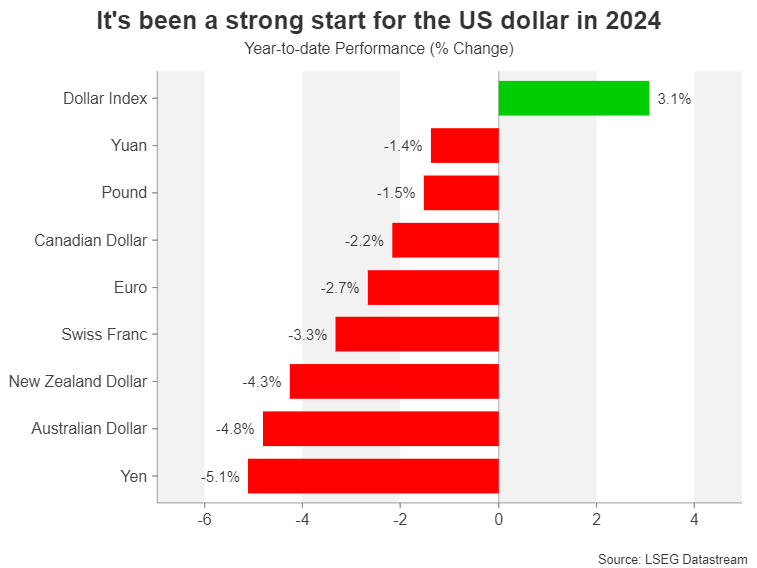
The US dollar may have ended 2023 on a bearish note as rate cut speculation reached fever pitch, but that has certainly not set the tone for 2024. In fact, the greenback rallied in the first week of January and the year-to-date uptrend received a solid endorsement on Friday when an upside surprise in the latest jobs report diminished hopes that the Federal Reserve would begin cutting rates as early as the March meeting. An equally stellar ISM services survey on Monday further cast doubt on the notion that policy easing is just around the corner.
Many investors are still holding out for a spring cut later in May, but even that may be too optimistic. As Chair Powell hinted at last week’s FOMC press briefing and in a subsequent interview, the Fed is in no rush to lower rates when the economy is so strong. Market odds for a May decrease currently stand at around 75%, leaving scope for a significant repricing if jobs growth and inflation don’t cool substantially enough over the next couple of months.
Fall in inflation has slowed down
However, neither is it completely right to say that markets are not paying attention to the data. Investors have priced out about 50 basis points of cuts for 2024 from where things stood in mid-January when easing bets peaked at around 165 bps. Nevertheless, there’s a danger that markets are too slow in dialling back their very dovish expectations and the Fed on its part isn’t being forceful enough in pushing back.
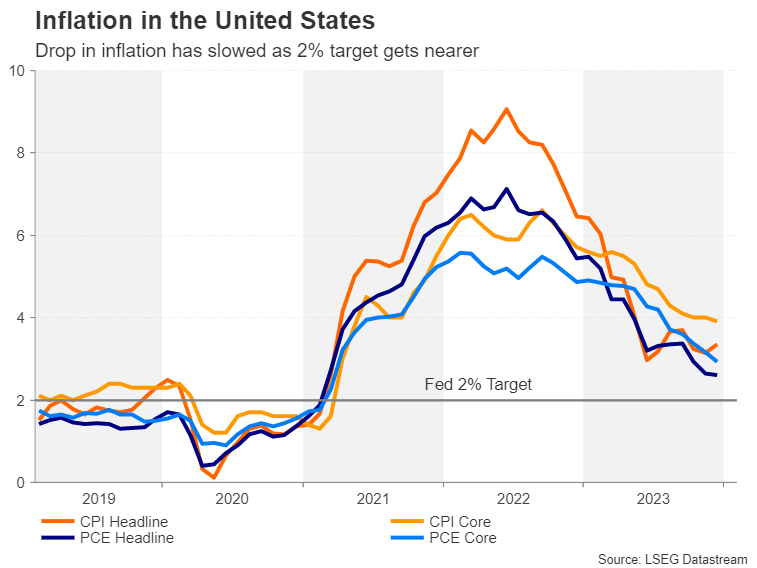
That leaves plenty of room for a further adjustment in market expectations should the inflation picture not pan out as most investors are hoping. The Fed is fairly confident that inflation is headed towards the 2% target in a sustainable manner, but there’s also likely to be some frustration that this final leg of the journey is taking longer than anticipated.
The labour market puzzle
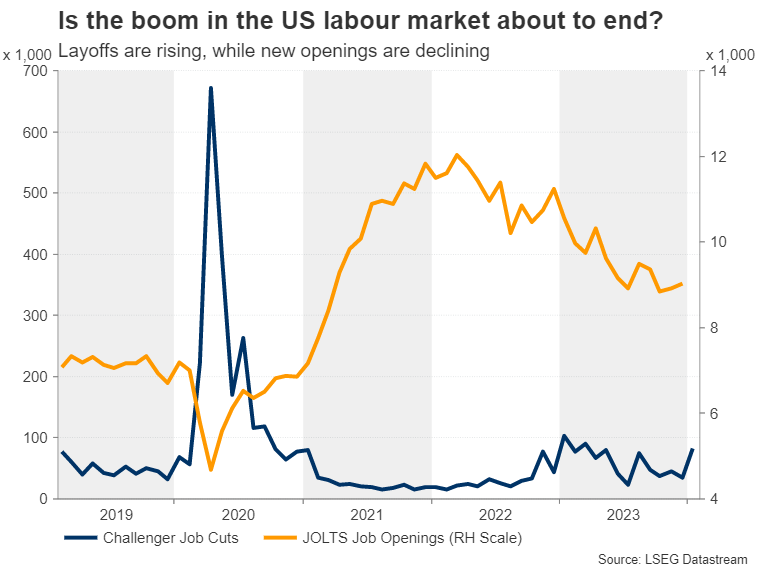
Even if the disinflation process were to speed up over the next few months, Fed officials are unlikely to throw caution to the wind as long as the labour market remains so tight. The most worrying aspect of the January payrolls report was that annual wage growth unexpectedly accelerated to 4.5%, with average earnings rising by a whopping 0.6% month-on-month.
Those impressive readings might not be repeated soon as many Wall Street giants have announced a fresh round of layoffs. But they still suggest that the economy is at greater risk of running too hot than slowing down abruptly, with the soft landing narrative now looking increasingly like the base case scenario.
Is Fed policy restrictive enough?
Unless the labour market takes a turn for the worse, the Fed’s own ‘conservative’ forecast of 75 bps of cuts in 2024 could also start to come into question soon. As long as more jobs are being created than lost and wages are rising faster than inflation, consumers will keep spending and the risk of a recession will stay remote.
It doesn’t help that financial conditions have loosened substantially since November, as not only have Treasury yields tumbled by around 100 bps, but also stocks have climbed to fresh record highs. The Fed is partly to blame for this by appearing too eager to lean towards the dovish side. The latest gains on Wall Street have the potential to refuel consumer spending, which could prompt the Fed to wait until the summer before considering the first rate reduction.
The case for a bullish dollar
All this makes the case for a weaker dollar less plausible in the first half of the year, particularly against the likes of the euro. With economic activity in the euro area remaining subdued and showing no sign of picking up, the European Central Bank is more likely to cut rates before the Fed does, making it difficult for the single currency to resume its late 2023 uptrend.
Of all the major currencies, the yen probably has a bigger chance of bouncing back against the US dollar should the Bank of Japan finally decide to end its negative interest rate policy. The BoJ has flagged April as the possible meeting to hike rates should this year’s spring wage negotiations result in large enough pay hikes.
For other currencies like the pound and Australian dollar where rate cuts could also be delayed by their central banks, it will be difficult for them to match the strong fundamentals for the US dollar, so until the Fed makes its pivot, they look set to stay on the backfoot.
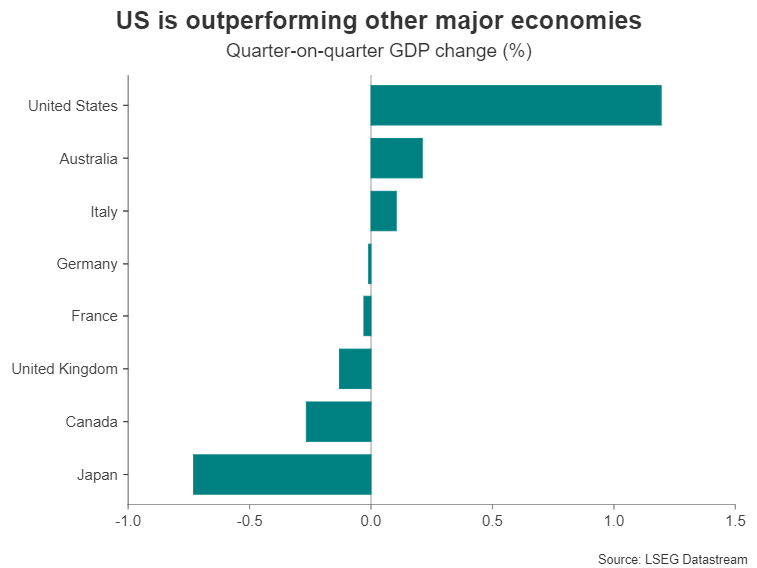
Further bolstering the greenback’s prospects in the first few months of 2024 are the heightened geopolitical threats amid the spiralling conflict in the Middle East, which is supporting demand for safe havens.
A summer rate cut?
Heading towards the second half, however, the picture might start to change if the Fed does finally embark on a rate cutting cycle. The main problem with this scenario is that beyond the initial selloff, there may be limited downside for the dollar thereafter if the US economy remains comparatively more robust, preventing yield spreads with other currencies from narrowing significantly.
On the whole, however, it seems that the stars are gradually aligning for the dollar bears. The continued weakness in energy prices bodes well for a further decline in inflation over the coming months, allowing the Fed to lower rates even if there’s no downturn in sight, although this outlook is dependent on there not being a wider fallout of the Israel-Hamas war.
Barring any fresh crises or external shocks, the biggest threat to the US economy might be businesses reducing their workforce much more aggressively in 2024. With employment being one half of the Fed’s dual mandate, policymakers would not hesitate to slash borrowing costs if the labour market deteriorated.
Election and soaring deficit risks
There are other risks too that could become more prominent in the second half of the year. First is the presidential election in November, with Trump and Biden poised for a rematch. The former supports tax cuts and the latter favours more spending so neither would necessarily be negative for the markets. But Trump’s unpredictability and Biden’s age are something that could make the markets nervous if that’s the reality facing voters come November.
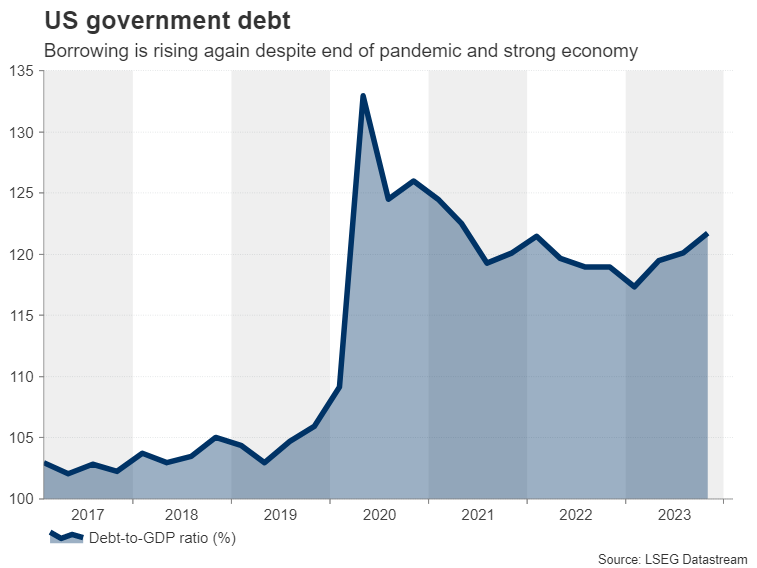
Finally, America’s ballooning debt poses both upside and downside risks for the dollar in 2024. Government borrowing surged in 2023 despite faster economic growth and pandemic-era spending being phased out. But the deficit could be even higher in 2024. Should Congress maintain the current course and debt jitters re-emerge, yields could spike higher, boosting the greenback in the short term.
Alternatively, if Congress decided to rein in some of the spending, tighter fiscal policy would give the Fed more room to cut rates, adding to the dollar’s potential downfall.
Best of the bunch
All in all, a major reversal in the dollar’s fortunes appears to have been pushed back again, in line with expectations of the Fed’s first rate cut. But just as there’s little reason for the Fed to move prematurely, it’s almost certain that a pivot is coming at some point this year. The gripe here is that when that happens, the scale of the cuts will probably disappoint, but perhaps more importantly, investors will still struggle to find better alternatives to the dollar.
NZ First Impressions: Labour market statistics, Q4 2023
The December quarter labour market surveys surprised modestly to the upside, suggesting that activity and inflation pressures are still easing, but perhaps not as quickly as the RBNZ would have hoped.
- Unemployment rate: 4.0% (prev: 3.9%, Westpac f/c: 4.2%, RBNZ f/c 4.2%)
- Employment change (quarterly): +0.4% (prev: -0.2%, Westpac f/c: +0.3%, RBNZ f/c +0.2%)
- Labour costs (private sector, quarterly): +1.0% (prev: 0.9%, Westpac f/c: +0.8%, RBNZ f/c +0.8%)
- Average hourly earnings (private sector, ordinary time quarterly): +0.5% (prev: +2.0%)
The December quarter labour market surveys produced some modest upside surprises, relative to what the market and the Reserve Bank were expecting. The unemployment rate rose from 3.9% to 4.0%, returning it to around its pre-Covid levels. The number of people employed rose by a solid 0.4%, though this was outpaced by the strong migration-led growth in the population.
The rise in the unemployment rate was less than the 4.2% that we and the Reserve Bank had forecast, although the reasons for the ‘miss’ were fairly minor. Employment growth was a little higher than the 0.3% we were expecting (but in line with the already-released Monthly Employment Indicator). At the same time, the labour force participation rate dipped to 71.9% – we had assumed an unchanged 72.0%, but we didn’t have a strong stance on that as it’s been quite volatile recently.
The unemployment rate in particular is a valuable real-time indicator of how hot the economy is running. The RBNZ has been looking to slow the economy to take the heat out of inflation pressures. And while activity is clearly cooling, the unemployment rate suggests that they haven’t made as much progress as they would have hoped at this point.
That said, the underutilisation rate – a broader measure of spare capacity in the labour market – saw a more substantial rise to 10.7%, from 10.4% last quarter and 9.3% a year ago. The rise this time was due to more part-time workers saying they would like to work more hours.
The other unwelcome surprise for the RBNZ was that wage inflation was also stronger than expected. The Labour Cost Index (LCI) rose by 1.0% for the private sector, against forecasts of a 0.8% rise. There was also another sharp lift in public sector pay rates, which may be a holdover from the health and education sector pay agreements that also boosted the previous quarter.
On an annual basis, private sector wage growth slowed to 3.9%, from 4.1% last quarter and a peak of 4.5% in March 2023. While wage inflation has clearly peaked in the private sector (though not in total, due to the large public sector increases), it has not receded as quickly as the RBNZ would have hoped. That in turn will have a bearing on its forecasts of how quickly inflation will return to within the 1-3% target range.
Overall, today’s results will probably reinforce the RBNZ’s stance that interest rate cuts are much further away than what the market is currently pricing in. While its November Monetary Policy Statement forecasts are somewhat dated by now, the recent speech by Chief Economist Paul Conway suggested that the RBNZ has not wavered in its concerns about the risk of inflation remaining stubbornly high.
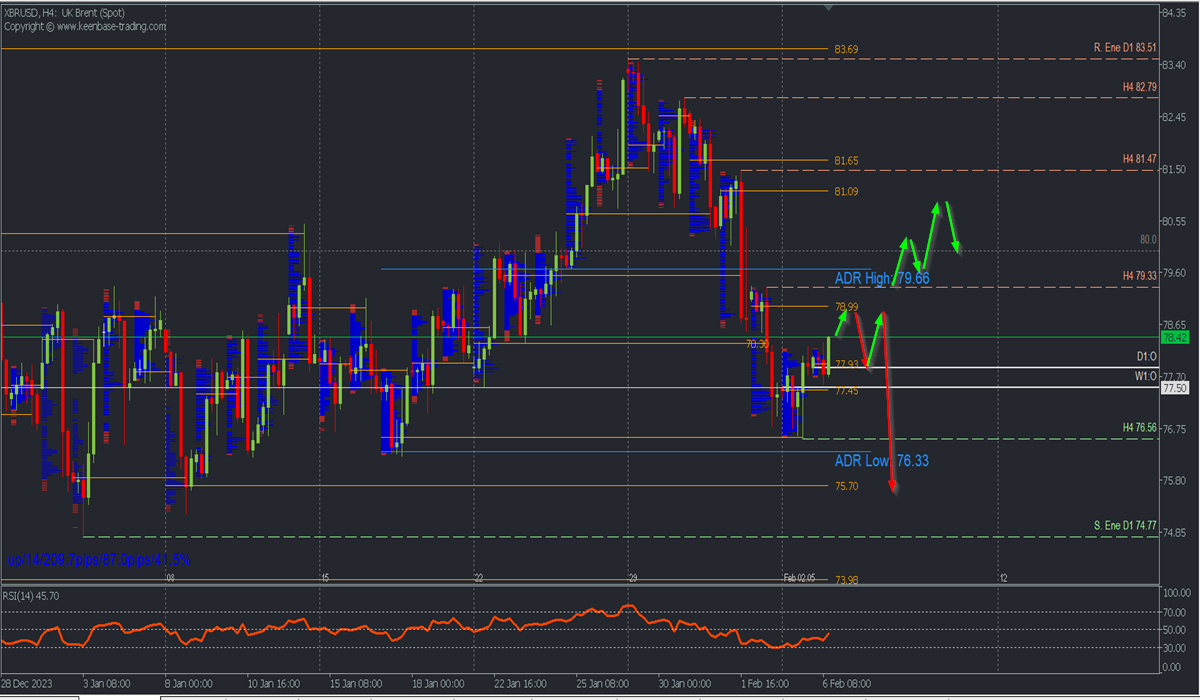
XBRUSD: Corrects Towards Supply Zone With Expected Further Downside Towards 75.70
Bearish Scenario: Sales below 78.99 with TP1: 77.93, TP2: 77.45, and upon its breakout TP3: 76.56 and TP4: 75.70. It is recommended to place a stop loss above 79.50, at least 1% of the account capital**. A trailing stop can be used.
Bullish Scenario: Purchases above 78.00 (wait for a pullback to this area) with TP1: 1679.00 (uncovered POC*), TP2: 79.33, and TP3: 79.66 intraday. It is recommended to set a stop loss (S.L.) below 77.40 or at least 1% of the account capital**.
Scenario from the H4 chart
After reaching a buying zone from three weeks ago at the uncovered POC* 76.57, the price reacts upwards and corrects towards the last selling zone at Friday's uncovered POC* at 78.99, leaving active two POCs at 77.93 and 77.45, as intraday buying (demand) zones.
From a structural point of view, the last relevant resistance is located at 79.33, implying that as long as this level remains intact, the sequence will continue to be bearish.
With purchases above the level 78.62, forming a local H1 support, extension towards 78.99 is expected, from where bears are expected to be reactivated for a new decline at least towards 77.93 and 77.45/50, already indicated demand zones, with a moderate bullish rebound, after which a bearish continuation and decisive breakout are expected, which will pave the way for bears to extend the decline towards the support 76.56 and the next uncovered POC at 75.70.
On the other hand, a bullish continuation will imply a trend reversal if there is a broad rebound from the buying zones 77.93 and 77.45 and the consequent decisive breakout of the selling zone and resistance 79.33.
The RSI remains in negative territory and is ascending towards the midpoint, indicating the possible culmination of the corrective ascent once the supply zone is reached.
*Uncovered POC: POC = Point of Control: It is the level or zone where the highest volume concentration occurred. If there was previously a bearish movement from it, it is considered a selling zone and forms a resistance zone. On the contrary, if there was previously a bullish impulse, it is considered a buying zone, usually located at lows, thus forming support zones.
**Consider this risk management suggestion
**It is very important that risk management be based on capital and traded volume. Therefore, a maximum risk of 1% of the capital is recommended. It is suggested to use risk management indicators such as Easy Order.
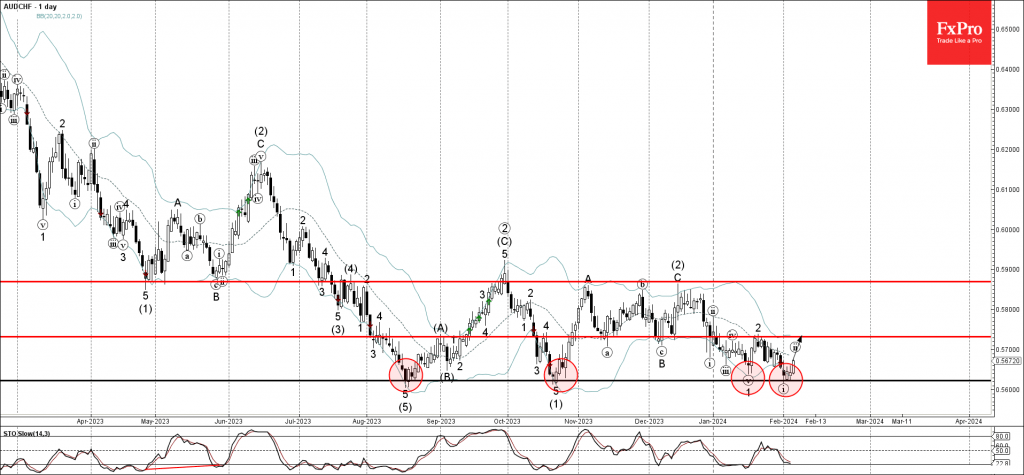
AUDCHF Wave Analysis
- AUDCHF reversed from key support level 0.5620
- Likely to rise to resistance level 0.5730
AUDCHF currency pair recently reversed up from the key support level 0.5620, which has been reversing the pair from the middle of August , stopping earlier waves (5),(1) and 1.
The support level 0.5620 was strengthened by the lower daily Bollinger Band – which started the active wave ii.
Given the strength of the support level 0.5620, AUDCHF currency pair can be expected to rise further to the next resistance level 0.5730, top of the previous correction 2.