Sample Category Title
USD/JPY Mid-Day Outlook
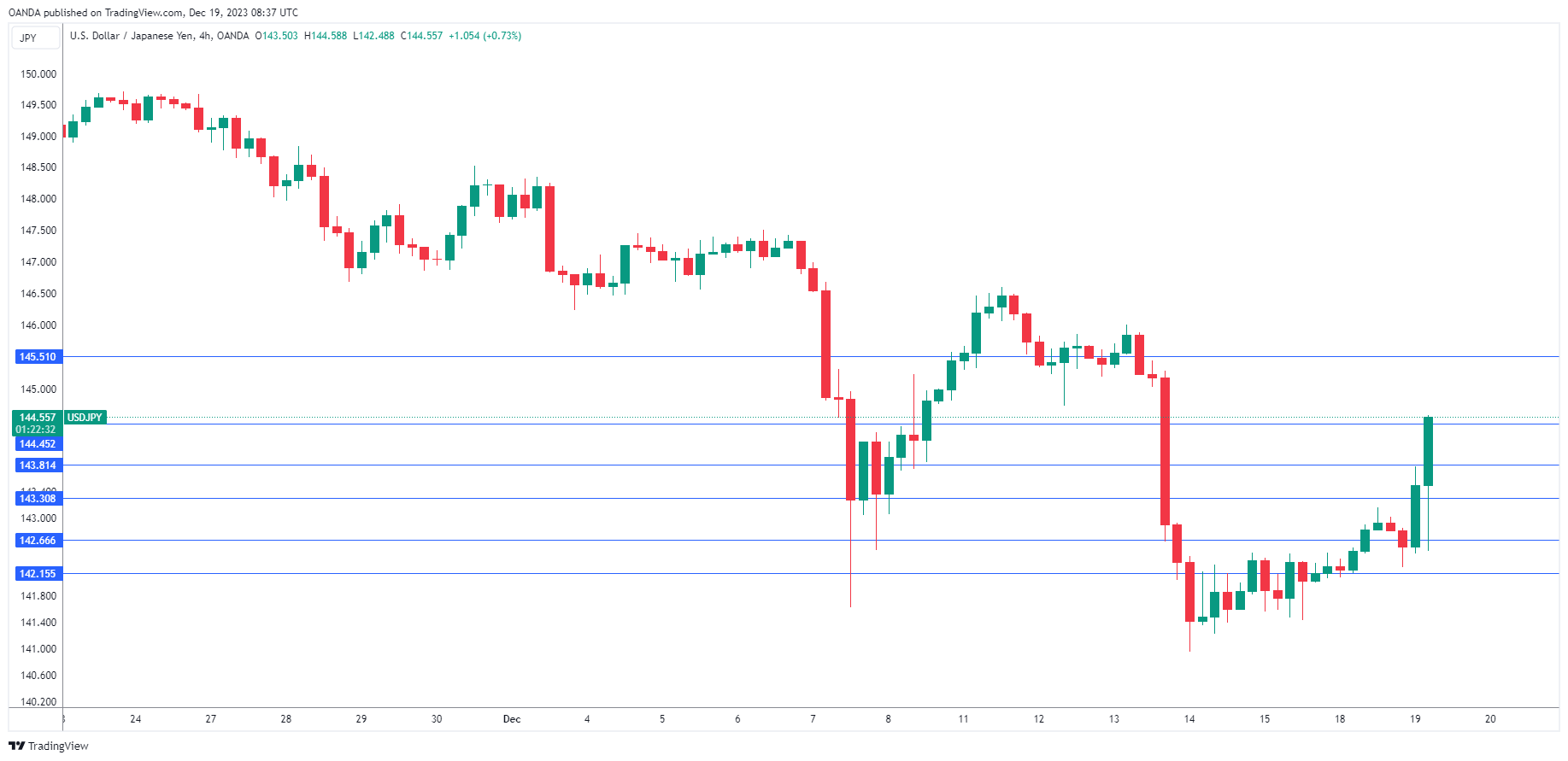
Daily Pivots: (S1) 142.15; (P) 142.66; (R1) 143.30; More...
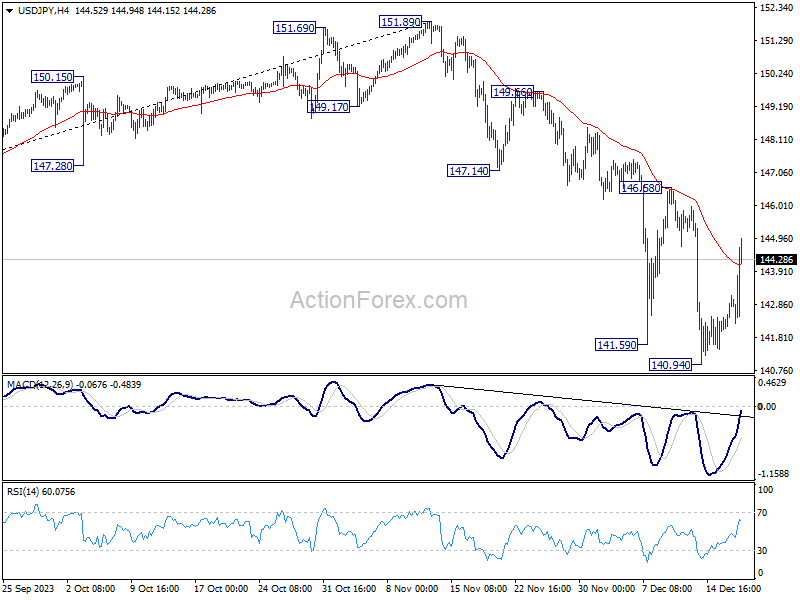
No change in USD/JPY for now despite today's strong recovery. Upside should be limited below 156.48 resistance to bring another decline. Firm break of 140.94 will resume the whole fall from 151.89. Next target will be next fibonacci level at 136.63.
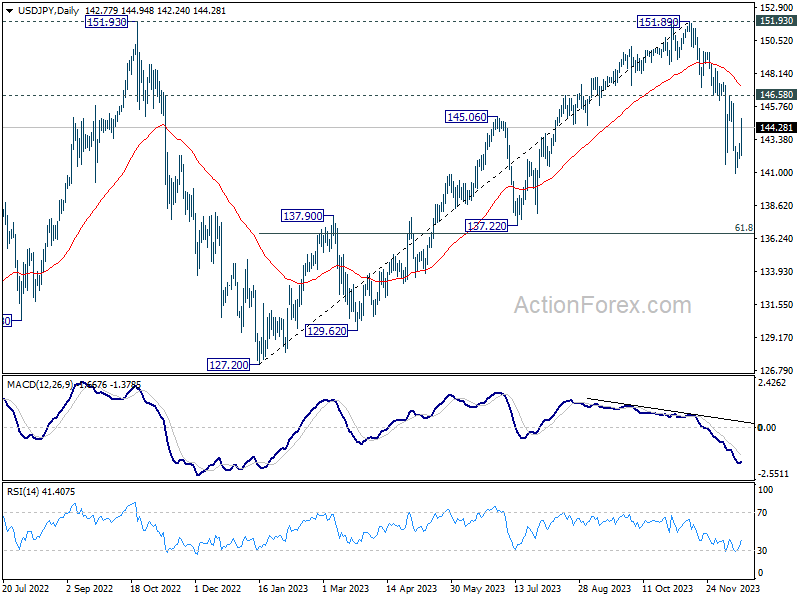
In the bigger picture, fall from 151.89 is seen as the third leg of the corrective pattern from 151.93 (2022 high). Deeper decline would be seen to 61.8% retracement of 127.20 to 151.89 at 136.63, sustained break there will pave the way to 127.20 support (2022 low). This will now remain the favored as long as 146.58 resistance holds.
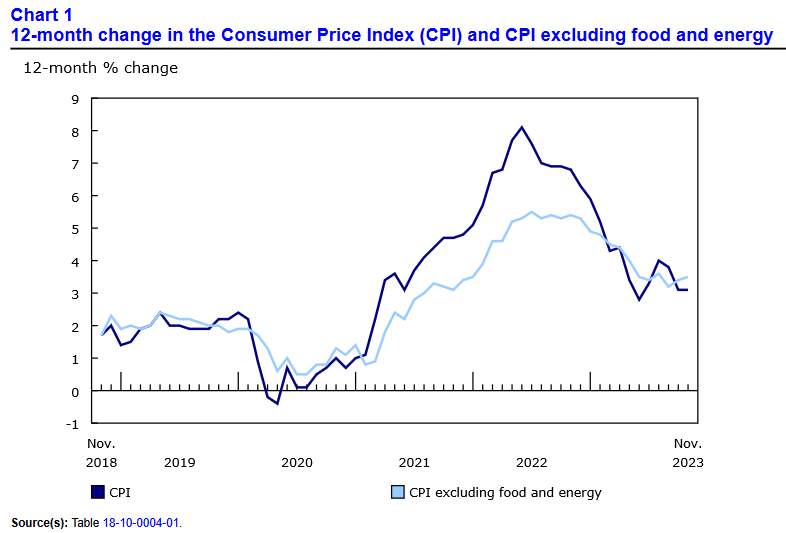
Canada CPI unchanged at 3.1% yoy in Nov, vs exp 2.9% yoy
Canada CPI was unchanged at 3.1% yoy in November, above expectation of 2.9% yoy. Higher prices for travel tours put upward pressure on CPI. Offsetting the upward pressure was slower price growth for food alongside lower prices for cellular services and fuel oil. Excluding food and energy, CPI accelerated from 3.4% yoy to 3.5% yoy.
CPI median was unchanged at 3.% yoy, above expectation of 3.3% yoy. CPI trimmed was unchanged at 3.5% yoy, above expectation of 3.4% yoy. CPI common slowed from 4.2% yoy to 3.9% yoy, below expectation of 4.0% yoy.
BoE’s Breeden focuses on inflationary persistence for future policy
BoE Deputy Governor Sarah Breeden acknowledged in a speech that the UK economy is making strides towards bringing inflation back to the BoE's 2% target, but emphasized that "our job isn't done."
Breeden expressed a focused concern on the persistence of inflationary pressures, highlighting a key area of the BoE's attention: "The question I am focused on is whether there is evidence of more persistent inflationary pressures which means we may need to tighten further."
Emphasizing the need for a sustained restrictive monetary policy, Breeden stated, "Regardless, monetary policy still needs to be restrictive for an extended period of time to keep pushing down on inflation and to return it sustainably to target."
Breeden also highlighted the importance of utilizing a diverse range of data sources to gauge the economy's trajectory. She mentioned using "soft data, such as surveys, as well as real-world conversations with businesses and others," to inform her assessment of economic trends.
USD/JPY: Strong Acceleration After Dovish BoJ Deflated Yen
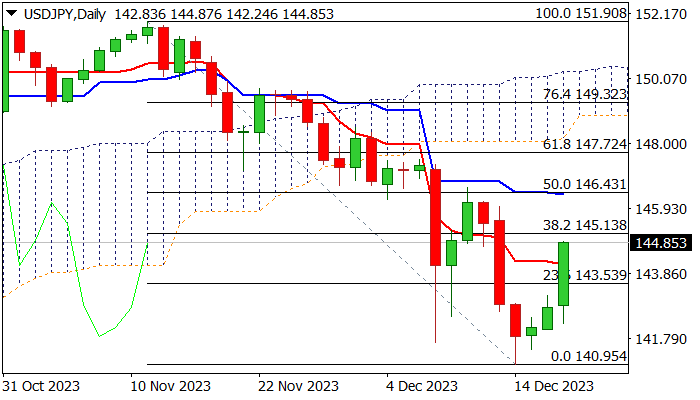
USDJPY was sharply up during the late Asian/European session on Tuesday (up 1.3% so far) in strong acceleration after dovish Bank of Japan deflated yen.
The central bank kept its ultra-loose monetary policy unchanged and maintained forward guidance, disappointing those who expected signals about the start of tightening cycle.
The pair is in near-term recovery for the third straight day, with today’s advance bring the biggest since Oct 31 and contributing to positive outlook.
Fresh bulls broke above daily Tenkan-sen (144.14) and pressuring pivotal Fibo barrier at 145.13 (38.2% retracement of 151.90/140.95).
Daily close above Tenkan-sen to validate recovery, with firm break above 145.13 to generate reversal signal and expose next key barriers at 146.50 zone (50% retracement / daily Kijun-sen/Dec 11 lower top).
Daily studies are improving, though caution is still required as 14-d momentum indicator is still in negative territory.
Res: 145.13; 145.99; 146.43; 146.58.
Sup: 144.14; 143.53; 142.60; 142.06.
Eurozone CPI finalized at 2.4%, core at 3.6%
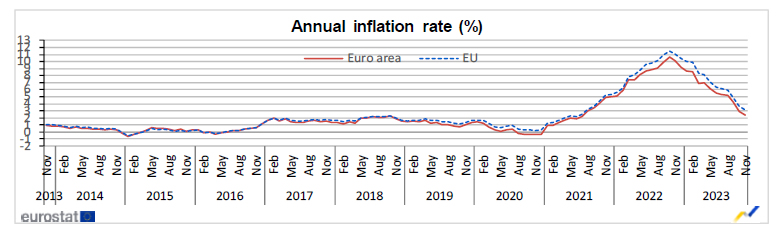
Eurozone CPI was finalized at 2.4% yoy in November, down from October's 2.9% yoy. CPI core (excluding energy, food, alcohol & tobacco) was finalized at 3.6% yoy , down from prior month's 4.2% yoy. The highest contribution came from services (+1.69 percentage points, pp), followed by food, alcohol & tobacco (+1.37 pp), non-energy industrial goods (+0.75 pp) and energy (-1.41 pp).
EU CPI was finalized at 3.1% yoy, down from prior month's 3.6% yoy. The lowest annual rates were registered in Belgium (-0.8%), Denmark (0.3%) and Italy (0.6%). The highest annual rates were recorded in Czechia (8.0%), Hungary (7.7%), Slovakia and Romania (both 6.9%). Compared with October, annual inflation fell in twenty-one Member States, remained stable in three and rose in three.
EURJPY Retraces Higher as 200-day Holds Ground
- EURJPY falls sharply but the 200-day SMA acts as a strong floor
- Repeated failure to violate the latter triggers an upward spike
- Momentum indicators improve, but remain in negative zones
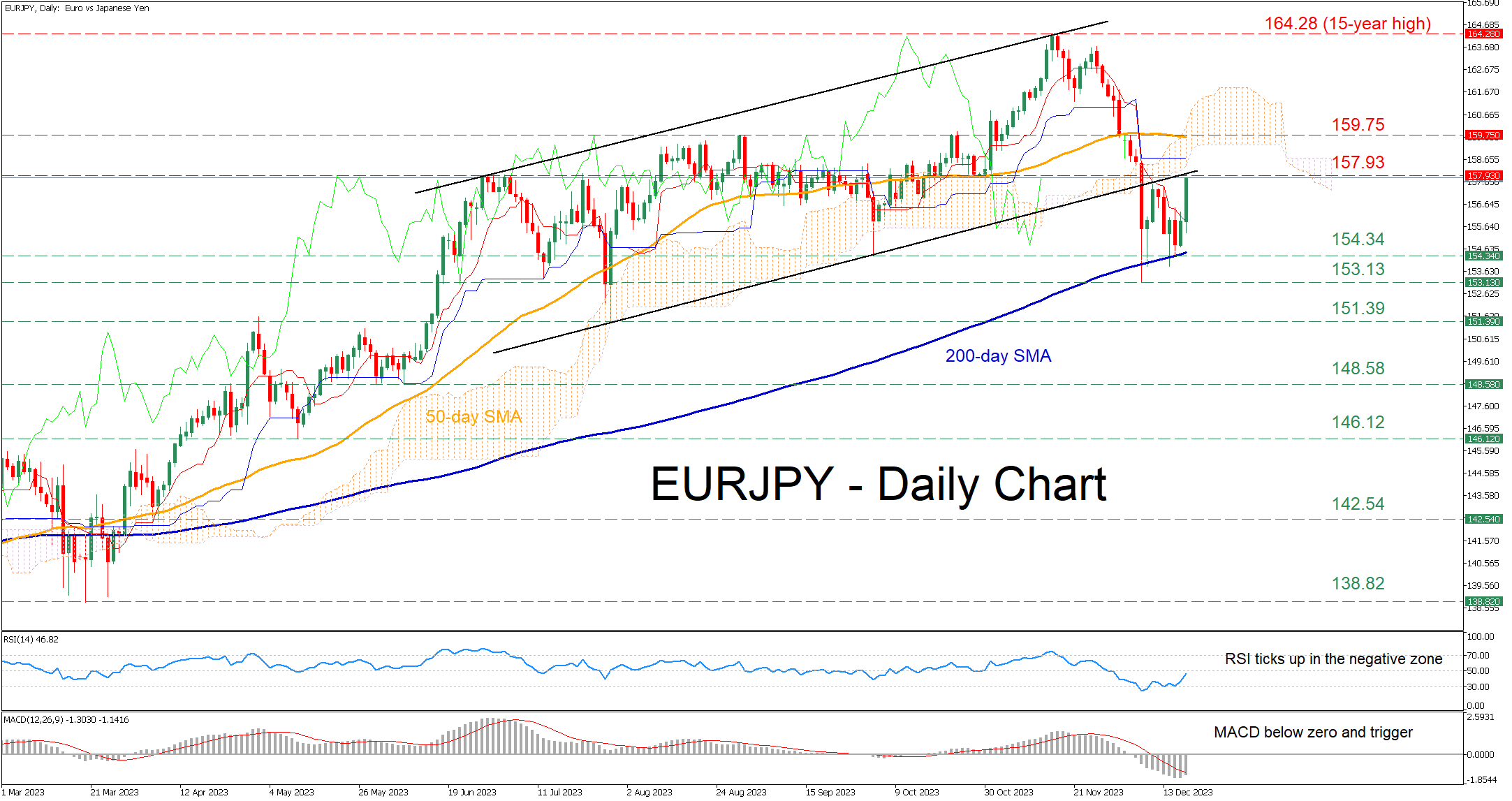
EURJPY had been experiencing a steep pullback from its recent 15-year peak of 164.28, which ceased at the crucial 200-day simple moving average (SMA). In today’s session, the pair has gained significant ground in its attempt to erase the recent correction.
Should buying pressures intensify further, the June-July resistance of 157.93 could prove to be the first barricade for the bulls to claim. A break above that area could pave the way for the August resistance of 159.75, which overlaps with the 50-day SMA. Failing to halt there, the pair might revisit its 15-year high of 164.28.
On the flipside, if the pair reverses back lower, the congested region that includes the 200-day SMA and the October-December support of 154.34 could act as the first line of defence. Sliding beneath that floor, the price may test its December bottom of 153.13, which is also its lowest level in four months. Further retreats could cease around the July low of 151.39.
In brief, EURJPY managed to pause its short-term selloff with some help from the 200-day SMA. However, for the bulls to regain confidence, the price has to reclaim the 157.93 hurdle.
USDCAD Forms Bullish Double Bottom
- USDCAD creates bullish formation after sharp decline
- A close above 1.3400 could boost buying sentiment
- Canadian CPI figures for November due at 13:30 GMT
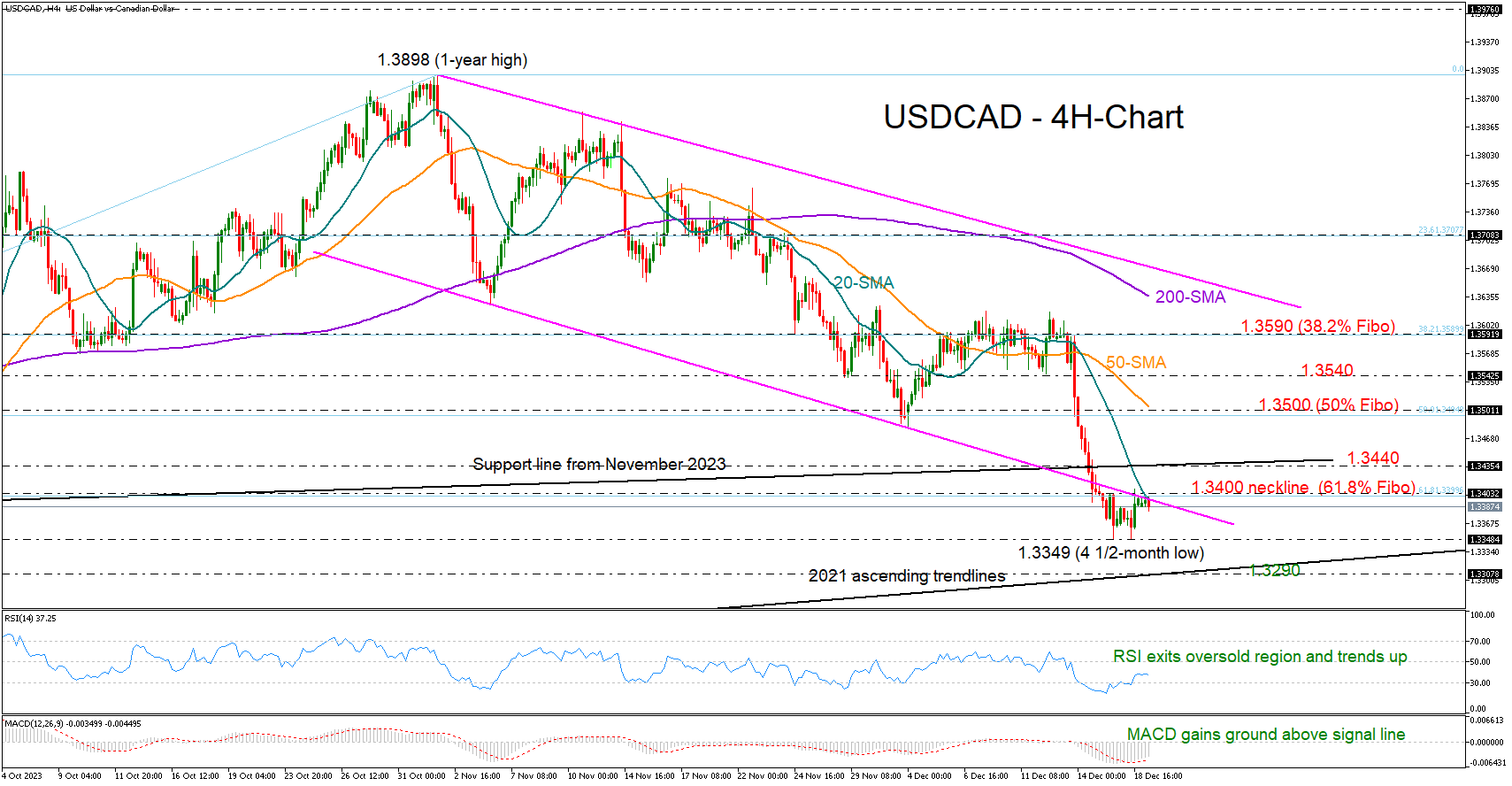
USDCAD entered a range trade following the slump to a four-and-a-half month low of 1.3349 last Friday. In the four-hour chart, the ongoing sideways move seems to have taken the shape of a bullish double bottom pattern, increasing optimism the pair might soon change direction to the upside.
In other encouraging signals, the RSI has bounced off oversold levels and keeps trending northwards, reflecting a positive bias. Likewise, the MACD continues to gain ground above its red signal line, suggesting that upside forces could persist in the short-term.
Technically though, the positive formation needs a confirmation above the neckline at 1.3400 and above the 20-period simple moving average (SMA). The 61.8% Fibonacci retracement of the July-November uptrend is placed in the same region. Should the pair step above that bar, it could accelerate towards the 1.3480-1.3500 region, unless the constraining line from November 2023 halts the recovery at 1.3435. A continuation above 1.3540 could last till the 38.2% Fibonacci of 1.3590.
In the event the 1.3400 mark stands firm, the pair could retest its recent lows around 1.3349. The 1.3300 round-level, which overlaps with the 2021 ascending trendline, could be another important region to watch before the spotlight falls on the 78.6% Fibonacci number of 1.3265.
Summing up, the technical picture is currently promoting a bullish trend reversal, but traders will need confirmation above 1.3400 to raise their buying orders.
US 500 Index Rallies to New Highs in 2023
- US 500 completes 8 green weeks
- Overall trend remains overwhelmingly positive
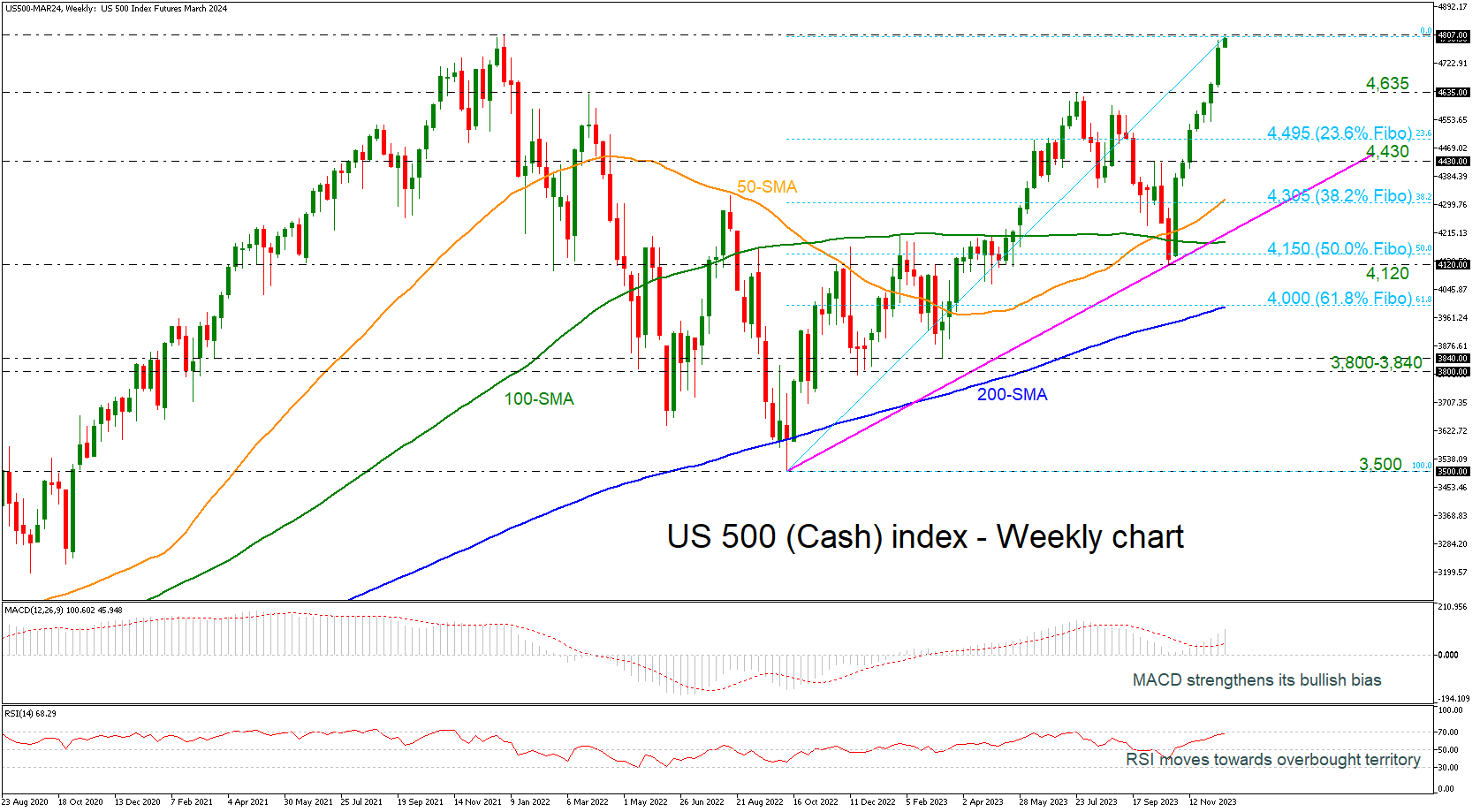
The US 500 cash index rose to its highest level of 4,801 in at least two years. The index is recording the eighth straight green week following the strong rebound off the ascending trend line and the 4,120 support level.
Weekly oscillators suggest that upside momentum is still gaining steam, reflecting the latest bullish rally in the market. The RSI has turned up and is ready to cross above the 70 level, while the MACD is extending its positive move above its trigger and zero lines.
If buyers maintain an upside rally and surpass the previous peak of 4,807, recorded in January 2022, it may push the price into uncharted territory and shift attention towards significant psychological levels, where traders may position their stop orders, potentially impeding further price increases. From this perspective, the key levels to monitor are 4,900 and 5,000.
Now should sellers take back control, the first obstacle to the downside might be the previous peak of 4,635, which has acted as strong resistance in recent months. If violated, the spotlight would then shift to the 23.6% Fibonacci retracement level of the upward move from 3,500 to 4,801 at 4,495. Beneath this line, the 4,430 inside swing high, taken from the peak on October 15, which overlaps with the 50-week simple moving average (SMA) would be tested ahead of the long-term uptrend line and the 100-week SMA at 4,190.
Summarizing, the long-term outlook remains clearly positive. A decisive break below the ascending trend line is needed to bring that into doubt, although a trend reversal would require much heavier declines than that.
Canadian Dollar Drifting Ahead of CPI Release
- Canada’s inflation rate expected to fall to 2.9%
- Fed members push back against rate cut expectations
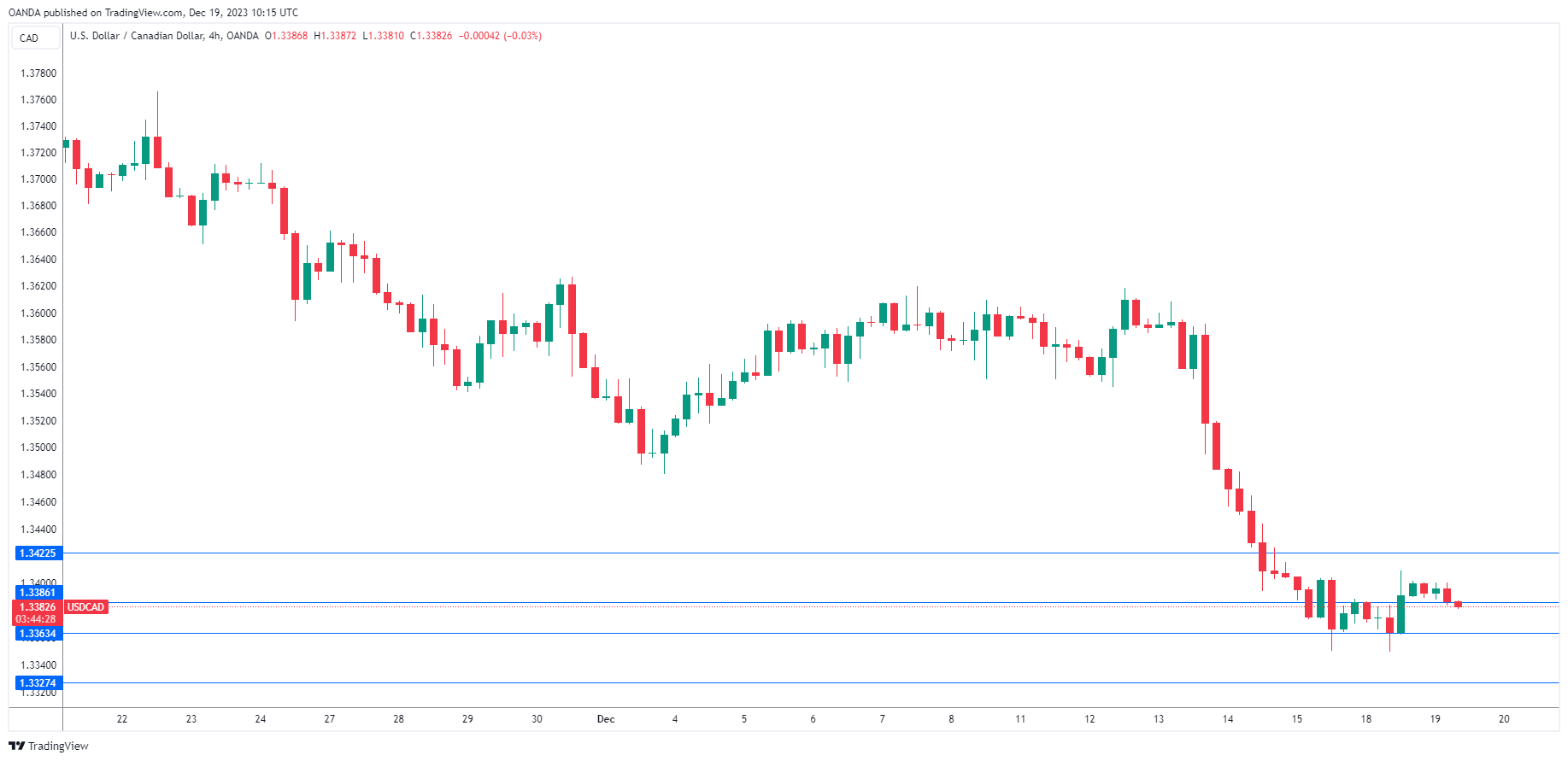
The Canadian dollar is showing little movement on Tuesday. In the European session, USD/CAD is trading at 1.3382, down 0.13%. We could see stronger movement from the Canadian dollar in the North American session, with the release of the Canadian inflation report.
Canadian inflation expected to ease to 2.9%
Canada releases the November inflation report later on Tuesday. In October, inflation dropped to 3.1% y/y, down sharply from 3.8%. The market consensus for November stands at 2.9%. Two key core inflation indicators are expected to ease to an average of 3.3%, down from an average of 3.5% in October.
A further drop in inflation would be an encouraging sign for the Bank of Canada, which has raised the cash rate to 5.0% but has paused three straight times. The BoC remained hawkish at the December meeting and kept the door open to additional rate hikes but the markets are convinced that the rate-tightening cycle is over and have priced in rate cuts next year, starting in mid-2024. A drop in the November inflation report would bolster expectations for rate cuts next year. If inflation surprises on the upside, it would bolster the Canadian dollar and force the BoC to continue pausing rates at restrictive levels (‘higher for lower’).
The US dollar has hit a rough patch since the Fed meeting last week when Fed Chair Powell penciled in three rate cuts next year. Traders are far more bullish and have priced in six rate hikes in 2024, starting in March.
We’re seeing some pushback from the Fed to dampen rate-cut fever in the markets. On Friday, New York Fed President John Williams said a rate cut in March was “premature” and even warned that rates could move higher if inflation were to stall or reverse. Cleveland Fed President Mester said on Monday that the markets are a “bit ahead” of the Fed on rate cuts, as the Fed was focused on how long it would need to maintain rates in restrictive territory, while the markets were focused on rate cuts.
USD/CAD Technical
- USD/CAD is testing support at 1.3363. Below, there is support at 1.3327
- There is resistance at 1.3386 and 1.3422
Japanese Yen Slides as BoJ Stands Pat
- BoJ makes no changes to policy or guidance
- Yen declines over 1%
The Japanese yen is sharply lower on Tuesday. In the European session, USD/JPY is trading at 144.42, up 1.15%. The yen surged 1.95% last week but has faltered and pared most of those gains this week.
BoJ maintains policy
Tuesday’s Bank of Japan meeting was a live meeting, as there was speculation that the central bank might make a move after some broad hints of tighter policy from senior Bank officials. In the end, the meeting was a non-event as even a tweak in language was not to be found, and disappointed market participants gave the yen a thumbs down.
The BoJ maintained its policy settings, but speculation is high that the central bank will tighten policy next year, at a time when the other major banks are loosening policy as inflation moves lower. Governor Ueda acknowledged that prices and wages are moving higher but said more time was needed to determine if a “positive wage-inflation cycle will fall in place”. Core inflation has remained above the 2% target for some 19 months, but the BoJ has argued that inflation has been driven by cost-push factors and is not sustainable. At a post-meeting press conference, Ueda rejected exiting from the Bank’s ultra-loose policy, saying that uncertainty over the outlook is “extremely high”.
The markets have been exuberant since the Fed meeting last week when Fed Chair Powell penciled in three rate cuts next year. Traders are far more bullish and are betting on six rate hikes in 2024, starting in March.
We’re seeing some pushback from the Fed to reign in market expectations. On Friday, New York Fed President John Williams said a rate cut in March was “premature” and even warned that rates could move higher if inflation were to stall or reverse. Cleveland Fed President Mester said on Monday that the markets are a “bit ahead” of the Fed on rate cuts, as the Fed was focused on how long it would need to maintain rates in restrictive territory, while the markets were focused on rate cuts.
USD/JPY Technical
- USD/JPY has pushed past resistance at 143.30 and 143.81 and is testing resistance at 144.45. Above, there is resistance at 145.51
- There is support at 142.66 and 142.15