Sample Category Title
CHFJPY Wave Analysis
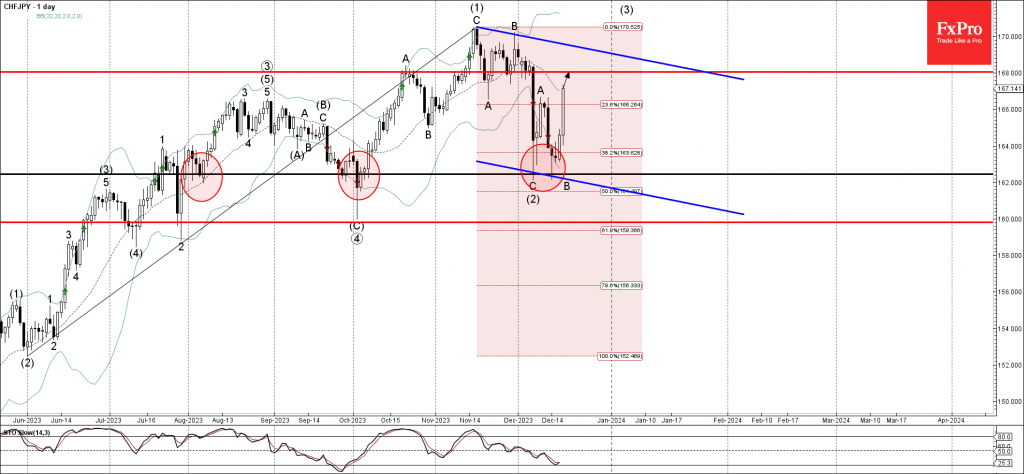
- CHFJPY reversed from support level 162.45
- Likely to rise to resistance level 168.00
CHFJPY currency pair recently reversed up from the key support level 162.45 (which has been reversing the price from August).
The support level 162.45 was strengthened by the lower daily Bollinger Band, support trendline of the daily down channel from November and the 38.2% Fibonacci correction of the upward impulse from June.
Given the prevailing uptrend, CHFJPY can be expected to rise further to the next resistance level 168.00 (former support from November).
USDCAD Wave Analysis
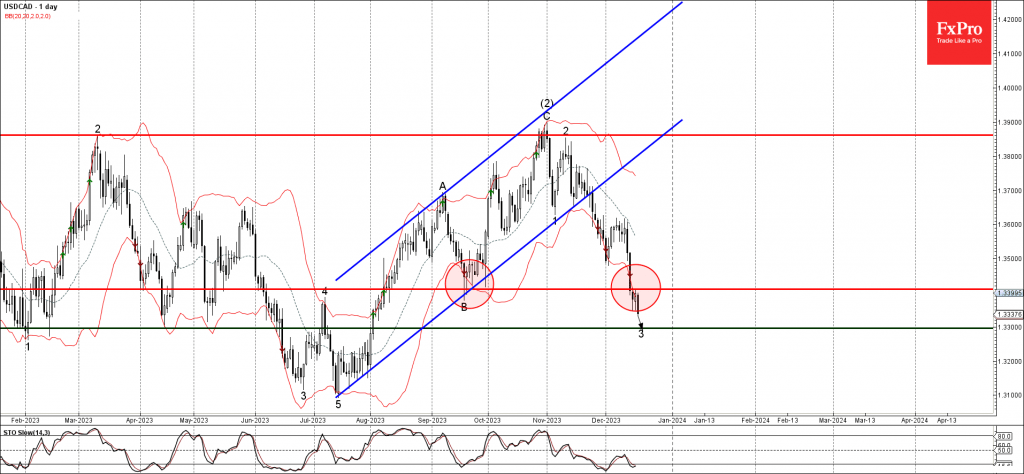
- USDCAD broke support level 1.3410
- Likely to fall to support level 1.3300
USDCAD currency pair under the bearish pressure after the pair broke the support level 1.3410 (low of wave B of the previous ABC correction (2) from the middle of July).
The breakout of the support level 1.3410 accelerated the active short-term impulse wave 3 of the higher impulse wave (3) from October.
USDCAD can be expected to fall further to the next support level 1.3300 (target price for the completion of the active impulse wave 3).
Will UK CPI Please the Market Ahead of Festive Break?
- Market recovering from Thursday’s relatively hawkish show by the BoE
- Pound would benefit against the euro from an upside CPI surprise
- November inflation report will be released on Wednesday (07.00 GMT)
A surprisingly hawkish BoE last week
Contrary to market expectations and the Fed setting the scene for a dovish round of central bank gatherings, the Bank of England did not pivot at last week’s meeting. Somewhat surprisingly, three BoE members continue to vote for another 25bps rate hike and thus influencing the overall rhetoric of the accompanying statement.
There was no press conference, but Governor Bailey’s post-meeting comments were supposed to be a cold shower for the ballooning market expectations for rate cuts. However, the market appears to have set its mind as 110bps of easing are expected by the BoE in 2024, considerably less than the 150bps of rate cuts anticipated by the neighbouring ECB, and despite similar efforts from ECB members to dent the market’s aggressive rate cut hopes.
Data releases continue to matter
This situation is unlikely to change soon unless data turns negative very quickly. Therefore, data releases still hold all the cards. Last week finished on a mixed note as the stronger Services PMI was overshadowed by the weaker Manufacturing PMI survey. The latter was not completely unexpected as there is continued weakness in the sector as confirmed by the recent manufacturing production data. We also have to include the impact of the recent political cabinet reshuffle - investment-hungry sectors like manufacturing dislike political uncertainty – and the weaker growth sentiment seen in the euro area.
Moving to this week and the November inflation report is the key event. We have to acknowledge that since the next BoE meeting will be held on February 1, which will include the quarterly Monetary Policy Report, there will be another inflation report in mid-January 2024. Having said that, every data point matters, especially in the current period of lower liquidity as we are getting very close to the festive period.
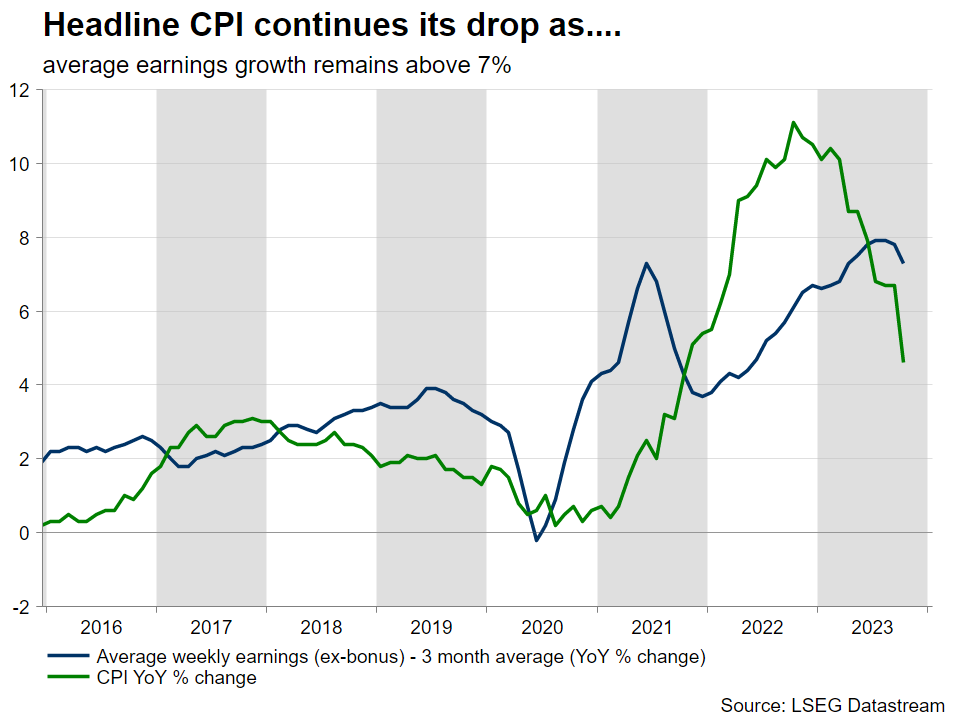
The headline CPI is forecast to slow further to a 4.4% year-on-year growth, while the core indicator is also expected to edge lower to 5.5%. These inflation levels are clearly not associated with a central bank assumed to be on the brink of embarking on an aggressive easing campaign unless growth falls off a cliff. The final GDP print for the third quarter of 2023 will be published on Friday but it is unlikely to have market impact and would be treated as “old news”.
Adding to the hawkish evidence and with average earnings growth remaining north of 7%, retail sales are expected to improve from low levels. This trend will probably persist during the traditionally spending-heavy festive period. In this context, on Friday, the November print for retail sales is expected to show a -1.8% year-on-year growth with the improvement possibly being stronger in the retail sales ex-fuel indicator.
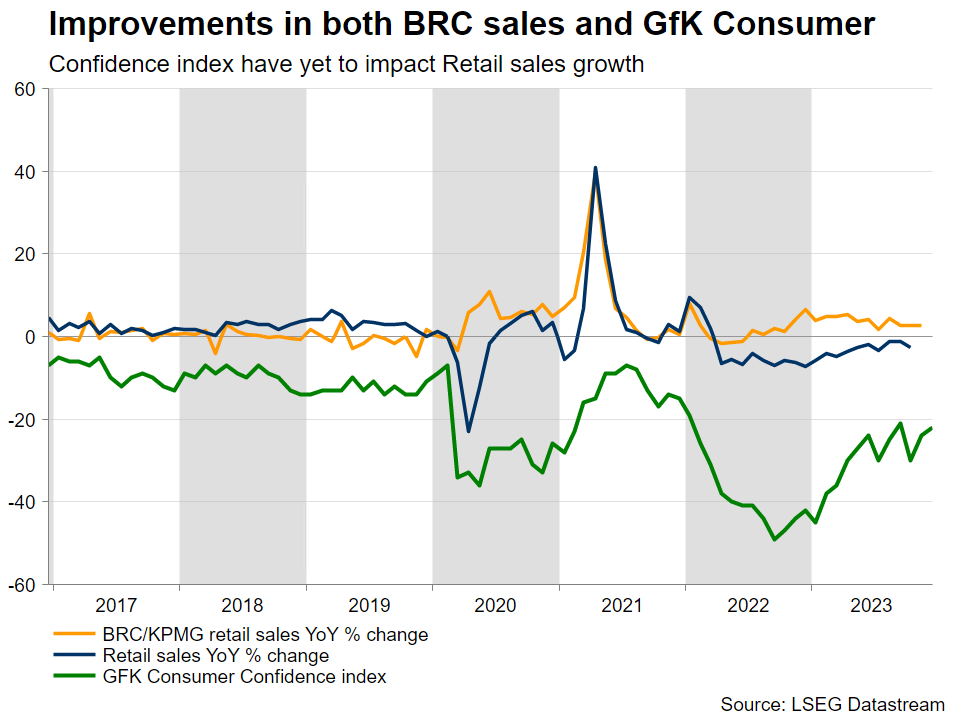
Pound could benefit from a stronger inflation report
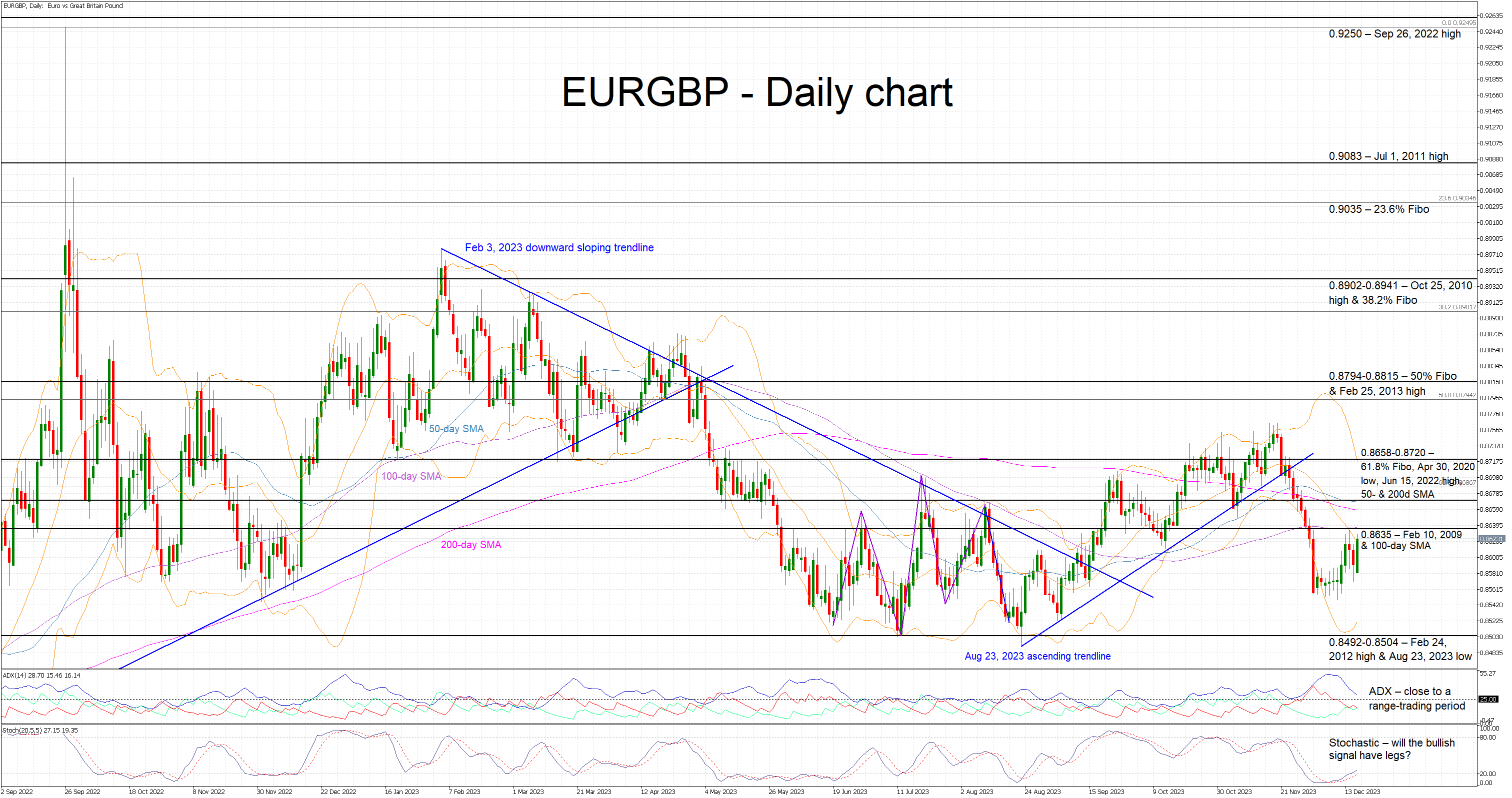
On the back of the aggressive build-up of rate cut expectations by the ECB, the pound managed to outperform the euro since mid-November, pushing the euro/pound pair to a new 3-month low. However, this outperformance appears to have run out of gas following the unexpected hawkishness exhibited by the ECB at last week’s meeting.
Focusing on this week and another small downside surprise in the UK inflation report could open the door for a more protracted move higher towards the busy 0.8658-0.8720 area. On the flip side, stronger inflation prints, especially in the case of the core CPI component, would somewhat unsettle market expectation, allowing the euro/pound pair to stage a move towards a new 3-month low, below the recent 0.8548 print.
Canada: Cloudy Signals on Inflation in November Have a Sliver Lining
Canadians aren't getting much relief on inflation for Christmas this year, with CPI inflation remaining at 3.1% on a year-on-year (y/y) basis in November.
For headline inflation, Statistics Canada cited that higher prices for travel tours (+26.1% y/y,) due to events held in destination cities in the U.S. (potentially due to Formula 1 in Vegas) offset slower price growth for food and declines for cellular services (-22.6% y/y), and fuel oil.
Food inflation slowed to 5% y/y in November from 5.6% in October. That is the fifth consecutive month food inflation has slowed, but that is unlikely to be perceptible when people are buying their turkeys or potatoes.
Energy prices were down 5.7% y/y in November thanks to the temporary suspension of the federal carbon levy on fuel oil, which drove prices 23.6% lower than a year ago. While an increase in time of use rates for electricity in Ontario lifted electricity prices to 8.2% y/y versus 6.7% in October.
Services prices remained elevated in November, up 4.6% y/y in November, matching October's pace. The heavily weighted shelter component took a small step in the right direction, cooling to 5% y/y in November (vs. 5.6% in October).
The Bank of Canada's underlying inflation measures were unchanged at 3.5% for CPI trim, and 3.4% for CPI median. However, the news was better when you zero in on the three-month annualized pace, which have fallen to 2.3% for CPI median and 2.6% for CPI trim. This suggests the year-on-year pace of inflation should head lower over the coming months.
Key Implications
The Bank of Canada got a real mix in their inflation stocking this month. There were a few lumps of coal in the form of no progress on headline inflation, and continued strength in services inflation. But, when they dig down to the bottom of the toe there is a shiny bauble – that their preferred core inflation measures averaged just below 2 ½% on a annualized basis over the past three months, the slowest pace since the beginning of 2021.
Governor Macklem may be humming All I want for Christmas is two (percent), but he is going to need to wait a little longer for that gift. Canada's economy has cooled in recent months, and inflation is slowly feeling the chill. We expect weaker demand in the economy will gradually see inflation come down enough for the Bank of Canada to cut rates in the second quarter of next year (see our latest forecast).
Canadian CPI Boosts Loonie, Yet Overshadowed by Sterling’s Strength
Canadian Dollar jumps against US Dollar in early US session. The move is primarily attributed to Canada's CPI data, which came in stronger than anticipated, signaling persistent inflationary pressures. Despite this uptick, CAD is not leading the pack, as it faces stiff competition from others, including the buoyant Sterling. Pound's significant rise can be traced back to hawkish statements made by the new deputy governor of BoE. These comments have infused upward momentum into the currency, leading to its appreciation not just against Euro and Swiss Franc as well.
Concurrently, Japanese Yen's selloff intensified following BoJ Governor Kazuo Ueda's post-meeting press conference, which reaffirmed the central bank's dovish stance, and lacked any indications of a shift towards exit of ultra-loose monetary policy. Dollar finds itself as the second-worst performer, succumbing to a wave of selling pressure across various fronts. While Euro has managed to gain against the weaker Yen and Dollar, it still ranks as the third-worst performer of the day.
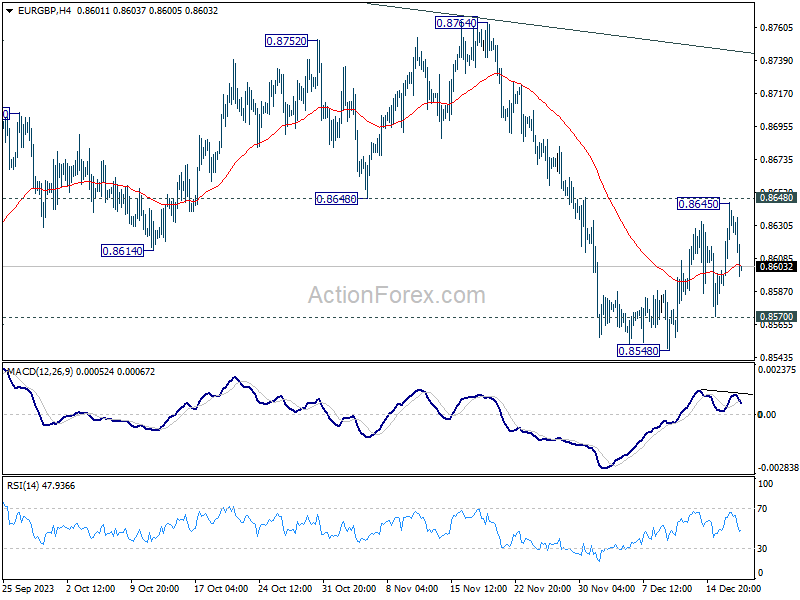
Technically, EUR/GBP's dip today raises the chance that recovery from 0.8548 has completed at 0.8645, after rejection by 0.8648 support turned resistance. Focus is back on 0.8570 minor support. Firm break there should push EUR/GBP through 0.8548 to resume the larger down trend. UK CPI data scheduled for tomorrow could be the trigger.
In Europe, at the time of writing, FTSE is up 0.06%. DAX is up 0.44%. CAC is down -0.02%. Germany 10-year yield is down -0.063 at 2.017. UK 10-year yield is down -0.032 at 3.664. Earlier in Asia, Nikkei rose 1.41%. Hong Kong HSI fell -0.75%. China Shanghai SSE rose 0.05%. Singapore Strait Times rose 0.11%. Japan 10-year JGB yield fell -0.0353 to 0.634.
Canada CPI unchanged at 3.1% yoy in Nov, vs exp 2.9% yoy
Canada CPI was unchanged at 3.1% yoy in November, above expectation of 2.9% yoy. Higher prices for travel tours put upward pressure on CPI. Offsetting the upward pressure was slower price growth for food alongside lower prices for cellular services and fuel oil. Excluding food and energy, CPI accelerated from 3.4% yoy to 3.5% yoy.
CPI median was unchanged at 3.% yoy, above expectation of 3.3% yoy. CPI trimmed was unchanged at 3.5% yoy, above expectation of 3.4% yoy. CPI common slowed from 4.2% yoy to 3.9% yoy, below expectation of 4.0% yoy.
BoE's Breeden focuses on inflationary persistence for future policy
BoE Deputy Governor Sarah Breeden acknowledged in a speech that the UK economy is making strides towards bringing inflation back to the BoE's 2% target, but emphasized that "our job isn't done."
Breeden expressed a focused concern on the persistence of inflationary pressures, highlighting a key area of the BoE's attention: "The question I am focused on is whether there is evidence of more persistent inflationary pressures which means we may need to tighten further."
Emphasizing the need for a sustained restrictive monetary policy, Breeden stated, "Regardless, monetary policy still needs to be restrictive for an extended period of time to keep pushing down on inflation and to return it sustainably to target."
Breeden also highlighted the importance of utilizing a diverse range of data sources to gauge the economy's trajectory. She mentioned using "soft data, such as surveys, as well as real-world conversations with businesses and others," to inform her assessment of economic trends.
Eurozone CPI finalized at 2.4%, core at 3.6%
Eurozone CPI was finalized at 2.4% yoy in November, down from October's 2.9% yoy. CPI core (excluding energy, food, alcohol & tobacco) was finalized at 3.6% yoy , down from prior month's 4.2% yoy. The highest contribution came from services (+1.69 percentage points, pp), followed by food, alcohol & tobacco (+1.37 pp), non-energy industrial goods (+0.75 pp) and energy (-1.41 pp).
EU CPI was finalized at 3.1% yoy, down from prior month's 3.6% yoy. The lowest annual rates were registered in Belgium (-0.8%), Denmark (0.3%) and Italy (0.6%). The highest annual rates were recorded in Czechia (8.0%), Hungary (7.7%), Slovakia and Romania (both 6.9%). Compared with October, annual inflation fell in twenty-one Member States, remained stable in three and rose in three.
BoJ holds steady despite speculation for tweaks
BoJ decided to maintain its monetary policy unchanged, a move that has come as a disappointment to some observers who anticipated minor policy changes or at least some alterations in the statement.
Under the Yield Curve Control framework, short-term policy interest rate remains at -0.1%. BoJ has also maintains its target for the 10-year JGB yield at approximately 0%, allowing for a cap of 1% for yield fluctuations. This decision was reached unanimously.
In addition, BoJ reiterated its commitment to an easing bias, stating it "will not hesitate to take additional easing measures if necessary."
Regarding Japan's economic outlook, BoJ expects a moderate ongoing recovery in the near term. However, it acknowledges downward pressures, primarily due to a slowdown in the recovery pace of overseas economies. Looking ahead, the central bank projects that as a positive cycle from income to spending strengthens, Japan's economy will continue to grow at a rate above its potential growth rate.
In terms of inflation, BoJ anticipates CPI core to remain above 2% through fiscal 2024. Underlying inflation is expected to "increase gradually toward achieving the price stability target."
BoJ Ueda's dovish press conference
Japanese Yen's decline gained momentum following dovish comments by BoJ Governor Kazuo Ueda in the post-meeting press conference. Ueda reaffirmed the central bank's readiness to take "additional easing steps if necessary," highlighting the "extremely high" level of uncertainty surrounding the economy.
Addressing the possibility of a policy adjustment in January meeting, Ueda downplayed the likelihood of an abrupt rate hike, stating, "I don't think the chance is high for us to say abruptly that we will hike rates at a subsequent meeting." He also mentioned that "we won't see much new data" to come before the meeting, except branch managers' meeting which will provide insights into regional economies.
Ueda spoke about various policy scenarios under consideration, recognizing the high degree of uncertainty in current economic forecasts. He noted the difficulty in outlining a clear exit strategy from the ultra-loose monetary policy due to the unpredictability of achieving sustainable and stable inflation at the target level. Ueda assured that once the BoJ foresees conditions aligning with their targets, more information will be disclosed.
RBA considered hike and hold, Dec minutes show
Minutes of RBA's December 5 meeting revealed that both a 25bps hike and maintaining the status quo were considered. Ultimately, they opted to keep the interest rate unchanged at 4.35%. The rationale behind this decision was the perceived value in "waiting for further data to assess how the balance of risks was evolving and how best to balance these risks when setting policy."
The board members concurred that the need for additional monetary tightening to ensure inflation returns to the target within a reasonable timeframe would be contingent on how incoming data influences the economic outlook and the assessment of risks.
The RBA emphasized its commitment to closely monitoring various economic indicators in its future policy decisions. This includes developments in the global economy, trends in domestic demand, and the outlook for inflation and the labor market.
NZ ANZ business confidence improved to 33.2, with mixed inflation signals
New Zealand's ANZ Business Confidence climbed from 30.8 to 33.2 in December. Looking into the specifics, own activity outlook improved from 26.3 to 29.3, indicating positive sentiment about future business conditions. However, investment intentions dropped from 4.5 to 2.7, suggesting some hesitancy in capital expenditures. Employment intentions rose from 5.4 to 7.0, reflecting moderately stronger inclination towards hiring.
In terms of pricing, there was a noticeable increase, with pricing intentions moving from 46.8 to 50.2. This rise implies that more businesses are planning to increase their prices, which could contribute to inflationary pressures. Similarly, cost expectations saw an upward movement from 73.9 to 76.2, indicating rising costs for businesses. On the other hand, inflation expectations showed a decline from 4.79% to 4.61%.
ANZ commented on the mixed nature of the inflation indicators, as they do not present an encouraging outlook for inflation. With more data expected before RBNZ's February decision, this survey's results might not be among the most favorable. While recent GDP data showed RBNZ's measures gaining more traction than previously understood, the extent of economic downturn required to bring inflation down to the 2% target remains an unresolved question.
New Zealand's trade deficit narrows to NZD -1.2B, led by decreased trade with china
New Zealand's goods trade deficit narrowed from NZD 1.7B to NZD 1.2B in November, aligning largely with market expectations. Exports fell by NZD 337m, representing -5.3% yoy decline, settling at NZD 6.0B. Meanwhile, imports saw a more substantial reduction of NZD 1.3B, -15% yoy decrease, totaling NZD 7.2B.
A key factor in these changes is reduced trade volume with China, which led contraction in both imports and exports. Exports to China decreased by NZD 183m, -9.7% yoy fall. Imports from China also saw a substantial reduction of NZD 347m, marking -17% yoy decrease.
Other key trading partners also showed varied trends. Exports to Australia and EU declined by NZD 35m (-4.5% yoy) and NZD 27m (-9.1% yoy), respectively. Conversely, exports to US increased by NZD 110m, a significant 18% yoy rise. Exports to Japan experienced a sharp decline of NZD 99m, -27% yoy drop.
In the realm of imports, alongside China, EU, Australia, US, and South Korea all registered declines. Imports from the EU decreased by NZD 164m (-14% yoy), from Australia by NZD 219m (-23% yoy), from the US by NZD 68m (-11% yoy), and from South Korea by NZD 231m (-32% yoy).
USD/CAD Mid-Day Outlook
Daily Pivots: (S1) 1.3363; (P) 1.3386; (R1) 1.3422; More...
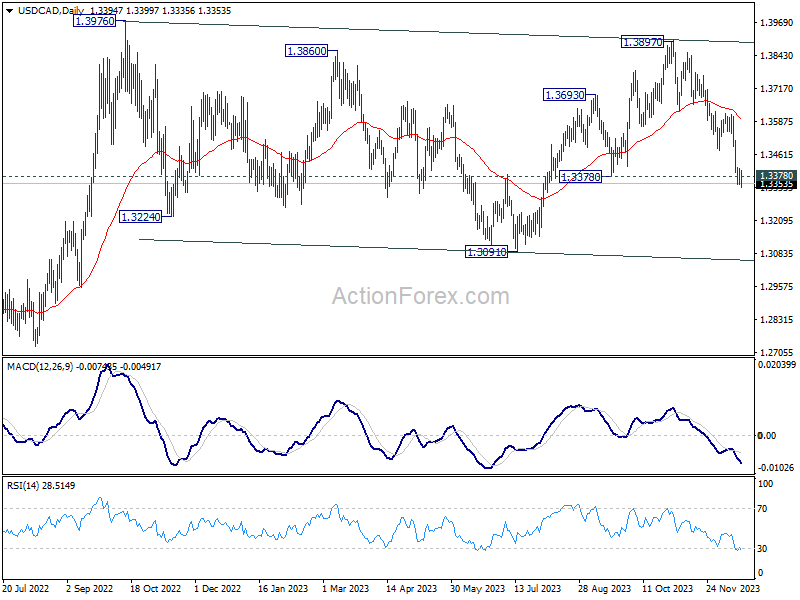
USD/CAD's decline is resuming by breaking 1.3348 temporary low. Intraday bias is back on the downside. Sustained trading below 1.3378 will extend the fall from 1.3897 to retest 1.3091 support next. On the upside above 1.3408 minor resistance will turn intraday bias neutral again. But risk will stay on the downside as long as 1.3479 support turned resistance holds.
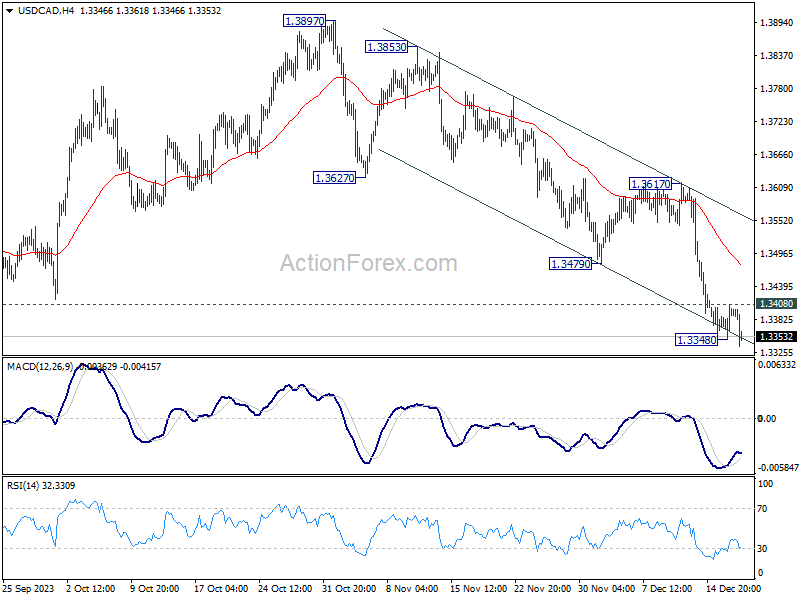
In the bigger picture, outlook is mixed up by deeper then expected fall from 1.3897. But after all, price actions from 1.3976 (2022 high) are viewed as a corrective pattern that's in progress. Larger up trend from 1.2005 (2021 low) is still expected to resume at a later stage as long as 1.2947 resistance turned support holds.
Economic Indicators Update
| GMT | Ccy | Events | Actual | Forecast | Previous | Revised |
|---|---|---|---|---|---|---|
| 21:45 | NZD | Trade Balance (NZD) Nov | -1234M | -1200M | -1709M | -1730M |
| 00:00 | NZD | ANZ Business Confidence Dec | 33.2 | 30.8 | ||
| 00:30 | AUD | RBA Meeting Minutes | ||||
| 02:49 | JPY | BoJ Interest Rate Decision | -0.10% | -0.10% | -0.10% | |
| 07:00 | CHF | Trade Balance (CHF) Nov | 3.71B | 3.50B | 4.60B | 4.71B |
| 10:00 | EUR | Eurozone CPI Y/Y Nov F | 2.40% | 2.40% | 2.40% | |
| 10:00 | EUR | Eurozone CPI Core Y/Y Nov F | 3.60% | 3.60% | 3.60% | |
| 13:30 | USD | Housing Starts Nov | 1.56M | 1.360M | 1.372M | 1.36M |
| 13:30 | USD | Building Permits Nov | 1.46M | 1.470M | 1.498M | 1.50M |
| 13:30 | CAD | Industrial Product Price M/M Nov | -0.40% | -0.70% | -1.00% | -0.90% |
| 13:30 | CAD | Raw Material Price Index Nov | -4.20% | -3.50% | -2.50% | -2.60% |
| 13:30 | CAD | CPI M/M Nov | 0.10% | -0.10% | 0.10% | |
| 13:30 | CAD | CPI Y/Y Nov | 3.10% | 2.90% | 3.10% | |
| 13:30 | CAD | CPI Median Y/Y Nov | 3.40% | 3.30% | 3.60% | 3.40% |
| 13:30 | CAD | CPI Trimmed Y/Y Nov | 3.50% | 3.40% | 3.50% | |
| 13:30 | CAD | CPI Common Y/Y Nov | 3.90% | 4.00% | 4.20% |
USD/CAD Mid-Day Outlook
Daily Pivots: (S1) 1.3363; (P) 1.3386; (R1) 1.3422; More...
USD/CAD's decline is resuming by breaking 1.3348 temporary low. Intraday bias is back on the downside. Sustained trading below 1.3378 will extend the fall from 1.3897 to retest 1.3091 support next. On the upside above 1.3408 minor resistance will turn intraday bias neutral again. But risk will stay on the downside as long as 1.3479 support turned resistance holds.
In the bigger picture, outlook is mixed up by deeper then expected fall from 1.3897. But after all, price actions from 1.3976 (2022 high) are viewed as a corrective pattern that's in progress. Larger up trend from 1.2005 (2021 low) is still expected to resume at a later stage as long as 1.2947 resistance turned support holds.
EUR/USD Mid-Day Outlook
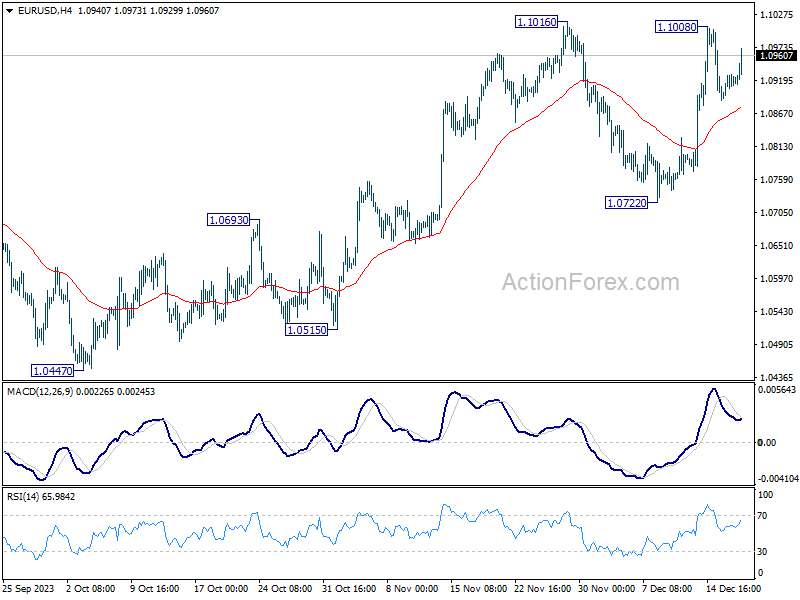
Daily Pivots: (S1) 1.0900; (P) 1.0916; (R1) 1.0939; More...
EUR/USD is staying below 1.1008/16 resistance zone despite today's rebound. Intraday bias remains neutral for the moment. Further rally is expected as long as 1.0722 support holds. On the upside, break of 1.1016 will resume the whole rise from 1.0447 to retest 1.1274 high.
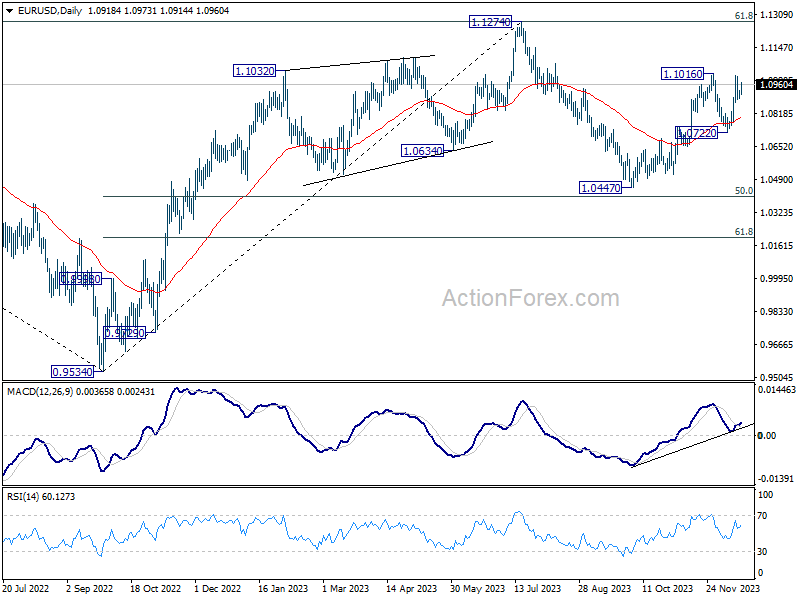
In the bigger picture, price actions from 1.1274 are viewed as a corrective pattern to rise from 0.9534 (2022 low). Rise from 1.0447 is seen as the second leg. While further rally could cannot be ruled out, upside should be limited by 1.1274 to bring the third leg of the pattern. Meanwhile, sustained break of 1.0722 support will argue that the third leg has already started for 1.0447 and below.
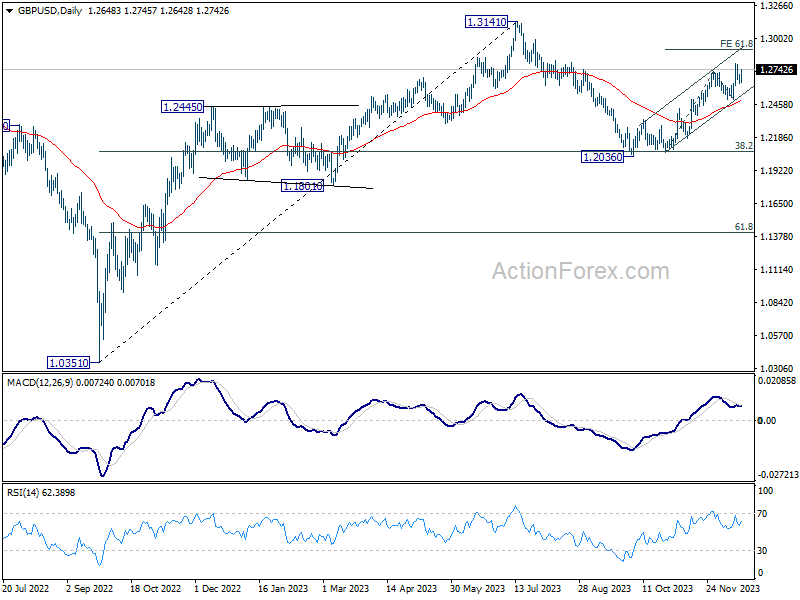
GBP/USD Mid-Day Outlook
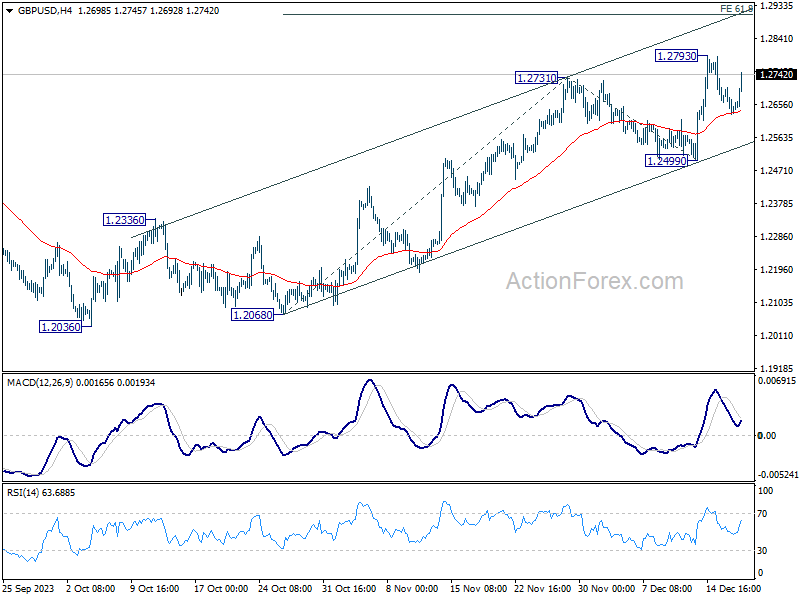
Daily Pivots: (S1) 1.2616; (P) 1.2660; (R1) 1.2691; More...
GBP/USD rebounds strongly today but stays below 1.2793 resistance. Intraday bias remains neutral first. Further rally is expected as long as 1.2499 support holds. On the upside, firm break of 1.2793 will resume the rally from 1.2036. Next target is 61.8% projection of 1.2068 to 1.2731 from 1.2499 at 1.2909.
In the bigger picture, price actions from 1.3141 medium term top are seen as a corrective pattern to rise from 1.0351 (2022 low). Rise from 1.2036 is seen as the second leg that's in progress. Upside should be limited by 1.3141 to bring the third leg of the pattern. Meanwhile, break of 1.2499 support will argue that the third leg has already started for 38.2% retracement of 1.0351 (2022 low) to 1.3141 at 1.2075 again.
USD/CHF Mid-Day Outlook
Daily Pivots: (S1) 0.8655; (P) 0.8683; (R1) 0.8700; More....
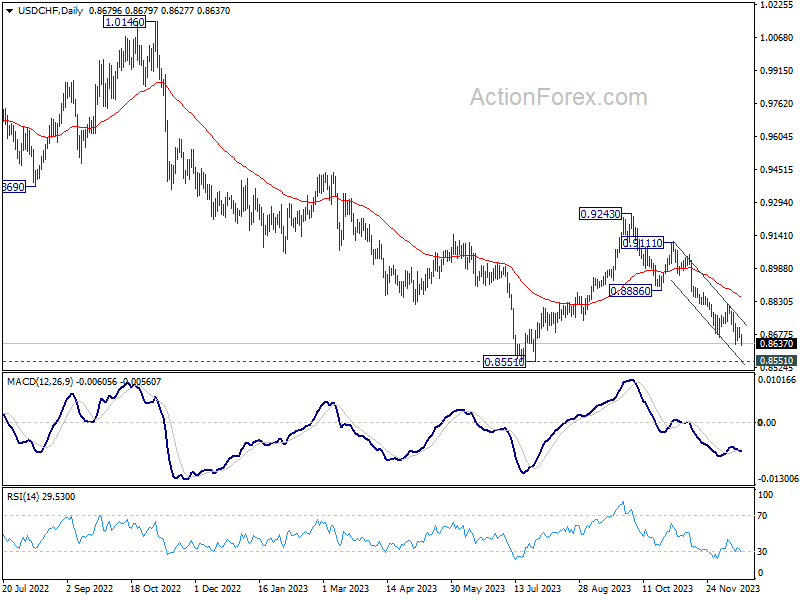
Break of 0.8629 support suggests that USD/CHF's decline is resuming. Intraday bias is back on the downside. Current fall from 0.9243 should target 0.8551 key support next. On the upside, above 0.8710 minor resistance will turn intraday bias neutral again first. But outlook will remain bearish as long as 0.8819 resistance holds.
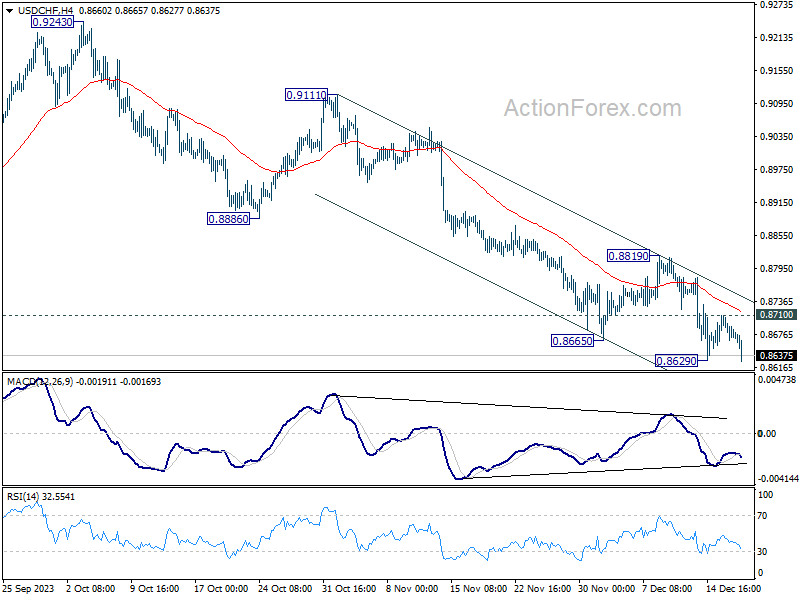
In the bigger picture, price actions from 0.8551 are currently seen as a corrective pattern to the decline from 1.0146 (2022 high). Fall from 0.9243 is seen as the second leg for now. Strong support should be seen 0.8551 to bring rebound. Meanwhile, break of 0.9111 resistance will argue that the third leg has started already, and target 0.9243.