

Sample Category Title
EUR/USD Daily Outlook
Daily Pivots: (S1) 1.0752; (P) 1.0820; (R1) 1.0947; More...
Intraday bias in EUR/USD stays on the upside at this point. Further rally should be seen to 61.8% retracement of 1.1274 to 1.0447 at 1.0958 next. On the downside, below 1.0824 minor support will turn intraday bias neutral and bring retreat first. But downside should be contained well above 1.0655 support to bring another rally.
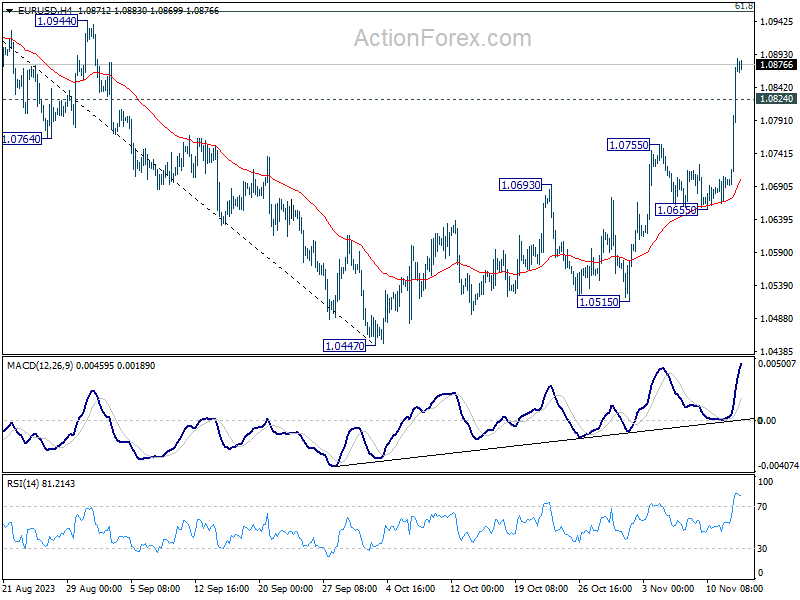
In the bigger picture, price actions from 1.1274 are viewed as a corrective pattern to rise from 0.9534 (2022 low). Rise from 1.0447 is tentatively seen as the second leg. Hence while further rally could be seen, upside should be limited by 1.1274 to bring the third leg of the pattern. However, break of 1.0447 will resume the fall to 61.8% retracement of 0.9543 to 1.1274 at 1.0199.
Technical Outlook and Review
DXY:
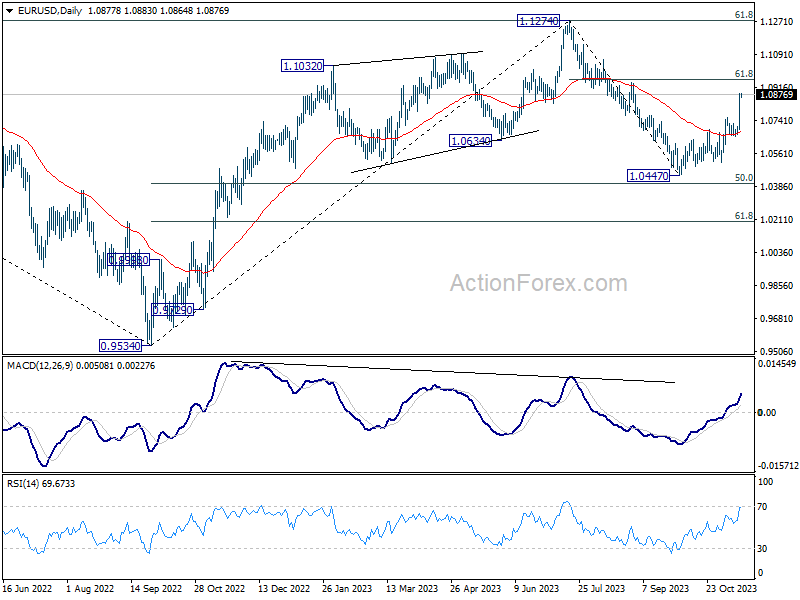
The current chart for DXY exhibits a bearish overall momentum, implying the likelihood of a bearish continuation, primarily targeting the 1st support level.
The 1st support level at 105.40 holds significance as it aligns with both an overlap support and the 50% Fibonacci Retracement level. This confluence indicates a substantial zone where we might witness a noteworthy influx of buyers or a pause in the prevailing bearish trend.
Supporting this, the 2nd support at 104.95 is identified as a multi-swing low support. This classification reinforces its credibility as a support level, signifying past instances where buying interest emerged, making it a key reference point.
On the flip side, we encounter the 1st resistance at 105.95, characterized as an overlap resistance and coinciding with the 50% Fibonacci Retracement level. This juncture suggests the potential for heightened selling interest, possibly serving as a hindrance to any substantial upward movement.
Additionally, the 2nd resistance at 106.46 is classified as a pullback resistance, signifying another noteworthy level where price action could encounter selling pressure as it continues its bearish momentum
EUR/USD:
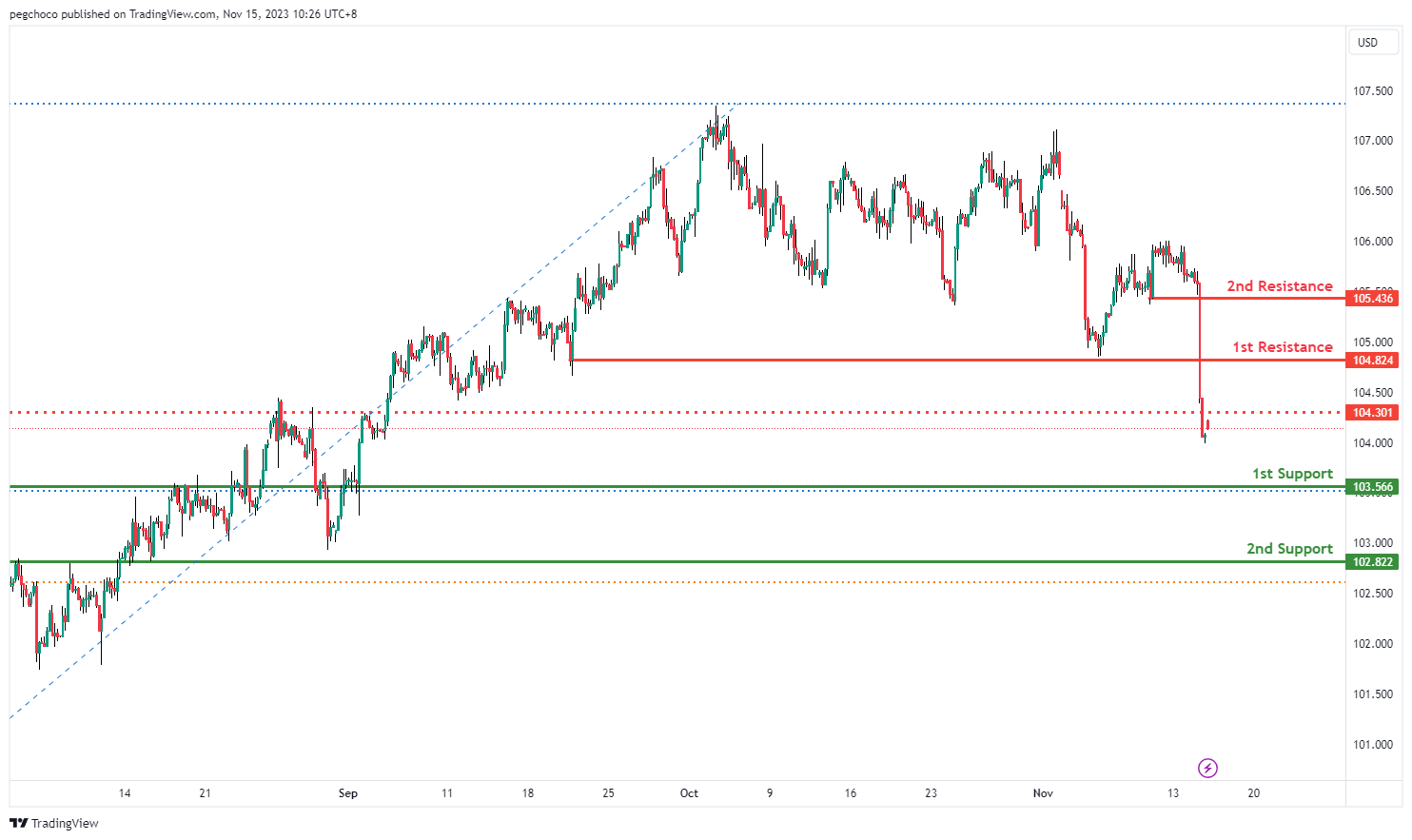
The EUR/USD chart currently exhibits a bullish overall momentum, but there is a short-term potential for a drop towards the 1st support level before a bounce that could lead to a rise towards the 1st resistance level.
The 1st support level at 1.0764 is considered a pullback support. This level is expected to provide a solid foundation for potential buyers, acting as a point of interest where the price may find support during any short-term decline.
Supporting this, the 2nd support at 1.0663 is identified as an overlap support. Overlap supports often carry significance as they indicate areas where price has previously found support, making them relevant levels to watch.
On the flip side, the 1st resistance at 1.0884 is characterized as a multi-swing high resistance. This level suggests a notable zone where selling interest may intensify, potentially serving as a barrier to further upward movement in the short term.
Additionally, the 2nd resistance at 1.0943 is categorized as a swing high resistance. This level adds another layer of resistance, indicating a point where the price could encounter increased selling pressure during its potential rise.
An intermediate support level at 1.0826 is also noted, serving as an additional pullback support. This level adds further reinforcement to the idea of a short-term drop followed by a potential bounce from the 1st support.
EUR/JPY:
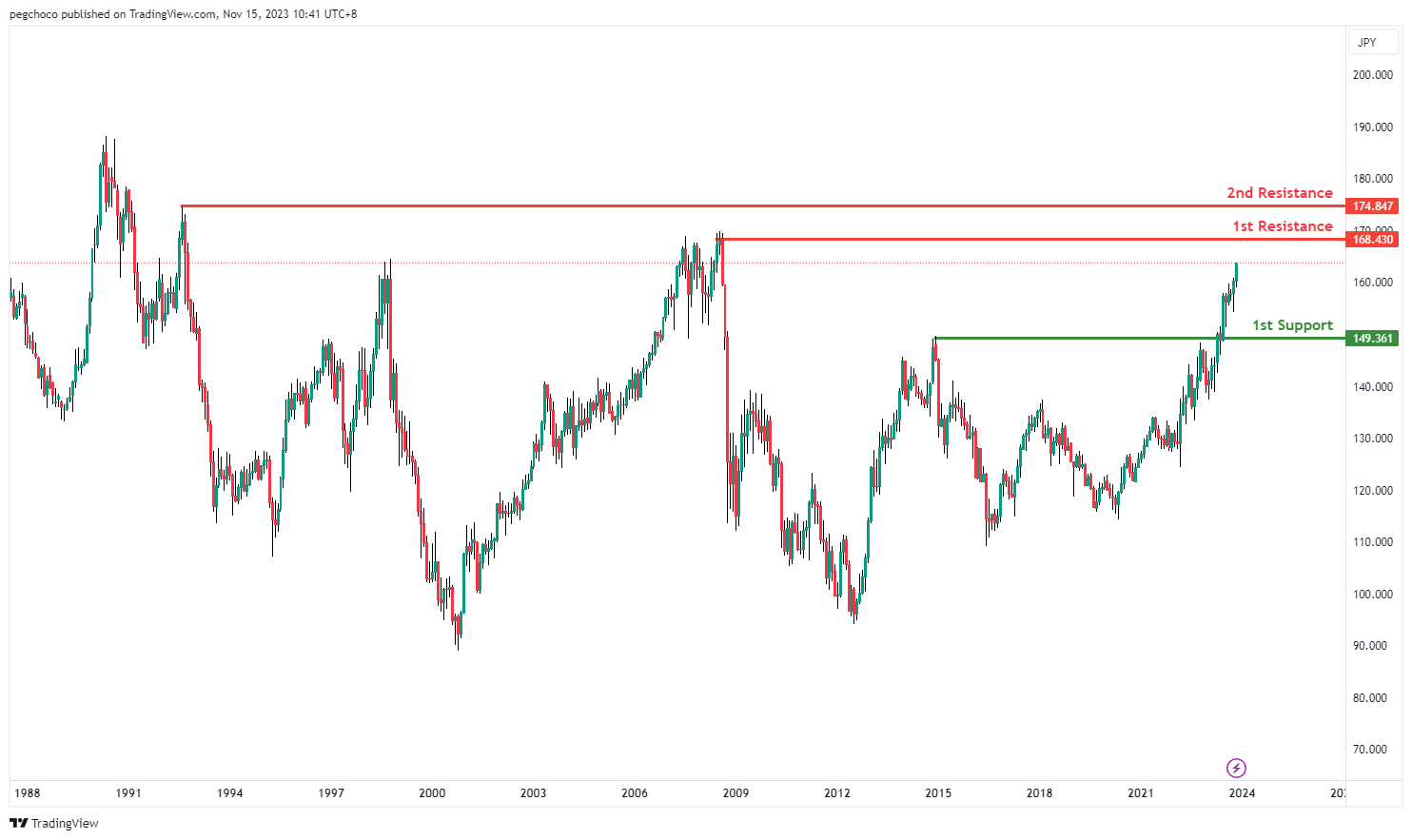
The EUR/JPY chart currently suggests a bullish momentum, suggesting a potential for price to make a bullish continuation towards the 1st resistance.
The 1st resistance level at 168.43 is identified as a swing-high resistance. Higher up, the 2nd resistance level at 174.85 is also noted as a swing-high resistance.
To the downside, the 1st support level at 149.36 is identified as a pullback support, potentially acting as a strong support area.
EUR/GBP:
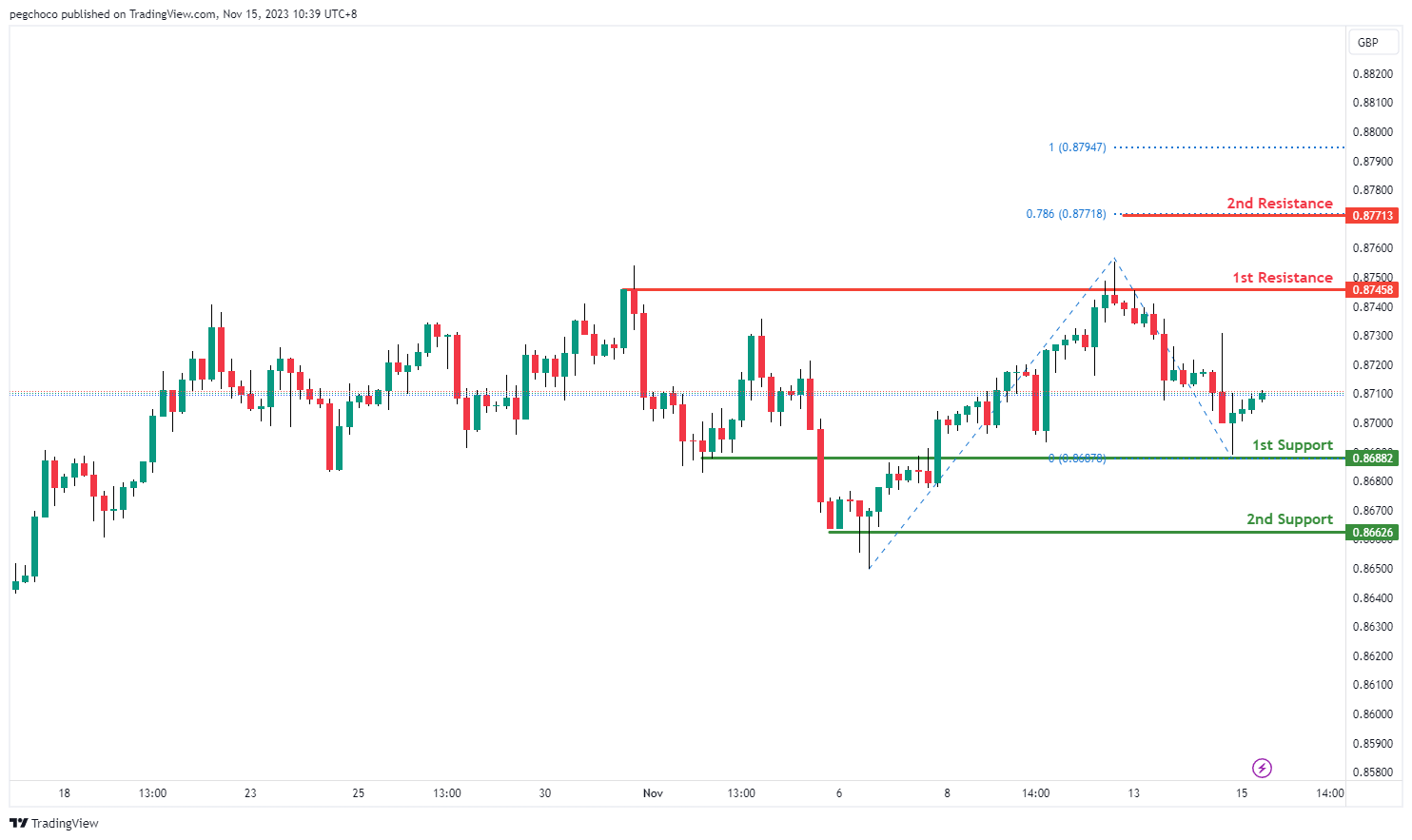
The EUR/GBP chart currently demonstrates a bullish momentum, suggesting a potential for price to make a bullish continuation towards the 1st resistance.
The 1st resistance level at 0.8746 is identified as a pullback resistance. Higher up, the 2nd resistance level at 0.8771 is noted as a resistance level that aligns witt the 78.60% Fibonacci projection level.
To the downside, the 1st support level at 0.8688 is identified as an overlap support. Additionally, the 2nd support level at 0.8663 is marked as a pullback support, reinforcing the potential strength of the support zone.
GBP/USD:
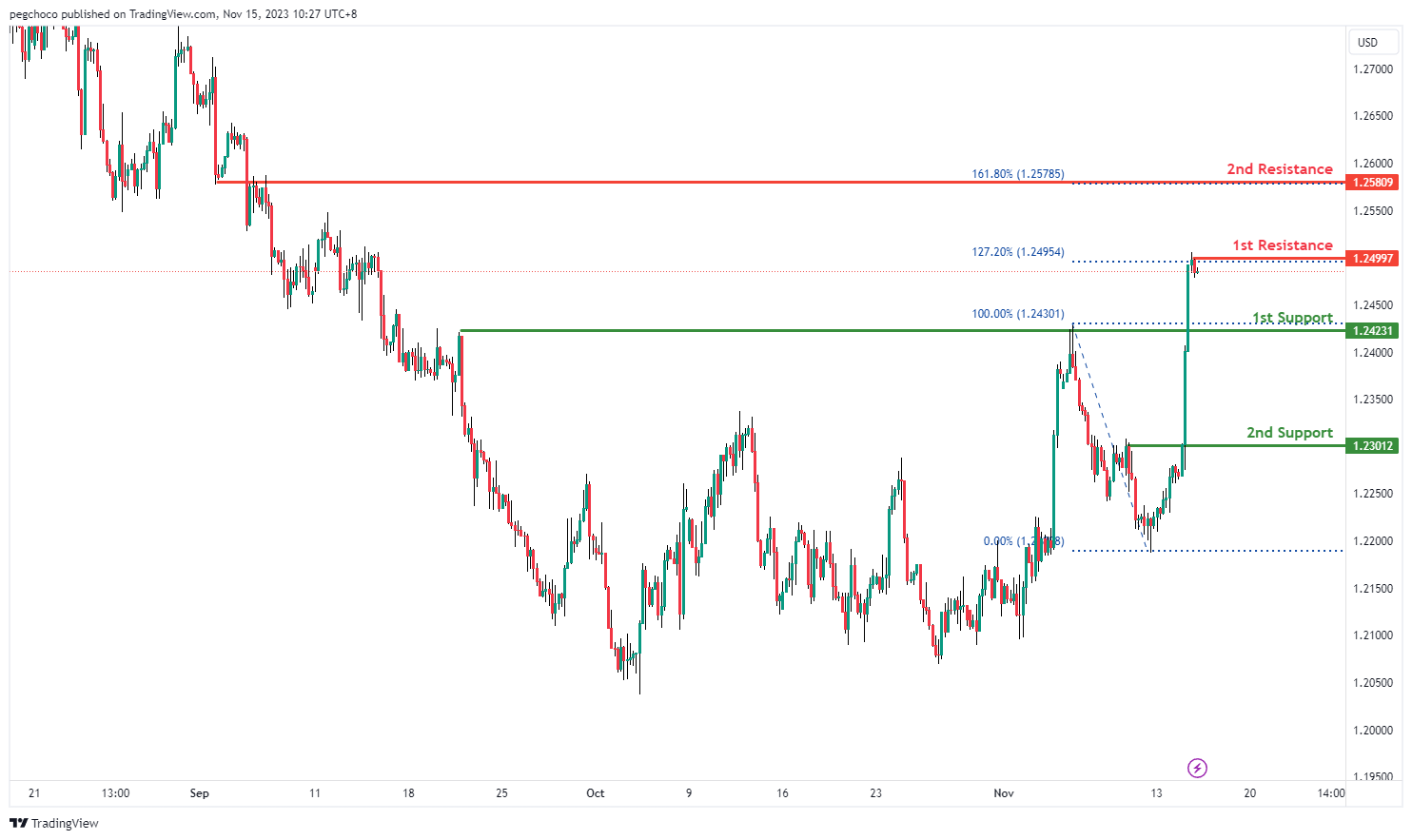
The GBP/USD chart currently displays a bullish overall momentum, but there’s a possibility of a short-term drop towards the 1st support level before a potential bounce that could lead to a rise towards the 1st resistance level.
The 1st support level at 1.2423 is identified as a pullback support. This level is expected to be a point of interest for potential buyers in the short term, possibly acting as a support zone where the price could find some stability during a downward move.
Similarly, the 2nd support at 1.2301 is also considered a pullback support. These pullback support levels indicate areas where buyers have previously stepped in, adding to their significance as relevant support levels to monitor.
On the resistance side, the 1st resistance at 1.2499 is noteworthy as it aligns with the 127.20% Fibonacci Extension level. This Fibonacci extension level suggests a potential zone where selling interest may intensify, acting as a barrier to further upward movement.
Furthermore, the 2nd resistance at 1.2580 is categorized as an overlap resistance and coincides with the 161.80% Fibonacci Extension level. This level adds another layer of resistance, indicating a point where the price could encounter increased selling pressure during its potential rise.
GBP/JPY:
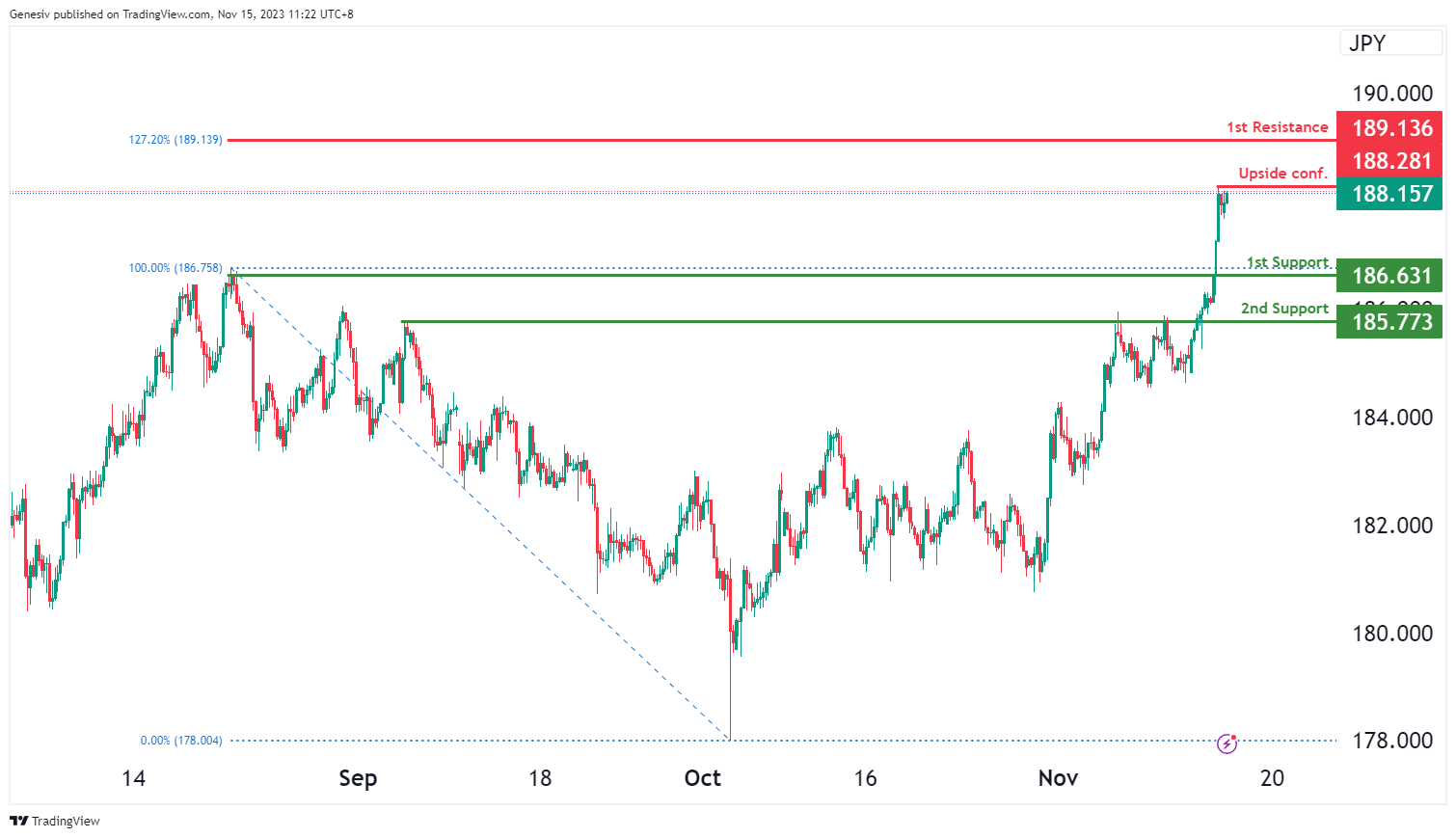
The GBP/JPY chart currently exhibits a bullish momentum, suggesting a potential bullish continuation towards the first resistance should price break above the upside confirmation.
The upside confirmation level at 188.28 is identified as a pullback support while the 1st resistance level at 189.14 is marked as a resistance level that aligns with the 127.20% Fibonacci extension level.
To the downside, the 1st support level at 186.63 is identified as a pullback support. Additionally, the 2nd support level at 185.77 is also noted as a pullback support, further reinforcing the potential strength of the support zone.
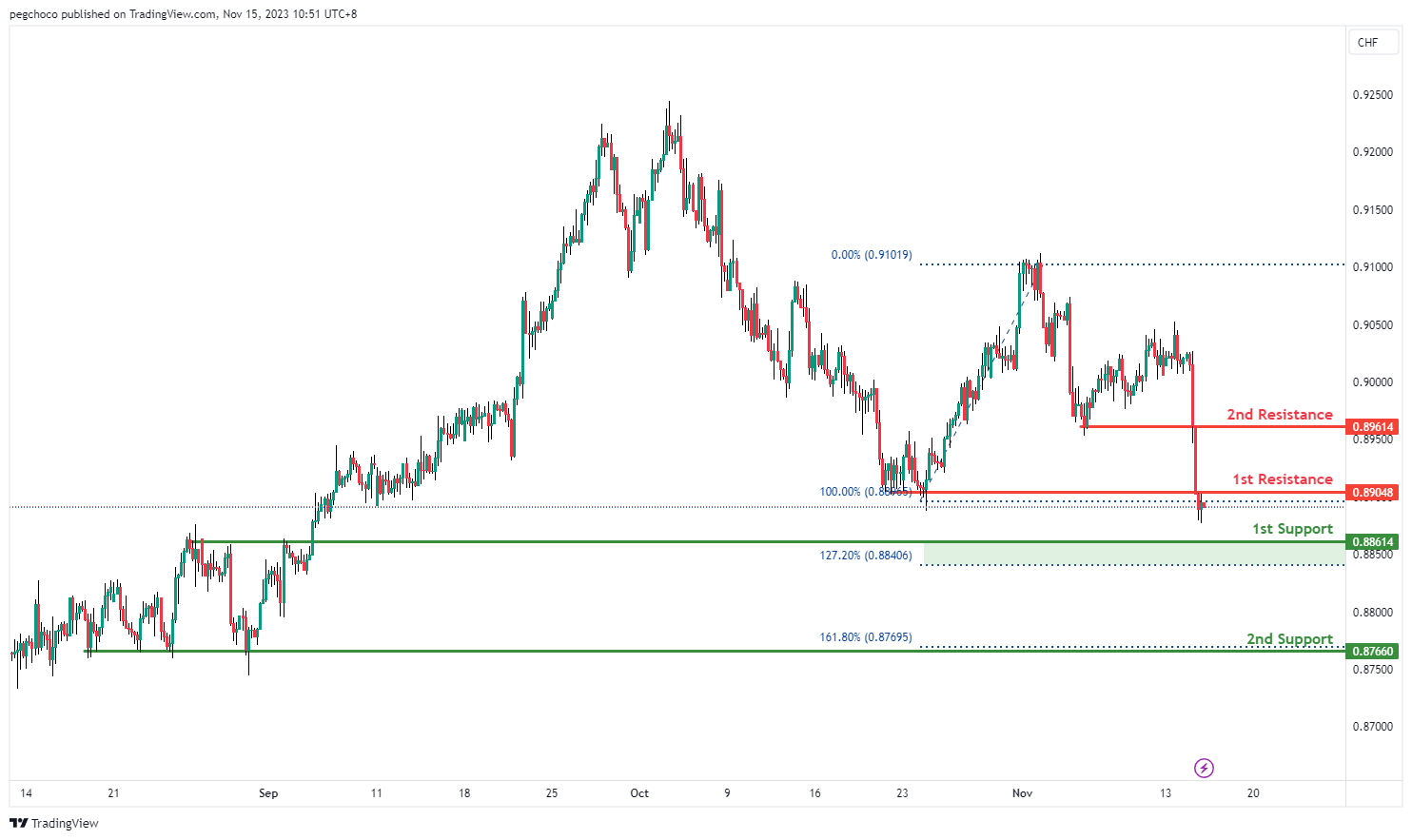
USD/CHF:
The USD/CHF chart currently exhibits a bearish overall momentum, suggesting the potential for a bearish continuation towards the 1st support level.
The 1st support level at 0.8861 is identified as a pullback support and coincides with the 127.20% Fibonacci Extension level. This confluence suggests a significant level of support where traders might expect buying interest or a pause in the bearish movement.
The 2nd support at 0.8766 is considered a multi-swing low support and coincides with the 161.80% Fibonacci Extension level. Such levels often indicate areas where buyers have previously intervened, further reinforcing their importance as potential support levels.
On the resistance side, the 1st resistance at 0.8904 is categorized as a pullback resistance. This level may act as a barrier to upward movements, where selling interest could intensify.
Similarly, the 2nd resistance at 0.8961 is also noted as a pullback resistance, adding another layer of potential resistance to the price’s upward movements.
USD/JPY:
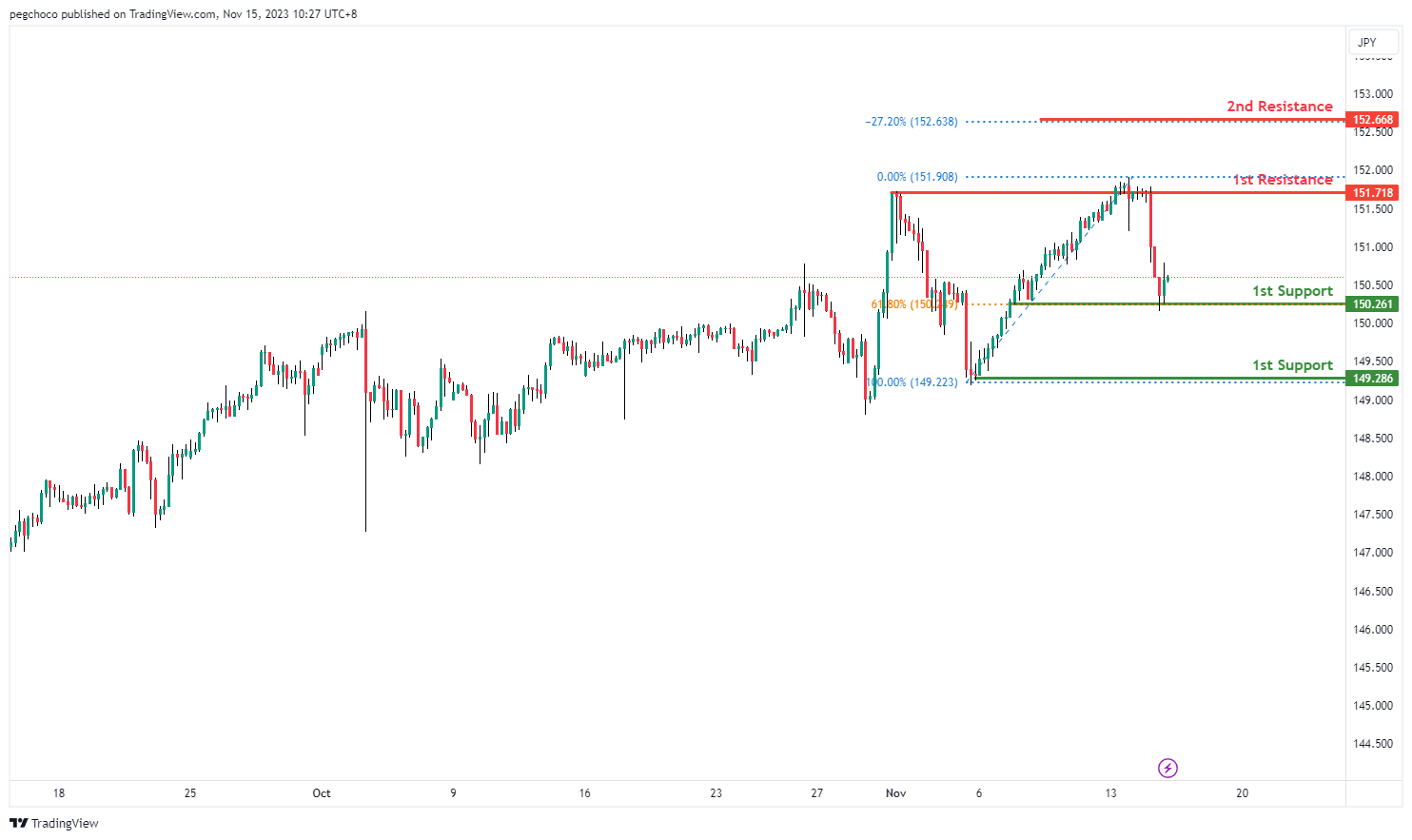
The USD/JPY chart currently has a bullish overall momentum, suggesting the potential for a bullish bounce off the 1st support level and a move towards the 1st resistance.
The 1st support level at 150.26 is identified as an overlap support and also coincides with the 61.80% Fibonacci Retracement level. This confluence indicates a significant level of support where traders may anticipate buying interest or a pause in the bullish movement.
The 2nd support at 149.28 is considered a swing low support, further reinforcing its potential as a support level. Swing lows often represent areas where buyers have previously stepped in, making it a relevant support level.
On the resistance side, the 1st resistance at 151.71 is categorized as a multi-swing high resistance, suggesting that there could be selling interest in this area. This level could act as a barrier to further upward movement.
The 2nd resistance at 152.66 is noted as a level where the price may encounter selling pressure and corresponds to the -27% Fibonacci Extension level.
USD/CAD:
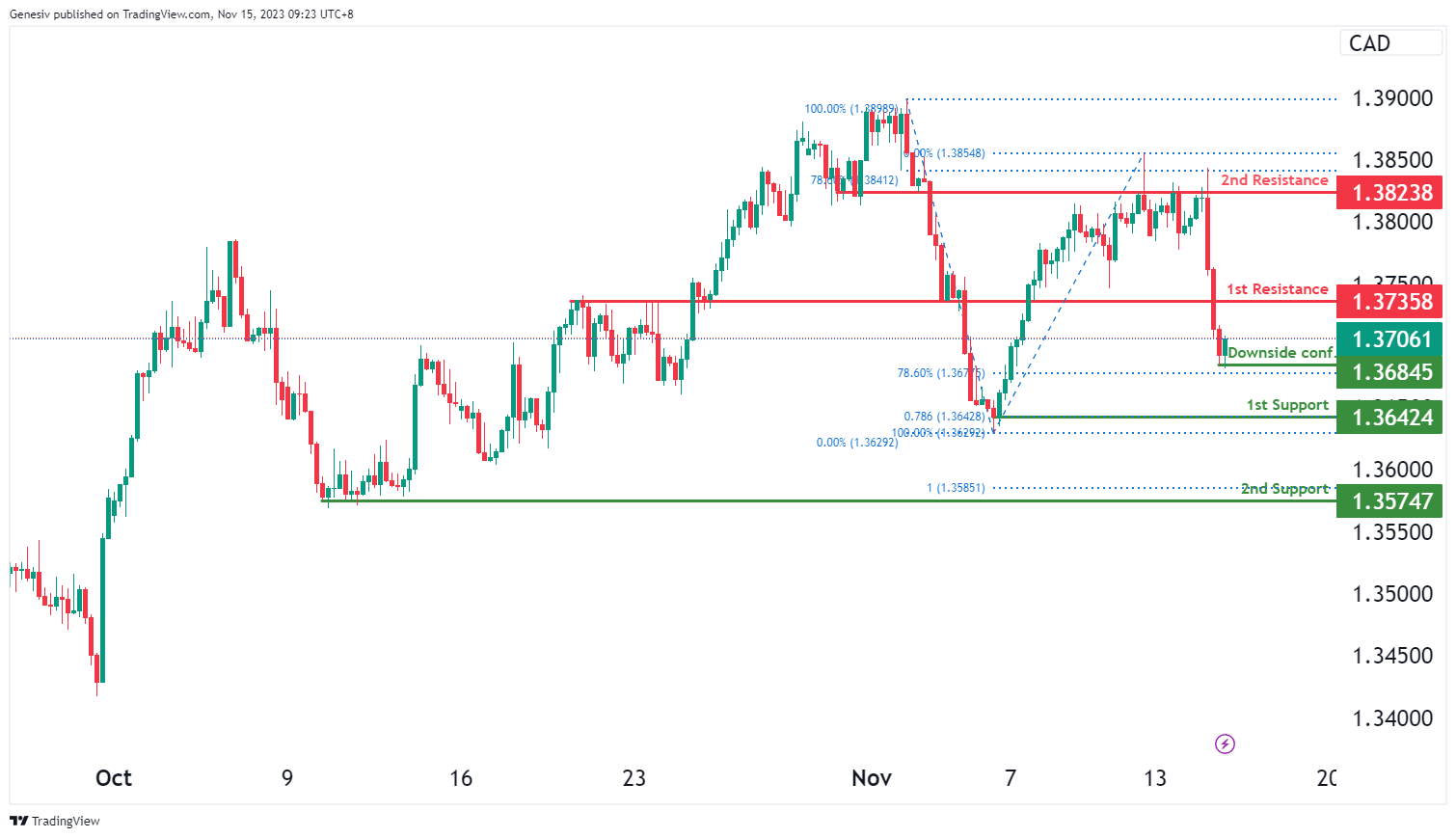
The USD/CAD chart currently shows an overall bearish momentum, indicating the potential for further downside movement should price break under the downside confirmation.
The downside confirmation level at 1.3685 is identified as a pullback support that aligns close to the 78.60% Fibonacci retracement level while the 1st support level at 1.3642 is marked as a swing-low support that aligns close to the 78.60% Fibonacci projection level. Further below, the 2nd support level at 1.3575 is noted as a pullabck support that aligns close to the 100.00% Fibonacci projection level.
To the upside, the 1st resistance level at 1.3736 is identified as an overlap resistance. Higher up, the 2nd resistance level at 1.3824 is also marked as an overlap resistance that aligns close to the 78.60% Fibonacci retracement level.
AUD/USD:
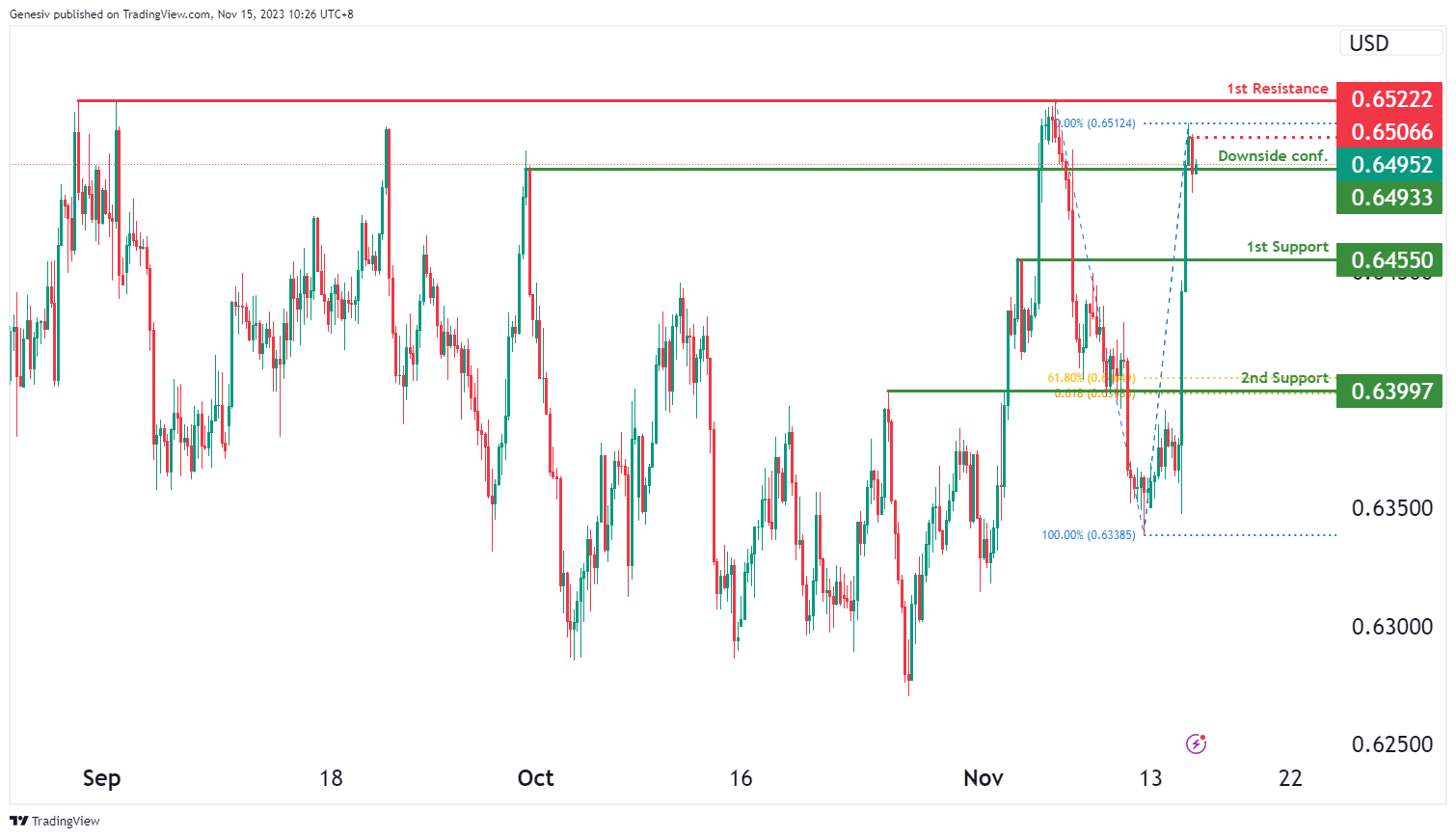
The AUD/USD chart currently exhibits an overall bullish momentum, suggesting the potential for a bullish continuation towards the 1st resistance.
The intermediate resistance level at 0.6507 is identified as a pullback resistance. Higher up, the 1st resistance level at 0.6522 is marked as a multi-swing-high resistance, suggesting that it could serve as a strong resistance level.
On the support side, the downside confirmation level at 0.6493 is identified as a pullback support. Should price break below this level, it could trigger a bearish move towards the 1st support level. The 1st support level at 0.6455 is noted as a pullback support. Further below, the 2nd support level at 0.6399 is also marked as a pullback support that aligns with a confluence of Fibonacci levels i.e. the 61.80% retracement and the 61.80% projection levels, suggesting a significant support level.
NZD/USD
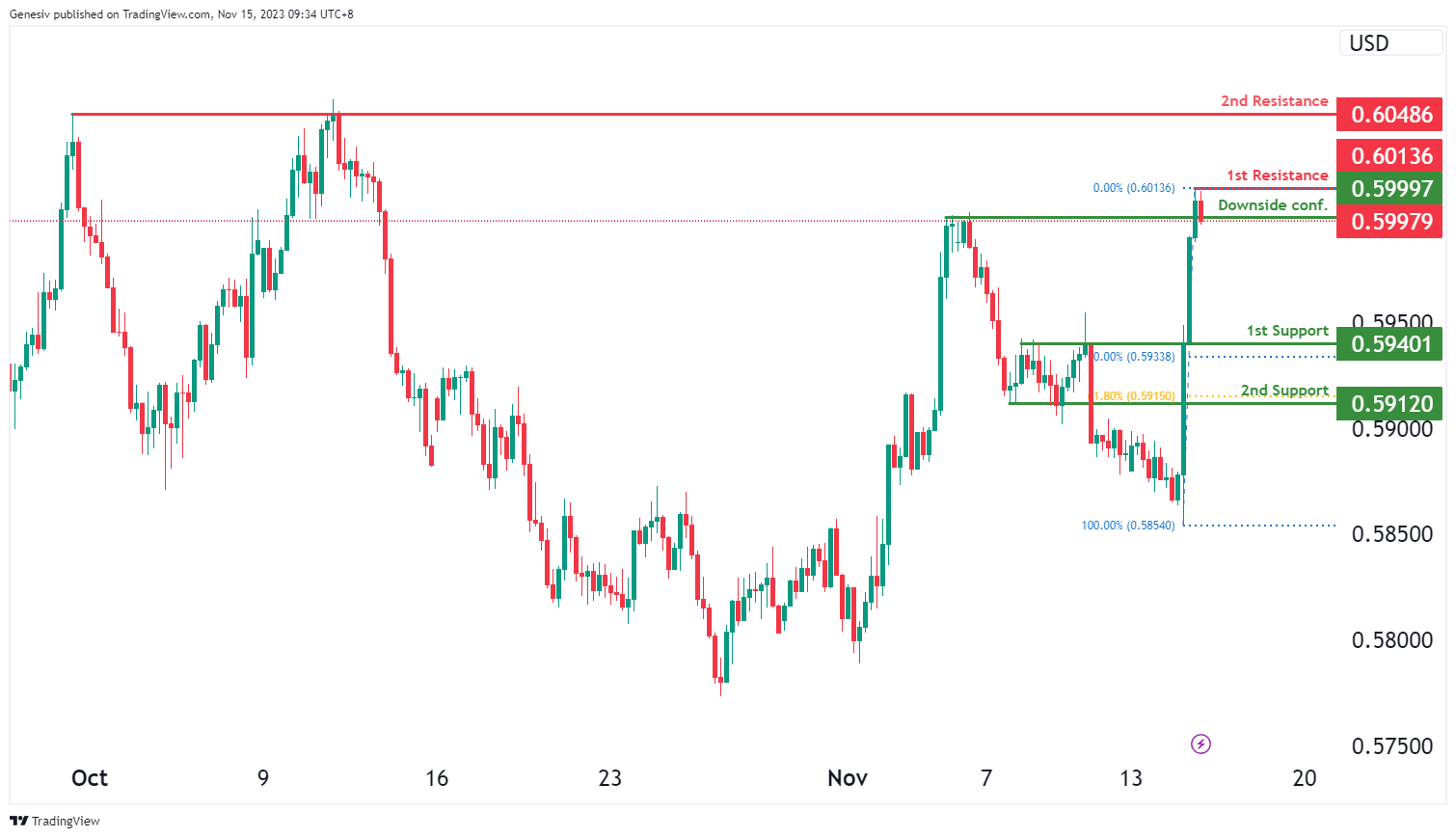
The NZD/USD chart currently exhibits an overall bullish momentum, suggesting the potential for further upward movement.
The 1st resistance level at 0.6014 is identified as a pullback resistance while the 2nd resistance level at 0.6049 is marked as a multi-swing-high resistance, indicating its potential strength as a barrier to further bullish movement.
To the downside, the 1st support level at 0.5940 is identified as a pullback support that aligns close to the 50.00% Fibonacci retracement level. Further below, the 2nd support level at 0.5912 is also noted as a pullback support that aligns with the 61.80% Fibonacci retracement level, signifying its significance as a strong support area.
DJ30:
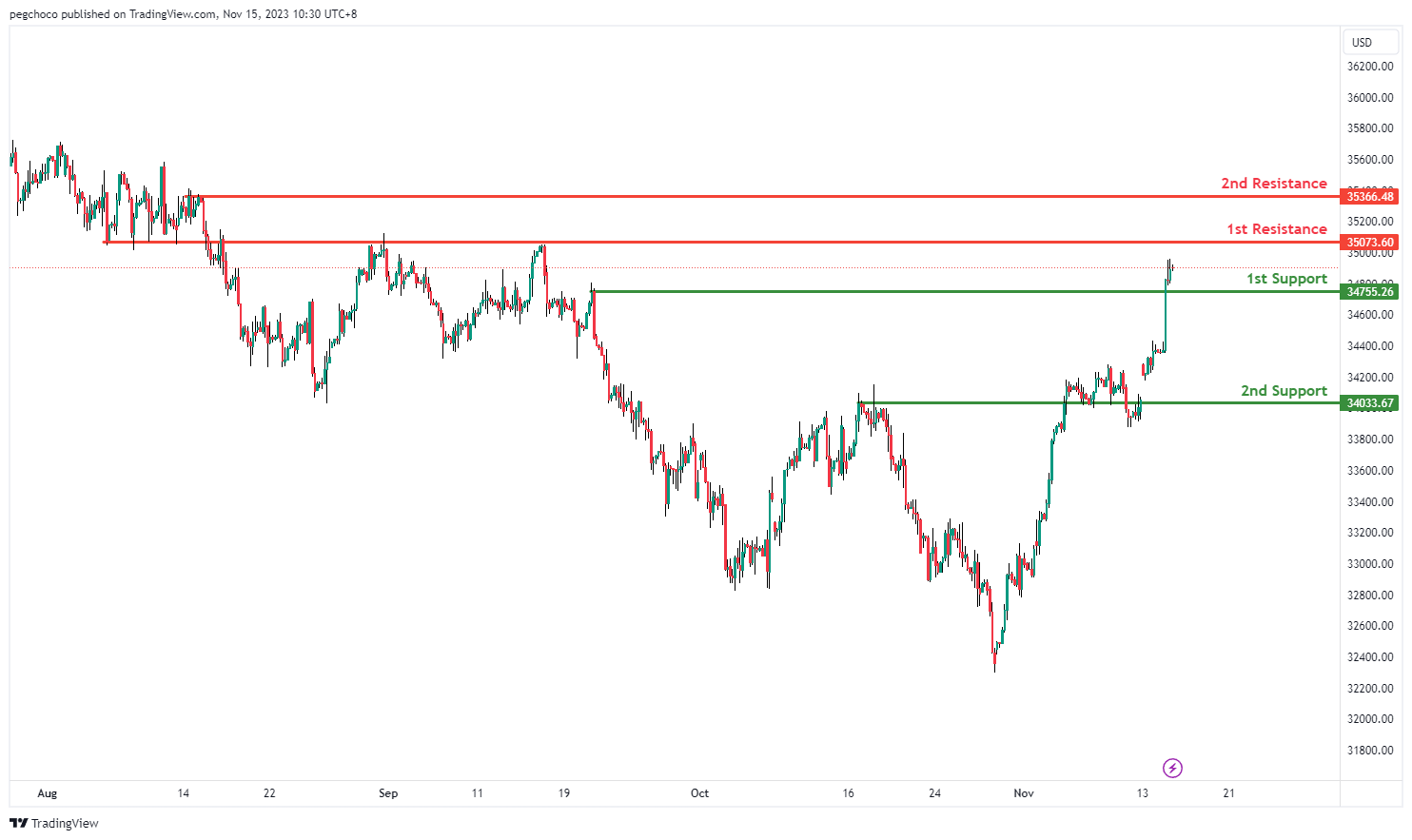
The DJ30 chart is currently showing an overall bullish momentum, suggesting a potential for price to make a bullish continuation towards the 1st resistance.
The 1st resistance level at 35073.60 is marked as an overlap resistance. Higher up, the 2nd resistance level at 35366.48 is noted as a pullback resistance, indicating a potential resistance area for further upward movement.
On the support side, the 1st support level at 34755.26 is identified as a pullback support. Further below, the 2nd support level at 34033.67 is noted as an overlap support, marking another potential level for a strong support area.
GER40:
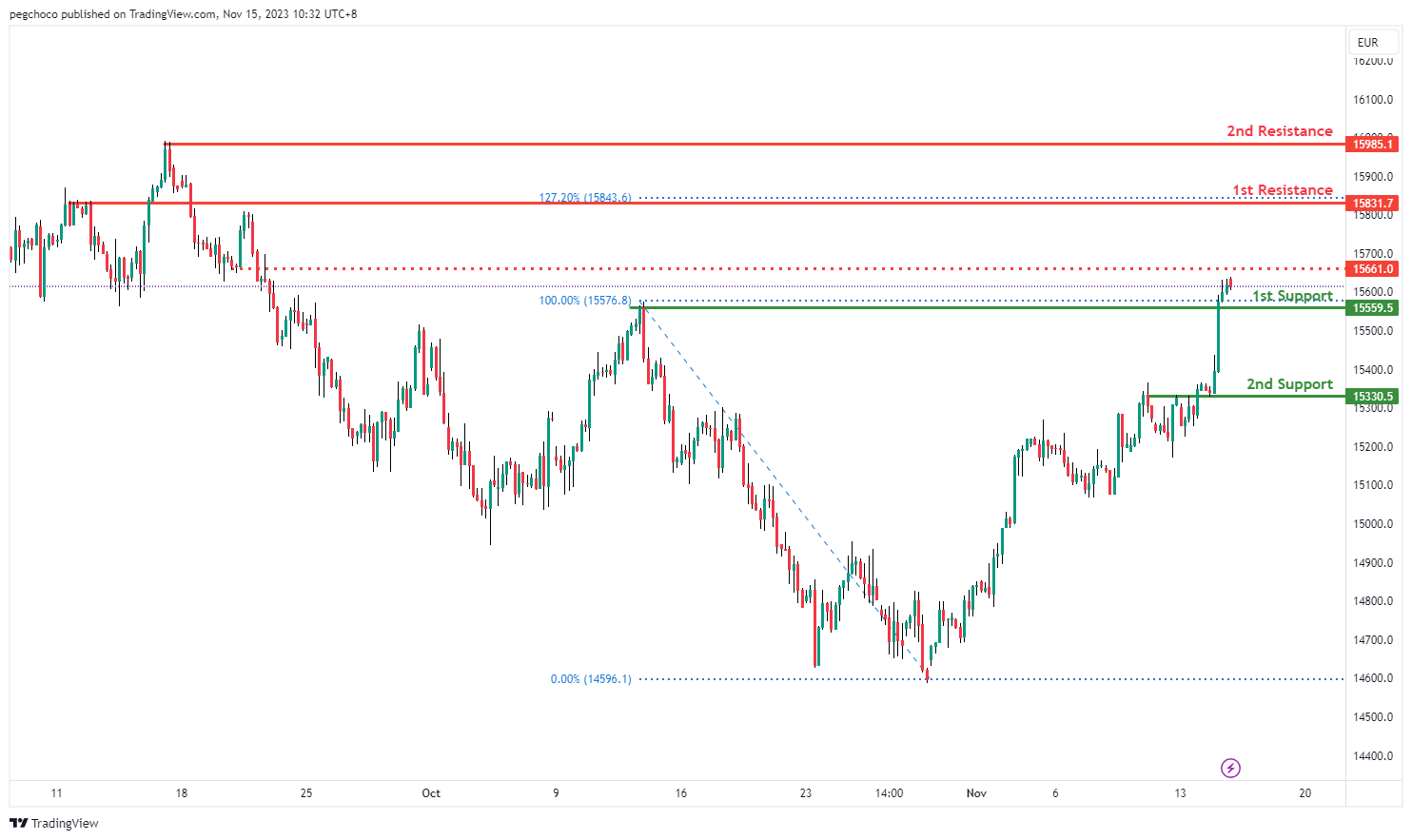
The GER40 chart is currently displaying an overall bullish momentum, suggesting a potential for price to make a bullish continuation towards the 1st resistance should it break above the intermediate resistance.
The intermediate resistance level at 15661.00 is identified as a pullback resistance while the 1st resistance level at 15831.70 is marked as an overlap resistance that aligns with the 127.20% Fibonacci extension level. Higher up, the 2nd resistance level at 15985.10 is noted as a swing-high resistance, indicating a potential resistance area for further upward movement.
On the support side, the 1st support level at 15559.50 is identified as a pullback support. Further below, the 2nd support level at 15330.50 is noted as an overlap support, marking another potential level for a strong support area.
US500
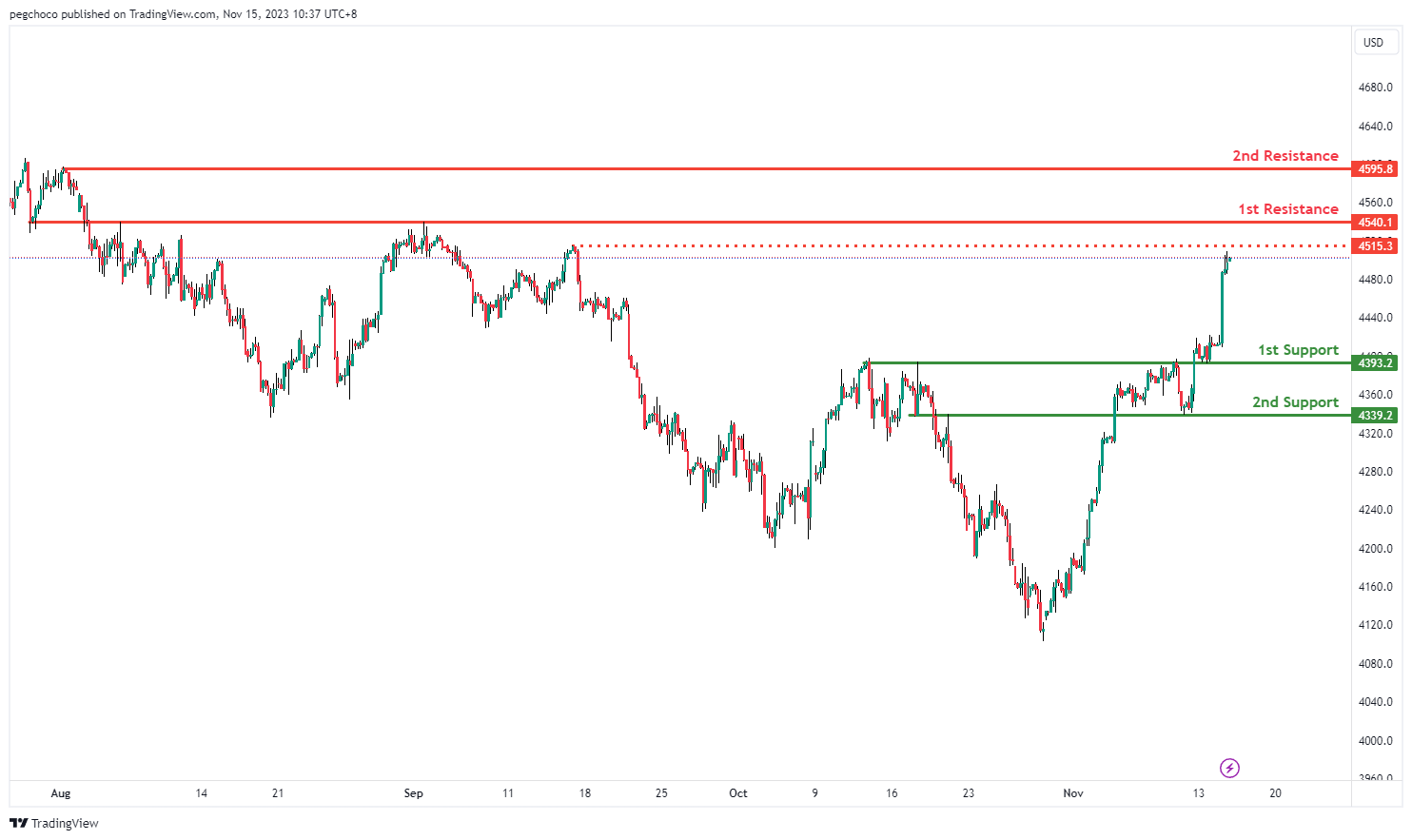
The US500 chart is currently indicating an overall bullish momentum, suggesting a potential for price to make a bullish continuation towards the 1st resistance should it break above the intermediate resistance.
The intermediate resistance level at 4515.30 is identified as a pullback resistance while the 1st resistance level at 4540.10 is marked as an overlap resistance. Higher up, the 2nd resistance level at 4595.80 is noted as a pullback resistance, indicating a potential resistance area for further upward movement.
On the support side, the 1st support level at 4393.20 is identified as an overlap support. Further below, the 2nd support level at 4339.20 is also noted as an overlap support, marking another potential level for a strong support area.
BTC/USD:
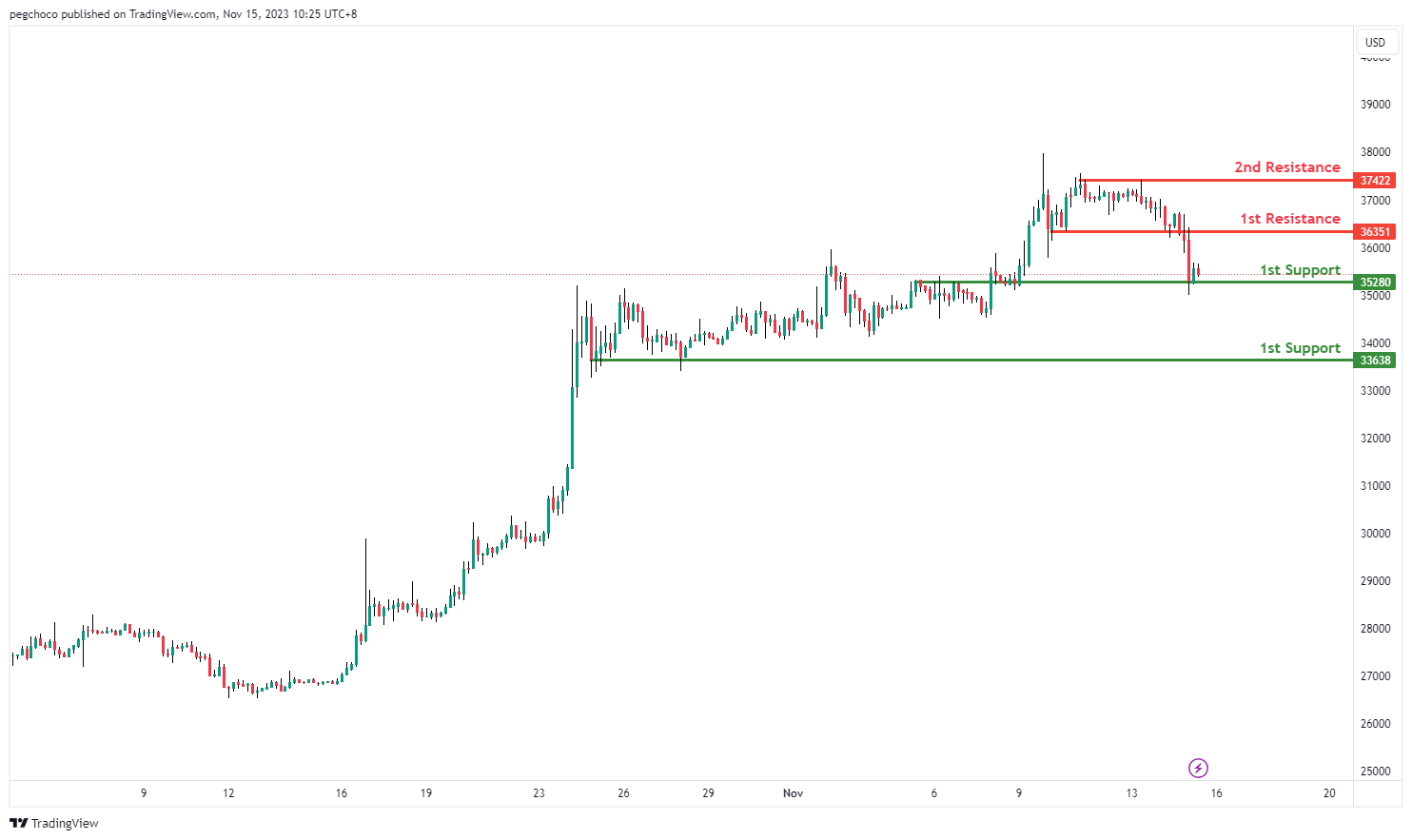
The BTC/USD chart is currently exhibiting a an overall bearish momentum with a potential for price to make a bearish continuation towards the 1st support.
The 1st support level at 35280 is identified as an overlap support. Further below, the 2nd support level at 33638 is marked as a pullback support, potentially acting as a strong support area.
To the upside, the 1st resistance level at 36351 is idenitfed as a pullback resistance while the 2nd resistance level at 37422 is also noted as another pullback resistance, indicating a significant level where price might encounter hurdles to its upward movement.
ETH/USD:
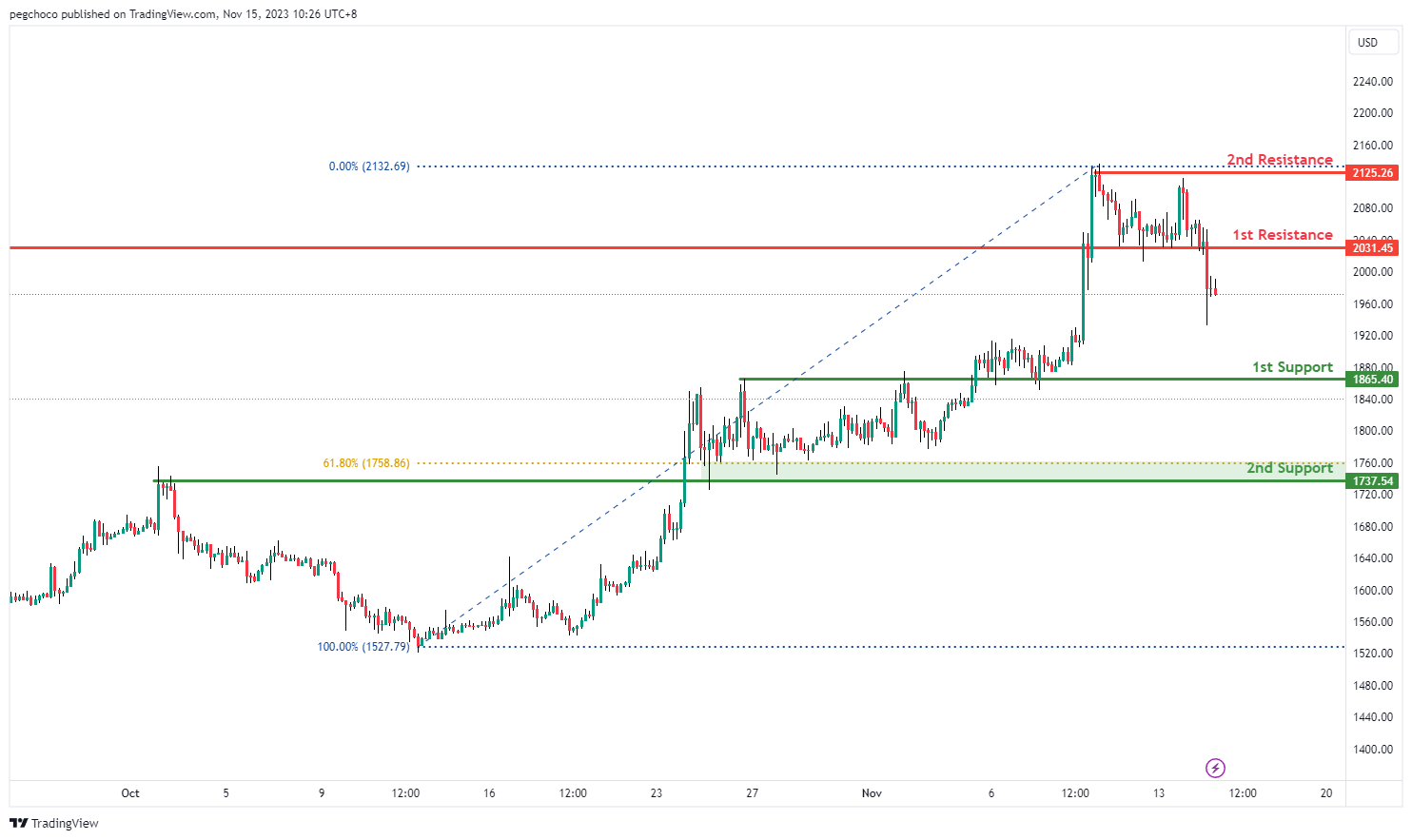
The ETH/USD chart currently displays an overall bearish momentumwith a potential for price to make a bearish continuation towards the 1st support.
The 1st support level at 1865.40 is identified as an overlap support. Further below, the 2nd support level at 1737.54 is also marked as an overlap support that aligns with the 61.80% Fibonacci retracement level.
To the upside, the 1st resistance level at 2031.45 is idenitfed as an overlap resistance while the 2nd resistance level at 2125.26 is noted as a pullback resistance, indicating a significant level where price might encounter hurdles to its upward movement.
WTI/USD:
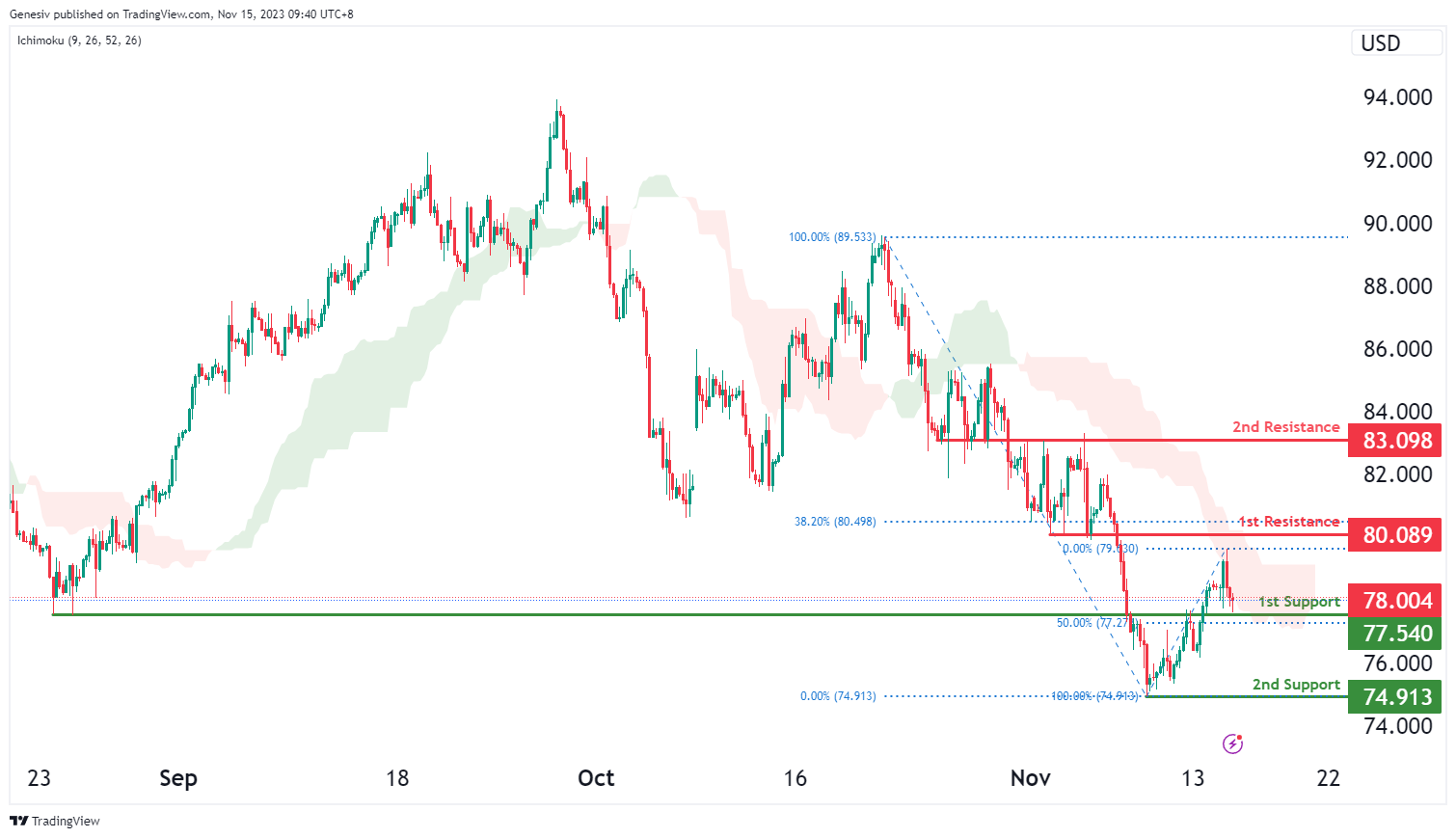
The WTI (West Texas Intermediate) chart currently shows a weak bullish momentum, suggesting the potential for further upward movement towards the 1st resistance. However, price is also trading within the bearish Ichimoku cloud and any price gains could potentially be restricted by the cloud.
The 1st resistance level at 80.09 is identified as a pullback resistance that aligns close to the 38.20% Fibonacci retracement level. Higher up, the 2nd resistance level at 83.09 is marked as an overlap resistance, suggesting potential strength as a barrier to further bullish movement.
To the downside, the 1st support level at 77.54 is identified as an overlap support that aligns with the 50.00% Fibonacci retracement level. Further below, the 2nd support level at 74.91 is noted as a swing-low support, signifying its potential as a strong support area.
XAU/USD (GOLD):
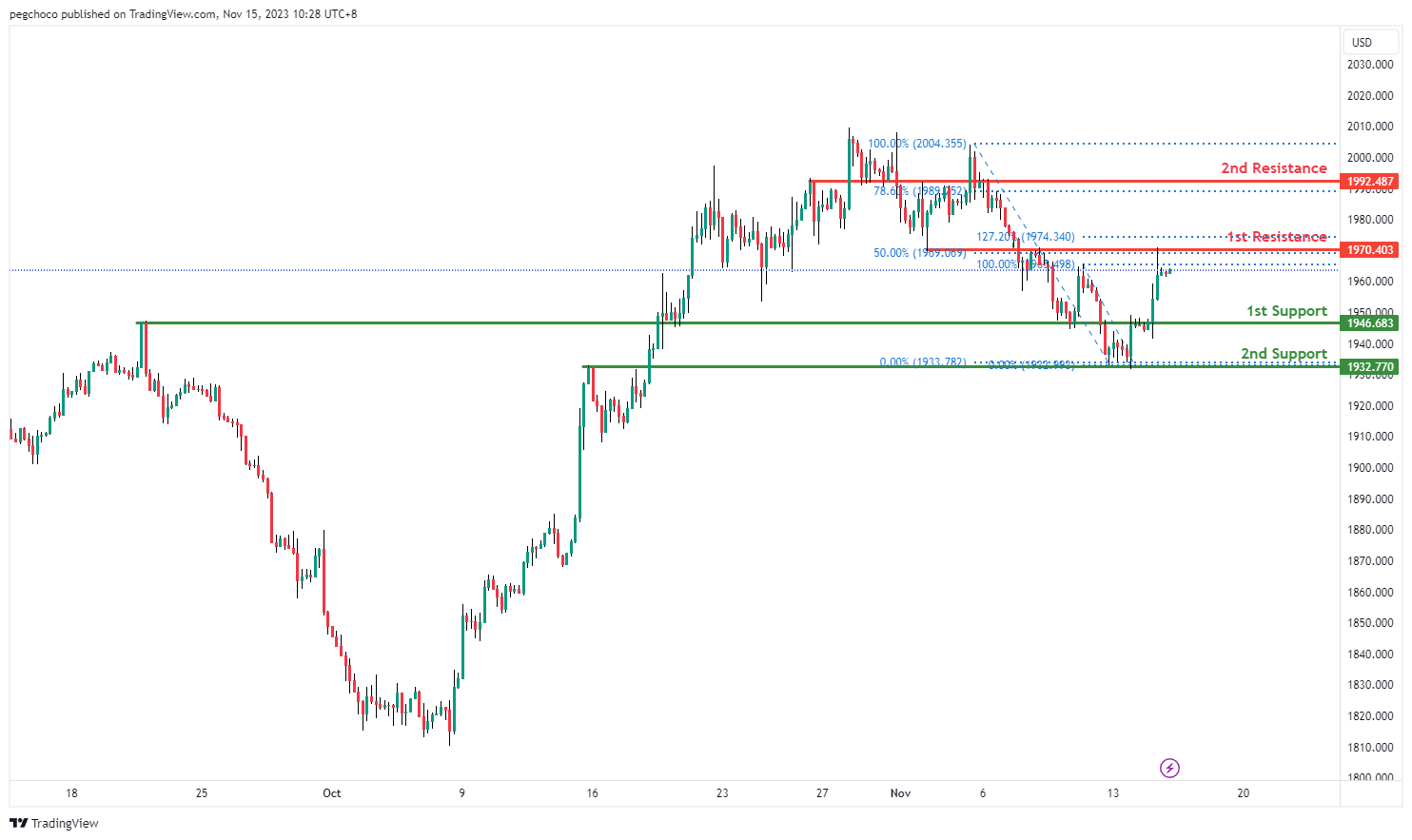
The XAU/USD chart currently exhibits a bullish overall momentum, suggesting the potential for a bullish continuation towards the 1st resistance.
The 1st support level at 1946.68 is identified as a pullback support, indicating it could act as a significant level of support. Pullback supports often attract buying interest or lead to a pause in the bullish movement.
The 2nd support at 1932.77 is categorized as an overlap support, further reinforcing its potential as a support level. Overlap supports indicate areas where historical price action has found support.
On the resistance side, the 1st resistance at 1970.40 is noted as an overlap resistance and coincides with the 50% Fibonacci Retracement level. This confluence suggests that there could be selling interest in this area, potentially acting as a barrier to further upward movement.
The 2nd resistance at 1992.48 is identified as an overlap resistance, further strengthening the potential resistance level.
GBP/USD Daily Outlook
Daily Pivots: (S1) 1.2337; (P) 1.2421; (R1) 1.2583; More...
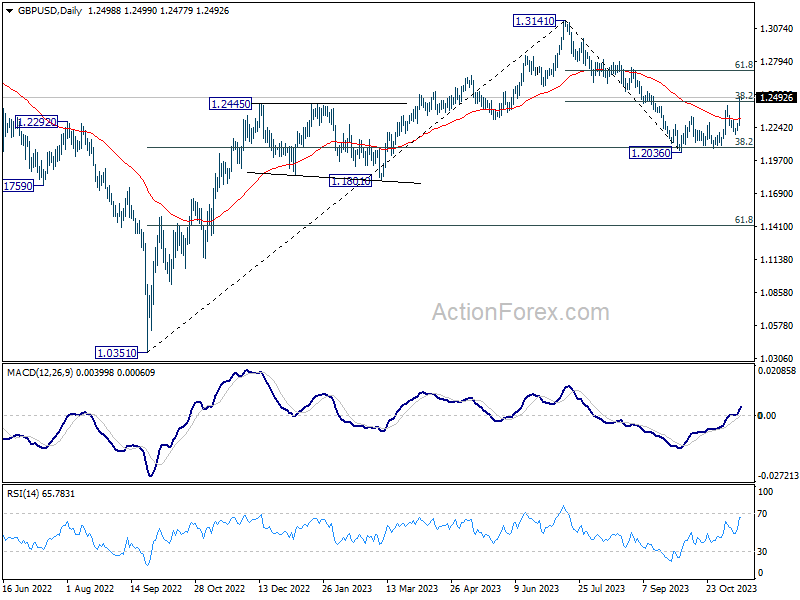
GBP/USD's rally extends to as high as 1.2504 so far. Intraday bias remains on the upside at this point. Sustained trading above 38.2% retracement of 1.3141 to 1.2036 at 1.2458 will pave the way to 61.8% retracement at 1.2716. On the downside, below 1.2443 minor support will turn intraday bias neutral and bring retreat. But downside should be contained well above 1.2185 support to bring another rally.
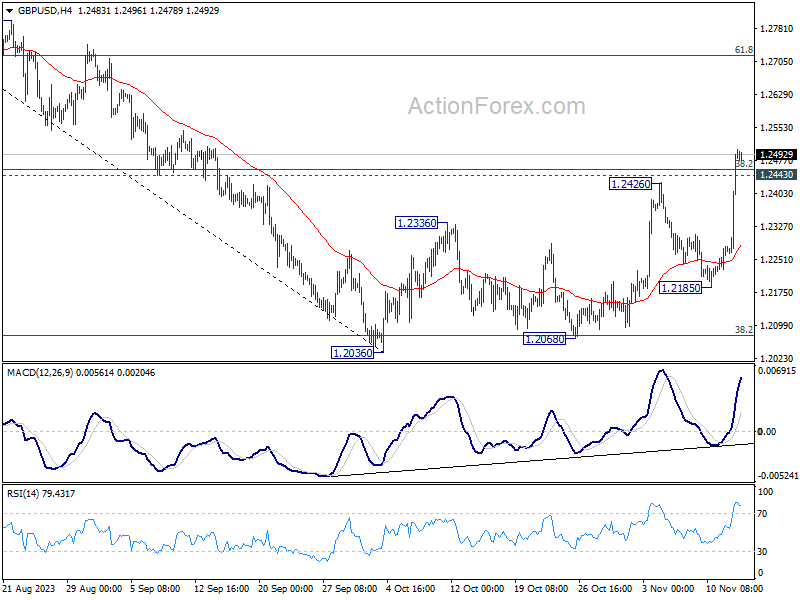
In the bigger picture, price actions from 1.3141 are seen as a corrective pattern to rise from 1.0351 (2022 low). Strong rebound from 38.2% retracement of 1.0351 (2022 low) to 1.3141 at 1.2075 will argue that current rise from 1.2036 is already the second leg. However, while further rally could be seen, upside should be limited by 1.3141 to bring the third leg of the pattern.
Dollar Weakness Prevails as Market Bets on Fed Rate Pivot, H1 Cut Expectations Surge
Dollar remains subdued in the aftermath of its significant selloff triggered by CPI release overnight. Market sentiment has swiftly shifted, with the majority now almost ruling out the possibility of further rate hikes by Fed. This shift indicates a growing consensus that current federal funds rate of 5.25-5.50% marks the peak of this cycle.
Moreover, traders are increasingly speculating more boldly on the timing of rate cuts, with approximately 30% chance by the end of Q1 and over 80% probability by the end of the first half of the next year. This speculation is primarily driven by the belief that Fed might pivot to easing policies sooner if economic data continues to show signs of a downturn.
The impact of these expectations is evident across various markets. Notably, NASDAQ led a robust closing in major indexes, and the 10-year yield experienced a significant decline, losing nearly -0.2%. Looking back, the psychological level of 5% yields seemed to have attracted significant treasury buying interest. Future data that underperforms could spur an even more pronounced dip in yields, and intensifying expectation of Fed's pivot to rate cuts in 2024.
In the foreign exchange markets, Australian and New Zealand Dollars have emerged as the primary beneficiaries of Dollar's weakness, leading the performance charts for the week. This strength is amplified by positive sentiment flowing through Asian markets. British Pound, known for its sensitivity to shifts in risk sentiment, has also performed strongly, while Euro trails closely behind. Conversely, Japanese Yen and Swiss Franc, despite their appreciable gains against Dollar, have not matched the momentum seen in other major currencies.
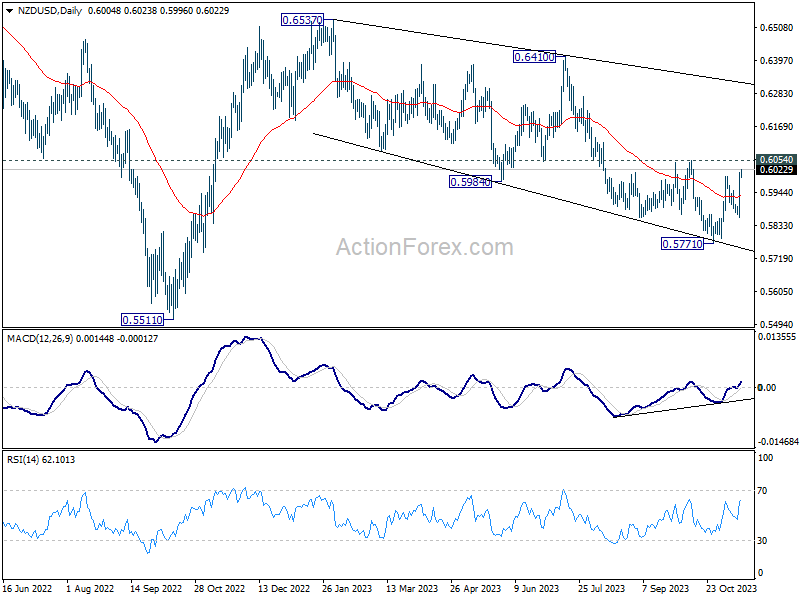
From a technical perspective, a key question is whether NZD/USD and AUD/USD's down trend since February has already completed in October. Focus is now on 0.6054 resistance in NZD/USD (corresponding level of 0.6510 in AUD/USD) for the near term. Decisive break of 0.6054 will argue that the fall from 0.6537 has completed with three waves down to 0.5771. That would change near term outlook bullish for at least a take on falling trend resistance (now at 0.6318). Synchronized rallies in NZD/USD and AUD/USD will reinforce each other.
In Asia, at the time of writing, Nikkei is up 2.28%. Hong Kong HSI is up 2.83%. China Shanghai SSE is up 0.45%. Singapore Strait Times is up 0.50%. Japan 10-year JGB yield is down -0.077 at 0.779. Overnight, DOW rose 1.43%. S&P 500 rose 1.91%. NASDAQ rose 2.37%. 10-year yield fell -0.191 to 4.441.
Fed's Goolsbee eyes housing as crucial for continued disinflation progress
Chicago Fed President Austan Goolsbee acknowledged yesterday that "progress continues towards 2% inflation target. He highlighted the decline in goods inflation, but points out the critical role of housing inflation in the coming quarters.
Goolsbee emphasized, "With goods inflation already coming down and nonhousing services inflation typically slow to adjust, the key to further progress over the next few quarters will be what happens to housing inflation."
Separately, Richmond Fed President Thomas Barkin exhibited a more guarded stance. He expresses doubts about a smooth transition to the Fed's inflation target, underscoring the complexity of the current economic scenario.
Barkin noted, "I'm just not convinced that inflation is on some smooth glide path down to 2%." He acknowledges the recent decrease in inflation rates but attributes it primarily to the partial reversal of spikes seen during the Covid era, driven by high demand and supply constraints.
Barkin further points out that certain sectors, such as shelter and services, continue to exhibit inflation rates above historical norms.
Japan's GDP down -0.5% qoq, -2.1% annualized in Q3
Japan's GDP contracted -0.5% qoq in Q3, starkly underperformed market expectations of -0.1% qoq decline. On annualized basis, the situation appears even more drastic, with the economy shrinking by -2.1%, far exceeding anticipated -0.6% contraction, and being the worst since Q3 2021.
A critical factor in this downturn was a -0.6% decrease in business investment, marking a continuous decline for two consecutive quarters. This reduction was primarily influenced by reduced spending on semiconductor production equipment, reflecting broader challenges in global tech sector.
Additionally, private consumption, a key driver of economic activity, saw a marginal fall of -0.04%. This marks the second successive quarter of decline, with slump in vehicle sales significantly impacting consumer spending.
China's industrial and retail growth surpass expectations, PBOC injects fresh funds
China's industrial output and retail sales for October exceeded market expectations. Industrial production rose 4.6% yoy, surpassing forecasted 4.5% yoy, marking an improvement from September's 4.5% yoy growth. Retail sales recorded a robust 7.6% yoy growth, significantly higher than anticipated 7.0% yoy and showing a considerable improvement from 5.5% yoy increase in September.
However, fixed asset investment experienced slower growth, rising only 2.9% ytd yoy, which was below the expected 3.1%. The real estate sector particularly faced challenges, with investment dropping by -9.3% ytd yoy, a deterioration compared to the previous period through September.
In a separate development, People's Bank of China maintained interest rate on CNY 1.45T worth of one-year medium-term lending facility loans at 2.50%, consistent with previous operations. As CNY 850B worth of MLF loans were set to expire this month, this move resulted in a net injection of CNY 600B of fresh funds into the banking system.
The central bank stated that this loan operation aimed to keep the banking system's liquidity at a reasonably ample level, countering short-term factors such as tax payments and government bond issuances.
Looking ahead
UK CPI is the main focus in European while PPI and RPI will also be released. Eurozone trade balance and industrial production will be featured too.
Later in the day, US retail sales will be the main focus, along with PPI and Empire stat manufacturing index. Canada will release manufacturing sales and wholesale sales.
GBP/USD Daily Outlook
Daily Pivots: (S1) 1.2337; (P) 1.2421; (R1) 1.2583; More...
GBP/USD's rally extends to as high as 1.2504 so far. Intraday bias remains on the upside at this point. Sustained trading above 38.2% retracement of 1.3141 to 1.2036 at 1.2458 will pave the way to 61.8% retracement at 1.2716. On the downside, below 1.2443 minor support will turn intraday bias neutral and bring retreat. But downside should be contained well above 1.2185 support to bring another rally.
In the bigger picture, price actions from 1.3141 are seen as a corrective pattern to rise from 1.0351 (2022 low). Strong rebound from 38.2% retracement of 1.0351 (2022 low) to 1.3141 at 1.2075 will argue that current rise from 1.2036 is already the second leg. However, while further rally could be seen, upside should be limited by 1.3141 to bring the third leg of the pattern.
Economic Indicators Update
| GMT | Ccy | Events | Actual | Forecast | Previous | Revised |
|---|---|---|---|---|---|---|
| 00:30 | AUD | Wage Price Index Q/Q Q3 | 1.30% | 1.30% | 0.80% | 0.90% |
| 23:50 | JPY | GDP Q/Q Q3 P | -0.50% | -0.10% | 1.20% | |
| 23:50 | JPY | GDP Deflator Y/Y Q3 P | 5.10% | 4.80% | 3.50% | |
| 02:00 | CNY | Industrial Production Y/Y Oct | 4.60% | 4.50% | 4.50% | |
| 02:00 | CNY | Retail Sales Y/Y Oct | 7.60% | 7.00% | 5.50% | |
| 02:00 | CNY | Fixed Asset Investment YTD Y/Y Oct | 2.90% | 3.10% | 3.10% | |
| 04:30 | JPY | Industrial Production M/M Sep F | 0.50% | 0.20% | 0.20% | |
| 07:00 | GBP | CPI M/M Oct | 0.20% | 0.50% | ||
| 07:00 | GBP | CPI Y/Y Oct | 4.70% | 6.70% | ||
| 07:00 | GBP | Core CPI Y/Y Oct | 5.80% | 6.10% | ||
| 07:00 | GBP | RPI M/M Oct | 0.50% | |||
| 07:00 | GBP | RPI Y/Y Oct | 6.40% | 8.90% | ||
| 07:00 | GBP | PPI Input M/M Oct | 0.10% | 0.40% | ||
| 07:00 | GBP | PPI Input Y/Y Oct | -2.60% | |||
| 07:00 | GBP | PPI Output M/M Oct | 0.10% | 0.40% | ||
| 07:00 | GBP | PPI Output Y/Y Oct | -0.10% | |||
| 07:00 | GBP | PPI Core Output M/M Oct | 0.00% | |||
| 07:00 | GBP | PPI Core Output Y/Y Oct | 0.70% | |||
| 10:00 | EUR | Eurozone Trade Balance (EUR) Sep | 12.3B | 11.9B | ||
| 10:00 | EUR | Eurozone Industrial Production M/M Sep | -0.90% | 0.60% | ||
| 13:30 | CAD | Manufacturing Sales M/M Sep | 0.80% | 0.70% | ||
| 13:30 | CAD | Wholesale Sales M/M Sep | 1.40% | 2.30% | ||
| 13:30 | USD | Empire State Manufacturing Index Nov | -2.6 | -4.6 | ||
| 13:30 | USD | Retail Sales M/M Oct | -0.30% | 0.70% | ||
| 13:30 | USD | Retail Sales ex Autos M/M Oct | -0.20% | 0.60% | ||
| 13:30 | USD | PPI M/M Oct | 0.10% | 0.50% | ||
| 13:30 | USD | PPI Y/Y Oct | 1.90% | 2.20% | ||
| 13:30 | USD | PPI Core M/M Oct | 0.20% | 0.30% | ||
| 13:30 | USD | PPI Core Y/Y Oct | 2.70% | 2.70% | ||
| 15:00 | USD | Business Inventories Sep | 0.30% | 0.40% | ||
| 15:30 | USD | Crude Oil Inventories |
GBPUSD Short Term Elliott Wave Structure Suggests Further Upside
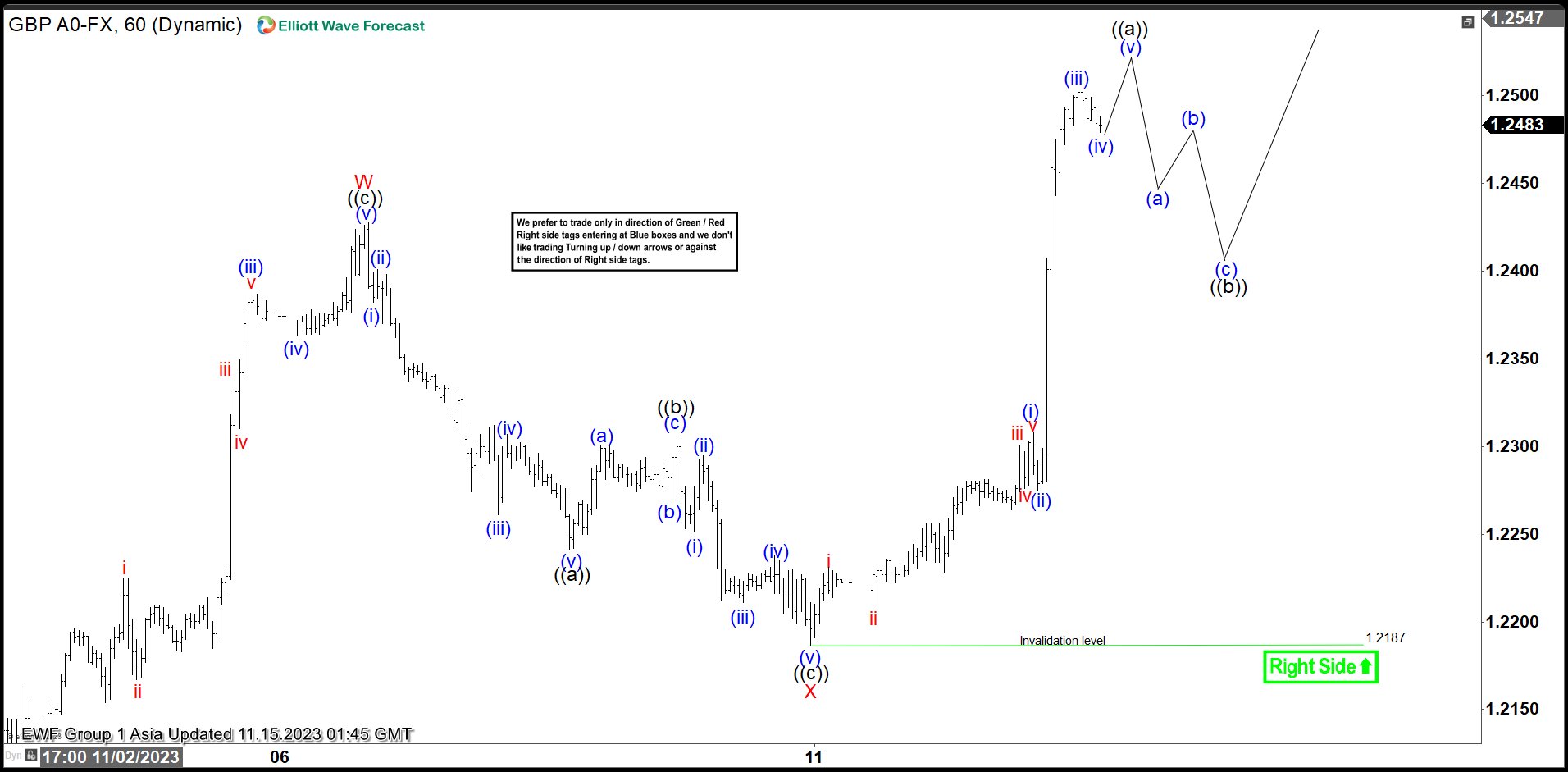
GBPUSD shows a 5 swing sequence from 10.4.2023 low favoring further upside. The rally from 10.4.2023 low takes the form of a double three Elliott Wave structure or a double zigzag. Up from 10.4.2023 low, wave W ended at 1.24.28 and dips in wave X ended at 1.2186. Internal subdivision of wave X unfolded as a zigzag Elliott Wave structure. Down from wave W, wave ((a)) ended at 1.224 and wave ((b)) ended at 1.2309. Wave ((c)) lower ended at 1.2187 which completed wave X.
Pair has since turned higher in wave Y. Internal subdivision of wave Y is unfolding as another zigzag structure. Up from wave X, wave (i) ended at 1.2308 and wave (ii) pullback ended at 1.2275. Wave (iii) higher ended at 1.2506, and wave (iv) ended at 1.2478. Expect pair to extend higher in wave (v) to end wave ((a)). Afterwards, it should pullback in wave ((b)) to correct cycle from 11.10.2023 low before the rally resumes. Near term, as far as pivot at 1.2187 low stays intact, expect dips to find support in 3, 7, 11 swing for further upside. Potential target higher is 100% – 161.8% Fibonacci extension of wave W. This area comes at 1.257 – 1.282.
GBPUSD 60 Minutes Elliott Wave Chart
GBPUSD Elliott Wave Video
https://www.youtube.com/watch?v=0X9vhLc6Wo4
China’s industrial and retail growth surpass expectations, PBOC injects fresh funds
China's industrial output and retail sales for October exceeded market expectations. Industrial production rose 4.6% yoy, surpassing forecasted 4.5% yoy, marking an improvement from September's 4.5% yoy growth. Retail sales recorded a robust 7.6% yoy growth, significantly higher than anticipated 7.0% yoy and showing a considerable improvement from 5.5% yoy increase in September.
However, fixed asset investment experienced slower growth, rising only 2.9% ytd yoy, which was below the expected 3.1%. The real estate sector particularly faced challenges, with investment dropping by -9.3% ytd yoy, a deterioration compared to the previous period through September.
In a separate development, People's Bank of China maintained the interest rate on CNY 1.45T worth of one-year medium-term lending facility loans at 2.50%, consistent with previous operations. As CNY 850B worth of MLF loans were set to expire this month, this move resulted in a net injection of CNY 600B of fresh funds into the banking system.
The central bank stated that this loan operation aimed to keep the banking system's liquidity at a reasonably ample level, countering short-term factors such as tax payments and government bond issuances.
Japan’s GDP down -0.5% qoq, -2.1% annualized in Q3
Japan's GDP contracted -0.5% qoq in Q3, starkly underperformed market expectations of -0.1% qoq decline. On annualized basis, the situation appears even more drastic, with the economy shrinking by -2.1%, far exceeding anticipated -0.6% contraction, and being the worst since Q3 2021.
A critical factor in this downturn was a -0.6% decrease in business investment, marking a continuous decline for two consecutive quarters. This reduction was primarily influenced by reduced spending on semiconductor production equipment, reflecting broader challenges in global tech sector.
Additionally, private consumption, a key driver of economic activity, saw a marginal fall of -0.04%. This marks the second successive quarter of decline, with slump in vehicle sales significantly impacting consumer spending.
Fed’s Goolsbee eyes housing as crucial for continued disinflation progress
Chicago Fed President Austan Goolsbee acknowledged yesterday that "progress continues towards 2% inflation target. He highlighted the decline in goods inflation, but points out the critical role of housing inflation in the coming quarters.
Goolsbee emphasized, "With goods inflation already coming down and nonhousing services inflation typically slow to adjust, the key to further progress over the next few quarters will be what happens to housing inflation."
Separately, Richmond Fed President Thomas Barkin exhibited a more guarded stance. He expresses doubts about a smooth transition to the Fed's inflation target, underscoring the complexity of the current economic scenario.
Barkin noted, "I'm just not convinced that inflation is on some smooth glide path down to 2%." He acknowledges the recent decrease in inflation rates but attributes it primarily to the partial reversal of spikes seen during the Covid era, driven by high demand and supply constraints.
Barkin further points out that certain sectors, such as shelter and services, continue to exhibit inflation rates above historical norms.
Fed’s Barkin not convinced of steady inflation decline despite today’s CPI data
Richmond Fed President Thomas Barkin has voiced skepticism regarding the trajectory of inflation, even in light of today's U.S. CPI data showing decline in headline and core readings. In his comments at a event, Barkin remarked, "I'm just not convinced that inflation is on some smooth glide path down to 2%."
Barkin pointed out that the recent decrease in inflation figures is largely attributable to a partial reversal of the price spikes experienced during Covid-era, which were driven by elevated demand and supply shortages. He highlighted ongoing concerns, stating, "Shelter and shelter inflation remain higher than historic levels, so does services inflation."
Emphasizing the resilience of businesses in the current economic environment, Barkin noted, "Businesses aren't going to back down from prices until they have to," suggesting that a slowdown might be necessary.
"I do see some sort of slowdown," he added.