

Sample Category Title
GBP/USD Mid-Day Outlook
Daily Pivots: (S1) 1.2696; (P) 1.2731; (R1) 1.2773; More...
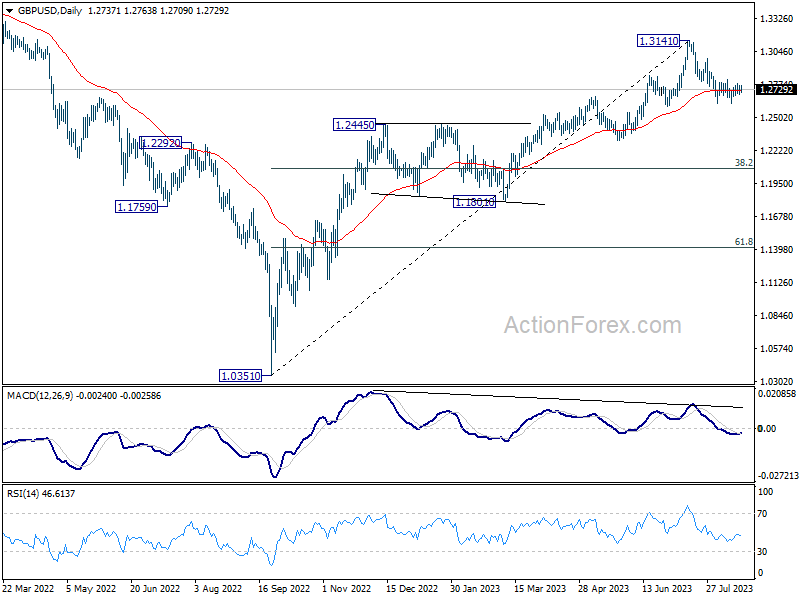
GBP/USD continues to trade inside established range and intraday bias remains neutral. On the downside, firm break of 1.2615, and sustained trading below 1.2678 resistance turned support will argue that it's already in a larger correction. Deeper decline would then be seen to 1.2306 support next. Nevertheless, break of 1.2817 minor resistance will indicate that the pull back from 1.3141 has completed, and turn bias back to the upside for stronger rebound.
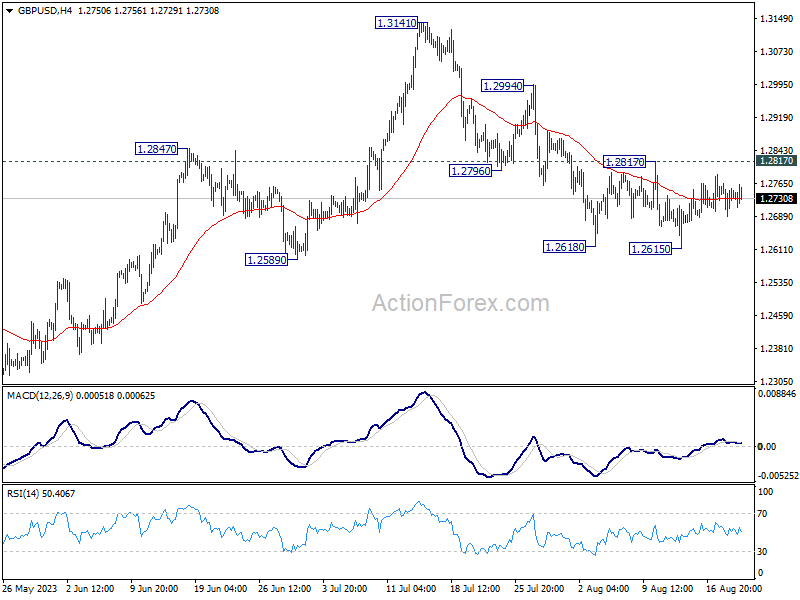
In the bigger picture, a medium term top could be in place at 1.3141 already, on bearish divergence condition in D MACD. Sustained trading below 55 D EMA (now at 1.2723) should confirm this case, and bring deeper fall to 38.2% retracement of 1.0351 to 1.3141 at 1.2075, as a correction to up trend from 1.0351 (2022 low). For now, rise will stay mildly on the downside as long as 1.3141 resistance holds, in case of strong rebound.
USD/CHF Mid-Day Outlook
Daily Pivots: (S1) 0.8783; (P) 0.8806; (R1) 0.8846; More....
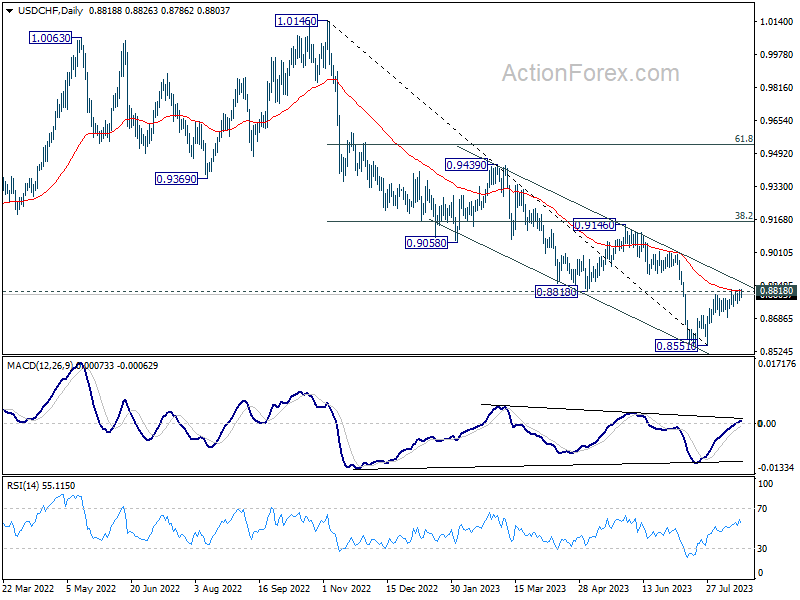
Range trading continues in USD/CHF and intraday bias stays neutral. On the upside, decisive break of 0.8818/26 resistance zone will carry larger bullish implication, and target 0.9146 cluster resistance next. However, break of 0.8688 support will indicate rejection by 0.8818, and turn bias back to the downside for retesting 0.8551 low.
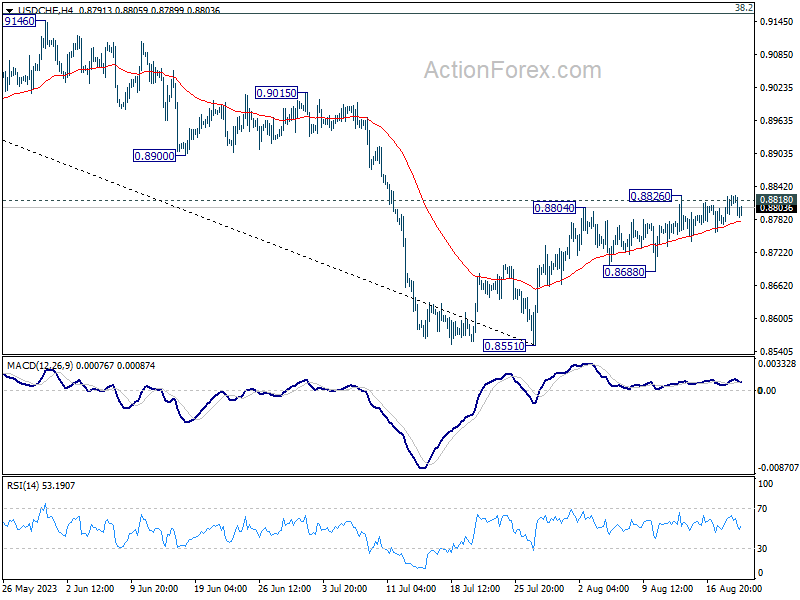
In the bigger picture, a medium term bottom could be in place at 0.8551 already, on bullish convergence condition in D MACD. Sustained trading above 0.8818 support turned resistance will bring further rise to 0.9146 cluster resistance (38.2% retracement of 1.0146 to 0.8551 at 0.9160), even as a correction. Nevertheless, break of 0.8851 will resume the down trend from 1.0146 instead.
USD/JPY Mid-Day Outlook
Daily Pivots: (S1) 144.92; (P) 145.40; (R1) 145.87; More...
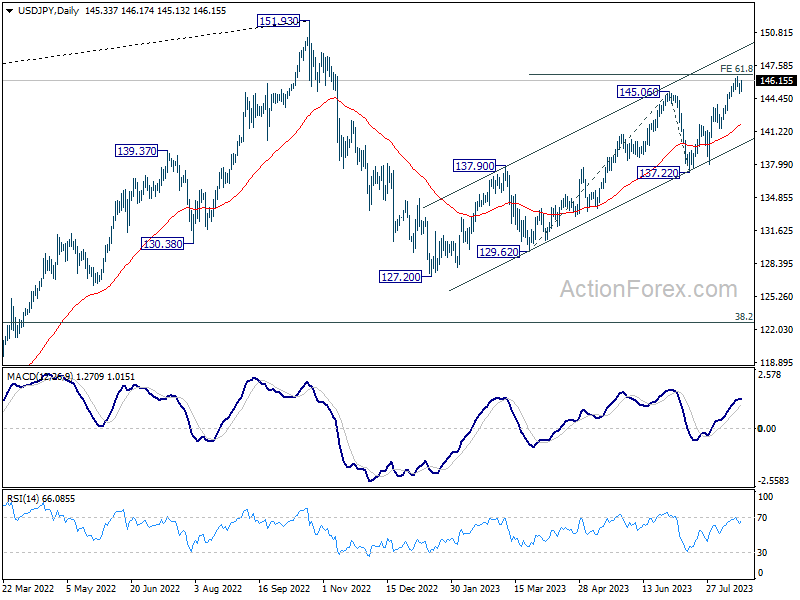
USD/JPY recovered ahead of 55 4H EMA but stays below 146.55 temporary top. Intraday bias remains neutral first. On the upside, sustained break of 61.8% projection of 129.62 to 145.06 from 137.22 at 146.76 will pave the way to retest 151.93 high. However, considering bearish divergence condition in 4H MACD, firm break of 143.88 resistance turned support will be a sign of reversal, and turn bias back to the downside for 55 D EMA (now at 141.92).
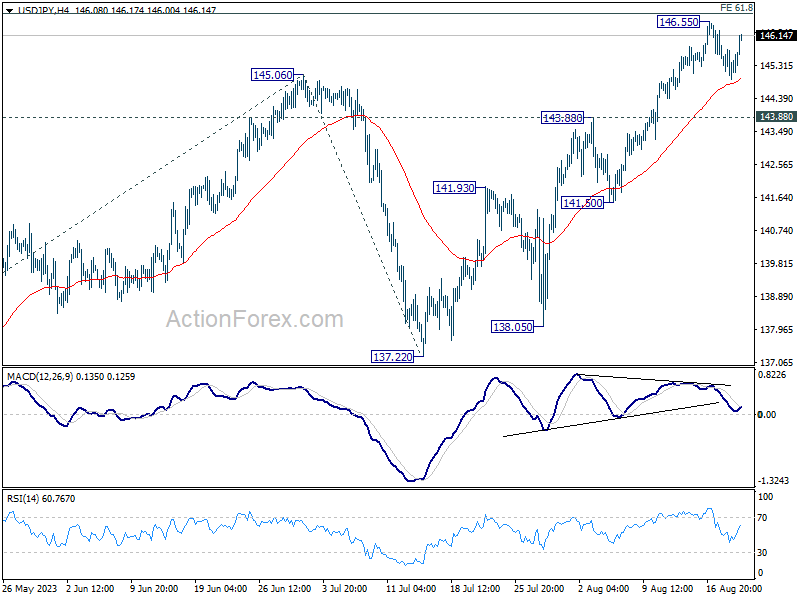
In the bigger picture, overall price actions from 151.93 (2022 high) are views as a corrective pattern. Rise from 127.20 is seen as the second leg of the pattern and could still be in progress. But even in case of extended rise, strong resistance should be seen from 151.93 to limit upside. Meanwhile, break of 137.22 support should confirm the start of the third leg to 127.20 (2023 low) and below.
Yen Faces Pressure Again Amid Rising Benchmark Yields in Europe and US
Japanese Yen is feeling the heat once again, buckling under the surge in major European and US benchmark yields. Notably, yield on Japan's 10-year JGB did jump, closing 0.655 today. However, this level has acted as a formidable ceiling for a while, even in the wake of BoJ's recent allowance hike to 1% last month. With this backdrop, Yen appears poised to challenge and possibly break recent support levels against its European counterparts and Dollar.
Elsewhere in the currency markets, Dollar finds itself in the dubious distinction of being one of the day's laggards just after Yen, with Australian and New Zealand dollars closely tailing. In stark contrast, Canadian Dollar emerges as the top performer for the day, likely buoyed by the uptick in oil prices. Swiss Franc clinches the second spot, with Euro closely on its heels, while the Sterling presents a more ambivalent picture.
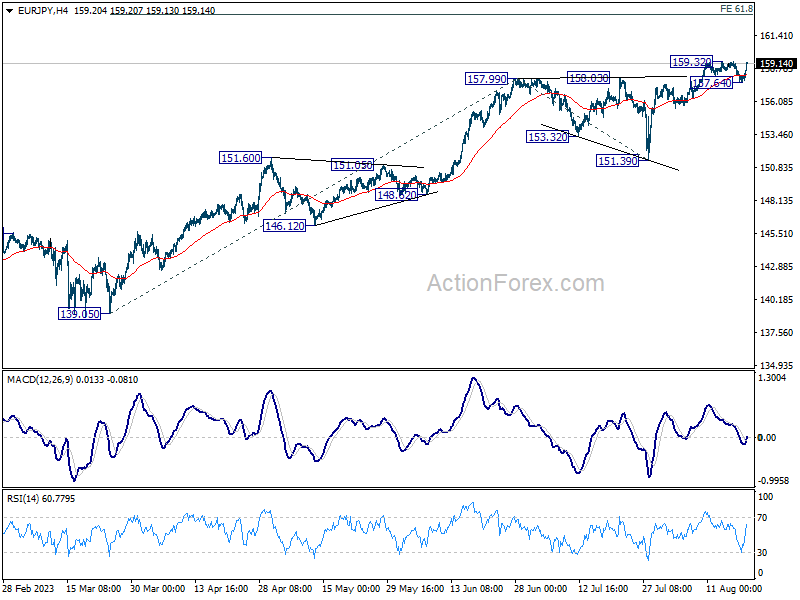
Technically, EUR/JPY's strong rally today argues that pull back from 159.32 has completed. Firm break of 159.32 will resume larger up trend to 61.8% projection of 139.05 to 157.99 from 151.39 at 163.09. At the same time, break of 186.45 resistance in GBP/JPY and 146.55 in USD/JPY would further confirm Yen's downside momentum.
In Europe, at the time of writing, FTSE is up 0.23%. DAX is up 0.50%. CAC is up 0.87%. Germany 10-year yield is up 0.0558 at 2.681. Earlier in Asia, Nikkei rose 0.37%. Hong Kong HSI dropped -1.82%. China Shanghai SSE dropped -1.24%. Singapore Strait Times dropped -0.63%. Japan 10-year JGB yield closed up 0.0245 to 0.655.
Bundesbank: Germany economy to stagnate, inflation to stay above 2%
In its latest monthly report, Bundesbank paints a sobering picture of the German economy, which remains ensnared in a weak phase. Key factors hampering growth include tepid foreign demand combined with escalating financing costs. The bank foresees the economic output remaining largely stagnant for the summer quarter.
Yet, it's not all gloom. Bundesbank highlights several silver linings. Stable employment conditions paired with robust wage hikes amidst decreasing inflation rates are expected to stimulate private consumption, continuing its recovery trajectory. This, in turn, offers a promising uplift for the service sector.
Nevertheless, the manufacturing sector poses significant concerns. Weak industrial production, attributed to a continued slump in demand for industrial goods, threatens to stymie the nation's broader economic progress. Interestingly, the report underscores that the recent recovery in demand is predominantly driven by large orders, typically characterized by extended processing times. In the absence of these large-scale orders, demand, both domestically and internationally, would plummet more precipitously.
Peering into the future, Bundesbank's experts anticipate declining inflation rate in the autumn, largely influenced by dropping energy prices. On the flip side, the institution projects wage growth to persistently remain strong, extending beyond 2023. This dynamic of robust wage growth amid other economic pressures is pinpointed as a primary factor likely to keep the inflation rate hovering above the 2 percent mark for an extended duration.
China cuts 1-yr LPR moderately, keeps 5-yr LPR unchanged
In a somewhat anticipated move, China's PBoC made a cut to its one-year loan prime rate by 10bps, settling it at 3.45%. This is a slight deviation from the 15bps reduction that the majority of economists had forecasted. What stands out is that this marks the second reduction in this rate in just a span of three months.
However, eyebrows were raised when PBOC decided to keep its five-year LPR — the benchmark for most mortgages in the country — steady at 4.2%. This move defied expectations of a 15 bps cut by many market watchers. The unaltered five-year LPR is being read by many as a signal of Chinese banks' hesitancy to compromise their rate differential margin. Such reluctance throws into sharp relief potential concerns about the effective transmission of PBOC's policy decisions into the broader market landscape.
Furthermore, it stirs up conversations about the central bank's capability to invigorate the property sector and the broader economy through monetary easing strategies. This narrative is all the more potent given that this decision on the one-year LPR came on the heels of an unexpected reduction in PBOC's medium-term policy rate just a week earlier. To give specifics, PBOC had reduced the one-year medium-term lending facility rate by 15 basis points, bringing it down to 2.50% from its previous 2.65%.
Considering these rate adjustments, many financial experts are now projecting more proactive measures from the PBOC in the forthcoming months. This may encompass further rate trims as well as potential reductions in the reserve requirement ratio for banks.
NZ exports down -14% yoy in Jul, imports down -16% yoy, China leads the falls
July 2023 has been a challenging month for New Zealand's trade scenario, as the island nation witnessed a steep fall in both goods exports and imports. Data released depicted a substantial decline, with exports plunging by NZD -890m or -14% yoy, concluding at NZD 5.5B. Concurrently, imports saw a -16% yoy decline, falling NZD -1.2B to settle at NZD 6.6B for the month. This decrease in trade volumes culminated in a monthly trade deficit of NZD -1.1B. This significantly overshadows market expectations of NZD -0.05B.
Zooming in on the country-by-country trade details, China conspicuously led the downturn in both exports and imports. New Zealand's exports to the Asian giant dipped by -24% yoy, translating to a decline of NZD -407m while imports reduced by a staggering NZD -427m, down -25% yoy.
However, not all trade relations showed a contraction. Australia the US emerged as silver linings, with their exports experiencing an upward trajectory. Exports to Australia saw an 8.9% yoy growth, adding NZD 59m to the tally, and US followed suit with a 16% yoy rise, upping the figure by NZD 105m.
Yet, as New Zealand engaged with its other major trade partners, the news wasn't all positive. European Union and Japan both registered a decrease in exports, declining by -16% yoy (NZD -73m) and -21% yoy (NZD -84m) respectively. On the import front, while USA and South Korea posted a rise of 24% (NZD 166m) and 18% (NZD 71m), both European Union (up 1.9% yoy) and Australia (down -2.7% yoy) experienced mixed results.
NZD/USD pressing channel support, could it bounce from here?
In recent weeks, the antipodean currencies have encountered turbulent waters, contending for the title of the month's poorest performers. Reserve Banks of both Australia and New Zealand are widely perceived to have reached the peaks of their ongoing tightening cycles. In contrast, ECB and BoE (and less certainly Fed) seem poised for further rate hikes. Also, the broader sentiment, underpinned by belief that global interest rates may remain elevated longer than previously anticipated, has notably dampened risk appetites.
However, recent economic concerns stemming from China have played a pivotal role in the accelerated depreciation of these currencies in the last fortnight. China's less-than-stellar economic recovery post its stringent Covid lockdowns, coupled with looming deflation risks and challenges in its property and finance sectors, have further intensified the pressure on the antipodean currencies. Additionally, PBoC milder than anticipated rate cut today further dampened sentiments towards these currencies.
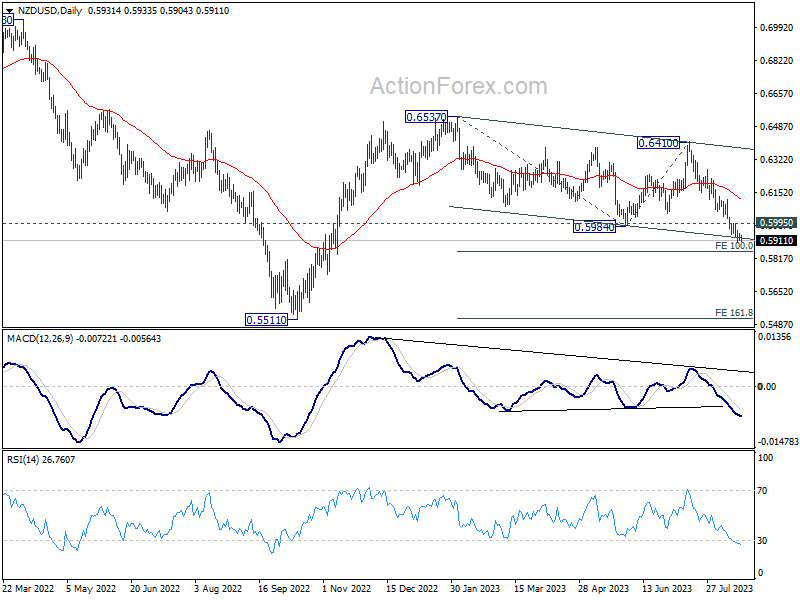
Technically speaking, however, there is prospect of a near term bounce in NZD/USD, given that it's now pressing a medium term channel support on oversold condition. Break above 0.5995 resistance will trigger a rebound to 55 D EMA (now at 0.6117). However, deeper decline and firm break of 100% projection of 0.6537 to 0.5984 from 0.6410 at 0.5857 could prompt downside acceleration to 161.8% projection at 0.5515, which is close to 0.5511 long term support (2022 low).
USD/JPY Mid-Day Outlook
Daily Pivots: (S1) 144.92; (P) 145.40; (R1) 145.87; More...
USD/JPY recovered ahead of 55 4H EMA but stays below 146.55 temporary top. Intraday bias remains neutral first. On the upside, sustained break of 61.8% projection of 129.62 to 145.06 from 137.22 at 146.76 will pave the way to retest 151.93 high. However, considering bearish divergence condition in 4H MACD, firm break of 143.88 resistance turned support will be a sign of reversal, and turn bias back to the downside for 55 D EMA (now at 141.92).
In the bigger picture, overall price actions from 151.93 (2022 high) are views as a corrective pattern. Rise from 127.20 is seen as the second leg of the pattern and could still be in progress. But even in case of extended rise, strong resistance should be seen from 151.93 to limit upside. Meanwhile, break of 137.22 support should confirm the start of the third leg to 127.20 (2023 low) and below.
Economic Indicators Update
| GMT | Ccy | Events | Actual | Forecast | Previous | Revised |
|---|---|---|---|---|---|---|
| 22:45 | NZD | Trade Balance (NZD) Jul | -1107M | -50M | 9M | -111M |
| 23:01 | GBP | Rightmove House Price Index M/M Aug | -1.90% | -0.20% | ||
| 06:00 | EUR | Germany PPI M/M Jul | -1.10% | -0.20% | -0.30% | |
| 06:00 | EUR | Germany PPI Y/Y Jul | -6.00% | -5.10% | 0.10% | |
| 12:30 | CAD | New Housing Price Index M/M Jul | -0.10% | 0.00% | 0.10% |
WTI Oil Technical: Potential Bullish Reversal to Resume Medium-Term Uptrend
- The recent decline of -6.8% from its 10 August 2023 high has not damaged the medium-term uptrend phase of WTI oil.
- Today’s price actions have indicated a revival of a short-term uptrend phase.
- Watch the key short-term support at US$80.90.
The price actions of West Texas Oil (a proxy of WTI crude oil futures) have indeed shaped the expected minor short-term pull-back and broke below US$79.80 per barrel minor support as it printed an intraday low of US$79.11 last Thursday, 17 August.
All in all, it has recorded an accumulated decline of -6.8% from its 10 August 2023 high of US$84.92 but from a technical analysis perspective, the medium-term uptrend phase in place since 28 June 2023 low of US$66.95 remains intact.
Medium-term momentum has turned positive
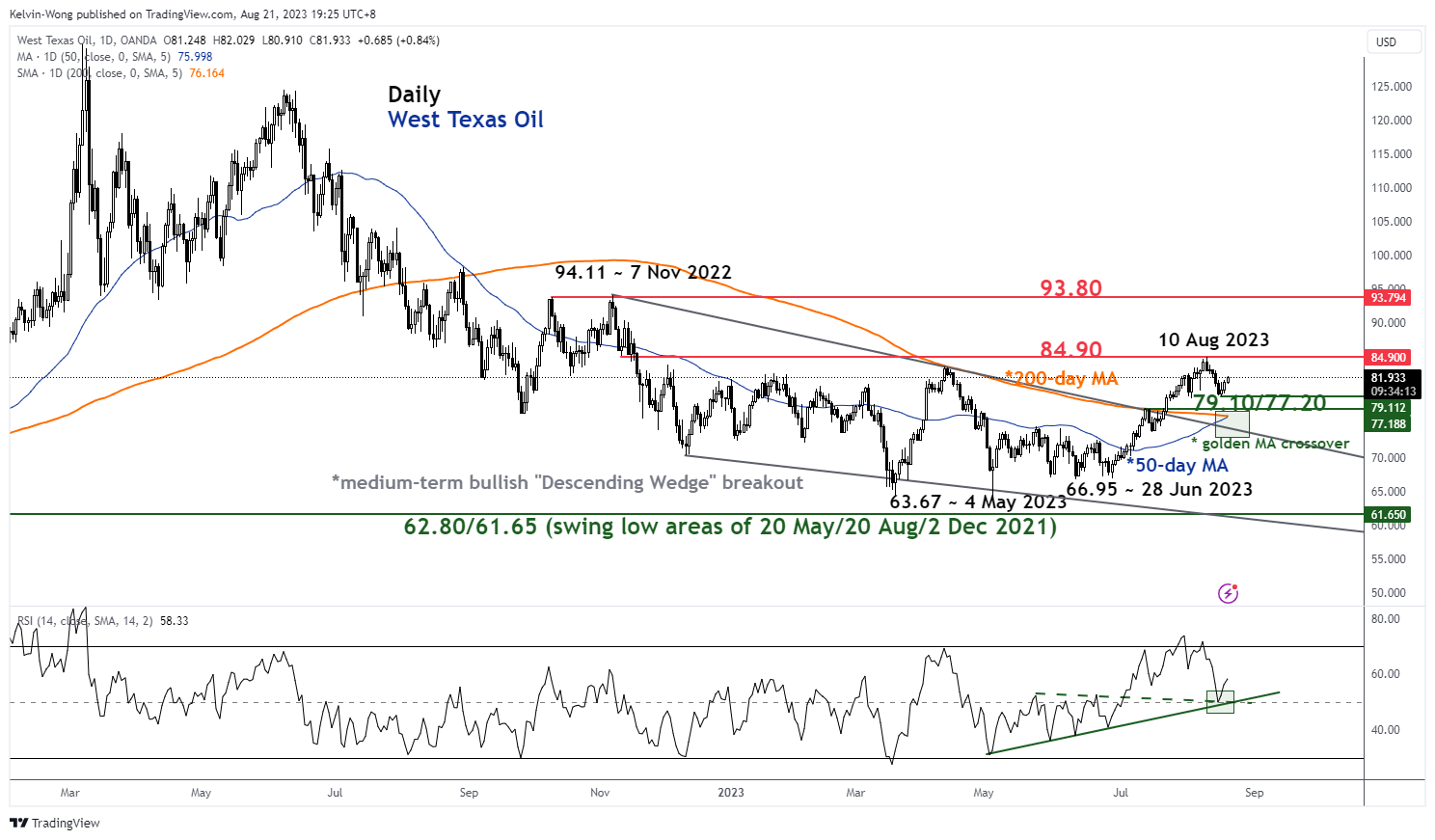
Fig 1: West Texas Oil medium-term trend as of 21 Aug 2023 (Source: TradingView, click to enlarge chart)
Recent price actions of West Texas Oil have led to the emergence of an imminent “golden crossover” bullish condition seen in the 50-day and 200-day moving averages.
In addition, the daily RSI oscillator has also just staged a rebound right at a key parallel support at the 50 level. These observations suggest that medium-term bullish momentum may have resurfaced which in turn increases the odds of the continuation of a potential impulsive up move sequence within its medium-term uptrend phase in place since the 28 June 2023 low.
Evolving into a minor short-term uptrend
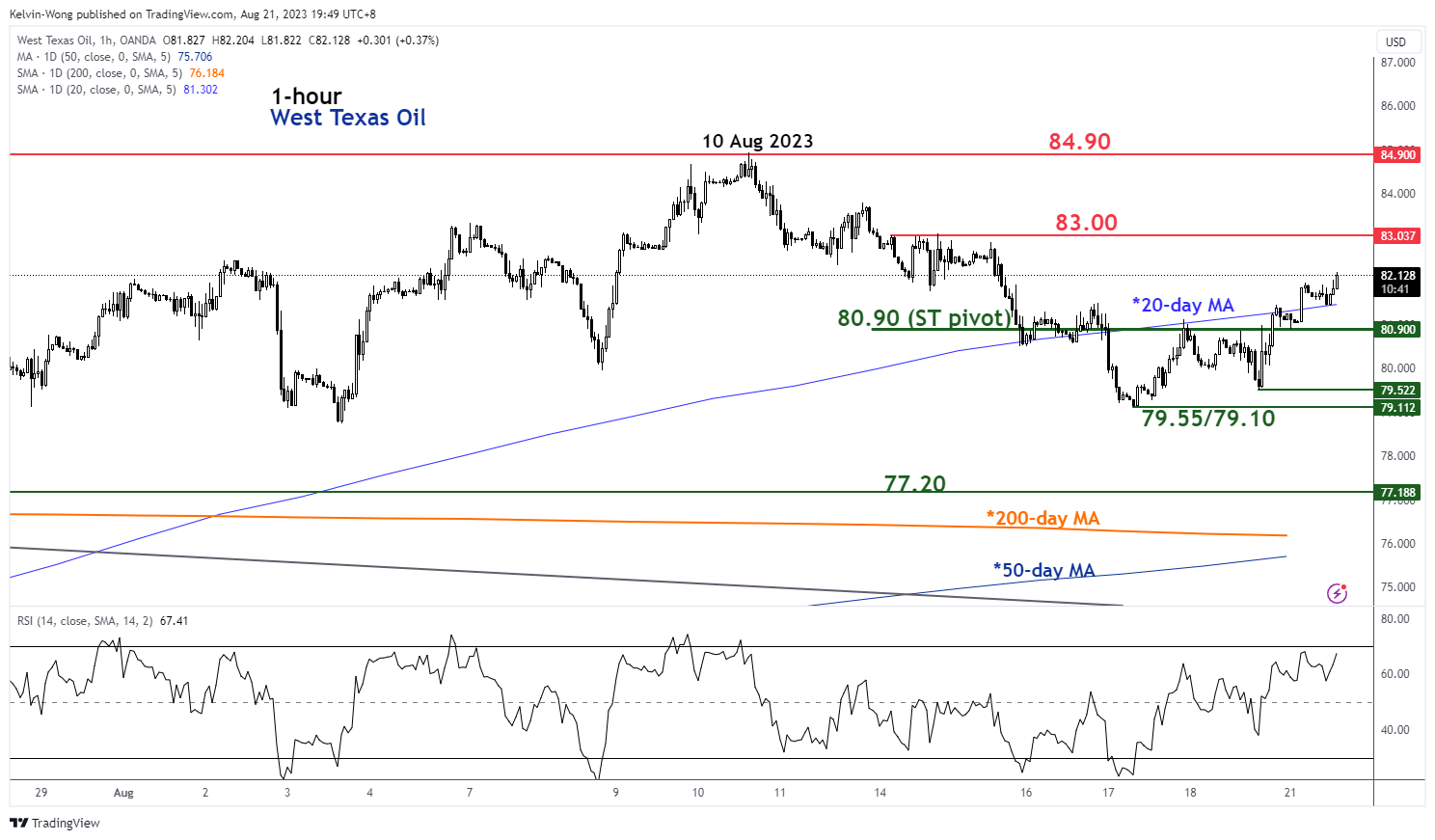
Fig 2: West Texas Oil minor short-term trend as of 21 Aug 2023 (Source: TradingView, click to enlarge chart)
Today’s price action has just surpassed the 20-day moving average which suggests the potential start of a minor short-term uptrend phase for West Texas Oil.
Watch the US$80.90 key short-term pivotal support to see the next intermediate resistance coming in at US$83.00 before a retest on the 10 August 2023 swing high of US$84.90.
However, a break below US$80.90 negates the bearish tone to expose the US$79.55/79.10 support.
Bundesbank: Germany economy to stagnate, inflation to stay above 2%
In its latest monthly report, Bundesbank paints a sobering picture of the German economy, which remains ensnared in a weak phase. Key factors hampering growth include tepid foreign demand combined with escalating financing costs. The bank foresees the economic output remaining largely stagnant for the summer quarter.
Yet, it's not all gloom. Bundesbank highlights several silver linings. Stable employment conditions paired with robust wage hikes amidst decreasing inflation rates are expected to stimulate private consumption, continuing its recovery trajectory. This, in turn, offers a promising uplift for the service sector.
Nevertheless, the manufacturing sector poses significant concerns. Weak industrial production, attributed to a continued slump in demand for industrial goods, threatens to stymie the nation's broader economic progress. Interestingly, the report underscores that the recent recovery in demand is predominantly driven by large orders, typically characterized by extended processing times. In the absence of these large-scale orders, demand, both domestically and internationally, would plummet more precipitously.
Peering into the future, Bundesbank's experts anticipate declining inflation rate in the autumn, largely influenced by dropping energy prices. On the flip side, the institution projects wage growth to persistently remain strong, extending beyond 2023. This dynamic of robust wage growth amid other economic pressures is pinpointed as a primary factor likely to keep the inflation rate hovering above the 2 percent mark for an extended duration.
Crude Oil Finds Stability Amidst Price Recovery
The commodity market has stabilised as the new week begins. The price of a barrel of Brent is hovering around 85.40 USD.
The price recovery is observed for the third consecutive day. Market expectations are tied to China: there are reasons to believe that the Chinese authorities will implement additional measures in their stimulus-driven economic policy.
Meanwhile, market players continue to exercise caution. The Federal Reserve System recently announced its readiness to continue tightening its monetary policy to combat inflation. At the same time, the economic outlook for China remains uncertain.
Technical analysis of Spot Brent Crude Oil:
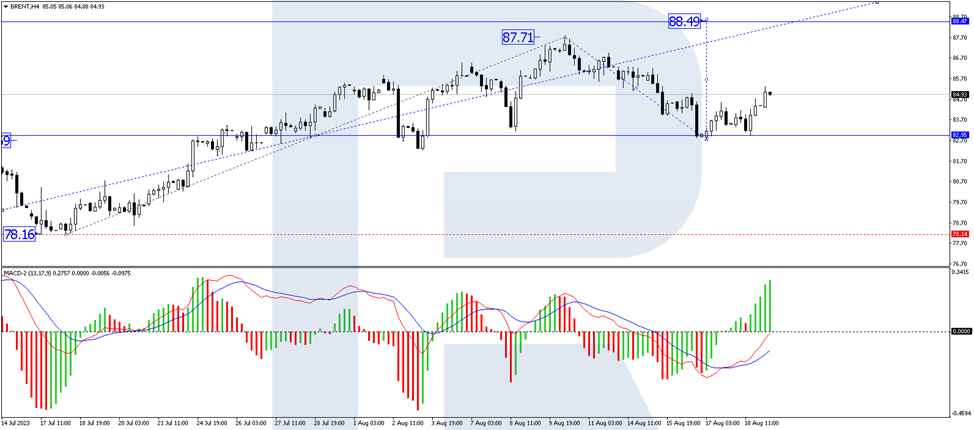
On the H4 Brent chart, the price has rebounded from the support level and is now developing an ascending wave to 88.50. This is a local target. After the price reaches it, a link of declining correction to 85.75 might follow (with a test from above). Next thing, a rise to 94.50 could be expected. Technically, this scenario is confirmed by the MACD, whose signal line has left the histogram area and is aimed strictly upwards.
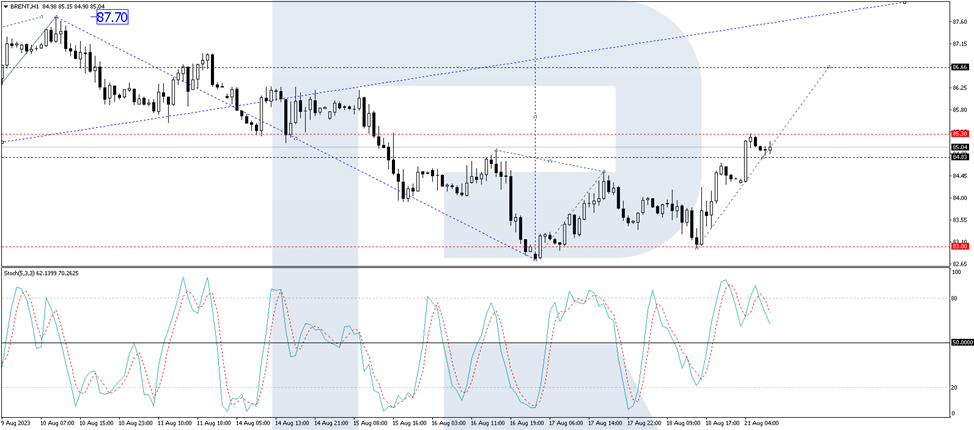
On the H1 Brent chart, a structure of an impulse to rise to 85.30 has formed. Today a narrow consolidation range is expected to develop below it. An escape from the range upwards might facilitate the development of a wave to 86.66, from where the trend could continue to 88.50. Technically, this scenario is confirmed by the Stochastic oscillator with the signal line under 80, ready to renew the highs.
German PPI’s Sharp Drop Lifts Peak-Rates Hopes
The sharp fall in German producer prices is both a signal of easing inflationary pressures and a warning of a sharp slowdown in demand.
The German producer price index fell by 1.1% in July, dwarfing the expected correction of 0.1%. Prices are 6% lower than a year ago, marking the sharpest annual decline since 2009.
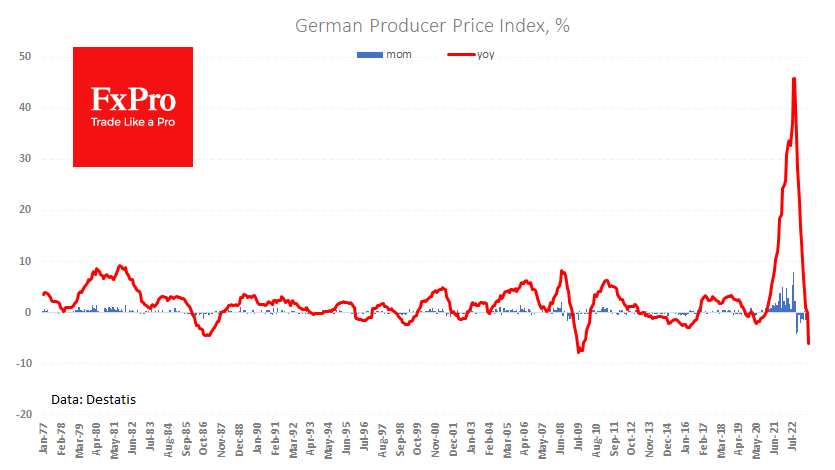
The data shows how quickly producers are cutting prices after the value of imports fell 11.4% y/y in June. This momentum raises hopes that inflation in Germany may not be as sticky as in other advanced economies, where rising service costs and a tight labour market are pushing up final prices.
Rapidly falling prices and weak business sentiment indicators have brought Germany’s title ‘Sick man of Europe’ back into the spotlight, although such comparisons seem premature. Germany, which has often been resolute in its fight against inflation, may soften its stance.
In that case, the chances of further rate hikes by the ECB may diminish. Signs of a slowdown in the German economy, which is more exposed to China and Russia than other major eurozone economies, point in the same direction.
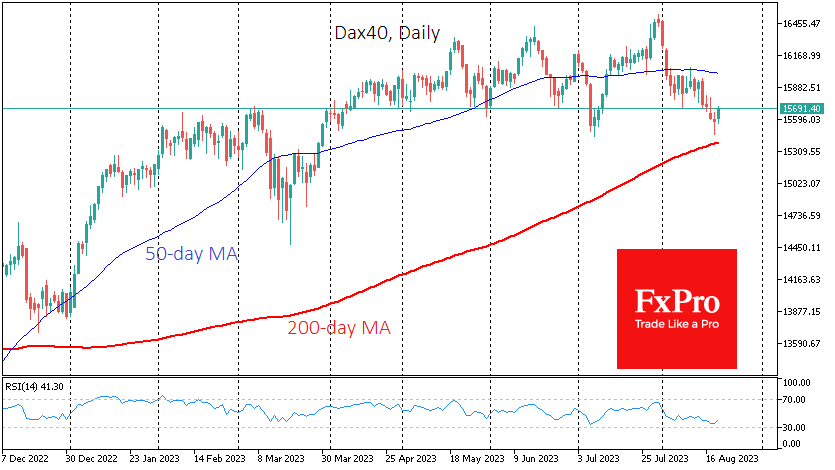
The German DAX40 is up 0.8% today, and the EuroStoxx50 is up over 1%, actively recovering from last week’s losses. This is fuelled by positive traction in US index futures and hopes the ECB rate hike is nearing its peak. Interestingly, the EURUSD is also rising, maintaining its positive correlation with equity market dynamics, temporarily having more weight on the market than the interest-rate differential perspective.
Another Rough Week for Australian Dollar
- AUD/USD close to 9-month lows
- China fails to cut 5-year LPR
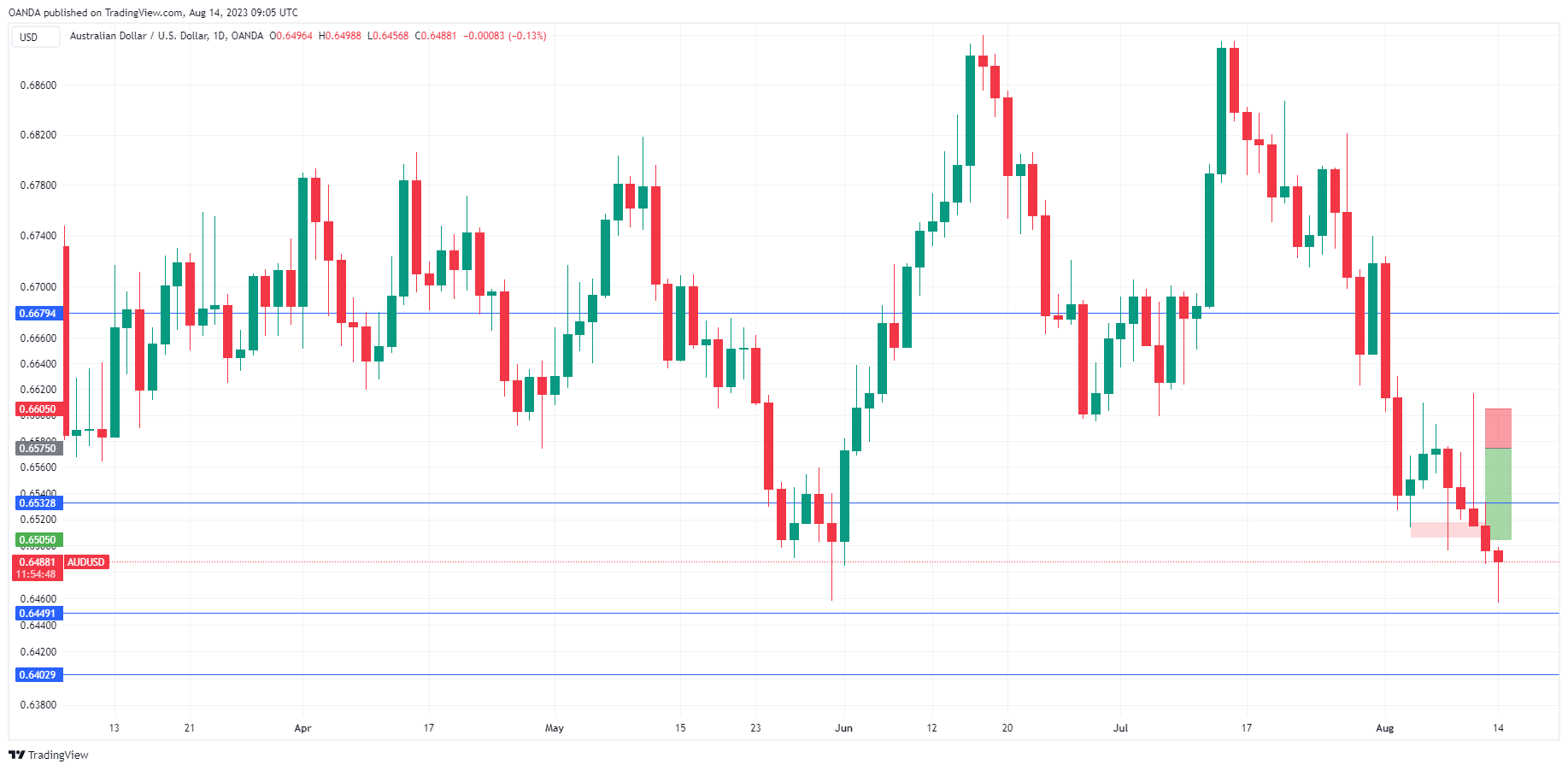
The Australian dollar is steady at the start of the new trading week. In the European session, AUD/USD is unchanged at 0.6404. It’s a very quiet week for Australian releases, with no tier-1 releases. On Wednesday, Australia releases services and manufacturing PMIs for August. Services and manufacturing both contracted in July, with readings below the 50.0 level.
The Aussie has hit a rough patch and has reeled off five straight losing weeks against the US dollar, sliding over 400 basis points in that period. The economic picture in China continues to deteriorate, and this has been a major reason for the Australian dollar’s sharp deterioration.
China is Australia’s number one trading partner, and when China sneezes there’s a good chance Australia will catch a cold. China’s economic data has been pointing downward and the world’s second-largest economy is experiencing deflation. Last week, Evergrande, a huge Chinese property developer, filed for bankruptcy in New York, raising fears of contagion to other parts of the economy.
The People’s Bank of China (PBOC) responded to the economic slowdown with a surprise cut to the one-year medium-term lending rate. The central bank was expected to follow up with cuts to the one-year and five-year loan prime rates (LPR). On Monday, the PBOC trimmed its one-year LPR from 3.55% to 3.45%, but surprisingly, did not lower the 5-year LPR, a key lending rate that affects mortgages.
Lower lending rates are intended to boost credit demand, but the central bank’s lukewarm move is unlikely to provide much of a boost to China’s ailing economy. That does not bode well for the struggling Australian dollar, and if China’s economy continues to show signs of weakening, I would expect the Australian dollar to continue losing ground.
AUD/USD Technical
- AUD/USD is putting pressure on resistance at 0.6431. Next, there is resistance at 0.6496
- There is support at 0.6339 and 0.6274
NZD/USD pressing channel support, could it bounce from here?
In recent weeks, the antipodean currencies have encountered turbulent waters, contending for the title of the month's poorest performers. Reserve Banks of both Australia and New Zealand are widely perceived to have reached the peaks of their ongoing tightening cycles. In contrast, ECB and BoE (and less certaintly Fed) seem poised for further rate hikes. Also, the broader sentiment, underpinned by belief that global interest rates may remain elevated longer than previously anticipated, has notably dampened risk appetites.
However, recent economic concerns stemming from China have played a pivotal role in the accelerated depreciation of these currencies in the last fortnight. China's less-than-stellar economic recovery post its stringent Covid lockdowns, coupled with looming deflation risks and challenges in its property and finance sectors, have further intensified the pressure on the antipodean currencies. Additionally, PBoC milder than anticipated rate cut today further dampened sentiments towards these currencies.
Technically speaking, however, there is prospect of a near term bounce in NZD/USD, given that it's now pressing a medium term channel support on oversold condition. Break above 0.5995 resistance will trigger a rebound to 55 D EMA (now at 0.6117). However, deeper decline and firm break of 100% projection of 0.6537 to 0.5984 from 0.6410 at 0.5857 could prompt downside acceleration to 161.8% projection at 0.5515, which is close to 0.5511 long term support (2022 low).