Sample Category Title
GBP/USD Tests Resistance
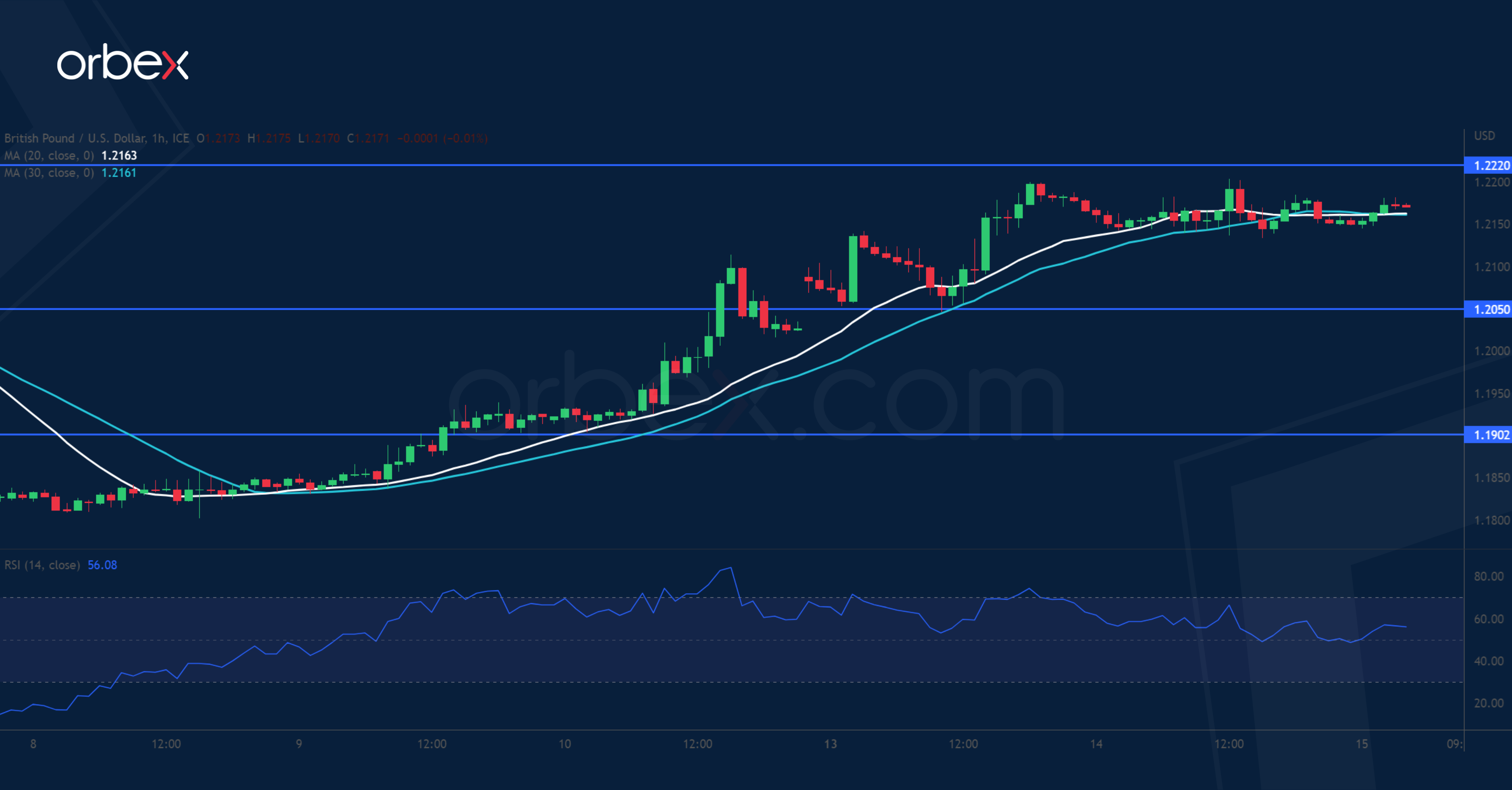
The US dollar struggles as data show a slowdown in headline inflation in February. Cable’s recovery above 1.2050 then the double top at 1.2140 has put the pair back on track after a three-month long consolidation. 1.2050 has turned into a support to keep the latest momentum going while 1.1900 further down is where the bulls would draw a line in the sand. A close above the mid-February spike of 1.2220 may extend gains to this year’s high at 1.2430, which would be a step closer to a bullish continuation in the medium-term.
We Expect ECB to Stick to Its Guidance of a 50 bps Rate Hike Tomorrow
Markets
Volatility on especially rate markets remained high yesterday. Markets in the end erased part of the fallout of the SVB and Signature Bank collapse & government deposit bailout. The jury is still out on whether these two regional bank failures are “isolated” events or whether larger systemic risks to financial stability loom. It puts the Fed in difficult position next week when it gathers following two months of hot labour market data and stubbornly high inflation readings. Yesterday’s core CPI printed marginally stronger at 0.5% M/M and 5.5% Y/Y with core services inflation showing no signs of slowing. The data argue in favour of accelerating tightening to 50 bps, but the regional banking crisis pleads for sticking to January’s 25 bps hike. The latter is the more likely and discounted scenario. Providing guidance for the rest of the year via the Summary of Economic Projections will be a tough call for Fed governors given the recent hiccup. Ceteris paribus, we think the Fed will use its regulatory macroprudential framework to map financial stability risks (expected May 1; ahead of May 3 policy meeting) and keep its eyes on the price(s). US money markets reverted to discounting a too dovish policy path going forward (<5% policy rate peak with 50 bps rate cut discounted by end 2023) in this scenario. US yields yesterday closed the session 9.2 bps (30-yr) to 27.4 bps (2-yr) higher with intraday moves even larger. Compared to last Wednesday’s close, US yields are still 30 bps lower at the 10-yr tenor and 80 bps at the 2-yr. German yields added 13.4 bps (30-yr) to 20.2 bps (2-yr) yesterday. A similar weekly comparison shows them being 23 bps lower on the 10-yr and 45 bps at the 2-yr. We expect the ECB to stick to its guidance of a 50 bps rate hike tomorrow (currently not completely discounted) while holding back on strong guidance for the May policy meeting. As for the US, European money markets are currently positioned way too soft with a policy rate peak of 3.50% by autumn. US equity markets rebounded 1% to (Dow) to 2% (Nasdaq) but came off intraday highs after the collision between a Russian fighter jet and a US drone. FX markets stomached the whole banking crisis best as again witnessed in yesterday’s rangebound EUR/USD-session between roughly 1.07 and 1.0750. There are more signs of cautious relief this morning with the front end of the US yield curve underperforming. Asian stock markets gain around 1.5%. Today’s eco calendar contains US PPI data, retail sales and Empire Manufacturing Survey. Markets are unlikely to be tempted to react on them. They’ll first want more evidence that the regional US banking issues don’t ask for another victim. Yesterday’s market action in this respect was constructive. UK markets will look to Chancellor Hunt’s annual budget release. EUR/GBP yesterday tried to find a way below 0.88 on strong labour market data, but failed to do so.
News and views
New Zealand’s annual current account deficit amounted to NZD 33,8bn in 2022. The current account deficit ratio jumped from 6.0% of GDP in 2021 to 8.9%, the highest deficit ratio since start of the series in 1988. The rise in the deficit was mainly due to a NZD 10bn widening of the goods and services balance and a NZD 2.7% rise of the income deficit. Imports of goods and services rose NZD 23bn (25.8%). Exports of goods and services rose only NZD 13,1bn (16.8%). “Since New Zealand’s borders opened more New Zealanders have been travelling overseas. The spending on both air transport and travel contributed to the rise in services imports for the year to December 2022,” institutional sectors senior manager Paul Pascoe said. In a comment on Bloomberg, S&P global was quoted that the New Zealand Credit rating could come under pressure as the deficit was much wider than the agency expected. S&P currently has foreign currency rating of AA+ and a AAA local currency rating for the country. The kiwi dollar eased slightly this morning to NZD/USD 0.622
A series of February China eco data published this morning showed a mixed picture on the pace of the recovery after the country abruptly changed its Covid-19 approach end last year. Retail sales in the first two months of the year were 3.5% higher compared to the same month last year (was minus 1.8% in Dec), broadly as expected. However, industrial production gaining 2.6% Y/Y lagged expectations. Fixed assets investment accelerated to 5.5% Y/Y. Residential property investment still printed negative (-5.7%) compared to the same month last year. The rise in fixed asset investment suggests that growth might remain dependent on persistent government support. The yuan this morning weakened slightly against a dollar that was marginally stronger overnight (USD/CNY 6.8875).
GBP/JPY Daily Outlook
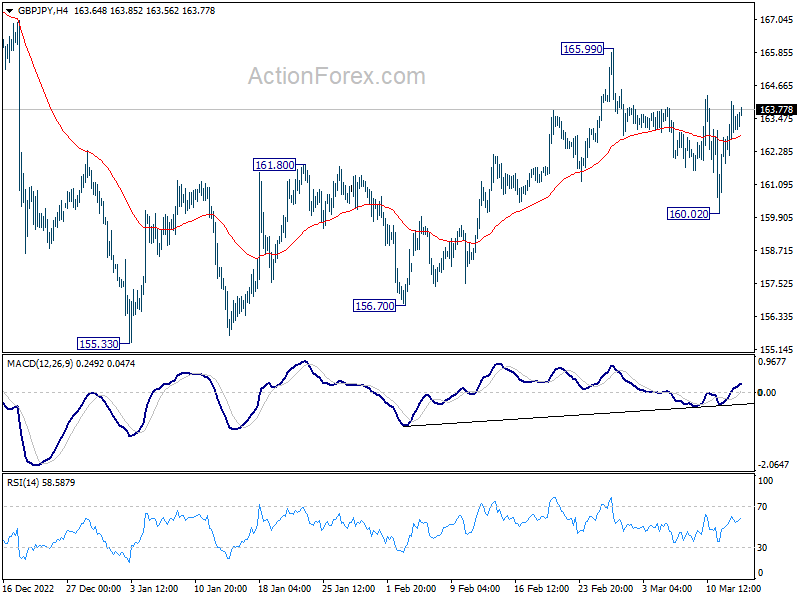
Daily Pivots: (S1) 162.01; (P) 163.04; (R1) 164.22; More...
Intraday bias in GBP/JPY remains neutral first. On the upside, break of 165.99 resistance will resume the rally from 155.33. That would also revive the case that correction from 172.11 has completed. Further rise should be seen back to retest 172.11 high. However, below 160.02 will bring deeper fall to 156.70 support instead.
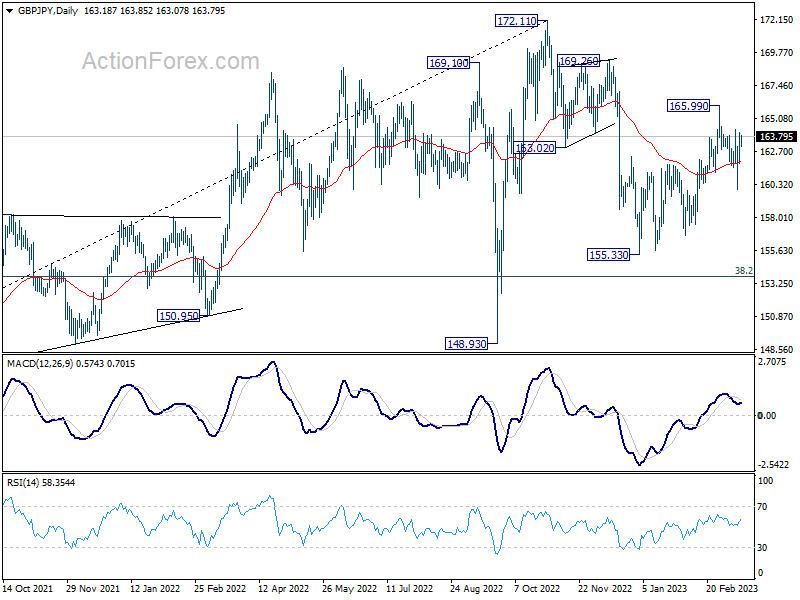
In the bigger picture, as long as 38.2% retracement of 123.94 (2020 low) to 172.11 (2022 high) at 153.70 holds, medium term bullishness is retained. That is, larger up trend from 123.94 (2020 low) is still in progress. Break of 172.11 high to resume such up trend is expected at a later stage.
EUR/JPY Daily Outlook
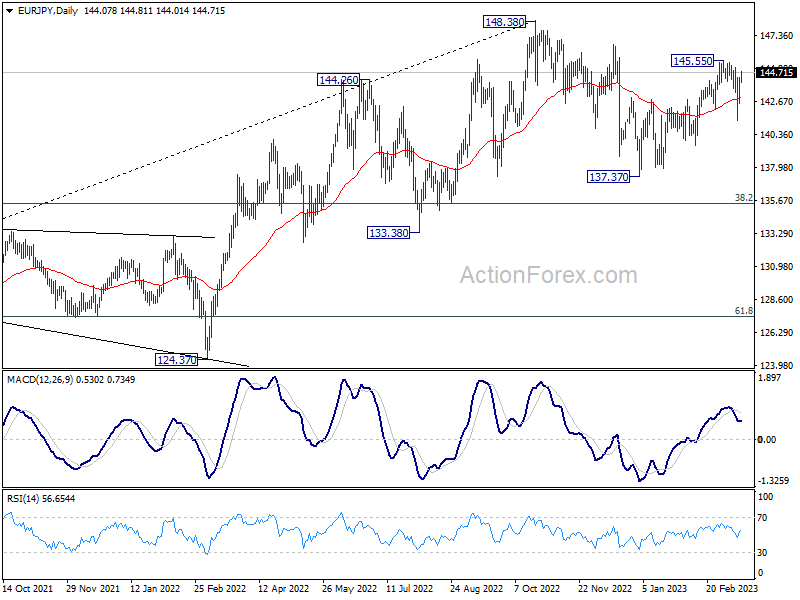
Daily Pivots: (S1) 142.92; (P) 143.67; (R1) 144.79; More....
Intraday bias in EUR/JPY stays neutral for the moment. On the upside, firm break of 145.55 resistance will resume the rise from 137.37. That would also revive the case that correction from 148.38 has completed. Bias will be turned back to the upside for retesting 148.38 high. On the downside, however, break of 141.36 will bring another decline to 139.54 support.

In the bigger picture, as long as 55 week EMA (now at 139.54) holds, larger up trend from 114.42 (2020 low) is still in progress for 149.76 long term resistance. However, firm break of 55 week EMA will bring deeper fall to 38.2% retracement of 114.42 to 148.38 at 135.40. Sustained break there will raise the chance of trend reversal, and target 61.8% retracement at 127.39.
EUR/GBP Daily Outlook
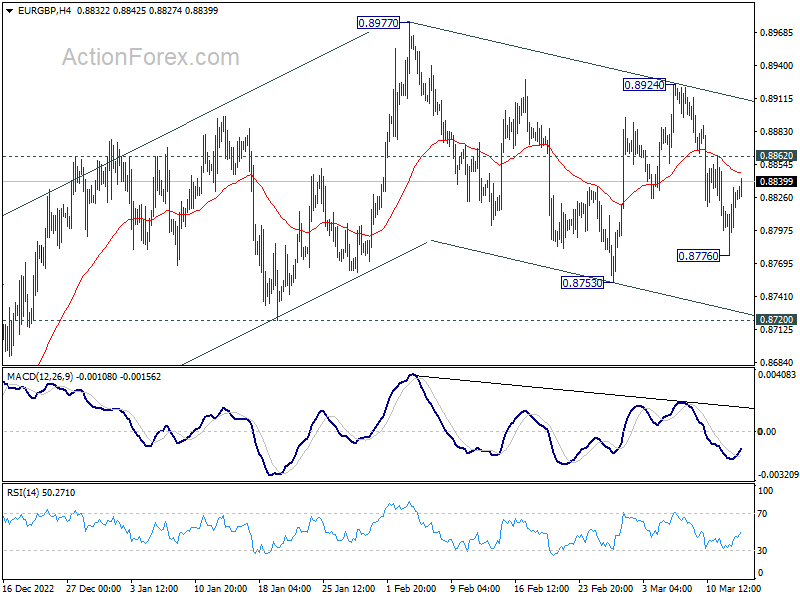
Daily Pivots: (S1) 0.8792; (P) 0.8814; (R1) 0.8850; More...
Intraday bias in EUR/GBP is turned neutral first as it recovered after dipping to 0.8776. Outlook is unchanged that corrective pattern from 0.8977 might extend further. Below 0.8776 will target 0.8753 support and below. But strong support is expected from 0.8720 to contain downside and bring rebound. On the upside, above 0.8862 minor resistance will turn bias back to the upside for 0.8924 resistance and above.
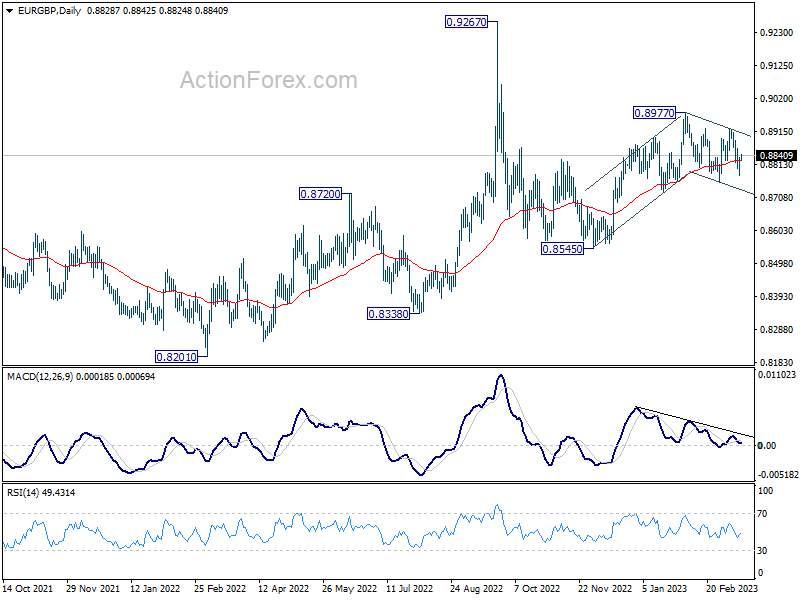
In the bigger picture, outlook is rather mixed for now, except that price actions from 0.9267 (2022 high) are part of the long term range pattern from 0.9499 (2020 high). With 0.8720 support intact, rise from 0.8545 is in favor to continue through 0.8977. However, firm break of 0.8720 will argue that such rebound has completed, and open up deeper fall through this support level.
EUR/AUD Daily Outlook
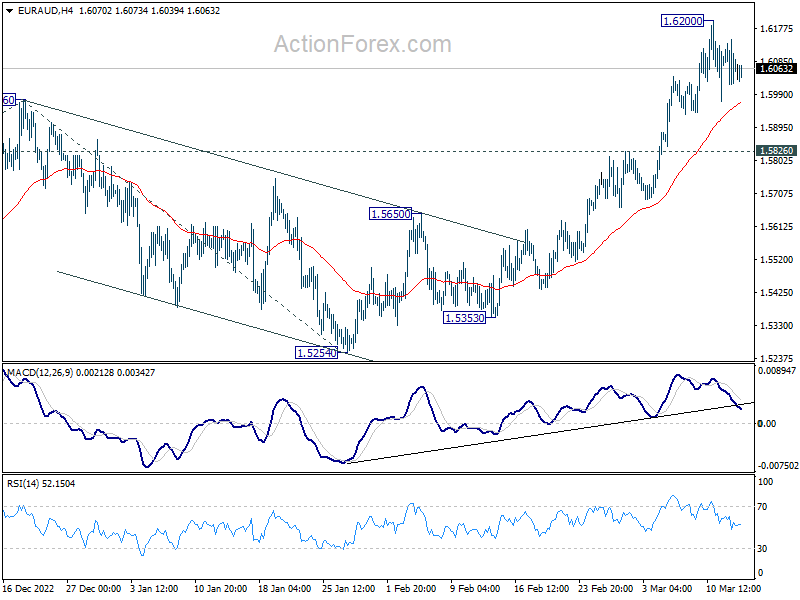
Daily Pivots: (S1) 1.6008; (P) 1.6073; (R1) 1.6126; More...
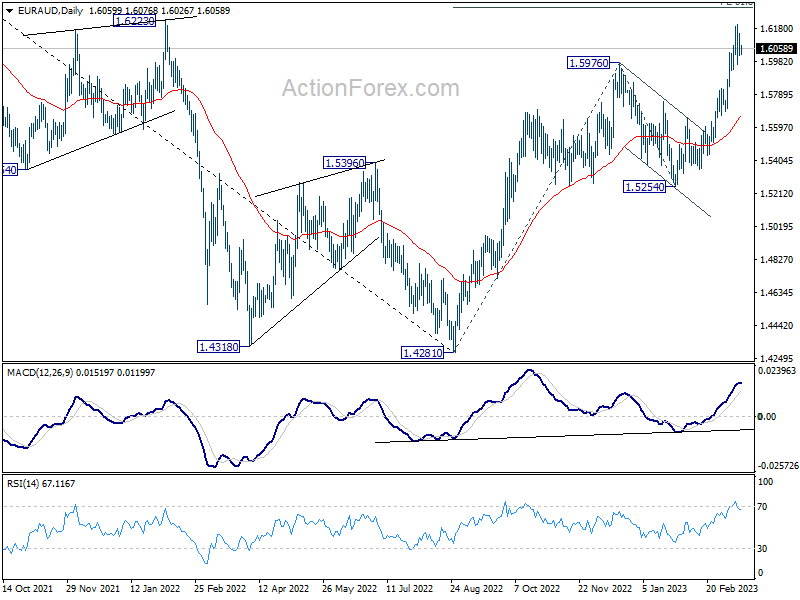
Intraday bias in EUR/AUD remains neutral for consolidation below 1.6200. Downside of retreat should be contained by 1.5826 support to bring another rally. Break of 1.6200 will resume the larger rise from 1.4281 to 61.8% projection of 1.4281 to 1.5976 from 1.5254 at 1.6302 next.
In the bigger picture, the strong support from 55 week EMA (now at 1.5396) is raising the chance of bullish trend reversal. Focus is now on 1.6434 cluster resistance (38.2% retracement of 1.9799 to 1.4281 at 1.6389). Sustained break there should confirm that whole down trend from 1.9799 (2020 high) has completed. Further rally should then be seen to 61.8% retracement at 1.7691. However, rejection by this cluster resistance will make medium term outlook neutral at best.
EUR/CHF Daily Outlook
Daily Pivots: (S1) 0.9766; (P) 0.9794; (R1) 0.9841; More...
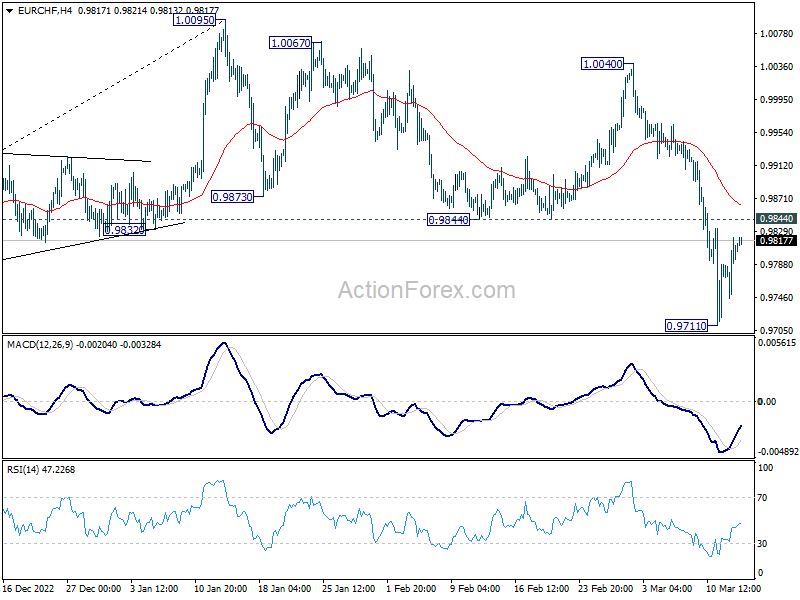
Intraday bias in EUR/CHF remains neutral for the moment and some more consolidations could be seen above 0.9711. Upside of recovery should be limited by 0.9844 support turned resistance to bring another decline. As noted before, rebound 0.9407 could have completed at 1.0095 already. Below 0.9711 will target 61.8% retracement of 0.9407 to 1.0095 at 0.9670. Sustained break there will bring deeper fall to retest 0.9407 low. Overall, risk will stay on the downside as long as 55 day EMA (now at 0.9906) holds.
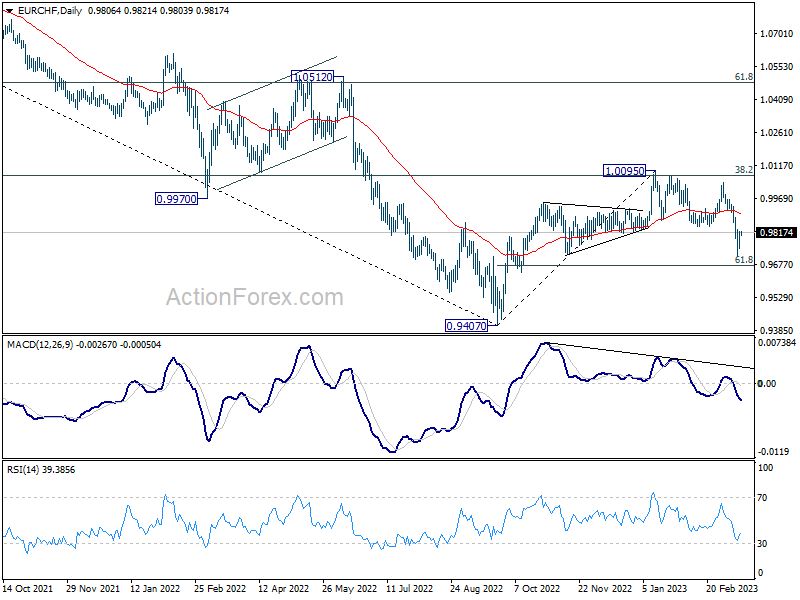
In the bigger picture, rejection by 55 week EMA (now at 1.0011) and 38.2% retracement of 1.1149 to 0.9407 at 1.0072 suggests that medium term outlook is staying bearish. That is, down trend from 1.2004 is not completed yet and is in favor to resume through 0.9407 at a later stage. For now, this will be the favored case as long as 1.0095 resistance holds.
Fed Expectations Back a 25bp Hike in the Wake of CPI Data
Global banks, including the US regional banks, rebounded sharply on Tuesday.
As such, the past days’ banking stress has been rapidly contained after the US government put in place the necessary measures to restore confidence.
The return of confidence in the banking sector sent the US bond prices lower, and the yields higher. But the big jump in US yields was the countercoup of a historic slump and didn’t prevent the S&P500 from recording a 1.65% advance on Tuesday. Nasdaq 100 rallied 2.30%.
A collision between a Russian jet and a US drone over the Black Sea – denied by Russia, and the US inflation report came to tame a part of the joy over the banking relief.
US futures hint at a flat open.
US inflation cements 25bp hike expectations
The US inflation data came in line with expectations on a yearly basis. The headline inflation fell from 6.4% to 6% as expected, and core inflation eased from 5.6% to 5.5%, as expected.
Yet, the uptick in core inflation on a monthly basis to 0.5% - a five-month high, and the stickiness of services inflation above the 7% mark, revived the Federal Reserve (Fed) hawks on fear that we may no longer see inflation trend lower in the coming months, if the Fed stopped tightening now and here.
Discomfort regarding the US inflation data, combined with the gently waning stress in banks, brought the expectation of a 25bp hike back on the table.
Note that, if we hadn’t had the SVB debacle, that expectation would’ve easily been stuck around 50bp. And this is something that we could see reflected in the Fed’s March dot plot.
Today, investors will keep an eye on US PPI data and the Empire Manufacturing index.
ECB will likely stick to 50bp hike
The EURUSD is drilling above its 50-DMA, 1.0730, in the run up to Thursday’s European Central Bank (ECB) meeting.
Many wonder whether the ECB will soften its tone in the wake of tensions across bank stocks over the past week.
But the chances are that the ECB will maintain its plan to raise the rates by 50bp at tomorrow’s policy meeting, and the divergence between a more dovish Fed due to the US banking stress, and a confidently hawkish ECB could help the euro recover against the greenback, and bring the 1.10 target back in sight.
Budget day
In the UK, the Chancellor of Exchequer will make a budget statement to the MPs in the House of Commons today.
At today’s statement, there will likely be no tax cuts despite a terrible cost-of-living crisis, however the government will likely keep the £2500 per year limit on energy bills for three more months, instead of letting them run to £3000 from April.
The latter would be good news for inflation as inflation in Britain is worse than in Europe or in the US. Goldman Sachs predicts that if the government kept the limit at £2500, inflation in Britain would fall to 1.8% in the Q4, which is below the Bank of England’s (BoE) 2% target.
On the investment side, Jeremy Hunt will likely announce measures to boost investment in the UK, including generous tax incentives to attract businesses back to the UK to make sure that growth in Britain catches up its European peers, now that Sunak’s government seemed to have eased a part of the Brexit headache that prevented investors from full heartedly invest in the UK.
What’s important for investors today is how the UK will boost growth, how it will finance it, and how the bond markets will react to the budget statement. There will probably not be an unexpected reaction, or a meltdown as was the case in September with Liz Truss’ budget disaster. The confidence in Sunak’s government is strong and the actual government’s sense of budget discipline should ensure a smooth budget day.
On the currency front, Cable jumped above the 50-DMA as a result of a broadly weaker US dollar on the US banking stress, but a correction in the dollar’s value will likely keep the topside limited at 1.22 and encourage a correction toward the 100-DMA, which stands a couple of pips below the 1.2050 mark.
Easing Fears
Market movers today
From the US, we get producer prices and retail sales for February. Like the CPI, the PPI is expected to show declining headline inflation but still too high core inflation at the producer level. Consensus is for a small decline in retail sales after the big 1.7% m/m increase in January, but keep in mind that the data is prone to large revisions.
Swedish y/y inflation for February should decline a little from the high January levels, but we still call for 8.6% for CPIF excluding energy which would be 0.6 percentage points above the Riksbank's forecast and hence supporting the widely held expectation of a 50bp hike in April. That said, even a low outcome is unlikely to change that expectation.
The 60 second overview
In particular rates markets reversed a portion of Monday's rally yesterday as markets see the US banking crisis as more contained than the initial assessment. The front end led the sell-off across the curve. The 2y Schatz rose 20bp yesterday, reversing around half of Monday's rally, while 10y German Bunds rose 15bp to 2.42%. ECB peak policy rate expectations now stand at 3.67%, which compares to a low of 3.10% on Monday. The Fed's equivalent rose to almost 5% yesterday.
The US February CPI continued to illustrate persistent underlying inflation pressures. Core CPI came out above expectations at 0.45% m/m (forecast 0.4%) driven by core services, and while the shelter component explained part of the uptick, broader core services ex. housing and healthcare inflation accelerated to 0.8% m/m (from 0.65%). Similarly, Atlanta Fed's sticky CPI picked up to 6.8% on annualized m/m basis (5-month high), which remains clearly too fast for the Fed. Energy and core goods CPI came out below expectations, but as the labour market remains tight, services remain the key focus for monetary policy. The Fed faces a challenging decision next week balancing price and financial stability risks, but with risk markets stabilizing for now, short-term inflation expectations recovering and underlying price pressures still elevated, we stick to our call for two more 25bp Fed hikes in March and May.
We argue that we expect ECB to largely look through the recent events from a decision point of view arguing it is primarily a US isolated case, but we see a dovish 50bp rate hike due to communication and the uncertain outlook being chosen. Contrary to our anticipation last week, we do not think Lagarde will give firm guidance for a May hike but emphasise data dependence and a meeting by meeting approach. This leaves markets in the driver's seat for financial conditions. We do not see ECB announcing new liquidity lines now, but they will sound ready.
Equities: Global equities ended 1% higher yesterday despite the Asian markets dragging the overall performance down. A staggering turnaround took place during the European cash session, and in our opinion, this had nothing to do with macro data. The turnaround is happening as investors are starting to realize the SVB failure will not lead to a systemic risk. Look at the banks in Europe yesterday, they started out as the worst performer but ended 2.4% high as the third best industry yesterday. In the US, bank performance was much more mixed or selective with First Republic Bank up 27%. Another sign of the improving risk sentiment, cyclicals outperformed defensive, min vol underperformed and VIX came off the highs from Monday. All indices were higher in US with Dow +1.1%, S&P 500 +1.7%, Nasdaq +2.1%, Russell 2000 +1.9%. Most Asian markets are playing catch-up this morning though with Nikkei going against the trend. Futures in Europe and US haven been fluctuating between gains and losses this morning.
FI: The German ASW spreads tightened 5bp in both the Bobl and Bund, while tightening 9bp in the Schatz ASW yesterday. German ASW are still elevated compared to last week - and further tightening is expected although the pace in light of increased volatility is uncertainty.
FX: Yesterday we saw some reversal of Monday's moves, with front-end treasuries underperforming and markets once again re-pricing Fed back to expecting 25bp next week following the inflation data. In FX, however, USD and JPY underperformed while SEK was among the winners, with EUR/SEK sharply lower in line with improving risk sentiment.
Credit: Credit markets saw a rebound on Tuesday following the negative sentiment from the SVB fallout at the start of the week. Itraxx main tightened 5bp to close at 89.6bp, while Itraxx Xover tightened 19.6bp to close at 457bp. Primary markets were once again somewhat muted, with issuers weighing the right moment to step back into the market given the current high uncertainty on the future path of rates and spreads.
Nordic macro
In Sweden, the February inflation outcome is today's clue. We expect both CPIF and CPIF ex energy to decline marginally compared to January, to 9.0 % yoy and 8.6 % yoy, respectively. This is 0.4 percentage points below and 0.6 percentage points above the Riksbank's respective forecasts. The Riksbank is currently focused on the latter. In the parliamentary hearing yesterday, Erik Thedéen again stressed that they are worried about the still rising trend in core inflation, the risk that there has been a problematic shift in price setting behaviour. He did not sound dovish at all even in light of recent financial market turmoil. Needless to say today's and the next and final sets of inflation data will be key for the April decision. A bit surprisingly, there were no questions or discussion about the SEK at the hearing. We still look for 50bp in April and a final 25bp in June while we also expect that by then core inflation will have moderated for a couple of months.
USD/CAD Daily Outlook
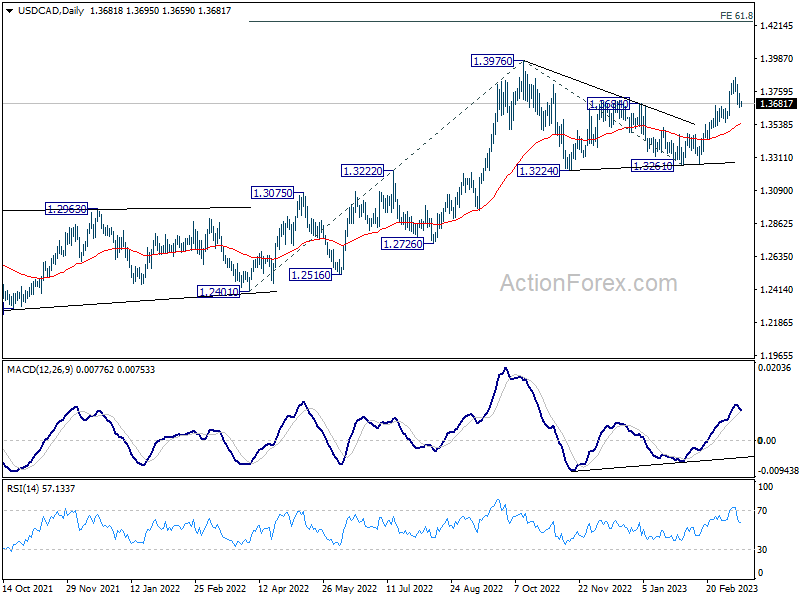
Daily Pivots: (S1) 1.3641; (P) 1.3695; (R1) 1.3739; More....
Intraday bias in USD/CAD remains neutral at this point. Further rally is still expected with 1.3664 support intact. On the upside, break of 1.3860 will resume the rally from 1.3261 to retest 1.3976 high. However, firm break of 1.3664 will mix up the near term outlook and bring deeper pullback first.
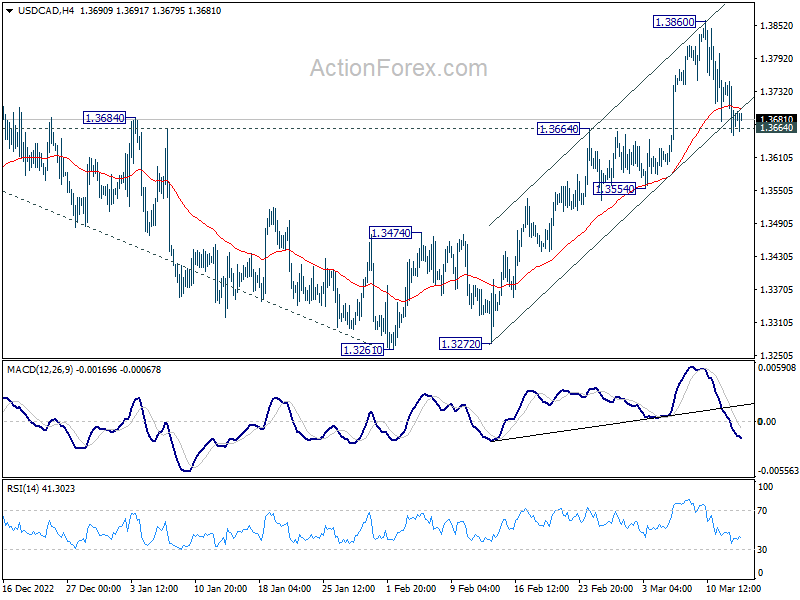
In the bigger picture, the up trend from 1.2005 (2021 low) is still in progress. Break of 1.3976 will confirm resumption and target 61.8% projection of 1.2401 to 1.3976 from 1.3261 at 1.4234. Firm break there will pave the way to long term resistance zone at 1.4667/89 (2016, 2020 highs). On the downside, break of 1.3261 support is needed to confirm medium term topping. Otherwise, outlook will remain bullish even in case of deep pull back.