Sample Category Title
Reaction of Fed to the New Financial Stability Issues is Difficult to Assess
Markets
On Friday, it was impossible for markets to decouple its reaction to the US payrolls from the developing story on Silicon Valley Bank. The US economy in February added an above-consensus 311 000 jobs. The unemployment rate rose from 3.4% to 3.6%, but at the same time participation rate improved from 62.4% to 62.5%. Average hourly earnings (AHE) were marginally softer at 0.2% M/M and 4.6% Y/Y). Even so, in times of market stability, these data probably wouldn’t have changed markets’ expectations between a 25 or 50 bps Fed rate hike on March 22. However, with financial stability issues from the SVB looming large, US yields nosedived for a second consecutive session. In a steepening move US yields again declined between 14.3 bps (30-y) and 28.4 bps (2-y). In the 10y sector, the decline was almost solely at the expense of lower real yields. US equities again lost between 1.07% (Dow) and 1.76% (Nasdaq). The Eurostoxx50 ceded 1.32%. The dollar remained in the defensive as markets still pondered how much room the Fed has left over to combat inflation. The US currency lost on a daily basis (EUR/USD close 1.0643, DXY 104.58), but finished well off the intraday lows. Moves in European bond/interest rate markets were less sharp. Still, the German yield curve also steepened with yields declining between 18 bps (2-y) and 12.1 bps.
During the weekend, the Fed and the Treasury took measures to ringfence the fall-out from the SVB collapse (and from other potential cases facing similar problems). In a statement, the Fed, the Treasury and the FDIC announced that it took measures to fully protected deposit holders from SVB and Signature Bank. The Fed also announced a new ‘Bank Term Funding Program’ that offers loans to banks under easier terms (collateral) and also relaxed (collateral) terms for lending through its discount window. Asian markets this morning show a mixed picture with some still facing follow-though losses from WS on Friday (Topix -1.51%). At the same time, China outperforms.
The US yield curve this morning continues its steepening move with the 2-y yield losing another 15 bps. Key question remains to what extent uncertainty on financial stability will change the trajectory of the Fed’s anti-inflation campaign. Markets now have downscaled expectations to a 25 bps hike later this month and 5.1% peak rate, compared to expectations for a Fed peak rate at 5.50/5.75% mid last week. Today, there are no important data on the calendar. The reaction of the Fed to the new financial stability issues is difficult to assess. Even so, the UK example in September last year, showed that this doesn’t automatically excludes further rate rises. At current levels, we have the impression that (more) than enough Fed tightening is priced out, especially if tomorrow’s US February CPI data would confirm persistence of (core) inflation. A rebound in US equity futures at least suggests markets see the weekend action from the Fed and the Treasury might go some way to address similar problems, if they were to occur. We don’t expect the developments in the US to change the ECB’s intention to raise the deposit rate by 50 bps on Thursday. The sharp loss of interest rate support at the short end of the curve keeps the dollar in the defensive. EUR/USD regained the 1.0695 intermediate resistance, with a next key reference seen at 1.0803 (14 Feb top). If the decline in ST US yields/scaling back of Fed tightening stops, the USD decline might gradually slow.
News Headlines
Germany has averted a postal strike after the country’s biggest postal group agreed to double-digit pay rises to compensate for decades-high inflation. The two-year deal covering 160 000 employees was agreed in last-minute negotiations and is the latest sign of how once supply-driven inflation has morphed into a domestic and demand-driven one. Wage negotiations in the euro zone has resulted to pay rises of 4.4% in 2022 and 4.8% this year, an ECB series showed. Chief economist Lane said this was higher than the level consistent with inflation returning to 2%.
Tyrowicz, the National Bank of Poland’s most hawkish policy member, called governor Glapinski’s call for rate cuts by the end of the year “irresponsible”. She referred to inflation being forecasted to only be at the (top of the) tolerance range in the third quarter of 2025. This long time frame and continued price stability risks should mute any talks about potential monetary easing, Tyrowicz said, adding that even if rates would be lifted to 7% is would probably not be enough to bring inflation back in a timely enough manner. She has consistently been outvoted in her call for higher rates. The Polish zloty in recent weeks appreciated to 4.67 but remains within the relatively narrow 4.65/4.80 trading range...
GBP/JPY Daily Outlook
Daily Pivots: (S1) 161.60; (P) 162.91; (R1) 163.87; More...
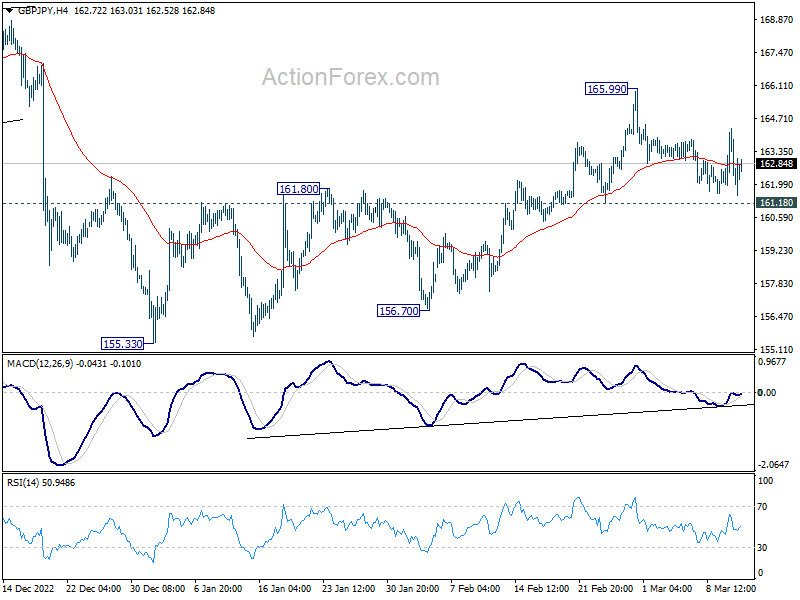
Intraday bias in GBP/JPY remains neutral as consolidation from 165.99 is extending. Further rally is still expected as long as 161.18 support holds. As noted before, corrective fall from 172.11 should have completed at 155.33 already. Break of 165.99 will target 169.26 resistance first, and then 172.11 high. However, break of 161.18 support will dampen this view and turn bias to the downside for 156.70 support instead.
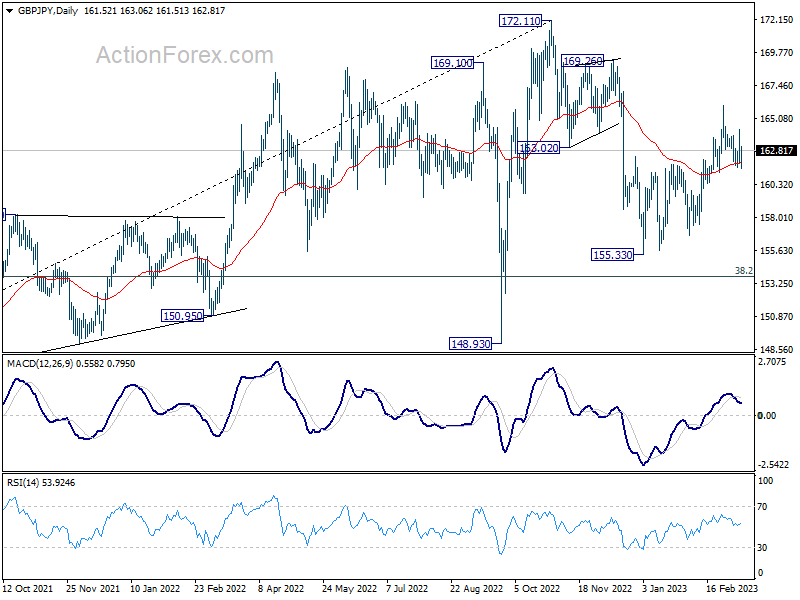
In the bigger picture, corrective decline from 172.11 medium term should have completed at 155.33. With 38.2% retracement of 123.94 (2020 low) to 172.11 (2022 high) at 153.70 intact, medium term bullishness is retained. That is, larger up trend from 123.94 (2020 low) is still in progress. Break of 172.11 high to resume such up trend is expected at a later stage.
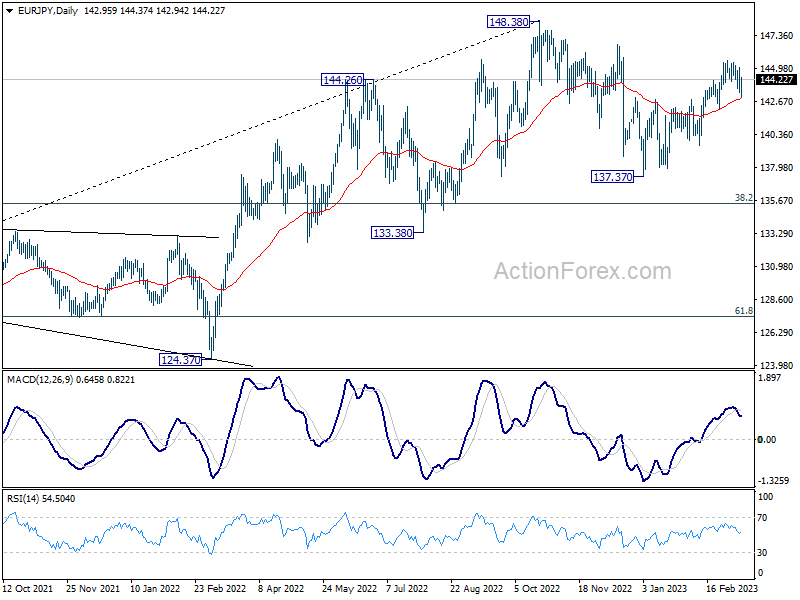
EUR/JPY Daily Outlook
Daily Pivots: (S1) 142.99; (P) 144.05; (R1) 144.74; More....
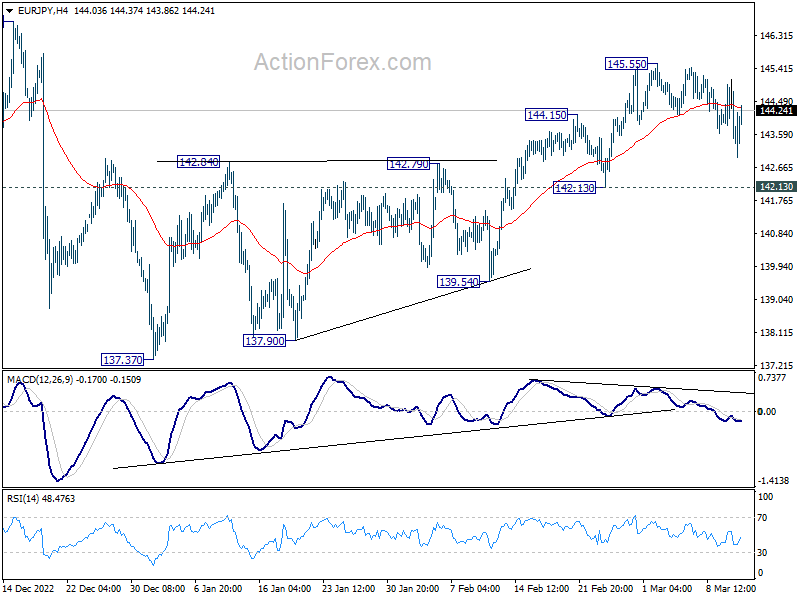
Intraday bias in EUR/JPY remains neutral for the moment and consolidation from 145.55 could extend. Further rally is expected as long as 142.13 support holds. Corrective fall from 148.38 has completed at 137.37 already. Break of 145.55 will resume the rise from 137.37 to 146.71 resistance and then 148.38 high.
In the bigger picture, as long as 55 week EMA (now at 139.54) holds, larger up trend from 114.42 (2020 low) is still in progress for 149.76 long term resistance. However, firm break of 55 week EMA will bring deeper fall to 38.2% retracement of 114.42 to 148.38 at 135.40. Sustained break there will raise the chance of trend reversal, and target 61.8% retracement at 127.39.
EUR/GBP Daily Outlook
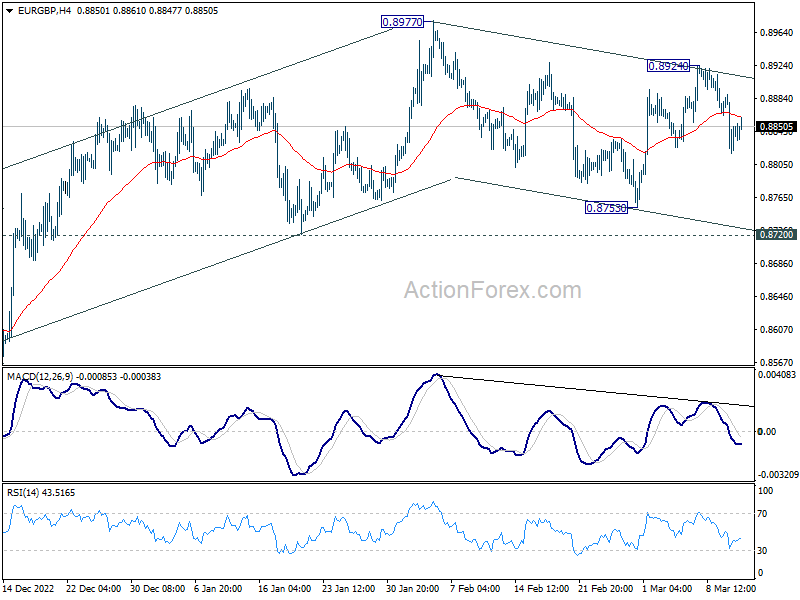
Daily Pivots: (S1) 0.8811; (P) 0.8850; (R1) 0.8881; More...
Intraday bias in EUR/GBP remains mildly on the downside at this point. Corrective pattern from 0.8977 is in progress with another falling leg. Deeper fall would be seen to 0.8753 support and possibly below. On the upside, above 0.8924 will bring retest of 0.8977 instead.
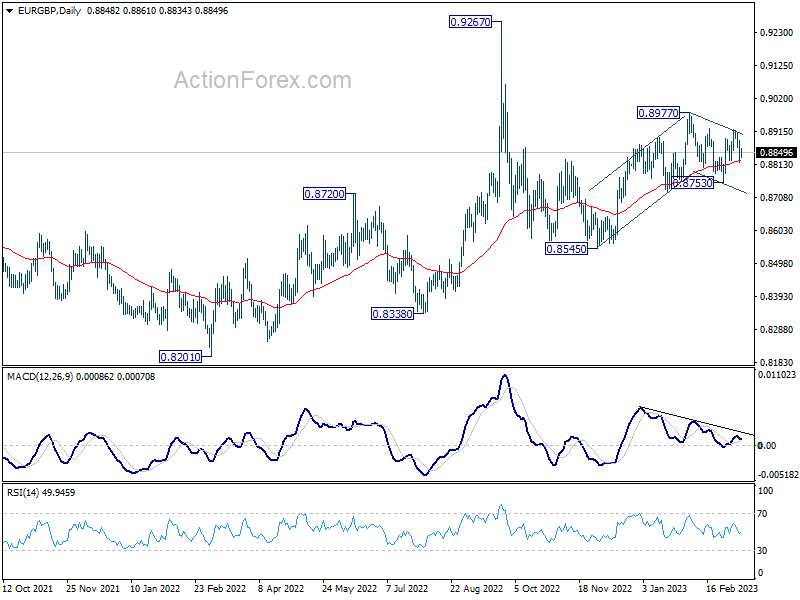
In the bigger picture, outlook is rather mixed for now, except that price actions from 0.9267 (2022 high) are part of the long term range pattern from 0.9499 (2020 high). With 0.8720 support intact, rise from 0.8545 is in favor to continue through 0.8977. However, firm break of 0.8720 will argue that such rebound has completed, and open up deeper fall through this support level.
EUR/AUD Daily Outlook
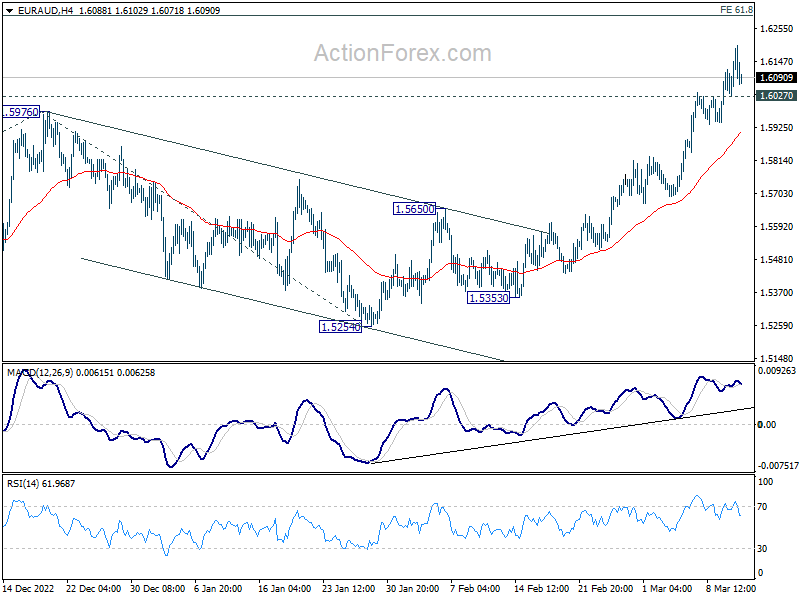
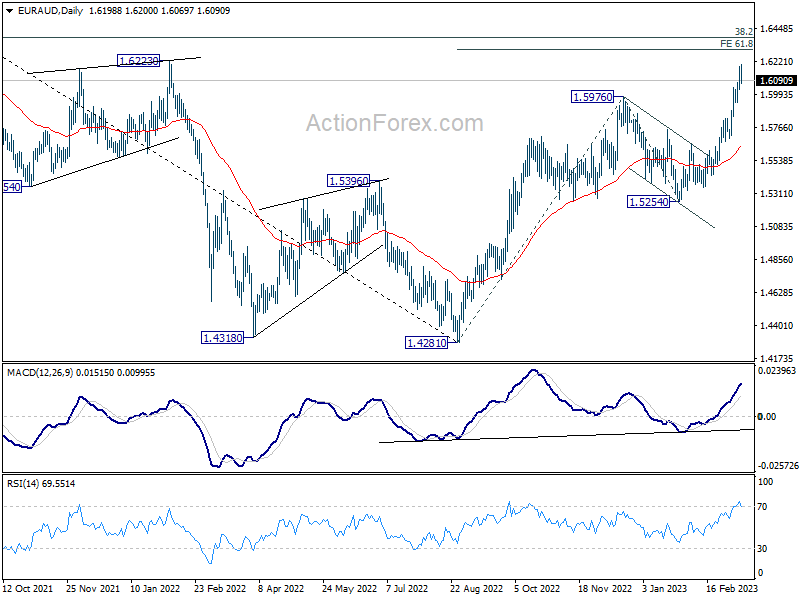
Daily Pivots: (S1) 1.6067; (P) 1.6129; (R1) 1.6226; More...
Intraday bias in EUR/AUD stays on the upside for the moment. Current rally from 1.4281 should target 61.8% projection of 1.4281 to 1.5976 from 1.5254 at 1.6302 next. On the downside, below 1.6027 minor support will turn bias neutral and bring consolidations again first.
In the bigger picture, the strong support from 55 week EMA (now at 1.5396) is raising the chance of bullish trend reversal. Focus is now on 1.6434 cluster resistance (38.2% retracement of 1.9799 to 1.4281 at 1.6389). Sustained break there should confirm that whole down trend from 1.9799 (2020 high) has completed. Further rally should then be seen to 61.8% retracement at 1.7691. However, rejection by this cluster resistance will make medium term outlook neutral at best.
EUR/CHF Daily Outlook
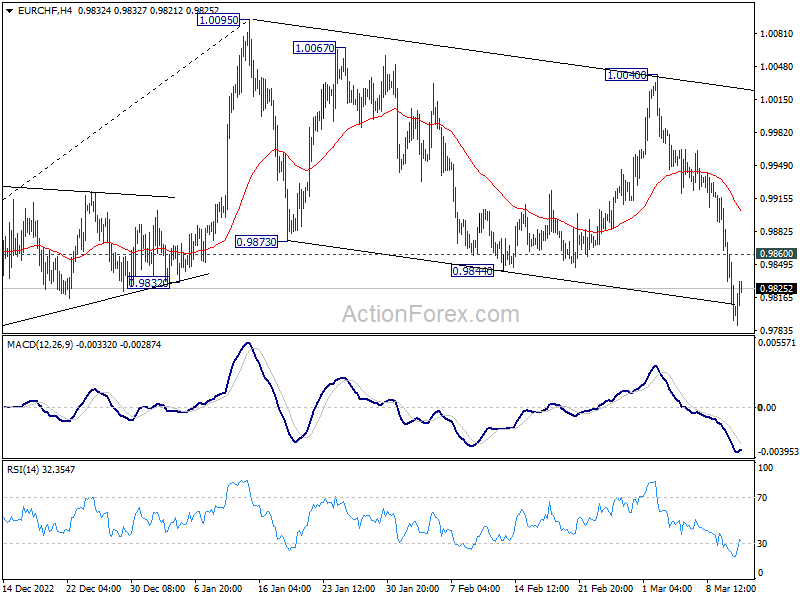
Daily Pivots: (S1) 0.9769; (P) 0.9828; (R1) 0.9861; More...
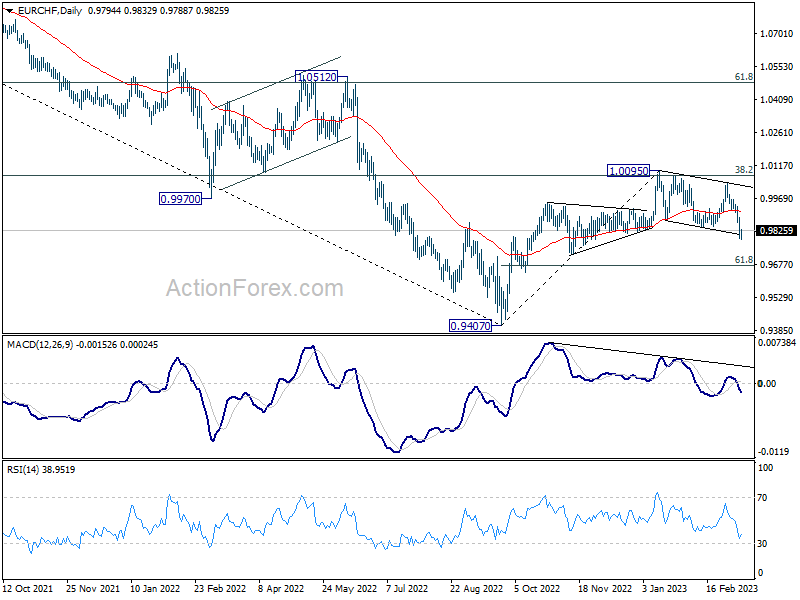
Intraday bias in EUR/CHF remains on the downside for the moment. Rebound from 0.9407 could have completed at 1.0095 already, on bearish divergence condition in daily MACD. Deeper fall would be seen to 61.8% retracement of 0.9407 to 1.0095 at 0.9670. Sustained break there will bring deeper fall to retest 0.9407 low. On the upside, above 0.9860 minor resistance will turn intraday bias neutral first. But risk will stay on the downside as long as 55 day EMA (now at 0.9910) holds.
In the bigger picture, rejection by 55 week EMA (now at 1.0011) and 38.2% retracement of 1.1149 to 0.9407 at 1.0072 suggests that medium term outlook is staying bearish. That is, down trend from 1.2004 is not completed yet and is in favor to resume through 0.9407 at a later stage. For now, this will be the favored case as long as 1.0095 resistance holds.
Contagion Fears
Market movers today
We start the week in a quiet fashion on the data front, but market focus remains on the collapse of Silicon Valley Bank (SVB) and the repercussions for the wider US banking system.
Later the this week the key data release for markets will be the US CPI for February on Tuesday, which will be crucial for Fed's decision to hike by either 25bp or 50bp at the next meeting. It is also time for another 50bp hike from the ECB on Thursday, but markets will pay attention to the communication for the May meeting.
The 60 second overview
Markets continue to be roiled by the collapse of Silicon Valley Bank (SVB). The freefall of its share price continued on Friday after an unsuccessful attempt to raise capital and a cash exodus from tech start-ups. Trading was later halted and SVB shut down by US banking regulators due to liquidity issues, making SVB the second-largest bank failure in US history, after the 2008 collapse of Washington Mutual. Markets continue to worry about contagion effects to other banks and the tech and start-up industry. Global bond yields collapsed in the risk-off move, while equities and the USD suffered.
Late Sunday night, the Fed, the US Treasury and the FDIC announced a series of emergency measures to limit the uncertainty stemming from the collapse of the SVB. The regulators will protect all the deposits at the SVB as well as the crypto-focused Signature Bank, which the authorities also closed on Sunday due to systemic risk concerns. In addition, the Fed announced a new Bank Term Funding Program (BTFP), which will provide financing for banks for up to one year against collateral valued at par. This could help banks access emergency financing without them having to sell assets with large unrealized losses, as was the case with SVB. Markets reacted positively to the news, with equity futures recovering overnight. That said, while the measures are substantial, it remains to be seen if they can restore confidence in the market over the coming days.
US labour market: Non-farm payrolls rose by 311,000 last month, more than expected but less than January's blowout print. However, the February jobs report was a mixed bag. Despite strong employment growth, wage growth cooled down to 0.2% m/m and the unemployment rate ticked up to 3.6% (from 3.4% in January), as labour force participation improved. The data muddied the water as the Fed decides whether to step up the pace of rate hikes, but in light of fragile risk sentiment we still favour a 25bp at the March meeting. Markets agree and now price in a less than 50% chance for a 50bp March hike. That said, a strong inflation print tomorrow could tip the balance again and will consequently be watched closely by markets.
Equities: Equities ended Friday lower and MSCI world down almost 4% last week. While last week started with the overheating narrative dominating, it ended with fear of recession and banking crisis on Thursday and Friday. Hence, flight to safety, defensives and quality, but not in the usual regional i.e., flight to safety in US equities. US is the centre of the storm, both in terms of the overheating narrative and the failure of SVB. Hence US equities continued to underperform with uncertainty increasing and VIX closing on 25. Friday action in US showed Dow -1.1%, S&P 500 -1.5%, Nasdaq -1.7% and Russell 2000 -2.95%. With US authorities stepping in with a backstop, we can very well see a reversal of much of the Thursday and Friday moves in equities as this week of trading begins. Asian markets are very mixed this morning with Hang Seng sharply higher, while Nikkei 225 is lower. US futures sharply higher, while European futures are showing smaller gains this morning.
FI: Global bond yields collapsed on Friday on the back of the increased uncertainty in the financial sector after of collapse of SVB. 10Y Treasuries declined some 30bp since Thursday, while 2Y yields are down some 50bp. There was a solid flight-to-quality as both Bunds and Treasuries rallied vs. swaps.
FX: Fears of systemic risks spread through asset markets following the news on Silicon Valley Bank's suspension. US rates fell and EUR/USD is once again trading above 1.07, whereas risk-off has pulled USD/JPY below 135 Notably and despite this, Scandies are starting the week off recent (Friday's) highs.
Credit: In short - change of sentiment! Silicon Valley Bank became the biggest US bank failure in more than a decade after a tumultuous week that saw an unsuccessful attempt to raise capital and a cash exodus from the tech start-ups that had fuelled the lender's rise. Following the turmoil iTraxx Main widened 6bp to 82bp while iTraxx X-over widened 30bp to 426bp.
Bank Crisis Hammers Fed Hike Expectations
The Silicon Valley Bank (SVB) went bust on Friday, around 44 hours after announcing that they would raise capital to fill in an almost $2 billion hole, after the bank sold its loss-making portfolio, rich in US treasuries, to pay their depositors – who are mostly tech startups – back in the actual environment of rising interest rates.
Signature Bank also collapsed abruptly this weekend, as regulators said that keeping the bank – which has a big real estate portfolio and law firms’ money, could threaten the stability of the entire financial system.
SVB’s flash crash raised questions that other similar local banks in the US could also experience liquidity issues and may not be able to pay their depositors back, unless they also start selling their probably loss-making portfolios.
So, the likes of First Republic Bank, PacWest Bancorp and Signature Bank suffered heavy losses on Friday.
Across Europe, big banks pulled indices down on Friday, as well – even though they are not expected to have similar liquidity issues as the Silicon Valley Bank. Most big banks have a diversified client base and more importantly don’t have the same exposure to tech startups, which are extremely rate sensitive.
The contagion risk remains for small banks with highly rate-sensitive clients, but the US authorities now step in to avoid contagion. They said that SVB depositors could access their money today.
The bank crisis changes the landscape for Fed expectations
The bank crisis will be sitting in the headlines, as solutions and possible contagion beyond the banking sector and beyond the US borders will be on the menu of the week.
The latter will likely interfere with Federal Reserve (Fed) rate hike expectations, as well, as the Fed may want to think twice before stepping on the gas this month; Mr. Powell certainly doesn’t want to go down in history as the clumsiest Fed President in the history of the Fed.
So, it is well possible that the Fed may simply FORGET about a 50bp hike this month or may not hike at all.
Activity in Fed funds futures now assesses more than 98% chance for a 25bp hike in March, not because the US jobs data was soft enough to overhaul rate hike expectations last Friday, but because the Fed can’t ignore the issues caused by the steep interest rate increases in the banking sector and can’t afford to trigger a financial crisis to bring inflation back to 2%.
Economic data will be important, but the developments across the banking sector could overshadow the data.
Last Friday, the US released a mixed jobs report. The NFP printed another strong 311’000 new nonfarm jobs additions in February, versus around 200’000 expected by analysts. But the unemployment rate ticked higher from 3.4% to 3.6%, as the participation rate improved, and the wages grew less than expected.
The kneejerk market reaction was a swift decline in the US dollar, and the yields. But of course, a major part of the decline in the US short term yields is due to the expectations that the Fed may have its hands tied faced with the banking crisis and could forget about another rate hike in the immediate future.
The latest fall in US yields is not necessarily based on the best foundation for a stock rally. And indeed we saw the S&P500 dive on Friday to the bearish consolidation zone below the major 38.2% Fibonacci retracement on the October to February rally. But at the time of writing, the S&P500 futures hint at an almost 2% rise at the open.
Tomorrow, the US will release the latest inflation figures for February, and the expectation is a further decline both in headline and core inflation. A sufficient decline in US inflation will cement the idea of a 25bp hike, or no rate hike from the Fed this month. But even disappointing inflation figures may not fuel the Fed rate hike expectations, depending on how the situation evolves on the banks’ front.
USD/CAD Daily Outlook
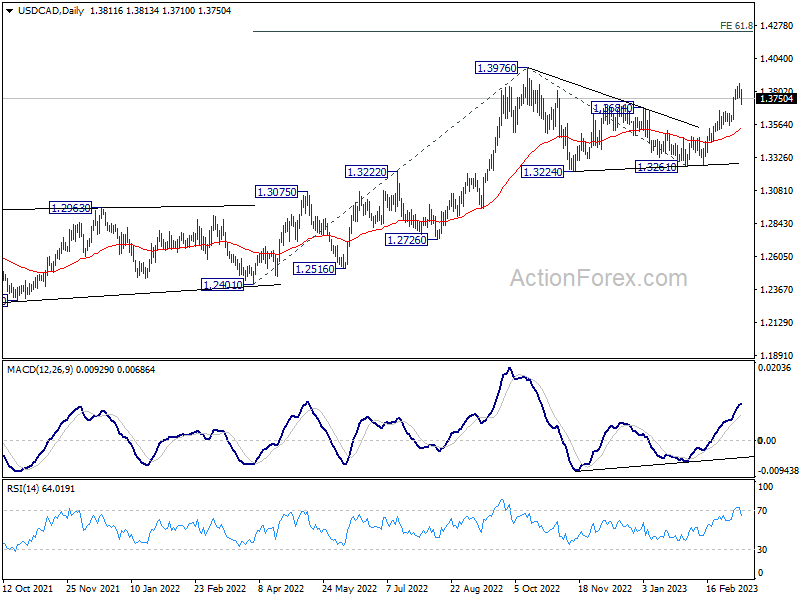
Daily Pivots: (S1) 1.3770; (P) 1.3816; (R1) 1.3870; More....
Intraday bias in USD/CAD remains neutral as consolidation from 1.3860 continues. Downside of retreat should be contained by 1.3664 resistance turned support to bring another rally. Break of 1.3860 will resume the rally from 1.3261 to retest 1.3976 high. However, firm break of 1.3664 will mix up the near term outlook and bring deeper pullback first.
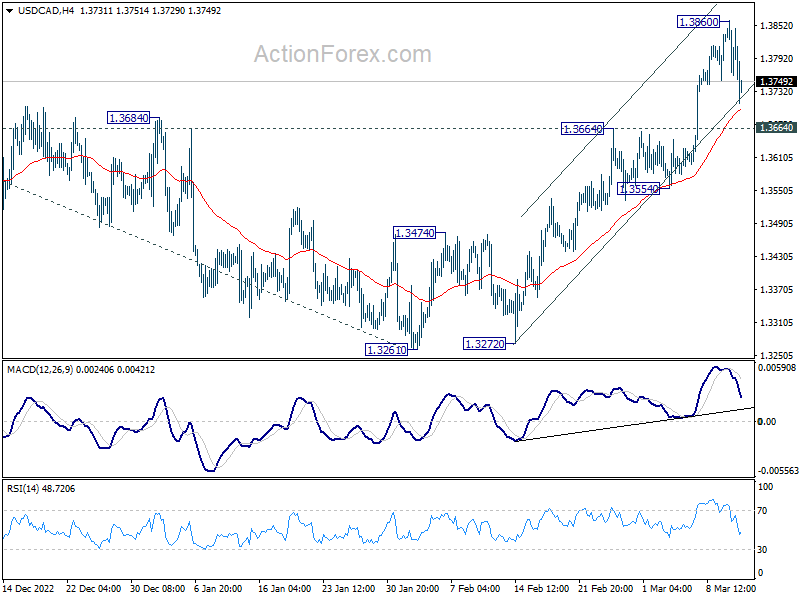
In the bigger picture, the up trend from 1.2005 (2021 low) is still in progress. Break of 1.3976 will confirm resumption and target 61.8% projection of 1.2401 to 1.3976 from 1.3261 at 1.4234. Firm break there will pave the way to long term resistance zone at 1.4667/89 (2016, 2020 highs). On the downside, break of 1.3261 support is needed to confirm medium term topping. Otherwise, outlook will remain bullish even in case of deep pull back.
AUD/USD Daily Report
Daily Pivots: (S1) 0.6551; (P) 0.6596; (R1) 0.6626; More...
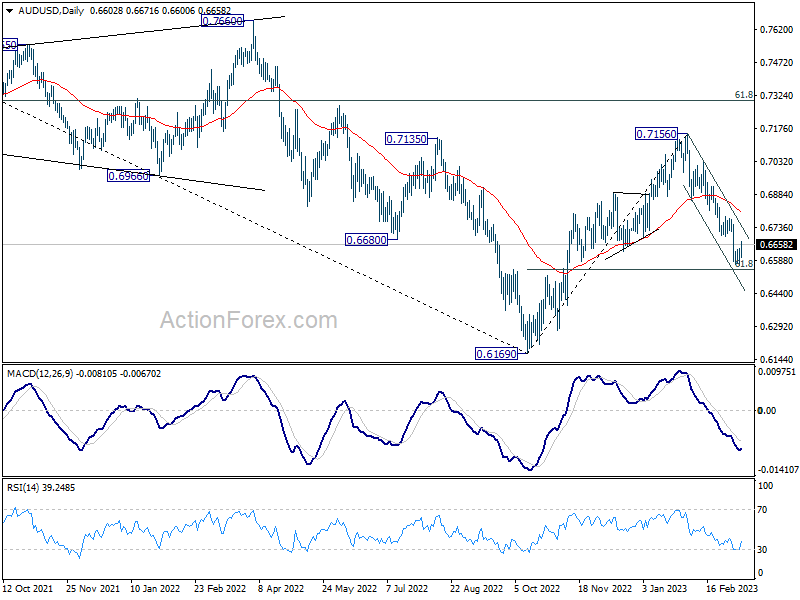
AUD/USD's recovery from 0.6563 continues today but stays below 0.6694 support turned resistance. Intraday bias remains neutral at this point. Focus is on whether 0.6546 fibonacci level would provide strong support to bring reversal. On the upside, break of 0.6694 support turned resistance will indicate short term bottoming, and turn bias back to the upside for rebound to 55 day EMA (now at 0.6803). However, sustained break of 0.6546 will carry larger bearish implication and target 0.6169 low.
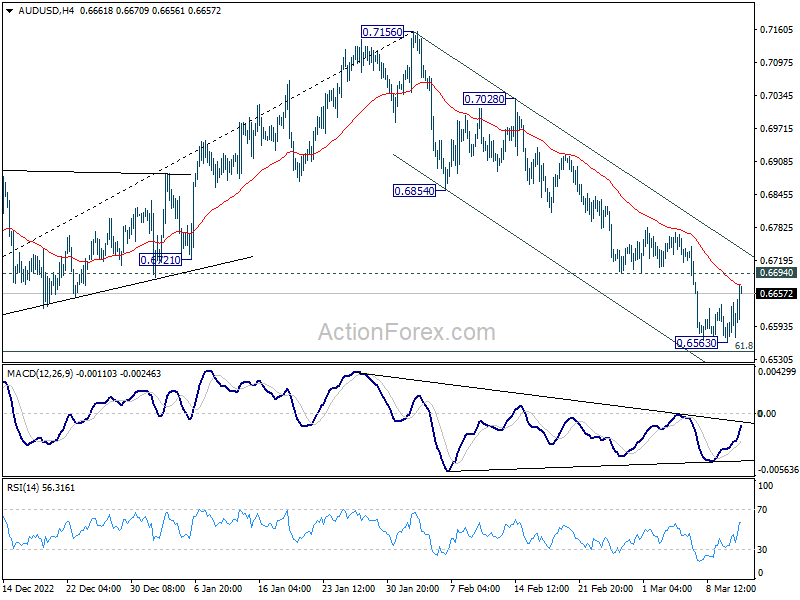
In the bigger picture, rise from 0.6169 (2022 low) has completed at 0.7156, after rejection by 55 month EMA (now at 0.7158). Deeper decline would then be see back to 61.8% retracement of 0.6169 to 0.7156 at 0.6546, even as a corrective fall. Sustained break there will raise the chance of long term down trend resumption through 0.6169 low.