Sample Category Title
US yield curve inversion unwinding quickly, imminent recession concerns
US yield curve inversion unwinding quickly, imminent recession concerns US Treasury yield has experienced a significant decline as funds continue to pour into bonds due to the collapse of Silicon Valley Bank. Overnight, the 2-year yield dropped by -0.585 to 4.030, after breaching the 4% handle. This is the worst one-day drop since the 2008 global financial crisis. The yield fell by nearly 100 basis points from Wednesday's 5.066, which was the most significant three-day decline since the 1987 market crash.
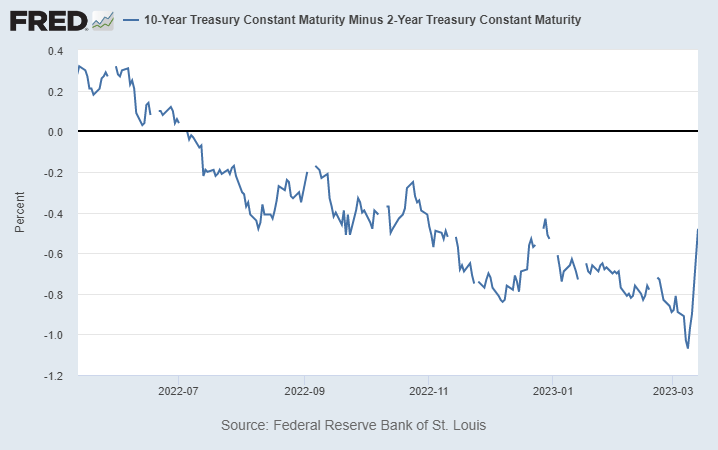
However, an even more critical development is the rapid unwinding of the yield curve inversion. Last week, the 10-year yield was more than 100 basis points below the 2-year yield. But now, it's around 50 basis points below. It's still too early to tell if the yield curve is normalizing, but recent history suggests that a recession in the US is imminent if that is the case.
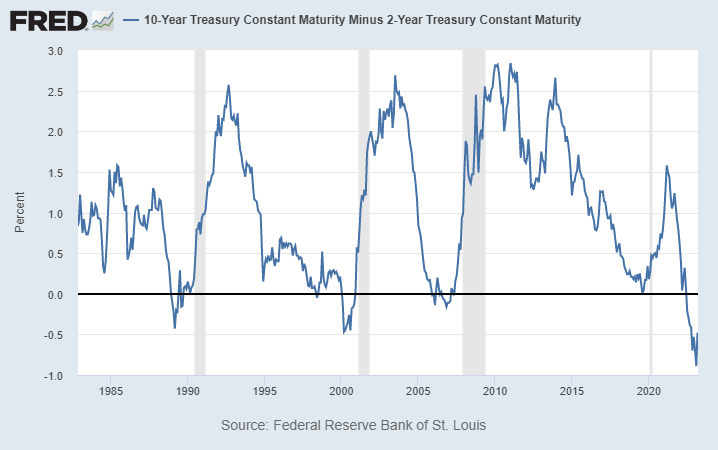
In the first example, for the 1988/90 inversion period, yield curve can be considered fully normalized in April 1990. Recession officially began in July 1990, three months later.
In the second example, for the 2000 inversion period, yield curve can be considered fully normalized in January 2001, and recession started in March 2001, three months later.
In the third example, for the 2006/2007 inversion period, yield curve can be considered fully normalized in June 2007. Recession officially started in December, six months later.
Australia NAB business confidence fell to -4, conditions down to 17
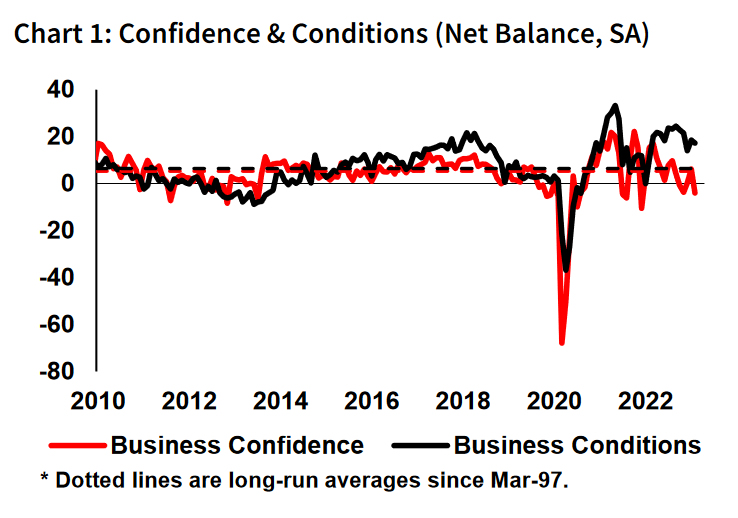
Australia NAB Business Confidence dropped sharply from 6 to -4 in February. Business Conditions dropped from 18 to 17. Looking at some details, trading conditions were unchanged at 27. Profitability conditions dropped from 18 to 14. Employment conditions rose from 11 to 12.
"Overall, the survey confirms the ongoing resilience of the economy through the first months of 2023, though we continue to expect a more material slowdown in demand later in the year when the full effect of rate rises has passed through," said NAB.
GBP/USD Aims Fresh Run To 1.2200, US CPI Next
Key Highlights
- GBP/USD recovered and surpassed the 1.2200 resistance.
- EUR/USD might extend gains and revisit 1.0800.
- The UK Claimant count could change -12.4K in Feb 2023.
- The US CPI could drop from 6.4 to 6.0% in Feb 2023 (YoY).
GBP/USD Technical Analysis
The British Pound started a strong increase from the 1.1800 zone against the US Dollar. GBP/USD broke a major hurdle near 1.1920 to move into a positive zone.
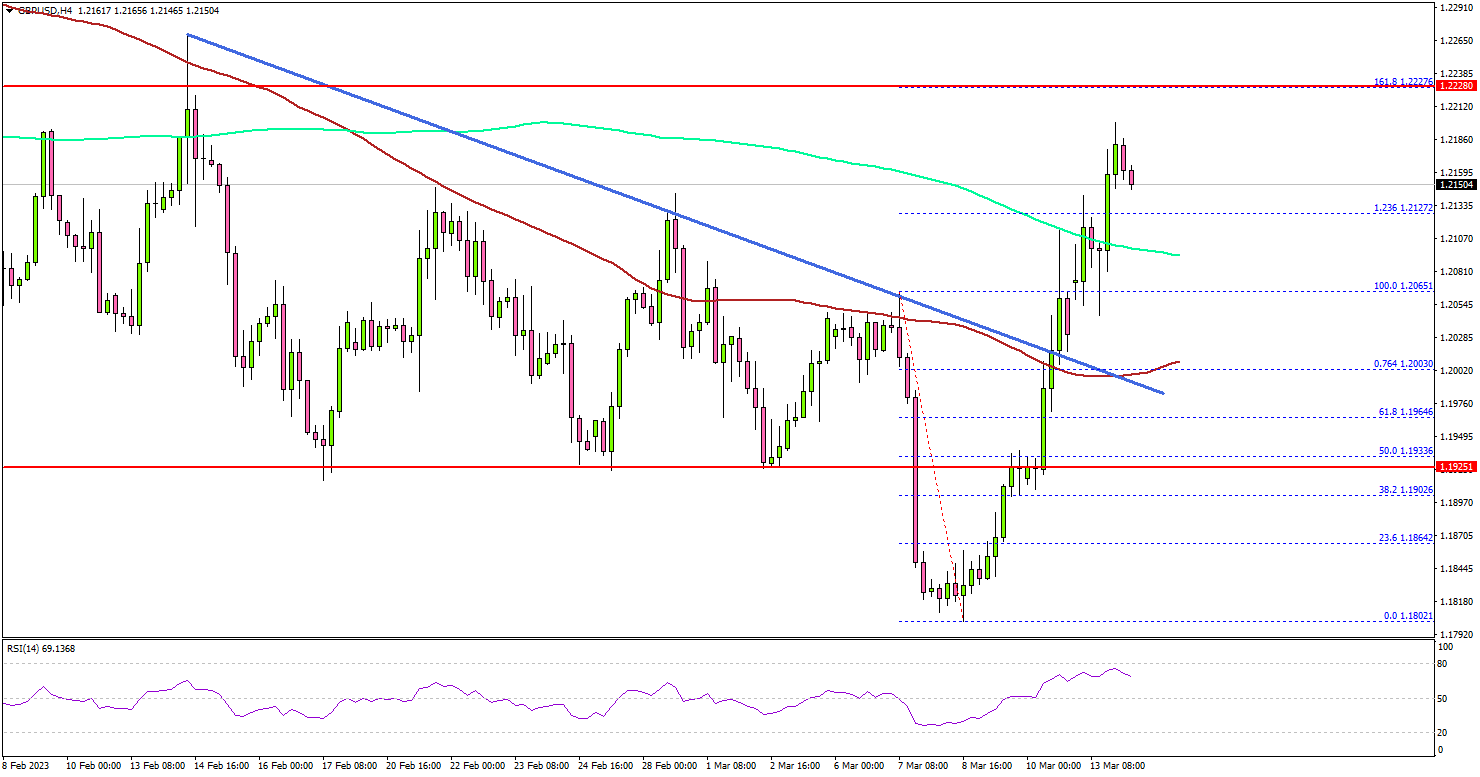
Looking at the 4-hours chart, the pair gained pace above the 1.2000 resistance and the 100 simple moving average (red, 4-hours). Besides, the pair broke a key bearish trend line with resistance near 1.2000.
The bulls even pumped the pair above the 1.2100 level and the 200 simple moving average (green, 4-hours). The pair is now trading above the 1.2120 level.
An immediate resistance is near the 1.2185 level. The next major resistance is near the 1.2220 level. It is near the 1.618 Fib extension level of the downward move from the 1.2065 swing high to 1.1802 low.
A clear move above the 1.2220 resistance might start another increase towards the 1.2320 zone. Any more gains might send the pair towards 1.2400.
On the downside, an immediate support is near the 1.2065. The next major support is near the 1.2000 level and the 100 simple moving average (red, 4-hours), below which there is a risk of a move towards the 1.1920 level.
Looking at EUR/USD, the pair is showing positive signs above the 1.0650 level and there could be more upsides towards the 1.0800 level.
Economic Releases
- UK Claimant Count Change for Feb 2023 – Forecast -12.4K, versus -12.9K previous.
- UK ILO Unemployment Rate for Jan 2023 (3M) – Forecast 3.8%, versus 3.7% previous.
- US Consumer Price Index for Feb 2023 (MoM) – Forecast +0.4%, versus +0.5% previous.
- US Consumer Price Index for Feb 2023 (YoY) – Forecast +6.0%, versus +6.4% previous.
Australia Westpac consumer sentiment unchanged at 78.5, second sub-80 read in a row
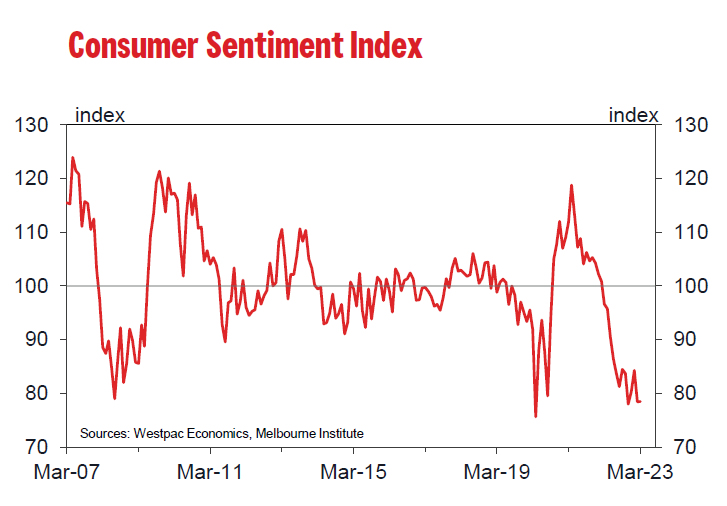
Australia Westpac Consumer Sentiment Index was unchanged at 78.5 in March, a second month of extremely weak reading, near historical lows. Areas of most concern remain inflation, interest rates, and the economy.
Westpac noted that there were only one month of sub-80 reading during the COVID pandemic and the global financial crisis period. Runs of sub-80 have only been seen during the recession during the 1980s and 1990s.
Regarding RBA policy, Westpac will wait after release of data on employment, inflation, spending, and confidence, before deciding to change the expectation of a 25bps hike in April. But Westpac maintained the forecast of another 25bps hike in May.
Gold Wave Analysis
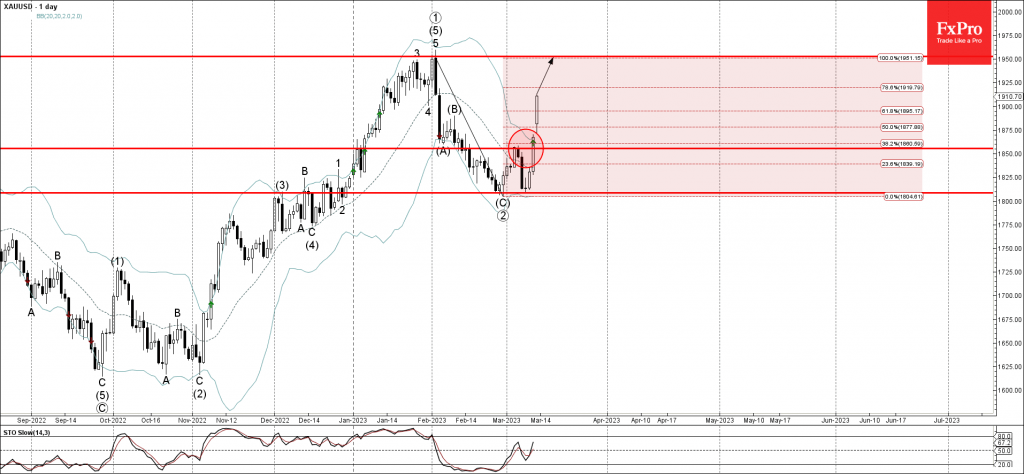
- Gold broke resistance area
- Likely to rise to resistance level 1950.00
Gold recently broke the resistance area located between the resistance level 1855.00 and the 38.2% Fibonacci correction of the downward correction from the start of February.
The breakout of this resistance area accelerated the active intermediate impulse wave (1).
Gold can be expected to rise further toward the next resistance level 1950.00 (previous multi-month high from the start of February).
GBPUSD Wave Analysis
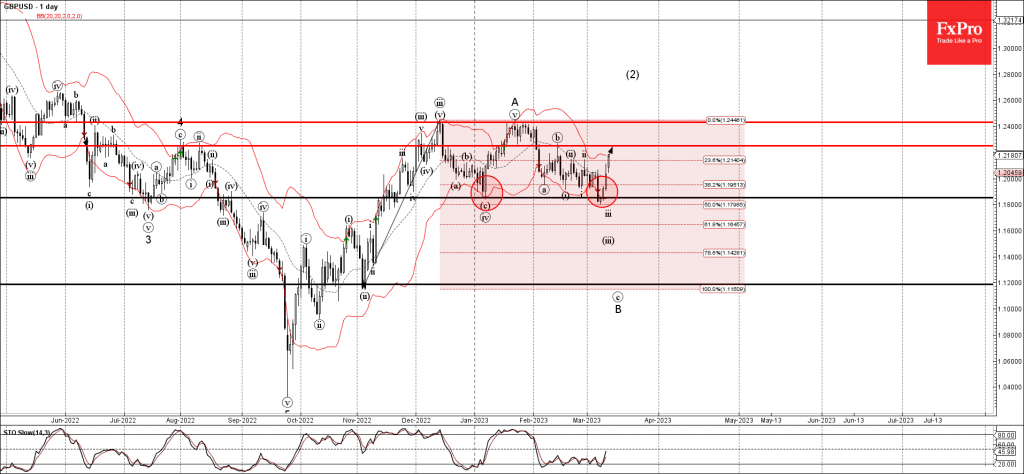
- GBPUSD reversed from support level 1.1855
- Likely to rise to resistance level 1.2250
GBPUSD currency pair recently reversed up from the key support level 1.1855 (previous monthly low from January) standing near the lower daily Bollinger Band and the 50% Fibonacci correction of the upward impulse from November.
The upward reversal from the support level 1.1855 created the daily candlesticks reversal pattern Morning Star.
GBPUSD can be expected to rise further toward the next resistance level 1.2250 (top of wave (b) from February).
Sunset Market Commentary
Markets
During the weekend, US authorities took steps to restore confidence in the US financial system after the collapse of Silicon Valley Bank (SVB). They included full protection for all depositors of SVB (and Signature Bank). At the same time, the Federal Reserve, with the backing of the Treasury, put in place a new ‘Bank Term Funding Program’ to provide 1-year funding for banks at less tight collateral conditions (full face value). Similar collateral requirements now also apply for the discount window. Despite the action from the US authorities, markets today again are trading extremely volatile as investors continue to ponder the consequences post SVB in terms of financial stability, the impact on the economy and the impact on Fed/CB policy going forward. At a time of market panic, it’s always difficult to assess what part of a move is due to a ‘simple’ defensive run for safety or to what extent investors are really changing expectations on central bank policy going forward. Whatever the explanation, US yields today additionally lose between 50 bps (2-y) and 15 bps (10-y)!!! Compared to Wednesday evening US 2-year yield has lost about 100 bps. The US 10-y yield ceded about 55 bps. Markets currently hardly discount one additional 25 bps Fed hike anymore. In Europe, German yields are tumbling between 53 bps (2-y) and 23 bps (30-y). Cumulative declines currently amount to 75+ bps for the 2-y yield (since Wednesday) and 55 bps for the German 10-y yield (compared to March 2 peak). Despite very explicit ECB guidance of late, market now also see an almost even chance on 50 bps or 25 bps ECB rate hike later this week. The expected peak in the ECB deposit rate has been reduced to about 3.15% down from 4.0%+ levels recorded mid last week. Markets obviously are solely focused on financial stability risks when assessing CB’s reaction function. Interesting to see whether this might change tomorrow when the US inflation data will be published. This morning, US equity futures initially reacted positively to the measures announced during the weekend. Sentiment deteriorated as the European trading session proceeded. The Euro Stoxx 50 at some point lost 3.5%+ (currently -3.0%). US equities also opened in red, but currently try to return in green with financials still feeling most of the strain. (Brent) oil dropped further to test the $80 p/b level. The combination of a sharp decline in core yields and an aggressive risk-off sentiment propels gold to the strongest level since early February ($1908 p/oz).
On FX markets, the dollar still doesn’t profit from the overall risk-off environment as the focus remains on US financial stability. Major USD cross rates showed substantial intraday swings. DXY hovers near the 103.75 area. EUR/USD after a strong open and a temporary intra-day dip, currently trades near the 1.07 big figure. The yen outperforms, against the dollar (USD/JPY 133 from a close on Friday near 135), but also against the euro (EUR/JPY 142.5 from 143.7). The Swiss franc also again enjoys as strong safe have bid, but EUR/CHF (0.974) at the lowest level since mid-October last year. Smaller less liquid currencies are fighting an uphill battle. EUR/SEK (10.43) intraday touched an new post-corona top. EUR/NOK also reached the highest level since May 2020. Among the CE currencies, the forint suffers most, with EUR/HUF returning to the 390 area. The Czech koruna eases to the 23.73 area. The zloty outperforms the region holding little changed near 4.685. Sterling also held relatively strong with EUR/GBP even easing slightly to 0.882.News Headlines
CNB vice governor Eva Zamrazilova said Czech interest rates will have to stay above neutral for longer than initially expected so that inflation doesn’t flare up again. She added that she doesn’t agree with the idea that when inflation returns to target, the CNB can go back to the decade-old policy of low interest rates. Czech money markets for a long time agreed but started pricing in faster rate cuts over the previous days amid heightened volatility in the wake of the SVB collapse. A first cut is anticipated in early Q3. The Czech crown, together with regional peers, is under pressure today. EUR/CZK advances from a Friday close at 23.64 to 23.74 currently.
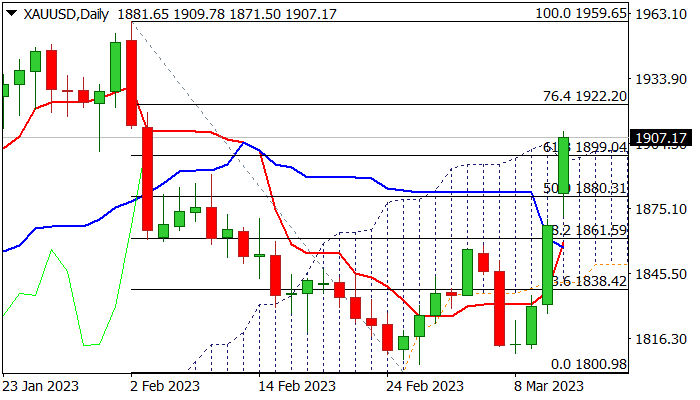
XAU/USD: Gold Surges Above $1900 On Growing Uncertainty
Gold surged above $1900 mark on Monday and hit its highest since early February, as growing uncertainty after collapse of Silicon Valley Bank and subsequent downgrade in expectations about the size of Fed’s next rate hikes, prompted investors out of dollar, boosting yellow metal’s safe-haven appeal.
Markets became increasingly worried that collapse of SVB may spark a chain reaction, as banking sector seems to be hurt by rising borrowing cost more than estimated, despite the US President Biden, in his speech today, declared that the US baking system is safe, after the collapse of Silicon Valley Bank and Signature Bank in New York.
Immediate measures taken by government to protect bank customers and save their deposits and President Biden’s promises that American banking system is safe, and regulators are going to apply new and stricter rules, did not fully convince investors, which fled into safety in the highly uncertain conditions.
Gold price is in steep ascend for the third straight day, after the dollar was initially dented by speculations about Fed’s coming action and further pressured by last Friday’s US labor report and SVB collapse.
Fresh bullish acceleration on Monday further improved the structure of daily technical studies, as positive momentum is gaining pace, moving averages are in bullish setup and strong bullish signal was generated on break through very significant $1900 barrier (psychological / Fibo 61.8% of $1959/$1800 / top od daily Ichimoku cloud).
In addition, completion of bullish failure swing pattern on daily chart contributed to positive signals.
Daily close above $1900 level is needed to confirm bullish stance and signal further advance of metal’s price, mainly driven by fundamentals.
Bulls eye immediate target at $1922 (Fibo 76.4%) the last obstacle en-route to key barrier at $1959 (2023 high, posted on Feb 2).
Meanwhile, bulls may take a breather after strong rally, as daily studies are overbought, and traders are focusing on Tuesday’s release of the US Feb inflation report.
Res: 1909; 1923; 1929; 1949.
Sup: 1900; 1882; 1866; 1856.
Pound Extends Gains on US Bank Debacle, UK Employment Report and US Inflation Next
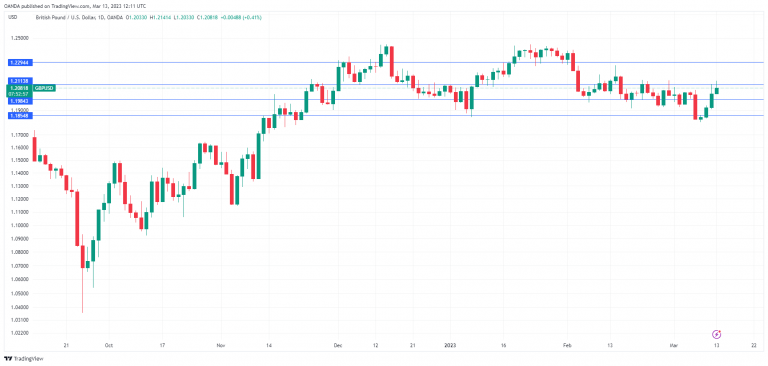
The British pound continues to rally and punched as high as 1.2141 earlier today before retreating. In the European session, GBP/USD is trading at 1.2100, up 0.56%.
There are no economic releases out of the US or UK or Monday, but the markets have plenty to digest after the sudden collapse of the Silicon Valley Bank (SVB). This marked the largest failure of a US bank since 2008 and has caused jitters in the markets over fears that the cantagion could spread to other banks. The Fed and the Treasury Department quickly intervened and said SVB depositors would be protected. President Biden made an unscheduled televison appearance and vowed to hold accountable those responsible for the SVB debacle. The President’s pledge may be reassuring, but the fact that he needed to address the nation reflects the concern that SVB could trigger a full-blown banking crisis. Over the weekend, New York officials closed Signature Bank, one of the main banks in the cryptocurrency sector.
Markets scale back rate bets after SVB
The SVB collapse has hurt the US dollar, as market pricing of interest rate expectations has massively shifted. Just last week, the markets had priced a 50-bp hike at 70% and a 25-bp increase at 30%. Currently, there is a 70% likelihood of a 25-bp increase and a 30% chance of the Fed holding rates at 4.75%. The dust hasn’t yet settled from the SVB failure so it’s understandable that the markets are jittery. If it becomes clear that no further banks are in danger of failing, we could see the markets again price in a 50-bp increase.
The US employment report on Friday was a mixed bag. Job growth came in at 311,000, cruising past the forecast of 225,000. The rest of the report was not as impressive and lent support to the view that the labour market may be about to cool. Wage growth ticked lower to 0.2% m/m, down from 0.3% in January and a consensus of 0.3%. As well, the unemployment rate rose to 3.6%, above the prior reading of 3.4%, which was also the estimate.
On Tuesday, we’ll get a look at key releases on both sides of the pond. The UK releases employment, with unemployment claims expected to fall by 12,400 in February, following a 12,900 decline in January. In the US, all eyes will be on the February inflation report, with headline CPI expected to fall to 6.0%, down from 6.4% in January. I expect further volatility from GBP/USD on Tuesday.
GBP/USD Technical
- GBP/USD tested resistance at 1.2113 earlier in the day. Above, there is resistance at 1.2294
- There is support at 1.1984 and 1.1854