Sample Category Title
AUDJPY Wave Analysis
- AUDJPY broke round resistance level 90.00
- Likely to rise to resistance level 92.00
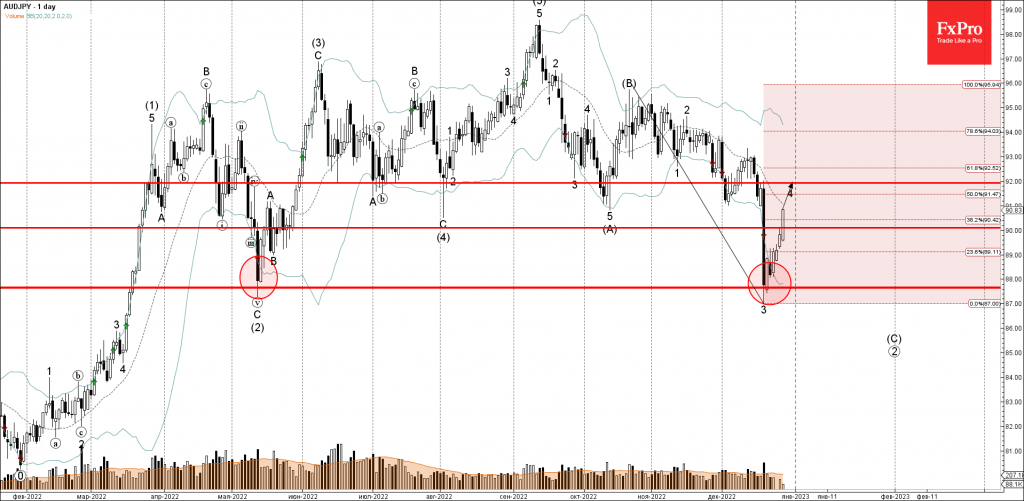
AUDJPY continues to rise inside the minor correction 4, which previously broke the round resistance level 90.00 intersecting with the 38.2% Fibonacci correction of the downward impulse from November.
The breakout of the resistance level 90.00 follows the earlier sharp upward reversal from the powerful long-term support level 87.65 (which started wave (3) in May).
AUDJPY can be expected to rise further toward the next resistance level 92.00 (target price for the completion of the active wave 4).
NZDUSD Back Above 0.63; Will 20-SMA Cap the Advance?
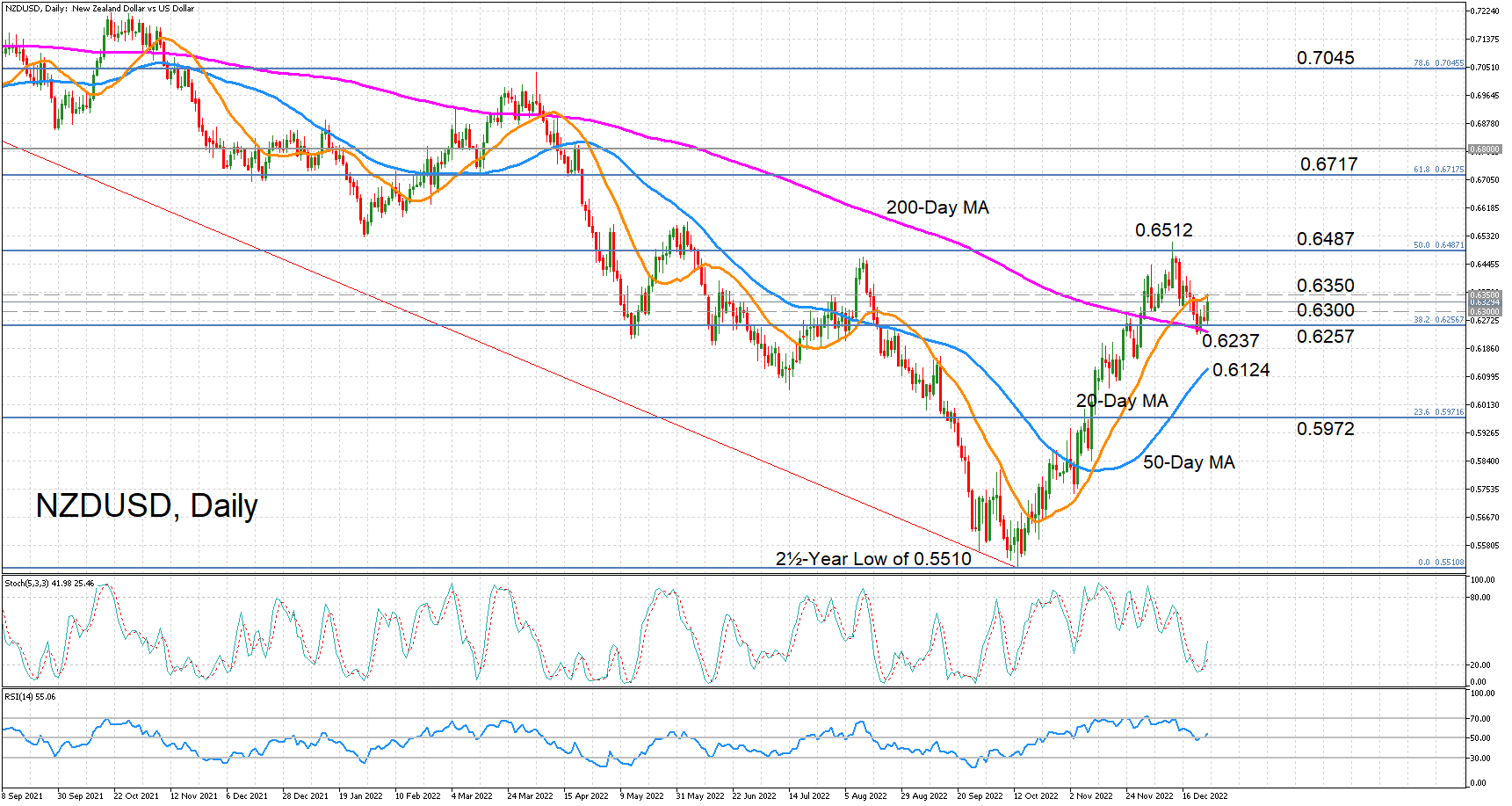
NZDUSD is climbing again after the recent pullback deflected off the 200-day simple moving average (SMA). The price is currently attempting to pierce above its 20-day SMA just beneath the 0.6350 mark, while to the downside, there is immediate support from the 38.2% Fibonacci retracement of the February 2021-October 2022 downtrend at 0.6257, as well as the 200-day SMA slightly lower.
The momentum indicators suggest today’s rebound has scope to stretch further in the coming days. The stochastics are rising as they recover from the oversold region, while the RSI is headed north, moving away from neutral territory.
If the pair successfully overcomes the 20-day SMA, there is likely to be further resistance in the 0.6500 region where the 50% Fibonacci resides. The next critical barrier is the 61.8% Fibonacci at 0.6717 and even higher, buyers could face difficulty near the 78.6% Fibonacci of 0.7045, which proved a sticking point back in April.
However, if the 20-day SMA holds and the upside momentum loses steam, the price is likely to again seek support from the 200-day SMA, currently at 0.6237. Should this defence break, the pair could dip towards the 50-day SMA at 0.6124, after which, the bears would turn their attention to the 23.6% Fibonacci of 0.5972. If this is breached too, there would be little to stop the pair from revisiting October’s two-and-and-a-half-year low of 0.5510 and resume the longer-term downtrend.
Summing up, the latest uptrend remains intact for now and surpassing the December top of 0.6512 is essential for reinforcing the medium-term bullish outlook. But if the pair continues to consolidate and drifts towards its 50-day SMA, the positive picture would be at risk of turning neutral.
Dollar Index: Signal of Deeper Fall on Monthly Close Below Broken Pivotal Fibo Support
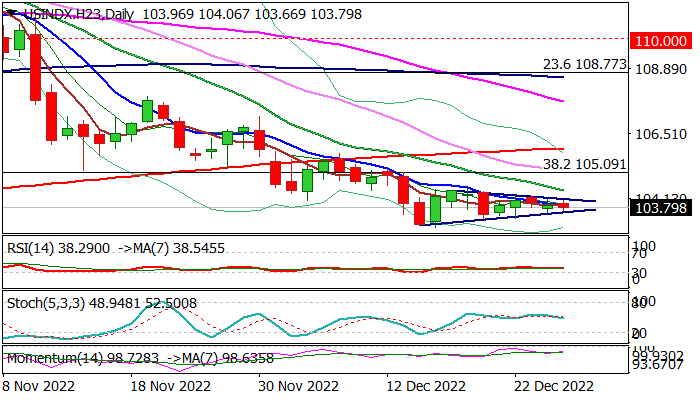
The dollar index is in directionless near-term mode and trading within a narrowing, triangular range, but overall picture remains bearish.
Daily studies are in full bearish mode, weekly chart shows strengthening bearish momentum, but moving averages are in mixed setup, while bullish structure on monthly chart is weakening.
The greenback was up around 8% overall in 2022, mainly driven by the actions of the US Federal Reserve, but also as safe-haven, due to rising geopolitical and economic uncertainty.
The dollar strongly appreciated on the gap between the Fed and other major central banks, as the US policymakers were the first to start tightening monetary policy to fight soaring inflation, while other central banks stayed on hold for some time.
Further support to the US currency came from aggressive rate hikes by the Fed, but more dovish tones from the US policymakers in last three months prompted traders to collect profits from their larger long positions that deflated dollar.
Pullback from new 20-year high at 114.72 (Sep 28) in past three months shows no significant signs that corrective phase is over, but shows that downside remains at risk, as bearish signal is developing on monthly chart, following break of pivotal Fibo support at 105.09 (38.2% retracement of 89.50/114.72 rally, reinforced by 10 MMA).
Monthly close below this level would add to negative signals and keep focus shifted lower, with targets at 102.11/100.00 (50% retracement / psychological) coming in focus.
Traders will continue to focus on the actions of the central bank, but also the economic picture, as the US economy is at the edge of recession, due to negative impact from high interest rates to economic growth. The dollar’s direction will be also strongly influenced by the main components of dollar index – Euro and Japanese yen.
Near-term action should stay capped by broken Fibo barrier at 105.09 to remain bearish, though bias would remain negative while potential stronger upticks remain below 200DMA (105.97).
Res: 104.12; 104.43; 105.09; 105.78.
Sup: 103.68; 103.38; 103.06; 102.11.
USD/JPY Mid-Day Outlook
Daily Pivots: (S1) 132.90; (P) 133.25; (R1) 133.86; More...
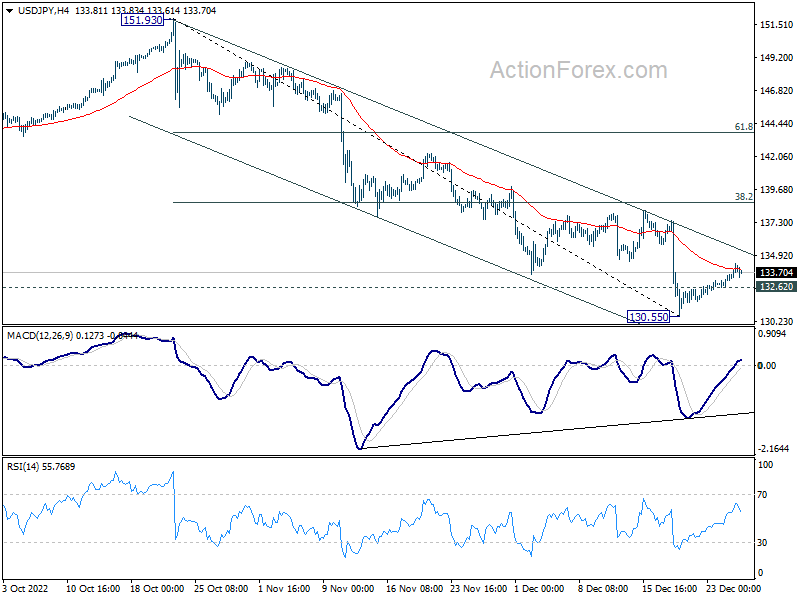
Intraday bias in USD/JPY stays mildly on the upside at this point. Rebound from 130.55 short term bottom would extend to 38.2% retracement of 151.93 to 130.55 at 138.71 first. On the downside, however, break of 132.62 minor support will bring retest of 130.55 instead.
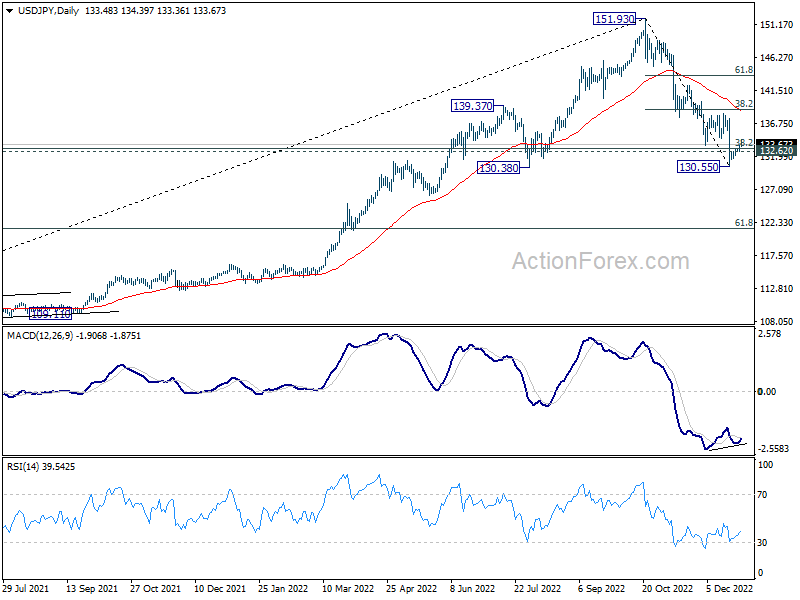
In the bigger picture, price actions from 151.93 medium term could be just a corrective pattern to up trend from 102.58 (2021 low). Strong support from 38.2% retracement of 102.58 to 151.93 at 133.07 and 55 week EMA (now at 131.76) will set the range for such corrective pattern. However, sustained break of 55 week EMA will pave the way to 61.8% retracement at 121.43.
USD/CHF Mid-Day Outlook
Daily Pivots: (S1) 0.9265; (P) 0.9298; (R1) 0.9327; More...
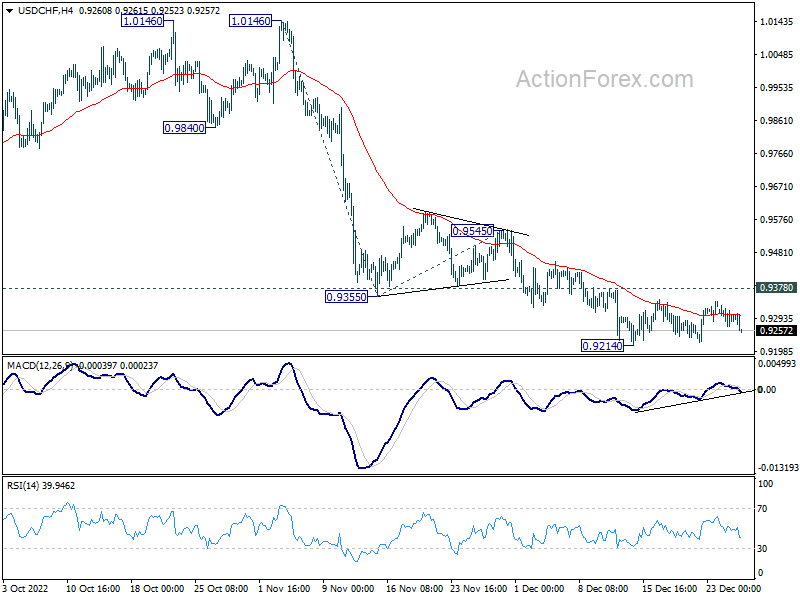
Intraday bias in USD/CHF stays neutral, and further decline is in favor with 0.9378 resistance intact. On the downside, break of 0.9214 will resume the fall and target 61.8% projection of 1.0146 to 0.9355 from 0.9545 at 0.9056. However, break of 0.9378 resistance will indicate short term bottoming and turn bias back to the upside for 0.9545 resistance instead.
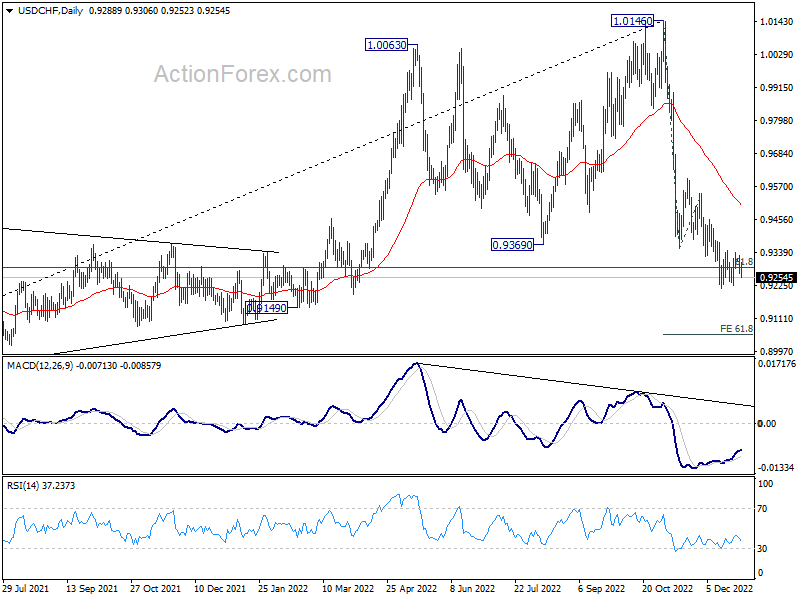
In the bigger picture, rise from 0.8756 (2021 low) has completed at 1.0146, well ahead of 1.0342 long term resistance (2016 high). Based on current downside momentum, fall from 1.0146 might be a medium term down trend itself. Sustained break of 61.8% retracement of 0.8756 to 1.0146 at 0.9287 will pave the way to 0.8756. In any case, risk will stay on the downside as long as 0.9545 resistance holds.
EUR/USD Mid-Day Outlook
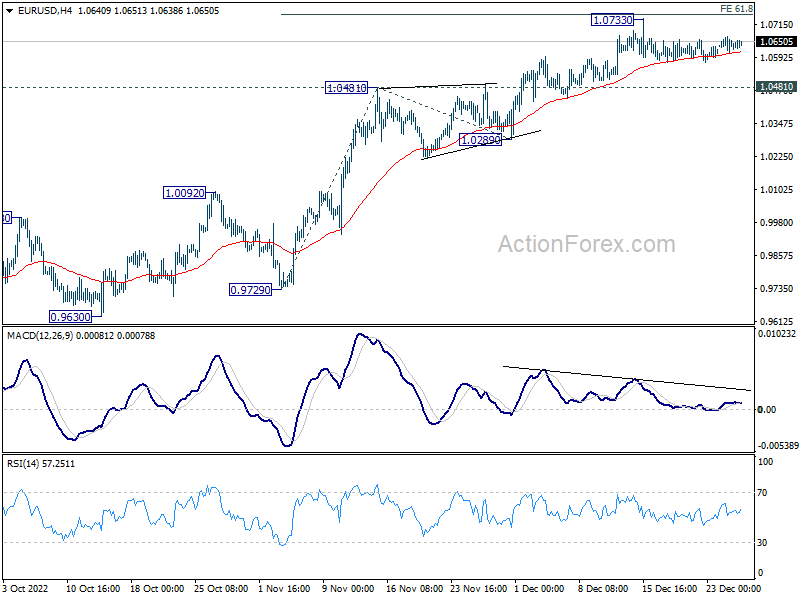
Daily Pivots: (S1) 1.0611; (P) 1.0640; (R1) 1.0668; More...
Intraday bias in EUR/USD remains neutral as sideway consolidation continues. Further rally is expected as long as 1.0481 resistance turned support holds. Firm break of 61.8% projection of 0.9729 to 1.0481 from 1.0289 at 1.0754 will pave the way to 100% projection at 1.1041. However, firm break of 1.0481 will confirm short term topping and bring deeper fall to 1.0289 support.
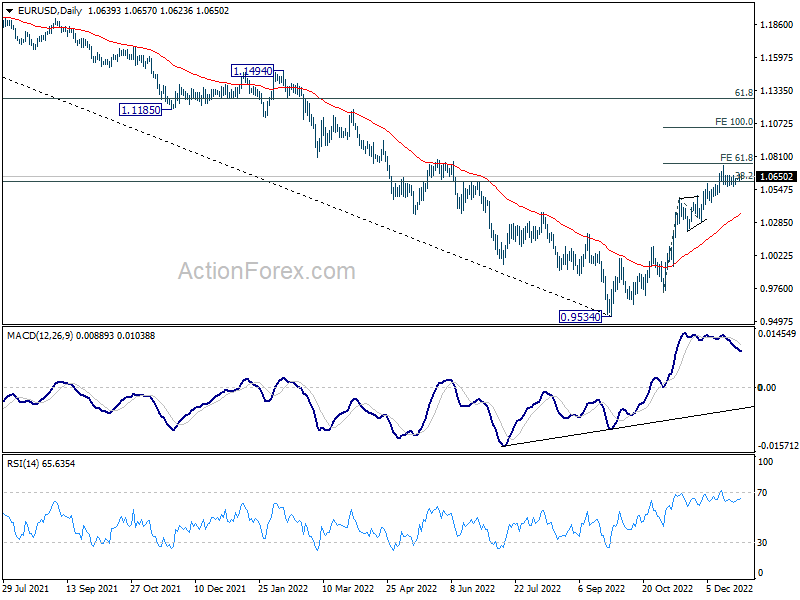
In the bigger picture, focus stays on 38.2% retracement of 1.2348 (2021 high) to 0.9534 at 1.0609. Rejection by 1.0609 will suggest that price actions from 0.9534 medium term bottom are developing into a corrective pattern. Thus, medium bearishness is retained for another fall through 0.9534 at a later stage. However, sustained break of 1.0609 will raise the chance of trend reversal and target 61.8% retracement at 1.1273.
GBP/USD Mid-Day Outlook
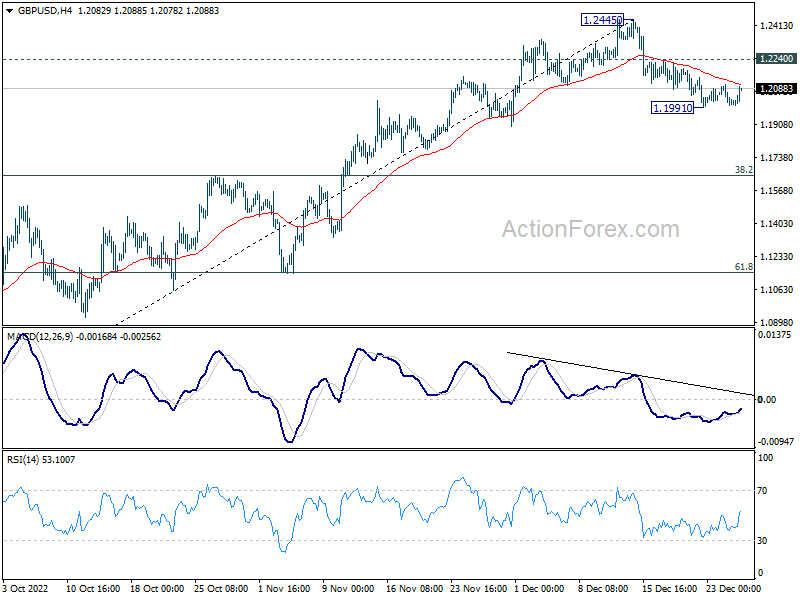
Daily Pivots: (S1) 1.1985; (P) 1.2049; (R1) 1.2094; More...
GBP/USD recovers mildly today but stays in tight range. Intraday bias remains neutral for the moment. On the downside, break of 1.1991 will resume the fall from 1.2445 to 55 day EMA (now at 1.1916). Firm break there will target 38.2% retracement of 1.0351 to 1.2445 at 1.1645. On the upside, break of 1.2240 minor resistance will turn bias back to the upside for retesting 1.2445 instead.
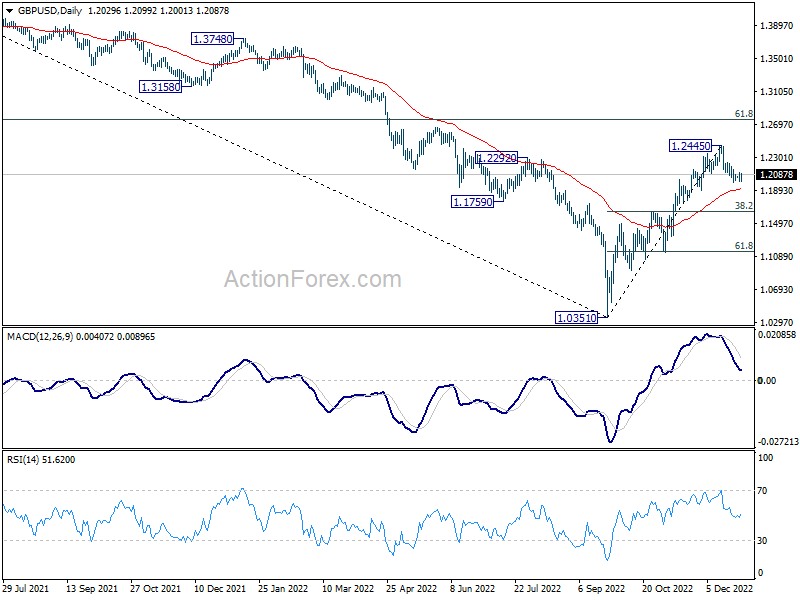
In the bigger picture, rise from 1.0351 medium term bottom is at least correcting whole down trend from 1.4248 (2021 high). Further rise is expected as long as 1.1644 resistance turned support holds. Next target is 61.8% retracement of 1.4248 to 1.0351 at 1.2759. Sustained break there will pave the way back to 1.4248. This will remain the favored case as long as 55 day EMA (now at 1.1916) holds.
Yen Extends Decline, Aussie and Kiwi Stronger
Yen's selloff continues today, so are the rallies in US and European benchmark treasury yields. While the cap on 10-year JGB yields was raised earlier this month, there is still a cap. On the other hand, market sentiments appeared to be boosted by relaxation of outbound travel in China. Additionally, BoJ's Summary of Opinions indicated that the board is in no way ready to exit the ultra loose monetary policy yet. As for today, Euro and Dollar are the next weakest while Kiwi and Aussie are the strongest ones.
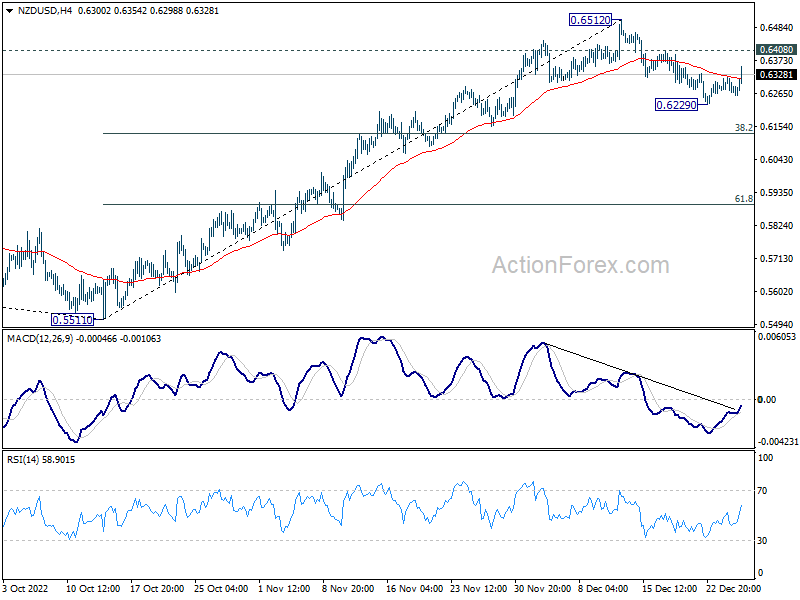
Technically, NZD/USD's break of 4 hour 55 EMA suggests that correction from 0.6512 has completed earlier than expected at 0.6629. Further rise is mildly in favor to 0.6408 resistance. Break there will bring retest of 0.6512 high. However, rejection by 0.6408 will still extend the correction from 0.6512 to 38.2% retracement of 0.5511 to 0.6512 at 0.6130.
In Europe, at the time of writing, FTSE is up 0.79%. DAX is down -0.13%. CAC is flat. Germany 10-year yield is up 0.109 at 2.496. Earlier in Asia, Nikkei dropped -0.41%. Hong Kong HSI rose 1.56%. China Shanghai SSE dropped -0.26%. Singapore Strait Times rose 0.02%. Japan 10-year JGB yield dropped -0.011 to 0.457.
AUD/JPY extends rebound, hopeful for bounce in Chinese tourists
Australian Dollar is among the strongest ones for today, and appeared to be give a lift by China's resumption of issuing outbound visas from January 8. Australia is among the top 10 destinations with fastest-growing search volume in China after the news, indicating its popularity in Chinese tourists. Tourism operators are hopeful that visitations will rebound strongly, which is 95 below the pre-pandemic levels.
Japan, India, Italy and South Korea all said they would be imposing tighter COVID-testing requirements on tourists from China, with concerns on the lack of transparency on infections and variants in the country. But there is nothing heard from the Australian government yet.
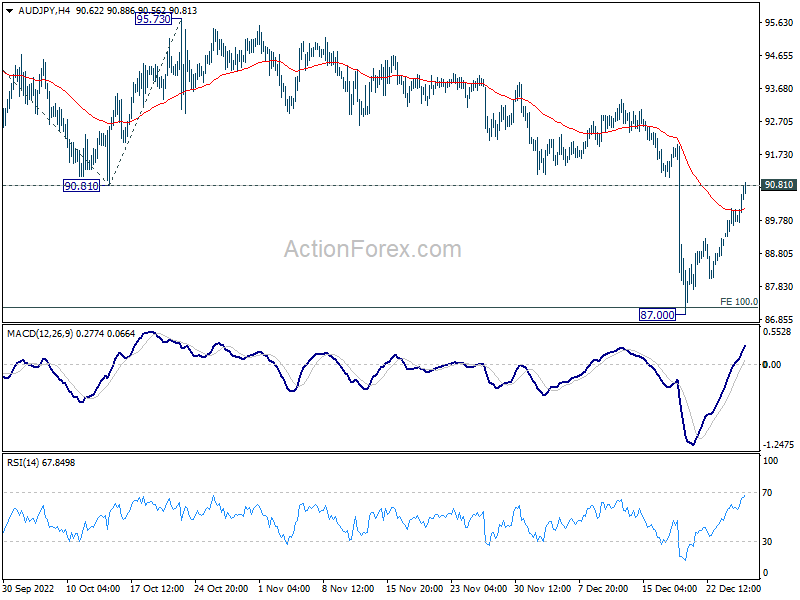
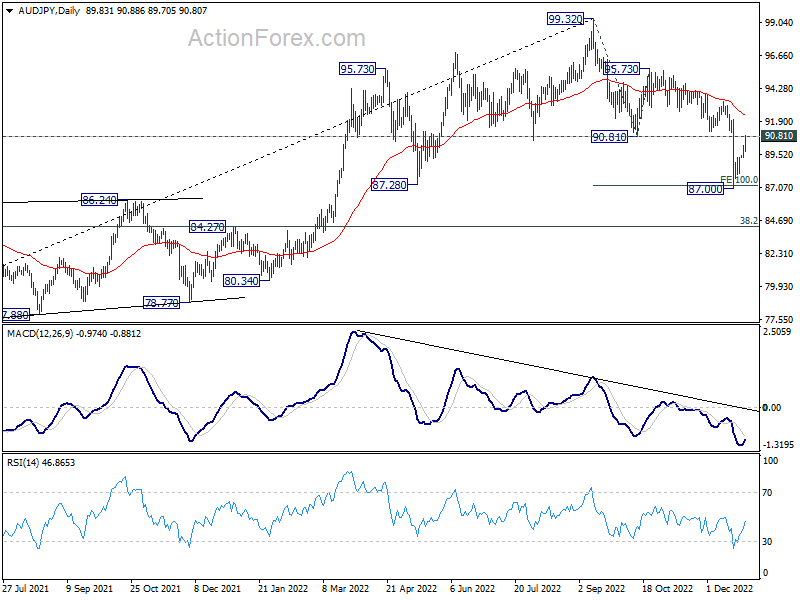
AUD/JPY is extending the rebound from 87.00, and it's now pressing 90.81 key near term support turned resistance. Sustained break there will argue that corrective fall from 99.32 has completed at 87.00, after hitting 100% projection of 99.32 to 90.81 from 95.73 at 87.22. In such case, stronger rise should be seen back to 95.73/99.32 range, as the second leg of the corrective pattern from 99.32.
BoJ Opinions: Expansion of 10-yr yield fluctuations enhances sustainability of YCC
In the Summary of Opinions at BoJ's December 19-20 meeting, several members noted that Japan is currently in a "critical phase" in achieving 2% inflation target. One noted that "signs of a virtuous cycle have started to be seen" between wages and prices". This is "evidenced by the overall high levels of corporate profits and moves to increase wages amid tight labor market conditions."
But "price stability is not considered to have been achieved". Thus, it's appropriate for BoJ to continue with the Quantitative and Qualitative Monetary Easing (QQE) with Yield Curve Control for as long as necessary, to "firmly support the economy and realize a favorable environment for firms to raise wages.
Many members noted the "deterioration in the functioning of bond markets", and "distortion in the price formation of 10-year bonds". Expansion of the range of 10-year JGB yield fluctuation will address the deterioration and distortion. But it's "not intended to change the direction of monetary easing". The expansion will "contribute to enhancing the sustainability of yield curve control".
Japan industrial production down -0.1% mom in Nov, output weakening
Japan industrial production declined -0.1% mom in November, better than expectation of -0.2% mom. But that's still the third straight month of contraction, followed -3.2% mom in October and -1.7% mom in September.
Looking at some details, general machinery output was down -7.9%, production machinery was down -5.7% while auto products was down -0.8%.
The Ministry of Economy, Trade and Industry downgraded the assessment of industrial production to "weakening". It expects output to rebound by 2.8% in December, then decrease -0.6% in January.
GBP/USD Mid-Day Outlook
Daily Pivots: (S1) 1.1985; (P) 1.2049; (R1) 1.2094; More...
GBP/USD recovers mildly today but stays in tight range. Intraday bias remains neutral for the moment. On the downside, break of 1.1991 will resume the fall from 1.2445 to 55 day EMA (now at 1.1916). Firm break there will target 38.2% retracement of 1.0351 to 1.2445 at 1.1645. On the upside, break of 1.2240 minor resistance will turn bias back to the upside for retesting 1.2445 instead.
In the bigger picture, rise from 1.0351 medium term bottom is at least correcting whole down trend from 1.4248 (2021 high). Further rise is expected as long as 1.1644 resistance turned support holds. Next target is 61.8% retracement of 1.4248 to 1.0351 at 1.2759. Sustained break there will pave the way back to 1.4248. This will remain the favored case as long as 55 day EMA (now at 1.1916) holds.
Economic Indicators Update
| GMT | Ccy | Events | Actual | Forecast | Previous | Revised |
|---|---|---|---|---|---|---|
| 23:50 | JPY | BoJ Summary of Opinions | ||||
| 23:50 | JPY | Industrial Production M/M Nov P | -0.10% | -0.20% | -3.20% | |
| 09:00 | CHF | Credit Suisse Economic Expectations Dec | -42.8 | -57.5 | ||
| 15:00 | USD | Pending Home Sales M/M Nov | -1.20% | -4.60% |
AUD/JPY extends rebound, hopeful for bounce in Chinese tourists
Australian Dollar is among the strongest ones for today, and appeared to be give a lift by China's resumption of issuing outbound visas from January 8. Australia is among the top 10 destinations with fastest-growing search volume in China after the news, indicating its popularity in Chinese tourists. Tourism operators are hopeful that visitations will rebound strongly, which is 95 below the pre-pandemic levels.
Japan, India, Italy and South Korea all said they would be imposing tighter COVID-testing requirements on tourists from China, with concerns on the lack of transparency on infections and variants in the country. But there is nothing heard from the Australian government yet.
AUD/JPY is extending the rebound from 87.00, and it's now pressing 90.81 key near term support turned resistance. Sustained break there will argue that corrective fall from 99.32 has completed at 87.00, after hitting 100% projection of 99.32 to 90.81 from 95.73 at 87.22. In such case, stronger rise should be seen back to 95.73/99.32 range, as the second leg of the corrective pattern from 99.32.
EUR/USD: A deep correction tends to 1.090
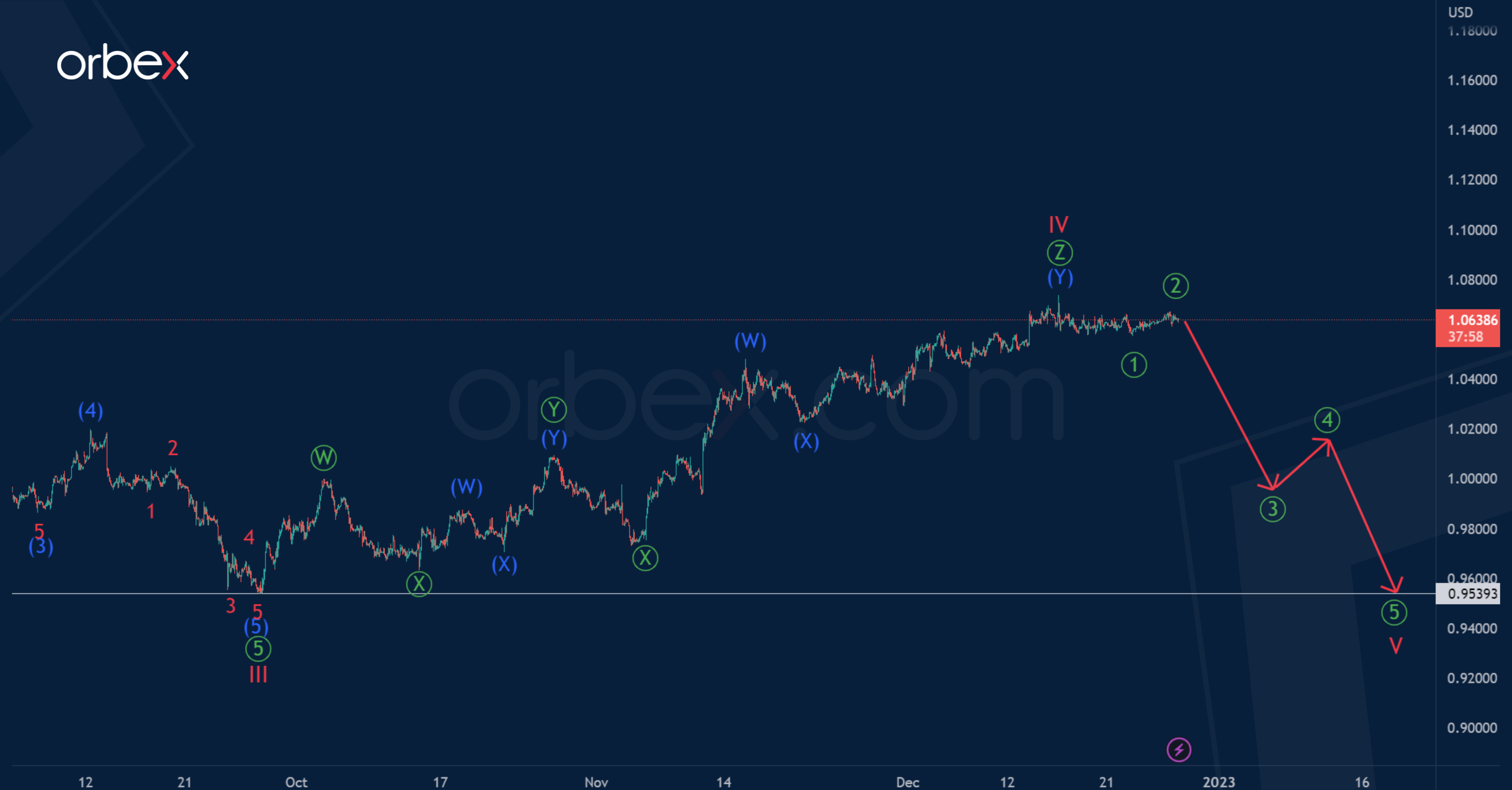
In the long term, the EURUSD currency is expected to form a bearish cycle impulse, which consists of five main sub-waves I-II-III-IV-V.
Most likely, the cycle impulse sub-wave III was fully completed, after which the formation of a bullish correction IV began. This complex correction is similar to a triple zigzag consisting of primary sub-waves Ⓦ-Ⓧ-Ⓨ-Ⓧ-Ⓩ.
The primary sub-waves Ⓦ-Ⓧ-Ⓨ-Ⓧ look complete. The development of the last sub-wave is expected in the near future. It may form a double zigzag pattern (W)-(X)-(Y) near 1.090. At that level, correction IV will be at 50% of impulse III.
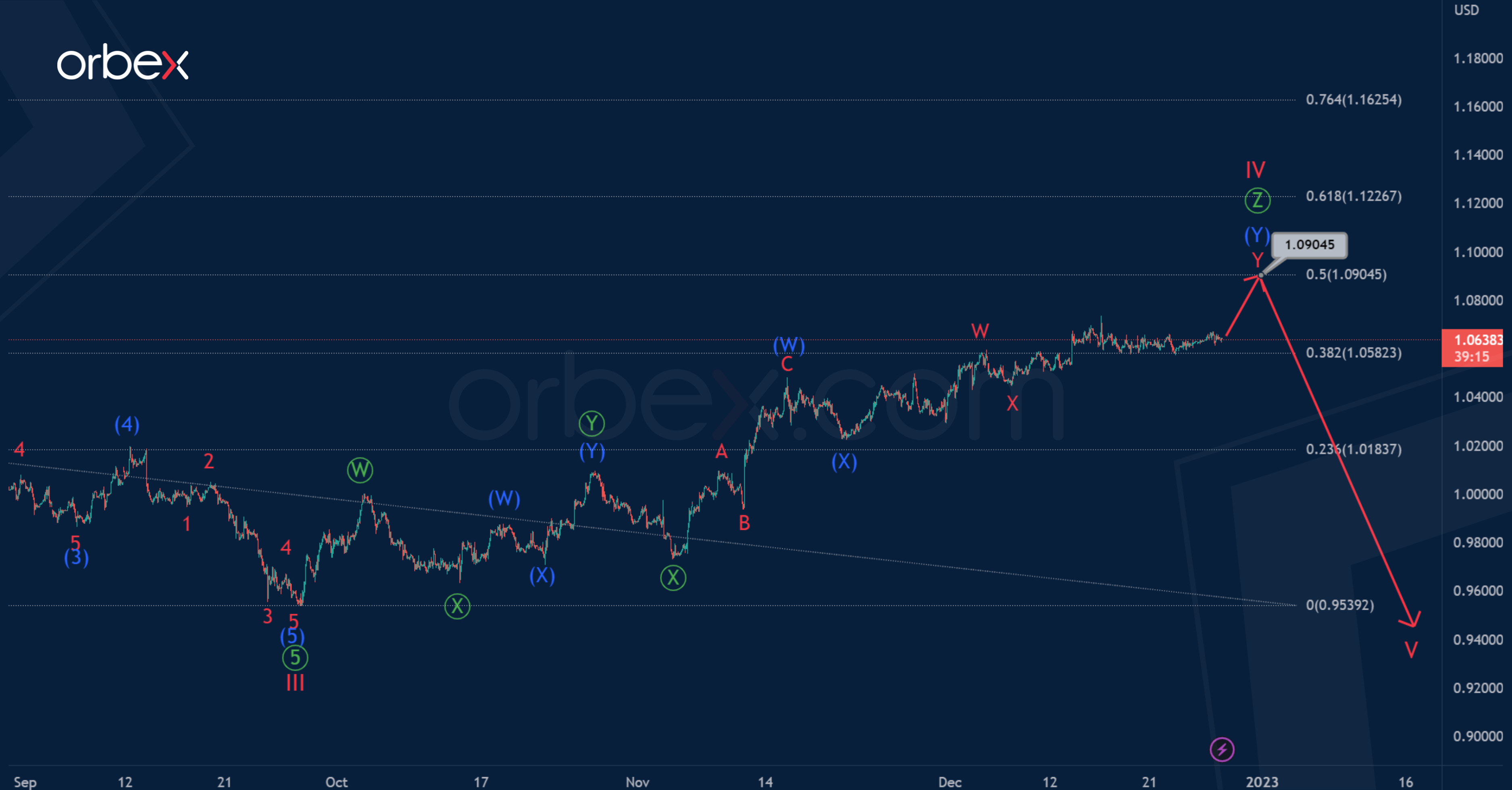
According to the alternative version, the cycle correction IV has already been fully completed and is a triple zigzag, as in the main version.
In the last section of the chart, we can notice the development of the initial part of the cycle wave V, which may take the form of a primary impulse or an ending diagonal.
It is assumed that the bears can re-go to the minimum of 0.953, at which a large impulse wave III was completed.
It is preferable to add this pair on our watchlist!