Sample Category Title
Swiss Franc Showing Strength
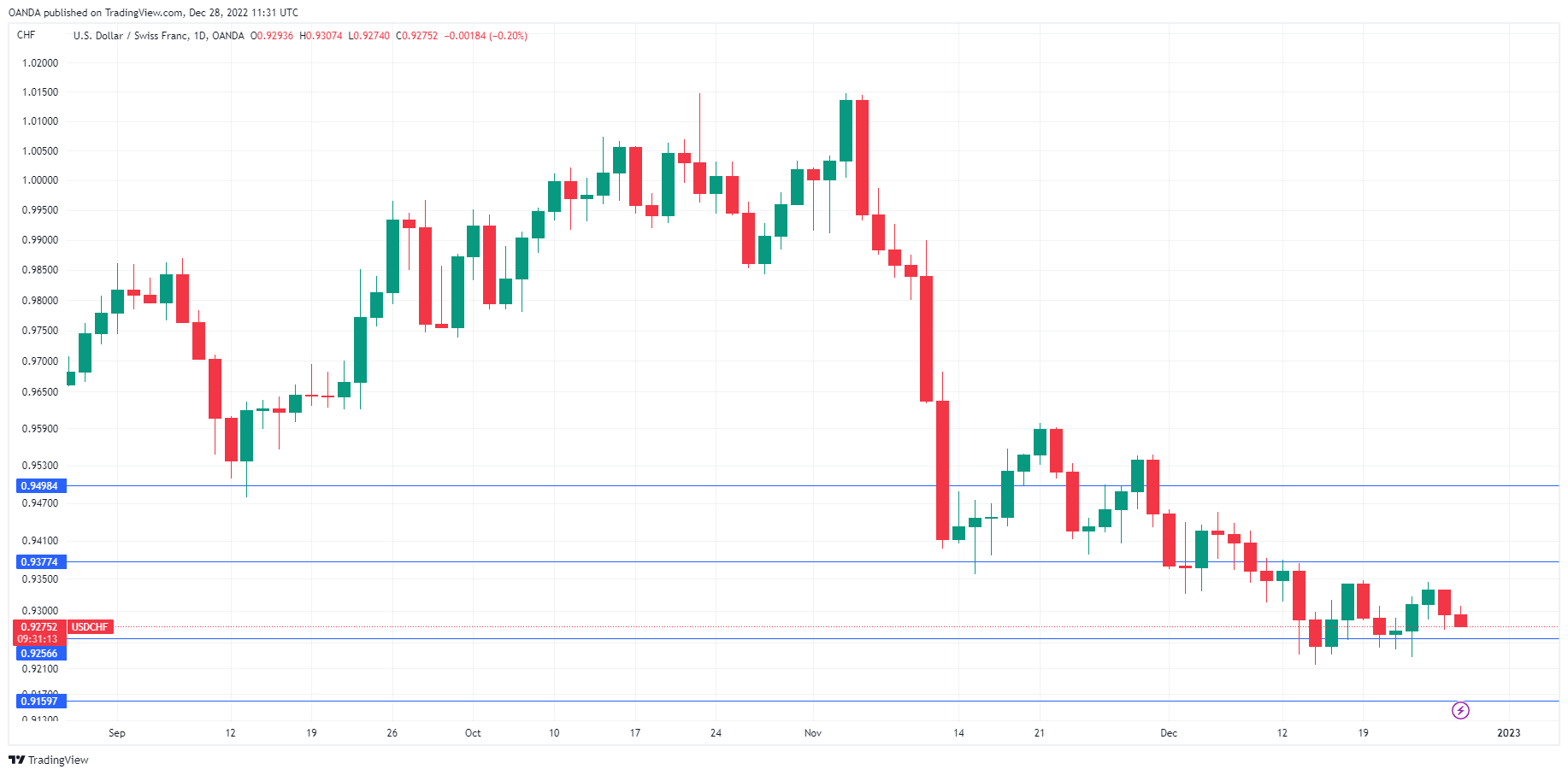
Market activity is subdued on Wednesday in thin post-holiday trade. In the European session, USD/CHF is almost trading at 0.9280, down 0.14%.
Over the final two months of the year, the Swiss franc has looked sharp against the US dollar. USD/CHF tumbled 5.6% in November and is down another 1.6% in December. The pair fell as low as 0.9215 on December 14th, its lowest level since April. The Swiss National Bank (SNB) is keeping a close eye on the appreciation of the Swiss franc, as this makes Swiss exports more expensive. The SNB has shown that it is not shy about intervening in the currency markets if it believes that the Swissie exchange rate is too high.
The SNB has joined the global tightening party in 2022, raising interest rates into positive territory after years of sub-zero rates. The SNB delivered an oversize rate of 0.50% earlier this month, bringing the cash rate to 1.00%. The central bank had an accommodative monetary policy in place for years in order to combat deflation. In the new era of rising inflation, the SNB has switched gears, with 175 basis points of tightening this year. Switzerland’s inflation rate of 3% is much lower than in the eurozone, but this is above the SNB’s target of 0-2%. At the December meeting, the SNB said it would not rule out further tightening, which will largely depend on inflation forecasts. If inflation does not ease, there is a strong likelihood of another rate hike in March.
ZEW Economic Expectations climbs
It’s a very light calendar this week in Switzerland, with just two events. Earlier today, ZEW Economic Expectations showed a strong improvement with a reading of -42.8 in December, up from -57.5 in November and above the consensus of -50.5 points. This is a step in the right direction, but the latest reading was the 10th straight in negative territory. On Friday, we’ll get a look at the KOF Economic Barometer, which has been on a downturn. The consensus stands at 86.9 for December, following 89.5 in November.
USD/CHF Technical
- USD/CHF is putting pressure on support at 0.9256. Below, there is support at 0.9159
- There is resistance at 0.9377 and 0.9498
GBP/USD Started a Downside Correction
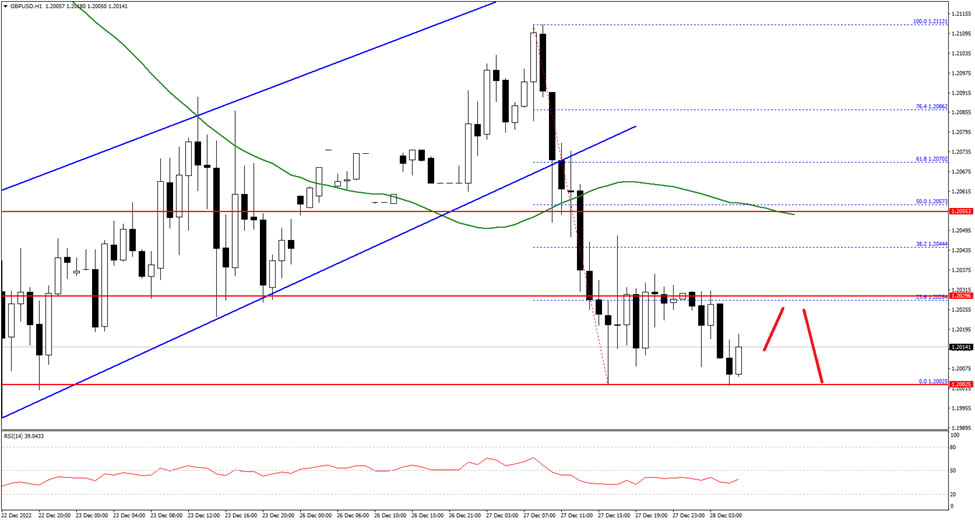
The British Pound started a downside correction from the 1.2120 zone against the US Dollar. The GBP/USD pair declined below 1.2080 to move into a short-term bearish zone.
The pair even settled below the 1.2050 level and the 50 hourly simple moving average. It is now consolidating near the 1.2010 level on FXOpen, with an immediate resistance at 1.2025.
The main hurdle is near the 1.2055 level and the 50 hourly simple moving average. If there is a clear upside break above the 1.2055 resistance, the pair could rise steadily towards the 1.2120 level in the near term. The next major resistance sits near the 1.2180 level.
On the downside, the first major support is near the 1.2005 level. The main support is forming near the 1.2000 level. A break below the 1.2000 support could push the pair towards the 1.1940 support.
Yen Extends Losses after Summary of Opinions
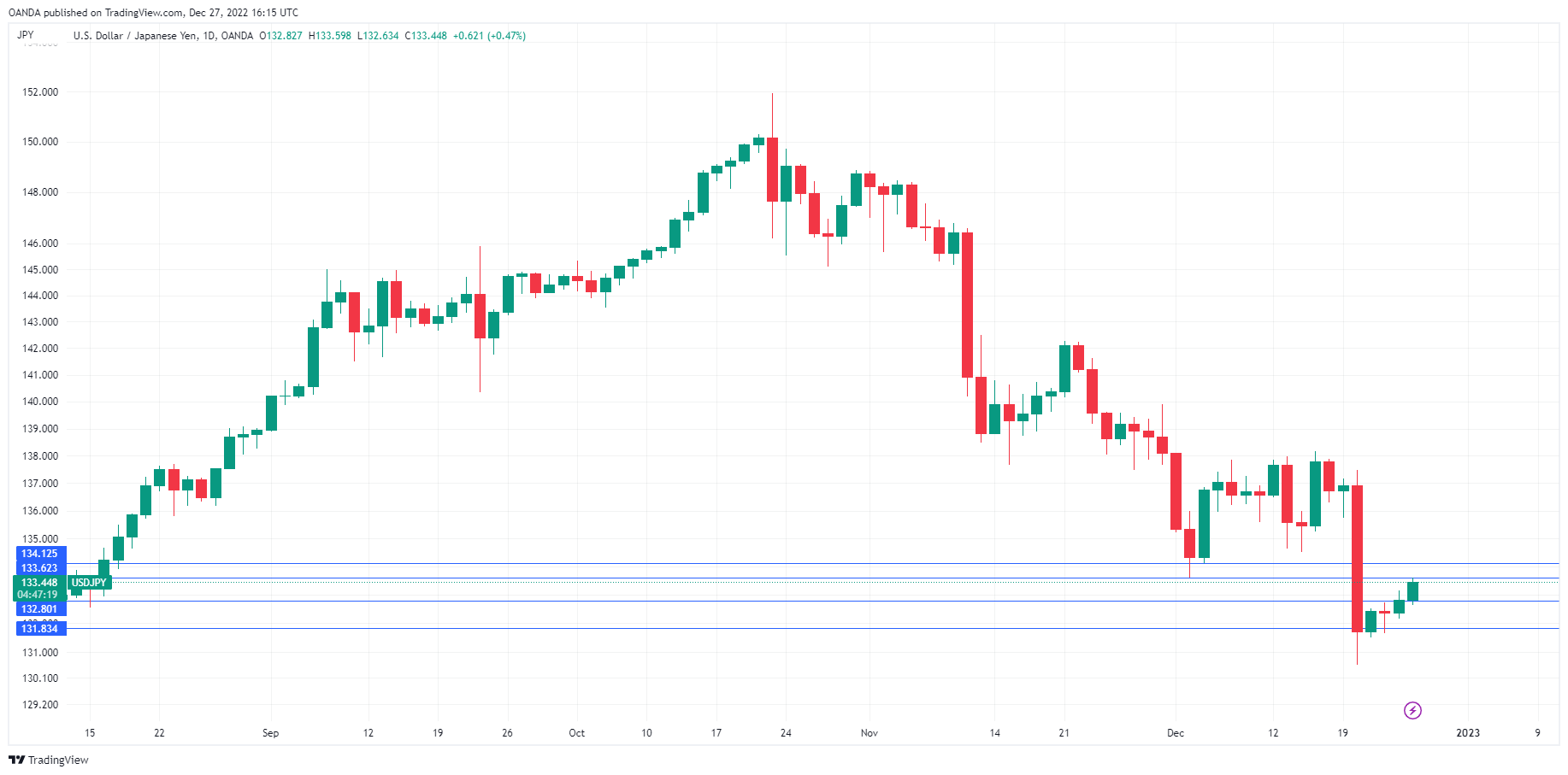
The Japanese yen continues to lose ground this week and is in negative territory on Wednesday. In the European session, USD/JPY is trading at 134.11, up 0.49%.
Post-Christmas holiday trading remains thin, but USD/JPY has made steady gains and climbed 1% this week. The US dollar has recovered somewhat after last Tuesday’s slide when it fell a staggering 3.8% after the BoJ widened its yield curve band. The move blindsided the markets, which had not expected any major policy moves prior to the end of Governor Kuroda’s term in April.
Summary of Opinions – no exit from loose policy
Investors were all ears as the BoJ released today the summary of opinions from last week’s dramatic meeting. The summary of opinions showed that several of the nine board members said that the tweak to yield control was aimed at enhancing the current stimulus programme rather than ending it. This reiterated what Governor Kuroda stated in a press conference after the meeting. Still, speculation remains high that the BoJ could take further steps that tighten policy, and even exit the Bank’s ultra-loose policy, especially with inflation running at a 40-year high.
The summary of opinions indicated that members discussed rising inflation and the possibility that higher wages would remove the risk of a return to deflation. The BoJ has been focused on wages, arguing that strong wage growth will ensure that inflation is sustainable, as opposed to inflation that is driven by higher costs for energy and raw materials. The government is also making wages a top priority, and there are indications that major companies and labour unions will negotiate higher wages in the spring. If the BoJ sees that wages are rising it could raise its yield curve control target, which is currently around 0% for 10-year bonds. The BoJ will likely be back in the headlines shortly, with its next meeting on Jan. 17th and 18th.
USD/JPY Technical
- USD/JPY is testing resistance at 134.12. Above, there is resistance at 134.82
- There is support at 133.25 and 132.29
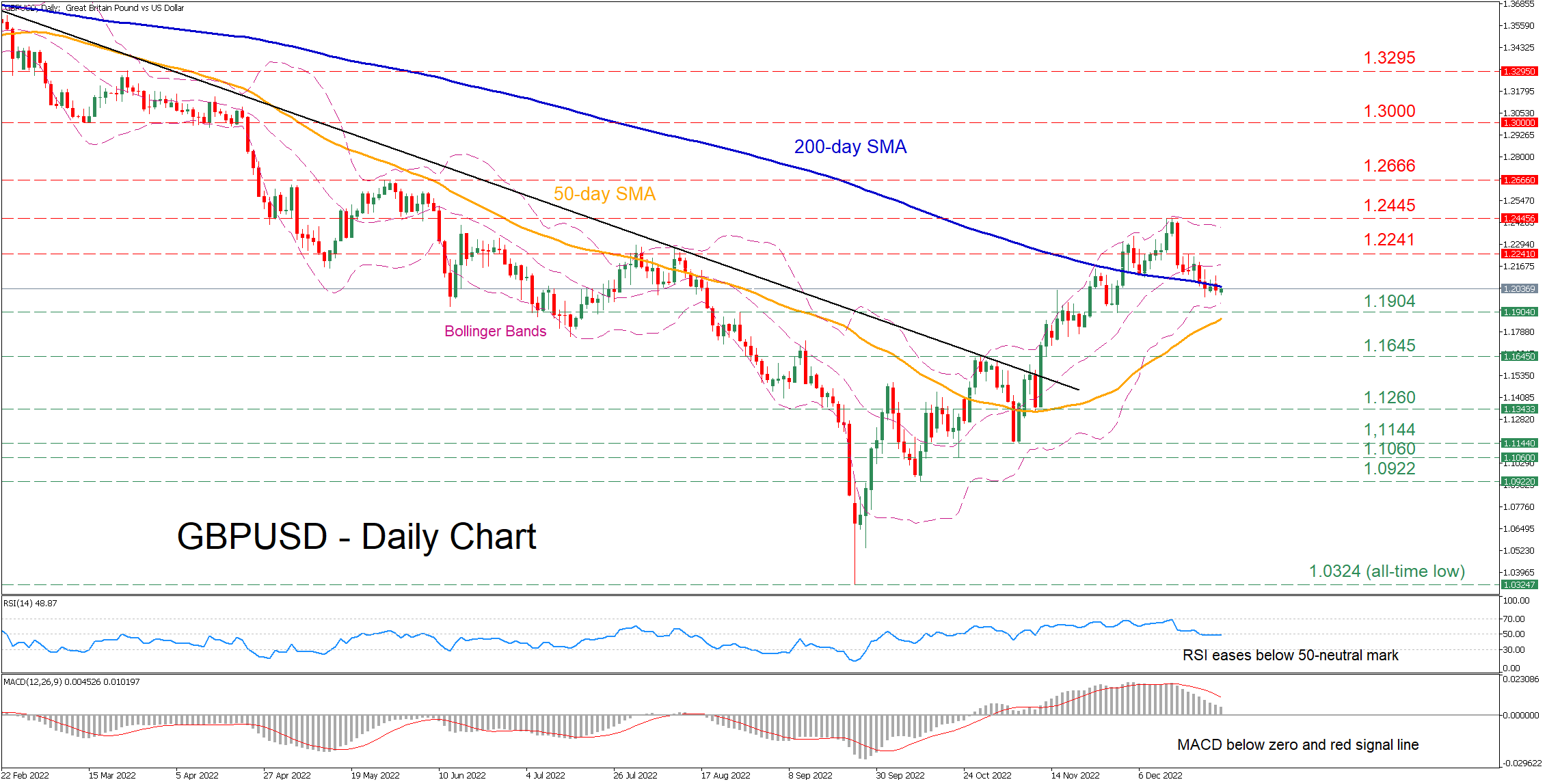
GBPUSD Battles with 200-Dday SMA as Pullback Extends
GBPUSD has been edging higher after finding its feet at the all-time low of 1.0324 in late September. Even though the pair has staged a strong rebound, it is currently experiencing downside correction, with the 200-day simple moving average (SMA) acting as a strong floor.
The short-term oscillators currently suggest that bearish forces are in control. Specifically, the RSI slid below its 50-neutral mark, while the MACD histogram is declining below its red signal line in the positive territory.
If the negative momentum strengthens and the price extends its retreat, the recent low of 1.1904 might act as the first line of defence. Diving lower, the pair could challenge the October resistance of 1.1645 before the focus shifts to 1.1260. Failing to halt there, the November low of 1.1144 may curb further declines.
To the upside, bullish actions could propel the price towards the recent resistance region of 1.2241. Piercing through this zone, the bulls could aim at 1.2445, which rejected the pair’s medium-term rebound. Even higher, the May peak of 1.2666 could come under examination.
Overall, GBPUSD is experiencing a moderate pullback since its uptrend encountered significant resistance. Therefore, a dive beneath the 200-day SMA may accelerate the downfall.
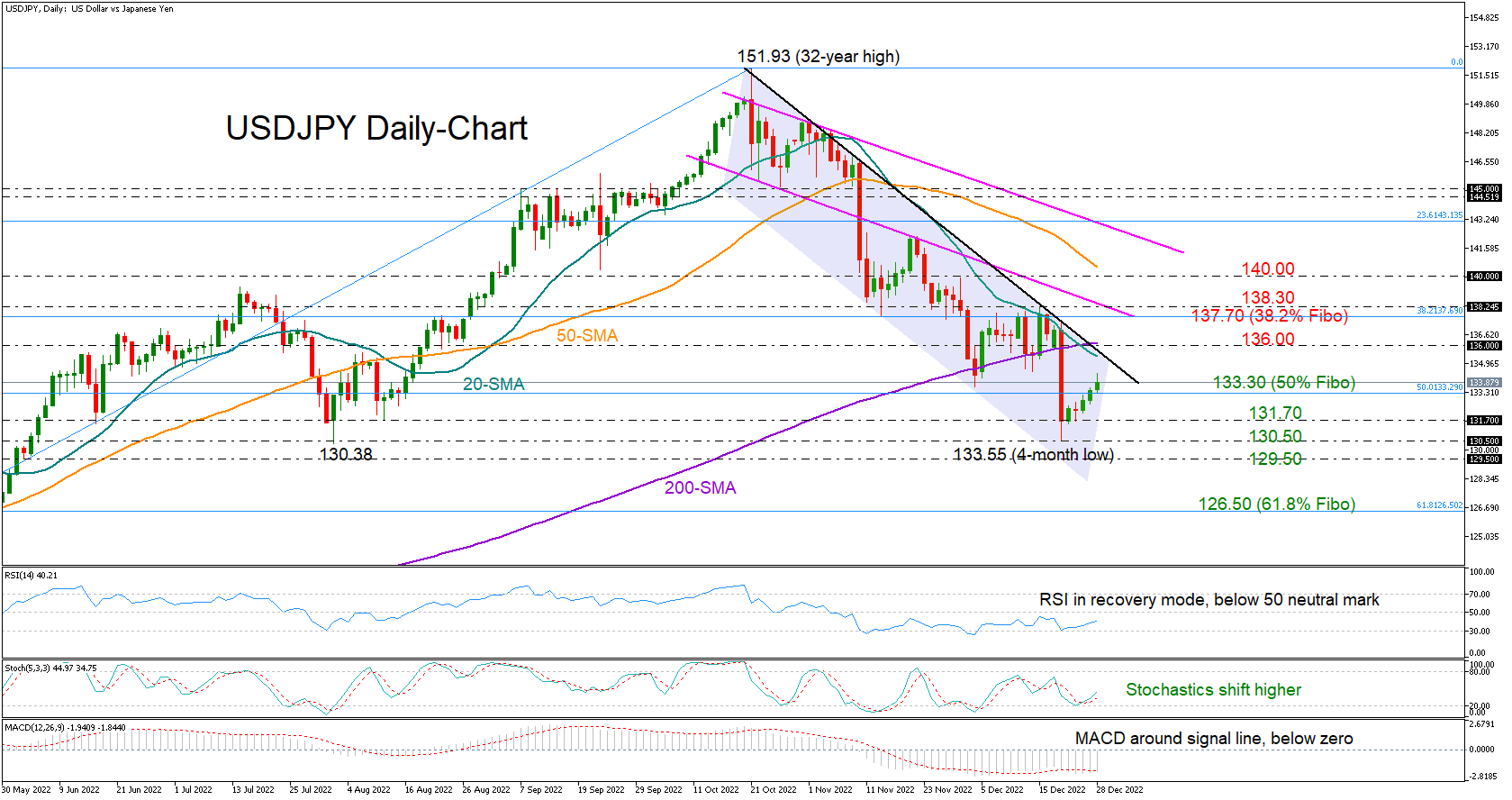
USDJPY Rises, But Outlook Still Cloudy
USDJPY is set for another green day, being halfway below last week’s pre-crash levels at 133.80.
The price has been gradually gaining ground over the past couple of sessions, with the RSI and the stochastics endorsing the improvement in sentiment as the indicators changed direction to the upside. That said, the crucial resistance trendline drawn from October’s peak is coming again on the radar, threatening a new bearish episode near the 20-day simple moving average (SMA) at 135.40. The 200-day SMA could prove another headwind slightly higher at 136.00.
Should the bulls drive even higher, the next challenge may occur around the 38.2% Fibonacci retracement of the March-October uptrend at 137.70, where the lower boundary of the broken bearish channel is positioned. Another victory here may attract fresh buying interest, lifting the pair up to the 50-day SMA, which is currently converging towards the 140.00 number.
In the event the price closes below the 50% Fibonacci of 133.30, all eyes will turn again to the 131.70-130.50 support area. Sliding lower, some consolidation may develop near the 129.50 handle before an aggressive sell-off squeezes the price towards the 61.8% Fibonacci of 126.50.
In short, the latest pickup in USDJPY looks untrustworthy as downside risks keep lingering overhead within the 135.40-136.00 region.
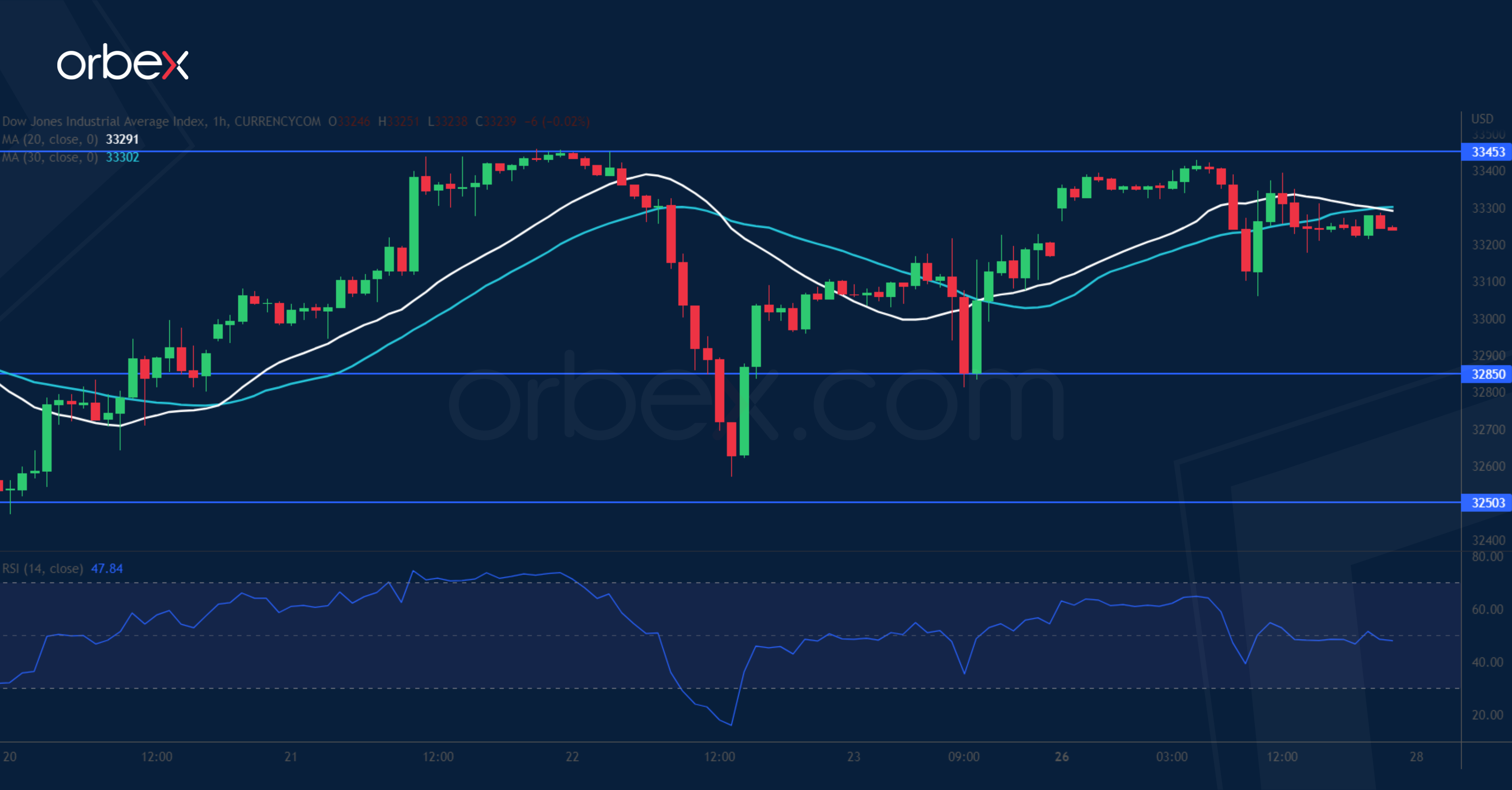
Dow Jones 30 Stays in Range
The Dow Jones treads water as thinning liquidity and few economic data keep investors at bay. The sell-off in mid-December has prompted short-term buyers to bail out. Though the latest retracement secured bids in the critical demand zone around 32500. A rally back above 33450 would help the bulls regain confidence. 34400 near the recent top is a major resistance and the recovery could be back on track should buyers succeed in lifting the last offers over there. On the downside, 32850 is the first support.
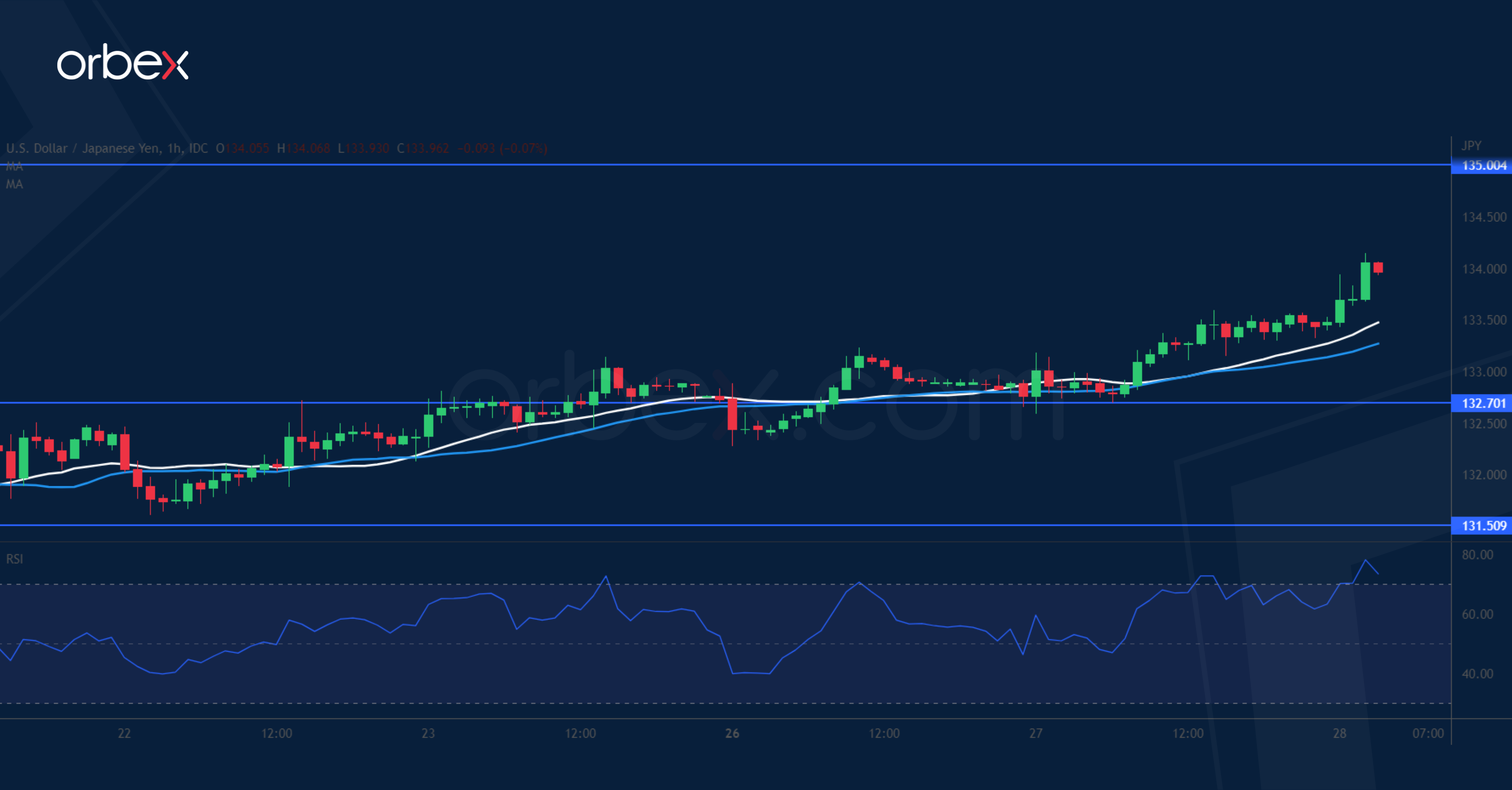
USD/JPY Recoups Losses
The US dollar regained some lost ground on the back of rising Treasury yields. The price action is seeking to hold above August’s low of 130.80 as a bearish breakout could pave the way for sustained weakness in the new year. The bounce could be driven by sellers’ profit-taking in this critical demand zone. 135.00 at the confluence of a support-turned-resistance and the 20-day moving average might make it a tough level to crack. Its breach, however, would turn the tide in the bulls’ favour. 132.70 is the closest support.
EUR/USD Consolidates Gains
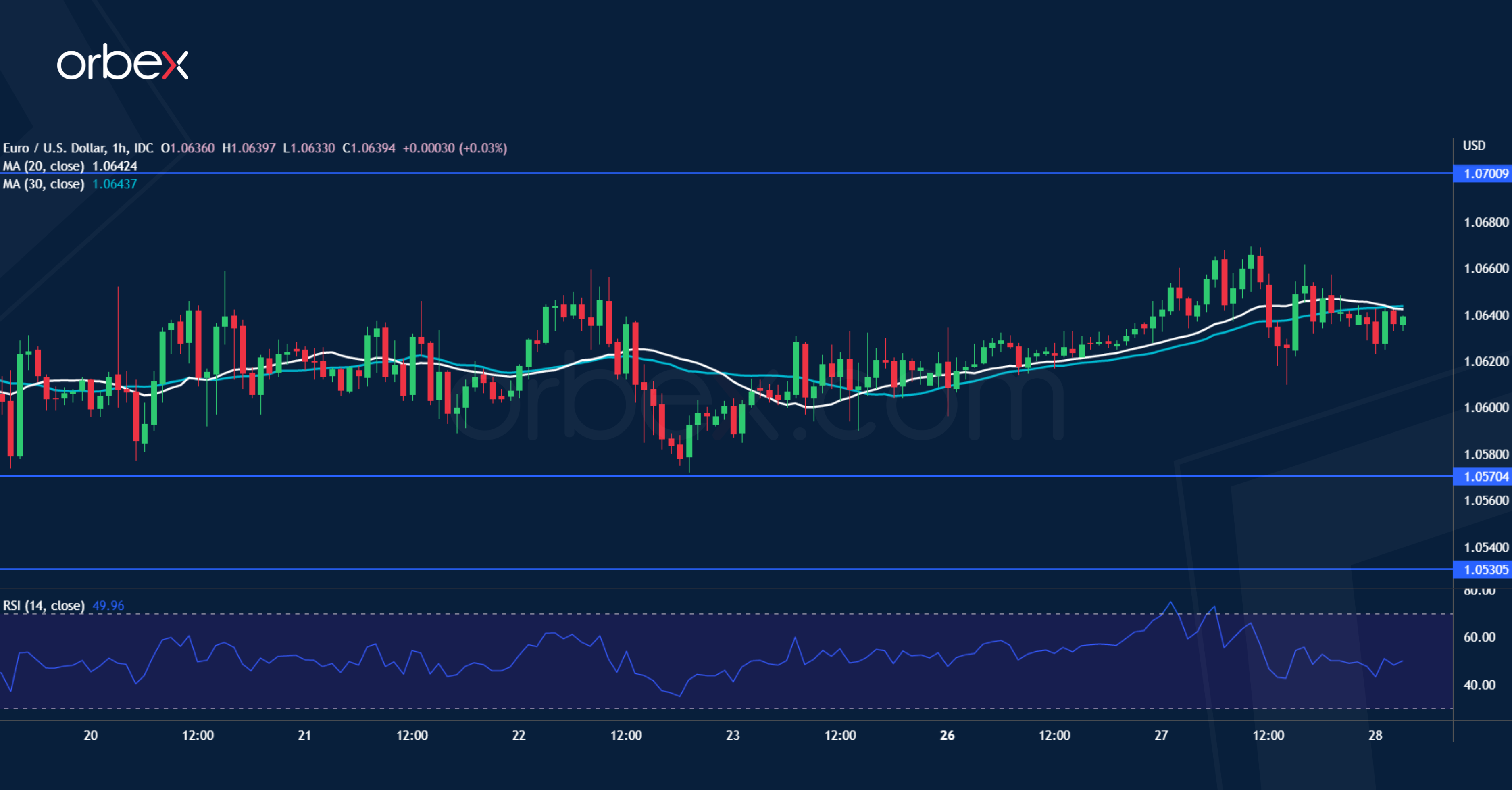
The euro keeps the high ground thanks to the ECB’s hawkish approach. The euro has retained its upward trajectory, and the RSI returning to the neutral area on the daily chart has taken some heat off the rally. The current consolidation may allow the bulls to accumulate above the 20-day moving average. The recent high of 1.0700 is the first resistance and its breach would lift the pair to last May’s high of 1.0780 which is a major obstacle in the medium-term. 1.0570 is an important support to keep intraday buyers interested.
Chinese Reopening Story is Not All Rosy
Yesterday, Russia finally responded to the EU’s price cap on its oil exports, saying that they will simply stop exporting their oil to parties that ‘directly or indirectly use the mechanism of setting a price cap’.
The Russian oil export ban will reportedly last at least until July 2023. Fair enough.
The latter announcement gave a minor boost to crude oil yesterday, but the barrel of American crude remained offered into the 50-DMA, near $81.60pb, and the price is back below the $80pb this morning.
Why? Because most countries that are pointed by Putin’s finger have already stopped majority of oil imports from Russia.
Plus, the Russian crude is already trading below the $60pb price cap - meaning that there is no direct implication on the Russian supply – at least in the immediate future.
The country produces around 10 mio barrels per day, although the Russian Prime Minister said that the output may fall by 500’000 to 700’000 barrels a day early next year, which would be around 5-6% of the current production.
But, an eventual decrease in Russian oil supply gives support to the oil bulls’ in the medium rub.
Other factors like Chinese reopening, and the cold weather in America should also help throw a floor under a further selloff in oil, and even encourage a rise above the 50-DMA, and toward the $88pb target.
Chinese reopening story is not all rosy
If the Chinese reopening story is positive for oil and commodity prices - and for the massively battered Chinese stocks, it’s bad news for global inflation.
This is why we don’t see the US stocks gain on China reopening news, but we rather see them under a decent pressure, as the surge in Chinese demand will certainly boost inflation through higher energy and commodity prices.
And in response to higher inflation, the central banks will continue hiking rates.
And the stronger the positive impact on growth from Chinese reopening, the faster the global inflation, and the faster the global inflation the more aggressive the central bank actions will be.
The 10-year yield jumped 2.5% yesterday to above 3.85% and the German 10-year yield spiked more than 4.50% to above 2.50%. The rising global yields gave some support to the US dollar yesterday, but gains in greenback remained limited at some places.
The EUR/USD for example was flat to slightly positive as the European Central Bank 8ECB) hawks didn’t let the Federal Reserve (Fed) hawks take the upper hand.
Gold rallied $33 per ounce, to $1833, defying the rising US yields, while the Aussie-dollar pushed higher as well, parallel to the positive pressure in iron ore futures thanks to the improved prospects of Chinese demand.
Nevertheless, the Chinese reopening story doesn’t do good to sentiment in stock markets.
The S&P 500 slid 0.40% yesterday, where gains in energy stocks helped temper headwinds in rate-sensitive technology stocks, while Nasdaq, which is plenty of tech stocks, slumped 1.50% yesterday, and is certainly headed toward the next bearish target that stands at 10’200.
And the overall bearish sentiment, and endless news about FTX Sam Bankman Fried, which also raises concerns regarding the financial health of other cryptocurrency companies, pushed Bitcoin under the $17K mark, again.
And besides the global macro headwinds, and the sector-specific worries, there is also a growing headache regarding the impact of current price action on mining activities. Bitcoin’s hash rate has been falling sharply since the FTX collapse, as some miners default under the pressure of globally squeezed margins.
EUR/USD Daily Outlook
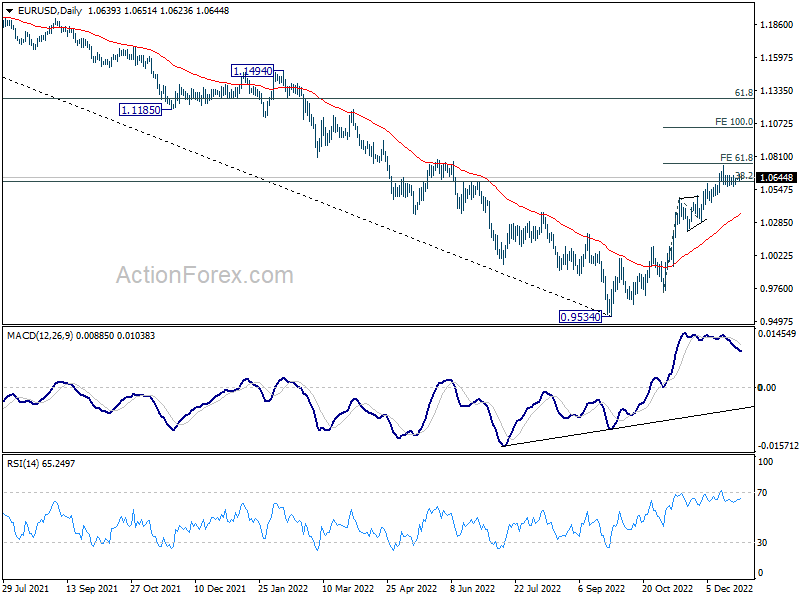
Daily Pivots: (S1) 1.0611; (P) 1.0640; (R1) 1.0668; More...
EUR/USD is still bounded in consolidation from 1.0733 and intraday bias remains neutral first. Further rally is expected as long as 1.0481 resistance turned support holds. Firm break of 61.8% projection of 0.9729 to 1.0481 from 1.0289 at 1.0754 will pave the way to 100% projection at 1.1041. However, firm break of 1.0481 will confirm short term topping and bring deeper fall to 1.0289 support.
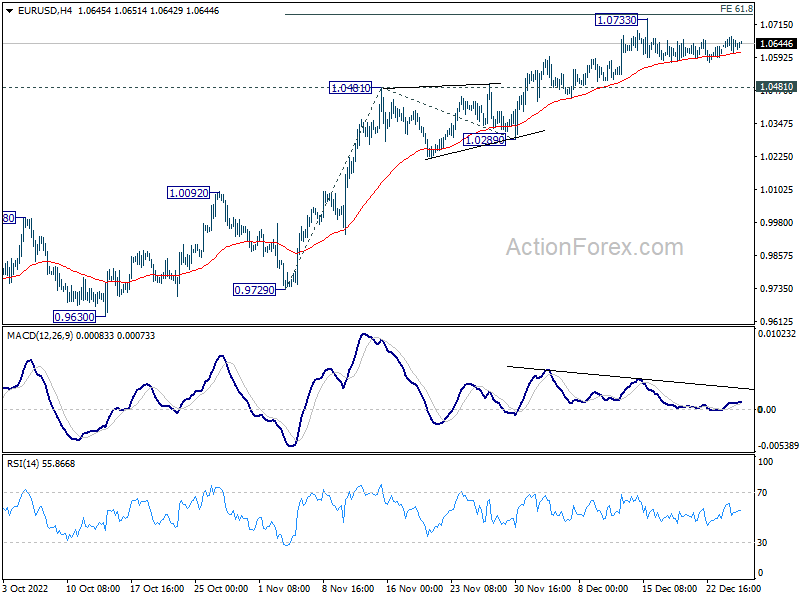
In the bigger picture, focus stays on 38.2% retracement of 1.2348 (2021 high) to 0.9534 at 1.0609. Rejection by 1.0609 will suggest that price actions from 0.9534 medium term bottom are developing into a corrective pattern. Thus, medium bearishness is retained for another fall through 0.9534 at a later stage. However, sustained break of 1.0609 will raise the chance of trend reversal and target 61.8% retracement at 1.1273.