Sample Category Title
CAD/JPY struggling at 100, eyes on BoC hike
BoC is widely expected to continue with tightening today. But opinion on the size of the rate hike is split, with odds slightly in favor to 50 than 25. The main question, though, is not about how much the hike is, but how BoC would indicate the path forward. That is, how close interest is to the terminal rate. This is what the statement would be scrutinized for.
Some suggested readings on BoC:
- BOC Interest Rate Decision: Foreshadowing the Fed?
- Can the BoC Meeting Deliver Any Surprises?
- Bank of Canada Hiking Cycle Could Be Drawing to a Close
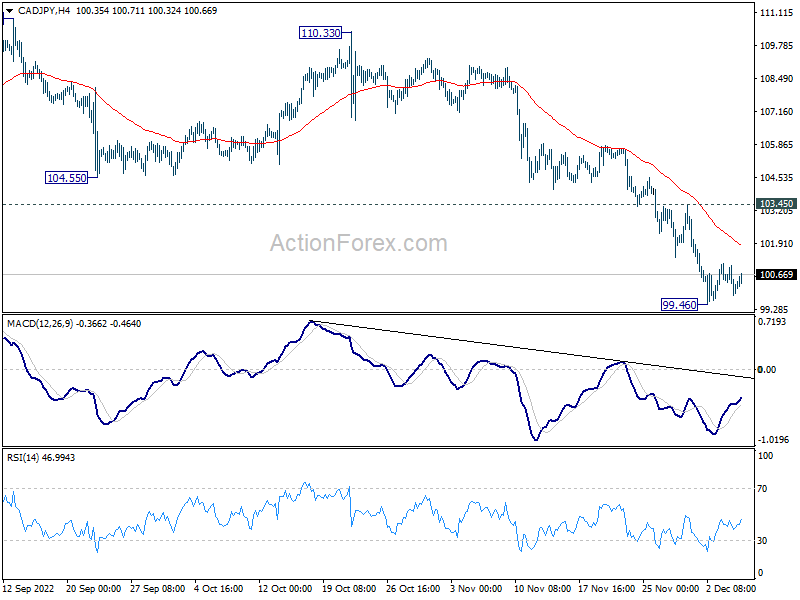
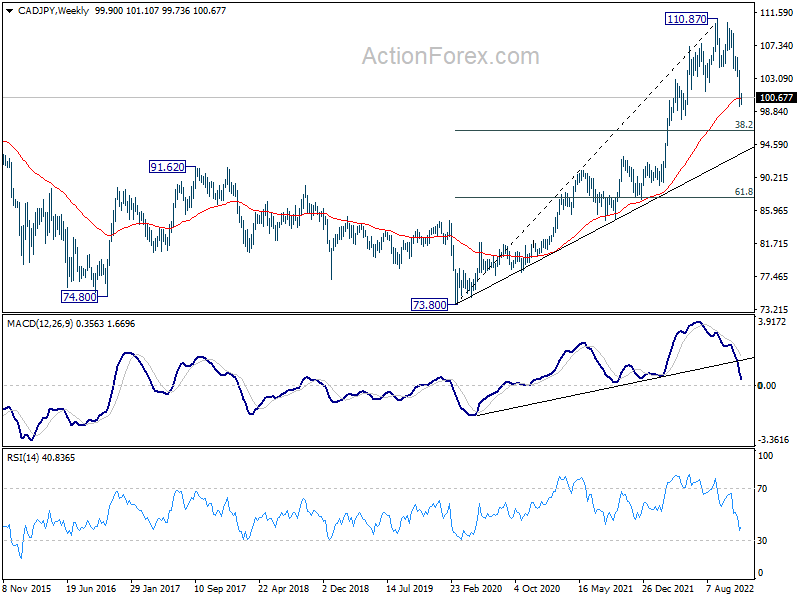
CAD/JPY's decline halted last week after hitting 99.46, but it's just struggling around 100 handle, with no momentum for a solid rebound. For now, deeper fall is expected as long as 4 hour 55 EMA (now at 101.88) holds. Break of 99.46 will resume the decline from 110.87 as a long term correction. CAD/JPY should have a take on 38.2% retracement of 73.80 to 110.87 at 96.70 before forming a bottom.
Australia AiG services fell to 45.6, deepening contraction
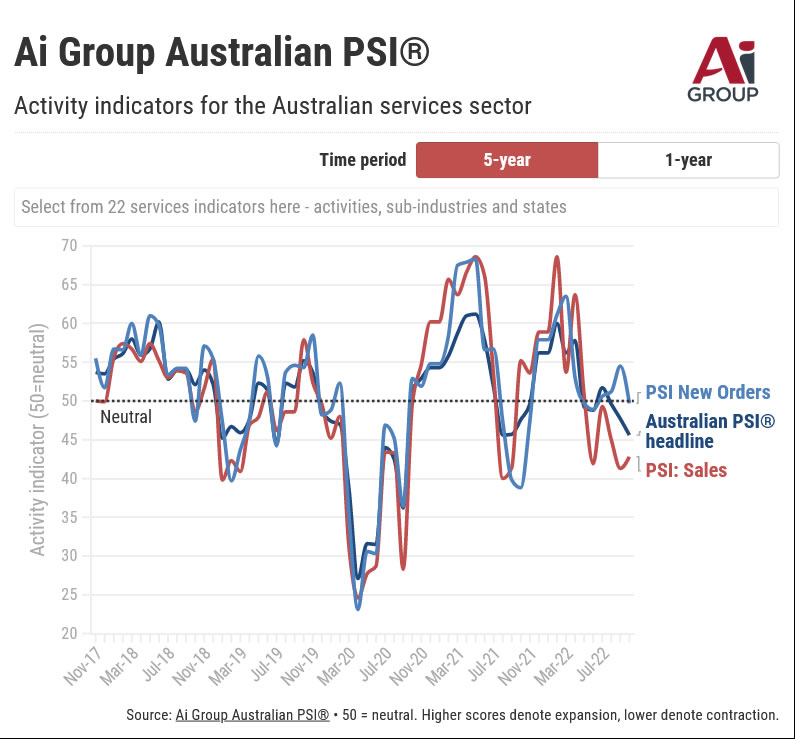
Australia AiG Performance of Services dropped -2.1 pts to 45.6 in November, signaling contraction for a third month. Sales rose 1.5 to 42.8. Employment dropped -6.1 to 47.8. New orders dropped -4.8 to 49.7. Input prices dropped -3.6 to 74.0. Selling prices rose 2.2 to 64.4. Average wages rose 3.8 to 68.6.
Innes Willox, Chief Executive of the national employer association Ai Group, said: "The deteriorating economic outlook is clearly weighing on Australia's services sector. The Australian PSI indicated a deepening contraction in the services sector, with three months of declining results. Steep falls in indicators for employment and new orders in November reveal weakening demand for services, while ongoing labour shortages continue to constrain the supply side."
Australia GDP grew 0.6% qoq in Q3, terms of trade deteriorated
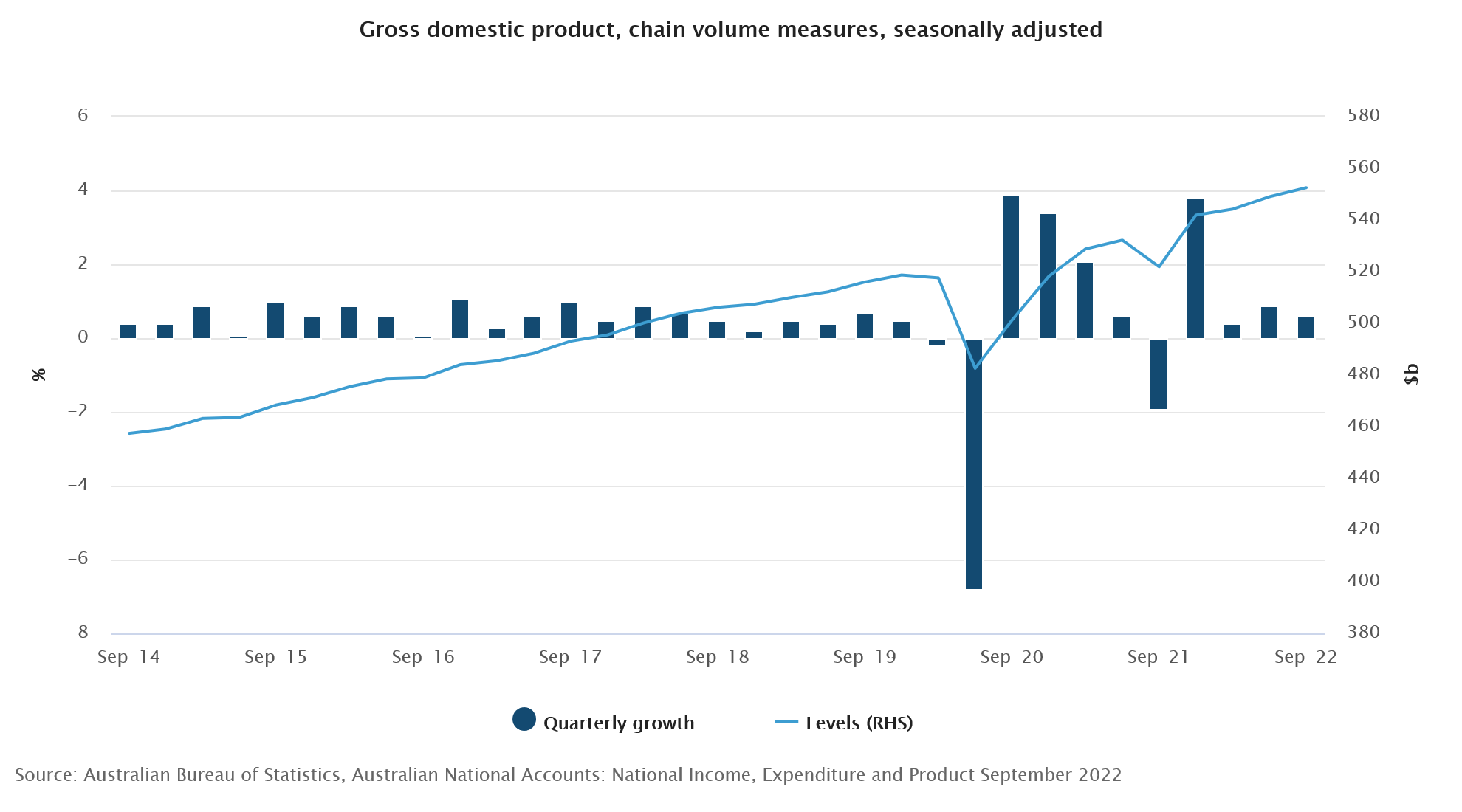
Australia GDP grew 0.6% qoq in Q3, below expectation of 0.7% qoq. Household spending rose 1.1%, contributing 0.6% to GDP. Compensation of employees increased 3.2%, the strongest rise since December quarter 2006. Net trade detracted -0.2% from GDP, with a 2.7% increase in exports offset by a 3.9% rise in imports. The terms of trade fell -6.6%, the largest fall since June quarter 2009, as import prices increased and export prices fell.
BoJ Nakamura: Inflation not accompanied by wage increases yet
BoJ board member Toyoaki Nakamura said, "recent price rises aren't accompanied by wage increases yet". He added that Japan is far from the situation where wage inflation spiral becomes a concern. The central bank needs to continue with ultra-loose monetary policy for the time being.
"Tightening monetary policy at a time when demand continues to remain lower than supply would put huge pressure on corporate and household activity," he warned.
He expects inflation to slow next year as energy and food price rises fade.
Gold Price Dips Remain Attractive To The Bulls
Key Highlights
- Gold price started a downside correction from the $1,810 zone.
- A major bullish trend line is forming with support near $1,758 on the 4-hours chart.
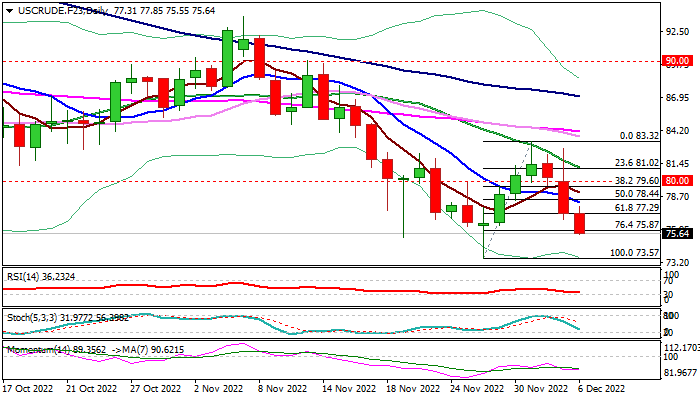
- Crude oil price gained bearish momentum and declined below $78.
- The BoC interest rate decision is scheduled today (forecast 4.25%, versus 3.75% previous).
Gold Price Technical Analysis
Gold price formed a base above the $1,725 level against the US Dollar. The price started a steady increase above the $1,750 and $1,770 levels.
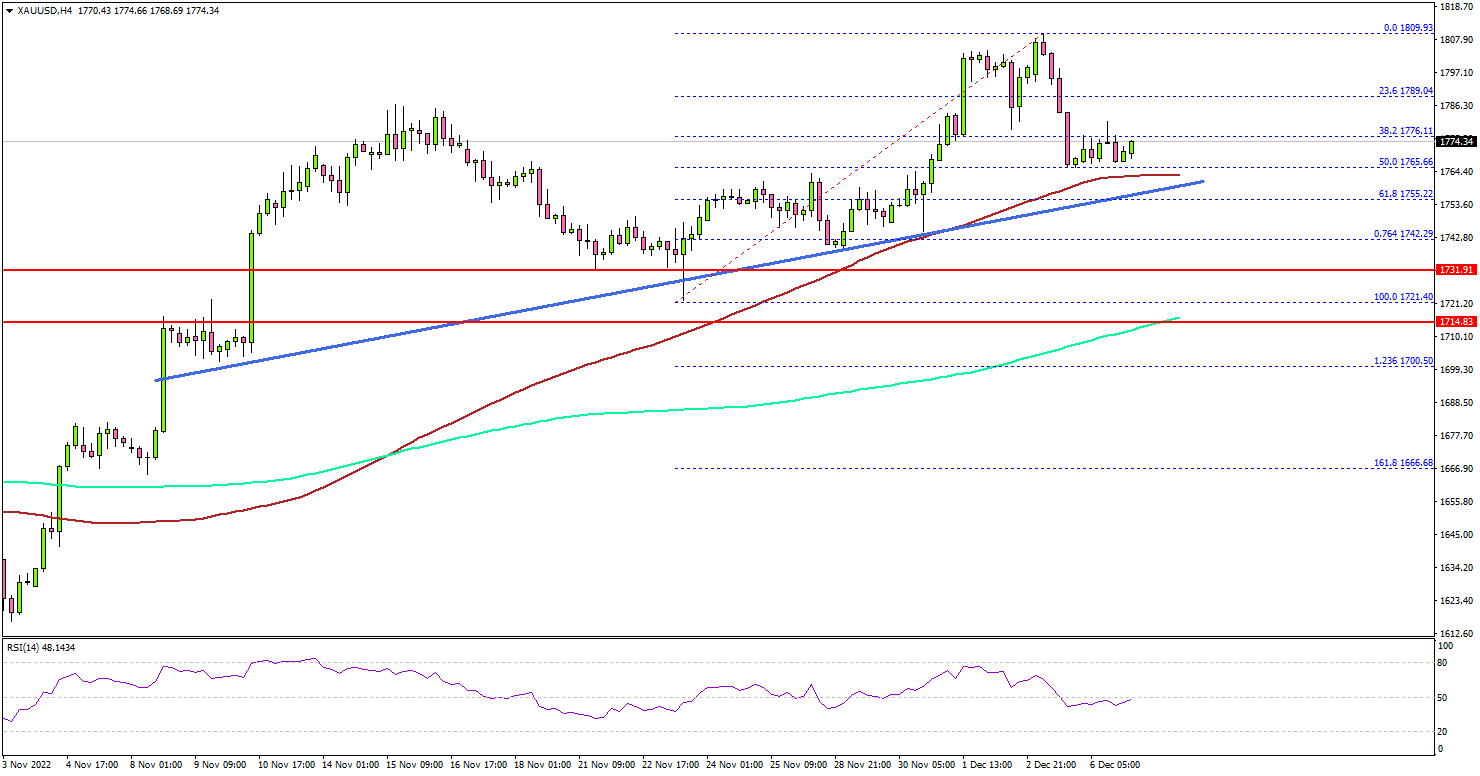
The 4-hours chart of XAU/USD indicates that the price gained pace above the $1,780 resistance zone. The price even moved above the $1,800 level and settled well above the 100 simple moving average (red, 4-hours) plus the 200 simple moving average (green, 4-hours).
The price traded as high as $1,809. Recently, there was a downside correction below the $1,800 level. The price traded below the 23.6% Fib retracement level of the upward move from the $1,721 swing low to $1,809 high.
On the downside, an initial support is near the $1,755 level. There is also a major bullish trend line forming with support near $1,758 on the same chart.
The next major support is near the $1,730 level. The main support is near $1,720, below which gold price might struggle to stay above the $1,700 zone. On the upside, the price might face sellers near the $1,790 level.
The next major resistance is near the $1,800 level. Any more gains might send the price towards the $1,810 resistance level, above which gold price might revisit the $1,832 resistance.
Looking at crude oil price, there was a sharp decline below the $80 and $78 support levels. The next major support sits near the $72 level.
Economic Releases to Watch Today
- Euro Zone Gross Domestic Product for Q3 2022 (QoQ) - Forecast 0.2%, versus 0.2% previous.
- Euro Zone Gross Domestic Product for Q3 2022 (YoY) - Forecast 2.1%, versus 2.1% previous.
- BoC Interest Rate Decision – Forecast 4.25%, versus 3.75% previous.
First Impressions: Australian Q3 GDP
Australian economy expands by 0.6%, a little softer than expected. The impacts of high inflation and higher interest rates are becoming apparent – notably, the real estate sector on lower turnover subtracted 0.2ppts from activity in the period.
The Australian economy expanded by 0.6% in the September quarter.
That was a little softer than anticipated, market median 0.7% and Westpac 0.8%.
Annual growth is 5.9%. The level of activity is 6.5% above levels prior to the pandemic, at the end of 2019.
Key surprise: The real estate sector – in the form of Ownership Transfer Costs (turnover in the property sector) plunged by -11.2%, subtracting 0.2ppts from activity. We had allowed for a more modest fall (recent quarterly outcomes have been -1.1%, -2.5% and -2.1%).
This provides further evidence that the Australian economy is in transition. Earlier tailwinds are fading, and the impacts of high inflation and higher interest rates are beginning to become apparent. A sharp economic slowdown is in prospect for 2023.
Hours worked: The National Accounts estimate that hours worked expanded by only 0.1% - even a touch softer than the Labour Force survey, which reported a rise of 0.2%. Supply constraints are a factor, with the economy bumping up against capacity constraints. In addition, in the September quarter, there was elevated sick leave (around covid) and elevated levels of annual leave.
Consumer spending grew by 1.1% in the quarter, broadly meeting our expectations.
The ABS report that this was driven by discretionary goods and services – as the reopening effect (which was greatest over the first half of the year) extended into the September quarter.
Hotels, cafes and restaurants (+5.5%) and transport services (+13.9%) led the increases as COVID-related impacts eased, aiding the recovery of domestic and international tourism-related activity. Purchase of vehicles (+10.1%) also contributed to the rise as supply constraints eased and order backlogs were fulfilled.
The household saving ratio declined from 8.3% to 6.9%, returning towards levels seen prior to the pandemic. Household saving fell as the rise in household spending outpaced growth in gross disposable income.
Gross disposable income rose 1.6%, driven by labour income (COE). Non-labour income also grew with property income received by households up 9.5%. Offsetting this was income payable growth of 5.2%. This was driven by interest payable on dwellings up 36.0%, in line with interest rate rises during the quarter.
Expenditure detail:
Domestic demand grew by 0.6% in the quarter.
Net exports subtracted -0.2ppts from activity offset by a positive 0.2ppts contribution from total inventories. Of note, other inventories subtracted 0.2ppts from growth in the period.
Home building activity advanced by a modest 1% in the quarter, with a 3.4% increase in new home building outweighing a 2.2% decline in renovation work.
Business investment grew by 0.7%, with a lift in construction work outweighing a -3.0% decline in equipment spending.
Public demand is cresting at a high level, managing to post only a tepid 0.2% increase. This follows rapid growth up to the March quarter 2022, boosted by the response to the pandemic.
Sunset Market Commentary
Markets
Your average daily soap opera tonight will most likely hold more plot twists than markets do today. European equity markets whipsawed in a tight range just below the zero point and WS opens flat in a session devoid of news and economic data. Core bonds gained with US Treasuries underperforming Bunds. US yields initially gave back some of yesterday’s post-ISM gains but erased those in early US dealings. The long end slightly outperforms, causing the inversion to deepen further. German yields drop 5.2 to 6.3 bps in the 2y-10y segment even after gapping higher at the open in a partial catch-up with the US yesterday. The 1.77% support area in the 10y yield is just too much of a technical lure. Swaps outperform Bunds to the tune of a basis point or two. If any, other than a Lane speech we’ve seen little to explain for the European outperformance relative to the US. The ECB chief economist said he was fairly confident that inflation is near its peak. There could be some extra inflation early next year but in the spring/summer of 2023 there should be a sizeable drop. While he expects that more rate increases are necessary, he said that much has been done already. Frankfurt has raised rates since July by 200 bps. Lane did acknowledge that bringing inflation back to 2% from the current high levels will take time, amongst others because he expects second round effects coming from bigger-than-usual pay increases which will drive inflation next year and in 2024.
Over to FX! Where not much is happening either. EUR/USD doesn’t know which side to pick around the 1.05 big figure. The trade-weighted dollar is testing support from the 38.2% retracement of the 2021-2022 advance at 105.01. USD/JPY eases marginally to 136.28. Sterling is keeping low profile in the EUR/GBP 0.86 environment. In Central-Europe, the Hungarian forint underperforms regional peers. EUR/HUF is attacking recent highs around 414.6. This level must hold for the forint to prevent a technical return to the 430 all-time low. Forint weakness emerges amidst uncertainty around the disbursement of funds totaling over €13bn. The EC last week recommended member states to freeze €7.5bn of regular budget resources until Hungary implements a range of antigraft reforms. It also suggested to already approve Hungary’s Covid recovery plan as to avoid part of the €5.8bn grants being permanently lost but withhold the payout until more rule-of-law targets are met. The decision would be made today but is again postponed, to December 19. It’s no secret that the EU also uses the funds as leverage to persuade Hungary to drop its opposition to additional aid for Ukraine.
News Headlines
Czech October retail trade declined 1.8% in real terms to be 9.4% lower Y/Y (was -5.3%Y/Y in September). Sales of non-food goods decreased by 2.8% M/M and sales of food by 1.0% M/M, whereas sales of automotive fuel increased by 0.6%. The decrease in Y/Y sales already lasts from May this year. According the Czech statistical office ‘year-on-year decrease was reported by all main assortment types of specialised stores with non-food goods, except for stores selling dispensing chemist, medical and orthopedic goods. Retail sale via mail order houses or via Internet continued to decrease already for the tenth successive month.’ The slowdown in domestic demand supports the case for the Czech national bank to pause its hiking cycle with the policy rate currently at 7.0%. The krona weakens slightly today trading EUR/ CZK 24.32.
GDP growth in South Africa in Q3 turned out to be surprisingly strong. Activity grew by 1.6% Q/Q and 4.1 Y/Y, coming after a quarterly contraction of 0.7% in Q2. Strong Q3 growth also resulted in the South African economy now again surpassing the level from before the COVID-19 pandemic. Measured by production, 8 out of 10 industry sectors contributed to growth, with the biggest contribution (0.5%) coming from agriculture where activity increased 19;2. Measures by spending, household consumption decreased by 0.3% Q/Q (-0.2% contribution). Major positive contributions came from inventories (0.7%) and net exports (0.6%) and to a lesser extent from capital formation +0.3%). The rand rebounds slightly today trading at USD/ZAR 17.29, from an open 17.43.
Australia Not Keeping Pace With US Rate Hike
The Reserve Bank of Australia raised its key rate by 0.25 percentage points to 3.1% on Tuesday morning, meeting expectations. The current rate level is the highest in 10 years and the eighth consecutive hike, but the RBA has signalled more to come.
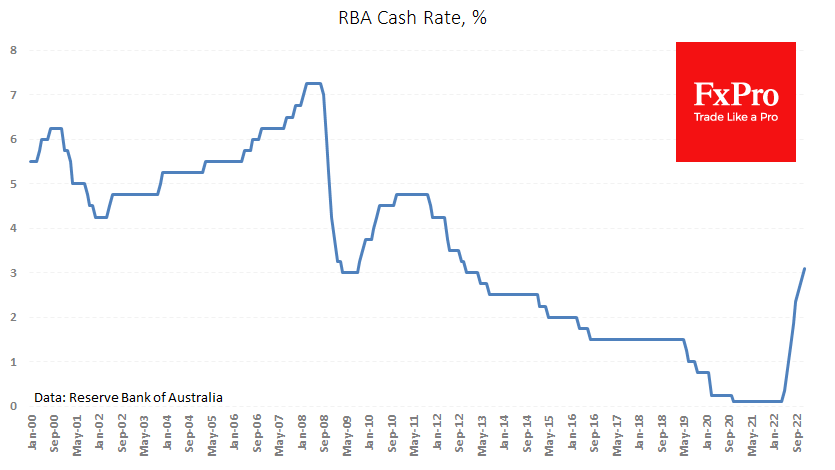
The RBA considers current inflation at 6.9% YoY “too high”, noting the contribution of global and local factors. The central bank is pointing at the need to balance supply and demand. Translated from central bankers’ language, it warns more pain for consumers to come via stricter credit conditions that are bad for jobs and loan rates. At the same time, Australia has moved from a run to a pitch for the third month, raising the rate by 25 points instead of 50.
While the Fed is also promising to slow down with tightening, the Reserve Bank of Australia did so earlier, widening the difference between the effective federal funds rate and the RBA key rate to 0.9 percentage points in November. This differential is likely to rise by 1.2 points after the Fed rate hike in just over a week by 0.5 points, as markets expect. Before March, the differential was -0.02 in favour of the AUD and later held in the range of 0.3-0.4 in favour of the USD.
The main intrigue of the forex market is the answer to whether we will see a recovery of the 2018-2020 regime when the key rate in the USA was more than a percentage point higher than the Australian one. Fundamentally, this resulted from the US and China trade wars, which slowed the latter’s growth. The technical manifestation for the forex market appeared to be pressure on the AUDUSD pair during this period, which was losing smoothly due to a sustained play on the interest rate differential – the carry trade.
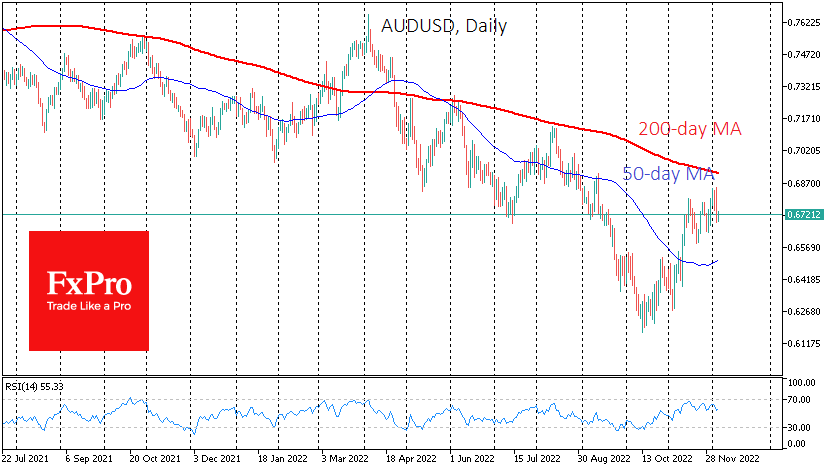
Since October this year, when markets began to price in a slowdown in the pace of Fed rate hikes, the AUDUSD has shown a 10% rise, which has been losing strength in recent days in anticipation of new regulatory signals. As the differential continues to build, pressure on AUDUSD could once again become the primary short-term trend, following the November recharging of dollar bulls. On the side of the Aussie, bulls could be played by Australia’s tight labour market, with the lowest unemployment rate since 1974 and China’s recent reversal to a stimulus after quarters of slowing growth. If these factors remain in place, they will allow for a noticeably higher rate hike in Australia than in the USA, returning curry traders’ interest in buying AUDUSD.
WTI Oil: Crude Price Continues to Fall Despite Price Cap on Russian Oil
WTI oil price holds firmly in red for the third straight day and hit one week low in European trading on Tuesday, pressured by stronger dollar and recession fears which so far offset expected impact from G7 decision to cap the price of Russian oil.
Negative technical studies add to near-term outlook, as daily MA’s are in full bearish setup and negative momentum is strong.
Fresh acceleration lower from Dec 1 recovery top ($83.32) emerged after bulls got trapped above Fibo barrier at $81.27 (38.2% of $93.72/$73.57) and reversed so far 76.4% of $73.57 $83.32 recovery leg, on track to fully retrace correction from $73.57 (Nov 28 low, the lowest since late Dec 2021) to $83.32 (Dec 1 high).
Loss of $73.57 handle would expose next significant support at $73.03 (200MMA) which guards psychological $70 support and $68.50 (50% retracement of $6.52 $130.48 recovery phase).
Res: 76.26; 77.29; 77.85; 78.44.
Sup: 75.26; 73.57; 73.03; 70.00.