Sample Category Title
Dollar Index: Dollar Gains Traction But Faces Strong Obstacles
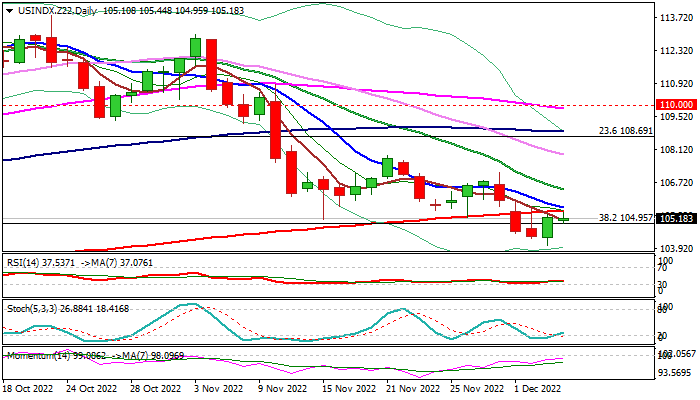
The dollar index is holding firm tone in early Tuesday, following 0.8% advance on Monday (the biggest one-day rally since Oct 27.
Better than expected US data on Monday (services PMI, Factory orders) improved the sentiment and lifted the greenback, as signals that the economy remains robust despite strong rise in borrowing cost, counter recession worries.
The US central bank is expected to raise interest rates by 50 basis points to 4.25%/4.5% range in the policy meeting next week, with terminal rate seen just above 5% and expected to be reached in May.
On the other hand, the risk sentiment is expected to be hurt by the impact of the latest decision of the EU to cap prices of Russian oil, which would start to hit energy prices in the Europe soon.
Daily studies slightly improved on Monday’s completion of bullish engulfing pattern and stochastic emerging from oversold zone, along with north-heading 14-d momentum, though still holding in negative territory.
Fresh bulls face strong barrier provided by 200DMA (105.53) which capped the cation on last Fri / Mon, after being broken last Thursday and reverted to resistance.
In addition, converging falling 10 DMA and 200DMA are on track to form a death-cross, which would further strengthen resistance.
Bullish scenario requires firm break of 200DMA to generate fresh bullish signal, which would look for confirmation on rise above 107.13 (Nov 30 lower top), otherwise limited recovery would keep larger bears intact and risk fresh push lower.
Res: 104.95; 105.44; 106.08; 106.86
Sup: 104.95; 104.31; 104.05; 103.18
Wind Out of the Sails
Stock markets are making small losses on Tuesday, while US futures are relatively unchanged ahead of the open.
The recovery rally has lost momentum in recent sessions which is understandable after that jobs report. That's not to say optimism can't and won't return but that wages component was a huge body blow. Investors are a little winded and it may just take a little time to get their breath back.
The PPI data on Friday could offer a helping hand on that front but even then, it will be hard to ease the concern Fed policymakers will undoubtedly have about the pace of wage growth, consumer resilience and the still large savings buffer. None of this aligns with a swift and relatively pain-free return to 2% inflation.
RBA maintains flexible approach
The key takeaway from the RBA meeting today was flexibility. There is no pre-set path and while policymakers expect to need to raise rates at upcoming meetings, the data will dictate if so and by how much. That doesn't help investors gage exactly what we can expect from the central bank but in such uncertain times, that makes a lot of sense. And you can see that reflected in the interest rate probabilities for the first quarter of next year. As it stands, no change or 25 basis points in February is a coin toss, while 3.35% in March (25bps above the current rate) is seen as being 50% likely with 25bps either side around 25% each. Clearly the RBAs communication strategy is going to plan.
Households feeling the squeeze this festive season
It will come as a surprise to no one that UK consumer spending remains subdued, with BRC reporting a 4.1% annual increase. With inflation running at 11.1%, spending is falling well behind, as is the case with wages, which suggests people are buying less and being more selective with what they do this festive season. Again, what can you expect when the economy is probably already in recession amid a terrible cost-of-living crisis that hurts those worst off most. The road to recovery for the UK is going to be long and painful, it seems.
The only guarantee for oil markets
It's been a volatile start to the week in oil markets, continuing in much the same way we ended last, with traders still working through the announcements from the G7 and OPEC+, as well as the latest Covid moves from China. In many way, none of the above improve visibility in the crude oil space; they arguably actually make the outlook more uncertain.
But the intial response to the above has seemingly been negative for crude prices, with the loosening of Chinese Covid curbs not enough to offset the $60 price cap and unchanged OPEC+ decision. The cap is probably viewed as a business as usual for now, with Russia reportedly selling below these levels already and improving its ability to get around the sanctions. Which means output remains broadly steady.
The move from OPEC+ was probably driven by the lack of visibility on China and Russia but as the group has warned in the past, should prices fall too far and the market become imbalanced, it won't wait until the next scheduled meeting to respond. It seems that the only thing guaranteed in the oil market for now is volatility.
Gold paring losses
The dollar recovered strongly on Monday as trade became increasingly risk-averse, hitting gold and forcing it back below $1,800 where it briefly traded above. It's attempting to pare those losses today, up around half a percent on the day but it may struggle in the short-term. It's been an incredible recovery until now but Friday was a massive setback. We now have to wait for PPI on Friday for some good news, with Fed policymakers in the blackout period ahead of the final meeting of the year, next week.
Stabilising?
The risk-reversal trade on Monday took the wind out of bitcoins sails, not that it would have taken much in the circumstances. It's trading back around $17,000 where it has spent most of the last week, which the community will probably be relieved about. Anticipating what's going to come next for cryptos feels incredibly difficult and dependent on the ongoing fallout from FTX. To reiterate what I've said recently, silence is bliss.
EUR/USD Mid-Day Outlook
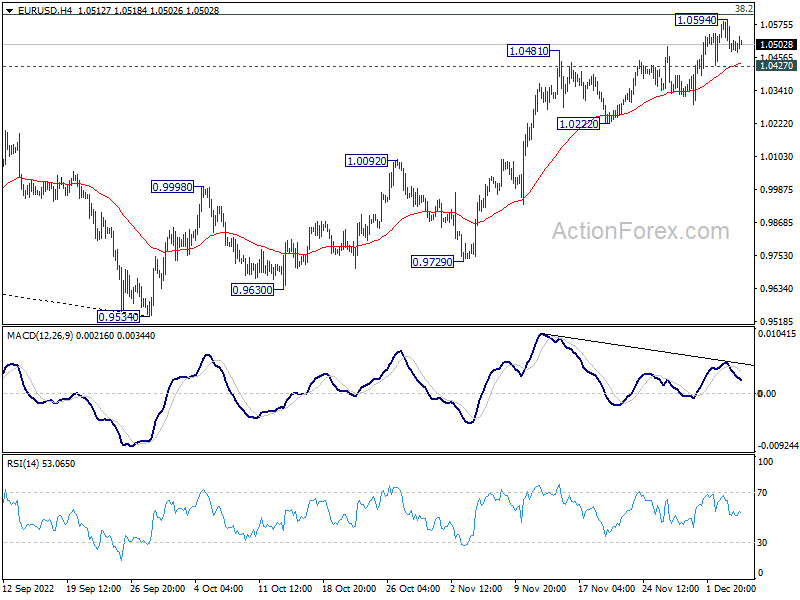
Daily Pivots: (S1) 1.0451; (P) 1.0523; (R1) 1.0566; More...
Intraday bias in EUR/USD stays neutral at this point. Considering bearish divergence condition in 4 hour MACD, break of 1.0427 minor support ill indicate short term topping at 1.0594, after rejection by 1.0609 fibonacci level. Intraday bias will be turned back to the downside for 1.0222 support and possibly below.
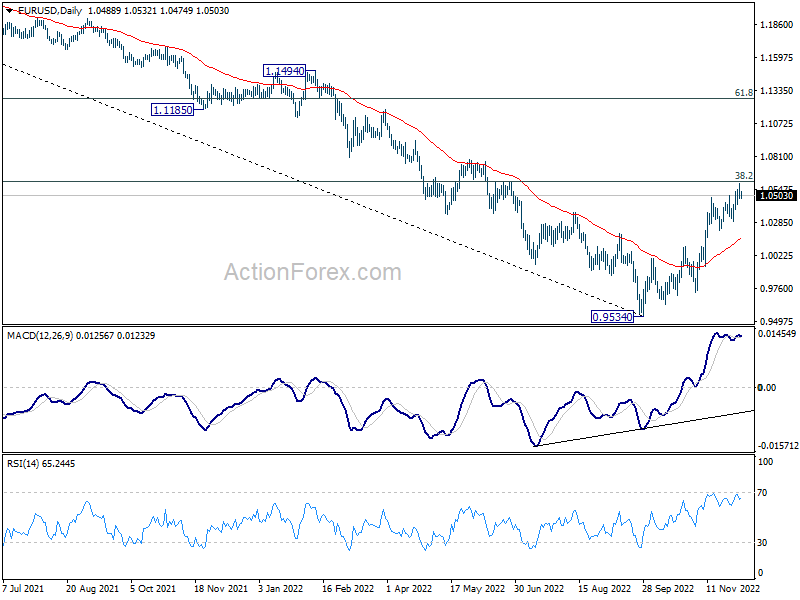
In the bigger picture, a medium term bottom was in place at 0.9534, on bullish convergence condition in daily MACD. Even as a corrective rise, rally from 0.9534 should target 38.2% retracement of 1.2348 (2021 high) to 0.9534 at 1.0609. Sustained trading above 55 week EMA (now at 1.0566) will raise the chance of trend reversal and target 61.8% retracement at 1.1273. However, rejection by 1.0609 will retain medium term bearishness for down trend resumption at a later stage.
GBP/USD Mid-Day Outlook
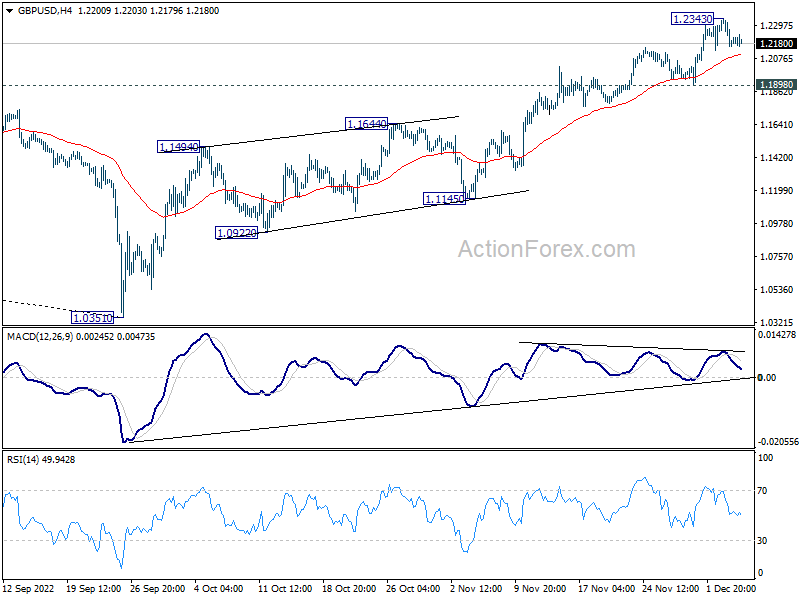
Daily Pivots: (S1) 1.2124; (P) 1.2234; (R1) 1.2307; More...
Intraday bias in GBP/USD stays neutral for the moment. Further rally is expected as long as 1.1898 support holds. Above 1.2343 will resume the rise from 1.0351 and target 1.2759 medium term fibonacci level next. However, firm break of 1.1898 support will confirm short term topping and turn bias back to the downside.
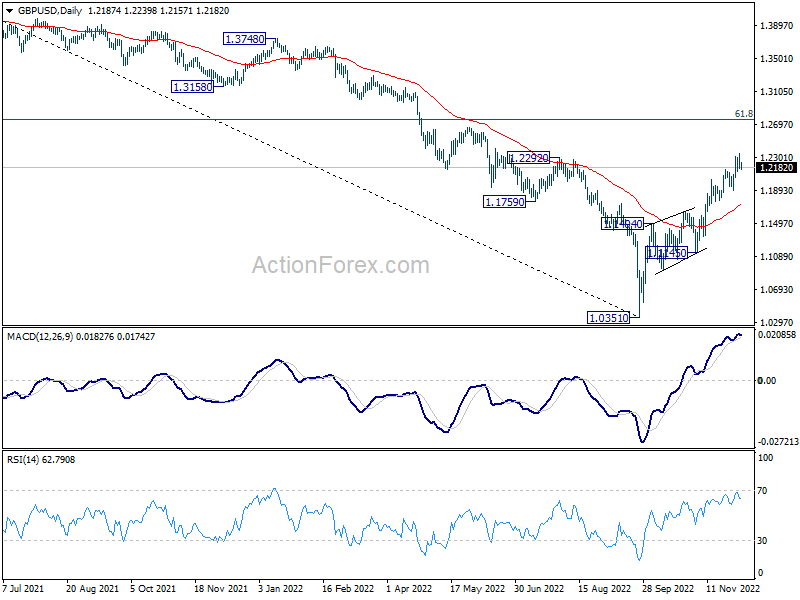
In the bigger picture, rise from 1.0351 medium term bottom is at least correcting whole down trend from 1.4248 (2021 high). Further rise is expected as long as 1.1644 resistance turned support holds. Next target is 61.8% retracement of 1.4248 to 1.0351 at 1.2759. Sustained break there will pave the way back to 1.4248.
USD/CHF Mid-Day Outlook
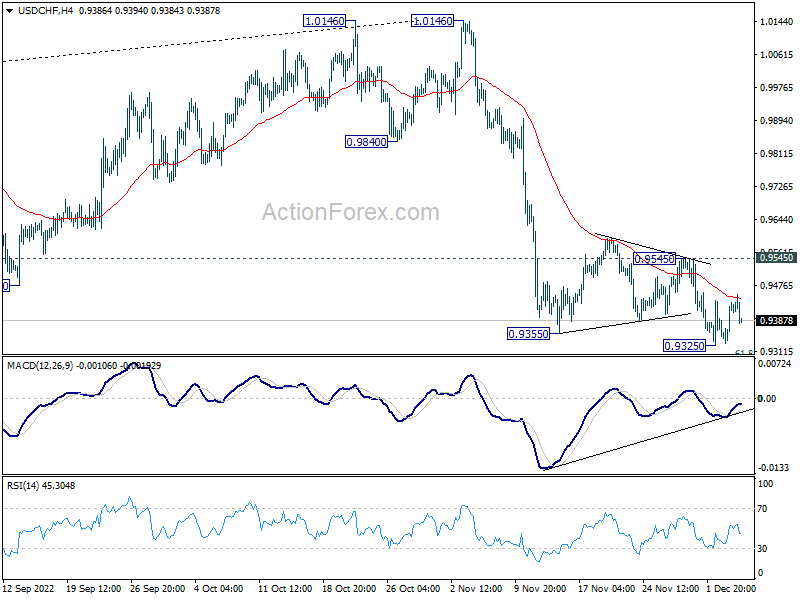
Daily Pivots: (S1) 0.9360; (P) 0.9398; (R1) 0.9465; More...
Intraday bias in USD/CHF remains neutral for the moment. Considering bullish convergence condition in 4 hour MACD, break of 0.9545 will indicate short term bottoming at 0.9325. Intraday bias will be back on the upside for 55 day EMA (now at 0.9669). On the downside, below 0.9325 will target 0.9287 fibonacci level.
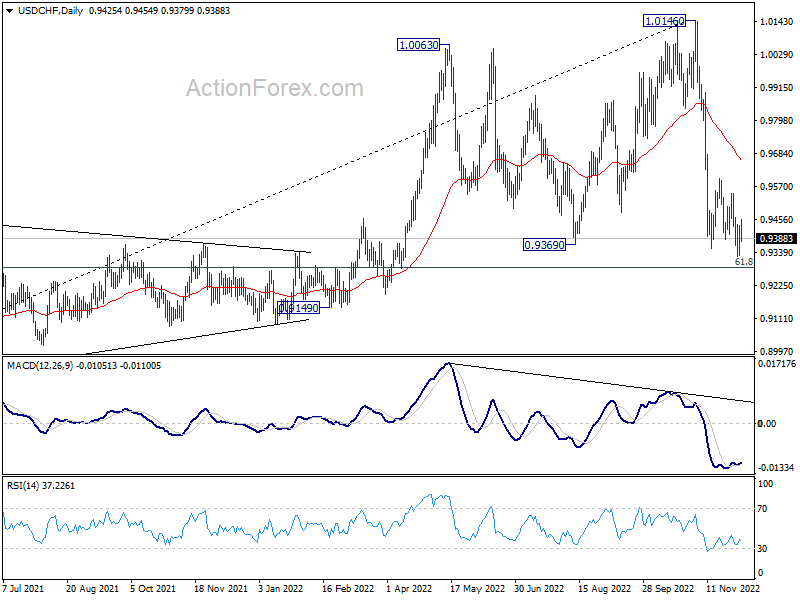
In the bigger picture, rise from 0.8756 (2021 low) has completed at 1.0146, well ahead of 1.0342 long term resistance (2016 high). Based on current downside momentum, fall from 1.0146 might be a medium term down trend itself. Break of 61.8% retracement of 0.8756 to 1.0146 at 0.9287 will pave the way to 0.8756. In any case, risk will stay on the downside as long as 55 day EMA (now at 0.9690) holds.
USD/JPY Mid-Day Outlook
Daily Pivots: (S1) 134.98; (P) 135.92; (R1) 137.70; More...
Intraday bias in USD/JPY stays neutral first. On the upside, break of 137.66 resistance will indicate short term bottoming, on bullish convergence condition in 4 hour MACD, ahead of 133.07 medium term fibonacci level. Intraday bias will be turned back to the downside for 142.24 resistance first. However, before, another decline could still be seen to 133.07 medium term fibonacci level or further to 55 week EMA.
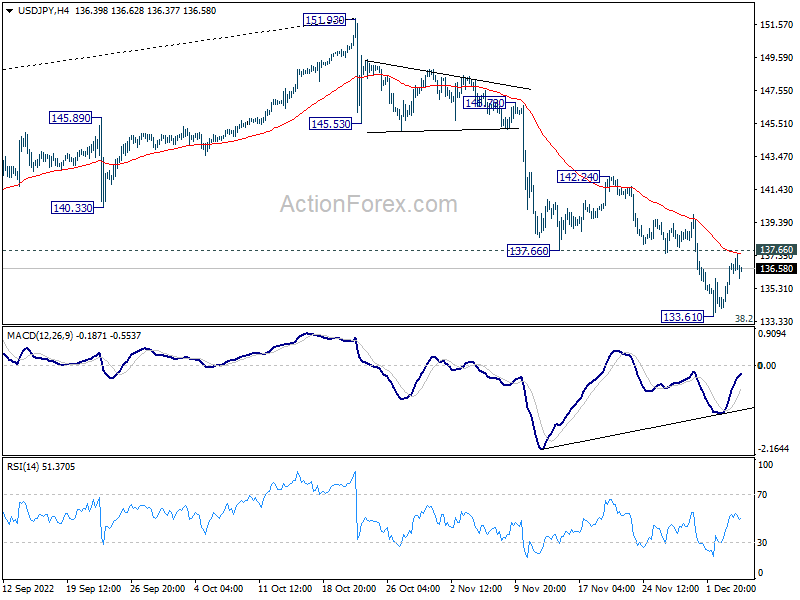
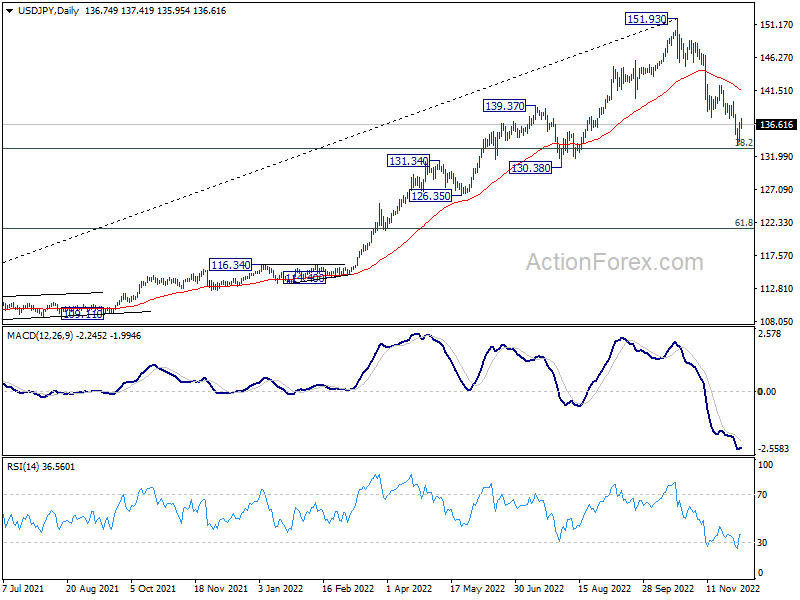
In the bigger picture, a medium term top should be formed at 151.93. Fall from there is correcting larger up trend from 102.58. It's too early to call for bearish trend reversal. But even as a corrective move, such decline should target 38.2% retracement of 102.58 to 151.93 at 133.07, or further to 55 week EMA (now at 131.33). Some support should be seen around this zone to bring rebound. However, sustained break of 55 week EMA will pave the way to 61.8% retracement at 121.43.
USD/CAD Mid-Day Outlook
Daily Pivots: (S1) 1.3447; (P) 1.3526; (R1) 1.3667; More....
Intraday bias in USD/CAD stays neutral first with immediate focus on 1.3644 resistance. Firm break there will affirm the case that correction from 1.3976 has completed at 1.3224. Further rise should then be seen to 1.3807 resistance first. However, break of 1.3383 will likely resume the fall from 1.3976 through 1.3222 cluster support, which carries larger bearish implications.
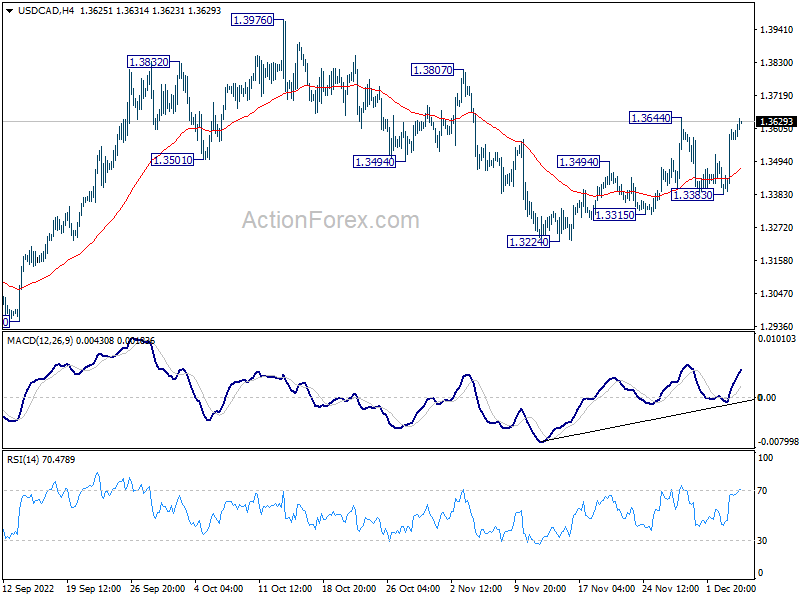
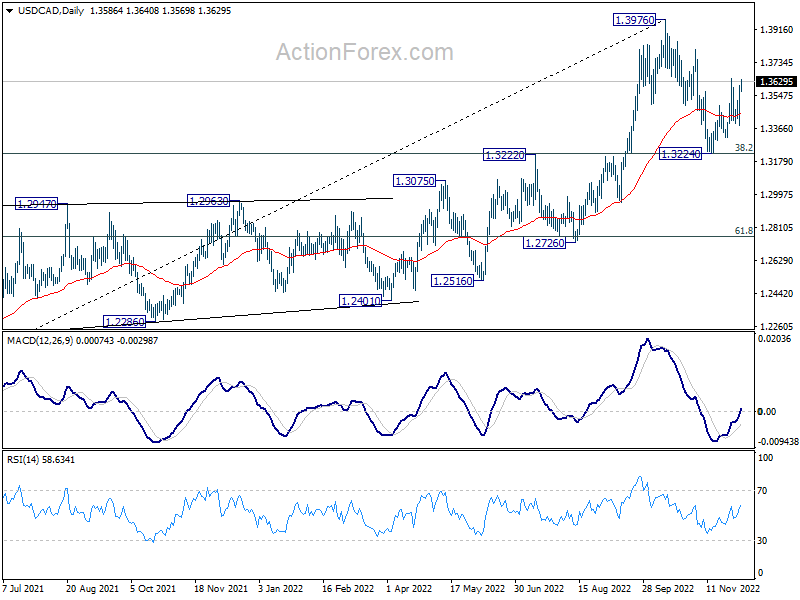
In the bigger picture, as long as 1.3222 cluster support (38.2% retracement of 1.2005 to 1.3976 at 1.3223) holds, larger up trend from 1.2005 (2021 low) is still expected to resume through 1.3976 high at a later stage. However, firm break of 1.3222/3 will indicate that the trend might have reversed. Deeper fall would be seen to next cluster support at 1.2726 (61.8% retracement at 1.2758).
Canadian Dollar Weakens in Otherwise Indecisive Markets
Canadian Dollar is currently the weakest one in otherwise sluggish markets. Falling oil price is a factor dragging down the Loonie, and traders are also cautious on a dovish rate hike by BoC tomorrow. There is still no clear follow through buying in Dollar against others. Aussie is steady after RBA rate hike earlier today, but looks vulnerable. meanwhile, European majors are mixed with Swiss Franc having a slight upper hand. Yen is apparently waiting for guidance from the stock and bond markets.
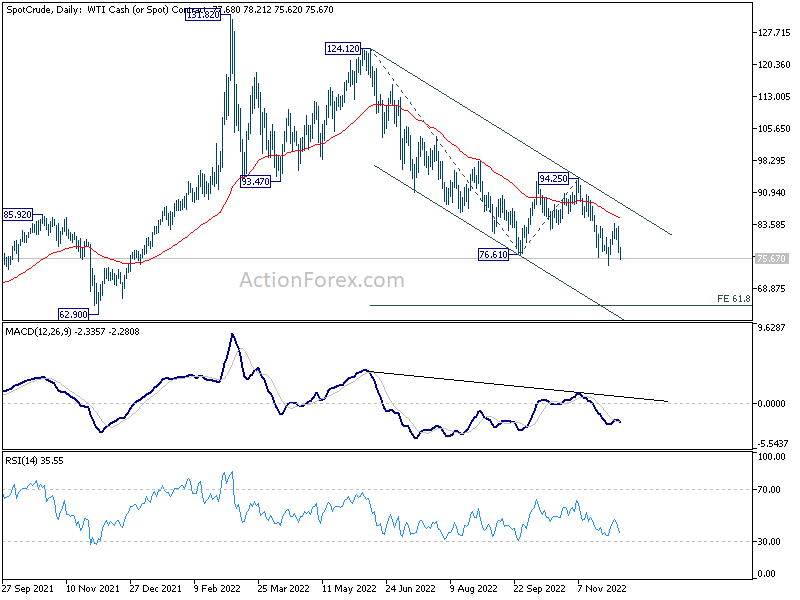
Technically, WTI oil's recovery from 74.10 might have completed at 83.82 already, capped well below 55 day EMA. Retest of 74.10 should be seen rather soon. Firm break there will resume larger down trend to 61.8% projection of 124.12 to 76.61 from 94.25 at 64.88. If happens, that might lift USD/CAD for at least a test on 1.3976 high.
In Europe, at the time of writing, FTSE is down -0.46%. DAX is down-0.28%. CAC is down -0.22%. Germany 10-year yield is down -0.0757 to 1.807. Earlier in Asia, Nikkei rose 0.24%. Hong Kong HSI dropped -0.40%. China Shanghai SSE rose 0.02%. Singapore Strait Times dropped -0.46%. Japan 10-year JGB yield dropped -0.0052 to 0.253.
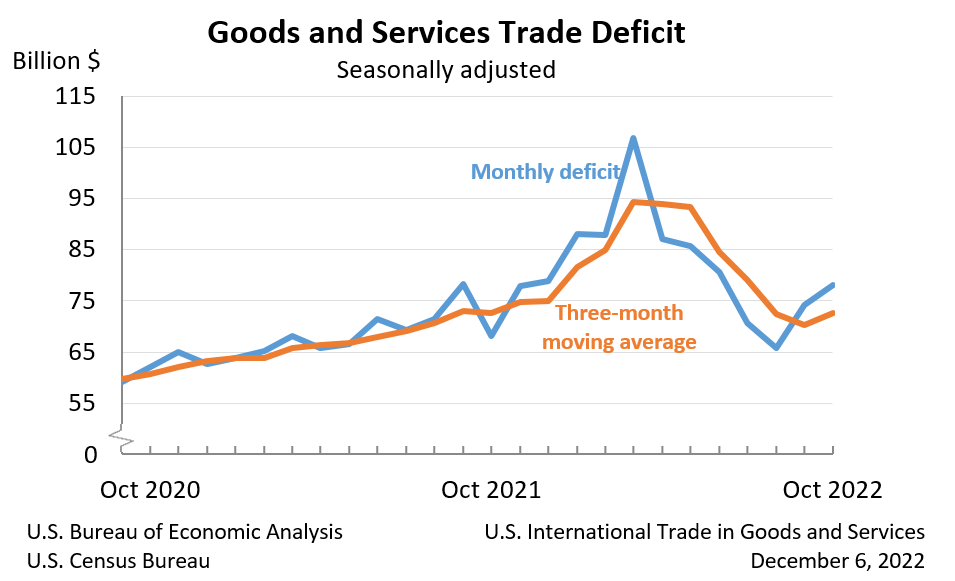
US trade deficit widened to USD -78.2B in Oct
US exports of goods and services dropped USD 1.9B over the month in October, while imports rose USD 2.2B. Trade deficit widened from USD -74.1B to USD -78.2B, smaller than expectation of USD -79.4B.
The increased in goods and services trade deficit reflected an increased in goods deficit of USD 6.1B to USD -99.6B, and increased in services surplus of USD 2.1B to USD 21.4B.
ECB Lane reasonably confidence EZ close to peak inflation
ECB Chief Economist Philip Lane said in an interview, "I would be reasonably confident in saying that it is likely we are close to peak inflation". But it's still uncertain whether inflation has peaked or it will arrive at the start of 2023. He didn't rule out some extra inflation early next year. But, "once we are past the initial months of 2023, later on in 2023 – in the spring or summer – we should see a sizeable drop in the inflation rate." Still, the journey back to 2% will "take time".
"We need to recognise that the interest rate decisions we have already made will help to reduce the inflation rate next year and the year after that," he said. "We do expect that more rate increases will be necessary, but a lot has been done already, so we will have to ensure we have a good understanding of the inflation outlook, and the risk factors when setting the interest rate on a meeting-by-meeting basis."
Lane also said, "QT should essentially be a background programme". That is, policymakers will ensure QT makes its contribution to policy normalization in "a way that reinforces the primary instrument, which is setting rates".
ECB Herodotou: There will be another hike or hikes
ECB Governing Council member Constantinos Herodotou said, "We are very near the neutral rate. There will be I think another hike or hikes."
"There are a number of variables that may give some comfort and should there be an economic impact, it won't be.. a hard landing" he said, pointing to fiscal support and the robust jobs market.
RBA hikes 25bps, expects to increase interest rates further
RBA raises cash rate by 25bps to 3.10% as widely expected. Tightening bias is maintained as "the Board expects to increase interest rates further over the period ahead", even though it's "not on a pre-set course". The size and timing of future rate hikes will continue to be determined by incoming data and the outlook for inflation and job market. The path to slow inflation and achieve a soft landing remains a "narrow one".
The central bank expects inflation to peak at around 8% in Q4, and then decline next year due to "ongoing resolution of global supply-side problems, recent declines in some commodity prices and slower growth in demand". Medium-term inflation expectations "remain well anchored". Inflation is expected to decline to "a little over 3 per cent over 2024".
RBA also expects growth to "moderate over the year ahead" to 1.50% in 2023 and 2024. Labor market remains "very tight" but employment growth has slowed. Wages growth is "continuing to pick up". "Given the importance of avoiding a prices-wages spiral, the Board will continue to pay close attention to both the evolution of labour costs and the price-setting behaviour of firms in the period ahead."
BoJ Kuroda: Premature to discuss specifics of monetary policy framework
BoJ Governor Haruhiko Kuroda told the parliament, "the BOJ is seeking to sustainably and stably achieve its 2% inflation target accompanied by wage growth. Our view is that this will likely take more time."
"It's therefore premature to discuss specifics about our monetary policy framework," he said.
"We'll maintain our current monetary policy to make it easier for companies to raise wages," he added.
USD/CAD Mid-Day Outlook
Daily Pivots: (S1) 1.3447; (P) 1.3526; (R1) 1.3667; More....
Intraday bias in USD/CAD stays neutral first with immediate focus on 1.3644 resistance. Firm break there will affirm the case that correction from 1.3976 has completed at 1.3224. Further rise should then be seen to 1.3807 resistance first. However, break of 1.3383 will likely resume the fall from 1.3976 through 1.3222 cluster support, which carries larger bearish implications.
In the bigger picture, as long as 1.3222 cluster support (38.2% retracement of 1.2005 to 1.3976 at 1.3223) holds, larger up trend from 1.2005 (2021 low) is still expected to resume through 1.3976 high at a later stage. However, firm break of 1.3222/3 will indicate that the trend might have reversed. Deeper fall would be seen to next cluster support at 1.2726 (61.8% retracement at 1.2758).
Economic Indicators Update
| GMT | Ccy | Events | Actual | Forecast | Previous | Revised |
|---|---|---|---|---|---|---|
| 23:30 | JPY | Labor Cash Earnings Y/Y Oct | 1.80% | 2.00% | 2.10% | 2.20% |
| 23:30 | JPY | Household Spending Y/Y Oct | 1.20% | 0.90% | 2.30% | |
| 00:01 | GBP | BRC Like-For-Like Retail Sales Y/Y Nov | 4.10% | 1.20% | ||
| 00:30 | AUD | Current Account Balance (AUD) Q3 | -2.3B | 6.3B | 18.3B | 14.7B |
| 03:30 | AUD | RBA Interest Rate Decision | 3.10% | 3.10% | 2.85% | |
| 07:00 | EUR | Germany Factory Orders M/M Oct | 0.80% | 0.20% | -4.00% | -2.90% |
| 09:30 | GBP | Construction PMI Nov | 50.4 | 52.7 | 53.2 | |
| 13:30 | CAD | Trade Balance (CAD) Oct | 1.2B | 0.9B | 1.1B | 0.6B |
| 13:30 | USD | Trade Balance (USD) Oct | -78.2B | -79.4B | -73.3B | -74.1B |
USD/CAD Eyes Bank of Canada Meet
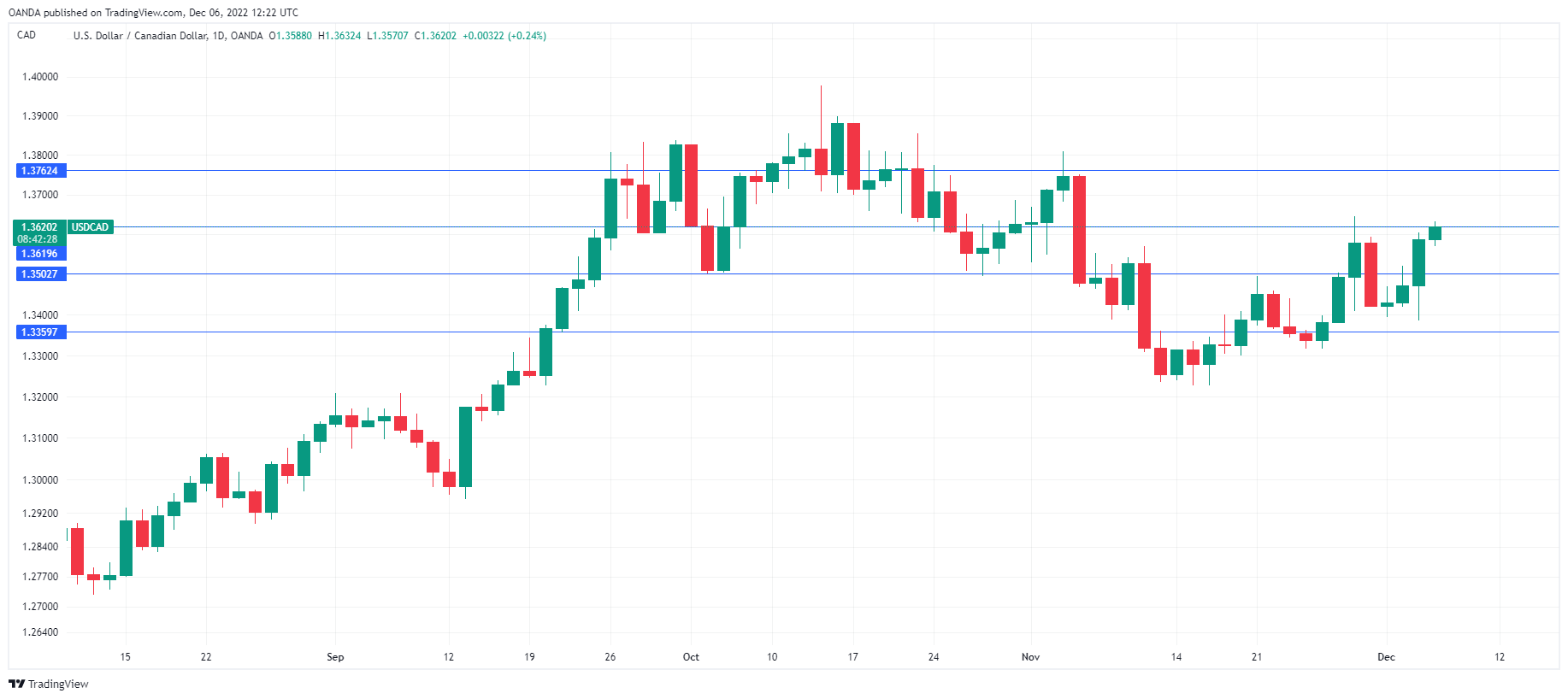
The Canadian dollar is slightly lower on Tuesday. In the European session, USD/CAD is trading at 1.3620, up 0.24%.
What does the Bank of Canada have planned?
The Bank of Canada has been aggressive in its tightening, including a whopping full-point hike in July, which brought the cash rate to 2.50%. The BoC has been gradually easing since then, raising rates by 75 bp and then 50 bp, bringing the cash rate to 3.75%. Will the trend continue on Wednesday? According to the markets, probably yes. There is a 72% chance of a 25 bp move, with a 28% likelihood of a second straight 50 bp move.
At the October meeting, there was a 50/50 split over whether the BoC would raise rates by 50 or 75 bp, and the Bank opted for the more conservative move. With the Canadian economy showing signs of slowing down amidst an uncertain global outlook, a modest 25-bp hike would make sense. Still, it must be remembered that inflation remains very high at 6.9% and the BoC has shown that it is willing to keep the rate pedal on the floor if necessary. If the BoC goes for the 50 bp increase, it would be viewed as a hawkish surprise which would likely boost the Canadian dollar.
What can we expect from the BoC in 2023? The terminal rate is projected at around 4.5%, which would mean several more rate hikes early in the New Year. Of course, rate policy will be heavily dictated by key data such as employment, consumer spending and inflation. In addition, the BoC will want to keep pace (or close to it) with the Federal Reserve, which is widely expected to raise rates by 50 bp next week.
USD/CAD Technical
- USD/CAD is testing resistance at 1.3619. Above, there is resistance at 1.3762
- There is support at 1.3502 and 1.3359
US trade deficit widened to USD -78.2B in Oct
US exports of goods and services dropped USD 1.9B over the month in October, while imports rose USD 2.2B. Trade deficit widened from USD -74.1B to USD -78.2B, smaller than expectation of USD -79.4B.
The increased in goods and services trade deficit reflected an increased in goods deficit of USD 6.1B to USD -99.6B, and increased in services surplus of USD 2.1B to USD 21.4B.