Sample Category Title
EUR Decided to Sky-Rocket
On Monday, the market major has reached 1.0580. It must be realized, that this is not because the euro is strong but because the dollar is weak. Investors are undermining the USD, treading on statistics and upcoming decisions of the US Federal Reserve System.
The labour market in the US remains vigorous. In November, the unemployment rate remained at 3.7%, and the NFP grew by 263 thousand instead of 200 thousand forecast. Average hourly wage increased by 5.1% y/y upon growing by 4.6% in October.
All this makes the employment picture quite stable and gives us an idea that the US business withstands the growing expenses on crediting quite efficiently. The wage fund has expanded, which hinders the market idea about the interest rate growing by 50 base points in December.
With all this background, the USD is really unstable, which is obvious in the quotes.
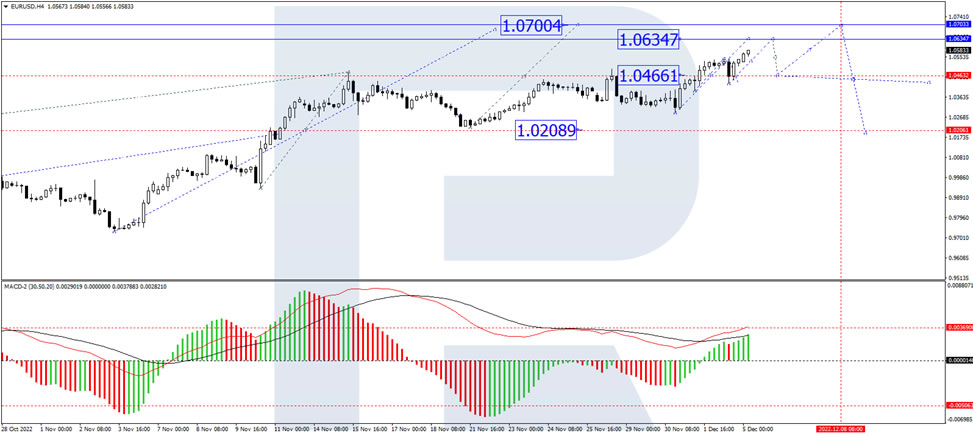
On H4, the currency pair has formed a consolidation range around 1.0466. Today the market is trying to break it upwards. The structure of growth is expected to extend to 1.0634, and after it is reached, a link of correction to 1.0464 is not excluded, followed by growth to 1.0703. Technically, this scenario is confirmed by the MACD: its line is directed strictly upwards, which suggests further growth.
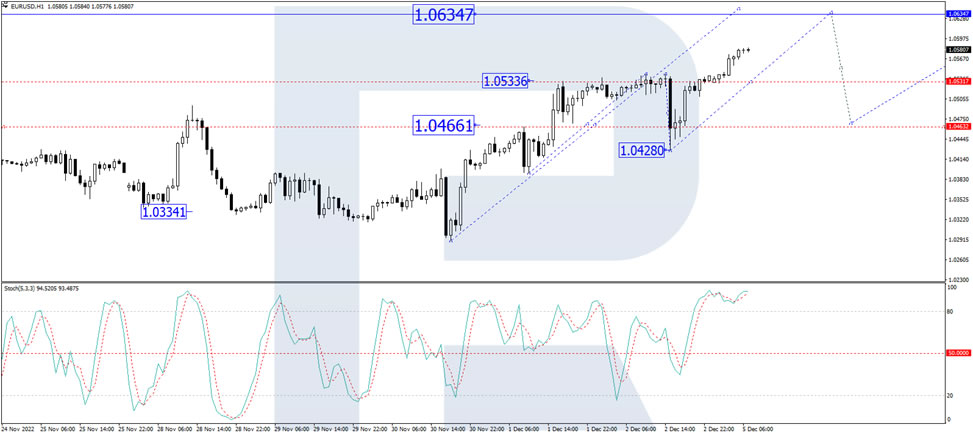
On H1, the pair has completed an impulse of growth to 1.0531. Today the market has formed a consolidation range around it, and with an escape upwards, it extends the structure of growth to 1.0634. Technically, the scenario is confirmed by the Stochastic oscillator. Its signal line is above 80 and shows no evidence of decline as yet.
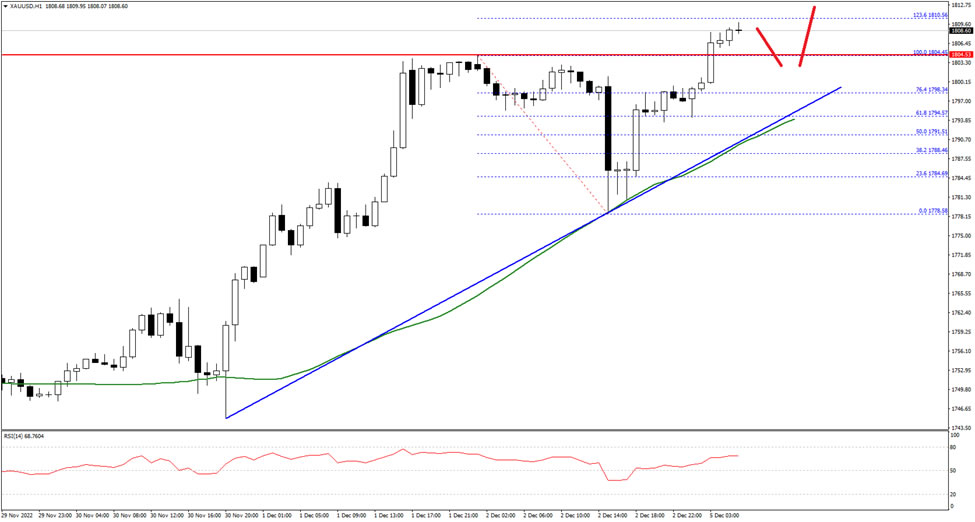
Gold Price Currently Consolidating Gains Near $1,810
Gold price started a fresh increase from the $1,740 support zone against the US Dollar. The price gained pace above the $1,780 resistance to move into a positive zone.
The pair even climbed above the $1,800 resistance and settled well above the 50 hourly simple moving average. It traded as high as $1,810 and is currently consolidating gains. On the downside, the price is holding the $1,805 support zone.
The next major support is near the $1,798 level and a connecting bullish trend line on the hourly chart, below which the price might decline towards the $1,790 support level in the near term. Any more losses might call for a test of $1,780 on FXOpen.
On the upside, the first major resistance is near the $1,810 level. The next main resistance could be near the $1,818 level, above which the price could start a steady increase towards the $1,825 level.
Can the BoC Meeting Deliver Any Surprises?
The Bank of Canada is about to announce another rate hike on December 7. The market expects a 25bps rate increase despite the upside surprise in the Q3 GDP and the tight labour market. Chances of a bigger rate hike appear slim, but such an announcement could have a sizable impact on the loonie.
BoC defied market pricing at the October meeting
The BoC holds its eighth and final interest rate setting meeting for 2022, a week ahead of the Fed and ECB meetings on December 14 and 15, respectively. The rate decision will be announced at 15:00 GMT with the press conference by Governor Macklem coming at 16:00 GMT.
In October, the BoC defied market pricing that it was leaning towards a 75bps move and hiked by 50bps, taking the overnight rate to 3.75% - the highest level since 2008. Both the interest rate statement and Macklem’s comments at the press conference were hawkish, keeping the door open for further (potentially sizeable) hikes. However, the Canadian dollar was spooked from the projections that the economy could stall over the next few quarters, raising concerns over potentially similar economic comments from other central banks.
Data and hawkish rhetoric justify 25bps rate hike
Since the October meeting, data releases have been on the positive side. GDP growth surprised on the upside in the third quarter with 2.9% quarter-on-quarter annualized rate, while the latest inflation print showed signs of stabilization at arguably very elevated levels. Meanwhile, labour market data came in stronger than anticipated for October, but the September retail sales painted a bleaker picture.
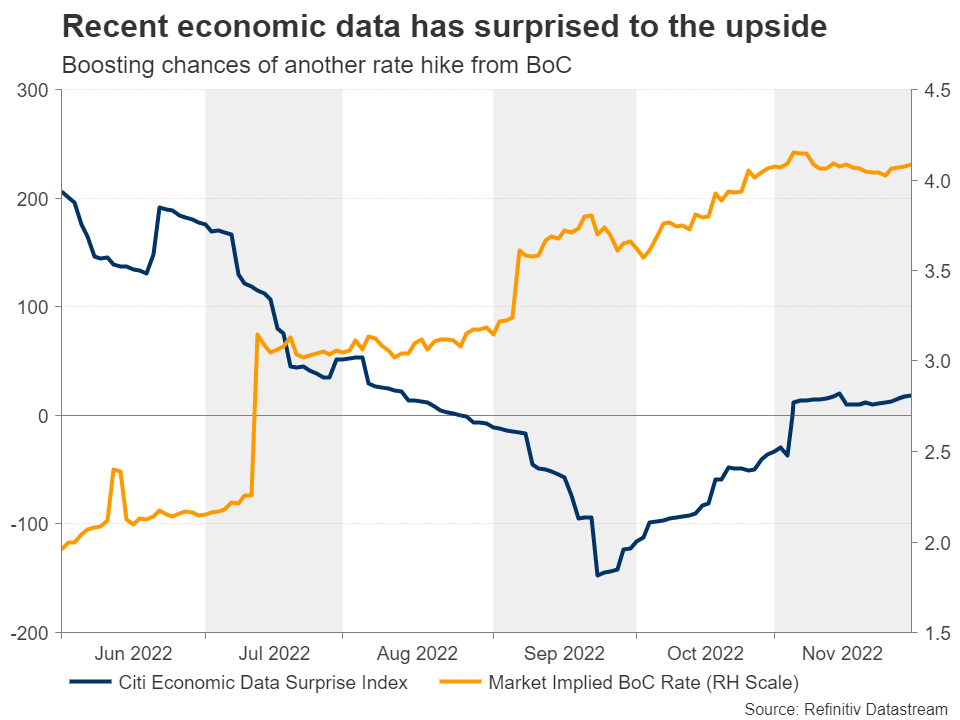
Similarly, the top two BoC officials, Governor Macklem and Senior Deputy Governor Rogers, have been on the wires reiterating their hawkish intentions. While the market appears convinced that another rate hike will be announced, the focus has been on the size of future hikes and the terminal rate. Macklem has been outspoken about getting closer to the end of the hiking cycle, but it clearly depends on the inflation trajectory and the moves from the other major central banks, especially the Fed.
Following the November 30 speech by Fed Chairman Powell, and particularly his signal for less aggressive rate hikes going forward, the market pricing is leaning towards a 25bps rate hike to 4%. A significant probability, currently above 80%, is attached to such an outcome, with the rest pointing towards a bigger 50bps move. A 25bps move could send a strong message that the BoC is closing in on its terminal overnight rate. The immediate impact on dollar/loonie is unlikely to be massive, but as the market digests the announcement and its possible implications on other central banks, the reaction could be more sizeable.
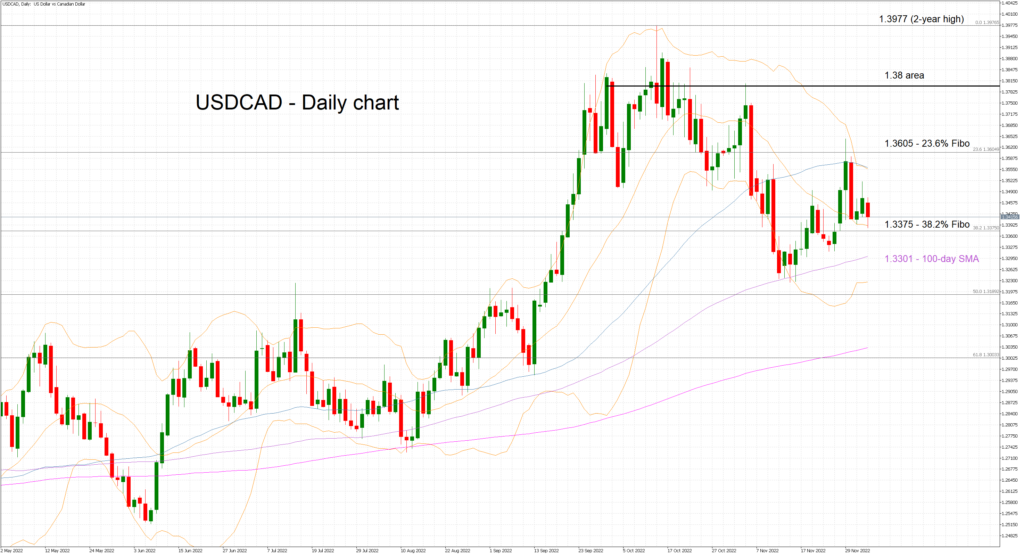
A more sizable rate hike, for example 50bps, coupled with a stronger hawkish commentary at the press conference would open the door for appreciation of the loonie against the dollar. Loonie bulls would eye the 38.2% Fibonacci retracement level of the April 5 – October 13 uptrend of 1.3375, and eventually the 100-day simple moving average at 1.3295. If loonie bears take the reins, the 1.3605, which is the 23.6% Fibonacci level, should be the first resistance level, followed by the 1.38 area.
ECB Makhlouf: Premature to be talking about end-point for policy rates
ECB Governing Council member Gabriel Makhlouf said, "To continue on our path to bring inflation back to our 2% target, I see a 50 basis-point increase in interest rates as the minimum needed at our December meeting."
"We have to be open to policy rates moving into restrictive territory for a period," the Irish central-bank chief said. "It is premature to be talking about the end-point for policy rates amid the prevailing levels of uncertainty."
"The justification for the expansion of the balance sheet – too low inflation and the risk of deflation – has ended, and it is time to look at reducing its size," he said.
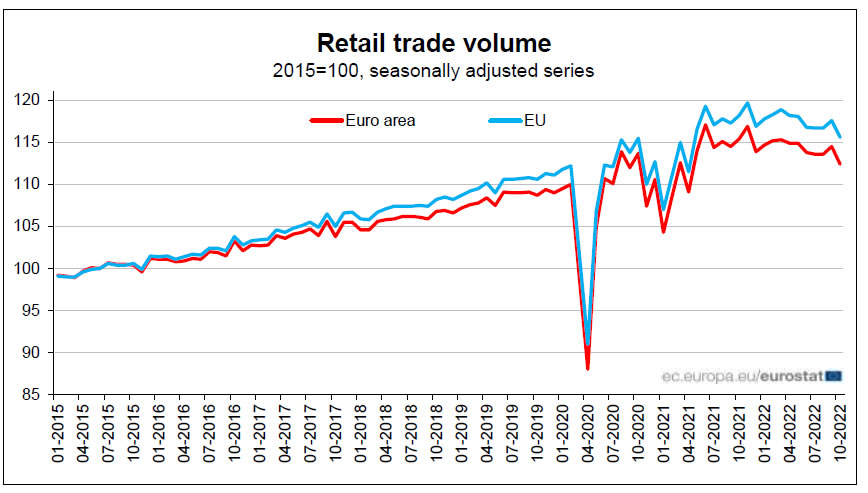
Eurozone retail sales dropped -1.8% mom in Oct, EU down -1.7% mom
Eurozone retail sales volume dropped -1.8% mom in October, worse than expectation of -1.6% mom. The volume of retail trade decreased by -2.1% for non-food products and by -1.5% for food, drinks and tobacco, while it grew by 0.3% for automotive fuels.
EU retail sales volume dropped -1.7% mom. Among Member States for which data are available, the largest monthly decreases in the total retail trade volume were registered in Austria (-4.6%), Croatia (-4.0%) and Belgium (-3.3%). Increases were observed in Luxembourg (+2.6%), Cyprus, Malta and Portugal (all +0.5%) and Spain (+0.4%).
Eurozone Sentix investor confidence rose to -21, recession ends before it’s begun
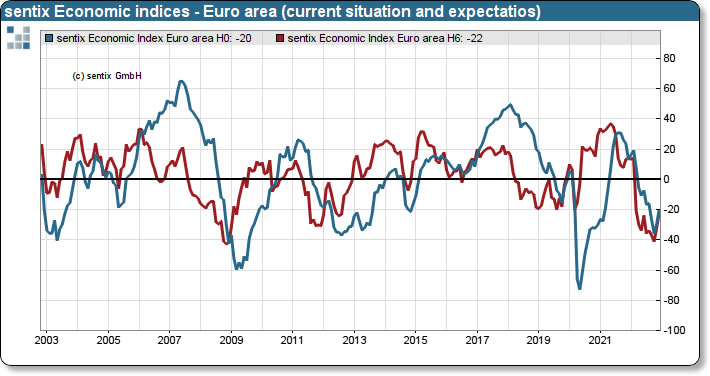
Eurozone Sentix Investor Confidence rose from -30.9 to -21.0 in December, highest since June. Current Situation Index rose from -29.5 to -20.0. Expectations Index rose from -32.3 to -22.0, highest since March.
Sentix said: "The latest sentix economic data improve again and surprisingly significantly. Investors are spreading hope that thanks to mild winter weather, sufficient gas in storage and a possible peak in inflation data, the economic downturn has also passed its zenith.
"Internationally, there are also more moderate tones from the US Federal Reserve, which is holding out the prospect of "only" 50 basis points of interest rate increases in December. And in China, the protests finally seem to point to an end to the restrictive Corona measures.
"So will the recession end before it has really begun?"
UK PMI services finalized at 48.8, economic contraction rate held steady
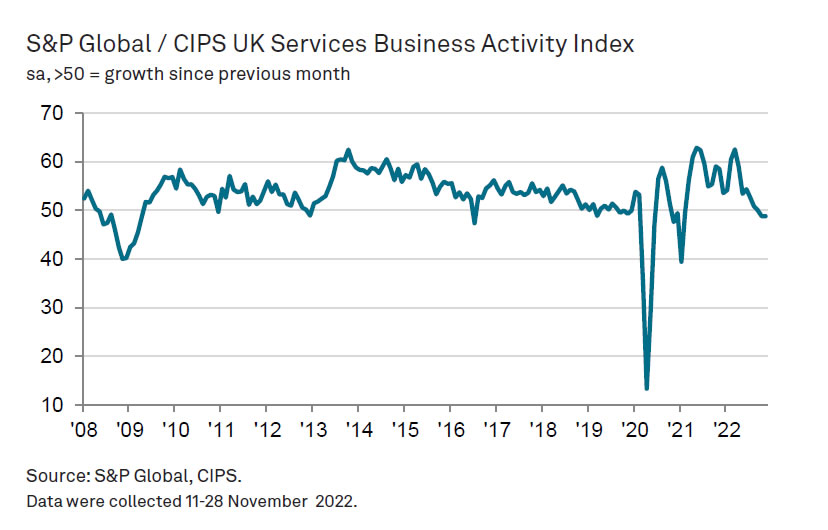
UK PMI services was finalized at 48.8 in November, unchanged from October's reading, lowest since January 2021, and second second consecutive month of contraction. PMI Composite was finalized at 48.2, unchanged from prior month, and the fourth successive month of contraction.
Chris Williamson, Chief Business Economist at S&P Global Market Intelligence: "A further economic contraction signalled by the PMI surveys hints at a growing recession risk for the UK. A change of government and its new economic policies may have helped arrested some of the financial market volatility after September's 'mini-budget' but the economic picture remains stubbornly unchanged. "
"The overall rate of economic contraction has held steady compared to October, indicative of GDP falling at a quarterly rate of 0.4%. As such, this is the toughest spell the UK economy has faced since the global financial crisis excluding only the height of the pandemic.
Eurozone PMI composite finalized at 47.8, downturn remains only modest
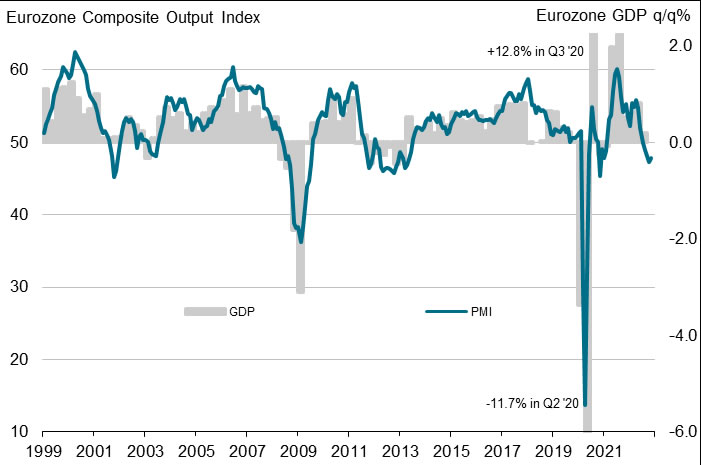
Eurozone PMI Services was finalized at 48.5 in November, down from October's 48.6. That's also a 21-month low. PMI Composite was finalized at 47.8, up from prior month's 47.3. Looking at some member countries, Ireland PMI Composite France dropped to 48.8 and 48.7 respectively, both 21-month low. Germany (46.3), Italy (48.9), and Spain (49.6) were at 3-month high.
Chris Williamson, Chief Business Economist at S&P Global Market Intelligence said: "A fifth consecutive monthly falling output signalled by the PMI adds to the likelihood that the eurozone is sliding into recession. However, at present the downturn remains only modest, with an easing in the overall rate of contraction in November means so far the region looks set to see GDP contract by a mere 0.2%."
EURCHF Edges Higher But Bias Unclear
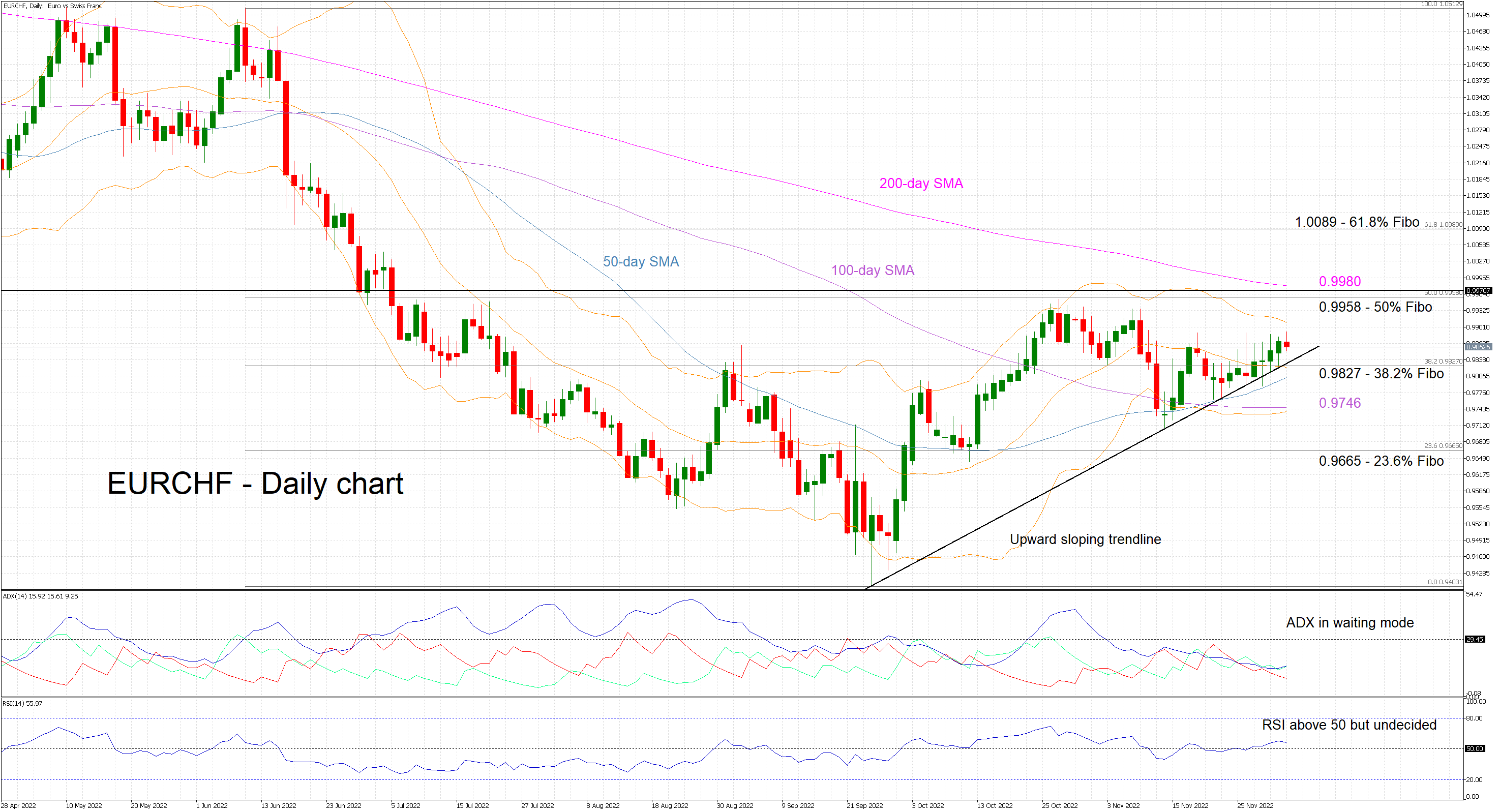
EURCHF has been gradually edging higher in the past few sessions as it attempts to find a clear direction ahead of an action-packed period. A series of higher highs and higher lows since the multi-decade low of September 26 of 0.9403 have placed the pair in a short-term bullish trend but the near-term bias remains unclear.
The September 29 upward sloping trendline has been acting as a trailing support amidst an environment of lower volatility. A cross check of the indicators confirms this market uncertainty. The Average Directional Movement Index (ADX) is showing a lack of trend, as it is clearly below 25, while the RSI is trading sideways, but above the 50-midpoint. If we also put in the mix the tightening Bollinger bands, then the market appears to be gearing up for the next move.
Should the bulls decide to push EURCHF higher, they will be faced with the 0.9958-80 area. The 50% Fibonacci retracement level of the June 9 – September 26 downtrend of 0.9958, the March 7 low and the 200-day simple moving average (SMA) respectively occupy this range. Looking higher, the 61.8% Fibonacci at 1.0089 should be an obvious target.
From the perspective of the bears, the 38.2% Fibonacci of 0.9827 and the 50-day SMA should be the initial targets, before they become more ambitious and place their eyes on the 100-day SMA at 0.9746. Lower, the 23.6% Fibonacci of 0.9665 could be the next support level.
To sum up, EURCHF is trying to find its near-term direction. The very gradual move higher is not confirmed by the momentum indicators as the market appears to be in waiting mode.
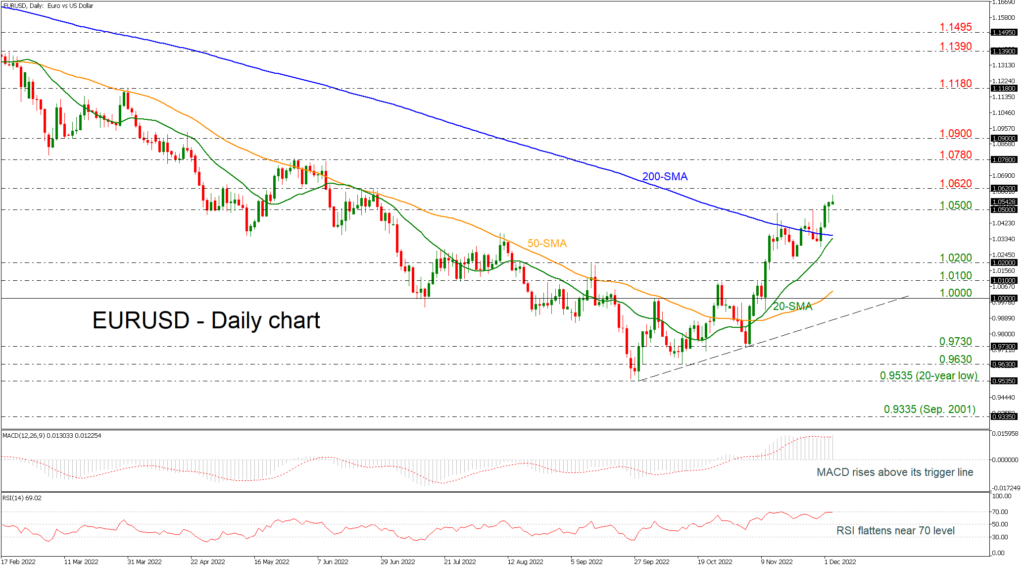
EURUSD Shows Positive Signs above 1.0500
EURUSD advanced above the 1.0500 in the previous couple of sessions, suggesting that the market is in a bullish mode in the short-term timeframe.
Regarding the trend, it is likely to remain on the upside as the price continues to stay above the 200-day simple moving average (SMA). The MACD oscillator is strengthening its bullish momentum above its trigger line in the positive region; however, the RSI is holding near the overbought territory, suggesting some losses.
An extension to the upside could meet the 1.0620 resistance level ahead of the next obstacle of 1.0780, taken from the high on May 30. Further up, resistance could run towards the 1.0900 psychological mark.
On the other hand, if the pair weakens, the 200-day SMA and the 20-day SMA around 1.0355 could provide immediate support ahead of the 1.0200 barrier. Even lower, the 1.0100 and the 1.0000 round numbers could worsen the outlook to bearish, opening the way towards the 0.9730 level.
In the long-term picture, the bearish sentiment changed after the jump above the 1.0500 handle and the 200-day SMA. Any moves below those levels may switch the outlook back to bearish.