

Sample Category Title
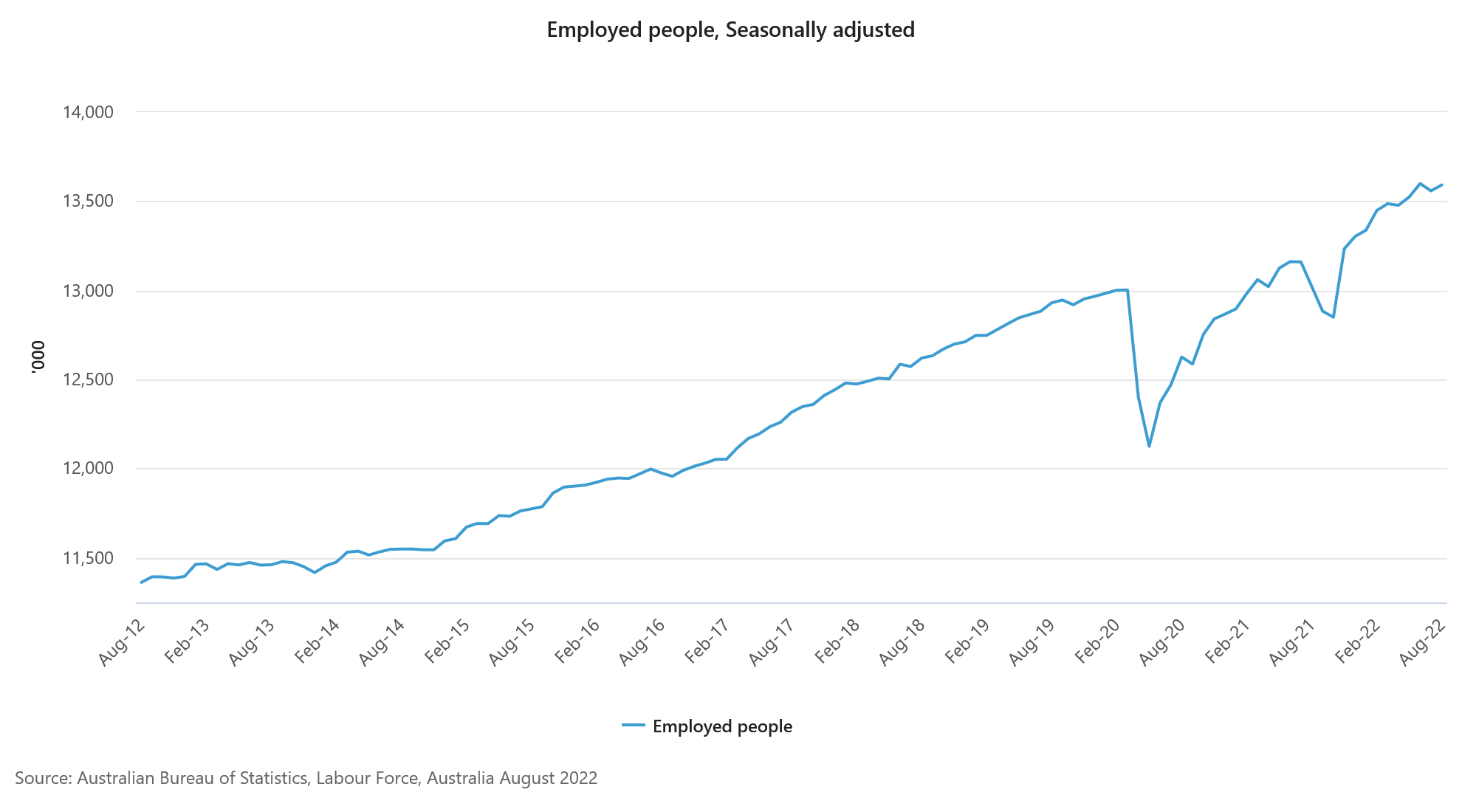
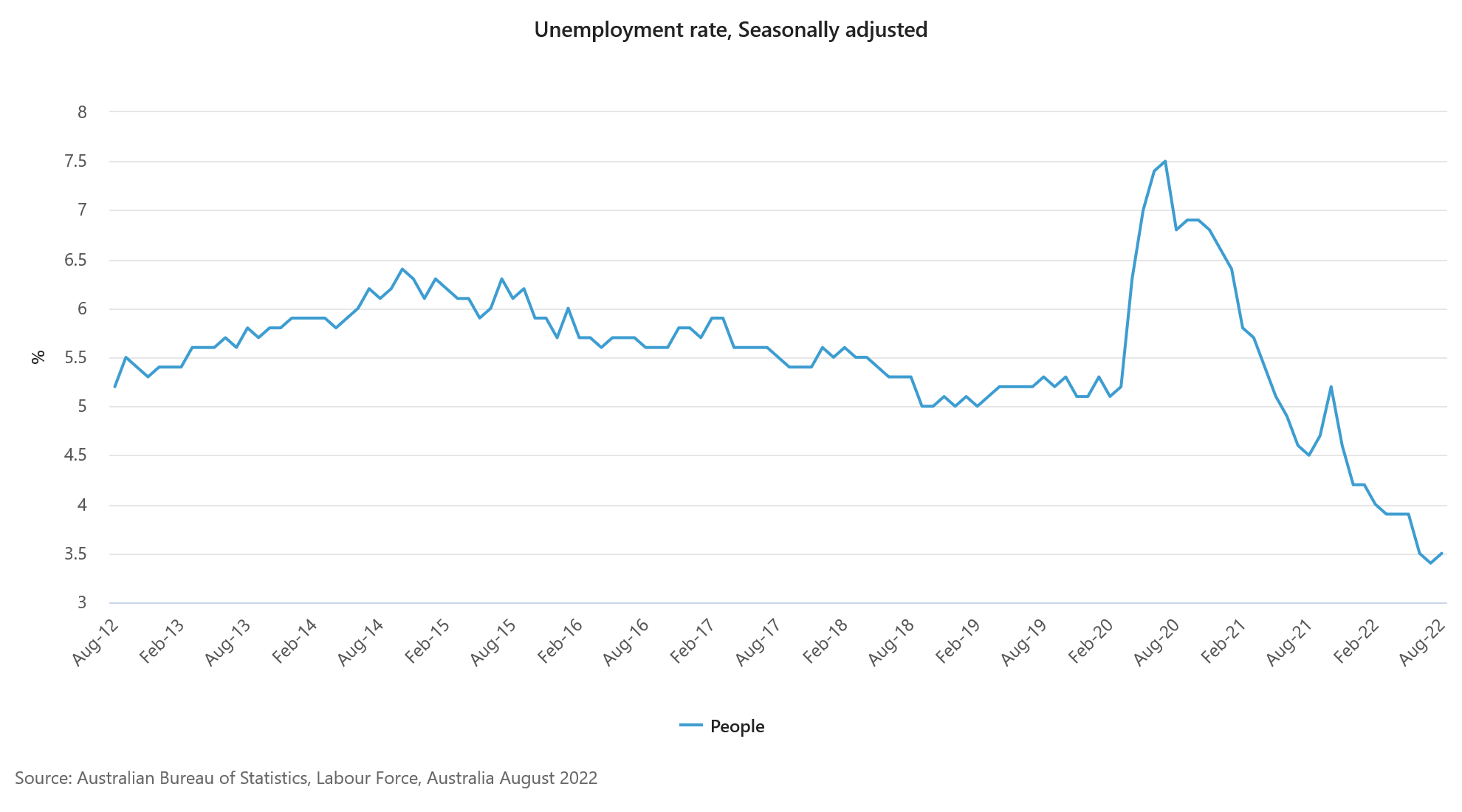
Australia employment rose 33.5k in Aug, unemployment rate ticked up to 3.5%
Australia employment rose 33.5k in August, slightly smaller than expectation of 35.5k. Full-time jobs rose 58.8k while part-time jobs decreased -25.3k.
Unemployment rate ticked up from 3.4% to 3.5%, above expectation of 3.4%. Participation rate rose 0.2% from 66.4% to 66.6%. Monthly hours worked rose 0.8% mom.
New Zealand GDP grew 1.7% qoq in Q2, driven by services
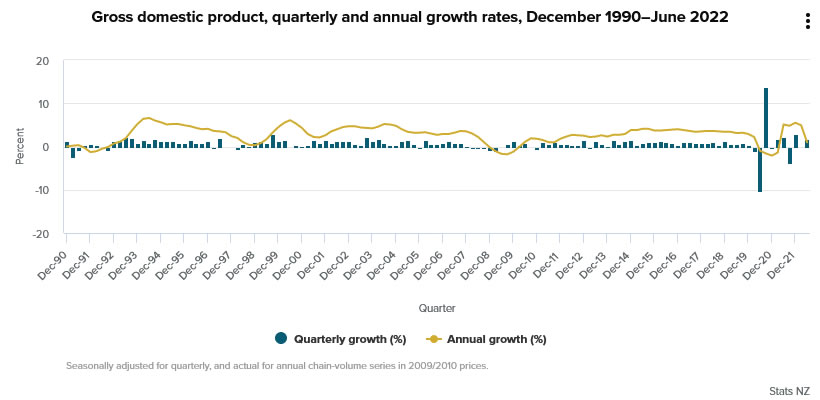
New Zealand GDP grew 1.7% qoq in Q2, above expectation of 1.0% qoq, following a -0.2% qoq decline in Q1. Service industries rose 2.7% but goods producing industries dropped -3.8%. Primary industries rose 0.2%.
"The reopening of borders, easing of both domestic and international travel restrictions, and fewer domestic restrictions under the Orange traffic light setting supported growth in industries that had been most affected by the COVID-19 response measures," national accounts – industry and production senior manager Ruvani Ratnayake said.
"In the June 2022 quarter, households and international visitors spent more on transport, accommodation, eating out, and sports and recreational activities."
ECB Lane: Larger increment of interest rates appropriate
ECB Chief Economist Philip Lane said in a speech that risks to the inflation outlook are "primarily on the upside". Major short term risk is a "further disruption of energy supplies". Over the medium term, inflation may turn out to be higher than expected because of a "persistent worsening of the production capacity", further increases in "energy and food prices", and rise in "inflation expectations above our target" or higher "anticipated wage rises.
"In the context of a long projected period with inflation far above target, the net upside risks to inflation and taking into account that the current setting of the key policy rates is still highly accommodative, it was appropriate to take a major step that frontloads the transition from the prevailing highly-accommodative level of policy rates towards levels that will support a timely return of inflation to our target," he said, about last week's 75bps rate hike".
"In calibrating a multi-step transition path, the appropriate size of an individual increment will be larger, the wider the gap to the terminal rate and the more skewed the risks to the inflation target, he added.
Crude Oil Price Could Gain Bullish Momentum, Gold Consolidates
Key Highlights
- Crude oil price started a steady increase above the $85 resistance.
- It broke a major bearish trend line with resistance at $87.50 on the 4-hours chart.
- Gold price is consolidating losses below the $1,720 resistance zone.
- EUR/USD could revisit the 0.9900 support zone, and GBP/USD is holding the 1.1440 support.
Crude Oil Price Technical Analysis
After declining towards the $81.20 zone, crude oil price found support against the US Dollar. The price started a steady increase and was able to clear the $85 resistance.
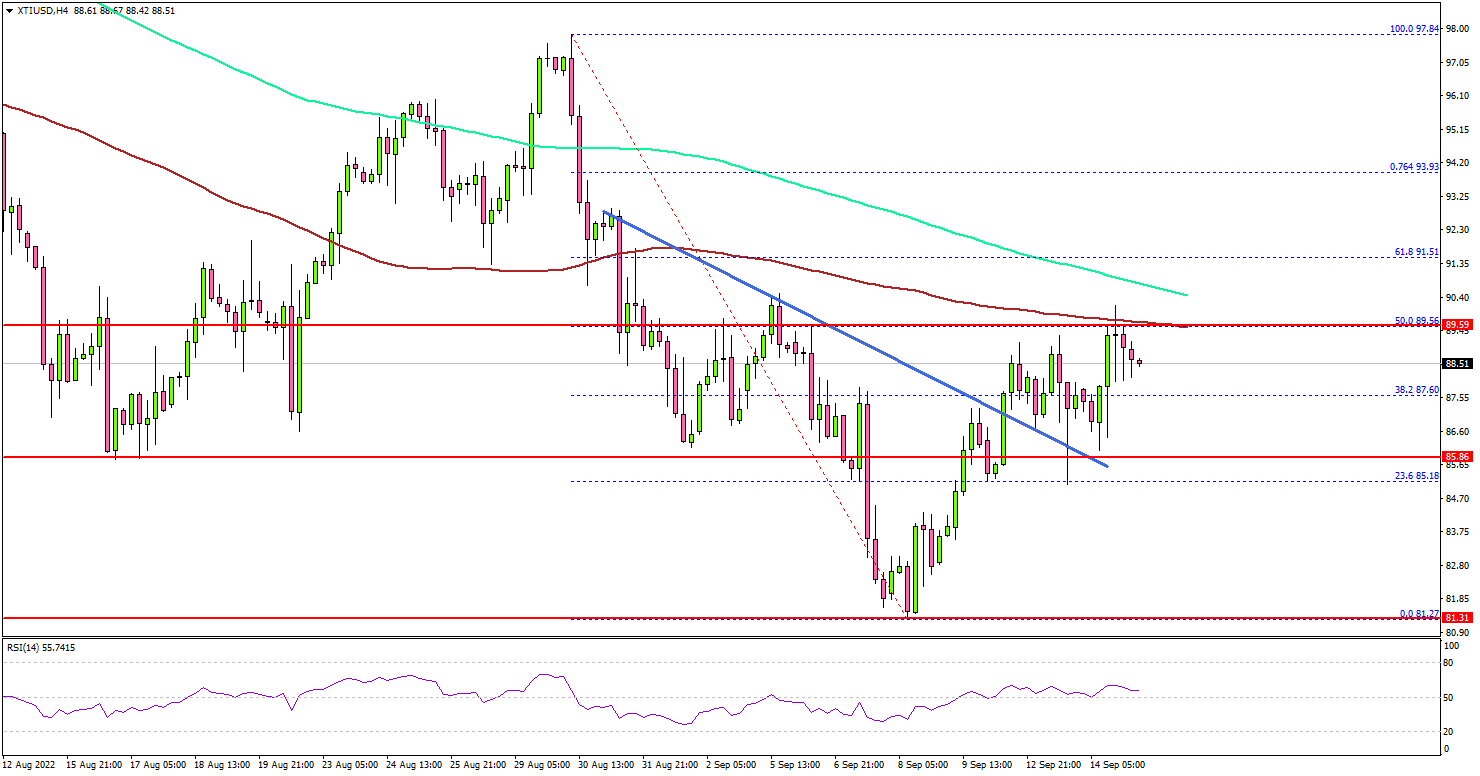
Looking at the 4-hours chart of XTI/USD, there was a break above the $86.50 resistance and a major bearish trend line with resistance at $87.50. It opened the doors for more upsides above the 38.2% Fib retracement level of the downward move from the $97.84 swing high to $81.27 low.
The bulls pushed the price to the $90 zone and the 100 simple moving average (red, 4-hours). The price also tested the 50% Fib retracement level of the downward move from the $97.84 swing high to $81.27 low.
A clear move above the $90.00 level and the 200 simple moving average (green, 4-hours) could push the price further higher.
The next major resistance is near $91.50, above which the price could accelerate higher towards the $94.50 zone.
On the downside, an initial support is near the $87.50 level. The next major support is near $85.80. The main support sits near $85, below which there is a risk of a move towards the $82.50 level. Any more losses might call for a test of the $81.20 zone.
Looking at gold price, the bulls are protecting the $1,690 zone, but the price might continue to face resistance near $1,720.
Economic Releases to Watch Today
- US Retail Sales for August 2022 (MoM) – Forecast 0%, versus 0% previous.
- US Industrial Production for August 2022 (MoM) – Forecast 0.2%, versus 0.6% previous.
Eco Data 9/15/22
[php_everywhere instance="1"]
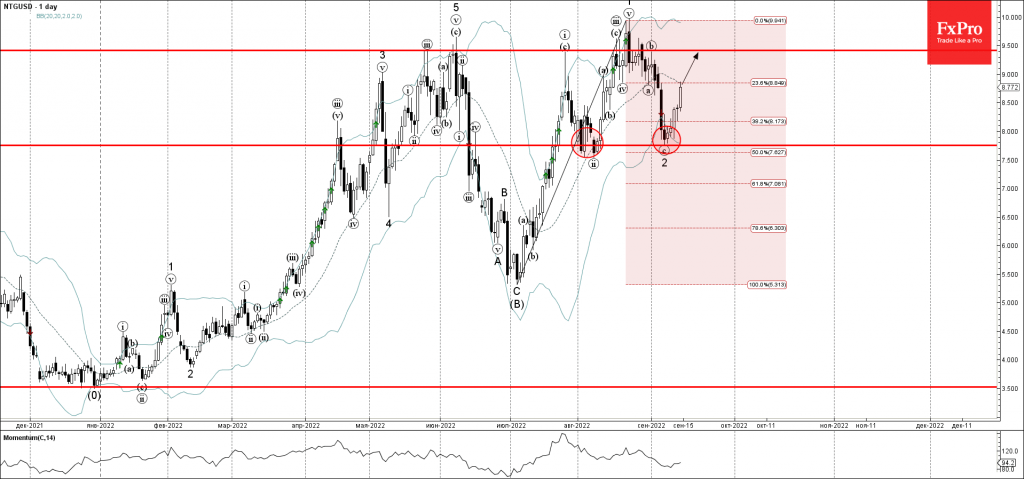
Natural Gas Wave Analysis
- Natural gas rising inside impulse wave 3
- Likely to rise to resistance level 9.500
Natural gas recently reversed up from the key support level 7.755 (which has been reversing the price from the start of August), standing near the lower daily Bollinger Band and the 50% Fibonacci correction of the upward impulse from July.
The upward reversal from the support level 7.755 started the active short-term upward, which belongs to wave (C) from July.
Natural gas can be expected to rise further toward the next resistance level 9.500 (top of the earlier short-term correction (b) from last month).
EURJPY Wave Analysis
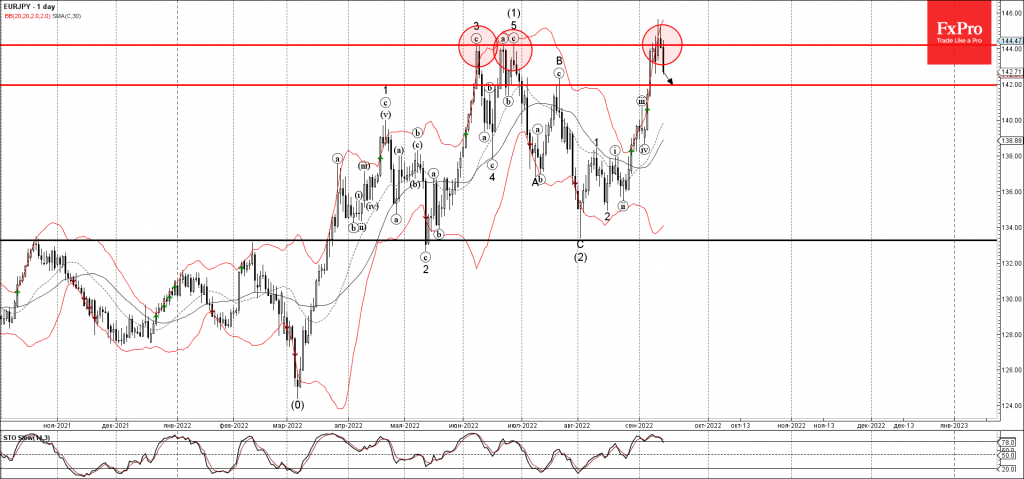
- EURJPY reversed from resistance level 144.00
- Likely to fall to support level 142.00
EURJPY recently reversed down from the key resistance level 144.00 (which has been reversing the price from the start of June), standing near the upper daily Bollinger Band.
The downward reversal from the resistance level 144.00 created the daily Japanese candlesticks reversal pattern Shooting Star.
EURJPY can be expected to fall further toward the next support level 142.00 (former resistance, which stopped wave B in July).
New Zealand Q2 GDP Eyed as Recession Fears Ramp Up
New Zealand will report second-quarter GDP data on Wednesday at 22:45 GMT. After a negative start to the year, the commodity-dependent economy has likely enjoyed some post-Covid expansion, avoiding a technical recession despite the dim economic releases during the period. A negative surprise cannot be ruled out, though in any case, the data could do little to alter the RBNZ’s hawkish stance and hence affect the battered kiwi.
Disappointing retail sales flag technical recession
The June quarter was not very pleasant for the New Zealand economy according to recent stats. Retail sales slumped more than projected by 2.3% q/q led by declines in furniture, electrical goods, and vehicles. Although retail sales are representing a minor share of GDP, investors consider the measure a solid proxy for economic performance. Therefore, another negative print could be possible, keeping the case for a technical recession open.
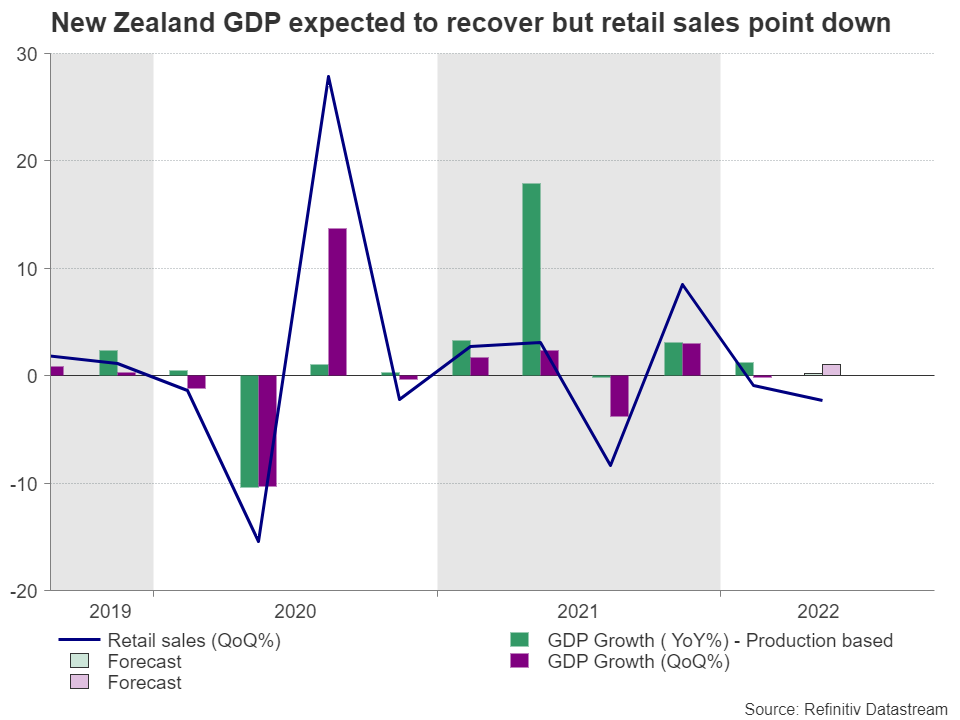
Despite that, analysts are on average optimistic the economy bounced back to the positive area, marking a growth of 1.0% q/q, while on a yearly basis, estimates point to a slowdown to 0.2% from 1.2% previously. Recall that the trade balance was a surplus most of the second quarter despite the depressed business confidence before switching again to deficit in June, while Q2 labor costs almost doubled from the previous quarter as the unemployment rate remained at record lows.
The Reserve Bank of New Zealand is also optimistic that the economy enjoyed some recovery in the June quarter, while eyeing a recession in 2023 in the absence of net exports recovery.
RBNZ may shrug off GDP data
Perhaps the lifting of travel curbs in May brought some economic relief, which may be more evident in the Q3 GDP release. Nevertheless, no matter what the outcome will be, Q2 GDP figures might be outdated when the Reserve Bank of New Zealand meets on October 5 to set its policy.
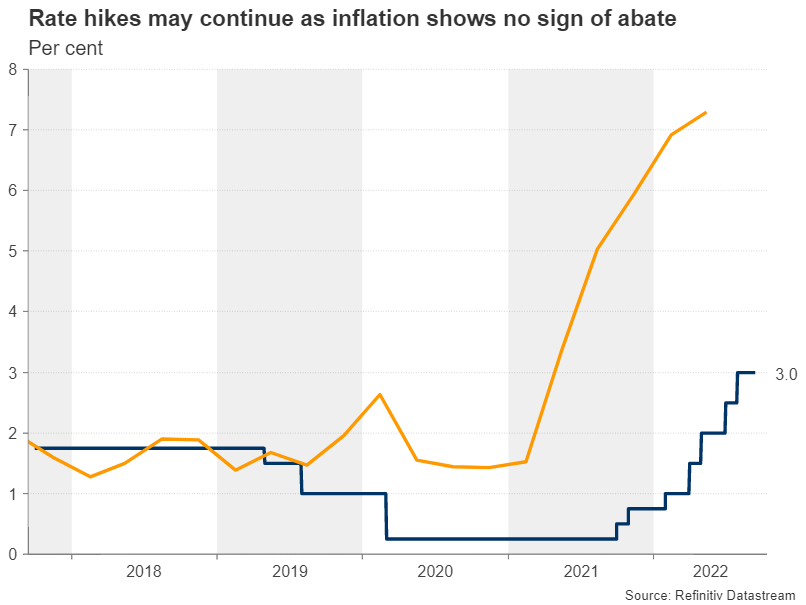
Besides, with the labor market so tight and high margins in the key dairy industry offsetting farm rising costs so far, policymakers can still afford to prioritize cooling inflation towards their 1-3% target over growth, which is exposed to a slowing housing market and China’s softening outlook. Recall that consumer prices hit the steepest-than-forecast 7.3% y/y increase in June -the highest since 1980.
NZD/USD outlook
Therefore, unless there is a big deviation from forecasts, the data may have a negligible impact on the RBNZ rate expectations, which are currently pointing to a 50bps rate hike with a probability of 86%. The next inflation and employment reports may have a larger influence on the RBNZ guidance, which showed interest rates rising faster to 4.1% in the second quarter of 2023 versus 3.59% projected in May. It’s also worthy to note that a gradual decline in 2024 is still on the cards.
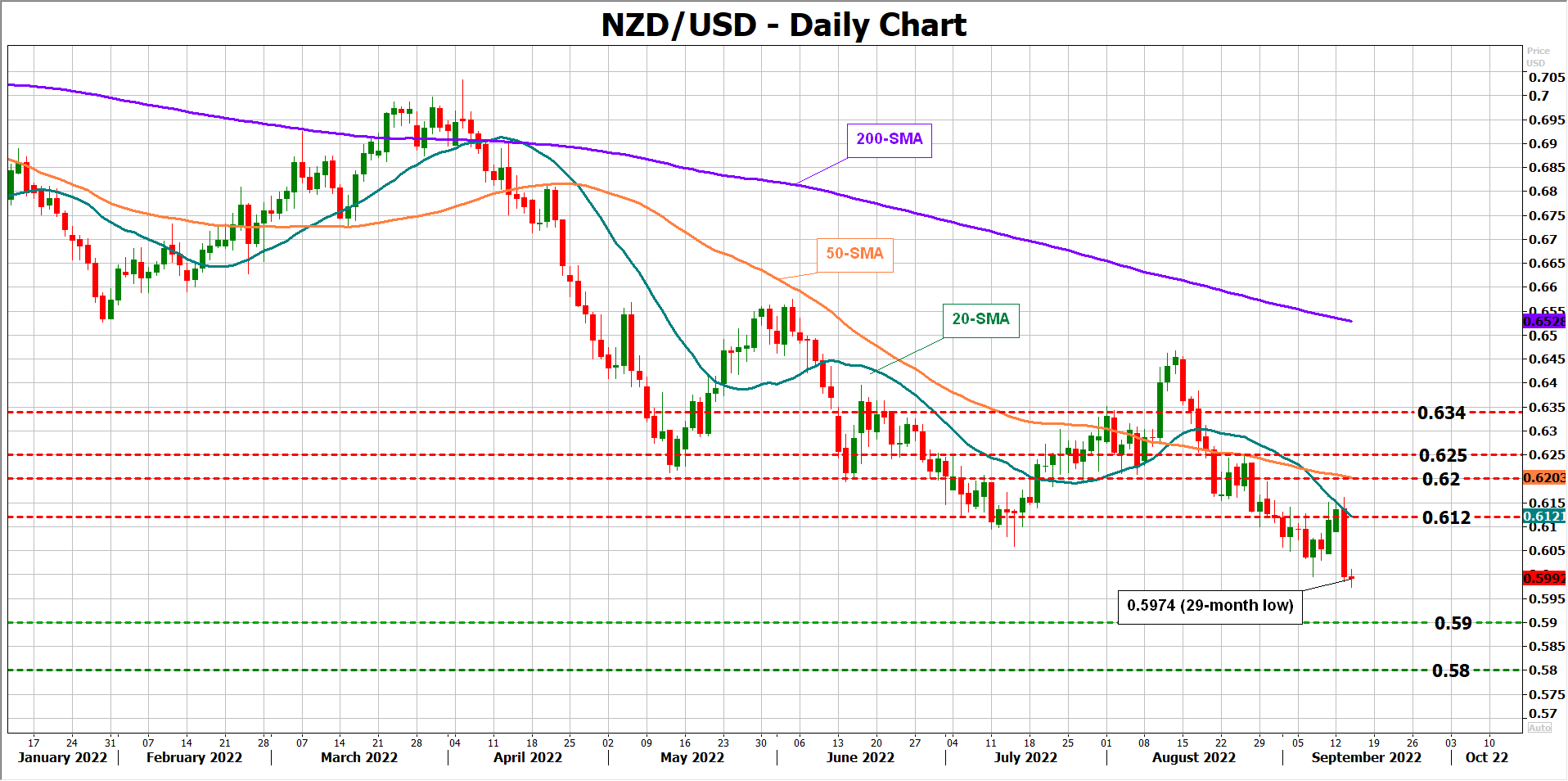
Given the above, the kiwi has little scope to stage a meaningful rally overnight. From a technical perspective, bearish risks have worsened against the US dollar following the plunge to a 28-month low of 0.5975, opening the door for the 0.5900 round level. In the event of a sharper sell-off, the 0.5840 – 0.5800 constraining zone could be the next destination.
On the upside, only a sustainable rebound above the 20-day simple moving average (SMA) at 0.6120 could ease selling interest and help the pair crawl up to the 50-day SMA at 0.6200. Further up, the restrictive area around 0.6250 could add some downside pressure ahead of the 0.6340 region.
Australia Unemployment, and First Central Bank to Blink
Jobs figures are back in focus in Australia following some interesting comments from RBA Governor Lowe a few days back. Of course the RBA doesn't care about the employment situation directly. But the theory is that jobs support consumer demand, which in turn supports prices. With the employment situation expected to turn around, particularly going into Australia's spring season, does that mean it's time to start considering a change in RBA policy?
The Governor insists that it's not, and that policy will be consistent. The issue is that market expectations seem to not align with the RBA's outlook, pricing in more hikes into next year. In his latest speech, Lowe appeared to be trying to temper expectations. One key point is insisting that Australia did not need to follow the Fed's rate higher, citing the employment situation.
What is the employment situation?
Australia has relatively low unemployment, which has contributed to upward pressure in wages. However, wages have not kept pace with rising inflation, which means the RBA doesn't have to worry about a wage-price spiral. With housing prices starting to fall, but exports remaining strong, there is a case that the reserve bank might not feel as much urgency to control the market. Healthy appetite for raw materials from China has continued to support the dollar, which in turn puts downward pressure on prices. Given the amount of imports from Australia, this might have a bigger impact on reducing inflation than direct monetary policy.
Recently there has been a little weakness in employment, but that was seen as a result of lower participation. Increasing labor force participation would be seen as helping the RBA's objective to bring prices down, as it would help increase production and solve some of the supply side issues. For that reason, the RBA might be wary about going above the neutral rate. Lowe did not give a specific range, just simply said that current policy was "nearer".
What to look out for
Australia August unemployment rate is expected to stay steady at 3.4%, despite the participation rate expected to tick up a couple of decimals to 66.6% from 66.4% prior. Australian firms have been complaining for months that they have been having trouble enticing workers back.
The employment change is projected to turn around, and show 35K jobs created compared to -49.9K in July. These figures are seasonally adjusted to account for Australia coming out of the middle of winter. Chief sector that had been impacted over the last few months was construction as home sales and prices started to fall.
Potential market reaction
The issue now is whether the RBA will hike another 50bps or just do 25bps at their next meeting at the start of October. So far, there is much consensus, but the market still seems to be betting on a more hawkish option.
Better jobs numbers would actually give the RBA more room to maneuver, and could be interpreted by the market as meaning a harsher hike is more likely. On the other hand, if the labor market were to not show the expected rebound, it could shake some of the confidence that policy will be as tight as expected, and weaken the Aussie.
Dollar Could Add Another 5% Before Finding G7 Resistance
Yesterday we wondered whether the dollar retreat was a correction or a reversal. But the reaction of the financial markets to the US inflation report has put everything in its place by confirming that we are still in a bull market for the dollar. Very often, though not always, this means a bear market for equities.
The Dollar Index’s corrective pullback from the extremes over the past week allowed players to accumulate liquidity for a new strike, which did not take long to come.
Dollar bulls took advantage of a rather average occasion – a slowdown in inflation to 8.3% instead of the expected 8.1% – to cause the DXY to strengthen by almost two per cent – the strongest one-day move since March 2020. Similarly, the stock market crash recalled the worst moments for the market at the start of the pandemic. That said, the inflation surprise (difference between fact and expectation) was not the most significant during this time.
The money markets have shifted markedly in their expectations for next week’s rate hike, laying down a 100% chance of a 75-point increase and a 34% chance of a 100-point rise at once. The previous day, we talked about less than 90% for 75 points and 0% for 100 points. However, an even bigger shock to expectations in July did not cause commensurate market turbulence.
In our view, yesterday’s move was purely technical. The dollar bulls proved that they hold control of the market, protecting the DXY from any severe test of the 50-day moving average. This was most telling in the EURUSD, which reversed below this line with a decisive move.
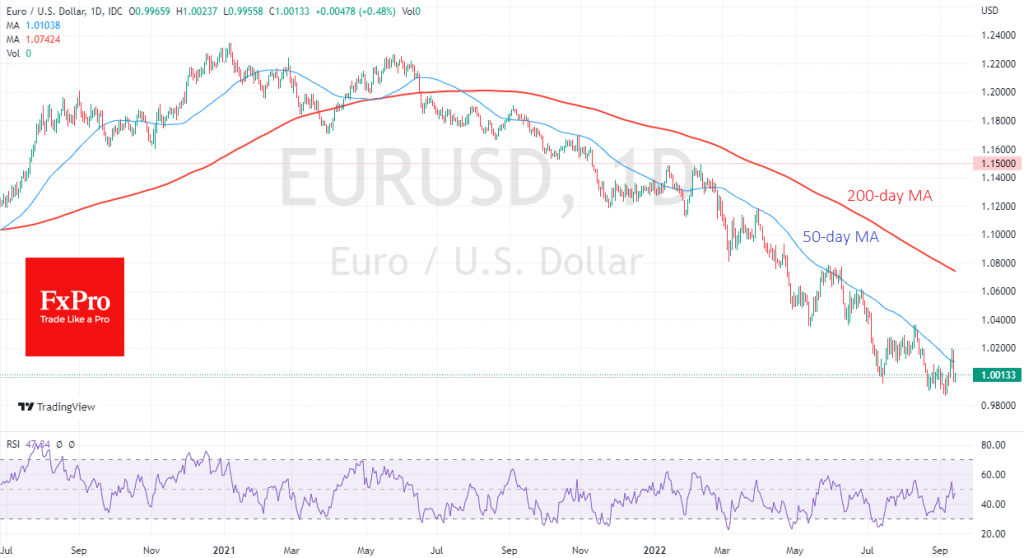
Usually, such strong moves at key levels will break the resistance of the second side for a long time. In other words, we could now see more of a dollar march in the coming days and weeks with the potential for a renewal of the DXY global highs.
A further rise in the dollar could deprive the EURUSD of support near parity, sending it in search of a bottom lower in 0.95-0.96. We have seen quite a few reversals and accelerations in this area throughout the synthetic euro’s existence.
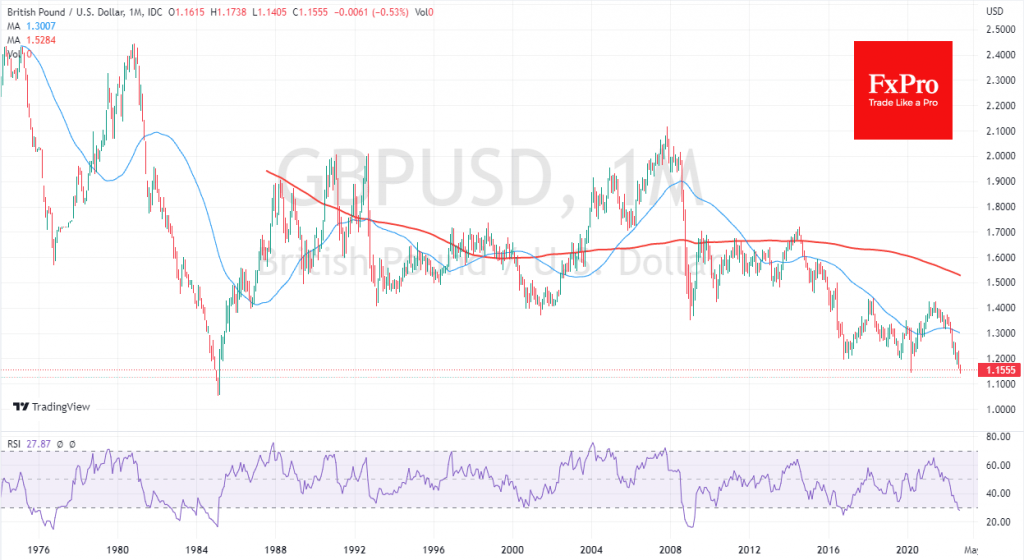
The GBPUSD would then risk a renewal of the lows from 1985, going down to 1.1000. For now, we consider a move below that year’s low (below 1.05) in an unlikely extreme scenario.
For the USDJPY, the road to 150 seems to be opening. However, we are cautiously looking at the potential for further gains. There are now reports that the Bank of Japan is preparing for currency interventions. The currency market values the dollar extremely highly, which could trigger a weakly controlled domino effect in the markets, which is hardly in the interest of the financial and monetary watchdogs.
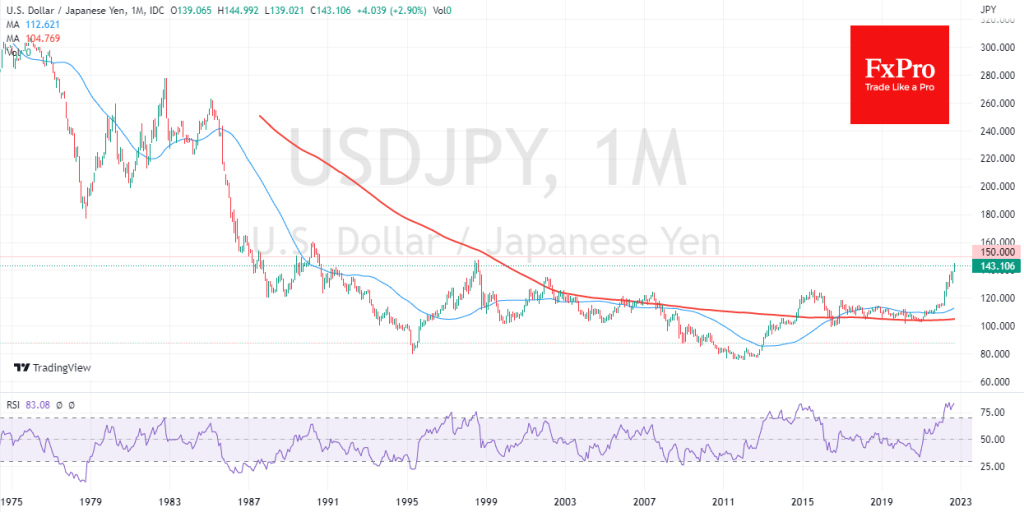
Simply put, the dollar could easily add around 5% to current levels in the coming days and weeks. Still, one must watch the rhetoric of the G7 authorities at the abovementioned levels very closely.