

Sample Category Title
September Flashlight for the FOMC Blackout Period
Summary
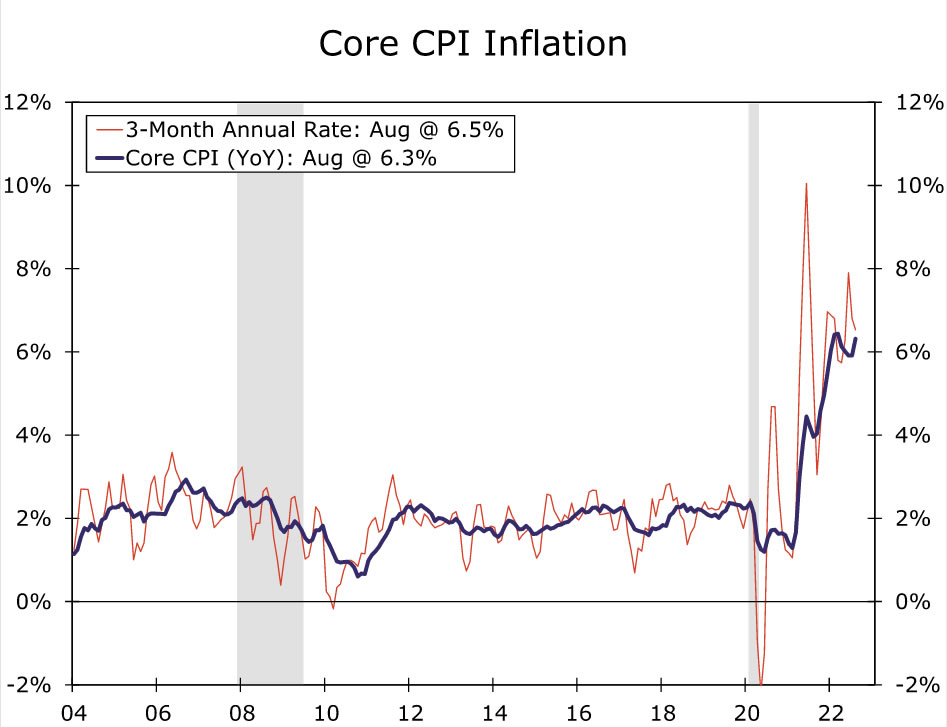
Another super-sized 75 bps rate hike at next week's FOMC meetings seems all but assured. Employment growth has been robust over the past two months, averaging 421K new jobs in July and August. Headline inflation has been relatively tame over the same period, but falling gasoline prices have accounted for the bulk of the weakness. Excluding food and energy, core inflation has remained far too high for the Fed's liking. Over the past three months, core inflation has risen at a 6.5% annualized rate, more than triple the central bank's 2% target.
Next week's meeting will also include an update to the FOMC's Summary of Economic Projections (SEP). We expect the 2022 median projection for the federal funds rate to be 3.875%, up from 3.375% in the June SEP. We think the 2023 median dot probably will be above the 2022 dot, but only modestly so. Despite the hawkish rhetoric, few Fed officials have publicly advocated for a peak federal funds rate that is well above 4%. Our expectation is that the median projection for the 2023 fed funds rate will be 4.175%. For 2024 and 2025, we think the dots will show a steady easing of policy as inflation moves back to 2%. We expect the changes to the SEP inflation projections will be relatively modest, but weaker GDP growth and higher unemployment projections for 2023 seem likely in our view.
At some point, Chair Powell and his FOMC colleagues will feel confident enough that they can slow the pace of monetary policy tightening. With the federal funds rate soon to be above 3% for the first time in 15 years and with QT running at full speed, monetary policy is rapidly moving towards restrictive territory. That said, we do not think the FOMC is ready to slow the pace of tightening yet, let alone reverse course. Chair Powell's speech at Jackson Hole made clear that the Federal Reserve views its fight against inflation as far from finished. We expect a similar message to come through in the post-meeting press conference next week.
The FOMC to Keep Rolling with Another 75 Bps Hike in September
Unrelenting inflation along with a boiling hot jobs market led the FOMC to deliver its second-straight 75 bps rate hike at its most recent meeting in late July. The decision for another jumbo move—the likes of which prior to June had not been seen since 1994—came despite signs of economic activity beginning to soften. With 225 bps of tightening delivered over just four meetings and indications that spending and investment are wobbling, Chair Powell noted in July's post-meeting press conference that at some point it will become appropriate to slow the pace of rate increases. Deciding when exactly to ease up on the brakes, however, depends on incoming data. Not only does the FOMC want to assess the cumulative affects of tightening to date, but, in our view, it wants to move away from meeting-specific guidance given the fast pace at which the inflation and broader economic backdrop continue to evolve.
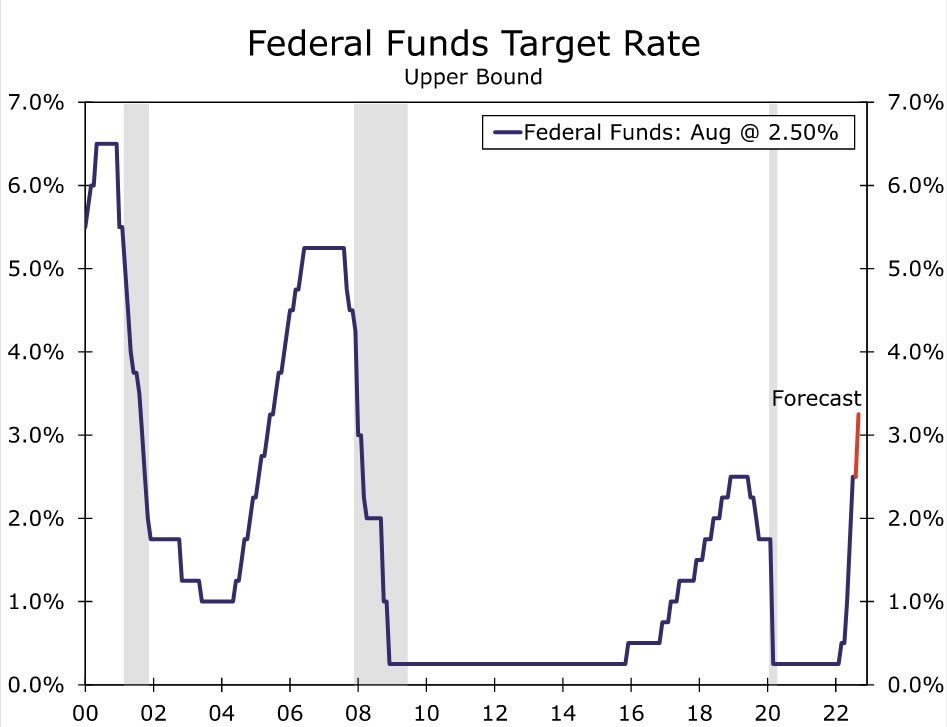
While FOMC officials have been playing their next move closer to the chest, the time to start slowing rate increases does not appear to be in hand just yet. We expect the FOMC to raise the fed funds rate by another 75 bps in September, bringing the target range to 3.00-3.25%. If realized, this move would put the federal funds rate at its highest level in 15 years (Figure 1). Consumer spending remains under pressure from inflation but thus far has not buckled. Similarly, industrial activity has shown signs of stabilizing relative to a couple of months ago when growth in industrial production essentially stalled.
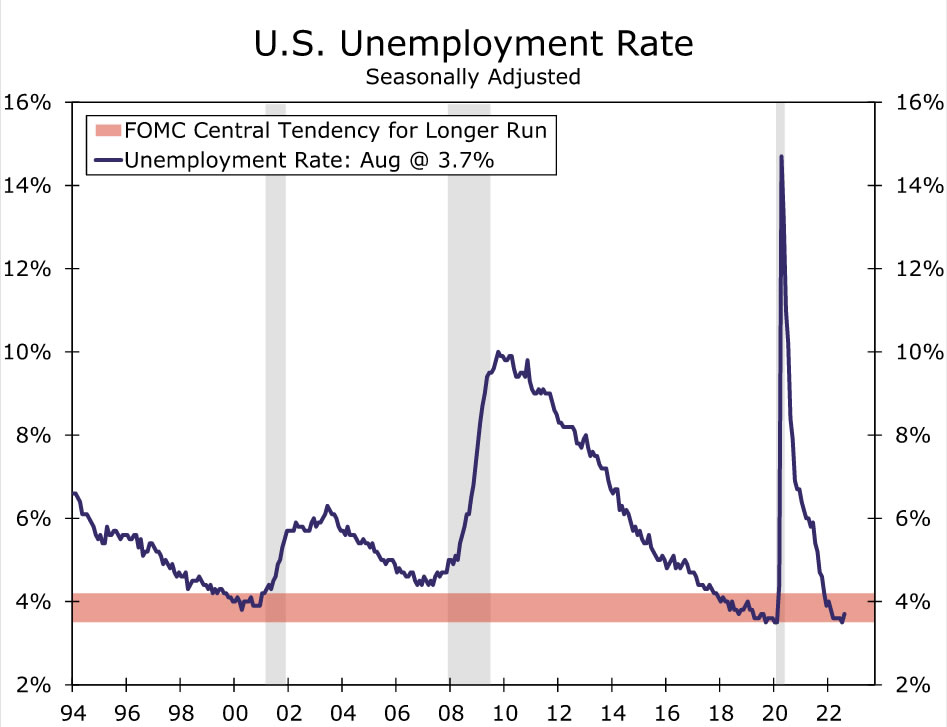
More importantly for the FOMC, the labor market remains exceptionally strong. Employment growth cooled slightly over the inter-meeting period, but the labor market is still incredibly tight. Hiring in August followed up July's blockbuster print with a gain of 315K jobs, robust in its own right. The unemployment rate moved up to 3.7%, but the increase was due to an encouraging rise in labor force participation rather than an increase in layoffs. At just 3.7%, the unemployment rate remains near the low end of what Fed officials agree is sustainable over the long run (Figure 2). Job openings, hiring plans and businesses reporting at least one job hard to fill have softened since the Fed's past meeting, but only minimally. All told, tightness in the labor market eased only incrementally since the previous FOMC meeting.
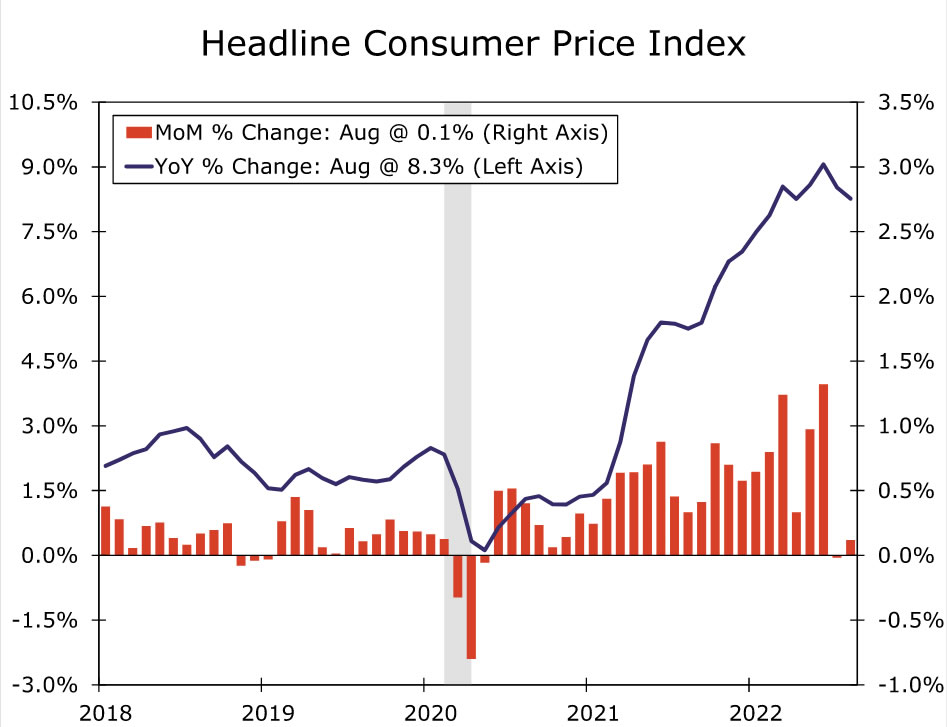
Headline inflation has been relatively benign over the past two months. The overall CPI was flat in July relative to the previous month and increased just 0.1% in August (Figure 3) Chair Powell has stated that he would like to see "compelling evidence that inflation is moving down," and the two past two CPI prints would seem to offer some preliminary evidence. But, with a drop in gasoline prices driving much of the recent softness, a sustained return to 2% inflation remains far from assured. Core inflation has not eased nearly as much as headline inflation and is still advancing well-ahead of the Fed target. The August CPI report showed core inflation registered a 6.5% annualized pace over the past three months (Figure 4).
While some recent slowing in price growth is a step in the right direction, it comes at a time when FOMC members sound more resolute in their efforts to return inflation to 2% for the long haul. In a pointed speech at the Kansas City Fed's annual symposium at Jackson Hole, Chair Powell made clear that the FOMC is laser-focused on restoring price stability. Chair Powell and other members appear wary of easing up prematurely, citing historical comparisons to the 1970s and coalescing around the view that policy will need to be restrictive for some time. The steady string of tough talk on inflation continued even after the August jobs report showed slight cooling in the labor market and estimates rolled in that consumer price growth was tame in August. Financial market participants have taken notice: at present, the market is fully priced for a 75 bps rate hike at the September FOMC meeting.
September's increase in the fed funds rate will be complimented by the reduction in the Fed's balance sheet hitting its full stride. Starting this month, up to $60 billion each month of maturing Treasury securities will roll off the balance sheet, a doubling from the June-August pace of $30 billion per month. The cap on mortgage-backed securities paydowns also has doubled to $35 billion per month, although by our estimates paydowns are expected to run well below this cap for the foreseeable future since mortgage demand has slowed to trickle in recent months amid higher rates.1
Smaller Yet Meaningful Changes Likely Coming in the New SEP
The FOMC updates its Summary of Economic Projections (SEP) four times a year: March, June, September and December. The past few updates have contained sizable revisions to the outlook for economic growth, inflation and the federal funds rate amid a rapidly evolving economic landscape. Next week's update will once again include some revisions, but we expect them to be more modest than the ones that occurred in March and June.
In our view, the biggest changes to the FOMC's projections for the federal funds rate (i.e. the dot plot) will be for 2022. In June, the median participant projection for the 2022 year-end fed funds rate was 3.375% (Figure 5). If the FOMC hikes by 75bps next week as we expect, that would put the midpoint of the fed funds target range at 3.125% with two meetings still to go this year. We think the 2022 median dot will move up to 3.875% to reflect a more aggressive path of tightening.
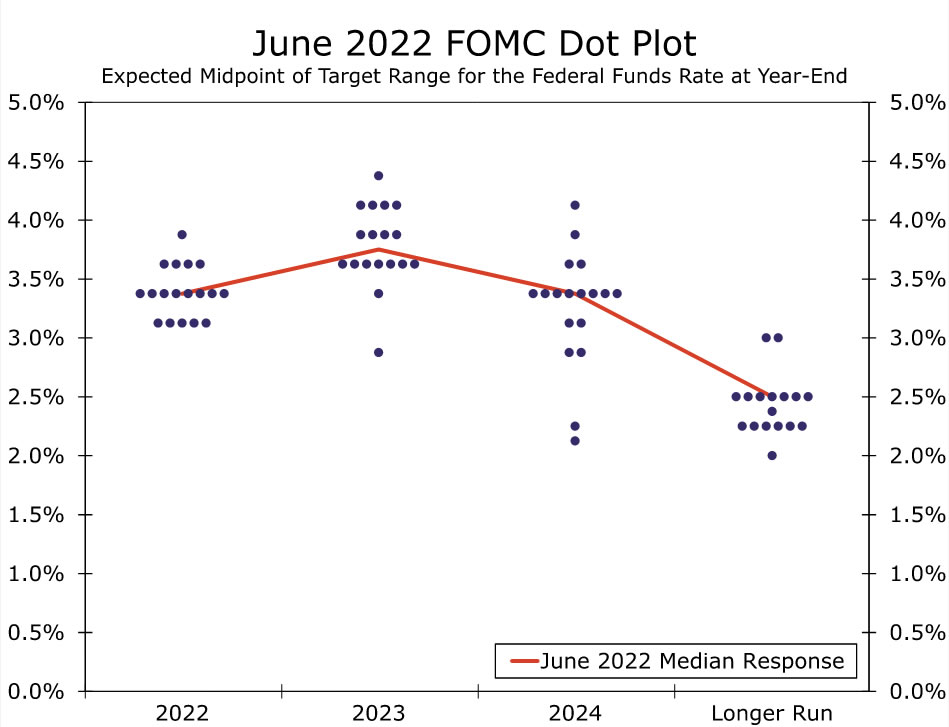
As discussed earlier, Fed officials have made clear in their public comments that monetary policy easing remains a long way off. Thus, from a signaling standpoint, we think the 2023 median dot probably will be above the 2022 dot, but only modestly so. Despite the hawkish rhetoric, few Fed officials have publicly advocated for a peak federal funds rate that is well above 4%. Our expectation is that the median projection for the 2023 fed funds rate will be 4.125%. For 2024 and 2025, we think the dots will show a steady easing of policy as inflation moves back to 2% and the Committee responds accordingly by gradually moving the fed funds rate back towards its longer-run level of 2.5%.
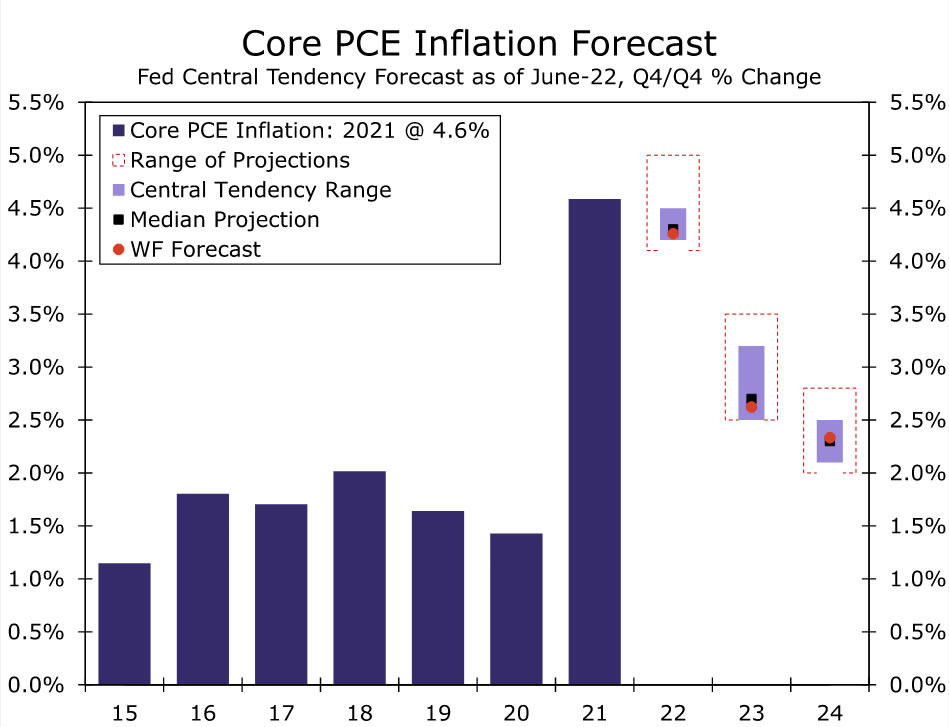
In the June SEP, the median FOMC participant looked for PCE inflation to be 5.2% in 2022 and 2.6% in 2023. Our most recent forecast, published on September 9, is roughly in line with these projections. We look for inflation as measured by the PCE deflator to be 5.1% and 2.3% in 2022 and 2023, respectively. Similarly, the median FOMC projection in the June SEP for the core PCE deflator was 4.3% in 2022 and 2.7% in 2023, and our latest forecast looks for a comparable 4.3% in 2022 and 2.6% in 2023 (Figure 6). Tweaks may be coming, but we do not expect sweeping changes to the inflation outlook in the updated September SEP.
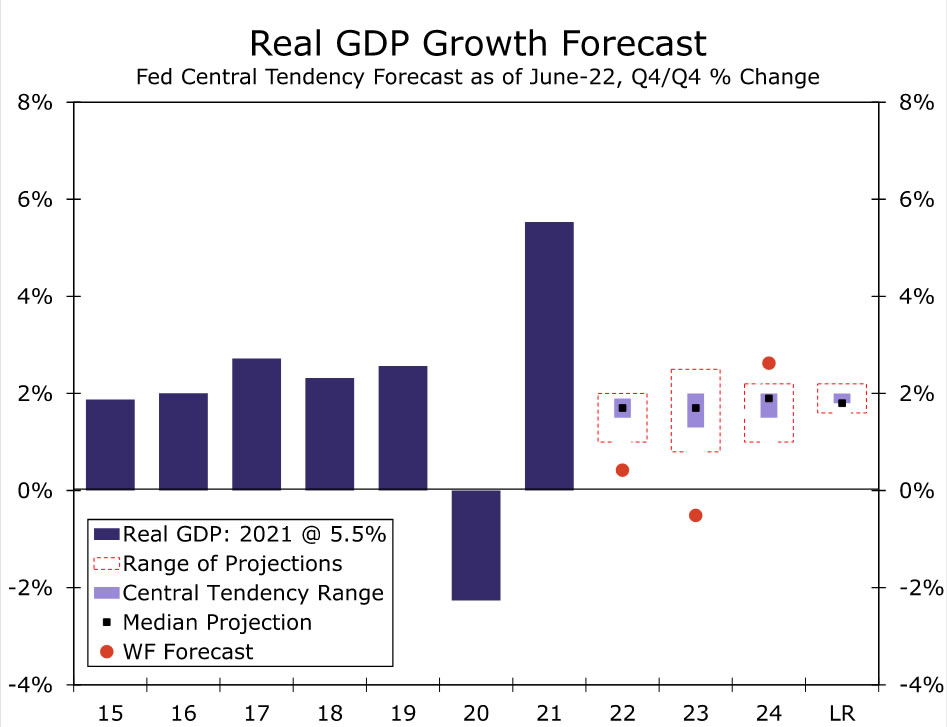
The FOMC's projections for economic growth in 2022 likely will come down, reflecting the two consecutive quarters of negative real GDP registered in the first half of this year. Our own estimate is for GDP to register just a 0.4% year-over-year rise in Q4, well below the 1.7% median estimate in the June SEP (Figure 7). The 2023 estimates for GDP growth and unemployment should be more telling of how bumpy the FOMC sees the road to bringing down inflation. In June, the median 2023 estimate for GDP growth (1.7%) was only a hair below the Committee's estimate for the economy's long run trend growth rate (1.8%).
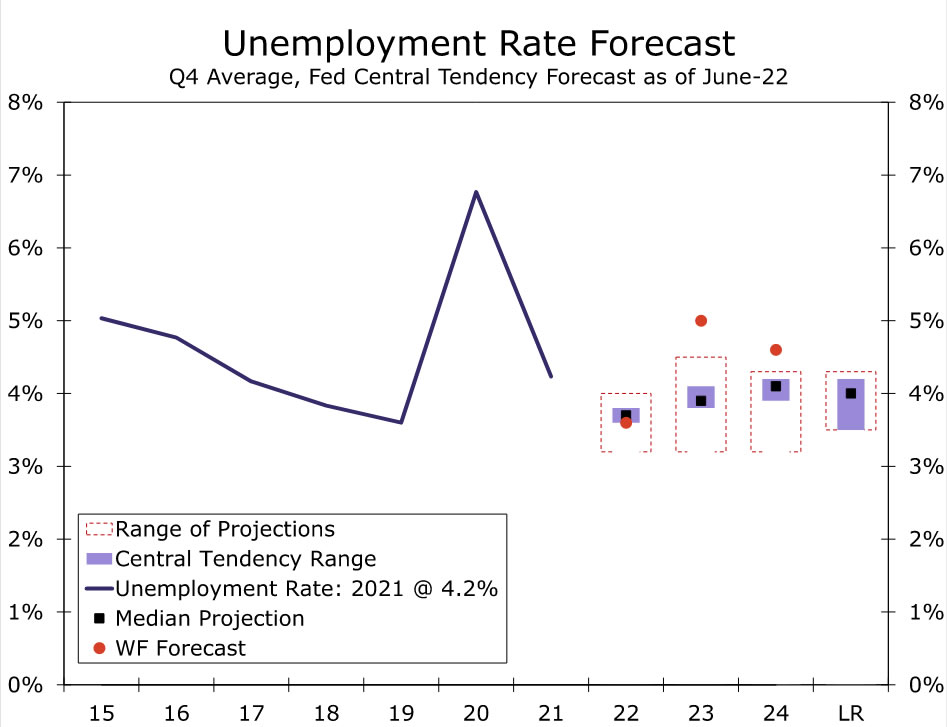
We would not be surprised to see the 2023 growth projection decline further as the FOMC signals a more restrictive stance of policy will be needed to bring down inflation. Similarly, we expect the median estimate for the unemployment rate at the end of 2023 to move up (Figure 8). While we do not believe the SEP will signal that a recession is likely to ensue from the prolonged stance of more restrictive policy, as our own forecast suggests, we expect it paint a more realistic portrait in that restoring price stability will impart a meaningful hit to economic growth and the jobs market.
It remains to be seen whether next week will mark the final 75 bps rate hike of the tightening cycle. For essentially the entire year, the FOMC has been increasingly hawkish at each successive Committee meeting in response to alarmingly fast inflation. July's downside miss on inflation was promptly offset by an upside miss in the August CPI report, putting pressure back on the FOMC to remain diligently hawkish at next week's meeting. But with the federal funds rate poised to be above 3% after next week's meeting and QT running at full speed, Fed officials may finally start to feel that the pace of tightening can moderate in Q4 and beyond. That said, there is a big difference between slowing the pace of tightening and a full-blown policy pivot. Chair Powell's speech at Jackson Hole made clear that the Federal Reserve views its fight against inflation as far from finished. We expect a similar message to come through in the post-meeting press conference next week.
Weakening UK Inflation Eases Pressure on the Pound
The inflation report marathon continues; it was the UK’s turn this morning. Traditionally, the consumer price change figures attracted the most attention. For the month, they rose by 0.5% (slightly less than the 0.6% expected), and annual inflation fell from 10.1% to 9.9%, slightly weaker than the 10.0% expected.
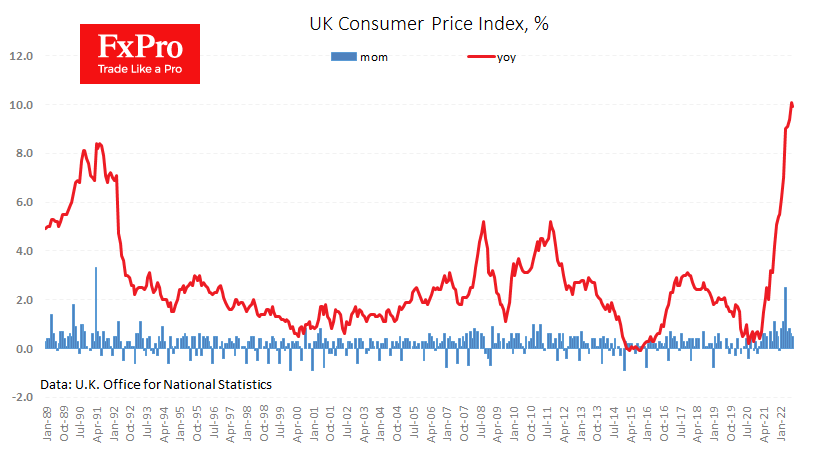
As previously with the US data, core inflation exceeded expectations, reaching 6.3% – a new all-time high. However, there are several signs that the inflation wave has subsided.
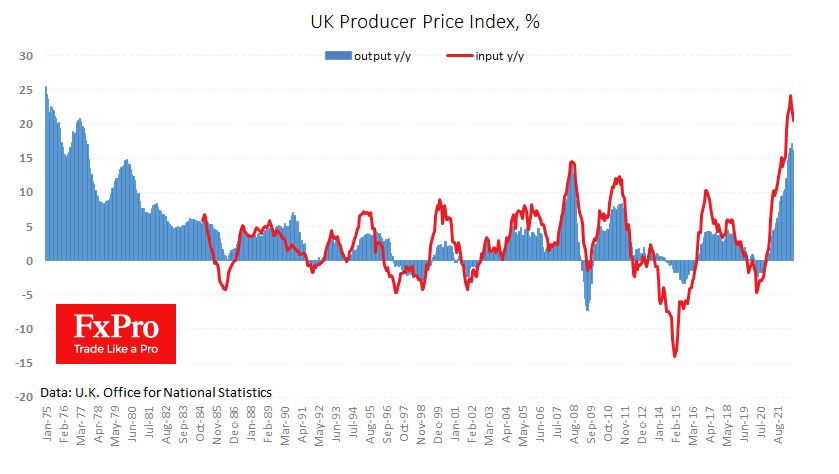
Producers reduced their selling prices for the first time in almost two years. The reduction was a nominal 0.1%, but we should expect more. This indicator’s annual rate of increase fell from 17.1% to 16.1%.
Producer input prices (an even earlier indicator for inflation) lost 1.2% in August – the largest since April 2020. By the same month a year earlier, growth had slowed to 20.5% compared with 22.6% in July and 24.1% in June.
It is also worth remembering that the effect of the high base (there were already higher price growth rates at this time a year ago) will weigh on the annual inflation figure.
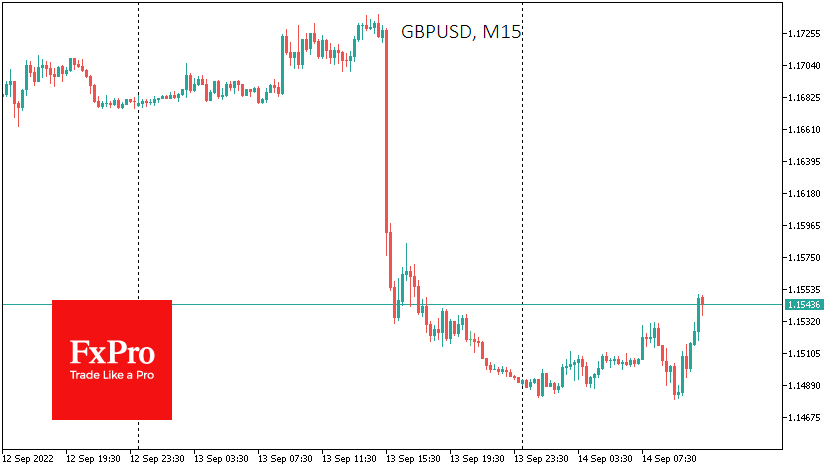
After we saw a sharp rise in the dollar on hot inflation from the US, one could have expected a new wave of pressure on the Pound on weak data. But that did not happen, for which there is a logical explanation. The news in the US caused a revision of rate expectations, but this is not happening in the UK markets.
Lower inflation puts less pressure on Sterling’s purchasing power. In the longer term, this will help reduce the shock to the economy from tightening monetary policy, which is positive for the currency.
GBP/USD: Cable Regains Traction after Tuesday’s Strong Fall But Bears Still in Control
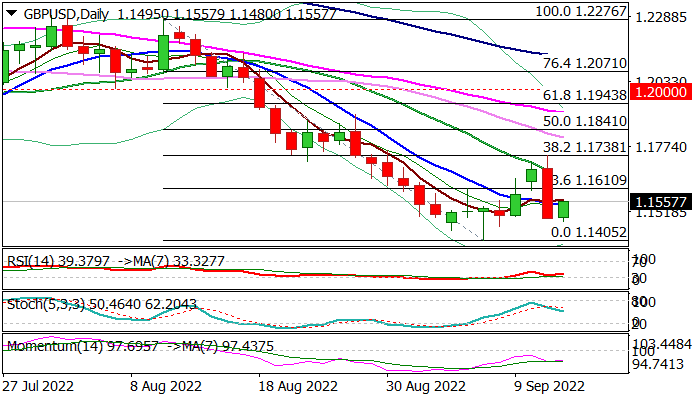
Cable regained traction after a brief dip under 1.15 mark on lower than expected UK inflation data, as expectations of 0.75% BoE rate hike next week continue to dominate and underpin pound.
Wednesday’s sharp drop on higher than expected US inflation (cable was down 1.7% for the day in the biggest daily loss since May) left large daily bearish candle that weighs on near-term action, with signal being supported by strong bearish momentum on daily chart.
Recovery cracked initial barrier at 1.1542 (10DMA) with break here to ease bearish pressure and allow for stronger correction towards falling 20DMA (1.1656), which should cap rallies and maintain negative bias.
Only lift and close above pivotal Fibo barrier at 1.1738 (38.2% of 1.2276/1.1405) would sideline larger bears and open was for stronger rebound.
Res: 1.1562; 1.1610; 1.1656; 1.1738.
Sup: 1.1480; 1.1440; 1.1443; 1.1405.
Yen Recovers after BoJ Rate Check
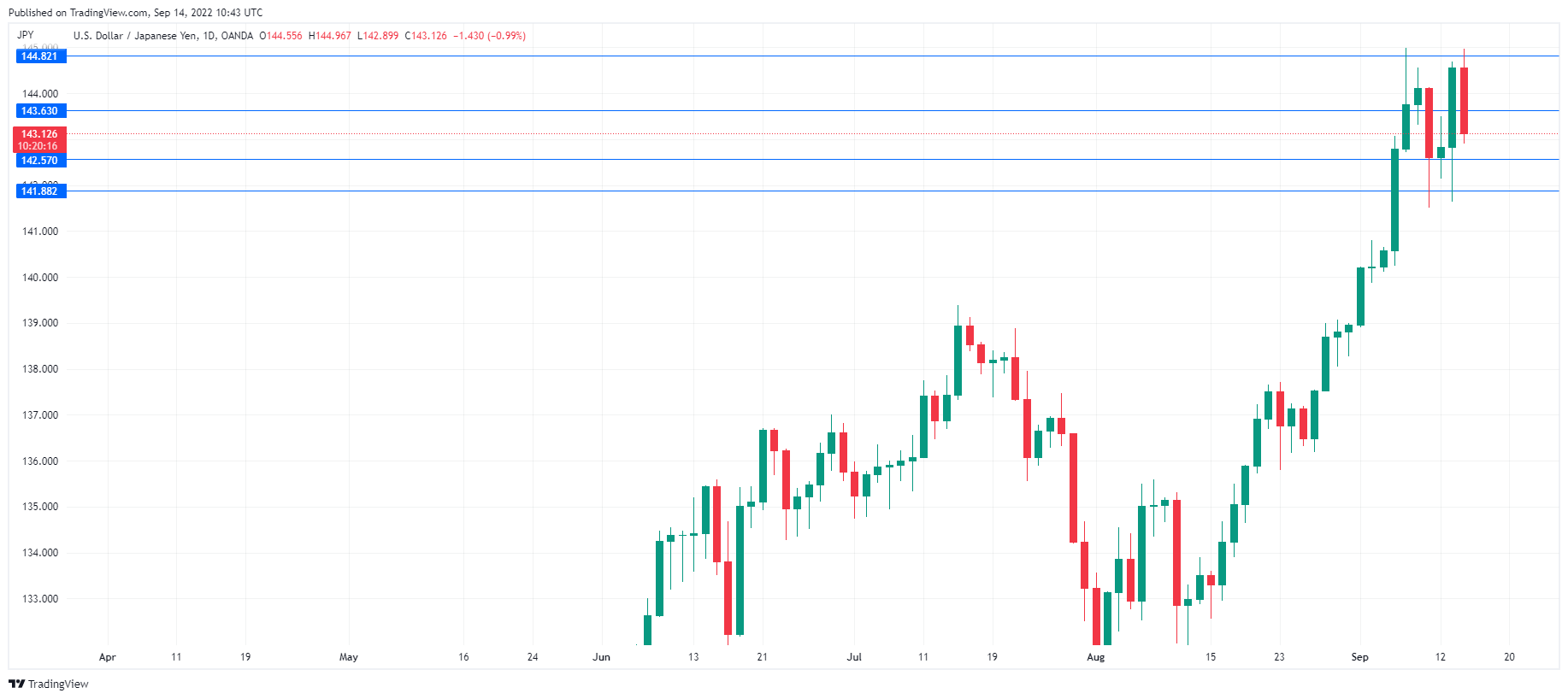
The Japanese yen has posted sharp gains today. USD/JPY is trading at 143.09, down 1.00% on the day.
Is Japan planning a currency intervention?
The yen has taken investors on a roller-coaster ride this week. On Tuesday, the dollar shined, posting broad gains against the majors and climbing 1.19% against the yen. The catalyst for the upswing was the US inflation report, which was higher than expected. The yen has recovered most of these losses today, after reports that the Bank of Japan had conducted a rate check, which could signal currency intervention in order to prop up the ailing yen.
The BoJ has rigidly maintained its ultra-loose monetary policy in order to stimulate Japan’s fragile economy. As part of this policy, the BoJ has kept a firm hand on its yield curve control, and the price for this stance has been a freefall in the yen, which is done an astounding 30% against the dollar this year. Japanese policy makers have fired verbal warnings about the yen’s depreciation causing deep concern, but the markets have learned to ignore the rhetoric, which hasn’t been backed up by any action.
The yen hit 144.99 last week, a new 24-year low, and there has been speculation that 145 is a line in the sand for Japan’s Ministry of Finance, which would be responsible for a currency intervention by purchasing a massive amount of yen with US dollars on the currency markets. Japanese officials haven’t ruled out intervention, but there is a legal hurdle as Japan cannot intervene in the currency markets without permission from the G-20. The last time Japan intervened to prop up the yen was in 2011, in the middle of a financial crisis in Asia. Still, investors will be paying close attention to the BOJ’s meeting on September 22, which comes just one day after the Fed’s next meeting. Any hints of intervention could send the yen sharply higher.
If, however, Japan decides once again to stay on the sidelines, the yen has more room to fall. The Fed is likely to raise rates by 75bp at the upcoming meeting, but there is a reasonable possibility of a massive 100bp hike as well. With the yen at the mercy of the US/Japan rate differential, I expect the yen to continue to lose ground, barring some dramatic action from Tokyo.
USD/JPY Technical
- 1.4363 is the next line of resistance, followed by 144.81
- USD/JPY has support at 142.56, followed by 141.88
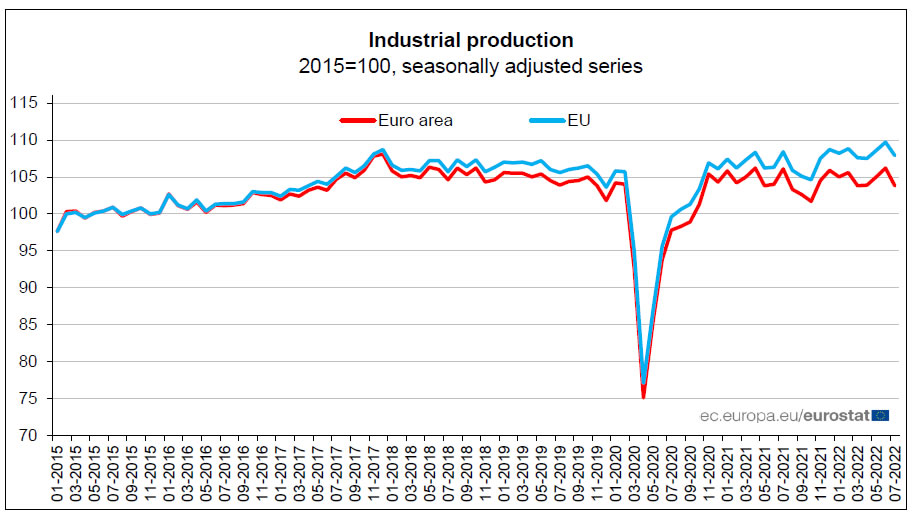
Eurozone industrial production dropped -2.3% mom in Jul, EU down -1.6% mom
Eurozone industrial production dropped -2.3% mom in July, much worse than expectation of -0.8% mom. Production of capital goods fell by -4.2%, durable consumer goods by -1.6% and intermediate goods by -0.8%, while production of energy rose by 0.4% and non-durable consumer goods by 1.2%.
EU industrial production declined -1.6% mom. Among Member States for which data are available, the largest monthly decreases were registered in Ireland (-18.9%), Estonia (-7.4%) and Austria (-3.2%). The highest increases were observed in Lithuania (+6.5%), Sweden (+5.8%) and Malta (+4.2%).
10 Year US Yields Ready to Attack 3.5%
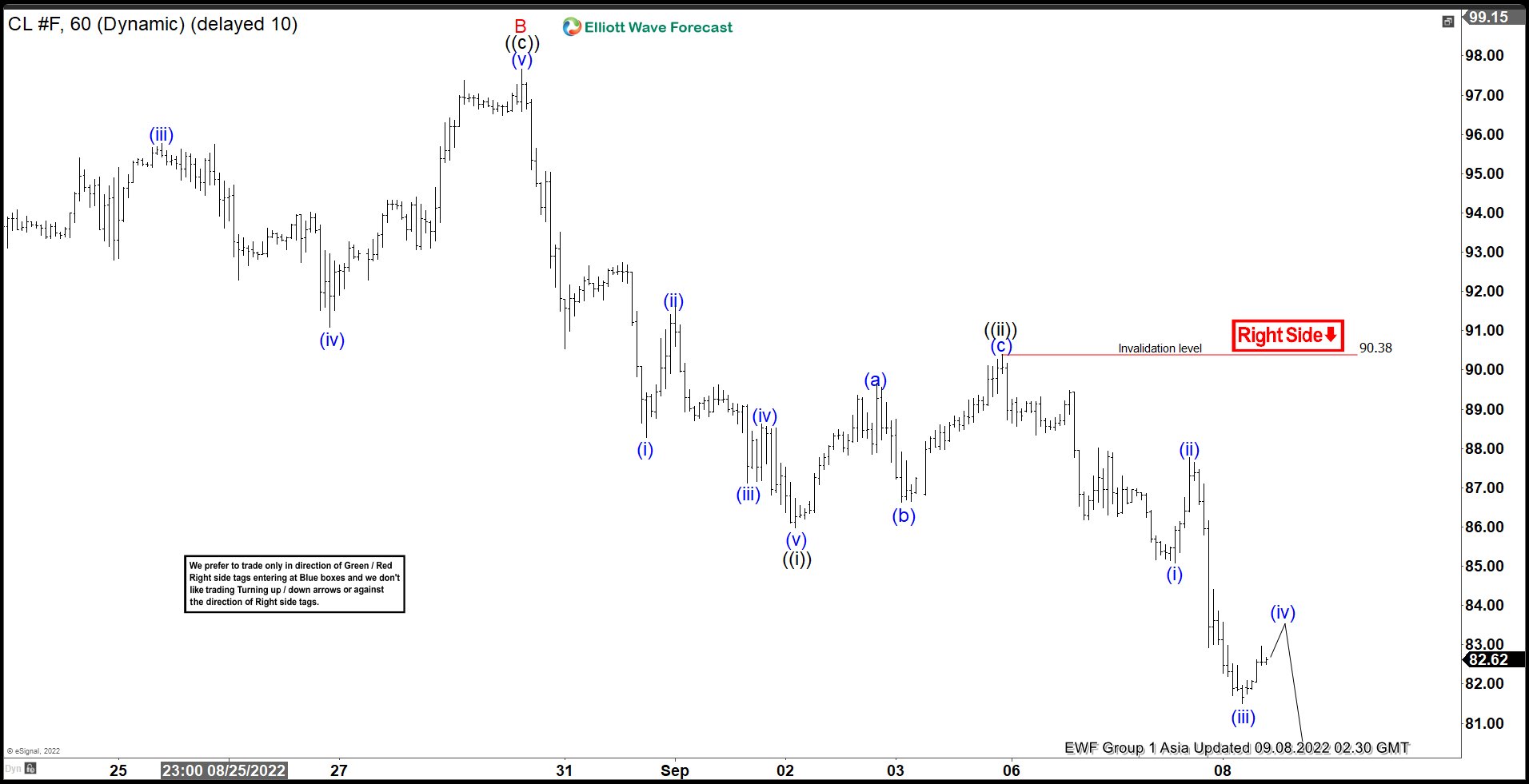
USD is up across the board on hawkish FED policy speculation after the US CPI data came higher than expected. The USD is very strgon and almost erased all of the losses vs other currencies as stocks came down and US yield rally. The risk-off mode is here and will likely resume as recent price action appears impulsive. We also think that US yields are ready to take out that 2022 highs, so USD can stay strong in sessions ahead. Maybe the only pair to watch for potential surprise in the opposite direction can be USDJPY after another day of BoJ intervention talk.
Crypto Bears Confirmed Their Strength
Market picture
Bitcoin collapsed 9.6% on Tuesday, ending the day near $20.2K, which remains on Wednesday morning. Ether is losing 6.4% overnight to $1610. The most significant altcoins took a heavy hit, losing between 4.6% (BNB) and 13% (Solana), but remain on the plus side after seven days.
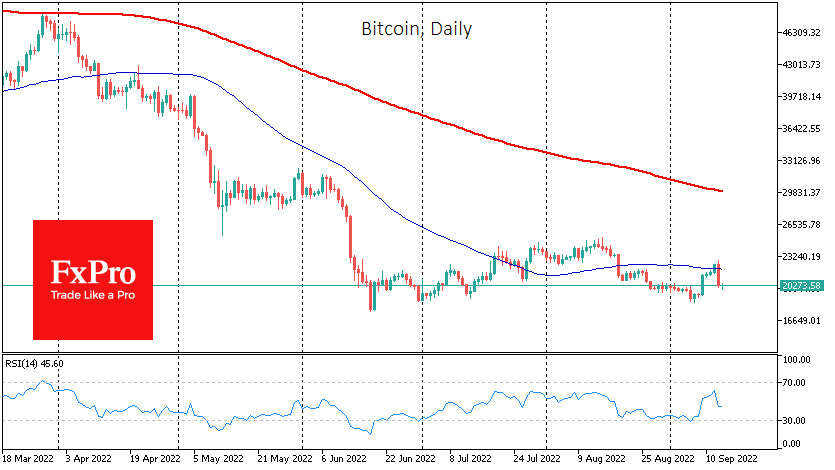
The bears in Bitcoin have asserted that they are in control. From the 50-day moving average level, BTCUSD experienced a substantial decline. This could bring back downward sentiment, as it did in August, for an extended period. However, it is too early to speculate on whether the June lows will be renewed.
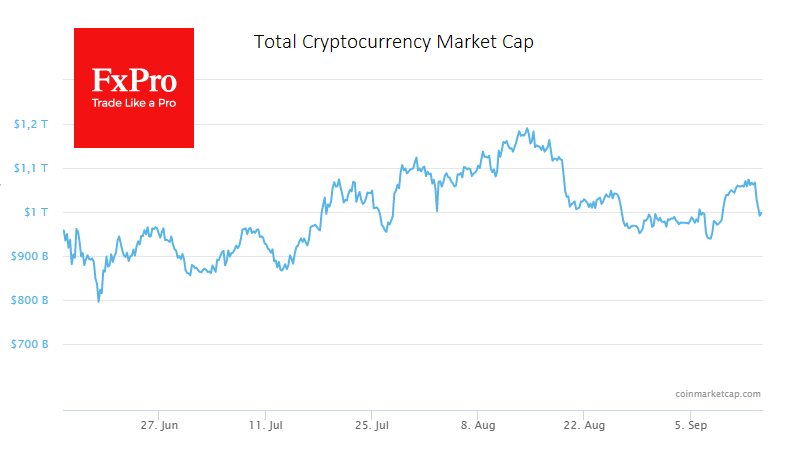
Pressure on all risky assets came after a hot US inflation report, which increased the likelihood of a more robust Fed rate hike next week and triggered the strongest sell-off in more than two years.
News background
Eugene Fama, 2013 Nobel Prize laureate in Economics, believes that bitcoin will have value as a means of payment. However, BTC’s high volatility prevents it from being used for that purpose. We should add that this refers not only to the downside but also to upside moves.
Ethereum has a much higher near-term growth potential than bitcoin, according to ConsenSys. ETH could become a savings vehicle following The Merge event, set to take place on September 15.
Digital asset management platform Abra is launching Abra Bank, the first regulated crypto bank in the US, providing traditional services for cryptocurrencies.
According to media reports, investment giant Fidelity Investments, which serves 34 million clients, plans to provide retail clients access to bitcoin trading on its brokerage platform.
Aussie Stabilizes after Freefall
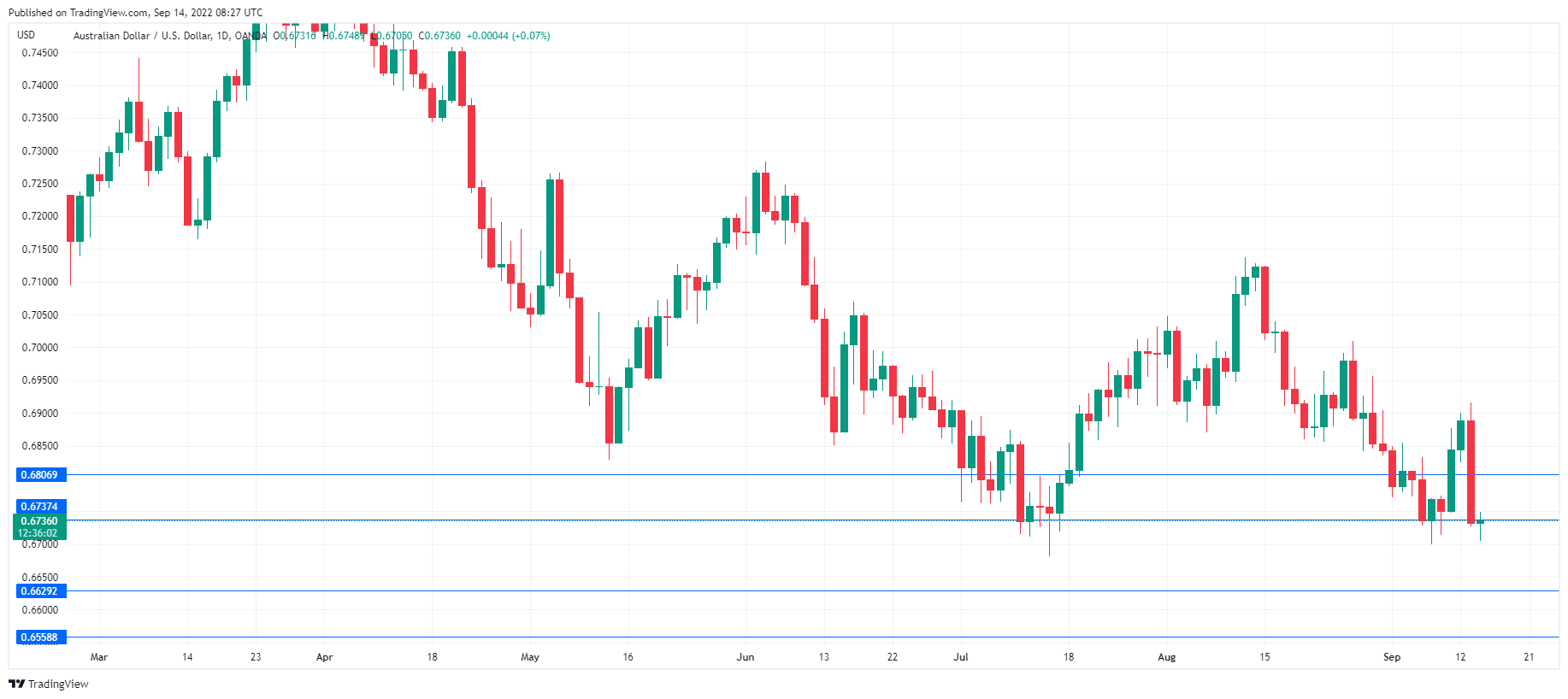
The Australian dollar is licking its wounds today, after a brutal collapse on Tuesday. AUD/USD is trading at 0.6739 in the European session, up 0.12%.
US inflation sends USD soaring
On Tuesday, I noted that the Australian dollar had edged higher, thanks to decent consumer and business confidence data. That changed in a hurry after the US inflation report, and by the end of the day, AUD/USD had plunged an astounding 2.29%. The Aussie wasn’t alone, as the US dollar posted sharp gains against all the major currencies.
In the US, investors were dismayed with the August inflation report, even though headline inflation fell to 8.3%, down from 8.5%, thanks to lower gasoline prices. The reading was well above the consensus of 8.0%, and core CPI rose to 6.3%, up from 5.9% and above the forecast of 6.1%. The markets reacted sharply to the news, as equity markets slumped and the US dollar was off to the races. The market response was a polar opposite to the July inflation report, when market euphoria sent the stock markets flying and the US dollar tumbling.
The latest inflation numbers have removed any expectations of a modest 50bp increase at the Fed’s meeting next week and have raised the possibility of a massive 100bp hike. The markets have priced in a 75bp increase at 60% and a 100bp rise at 40%, compared to 80% for 75bp and 20% for 100bp after the inflation report was released. I expect these odds to continue to fluctuate as we get closer to the September 21st meeting. Larry Summers, a former Treasury Secretary, said on Tuesday that the inflation report indicated that the US has a “serious inflation problem” and a 100bp move would “reinforce credibility”.
Market attention will shift to the Australian employment report on Thursday. The market consensus stands at 35.0 thousand for August, which would be a huge rebound after the -40.9 thousand reading in July. A strong release will make it easier for the RBA to remain aggressive as it continues to battle inflation. The RBA will be keeping a close eye on Consumer Inflation Expectations, which will also be released on Thursday. The index is expected to rise to 6.7% in August, up from 5.9% in July.
AUD/USD Technical
- AUD/USD is testing resistance at 0.6737. Above, there is resistance at 0.6807
- There is support at 0.6629 and 0.6559
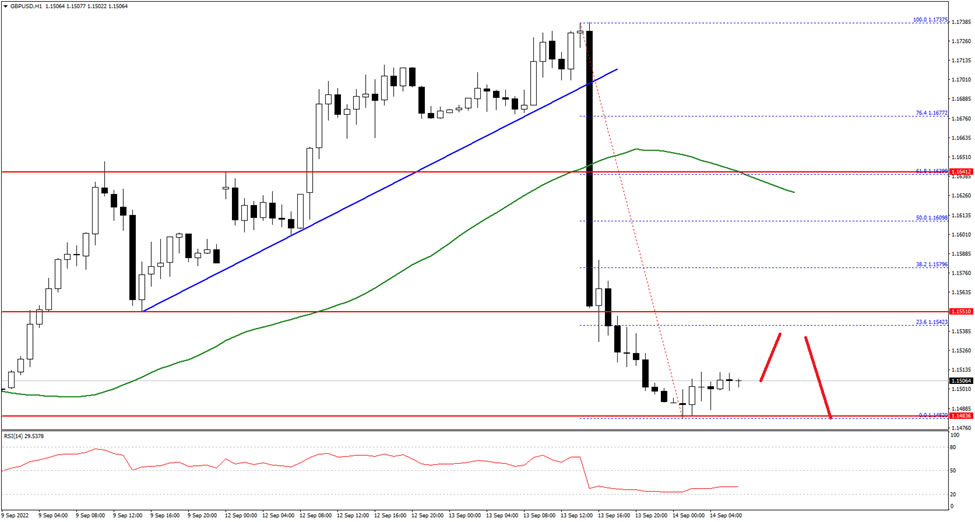
GBP/USD Pair Started a Heavy Decline Below $1.1650
The British Pound started a fresh decline from the 1.1740 resistance zone against the US Dollar. The GBP/USD pair declined heavily below the 1.1700 and 1.1650 levels.
There was a close below the 1.1600 level and the 50 hourly simple moving average. It even spiked below the 1.1520 level and traded as low as 1.1482. The pair is now consolidating losses, with an immediate resistance near the 1.1520 level.
The first major resistance sits near the 1.1550 zone. If there is a clear upside break above the 1.1550 resistance, the pair could rise steadily towards the 1.1600 level in the near term.
On the downside, an initial support is near the 1.1500 level. The main support is forming near 1.1480 on FXOpen. A break below the 1.1480 support could even push the pair below the 1.1450 support.
BoE Preview: Another 50bp Rate Hike in Store
- We expect BoE to hike the Bank Rate by another 50bp on Thursday 22 September, but acknowledge that it is a close call between 50bp and 75bp.
- We expect further 50bp hikes in both November and December followed by 25bp in February. Hence, we lift the end point of our projection to 3.25% (prev. 2.50%)
- We expect fewer hikes than priced in markets as we emphasise the rising recession risk. In our base case, we expect EUR/GBP to rise upon announcement (see p. 2).
BoE call. We expect the Bank of England (BoE) to hike the Bank Rate by another 50bp at its next meeting bringing it to 2.25%. Markets are currently pricing around 65-70bp. We expect 50bp as opposed to 75bp, as we are more negative on the growth outlook. Also BoE has had a tendency to surprise to the dovish side at recent meetings. Additionally, BoE was the first G10 central bank to forecast a recession by Q4 2022 at its last meeting, while using a far more dovish market pricing as policy input than what is currently priced. We see this as a contributing factor to our base case as the growth outlook looks considerably worse now than back then given current market pricing.
We expect the BoE to repeat the message of a meeting-by-meeting approach effectively eliminating forward guidance, similar to both the ECB and the Fed. Note, that there will not be any updated inflation or GDP forecasts published at this meeting (interim meeting).
In light of recent developments we update our BoE call and now expect 50bp hikes in September, November and December followed by a final 25bp hike in February 2023. The endpoint is thus lifted to 3.25% (from 2.50%). We see possibility for further hikes in 2023, if we see underlying inflation pressures to prove persistent.
As outlined at the last meeting, we expect outright government bond selling to commence with a proposed bond sales of GBP 10bn per quarter, totalling a reduction in bond holdings of GBP 80bn over twelve months.
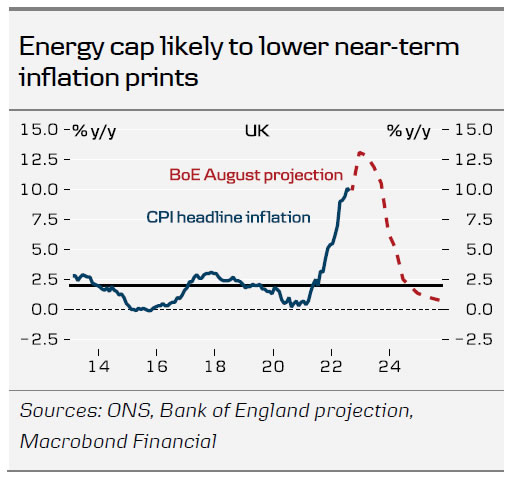
Fiscal policy. The newly elected Prime Minister Liz Truss recently announced an energy support package to households, capping the yearly energy bills at GBP 2,500 from October and two years ahead. This limits the planned increase of 80% in energy costs down to an estimate of 27%. In turn, this could result in inflation prints being lower in the near-term than first projected. In our view, this makes a 75bp hike less likely.
Meanwhile, with the package expected to be deficit funded, we could see upside to inflation down the road with inflation possibly proving to be more persistent. This could highlight the need for further hikes in 2023, yet amid the deficit funding uncertainty we still lean towards 50bp next week.
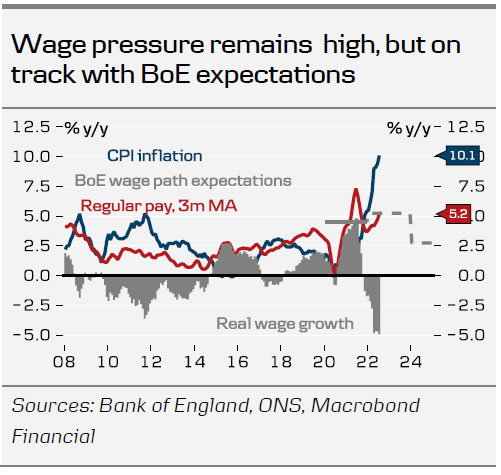
Growth outlook. We continue to expect the UK to head into recession in H1 2023. Although we expect fiscal stimulus to dampen the fall, it will not be enough to fully offset the erosion of real wage growth. Manufacturing PMI dropped to 47.3 in August and retail sales have started to show signs of slowing. The labour market is still very tight with high wage pressure, although the latest labour market data showed some signs that the labour market is losing some of its momentum with higher inactivity and more people stepping out of the work force.
FX. In our base case of a 50bp hike, we expect EUR/GBP to move slightly higher on announcement. As we expect the BoE to highlight the gloomy growth outlook for the UK economy amid rising recession risk, we expect EUR/GBP to continue its move higher during the press conference.
We still widely consider EUR/GBP a range play for the coming months, with GBP currently trading in the weaker part of the range at just below 0.87. Further out, we expect GBP to appreciate vs EUR in a USD-positive environment, which is why we expect the cross to move back towards 0.84 in 12M. We will look for GBP buying opportunities over the coming months as we do not yet like the timing.