

Sample Category Title
Weekly Economic & Financial Commentary: Not Yet a Recession Way Down Inside
Summary
United States: Busy Data Week Shows Wobbling U.S. Economy
- Data released this week showed that U.S. economic growth modestly contracted in Q2. New home sales were yet another data release that pointed toward a cooling housing market. The FOMC continued its fight against elevated inflation with its second consecutive 75 bps increase in the federal funds rate.
- Next week: ISM Manufacturing (Mon), Trade Balance (Tue), Employment (Fri)
International: The Global Economic Outlook Dims
- Over the past several months, concerns about the global economic outlook have intensified, and predications of possible recessions around the world have become more widespread. As a result, we recently further downgraded our outlook and now expect global GDP growth of just 2.3% in 2022 and 1.6% in 2023.
- Next week: RBA Cash Rate (Tue), BCB Selic Rate (Wed), BoE Bank Rate (Thu)
Interest Rate Watch: FOMC Hikes by 75 bps and Indicates More to Come
- Not only did the FOMC raise its target range for the federal funds rate by 75 bps, which was widely expected, but it signaled that more tightening is likely. That said, the FOMC acknowledged the recent slowdown in economic activity.
Topic of the Week: Not Yet a Recession Way Down Inside
- Real GDP posted back-to-back declines in the first two quarters of 2022. While two consecutive quarters of negative GDP growth is one working definition of recession, it is not the official one. In a recent report, we unpacked the right variables to watch and introduced a new at-a-glance tool to get the next recession call right.
Eurozone Data Reinforces Case For Another 50 Basis Points ECB Hike
Summary
- The Eurozone economy proved pleasantly—and surprisingly—resilient in Q2, with the initial estimate showing the region's GDP grew by 0.7% quarter-over-quarter. Not only was that firmer than the consensus forecast for a 0.2% gain, it was also a modest improvement from the 0.5% gain seen in Q1.
- The Eurozone July CPI was also released, and showed a further acceleration of inflation across the region. Headline CPI inflation quickened to 8.9% year-over-year, the fastest pace on record. The quickening in inflation was driven by higher food prices, and also reflected broader price gains, as the core CPI quickened to 4.0% and the services CPI quickened to 3.7%
- We view the Eurozone Q2 GDP figures as resilient enough, and July inflation figures as worrisome enough, to reinforce the case for another 50 bps Deposit Rate increase from the European Central Bank (ECB) in September, even with some concerns about the longer-term economic outlook for the region.
Eurozone Economy Resilient in the Second Quarter
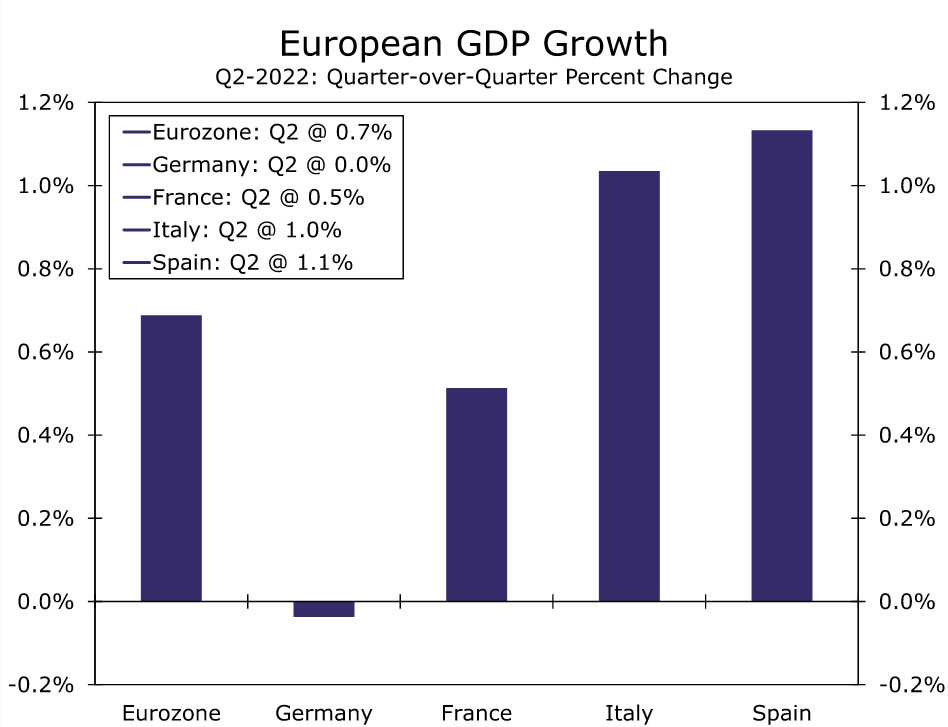
The Eurozone economy proved pleasantly—and surprisingly—resilient in Q2, with the initial estimate showing the region's GDP grew by 0.7% quarter-over-quarter. Not only was GDP firmer than the consensus forecast for a 0.2% gain, it was also a modest improvement from the 0.5% gain seen in Q1. GDP growth did slow on a year-over-year basis, albeit less than expected, to 4.0%. Looking at quarterly GDP growth for some of the region's largest economies, France (0.5%), Italy (1.0%) and Spain (1.1%) all enjoyed decent gains. In fact, it was the zero GDP growth for the quarter in Germany that prevented growth for the overall Eurozone region from being even stronger.
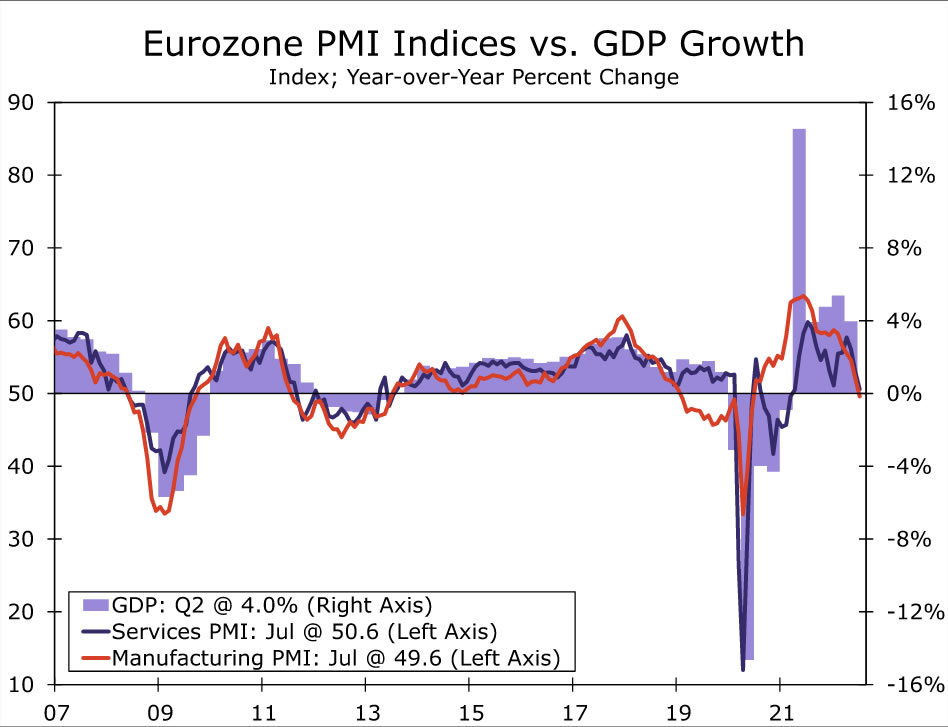
Of course, Germany is one of the Eurozone region's economies that is most susceptible to a disruption in energy imports from Russia, and thus could see economic activity weaken even further in the quarters ahead. Germany's IFO business confidence fell to 88.6 in July from 92.2 in June, while the expectations component fell to 80.3, both outcomes that could be portending a German recession in the months and quarters ahead. More generally for the Eurozone, confidence surveys and leading indicators are consistent with a slower pace of growth from the second half of this year, as the Eurozone July manufacturing and service sector PMIs both fell noticeably to 49.6 and 50.6 respectively. A combination of high energy prices that should increasingly weigh on spending, energy supply disruptions that could more directly impact production and growth, and a likely U.S. recession, all still have the potential to push the Eurozone economy into recession by early next year, despite the encouraging second quarter result.
Inflation Still Rising Early in the Third Quarter
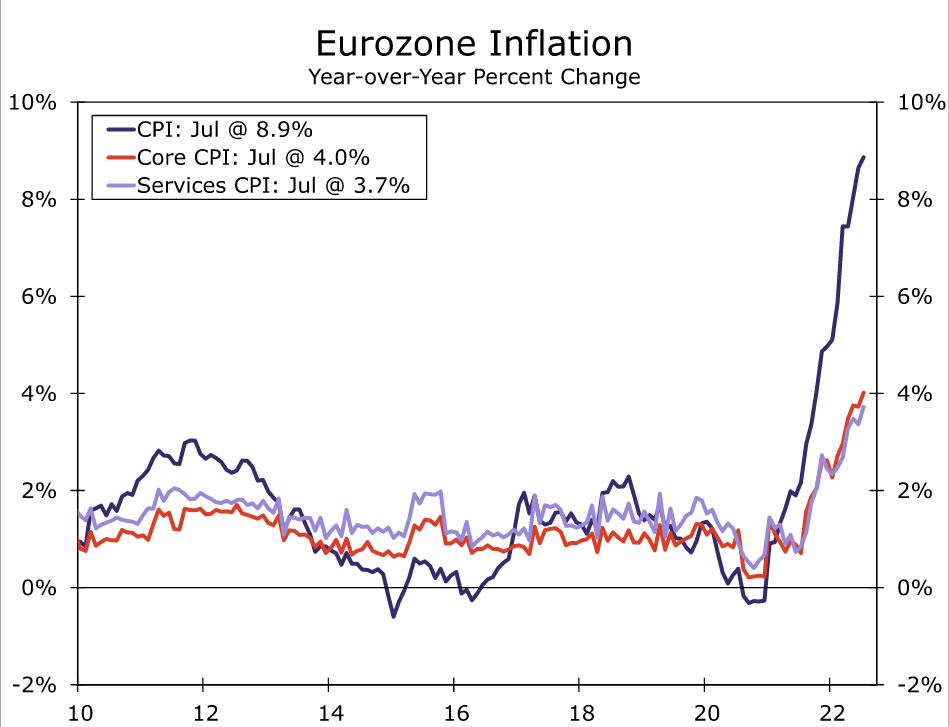
The GDP figures were not the only key piece of economic news from the Eurozone. The Eurozone July CPI was also released, and showed a further acceleration of inflation across the region. Headline CPI inflation quickened to 8.9% year-over-year, the fastest pace on record. For the latest month, energy price inflation actually softened a bit, showing a gain of 39.7%. Instead, the quickening in inflation was driven by higher food prices, and also reflected broader price gains, as the core CPI quickened to 4.0% and the services CPI quickened to 3.7%. Indeed, our estimates suggest that on seasonally adjusted basis, core CPI inflation is running at an annualized rate of close to 4% over the past three months as well as the past six months, suggesting that underlying inflation pressures likely remain uncomfortably high for European Central Bank policymakers.
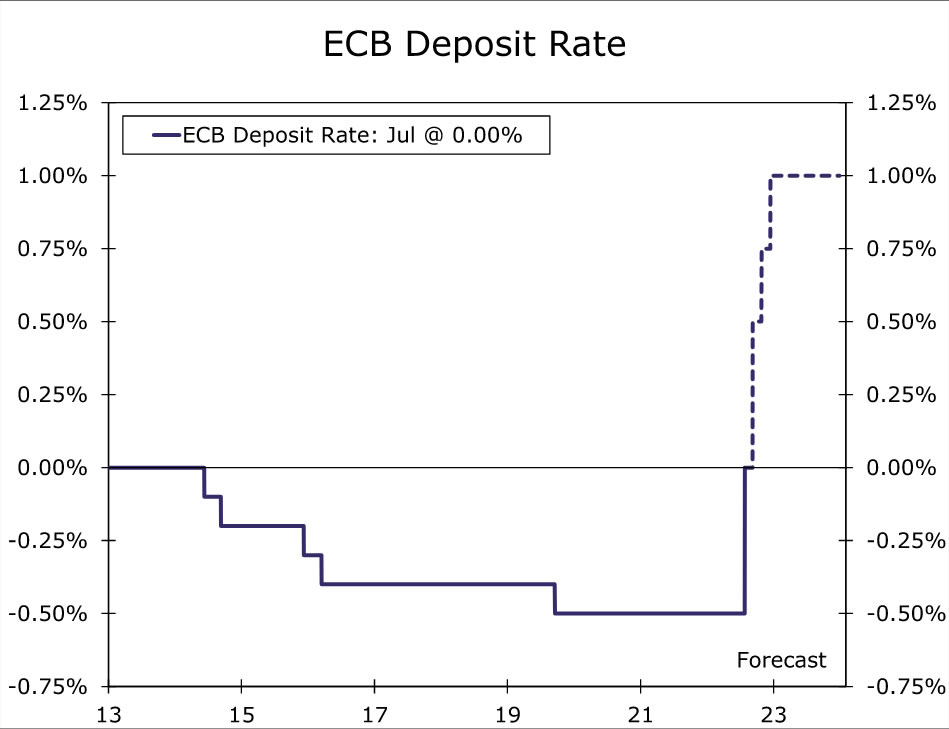
When the European Central Bank kicked off its rate hike cycle in July with a 50 bps Deposit Rate increase, it said the front loading of its exit from negative interest rates would allow it to transition to a meeting-by-meeting approach to interest rate decisions. In that context, we believe today's data offers some guidance and insight into the probable outcome of the European Central Bank's September monetary policy meeting. We view the Eurozone Q2 GDP figures as resilient enough, and July inflation figures as worrisome enough, to reinforce the case for another 50 bps Deposit Rate increase in September, even with some concerns about the longer-term economic outlook for the region. While the prospect of another 50 bps rate increase along with the relative resilience (for now) of the Eurozone economy compared to the U.S. economy could possibly offer brief support for the euro, we still expect a weaker EUR/USD exchange rate over time. Indeed, we forecast the EUR/USD exchange rate to fall to $0.9600 (or below) over the medium-term.
The Weekly Bottom Line: Technically Not There (Yet)
U.S. Highlights
- Real GDP declined for the second consecutive quarter in Q2, meeting one (narrow) criteria of a recession.
- The Federal Reserve delivered another supersized rate hike of 75bps this week, bringing the upper bound of the policy rate to 2.5%. Chair Powell emphasized the need to take rates higher but neglected to give any forward guidance.
Canadian Highlights
- GDP growth stalled in May with declines in goods-producing industries leading the deceleration.
- We expect the Bank of Canada to continue being data dependent and see interest rates rising by 50bps in September and 25bps in October.
Global Highlights
- The energy shock due to Russia’s war in Ukraine that is fueling much of the region’s inflation is also increasingly likely to profoundly restrict growth.
- For the European Central Bank, this represents the worst-case scenario, as it could soon be faced with the prospect of raising rates to preserve longer-term stability despite an output contraction.
U.S. - Technically Not There (Yet)
The dreaded “R” word (recession) isn’t one economist’s use lightly. This is why so much focus was placed on this week’s advance estimate of Q2 GDP and the FOMC meeting.
According to Bureau of Economic Analysis, real GDP declined 0.9% q/q (annualized) in Q2 – well below the consensus forecast of a modest 0.4% gain (Chart 1). More significant than the headline print was that activity has now declined in each of the last two consecutive quarters – meeting one (narrow) criteria of a “technical” recession. At this point, most economists would agree that the US economy isn’t (yet) in recession. The National Bureau of Economic Research (NBER), who is tasked with dating business cycles, would also agree. Outside of just economic growth, the NBER considers a host of other indicators including measures of production, employment, and income. At present, most of these measures continue to point to an economy that remains in expansionary territory.
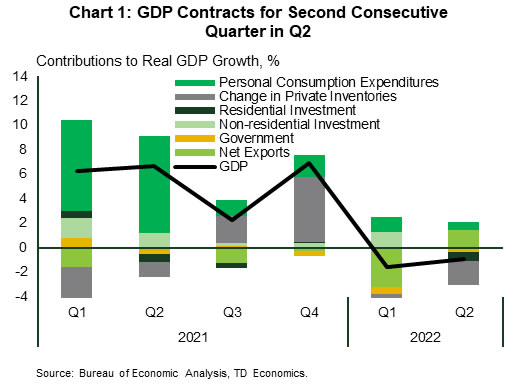
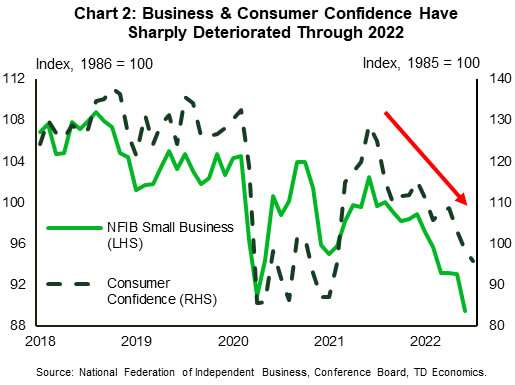
That said, domestic demand has shown a clear sign of slowing. Consumer spending decelerated to just 1% in the second quarter, while fixed investment declined by 3.9%. At this point, it doesn’t appear that growth prospects will be improving anytime soon. Measures of both consumer and business sentiment have turned decisively lower in recent months, and this is showing in the monthly consumer spending data (Chart 2). After adjusting for inflation, real consumer spending was up just 0.1% m/m in June – a rebound from May’s 0.3% decline – but nonetheless a weak handoff into Q3.
The FOMC acknowledged the recent softening in economic data in the very first sentence of its July statement. But that didn’t stop them from raising rates by another 75bps. At 2.5%, the policy rate is now in the vicinity of the FOMC’s assessment of neutral – the interest rate that’s neither accommodative nor restrictive. However, Chair Powell was explicit in the press conference that the Committee intends to raise the policy rate well into “restrictive” territory in order to return price stability. Powell was careful in his word choice, admitting that doing so will lead to some slowing in growth and a rise in the unemployment rate, but skirted any explicit reference to recession. Just how far above neutral the FOMC will have to go remains dependent on how the economy responds to past hikes between now and September.
Perhaps the most noteworthy takeaway from Powell’s entire press conference came from what he neglected to say. In contrast to more recent briefings, the Chair failed to give explicit forward guidance on the expected changes to the policy rate at its next meeting. Instead, he emphasized the need to “just go to a meeting-by-meeting basis”, suggesting the size of future hikes will be entirely data dependent. From that perspective, the July/August CPI and employment reports will be under the microscope. However, the Q2 release of the employment cost index will also catch the FOMC’s eye. The index adjusts for the composition of jobs, providing the cleanest snapshot of overall employee earnings. It showed that growth in employment compensation remained elevated in Q2 – growing 5.4% (annualized). From a scoring perspective, this favors another big move in September. Let’s see what employment brings next Friday!
Canada - Canadian Economy Reports No Growth
Canadian equities rallied in response to the Federal Reserve interest rate hike of 75 basis points (bps) on Wednesday. Though Chair Powell made it clear that the Fed is committed to cooling inflation, he did point to softening consumer spending which could mean fewer interest rate hikes going forward. Canadian 5- and 10-year yields responded to the news and both fell. Copper, aluminum and nickel prices, all key indicators of global demand, also fell this week under concerns of slowing global demand (Chart 1).
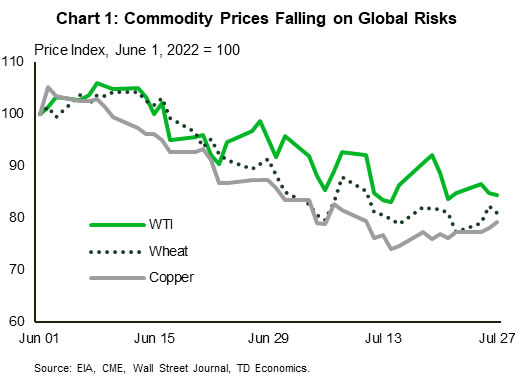
Offsetting some of these price declines was the depreciation of the U.S. dollar, making commodities cheaper for foreign buyers. The slip in the greenback comes after months of investors seeking shelter in the currency as explained in our latest Dollars and Sense report.
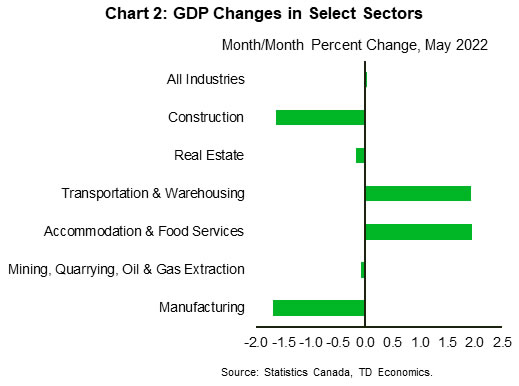
Canada's economy is also showing signs of slowing as GDP remained unchanged in May (Chart 2), and only a modest expansion now anticipated in June (+0.1% month-over-month). As expected, services grew (0.4%) but was offset by a decline in the goods-producing industries (-1.0%). Manufacturing (-1.7%) fell after having expanded for 7 consecutive months, while construction (-1.6%) also contracted. Accommodations and food services picked up some of the slack, expanding by 1.9%. The transportation and warehouse sector (1.9%) also gained ground, with air transportation driving growth. Real estate (-0.2%) contracted slightly as the industry continues to contend with weaker demand given the significant erosion in affordability.
The Canadian small business confidence index also disappointed, as the short-term index showed a monthly drop of almost 8 points in July, falling to 46.7. Similarly, the long-term index also dropped by almost 7 points to 52.7. July's declines mark the fourth consecutive month that both measures have deteriorated, reflecting low confidence in almost all sectors - particularly retail and agriculture. Across the provinces, Ontario, and Newfoundland saw the largest decline in both short term and long-term optimism, while P.E.I. is somewhat insulated to the low business confidence felt elsewhere. The long-term index showed similar provincial patterns, with all provinces recording declines last month. Of note, the index for Newfoundland fell the most (11.8 points), while Ontario's index fell 6 points. The weak confidence indicators are another clear sign that the Canadian economy is slowing amid rising interest rates.
Former Governor Poloz said that inflation targeting is "like landing a plane in the fog, you know when you hit the runway you're there, but right until that moment you're trying to be data dependent". The Bank of Canada will no doubt take the softening data into consideration for their next interest rate announcement in September, but the fog is heavy, and we haven't touched the runway yet.
Global- The European Dilemma
The European Central Bank (ECB) is facing a daunting outlook. The energy shock due to Russia's war in Ukraine that is fueling much of the region's inflation is also increasingly likely to profoundly restrict growth. As near-term indicators are signaling that a recession may soon begin, the ECB has committed to a "meeting-to-meeting" basis for rate decisions that could force them to raise rates into a recession.
Near-term tracking measures have started to show a steep deceleration, or outright contractions, in economic activity in the euro area. July's flash PMI readings for the euro area reflected a decline in output, with much of the pain being felt in its industrial engine – Germany. The EuroCOIN and Ita-COIN indicators are also showing growth having topped out and starting to fall.
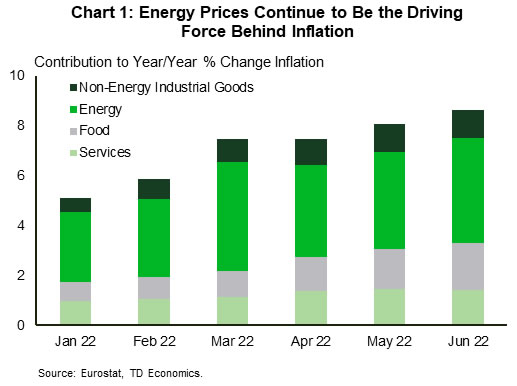
Looking forward, it is the ongoing lift to energy prices that is most concerning. Recession fears have helped crude oil prices off their highs, but supply concerns have supported a high floor under prices. Moreover, if Russia halts natural gas flows to Europe, it risks creating an outright shortage in the coming months, further raising inflation and reducing output. Thus far the energy shock is responsible for roughly half (Chart 1) of the inflationary impulse in the euro zone.
A full stoppage of gas flows would lead to substantial demand destruction and a host of literature on potential losses has emerged in the past months. IMF researchi suggests E.U. output losses could range between -2.7%, in the worst-case scenario and -0.4% if the E.U. were able to fully integrate into the global LNG market.
To counteract the risks, the European Commission has asked for a voluntary 15% reduction in natural gas usage across the EU (with some exceptions). These voluntary cutbacks could go a long way to limit the economic fallout from a gas shortage. IMF estimatesii for Germany suggest that by strategically rationing gas, the direct GDP loss in the first six months of the shock could be reduced from 0.9% to 0.2%.
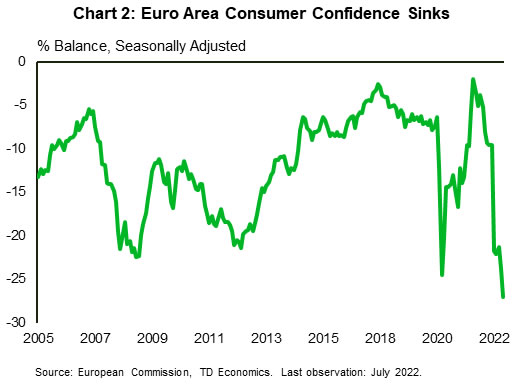
Beyond the direct effects, consumer confidence is tumbling (Chart 2). Falls this large typically drive up precautionary savings. Meanwhile, business confidence, having remained relatively resilient through June is starting to weaken notably.
The ECB supported its decision to raise interest rates by 50 basis points by emphasizing the need to temper inflation expectations and the introduction of a new bond-buying tool to help monetary policy transmission. However, higher energy prices are fueling an inflationary feedback loop, and it may soon be faced with the prospect of raising rates to preserve longer-term stability despite an output contraction.
Week Ahead – Next Up, Jobs
How strong is the labour market?
Last week was action-packed and it’s not likely to ease up with attention now shifting from the Fed and the “technical recession” in the US to the labour market. Various officials have highlighted the strength of the labour market when explaining why the US isn’t in a real recession which will draw increased scrutiny on Friday’s jobs report.
Earnings have been a mixed bag so far, with big tech this past week being given a free pass when missing on revenue and earnings as long as the outlook was solid. Some benefited greatly from that while others didn’t fare so well. Investors are seemingly in a buoyant mood after the Fed meeting which may help over the remainder of the season.
We can’t put together a week ahead without discussing central banks and many more are due to meet next week. The Bank of England could be the latest to hike by 50 basis points, while the RBA is expected to do so again. There’s never a dull week in the markets at the moment.
US
The US economy is clearly in slowdown mode and now Wall Street will want to know how tight the labour market remains. The July nonfarm payroll report is expected to show hiring is cooling but that unemployment is still expected to hold steady at 3.6%. A gain of 250,000 jobs in July would be down from the pace of 372,000 seen in the prior month, while still showing signs that the economy is not in terrible shape.
Traders will also pay close attention to a few Fed appearances during the week from Evans, Bullard, and Mester. Leading up to the September policy decision, traders will want to know how many Fed members are positioning themselves for a slower pace of tightening policy.
The focus will go to NFP Friday, but it is a busy week filled with several key economic reports. Monday is massive as the ISM manufacturing report will be closely watched as it is expected to show another decline but still remain in expansion territory. Wednesday contains the release of both June factory orders and the July ISM services report. Thursday has the June trade data and initial jobless claims, which have been steadily rising since the end of March.
Election season heats up as the US primary elections are held in Arizona, Kansas, Michigan, Missouri, and Washington. The Republican National Committee Summer Meeting takes place.
Secretary of State Blinken is expected to attend the ASEAN foreign ministers’ meeting, where Russia’s Lavrov might attend.
EU
A relatively quiet week for Europe, with final PMIs and unemployment the only notable highlights. Even the surveys are unlikely to be subject to much of a revision. Inflation in July hit another record high which will keep the pressure up on the ECB to hike by 50 basis points in September.
The focus next week will be on the evolving situation around Nord Stream 1 and the inability of Europe to fill stores ahead of the winter. Now running at 20%, what are the chances of the final turbine running into issues and going offline?
UK
A 50 basis point rate hike is quite heavily priced in for next Thursday but it’s far from a certainty. The MPC has been very reluctant to hike too aggressively, preferring 25 at each meeting so far this year. A recession is coming to the UK later this year and policymakers may be mindful of the fact that too many hikes will just deepen the slump.
Considering the size of the energy price cap increase facing households in October, policymakers may be right to be cautious despite inflation peaking above 11% as households will have no choice but to rein in spending as the cost of living crisis hits budgets. Final PMIs also in focus as the economy slows.
Russia
Services and manufacturing PMIs are the only notable releases next week. The rouble has seen some relief over the last couple of weeks but remains more than 15% above its pre-invasion level against the dollar meaning further rate cuts are likely in the pipeline. This could come in between meetings if the CBR determines it necessary.
South Africa
Only tier three data releases next week.
Turkey
Monitoring Turkish inflation data is purely an academic exercise at this point as it has no impact whatsoever on the policy decisions of the CBRT. Still, it’s expected to surpass 80% next week when the July data is released. If nothing else, it certainly puts everyone else’s inflation problems into perspective.
Switzerland
Inflation data next week is expected to accelerate to 3.6% for July, raising the odds of a rate hike from the SNB in September if it waits that long. A 50 basis point increase is largely priced in but it may move further. Either way, it will soon become the latest central bank to end years of negative interest rates.
China
China releases manufacturing and non-manufacturing PMIs on Sunday, and the Caixin manufacturing PMI on Monday. Weak numbers could see local equities drop at the open on Monday after negative comments around the economy this past Friday.
Evergrande faces a deadline of this Sunday to agree on a debt restructuring with offshore bondholders. Failure could weigh on Hong Kong markets in particular.
Caixin services PMI could generate short-term volatility on Thursday.
India
India’s trade balance on Tuesday is likely to remain deeply negative at $26.0 billion, keeping the pressure up on the INR as soaring inflation globally blows out its import bills. It is continuing to suffer stock outflows from international investors, which is also INR negative.
The RBI releases its latest interest rate decision on Friday. Markets are looking for a 50 basis point increase to 5.40%. The RBI has been hawkish in tone of late, but if they blink and hold or only move 0.25%, we may see some very heavy pressure on the INR once again, although that could be a short-term positive for local equities. That situation could be exacerbated if the US payrolls are strong, and the “softer Fed” trade sees some unwinding.
Australia
The Australian dollar remains at the mercy of international investor sentiment flows which have been positive for the past week. It could drop suddenly if investor sentiment swings south. Having said that, it has staged a major bullish technical breakout. For now, gains are being limited by AUD/JPY selling as USD/JPY collapses.
Australia has a big data week with ANZ job ads, retail sales, and the balance of trade which could bring some intraday volatility. The week’s highlight is the RBA rate decision on Tuesday with markets expecting another 50 basis point hike. Less could be positive for local equities. A 50 basis point hike could boost AUD/USD short-term, although it remains at the mercy of global investor sentiment swings.
New Zealand
New Zealand releases employment and labour cost data on Wednesday which has upside risk. Firm data will raise RBNZ hiking expectations, a potential headwind for local equities and short-term boost for the NZD.
The New Zealand dollar remains at the mercy of international investor sentiment flows but has made a substantial topside technical breakout. The rally is being tempered by NZD/JPY selling due to the USD/JPY collapse. If that slows, the NZD/USD rally could resume.
Japan
Japan releases Jibun Bank manufacturing and services PMIs this week, and household spending. It should generate only short-term volatility as markets focus on the US non-farms, and also the US/Japan rate differential following the USD/JPY collapse.
USD/JPY has collapsed in the past week as a less hawkish FOMC and soft US data saw US yields tumble. That has seen USD/JPY fall 500 points over two sessions as the very crowded long USD/JPY trade capitulated.
Singapore
Another set of firm data from Singapore the past week has eyes firmly on retail sales on Thursday. Firmer numbers again will likely cement another tightening of monetary policy by the MAS in October, following its recent unscheduled move.
Economic Calendar
Saturday, July 30
Economic Data/Events
- UK train drivers expected to strike against seven companies
- EasyJet Plc’s cabin crew in Spain are on strike through Sunday
Sunday, July 31
Economic Data/Events
- China July manufacturing PMI: 50.4e v 50.2 prior, non-manufacturing PMI: 54.0e v 54.7 prior
Monday, Aug. 1
Economic Data/Events
- US construction spending, July ISM manufacturing: 52.1e v 53.0 prior, final manufacturing PMI
- Australia manufacturing PMI, Melbourne Institute inflation
- China Caixin manufacturing PMI
- Eurozone manufacturing PMI, unemployment
- France manufacturing PMI
- Germany manufacturing PMI
- India manufacturing PMI
- Italy unemployment
- Japan vehicle sales, manufacturing PMI
- New Zealand building permits
- Russia manufacturing PMI
- UK manufacturing PMI
- Tory members start voting on the next UK PM
Tuesday, Aug. 2
Economic Data/Events
- US JOLTS job openings, light vehicle sales
- US primary elections are held in Arizona, Kansas, Michigan, Missouri and Washington.
- US Secretary of State Blinken to attend the ASEAN foreign ministers meeting in Phnom Penh, Cambodia, and visit the Philippines
- Russian Foreign Minister Sergei Lavrov to attend the ASEAN talks
- Chicago Fed President Evans hosts a media breakfast
- St. Louis Fed President Bullard discusses the economy and monetary policy at an event hosted by the Money Marketeers of New York University
- RBA Decision: Expected to raise rates by 50bps to 1.85%
- Australia building approvals
- Mexico leading indicators, international reserves
- Spain unemployment
- UK house prices
Wednesday, Aug. 3
Economic Data/Events
- US factory orders, durable goods, ISM services, services PMI
- OPEC+ meeting on output
- Australia services PMI, retail sales
- China Caixin services PMI
- Brazil rate decision
- Eurozone retail sales, services PMI, PPI
- Germany trade, services PMI
- India services PMI
- Japan services PMI
- New Zealand unemployment
- Russia services PMI, weekly CPI
- Switzerland CPI
- Turkey CPI, PPI
- UK services PMI
- EIA crude oil inventory
Thursday, Aug. 4
Economic Data/Events
- US initial jobless claims, trade
- Australia trade balance
- Eurozone ECB publishes the economic bulletin
- Germany factory orders
- Hungary one-week deposit rate
- UK BOE rate decision: Expected to raise rates by 50bps to 1.75%
- UK Tory leadership debate between Liz Truss and Rishi Sunak
- NATO Secretary General Stoltenberg speaks at the Workers’ Youth League on the island of Utoya, Norway
- Cleveland Fed President Mester discusses the outlook for the economy and monetary policy at an event hosted by the Economic Club of Pittsburgh
- The National Oceanic and Atmospheric Administration updates its 2022 Atlantic hurricane forecast ahead of the historical peak of the season
- Congressional primaries are held in Tennessee
Friday, Aug. 5
Economic Data/Events
- US July Change in nonfarm payrolls: 250Ke v 372K prior, unemployment rate
- Australia RBA quarterly update of economic forecasts and policy outlook
- Canada employment change, unemployment rate
- France trade, industrial production
- Germany industrial production
- India rate decision
- Italy industrial production
- Japan household spending, labour cash earnings
- Singapore retail sales
- Spain industrial production
- Thailand CPI
- BOE Chief Economist Pill speaks at the Monetary Policy Report national agency briefing
- Russian President Putin is to meet with Turkish President Erdogan in Sochi, Russia
Sovereign Rating Updates
- France (Fitch)
- EFSF (S&P)
- ESM (S&P)
- Czech Republic (Moody’s)
- Sweden (DBRS)
Over-Heating Labour Markets May be Nearing a Turning Point
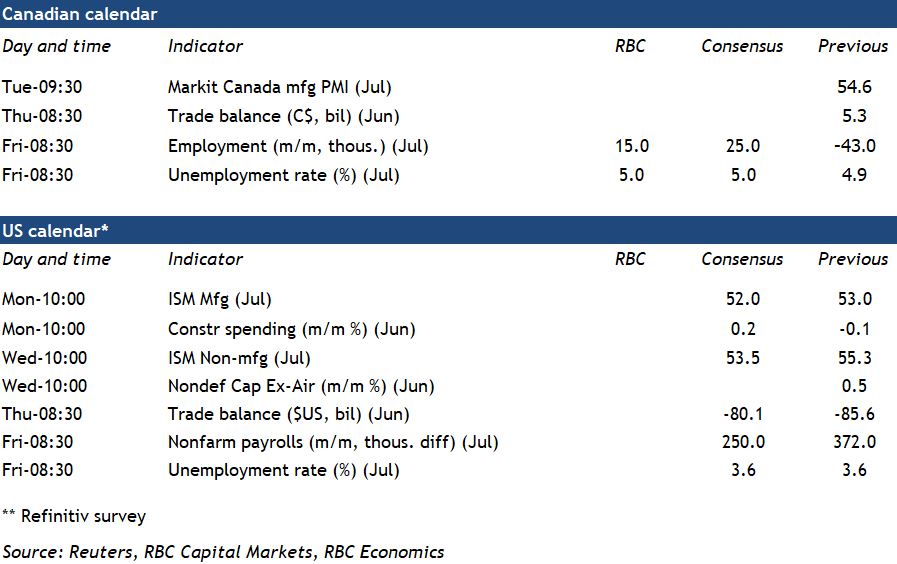
We expect the Canadian and U.S. labour markets to have added jobs in July, albeit both at a slower pace than earlier in the pandemic recovery. We expect the Canadian employment count edged up 15k, to partially offset a 43k drop in June. In addition, we also look for the unemployment rate to tick higher to 5.0% from the record low (back to at least 1976) 4.9% in June with the number of people looking for work bouncing back from a decline of almost 100k in June. US employment growth likely slowed to a still-strong 250k in July, alongside a tick up in the unemployment rate to 3.7%. In both Canada and the U.S., demand for workers is running well-above pre-pandemic levels, and increased competition has been pushing up wages.
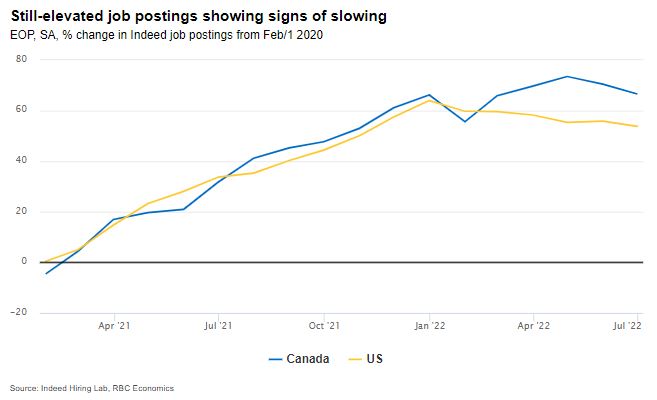
Still, that may be heading for a turn. Slowing global demand and surging labour costs are just some of the reasons to expect a slowdown in overall labour demand. Initial jobless claims in the U.S. have been on the rise since late March. While job openings are still very high, they have been edging lower in recent months. To-date, that hasn’t resulted in higher unemployment. But going forward, slowing demand means on average it will take gradually longer for new labour market entrants, or those that just lost employment, to find work again. We expect that dynamic will begin to push the unemployment rate higher over the second half of 2022, with the pace of increase accelerating in 2023 as higher inflation and interest rates further cool labour demand.
Week ahead data watch:
The Canadian merchandise trade surplus likely edged lower in June after surging to $5.3 billion in May on higher oil prices and a surge in aircraft exports. Oil prices moved higher again in June, but we look for the trade balance excluding energy products to partially reverse May’s increase.
Week Ahead – Bruised Dollar Looks to NFP Report; BoE Could Speed up Rate Hikes
The coming week is shaping up to be another crucial one for gauging recession risks and monetary policy paths. It’s NFP week in the United States and the RBA and Bank of England will decide whether to accelerate their hiking cycles. The ISM PMIs are bound to attract a lot of attention as well in the US as growth concerns intensify. Elsewhere, employment figures in Canada and New Zealand, and manufacturing PMIs out of China will be the highlights. Meanwhile, a meeting of OPEC+ countries might yet result in a decision to produce more oil.
US jobs report eyed as Fed admits economy is slowing
The US economy is officially in a technical recession after GDP shrank in both the first and second quarters. But by its own definition, the Fed does not see a broad-based decline in economic activity as there appears to be several pockets of growth still. Moreover, the strong jobs growth and wage pressures are “not consistent with a recession” according to Chair Jerome Powell.
Nevertheless, there can be no doubt that hiring is slowing and if the latest earnings season is any indication, some companies have even started to lay off staff. But on balance, the economy continues to churn out more new jobs than what is being lost. The forecast for Friday’s nonfarm payrolls print is 250k in July versus 372k in June.
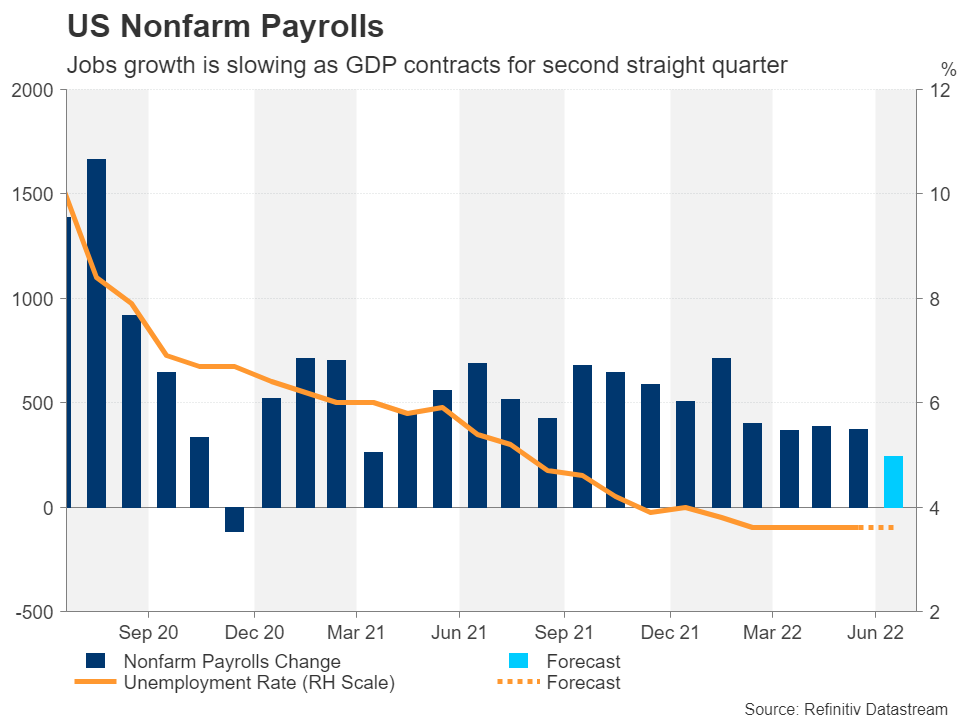
The jobless rate and growth in average hourly earnings are expected to have held unchanged at 3.6% and 0.3% m/m, respectively, in July.
However, the NFP report will not be the only thing at the top of investors’ agenda as the ISM manufacturing and non-manufacturing PMIs, due on Monday and Wednesday, respectively, will also be watched closely for further evidence of a cooling economy.
If worse-than-expected readings are complemented by a drop in the ISM’s prices paid component, the markets might not react too adversely to poor data. Powell hinted in his post-meeting press conference that the Fed will slow down its rate hikes at some point. Although the timing isn’t clear, tightening bets have been pared back notably, boosting risk assets but knocking down the US dollar. A soft batch of numbers could further lift stocks and weigh on the greenback.
RBA to stay the course
The Reserve Bank of Australia will kick off next week’s two central bank meetings on Tuesday and a fourth straight rate increase is on the cards. After raising rates by 50 basis points at the last two meetings, there was some speculation that the RBA would get more aggressive in July and hike by 75 bps. However, following the Fed’s not so hawkish tone at July’s FOMC meeting and weaker-than-forecast inflation in Australia in the second quarter, investors now expect the RBA will stick with 50-bps increments.
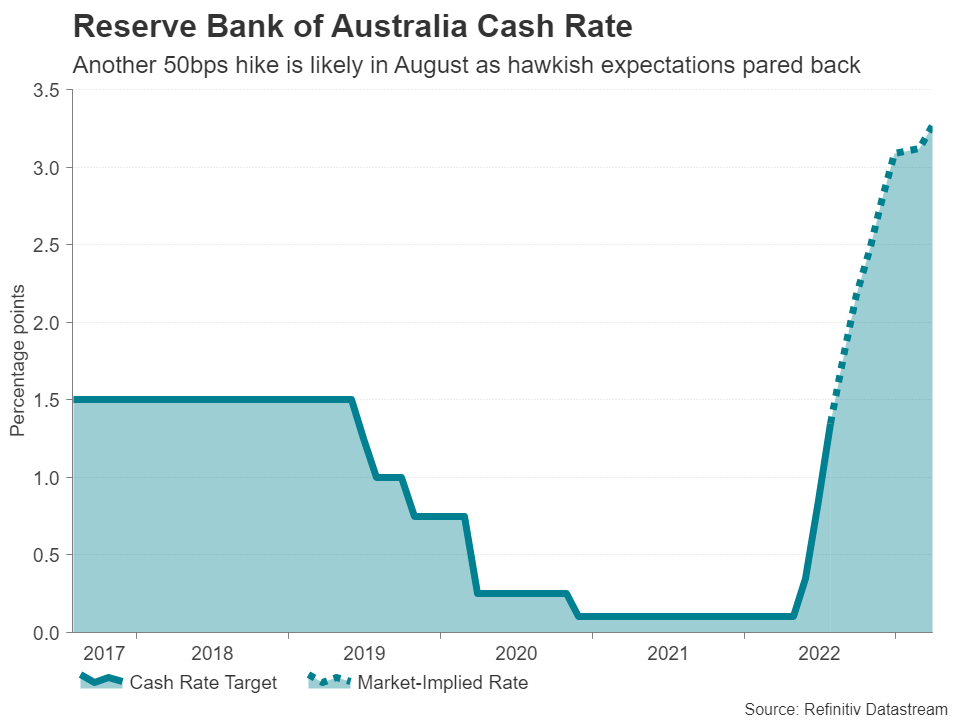
But as long as the greenback stays subdued, the absence of a hawkish surprise by the RBA will probably not hurt the Australian dollar much. The aussie could even gain if Governor Philip Lowe keeps the option of bigger hikes on the table. The bank’s quarterly economic projections, which are due on Friday, could also bolster the aussie if the forecasts for CPI are revised higher.
On the data front, the AIG manufacturing index (Monday), building approvals for June (Tuesday), AIG services index (Friday) might draw some interest too, but aussie traders will also be keeping an eye on Chinese PMIs. China’s official and Caixin manufacturing PMIs are both released on Monday and are not predicted to point to much of a quickening of the rebound from the lockdown-induced contraction in the spring. Any disappointment in the PMIs poses a downside risk for the aussie.
Will BoE join the 50-bps club?
The Bank of England may have been one of the first major central banks to start lifting borrowing costs, but it has been doing so at a pace of 25-bps increments. This could change in August as UK inflation is fast approaching 10% despite having raised rates at every meeting since December. BoE policymakers have been a lot more cautious than their global counterparts as they expect higher prices to do part of the job of denting demand for them. But the fact that most of the price pressures are stemming from supply-side factors – something that central banks have no control over – is also why the BoE hasn’t pressed on the brakes too hard.
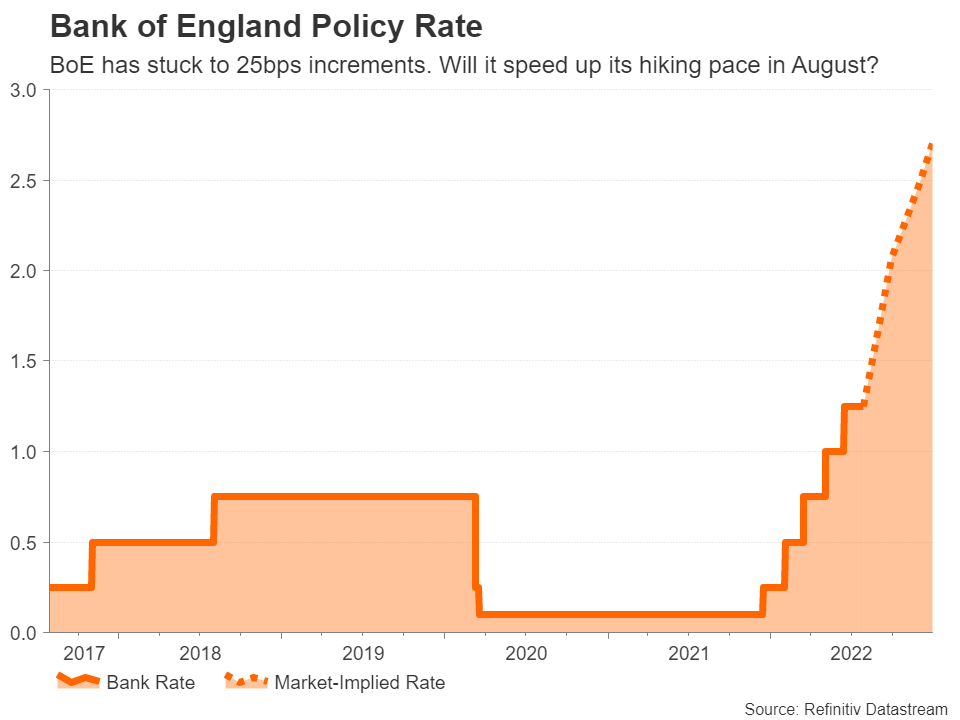
However, with the labour market still going strong and PMI surveys not yet showing a contraction for the UK economy, policymakers will likely come to the conclusion that a larger increase may be necessary this time, as flagged by Governor Andrew Bailey.
If the BoE does go ahead with a 50-bps hike and signals that it could repeat this at one or more of the remaining meetings of the year, sterling could extend its current rebound against the US dollar. On the other hand, if Bailey suggests that the double hike was a one off and the BoE’s quarterly forecasts paint an even gloomier picture than they already do, the pound’s upswing will be put to the test.
Jobs in focus in Canada and New Zealand too
Other economies enjoying the phenomenon of a tight labour market are Canada’s and New Zealand’s. But unlike the UK, their central banks have been a lot more aggressive. Investors expect at least two more 50-bps rate increases from the Bank of Canada and the Reserve Bank of New Zealand and the upcoming employment reports are not anticipated to have a significant bearing on those probabilities.
New Zealand’s quarterly jobs numbers are up first on Wednesday and Canada’s will follow on Friday.
With the greenback being worse off after the Fed meeting, the local dollars might appreciate from better-than-expected employment figures.
OPEC might raise output
For the Canadian dollar, traders will also be keeping an eye on OPEC’s monthly meeting on Wednesday.
There’s a chance that OPEC and non-OPEC producers may decide to raise their production quotas, extending the planned output increases beyond September.
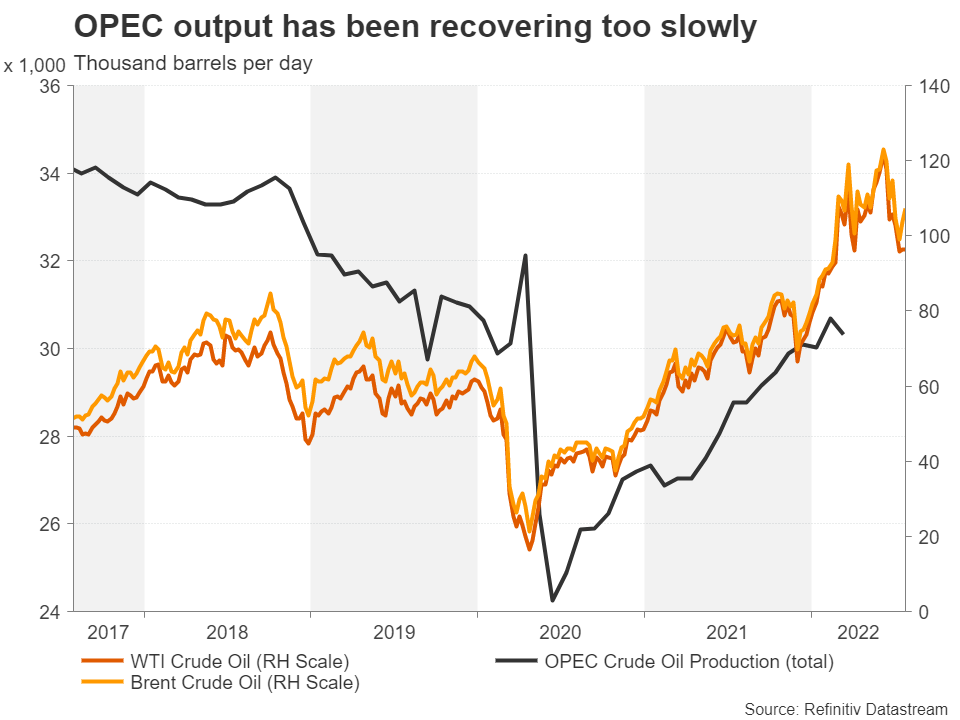
Saudi Arabia, OPEC’s de facto leader, has so far refused to pump additional oil as requested by the White House. But following President Biden’s trip to the kingdom in July, it’s possible that Saudi Arabia will push other members for a further supply boost.
Should OPEC+ announce a new deal that involves substantially higher output rather than merely a symbolic increase, oil prices are likely to come under pressure as a big move is not being widely anticipated.
Euro to remain on recession watch
Over in Europe, it will be a relatively quiet week, although investors will certainly continue to monitor developments with Russian gas flows to the continent. Natural gas supplies via the Nord Stream pipeline were cut to 20% of capacity over the last week, fuelling fears that Europe will have to ration how much energy it uses over the coming winter. Germany is one of the countries that’s likely to be affected the most from gas shortages and is why the euro barely rallied when the ECB shocked markets with a 50-bps rate rise last week.
But given how fast the data has been deteriorating, the Eurozone economy may already be on the verge of a recession.
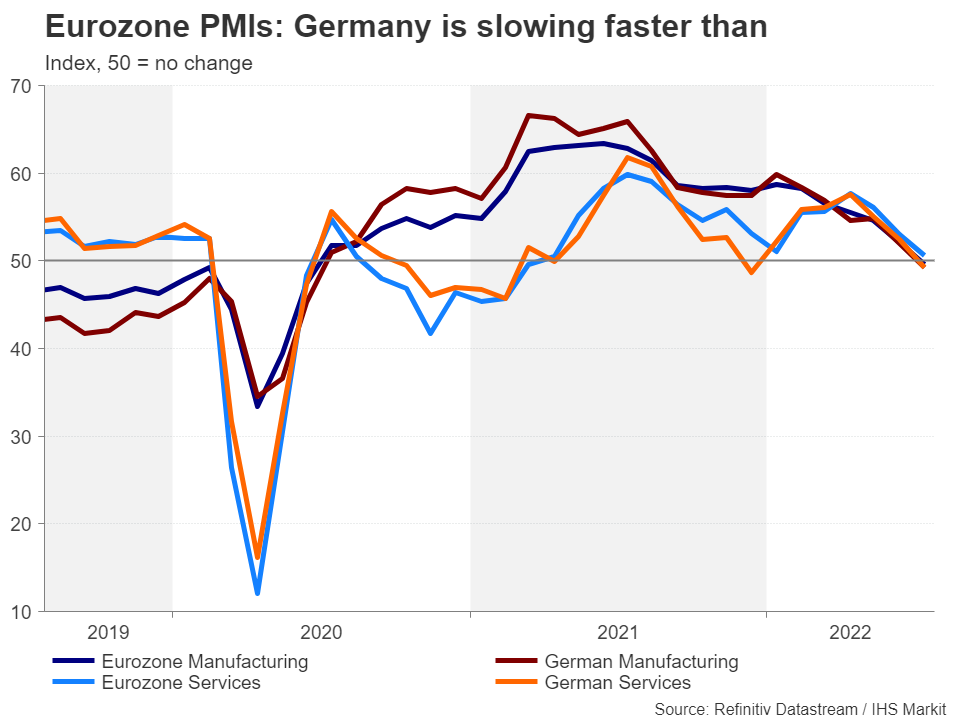
The final estimate of the euro area’s composite PMI for July is expected to be confirmed at 49.4 on Wednesday, while German industrial orders and production data for June on Thursday and Friday, respectively, are forecast to show negative growth.
Fed Might Go Easy as US Economy Contracts
GBP/USD recovers as BoE to hike by 50bp
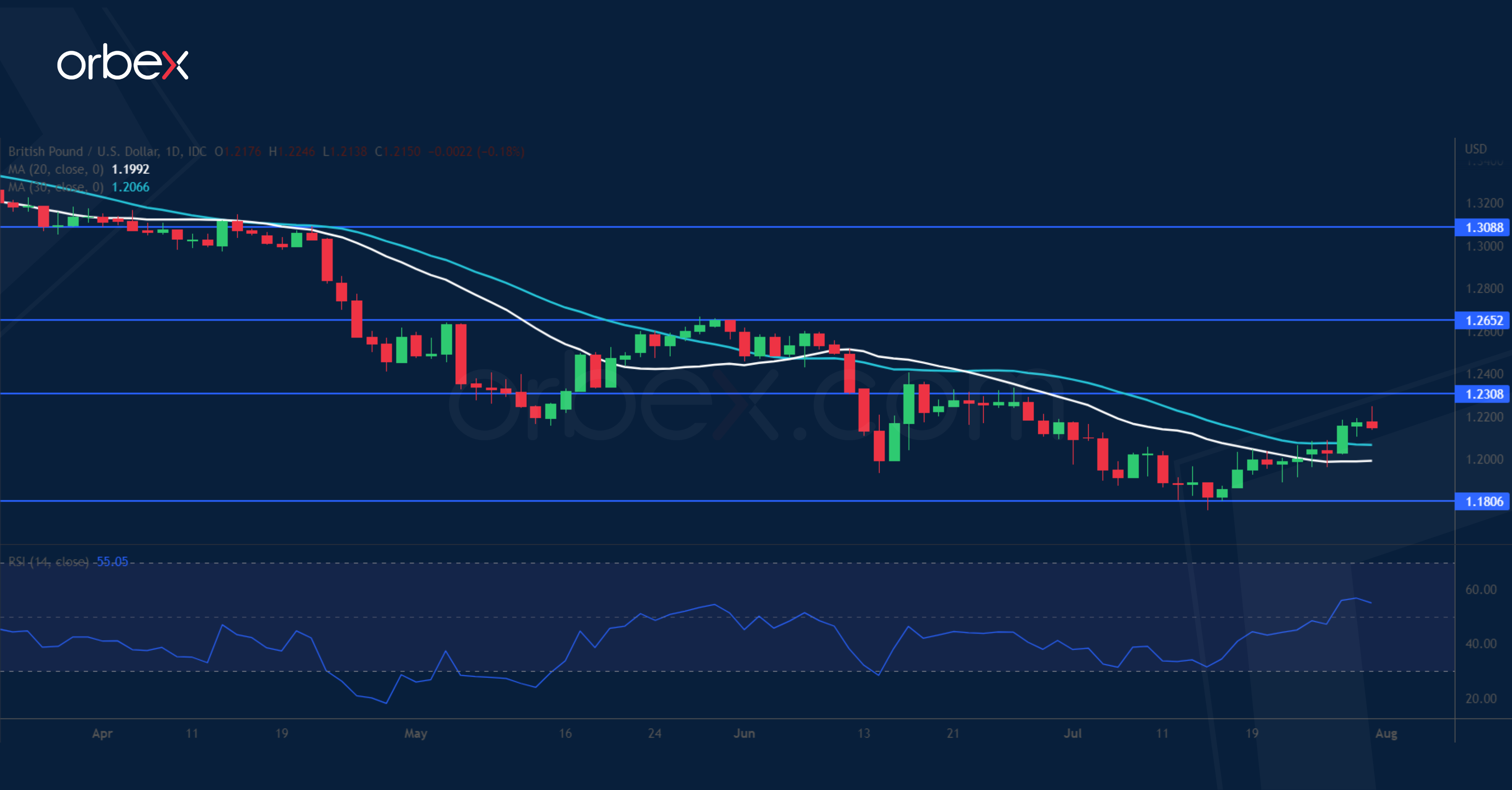
Sterling bounces higher as the Bank of England may deliver its first half-point hike since 1997. The UK’s inflation surged to a 40-year high at 9.4% band could reach a double digit in the autumn. When it comes to choosing between fighting soaring prices and preventing a downturn, it seems to be the same story all over again. Even the ECB has become more aggressive than expected with a 50 bp rate hike, the market is pricing in a similar-sized move this week by Governor Bailey and co. The downside risk would be a surprise with a dovish 25 bp increase. 1.1800 is a fresh support and 1.2300 the first hurdle if the rebound gains traction.
AUD/USD bounces over hawkish RBA
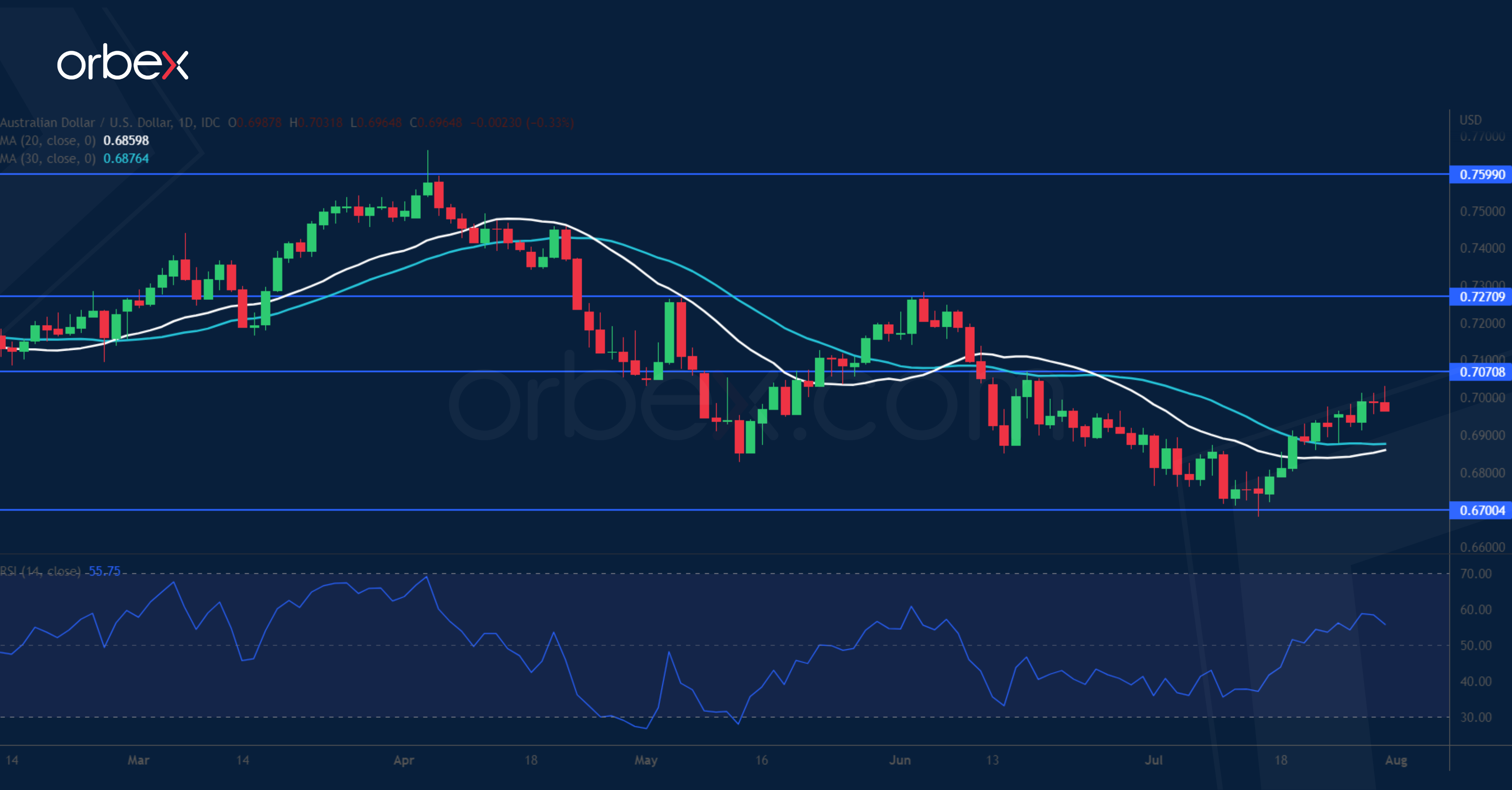
The Australian dollar rallies as the RBA speeds up its quantitative tightening. Australian inflation surged to a 21-year high in the previous quarter with no sign of peaking yet. In their latest economic update, the government painted a rather gloomy picture with growth forecasts revised down and inflation up. The central bank is expected to add another 50 basis points to its cash rate at the upcoming policy meeting. Meanwhile, cyclical commodities such as iron ore and copper have shown signs of stabilising, offering extra tailwinds to the risk-sensitive currency. The pair is testing 0.7070 with 0.6700 as a fresh support.
XAU/USD rallies as traders drop dollar
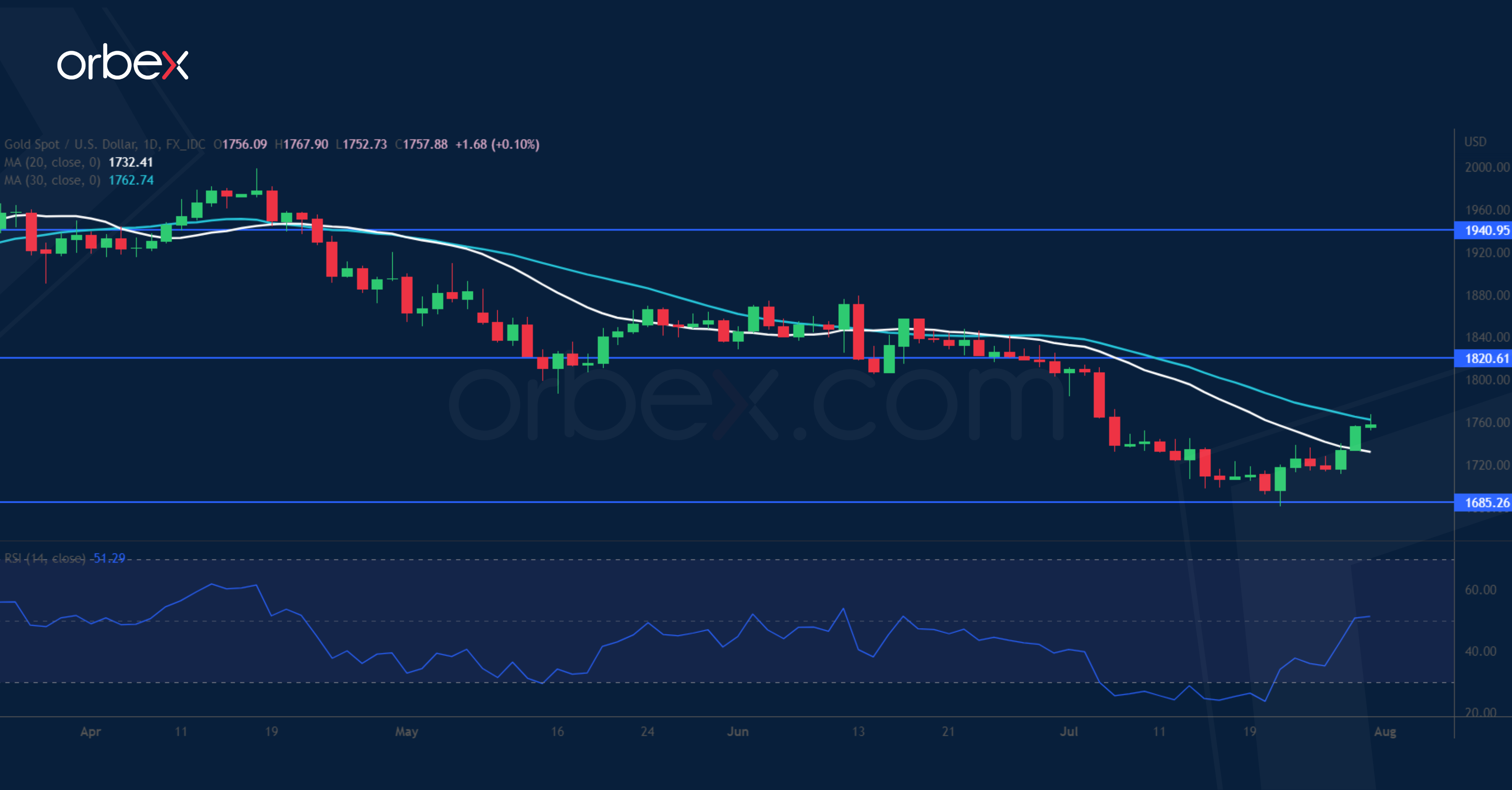
Gold recoups losses as the US dollar retreats in the wake of a less aggressive tone from the Fed. Chairman Powell has chosen to stay vague about his next move, with the decision hinging on economic data. The US economy unexpectedly shrank by 0.9% in the second quarter, cementing concerns that a recession is in sight. What the market actually cares about is whether the Fed could engineer a controlled slowdown which would convince them to lift their feet off the hike pedal. Such a prospect led traders to offload their dollars from a crowded bullish ride. Gold gained traction after it bounced off 1685 and is heading towards 1820.
NAS 100 bounces as Fed tempers hike expectations
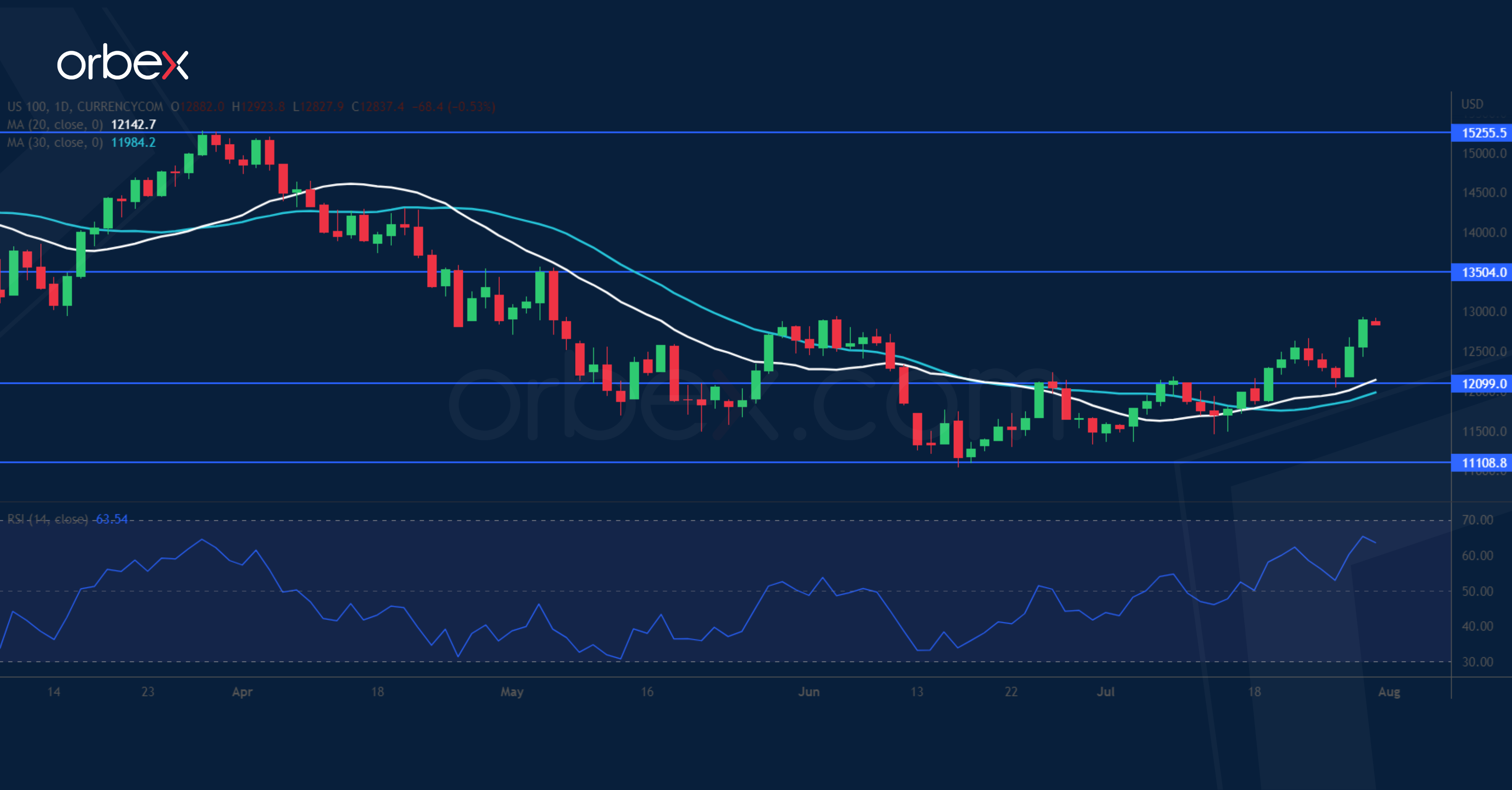
The Nasdaq 100 jumped after traders found relief in a subtle dovish shift in the Fed’s agenda. The latest 75bp rate increase was widely anticipated by the market. By leaving the psychological 100bp off the table, policymakers gave investors hope for a slower pace of monetary policy normalisation. Peak in interest rate expectations would ease strains on hard-hit growth stocks, whose valuations are heavily dependent on discount rates. Combined with upbeat revenues and earnings, albeit lowered analyst expectations, the tech index may attract bidders once again. 13500 is the next resistance to crack and 12100 a fresh support.
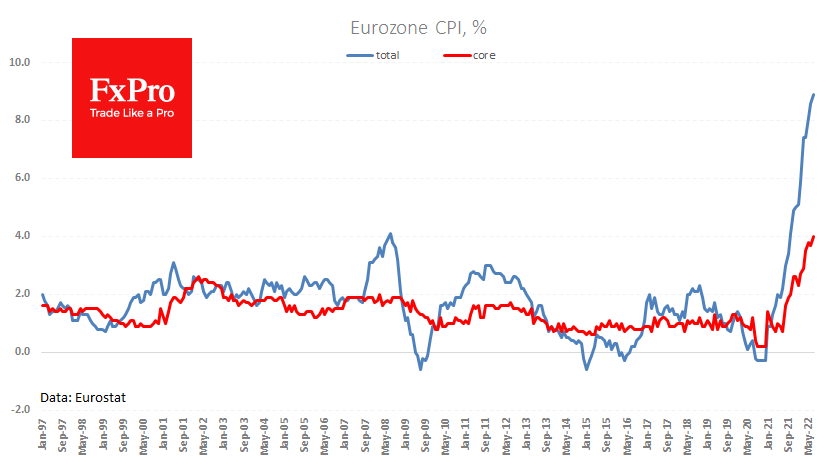
Inflation, GDP Above Expectation Uninspiring for Euro Buyers
Inflation in the eurozone continues to speed up. Preliminary data for July showed a price increase of 8.9% against 8.6% a month earlier and the expected 8.7%. The core price index (which excludes energy and food) rose 4% y/y vs 3.7% a month earlier. Renewing the region’s historical record price increase rate would probably force the ECB to continue with a policy tightening.
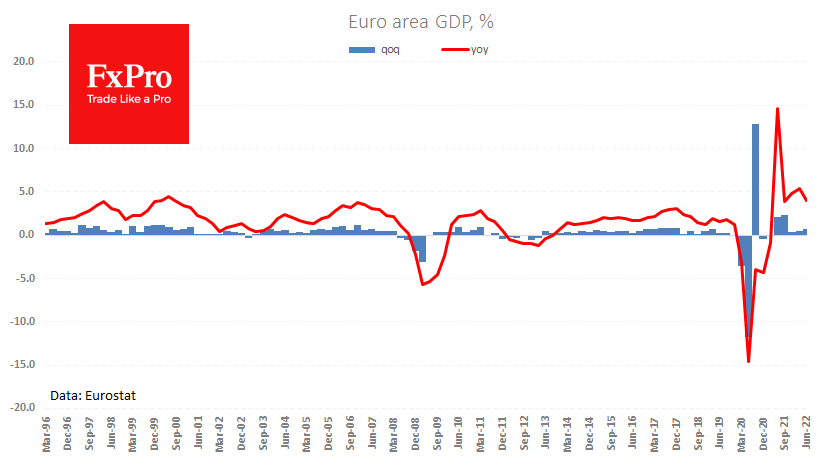
In support of this argument, GDP figures for the second quarter were also significantly better than expected. The Euro-region economy added 0.7% in the quarter and 4% compared to the same quarter a year earlier, noticeably better than the forecasted 0.2% and 3.4%, respectively.
The typical reaction to such a combination of data would be for the euro to strengthen against a wide range of competitors. The reality so far turns out to be different, as currency market traders must factor in the already accumulated lag of the ECB in their quotes.
As a result, EURUSD continues to stomp around 1.0200 for the past ten days, while other major pairs have made a more decisive corrective rebound. Judging by market dynamics, the clouds over the euro are much heavier than the JPY, CHF, or GBP, not to mention the commodity-related CAD, AUD.
How is a Slowdown in US Economy a Good Thing?
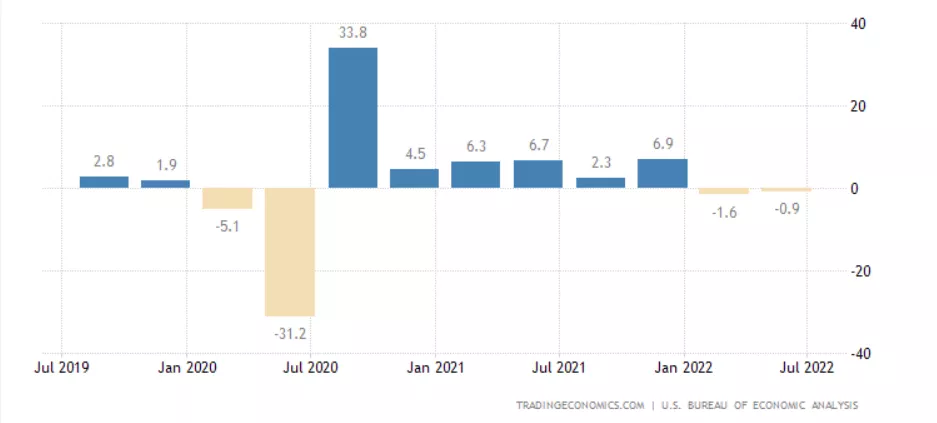
The bad news is that the US economy slowed for the second consecutive quarter in 2022, entering a technical recession. That's two consecutive quarters of gross domestic product (GDP) contraction. However, the good news is a slowing economy may be what the US needs to win its fight against inflation.
As the US economy reopens to recovery from the pandemic, economic growth rebounded fiercely, supported by consumers spending their savings and the stimulus that was pumped into the markets. But this insane support has driven prices so strongly that inflation got out of control (9.1%, the highest in 40 years), with strong demand and modest supply.
Were the Fed's rate hikes helpful in dampening demand?
The Fed's intervention to bring inflation back to its 2% target, after raising interest rates four times since March 2022, two of them in a row by 75 basis points, is reflected now in the economy. While the US central bank relies on its favorite tool - the interest rate - to cool demand and inflation by making borrowing more expensive, it risks plunging the economy into a recession.
It seems that the sharp rate hikes are starting to show their results. The US economy contracted by 0.9% in the second consecutive quarter, reflecting the economy's weakness with slowing consumer spending amid rising prices, declining investment and economic activity, and a damp housing market. The Fed wants to see demand fall for "a sustained period" to give inflation a chance to come down without entering a deep recession, Fed Chair Jerome Powell said.
While Powell thinks the US economy isn't in a recession right now, he admitted that the economy is slowing and will likely need to slow more to bring inflation back to earth. The Federal Reserve said it wouldn't be easy in its fight against the highest inflation in 40 years, even if it means a shrinking economy and a slowing job market.
How is a slowdown in the US economy good?
The more the economy slows down, the inflationary pressures will fall, and prices will calm down. Subsequently, this may prompt the Fed to ease the aggressive rate hikes and will head for smaller increases in the upcoming meetings. The danger is that with a shrinking economy, demand could fall so dramatically that the economy would be pushed into recession.
Will the contraction of the US economy affect the Fed's rate hikes?
We don't think the GDP decline should affect the Fed's rate hike cycle. The reason is that evidence of a slowdown has yet to appear in US employment data or a rise in layoffs, which economists also use to gauge whether a country is in a recession. The unemployment rate stabilized at 3.6%, the lowest from pre-pandemic levels.
The upcoming labor market data will be the best ground for whether we're heading into a recession or not. Jerome Powell dismissed questions about whether the US economy is in or on the cusp of a recession, arguing for the labor market's strength because US companies continue to add more than 350,000 jobs each month.
Sunset Market Commentary
Markets
European (GDP) data are seldom determining drivers for markets. However, today’s data mix with the first estimate of EMU Q2 growth and the preliminary EMU CPI at least provided an interesting challenge after the recent sharp repositioning on interest rate markets. Europe is expected to be headed for a very difficult H2, if not an outright recession. Admittedly, GDP data are backward looking in nature. Even so, at 0.7%Q/Q and 4.0% Y/Y the EMU Q2 GDP estimate smashed expectations by a margin that was seldom seen. Countries like Spain (1.1 Q/Q, 6.3 % Y/Y), Italy (1.0% Q/Q, 4.6% Y/Y) and France (0.5% Q/Q, 4.2% Y/Y) posted growth that in a European context usually are associated with an economic boom, rather than an economy heading for recession. Germany didn’t bring a similar positive surprise (0.0% Q.Q and 1.5% Y/Y). Still, the starting point going into H2 is better than feared. At the same time, EMU July headline inflation rose a faster-than-expected 0.1% M/M and 8.9% Y/Y, the highest level on record. Core inflation also turned back north from 3.7% last month to 4.0%. There are few signs that inflation will cool soon. The ECB last week abstained from giving any forward guidance. The pace of rate hikes at upcoming meetings will be determined by incoming data. Today’s data at least raise the case for another 50 bps September hike. Market pricing currently still is more or less halfway between a 25 and a 50 bps hike. German yields are rebounding about 8 bps across the curve except for the 30-y (4.4 bps). Given recent freefall, this is hardly more than a technical correction. We keep a close eye at ECB comments in the wake of today’s data. Data yesterday showed that the US growth in Q2 was negative for the second consecutive quarter. Fed’s Bostic today joined Powell’s view that the US is not in recession. The Fed needs to take further action to tame inflation. The June PCE deflator still rose a strong 1.0% M/M. US yields are rebounding between 7.0 bps (2-y) and 2 bps (30-y). Equities continued their recent rebound, probably mainly driven by better than expected earnings rather than macro data. The EuroStoxx50 gains 1.20%. US indices rise more modestly (S&P 500 +0.6%) despite strong earnings from tech bellwethers yesterday evening.
On FX, the euro again tried to go higher in the 1.02 big figure on the strong EMU data, but the move again failed miserably. The 1.0278 top wasn’t even tested. The pair currently again trades in the 1.0175 area. ECB’s de Guindos indicated that the weak euro was an element in the July ECB policy assessment. The DXY index dropped temporarily below 106 but more than reversed the earlier decline (106.55). Similar pattern for USD/JPY (134.4). The Swiss franc rally took a breather (EUR/CHF 0.9735). Sterling also eases with after a strong run this week (EUR/GBP 0.8400). News Headlines
Polish July headline inflation flatlined at 15.5% y/y with monthly price pressures slightly below expectations at 0.4%. A drop in fuel prices (-2.6% m/m) accounted for much of the sharp monthly deceleration. That said, KBC Economics estimates that core inflation went up by 9.7% y/y, quickening from 9.1% the month before and meaning that it is too soon for the National Bank of Poland to declare victory on inflation just yet. Short-term Polish swap yields were inclined to advance on the publication but soon reversed course in risk-on trading. The curve steepens with losses of 6 bps at the front. The zloty is today’s CE outperformer though. EUR/PLN eases from 4.76 to 4.73.
The Czech economy unexpectedly expanded by 0.2% q/q, crushing consensus for a 0.4% contraction, preliminary data showed. Year-over-year the economy is now 3.6% bigger. According to the Statistical Office, growth was powered by the services sector, which reaped the benefits from easing Covid measures. The industrial sector tough stagnated at relatively low levels. In the expenditure approach, domestic demand was the main growth source, compensating for weaker net exports. This probably won’t last in the second half of this year and early 2023 though, as high prices bite and consumer confidence has dropped significantly. The gas situation in the winter will prove critical for GDP as well with the Czech economy highly reliant on Russian supplies. The Czech crown loses against the euro today, extending a gradual weakening trend since mid-July. EUR/CZK trades near 24.62.