Sample Category Title
ECB and Bank of England Likely to Hold the Line
In focus today
In the euro area, we expect the ECB to leave the deposit rate unchanged at 2.00% in line with consensus and market pricing. Lagarde is likely to face questions on the recent strengthening of the euro but provide a neutral answer, not highlighting any target level. We expect a muted market reaction as Lagarde refrains from giving new policy signals since the ECB awaits new staff projections in March. For details, see ECB Preview - Stronger euro? No problem, 30 January.
In the UK, the Bank of England is expected to leave the policy rate unchanged at 3.75%. With the January release of the strongest PMI since April 2024 as well as inflation at 3.4%, the decision to maintain the interest rate may be less split than the latest decisions.
In the US, the Bureau of Labor Statistics (BLS) announced yesterday the rescheduled dates for data releases that were delayed by the brief partial government shutdown. Tuesday's December JOLTs report will be released already today at 16:00 CET, and the Department of Labor confirmed that also the weekly jobless claims data will be published today as usual. Friday's Jobs Report will be delayed until next Wednesday and next week's CPI report will be pushed back from Wednesday to Friday. Note that as the shutdown took place after the data collection periods for both the Jobs Report and the CPI, the data quality should not be affected by the delay.
Economic and market news
What happened yesterday
In geopolitics, tensions between the US and Iran continue ahead of nuclear talks on Friday, which are scheduled to be held in Oman. The current discussions are focused on Iran's nuclear programme and come amid a heightened US military presence in the Gulf. On Wednesday, President Trump warned Iran's supreme leader Ayatollah Khamenei about potential military strikes.
In the US and China relations, there was a call between President Trump and President Xi Jinping ahead of multiple meetings this year and an expected summit in China in April. They discussed Chinese armed sales to Taiwan as well as trade and security. In December, the US announced a sales deal with Taiwan including USD 11.1bn in weapons that could be used to defend against possible Chinese attacks. Yesterday at the call, Xi stated that Taiwan would not be separated from China.
In the euro area, HICP inflation declined as expected to 1.7% y/y in January from 2.0% y/y in December. The main reason for lower headline inflation was a sharp decline in energy inflation to -4.1% y/y from -2.1% y/y in December owing to a significant base effect. Core inflation declined more than expected, falling to 2.2% y/y (cons: 2.3% y/y) down from 2.3% y/y in December. Core inflation was lower than expected due to a surprise in services that rose only 0.15% m/m s.a. The downward surprise in services inflation is slightly dovish for the ECB.
Also in the euro area, the final euro area PMI report for January was revised down slightly with the composite index at 51.3 (flash: 51.5) and services at 51.6 (flash: 51.9). The marginal change should not have any significant impact for the ECB's assessment of the economic situation. Focus is likely still on the stronger-than-expected GDP growth in Q4 2025.
In the US, the ADP national employment report showed that US employment increased by +22k private sector jobs in January, a bit below consensus at +48k. Sector-wise, education & health services was the biggest positive driver (+74k), while professional services and manufacturing recorded job losses (-57k and -8k, respectively). This is generally consistent with what we saw last year as well.
Additionally, the ISM report on the US non-manufacturing sector reported PMI at 53.8 in January (cons: 53.5, Dec: 53.8), appearing weaker than its manufacturing counterpart. Business activity growth remains robust, but new orders have slowed and price pressures remain elevated.
In Poland and in line with expectations, the National Bank of Poland maintained its policy rate at 4.00%. The decision is the second consecutive month of the interest rate being maintained, marking an end for now to the easing cycle that has resulted in a 175bp decrease throughout 2025.
In Sweden, the Riksbank minutes were released. They highlighted increasing contrasts within the board despite an unanimous decision in January. Discussions mainly centred on conditions for potential cuts, with limited focus on upside inflation risks, though most board members cite krona appreciation as a downside risk. Overall, the outlook for the Riksbank appears steady.
Also in Sweden, composite PMI for January fell to 54.8 from 56.0 in December, landing below its historical average (55.1). The decline in the composite index was driven by a drop in the services PMI, which decreased from 56.3 to 54.3. All components fell, with the main driver being lower new orders. The services PMI is now also below its historical average of 55.6.
Equities: Global equities ended the day 0.3% lower, in a defensive outperformance. The sell-off was driven by the Mag7 companies, where in fact 71% of the companies in the S&P500 ended the day higher. Mag7 was down 1.8% with the overall index down -0.5%. Nasdaq was 1.5% down while Russell2000 was 0.9% lower. Following a wobbly start to the year for Mag7 (-4% ytd), it is now just 4% higher than the overall index since the start of last year. Tuesday's selloff in software companies extended into Wednesday as well, albeit at a smaller scale. The Mag7 led sell-off also carried into Asia overnight, with equities weaker across the board. In particular the Kospi, which is our preferred way of expressing the AI/tech view, is down 3.5%. US futures are marginally weaker.
FI and FX: Triggered by Riksbank minutes to the dovish side, the SEK sold off yesterday, with EUR/SEK rising 10 figures and breaching 10.60, whilst the RIBA market added a few basis points worth of cuts to the front end. We deem the reaction in the krona as fair, having argued that the SEK rally had and still has gone too far. EUR/NOK made a smaller rebound and closed the US session above 11.40, which as a result pushed NOK/SEK toward 0.93, its highest level in a month amid another push on the oil price. The USD gained vs peers as the EUR/USD slipped to 1.18 and USD/JPY edged toward 157. The UST10y segment held steady while UST2y dropped in a slight bullish steepening.
GBP/JPY Daily Outlook
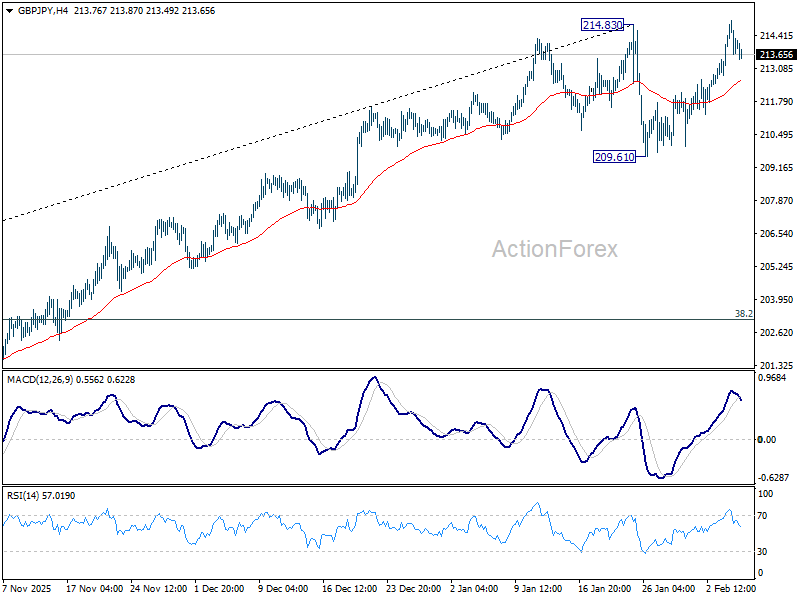
Daily Pivots: (S1) 213.22; (P) 214.12; (R1) 215.08; More...
GBP/JPY retreated after brief breach of 214.83 and intraday bias stays neutral. On the upside. firm break of 214.83 will resume larger up trend to 220.90 projection level next. Rejection by 214.83 will bring more consolidations first. But in case of another dip, downside should be contained by 55 D EMA (now at 209.70) to bring rally resumption.
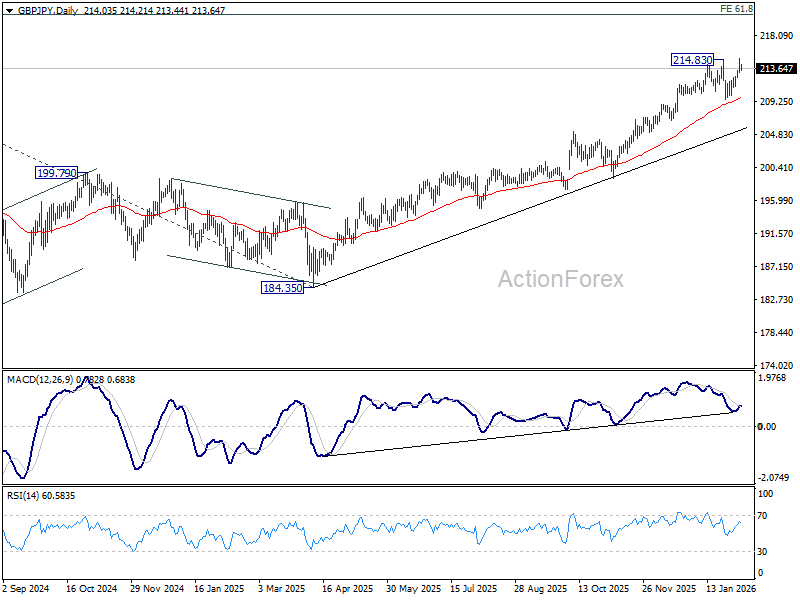
In the bigger picture, up trend from 123.94 (2020 low) is in progress. Next target is 61.8% projection of 148.93 (2022 low) to 208.09 (2024 high) from 184.35 at 220.90. On the downside, break of 205.30 resistance turned support is needed to indicate medium term topping. Otherwise, outlook will stay bullish even in case of deep pullback.
EUR/JPY Daily Outlook
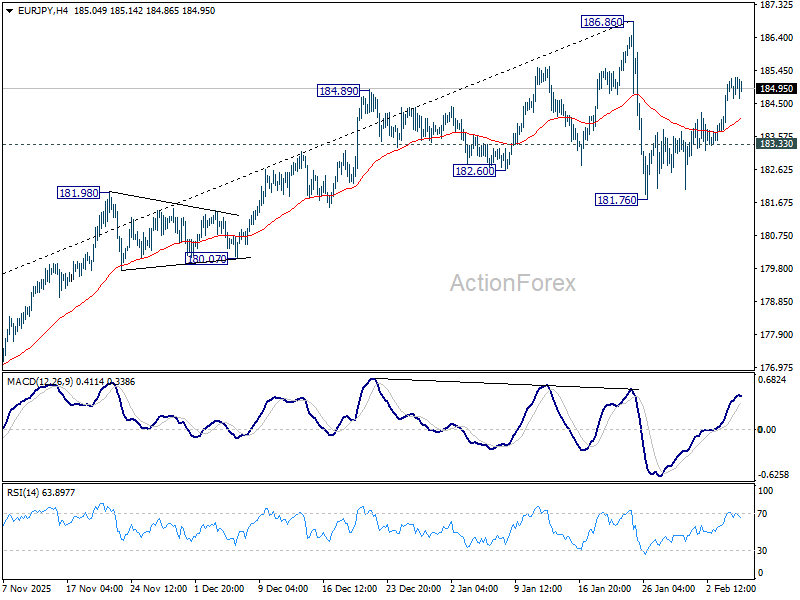
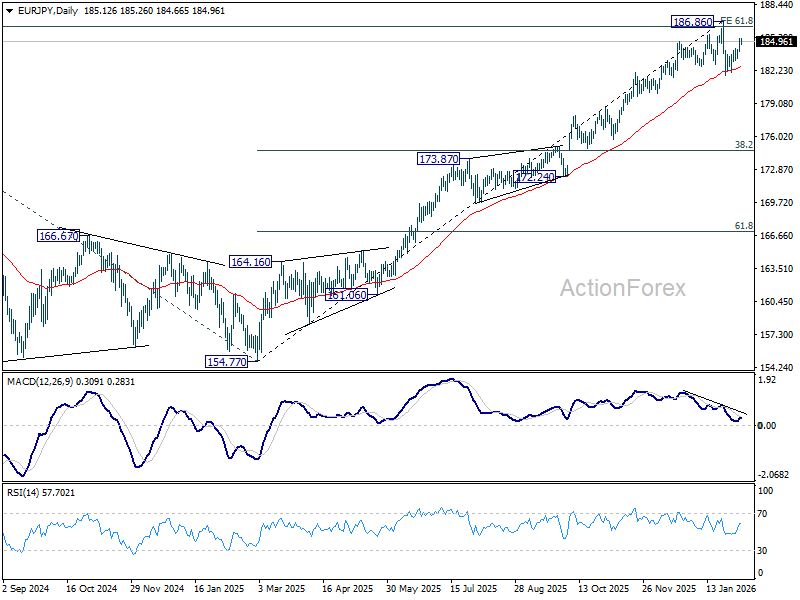
Daily Pivots: (S1) 184.26; (P) 184.77; (R1) 185.65; More...
EUR/JPY is staying in range below 186.86 and intraday bias remains neutral. On the downside, below 183.33 will bring retest of 181.76. Sustained trading below 55 D EMA (now at 182.56) should solidify the case that fall from 186.86 medium term top is correcting whole rise from 154.77. Deeper decline should then be seen to 38.2% retracement of 154.77 to 186.86 at 174.60. Nevertheless, firm break of 186.86 will resume larger up trend.
In the bigger picture, up trend from 114.42 (2020 low) is in progress and and met 61.8% projection of 124.37 to 175.41 from 154.77 at 186.31. Considering bearish divergence condition in D MACD, upside could be capped by 186.31 on first attempt. Still, outlook will stay bullish as long as 55 W EMA (now at 173.32) holds, even in case of deep pullback. Sustained break of 186.31 will pave the way to 78.6% projection at 194.88 next.
EUR/GBP Daily Outlook
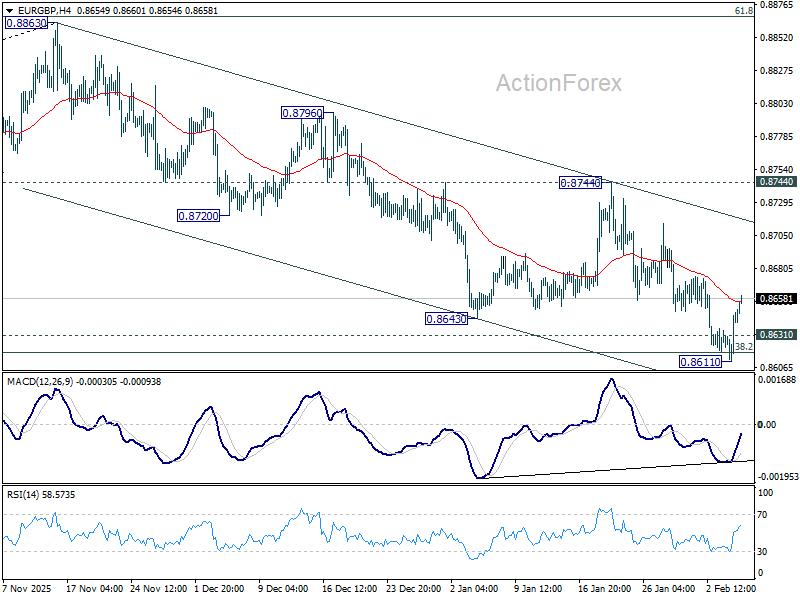
Daily Pivots: (S1) 0.8623; (P) 0.8636; (R1) 0.8660; More…
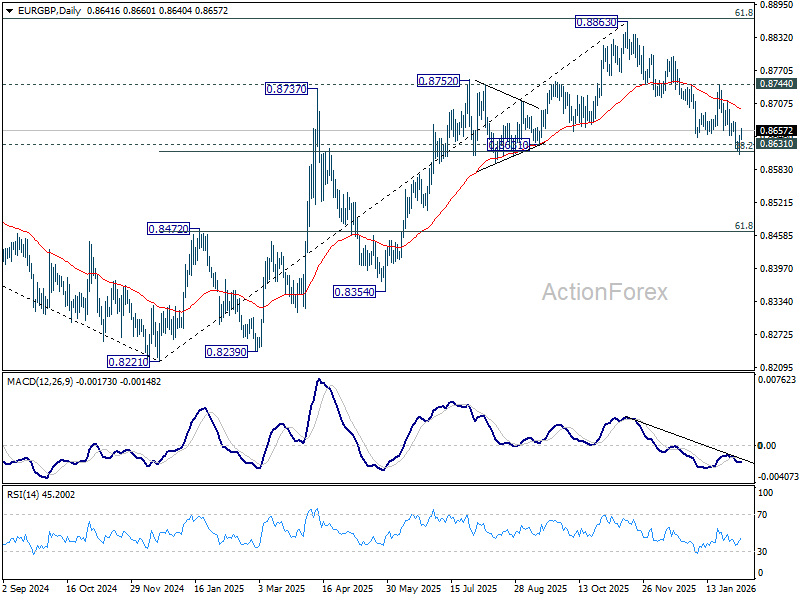
Intraday bias in EUR/GBP is turned neutral first with current recovery. On the downside, decisive break of 0.8631 cluster support (38.2% retracement of 0.8221 to 0.8663 at 0.8618) will carry larger bearish implications. Next target is 61.8% retracement at 0.8466. On the upside, however, break of 0.8744 resistance will suggest that fall from 0.8863 has completed as a corrective move.
In the bigger picture, rise from 0.8221 medium term bottom (2024 low) is seen as a corrective move. Upside should be limited by 61.8% retracement of 0.9267 to 0.8221 at 0.8867. Sustained trading below 55 W EMA (now at 0.8625) should confirm that this corrective bounce has completed. In this case, deeper fall would be seen back to 0.8201/21 key support zone. However, decisive break of 0.8867 will suggest that EUR/GBP is already reversing whole decline from 0.9267 (2022 high). That should pave the way back to 0.9267.
EUR/AUD Daily Outlook
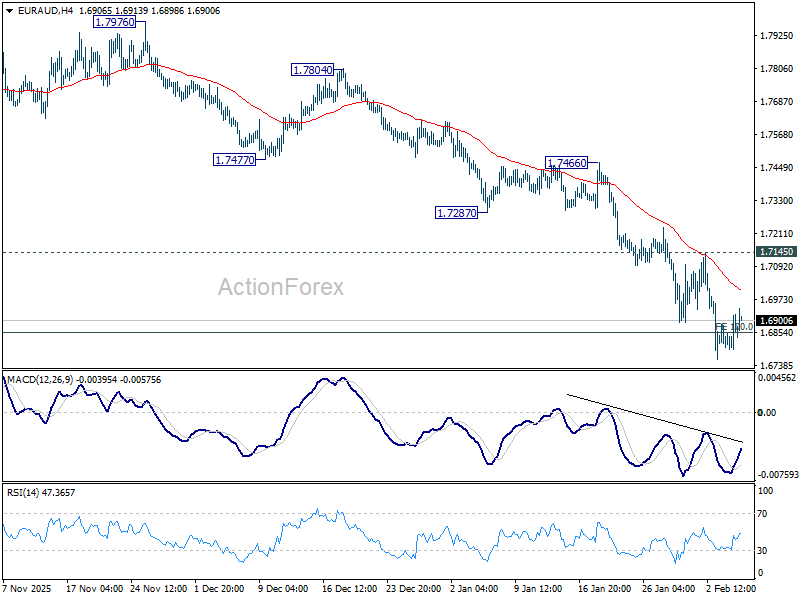
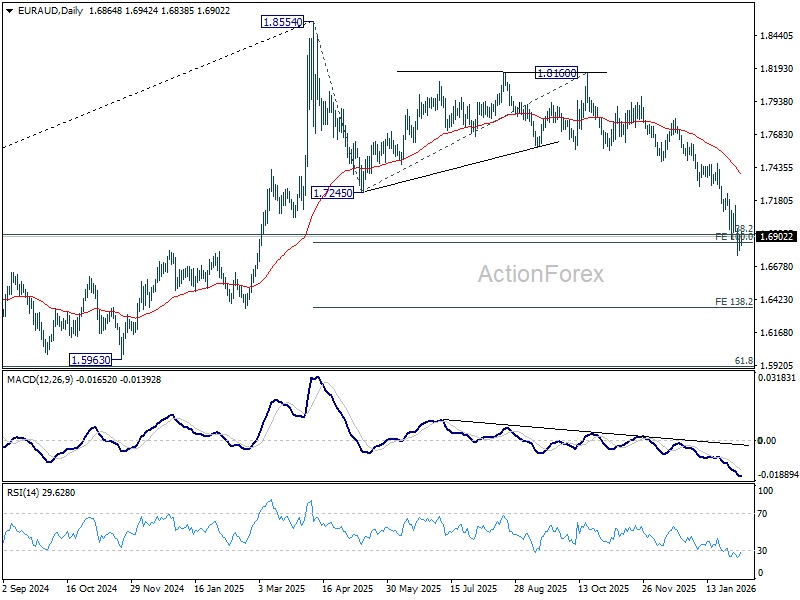
Daily Pivots: (S1) 1.6804; (P) 1.6863; (R1) 1.6928; More...
Further decline is expected in EUR/AUD as long as 1.7145 resistance holds. Sustained trading below 100% projection of 1.8554 to 1.7245 from 1.8160 at 1.6851 will pave the way to 138.2% projection at 1.6351 next. However, break of 1.7145 will confirm short term bottoming, and turn bias back to the upside for stronger rebound.
In the bigger picture, fall from 1.8554 medium term top is still in progress. Sustained break of 38.2% retracement of 1.4281 to 1.8554 at 1.6922 will argue that it's already reversing whole up trend from 1.4281 (2022 low). Deeper fall would be seen to 61.8% retracement at 1.5913. For now, risk will stay on the downside as long as 55 D EMA (now at 1.7396) holds even in case of strong rebound.
EUR/CHF Daily Outlook
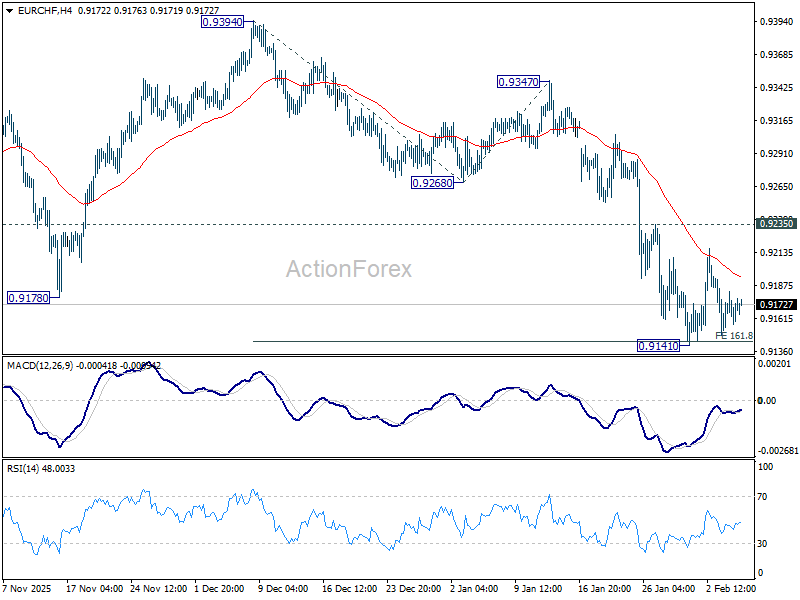
Daily Pivots: (S1) 0.9163; (P) 0.9173; (R1) 0.9189; More....
Intraday bias in EUR/CHF remains neutral for more consolidations above 0.9141. Upside should be limited by 0.9235 to bring another fall. Decisive break of 0.9141 will extend larger down trend to 261.8% projection of 0.9394 to 0.9268 from 0.9347 at 0.9143. However, firm break of 0.9235 resistance will suggest short term bottoming and bring stronger rebound to 55 D EMA (now at 0.9267).
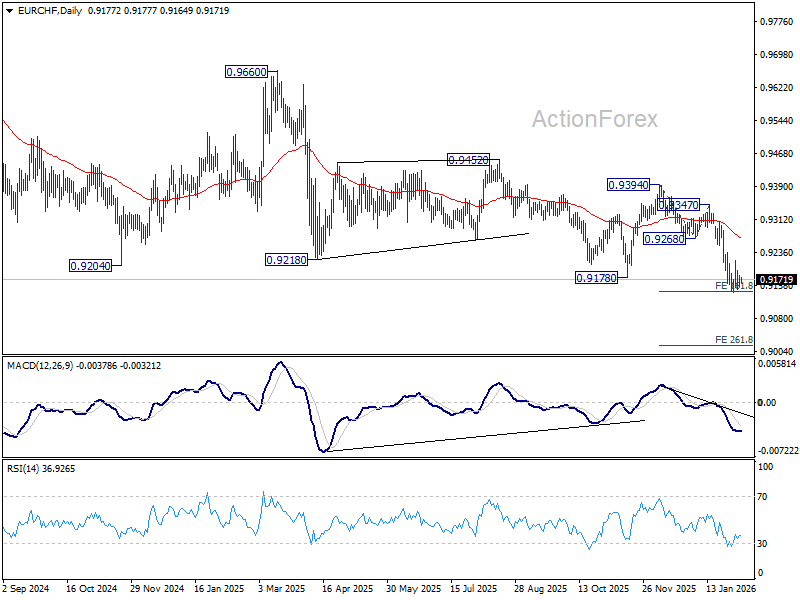
In the bigger picture, another rejection by 55 W EMA (now at 0.9350) keeps outlook bearish. Downtrend from 1.2004 (2018 high) is still in progress. Firm break of 0.9178 will target 61.8% projection of 1.1149 to 0.9407 from 0.9928 0.8851. Outlook will stay bearish as long as 0.9394 resistance holds, in case of recovery.
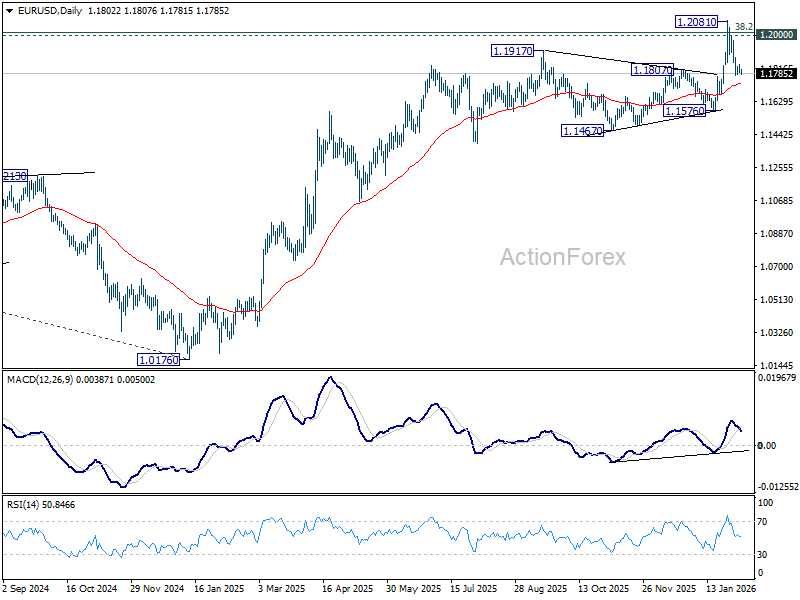
EUR/USD Daily Outlook
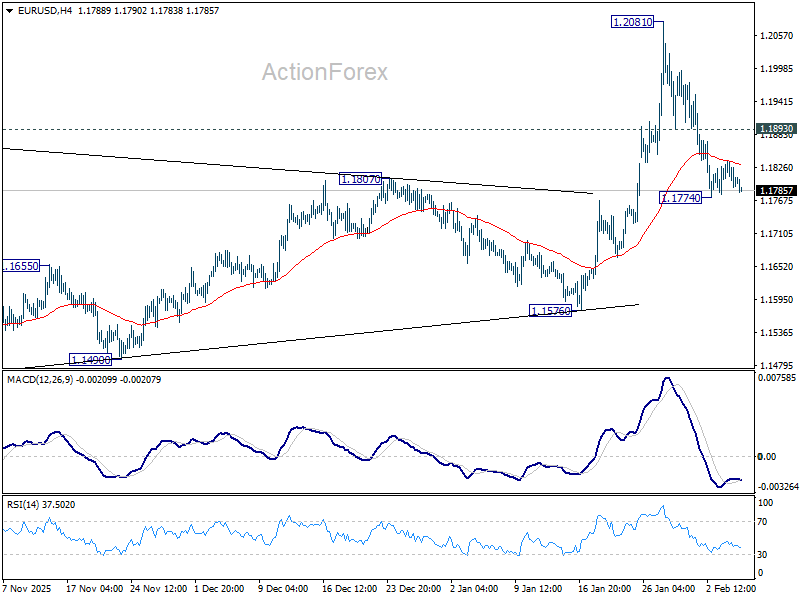
Daily Pivots: (S1) 1.1786; (P) 1.1812; (R1) 1.1833; More….
Intraday bias in EUR/USD remains neutral for the moment. On the downside, below 1.1774 will extend the fall from 1.2081 short term top to 55 D EMA (now at 1.1724). Firm break there will raise the chance of reversal on rejection by 1.2 psychological level, and target 1.1576 support. On the upside, above 1.1893 minor resistance will bring stronger rebound to retest 1.2081. Decisive break above 1.2 will carry larger bullish implications.
In the bigger picture, as long as 55 W EMA (now at 1.1458) holds, up trend from 0.9534 (2022 low) is still in favor to continue. Decisive break of 1.2 key psychological level will add to the case of long term bullish trend reversal. Next medium term target will be 138.2% projection of 0.9534 to 1.1274 from 1.0176 at 1.2581. However, sustained trading below 55 W EMA will argue that rise from 0.9534 has completed as a three wave corrective bounce, and keep long term outlook bearish.
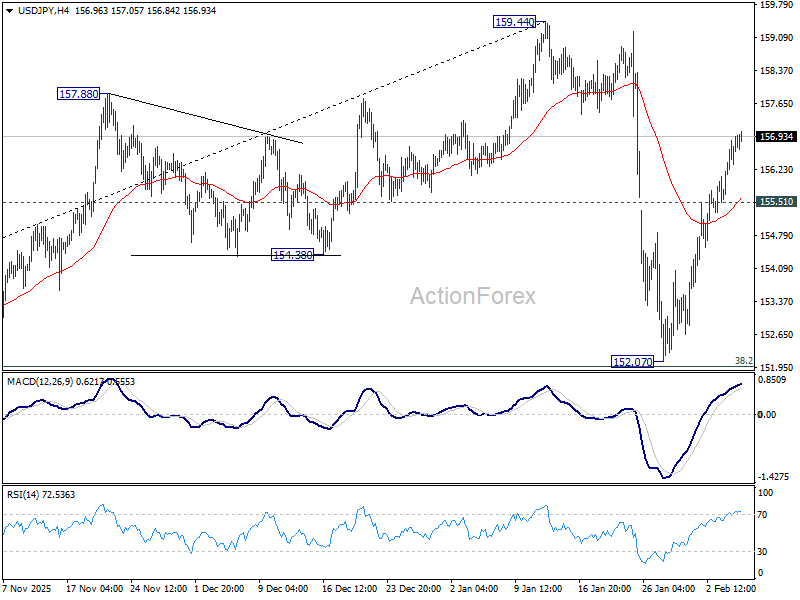
USD/JPY Daily Outlook
Daily Pivots: (S1) 156.03; (P) 156.49; (R1) 157.34; More...
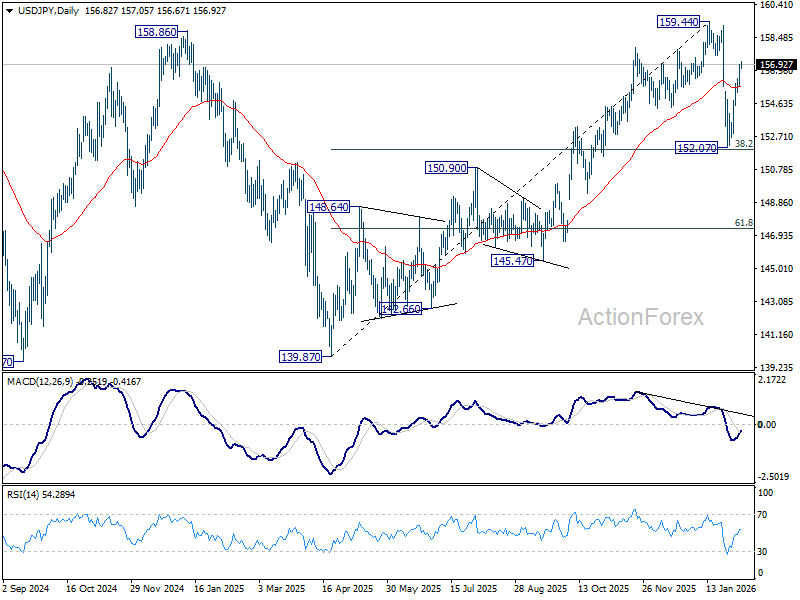
Intraday bias in USD/JPY remains on the upside at this point. Rise from 152.07 is seen as the second leg of the corrective pattern from 159.44. Further rebound should be seen to retest 159.44 next. On the downside, below 155.51 minor support will turn intraday bias neutral first. But overall outlook will stay bullish as long as 38.2% retracement of 139.87 to 159.44 at 151.96, in case of another dip.
In the bigger picture, outlook is unchanged that corrective pattern from 161.94 (2024 high) should have completed with three waves at 139.87. Larger up trend from 102.58 (2021 low) could be ready to resume through 161.94. This will remain the favored case as long as 55 W EMA (now at 151.59) holds. However, sustained break of 55 W EMA will argue that the pattern from 161.94 is extending with another falling leg.
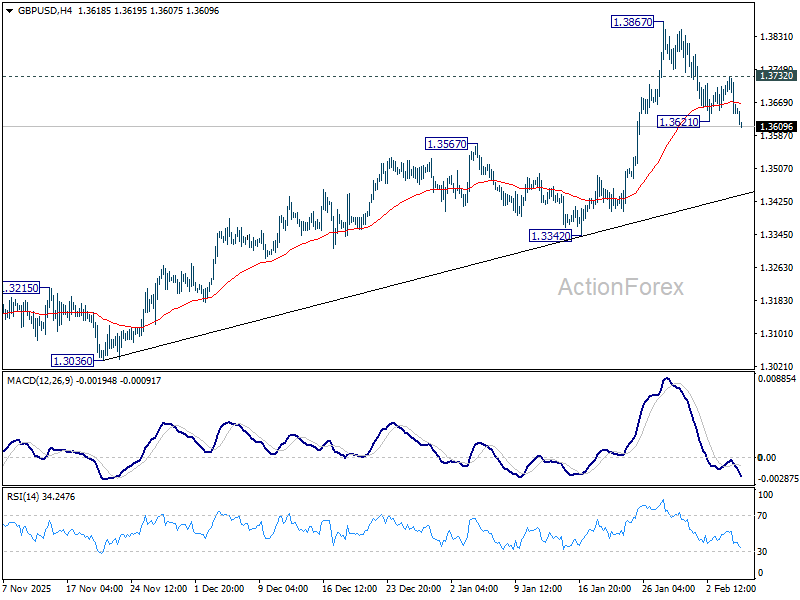
GBP/USD Daily Outlook
Daily Pivots: (S1) 1.3622; (P) 1.3677; (R1) 1.3712; More...
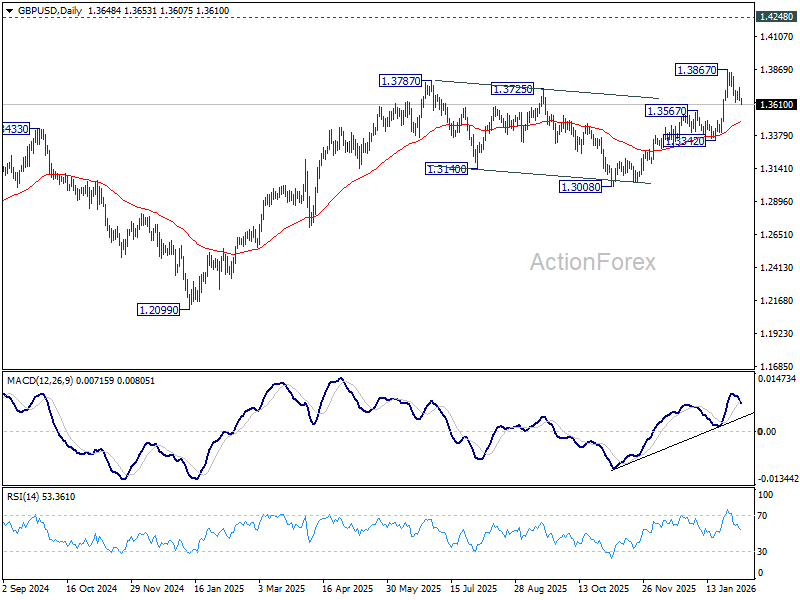
Intraday bias is back on the downside as pullback from 1.3867 short term top resumes. Deeper decline would be seen to 55 D EMA (now at 1.3482). On the upside, above 1.3732 minor resistance will bring retest of 1.3867. Firm break there will resume larger up trend towards 1.4284 key resistance.
In the bigger picture, rise from 1.0351 (2022 low) is resuming by breaking through 1.3787 high. Further rally should be seen to 1.4284 key resistance (2021 high). Decisive break there will add to the case of long term bullish trend reversal. For now, outlook will stay bullish as long as 1.3008 support holds, even in case of deep pullback.
USD/CHF Daily Outlook
Daily Pivots: (S1) 0.7754; (P) 0.7765; (R1) 0.7785; More….
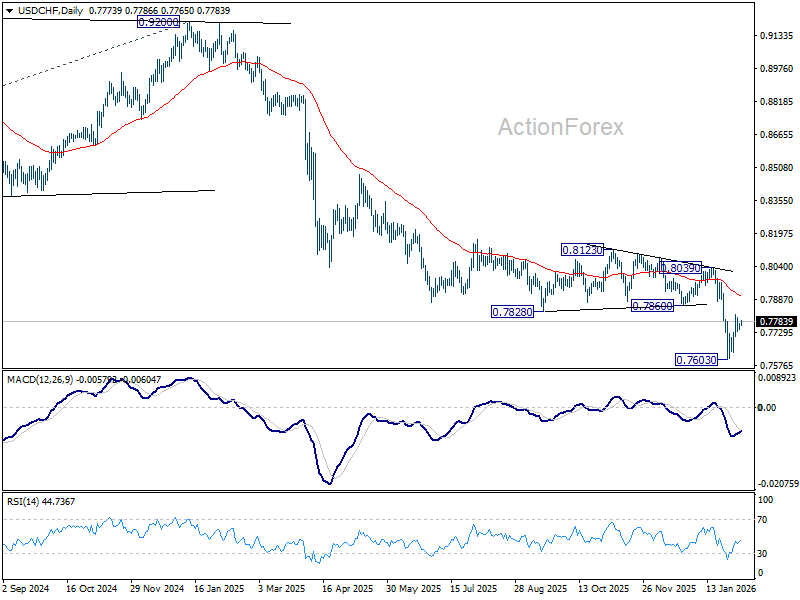
Intraday bias in USD/CHF remains neutral for the moment. On the upside, above 0.7816 will resume the rebound from 0.7603 short term bottom to 55 D EMA (now at 0.7905). On the downside, below 0.7713 minor support will bring retest of 0.7603. Firm break there will resume larger down trend to 0.7382 projection level next.
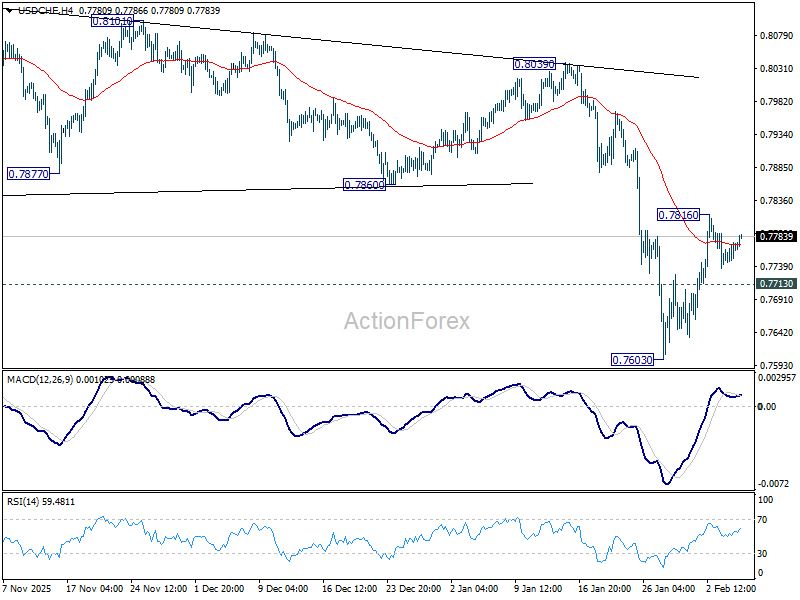
In the bigger picture, larger down trend from 1.0342 (2017 high) is still in progress and resuming. Next target is 100% projection of 1.0146 (2022 high) to 0.8332 from 0.9200 at 0.7382. In any case, outlook will stay bearish as long as 55 W EMA (now at 0.8166) holds.