Sample Category Title
USD/JPY Mid-Day Outlook
Daily Pivots: (S1) 121.82; (P) 123.078; (R1) 124.14; More...
Intraday bias in USD/JPY remains neutral and further rise is still in favor with 121.17 minor support intact. On the upside, above 125.09 will target 161.8% projection of 109.11 to 116.34 from 114.40 at 126.09, which is close to 125.85 long term resistance. However, break of 121.17 will indicate short term topping, and bring deeper pull back.
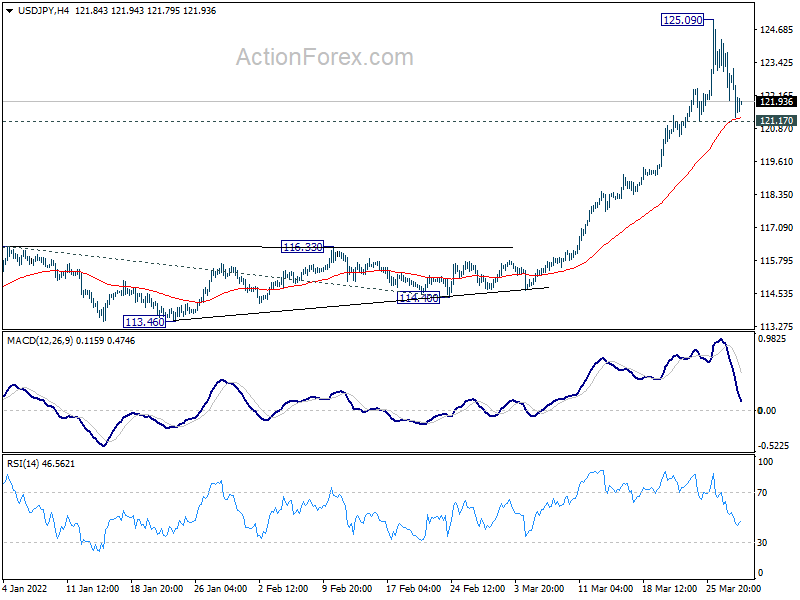
In the bigger picture, up trend from 98.97 (2016 low) in in progress for retesting 125.85 (2015 high). Sustained break there will confirm long term up trend resumption. Next target will be 61.8% projection of 75.56 (2011 low) to 125.85 (2015 high) from 98.97 at 130.04. This will now remain the favored case as long as 116.34 resistance turned support holds.
USD/CHF Mid-Day Outlook
Daily Pivots: (S1) 0.9280; (P) 0.9327; (R1) 0.9356; More....
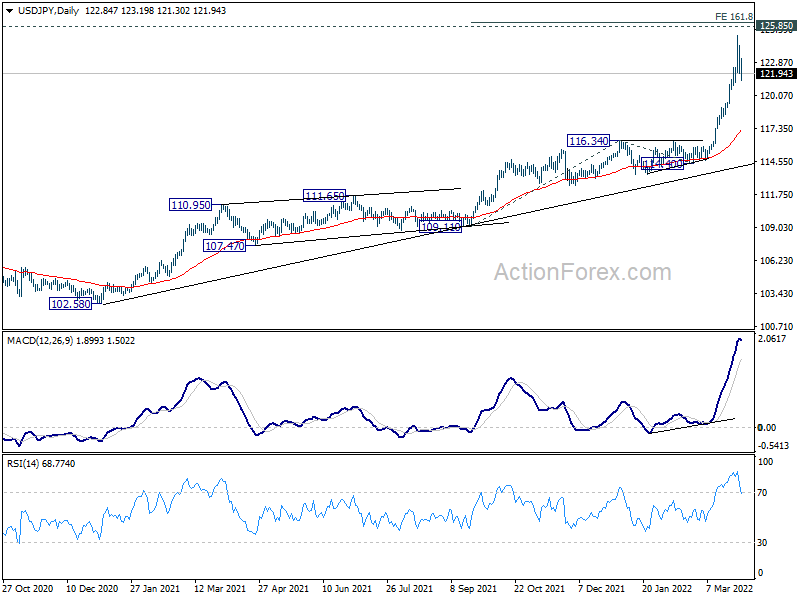
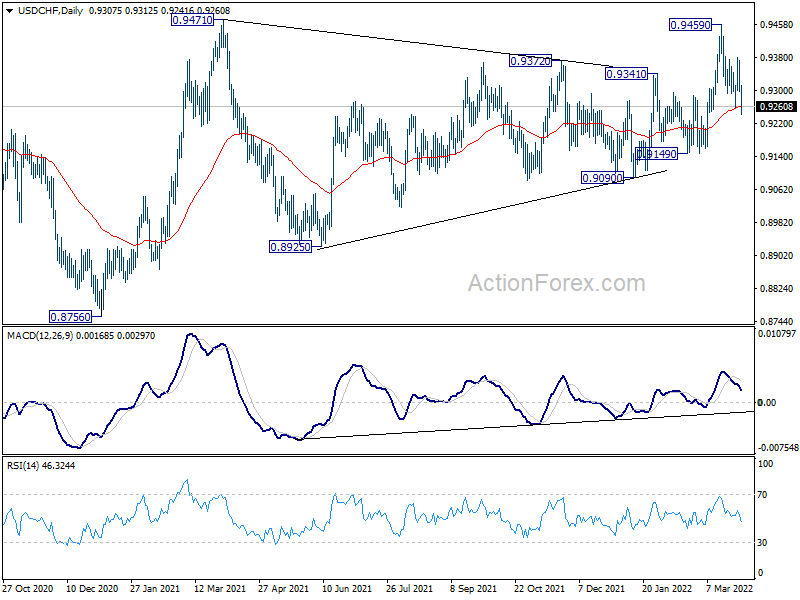
USD/CHF's fall from 0.9459 resumed by taking out 0.9259 temporary low. Intraday bias is back on the downside. Further fall would be seen towards 0.9149 support next. On the upside, above 0.9380 resistance will flip bias back to the upside for 0.9459 resistance instead.
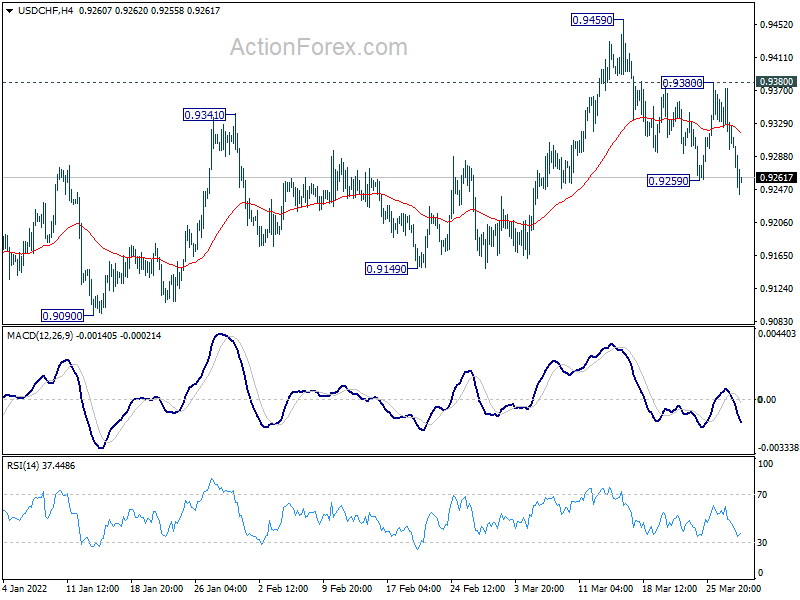
In the bigger picture, medium term outlook will be neutral at best as long as 0.9471 resistance holds. Larger down trend could still extend through 0.8756 (2021 low). However, firm break of 0.9471 will argue that whole down trend form 1.0342 (2016 high), has completed with waves down to 0.8756. A medium term up trend should be set up to target 1.0237/0342 resistance zone.
GBP/USD Mid-Day Outlook
Daily Pivots: (S1) 1.3043; (P) 1.3101; (R1) 1.3152; More...
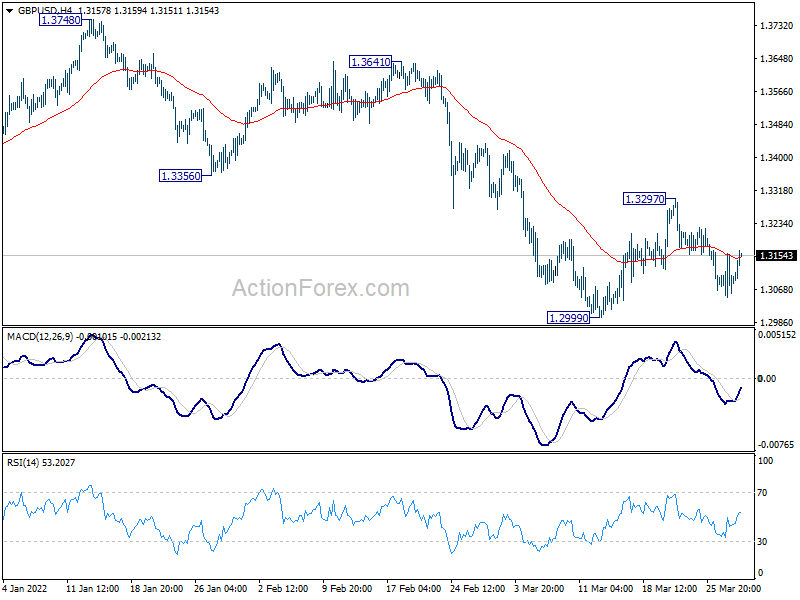
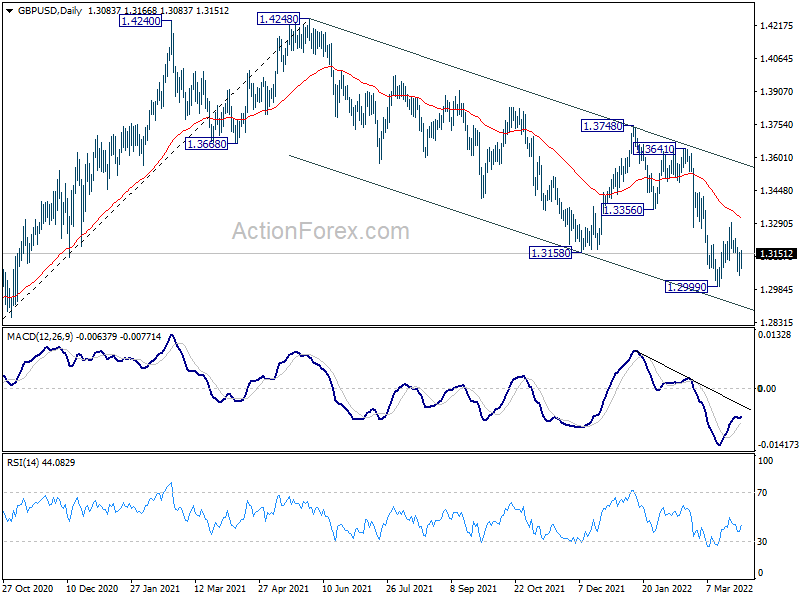
Intraday bias in GBP/USD stays neutral as sideway trading from 1.2999 continues. But overall stays bearish with 1.3297 resistance intact. On the downside, break of 1.2999 low will resume larger down trend from 1.4248. However, firm break of 1.3297 will bring strong rebound through 55 day EMA (now at 1.3315) and above.
In the bigger picture, current development suggests that the up trend from 1.1409 (2020 low) has completed at 1.4248. Decline from 1.4248 could still be a corrective move, or it could be the start of a long term down trend. In either case, deeper decline would be seen back to 61.8% retracement of 2.1161 to 1.1409 at 1.2493. In any case, break of 1.3748 resistance is needed to indicate medium term bottoming, or outlook will stay bearish.
EUR/USD Mid-Day Outlook
Daily Pivots: (S1) 1.0992; (P) 1.1064 (R1) 1.1159; More...
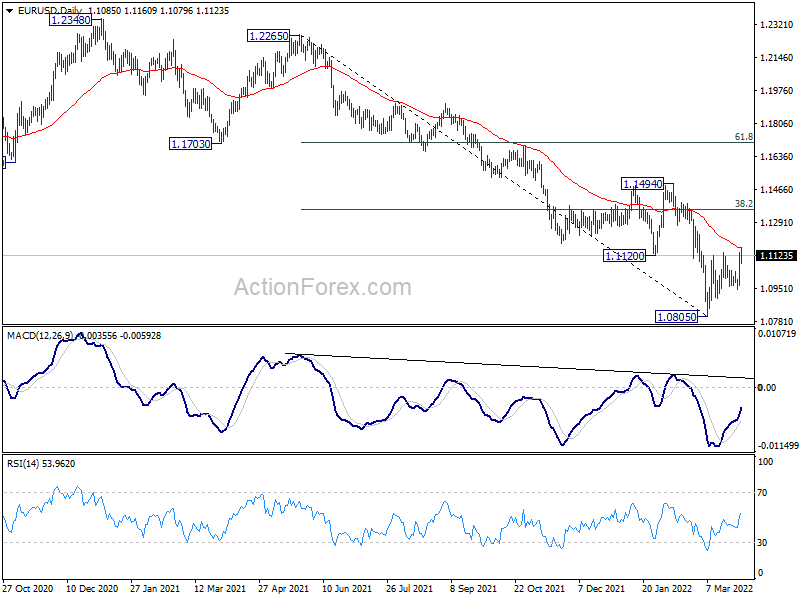
Intraday bias in EUR/USD is mildly on the with focus on 1.1120 support turned resistance. Sustained break there will argue that it's at least correcting the decline from 1.2265. Further rally should then be seen to 38.2% retracement of 1.2265 to 1.0805 at 1.1363. On the downside, however, break of 1.0943 support will revive near term bearishness, and bring retest of 1.0805 low.
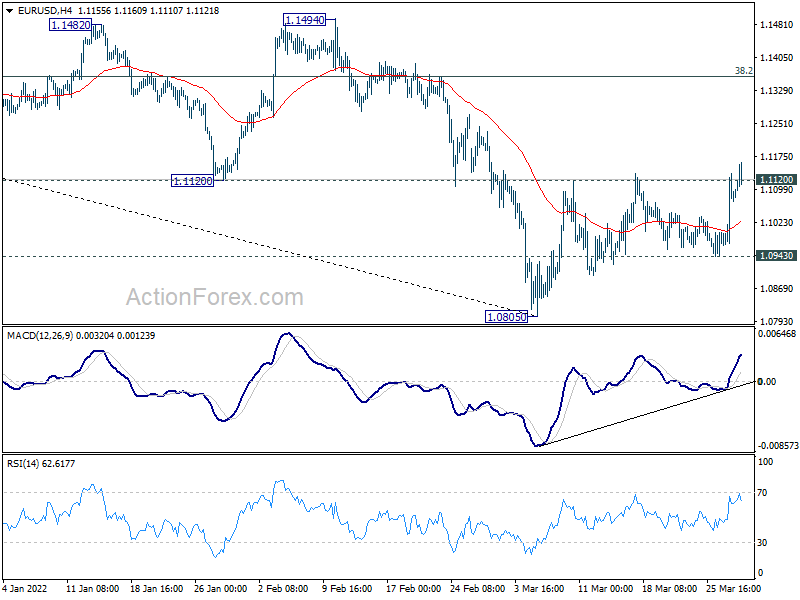
In the bigger picture, the decline from 1.2348 (2021 high) is expected to continue as long as 1.1494 resistance holds. Firm break of 1.0635 (2020 low) will raise the chance of long term down trend resumption and target a retest on 1.0339 (2017 low) next. Nevertheless, break of 1.1494 will maintain medium term neutral outlook, and extending term range trading first.
Dollar Soft Despite Solid ADP Job Data, Euro Follow Through Momentum
Dollar is trading as the worst performing for the day, and receive no support from solid ADP private job data. The greenback is somewhat weighed down by extended retreat in benchmark US yields. On the other hand, Euro is supported by rising Germany benchmark yields, after consumer inflation hit the highest level in more than 40 years. Yet, Euro bulls are still not too committed to push it higher, as the hope of Russia ceasefire remains in doubt. Yen is the strongest one for today, trying to extend recovery.
Technically, we'd reiterate that some near term resistance levels need to be take out with conviction before Euro could prove it's underlying strength. the levels include 1.1120 support turned resistance in EUR/USD, 0.8476 structural resistance in EUR/GBP, and 1.0400 resistance in EUR/CHF. As for Dollar, it will probably need to wait until non-farm payroll report to have a chance for a come back.
In Europe, at the time of writing, FTSE is up 0.02%. DAX is down -1.64%. CAC is down -1.10%. Germany 10-year yield is up 0.051 at 0.683. Earlier in Asia, Nikkei dropped -0.80%. Hong Kong HSI rose 1.39%. China Shanghai SSE rose 1.96%. Singapore Strait Times rose 0.25%. Japan 10-year JGB yield dropped -0.0328 to 0.220.
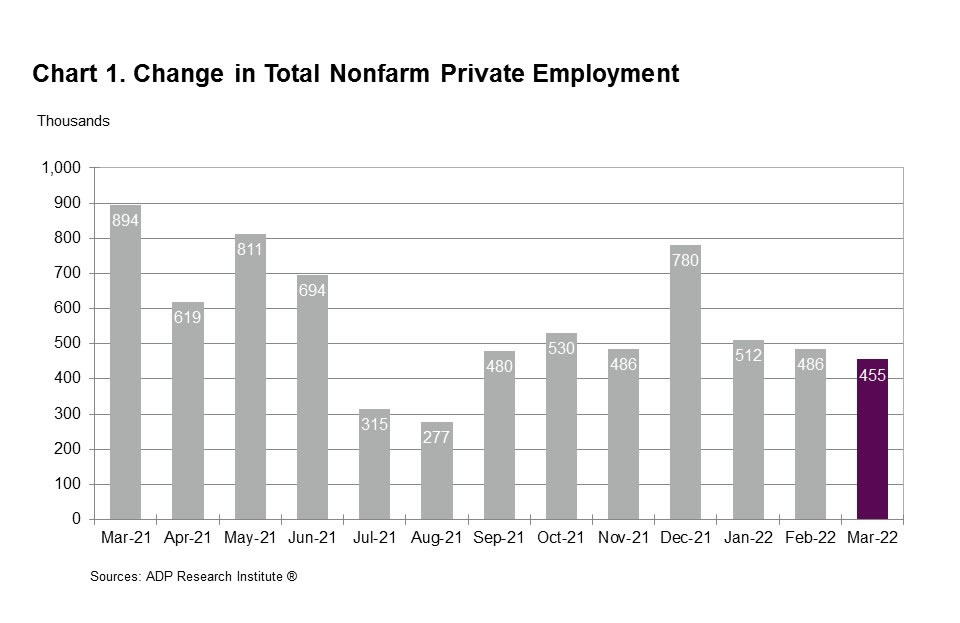
US ADP jobs grew 455k, broad-based growth
US ADP private employment grew 455k in March, slightly above expectation of 450k. By company size, small businesses added 90k jobs, medium businesses added 188k, large businesses added 177k. By sector, goods-producing jobs grew 79k while service-providing jobs grew 377k.
"Job growth was broad-based across sectors in March, contributing to the nearly 1.5 million jobs added for the first quarter in 2022," said Nela Richardson, chief economist, ADP. "Businesses are hiring, specifically among the service providers which had the most ground to make up due to early pandemic losses. However, a tight labor supply remains an obstacle for continued growth in consumer-facing industries."
ECB Lagarde emphasizes principles of optionality, gradualism and flexibility
ECB President Christine Lagarde said in a speech the economic impact of Ukraine war is a "supply shock" that " simultaneously pushes up inflation and reduces growth." Three main favors are likely to take inflation higher, including energy, food, and manufacturing bottlenecks.
The war also posses "significant risks" to growth, implying a loss of EUR 150B in the economy in one year. The conflict also "drain confidence" through at least two channels. Firstly, households become more pessimistic and cut back on spending. Secondly, business investment is likely to be affected.
As for ECB, Lagarde said the best way to navigate this uncertainty is to emphasize the "principles of optionality, gradualism and flexibility." Optionality means if incoming data support that medium term inflation will not weaken after the end of net asset purchases, the APP will be concluded in Q3. But ECB also stand ready to revise the schedule for net asset purchases in terms of size and/or duration. Gradualism means the adjustments to interest rate will take place "some time" after end of net purchases and will be gradual. Flexibility means ECB will use the its toolkit to ensure policy is transmitted evenly across all parts of Eurozone.
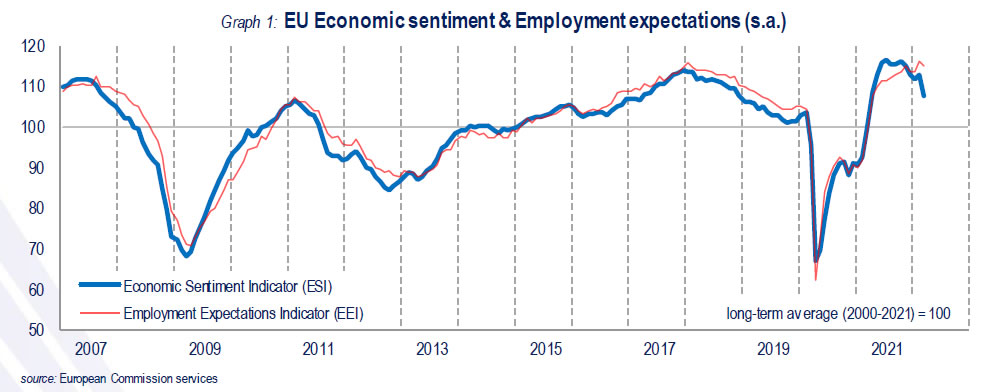
Eurozone economic sentiment dropped to 108.5, EU down to 107.5
Eurozone Economic Sentiment Indicator dropped from 113.9 to 108.5 in March. Industry confidence dropped from 14.1 to 10.4. Services confidence rose from 12.9 to 14.4. Consumer confidence dropped from -8.8 to -18.7. Retail trade confidence dropped from 5.5 to 0.2. Construction confidence ticked down from 9.9 to 9.8. Employment Expectation Indicator dropped from 116.4 to 115.5.
EU Economic Sentiment dropped from 112.8 to 107.5. Amongst the largest EU economies, the ESI fell sharply in France (-7.1), Spain (-6.5), Germany (-4.3) and, to a lesser extent, in Poland (-3.0) and Italy (-2.6), while it brightened slightly in the Netherlands (+0.5).
Swiss KOF dropped to 99.7, recovery overshadowed by war in Ukraine
Swiss KOF Economic Barometer dropped from 105 to 99.7 in March, worse than expectation of 101.0. The index is now slightly below its long-term average.
KOF said: "The recovery from the economic consequences of the pandemic is now overshadowed by the war in Ukraine. Overall, a moderate development of the Swiss economy can be expected for the near future."
"The decline is primarily due to indicators from the manufacturing sector, followed by those for private consumption. The other indicators included in the barometer show hardly any changes."
BoJ increases size of JGB purchases to defend yield cap
BoJ announced to increase the size of its JGB purchases to defend it's 10-year yield cap imposed under the yield curve control.
It increased the size of purchase of JGB with maturities of 3 to 10 years today, by a combined JPY 450B to JPY 1325B. It will additionally buy JPY 150B of JGB with maturities between 10 to 25 years, and JPY 100B with maturity more than 25 years.
"The BOJ will increase the number of auction dates and the amount of outright JGB purchases as needed, taking account of market conditions," the BOJ said in a statement.
Released from Japan, retail sales dropped -0.8% yoy in February, worse than expectation of -0.3% yoy.
New Zealand ANZ business confidence rose to -41.9, inflation expectations rose again
New Zealand ANZ business confidence rose from -51.8 to -41.9 in March. Own activity outlook rose from -2.2 to 3.3. Looking at some details, export intentions rose from 0.9 to 7.9. Investment intentions rose from 4.5 to 5.2. Employment intentions rose from 2.3 to 12.3. Pricing intentions rose from 74.1 to 80.5. Cost expectations rose from 92.0 to 95.9. Inflation expectations rose back from 5.29 to 5.51.
ANZ said: "With inflation pressures now so extreme, and the RBNZ's inflation-targeting credibility on the line, it's full steam ahead for rate hikes – we're forecasting 50bp hikes in both April and May.
"It could well be a rough ride, but maintaining medium-term price stability is the best contribution monetary policy can make to New Zealand's big-picture economic prospects from this very difficult starting point."
Also from New Zealand, building permits rose 10.5% mom in February.
EUR/USD Mid-Day Outlook
Daily Pivots: (S1) 1.0992; (P) 1.1064 (R1) 1.1159; More...
Intraday bias in EUR/USD is mildly on the with focus on 1.1120 support turned resistance. Sustained break there will argue that it's at least correcting the decline from 1.2265. Further rally should then be seen to 38.2% retracement of 1.2265 to 1.0805 at 1.1363. On the downside, however, break of 1.0943 support will revive near term bearishness, and bring retest of 1.0805 low.
In the bigger picture, the decline from 1.2348 (2021 high) is expected to continue as long as 1.1494 resistance holds. Firm break of 1.0635 (2020 low) will raise the chance of long term down trend resumption and target a retest on 1.0339 (2017 low) next. Nevertheless, break of 1.1494 will maintain medium term neutral outlook, and extending term range trading first.
Economic Indicators Update
| GMT | Ccy | Events | Actual | Forecast | Previous | Revised |
|---|---|---|---|---|---|---|
| 21:45 | NZD | Building Permits M/M Feb | 10.50% | -9.20% | -8.70% | |
| 23:01 | GBP | BRC Shop Price Index Y/Y Feb | 2.10% | 1.80% | ||
| 23:50 | JPY | Retail Trade Y/Y Feb | -0.80% | -0.30% | 1.10% | |
| 00:00 | NZD | ANZ Business Confidence Mar | -41.9 | -51.8 | ||
| 07:00 | CHF | KOF Leading Indicator Mar | 99.7 | 101 | 105 | 105.3 |
| 08:00 | CHF | Credit Suisse Economic Expectations Mar | -27.8 | 9 | ||
| 09:00 | EUR | Eurozone Economic Sentiment Indicator Mar | 108.5 | 110 | 114 | 113.9 |
| 09:00 | EUR | Eurozone Industrial Confidence Mar | 10.4 | 8.9 | 14 | 14.1 |
| 09:00 | EUR | Eurozone Services Sentiment Mar | 14.4 | 10 | 13 | 12.9 |
| 09:00 | EUR | Eurozone Consumer Confidence Mar F | -18.7 | -18.7 | -18.7 | |
| 12:00 | EUR | Germany CPI M/M Mar P | 2.50% | 1.60% | 0.90% | |
| 12:00 | EUR | Germany CPI Y/Y Mar P | 7.30% | 6.10% | 5.10% | |
| 12:15 | USD | ADP Employment Change Mar | 455K | 450K | 475K | 486K |
| 12:30 | USD | GDP Annualized Q4 F | 6.90% | 7.10% | 7.00% | |
| 12:30 | USD | GDP Price Index Q4 F | 7.10% | 7.10% | 7.10% | |
| 14:30 | USD | Crude Oil Inventories | -2.0M | -2.5M |
US ADP jobs grew 455k, broad-based growth
US ADP private employment grew 455k in March, slightly above expectation of 450k. By company size, small businesses added 90k jobs, medium businesses added 188k, large businesses added 177k. By sector, goods-producing jobs grew 79k while service-providing jobs grew 377k.
"Job growth was broad-based across sectors in March, contributing to the nearly 1.5 million jobs added for the first quarter in 2022," said Nela Richardson, chief economist, ADP. "Businesses are hiring, specifically among the service providers which had the most ground to make up due to early pandemic losses. However, a tight labor supply remains an obstacle for continued growth in consumer-facing industries."
NZDUSD Aims for Uptrend Resumption
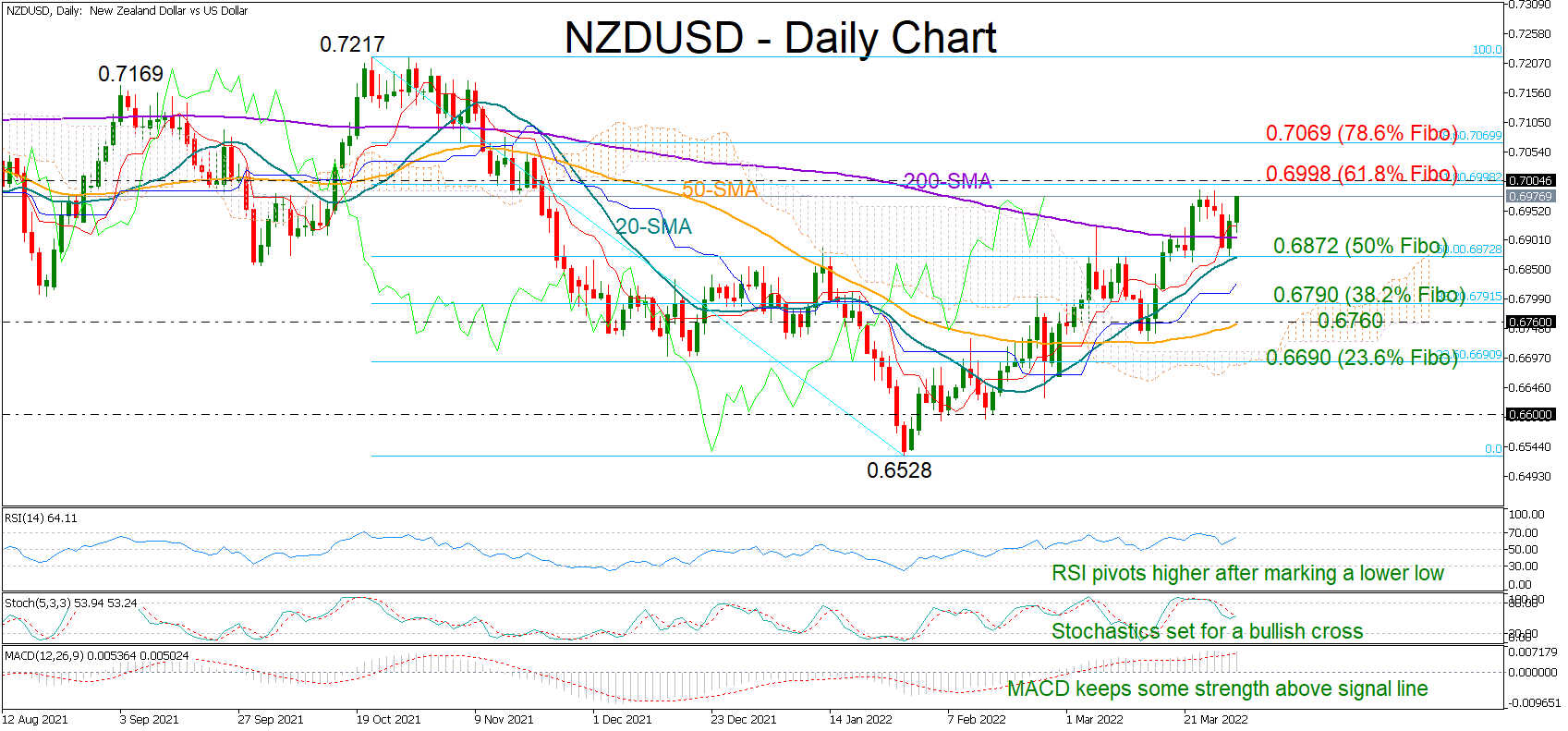
NZDUSD is trading positive for the second consecutive day, flirting with last week’s high of 0.6987 after finding strong support near the 20-day simple moving average (SMA) and the 50% Fibonacci retracement of the 0.7217 – 0.6528 downleg.
Technical signals are neutral-to-bullish at the moment as the RSI has resumed its positive momentum after marking a lower low above 50. The Stochastics are set for a bullish cross, while the MACD is preserving some strength above its red signal line, but is still below its recent highs.
In trend indicators, the 20-day SMA is quickly approaching the 200-day SMA. A positive intersection between those lines could boost hopes that the uptrend off 0.6558 could gain new legs.
The 61.8% Fibonacci level of 0.6998 is overhead and will be closely watched in the coming sessions. A decisive close above that bar could drive the price towards the 78.6% Fibonacci of 0.7070. Should buying pressures grow further, the spotlight will turn to the 0.7169 – 0.7217 key resistance territory.
If the bullish action stalls at 0.7000, the price may drift lower to seek support around the 50% Fibonacci of 0.6872. The area has been a crucial barricade to upside and downside movements since the start of the year, therefore any violation at this point is expected to produce a sharper decline towards the 38.2% Fibonacci of 0.6790 and the 50-day SMA at 0.6858. Moving beneath the latter, the pair could next test the 23.6% Fibonacci of 0.6690.
In summary, NZDUSD is facing a neutral-to-bullish short-term bias. A successful penetration of the 0.7000 level could motivate fresh buying, while a drop below 0.6872 may confirm additional losses.
Japanese Yen Extends Gains
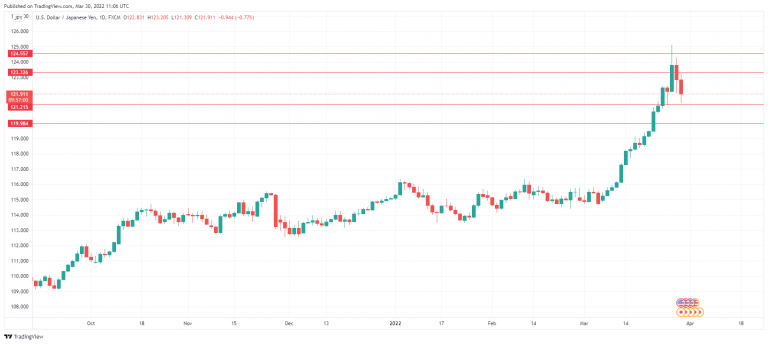
The Japanese yen continues to rebound and has posted sharp gains for a second straight day. USD/JPY is trading at 121.80 in the European session, down 0.82% on the day.
Yen volatility continues
The yen continues to show sharp volatility. USD/JPY started the week with gains of 1.42% and breaking above the 125 level for the first time since August 2016. The yen has clawed back and erased these losses, pushing below the 122 line.
The Bank of Japan started the yen’s slide on Monday when it intervened by making an unlimited bid for JGBs in order to cap 10-year rates at 0.25%. The BoJ has extended this move until Thursday, and it has worked well, as the 10-year yield is at 0.22%, with USD/JPY down sharply for a second straight day. The BoJ has managed to contain the selloff in the yen, but can the yen hold onto these gains? Much of the yen’s recent gains may be due to repatriation flows into Japan ahead of the financial year-end on Thursday. These repatriation flows could quickly reverse and push the yen to lower levels.
The BoJ’s intervention to defend the yield curve and keep benchmark yields at an upper limit of 0.25% has been dramatic, and the Bank has showed its determination to keep rates low and maintain a loose policy in order to kickstart the weak economy. This puts the BoJ out of sync with the Federal Reserve and other major central banks which are tightening policy in order to contain re-hot inflation. This will likely result in a widening of the US/Japan rate differential, which is bearish for the rate-sensitive yen.
The BoJ has understandably been in focus this week, but there other events on the economic calendar which warrant attention. Japan’s retail sales declined by 0.80%, marking a third successive month of losses. Price rises and Covid restrictions are weighing on consumer spending, which is dampening economic growth.
USD/JPY Technical
- 121.21 is providing support, followed by 119.98
- There is resistance at 123.32 and 124.55
USDJPY Retreats from 19-Year High, Upside Risks Linger
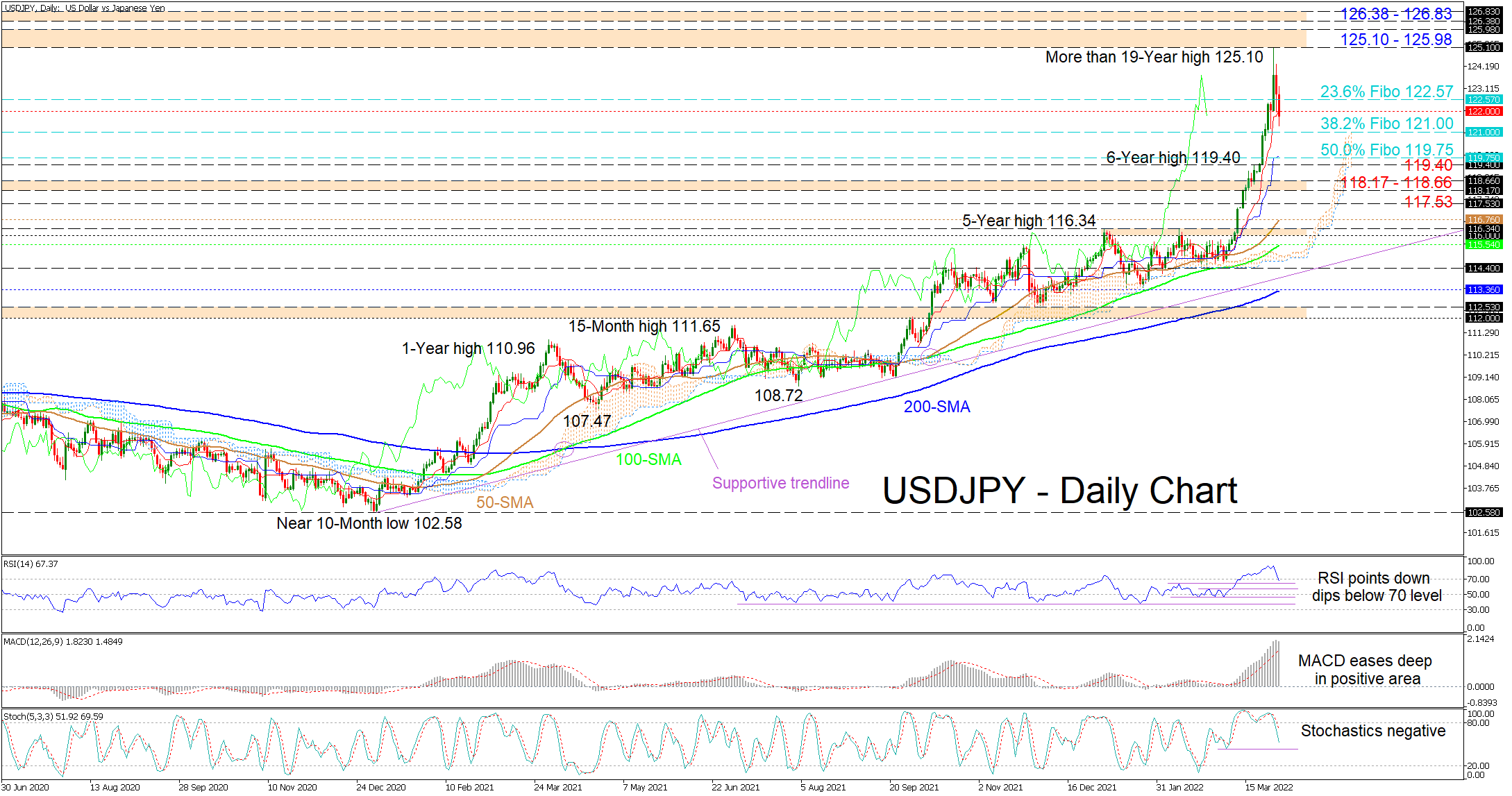
USDJPY is currently trading around its red Tenkan-sen line around 122.00 after retracing below the 122.57 level, which is the 23.6% Fibonacci retracement of the up leg from the 114.40 low until the recorded 125.10 rally peak. The rising simple moving averages (SMAs) continue to endorse the prevailing ascent despite the fresh correction in the pair.
For now, the Ichimoku lines indicate that bullish forces have yet to fully abate, while the short-term oscillators suggest that positive momentum is subsiding. The MACD, which is very far in the bullish region, is waning towards its red trigger line, while the RSI has turned bearish with its fresh drop below the 70 overbought level. Moreover, the negatively charged stochastic oscillator is promoting additional downward moves in the pair.
If the bearish price correction endures, initial friction to the downside could occur at the 38.2% Fibo of 121.00 ahead of an area of support between the 50.0% Fibo of 119.75 and the six-year inside swing high of 119.40. A more profound pullback may then challenge the 118.17-118.66 support border formed by the December 2016 and January 2017 peaks. Sinking past this critical obstacle, the 117.53 barrier from January 2017 could then come under attack.
Otherwise, if buyers re-emerge and push higher from the vicinity of the red Tenkan-sen line, prompt resistance could arise from the 23.6% Fibo of 122.57. Gaining additional legs above this border, the bulls may then eye the 125.10-125.98 resistance section, shaped by the June, October and December 2002 peaks. Nonetheless, once renewing the bullish impetus of the broader uptrend, the bulls would also need to overrun the neighbouring 126.38-126.83 resistance band to open the way for a test of the 129.00 handle, overlapping the next resistance high.
Summarizing, USDJPY’s upside risks prevail despite the softening to a degree of the pair’s bullish bearing. A deeper bearish correction below the 118.17-118.66 support border could spark worries about growing negative tendencies.
Eurozone economic sentiment dropped to 108.5, EU down to 107.5
Eurozone Economic Sentiment Indicator dropped from 113.9 to 108.5 in March. Industry confidence dropped from 14.1 to 10.4. Services confidence rose from 12.9 to 14.4. Consumer confidence dropped from -8.8 to -18.7. Retail trade confidence dropped from 5.5 to 0.2. Construction confidence ticked down from 9.9 to 9.8. Employment Expectation Indicator dropped from 116.4 to 115.5.
EU Economic Sentiment dropped from 112.8 to 107.5. Amongst the largest EU economies, the ESI fell sharply in France (-7.1), Spain (-6.5), Germany (-4.3) and, to a lesser extent, in Poland (-3.0) and Italy (-2.6), while it brightened slightly in the Netherlands (+0.5).