

Sample Category Title
USD/JPY Mid-Day Outlook
Daily Pivots: (S1) 110.41; (P) 110.61; (R1) 110.83; More...
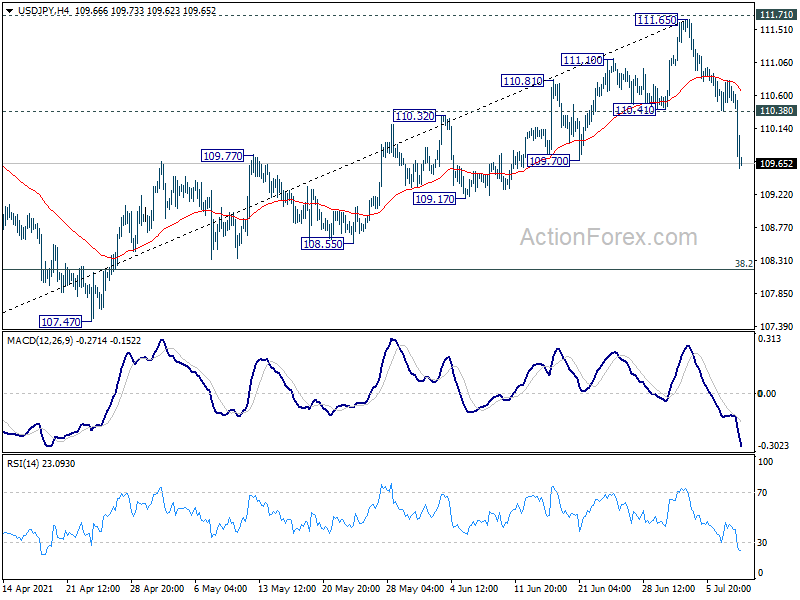
Intraday bias in USD/JPY remains on the downside at this point. Sustained trading below 55 day EMA (now at 109.79) will suggest that it's at least correcting the whole rise from 102.58. Deeper fall would be seen to 38.2% retracement of 102.58 to 111.65 at 108.18. On the upside, above 110.38 minor resistance will turn intraday bias neutral first. But risk will be mildly on the downside as long as 111.65 resistance holds, in case of recovery.
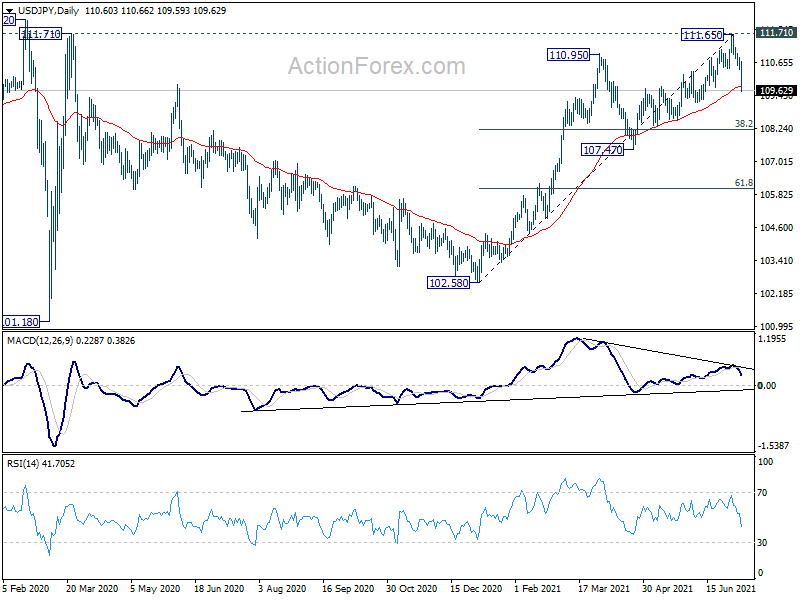
In the bigger picture, medium term outlook is staying neutral with 111.71 resistance intact. Though, as notable support was seen from 55 day EMA, rise from 102.58 is mildly in favor to extend higher. Decisive break of 111.71/112.22 resistance will suggest long term bullish reversal. Rise from 101.18 could then target 118.65 resistance (Dec 2016) and above. However, sustained break of 55 day EMA would revive some medium term bearishness, and open up deep fall back towards 102.58 support.
European Stocks Tank as Recovery Concerns Mount
European stocks are sinking lower, reversing gains from the previous session following a weak handover from Asia.
While stocks have been on a tear, hitting all-time highs last month, the mood in the markets is starting to sour. Concerns over the health of the economic recovery are denting risk sentiment and hitting demand for stocks even as the Federal Reserve moves towards tapering asset purchases.
Inflation concerns and fears that the Federal Reserve could move to start tightening monetary policy have been lingering over the past few weeks, particularly since its hawkish shift at the June meeting. The minutes from the Fed’s June policy meeting confirmed that the central bank is moving towards tapering its asset purchases, potentially as soon as this year. However, the minutes also revealed that more evidence of a robust economic recovery would be needed to set a more defined timeline for tapering.
Interestingly the minutes come as the bond market continues to show traders are increasingly less concerned with the risk of rising inflation and interest rate rises. This is pretty much the polar opposite of what some Fed policymakers appear to be worried about when they adopted the view of two interest rate rises in 2023. This certainly isn’t the first time the bond market and the Fed have been out of sync this year. Today, bond yields continue to slump lower. The yield on the 10-year treasury has tumbled to 1.26%, a fresh four-month low.
The overriding concern being reflected in the bond market is that peak growth has been reached, and the benefits from fiscal policy are starting to fade. Recent data has been disappointing. The Citigroup Economic Surprise Index is at its lowest level since February.
Banks in Europe are taking the biggest hit on the back of falling government bond yields. Other cyclical stocks such as automotive and miners are also firmly out of favour on global growth concerns.
Looking ahead, attention falls firmly on the US jobless claims data due later today. Expectations are for initial jobless claims to fall to 350k, down from 364k the previous week. This would be a new post-pandemic low and support the view that the US labour market is continuing along a steady but not too strong path to recovery.
FX – Euro capitalises on weak USD, ECB strategy report in focus
Despite the Fed’s hawkish bias appearing in the FOMC minutes, the US dollar is following bond yields lower. The greenback continues to edge away from the three-month high reached overnight.
The euro is outperforming its major peers, benefitting from the weaker USD even as investors expect the ECB to push the goalposts back for raising interest rates.
Following an 18-month policy review, the ECB is expected to set its inflation target at 2%, ditching the previous “below but close to 2%” stance. The central bank could also say that an overshoot beyond 2% is ok. Typically, this would have a negative impact on the value of the euro. However, today USD weakness is in the driving seat.
Oil extends declines for a third straight day
Oil prices are heading lower for a third straight session amid ongoing uncertainty over supply across the second half of the year. Following the collapse of the OPEC+ talks, fear is gripping the oil markets, sending oil prices tumbling more than 6% in just three days. The overriding concern is that the current output agreement will be abandoned, and producers will ramp up production to boost market share.
While near-term demand is clearly outstripping supply, the markets are fretting that this will not be the case heading towards the end of the year should the OPEC+ agreement fall apart. Currently, OPEC is retaining supply by around six million barrels a day. The group was looking to lower this to four million. However, the United Arab Emirates dissented.
API data revealed that oil stockpiles in America declined by eight million barrels, far outstripping the eight million estimated, highlighting the extent to which increased demand and limited supply are draining inventories. EIA data later today is expected to reveal a similar pattern, falling for a seventh straight week.
Gold shines
Gold has certainly found its mojo after June’s steep decline, extending gains for a seventh straight session. As expectations of higher interest rates decline, along with treasury yields, non-yielding gold is firmly in demand.
Meanwhile, the risk-off mood in the market is adding to gold’s lure. Significantly, the precious metal closed above the key psychological level of USD1800 on Wednesday, paving the way for further gains. A move above yesterday’s high of USD1815 could open the door to fresh multiweek highs.
The FOMC meeting was highly anticipated but in the end, policymakers failed to provide the markets with any clarity about when the Fed might decide to taper its bond-buying program. With the Fed looking less hawkish than just a few weeks ago, gold bulls have reason to be optimistic.
USD/CHF Mid-Day Outlook
Daily Pivots: (S1) 0.9231; (P) 0.9249; (R1) 0.9276; More....
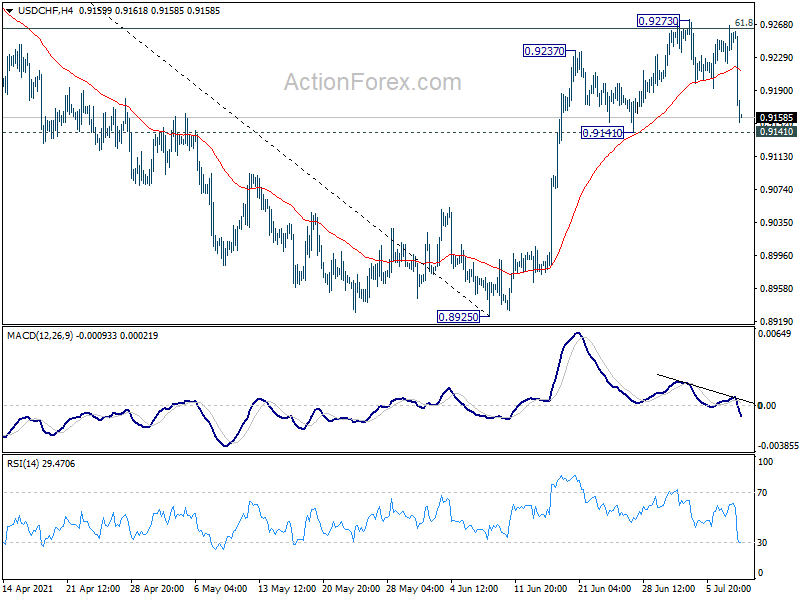
USD/CHF falls sharply today but stays above 0.9141 support. Intraday bias remains neutral at this point first. On the downside, firm break of 0.9141 will argue that whole rebound from 0.8925 has completed. Intraday bias will be turned to the downside for 55 day EMA (now at 0.9115). Sustained break there will pave the way back to retest 0.8925 low. On the upside, though, break of 0.9273 will resume the rally to 0.9471 key resistance instead.
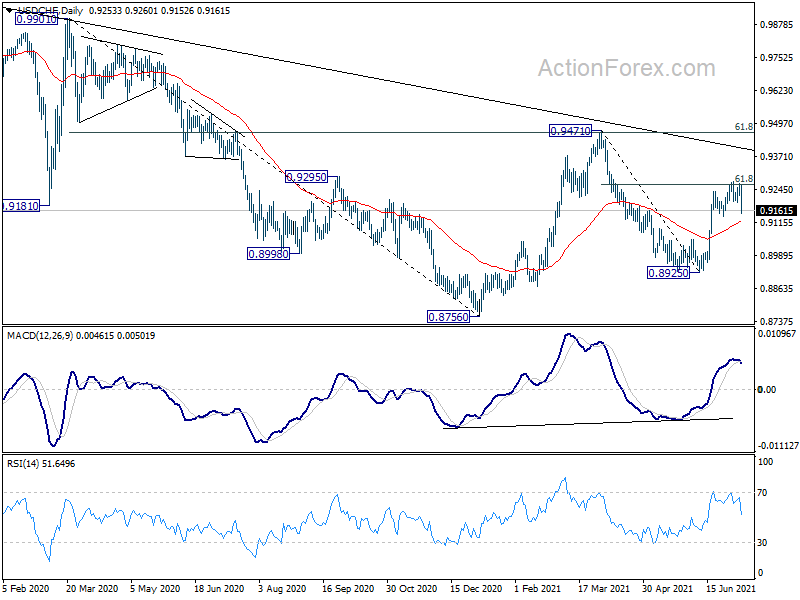
In the bigger picture, medium term outlook is currently neutral with focus on 0.9471 resistance. Sustained break there will indicate completion of whole decline from 1.0342 (2016 high). Medium term outlook will be turned bullish for a test on 1.0342 high. But, rejection by 0.9471 again will revive bearishness for another fall through 0.8756 low.
Swiss Franc and Yen Soar on Deep Risk Averse Sentiment
Risk aversion generally dominates the global markets today. Following selloff in Asia, major European indexes open lower and are trading down around -2%. DOW future is also losing around -500pts. Swiss Franc and Yen are overwhelmingly the strongest ones for the day, as followed by Euro and Dollar. Commodity currencies are the worst performing, Focus will now turn to developments in US stocks and yields, on whether they could "bend up " before closing.
Technically, we'd believe that the key level to watch is 34k handle in DOW, which is slightly below 55 day EMA and medium term trend line support. Sustained break there would at least bring deeper fall back towards 33271.93 support. That might trigger even strong rally in Yen and Franc. However, defending 34k could, at least, help Yen crosses stabilize from the current level.
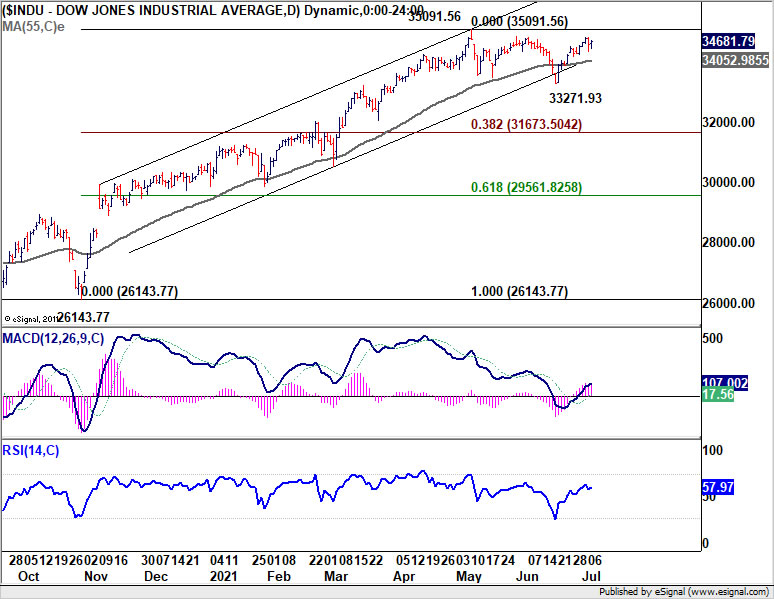
In Europe, at the time of writing, FTSE is down -1.93%. DAX is down -2.01%. CAC is down -2.29%. Germany 10-year yield is down -0.014 at -0.308. Earlier in Asia, Nikkei dropped -0.88%. Hong Kong HSI dropped -2.89%. China Shanghai SSE dropped -0.79%. Singapore Strait Times dropped -1.08%. Japan 10-year JGB yield closed flat at 0.028.
US initial jobless claims rose to 373k, above expectations
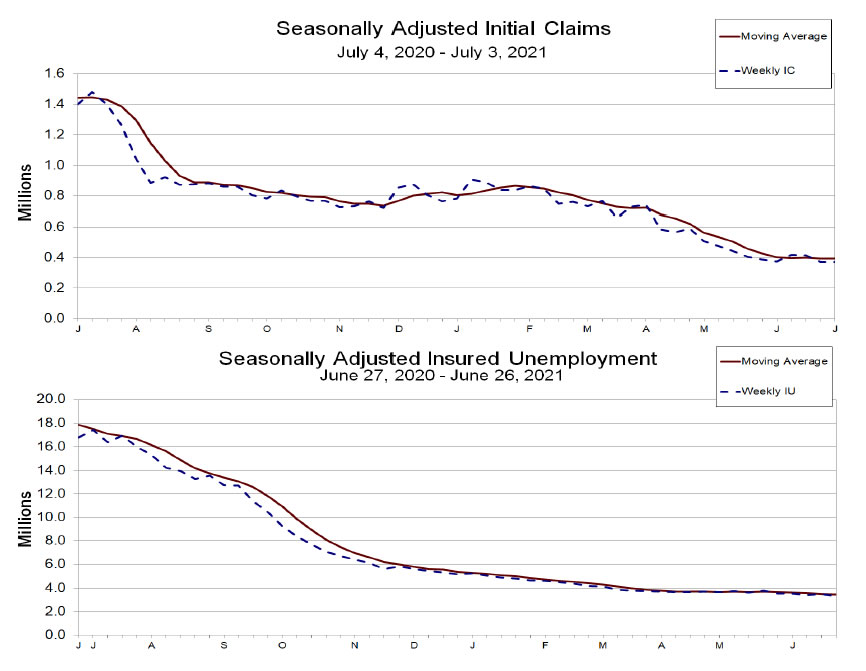
US initial jobless claims rose 2k to 373k in the week ending July 3, above expectation of 355k. Four-week moving average of initial claims dropped -250 to 394.5k, lowest since March 14, 2020.
Continuing claims dropped -145k to 3339k in the week ending June 26, lowest since March 21, 2020. Four-week moving average of continuing claims dropped -44.5k to 3441k, lowest since March 21, 2020.
ECB adopts symmetric 2% inflation target negative and positive deviations equally undesirable
ECB announced to adopts a symmetric 2% inflation target over medium term. Being symmetric meaning "negative and positive deviations of inflation from the target are equally undesirable".
"When the economy is operating close to the lower bound on nominal interest rates, it requires especially forceful or persistent monetary policy action to avoid negative deviations from the inflation target becoming entrenched," ECB said. "This may also imply a transitory period in which inflation is moderately above target."
Also, HICP will remain the appropriate price measures, while the Governing Council recommends inclusion of owner-occupied housing over time.
President Christine Lagarde said, "The new strategy is a strong foundation that will guide us in the conduct of monetary policy in the years to come."
RBA Lowe wants to see results, not forecast, for rate hikes
In a speech, RBA Governor Philip Lowe said, it is "not enough" for inflation to be "forecast" in the rate of 2-3% target for the central bank to lift interest rates. He emphasized, "We want to see results before we change interest rates". Also, "the bond purchases will end prior to any increase in the cash rate".
He added that for inflation be sustainably in target rate, it's like that "wage growth will need to exceed 3 per cent". It will take "until 2024" for inflation to be sustainably within the target range.
Lowe also emphasized that "the condition for an increase in the cash rate depends upon the data, not the date; it is based on inflation outcomes, not the calendar." Also, the tapering to AUD 4B purchase in bonds a week "does not represent a withdrawal of support".
A look at falling AUD/JPY and GBP/CHF as risk aversion intensifies
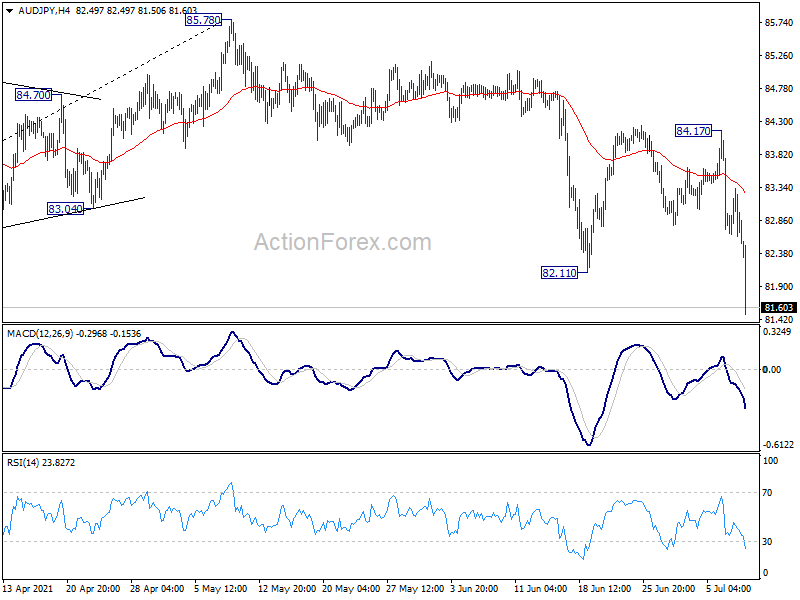
Risk aversion comes back again today, as led by the -807pts, or -2.89%, free fall in Hong Kong HSI. In the currency markets, Yen and Swiss Franc are currently the strongest ones.
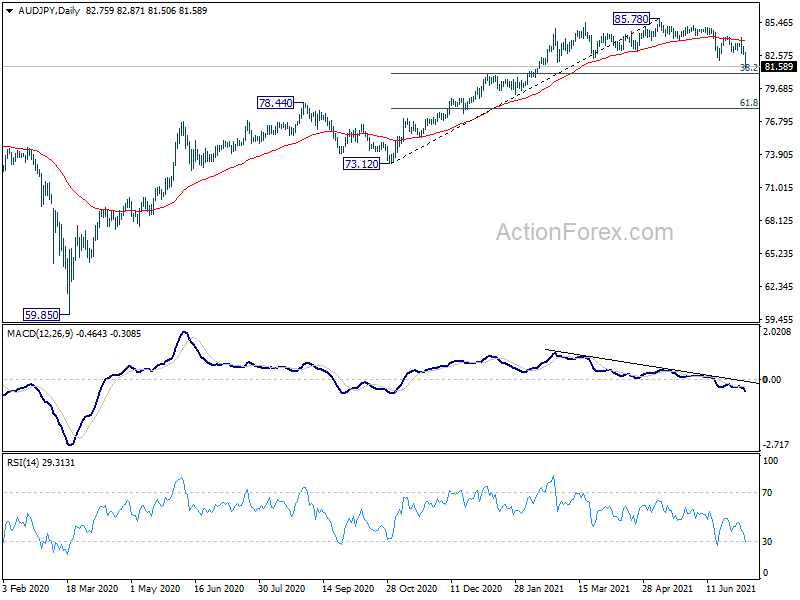
AUD/JPY breaks through 82.11 support to as low as 81.50 so far, resuming whole decline from 85.78. Rejection by 55 day EMA is a clear sign of near term bearishness. Such decline is seen as correcting the rise from 73.12 for the moment. Hence, we'd look for strong support from 38.2% retracement of 73.12 to 85.78 at 80.94 to contain downside and bring rebound. However, sustained break of 80.94 will argue that it's indeed correcting whole up trend from 59.85 and target 73.12/78.44 support zone.
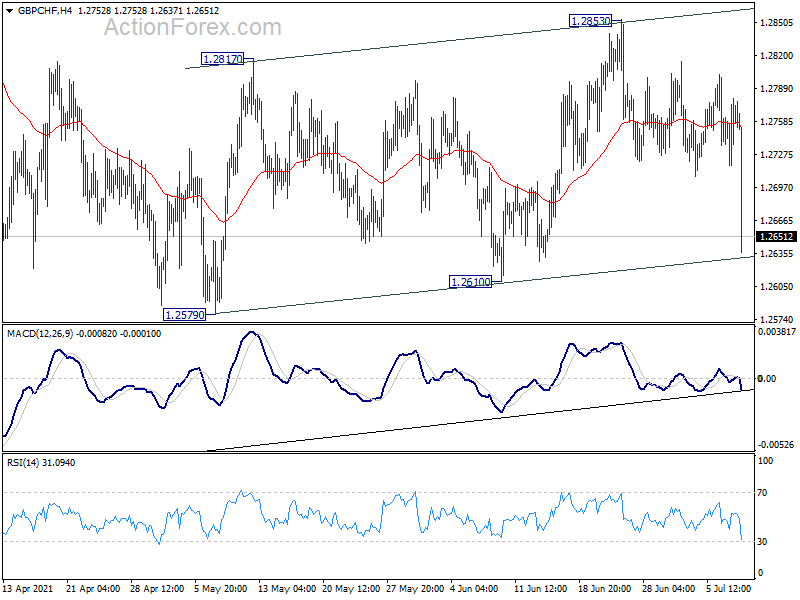
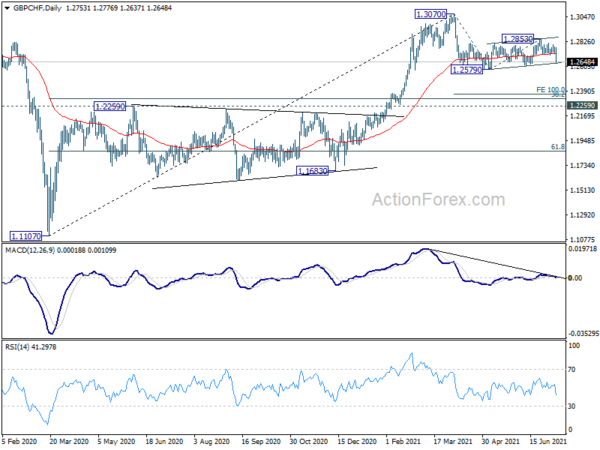
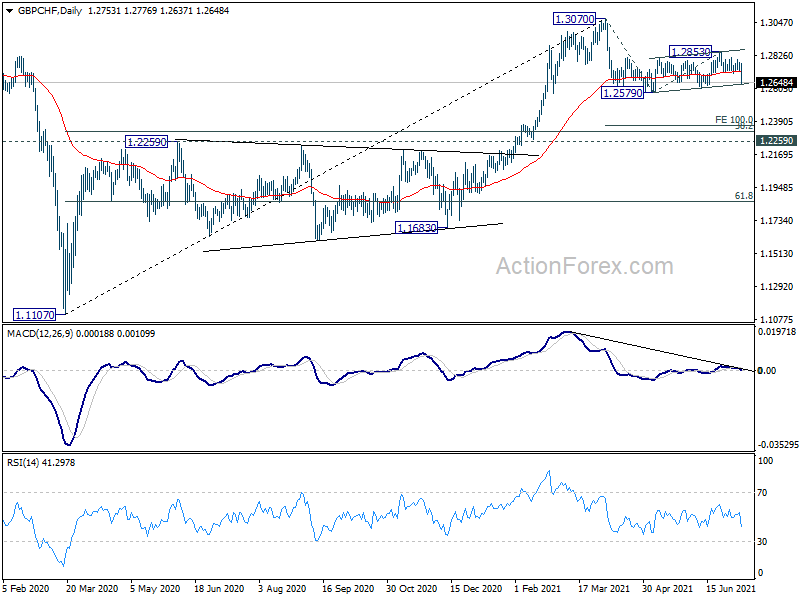
GBP/CHF's sharp fall today now argues that consolidation from 1.2579 might have completed with three waves up to 1.2853. Immediate focus is now on 1.2579/2610 support zone. Decisive break there will confirm this bearish case and target 100% projection of 1.3070 to 1.2579 from 1.2853 at 1.2362. At this point, we'd expect strong support around 1.2259 resistance turned support to contain downside and bring rebound.
 USD/CHF Mid-Day Outlook
Daily Pivots: (S1) 0.9231; (P) 0.9249; (R1) 0.9276; More....
USD/CHF falls sharply today but stays above 0.9141 support. Intraday bias remains neutral at this point first. On the downside, firm break of 0.9141 will argue that whole rebound from 0.8925 has completed. Intraday bias will be turned to the downside for 55 day EMA (now at 0.9115). Sustained break there will pave the way back to retest 0.8925 low. On the upside, though, break of 0.9273 will resume the rally to 0.9471 key resistance instead.
In the bigger picture, medium term outlook is currently neutral with focus on 0.9471 resistance. Sustained break there will indicate completion of whole decline from 1.0342 (2016 high). Medium term outlook will be turned bullish for a test on 1.0342 high. But, rejection by 0.9471 again will revive bearishness for another fall through 0.8756 low.
Economic Indicators Update
| GMT | Ccy | Events | Actual | Forecast | Previous | Revised |
|---|---|---|---|---|---|---|
| 23:01 | GBP | RICS Housing Price Balance Jun | 83% | 78% | 83% | 82% |
| 23:50 | JPY | Bank Lending Y/Y Jun | 1.40% | 3.00% | 2.90% | 2.80% |
| 23:50 | JPY | Current Account (JPY) May | 1.87T | 1.59T | 1.55T | |
| 05:00 | JPY | Eco Watchers Survey: Current Jun | 47.6 | 41.9 | 38.1 | |
| 05:45 | CHF | Unemployment Rate Jun | 3.10% | 3.00% | 3.00% | |
| 06:00 | EUR | Germany Trade Balance (EUR) May | 12.6B | 15.8B | 15.9B | |
| 12:30 | USD | Initial Jobless Claims (Jul 2) | 373K | 355K | 364K | 371K |
| 14:30 | USD | Natural Gas Storage | 29B | 76B | ||
| 15:00 | USD | Crude Oil Inventories | -4.0M | -6.7M |
US initial jobless claims rose to 373k, above expectations
US initial jobless claims rose 2k to 373k in the week ending July 3, above expectation of 355k. Four-week moving average of initial claims dropped -250 to 394.5k, lowest since March 14, 2020.
Continuing claims dropped -145k to 3339k in the week ending June 26, lowest since March 21, 2020. Four-week moving average of continuing claims dropped -44.5k to 3441k, lowest since March 21, 2020.
DAX: Stocks Dumped As Risk Off Continues
After the S&P 500 hit a new record in the aftermath of the FOMC minutes last night, the markets have gone into a bit of a reverse. Already struggling, Chinese and Japanese shares sold off again during Asian hours, which soured sentiment as European investors started their day. Here, the major indices fell about 1% shortly after the open before extending their declines by mid-morning, with some indices showing losses of more 2% by midday in London. The risk off tone was evidenced elsewhere, too, with US futures, crude oil and copper prices all weakening. Safe-haven currencies – the Japanese yen and Swiss franc – rallied, while risk-sensitive commodity dollars and EM currencies slumped. Bond prices continued to rise, causing their yields to fall further with the 10-year US Treasury dipping to 1.25%, its lowest since 16 February. The falling yields weighed on banks with Barclays shedding nearly 4% to make it one of the worst performing stock on the FTSE 100. Gold found some mild support on the back of falling yields and risk-off tone. Will US investors save the day once again and buy this latest dip, or is this the start of a more meaningful correction?
So, what is going on?
This morning certainly, investors didn’t appear to be in a cheerful mood. It looks like optimism over a sharp global recovery has been replaced by mild fears that growth is nearing a peak and that central banks are likely to slowly taper their emergency stimulus measures. Rising cases of the delta variant of Covid-19 has weighed on the recovery prospects, with Japan officially declaring state of emergency for Tokyo just two weeks before the Olympics. The drop in yields is indicative of indicative of the death of the reflation trade, and I wonder whether this is to do with a big fall in commodity prices of later. This week’s big drop in oil prices has certainly reduced inflation concerns a little.
Tapering concerns are also weighing on the markets. The FOMC’s last meeting minutes, released Wednesday, more or less confirmed policymakers are ready to taper QE, even though officials still felt that substantial further progress on the US economic recovery "was generally seen as not having yet been met."
Will the markets recover?
Surely if growth concerns rise and the recovery slows down again, the Fed may well delay tapering. What’s more, the European Central Bank is continuing to provide ample monetary stimulus. Today, the latter is expected to announce the outcome of an 18-month strategy review. Most ECB watchers are expecting the central bank to redefine its inflation target. Instead of the current "below but close to 2%,” the central bank is likely to declare a 2% target.
If so, this would effectively raise their inflation goal to 2%, allowing the central bank room to overshoot inflation if and when needed. In other words, the new strategy would allow the ECB to justify sustaining its ultra-loose monetary policy for longer.
Thus, the selling pressure could ease soon as investors realise that central bank support will be there if the economic recovery stalls, or there is a bit of turmoil in the markets.
That being said, things could potentially get uglier before the bargain hunters are tempted to dip their toes in.
DAX breaks down
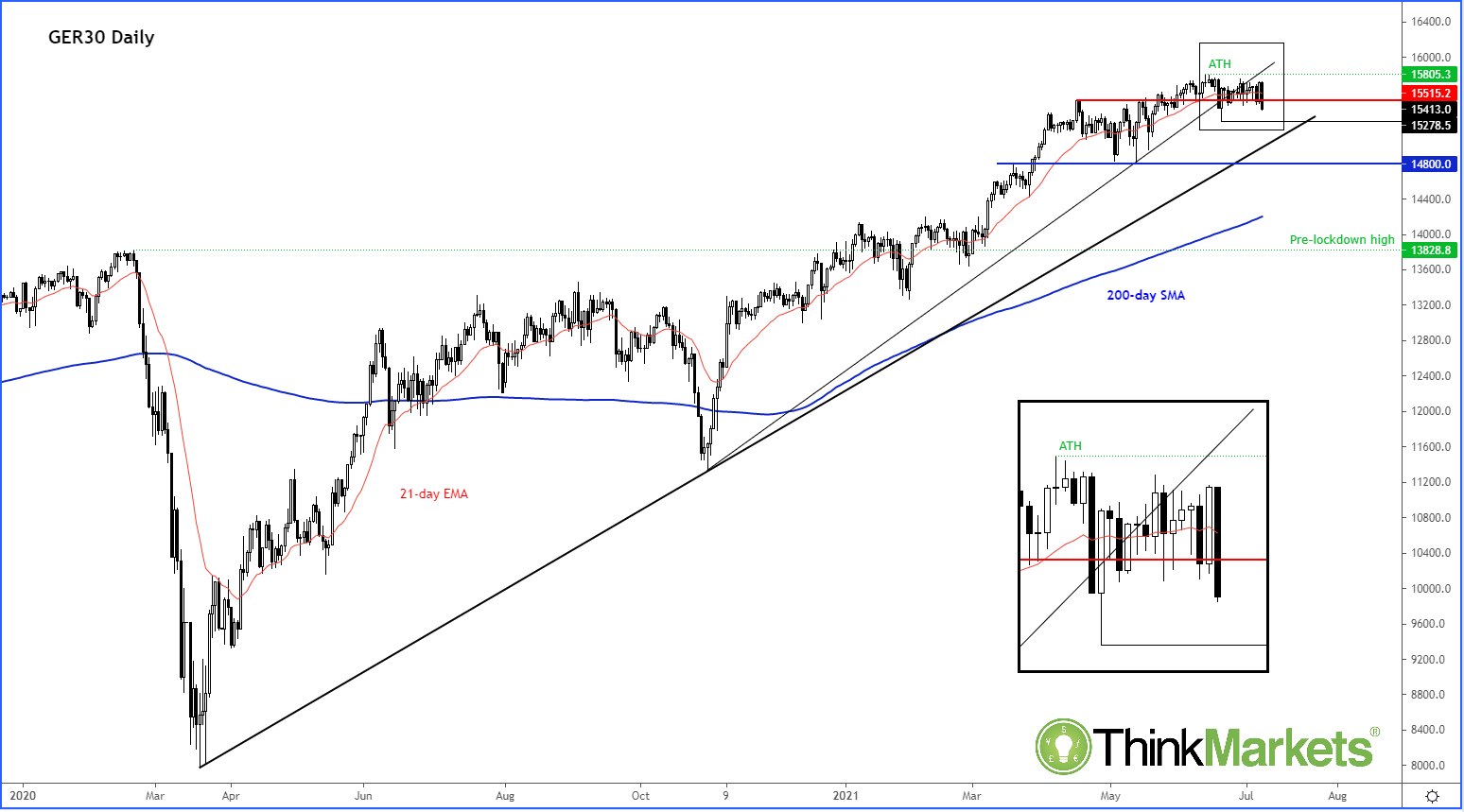
As it is the “ECB day,” let’s keep an eye on the DAX. The German index has just broken out of its recent range, so there is likely to be more downside risks than upside in the short-term outlook. We could see a possible drop to test liquidity beneath 15280 soon. Key resistance now comes in around 15500.
(ECB) The ECB’s Monetary Policy Strategy Statement
- Since the previous strategy review in 2003, the euro area economy and the global economy have been undergoing profound structural changes. Declining trend growth, which can be linked to slower productivity growth and demographic factors, and the legacy of the global financial crisis have driven down equilibrium real interest rates. This has reduced the scope for the European Central Bank (ECB) and other central banks to achieve their objectives by exclusively relying on changes in policy interest rates. In addition, globalisation, digitalisation, the threat to environmental sustainability and changes in the financial system pose challenges for the conduct of monetary policy.
- The monetary policy strategy of the ECB is both guided and bound by its mandate conferred by the Treaty on European Union and the Treaty on the Functioning of the European Union. The primary objective of the ECB is to maintain price stability in the euro area. Without prejudice to the price stability objective, the Eurosystem shall support the general economic policies in the EU with a view to contributing to the achievement of the Union's objectives as laid down in Article 3 of the Treaty on European Union. These objectives include balanced economic growth, a highly competitive social market economy aiming at full employment and social progress, and a high level of protection and improvement of the quality of the environment. The Eurosystem shall also contribute to the smooth conduct of policies pursued by the competent authorities relating to the prudential supervision of credit institutions and the stability of the financial system.
- The Governing Council confirms that the Harmonised Index of Consumer Prices (HICP) remains the appropriate price measure for assessing the achievement of the price stability objective. However, the Governing Council recognises that the inclusion of the costs related to owner-occupied housing in the HICP would better represent the inflation rate that is relevant for households. Recognising that the full inclusion of owner-occupied housing in the HICP is a multi-year project, the Governing Council in its monetary policy assessments will, in the meantime, take into account inflation measures that include initial estimates of the cost of owner-occupied housing in its wider set of supplementary inflation indicators.
- An inflation buffer above zero per cent provides monetary policy with space for interest rate cuts in the event of adverse developments and a safety margin against the risk of deflation through its positive impact on the trend level of nominal interest rates. The experience gained since 2003 has reinforced the macroeconomic importance of an inflation buffer. In particular, the pronounced trend decline in the equilibrium real interest rate, if persistent, implies that the effective lower bound on nominal interest rates will more frequently constrain the conduct of monetary policy. The facilitation of cross-country macroeconomic adjustment within the euro area, downward nominal wage rigidities and measurement bias also warrant an inflation buffer.
- The Governing Council considers that price stability is best maintained by aiming for two per cent inflation over the medium term. The Governing Council's commitment to this target is symmetric. Symmetry means that the Governing Council considers negative and positive deviations from this target as equally undesirable. The two per cent inflation target provides a clear anchor for inflation expectations, which is essential for maintaining price stability.
- To maintain the symmetry of its inflation target, the Governing Council recognises the importance of taking into account the implications of the effective lower bound. In particular, when the economy is close to the lower bound, this requires especially forceful or persistent monetary policy measures to avoid negative deviations from the inflation target becoming entrenched. This may also imply a transitory period in which inflation is moderately above target.
- The Governing Council confirms the medium-term orientation of its monetary policy strategy. This allows for inevitable short-term deviations of inflation from the target, as well as lags and uncertainty in the transmission of monetary policy to the economy and to inflation. The flexibility of the medium-term orientation takes into account that the appropriate monetary policy response to a deviation of inflation from the target is context-specific and depends on the origin, magnitude and persistence of the deviation. It also allows the Governing Council in its monetary policy decisions to cater for other considerations relevant to the pursuit of price stability.
- The ECB is committed to setting its monetary policy to ensure that inflation stabilises at its two per cent target in the medium term. The primary monetary policy instrument is the set of ECB policy rates. In recognition of the effective lower bound on policy rates, the Governing Council will also employ in particular forward guidance, asset purchases and longer-term refinancing operations, as appropriate. The Governing Council will continue to respond flexibly to new challenges as they arise and consider, as needed, new policy instruments in the pursuit of its price stability objective.
- The Governing Council bases its monetary policy decisions, including the evaluation of the proportionality of its decisions and potential side effects, on an integrated assessment of all relevant factors. This assessment builds on two interdependent analyses: the economic analysis and the monetary and financial analysis. Within this framework, the economic analysis focuses on real and nominal economic developments, whereas the monetary and financial analysis examines monetary and financial indicators, with a focus on the operation of the monetary transmission mechanism and the possible risks to medium-term price stability from financial imbalances and monetary factors. The pervasive role of macro-financial linkages in economic, monetary and financial developments requires that the interdependencies across the two analyses are fully incorporated. This framework reflects the changes that the ECB's economic analysis and monetary analysis have undergone since 2003, the importance of monitoring the transmission mechanism in calibrating monetary policy instruments and the recognition that financial stability is a precondition for price stability.
- Climate change has profound implications for price stability through its impact on the structure and cyclical dynamics of the economy and the financial system. Addressing climate change is a global challenge and a policy priority for the EU. Within its mandate, the Governing Council is committed to ensuring that the Eurosystem fully takes into account, in line with the EU's climate goals and objectives, the implications of climate change and the carbon transition for monetary policy and central banking. Accordingly, the Governing Council has committed to an ambitious climate-related action plan. In addition to the comprehensive incorporation of climate factors in its monetary policy assessments, the Governing Council will adapt the design of its monetary policy operational framework in relation to disclosures, risk assessment, corporate sector asset purchases and the collateral framework.
- The communication of monetary policy decisions through the Monetary Policy Statement, the press conference, the Economic Bulletin and the monetary policy accounts will be adapted to reflect the revised monetary policy strategy. These products will be complemented by layered and visualised versions of monetary policy communication geared towards the wider public, which is essential for ensuring public understanding of and trust in the actions of the ECB. Drawing on the successful experience with the listening events held during the strategy review, the Governing Council intends to make outreach events a structural feature of the Eurosystem's interaction with the public.
- The Governing Council intends to assess periodically the appropriateness of its monetary policy strategy, with the next assessment expected in 2025
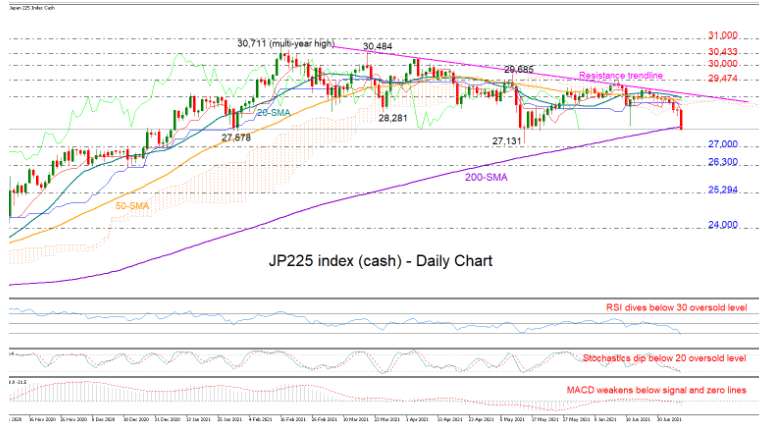
JP 225 Index Plummets To Test 200-Day SMA
Japan's 225 stock index (cash) slumped by more than 2.0% to the lowest since May 13 in the wake of the news that Japan will resume the state of emergency in Tokyo ahead of the Olympic games.
The 200-day simple moving average (SMA) is currently under examination around 27,740 and near a key support region for the first time in a year as the RSI and the Stochastics dip in the oversold area. The rampant negative momentum in the MACD is also promoting additional bearish corrections.
Should the 200-day SMA give way, the sell-off could spiral towards the 27,000 level, while lower, the index may consolidate around 26,300 before another sharp correction takes place to 25,294.
On the upside, the downward-sloping trendline drawn from the March peaks will remain the key for boosting buying confidence towards June's high of 29,474. If bullish pressures dominate from here, the index may push harder to go through the crucial 30,000 – 30,711 resistance region and print fresh multi-year highs near the 31,000 psychological level.
In brief, the JP 225 index is at risk of shaping another downside correction, with the confirmation coming around the 200-day SMA and the 27,740 number.
ECB adopts symmetric 2% inflation target negative and positive deviations equally undesirable
ECB announced to adopts a symmetric 2% inflation target over medium term. Being symmetric meaning "negative and positive deviations of inflation from the target are equally undesirable".
"When the economy is operating close to the lower bound on nominal interest rates, it requires especially forceful or persistent monetary policy action to avoid negative deviations from the inflation target becoming entrenched," ECB said. "This may also imply a transitory period in which inflation is moderately above target."
Also, HICP will remain the appropriate price measures, while the Governing Council recommends inclusion of owner-occupied housing over time.
President Christine Lagarde said, "The new strategy is a strong foundation that will guide us in the conduct of monetary policy in the years to come."
Global Yields Move Lower
Notes/Observations
- ECB to announce the results of its strategic review but its monetary policy likely to remain ultra-loose for some time.
- Risk aversion sentiment finding footing as concern over rising coronavirus cases in various countries.
Asia
- China Sec Journal noted that PBoC might cut its RRR during Sept to help the economy, 'targeted' RRR cut might be implemented at the end of Q3.
- China PBOC Deputy Gov Fan stated that PBOC to take more antitrust actions in the payments sector (similar to measures placed on Ant); Worried about stablecoin impact on global.
currency
- RBA Gov Lowe reiterated forward guidance that it would take to 2024 to reach conditions to adjust rates.
Europe
- ECB Strategy Review said to agree to set a new inflation target of 2% (from "below but close to 2%") and to allow for some overshoot of the new inflation goal.
- Bank of France raised its Q2 GDP forecast from 0.5% to 1.0%. Noted that the economy was recovering a little faster than expected.
Americas
- FOMC Jun Minutes noted that indicators of economic activity and employment had strengthened. Participants remarked that the actual rise in inflation was larger than anticipated. A substantial majority of participants judged that the risks to their inflation projections were tilted to the upside because of concerns that supply disruptions and labor shortages might linger for longer. Members generally expected inflation to ease as the effect of these transitory factors dissipated, but several participants remarked that they anticipated that supply chain limitations and input shortages would put upward pressure on prices into next year. Various participants saw taper somewhat earlier than anticipated (Note: Analysts noted afterward that Fed officials kept a patient tone in terms of tightening monetary policy).
- Fed's Bostic (FOMC voter, hawk) noted that a premature rate increase would weigh on the economy but moving late could destabilizing the economy and financial system. The goal would be for the balance sheet to become 'proportionately smaller in relation to the economy once the crisis is past.
Energy
- Weekly API Crude Oil Inventories: -8.0M v -8.2M prior (7th straight weekly draw).
Speakers/Fixed income/FX/Commodities/Erratum
Equities
- Indices [Stoxx600 -1.9% at 4,002, FTSE -1.3% at 7,056, DAX -1.4% at 15,482, CAC-40 -1.9% at 6,407, IBEX-35 -2.2% at 8,661, FTSE MIB -2.0% at 24,785, SMI -1.2% at 11,938, S&P 500 Futures -1.1%].
- Market Focal Points/Key Themes: European indices open lower across the board and fell deeper in the red as the session wore on; better-performing sectors include financials and industrials; sectors leading to the downside include real estate and energy; Knorr-Bremse assists in acquiring a stake in Hella; Logitech to replace Swatch on SMI; focus on the release of ECB strategy review; no major earnings releases expected in the upcoming US session.
Equities
- Consumer discretionary: B&M European Value Retail BME.UK -3.0% (results), Deliveroo ROO.UK +3.7% (trading update), Entain ENT.UK +1.8% (trading update), Persimmon PSN.UK.
- 2.7% (results).
- Consumer staples: Watches of Switzerland WOSG.UK -2.1% (results).
- Energy: TGS TGS.NO -9.3% (prelim results).
- Financials: Danske Bank DANSKE.DK +3.3% (raises outlook).
- Industrials: Hella HLE.DE -2.2% (Knorr Bremse to not invest), Knorr-Bremse KBX.DE +6.1% (won't take stake in Hella), Komax KOMN.CH +10.6% (guidance), Stellantis STLA.NL -3.3% (investor day).
- Technology: Betsson BETSB.SE +7.6% (results), TeamViewer TMV.DE -12.9% (results).
Speakers
- UK Chancellor of the Exchequer Sunak (Fin Min) stated that govt plans for jobs was working as unemployment had been far lower than feared.
- Russia Fin Min Siluanov stated that the carbon tax could impact the Russian budget due to falling revenues during the energy transition.
- Russia Central Bank official Tremasov stated that 2021 GDP growth likely over 4%.
- Romania PM Orban said to dismiss Fin Min City.
- Japan PM Suga confirmed the new State of Emergency for the Tokyo area; effective from July 12th thru Aug 22nd.
- BOJ said to offer zero rate long-term loans as part of its climate scheme.
- Malaysia Central Bank (BNM) Policy Statement noted that renewed pandemic measures to dampen growth momentum while favorable external demand to increase growth. Headline inflation likely to be closer to the lower end of the forecast range of 2.5-4.0%. Underlying inflation to remain subdued amid continued spare capacity in the economy. The recent spike in inflation seen as transitory; will moderate in near term as low base effect dissipated.
- China Commerce Ministry (MOFCOM) spokesperson Gao Feng stated that EU-China were making technical preparations for an investment agreement.
Currencies/Fixed Income
- USD maintained its recent strength against the European majors as the Jun FOMC Minutes suggested tapering of asset purchases might start earlier than expected due to a stronger economic outlook. Dealers did note that Fed officials did keep a patient tone in terms of tightening monetary policy.
- EUR/USD hovering around the 1.18 level. Dealers eyeing the official release of the ECB’s strategy review but the most important aspect has been already leaked. Strategy Review said to agree to set new inflation target of 2% (from "below but close to 2%") and to allow for some overshoot of the new inflation goal. Dealers believe that ECB’s monetary policy likely to remain ultra-loose for some time.
- USD/JPY was lower on safe-haven flows. Dealers did later suspect the latest state of emergency in Tokyo to counter a rising wave of infections would deal a blow to the recovery and boost the chances of a stimulus package.
- Yield broadly lower globally. China 10-year yield below 3.0%; US 30-year below 1.90% for a 5-month low.
Economic data
- (SE) Sweden May Maklarstatistik Housing Prices Y/Y: 20% v 20% prior; Apartment Prices Y/Y: 13% v 13% prior.
- (NL) Netherlands Jun CPI M/M: 0.2% v 0.1% prior; Y/Y: 2.0% v 2.1% prior.
- (NL) Netherlands Jun CPI EU Harmonized M/M: 0.1% v 0.1% prior; Y/Y: 1.7% v 1.8%e.
- (CH) Swiss Jun Unemployment Rate: 2.8% v 2.9%e; Unemployment Rate (seasonally adj): 3.1% v 2.9%e.
- (DE) Germany May Current Account Balance: €13.1B v €21.0B prior; Trade Balance: €12.3B v €15.1Be; Exports M/M: 0.3% v 0.6%e; Imports M/M: 3.4% v 0.4%e.
- (FI) Finland May Preliminary Trade Balance: -€0.2B v -€0.3B prior.
- (RO) Romania Q1 Final GDP (3rd reading) Q/Q: 2.9% v 2.8% prelim; Y/Y: -0.2% v -0.2%e.
- (MY) Malaysia Central Bank (BNM) left the Overnight Policy Rate unchanged at 1.75% (as expected).
- (CZ) Czech May Retail Sales Y/Y: 16.5% v 15.7%e; Retail Sales (ex-auto) Y/Y: 8.1% v 3.0%e.
- (HU) Hungary Jun CPI M/M: 0.6% v 0.2%e; Y/Y: 5.3% v 4.9%e (3rd month with annual pace above target range).
Fixed income Issuance
- None seen.
Looking Ahead
- (PL) Poland Central Bank (NBP) Interest Rate Decision: Expected to leave Base Rate unchanged at 0.10%.
- (IE) Ireland Debt Agency (NTMA) to sell €1.0-1.5B in 2026, 2031 and 2035 IGB bonds.
- (CO) Colombia Jun Consumer Confidence Index: -26.1e v -34.3 prior.
- 05:25 (EU) Daily ECB Liquidity Stats.
- 05:30 (HU) Hungary Debt Agency (AKK) to sell debt.
- 06:00 (IE) Ireland Jun CPI M/M: No est v 0.1% prior; Y/Y: No est v 1.7% prior.
- 06:00 (IE) Ireland Jun CPI EU Harmonized M/M: No est v 0.2% prior; Y/Y: No est v 1.9% prior.
- 06:45 (US) Daily Libor Fixing.
- 07:00 (MX) Mexico Jun CPI M/M: 0.5%e v 0.2% prior; Y/Y: 5.9%e v 5.9% prior; CPI Core M/M: 0.6%e v 0.5% prior.
- 07:30 (EU) ECB account of Jun 10th Meeting (Minutes).
- 08:00 (CL) Chile Jun CPI M/M: 0.3%e v 0.3% prior; Y/Y: 4.1%e v 3.6% prior.
- 08:00 (BR) Brazil Jun IBGE Inflation IPCA M/M: 0.6%e v 0.8% prior; Y/Y: 8.4%e v 8.1% prior.
- 08:00 (UK) Daily Baltic Dry Bulk Index.
- 08:30 (US) Initial Jobless Claims: 350Ke v 364K prior; Continuing Claims: 3.35Me v 3.469M prior.
- 09:00 (RU) Russia Gold and Forex Reserve w/e July 2nd: No est v $592.4B prior.
- 10:00 (MX) Mexico Central Bank (Banxico) Jun Minutes.
- 10:00 (PL) Poland Central Bank Gov Glapinski post rate decision press conference.
- 10:30 (US) Weekly EIA Natural Gas Inventories.
- 11:00 (US) Weekly DOE Oil Inventories.
- 11:30 (US) Treasury to sell 4-Week and 8-Week Bills.
- 12:00 (CA) Canada to sell 3-year notes.
- 15:00 (US) May Consumer Credit: $18.0Be v $18.6B prior.
- 18:00 (NZ) New Zealand Jun Heavy Truckometer M/M: No est v -4.8% prior.
- 19:00 (PE) Peru Central Bank (BCRP) Interest Rate Decision: Expected to leave Reference Rate unchanged at 0.25%.
- 19:50 (JP) Japan Jun M2 Money Supply Y/Y: 6.0%e v 7.9% prior; M3 Money Supply Y/Y: 5.2%e v 6.9% prior.
- 21:00 (PH) Philippines May Trade Balance: -$2.6Be v -$2.7B prior; Exports Y/Y: 33.6%e v 72.1% prior; Imports Y/Y: 49.0%e v 140.9% prior.
- 21:30 (CN) China Jun CPI Y/Y: 1.3%e v 1.3% prior; PPI Y/Y: 8.8%e v 9.0% prior.
- 23:00 (CN) China to sell 30-year upsize Bond.
- 23:30 (JP) Japan to sell 3-Month Bills.