

Sample Category Title
USD/JPY Mid-Day Outlook
Daily Pivots: (S1) 146.62; (P) 147.60; (R1) 148.37; More...
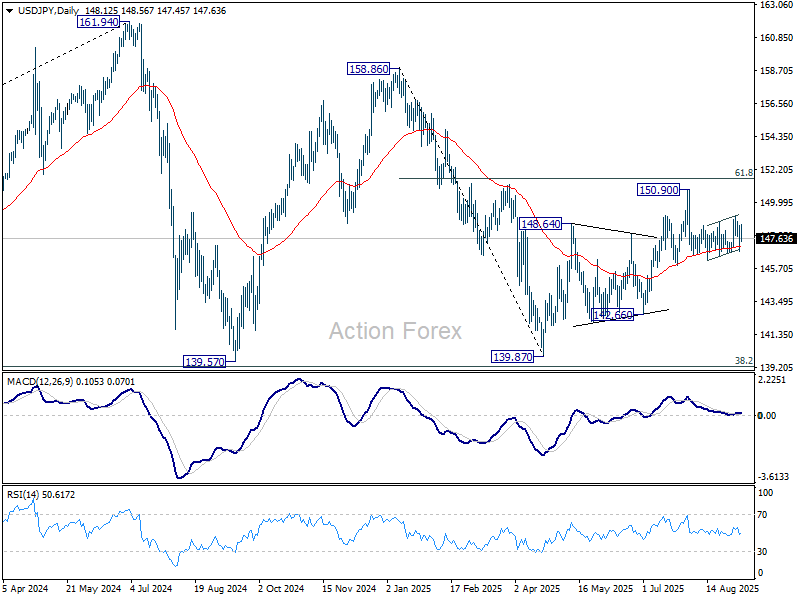
Intraday bias in USD/JPY stays neutral for the moment. On the downside, break of 146.65 will suggest that fall from 150.90 is resuming. More importantly, sustained trading below 55 D EMA (now at 147.15) will argue that whole rebound from 139.87 has completed with three waves up to 150.90. Deeper decline should then be seen to 142.66 support next. However, break of 149.12 will turn bias back to the upside for retesting 150.90.
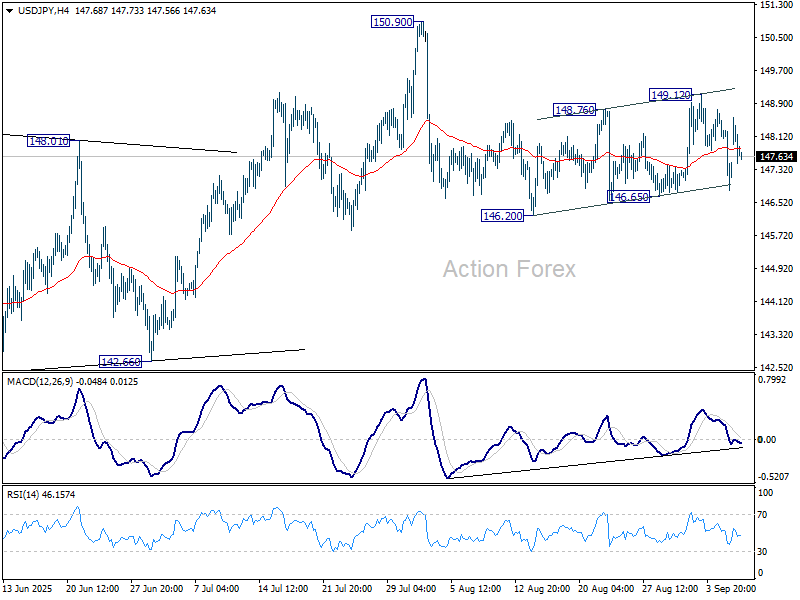
In the bigger picture, price actions from 161.94 (2024 high) are seen as a corrective pattern to rise from 102.58 (2021 low). Decisive break of 61.8% retracement of 158.86 to 139.87 at 151.22 will argue that it has already completed with three waves at 139.87. Larger up trend might then be ready to resume through 161.94 high. In case the corrective pattern extends with another fall, strong support is expected from 38.2% retracement of 102.58 to 161.94 at 139.26 to bring rebound.
EUR/CHF Mid-Day Outlook
Daily Pivots: (S1) 0.9334; (P) 0.9366; (R1) 0.9381; More....
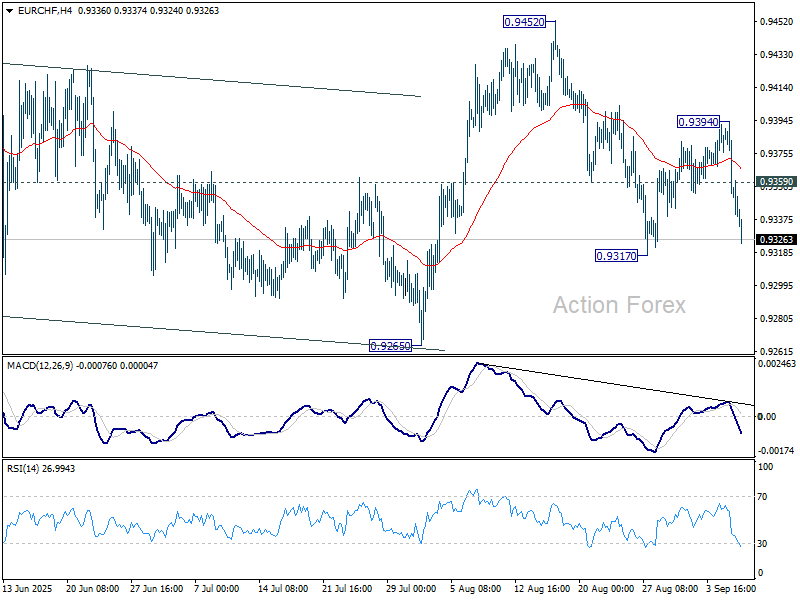
EUR/CHF's fall from 0.9394 accelerates lower today and intraday bias stays on the downside for 0.9371. Firm break there will solidify the bearish case that corrective pattern from 0.9218 has completed with three waves up to 0.9452 already. Deeper fall should then be seen to 0.9265 support, and then 0.9204 low. On the upside, above 0.9359 minor resistance will turn intraday bias neutral first. But risk will stay on the downside as long as 0.9394 resistance holds, in case of recovery.
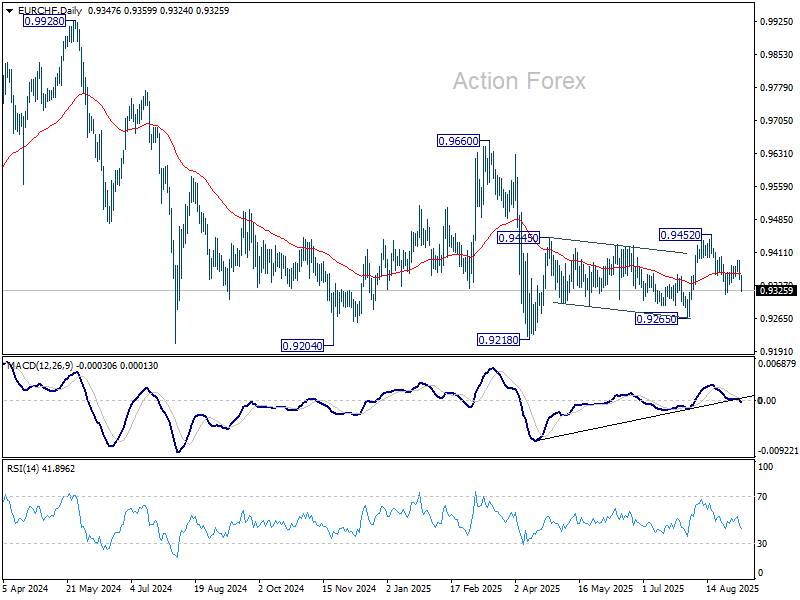
In the bigger picture, the down trend from 0.9204 (2018 high) might still be in progress considering that EUR/CHF is staying well inside the long term falling channel. However, with bullish convergence condition in W MACD, downside potential should be limited in case of another fall. Instead, firm break of 0.9660 resistance will be an important sign of medium term bullish trend reversal.
Euro Soft as France Faces Confidence Vote, Yen Weak Despite Recovery
Euro turned softer against both Sterling and Swiss Franc today as investors shifted focus to France ahead of a key confidence vote. While Thursday’s ECB rate decision dominates the week’s agenda, political instability in Paris could add fresh downside risk to the single currency.
Prime Minister François Bayrou’s minority government faces almost certain defeat in a no-confidence vote later in the day. If the government falls, it would mark the second collapse in less than a year following the implosion of Michel Barnier’s administration last December. President Emmanuel Macron would then be forced to appoint his fifth prime minister in under two years, a rapid turnover that has undermined investor confidence and compounded concerns over French fiscal credibility.
Beyond France, attention is also turning back to Japan following Prime Minister Shigeru Ishiba’s resignation over the weekend. The leadership race is shaping up between former economic security minister Sanae Takaichi and agriculture minister Shinjiro Koizumi. A recent Nikkei poll showed Takaichi narrowly ahead, with 23% support against Koizumi’s 22%.
If elected, Takaichi would be Japan’s first female prime minister and is viewed as a staunch supporter of “Abenomics.” Her opposition to BoJ rate hikes and advocacy of larger fiscal stimulus have drawn investor attention, as markets weigh the potential implications for policy continuity. Analysts highlight her strong team of bureaucratic allies as a key advantage.
Overall in the currency markets, Yen managed a partial rebound today but remains the weakest currency on the board, followed by Dollar and Euro. Kiwi leads gains, trailed by the Aussie and Swiss Franc. Sterling and Loonie are holding mid-range.
Elsewhere, oil prices rebounded as traders judged OPEC+’s latest output hike to be modest. The group agreed to raise production by 137,000 barrels per day from October, well below prior monthly increases. Also, many members were already exceeding quotas, suggesting the headline boost may add little new supply. Concerns over additional sanctions on Russian crude added to the upward pressure too.
In Europe, at the time of writing, FTSE is up 0.19%. DAX is up 0.43%. CAC is up 0.52%. UK 10-year yield is down -0.022 at 4.631. Germany 10-year yield is down -0.017 at 2.653. Earlier in Asia, Nikkei rose 1.45%. Hong Kong HSI rose 0.85%. China Shanghai SSE rose 0.38%. Singapore Strait times rose 0.03%. Japan 10-year JGB yield fell -0.008 to 1.568.
Eurozone Sentix confidence sinks to five-month low, summer optimism disintegrating at rapid pace
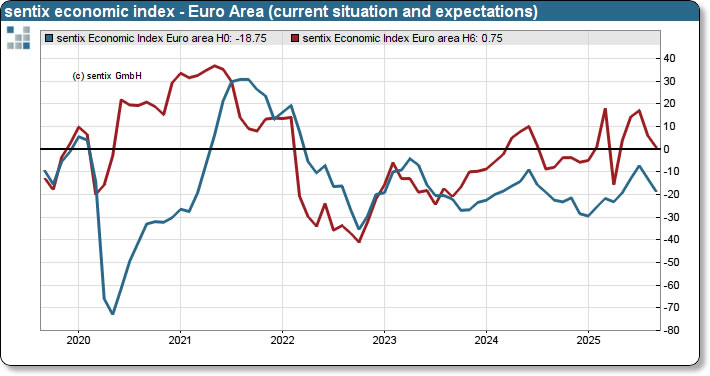
Eurozone investor sentiment deteriorated sharply in September, with the Sentix Confidence Index falling from -3.7 to -9.2, well below expectations of -1.1 and the weakest since April. Current Situation Index weakened to -18.8 from -13.0, while Expectations tumbled to 0.8 from 6.0.
Germany was the clear weak spot. Its investor confidence plunged from -12.8 to -22.1, while Current Situation gauge collapsed from -29.0 to -39.0. Expectations turned negative again, falling from 5.0 to -3.5, highlighting growing pessimism about Europe’s largest economy emerging from recession.
Sentix attributed the downturn to a mix of political and external headwinds: government instability in France, persistent weakness in German industry, an unfavorable tariffs arrangement with the US, and the ongoing war in Ukraine. These factors, it said, are exerting an “oppressive effect” on Eurozone sentiment.
The institute warned that summer optimism has “disintegrated at a rapid pace” and sees little sign of an autumn rebound. With export-oriented sectors facing more pressure under U.S. tariffs and rising concern over sovereign debt — particularly in France — the outlook for the Eurozone remains fragile heading into year-end.
China exports growth slows in August, US flows collapse -33% yoy
China’s trade report for August showed growing pressure from U.S. tariffs. Exports rose 4.4% yoy, below expectations of 5.0% yoy and the slowest pace in six months. Shipments to the U.S. plunged -33.1% yoy, while flows to Southeast Asia jumped 22.5% yoy, suggesting exporters may be rerouting goods through regional partners to cushion losses.
Imports also disappointed, rising just 1.3% yoy versus forecasts of 4.1% yoy. Imports from the U.S. dropped -16% yoy, reflecting both weaker domestic demand and the bite of tariffs. Still, the overall trade surplus widened from USD 98.2B to USD 102.3 B, beating expectations of USD 99.4B.
While the surplus provides headline support, the underlying dynamics are fragile. U.S. President Donald Trump has already threatened a 40% penalty tariff on goods deemed to be transshipped from China, raising questions about how long exporters can sustain the ASEAN workaround. Besides, economists warn that once U.S. tariffs rise above 35%, they become prohibitively high for many Chinese manufacturers.
Washington and Beijing extended their tariff truce by 90 days on August 11, locking in 30% U.S. duties on Chinese goods and 10% Chinese tariffs on U.S. exports. But with no path yet beyond the pause, uncertainty lingers over whether China can maintain export growth as tariff pressure intensifies.
Aussie strength meets Loonie weakness, AUD/CAD targets 0.9128 and above
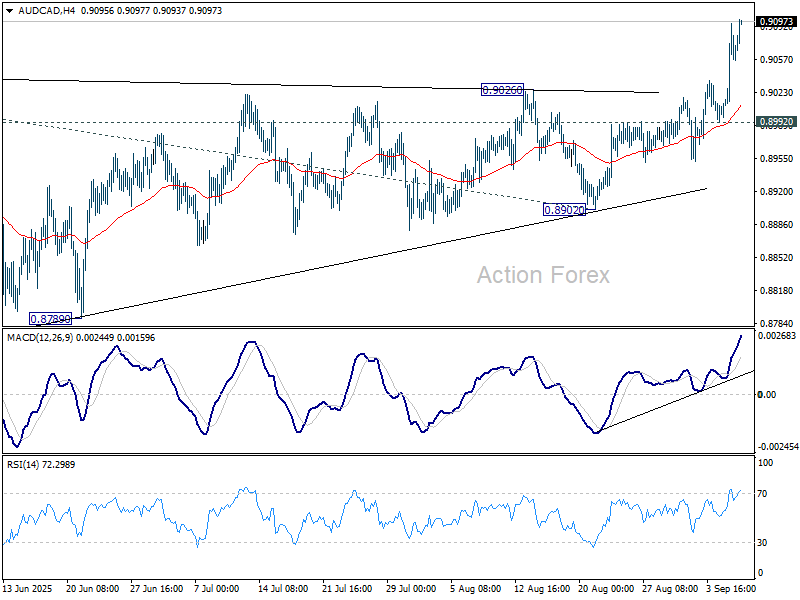
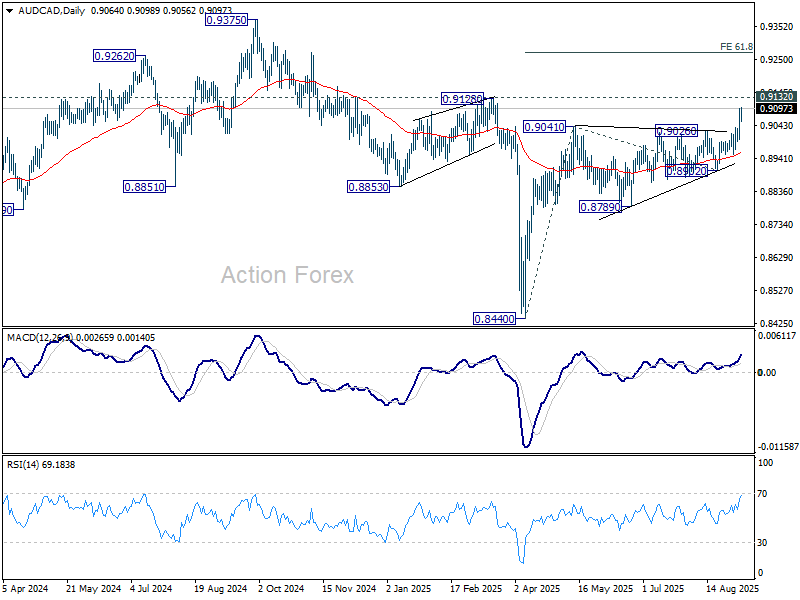
AUD/CAD resumed its rally from 0.8440 last week, breaking decisively through 0.9041 resistance level. The move reflects diverging fundamentals between Canadian Dollar, which is weighed down by weak domestic data, and Australian Dollar, which is drawing support from stronger consumption and external demand.
For Loonie, the trigger was August’s disappointing jobs report, which reignited expectations that the BoC will resume easing at its September 17 meeting. While markets have not fully priced a rate cut yet, sentiment is shifting toward renewed stimulus. Still, policymakers are likely to wait for the August CPI release on September 16 before making the final call.
Underlying inflation dynamics remain sticky, with CPI common holding at 2.6% yoy for a third consecutive month in July. That has kept some uncertainty in market pricing. But once tariff-driven price pressures ease, the BoC will have scope to bring rates down from the current 2.75% to around 2.00%.
In contrast, the RBA’s easing path looks less certain. Strong consumption data prompted Governor Michele Bullock to caution that fewer cuts may ultimately be delivered. The Australian Dollar has also found support from a sharp rally in Chinese equities, which has helped stabilize sentiment around regional growth prospects.
Technically, AUD/CAD's rise from 0.8440 should be reversing the whole downtrend from 0.8375. Further rise is expected as long as 0.8992 support holds, to 0.9128 structural resistance first. Firm break there will pave the way to 61.8% projection of 0.8440 to 0.9041 from 0.8902 at 0.9273.
EUR/CHF Mid-Day Outlook
Daily Pivots: (S1) 0.9334; (P) 0.9366; (R1) 0.9381; More....
EUR/CHF's fall from 0.9394 accelerates lower today and intraday bias stays on the downside for 0.9371. Firm break there will solidify the bearish case that corrective pattern from 0.9218 has completed with three waves up to 0.9452 already. Deeper fall should then be seen to 0.9265 support, and then 0.9204 low. On the upside, above 0.9359 minor resistance will turn intraday bias neutral first. But risk will stay on the downside as long as 0.9394 resistance holds, in case of recovery.
In the bigger picture, the down trend from 0.9204 (2018 high) might still be in progress considering that EUR/CHF is staying well inside the long term falling channel. However, with bullish convergence condition in W MACD, downside potential should be limited in case of another fall. Instead, firm break of 0.9660 resistance will be an important sign of medium term bullish trend reversal.
WTI Oil Rallies 1.8% as Russian Supply Concerns Outweigh Modest OPEC + Output Hike
Oil prices have risen as much as 1.8% at the start of the week as Oil pares last week's losses. The rally this morning has come as a surprise to some quarters after eight OPEC + members agreed to lift output by 137,000 bpd from October.
However, the move by OPEC + was seen as more modest than expected and thus saw market participants shrug off the potential consequences. On top of that, markets are focused on the possibility of more sanctions on Russian crude.after Russia hit Ukraine with its biggest air attack since the start of the war.
For now, concerns around Russian supply are keeping Oil prices supported.
Russia-Ukraine Developments
Frederic Lasserre, an expert from the energy trading company Gunvor, stated on Monday that new sanctions against countries that buy Russian oil could disrupt the global oil supply.
This comes after Russia carried out its largest air attack of the Ukraine war over the weekend, which set fire to a government building in Kyiv and killed at least four people, according to Ukrainian officials.
On Sunday, Donald Trump said that several European leaders would visit the U.S. to talk about how to solve the conflict.
Over the weekend, the investment bank Goldman Sachs released a note saying it expects a slightly larger surplus of oil in 2026. They believe that increased oil production in the Americas will be greater than the decrease in supply from Russia and the stronger demand worldwide. Goldman Sachs kept its oil price forecast for 2025 the same, and for 2026, it predicts the average price for Brent crude to be $56 a barrel and for West Texas Intermediate crude to be $52 a barrel.
OPEC + Production Increases as Saudi Arabia Strategy Pivot Continues
OPEC+, a group of major oil producers led by Saudi Arabia, announced a surprise plan to increase oil production. Although this might seem like a risk to a market that already has too much oil, the actual effect on prices will likely be small.
The decision is more about politics. Saudi Arabia is using this to show its leadership, gain a bigger share of the market, and strengthen its relationship with the U.S.
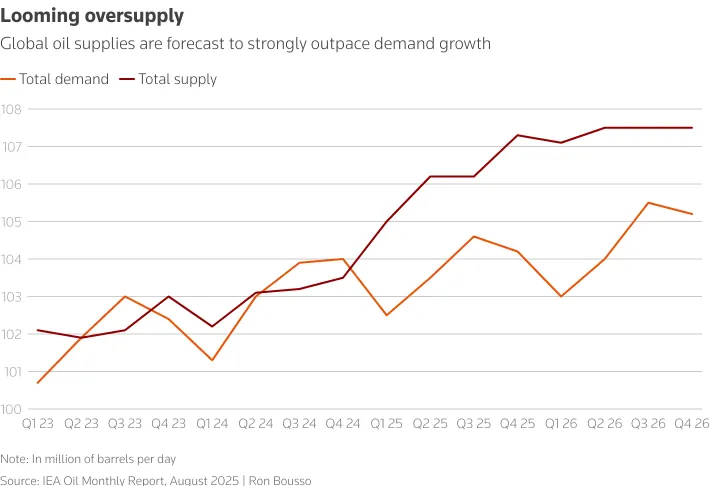
The group agreed to gradually undo 1.65 million barrels per day of production cuts that were supposed to last until the end of 2026. They will increase their output by 137,000 barrels per day in October. At this rate, it will take them a year to fully reverse those cuts.
Source: LSEG
While the market is expected to have a surplus of oil due to increased production from countries like the U.S. and Argentina, the actual amount of new oil added by OPEC+ will probably be less than announced. This is because most members are already producing as much as they can.
However, Saudi Arabia is a major exception. It has a lot of extra production capacity, unlike Russia, which is limited by sanctions. This puts Saudi Arabia in a strong position to increase its market share, especially from U.S. oil companies that may slow down production as prices fall.
This pivot by Saudi Arabia has been something which has been building over the past few months. The strategy does seem to be a sound one and time will tell whether the Saudis will reap the benefits.
For now though, this move may keep further Oil price gains in check as oversupply concerns also remain a concern.
WTI Oil Daily Chart, September 8, 2025
From a technical analysis standpoint, Oil is eyeing a recovery after last week's selloff.
However, the fundm=amentals might continue to keep a prolonged rally in check as uncertainties continue to dominate the agenda.
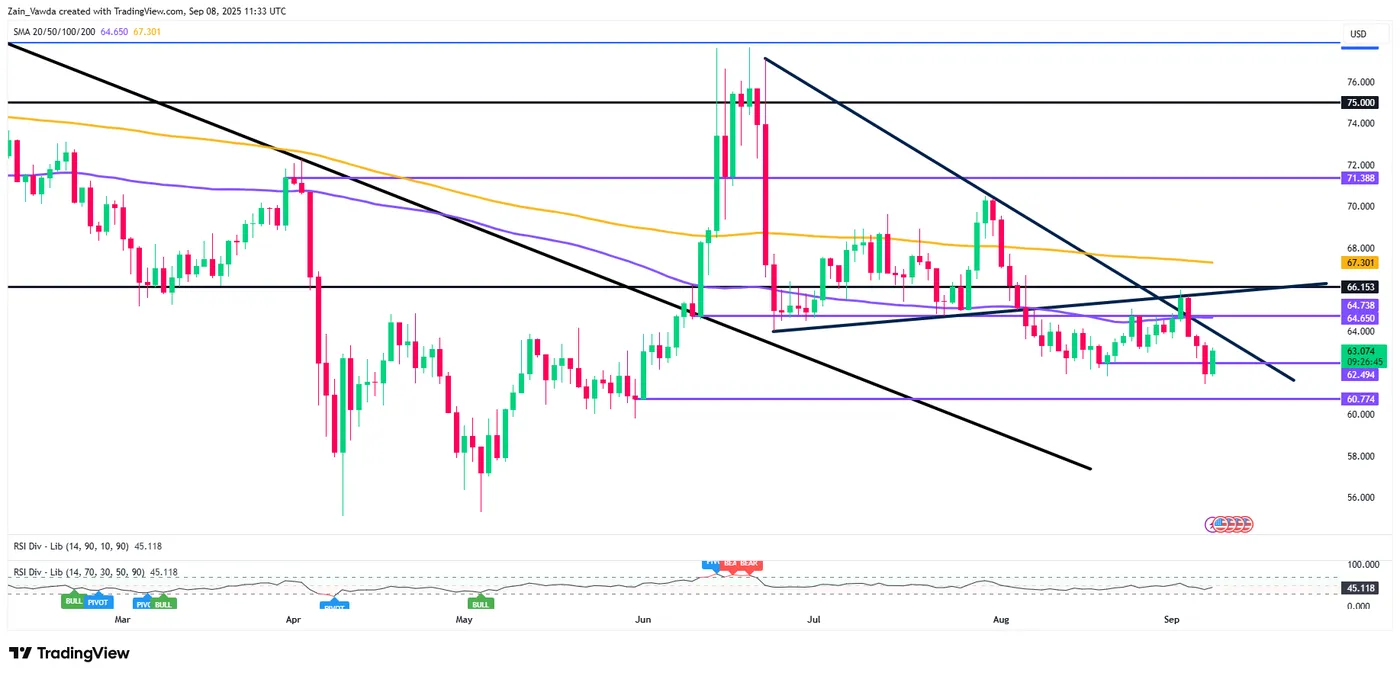
Immediate resistance rests at the 100-day MA which rests at 64.65 before the 66.15 and 67.30 handles come into focus.
A move lower from current prices, could bring last week's swing low around 61.50 before the 60.70 and the YTD low at 55.10 come into focus.
WTI Oil Daily Chart, September 8, 2025
Source: TradingView (click to enlarge)
Client Sentiment Data
Looking at OANDA client sentiment data and market participants are long on WTI with 89% of traders net-long. I prefer to take a contrarian view toward crowd sentiment and thus the fact that so many traders are long means WTI prices could decline in the near-term.
Nikkei 225 Technical: Bullish Trend Remains Intact Despite Japan’s PM Resignation
The price actions of the Japan 225 CFD Index (a proxy of the Nikkei 225 futures) have staged the expected bullish reversal after the test on the 41,760 key short-term pivotal support on 2 September 2025 (printed an intraday low of 41,688) and rallied by 3.6% to hit 43,203 on last Friday. 5 September.
In today’s Asia session, it gapped up and added 1.7% to print a current intraday high of 43,850, just a whisker away from the recent all-time high of 43,942 printed on 18 August, on the backdrop of the resignation of Japan’s Prime Minister Ishiba on Sunday.
Japan’s PM contenders are likely to advocate for fiscal stimulus measures
The Liberal Democratic Party (LDP) members are likely to vote for their leader in early October, with two leading contenders being Sanae Takaichi, a former internal affairs minister, and Agriculture Minister Shinjiro Koizumi, the son of a former prime minister.
Both contenders tend to have a more liberal stance towards fiscal policy and support more fiscal stimulus measures.
Let’s now take a closer look at the latest key technical elements to decipher its next short-term (1 to 3 days) directional bias and key levels to watch on the Japan 225 CFD Index.
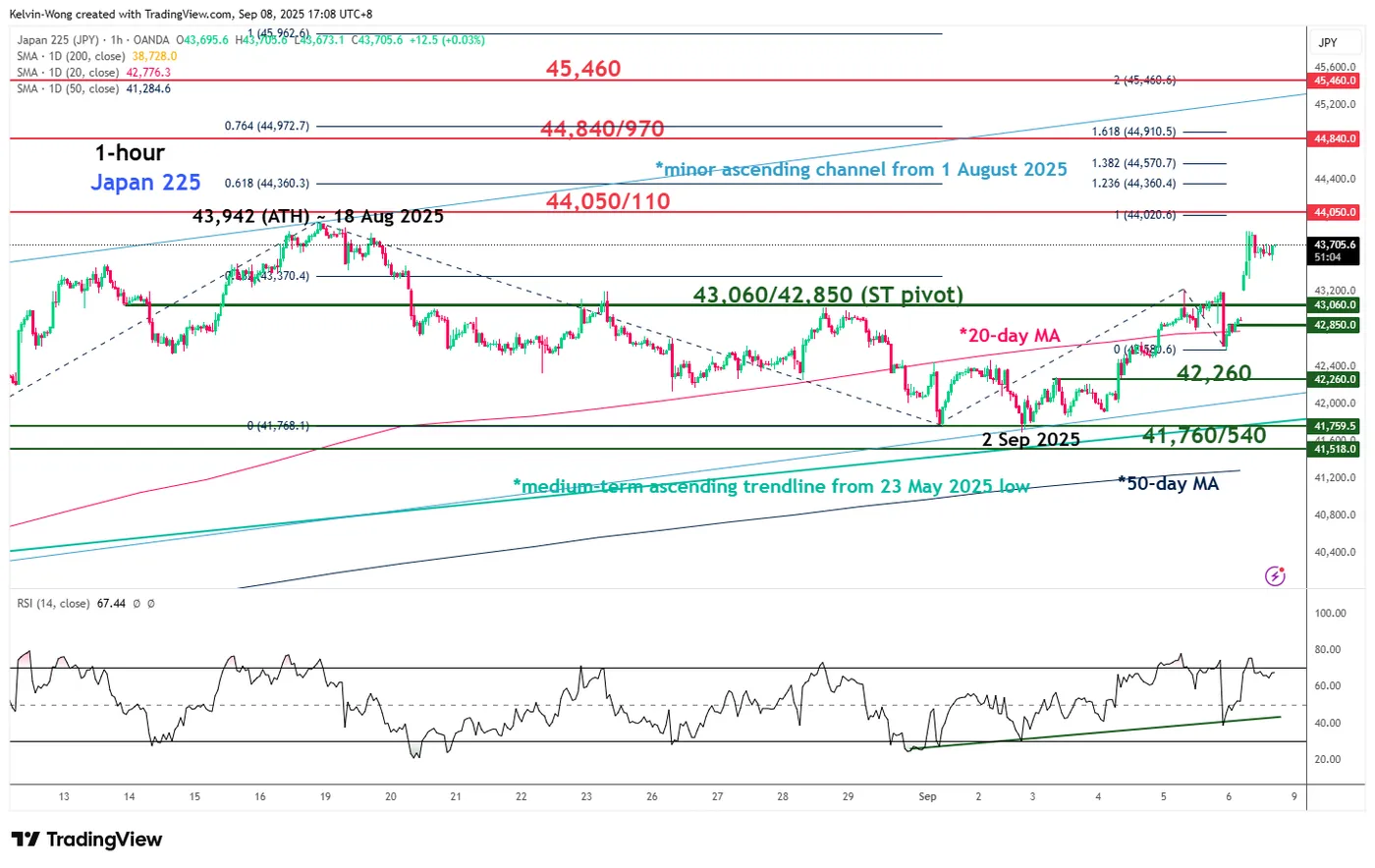
Fig. 1: Japan 225 CFD Index minor trend as of 8 Sep 2025 (Source: TradingView)
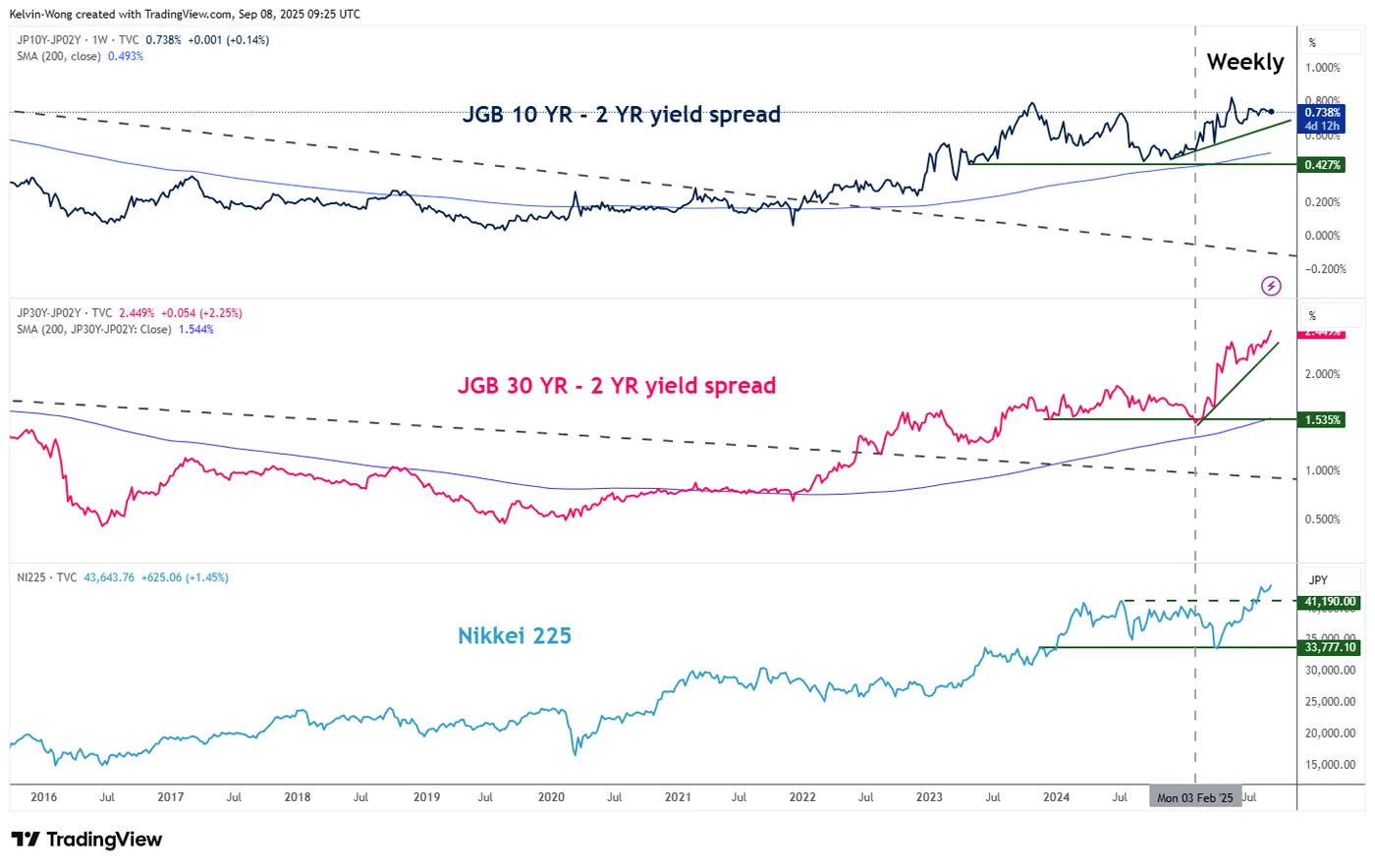
Fig. 2: JGB yield curves (30-YR/2-YR & 10-YR/2-YR) major trends as of 8 Sep 2025 (Source: TradingView, click to enlarge chart)
Preferred trend bias (1-3 days)
Maintain the bullish bias on the Japan 225 CFD Index with a tightened short-term pivotal support now at 43,060/42,850 for the next intermediate resistances to come in at 44,050/44,110 and 44,840/44,970 (Fibonacci extension cluster and towards the upper boundary of a minor ascending channel from 1 August 2025 low) (see Fig. 1).
Key elements
- Price actions of the Japan 225 have traded back above the 20-day moving average, which reinforces the ongoing short-term/minor bullish impulsive up move sequence.
- The hourly RSI momentum indicator has not flashed at a bearish divergence condition as it hit its overbought zone (above 70 level) in today’s Asia session.
- The major bullish breakout (steepening conditions) of the JGB yield curves since June 2022 has a direct correlation with the movements of the Nikkei 225, and the major uptrend phases of the JGB yield curves' steepening remain intact so far, in turn, may trigger a further positive feedback loop into the Nikkei 225 (see Fig. 2).
Alternative trend bias (1 to 3 days)
Failure to hold at the 43,060/42,850 key short-term support for the Japan 225 CFD Index negates the bullish tone for a minor corrective decline to expose the next intermediate support at 42,260.
Cryptocurrency Market Uncertainty as a Sign of Suppressed Retail Risk Appetite
Market Overview
Cryptocurrency market capitalisation has gained 2.5% over the past seven days to $3.85 trillion, demonstrating a very modest and erratic recovery without buyer euphoria or significant volumes. The crypto market capitalisation remains below its 50-day moving average, indicating the prevalence of bears in the market. This is a very worrying indicator of underlying risk appetite in financial markets. Although stocks are offsetting the weakness in the labour market with growth in anticipation of Fed dovishness, the weakness of the economy is still negative for retail customers, the driving force behind prices.
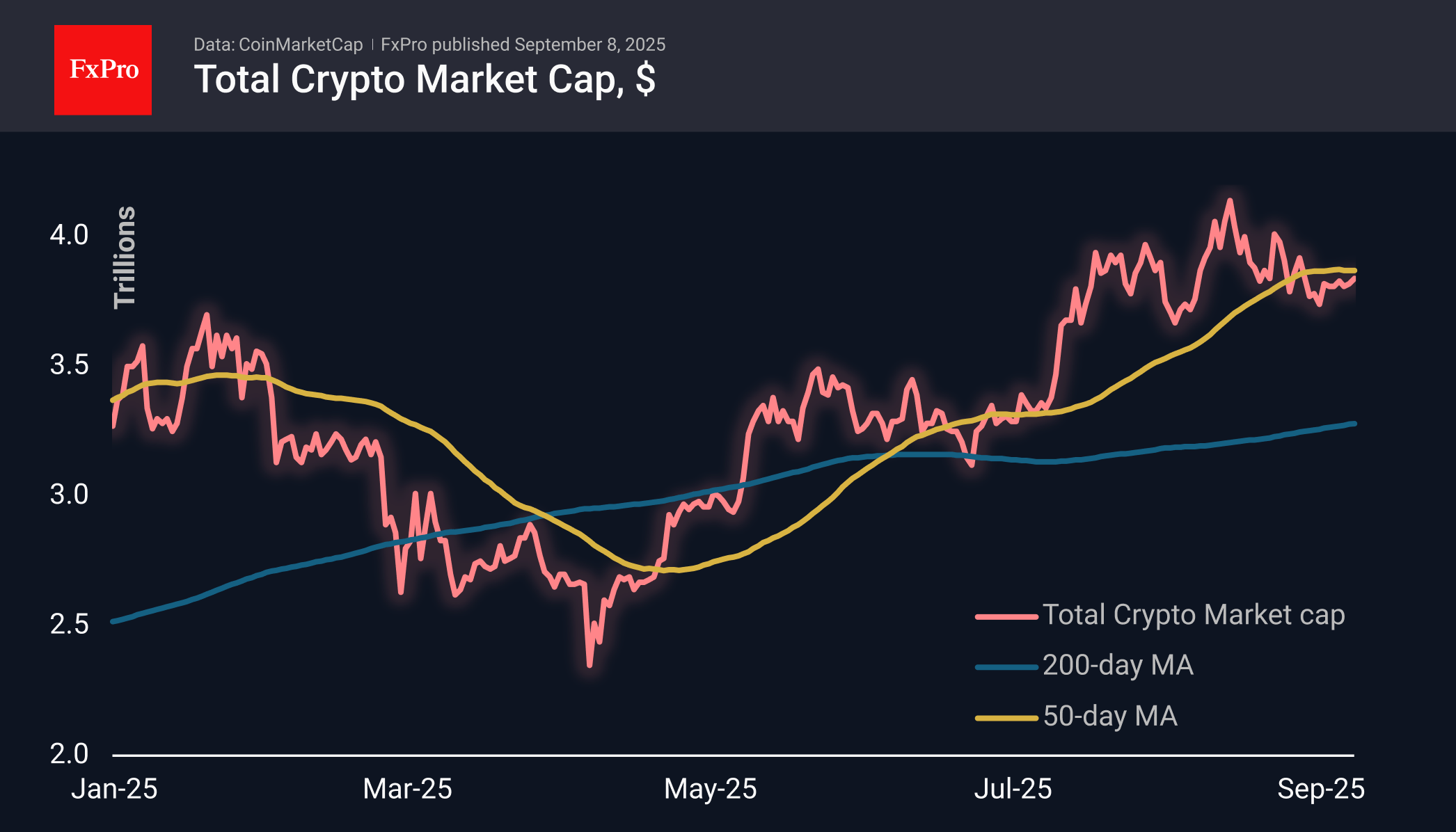
The sentiment index fell into fear territory on Sunday at 44, but returned to a neutral 51 on Monday, reflecting a wait-and-see stance.
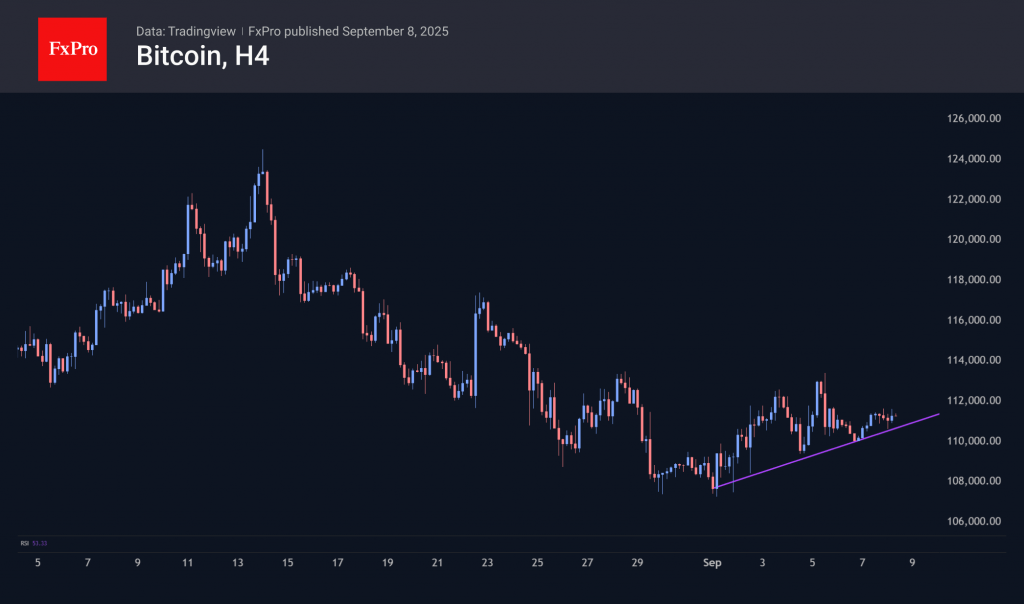
Bitcoin continues to hover around $111K, crossing this mark up or down every day for the past seven days. Since the beginning of September, an upward line can be drawn through the local price lows, but BTC has gained about 3.6% during this time, more than the losses on 28 August alone.
News Background
The total volume of corporate Bitcoin reserves reached a record 840,000 BTC in August, but their growth rate and transaction volume fell to annual lows, according to CryptoQuant. This indicates a weakening of institutional demand.
The altcoin season has already begun, but only for those coins that large companies have included in their reserves, according to Bloomberg. Another potential driver of the alt season could be the approval of crypto ETF applications in the US. About 10 assets are expected from the SEC, including Dogecoin, Chainlink, Stellar, Bitcoin Cash, Avalanche, Litecoin, Shiba Inu, Polkadot, Solana and Hedera.
Stablecoins are gaining popularity because they offer businesses faster, cheaper and more reliable payments than traditional systems, said Stripe CEO Patrick Collison.
The Financial Times has learned of Tether’s plans to buy gold. According to the publication’s sources, the issuer of the USDT stablecoin has been discussing investing in the entire precious metal supply chain, which includes mining, processing, trading, and royalties.
Nikkei 225 Rises Following Resignation of Prime Minister Shigeru Ishiba
As the chart shows, Japan’s Nikkei 225 stock index (Japan 225 on FXOpen) today approached its historic peak (B) around the 43,900 level.
Bullish sentiment was driven by political news. According to Reuters, Prime Minister Shigeru Ishiba has stepped down. The leading candidate to replace him, Sanae Takaichi, is regarded as a supporter of stimulus measures and unprecedented monetary easing – a bullish factor for companies.
Technical Analysis of the Nikkei 225
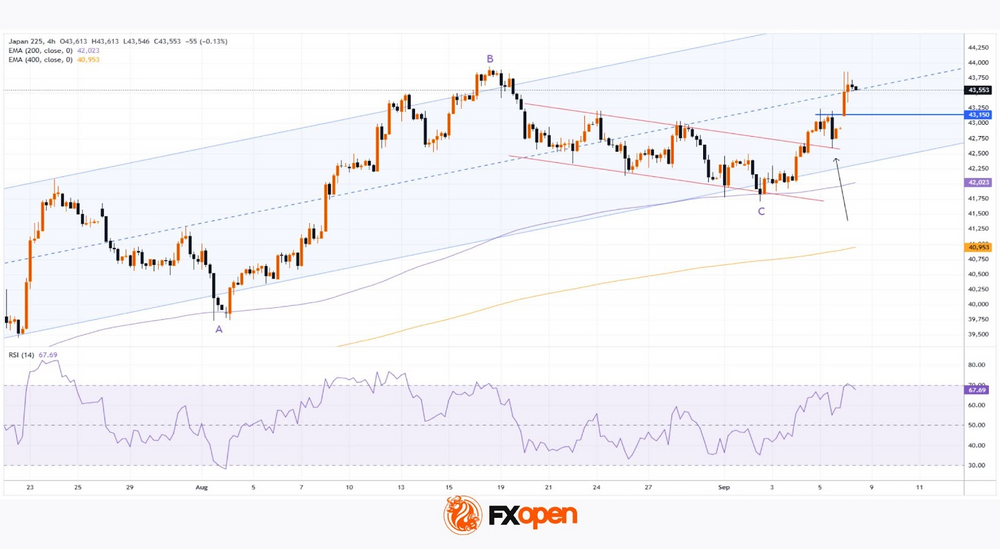
As indicated by the 200- and 400-period moving averages on the 4-hour chart, Japan’s stock market remains in a long-term uptrend. This summer, index movements have been forming an ascending channel, highlighted in blue, with the lower boundary acting as strong support.
Other bullish signs include:
→ A bullish structure, highlighted by a normal pullback of around 50% (B→C) following the A→B impulse.
→ During the B→C decline, price movements formed a corridor (marked with red lines) resembling a bullish flag pattern. Its breakout suggests an attempt to resume the upward trend after an interim correction.
→ Recent price action, indicating that former resistance levels have turned into support. This applies both to the upper red line (marked with an arrow) and to last week’s former resistance at 43,150.
On the other hand:
→ Long upper shadows on today’s candles point to increased selling pressure near the historic peak.
→ The RSI indicator has risen to the overbought territory.
Given that the index is now around the median of the ascending channel (a level where supply and demand tend to balance), we could assume the market may consolidate in the short term. Possible scenarios include:
→ Attempts to break through the historic high, which may fail – potentially trapping overly optimistic participants and creating signs of a bearish ICT Liquidity Sweep pattern above peak B.
→ A correction with a retest of the 43,150 level.
Trade global index CFDs with zero commission and tight spreads. Open your FXOpen account now or learn more about trading index CFDs with FXOpen.
This article represents the opinion of the Companies operating under the FXOpen brand only. It is not to be construed as an offer, solicitation, or recommendation with respect to products and services provided by the Companies operating under the FXOpen brand, nor is it to be considered financial advice.
Aussie strength meets Loonie weakness, AUD/CAD targets 0.9128 and above
AUD/CAD resumed its rally from 0.8440 last week, breaking decisively through 0.9041 resistance level. The move reflects diverging fundamentals between Canadian Dollar, which is weighed down by weak domestic data, and Australian Dollar, which is drawing support from stronger consumption and external demand.
For loonie, the trigger was August’s disappointing jobs report, which reignited expectations that the BoC will resume easing at its September 17 meeting. While markets have not fully priced a rate cut yet, sentiment is shifting toward renewed stimulus. Still, policymakers are likely to wait for the August CPI release on September 16 before making the final call.
Underlying inflation dynamics remain sticky, with CPI common holding at 2.6% yoy for a third consecutive month in July. That has kept some uncertainty in market pricing. But once tariff-driven price pressures ease, the BoC will have scope to bring rates down from the current 2.75% to around 2.00%.
In contrast, the RBA’s easing path looks less certain. Strong consumption data prompted Governor Michele Bullock to caution that fewer cuts may ultimately be delivered. The Australian Dollar has also found support from a sharp rally in Chinese equities, which has helped stabilize sentiment around regional growth prospects.
Technically, AUD/CAD's rise from 0.8440 should be reversing the whole downtrend from 0.8375. Further rise is expected as long as 0.8992 support holds, to 0.9128 structural resistance first. Firm break there will pave the way to 61.8% projection of 0.8440 to 0.9041 from 0.8902 at 0.9273.
Eurozone Sentix confidence sinks to five-month low, summer optimism disintegrating at rapid pace
Eurozone investor sentiment deteriorated sharply in September, with the Sentix Confidence Index falling from -3.7 to -9.2, well below expectations of -1.1 and the weakest since April. Current Situation Index weakened to -18.8 from -13.0, while Expectations tumbled to 0.8 from 6.0.
Germany was the clear weak spot. Its investor confidence plunged from -12.8 to -22.1, while Current Situation gauge collapsed from -29.0 to -39.0. Expectations turned negative again, falling from 5.0 to -3.5, highlighting growing pessimism about Europe’s largest economy emerging from recession.
Sentix attributed the downturn to a mix of political and external headwinds: government instability in France, persistent weakness in German industry, an unfavorable tariffs arrangement with the US, and the ongoing war in Ukraine. These factors, it said, are exerting an “oppressive effect” on Eurozone sentiment.
The institute warned that summer optimism has “disintegrated at a rapid pace” and sees little sign of an autumn rebound. With export-oriented sectors facing more pressure under U.S. tariffs and rising concern over sovereign debt — particularly in France — the outlook for the Eurozone remains fragile heading into year-end.
Gold Poised to Test Fresh Highs
Gold held near historic levels on Monday, trading around 3,590 USD per ounce, bolstered by a softer-than-expected US labour market report for August. Employment growth fell short of forecasts, while the unemployment rate climbed to its highest level since 2021. This has reinforced market expectations of an imminent Federal Reserve rate cut as early as September, with investors pricing in a 92% probability of such a move.
Further supporting the bullish sentiment are growing doubts over the Fed’s independence, as former President Donald Trump continues to criticise the central bank – driving increased safe-haven demand for gold.
Demand was also reinforced by the People’s Bank of China, which added to its gold reserves for the tenth consecutive month in August as part of a broader strategy to diversify its holdings away from the US dollar.
Additionally, the metal gained support from trade policy developments, with the Trump administration exempting gold and certain other metals from its latest tariff list.
In summary, gold remains near all-time highs due to a combination of dovish Fed expectations, political uncertainty, and sustained central bank demand.
Technical Analysis: XAU/USD
H4 Chart:
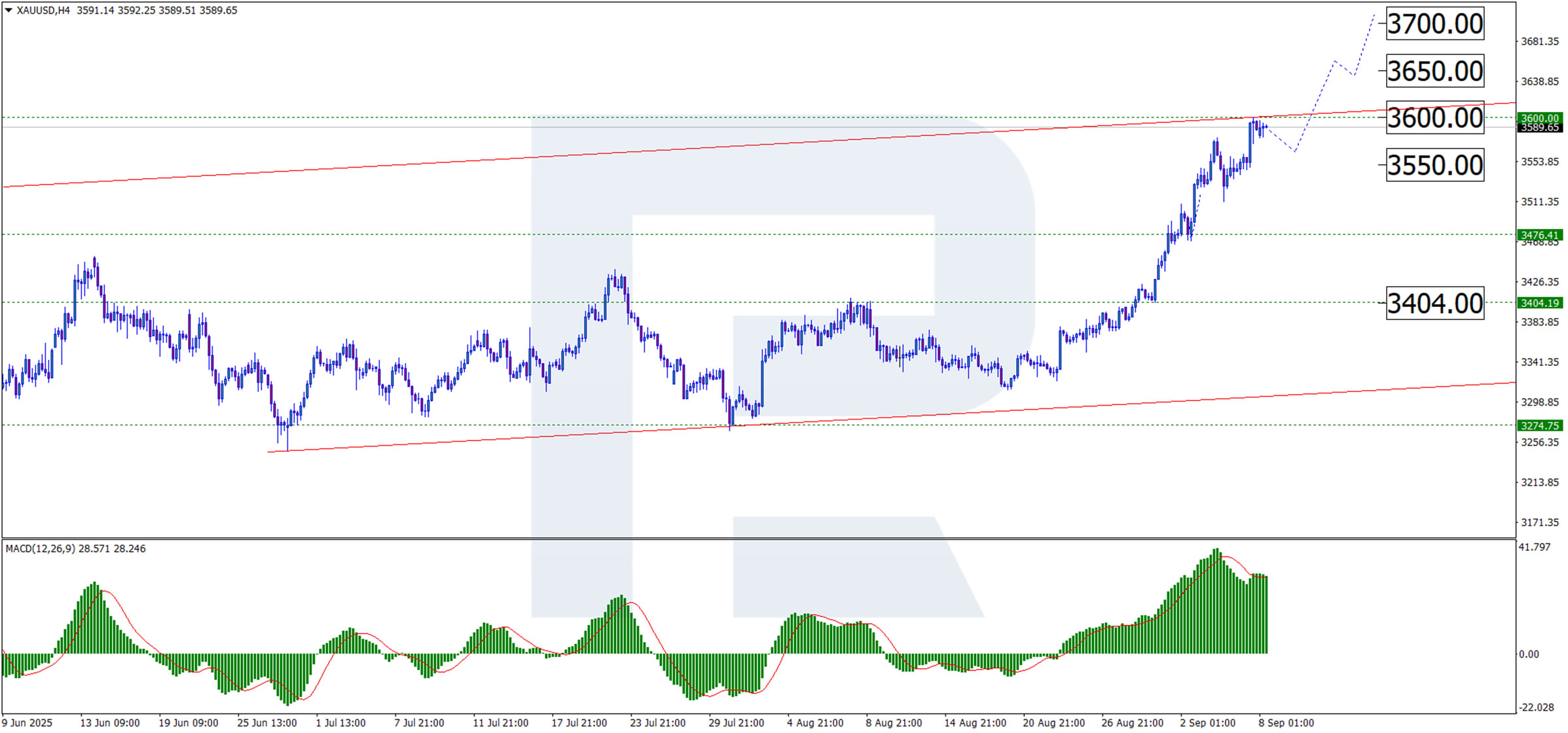
On the H4 chart, XAU/USD has completed another leg higher, reaching 3,600.07 USD. A corrective pullback toward the former resistance, which has now turned into support at around 3,550 USD, appears likely. Given the current fundamental backdrop, any test of this support may be followed by another upward wave, with initial targets at 3,600 USD and then 3,650 USD. The MACD indicator provides technical support for this scenario. Although the histogram and signal line remain above zero, both are declining – suggesting a near-term correction before the broader uptrend resumes.
H1 Chart:
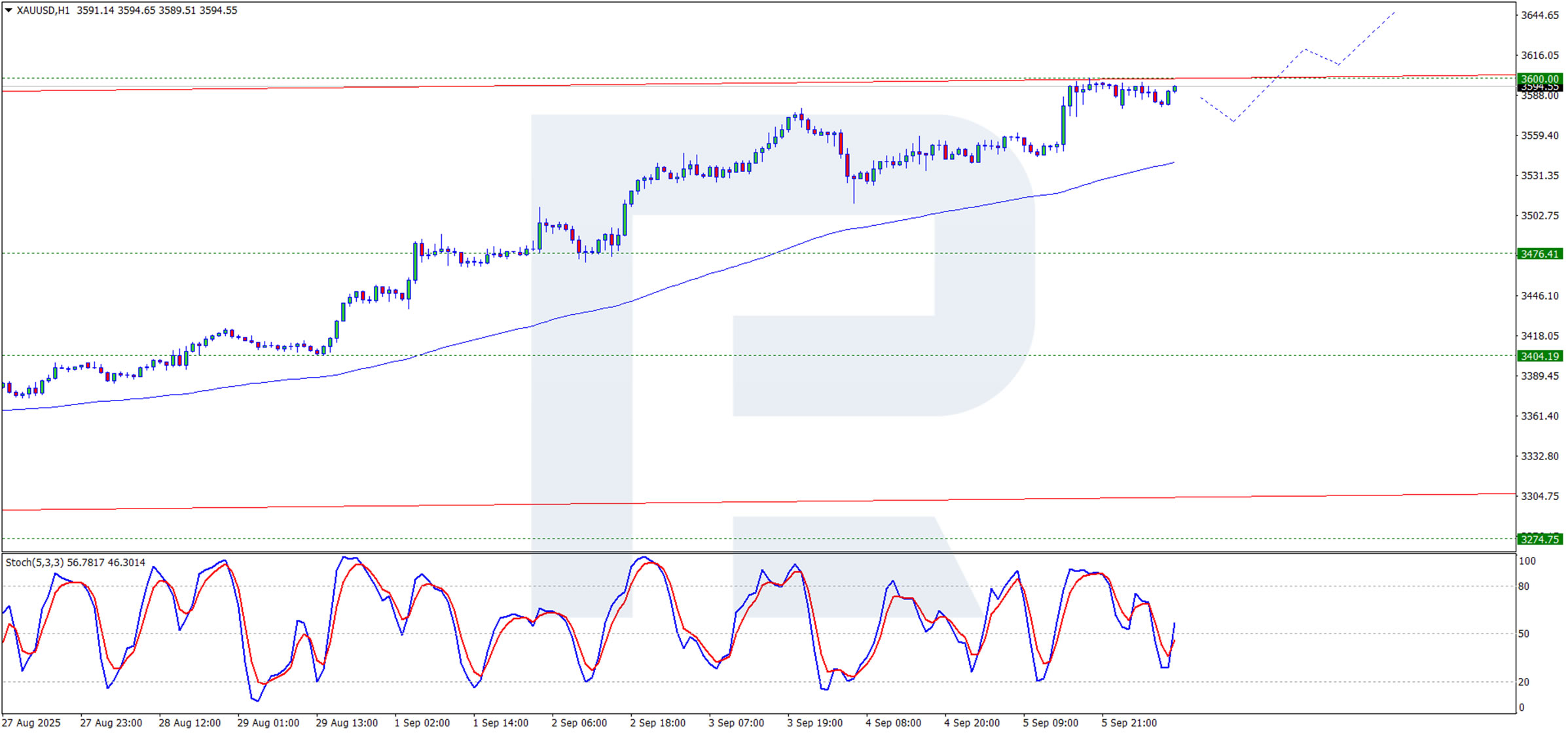
On the H1 chart, the pair tested 3,600.07 USD and is now forming a corrective decline. The initial support target is 3,550 USD. Holding this level could prompt renewed buying, supporting a continuation of the upward trend. The Stochastic oscillator aligns with this view, with its signal line testing the 50.0 level, indicating potential for further near-term consolidation or a mild retracement.
Conclusion
Gold remains well-supported by a confluence of fundamental factors, including expectations of Fed easing, geopolitical tensions, and robust institutional demand. While a short-term technical correction is likely, the broader bullish trend remains intact, with scope for further gains towards 3,650 USD.