

Sample Category Title
Bitcoin Capitalised on Dollar’s Temporary Weakness
Fiscal problems and tariff confusion are undermining confidence in the US dollar. Other assets are rushing to take advantage of the loss of interest in the greenback. The ECB argues that the uncertainty of the White House policy could be a moment of glory for the euro. The regional currency can increase its share in international settlements and forex reserves. But digital assets could also benefit from the dollar’s decline.
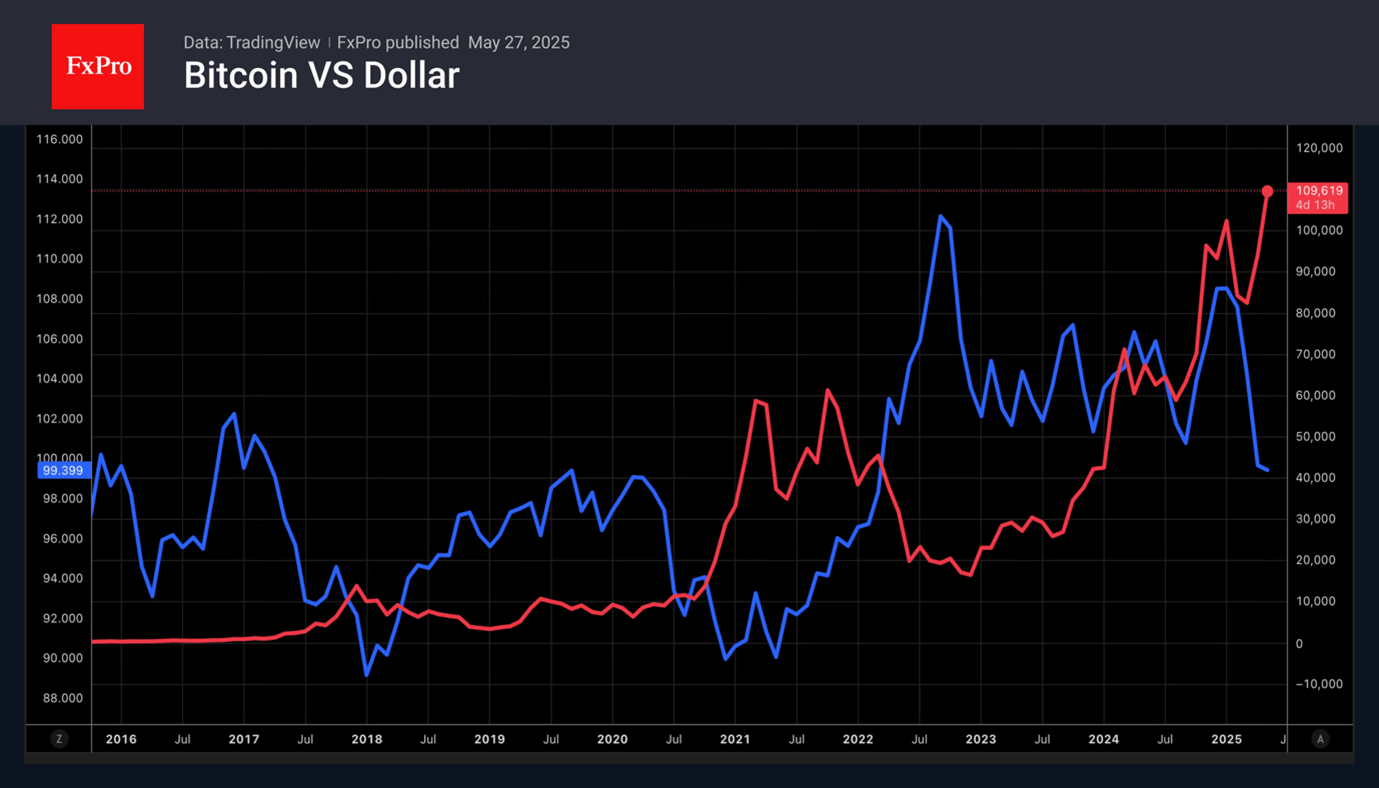
The BTCUSD rally against the backdrop of falling US stock indices and reduced global risk appetite might look strange. Perhaps the reason should be sought in Congress’s legislation about stablecoins. The legalisation of cryptocurrency offers an opportunity to be optimistic.
However, a ‘sell America’ trade is currently reigning over the markets. Investors are getting rid of stocks, bonds, and the US dollar and looking for alternatives. They are buying European stock indices, German bonds, and digital assets. Rumours are circulating that with the passage of legislation, stablecoins could become a competitor to bank deposits as holders can earn interest via stacking. Bank of America is ready to become an issuer of dollar-linked tokens in case of legalisation.
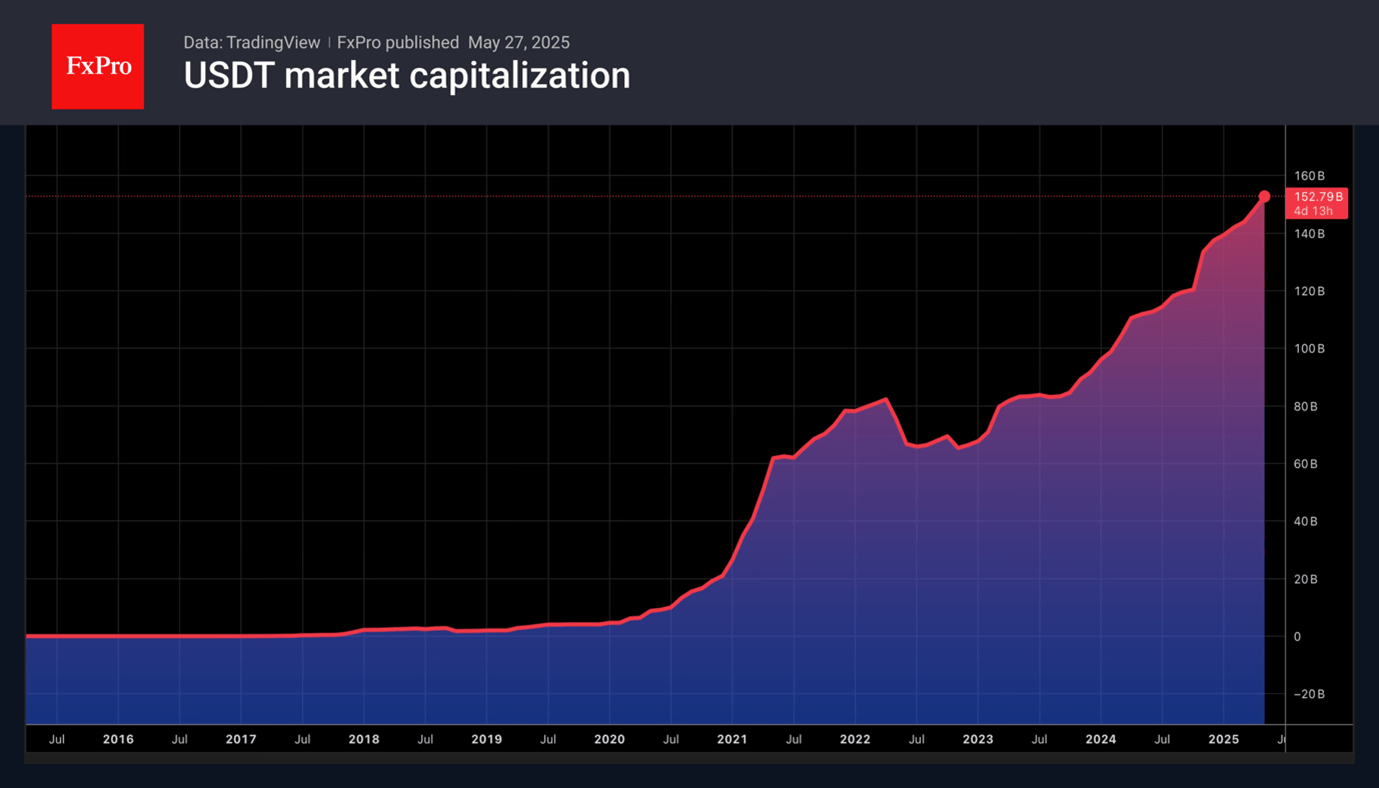
Tether, the largest player in the stablecoin market, is still wary of Congress considering the bill. The company is worried because of the potential differentiation between the activities of American and foreign issuers. The document may not be as good for the crypto industry as it seems. Will it contain too many restrictions?
Bitcoin is consolidating due to the lack of clarity about the bill and the US stock market being closed on Memorial Day. The S&P 500 is expected to open the new shortened week higher on the back of a truce in the US-EU trade war. Rising risk appetite may help Bitcoin regain its uptrend. Markets are wagering on the so-called Trump pattern, which suggests that postponements follow tariff threats. As a result, traders have an opportunity to buy the dip.
US consumer confidence jumps to 98, but recession signal persists
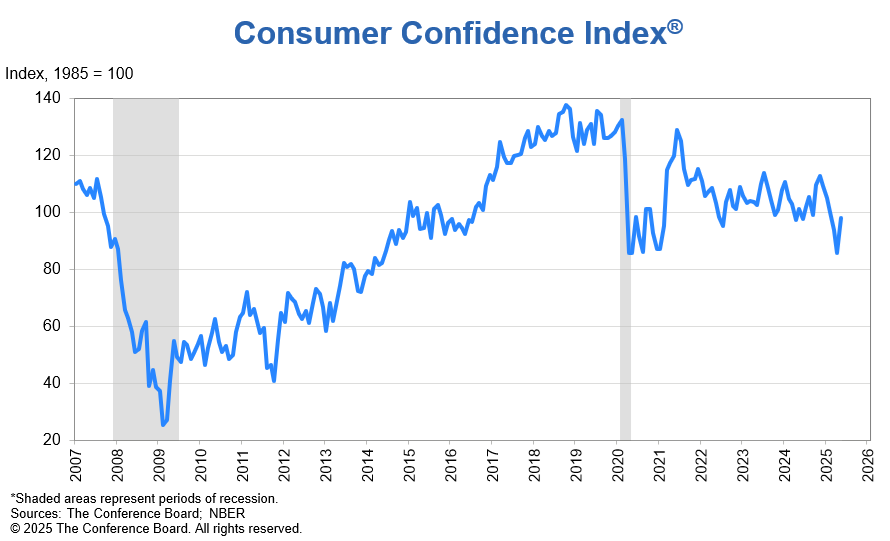
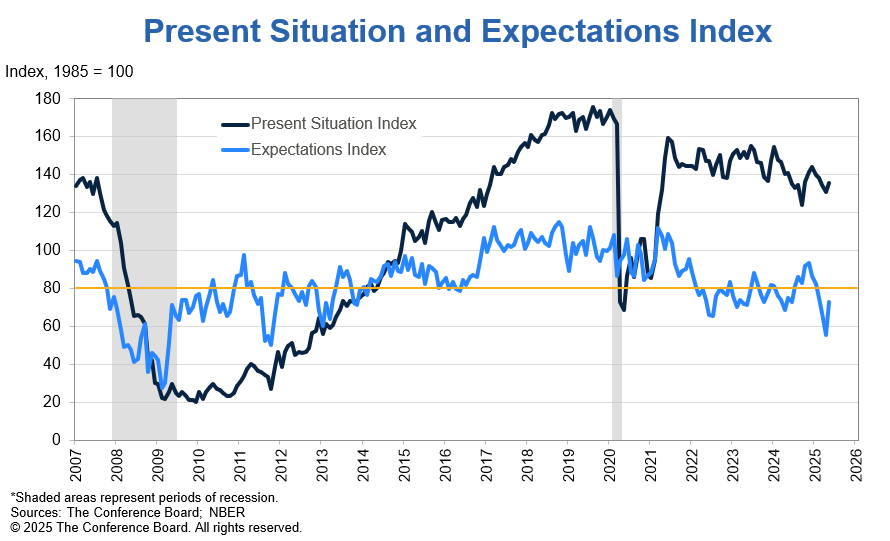
US Conference Board index jumped from 85.7 to 98.0 in May, far exceeding expectations of 87.1 and marking the first increase in six months. Present Situation Index rose 1.8 pts to 135.9. Expectations Index leapt by 17.4 points to 72.8.
Despite the rebound, the expectations component remains below the key threshold of 80, which historically signals elevated recession risk in the months ahead.
The improvement gained traction after the May 12 announcement of a partial pause on US-China tariffs, though the Conference Board noted the rebound had already begun beforehand.
According to Senior Economist Stephanie Guichard, the uptick was "largely driven by consumer expectations as all three components of the Expectations Index—business conditions, employment prospects, and future income".
Sunset Market Commentary
Markets
ECB’s Lagarde made a strong case yesterday when promoting a bigger, international role for the euro while that of the US dollar is gradually waning. Her long-term call needs to see the remaining stumbling blocks resolved first, including fragmented capital markets. It also means the short-term impact of an otherwise interesting speech is limited. The euro, in fact, is losing out against the dollar in a daily perspective. EUR/USD eased from an intraday high around 1.14 to 1.135. It’s not so much euro weakness as it is dollar strength though. USD/JPY rises to 144.07 while the trade-weighted DXY recovers to 99.35. The greenback is not the only US asset kicking of its first trading day of the week after having enjoyed the long weekend. They still had to catch up with Trump’s umpteenth U-turn on (European) tariffs. US Treasuries’ rally, for example, pushes yields between 1.4 and 5 bps lower. The long end of the curve outperformed in a move kickstarted by the Japanese bond surge during Asian dealings. Japanese bond yields dropped 20 bps (30-yr) after having hit multi-decade and in some cases record highs last week in maturities from 20-yr on. That happened after a miserable auction of that tenor. Fearing for tomorrow’s 40-yr bond auction, authorities started to sound out market participants on what the appropriate auction size would be. Reuters later reported the Ministry of Finance may trim its issuance of super-long bonds in response. European yields similarly drop a few bps at the back end of the curve. French inflation surprised to the downside, hitting a four-year low at 0.6% (0.9% expected). The miss came on the account of energy prices, which fell 1.5% m/m. But services prices eased as well, by a monthly 0.2%. Short-term yields barely budged. That’s not a huge surprise given that money markets are already pricing in a too low terminal ECB policy rate (<1.75%). A few more ECB members hit the wires before the 7-day quiet period kicks in from Thursday. Uberhawk Holzmann told the Financial Times that there’s no reason to lower rates in June or July. He argues for a pause until September to see how the trade conflict evolves. His comments contrast with most of his colleagues and indeed had little effect on market pricing for next week. A 25 bps rate cut remains fully priced in. UK gilts underperform global peers with the front end marching 5 bps higher and that’s actually masking an intraday 10 bps move. That’s supporting sterling and triggering a breach of EUR/GBP sub 0.84. European stocks extend yesterday’s gain by 0.4%. Wall Street opens more than 1% higher.
News & Views
The European Commission’s economic sentiment indicator (EMU) improved from 93.8 to 94.8 in May, beating 94.1 consensus. The employment expectations indicator also picked up, from 96.5 to 97. Both indicators remain below their long term average of 100. The rise in the ESI for the EU was primarily driven by a partial rebound of confidence in the retail trade sector (recovery of retailers’ assessment of the past business situation and more favourable assessments of the volumes of stock) and among consumers (especially receding pessimism over general economic situation), with a moderate contribution also from the construction sector (improved assessments of the level of order books). Confidence in both the industry and services sectors remained broadly stable. Selling price expectations dropped in services, retail trade and construction but remain above their long term averages. Consumers’ price expectations for the next 12 months reverted the sharp increase from April, ending the upward trend in place since late 2024.
The EU today approved the creation of a €150bn EU arms fund, the final legal step in setting up the SAFE (Security Action for Europe) scheme, involving joint EU borrowing to give loans to European countries for joint defense projects. For a project to qualify for SAFE funding, 65% of its value must come from companies based in the EU, Ukraine, Iceland, Liechtenstein, Norway and Switzerland. Companies from countries with a Security and Defense Partnership with the EU (eg UK) can also be eligible under additional conditions. The contribution of any single non-EU subcontractor in any funded project is capped at 15% but can rise to 35% under circumstance.
EUR/USD Mid-Day Outlook
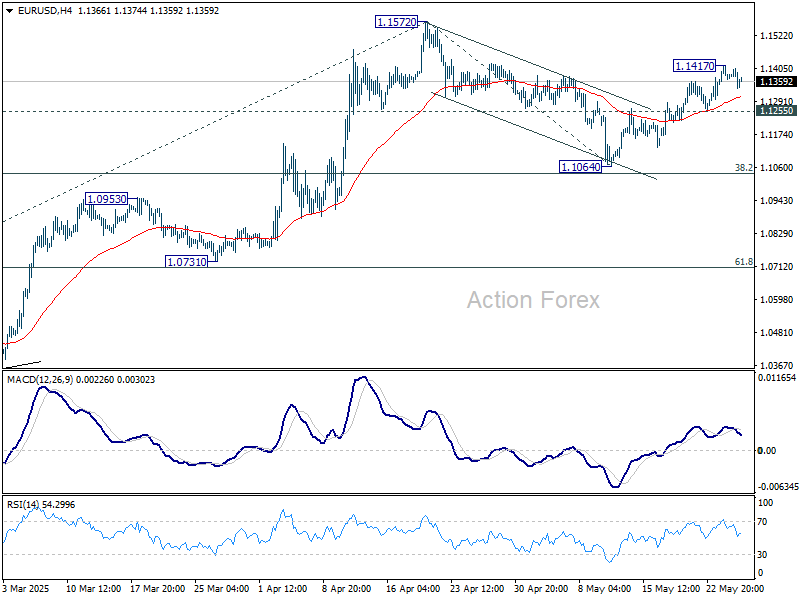
Daily Pivots: (S1) 1.1360; (P) 1.1389; (R1) 1.1417; More...
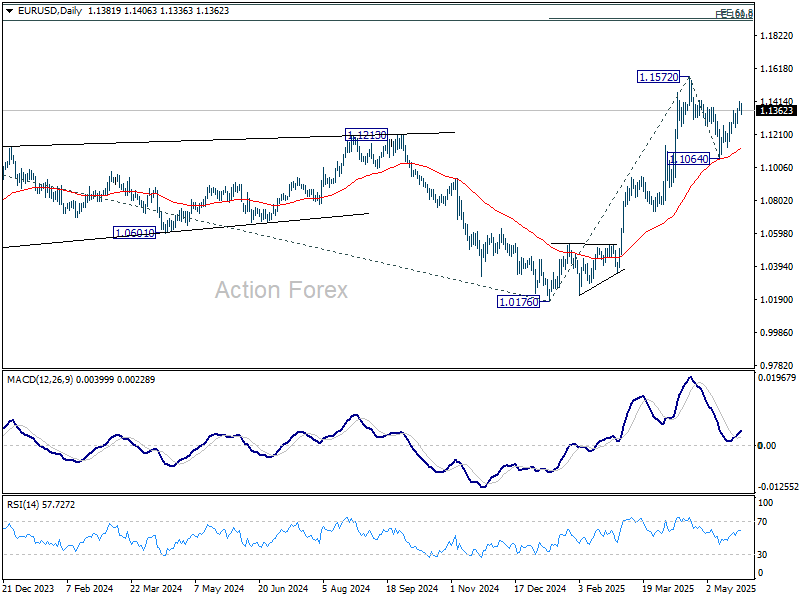
Intraday bias in EUR/USD is turned neutral first with current retreat. Further rise is in favor as long as 1.1255 support holds. Above 1.1417 will bring retest of 1.1572 high first. Decisive break there will resume larger up trend to 61.8% projection of 1.0176 to 1.1572 from 1.1064 at 1.1927. On the downside, however, break of 1.1255 will turn bias back to the downside to extend the corrective pattern from 1.1572 with another falling leg.
In the bigger picture, rise from 0.9534 long term bottom could be correcting the multi-decade downtrend or the start of a long term up trend. In either case, further rise should be seen to 100% projection of 0.9534 to 1.1274 from 1.0176 at 1.1916. This will now remain the favored case as long as 55 W EMA (now at 1.0858) holds.
GBP/USD Mid-Day Outlook
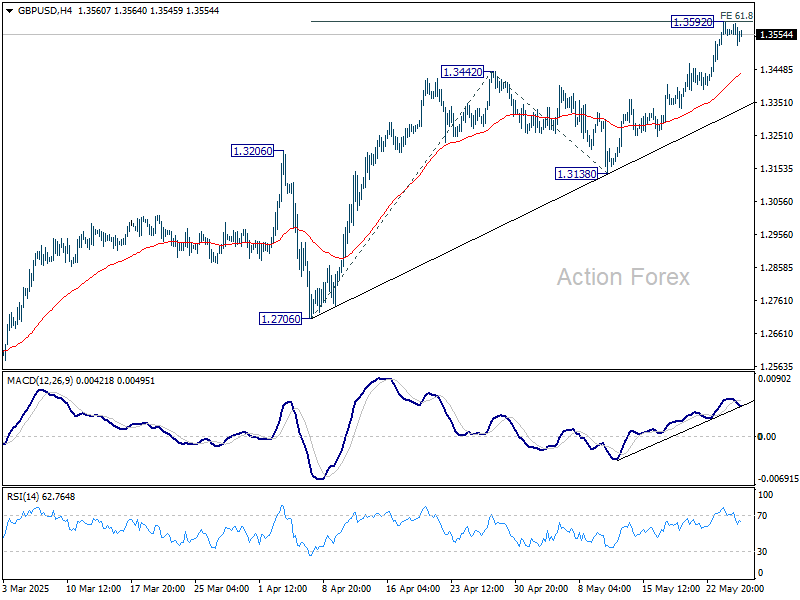
Daily Pivots: (S1) 1.3525; (P) 1.3559; (R1) 1.3597; More...
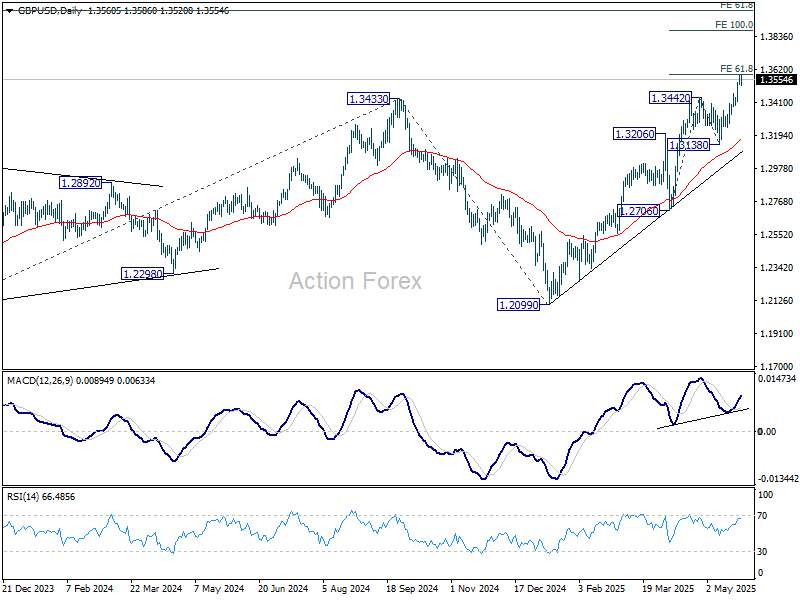
Intraday bias in GBP/USD remains neutral and some consolidations could be seen below 1.3592 temporary top. Downside should be contained well above 1.3138 support to bring another rally. On the upside, firm break of 1.3592 will turn bias back to the upside for 100% projection of 1.2706 to 1.3442 from 1.3138 at 1.3874.
In the bigger picture, up trend from 1.3051 (2022 low) is in progress. Next medium term target is 61.8% projection of 1.0351 to 1.3433 from 1.2099 at 1.4004. Outlook will now stay bullish as long as 55 W EMA (now at 1.2870) holds, even in case of deep pullback.
USD/CHF Mid-Day Outlook
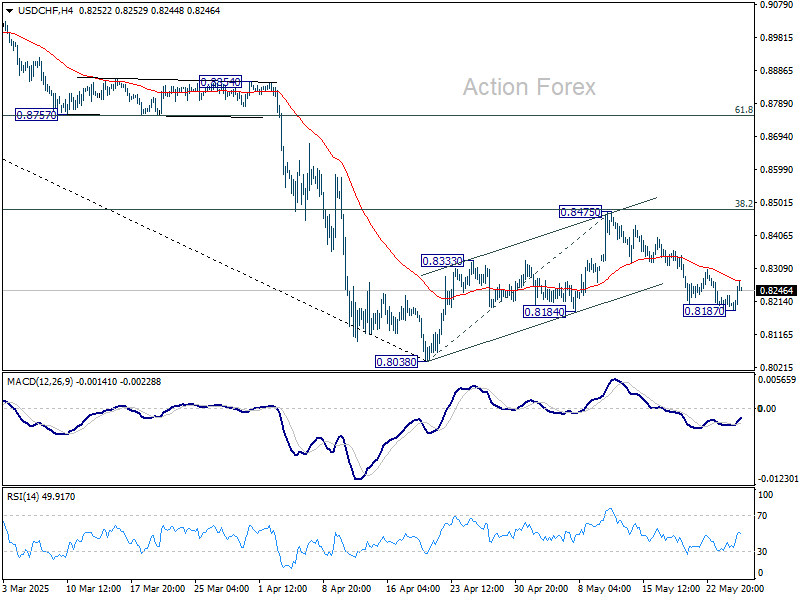
Daily Pivots: (S1) 0.8191; (P) 0.8212; (R1) 0.8231; More….
Intraday bias in USD/CHF is turned neutral with current recovery. For now, rise will stay on the downside as long as 0.8475 resistance holds, in case of recovery. Below 0.8187 will target 0.8038 low. Firm break there will resume larger down trend to 61.8% projection of 0.9200 to 0.8038 from 0.8475 at 0.7757 next.
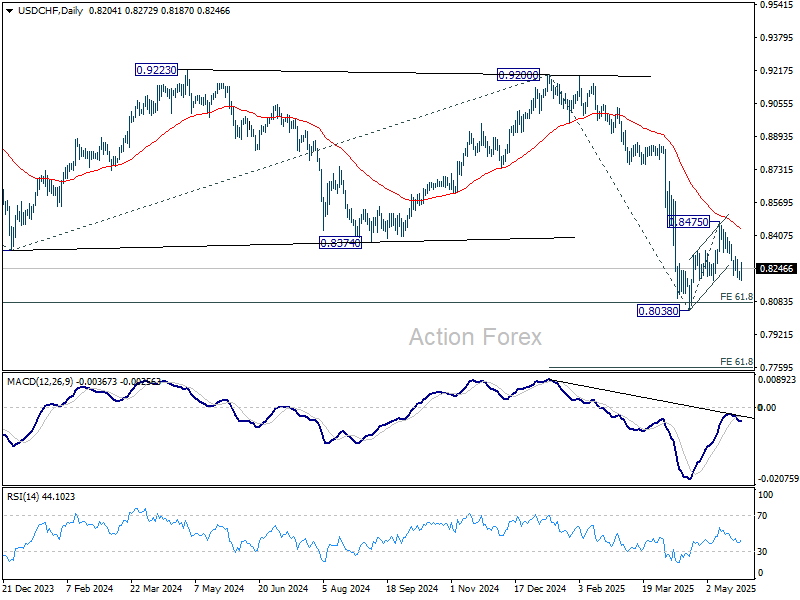
In the bigger picture, long term down trend from 1.0342 (2017 high) is still in progress and met 61.8% projection of 1.0146 (2022 high) to 0.8332 from 0.9200 at 0.8079 already. In any case, outlook will stay bearish as long as 55 W EMA (now at 0.8713) holds. Sustained break of 0.8079 will target 100% projection at 0.7382.
USD/JPY Mid-Day Outlook
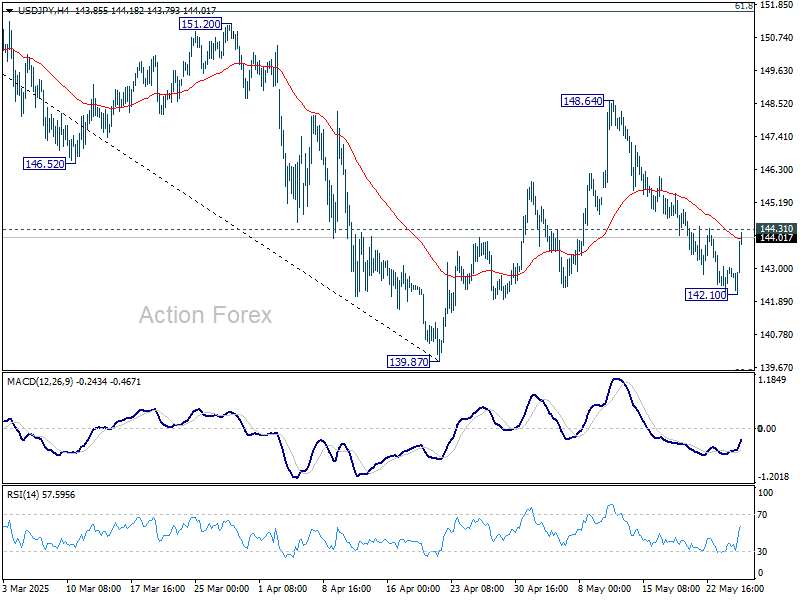
Daily Pivots: (S1) 142.35; (P) 142.72; (R1) 143.20; More...
USD/JPY recovered notably today but stays below 144.31 minor resistance. Intraday bias remains neutral first. On the upside, firm break of 144.31 will argue that fall from 148.64 has completed as a corrective pullback. Intraday bias will be turned back to the upside for 148.64 resistance next. Nevertheless, rejection by 144.31 will keep risks on the downside. Below 142.10 will target a retest on low.
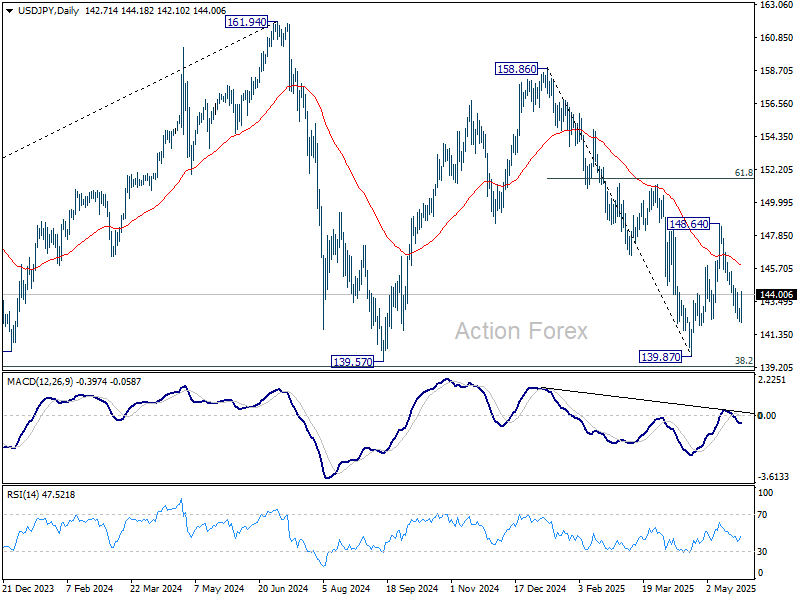
In the bigger picture, price actions from 161.94 are seen as a corrective pattern to rise from 102.58 (2021 low), with fall from 158.86 as the third leg. Strong support should be seen from 38.2% retracement of 102.58 to 161.94 at 139.26 to bring rebound. However, sustained break of 139.26 would open up deeper medium term decline to 61.8% retracement at 125.25.
Yen Crushed as Super-Long JGB Yields Plunge on Supply Cut Speculation
Yen is under intense selling pressure today, dragged down by a sharp plunge in super-long JGB yields. The 30-year yield closed at 2.836%, down significantly from 3.165% just days ago. This abrupt move followed a Reuters report suggesting that the Ministry of Finance may reduce super-long bond issuance as part of a potential tweak to its bond program. Discussions with market participants are expected to conclude by mid- to late-June, after which the MOF will formalize its decision.
The reported consideration comes in response to a surge in super-long yields to multi-decade highs, which had mirrored global trends, particularly a selloff in US long bonds. A reduction in supply could help stabilize Japan's long-end, which has come under additional pressure amid political calls for fiscal stimulus ahead of July’s upper house elections. Prime Minister Shigeru Ishiba faces growing demands for tax cuts and expansive spending measures, both of which could further exacerbate Japan's already heavy debt load and add pressure on government financing costs.
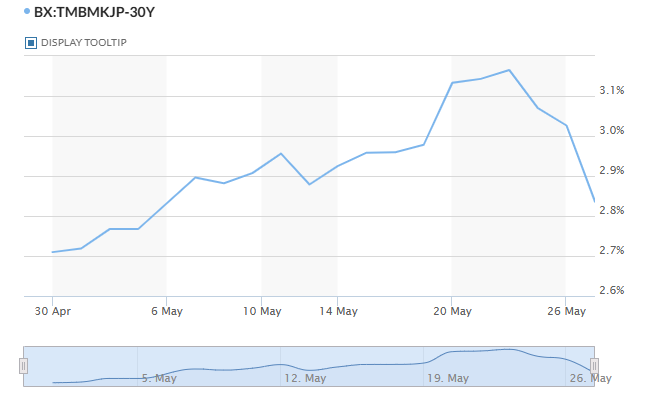
This bond market adjustment has compounded Yen weakness, particularly as global risk appetite revives. European equities are rallying, with DAX hitting a fresh record high, and US equity futures are pointing higher as well. This upswing in sentiment is fueling a rebound in Dollar, while Euro and Sterling are also firming against most peers. In contrast, the Swiss franc is underperforming, second only to Yen on the downside today. However, commodity currencies like Aussie, Kiwi and Loonie are showing muted reactions, failing to capitalize on the improved mood.
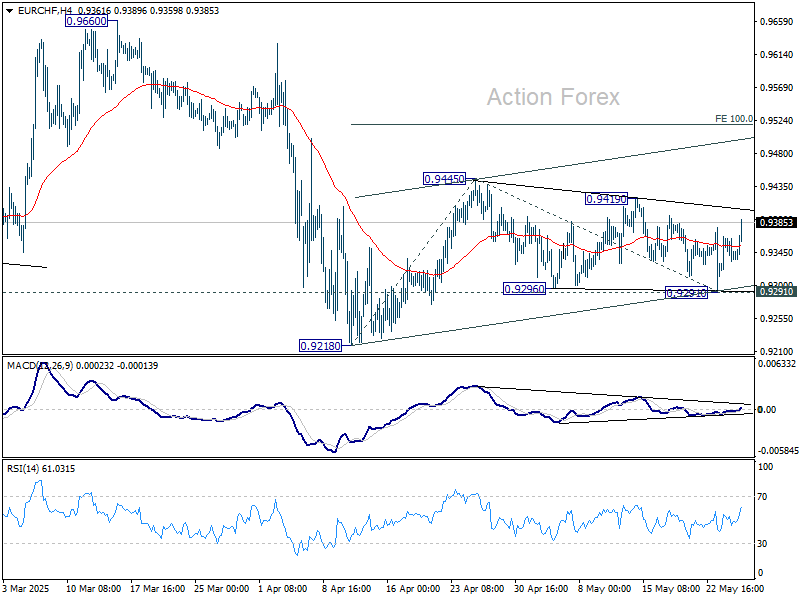
Technically, one focus now is whether EUR/CHF's rebound from 0.9291 could extend through 0.9419 resistance. In this case, that would signal resumption of rise from 0.9218. Next near term target will be 100% projection of 0.9218 to 0.9445 from 0.9291 at 0.9518.
In Europe, at the time of writing, FTSE is up 0.72%. DAX is up 0.70%. CAC is up 0.09%. UK 10-year yield is down -0.005 at 4.678. Germany 10-year yield is down -0.018 at 2.544. Earlier in Asia, Nikkei rose 0.51%. Hong Kong HSI rose 0.43%. China Shanghai SSE fell -0.18%. Singapore Strait Times rose 0.53%. Japan 10-year JGB yield fell -0.03 to 1.466.
US durable goods orders fall -6.3% mom, but core shows resilience
US durable goods orders fell sharply by -6.3% mom in April to USD 296.3B, driven primarily by a steep -17.1% mom drop in transportation equipment. The headline decline, while severe, was less than the expected -8.0%.
Orders excluding defense also posted a significant decline of -7.5% mom to USD 279.3B.
However, the underlying picture was somewhat more stable. Orders excluding the often-volatile transportation component rose by 0.2% mom to USD 197.5B, beating expectations of a flat reading.
This suggests that while large-ticket and defense-related items dragged the headline figure lower, private sector investment in capital goods is holding up better than feared.
Fed's Kashkari leans cautious on tariff shock, favors holding rates to anchor inflation expectations
Speaking at the IMES conference in Japan, Minneapolis Fed President Neel Kashkari addressed the growing internal debate within Fed over how to respond to the inflationary effects of new US tariffs.
He noted that some policymakers advocate “looking through” these price shocks, viewing them as "transitory", akin to a one-time upward shift in the price level rather than persistent inflation. That approach would favor cutting interest rates to support economic activity during the adjustment period.
However, Kashkari expressed skepticism toward this lenient view. He emphasized that trade negotiations are "unlikely to be resolved quickly"., warning of a prolonged period of elevated uncertainty and the risk of retaliatory measures.
Tariffs on intermediate goods could lead to delayed but persistent inflationary pressure as cost increases pass through to final goods over time.
Given these risks, Kashkari said he finds the case for holding rates steady more persuasive, especially in light of the need on "defending long-run inflation expectations".
While current policy is likely "only modestly restrictive", he argued that caution is warranted until the full effects of tariffs become clearer.
ECB's Holzmann: Should pause rate cut until at least September
Austrian ECB Governing Council member Robert Holzmann cautioned against further rate cuts in the near term, citing heightened uncertainty from the US-EU trade conflict and a belief that monetary policy is no longer the main drag on economic activity.
Arguing that “moving further south would be more risky than staying where we are,” Holzmann said there is no justification for easing in June or July and suggested waiting until at least September before reassessing the need for further action.
Holzmann also pointed to a notable rise in estimates of the neutral interest rate since early 2022, stating that ECB’s current policy stance is already "at least at the neutral level."
In his view, lower rates would provide little economic benefit, as lingering uncertainty, not borrowing costs, is the key factor suppressing growth.
ECB's Villeroy and Simuks Signal June rate cut
Comments from ECB Governing Council members today reinforced expectations for a rate cut in June, as inflation continues to moderate across the Eurozone.
French central bank chief François Villeroy de Galhau noted that policy normalization is “probably not complete,” and hinted that the upcoming ECB meeting is likely to deliver further action. He pointed to France’s May inflation reading of just 0.6% as a "very encouraging sign of disinflation in action"
Separately, Lithuania’s Gediminas Šimkus struck a dovish tone, stating that the balance of inflation risks has shifted to the downside, citing trade frictions with the US and a stronger Euro as deflationary forces. He added that current borrowing costs sit at the upper bound of the neutral range, leaving room for more rate reductions.
German Gfk consumer sentiment edges higher to -19.9, mood remains extremely low
Germany’s GfK Consumer Sentiment rose for the third straight month, reaching -19.9 in June, its highest reading since November 2024, but slightly below expectations of -19.7. In May, income expectations surged 6.1 pts to 10.4, the best since October last year. Economic expectations climbed 2.9 pts to 13.1, their highest since April 2023.
According to Rolf Bürkl of the NIM, the mood remains "extremely low," with uncertainty still elevated due to global trade tensions, stock market volatility, and persistent fears of another year of economic "stagnation". These concerns are encouraging households to prioritize saving over spending.
BoJ's Ueda highlights persistent food inflation and trade uncertainty
In his remarks at the BoJ-IMES Conference, BoJ Governor Kazuo Ueda highlighted a fresh wave of price pressures, particularly from food, has emerged in Japan recently. Rice prices nearly doubling year-on-year and broader non-fresh food categories climbing 7%.
While BoJ expects the latest food-driven inflation spike to be transitory, Ueda acknowledged that underlying inflation now hovers closer to the 2% mark than in previous years, warranting heightened vigilance.
BoJ retains its baseline scenario that underlying inflation will gradually return to the 2% target over time. However, given the evolving backdrop of supply-driven shocks and heightened global uncertainty, Ueda reiterated that any adjustment in the degree of monetary easing will hinge on incoming data.
"Considering the extremely high uncertainties, it is important for us to judge whether the outlook will be realized, without any preconceptions," Ueda emphasized.
USD/JPY Mid-Day Outlook
Daily Pivots: (S1) 142.35; (P) 142.72; (R1) 143.20; More...
USD/JPY recovered notably today but stays below 144.31 minor resistance. Intraday bias remains neutral first. On the upside, firm break of 144.31 will argue that fall from 148.64 has completed as a corrective pullback. Intraday bias will be turned back to the upside for 148.64 resistance next. Nevertheless, rejection by 144.31 will keep risks on the downside. Below 142.10 will target a retest on low.
In the bigger picture, price actions from 161.94 are seen as a corrective pattern to rise from 102.58 (2021 low), with fall from 158.86 as the third leg. Strong support should be seen from 38.2% retracement of 102.58 to 161.94 at 139.26 to bring rebound. However, sustained break of 139.26 would open up deeper medium term decline to 61.8% retracement at 125.25.
US durable goods orders fall -6.3% mom, but core shows resilience
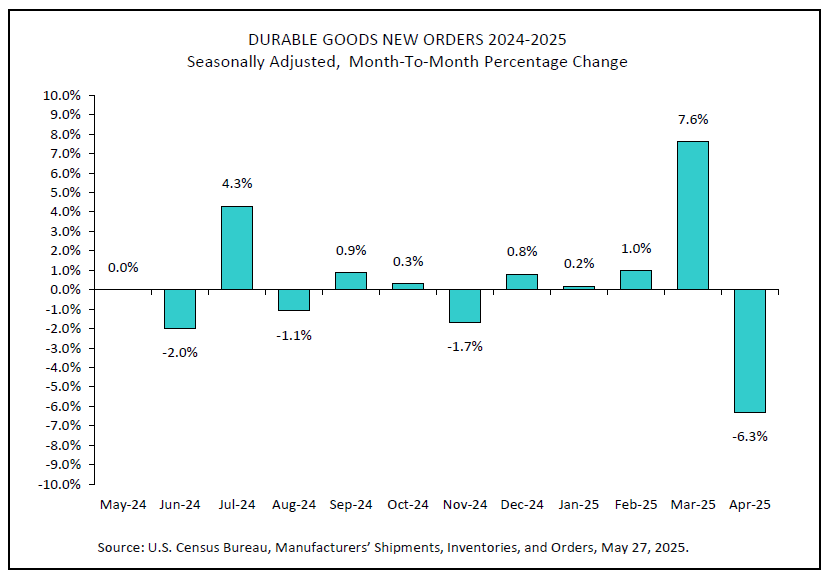
US durable goods orders fell sharply by -6.3% mom in April to USD 296.3B, driven primarily by a steep -17.1% mom drop in transportation equipment. The headline decline, while severe, was less than the expected -8.0%.
Orders excluding defense also posted a significant decline of -7.5% mom to USD 279.3B.
However, the underlying picture was somewhat more stable. Orders excluding the often-volatile transportation component rose by 0.2% mom to USD 197.5B, beating expectations of a flat reading.
This suggests that while large-ticket and defense-related items dragged the headline figure lower, private sector investment in capital goods is holding up better than feared.
ECB’s Holzmann: Should pause rate cut until at least September
Austrian ECB Governing Council member Robert Holzmann cautioned against further rate cuts in the near term, citing heightened uncertainty from the US-EU trade conflict and a belief that monetary policy is no longer the main drag on economic activity.
Arguing that “moving further south would be more risky than staying where we are,” Holzmann said there is no justification for easing in June or July and suggested waiting until at least September before reassessing the need for further action.
Holzmann also pointed to a notable rise in estimates of the neutral interest rate since early 2022, stating that ECB’s current policy stance is already "at least at the neutral level."
In his view, lower rates would provide little economic benefit, as lingering uncertainty, not borrowing costs, is the key factor suppressing growth.