Sample Category Title
EUR/GBP Daily Outlook
Daily Pivots: (S1) 0.8518; (P) 0.8551; (R1) 0.8570; More...
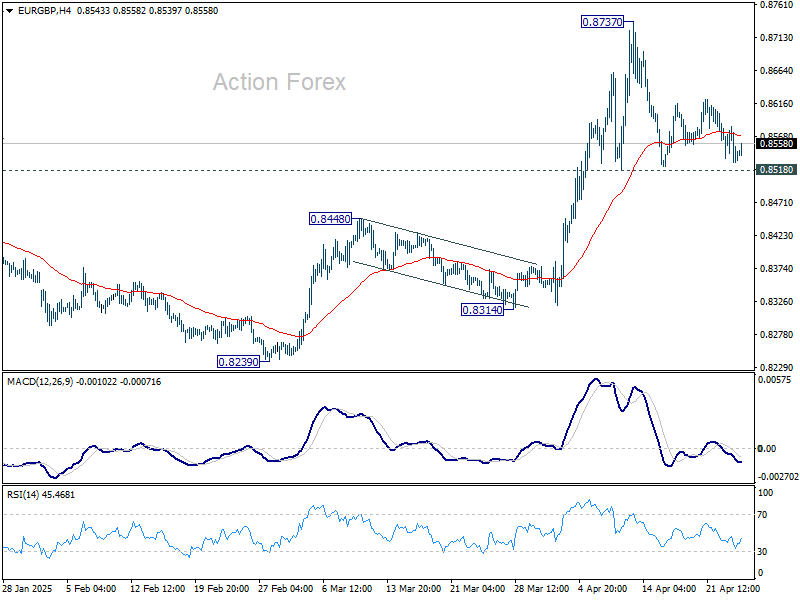
Outlook in EUR/GBP is unchanged and intraday bias stays neutral. More consolidations could be seen below 0.8737 short term top. Further rise is expected as long as 0.8518 support holds. On the upside, break of 0.8737 will resume the larger rally from 0.8221. However, sustained break of 0.8518 will bring deeper fall back to 55 D EMA (now at 0.8444).
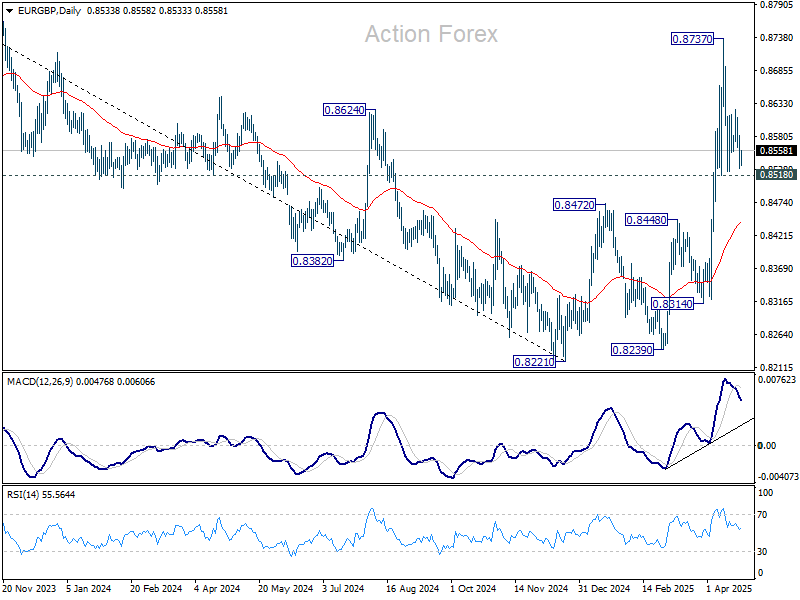
In the bigger picture, down trend from 0.9267 (2022 high) should have completed at 0.8221, just ahead of 0.9201 key support (2024 low). Rise from 0.8221 is likely reversing the whole fall. Further rise should be seen to 61.8% retracement of 0.9267 to 0.8221 at 0.8867 next. This will now remain the favored case as long as 0.8472 resistance turned support holds.
EUR/AUD Daily Outlook
Daily Pivots: (S1) 1.7659; (P) 1.7800; (R1) 1.7937; More...
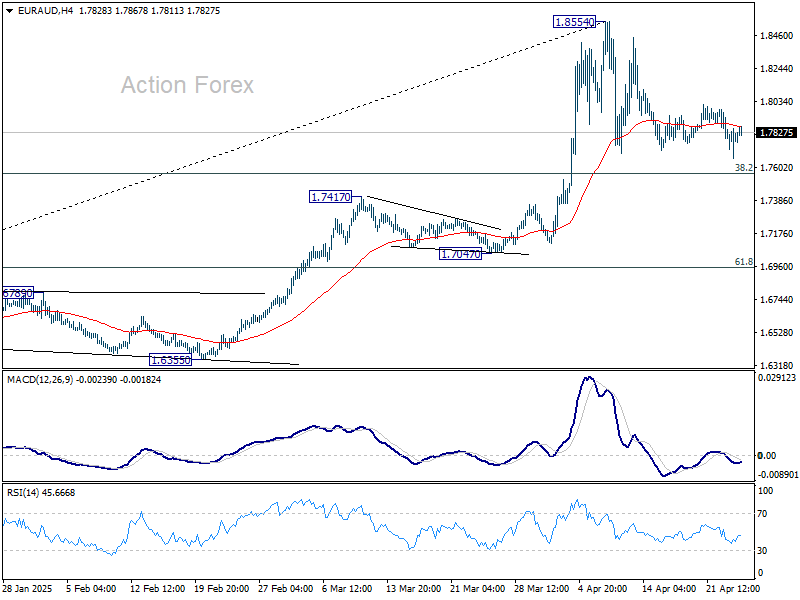
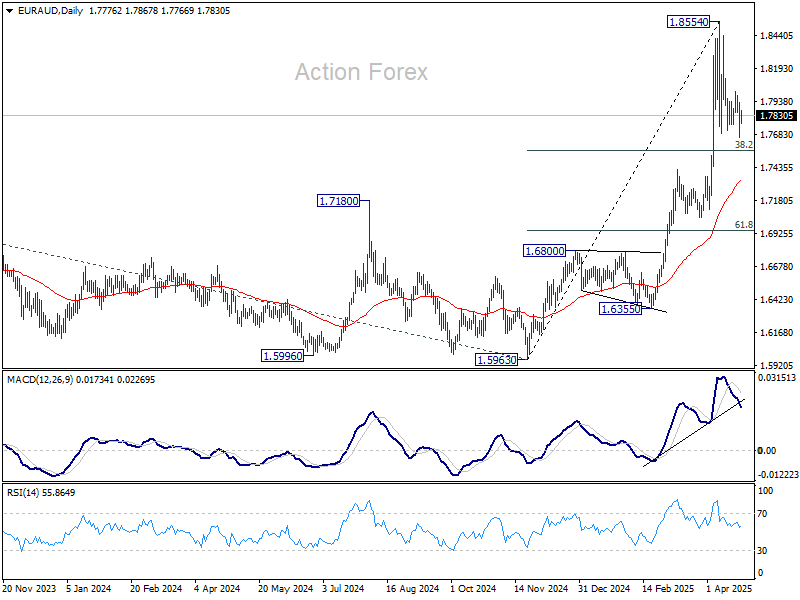
Outlook in EUR/AUD is unchanged as consolidation continues below 1.8554 short term top. Downside of pull back should be contained by 38.2% retracement of 1.5963 to 1.8854 at 1.7750. On the upside, firm break of 1.8554 will resume larger up trend. However, firm break of 1.7750 will bring deeper fall to 55 D EMA (now at 1.7324).
In the bigger picture, up trend from 1.4281 (2022 low) is in progress, and in reacceleration phase as seen in W MACD. Next target is 100% projection of 1.4281 to 1.7062 from 1.5963 at 1.8744. Firm break there will pave the way to 138.2% projection at 1.9806, which is close to 1.9799 (2020 high). Outlook will remain bullish as long as 1.7417 resistance turned support holds even in case of deep pullback.
EUR/JPY Daily Outlook
Daily Pivots: (S1) 161.50; (P) 161.99; (R1) 162.79; More...
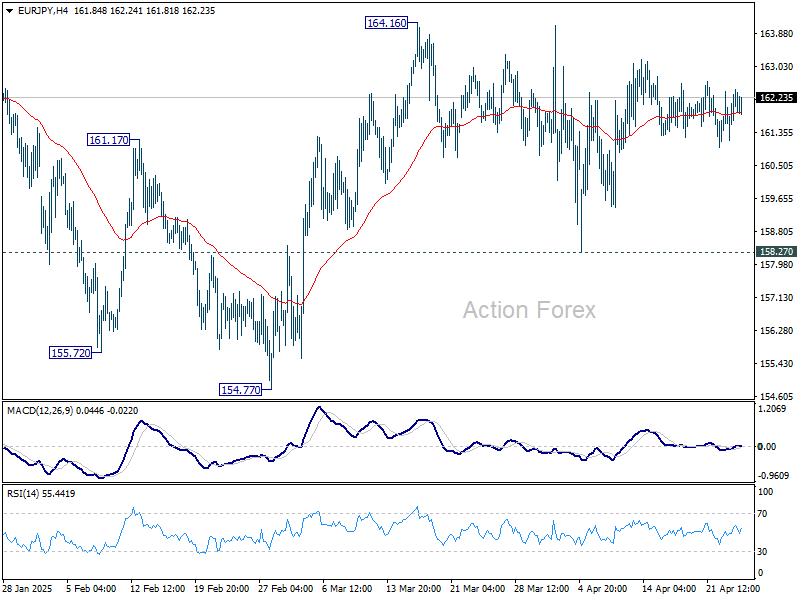
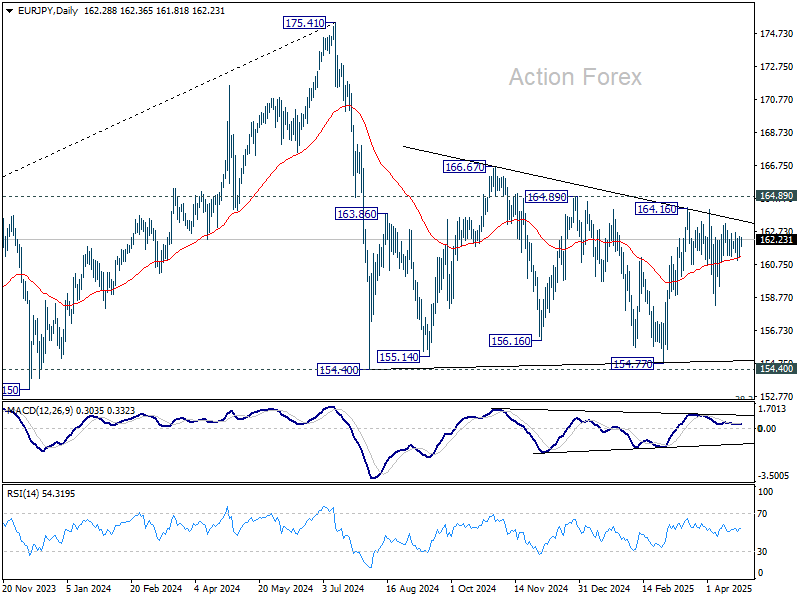
No change in EUR/JPY's outlook as range trading continues. Intraday bias remains neutral at this point. On the upside, above 164.16 will resume the rally from 154.77 to 164.89 resistance, and then 166.67. However, decisive break of 158.27 support will bring deeper decline back to 154.77 support. Overall, sideway consolidation pattern from 154.40 is still extending.
In the bigger picture, price actions from 175.41 are seen as correction to rally from 114.42 (2020 low). Strong support should be seen from 38.2% retracement of 114.42 to 175.41 at 152.11 to contain downside. However, sustained break of 152.11 will bring deeper fall even still as a correction.
GBP/JPY Daily Outlook
Daily Pivots: (S1) 188.83; (P) 189.57; (R1) 190.86; More...
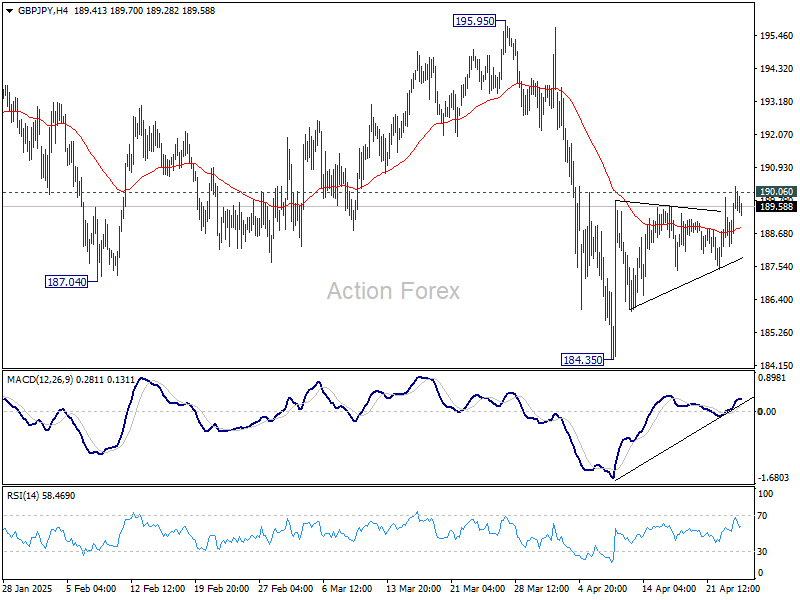
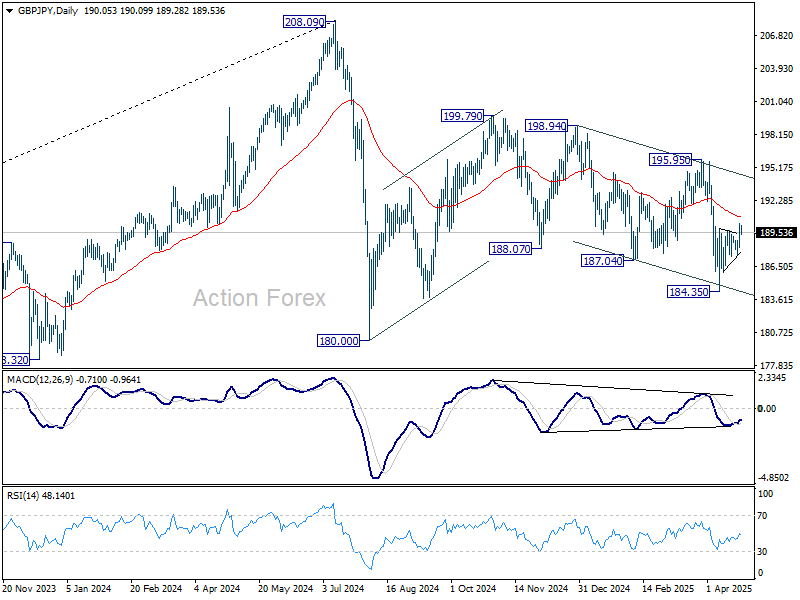
Intraday bias in GBP/JPY remains neutral for the moment. On the upside, firm break of 190.06 resistance will extend the rebound from 184.35 to 195.95. Nevertheless, on the downside, break of 184.35 will target 180.00 low instead.
In the bigger picture, price actions from 208.09 are seen as a correction to rally from 123.94 (2020 low). Strong support should be seen from 38.2% retracement of 123.94 to 208.09 at 175.94 to contain downside. However, sustained break of 175.94 will bring deeper fall even still as a correction.
Elliott Wave: Copper (HG) Impulsive Rally Signals More Upside
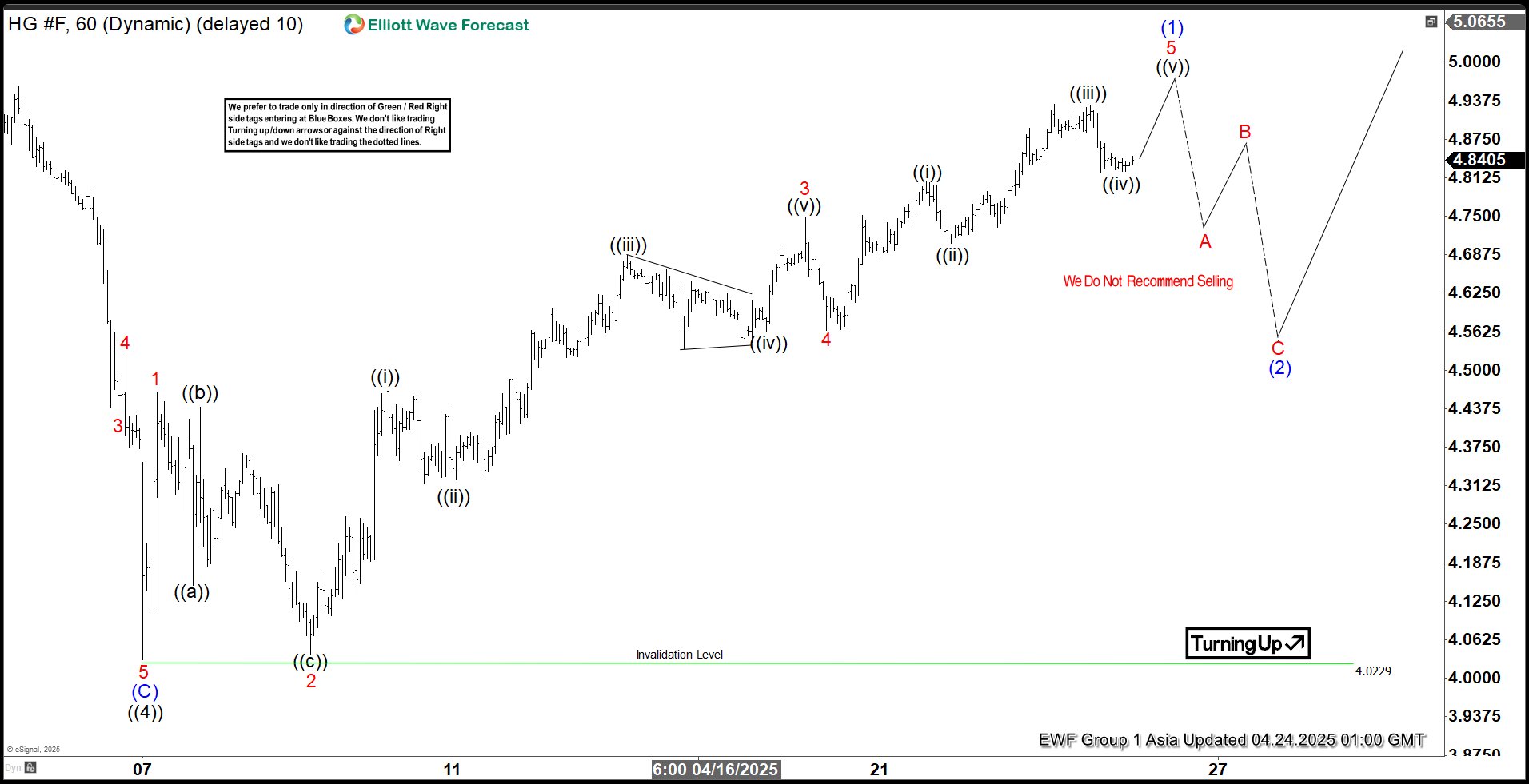
Copper ($HG) has been displaying a strong bullish trend, with the rally from the July 11, 2022 low unfolding in a Elliott Wave diagonal. This rally is structured as a 5-swing pattern, which is characteristic of a motive wave. This suggests that the broader trend favors further upside. As of the latest price action, the metal has completed a significant corrective phase and is now positioned for additional gains.
The recent pullback to the 4.03 low on April 7, 2025, marked the completion of wave ((4)). It is a corrective wave within the larger 5-wave diagonal structure. Following this low, copper has turned higher, initiating wave ((5)). This wave ((5)) is the final leg of the motive sequence. Within wave ((5)), the short-term rally from the wave ((4)) low at 4.03 appears to be unfolding in an impulsive manner, indicating strong upward momentum. Wave 1 ended at 4.465 and pullback in wave 2 ended at 4.038. The metal then rallied higher in wave 3 towards 4.748 and wave 4 dips ended at 4.564.
Expect cycle from April 7, 2025 low to end soon with wave 5 of (1) and the metal to see a 3 waves pullback. However, as long as pullbacks remain above the 4.03 low, copper is expected to see more upside. The Elliott Wave framework continues to support a bullish bias for $HG in the near term.
Copper (HG) 60 Minute Elliott Wave Chart
HG Video
https://www.youtube.com/watch?v=VsJk9RbxrS0
Trump Era Swings Become Standard Procedure
Markets
In the ‘Trump’ era glass-half-empty back to glass-half-full swings have become standard procedure and the trick was again at work yesterday. After indications that he was considering options to dismiss the Fed chair earlier this week, US president Trump moved to a more conciliatory tone vis-à-vis the Fed and its Chair. At the same time, comments from president Trump and press reports (including from the WSJ) suggested that some mitigation in the tariff war with China might be in the cards as well. Some see it as a kind of (at least short-term) Trump put as market turmoil is at risk of spiraling into outright chaos. Equity markets rebounded sharply in Europe and at the US open. Even so, those markets soon realized that any comment remains conditional only up to the next phase in the US administration’s communication. This ‘feeling’ only was reinforced by comments from Treasury secretary Bessent that the US didn’t intend to reduce tariffs on China unilaterally. In the end, US equities still closed with decent gains (S&P 500 + 1.67%, Nasdaq 2.50%) but well off the intraday highs. The US curve flattened with the 2-y adding 5.2 bps while the 30-y declined 5.5 bps. In the current environment, this move can be considered as an easing of the pressures that were building earlier this week. The closely watched 5-y US action was OK. Similar story for the dollar. DXY rebounded to close near 99.85, to be compared with a correction low just below 98 on Monday. Still, this doesn’t improve the overall picture on the US currency in any profound way. EUR/USD also corrected further to close at 1.1315. This euro ‘decline’ occurred even as the European/German yield curve bear flattened with German yields rising between 8.5 bps (2-y) and 5.2 bps (30-y). The move in the first place also should be considered as a risk-on correction. At the same time, EMU April PMI’s saw some fall-out from the global uncertainty (composite PMI 50.1 from 50.9), but the damage could even been bigger, with especially manufacturing showing some (unexpected?) resilience. ECB comments from Lagarde and Villeroy indicated some potential deflationary effects for the EU economy from the current trade uncertainty. Even so, the PMI’s suggest no need for the ECB rush into stimulative territory given current context of elevated uncertainty.
Asian equity markets this morning show no clear directional trend as yesterday’s WS optimism is petering out. Later today, the eco calendar contains German IFO business confidence, US durable goods orders and jobless claims and a $44 bln US 7-y Note auction. Recently, eco data most often only had limited impact on trading and often told more about market positioning rather than on the underlying eco narrative. The pressure on LT US Treasuries eased for now, but the 4.20%/4.25% area for 10-y looks like strong ‘support’. In EUR/USD 1.1264/1.1144 are the first references that needs to be cleared to call of the EUR/USD ascent. We’re not that far yet.
News & Views
The European Automobile Manufacturers’ Association (ACEA) showed new EU car registrations declining slightly in March (-0.2% Y/Y) with Q1 2025 registrations being 1.9% lower compared to Q1 2024 in the particularly challenging and unpredictable global (trade) context for auto makers. Hybrid electric vehicles are the most popular in EU, capturing 35.5% market share in Q1 (from 28.9% in Q1 2024). Battery EV’s grab a 15.2% market share in the Jan-March period, up from 12% last year, but still way below where they were expected to be. Three of the four largest markets in the EU, accounted for 63% of all battery-electric car registrations, recorded robust gains: Germany (+38.9%; 17% market share Q1 2025), Belgium (+29.9%; 33.4% market share), and the Netherlands (+7.9%; 35.3% market share). This contrasted with France, which saw a decline of 6.6% (18.2% market share). Petrol cars (28.7% from 35.9%) are the second largest category of new registrations, but the combined share of petrol and diesel cars fell to 38.3% from 48.3% over the same period last year.
The Financial Times reports that US President Trump is planning to spare carmakers from some of his most onerous tariffs, in another trade war climbdown following intense lobbying by industry executives over recent weeks. It would be a destacking of duties, exempting car parts from tariffs on imports from China related to fentanyl chemical exports as well as from those on steel and aluminum. They are already shielded from reciprocal tariffs while imports for cars from Mexico and Canada already have better terms if they comply with the USMCA trade treaty (only tariffs on non-US content). The 25% tariff imposed on all imports of foreign-made cars would stay in play as well as the separate 25% on parts which is due to take effect from May 3.
EUR/USD Daily Outlook
Daily Pivots: (S1) 1.1269; (P) 1.1354; (R1) 1.1401; More...
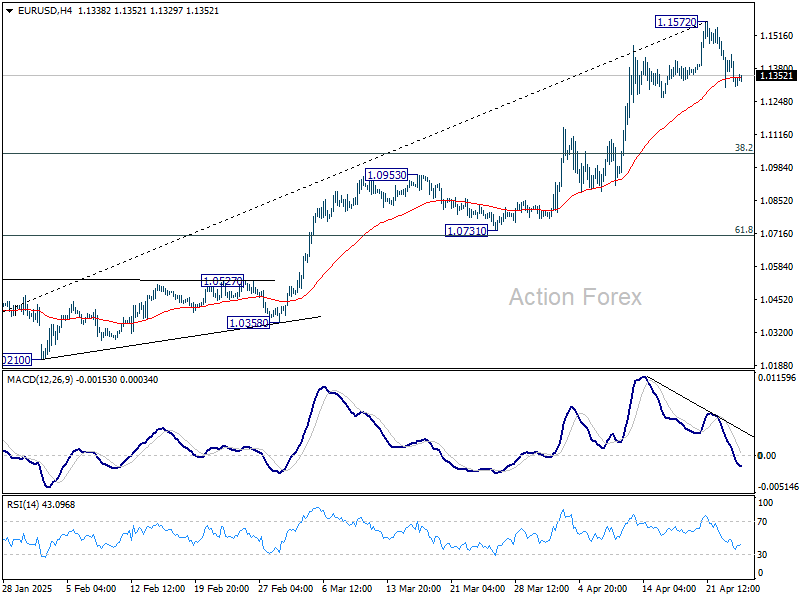
Intraday bias in EUR/USD remains mildly on the downside for the moment. Pull back from 1.1572 short term topping could extend lower. But downside should be contained by 38.2% retracement of 1.0176 to 1.1572 at 1.1039. On the upside, break of 1.1572 will resume larger up trend.
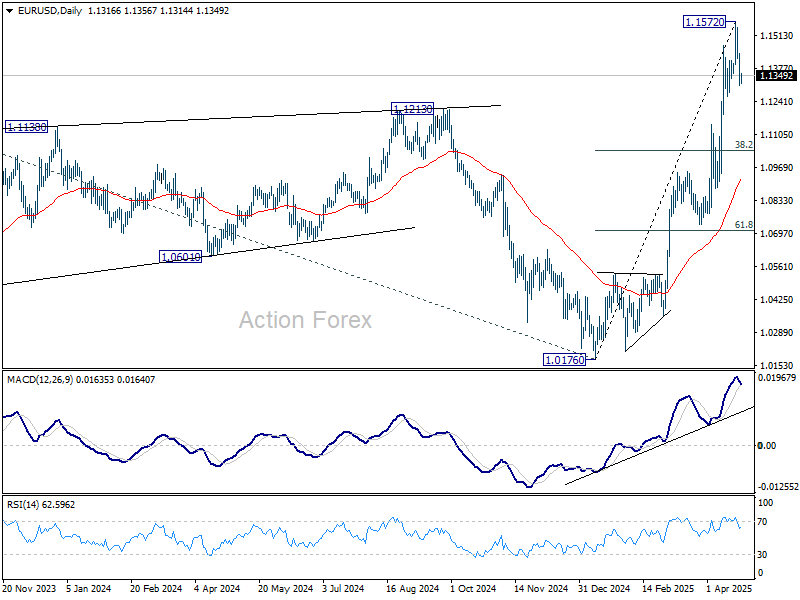
In the bigger picture, rise from 0.9534 long term bottom could be correcting the multi-decade downtrend or the start of a long term up trend. In either case, further rise should be seen to 100% projection of 0.9534 to 1.1274 from 1.0176 at 1.1916. This will now remain the favored case as long as 55 W EMA (now at 1.0776) holds.
GBP/USD Daily Outlook
Daily Pivots: (S1) 1.3212; (P) 1.3276; (R1) 1.3319; More...
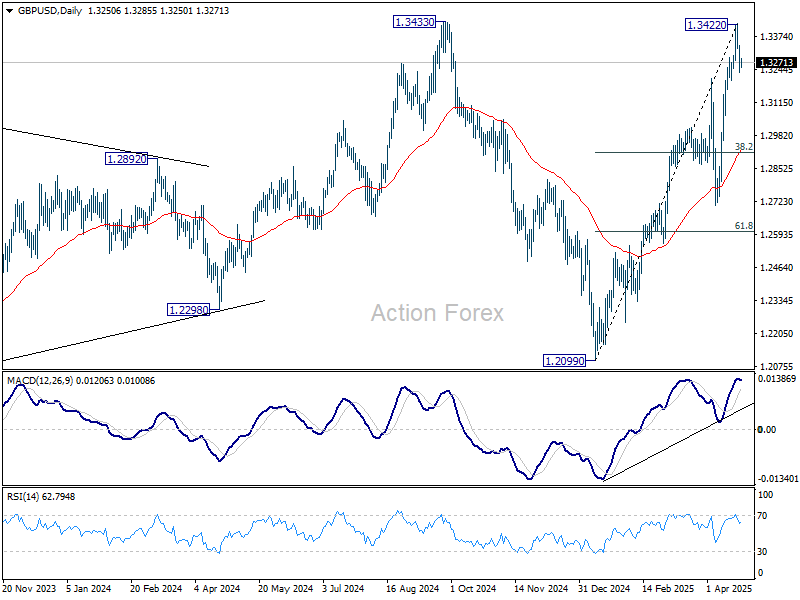
Intraday bias in GBP/USD remains mildly on the downside for the moment. Pullback from 1.3422 short term top would continue lower. But downside should be contained by 38.2% retracement of 1.2099 to 1.3422 at 1.2917. On the upside, firm break of 1.3433 will resume larger up trend.
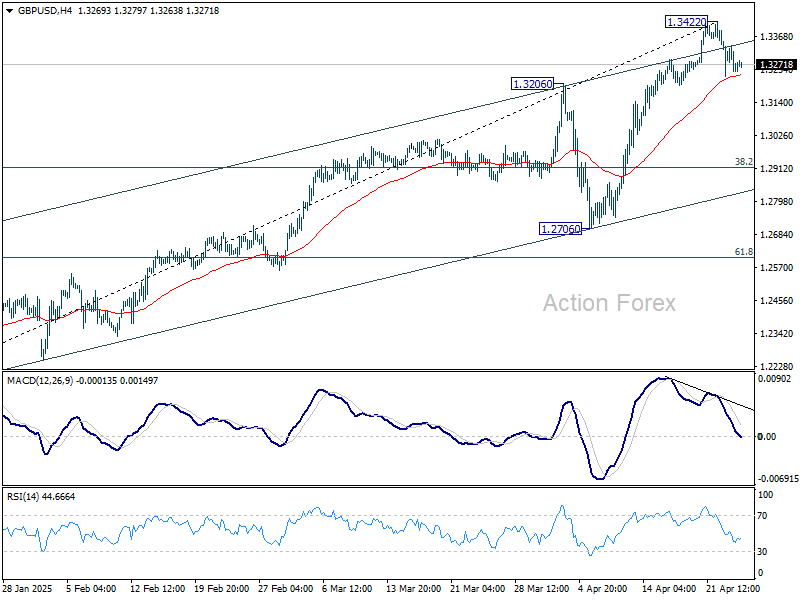
In the bigger picture, price actions from 1.3433 are seen as a corrective pattern to the up trend from 1.3051 (2022 low). Rise from 1.2099 could be the second leg. Overall, GBP/USD should target 1.4248 key resistance (2021 high) on break of 1.3433 at a later stage.
USD/CHF Daily Outlook
Daily Pivots: (S1) 0.8215; (P) 0.8264; (R1) 0.8355; More…
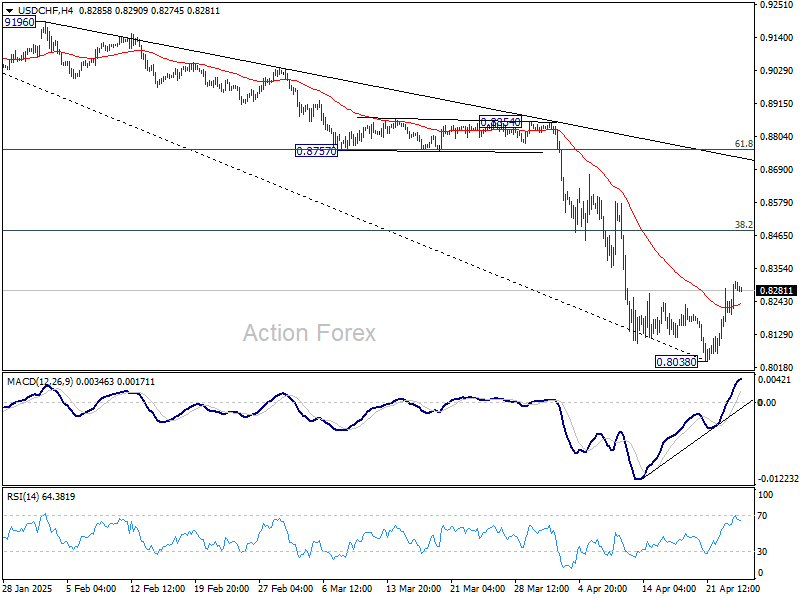
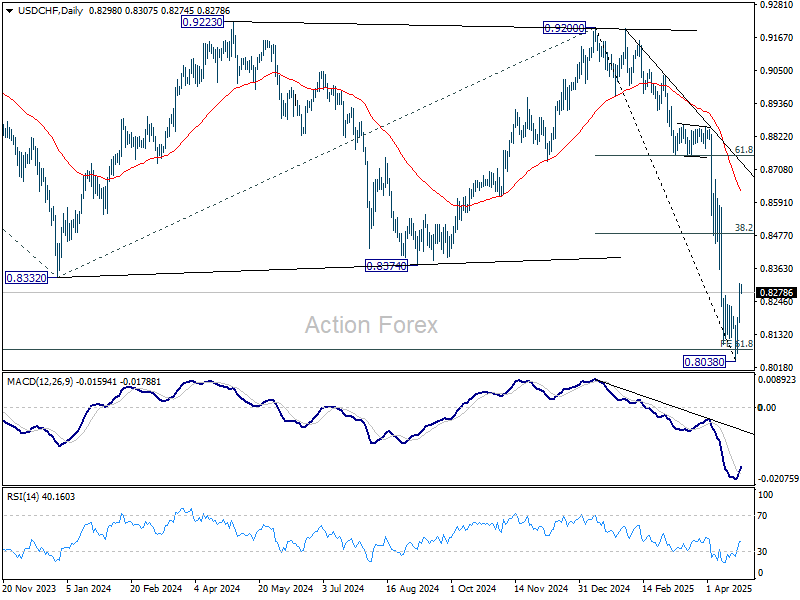
Intraday bias in USD/CHF stays on the upside, as rebound from 0.8038 short term bottom could extend to 38.2% retracement of 0.9200 to 0.8038 at 0.8482. But strong resistance should be seen there to limit upside. On the downside, break of 0.8038 will resume larger down trend.
In the bigger picture, long term down trend from 1.0342 (2017 high) is still in progress and met 61.8% projection of 1.0146 (2022 high) to 0.8332 from 0.9200 at 0.8079 already. In any case, outlook will stay bearish as long as 55 W EMA (now at 0.8794) holds. Sustained break of 0.8079 will target 100% projection at 0.7382.
USD/JPY Daily Outlook
Daily Pivots: (S1) 142.07; (P) 142.82; (R1) 144.19; More...
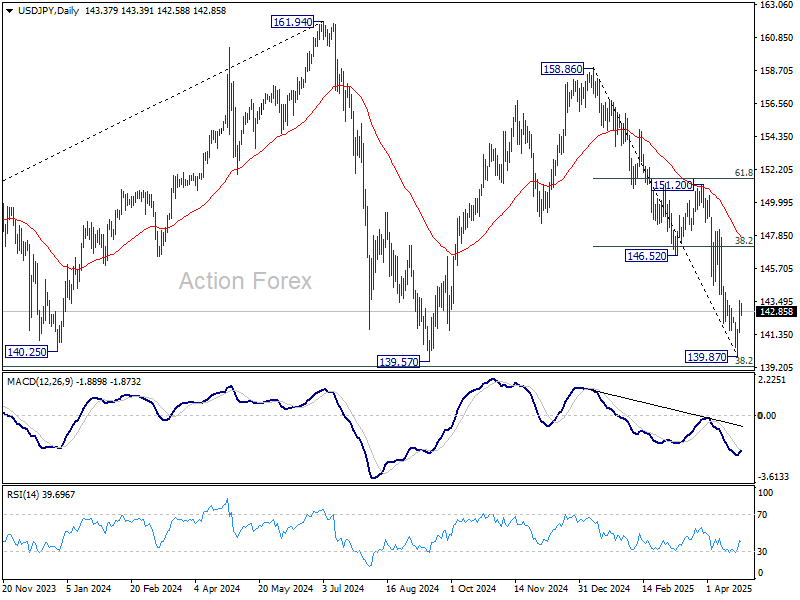
Intraday bias in USD/JPY stays on the upside as rebound from 139.87 short term bottom would extend higher. But overall risk will stay on the downside as long as 38.2% retracement of 158.86 to 139.87 at 147.12 holds. On the downside, decisive break of 139.26 will carry larger bearish implications.
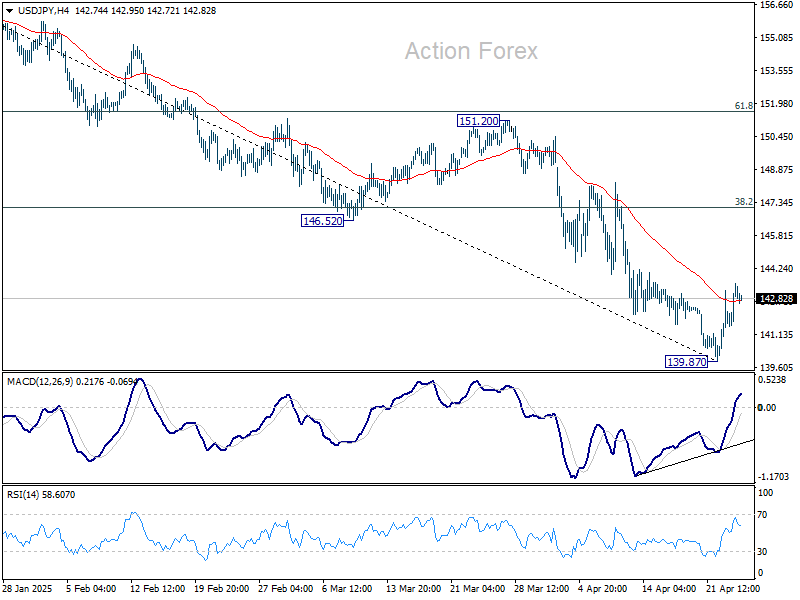
In the bigger picture, price actions from 161.94 are seen as a corrective pattern to rise from 102.58 (2021 low), with fall from 158.86 as the third leg. Strong support should be seen from 38.2% retracement of 102.58 to 161.94 at 139.26 to bring rebound. However, sustained break of 139.26 would open up deeper medium term decline to 61.8% retracement at 125.25.