Sample Category Title
Play in May, Don’t Go Away
The higher outlook for the cash rate is quite the turnaround. We expect another rate hike in May. Other pathways are possible as risk scenarios.
- With inflation now higher (and overall demand growth stronger) than previously expected, the RBA raised the cash rate in February. The question then becomes, how much more is coming and when? We believe that another cash rate increase will occur, in May.
- There are pathways that result in the next rate hike occurring at the March meeting, but this is less likely. The RBA believes (as we do) that much of the recent increase in inflation is temporary, which reduces the urgency of follow-up hikes.
- If things turn out as we expect, the RBA will be able to point to some turnaround in inflation, as temporary factors wash out by the time the August meeting comes around. This will enable the Board to take a ‘wait-and-see’ approach with policy already restrictive. There are scenarios where it will want to raise rates even further then, but they are not our baseline expectation.
The shift in the interest rate outlook in Australia since six months ago is quite the turnaround. Inflation has kicked up in ways that were not apparent or expected in mid 2025. One reason was that, while a slowdown in public demand growth and pick-up in private demand growth were both expected – as can often be an issue – the net of the two has been more positive than anticipated. Prices tend to respond sooner than volumes when demand surprises. Above-average inflation in many administered prices didn’t help. The RBA has responded to this, first by preparing the ground for a rate hike and ruling out the previously expected cuts, and then by delivering that rate increase at its February meeting. The question then becomes, how much more should we expect the cash rate to rise, and when?
We currently expect one more rate rise, in May. Other paths are possible if the data flow turns out differently than our expectations.
The main plank supporting this view is that the RBA Monetary Policy Board appears to be dissatisfied with the inflation trajectory implied by its staff forecasts. It therefore thinks it needs to do more than the roughly one extra hike that was priced in at the time those forecasts were finalised. It is unlikely that the data flow will turn softer soon enough to prevent it from moving in May. Even if the labour market does unravel unexpectedly, that will not happen soon enough to affect a May decision. Similarly, we think there is enough near-term momentum to inflation that the narrative that “it is showing some persistence” cannot be walked back by May. Our expectation for the March quarter inflation print is only marginally lower than what we believe the RBA’s to be. Near-term inflation outcomes would have to surprise noticeably to the downside to stay the RBA’s hand at its May meeting.
Recall that RBA’s forecasts are based on the technical assumption that the cash rate follows market pricing at the time the forecasts are finalised. As the Governor repeatedly emphasises in post-meeting media conferences, this is not a forecast or promise from the RBA. Rather, it is necessary to ensure that the forecasts are coherent across financial market variables. The market path for the cash rate is the one consistent with the exchange rate being where it is, another technical assumption in the RBA’s forecasting framework.
You can, however, glean something about what the RBA thinks regarding the rates outlook from the inflation forecast that the market path delivers. If it is uncomfortably high for too long, this is a sign that the Board thinks it might need to do more than was priced in. Again, an alternative path is not baked in, but it does give a guide to the balance of probabilities. And if the tone of the post-meeting press conference is any guide, at least some Board members think they will have to do even more than the 60bp increase over 2026 that was priced in at the time.
Could the rate increase come as soon as March, as a back-to-back hike? We cannot rule this out, but it is not our base-case expectation. While the staff forecasts are consistent with the RBA believing it might have to do more, the divergence from a more desirable inflation path was not large. And it is clear both from the post-meeting communication and today’s testimony before the House of Representatives that the RBA thinks that “[m]uch of the increase in inflation is judged to be temporary” and only some of it is persistent. It is plausible that there are members of the Board and/or the staff that see the need for tightening as more urgent, and therefore possible that some votes for a hike will be recorded in March. Given the RBA’s published assessment of the nature of the increase in inflation, though, we do not think the majority will vote for a March hike.
Beyond May, we think it is possible that the RBA will want to keep raising rates, but that this scenario is less likely than an extended period on hold in a restrictive stance, one that is not far off the earlier peak. Our assessment of the outlook is that a downward trajectory in underlying inflation will emerge and will start to be evident in the Q2 data. Part of this will be the start of the unwinding of the temporary component of the recent increase. Those who are more familiar with the ‘long and variable lags’ of monetary policy will note that this would be a very quick turnaround for monetary policy to have done the deed. Watch also for the labour market slowing more and sooner than the RBA is forecasting as a signal supporting on-hold policy beyond May.
A factor that received less attention in the RBA’s post-meeting communication and testimony is the role of the exchange rate in shaping the inflation outlook. Some of the recent pick-up in inflation came from consumer goods. Most of these are imported, and the weakness earlier in 2025 in the AUD, especially relative to the USD, would have played a role in this. (Recall that China’s currency is managed closely to the USD, so the AUD/USD rate effectively comprises around 40% of Australia’s trade-weighted index.) With the AUD now noticeably higher since the previous forecast round, the contribution to overall inflation from this source will go into reverse. Our own models as well as a commercially available whole-economy model suggest that pass-through of lower prices of imported goods through to retail prices could slow overall inflation noticeably sooner than the RBA’s forecasts imply. Our own forecasts make some allowance for this, but the model-implied effect implies that this could be stronger than we assume. (There are, of course, also upside risks to inflation, notably from home-building costs.)
Bottom line: we expect another hike in the cash rate in May, and while the risks are that they move sooner or do more, the likely data flow supports a one-hike-in-May scenario.
USD/JPY Presses Higher, But A Major Barrier Stands In The Way
Key Highlights
- USD/JPY recovered sharply and rallied above 155.50.
- A major bearish trend line is forming with resistance at 157.80 on the 4-hour chart.
- GBP/USD declined further and traded below 1.3620.
- Bitcoin extended losses and dived below $65,000.
USD/JPY Technical Analysis
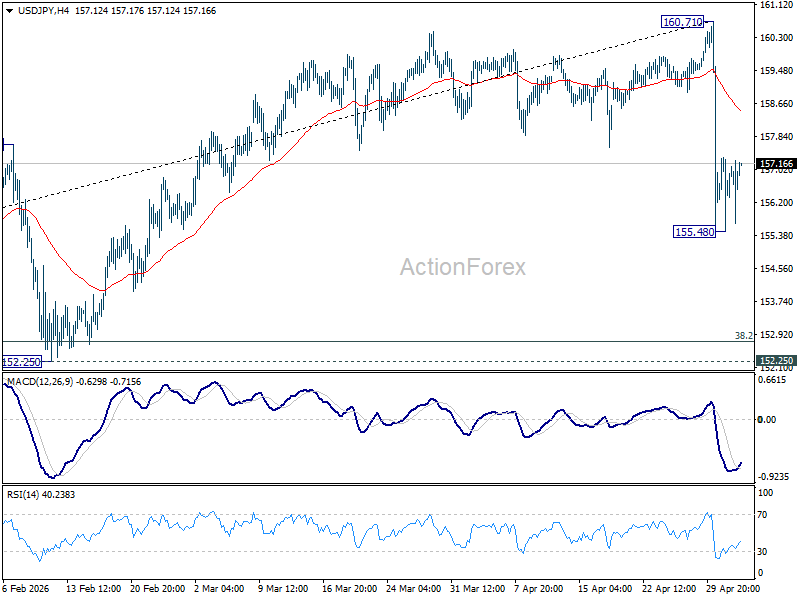
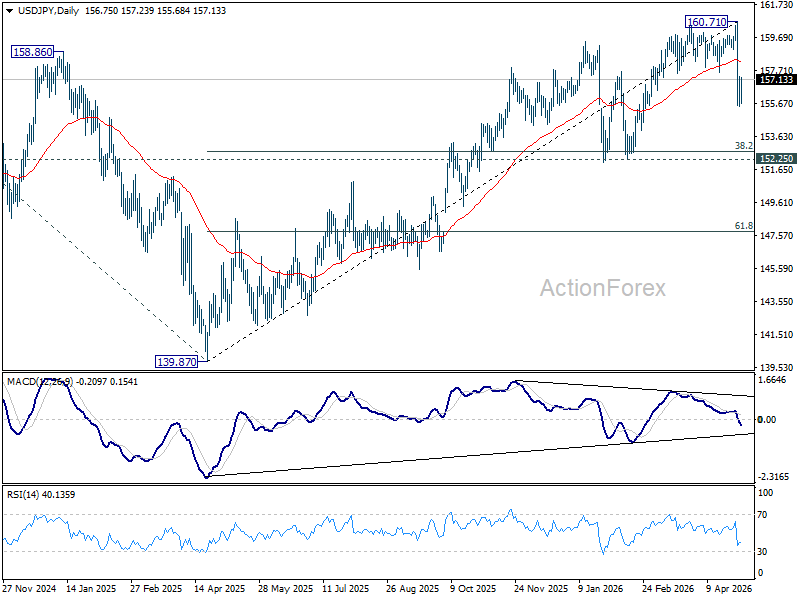
The US Dollar started a steady increase above 154.20 against the Japanese Yen. USD/JPY cleared the 155.00 resistance to enter a positive zone.
Looking at the 4-hour chart, the pair broke the 50% Fib retracement level of the downward move from the 159.45 swing high to the 152.09 low. The pair even surpassed the 100 simple moving average (red, 4-hour) and the 200 simple moving average (green, 4-hour).
On the upside, the pair could face hurdles near 157.70 or the 76.4% Fib retracement level of the downward move from the 159.45 swing high to the 152.09 low.
There is also a major bearish trend line forming with resistance at 157.80. The next stop for the bulls might be 158.00. A close above 158.00 could open the doors for more gains. In the stated case, the bulls could aim for a move toward 159.50.
Immediate support could be 156.50. The first major area for the bulls might be near 156.20. The main support sits at 154.90, below which the pair might gain bearish momentum. In the stated case, it could even revisit 152.50.
Looking at GBP/USD, the pair corrected some gains and traded below the 1.3620 support. The next key support might be 1.3500.
Upcoming Key Economic Events:
- Michigan Consumer Sentiment Index for Feb 2026 (Prelim) – Forecast 55.0, versus 56.4 previous.
- Canada’s Net Change In Employment for Jan 2026 – Forecast 7K, versus 8.2K previous.
- Canada’s Unemployment Rate for Jan 2026 - Forecast 6.8%, versus 6.8% previous.
Cliff Notes: Facing Uncertainty
Key insights from the week that was.
The RBA Monetary Policy Board decided to raise the cash rate by 25bps to 3.85% this week, in line with economist and market expectations. Justifying the decision, the Board stated that inflation had “picked up materially” against a backdrop of “greater momentum in demand”. Capacity pressures were seen as “unlikely to explain the majority of the recent increase [in inflation]”, with “sector-specific demand and price pressures” which “may not persist” also evident. Together, these dynamics are contributing to elevated near-term inflation and a slower projected return to target, a clear source of discomfort for the Board.
In a video update midweek, Chief Economist Luci Ellis discussed the RBA’s forecasts and the implications. A technical assumption of at least one more rate hike in 2026 together with a trimmed mean inflation forecast slightly above the mid-point at horizon’s end (2.6%yr in Jun-28) suggests another rate hike is most probable. We have consequently incorporated a follow-up 25bp hike in May into our baseline view. Note though, this adjustment reinforces our view that rate cuts are likely to prove necessary down the track, most likely in November 2027 and February 2028, leaving the cash rate at 3.60%.
Higher actual and expected interest rates have softened house price growth at the margin. Stripping out the effect of ‘thin’ trading over summer, Cotality reports that national house price gains on a seasonally adjusted basis have moderated from 1.1% in Oct-Nov to 0.9% over Dec-Jan. Choppy monthly reads for dwelling approvals have meanwhile made assessing the strength of ‘front-end’ housing supply a challenge. 2025 was a more positive year for new supply, but it was still well below the Government’s Housing Accord target. And headwinds are now stronger.
Before moving offshore, a final note on trade. The latest read on goods trade saw the surplus edge slightly higher to $3.4bn in December, supported by a modest gain in export earnings and a small decline in the import bill. The underlying dynamics point to a continued trend narrowing in the surplus, as global demand for commodity exports remains subdued and domestic recovery buoys consumer imports.
Offshore, there was plenty of central bank communications to parse.
The Bank of England kept rates steady at 3.75% in a 5-4 vote. Forward guidance points to a slower pace of easing in 2026 than 2025, with future decisions characterised as “a closer call”. According to the minutes, there are presently three camps in the MPC. The most hawkish advocated to keep rates on hold, concerned inflation may hold above target. The middle camp, which contained Governor Bailey and Catherine Mann, noted that there is room for additional easing, but wanted further evidence that weaker activity will feed through to inflation. While the four doves that voted for a cut are already confident inflation will normalise.
The updated BoE forecasts certainly make the case for additional easing in 2026. Most notably, the inflation profile has been revised down significantly, now foreseeing a return to 2.0%yr by Q3 this year and a pace at year end 0.5ppts lower than expected three months ago. GDP growth is forecast to be 0.3ppt lower in Q4 2026 at 1.1%yr, and the unemployment rate 0.3ppts higher at 5.3%. We continue to anticipate a further Bank Rate cut in March followed by a final cut in Q2.
The European Central Bank meanwhile decided to hold rates steady in February. No new forecasts were released, and the central bank’s forward guidance was largely unchanged, with the Governing Council set to “follow a data-dependant and meeting-by-meeting approach”. In the press conference, President Lagarde highlighted external risks stemming from “a volatile global policy environment” and weaker sentiment in financial markets. On inflation, she stated that underlying inflationary pressures remain consistent with the 2% target, but also acknowledged that euro appreciation could push inflation below the desired level.
The stable outlook for inflation allowed President Lagarde to reiterate that the ECB is in a “good place”, signalling that she, and likely most Governing Council members, currently see no reason to alter the existing policy stance. We hold a similar view, expecting policy to be unchanged through 2026, though we are mindful of the potential disinflationary impact of euro appreciation.
Finally to the US, the ISM PMIs for January pointed to improved conditions in the manufacturing sector and little change for services. The manufacturing PMI rose 4.7pts overall as the new orders component gained 9.7pts and employment was up 3.3pts. Note though that employment remains 4.8pts below the pre-COVID average, consistent with other labour market indicators which point to limited marginal labour demand. For services, conditions were unchanged overall despite a large decline in inventories and export orders. Employment also fell 1.4pts to be 6.3pts below its pre-COVID average.
Upstream prices pressures remain evident across the economy, the manufacturing prices component up 0.5pts in the month to be 3.2pts higher than its historic average and the services measure up 1.5pts, 10.4pts above the pre-COVID average. Tariffs, energy costs and capacity constraints across the economy are likely fuelling these pressures.
Bitcoin Tumbles to $63,000 Amid Global Tech Selloff – BTC/USD Outlook
Looking at the crypto market today, the outlook is grim. Bitcoin has lost nearly 50% of its value since that peak, total market capitalization has fallen back to Trump re-election levels, and major altcoins such as Solana have corrected by as much as 70% or more.
What goes up — especially when it goes up too fast — must eventually come down.
Current flows are eerily reminiscent of the November 2021 tech and crypto meltdown, making that period worth revisiting.
Tech Sector 3-month performance – Courtesy of Finviz. February 5, 2026
At the time, Bitcoin had surged from its $3,800 COVID lows to $69,000 in roughly a year and a half, topping in November 2021 before collapsing nearly 80% to around $15,800 — a move that felt like the end of the world.
Total crypto market cap fell from just over $3 trillion to roughly $736 billion during that drawdown.
That decline was accompanied by a series of brutal headlines, including the Terra/Luna collapse and the eventual FTX blow-up in 2022.
Total Crypto Market Cap, February 2026 – Source: TradingView
Since then, Bitcoin staged an impressive sixfold rally from its November 2022 lows.
Aside from the brief Liberation Day sweep toward $75,000, the market barely retraced — and it is now paying the hefty price.
A 70% decline from the $126,400 record high would bring Bitcoin back toward the $30,000 area – That may sound extreme from today’s levels, but in crypto, nothing is impossible. Extreme volatility is part of the asset class’s DNA, on both the upside and the downside.
Before diving into a deeper analysis of the father of cryptocurrencies, it’s worth remembering that these drawdowns are exactly what markets do best.
They create stories, hope, and spectacular trends — but also nightmares, grief, and collapses. Bubbles are nothing new, and while markets evolve from them, they rarely learn. They simply reflect humanity’s purest forms of exuberance and despair.
The key risk now is whether these declines spill over into other asset classes and trigger cascading effects. But it isn’t only about fear. Historically, assets that lose more than 50% of their value can become attractive accumulation candidates — often more so than buying at full price. Still, catching falling knives is dangerous, and many fortunes have been lost trying.
Plan carefully, scale in progressively, and always spread your risk.
Let's explore some key levels of interest from Weekly to Daily charts and trading levels for Bitcoin (BTC) to spot where the current drop could hold (and potentially reverse, even if the mood doesn't corroborate much with this idea).
Bloodshed in the Crypto Market
Daily overview of the Crypto Market, February 5, 2026 – Source: Finviz
The daily drops are staggering.
The selloffs have been accelerating in the past few minutes with Ethereum reaching $1,860 and XRP at $1.18 which could prompt short-term buyings of dip.
Still, be careful with falling knives!
Bitcoin multi-timeframe technical analysis
Weekly Chart
Bitcoin Weekly Chart, February 5, 2026 – Source: TradingView
With the fast-paced acceleration, Bitcoin is now dropping back to the $63,000 Major Support (which extends to $60,000), key level which served as the basis of the 2024 breakout.
The weekly candle is an ugly one.
If this extends further, it will be interesting to see how traders react to the 200-Week Moving average at $58,000. Let's take a closer look to see where we stand and spot for potential troughs.
Daily Chart and Technical Levels
Bitcoin Daily Chart, February 5, 2026 – Source: TradingView
With the daily run, it would be surprising to see the action continue much further in a straight line – However, the fragile market conditions wouldn't warrant an immediate bottom.
Keep a close look to immediate reactions between $60,000 to $63,000 as the session closes back to pre-breakout levels.
A striking Measured Move pattern could also be developing and seems like a decent target for such a drop.
Taking the October to November 2025 drop gives the base, which extends to $52,000, an interesting level for dip-buying if we get there.
Of course, investors will want to be extremely careful with themes around Markets as we keep correcting.
What starts with liquidations could easily turn into a larger disaster and contribute to even more extreme moves around Markets.
Levels of interest for BTC trading:
Support Levels:
- $60,000 to $63,000 Main 2024 support (immediate test)
- $52,000 to $58,000 Next support and 200-Week MA
- $2023 Breakout base $25,000 to $34,000
Resistance Levels:
- $75,000 Key long-term Pivot
- $80,000 to $83,000 mini-resistance
- $90,000 to $95,000 Pivotal Resistance
- Current all-time high $126,250
Safe Trades!
Bitcoin Wave Analysis
Bitcoin: ⬇️ Sell
- Bitcoin broke round support level 80000.00
- Likely to fall to support level 60000.00
Bitcoin cryptocurrency falling sharply after the price broke the round support level 80000.00, the support level 74342.00 (yearly low from 2025) and the weekly support trendline from 2023.
Each of these breakouts accelerated the active impulse waves 1 and (C).
Given the strongly bearish sentiment seen across cryptocurrency markets today, Bitcoin cryptocurrency can be expected to fall toward the next support level 60000.00.
Ethereum Wave Analysis
Ethereum: ⬇️ Sell
- Ethereum broke round support level 2000.00
- Likely to fall to support level 1725.00
Ethereum cryptocurrency recently broke the support zone between the support level 2120.00 (former multi-month low from June) and the round support level 2000.00.
The breakout of this support zone accelerated the active impulse wave C of the multi-month downward ABC correction (B) from August.
Ethereum can be expected to fall toward the next support level 1725.00 (former low from May and the target for the completion of the active impulse wave C).
Eco Data 2/6/26
| GMT | Ccy | Events | Act | Cons | Prev | Rev |
|---|---|---|---|---|---|---|
| 23:30 | JPY | Overall Household Spending Y/Y Dec | -2.60% | -0.30% | 2.90% | |
| 05:00 | JPY | Leading Economic Index Dec P | 110.2 | 109.8 | 109.9 | |
| 07:00 | EUR | Germany Industrial Production M/M Dec | -1.90% | -0.30% | 0.80% | 0.20% |
| 07:00 | EUR | Germany Trade Balance (EUR)Dec | 17.1B | 14.5B | 13.1B | |
| 08:00 | CHF | Unemployment Rate M/M Jan | 2.90% | 3.00% | 3.00% | |
| 08:00 | CHF | Foreign Currency Reserves Jan | 712B | 725B | ||
| 13:30 | CAD | Net Change in Employment Jan | -24.8K | 7.3K | 8.2K | |
| 13:30 | CAD | Unemployment Rate Jan | 6.50% | 6.80% | 6.80% | |
| 15:00 | CAD | Ivey PMI Jan | 50.9 | 49.7 | 51.9 | |
| 15:00 | USD | UoM Consumer Sentiment Feb P | 57.3 | 55.8 | 56.4 | |
| 15:00 | USD | UoM 1-Yr Inflation Expectations Feb P | 3.50% | 4% |
| 23:30 | JPY |
| Overall Household Spending Y/Y Dec | |
| Actual | -2.60% |
| Consensus | -0.30% |
| Previous | 2.90% |
| 05:00 | JPY |
| Leading Economic Index Dec P | |
| Actual | 110.2 |
| Consensus | 109.8 |
| Previous | 109.9 |
| 07:00 | EUR |
| Germany Industrial Production M/M Dec | |
| Actual | -1.90% |
| Consensus | -0.30% |
| Previous | 0.80% |
| Revised | 0.20% |
| 07:00 | EUR |
| Germany Trade Balance (EUR)Dec | |
| Actual | 17.1B |
| Consensus | 14.5B |
| Previous | 13.1B |
| 08:00 | CHF |
| Unemployment Rate M/M Jan | |
| Actual | 2.90% |
| Consensus | 3.00% |
| Previous | 3.00% |
| 08:00 | CHF |
| Foreign Currency Reserves Jan | |
| Actual | 712B |
| Consensus | |
| Previous | 725B |
| 13:30 | CAD |
| Net Change in Employment Jan | |
| Actual | -24.8K |
| Consensus | 7.3K |
| Previous | 8.2K |
| 13:30 | CAD |
| Unemployment Rate Jan | |
| Actual | 6.50% |
| Consensus | 6.80% |
| Previous | 6.80% |
| 15:00 | CAD |
| Ivey PMI Jan | |
| Actual | 50.9 |
| Consensus | 49.7 |
| Previous | 51.9 |
| 15:00 | USD |
| UoM Consumer Sentiment Feb P | |
| Actual | 57.3 |
| Consensus | 55.8 |
| Previous | 56.4 |
| 15:00 | USD |
| UoM 1-Yr Inflation Expectations Feb P | |
| Actual | 3.50% |
| Consensus | |
| Previous | 4% |
ECB Review: Accentuate the Positive
- ECB decided to leave its key policy rates unchanged with the deposit facility rate at 2.00% as widely expected by markets and consensus.
- Lagarde accentuated the positive factors of the economy such as low unemployment while downplaying the role of the inflation undershooting and strengthened euro.
- We maintain our call that the ECB will leave the deposit rate unchanged at 2.00% throughout both 2026 and 2027.
The ECB left the deposit rate unchanged at 2.00% as expected by both markets and analysts. The press release was short with the guidance paragraph similar to December. Interestingly, it was the positive aspects of the economy like low unemployment, solid private balance sheets and increased public spending that was accentuated despite inflation declining to 1.7% in January.
During the press conference Lagarde further emphasised the positive aspects, with limited reference to negative factors like tariffs. On inflation she focused on energy base effects and one-offs as the reason for lower inflation in January while stressing stable underlying indicators and most medium-term inflation expectations at 2%. She noted that the ECB has projected inflation below 2% in 2026 for a long time and that the 1.7% observed in January was consistent with the September staff projections despite coming in lower than the December projections. Hence, there still seems to be a clear bias towards holding the deposit rate steady despite inflation being below the 2% target.
Regarding the exchange rate, Lagarde stated that the ECB does not target specific rates but acknowledges its significance for inflation. The governing council discussed the exchange rate moves particularly against the USD and observed that the appreciation has occurred since March, and that no recent developments have raised concerns. The impact of the higher EUR/USD is already factored into the baseline projections. Hence, Lagarde clearly downplayed the euro strengthening and gave a very neutral answer as we had expected.
Lagarde also mentioned that the ECB is taking steps on reframing repo lines with the hopes of an announcement within the next few days. More specifically, she mentioned that the ECB is in the progress on reframing repo lines. Specifically opening up access and making them more attractive to other national central banks outside the euro area and Europe.
We maintain our call that the ECB will leave the deposit rate unchanged at 2.00% throughout both 2026 and 2027. Higher than expected growth and lower unemployment reduces the need for cuts in 2026 despite inflation falling below target. With inflation also projected below target in 2027 we do not expect ECB to hike rates. On the strategy side, we maintain our long-held payer bias in the short end of the EUR swap curve given the positive growth outlook, tight labour markets and the outlook of an increase in public spending in e.g. Germany.
Bank of England Review – Dovish Outlook Suggests More Cuts
- The Bank of England kept the Bank Rate unchanged at 3.75%.
- The vote split was 5-4, which was a dovish surprise.
- The new economic outlook for the UK entails less growth and inflation.
- We continue to aim for the next rate cut in April and pencil in another cut in November.
The Bank of England (BoE) kept the Bank Rate unchanged at 3.75% as expected. The decision was taken with a 5-4 vote, which was a closer call than expected and as such the probability of a rate cut in March and of several cuts has increased in our opinion. With two labour market reports and two inflation prints ahead of the March meeting, much can still happen by then.
Dissenting to the decision to hold rates were Dhingra, Taylor, Ramsden and Breeden, with the latter two as surprise moves, considering how data, if anything, has come in on the hawkish side since the December meeting. In the MPC member views, they both highlighted new analysis in the monetary policy report as a key reason why upside risks to inflation have diminished. Here BoE staff find that "structural changes in wage-setting will not keep adding to inflationary pressures".
In its monetary policy report, the new BoE outlook has a more dovish tone with both GDP and inflation forecasts lower and unemployment higher compared to November. CPI Inflation is now expected at 1.7% in 2027Q1 vs. 2.2% in the November report, while annual GDP growth has been revised 0.3pp lower to 1.2%. We highlight that recent PMI data had a particularly more hawkish flavour, with composite PMI at its highest level in three years and price indices suggesting more sustained inflation pressures. Upcoming data will judge what to make of this.
BoE call. Once again, the timing of the next rate cut is coming down to Governor Bailey. He clearly looks ready to cut rates further and said he finds the two cuts currently priced by markets as fair. The timing will hinge on incoming data, and we expect the bar for cutting further has been raised as the Bank Rate has closed in on neutral levels. We continue to aim for the next rate cut in April and pencil in another one in November.
Market reaction. EUR/GBP traded a bit higher on announcement, supporting our expectation for a further weakening of GBP. We aim for EUR/GBP at 0.89 levels on a 12M horizon on decreasing rate differentials, relatively weaker growth outlook in the UK and positive correlation to a USD negative environment.
GBP/USD Mid-Day Outlook
Daily Pivots: (S1) 1.3622; (P) 1.3677; (R1) 1.3712; More...
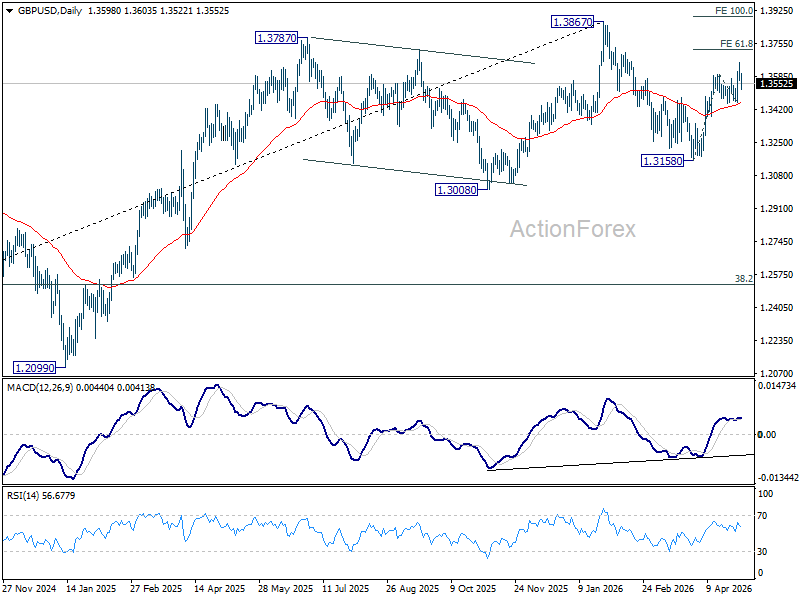
GBP/USD's fall from 1.3867 short term top is in progress. Intraday bias stays on the downside for 55 D EMA (now at 1.3482). Sustained break there will raise the chance of larger scale correction, and target 1.3342 support for confirmation. On the upside, above 1.3732 minor resistance will bring retest of 1.3867. Firm break there will resume larger up trend towards 1.4284 key resistance.
In the bigger picture, rise from 1.0351 (2022 low) is resuming by breaking through 1.3787 high. Further rally should be seen to 1.4284 key resistance (2021 high). Decisive break there will add to the case of long term bullish trend reversal. For now, outlook will stay bullish as long as 1.3008 support holds, even in case of deep pullback.