Sample Category Title
Bitcoin (BTC/USD) Volatility Measures are Tightening Up. Is it Time for Another Major Move?
- Bitcoin’s price has been range-bound since reaching a fresh all-time high on inauguration day.
- The upcoming FOMC meeting may serve as a catalyst for Bitcoin’s price.
- Volatility measures suggest that a major price move is incoming.
- Bitcoin’s technical analysis shows a messy daily timeframe and a breakout of a symmetrical triangle pattern on the H2 timeframe.
Bitcoin has struggled to push on since printing a fresh high on inauguration day of around 109356. Since then the world’s largest cryptocurrency has been struggling to kick on with profit taking and caution likely to be the major factors.
There has been some positive news for the crypto industry under the new US administration. President Donald Trump chose Mark Uyeda, a Republican, to be the temporary head of the Securities and Exchange Commission. Uyeda will probably be the acting chair until Trump’s pick, Paul Atkins, is confirmed by the Senate to replace Gensler.
Both Ueda and President Trump’s pick Paul Atkins have both advocated for a business friendly approach to crypto and are seen as positive for the industry. The Securities and Exchange Commission followed this with an announcement that acting Chair Mark Uyeda has started a “crypto task force” to create clear rules for crypto assets.
Despite many of these positive developments from Tuesday onward, Bitcoin has failed to prin a new high. It begs the question, is the bull run over or what will the next catalyst be?
Crypto Heatmap, January 23, 2025
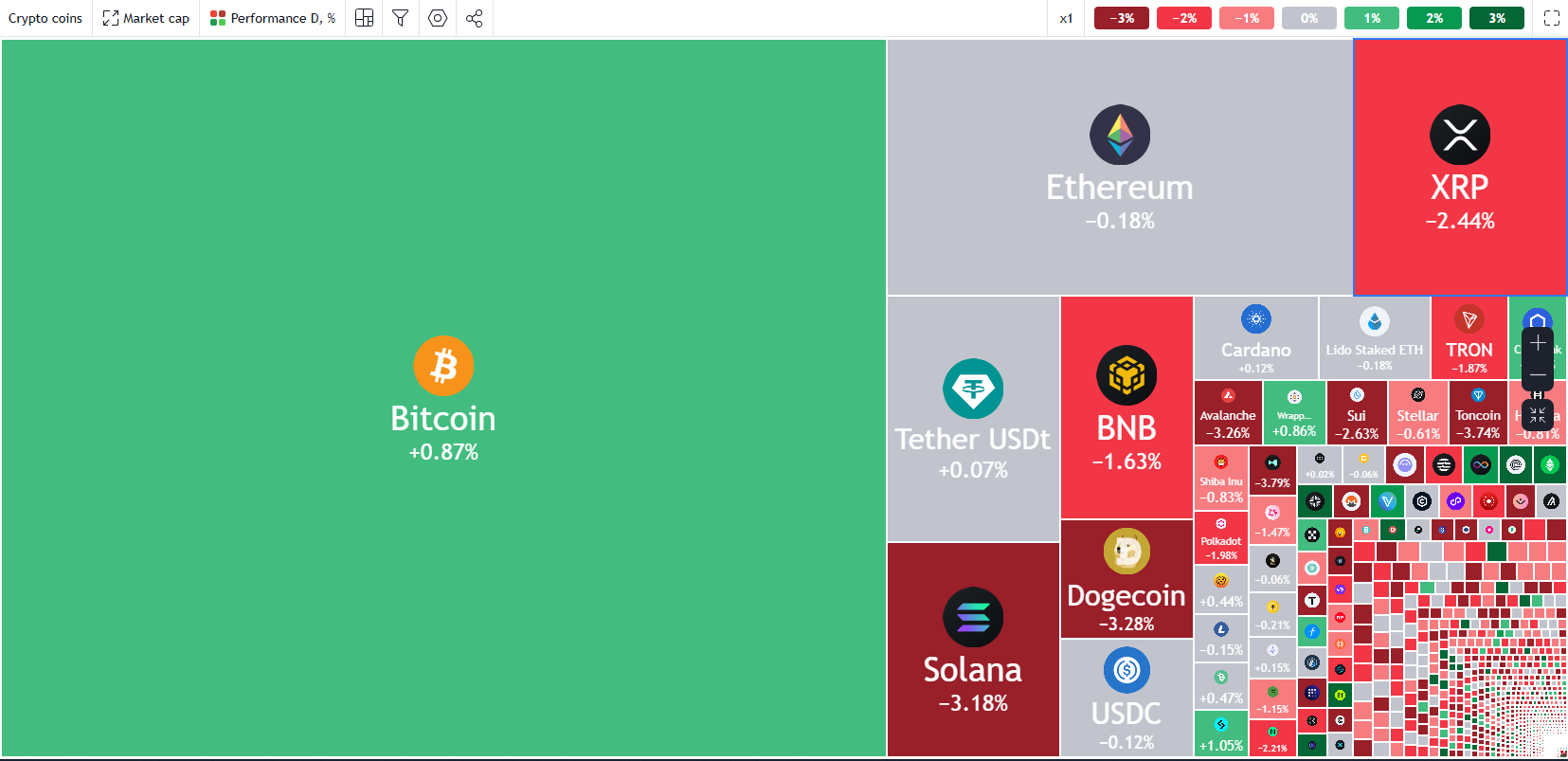
Source: TradingView (click to enlarge)
FOMC Meeting to Serve as the Catalyst?
Now that Donald Trump has taken his seat at the White House and most of the immediate crypto appointments out of the way, markets will likely shift attention to next week’s Federal Reserve meeting.
Monetary policy remains a hot topic and as we have seen in the past, lower rates do tend to help cryptomarkets as a whole. Lower rates usually means more disposable income especially for the retail crowd.
However, as things stand, the Fed are likely to maintain a slightly hawkish stance at the upcoming FOMC on January 29. The tariff proposals by President Trump that may start on February 1 coupled with encouraging data of late is likely to see the Fed remain cautious.
This may not bode particularly well for Bitcoin as higher rates means less disposable income and higher yields from traditional investments, like savings etc. which could be another challenge for crypto prices.
Volatility Measures Hint at the Potential for a Major Move
Glassnode’s recent on-chain weekly report has shed light on interesting developments around the recent Bitcoin price action and what it could mean. According to the data, both on-chain models and the narrow 60-day price range show a strong connection, helping investors anticipate periods of increased volatility.
By looking at the percentage difference between the highest and lowest prices over the last 60 days, we can track market volatility. The chart below shows times when the 60-day price range was tighter than it is now. These instances often happened before major volatility spikes, usually at the start of bull markets or before big drops in bear markets.
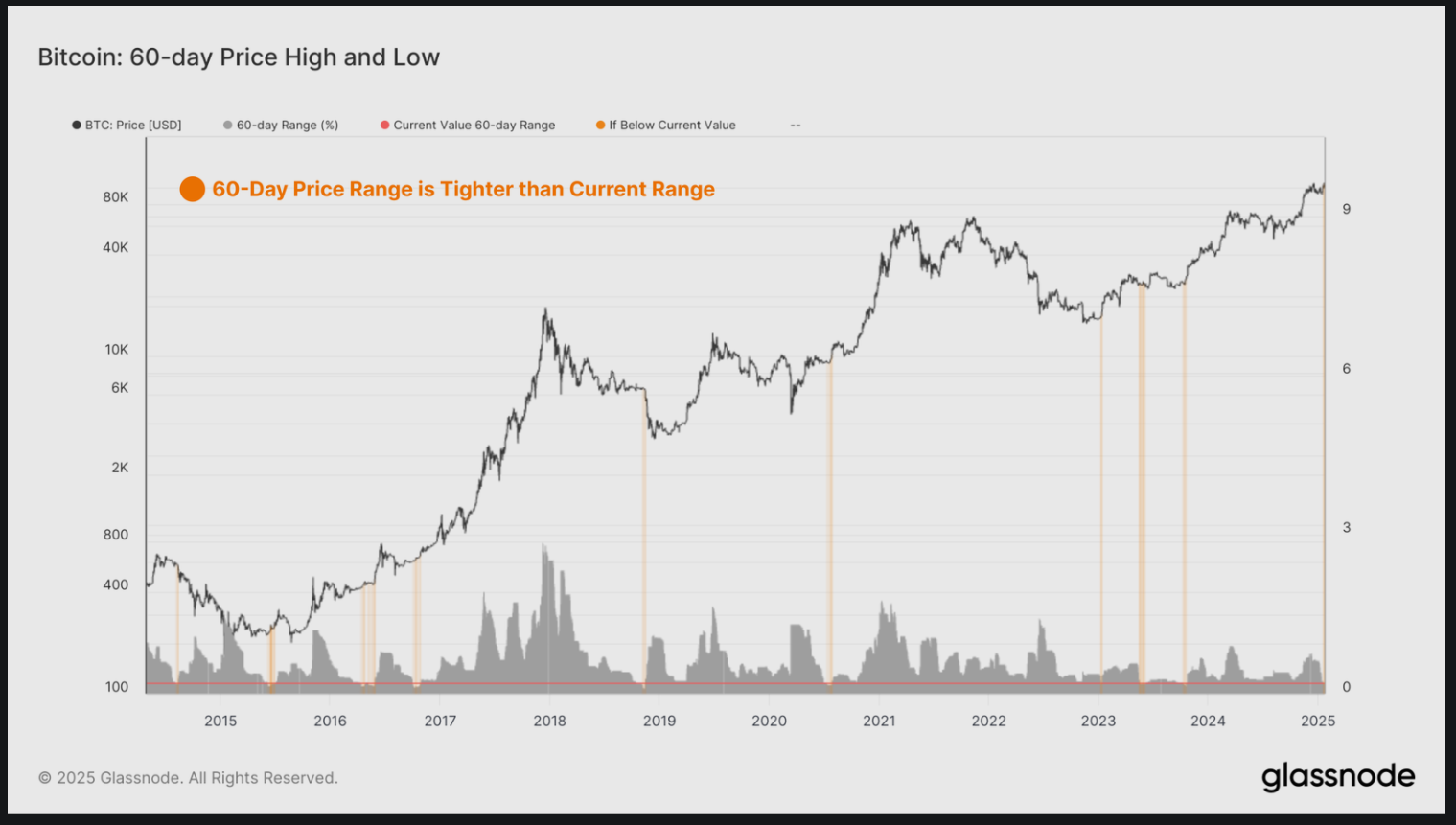
Source: Glassnode (click to enlarge)
Based on this chart, one could say that a major move is incoming. The Fed are scheduled to remain somewhat hawkish coupled with the news above and we could be in for a breakout which could favor the downside. Opposition to this could come if we do have any other crypto related posts from US President Donald Trump, which could see a rise in positive sentiment once more.
ETF Flows Remain Positive
Bitcoin ETF flows were strong in the days leading up to January 20 and have stayed strong since. This steady flow of money shows that investors are increasingly confident and interested in Bitcoin ETFs, indicating a positive outlook as the year progresses.
However despite flows of around $802 million on January 21 and $248.7 million yesterday Bitcoin continued its descent toward the 100k mark once more.
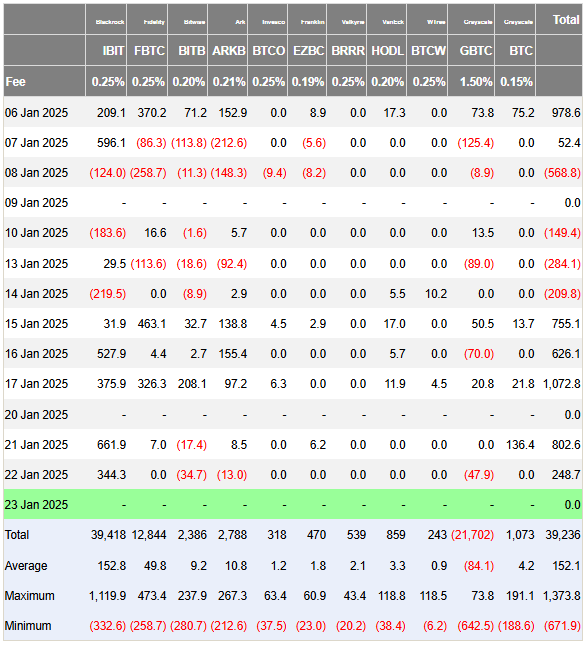
Source: Farside Investors (click to enlarge)
Looking at all the elements discussed above, there is a strong chance that the range between 100000 and 109356 remains intact over the coming days. The longer prices continue to coil in such a manner the more likely it is that an aggressive breakout will occur. The direction for now though remains up in the air.
There is another school of thought which may be key as well. Bitcoin has in many cases of late been seen as a hedge of sorts against uncertainty, almost a ‘digital gold’ if you will. Thus with more and more announcements by President Donald Trump and uncertainties increasing, this could work in Bitcoins favor and propel the Crypto to fresh highs. Something worth bearing in mind moving forward.
Technical Analysis BTC/USD
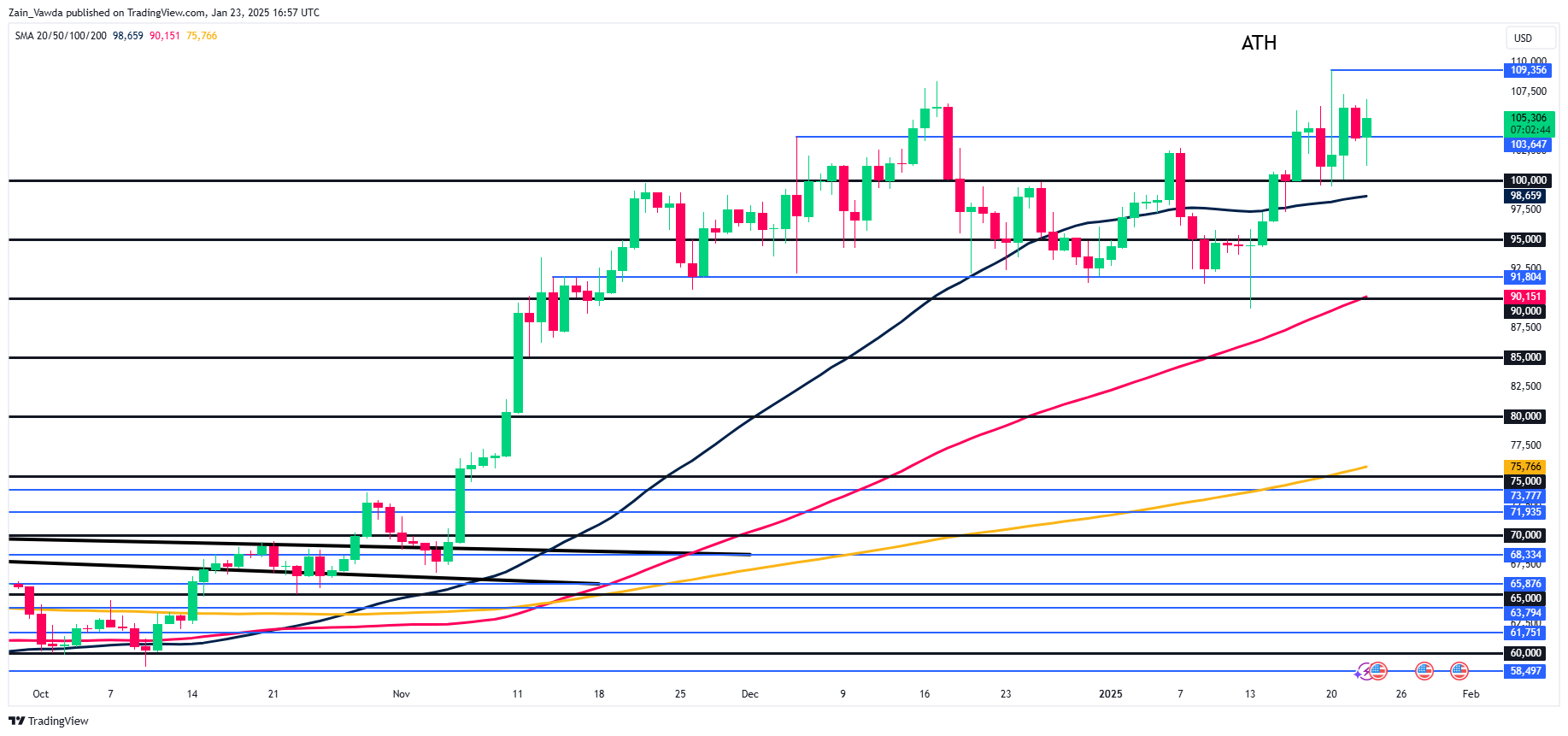
Bitcoin (BTC/USD) from a technical standpoint on the daily timeframe sees price stuck in the range between the psychological 100000 handle and the all-time highs around 109356.
We have been noticing quite a bit of whipsaw price action within the range with today’s price action being a prime example. Bitcoin hit a daily low around 101233 before bouncing aggressively to a daily high of 106848, a daily range of around $5000.
The daily timeframe being as messy as it is means a visit of a lower timeframe like the two-hour chart may be necessary.
Bitcoin (BTC/USD) Daily Chart, January 23, 2024
Source: TradingView.com (click to enlarge)
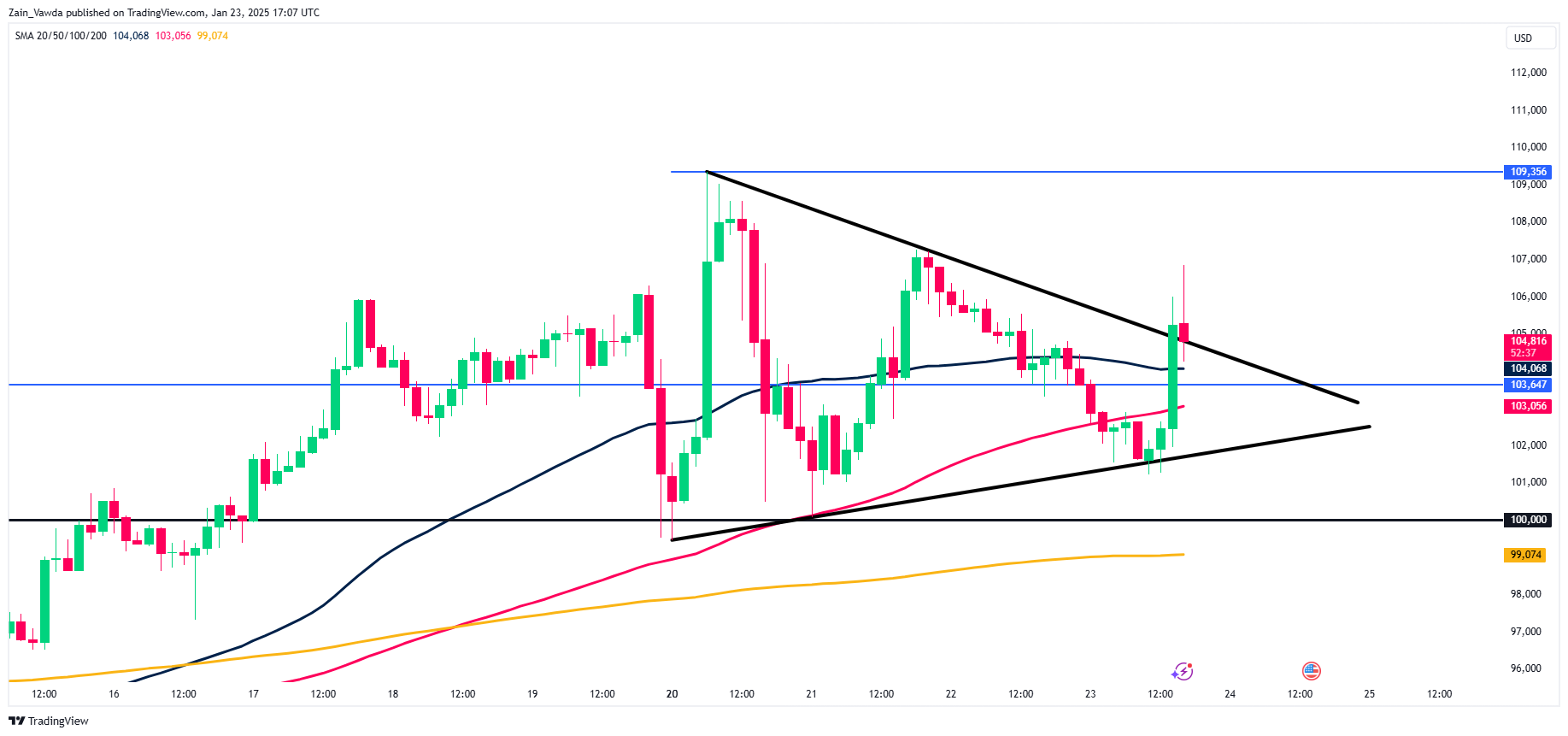
Dropping down to a H2 chart and as you can see below price action has also been messy with a series of lower highs and higher lows sending contradictory messaging.
We have had a breakout of the symmetrical triangle pattern in play on the H2 timeframe. Such a move should in theory lead to a rally to the upside.
The triangle mouth measures around $10,000 which would mean a rally of around $10,000 to the upside which could see Bitcoin prices reach the 115000 mark should the pattern play out.
However, with so many narratives at play there is no guarantee that such a move will play out.
Currently price is pulling back on the H2 timeframe, with immediate support provided by the 50 and 100-day MAs resting at 104062 and 103054 respectively. A break below this could open a retest of the 100000 handle.
Alternatively, should bulls take charge, immediate resistance rests at the 105000 handle before the swing high at 107000 comes into focus.
Bitcoin (BTC/USD) Two-Hour (H2) Chart, January 23, 2024
Source: TradingView.com (click to enlarge)
Support
- 104067
- 103054
- 100000
Resistance
- 105000
- 107000
- 109356
Fed Preview: Not Stealing the Spotlight
- We expect the Federal Reserve to maintain the Fed Funds Rate unchanged at 4.25-4.50% in the January meeting, in line with wide consensus and market pricing.
- The Fed communicated back in December that the January meeting would very likely mark a pause in the easing cycle. We still believe in the next cut in the following March meeting, but do not expect to hear strong forward guidance yet.
- Upcoming fiscal and trade policies are already playing a role in the participants’ projections, and Powell will remain cautious in his remarks amid the current high uncertainty. We think risks are skewed towards higher EUR/USD over the coming month, but do not expect strong reaction around the rate decision.
Incoming data has provided Powell with no reason to deviate from the course outlined in December. After reducing restraint by 100bp and as downside risks to economic growth have eased, the Fed will pause its cutting cycle in January to evaluate incoming data and not least the upcoming fiscal and trade policies from the new administration.
Trump has so far announced a likely 10% increase to tariffs against China alongside 25% for Canada and Mexico. While we believe more tariff hikes will eventually be in the pipeline, markets have found comfort in Trump avoiding more erratic changes for now. Importantly, we still have little detailed information on the other items on the fiscal policy agenda, such as the upcoming tax reform. Hence, while the December minutes revealed that some participants have already made preliminary assumptions on the policies, Powell will likely refrain from strong forward guidance for now.
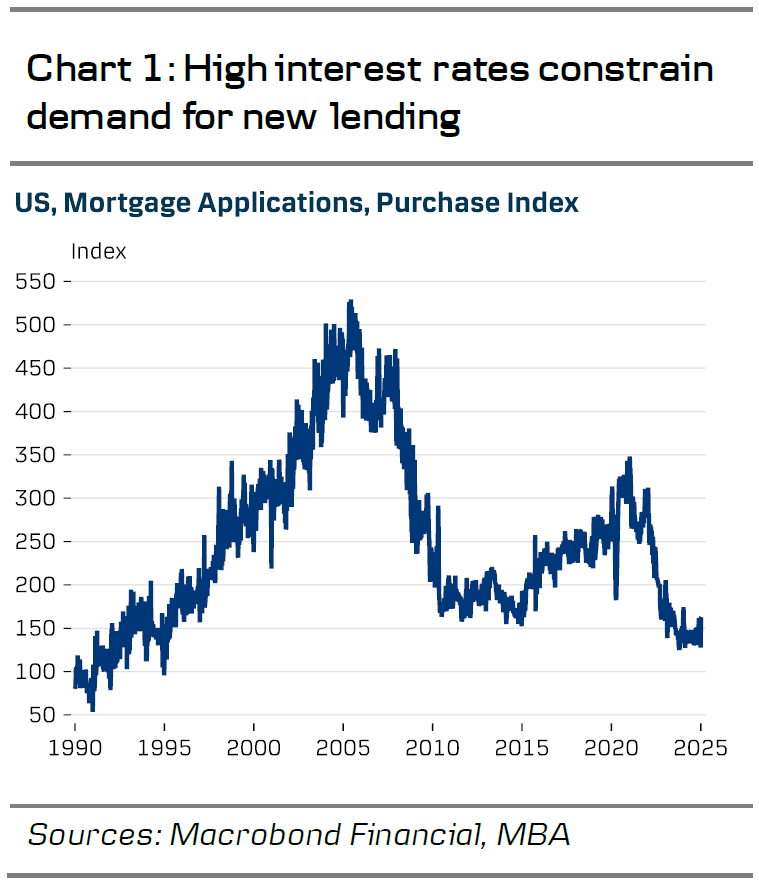
We still doubt tariff hikes alone will lead to persistent boost to inflation unless they are coupled with significant easing to domestic tax policies. For now, the current level of interest rates continues to have a restrictive effect on credit growth, which is evident in low mortgage application volumes (chart 1) and weak business loan demand in the Fed’s latest SLOOS survey. Aggregate bank lending growth has stabilized close to 2.5% y/y, still clearly below the typical 5% pace observed before the pandemic.
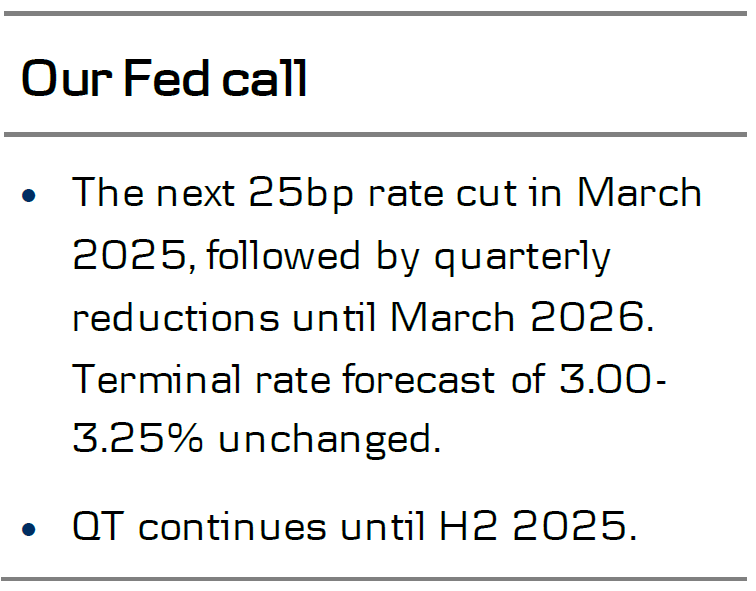
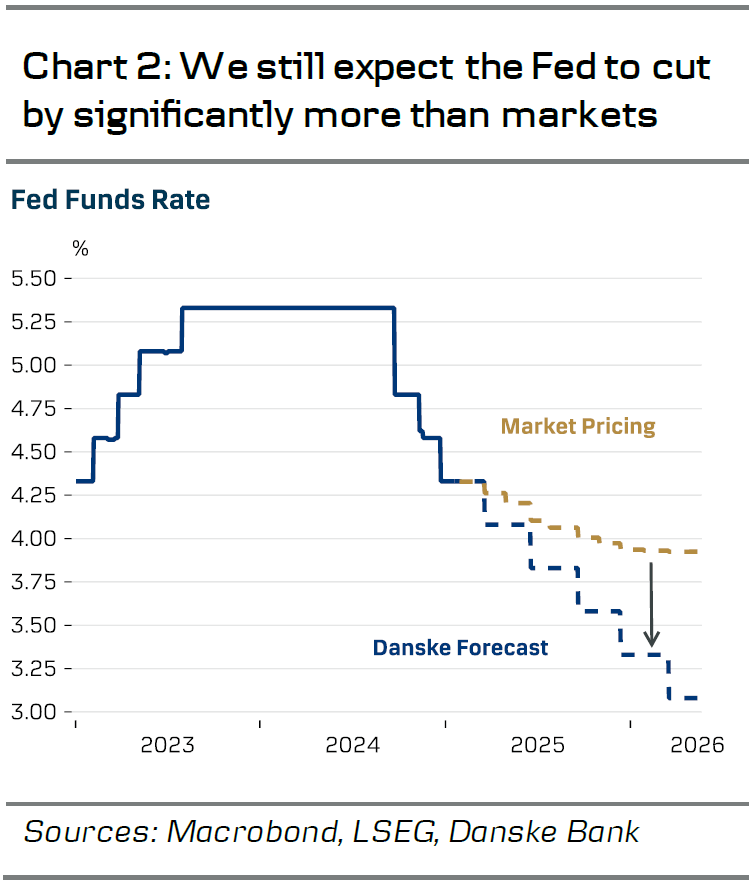
As such, we think current rates remain somewhat above neutral. As realized inflation data has continued moderating, we think the Fed can continue cutting rates when the next round of economic forecasts is released in the March meeting. We continue to forecast quarterly 25bp cuts until the policy rate target reaches 3.00-3.25% level in March of 2026 (chart 2). We will also continue monitoring any comments about QT towards the spring, although we do not expect any exact guidance quite yet. The government debt ceiling became binding again from the start of the year, which forces the Treasury to draw down its cash balance at the Fed to fund the ongoing deficits. This will counteract most of the liquidity tightening effect from QT for next few months, but we think either tapering or even ending QT might become timely sometime during the 2nd half of 2025.
For the time being though, the Fed has little reason to shake the markets. We continue to see near-term (1-3M) downside risks to UST yields and upside risks to EUR/USD but have no strong convictions for the Wednesday evening.
ECB Preview: No New Signals
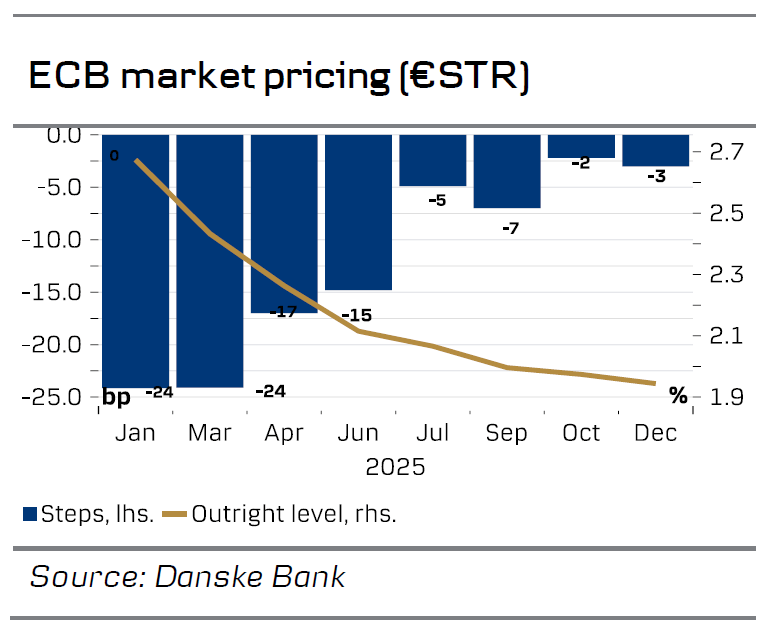
- When the ECB meets next week, the policy decision is essentially already guided, namely another 25bp cut which brings the policy rate to 2.75%. This is a unanimous expectation among analysts and markets. With the near-term uncertainties prevailing from the Trump administration as well as continuing domestic economic resilience we do not expect new signals on the policy rate outlook. Thus we expect the three-tiered reaction function to prevail (inflation outlook, underlying inflation and strength of monetary policy transmission) and the data dependency to be reiterated.
- Markets are pricing virtually another 100bp worth of rate cuts this year. While we expect the ECB to cut more than this, we see the risk of a December repeat of an initial hawkish market reaction due to Lagarde not committing to the end point of this cutting cycle may play out again.
Markets price 100bp worth of rate cuts this year
The ECB’s framework in recent quarters, focusing on data dependency and not data point dependency using its three-tiered reaction function, has led markets to trade its own narrative, as the ECB has chosen not to signal the policy outlook beyond the very near term. While it does not want to be data-point dependent, we find it difficult for the ECB not to weigh timely incoming data due to the elevated uncertainty surrounding the labour market and growth outlook. We saw it most recently in the fall last year where the weakness in European data in September / October made the ECB change the otherwise “hold guidance” to “cut guidance”, and ultimately deliver a rate cut.
Under-appreciated risk as policy level approaches neutral
During the press conference following the December meeting, Lagarde said that they didn't discuss the neutral rate level, which means they did not discuss the end point of this cutting cycle. She did, however, say that the discussion would take place once they come closer to that neutral rate level. During that occasion she repeatedly referenced the study from earlier 2024 that pointed to a range of neutral real rates between -0.5% and 0%. Lagarde also said that the conventional wisdom suggests that the neutral rate is probably a little higher than before. Assuming a 2% inflation target, that means that they would only be at neutral in June this year, if they cut 25bp at each of the four upcoming meetings. This consecutive rate cutting cycle seems to be getting a wide backing, particularly by the doves for the coming 3-4 cuts of 25bp. Villeroy, Kazimir alluded to this while Vujcic said that he is not uncomfortable with the current market pricing. Knot said he is comfortable with the market pricing for the coming two meetings but needs to see further data for decisions after that. He is not convinced that they need to go into stimulative territory. While it’s tangible for financial markets to discuss a yield level of where the cutting cycle ends, we find the key discussion to be had is what kind of policy stance is ultimately needed? We have only had limited guidance from GC members on this, with either guidance of a neutral stance or guidance of not being convinced to go into stimulative mode, however we expect this discussion to intensify in the GC after the March meeting.
Front end volatility to pick up as ECB approaches neutral rate
Looking ahead to the spring 2025 meetings we identify an under-appreciated risk to front end volatility as we discussed in COTW: The battle for April, 17.1.2025. In short, while the following claim is difficult to validate, we still argue that once you are further away from the assumed terminal rate, you will have less volatility, and this is what we have seen in the past couple of quarters with declining volatility. However, as you approach the level of the neutral rate, front-end volatility will start to pick up again. The question now becomes, at what level / distance to neutral will volatility start to pick up again?
Assuming the current SOFR pricing vs. neutral rate pricing is any guidance, the level where volatility may pick up may be about 50bp from current levels. Coincidentally, this aligns well with our view of the January and March policy rate decisions from the ECB being rather straightforward - as, after that, we are at a 2.5% policy rate, prompting a bigger battle and divergence of views for the policy decisions. This is simply due to the probability the outcome space will not be as one-sided anymore as it will be in the next two months. As a result, we expect April will be the next key battleground for policy decisions - and markets price this as well.
Lower momentum in underlying inflation continues
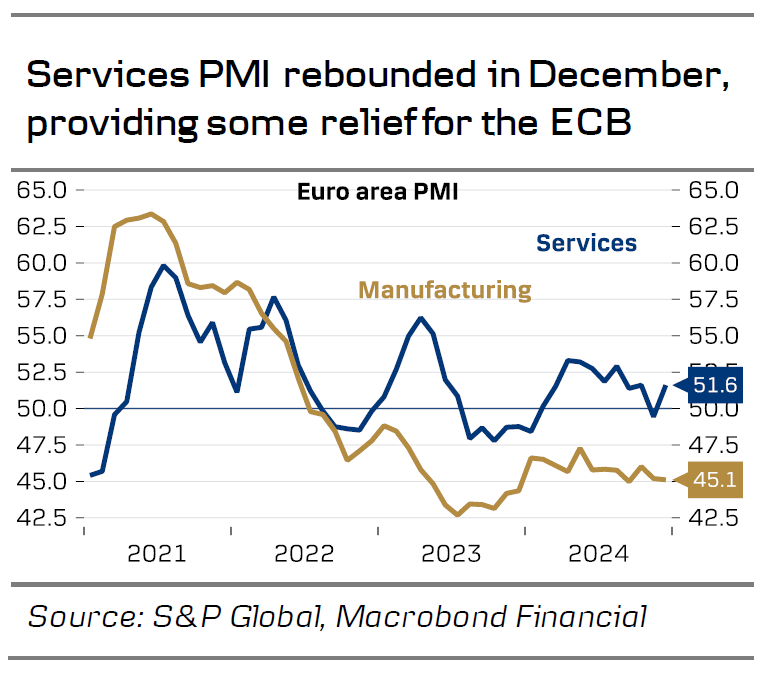
Since the December meeting, data has come out largely in line with the ECB’s narrative of the economy. Growth is weak but not collapsing, the labour market is resilient, and underlying inflation continues to ease. The PMIs in December rebounded partially from the significant decline in November which likely provided some relief in the ECB. In December, the composite PMI rose to 49.6 from 48.3, signalling a stagnant but not collapsing economy, driven by a larger-than-expected bounce back in services, which increased to 51.6 from 49.5, bringing services PMI back to the same level as in October. On Friday, the January PMI will be released, which is ahead of next week’s meeting, and thus will contain new information.
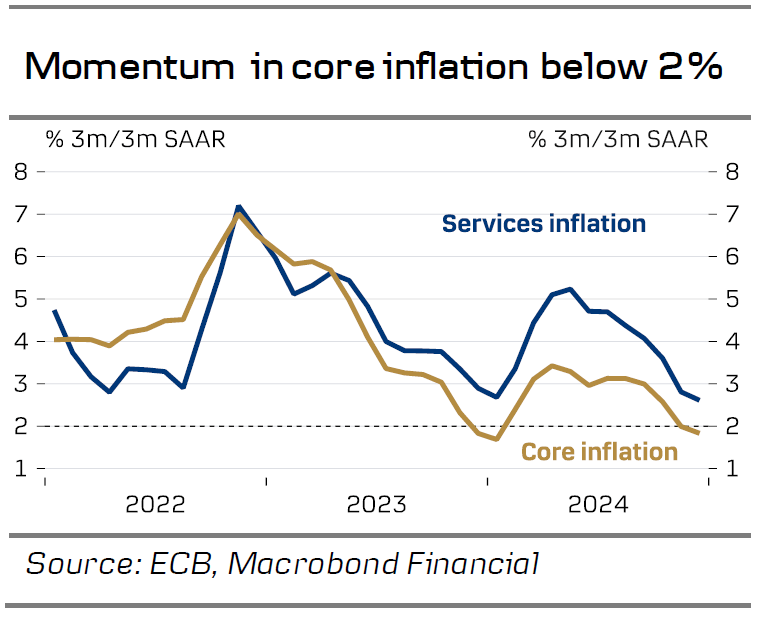
Headline inflation rose to 2.4% y/y from 2.2% as expected in December due to base effects on energy inflation, while the more important momentum in underlying inflation continued to move lower. Services momentum fell to 2.6% and core was below 2% for the second consecutive month at 1.8% in the 3m/3m annualised measure. Hence, December’s data confirmed the narrative of weakening momentum in underlying inflation as momentum in services is coming in lower while goods remain very low. December’s inflation figures resulted in the 2024Q4 average being marginally lower than the ECB staff predictions (0.1pp).
Labour market will be key for the ECB, but hard data is still strong
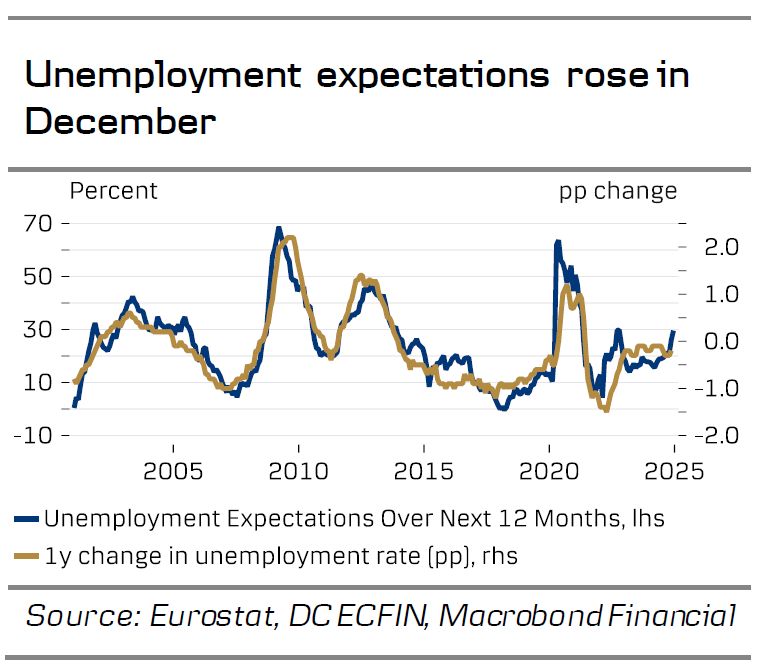
The ECB faces ongoing uncertainty regarding the labour market as survey indicators have softened in previous months. Unemployment expectations in the consumer survey jumped to a two-year high in December, and this indicator has previously led changes in the unemployment rate. However, hard data continues to show a solid labour market with rising employment in Q3 and the unemployment rate remaining at a record-low of 6.3% in November. Hence, the labour market remains very strong but forward-looking soft indicators point to risks of a deterioration.
Eventful week ahead for EUR/USD, but not because of the ECB
Next week could be another eventful one for EUR/USD. Not because of the ECB meeting since we do not expect any surprises here. (As an aside, the FOMC meeting the day before should not be a big market mover either, in our view.) But implied volatility in EUR/USD is high, because the market is anxious about what US President Trump will deliver in terms of key policies for the FX market, e.g. trade policies. He has already threatened to impose new tariffs on Canada, Mexico and China, possibly from 1 February – two days after the ECB meeting. Hence, there is a good chance that the news flow from the Trump administration will overshadow the ECB meeting, when it comes to EUR/USD. We expect EUR/USD to trade around 1.04-1.05 in the short term as we think Trump will under-deliver on some of his policy promises, but also because we think the recent US economic outperformance will fade a little.
Sunset Market Commentary
Markets
More lackluster, low volatility range trading across most major markets today. For now, visibility on the impact of the Trump policy on (global and US) growth and inflation remains too low, causing (FX and FI) investors to hold to a guarded wait-and-see approach. It is probably also too early to expect any directional guidance from the Fed when Powell comments at the press conference after next week’s policy decision. Aside from the lack of visibility on the global US-dominated picture, economic data are few and mostly second tier. Even US weekly jobless claims (223k) were too close to expectations to even trigger an small intraday move. In technical trading, US yields show a tentative steepening with the 2-y unchanged while the 30-y is adding 4.0 bps. A voluntaristic US (fiscal) policy probably put a floor for (US) yields. The digital address of US President Trump to the World Economic Forum in Davos still remains a wildcard for global markets. German yields are 2-3 bps higher in daily perspective. This week’s equity upleg, pushing (some) US and European equity indices near record levels also stalls. Investors ponder how much ‘good news’ is discounted with the issue of tariffs still looming and the Trump’s announcement of the Stargate AI project also still subject to a higher degree of uncertainty. The EuroStoxx 50 trades almost unchanged. The Nasdaq is ceding 0.3%, but the all-time top stays within reach. Low volatility trading also dominates the price action in the major (USD) cross rates. At 108.25, the USD DXY index is holding an intra-day range of less than 0.5%. EUR/USD is locked near the 1.04 big figure. The yen (USD/JPY 156.4) slightly outperforms as investors are looking forward to the BOJ taking another step in its process of policy normalization tomorrow morning. In the UK, the CBI monthly orders’ report confirmed a poor state of the manufacturing industry with the orders’ subindex holding at a low level. UK firms at the same time see rising cost pressures as higher social contributions from the UK budget are filtering through. The quarterly business optimism gauge declined to the lowest level since Q4 2022. The impact on sterling is limited. EUR/GBP hovers near recent ST top (EUR/GBP 0845 area). Among the CE currency, the zloty extends its ascent with EUR/PLN testing the early 2020 pre-covid low (EUR/PLN 4.20 area) as the NBP is expected to hold its policy rate unchanged at 5.75% still during most of this year.
News & Views
The Norges Bank kept its policy rate unchanged at 4.5%, but governor Ida Wolden Bache confirmed as expected that it will likely be reduced in March, when new growth and inflation forecasts are available. The Committee’s assessment is that a restrictive monetary policy is still needed to stabilise inflation around target, but that the time to begin easing monetary policy is soon approaching. There is substantial uncertainty about the outlook for both the global and Norwegian economy, but a rapid rise in business costs risks stoking price pressures ahead. The central bank therefore remains concerned with the risk of lowering the policy rate too quickly as it might imply inflation staying above target for even longer. The Norwegian krone is going nowhere withing the 11.50-12.00 trading band in place since August.
Turkey lowered its policy rate for a second consecutive meeting by 250 bps, from 47.50% to 45.00%. Indicators for Q4 2024 suggest that domestic demand stands at disinflationary levels. While inflation expectations and pricing behavior tend to improve, they continue to pose risks to the disinflation process. The underlying trend of inflation decreased in December but services items will likely trigger an increase in January because of time-dependent pricing and backward indexation. Core goods inflation will remain relatively low. The CBRT will maintain a tight monetary stance until price stability is achieved, suggesting that follow-up rate cuts won’t immediately increase in size. The central bank’s restrictive monetary policy managed to end the TRY-depreciation trend from the beginning of Q4 2024, but for the moment it is still trying to find a bottom rather than really recovering. EUR/TRY currently changes hands around 37.15.
Canada: Retail Sales flat in November, But Likely to Remain a Key Driver of Real Consumption in Q4
Retail sales were flat month-over-month (m/m) in November, right in line with the Statistics Canada’s advance estimate.
In real terms, however, sales declined by 0.4% m/m.
Sales at motor vehicle and parts dealers were up by 2.0% m/m, building on October's strong gains of 2.4% m/m. Ex-autos, sales were down 0.7% m/m, falling short of the consensus expectation of 0.1% m/m growth.
Receipts at gas stations and fuel vendors rose by 0.7% m/m in nominal terms and by 0.8% m/m in real terms, reflecting softer prices.
Excluding both auto sales and gas station receipts, core retail sales fell by 1.0% m/m in November, following a downwardly revised flat reading in October (previously reported as +0.2% m/m).
- The decline was driven by food and beverage retailers (-1.6% m/m), building material & garden supply dealers (-2.1% m/m), and general merchandise stores (-1.0% m/m).
- Gains at miscellaneous store retailers (+0.7% m/m) and furniture and home furnishings stores (+0.2% m/m) were not enough to offset declines.
E-commerce sales declined by 1.2% m/m after two consecutive months of growth.
Statistics Canada’s advance estimate for December suggests that sales were up 1.6%.
Key Implications
Apart from strength in auto sales, this was a softer-than-expected report. Flat goods inflation in November weighed on nominal sales, but even after accounting for price effects, real sales contracted in November.
Despite this, we upgraded our real consumption forecast to 3% in Q4 2024 as a strong flash estimate for December points to a rebound in activity. A parallel report on food services and drinking places suggests that services spending was robust. Moreover, shoppers could have been holding back their purchases in November until the expected GST tax in December (a sizeable decline in beer& wine stores provide good evidence of that). We estimate that the holiday provided a substantial 8.6% discount on affected items, which suggests that real activity was even stronger than reported in the flash estimate.
Yen Stabilizes in Weak Position as BoJ Rate Hike Awaited
While Yen remains the worst performer of the week so far, it has stabilized as the markets await the highly anticipated BoJ rate hike in the upcoming Asian session. Expectations for this rate move were well set by comments from BoJ Governor Kazuo Ueda last week. Risks from US political developments—specifically tariff policies under President Donald Trump—have now been set aside too, clearing the way for BoJ to proceed with its monetary normalization. Policy rate should be raised by 25bps to 0.50%.
The question now centers on how BoJ will portray Japan’s economic outlook and its policy path for the year. With signs of resurgent inflationary pressures, it’s unlikely that Ueda will strike a dovish tone. In fact, Japan’s upcoming CPI datad ue tomorrow too—expected to show core inflation rising for a second month to 3% in December—will support that view.
Ueda's comments in the post meeting press conference could be cautiously optimic. On the one hand, he would reiterate international uncertainties, and refrain from committing to a specific timeline for policy normalization. But the view towards domestic wage development could be upbeat. Inflation forecasts could also be raised in the new quarterly economic outlook report. Both would be seen as hawkish, albeit mildly. Currently, markets are seeing the chances of another hike in the middle of the year, and probably one more by the year-end to bring interest rate to a more neutral setting at 1.00%.
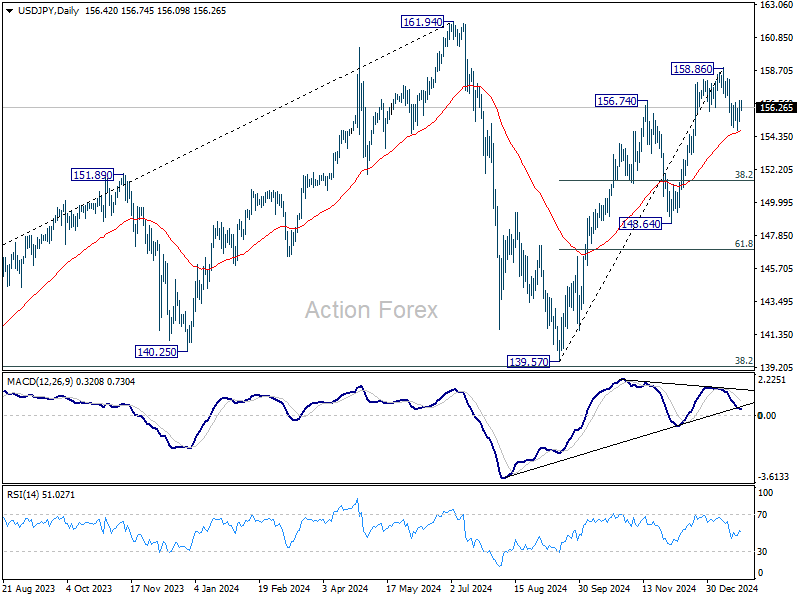
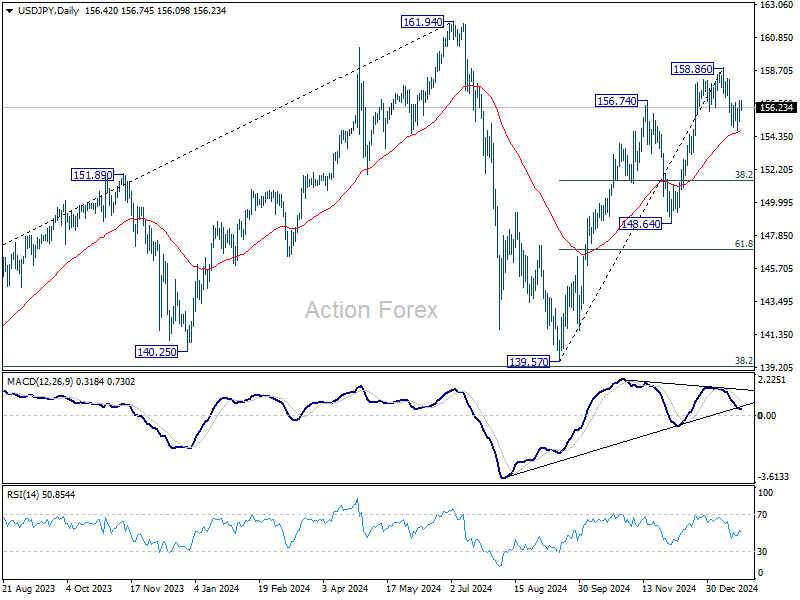
USD/JPY would be logically a pair to pay attention to. Price actions from 158.86 are seen as developing in to a corrective pattern for sure. While initial support was seen above 55 D EMA (now at 154.67) to slow the pull back, a hawkish BoJ hike tomorrow could push USD/JPY lower towards 38.2% retracement of 139.57 to 158.86 at 151.49.
Conversely, a robust rebound—even if BoJ sounds hawkish—might suggest that the correction from 158.86 is already done, and the rally from 139.57 could be ready to resume.
Overall for the week so far, the rankings in the performance ladder didn't chance much as trading has been rather subdued after volatility on Monday. Kiwi is currently the strongest, followed by Euro and then Aussie. Yen is the worst, followed by Dollar and then Loonie. Sterling and Swiss Franc are stuck in the middle.
Canada’s retail sales stagnate in Nov as core sales down -1% mom
Canada’s retail sales were flat in November, falling short of the expected 0.2% mom increase. The data revealed mixed performance across sectors, with declines in six out of nine subsectors.
Sales at food and beverage retailers dropped by -1.6% mom, driving much of the weakness in the report. However, gains in motor vehicle and parts dealers (+2.0% mom) and gasoline stations and fuel vendors (+0.7% mom) helped offset the broader declines, preventing an outright contraction in overall retail activity.
Core retail sales, which exclude the more volatile categories of motor vehicles and gasoline, declined by a notable -1.0% mom.
US initial jobless claims rises to 223k, above exp 220k
US initial jobless claims rose 6k to 223k in the week ending January 18, above expectation of 220k. Four-week moving of initial claims rose 750 to 213.5k.
Continuing claims rose 46k to 1899 in the week ending January 11, highest since November 13, 2021. Four-week moving average of continuing claims rose 500 to 1866k.
Japan posts first trade surplus in six months
Japan recorded a trade surplus of JPY 130.9B in December, the first surplus in six months, driven by a 2.8% yoy rise in exports to JPY 9.91T. Imports also jumped, rising 1.8% yoy to JPY 9.8T.
However, exports to the two largest trading partners saw declines, with shipments to China falling by -3.0% yoy and to the US by 2.1% yoy.
On a month-on-month seasonally adjusted basis, exports rose 6.3% mom to JPY 9.44T. Imports increased 2.2% mom to JPY 9.47T, resulting in a seasonally adjusted trade deficit of JPY 33B.
For the entirety of 2024, Japan’s trade deficit narrowed significantly, shrinking by 44% from the previous year to JPY -5.33T. Exports reached a record high of JPY 107.09T, up 6.2%, bolstered by strong demand for vehicles and semiconductor-related products. Imports also rose by 1.8% to JPY 112.42T.
EUR/USD Mid-Day Outlook
Daily Pivots: (S1) 1.0368; (P) 1.0401; (R1) 1.0461; More...
Intraday bias in EUR/USD remains neutral for the moment. On the upside, firm break of 1.0435 resistance will extend the rebound from 1.0176 to 38.2% retracement of 1.1213 to 1.0176 at 1.0572. Rejection by 1.0435 will keep the correction from 1.0176 relatively short. Firm break of 1.0176 will resume whole fall from 1.1213.

In the bigger picture, fall from 1.1274 (2023 high) should either be the second leg of the corrective pattern from 0.9534 (2022 low), or another down leg of the long term down trend. In both cases, sustained break of 61.8 retracement of 0.9534 to 1.1274 at 1.0199 will pave the way back to 0.9534. For now, outlook will stay bearish as long as 1.0629 resistance holds, even in case of strong rebound.

EUR/USD Mid-Day Outlook
Daily Pivots: (S1) 1.0368; (P) 1.0401; (R1) 1.0461; More...
Intraday bias in EUR/USD remains neutral for the moment. On the upside, firm break of 1.0435 resistance will extend the rebound from 1.0176 to 38.2% retracement of 1.1213 to 1.0176 at 1.0572. Rejection by 1.0435 will keep the correction from 1.0176 relatively short. Firm break of 1.0176 will resume whole fall from 1.1213.
In the bigger picture, fall from 1.1274 (2023 high) should either be the second leg of the corrective pattern from 0.9534 (2022 low), or another down leg of the long term down trend. In both cases, sustained break of 61.8 retracement of 0.9534 to 1.1274 at 1.0199 will pave the way back to 0.9534. For now, outlook will stay bearish as long as 1.0629 resistance holds, even in case of strong rebound.
GBP/USD Mid-Day Outlook
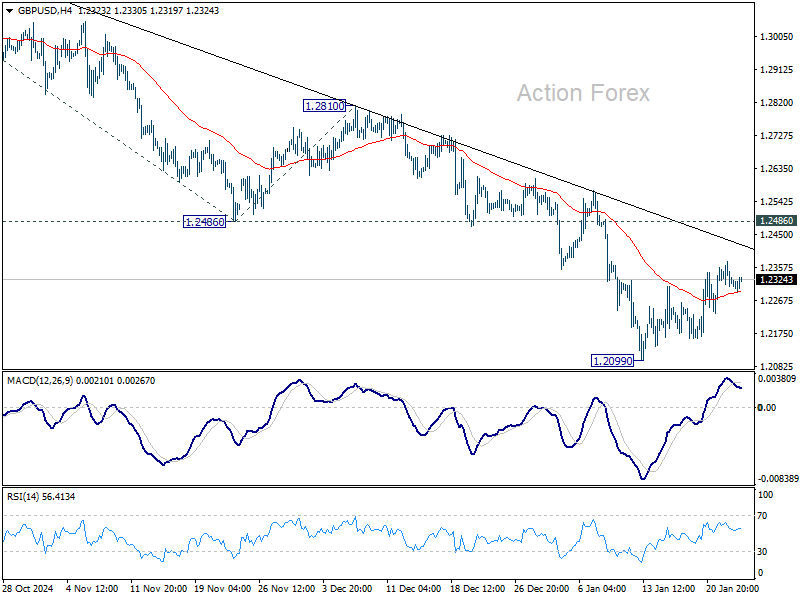
Daily Pivots: (S1) 1.2291; (P) 1.2333; (R1) 1.2359; More...
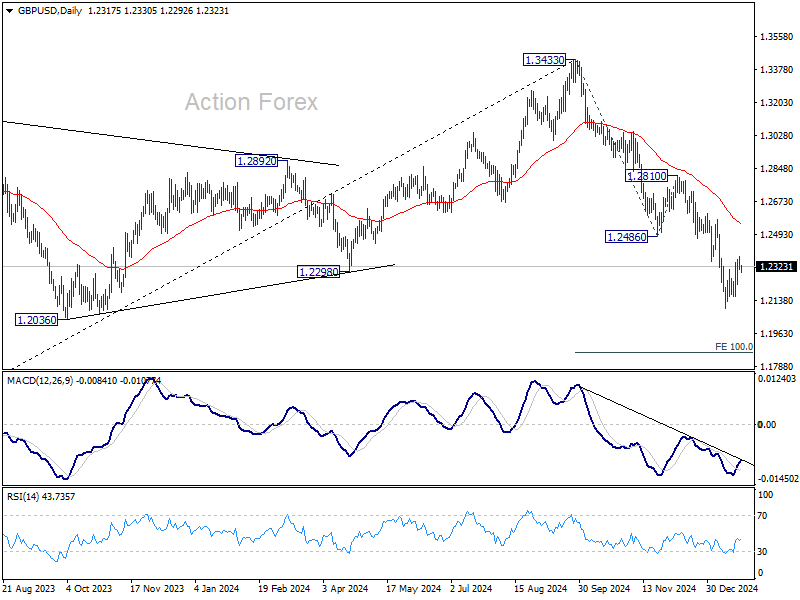
Intraday bias in GBP/USD remains neutral as consolidation pattern from 1.2099 is still extending. Further decline is expected with 1.2486 support turned resistance intact. On the downside, break of 1.2099 will resume the fall from 1.3433 to 100% projection of 1.3433 to 1.2486 from 1.2810 at 1.1863.
In the bigger picture, rise from 1.0351 (2022 low) should have already completed at 1.3433, and the trend has reversed. Further fall is now expected as long as 1.2810 resistance holds. Deeper decline should be seen to 61.8% retracement of 1.0351 to 1.3433 at 1.1528, even as a corrective move.
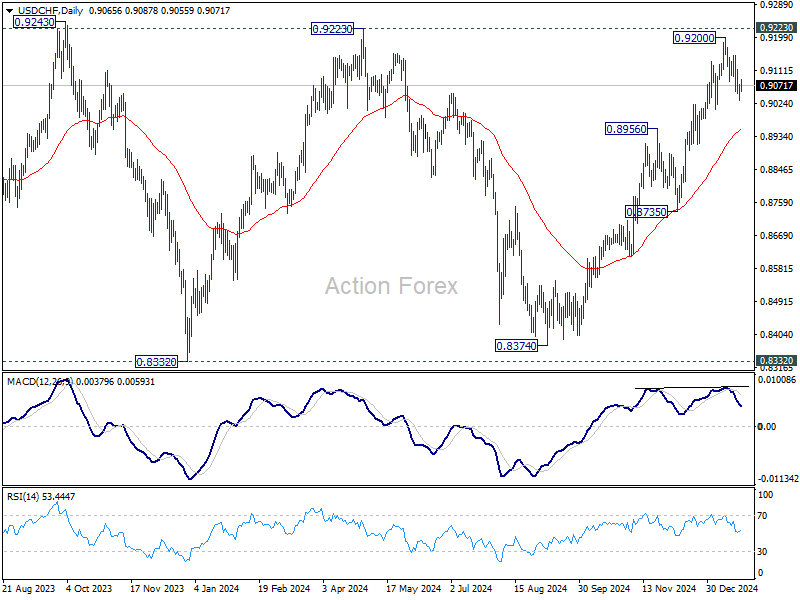
USD/CHF Mid-Day Outlook
Daily Pivots: (S1) 0.9039; (P) 0.9062; (R1) 0.9090; More…
Intraday bias in USD/CHF stays neutral as consolidations continue below 0.9200. Further rally is expected with 0.9007 support intact. On the upside, decisive break of 0.9223 will carry larger bullish implications. However, break of 0.9007 will turn bias back to the downside for deeper pull back to 55 D EMA (now at 0.8950).
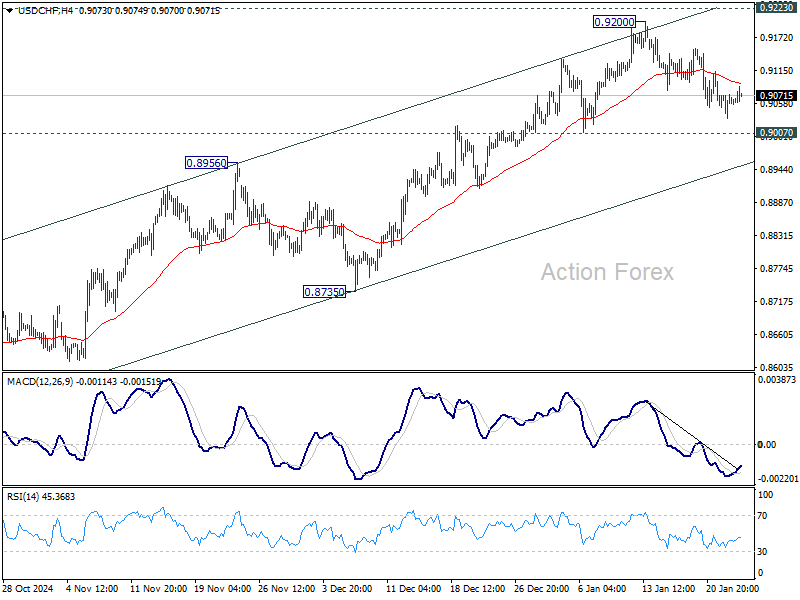
In the bigger picture, as long as 0.9223 resistance holds, price actions from 0.8332 (2023 low) are seen as a medium term corrective pattern. That is, long term down trend is in favor to resume through 0.8332 at a later stage. However, sustained break of 0.9223 will be an important sign of bullish trend reversal.
USD/JPY Mid-Day Outlook
Daily Pivots: (S1) 155.68; (P) 156.20; (R1) 157.04; More...
Intraday bias in USD/JPY stays neutral for the moment, and some more sideway trading might be seen. On the downside, sustained trading below 55 D EMA (now at 154.73) will extend the correction from 158.86 to 38.2% retracement of 139.57 to 158.86 at 151.49 next. However, firm break of 158.86 will resume the whole rally from 139.67 to retest 161.94 high.
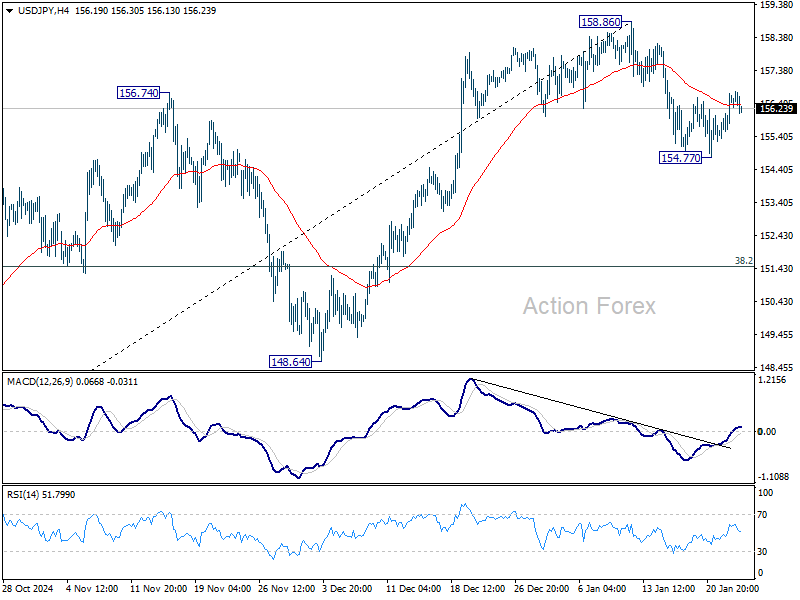
In the bigger picture, price actions from 161.94 are seen as a corrective pattern to rise from 102.58 (2021 low). The range of medium term consolidation should be set between 38.2% retracement of 102.58 to 161.94 at 139.26 and 161.94. Nevertheless, sustained break of 139.26 would open up deeper medium term decline to 61.8% retracement at 125.25.