Sample Category Title
Gold Short-Term Consolidation
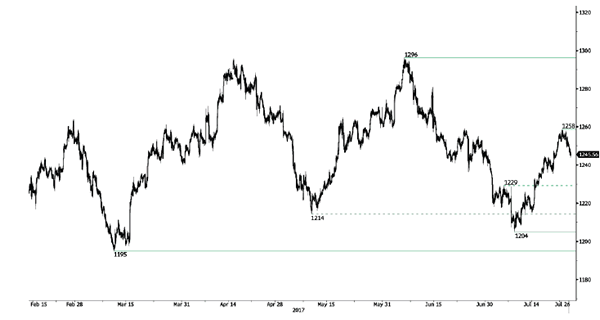
Gold's is consolidating lower. Strong support is given at 1204 10/07/2017 high). Hourly resistance lies at 1258 (23/06/2017 high). Expected to show further strengthening.
In the long-term, the technical structure suggests that there is a growing upside momentum. A break of 1392 (17/03/2014) is necessary ton confirm it, A major support can be found at 1045 (05/02/2010 low)
EUR/CHF Breaking 1.1100
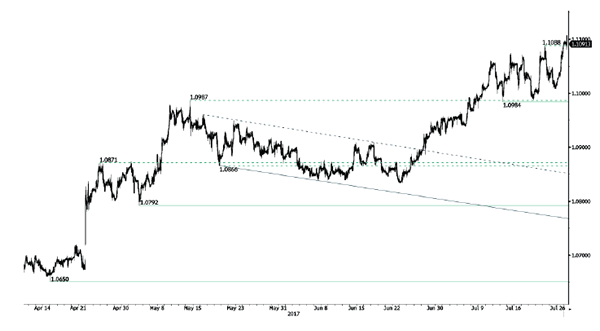
EUR/CHF is still trading above psychological level at 1.1000 and the pair has broken 1.1100. Selling pressures will likely grow around those levels. Hourly support is located at a distance at 1.0984 (13/07/2017 low). Expected to inch higher.
In the longer term, the technical structure is mixed. Resistance can be found at 1.1200 (04/02/2015 high). Yet,the ECB's QE programme is likely to cause persistent selling pressures on the euro, which should weigh on EUR/CHF. Supports can be found at 1.0184 (28/01/2015 low) and 1.0082 (27/01/2015 low).
EUR/GBP Little Selling Pressures
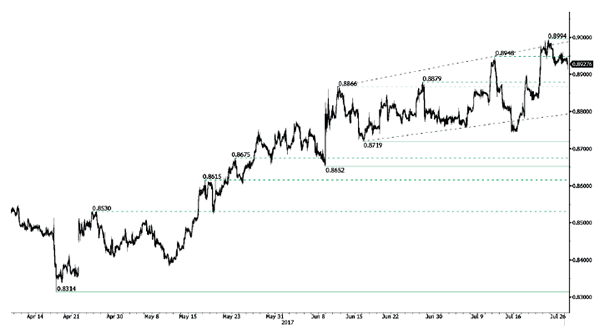
EUR/GBP is very volatile. The pair has surged toward 0.9000. Hourly support is given at a distance at 0.8742 (16/06/2017 low). Downside risks are important.
In the long-term, the pair has largely recovered from recent lows in 2015. The technical structure suggests a growing upside momentum. The pair is trading above from its 200 DMA. Strong resistance can be found at 0.9500 psychological level.
AUD/USD Ready For A New Leg Lower
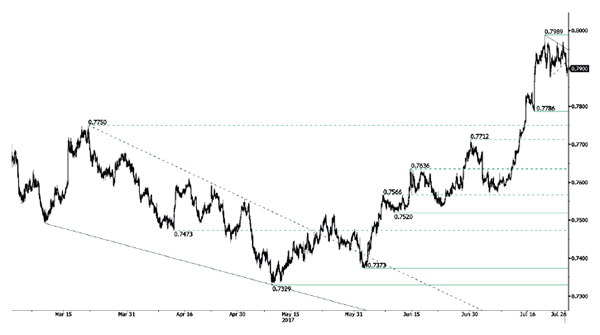
AUD/USD's technical structure seems to reverse. Hourly resistance is given at 0.7989 (19/07/2017 high). Hourly support given at 0.7875 (21/07/2017 low) is being monitored.
In the long-term, we are waiting for further signs that the current downtrend is ending. Key supports stand at 0.6009 (31/10/2008 low) . A break of the key resistance at 0.8295 (15/01/2015 high) is needed to invalidate our long-term bearish view.
USD/CAD Continued Decline
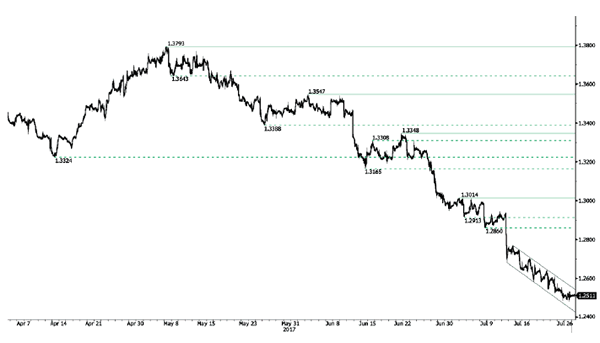
USD/CAD is going lower and the pair remains in a strong bearish momentum. Hourly resistance is given at 1.2701 (17/07/2017). Expected to show continued bearish pressures.
In the longer term, the pair is now monitoring long-term support that can be found at 1.2461 (16/03/2015 low). Strong resistance is given at 1.4690 (22/01/2016 high). The pair should head lower.
USD/CHF Short-Term Surge
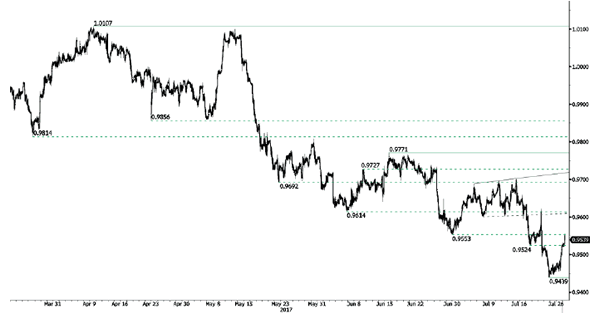
USD/CHF is trading higher. Hourly resistance can be found at 0.9620 (20/07/2017 high). Strong resistance is given at 1.0107 (10/04/2017 high). Expected to to show further bearish consolidation
In the long-term, the pair is still trading in range since 2011 despite some turmoil when the SNB unpegged the CHF. Key support can be found 0.8986 (30/01/2015 low). The technical structure favours nonetheless a long term bullish bias since the unpeg in January 2015.
USD/JPY Bouncing Higher
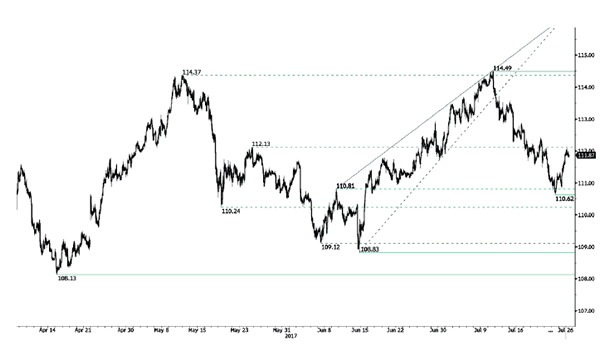
USD/JPY has bounced higher invalidating short-term bearish downtrend. Hourly support is given at 110.62 (24/06/2016 low). Stronger support is located at a distance at 108.83 (17/04/2017 low). Expected to show continued continued upside pressures.
We favor a long-term bearish bias. Support is now given at 96.57 (10/08/2013 low). A gradual rise towards the major resistance at 135.15 (01/02/2002 high) seems absolutely unlikely. Expected to decline further support at 93.79 (13/06/2013 low).
GBP/USD Sideways Price Action
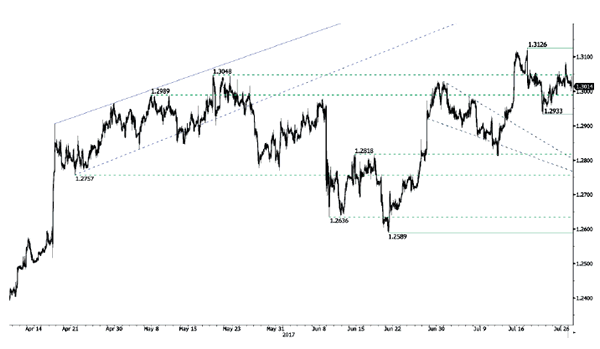
GBP/USD is trading above the 1.3000 mark. Hourly resistance is given at 1.3126 (16/07/2017 high). Hourly support is given at 1.2933 (20/07/2017 low). Expected to show continued bearish pressures.
The long-term technical pattern is even more negative since the Brexit vote has paved the way for further decline. Long-term support given at 1.0520 (01/03/85) represents a decent target. Long-term resistance is given at 1.5018 (24/06/2015) and would indicate a long-term reversal in the negative trend. Yet, it is very unlikely at the moment
EUR/USD Consolidating After Breaking 1.1700
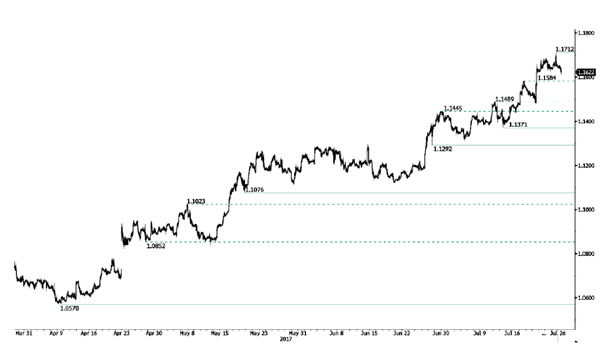
EUR/USD bullish pressures continue. Hourly resistance is given at 1.1712 (25/07/2017 high). Hourly support can be found at 1.1371 (13/07/2017 high). Stronger support lies at 1.1292 (28/06/2017 low). Expected to show continued bullish pressures.
In the longer term, the momentum is clearly negative. We favour a continued bearish bias towards parity. Key resistance holding at 1.1714 (24/08/2015 high) is on target while strong support lies at 1.0341 (03/01/2017 low).
Technical Outlook: EURUSD Eases Further As Dollar Regains Traction
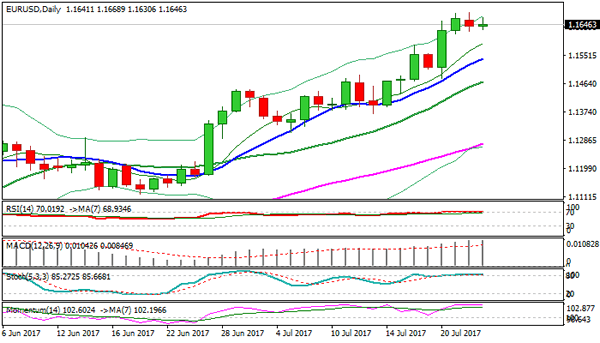
The Euro stands at the back foot on Wednesday and probes below last Friday’s low at 1.1618, which marks significant support.
Strong upside rejection on Tuesday after posting fresh two-year high at 1.1712 that left Doji daily candle with long upper shadow, generated initial negative signal, with single currency also being dragged lower by firmer dollar.
Reversal of daily RSI and slow stochastic from overbought zone generates additional bearish signal.
Dips may extend towards next solid support at 1.1570 zone (Fibo 23.6% of 1.1188/1.1712 upleg), reinforced by rising 10SMA which guards pivot at 1.1485 (Fibo 38.2% / rising 20SMA).
Firm break here would confirm reversal and trigger deeper correction.
The Euro is holding in larger uptrend and current easing is seen as correction before fresh push higher after initial attack at strong resistance zone between 1.1713 and 1.1735 failed.
Deeper correction would signal healthier uptrend with final break above 1.1713/35 pivots expected to spark stronger upside action.
The pair is awaiting comments from Fed later today for fresh direction signals.
Res: 1.1653, 1.1684, 1.1712, 1.1735
Sup: 1.1600, 1.1570, 1.1550, 1.1514