Sample Category Title
USD/CAD Daily Outlook
Daily Pivots: (S1) 1.3798; (P) 1.3824; (R1) 1.3850; More...
A temporary top should be in place at 1.3848 with current retreat. Intraday bias in USD/CAD is turned neutral for consolidations. Downside of retreat should be contained by 55 4H EMA (now at 1.3745) to bring another rally. On the upside, decisive break of 1.3845 high will resume whole rally from 1.3176. Next target is 61.8% projection of 1.3176 to 1.3845 from 1.3588 at 1.4025.
In the bigger picture, price actions from 1.3976 (2022 high) are viewed as a corrective pattern, that might have completed at 1.3176 (2023 low) already. Firm break of 1.3976 will confirm resumption of whole up trend from 1.2005 (2021 low). Next target is 61.8% projection of 1.2401 to 1.3976 from 1.3176 at 1.4149. This will be the favored case as long as 1.3588 support holds, in case of pullback.
EUR/CHF Daily Outlook
Daily Pivots: (S1) 0.9516; (P) 0.9566; (R1) 0.9612; More....
Intraday bias in EUR/CHF remains on the downside for retesting 0.9476 low. Firm break there will resume whole fall from 0.9928 to 100% projection of 0.9928 to 0.94767 from 0.9772 at 0.9320. On the upside, above 0.9607 minor resistance will turn intraday bias neutral first.
In the bigger picture, with 1.0095 key medium term resistance intact, price actions from 0.9252 (2023 low) are seen as a corrective pattern. Fall from 0.9928 might be the second leg and break of 0.9476 would bring deeper fall to retest 0.9252 low. But strong support should be seen there to extend the corrective pattern with another rising leg. In case, medium term outlook will be neutral at best as long as 1.0095 structural resistance holds.
EUR/GBP Daily Outlook
Daily Pivots: (S1) 0.8411; (P) 0.8425; (R1) 0.8455; More....
Intraday bias in EUR/GBP remains neutral for the moment and outlook stays bearish as long as 0.8498 resistance holds. Larger down trend should resume through 0.8382 at a later stage.
In the bigger picture, down trend from 0.9267 (2022 high) is in progress. Next target is 0.8201 key support (2022 low). For now, outlook will remain bearish as long as 0.8643 resistance holds, even in case of stronger rebound.
EUR/AUD Daily Outlook
Daily Pivots: (S1) 1.6477; (P) 1.6560; (R1) 1.6672; More...
A temporary top should be in place at 1.6642 with current retreat. Intraday bias in EUR/AUD is turned neutral for consolidations. Outlook will stay bullish as long as 1.6384 support holds. Above 1.6642 will resume the rise from 1.5996 to retest 1.6742 resistance. Decisive break there will argue that larger up trend is ready to resume and target 1.7062 high next.
In the bigger picture, fall from 1.7062 medium term top is seen as a correction to the up trend from 1.4281 (2022 low) and could have completed after hitting 38.2% retracement of 1.4281 to 1.7062 at 1.6000. On resumption next target will be 61.8% projection of 1.4281 to 1.7062 from 1.5996 at 1.7715. This will now remain the favored case as long as 55 D EMA (now at 1.6263) holds.
GBP/JPY Daily Outlook
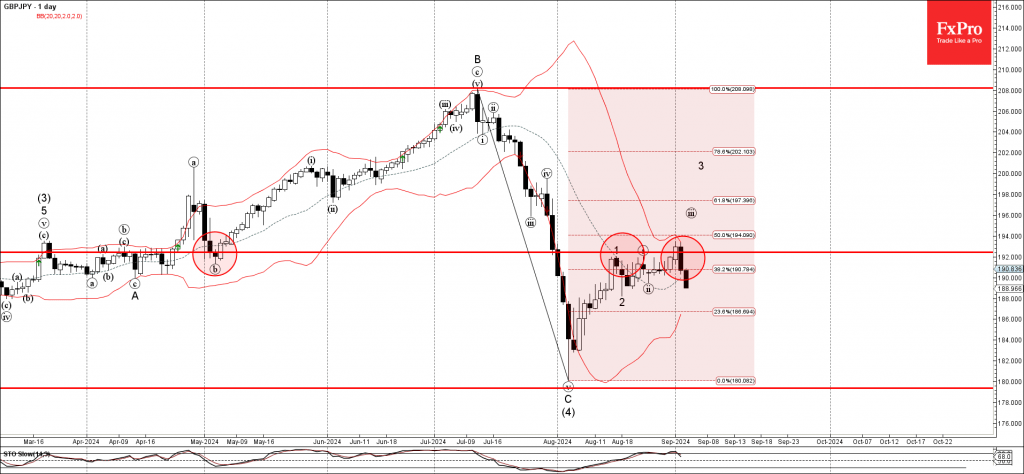
Daily Pivots: (S1) 196.14; (P) 197.55; (R1) 199.22; More...
A temporary low should be formed at 195.84 and intraday bias in GBP/JPY is turned neutral for consolidations. Risk will stay on the downside as long as 202.08 support turned resistance holds. Sustained trading below 38.2% retracement of 178.32 to 208.09 at 196.71 will argue that larger scale correction is under way to 185.49 fibonacci level.
In the bigger picture, considering bearish divergence condition in W MACD, 208.09 might be a medium term top and fall from there could already be correcting whole up trend from 148.93 (2022 low). Risk will now stay on the downside as long as 55 D EMA (now at 201.00). Sustained break of 196.71 will pave the way to 38.2% retracement of 148.93 to 208.09 at 185.49.
Rotation Continues, But Europe Doesn’t Benefit
We went from ‘the Federal Reserve (Fed) could hardly cut in September’ to ‘it would be a mistake not to cut in July or September’ (source: Mohammad El Erian’s Linkedin feed) in a blink of an eye. Everything seems upside down since last week. The Big Tech stocks that have been rallying relentlessly since the beginning of 2023 are hit hard by rapid outflows as worries regarding the AI spending and the realization that it may take time to see the benefits of this massive spending push investors to take a part of their profits and walk away.
Walk away where?! Walk away toward the treasuries and government bonds with the expectation that the Fed and other central banks will either start or continue cutting their rates, and walk away toward the smaller and cyclical pockets of the equity markets. In this context, we’ve been seeing the lower S&P500 and Nasdaq countered by a rise in economically sensitive sectors since about two weeks now. And diving into the S&P500, around 300 of the stocks in there actually gained yesterday, US crude rebounded after testing the $77pb support and the Rusell 2000 stocks rallied 1.26% – reinforcing the rotation trend – from tech to non-tech - after the latest growth update showed that the US economy not only secured a 2% growth but grew at an impressive pace of 2.8% last quarter – double the first quarter number which had seen the growth rate fall to 1.4%. Consumer spending grew 2.3% and helped keeping the US economy on a strong path – although the savings are melting and credit card debt is rising to levels not seen in a decade. Core PCE prices eased from 3.7% to 2.9% during the quarter. And although the easing in prices was not as much as analysts expected, the Fed rate cut expectations didn’t really got hurt by the strong numbers as again, it’s now thought by some big names that not cutting rates in one of the two next meetings would be a policy mistake for the Fed. I personally think that cutting rates next week would be a mistake too, given the still-strong inflation and unbelievable growth numbers. Presently, activity on Fed funds futures don’t show a meaningful bet for a July cut; the probability of a cut next week is given less than 7%.
We have one more important data to go before next week’s decision: the core PCE index, the Fed’s favourite gauge of inflation. That number is expected to show a slight slowdown from 2.6% to 2.5%, although we may see a certain quickening in the monthly figure. But all in all, if not catastrophic, the Fed will probably hint that a rate cut is coming in fall, when they meet next week. The US 2-year yield shortly fell to 4.34% despite the strong GDP read, the 10-year yield sit on 4.25% and the US dollar index hovered around the 200-DMA as the economic picture wasn’t as sunny as in the US elsewhere. On the contrary, weak French and Germany business surveys came to complete the cloudy picture painted by PMI surveys printed earlier in the week. And the earnings from European companies are less than enchanting, preventing the European stocks from benefiting from the sector rotation in the US. Kering- which is the house of luxury brands including Gucci and Balenciaga – dropped 7.5% after warning that its profit is set to tumble in Q2 and pulled LVMH, Hermes and Burberry down with. And note that Hermes couldn’t escape the luxury selloff even after announcing that its own sales jumped… Stellantis fell more than 7% after revealing that their earnings plunged in the H1 and Nestle dropped 5% after downgrading its sales outlook for the year. All in all, the earnings didn’t look great. If we do an overall summary, around 40 of MSCI Europe stocks released earnings this far, and only half of them have beaten analyst forecasts. So the Stoxx 600 really looks toppish right now. The weak economic data and meagre earnings boost the European Central Bank (ECB) rate cut expectations for September, but I don’t know if the ECB alone could cheer up investors. The EURUSD found support near the 1.0825 despite unpleasant news and data. But the sticky US growth limits the Fed’s rate cut potential, hence could also limit the euro’s upside potential against the greenback.
Elsewhere, the USDJPY tipped a toe below the 152 yesterday and on rising expectation that the Bank of Japan (BoJ) could hike its policy rate next week. But the BoJ is not the Fed, or the ECB. Just because the market expects a rate hike doesn’t mean it will actually happen. The BoJ could easily disappoint those anticipating a hike next week, delivering a blow to long yen positions.
EUR/JPY Daily Outlook
Daily Pivots: (S1) 165.33; (P) 166.46; (R1) 168.09; More...
A temporary low should be in place at 164.81 with current recovery. Intraday bias in EUR/JPY is turned neutral first. But risk will stay on the downside as long as 169.98 support turned resistance holds. On the downside, decisive break of 164.29 support turned resistance will indicate that larger scale correction is underway for 155.91 fibonacci level.
In the bigger picture, immediate focus is now on 164.29 resistance turned support. Strong rebound from there will retain medium term bullishness for resuming the up trend through 175.41 at a later stage. However, decisive break of 164.29 will indicate that fall from 175.41 is at least correcting the rise from 124.73, with risk of bearish trend reversal. Deeper decline would be seen to 38.2% retracement of 124.37 to 175.41 at 155.91.
Calmer Markets Shift Focus to US PCE Inflation Data
The forex markets have calmed down considerably in Asian session after a week of significant wild ride. Despite the pause, the risk-averse sentiment persists. Yen, which has led the charge this week, is starting to take a breather. It remains the runaway leader, followed by Swiss Franc and then Dollar. Meanwhile, New Zealand Dollar has overtaken Australian Dollar as the worst performer, with Canadian Dollar trailing as a distant third. Euro and Sterling are trading in the middle of the pack, with Euro showing a slight edge.
Today's spotlight is on US PCE inflation report. Both the headline and core PCE are anticipated to decrease to 2.5% in June, mirroring the CPI report's indication of ongoing disinflation. A 25bps rate cut by Fed in September is fully priced in by the markets. The primary question has shifted to whether Fed will implement two or three rate cuts this year. Fed fund futures currently suggest there is a 60% chance that the federal funds rate will end the year at 4.50-4.75%, a reduction of 0.75% from the current level.
Technically, Bitcoin rebounded notably after dipping to 63421 earlier in the week. The strong support from 55 D EMA so far is keeping the bullish case alive. That is, consolidation from 73812 has completed with three waves down to 53426. Larger up trend is ready to resume towards 61.8% projection of 24896 to 73812 from 53426 at 83686. Let's see how it goes.
In Asia, at the time of writing, Nikkei is up 0.02%. Hong Kong HSI is up 0.01%. China Shanghai SSE is down -0.24%. Singapore Strait Times is down -0.01%. Japan 10-year JGB yield is down -0.014 at 1.060. Overnight, DOW rose 0.20%. S&P 500 fell -0.51%. NASDAQ fell -0.93%. 10-year yield fell -0.030 to 4.256.
Tokyo CPI core rises, but core-core falls; BoJ rate hike uncertainty persists
Japan's Tokyo CPI core (excluding food) increased from 2.1% yoy to 2.2% yoy in July, aligning with market expectations. This marks the third consecutive month of re-acceleration following a dip to 1.6% yoy in April. The primary driver of this uptick was energy prices, with electricity costs soaring by 19.7% yoy due to the termination of government utility subsidies.
However, other inflation measures showed a slowdown. CPI core-core (excluding food and energy) dropped from 1.8% yoy to 1.5% yoy. Additionally, services inflation decreased from 0.9% yoy to 0.5% yoy, while headline CPI fell slightly from 2.3% yoy to 2.2% yoy.
The increase in core inflation maintains the possibility of a BoJ rate hike next week. However, the current data is not sufficiently conclusive to confirm this outcome. Swap markets indicate a 38% probability of a 15bps hike. A Bloomberg survey reveals that 30% of BoJ watchers anticipate a hike, with 90% viewing it as a potential risk.
Looking ahead
Main focus ahead is US personal income and spending, and PCE inflation.
EUR/JPY Daily Outlook
Daily Pivots: (S1) 165.33; (P) 166.46; (R1) 168.09; More...
A temporary low should be in place at 164.81 with current recovery. Intraday bias in EUR/JPY is turned neutral first. But risk will stay on the downside as long as 169.98 support turned resistance holds. On the downside, decisive break of 164.29 support turned resistance will indicate that larger scale correction is underway for 155.91 fibonacci level.
In the bigger picture, immediate focus is now on 164.29 resistance turned support. Strong rebound from there will retain medium term bullishness for resuming the up trend through 175.41 at a later stage. However, decisive break of 164.29 will indicate that fall from 175.41 is at least correcting the rise from 124.73, with risk of bearish trend reversal. Deeper decline would be seen to 38.2% retracement of 124.37 to 175.41 at 155.91.
Economic Indicators Update
| GMT | Ccy | Events | Actual | Forecast | Previous | Revised |
|---|---|---|---|---|---|---|
| 23:30 | JPY | Tokyo CPI Y/Y Jul | 2.20% | 2.30% | ||
| 23:30 | JPY | Tokyo CPI Core Y/Y Jul | 2.20% | 2.20% | 2.10% | |
| 23:30 | JPY | Tokyo CPI Core-Core Y/Y Jul | 1.50% | 1.80% | ||
| 12:30 | USD | Personal Income M/M Jun | 0.40% | 0.50% | ||
| 12:30 | USD | Personal Spending Jun | 0.30% | 0.20% | ||
| 12:30 | USD | PCE Price Index M/M Jun | 0.10% | 0.00% | ||
| 12:30 | USD | PCE Price Index Y/Y Jun | 2.50% | 2.60% | ||
| 12:30 | USD | Core PCE Price Index M/M Jun | 0.20% | 0.10% | ||
| 12:30 | USD | Core PCE Price Index Y/Y Jun | 2.50% | 2.60% | ||
| 14:00 | USD | Michigan Consumer Sentiment Jul F | 66 | 66 |
Cliff Notes: Waiting for a Clear Signal
Key insights from the week that was.
In Australia, a scant local data calendar left participants mulling over the possibilities for next week’s crucial Q2 CPI update. Our preview provides the detail behind our forecasts. Food, health and housing are expected to be the main contributors to our headline inflation forecast of 1.0% (3.8%yr); housing is also expected to be critical for underlying trimmed mean inflation (0.9%; 4.0%yr). While market appetite for an imminent rate hike has waned since the last monthly inflation update – from a 50% chance of an August increase to circa 20% currently – market participants’ perspectives are diverse. In our view, if the data print as we expect, it leaves the door open for the RBA rate cutting cycle to begin in November, as has been our forecast for some time. However, significant uncertainty remains around various components, particularly with respect to energy rebates and services inflation. The RBA understands this, hence any deviation from expectations will need to be closely assessed to determine its policy implications.
Responding to the run of significant events experienced in recent weeks and with considerable uncertainty over local and international developments into year end, Chief Economist Luci Ellis’ essay this week provides a framework for assessing the implications of news and events, from the detail of a given data release to structural developments across the global economy.
Moving offshore, the Bank of Canada cut rates by 25bps to 4.50% as expected at their July meeting. In the statement and press conference, there was a clear focus on the need to balance shifting economic risks, with inflation pressures abating and downside risks for activity becoming more evident. The Governing Council seem confident in inflation's downtrend, noting excess capacity in the economy and that the breadth of price pressures is back 'near its historic norm'. Inflation projections were revised down for 2025 and 2026 to 2.0% from 2.1%, but in 2024 inflation is expected to remain above target at 2.4% (previously 2.2%). Excess supply is appearing in the labour market as population growth holds around 3.0%. The BoC also noted that 'job seekers [are] taking longer to find work'. Activity growth is expected to be weak at 1½% through the first half of the year, a downgrade from their prior forecast. However, it should pick up in 2025 and 2026, absorbing excess capacity. The Governing Council will remain data dependent. But, with slack emerging across the economy and policy still contractionary, additional rate cuts are anticipated into year end and through 2025.
South of the border, US GDP re-accelerated in Q2, largely as we had anticipated. Growth came in at 2.8% annualised in Q2, twice Q1's 1.4% gain. Underlying the headline result, private demand growth was broadly the same in Q1 and Q2, respectively 2.5% and 2.7%, modestly below the 3.0% average of the decade prior to the pandemic. At 2.3% annualised, consumption growth was also consistent with its pre-pandemic average of 2.4%; though, for the past six months, growth in this sector has relied solely on services – a 2.8% annualised average compared to circa 0% for both durable and non-durable goods. Dwelling and structures investment both pulled back in Q2, but are still roughly 5.5% higher over the year – robust outcomes given the challenges posed by construction and finance costs. Equipment investment was very strong in Q2 at almost 12% annualised; however, this follows an extended period of weakness, with cumulative growth of just 1.1% over the prior two years. Intangibles investment growth remains robust, but is sub-par versus the pandemic years and the decade prior. We continue to expect the FOMC to deliver their first cut in September and another by year end. Next week’s July meeting will provide an update on their assessment of risks.
In China meanwhile, the PBoC eased policy settings this week. On Monday, they reduced their 7-day reverse repo rate by 10bps and commercial banks lowered the loan prime rate moments later. This was followed by a US$200bn increase to the medium-term lending facility – the biggest injection since January. Finally, the PBOC reduced the rate on the MLF by 20bps to 2.3%. These initiatives are marginal supports for the property sector and the consumer. Further support is likely coming. But with confidence as weak as it is, conditions are only likely to improve slowly, and downside risks will remain.
Events, My Dear Readers, Events
It helps to have a framework for thinking through the different events that might come along and surprise us. Some things are just lumps and bumps along the way, while others are genuinely forks in the path ahead.
The past few weeks have been big ones for news. An assassination attempt, a Presidential withdrawal and a global cyber-botch. Not to mention a string of elections in other countries in prior weeks. Aside from the salutary reminder that we should never attribute to conspiracy something that could as easily be a stuff-up, recent events have highlighted that unexpected events can occur, and that even things that were well-anticipated can have surprising consequences. As former UK Prime Minister Harold Macmillan famously said, the biggest issues he needed to deal with were ‘Events, my dear boy, events’.
It helps to have a framework for thinking through the events that might come along and surprise us. Some years ago, in another life, I tried to develop one, dividing things up into lumps, bumps and waves.
Lumps, bumps, waves …
Perhaps easiest to understand are the lumps and bumps. The ‘lumps’ are the single factors that are big enough to shift the total even though they are not representative. You can see the role they play when forming a view about very near-term outcomes. In the broader scheme of things, inflation is driven by macro-level factors, the balance of aggregate demand and aggregate supply. But in working out what you expect the next CPI result to print, you need to allow for all the individual components that could shift the total. This is why Westpac Economics Senior Economist Justin Smirk’s preview of next week’s CPI release covered specific factors such as electricity rebates and the timing of end of financial year sales. In ‘now-casting’, a ‘bottom-up’ view can be very helpful.
The ‘bumps’ are temporary special factors like cyclones or other disruptions. In a world where supply shocks are more prominent, thinking through the effects of these bumps will be something we all need to do more often.
Bumps are not always short-lived. A good example of a bump that is playing out over several years is the drop and then surge in population growth resulting from the closure of Australia’s international borders during the pandemic and subsequent reopening. The peak in population growth was last year, partly because China’s borders had just reopened. It will take a couple of years before population growth reverts to its pre-pandemic norm. In the meantime, the housing market is under pressure. Even allowing for some increase in average household size back to its pre-pandemic level, rental vacancy rates will remain low for a while, and rent growth in the CPI elevated.
A challenge for policy in all of this is that one needs to recognise where the aggregate numbers are being pushed around by one-offs and unrepresentative influences. At the same time, one cannot dismiss these effects entirely. Simply excluding all the one-off things that are boosting inflation, for example, can mean one ends up with an inappropriately sanguine view of the underlying trend.
We also need to pay attention to the ‘waves’ – the big shifts that can change the underlying structure of the economy. Typically these stem from demographic shifts or regulatory or technological developments.
Sometimes these waves are transitions to a new normal. The process of urbanisation underway in China is a good example of such a transition. The end of a transition can be especially challenging to navigate. People get used to the way things work during the transition phase, and do not anticipate that it will not last forever. This is especially so for the leveraging phase that typically follows deregulation of the financial sector. The crises and near-crises in Japan, Scandinavia and Australia in the early 1990s and in Asia in the late 1990s are all examples of how that can play out badly. It can also be hard to stick the landing when converging to a higher standard of living, as Ireland and Spain found after joining the Euro Area and converging to Euro Area living standards.
Another challenge with the truly important waves is that even when we recognise a wave is occurring, we might misread its broader implications. As I pointed out in that speech in 2019, it is often assumed that the ageing of the population means that participation in the labour force will decline and the workforces of advanced economies will shrink. In fact, with the notable exception of the United States, the reverse is happening. (This trend, and the US exception to it, is a topic for a future note.) Similarly, it is often assumed that technological change boosting productivity in one sector more than others will result in that sector expanding. That may be true for output, but the history of agricultural and manufacturing employment shows the opposite.
…and forks
With the benefit of a few more years, it has become clear that some events are best understood not as lumps, bumps or waves, but as forks in the road. A particular threshold event occurs with two or more possible future outcomes. Once it occurs, it closes off some potential futures, and sets us on one path. While this is not the superposition of possible states of a Schrödinger’s cat, we know that, for example, come November the cat will either be red or blue. The reunification of Germany was another good example.
Resolution of this kind of event uncertainty can shift market pricing considerably. Before the event pricing needs to cover a range of possible futures. Once some paths are closed off, the chance they might occur is no longer priced in.
We must remember, though, that not every big event is a lasting wave or a fork. Sometimes they are just big bumps, and things return to where they were before. And even if something is genuinely a fork, some aspects of the scenery along the path will be similar. For example, regardless of whether the November cat is red or blue, the United States will still be running enormous fiscal deficits in some form. That has implications for the global structure of interest rates. And in time, decisionmakers in that country may well face another fork in the road as a consequence.