Sample Category Title
EUR/USD Daily Outlook
Daily Pivots: (S1) 1.0820; (P) 1.0873; (R1) 1.0965; More.....
Intraday bias in EUR/USD remains on the upside for the moment. Decisive break of 1.0947 resistance will resume rise from 1.0665 and target 100% projection of 1.0665 to 1.0947 from 1.0776 at 1.1056. For now, risk will stay on the upside as long as 55 4H EMA (now at 1.0845) holds, in case of retreat.
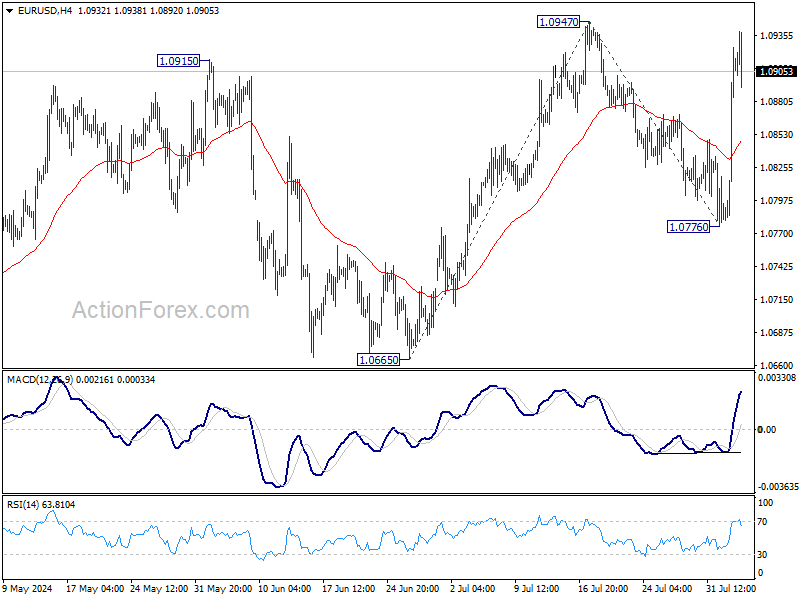
In the bigger picture, price actions from 1.1274 are viewed as a corrective pattern that's still be in progress. Break of 1.1138 resistance will be the first signal that rise from 0.9534 (2022 low) is ready to resume through 1.1274 (2023 high). However, break of 1.0665 support will extend the correction with another falling leg back towards 1.0447 support.
GBP/USD Daily Outlook
Daily Pivots: (S1) 1.2729; (P) 1.2784; (R1) 1.2861; More...
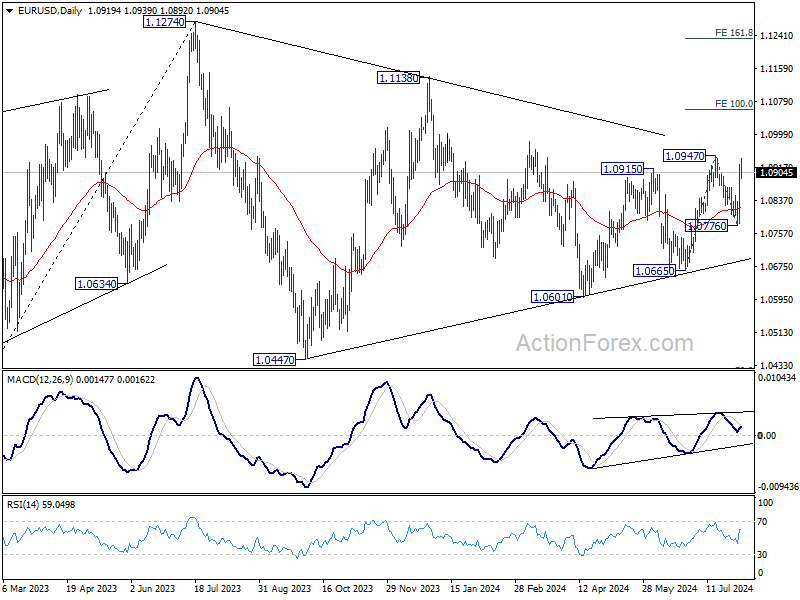
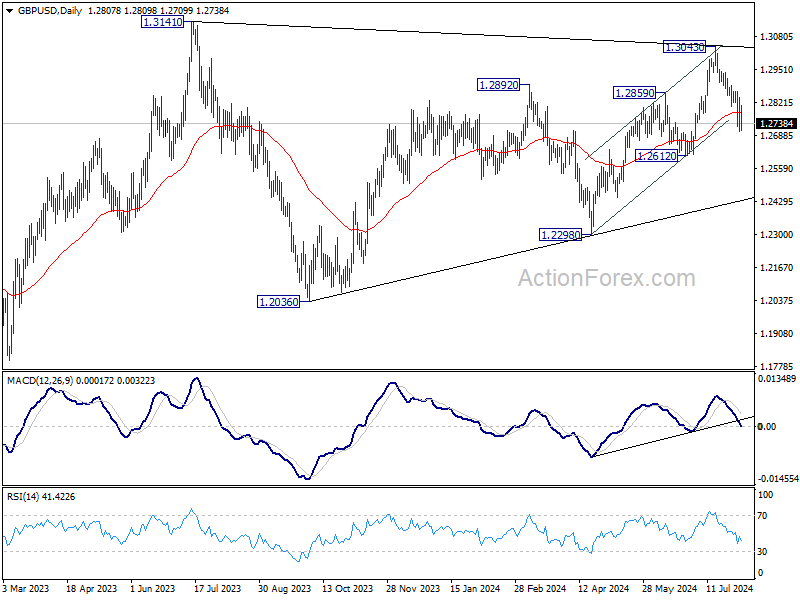
Intraday bias in GBP/USD remains neutral first and further decline is in favor with 1.2863 resistance intact. On the downside, below 1.2706 will target 1.2612 support first. Decisive break there should confirm that rise from 1.2298 has completed. However, break of 1.2863 will turn bias back to the upside for retesting 1.3043 resistance instead.
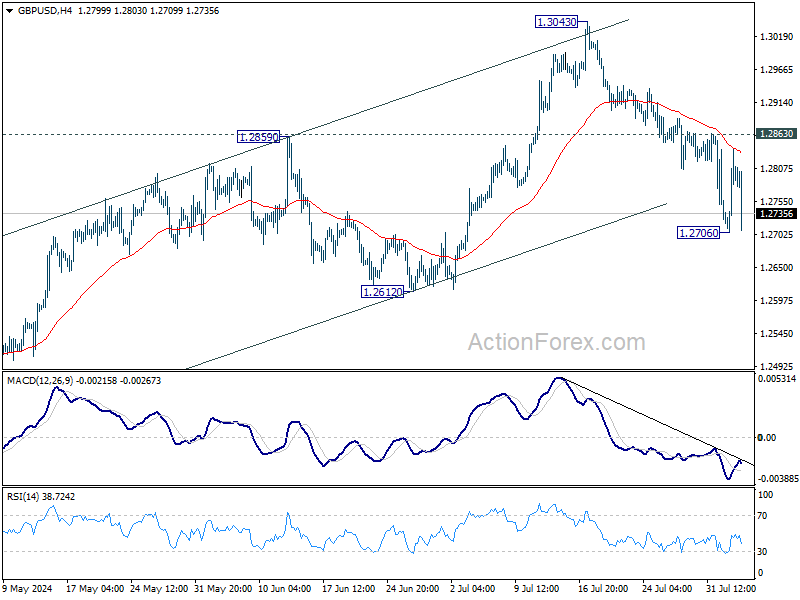
In the bigger picture, current development suggests that corrective pattern from 1.3141 is extending with fall from 1.3043 as another leg. Break of 1.2612 support would strengthen this case. But still, downside should be contained by 1.2036/2298 support zone even in case of deep decline. Rise from 1.0351 (2022 low) remains in favor to resume at a later stage.
USD/CHF Daily Outlook
Daily Pivots: (S1) 0.8523; (P) 0.8631; (R1) 0.8689; More…
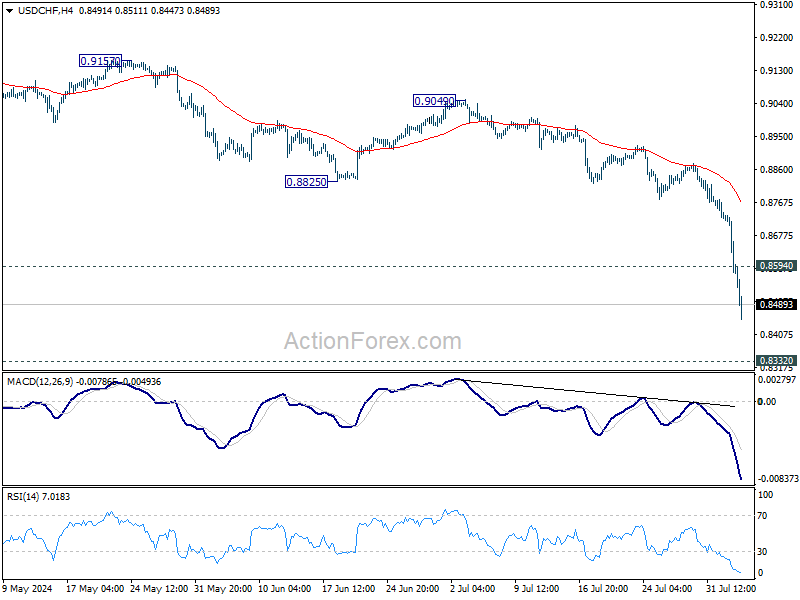
USD/CHF's decline accelerates lower today. There so no sign of bottoming yet, and intraday bias stays on the downside for retesting 0.8332 low. On the upside, above 0.8594 minor resistance will turn intraday bias neutral and bring consolidations, before staging another fall.
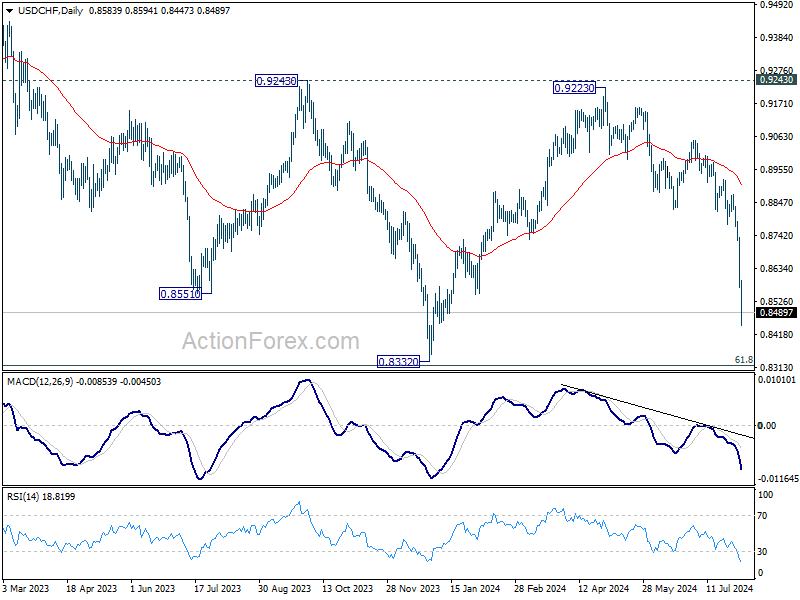
In the bigger picture, price actions from 0.8332 (2023 low) are currently seen as a medium term corrective pattern, with fall from 0.9223 as the second leg. Strong support could be seen from 0.8332 to bring rebound. Yet, overall outlook will continue to stay bearish as long as 0.9243 resistance holds. Firm break of 0.8332, however, will resume larger down trend from 1.0146 (2022 high).
USD/JPY Daily Outlook
Daily Pivots: (S1) 145.40; (P) 147.59; (R1) 148.76; More...
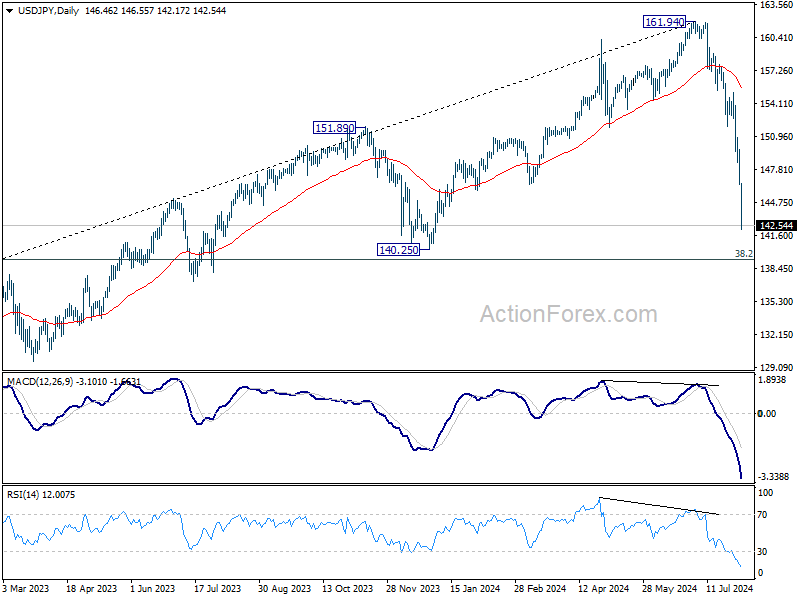
USD/JPY's decline accelerates further to as low as 142.17 so far today There is no sign of bottoming yet. Intraday bias stays on the downside for 140.25 support next. On the upside, above 146.40 minor resistance will turn intraday bias neutral and bring consolidations first, before staging another fall.
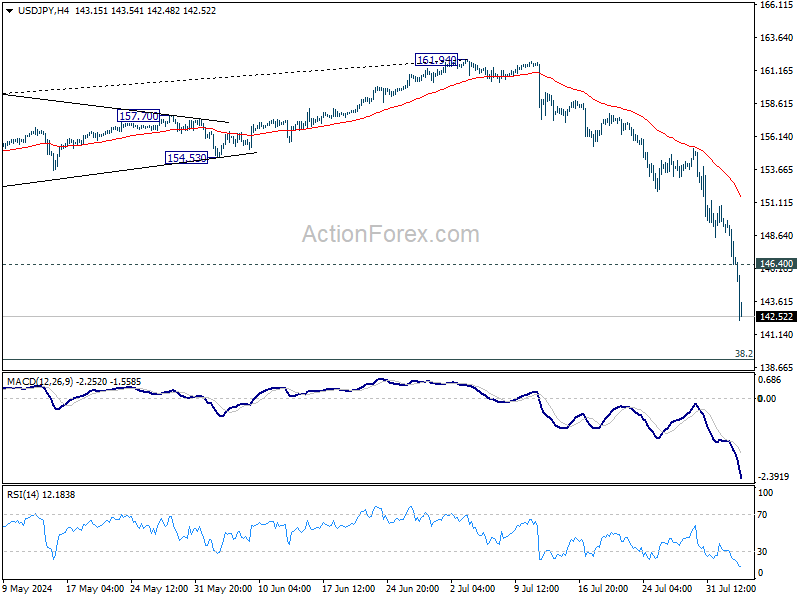
In the bigger picture, the strong break of 55 W EMA (now at 149.98) argue that fall from 161.94 medium term is correcting whole up trend from 102.58 (2021 low). Deeper decline could be seen to 38.2% retracement of 102.58 to 161.94 at 139.26, which is close to 140.25 support. In any case, risk will stay on the downside as long as 55 W EMA (now at 149.98) holds.
Market Rout Deepens Globally: Will ISM Services Provide Relief?
The global market turmoil showed no signs of easing as the week began, with Japanese stocks taking a severe hit during Asian session. Both the Nikkei 225 and Topix indices plunged by as much as nearly -10%, marking a -20% drop from their all-time highs on July 11. This selloff extended to the cryptocurrency market, where Ethereum fell more than -20% since Friday.
In the currency markets, Yen and Swiss Franc continue to be the preferred safe havens amidst the chaos. On the other hand, Aussie and Kiwi are bearing the brunt of the selloff. Euro is currently outperforming both Dollar and Sterling, while Canadian Dollar is mixed in the middle.
Investors are now anxiously awaiting US ISM services data, which could potentially exacerbate recession fears if the figures disappoint. Beyond the headline PMI reading, employment component will be closely scrutinized. Last week's increase in the unemployment rate triggered the Sahm Rule, a historically reliable recession indicator. Once the Sahm Rule threshold is breached, history suggests that the unemployment rate could rise rapidly.
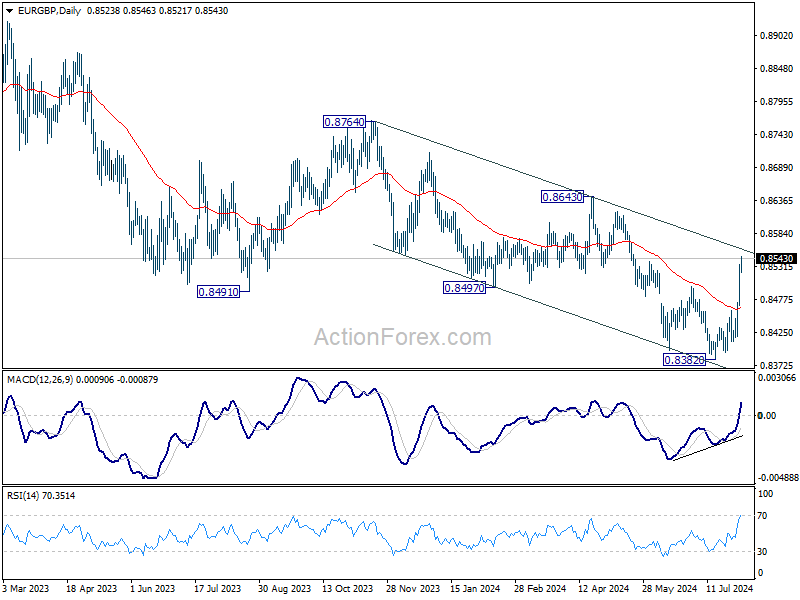
Technically, EUR/GBP would be an interesting one to look at this week, as it's quickly approaching falling channel resistance with last week's strong rally. Decisive break of this channel resistance will be a strong sign of 0.8382 is already a medium term bottoming. Stronger rally could be seen to 0.8643 and possibly 0.8764 resistance, even just as a corrective move. On the other hand, rejection by the channel will keep medium term outlook bearish in EUR/GBP for another fall through 0.8382 at a later stage.
In Asia, at the time of writing, Nikkei is own -9.78%. Hong Kong HSI is down -1.25%. China Shanghai SSE is down -0.61%. Singapore Straeit Times is down -3.75%. Japan 10-year JGB yield is down sharply by -0.167 at 0.792, breaking 0.8% handle.
Ethereum may find temporary support at 2100 after freefall, but threat lingers below 2800
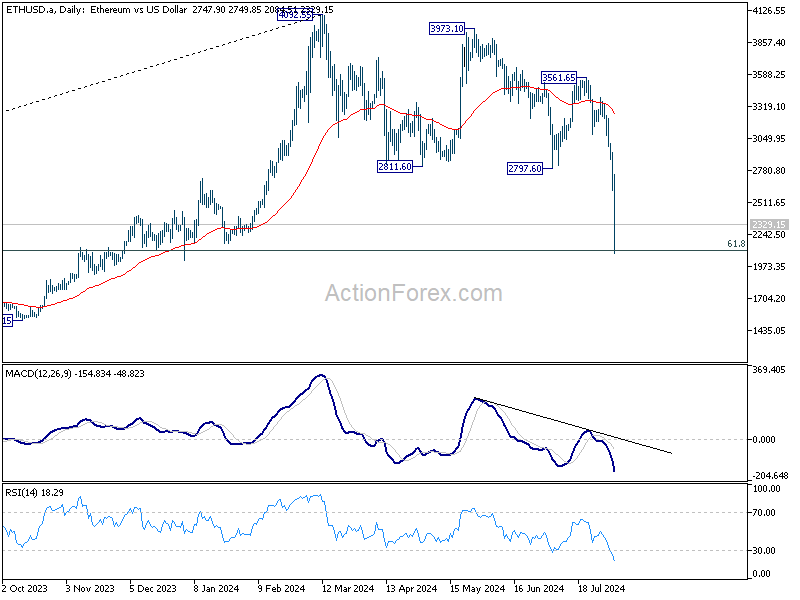
Ethereum has taken a severe hit in the past few days, plunging over 20% since Friday as the global market downturn extends its reach into the cryptocurrency space. This steep decline is fueled by a combination of broad-based risk aversion and specific pressures within the crypto market. Notably, Jump Crypto has been liquidating approximately USD 300m from a single wallet over the past two weeks, exacerbating the sell-off.
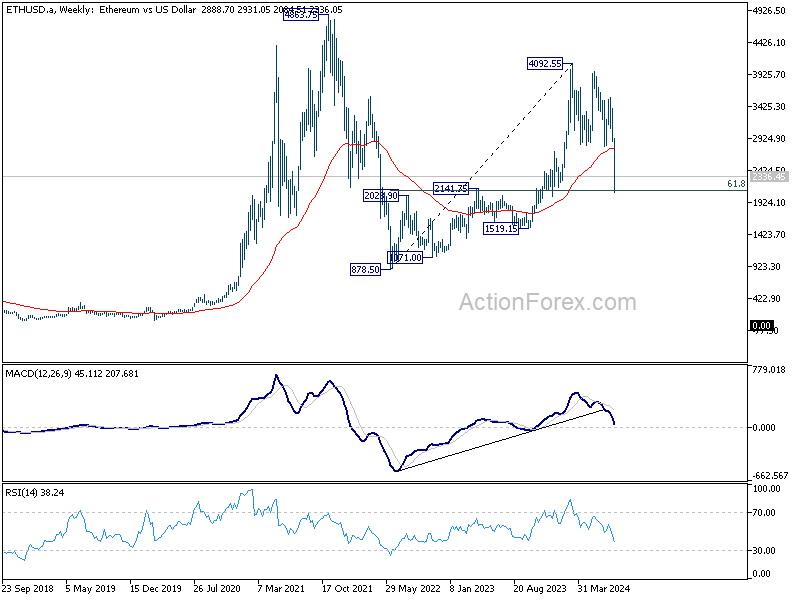
ETH is clearly reversing whole up trend from 878.50 (2022 low). Technically, there is prospect for a bounce at current levels, which is close to 61.8% retracement of 878.50 to 4092.55 at 2106.26, to bring near term consolidations. But risk will stay on the downside as long as 2797.60 support turned resistance holds. Sustained break of 2106.26 will pave the way to 1519.15 support next.
In summary, while Ethereum may find some temporary support around 2100 level, the overall risk remains skewed to the downside as long as it remains below 2800 resistance.
Japan's PMI services finalized at 53.7, concerns on sustained inflationary pressure
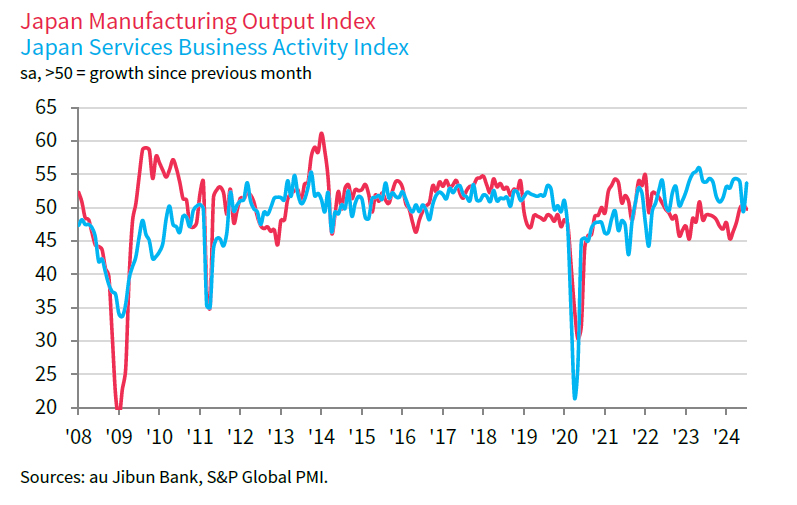
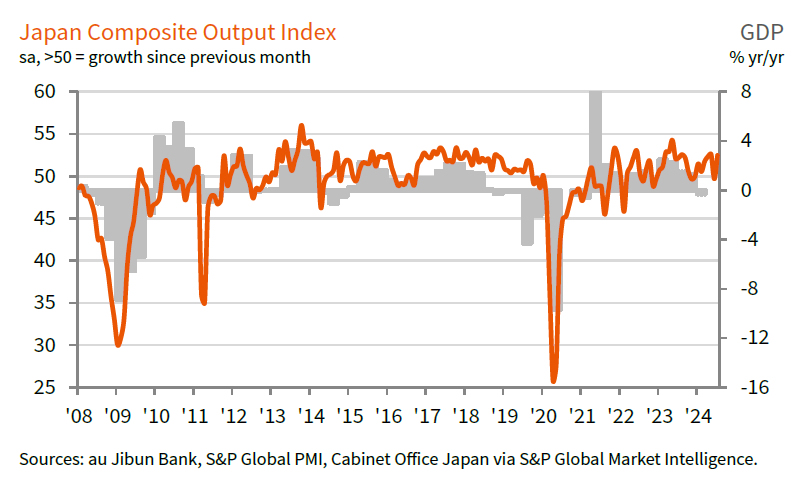
Japan's PMI Services was finalized at 53.7 in July, up from June's 49.4. PMI Composite was finalized at 52.5, up from June's 49.7.
Usamah Bhatti, Economist at S&P Global Market Intelligence, highlighted a "renewed upswing" in the services sector at the start of Q3, driven by "improved demand conditions and stronger customer numbers." This growth was largely domestic, as new export business declined for the first time this year. The outlook for the service sector remains positive, with outstanding business levels increasing and strong confidence in the 12-month outlook.
While the combined output of the manufacturing and services sectors expanded at a "moderate pace," the growth was primarily driven by the service sector, with manufacturing experiencing a slight contraction. Private sector companies reported that input price inflation remained "stubbornly high," affecting total output. There are concerns that "sustained inflationary pressure" could pose a downside risk to the economy in the coming months.
China's Caixin PMI services rises to 52.1, composite falls to 51.2
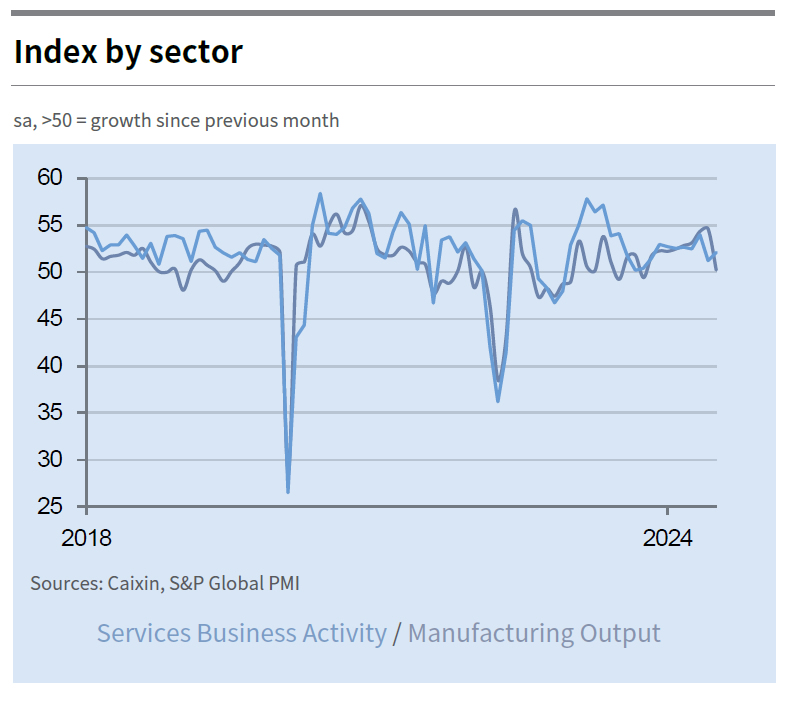
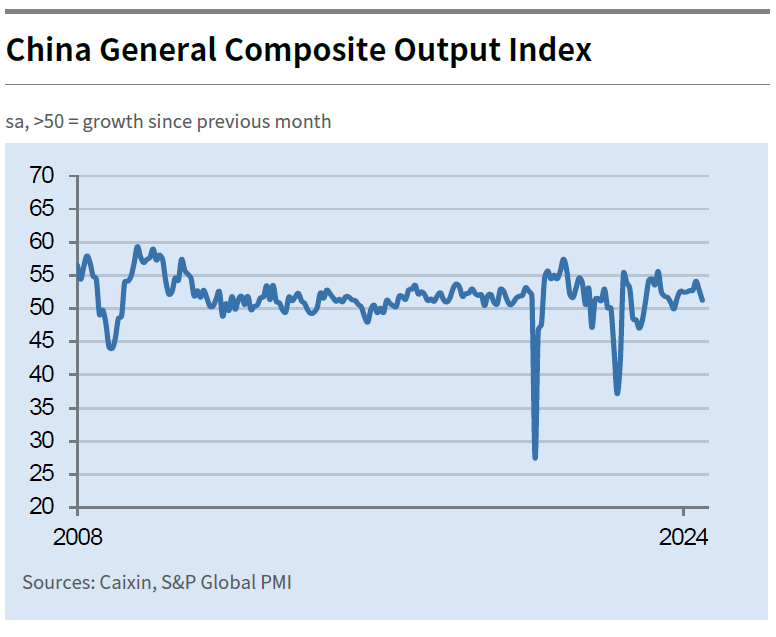
China's Caixin PMI Services increased from 51.2 to 52.1 in July, surpassing the expected 51.4 and remaining in expansionary territory for the 19th consecutive month. Meanwhile, PMI Composite fell from 52.8 to 51.2, but still marking the ninth consecutive month of expansion.
Wang Zhe, Senior Economist at Caixin Insight Group, noted that while the services sector saw improvement, manufacturing faced greater pressure. "The former outperformed the latter in terms of supply, demand and employment," Wang said. Despite this, composite prices remained weak, especially on the sales front, which further squeezed company profit margins. Market optimism improved, although it remained at a low level.
The latest data revealed that China's real GDP growth in Q2 slowed to 4.7% yoy, significantly lower than market expectations. This slowdown suggests that it will be challenging for the country to meet its annual growth target of around 5%. Wang said the primary issues remain insufficient effective domestic demand and weak market optimism.
RBA to hold rates steady, US ISM services key to market sentiment
RBA is widely expected to keep its interest rate unchanged at 4.35% this week. The pressure to raise rates has eased, at least temporarily, following Q2 CPI data, which showed moderation in underlying inflation. However, it is too early for RBA to adopt a dovish stance or signal future rate cuts. Governor Michele Bullock is likely to maintain the stance of "not ruling anything in or out."
A recent Reuters poll indicated that 22 out of 23 economists forecast no change in RBA's key interest rate before 2025, with only 10 expecting a 25bps cut in Q4. The market is pricing in roughly a 55% chance of a rate cut by the end of 2024.
In terms of central bank activities, BoJ summary of opinions from its latest meeting and BoC summary of deliberations will also be closely watched.
On the data front, US ISM services PMI will be a major focus at the start of the week. Market sentiment is increasingly centered around the risk of a looming recession or even hard landing in the US. The services sector, which has been a key driver of economic growth since early 2023, has shown signs of losing momentum in recent months. Any downside surprises in this data could prompt another selloff in risk assets.
Elsewhere, employment data from New Zealand and Canada will attract significant attention, along with Eurozone Sentix investor confidence and China's Caixin PMI services, CPI, and PPI.
Here are some highlights for the week:
- Monday: BoJ minutes; China Caixin PMI services; Eurozone PMI services final, Sentix investor confidence; UK PMI services final; US ISM services.
- Tuesday: Japan average cash earnings, household spending; RBA rate decision; Swiss unemployment rate, retail sales; Germany factory orders; UK PMI construction; Eurozone retail sales; Canada trade balance; US trade balance.
- Wednesday: New Zealand employment; China trade balance; Japan leading indicators; Germany industrial production, trade balance; France trade balance; Swiss foreign currency reserves; Canada Ivey PMI, BoC summary of deliberations.
- Thursday: BoJ summary of opinions; Japan current account, economy watchers sentiment; New Zealand inflation expectations; US jobless claims.
- Friday: China CPI, PPI; Germany CPI final; Swiss SECO consumer climate; Canada employment.
USD/JPY Daily Outlook
Daily Pivots: (S1) 145.40; (P) 147.59; (R1) 148.76; More...
USD/JPY's decline accelerates further to as low as 142.17 so far today There is no sign of bottoming yet. Intraday bias stays on the downside for 140.25 support next. On the upside, above 146.40 minor resistance will turn intraday bias neutral and bring consolidations first, before staging another fall.
In the bigger picture, the strong break of 55 W EMA (now at 149.98) argue that fall from 161.94 medium term is correcting whole up trend from 102.58 (2021 low). Deeper decline could be seen to 38.2% retracement of 102.58 to 161.94 at 139.26, which is close to 140.25 support. In any case, risk will stay on the downside as long as 55 W EMA (now at 149.98) holds.
Economic Indicators Update
| GMT | Ccy | Events | Actual | Forecast | Previous | Revised |
|---|---|---|---|---|---|---|
| 23:50 | JPY | BoJ Meeting Minutes | ||||
| 01:00 | AUD | TD Securities Inflation M/M Jul | 0.40% | 0.30% | ||
| 01:45 | CNY | Caixin Services PMI Jul | 52.1 | 51.4 | 51.2 | |
| 07:45 | EUR | Italy Services PMI Jul | 53 | 53.7 | ||
| 07:50 | EUR | France Services PMI Jul F | 50.7 | 50.7 | ||
| 07:55 | EUR | Germany Services PMI Jul F | 52 | 52 | ||
| 08:00 | EUR | Eurozone Services PMI Jul F | 51.9 | 51.9 | ||
| 08:30 | EUR | Eurozone Sentix Investor Confidence Aug | -7.3 | |||
| 08:30 | GBP | Services PMI Jul F | 52.4 | 52.4 | ||
| 09:00 | EUR | Eurozone PPI M/M Jun | 0.30% | -0.20% | ||
| 09:00 | EUR | Eurozone PPI Y/Y Jun | -3.30% | -4.20% | ||
| 13:45 | USD | Services PMI Jul F | 56 | 56 | ||
| 14:00 | USD | ISM Services PMI Jul | 51.4 | 48.8 |
EUR/USD Targets Gains, Bitcoin and Ethereum Nosedives
Key Highlights
- EUR/USD started a fresh increase from the 1.0775 support zone.
- It broke a key bearish trend line with resistance at 1.0820 on the 4-hour chart.
- GBP/USD is attempting to recover above the 1.2820 resistance.
- Bitcoin and Ethereum declined heavily below $60,000 and $2,500 respectively.
EUR/USD Technical Analysis
The Euro found support near the 1.0775 level against the US Dollar. EUR/USD formed a base and started a fresh increase above the 1.0820 resistance zone.
Looking at the 4-hour chart, the pair climbed above the 1.0840 level, the 200 simple moving average (green, 4-hour), and the 100 simple moving average (red, 4-hour). It broke a key bearish trend line with resistance at 1.0820.
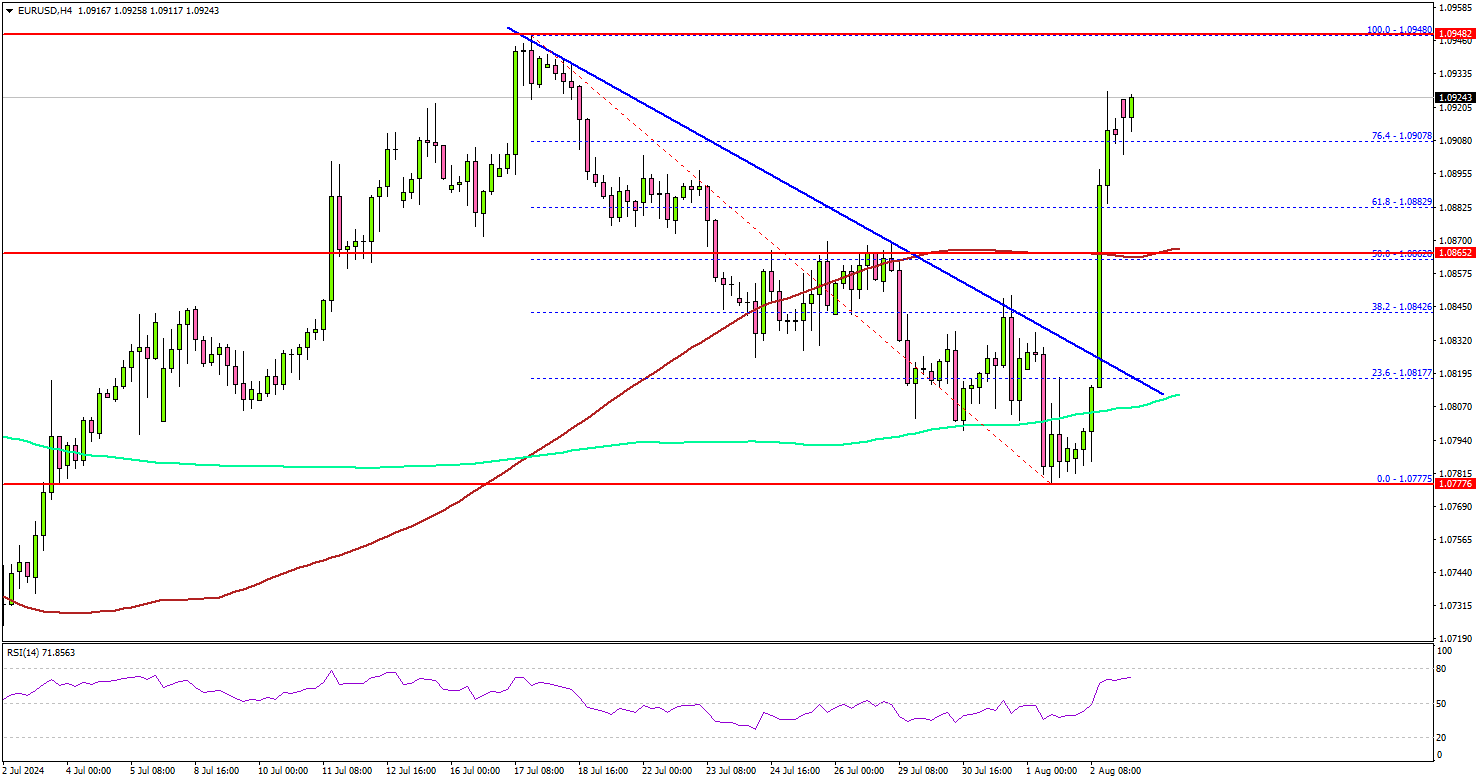
The pair even surpassed the 61.8% Fib retracement of the downward move from the 1.0948 swing high to the 1.0775 low. The pair is now showing positive signs above the 1.0900 level.
Immediate resistance sits near the 1.0935 level. The next resistance sits at 1.0950. A clear move above 1.0950 could open the door to more gains. In the stated case, the pair could rise and test 1.1050.
Immediate support is near the 1.0880 level. The next major support is near the 1.0850 level. A downside break and close below the 1.0850 support zone could open the doors for more losses. In the stated case, GBP/USD might decline toward the 1.0820 level.
Looking at Bitcoin, the bears took control amid heavy selling and the price declined heavily below the $60,000 zone.
Economic Releases
- Euro Zone Services PMI for July 2024 – Forecast 51.9, versus 51.9 previous.
- UK Services PMI for July 2024 – Forecast 52.4, versus 52.4 previous.
- US Services PMI for July 2024 – Forecast 56.0, versus 56.0 previous.
- US ISM Services Index for July 2024 – Forecast 51.0, versus 48.8 previous
Ethereum may find temporary support at 2100 after freefall, but threat lingers below 2800
Ethereum has taken a severe hit in the past few days, plunging over 20% since Friday as the global market downturn extends its reach into the cryptocurrency space. This steep decline is fueled by a combination of broad-based risk aversion and specific pressures within the crypto market. Notably, Jump Crypto has been liquidating approximately USD 300m from a single wallet over the past two weeks, exacerbating the sell-off.
ETH is clearly reversing whole up trend from 878.50 (2022 low). Technically, there is prospect for a bounce at current levels, which is close to 61.8% retracement of 878.50 to 4092.55 at 2106.26, to bring near term consolidations. But risk will stay on the downside as long as 2797.60 support turned resistance holds. Sustained break of 2106.26 will pave the way to 1519.15 support next.
In summary, while Ethereum may find some temporary support around 2100 level, the overall risk remains skewed to the downside as long as it remains below 2800 resistance.
China’s Caixin PMI services rises to 52.1, composite falls to 51.2
China's Caixin PMI Services increased from 51.2 to 52.1 in July, surpassing the expected 51.4 and remaining in expansionary territory for the 19th consecutive month. Meanwhile, PMI Composite fell from 52.8 to 51.2, but still marking the ninth consecutive month of expansion.
Wang Zhe, Senior Economist at Caixin Insight Group, noted that while the services sector saw improvement, manufacturing faced greater pressure. "The former outperformed the latter in terms of supply, demand and employment," Wang said. Despite this, composite prices remained weak, especially on the sales front, which further squeezed company profit margins. Market optimism improved, although it remained at a low level.
The latest data revealed that China's real GDP growth in Q2 slowed to 4.7% yoy, significantly lower than market expectations. This slowdown suggests that it will be challenging for the country to meet its annual growth target of around 5%. Wang said the primary issues remain insufficient effective domestic demand and weak market optimism.
Japan’s PMI services finalized at 53.7, concerns on sustained inflationary pressure
Japan's PMI Services was finalized at 53.7 in July, up from June's 49.4. PMI Composite was finalized at 52.5, up from June's 49.7.
Usamah Bhatti, Economist at S&P Global Market Intelligence, highlighted a "renewed upswing" in the services sector at the start of Q3, driven by "improved demand conditions and stronger customer numbers." This growth was largely domestic, as new export business declined for the first time this year. The outlook for the service sector remains positive, with outstanding business levels increasing and strong confidence in the 12-month outlook.
While the combined output of the manufacturing and services sectors expanded at a "moderate pace," the growth was primarily driven by the service sector, with manufacturing experiencing a slight contraction. Private sector companies reported that input price inflation remained "stubbornly high," affecting total output. There are concerns that "sustained inflationary pressure" could pose a downside risk to the economy in the coming months.
EURJPY Wave Analysis
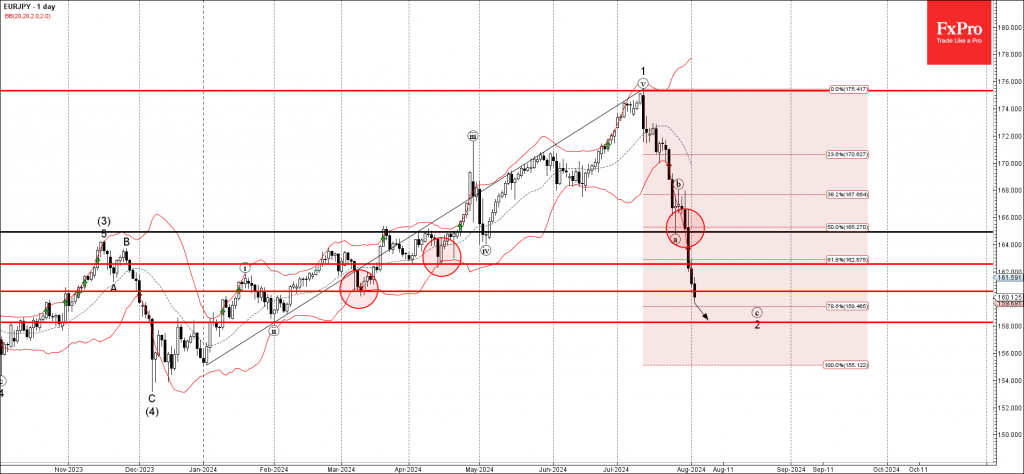
- EURJPY falling inside accelerated impulse wave c
- Likely to test support level 158.00
EURJPY currency pair continues to fall inside the accelerated downward impulse wave c of the minor ABC correction 2 from the start of July.
The price earlier broke the support zone lying between the support level 162.50 (former monthly low from March) and the 61.8% Fibonacci correction of the upward impulse from January.
Given the strongly bearish yen sentiment seen across the FX markets, EURJPY currency pair can be expected to fall further toward the next support level 158.00 (target price for the completion of the active impulse wave c).