Sample Category Title
USD/JPY Daily Outlook
Daily Pivots: (S1) 155.75; (P) 156.03; (R1) 156.56; More...
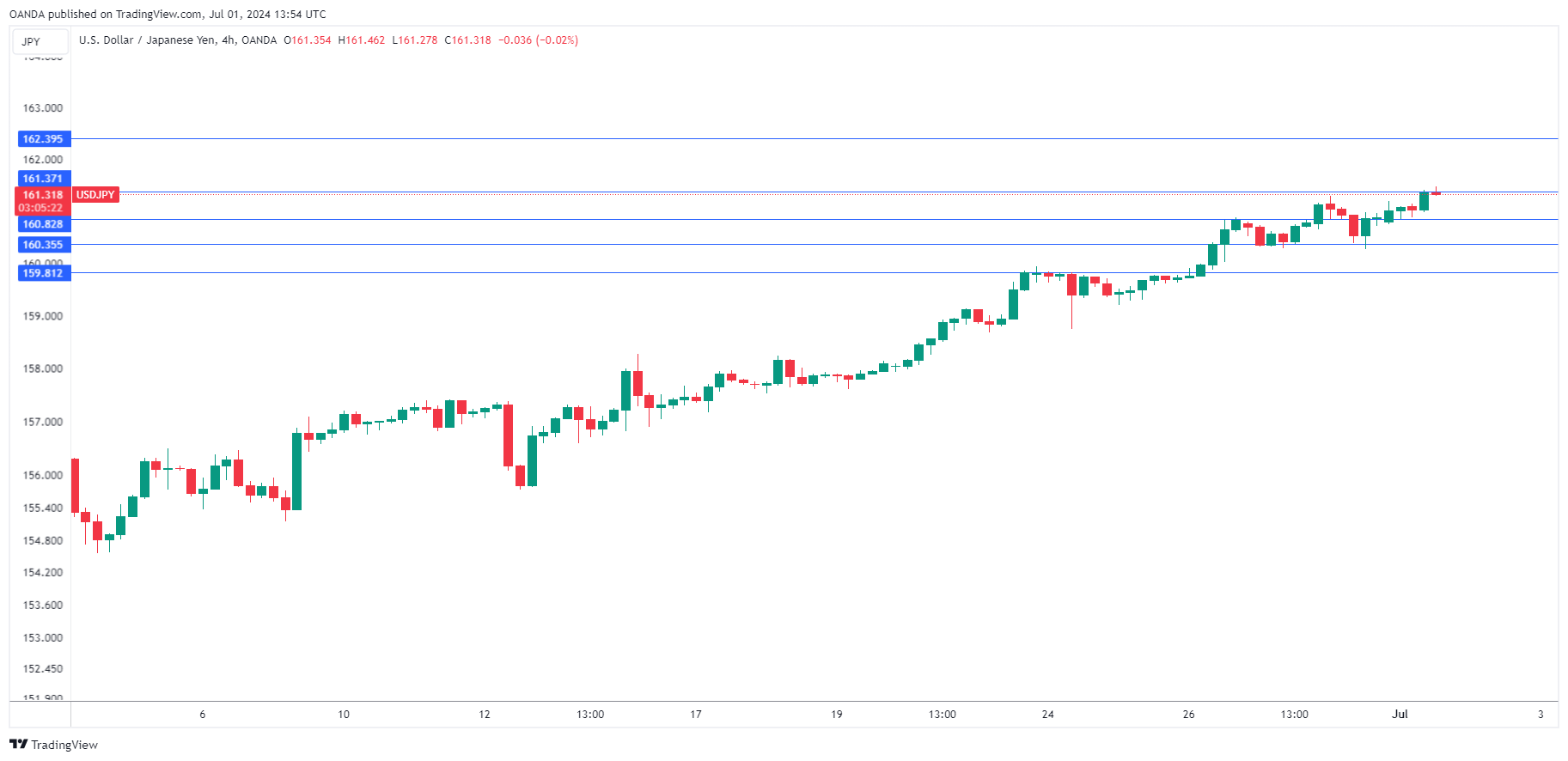
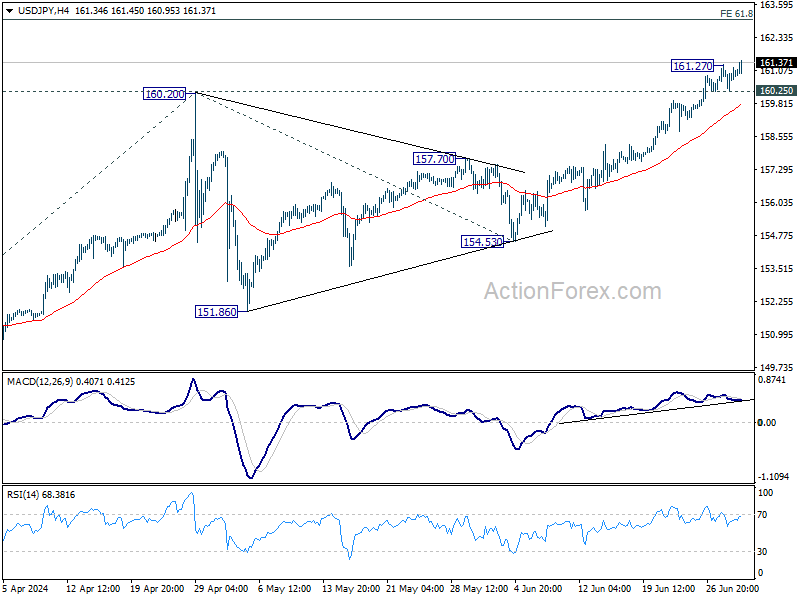
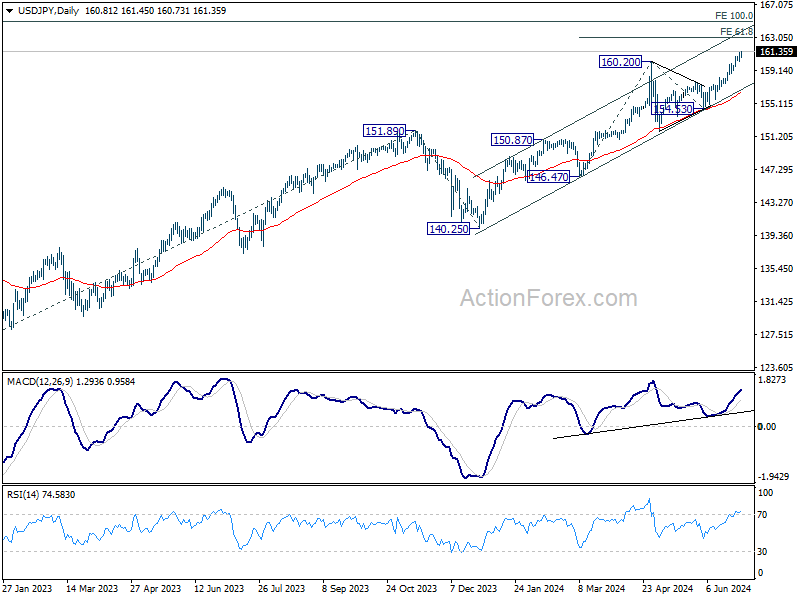
Intraday bias in USD/JPY stays neutral and outlook is unchanged. Price actions from 160.20 are seen as a corrective pattern. On the upside, break of 156.78 will resume the rise from 151.86, as the second leg, to 100% projection of 151.86 to 156.78 from 153.59 at 158.51. On the downside, below 153.59 will target 151.86 and below as the third leg.
In the bigger picture, a medium term top might be formed at 160.20. But as long as 150.87 resistance turned support holds, fall from there is seen as correcting rise from 150.25 only. However, decisive break of 150.87 will argue that larger correction is possibly underway, and target 146.47 support next.
USD/CAD Daily Outlook
Daily Pivots: (S1) 1.3602; (P) 1.3618; (R1) 1.3641; More...
USD/CAD is staying in consolidation above 1.3589 and intraday bias stays neutral. On the downside, break of 1.3589 will resume whole fall from 1.3845 and target 100% projection of 1.3845 to 1.3608 from 1.3761 at 1.3524. Also, sustained trading below 55 D EMA (now at 1.3628) will argue that whole rise from 1.3176 has completed already, and turn outlook bearish. On the other hand, strong bounce from current level, followed by break of 1.3689, will retain near term bullishness, and turn bias back to the upside.
In the bigger picture, price actions from 1.3976 (2022 high) are viewed as a corrective pattern. In case of another fall, strong support should emerge above 1.2947 resistance turned support to bring rebound. Firm break of 1.3976 will confirm up resumption of whole up trend from 1.2005 (2021 low). Next target is 61.8% projection of 1.2401 to 1.3976 from 1.3176 at 1.4149.
Elliott Wave Analysis Expects Dow Futures (YM) to Pullback in Wave 4
Short Term Elliott Wave in Dow Futures (YM) suggests rally from 4.19.2024 low is unfolding as a 5 waves impulse Elliott Wave structure. Up from 4.19.2024 low, wave ((i)) ended at 38801 and pullback in wave ((ii)) ended at 37866. Index extends higher again in wave ((iii)) with internal subdivision as an impulse in lesser degree. The 1 hour chart below shows the subdivision of wave ((iii)).
Up from wave ((ii)), wave i ended at 38527 and dips in wave ii ended at 38037. Index then extended higher in wave iii towards 39127 and pullback in wave iv ended at 38936. Final leg wave v ended at 39781 which completed wave (i). Index then pullback in wave (ii) towards 39405 and extended higher in wave (iii) towards 40191. Wave (iv) pullback ended at 39955. Final leg wave (v) ended at 40213 which completed wave ((iii)) in higher degree. Expect wave ((iv)) pullback to unfold in 3 swing before Index resumes higher in wave ((v)). Near term, as far as pivot at 37847 low stays intact, expect dips to find support in 3, 7, 11 swing for further upside.
YM_F 60 Minutes Elliott Wave Chart
Dow Futures (YM) Elliott Wave Video
https://www.youtube.com/watch?v=rFY1PKT8dkY
AUD/USD Daily Report
Daily Pivots: (S1) 0.6650; (P) 0.6679; (R1) 0.6697; More...
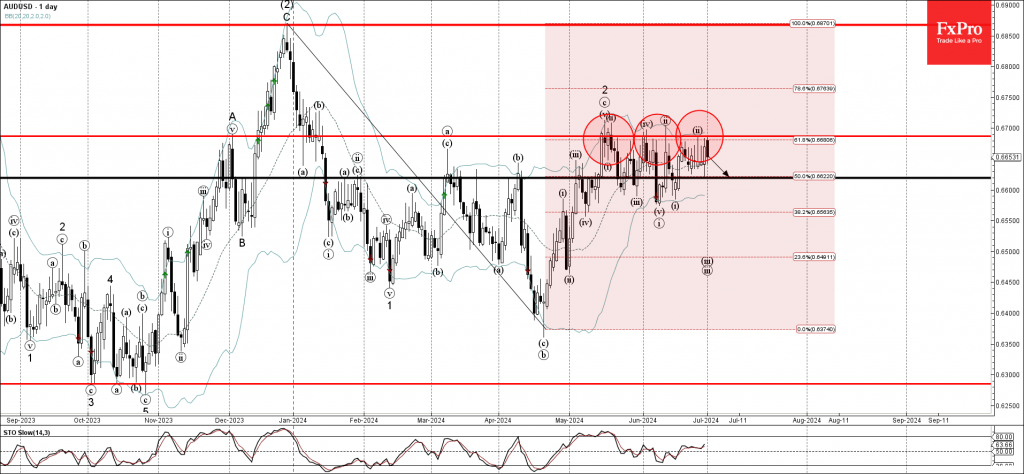
AUD/USD dips mildly today as consolidation from 0.6713 continues. Intraday bias stays neutral for the moment. Further rally is expected as long as 0.6578 support holds. As noted before, fall from 0.6870 has probably completed with three waves down to 0.6361 already. Above 0.6713 will target 0.6870 resistance next.
In the bigger picture, price actions from 0.6169 (2022 low) are seen as a medium term corrective pattern to the down trend from 0.8006 (2021 high). Fall from 0.7156 (2023 high) is seen as the second leg, which could have completed at 0.6269 already. Rise from there is seen as the third leg which is now trying to resume through 0.6870 resistance.
Aussie and Yen Decline, Loonie Awaits Crucial CPI Data
Australian Dollar weakened broadly during Asian session as its recent rally lost momentum. Despite RBA minutes revealing that a rate hike was considered earlier this month, which should have been supportive for the Aussie, this positive sentiment was countered by weak consumer sentiment readings. Additionally, Aussie seemed to be weighed down by a pullback in regional stock markets, particularly with the retreat in Hong Kong's HSI.
Meanwhile, Japanese Yen continued its broad-based decline, albeit at a slow pace. Japanese Finance Minister Shunichi Suzuki reiterated that foreign exchange rates should be determined by market fundamentals and move in stable manner. He also explained the government's aim to achieve wage growth that outpaces inflation, a challenging goal if prices keep rising strongly. This highlights Japan's cautious stance against a steep depreciation of Yen, which would increase import prices and inflation pressures.
In contrast, British Pound and Euro are currently the strongest performers of the day, followed by a recovering Dollar. New Zealand Dollar and Canadian Dollar are among the weakest, trailing behind Aussie and Yen, while Swiss Franc is positioned in the middle.
The focus today is on Canadian Dollar with release of Canadian CPI data. This data will be crucial in determining the likelihood of a rate cut by BoC in June. From a technical perspective, USD/CAD is struggling around 55 D EMA for now. Strong boucne from current level, followed by break of 1.3689 resistance, will retain near term bullishness. Rise from 1.3176 could then be ready to resume through 1.3845. However, sustained break of 55 D EMA will argue that rise from 1.3761 has completed, and turn near term outlook bearish. The upcoming CPI data will likely provide the market with a clearer direction.
In Asia, at the time of writing, Nikkei is down -0.05%. Hong Kong HSI is down -2.05%. China Shanghai SSE is down -0.41%. Singapore Strait Times is down -0.35%. Japan 10-year JGB yield is up 0.0017 at 0.981. Overnight, DOW fell -0.49%. S&P 500 rose 0.09%. NASDAQ rose 0.65%. 10-year yield rose 0.017 to 4.437.
Fed officials express caution on inflation, uncertainty over rate cuts
Fed Governor Philip Jefferson issued a cautious message in a speech last night, stating that while April's inflation data was "encouraging," it remains "too early to tell" if the recent slowdown in disinflation will be "long lasting." He described current monetary policy as restrictive and declined to predict whether rate cuts will happen this year. He emphasized the importance of continuing to closely monitor incoming economic data, the outlook, and the balance of risks.
Separately, Cleveland Fed President Loretta Mester told Bloomberg Television that she is reconsidering her earlier forecast of three interest rate cuts this year. Although not her "base case," Mester noted that if progress on reducing inflation stalls or reverses, Fed is "well positioned" to increase rates if necessary.
San Francisco Fed President Mary Daly also shared her views, expressing doubt about achieving the 2% inflation target in the near term. Daly highlighted that while there are expectations for improvement in shelter inflation, the progress is not expected to be rapid.
RBA minutes highlight debate over rate hike
RBA minutes from May 7 meeting reveal that a rate hike was considered but ultimately, the decision was made to hold cash rate target steady at 4.35%. The board emphasized that recent data indicated that "risks around inflation had risen somewhat," acknowledging the considerable uncertainty and the difficulty in "ruling in or ruling out" future changes in interest rate.
The minutes detailed that raising the cash rate could be appropriate if the board believed that the staff forecasts were "overly optimistic" about the forces driving down inflation, leaving the balance of risks tilted to the upside. Additionally, a higher cash rate might be necessary even with ongoing weakness in aggregate demand if "other factors slowed the pace of disinflation."
Conversely, the decision to hold the cash rate steady was based on the view that, although there had been significant updates on the economy since the last meeting, these updates were "not sufficient to warrant a change in the stance of monetary policy." Inflation was still declining towards the target, and the new information "did not materially alter its trajectory."
Australian Westpac consumer sentiment falls -0.3% mom amid budget disappointment
Australia Westpac Consumer Sentiment index fell by -0.3% mom to 82.2 in May. Westpac highlighted that the primary takeaways from the May survey are "no let-up in the weak consumer environment" and the cautious mindset of consumers. Consumers are more inclined to use funds from fiscal measures to repair their finances rather than go on spending sprees, which aligns with RBA's efforts to bring inflation back to target.
The May survey, conducted during budget week, provided a clear comparison of sentiment before and after the budget announcement. Sentiment among those surveyed before the budget was relatively optimistic, with an index reading of 86.8, marking a 5.3% increase from April. However, sentiment plummeted to 76.6 after the budget announcement, reflecting a 7% decline from April. This -11.8% drop in sentiment post-budget contrasts with a -7.4% decline observed last year.
Looking ahead
German PPI, Eurozone current account and trade balance, will be released in European session. Later in the day, Canadian CPI will take center stage.
AUD/USD Daily Report
Daily Pivots: (S1) 0.6650; (P) 0.6679; (R1) 0.6697; More...
AUD/USD dips mildly today as consolidation from 0.6713 continues. Intraday bias stays neutral for the moment. Further rally is expected as long as 0.6578 support holds. As noted before, fall from 0.6870 has probably completed with three waves down to 0.6361 already. Above 0.6713 will target 0.6870 resistance next.
In the bigger picture, price actions from 0.6169 (2022 low) are seen as a medium term corrective pattern to the down trend from 0.8006 (2021 high). Fall from 0.7156 (2023 high) is seen as the second leg, which could have completed at 0.6269 already. Rise from there is seen as the third leg which is now trying to resume through 0.6870 resistance.
Economic Indicators Update
| GMT | Ccy | Events | Actual | Forecast | Previous | Revised |
|---|---|---|---|---|---|---|
| 00:30 | AUD | Westpac Consumer Confidence May | -0.30% | -2.40% | ||
| 01:30 | AUD | RBA Minutes | ||||
| 06:00 | EUR | Germany PPI M/M Apr | 0.10% | 0.20% | ||
| 06:00 | EUR | Germany PPI Y/Y Apr | -3.20% | -2.90% | ||
| 08:00 | EUR | Eurozone Current Account (EUR) Mar | 30.2B | 29.5B | ||
| 09:00 | EUR | Eurozone Trade Balance (EUR) Mar | 19.9B | 17.9B | ||
| 12:30 | CAD | CPI M/M Apr | 0.50% | 0.60% | ||
| 12:30 | CAD | CPI Y/Y Apr | 2.80% | 2.90% | ||
| 12:30 | CAD | CPI Median Y/Y Apr | 2.70% | 2.80% | ||
| 12:30 | CAD | CPI Trimmed Y/Y Apr | 2.90% | 3.10% | ||
| 12:30 | CAD | CPI Common Y/Y Apr | 2.80% | 2.90% |
RBA minutes highlight debate over rate hike
RBA minutes from May 7 meeting reveal that a rate hike was considered but ultimately, the decision was made to hold cash rate target steady at 4.35%. The board emphasized that recent data indicated that "risks around inflation had risen somewhat," acknowledging the considerable uncertainty and the difficulty in "ruling in or ruling out" future changes in interest rate.
The minutes detailed that raising the cash rate could be appropriate if the board believed that the staff forecasts were "overly optimistic" about the forces driving down inflation, leaving the balance of risks tilted to the upside. Additionally, a higher cash rate might be necessary even with ongoing weakness in aggregate demand if "other factors slowed the pace of disinflation."
Conversely, the decision to hold the cash rate steady was based on the view that, although there had been significant updates on the economy since the last meeting, these updates were "not sufficient to warrant a change in the stance of monetary policy." Inflation was still declining towards the target, and the new information "did not materially alter its trajectory."
(RBA) Minutes of the Monetary Policy Meeting of the Reserve Bank Board
Sydney – 6 and 7 May 2024
Members present
Michele Bullock (Governor and Chair), Andrew Hauser (Deputy Governor), Ian Harper AO, Carolyn Hewson AO, Steven Kennedy PSM, Iain Ross AO, Elana Rubin AM, Carol Schwartz AO, Alison Watkins AM
Others present
Sarah Hunter (Assistant Governor, Economic), Christopher Kent (Assistant Governor, Financial Markets)
Anthony Dickman (Secretary), David Norman (Deputy Secretary)
Meredith Beechey Osterholm (Future Hub), Sally Cray (Chief Communications Officer), Marion Kohler (Head, Economic Analysis Department), Carl Schwartz (Acting Head, Domestic Markets Department), Penelope Smith (Head, International Department)
International economic conditions
Members began their discussion of international economic conditions by noting that the risks to global growth had become more balanced over prior weeks. While national accounts measures of growth in most advanced economies had remained weak, some forward-looking indicators had been more positive. The United States was the exception, where growth had been robust and had moderated only a little in 2024 compared with the very strong rates of 2023. The US labour market had been surprisingly strong over preceding months and labour markets in most other advanced economies remained tight, despite further gradual easing.
Inflation in advanced economies remained above central banks' targets, despite substantial declines, and progress in lowering inflation appeared to have stalled, in some cases at least temporarily. Core services price inflation remained high and the latest US inflation data had surprised on the upside. Members discussed how more persistent services price inflation could delay the return of inflation to target, particularly in those countries where signs were emerging that disinflation in core goods prices may have run its course.
Economic growth had picked up in China early in the year and appeared to be on track to reach the growth target for 2024 of 'around 5 per cent'. Some of this strength was attributable to a rise in net exports. Members noted, however, that conditions in the property market remained very weak and that policy support would still be needed to offset the resulting drag on GDP growth. The prices of iron ore, coking coal and base metals had all risen since the previous meeting, due to some combination of a stronger economic outlook for China and constrained supply. The staff forecast for trade-weighted growth in Australia's major trading partners had been little changed since the February meeting; while near-term forecasts for output growth in the United States and China had been revised higher, forecasts for some other trading partners had been revised downwards.
Domestic economic conditions
Consumer spending had continued to be weaker than expected in the first quarter of 2024. By contrast, real household disposable income had started to stabilise at a somewhat higher level than had been anticipated. The developments indicated that households were maintaining a higher rate of saving than had been expected. Members noted that a small share of households were curtailing their spending in the face of income constraints, but many others were simply choosing to reduce their spending. They debated the relative importance of higher returns on savings and greater-than-usual uncertainty among households in driving this outcome, noting that this was a key judgement for the outlook for output and inflation.
Both business investment and public sector spending had been growing strongly. Private non-residential construction and investment in software and other forms of intangibles had been important contributors to overall growth in business investment. Members acknowledged that it was not possible to determine accurately the shares of such investment intended to enhance productivity (e.g. artificial intelligence), mitigate risks (e.g. cybersecurity) or meet compliance obligations, though the economic implications of each would be different.
Labour market conditions had eased by less than had been anticipated three months earlier. The unemployment rate was still only modestly above its late-2022 trough. The participation rate and employment-to-population ratio also remained near record high levels, though average hours worked and job vacancies had both declined further. Demand was strongest for skilled labour and in government-related sectors. Members debated why employment growth was proving so resilient, noting that this could reflect decisions to hoard labour, marginal workers being less productive, persistently strong population growth, the current composition of demand or a difference in the outlook for spending among consumers and businesses. Different weightings on these factors would imply different implications for the economic outlook.
Members discussed the degree of spare capacity in the economy, which was a key judgement required for the outlook. They noted the staff's assessment that the level of demand exceeded supply at the end of 2023, though the gap had narrowed relatively quickly owing to subdued growth; it was also noted that such measures are subject to material uncertainty. Conditions in the labour market appeared to be tighter than those consistent with full employment, drawing on historical comparisons for a range of labour market indicators, model-based estimates and information from business surveys. Members discussed the implications of developments in wages and productivity for their assessment of the level of full employment.
Inflation had eased further in the March quarter in year-ended terms, but the pace of disinflation had slowed and the recent inflation data were stronger than had been expected in February. Both domestic labour and non-labour cost pressures remained high. Goods price inflation had eased further over prior months, but the pass-through of the earlier easing in import price growth to domestic consumer prices now appeared to be largely complete. Services price inflation had peaked but remained high, particularly for services that are less discretionary. Growth in unit labour costs remained high but had moderated slightly, in line with the recent increase in labour productivity growth.
Financial conditions
Market participants' expectations for the path of central bank policy rates had risen noticeably since the March meeting. This had been particularly pronounced in the United States and Australia, where recent inflation data had been higher than expected. While market pricing still implied that policy rates had reached a peak in many advanced economies, the expected timing of future reductions in policy rates had been pushed out, to later in 2024 in most cases. As expected, the Bank of Japan had raised its policy rate shortly after the March meeting and had announced an end to its yield curve control and several of its asset-purchasing programs.
Sovereign bond yields in most advanced economies had increased since the previous meeting. This was consistent with changes in market expectations for policy rates and a modest increase in financial market measures of inflation expectations in some countries. The easing in some other measures of global financial conditions since late 2023 remained in place. In particular, a range of risk asset prices, including equity prices, were still high. Corporate bond yields had risen, but by less than government bond yields, and conditions in international wholesale funding markets remained favourable. Members observed that such pricing was indicative of investors expecting benign economic outcomes.
The Australian dollar had appreciated a little since the previous meeting. This was consistent with a modest widening of yield differentials between Australia and other advanced economies and a recovery in commodity prices. On a trade-weighted basis, the Australian dollar had been supported by the depreciation of the yen and the renminbi.
Members considered overall financial conditions in Australia to be restrictive, particularly for households. They noted that the cash rate was above most estimates derived from a range of models of the so-called 'neutral rate' – the level consistent with monetary policy being neither expansionary nor contractionary. However, members acknowledged the considerable uncertainty around estimates of the neutral rate, which make it difficult to draw strong conclusions about the scale of this effect. They considered various developments that may have raised the neutral rate in recent years, while also noting that most of the structural factors that were linked to lowering the neutral rate over the preceding decade had not changed. Members also observed that several household financial indicators were consistent with financial conditions being significantly tighter than the average of the preceding 15 years, while the results of a comparison of business financial indicators were mixed.
Household debt payments had continued to rise as a share of household income. Scheduled mortgage payments had increased further as fixed-rate loans continued to roll onto higher rates. Nonetheless, extra payments by mortgage holders had also increased as a share of disposable income, to be slightly above the pre-pandemic average. This was consistent with households saving more, potentially in response to higher interest rates, thereby contributing to the weakness in consumption growth.
Market pricing implied that the cash rate was not expected to be reduced over the year ahead. Indeed, market pricing pointed to around a 40 per cent chance of one further rate increase in 2024, with reductions in the cash rate seen as likely in 2025. Relative to several other advanced economies, market participants expected fewer cuts in Australia, and for these cuts to begin later. Expectations for the level of the cash rate in Australia at the end of 2025, however, were comparable to those for other advanced economies. On average, market economists expected the RBA to begin cutting the cash rate one or two quarters earlier than implied by market pricing, although some market economists had also noted the possibility of an increase in the cash rate in coming months.
Economic outlook
Members noted that the staff forecasts were for a period of subdued demand growth during the remainder of 2024, bringing aggregate demand closer to balance with the economy's supply potential. The output gap was projected to close more slowly than it had in 2023. A key assumption in the forecasts was that the household savings rate would continue to rise in 2024 and consumption growth would recover more slowly than previously forecast. Members discussed the potential for both weaker outcomes (if the labour market weakened more than expected) or stronger outcomes (if households spent more of the unanticipated additional savings that had built up during the pandemic period).
Members noted that the labour market was projected to continue easing, though the easing was now expected to take longer than previously thought. Unemployment was expected to be around the level consistent with the Board's full employment mandate by mid-2025.
As in the February forecasts, inflation was expected to reach the target range of 2–3 per cent in the second half of 2025 and the midpoint in 2026, though this was predicated on a noticeably higher technical assumption for the cash rate than three months earlier. The near-term profile for CPI inflation was somewhat higher than in the February forecast because of the March quarter outcome, a more gradual projected easing in labour market capacity and higher petrol prices. Members observed that the forecasts did not incorporate any measures that may be announced in the forthcoming federal and state budgets for 2024/25.
Noting the staff's assessment that the risks to the domestic outlook were broadly balanced around the central forecasts, members considered scenarios that illustrated the implications of uncertainty around the level of full employment. These showed that inflation may not return to the target range over the forecast period if the labour market were to be tighter than assumed in the projections; on the other hand, there would be excess unemployment over this period and a faster decline in inflation if the labour market were to have more capacity than assumed. These scenarios illustrated that, while the risks may be balanced, the costs associated with them could be asymmetric because inflation was already projected to be above target for several years in the central forecast. Members observed that the implications for inflation would be qualitatively similar if trend productivity deviated from the assumption underlying the forecasts, and that these scenarios highlighted the importance of monitoring early warning indicators for economic activity, the labour market and inflation.
Considerations for monetary policy
Turning to considerations for the policy decision, members noted that most of the data received since the previous meeting had been stronger than expected. Taken together, these data suggested that there may be somewhat less slack in the economy than previously assessed. Inflation in Australia had declined more slowly than anticipated. Conditions in the labour market had eased by less than expected over prior months and were tighter than those consistent with full employment. Internationally, the data for both economic growth and inflation had also tended to exceed expectations, and the near-term outlook for output growth in some major economies had improved. The key exception to this trend of stronger-than-expected data related to consumer spending in Australia, where the data had signalled ongoing weakness into 2024.
Financial conditions in Australia were judged to be restrictive. Expectations for the future path of policy rates had increased both domestically and in the United States, and financial conditions had tightened in response. Market pricing no longer implied a reduction in the cash rate in 2024, and the Australian dollar had appreciated modestly, though remained within its recent range.
Members noted that the staff forecasts still had inflation returning to target within the same timeframe as expected in February, but that this was predicated on a technical assumption for the cash rate that was noticeably higher than previously assumed. The forecasts were for output growth to remain subdued in 2024, bringing aggregate demand and supply into closer balance. Labour market conditions were forecast to moderate gradually, and the unemployment rate was expected to be consistent with full employment by mid-2025.
Members discussed the key judgements in the staff forecasts. These were: consumption growth would remain weak for most of 2024, despite the stronger outlook for growth in income and wealth, which have been the key determinants of consumption in the past; there was now somewhat less spare capacity in the labour market than previously assumed, given the unexpectedly gradual easing of conditions; and inflation would continue to moderate, despite recent information signalling more persistence than previously assessed. If these judgements prove wrong, the forecasts for inflation and the labour market would need to be materially altered.
Members reviewed the strategy adopted by the Board over the preceding two years. This involved setting monetary policy to return inflation to target within a reasonable timeframe while supporting a gradual adjustment of labour market conditions to full employment. The strategy balanced the risk of inflation expectations drifting higher against the risk of inducing a pronounced rise in unemployment. Members recognised that there were significant costs associated with both risks and agreed that the strategy of seeking to balance the two remained appropriate. However, they expressed limited tolerance for inflation returning to target later than 2026.
Given these observations, members considered their decision on the cash rate.
Raising the cash rate at this meeting could be appropriate if the Board formed a view that the judgements underpinning the staff forecasts risked being overly optimistic about the forces that would drive down inflation, leaving the balance of risks tilted to the upside. The flow of data since the previous meeting had mostly been stronger than expected. The forecasts had also placed significant weight on the downside risks to consumption. Against that view, it was possible that consumer spending could pick up somewhat more rapidly if labour market outcomes remained benign, real household disposable income were to recover and balance sheets remained relatively strong for most households. If accompanied by further growth in public demand and business investment, this could sustain aggregate demand above the economy's supply potential and delay the return of inflation to target.
A higher cash rate might also be required, even with ongoing weakness in aggregate demand, if other factors slowed the pace of disinflation. Members observed that this could occur if trend productivity growth turned out to be weaker than assumed, unless wages growth were to moderate in response. A drift higher in inflation expectations, should it occur, would also make it more costly to return inflation to target.
By contrast, the case to hold the cash rate steady at this meeting was premised on the view that, while there had been notable updates on the state of the economy since the previous meeting, the updates had not been sufficient to warrant a change in the stance of monetary policy. Inflation was still declining towards the target and the recent information did not materially alter its trajectory. Furthermore, the forecasts showed a credible path by which the Board could meet its objectives in a timeframe that was consistent with the Board's strategy. These forecasts were underpinned by key judgements that were considered sound and resulted in a balanced set of risks around the central forecasts.
Holding the cash rate steady could also be an appropriate way to mitigate the risk that future demand growth turned out to be slower than envisaged in the forecasts, bringing inflation back to target more quickly than assumed and pushing unemployment well above the level consistent with full employment. That could come about, for example, if consumer spending remained subdued for a more prolonged period as the labour market softened, in turn dampening business investment and hiring. In that scenario, the current path of the cash rate implied by financial markets could turn out to be too high. Similarly, members observed that there is uncertainty about the rate of unemployment that is consistent with full employment. Holding the cash rate steady could be an appropriate way to mitigate the risk that the labour market is already close to full employment, which would bring inflation back to target somewhat sooner than envisaged.
In weighing up these options, members judged that the case to leave the cash rate unchanged at this meeting was the stronger one. They agreed that the flow of information since the previous meeting had increased the risks of inflation staying above target for longer. However, members considered that the staff forecasts presented a credible path back to the inflation target, with the risks surrounding the forecasts judged to be balanced. Importantly, inflation expectations remained well anchored. Given this, and the higher-than-usual level of uncertainty about the economic outlook, members judged that it remained reasonable to look through short-term variation in inflation to avoid excessive fine-tuning.
In finalising the Board's statement, members agreed that it was important to convey that recent data and other information had signalled that the risks around inflation had risen somewhat. They also agreed that returning inflation to target remained the Board's highest priority. This process was unlikely to be smooth and members recognised the considerable uncertainty about the outlook for both inflation and the labour market. Given this, members agreed that it was difficult either to rule in or rule out future changes in the cash rate target. They reiterated their resolve to do what is necessary to return inflation to target, and to continue paying close attention to developments in the global economy, trends in domestic demand, and the outlook for inflation and the labour market.
The decision
The Board decided to leave the cash rate target unchanged at 4.35 per cent, and the interest rate on Exchange Settlement balances unchanged at 4.25 per cent.
Australian Westpac consumer sentiment falls -0.3% mom amid budget disappointment
Australia Westpac Consumer Sentiment index fell by -0.3% mom to 82.2 in May. Westpac highlighted that the primary takeaways from the May survey are "no let-up in the weak consumer environment" and the cautious mindset of consumers. Consumers are more inclined to use funds from fiscal measures to repair their finances rather than go on spending sprees, which aligns with RBA's efforts to bring inflation back to target.
The May survey, conducted during budget week, provided a clear comparison of sentiment before and after the budget announcement. Sentiment among those surveyed before the budget was relatively optimistic, with an index reading of 86.8, marking a 5.3% increase from April. However, sentiment plummeted to 76.6 after the budget announcement, reflecting a 7% decline from April. This -11.8% drop in sentiment post-budget contrasts with a -7.4% decline observed last year.
Fed officials express caution on inflation, uncertainty over rate cuts
Fed Governor Philip Jefferson issued a cautious message in a speech last night, stating that while April's inflation data was "encouraging," it remains "too early to tell" if the recent slowdown in disinflation will be "long lasting." He described current monetary policy as restrictive and declined to predict whether rate cuts will happen this year. He emphasized the importance of continuing to closely monitor incoming economic data, the outlook, and the balance of risks.
Separately, Cleveland Fed President Loretta Mester told Bloomberg Television that she is reconsidering her earlier forecast of three interest rate cuts this year. Although not her "base case," Mester noted that if progress on reducing inflation stalls or reverses, Fed is "well positioned" to increase rates if necessary.
San Francisco Fed President Mary Daly also shared her views, expressing doubt about achieving the 2% inflation target in the near term. Daly highlighted that while there are expectations for improvement in shelter inflation, the progress is not expected to be rapid.
Bitcoin’s Resurgence: Price Climbs with Renewed Momentum
Key Highlights
- Bitcoin price climbed higher steadily higher above the $67,500 and $70,000 resistance levels.
- BTC is trading well above a key bullish trend line with support near $63,850 on the 4-hour chart.
- Crude oil prices found support near $76.80 and started a recovery wave.
- Gold surged toward the $2,450 level before a minor pullback.
Bitcoin Price Technical Analysis
Bitcoin price formed a base and started a fresh increase above $63,500. BTC/USD climbed higher above the $66,500 and $68,500 resistance levels to move into a positive zone.
Looking at the 4-hour chart, the price settled well above the 100 simple moving average (red, 4 hours) and the 200 simple moving average (green, 4 hours). The price also surpassed $70,000 and traded as high as $72,084.
The price is now consolidating gains and trading well above the 23.6% Fib retracement of the upward move from the $60,146 swing low to the $72,084 high.
Bitcoin is also trading well above a key bullish trend line with support near $63,850 on the 4-hour chart. The trend line is close to the 61.8% Fib retracement of the upward move from the $60,146 swing low to the $72,084 high.
The main support sits at $63,000 and the 200 simple moving average (green, 4 hours). Any more losses might send the price toward the $60,500 support zone.
Immediate resistance is near the $72,000 level. The first key resistance is near the $72,500 zone. The next resistance is near $73,800. A successful close above $73,800 might start another steady increase. In the stated case, the price may perhaps rise toward the $75,000 level.
Today’s Economic Releases
- Canadian Consumer Price Index for April 2024 (MoM) – Forecast +0.5%, versus +0.6% previous.
- Canadian Consumer Price Index for April 2024 (YoY) – Forecast +2.7%, versus +2.9% previous.