

Sample Category Title
EUR/AUD Daily Outlook
Daily Pivots: (S1) 1.6006; (P) 1.6077; (R1) 1.6132; More...
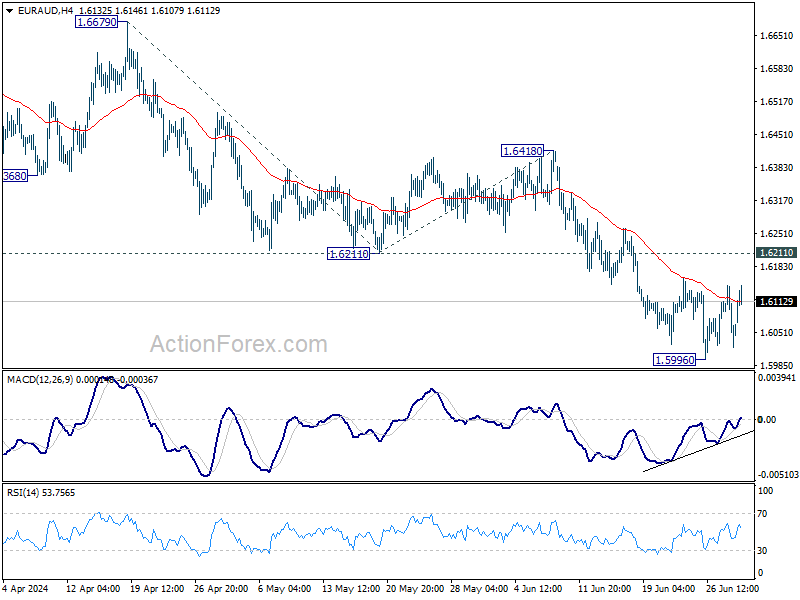
Intraday bias in EUR/AUD remains neutral for the moment and some more consolidations could be seen above 1.5996. But outlook stays bearish as long as 1.6211 support turned resistance holds. On the downside, break of 1.5996 will target 100% projection of 1.6679 to 1.6211 from 1.6418 at 1.5950. Firm break there will target 1.5846 key support next.
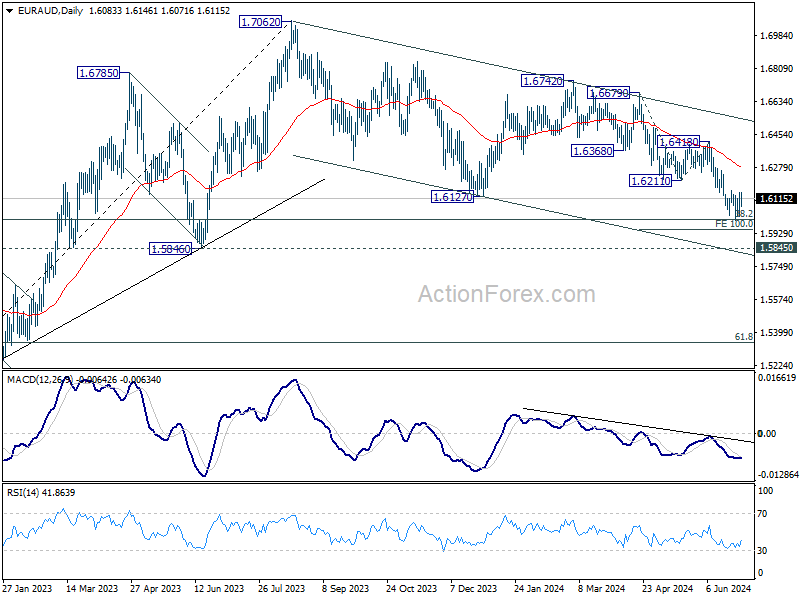
In the bigger picture, fall from 1.7062 medium term top is seen as a correction to the up trend from 1.4281 (2022 low) only. Strong support is still expected between 1.5846 and 38.2% retracement of 1.4281 to 1.7062 at 1.6000 to bring rebound. Break of 1.6148 resistance will argue that the correction has completed.
EUR/JPY Daily Outlook
Daily Pivots: (S1) 171.74; (P) 172.10; (R1) 172.73; More...
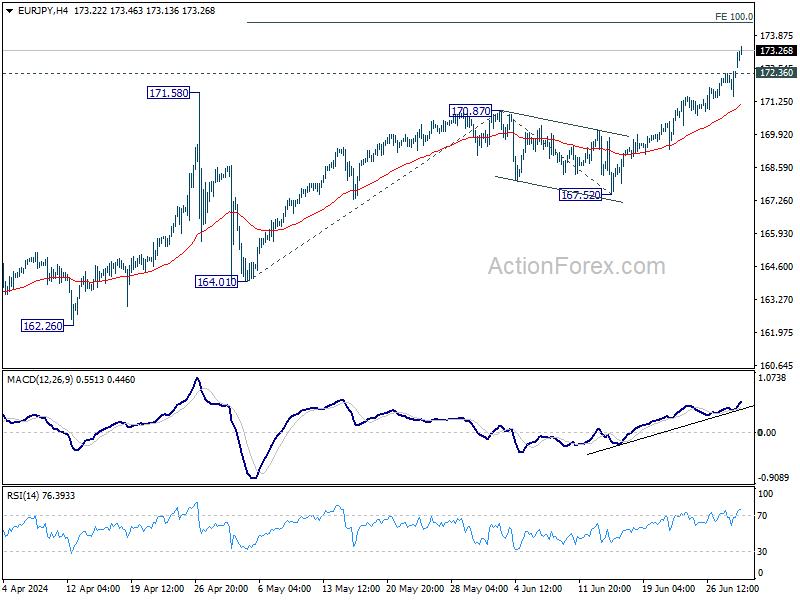
EUR/JPY's rally continues today and intraday bias stays on the upside. Next target is 100% projection of 164.01 to 170.87 from 167.52 at 174.38. On the downside, below 171.36 minor support will turn intraday bias neutral and bring consolidations first. But outlook will remain bullish as long as 170.87 resistance turned support holds.
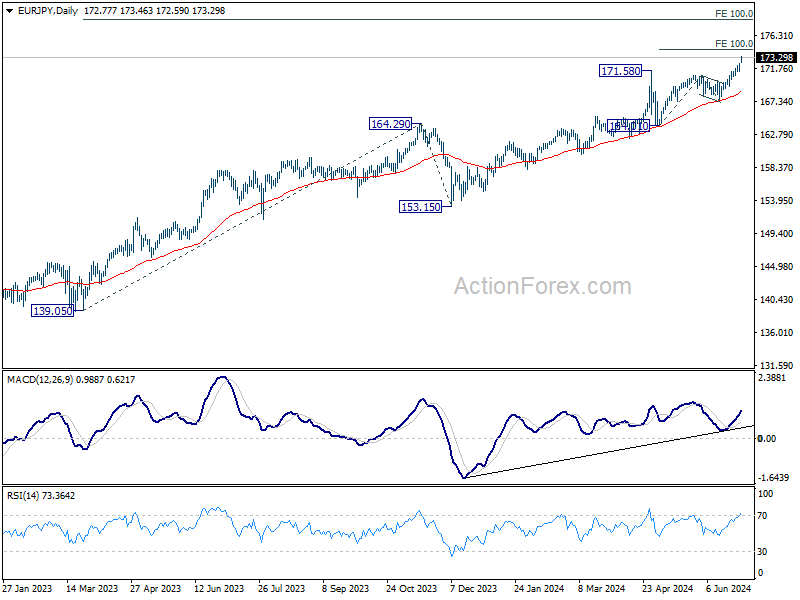
In the bigger picture, long term up trend is still in progress. Next target is 100% projection of 139.05 to 164.29 from 153.15 at 178.38. For now outlook will stay bullish as long as 167.52 support holds, even in case of deep pullback.
GBP/JPY Daily Outlook
Daily Pivots: (S1) 202.84; (P) 203.22; (R1) 203.86; More...
GBP/JPY's rally continues today and intraday bias stays on the upside. Next target is 100% projection of 191.34 to 200.72 from 197.18 at 206.56 next. On the downside, below 202.55 minor support will turn intraday bias neutral and bring consolidations. But outlook will remain bullish as long as 200.72 resistance turned support holds, in case of retreat.
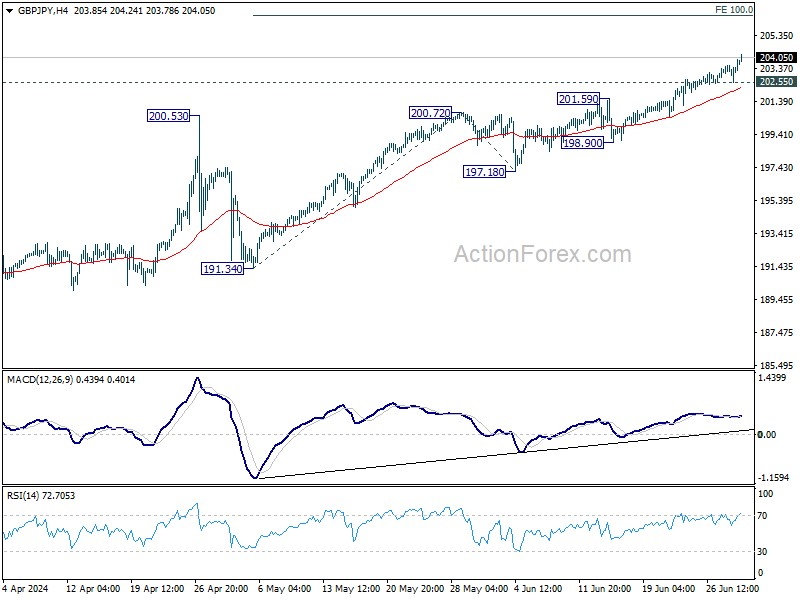
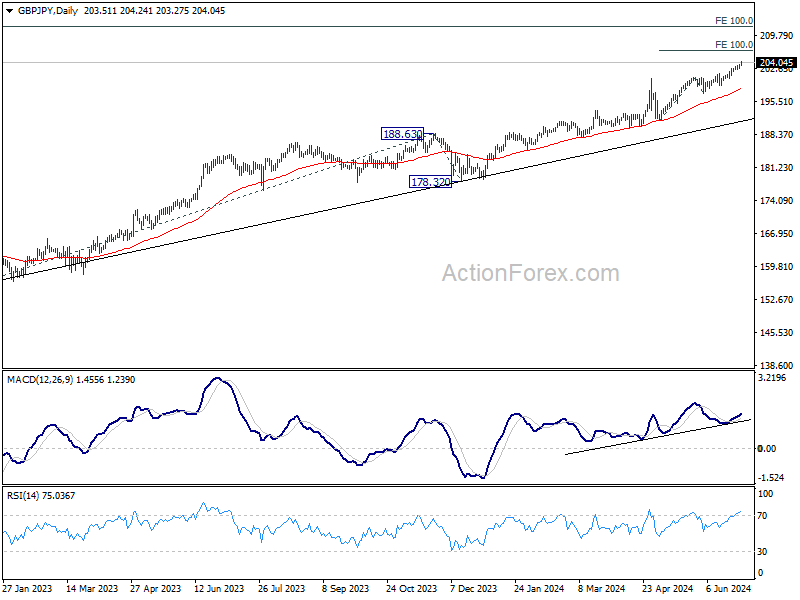
In the bigger picture, long term up trend is still in progress. Next target is 100% projection of 155.33 to 188.63 from 178.32 at 211.62. Outlook will stay bullish as long as 197.18 support holds, even in case of deep pullback.
EUR/USD Rises Towards 1.076
Markets
Core bonds sold off into the final trading hours last Friday. We didn’t spot an obvious reason underpinning the move. Economic data (US PCE deflators, national inflation figures of certain EU member states) printed bang in line with expectations. But a looming weekend full of event risk (first round of French parliamentary elections) coinciding with the end of the quarter resulted in overall jittery markets. US Treasuries by the end of the day underperformed Bunds. Yields erased previous losses of as much as 4.5 bps to close between 4.2 (2-yr) and 13.3 (30-yr) bps higher. German yields added 2.6 to 5.5 bps across the curve. Stocks struggled in Europe. The French CAC40 underperformed (-0.7%). Wall Street turned south immediately after opening higher. The dollar and the euro balanced each other out. EUR/USD finished slightly higher north of 1.07. USD/JPY rose towards a new 34-yr high (160.88).
Yesterday’s outcome of the first round in the French parliamentary elections turned out to be in line with the polls. Le Pen’s Rassemblement National (RN) secured the most votes (33.3%) with the left-wing NFP coming in second (28.3%). Macron’s Ensemble (ENS) was third (21.3%). Some 75 MPs were already elected in the first round. Because of the exceptionally high voter turnout (67.5%) there are currently around 300 constituencies (representing 52% of the 577 seats) that potentially face a three-way run-off in the second round Sunday, July 7. Comparing this just one in 2017 and 8 in 2022 underscores the still high level of uncertainty after the first round. This number will probably go down a bit still amid suggestions from leaders of NFP and ENS for third-placed candidates to tactically withdraw in specific situations. But the local candidates do not always heed these calls. We’ll know about the final list of candidates by Tuesday evening. Both of the above parties already gave voter recommendations as well but here too a lot depends on how the public responds to them. In any case, it’s too soon to draw firm conclusions. However, based on the exit polls and this morning’s constructive market reaction, the probability of a hung parliament (where none of the extremes can push through its agenda via an absolute majority) seems to have increased. EUR/USD rises towards 1.076, European stock futures point to an opening rally of almost 2% and Bund yields are set for gapping higher. The economic calendar today features German inflation numbers ahead of tomorrow’s EMU print. ECB president Lagarde kicks off its Sintra conference with an introductory speech tonight. We have circled Wednesday in red, with “Drivers of equilibrium interest rates” as one of the hot topics.
News & Views
The Bank of International Settlements (BIS) encourages central bankers in its annual report to finish the last mile in restoring price stability. They set a high bar for policy easing, warning that premature action could reignite inflationary pressures and force a costly policy reversal. Services prices and wage growth are other upside risks. Falling export prices and waning Chinese demand are disinflationary forces. At the same time, governments have to step up by consolidating public finances and prioritizing long overdue structural reforms. Unrestrained public finances threaten macroeconomic and financial stability and make it also harder to bring inflation down.
The Bank of Japan’s Q2 Tankan survey boost the case for more gradual policy normalization (small rate hike) at its July meeting. Sentiment at large manufacturers improved from 11 to 13 (vs 11 consensus) while it marginally weakened for large non-manufacturers (33 from 34 as expected). Optimists also continue outnumbering pessimists on the outlook for the next quarter. Large firms across all industries on average want to increase their capital expenditures by 11.1% in the current fiscal year, suggesting back-to-back double digit growth (10.6% in previous fiscal year). Businesses see CPI inflation at 2.2% in 5 years’ time, up from 2.1% in the Q1 survey. More firms increased prices from the previous quarter and even more indicated that they plan to do so in the next quarter (especially non-manufacturing).
Graphs
GE 10y yield
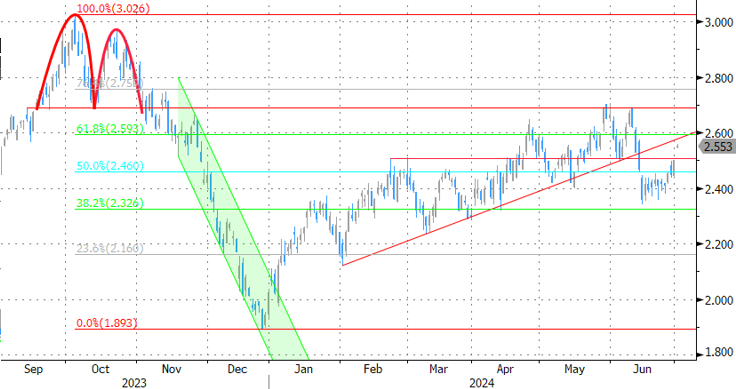
The ECB cut its key policy rates by 25 bps at the June policy meeting. A more bumpy inflation path in H2 2024, the EMU economy gradually regaining traction and the Fed’s higher for longer US strategy make follow-up moves difficult. Markets are coming to terms with that. Meanwhile, some of the save haven bids were reversed after the first round in the French elections. The 2.34%-2.4% support zone looks a solid one.
US 10y yield
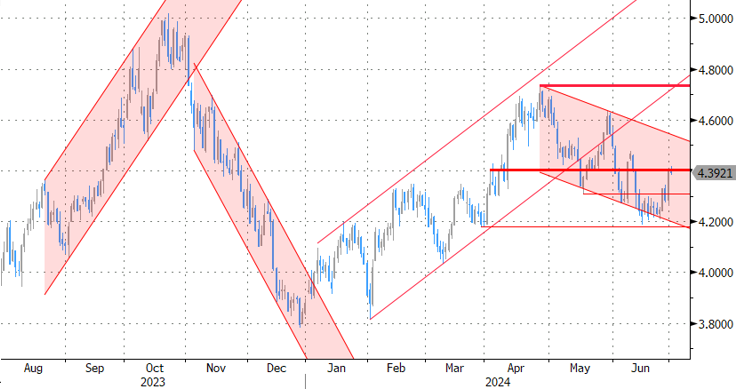
The Fed is seeking more evidence than just one slower-than-expected (May) CPI is providing. Upgraded inflation forecasts and a higher neutral rate complicate the exact timing of a first cut further. June dots suggest one move in 2024 followed by four more next year. Markets are positioned more aggressively, turning the recent low in yields into a technical support zone. A test of the downside of the 4.2/4.7% trading range was without consequences.
EUR/USD
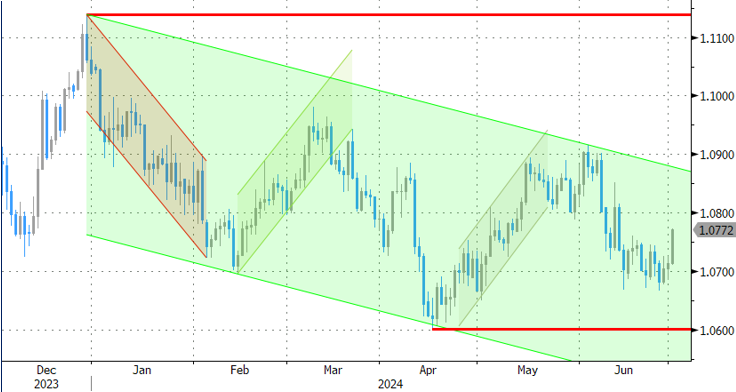
EUR/USD is stuck in the 1.06-1.09 range. The desynchronized rate cut cycle with the ECB exceptionally taking the lead, strong US May payrolls and a swing to the right in European elections pulled the pair away from 1.09. The Fed meeting balanced the weaker than expected US CPI outcome. The increased probability of a hung French parliament after the first round offered the euro some relief.
EUR/GBP
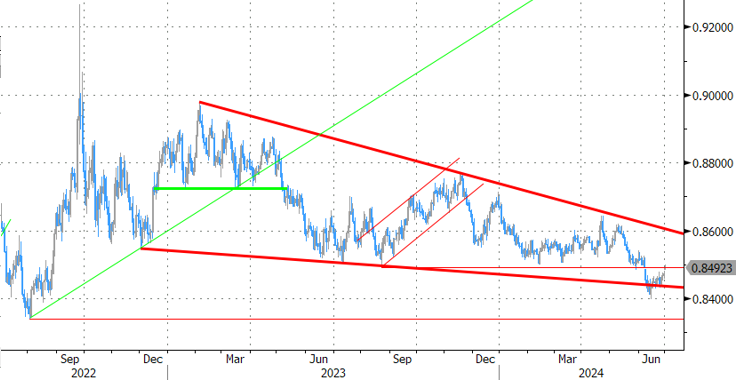
Debate at the BOE is focused at the timing of rate cuts. May headline inflation returned to 2%, but core measures weren’t in line with inflation sustainably returning to target any time soon. Still some BoE members at the June meeting appeared moving closer to a rate cut. This might cap further sterling gains. The euro’s vulnerability to political event risk going into the French elections eased for now. EUR/GBP 0.84 is becoming solid support.
USD/CAD Daily Outlook
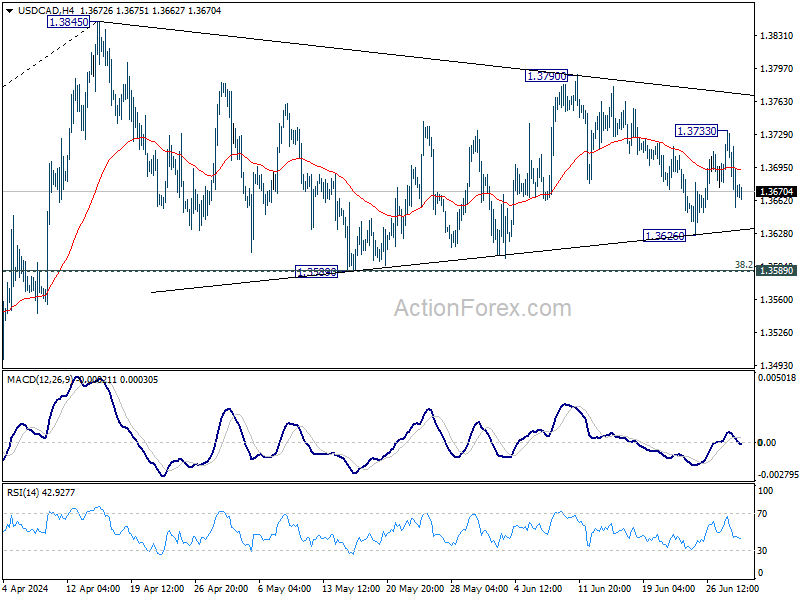
Daily Pivots: (S1) 1.3644; (P) 1.3690; (R1) 1.3724; More...
Intraday bias in USD/CAD remains neutral for the moment. Consolidation from 1.3845 could extend further. While deeper fall could be seen, downside should be contained by 1.3589 cluster support (38.2% retracement of 1.3176 to 1.3845 at 1.3589) to bring rebound. Break of 1.3790 resistance will argue that larger rise is ready to resume and target 1.3845 resistance.
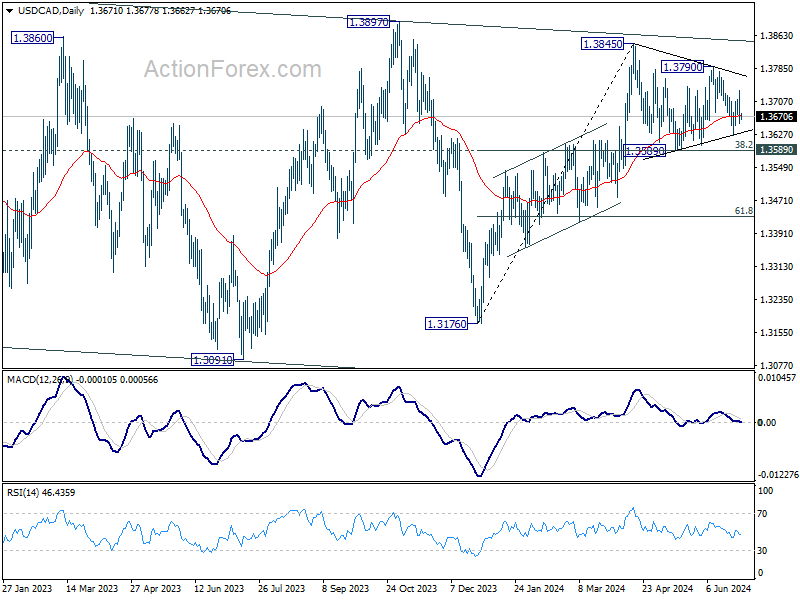
In the bigger picture, price actions from 1.3976 (2022 high) are viewed as a corrective pattern. In case of another fall, strong support should emerge above 1.2947 resistance turned support to bring rebound. Firm break of 1.3976 will confirm up resumption of whole up trend from 1.2005 (2021 low). Next target is 61.8% projection of 1.2401 to 1.3976 from 1.3176 at 1.4149.
AUD/USD Daily Report
Daily Pivots: (S1) 0.6632; (P) 0.6658; (R1) 0.6697; More...
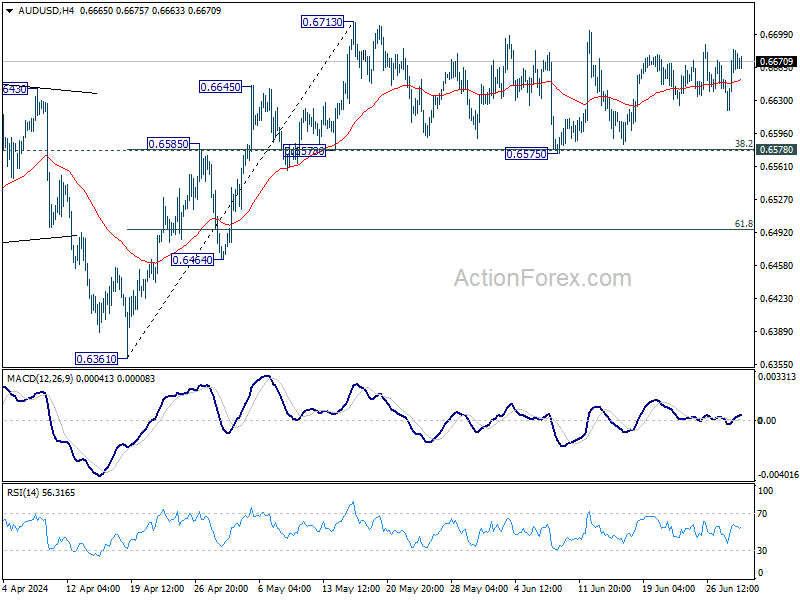
Intraday bias in AUD/USD remains neutral as consolidation from 0.6713 is still extending. Further rally is in favor with 0.6578 cluster support (38.2% retracement of 0.6361 to 0.6713 at 0.6579) intact. On the upside, firm break of 0.6713 will resume whole rise from 0.6361 to 0.6870 resistance next. However, sustained break of 0.6578 will dampen this bullish view, and bring deeper fall to 61.8% retracement at 0.6495.
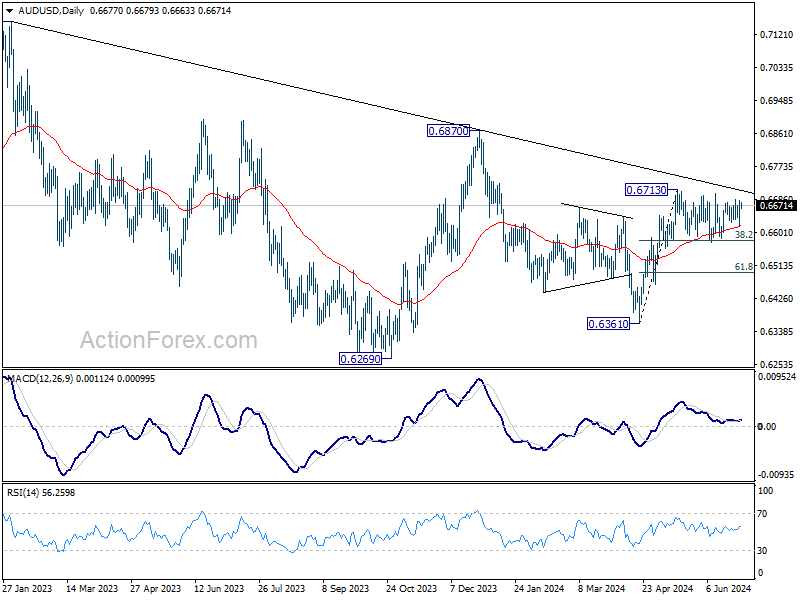
In the bigger picture, price actions from 0.6169 (2022 low) are seen as a medium term corrective pattern to the down trend from 0.8006 (2021 high). Fall from 0.7156 (2023 high) is seen as the second leg, which could have completed at 0.6269 already. Rise from there is seen as the third leg which is now trying to resume through 0.6870 resistance.
USD/JPY Daily Outlook
Daily Pivots: (S1) 160.36; (P) 160.82; (R1) 161.37; More...
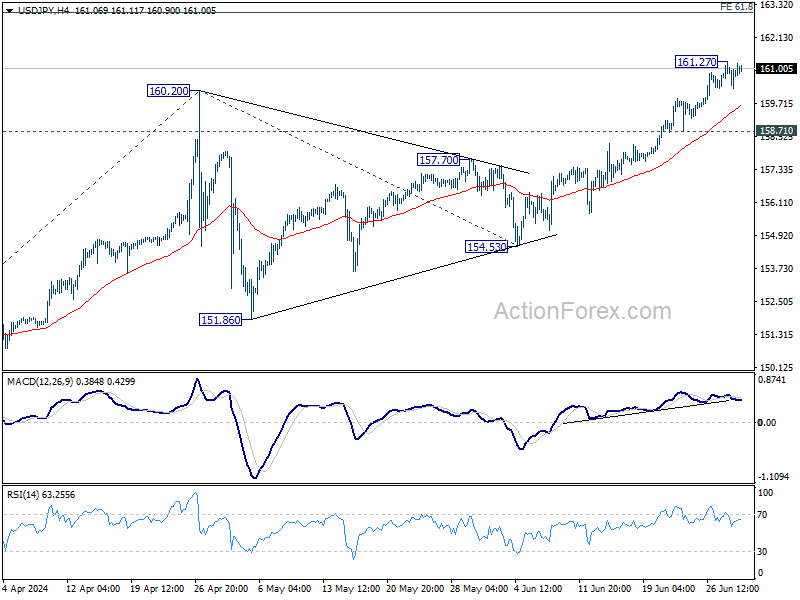
Intraday bias in USD/JPY remains neutral for consolidations below 161.27. Downside of retreat should be contained by 158.71 support to bring another rally. Break of 161.27 will target 61.8% projection of 146.47 to 160.20 from 154.53 at 163.01.
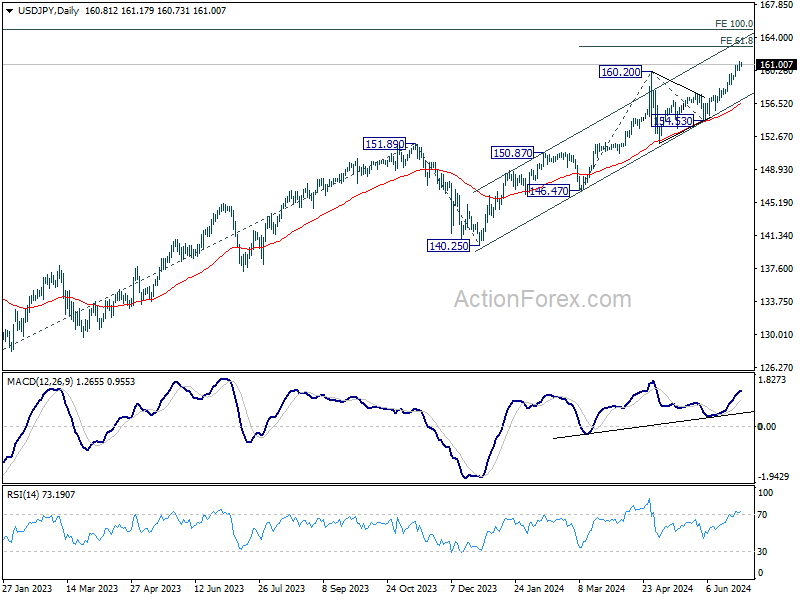
In the bigger picture, long term up trend is still in progress. Further rise is expected as long as 154.53 support holds. Next target is 100% projection of 127.20 (2023 low) to 151.89 (2023 high) from 140.25 at 164.94.
USD/CHF Daily Outlook
Daily Pivots: (S1) 0.8971; (P) 0.8990; (R1) 0.9007; More…
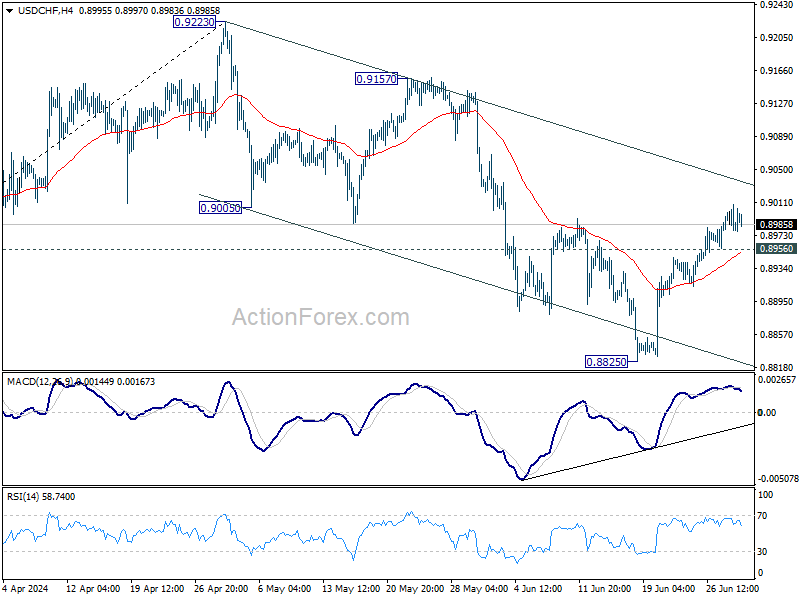
Intraday bias in USD/CHF stays mildly on the upside for channel resistance (now at 0.9034). Fall from 0.9223 might have completed as a three-wave corrective move to 0.8825. Firm break of channel resistance will target 0.9157 resistance next. On the downside, below 0.8956 minor support will turn intraday bias neutral gain first.
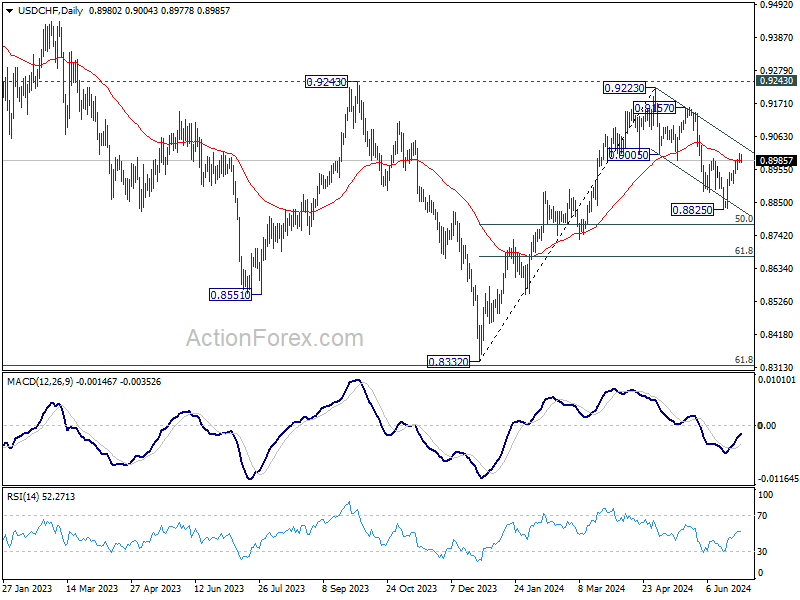
In the bigger picture, price actions from 0.8332 medium term bottom are seen as developing into a corrective pattern to the down trend from 1.0146 (2022 high). Rejection by 0.9243 resistance affirms this case, and maintains medium term bearishness. While more range trading could be seen between 0.8332/0.9243 first, downside breakout is mildly in favor at a later stage.
GBP/USD Daily Outlook
Daily Pivots: (S1) 1.2623; (P) 1.2642; (R1) 1.2665; More...
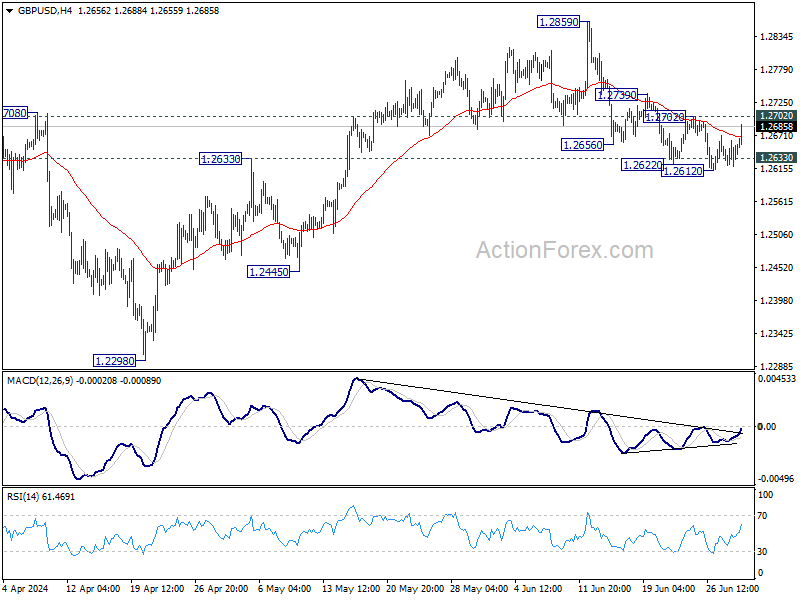
Intraday bias in GBP/USD stays neutral first. On the upside, firm break of 1.2702 resistance will argue that pull back from 1.2859 has completed, and bring retest of this high instead. Nevertheless, rejection by 1.2702 will keep risk on the downside. Sustained trading below 1.2633 resistance turned support will argue that whole rise from 1.2298 has completed, and target 1.2445 and below.
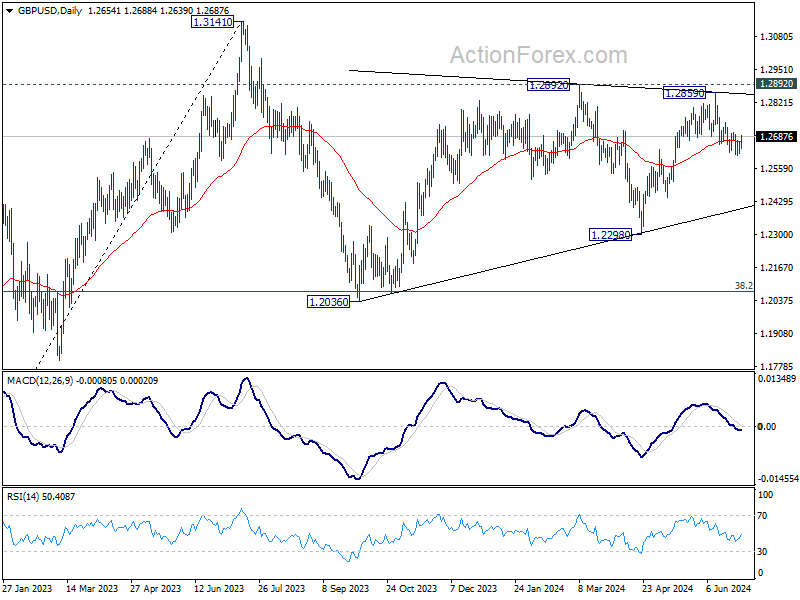
In the bigger picture, price actions from 1.3141 medium term top are seen as a corrective pattern that is still in progress. Break of 1.2445 support will confirm that another falling leg has started and target 1.2036 cluster support again (38.2% retracement of 1.0351 (2022 low) to 1.3141 at 1.2075. Nevertheless, break of 1.2892 resistance will argue that larger up trend from 1.0351is ready to resume through 1.3141.
Forex and Cryptocurrency Forecast
EUR/USD: Inflation in the US – Everything is Going According to Plan
Last week, specifically on Thursday, 27 June, the dollar received support from positive macroeconomic data from the US. The Department of Commerce reported that according to the final estimate, the US GDP grew by 1.4% in Q1, against the forecast of 1.3%. (According to the current Fed forecast, the country's real GDP will expand by 2.1% in 2024). Labour market statistics were also optimistic – the number of initial jobless claims in the US amounted to 233K, lower than both the forecast of 236K and the previous figure of 239K. Durable goods orders did not disappoint either, rising by 0.1% in May against the forecast of a decline of -0.1%. Against this backdrop, the DXY dollar index rose to 106.10, approaching April highs, and EUR/USD dropped to 1.0685.
However, the main events of the week were scheduled for Friday, 28 June, the last trading day of Q2. It is worth noting that the cash flows typical for the end of the quarter and the adjustment of trading positions at this time usually increase market volatility and can even cause chaotic movements in major currency pairs. Additionally, intrigue was added by the fact that on this day, the Bureau of Economic Analysis of the USA was to publish data on the Personal Consumption Expenditure (PCE) index for May. This indicator is the Fed's preferred inflation gauge and therefore influences decisions regarding interest rate changes.
According to preliminary estimates, the markets expected that the core index would decrease from 2.8% to 2.6% year-on-year and from 0.3% to 0.1% month-on-month. If this forecast were to come true, it would have strengthened expectations of an imminent easing of the American regulator's monetary policy. On the eve of the publication, market participants predicted that the first Fed rate cut would occur in September, with another one in November or December.
However, there was also an alternative scenario. On Wednesday, 26 June, Fed Board member Michelle Bowman stated that if the disinflation process in the US stalls, the regulator would have no choice but to resume tightening policy (QT).
The actual figures matched the forecasts exactly – core PCE decreased from 2.8% to 2.6% year-on-year and from 0.3% to 0.1% month-on-month. It is obvious that this result was already priced in, so it did not produce a "wow" effect on market participants, and after a brief dip, DXY returned to current levels.
The dollar was also supported by the President of the San Francisco Federal Reserve Bank, Mary Daly, who commented on the PCE data: "The Fed has not yet made a decision, but the PCE data is good news. [...] There is evidence that policy is sufficiently tight. [...] It takes more time for the policy to work. [...] If inflation remains stable or decreases slowly, rates will have to be raised longer."
As for the European Central Bank (ECB), unlike its overseas counterpart, it has already started the easing process (QE). At its meeting on 06 June, it already lowered the euro rate by 25 basis points (b.p.) to 4.25%. And as ECB representative Olli Rehn stated on 26 June, the market forecast for two more rate cuts in 2024 seems "reasonable". These words from Rehn signalled tolerance towards inflation spikes in the Eurozone, which is a negative factor for the common European currency.
The final point of the week, month, and quarter was set by the EUR/USD pair at 1.0713. The analyst forecast for the near future as of the evening of 28 June is as follows: 65% of expert votes were given for the pair's decline, 20% for its growth, and another 15% remained neutral. In technical analysis, 80% of trend indicators on D1 sided with the dollar and turned red, while 20% preferred the euro. Among oscillators, 75% were on the dollar's side, with the remaining 25% taking a neutral position. The nearest support for the pair is located in the zone of 1.0665-1.0670, followed by 1.0600-1.0615, 1.0565, 1.0495-1.0515, 1.0450, and 1.0370. Resistance zones are found around 1.0740-1.0760, then 1.0815, 1.0850, 1.0890-1.0915, 1.0945, 1.0980-1.1010, 1.1050, and 1.1100-1.1140.
The upcoming week will be rich in macroeconomic statistics. On Monday, 01 July and Tuesday, 02 July, preliminary data on such an important indicator as the consumer price index (CPI) in Germany and the Eurozone will be released, respectively. Speeches by ECB President Christine Lagarde and Fed Chair Jerome Powell are also scheduled for 01 and 02 July. In addition, on Monday and Wednesday, business activity indicators (PMI) in various sectors of the US economy will be known. But this is not the end of the flow of important information. Late in the evening of 03 July, the minutes of the last FOMC (Federal Open Market Committee) meeting of the Fed will be published. On Wednesday, 03 July, and Friday, 05 July, we will be flooded with statistics from the US labour market, including the unemployment rate and the number of new jobs created outside the agricultural sector (NFP). Traders should also keep in mind that 03 July is a short day in the US, and 04 July is a full holiday as the country celebrates Independence Day. And looking a bit further ahead, we remind you that early parliamentary elections will be held in France on Sunday, 07 July, the result of which could greatly affect the common European currency.
GBP/USD: Focus – On 04 July Elections
General parliamentary elections will be held not only in France but also in the United Kingdom, scheduled for Thursday, 04 July. Announcing this event, Prime Minister Rishi Sunak stated that he is proud of the "achievements of his government [Conservatives]". "Economic stability is the foundation of any success," he added, noting that the UK economy is still growing and inflation has returned to normal levels.
Despite Sunak's assurances, in May 2024, the monitoring company Ipsos reported that 84% of the population are "dissatisfied with how the government is managing the country". Current election forecasts based on public opinion polls show that 21.3% may vote for the Conservatives, 41.9% for their opponents, the Labour Party, and the rest for other parties.
It must be noted that the government of Rishi Sunak has several real achievements. On 19 June, data on consumer inflation (CPI) was published, and overall, the picture turned out to be quite good. The consumer price index month-on-month remained at the previous level of 0.3%, lower than the forecasted 0.4%. Year-on-year, the CPI decreased from 2.3% to 2.0%, reaching the Bank of England's (BoE) target for the first time since October 2021. The core index (Core CPI), which excludes volatile components such as food and energy prices, also showed a significant decrease from 3.9% to 3.5% year-on-year.
According to the report from the Office for National Statistics (ONS), presenting the final data on 28 June for Q1 2024, the UK economy grew by 0.7%, higher than the previous value and forecast of 0.6%. Year-on-year, real growth was 0.3%, exceeding the previous value and expectation of 0.2%. This was the best dynamic since Q4 2021.
If the UK parliamentary elections on 04 July and the inflation report on 17 July do not bring significant surprises, the markets predict that the BoE will start lowering rates at its nearest meeting on 01 August. According to ING bank strategists, "we still forecast that the Bank of England will start lowering rates in August and will begin to signal this in its speeches as soon as the general elections on 04 July are over". In their opinion, the likelihood of rate cuts by the Bank of England is much higher than those by the Fed, which will put pressure on the pound sterling. TDS company analysts, on the other hand, give the following forecast: "We believe a rate cut of 15 b.p. is expected in August, and about 50 b.p. in total for 2024". In several other market participant forecasts, it is also mentioned that by November, the reduction could be around 30 b.p.
GBP/USD ended the past five-day period exactly where it started – at 1.2644. The analyst forecast ahead of the parliamentary elections is unequivocal – 100% side with the dollar and expect the British currency to weaken. Regarding technical analysis on D1, there is also a clear advantage on the dollar's side. Trend indicators are in favour of the dollar at 65% to 35% red to green. Oscillators are 100% pointing south, with 20% signalling the pair is oversold. In case of further decline, the pair's levels and support zones are 1.2610-1.2620, 1.2540, 1.2445-1.2465, 1.2405, 1.2300-1.2330. In case of the pair's growth, it will meet resistance at levels 1.2675, 1.2700, 1.2740-1.2760, 1.2800-1.2820, 1.2860-1.2895, 1.2965-1.2995, 1.3040, and 1.3130-1.3140.
As for the events of the upcoming week, all investor attention is focused on the elections on 04 July. The next important event, as mentioned, will be the publication of the fresh inflation report in the United Kingdom on 17 July.
USD/JPY: Another Peak Conquered
Last week, 75% of analysts expecting new currency interventions voted for the USD/JPY pair's retreat south, while the remaining 25% pointed north. The minority, as is often the case with the Japanese currency, turned out to be right: no interventions occurred, and the pair reached another peak – 161.28.
Frankly, there's nothing to comment on here – everything has been discussed dozens and hundreds of times. The problem of the yen's weakening lies in the ultra-loose monetary policy of the Bank of Japan (BoJ). And as long as it does not decisively turn towards tightening, the national currency will continue to lose its positions. Of course, for a while, the Ministry of Finance and the Central Bank can support its exchange rate with currency interventions. But spending billions and billions on something that disappears like ripples on water after a few days – is there any point in that? Can this be called monetary policy?
If inflation falls in major competing countries, in Japan, it rises. According to data published on Friday, 28 June, the Consumer Price Index (CPI) in Tokyo for the year ending in June rose to 2.3% compared to 2.2% for the previous period. The core CPI inflation (excluding volatile food prices) also increased to 2.1% year-on-year, which is higher than both the forecast of 2.0% and the previous value of 1.9%. Another core CPI index for Tokyo (excluding food and energy prices) decreased in June to 1.8% year-on-year compared to the previous value of 2.2%.
Of course, these are not jumps that warrant sounding a loud alarm – all indicators are "hovering" around the target 2.0%. This allows Japanese officials to pause, without changing the vector of their monetary policy, and to limit themselves to verbal "interventions". Thus, Japan's Finance Minister Shunichi Suzuki once again stated that he is "deeply concerned about excessive and unilateral movements in the Forex market" and expressed hope that "trust in the Japanese currency is maintained". Suzuki's colleague, Cabinet Secretary Yoshimasa Hayashi, delivered almost the same speech word for word. However, he added that the authorities "will take appropriate measures regarding excessive currency movements", hinting at another currency intervention.
This hint from Yoshimasa Hayashi scared 60% of experts who voted for the pair's southward movement and yen strengthening, 20% pointed north, and 20% took a neutral position. The opinion of the indicators is unambiguous, as they have never heard of interventions. Therefore, all 100% of trend indicators and oscillators on D1 are green, although a quarter of the latter are in the overbought zone. The nearest support level is around 160.25, followed by 159.20, 158.65, 157.60-157.80, 156.60, 155.45-155.70, 154.50-154.70, 153.60, 153.00, 151.90-152.15, 150.80-151.00. The nearest resistance is in the 160.85 zone, followed by 161.30 and 162.50.
In the upcoming week, the calendar highlights Monday, 01 July. On this day, the Tankan Large Manufacturers Index will be published. No other important macro statistics regarding the state of the Japanese economy are planned for the coming days.
CRYPTOCURRENCIES: Causes and Consequences of "Black Monday" on 24 June
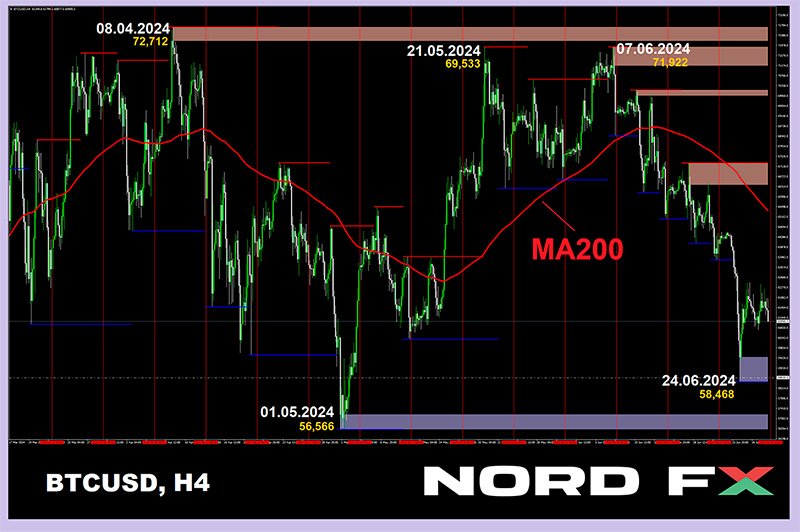
Monday, 24 June, presented investors with a very unpleasant surprise – on this day, bitcoin's price fell below $60,000 for the first time since 03 May, reaching $58,468 at one point. Ethereum, in turn, fell below $3,250. Analysts highlight several reasons for the active sell-offs, noting that they reflect overall instability in global financial markets and uncertainty about monetary and regulatory policies in several leading countries, especially China and the US. However, there are also more specific factors that contributed to the development of the bearish trend.
In mid-June, the German government began selling off a huge amount of bitcoins (about 50,000 BTC) confiscated in January. Panic sentiment sharply intensified after the announcement on 24 June that creditor payments for the bankrupt crypto exchange Mt.Gox would begin in early July. The total amount of funds to be distributed among former clients is 162,100 BTC, roughly $10 billion. Bitcoin responded to this news with an 8% drop. It's no surprise – such a volume of coins flooding the free market can seriously knock down prices. In the derivatives market, long positions worth $177 million were forcibly liquidated, and the total financing rate for futures contracts turned negative for the first time in June, indicating that sales exceeded purchases.
It is precisely on the expectations of Mt.Gox debt payments that the flagship crypto asset's quotes reached the lowest level in the past eight weeks last Monday. In this situation, two things are encouraging. Firstly, the deadline for repayment falls on 31 October, and it's possible that payments will be made in parts over four months rather than all at once. And secondly, there is hope that not all creditors will rush to convert their bitcoins into fiat, but will hold onto them, hoping for price growth.
In addition to the above, BTC miners exerted some downward pressure on the market. It became known that their coin reserves reached a 14-year low, as they had to sell a significant amount of BTC due to the April halving to cover operational expenses. Recall that the cost of mining bitcoin, according to JPMorgan analysts, is $53,000. Historically, this cost level is a strong support for BTC/USD. However, even in March, JPMorgan did not rule out that after the halving, bitcoin could temporarily fall to $42,000.
In the absence of positive signals, the demand for spot bitcoin ETFs continues to decline, major market participants slow down their activity, and start to take profits. This also pressures the prices. CEO of investment company CryptoQuant Ki Young Ju calculated that over the past two weeks, bitcoin whales and miners set a record by selling coins worth $1.2 billion.
According to 10x Research, all last week, US spot BTC ETFs recorded investor outflows, and on 21 June, net outflow exceeded $105 million. 10x Research believes that bitcoin will now need to find a new price range to stabilize the decline and then find growth catalysts. In the medium term, according to 10x Research analysts, it is not worth expecting BTC to return above $70,000.
Popular analyst Matthew Hyland noted that the combined bitcoin balance on centralized exchanges reached a multi-year low. In theory, this could be seen as a bullish signal, but the crypto market leader is not yet eager to show an upward trend. Naturally, the publication of key US economic data could serve as a vector for further cryptocurrency movements. If the Fed takes its first step in easing its monetary policy in September, it could support risky assets, including bitcoin. According to Cryptology experts, the chances of bitcoin reaching a new all-time high by the end of September are quite high, and what is happening now is a phase of accumulation.
Despite the current decline, many investors remain optimistic, citing the cyclical nature of the crypto market. They also do not forget about the US elections. For example, former Goldman Sachs CEO Raoul Pal predicted significant bitcoin and cryptocurrency market growth in Q4 2024. In an episode of The Wolf Of All Streets podcast, the financier noted that risky assets like bitcoin usually rally against the backdrop of US presidential elections. "The final quarter of an election year is a real 'banana zone' for all assets. It always is," Pal optimistically stated, noting that the "banana zone" for cryptocurrencies in autumn is much more pronounced than, for example, for the Nasdaq index.
Bitcoin was also supported by billionaire Michael Saylor. His company, MicroStrategy, is one of the largest bitcoin holders in the world, with 205,000 BTC on its balance sheet. Despite the negative trend, it increased its reserves by another 11,931 BTC (over $700 million) in the past month alone. Saylor is convinced of the first cryptocurrency's ability to grow to $10 million with support from China and other factors. He believes that in the future, governments, especially China, will fully embrace the first cryptocurrency and integrate it into the state infrastructure. The entrepreneur declared all pre-bitcoin economic instruments obsolete. "Before Satoshi Nakamoto, economics was a pseudoscience. All economists before Satoshi tried to develop economic laws with shells, glass beads, pieces of paper, and credit instruments," the businessman wrote, calling bitcoin a "perfect asset."
In previous reviews, we already wrote that the launch of exchange-traded spot ETFs on Ethereum could give a certain boost to the digital asset market. On 25 June, SEC (US Securities and Exchange Commission) Chairman Gary Gensler noted that the registration process for new ETFs is "going smoothly," and the approval date depends on how quickly applicants submit adjusted S-1 forms. Bloomberg analysts call 02 July the expected approval date for new products. Reuters, citing anonymous sources, reports that a consensus has been reached between fund managers and the SEC in negotiations, and only the "final touches" remain.
Co-founder of venture company Mechanism Capital Andrew Kang stated that after the approval of ETH-ETF, Ethereum's rate could correct by 30%, falling to $2,400. In his opinion, at this stage, the main altcoin attracts much less attention from institutional investors compared to bitcoin. Based on this, ETH-ETF will attract only 15% of funds compared to what BTC-ETF received at the start.
Kang noted that to increase Ethereum's attractiveness among investors, its ecosystem needs to be positioned as a decentralized financial settlement layer, a global computer, or a Web3 application store. At the same time, it will be difficult to sell new ideas for Ethereum's application to funds, as the asset is perceived by investors as an overvalued stock of a large technology company.
Significantly more positively views the future of Ethereum Matt Hougan, CIO of Bitwise, a company managing cryptocurrency funds. In his opinion, the appearance of a long-awaited exchange product is undoubtedly a positive factor, and the net inflow of investments into ETH-ETF over the first 18 months will amount to $15 billion. In his analysis, he relies on the experience of Canada and the EU, where in similar products the inflow ratio for Ethereum and Bitcoin is approximately 1 to 4 (i.e., 25%). In other words, if in the first quarter of work for spot Bitcoin-ETF the total inflow was $26.9 billion, for Ethereum it is expected to be at the level of $6.7 billion. In this case, in three months of work, the leading altcoin could rise to $4,400-5,000.
CEO of SkyBridge Capital Anthony Scaramucci believes that the price of Ethereum could rise even higher, reaching $10,000-12,000. Regarding bitcoin, the entrepreneur allows for its growth to $170,000-250,000. The main driver, in his opinion, will be the further institutional acceptance of cryptocurrency. Scaramucci called the approval of spot exchange ETFs an important regulatory barrier breakthrough for attracting new capital. Thanks to this, in his opinion, the share of digital gold in the portfolios of major players will soon be about 3%.
As of the evening of Friday, 28 June, BTC/USD is trading at $60,190, and ETH/USD is in the $3,390 zone. The total crypto market capitalization is $2.24 trillion ($2.34 trillion a week ago). The bitcoin Fear & Greed Index (Crypto Fear & Greed Index) has dropped from 63 to 47 points over the past 7 days, moving from the Greed zone to the Neutral zone.
In conclusion, here is another observation from Matt Hougan. The CIO of Bitwise presented three reasons why long-term investments in both bitcoin and Ethereum are more advantageous compared to investing only in bitcoin. These are: 1. portfolio diversification 2. the opportunity to earn on very different ecosystems and 3. economic benefit.
Considering the difference in the capitalization levels of bitcoin and Ethereum, Hougan believes that 75% of the capital should be invested in BTC and 25% in ETH. According to calculations, over the period from May 2020 to May 2024, the yield of such an investment portfolio is 3% per annum higher than one that only contains bitcoin. However, Hougan acknowledges that in the shorter term, a portfolio including 100% BTC outperforms a diversified one. Moreover, investing only in bitcoin carries fewer risks due to its higher market capitalization and features such as limited coin issuance and a phased reduction in the inflation rate to zero.