Sample Category Title
USD/CHF Daily Outlook
Daily Pivots: (S1) 0.8950; (P) 0.8967; (R1) 0.8990; More…
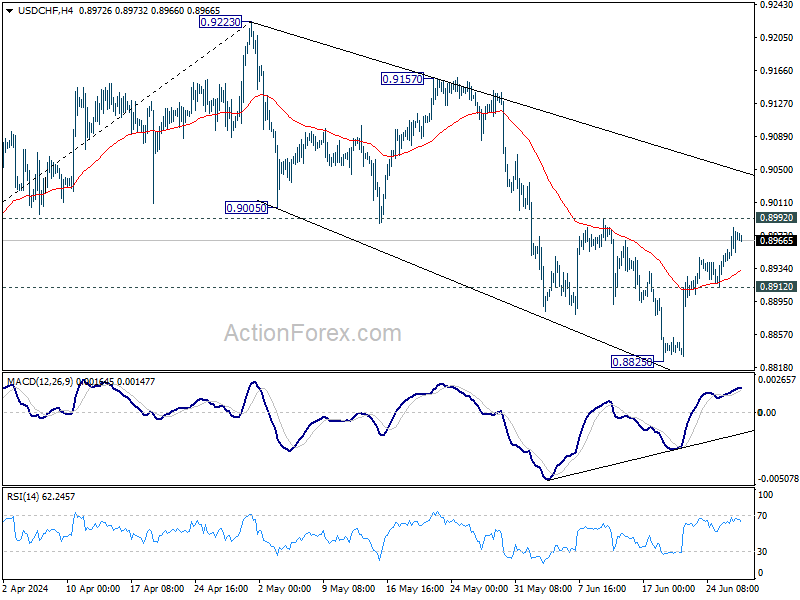
No change in USD/CHF's outlook and intraday bias stays neutral. Further decline is still expected with 0.8992 resistance intact. Below 0.8912 minor support will bring retest of 0.8825 low. Firm break there will resume the fall from 0.9223 to 61.8% retracement of 0.8332 to 0.9223 at 0.8672. However, firm break of 0.8892 will argue that fall from 0.9223 has completed as a three-wave corrective move to 0.8825. In this case, intraday bias will be back on the upside for 0.9157 resistance.
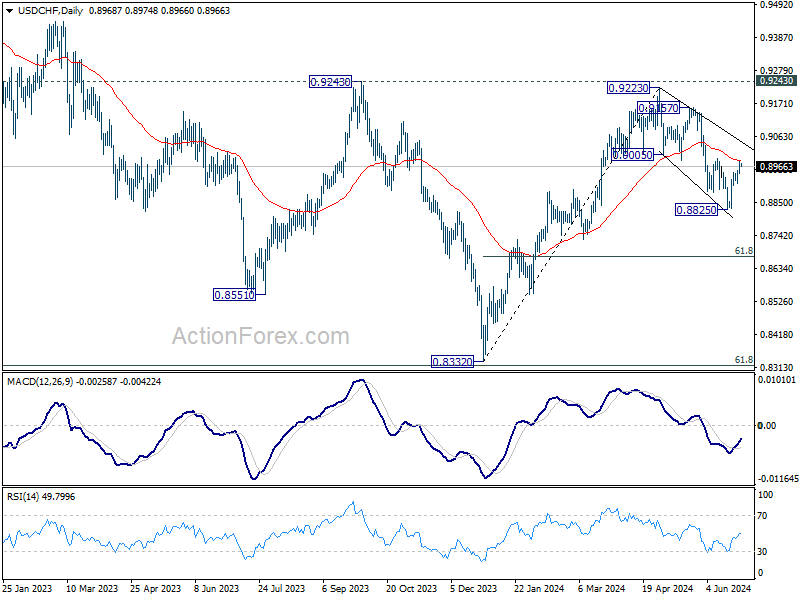
In the bigger picture, price actions from 0.8332 medium term bottom are seen as developing into a corrective pattern to the down trend from 1.0146 (2022 high). Rejection by 0.9243 resistance affirms this case, and maintains medium term bearishness. While more range trading could be seen between 0.8332/0.9243 first, downside break out is mildly in favor at a later stage.
USD/JPY Daily Outlook
Daily Pivots: (S1) 160.00; (P) 160.43; (R1) 161.26; More...
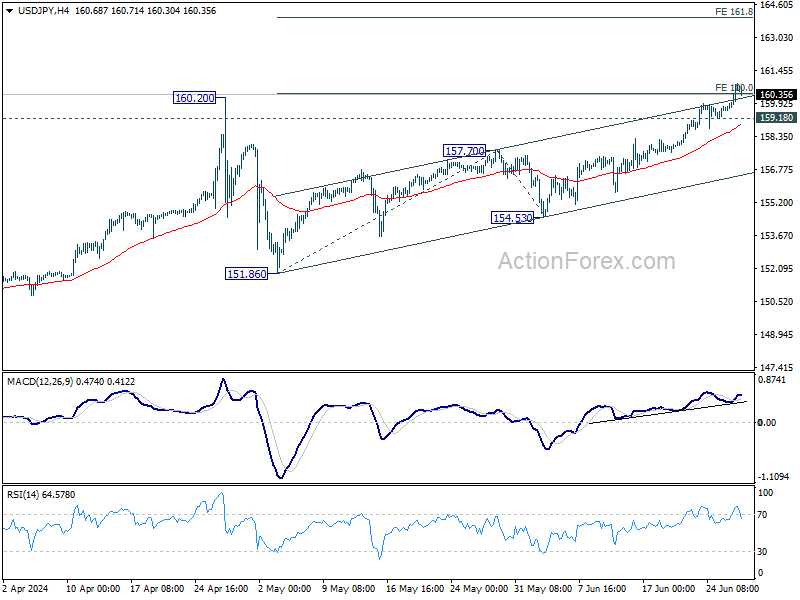
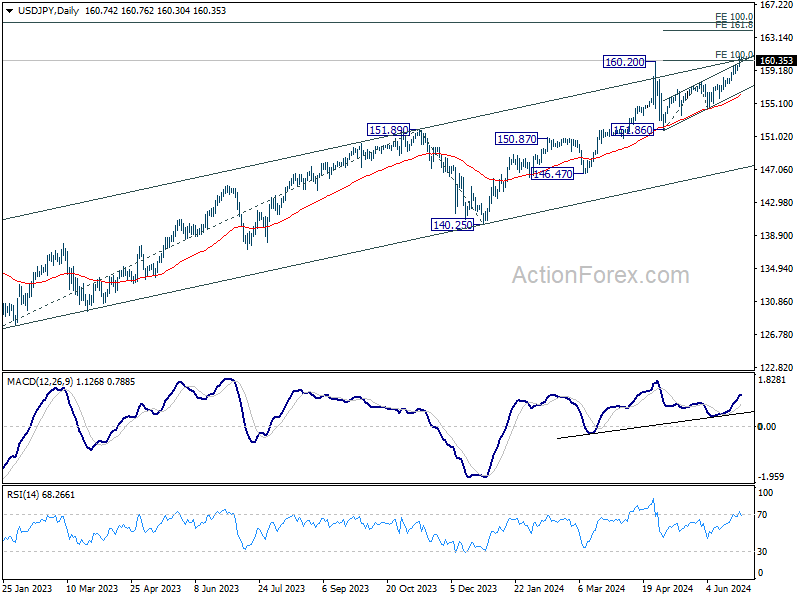
Intraday bias in USD/JPY remains on the upside at this point. Sustained trading above 100% projection of 151.86 to 157.70 from 154.53 at 160.37 will pave the way to 161.8% projection at 163.97. On the downside, below 159.18 minor support will turn intraday bias neutral again first. But outlook will stay bullish as long as 157.70 resistance turned support holds.
In the bigger picture, there is no sign of long term trend reversal yet. Further rally is expected as long as 151.86 support holds. Decisive break of 160.02 will target 100% projection of 127.20 to 151.89 from 140.25 at 164.94.
Yen Recovers as Japan Steps Up Verbal Intervention, But No Sign of Lasting Bottom Yet
Yen is showing broad-based recovery today, although the momentum remains weak, following its decline to the lowest level against Dollar since 1986. Japan has finally stepped up its verbal intervention efforts again, with Finance Minister Shunichi Suzuki expressing a "high sense of urgency" regarding Yen's depreciation. Suzuki pledged to "take necessary action as needed" and reiterated his "strong concern" over one-sided currency moves and their impact on the economy.
Despite this, Yen remains the second worst performer of the week, showing minimal signs of a lasting bottom. Conversely, Dollar is the second strongest currency, trailing only Australian Dollar. Even if Japan intervenes in the markets, such efforts alone may not be sufficient to reverse USD/JPY trend unless Dollar also weakens against other major currencies.
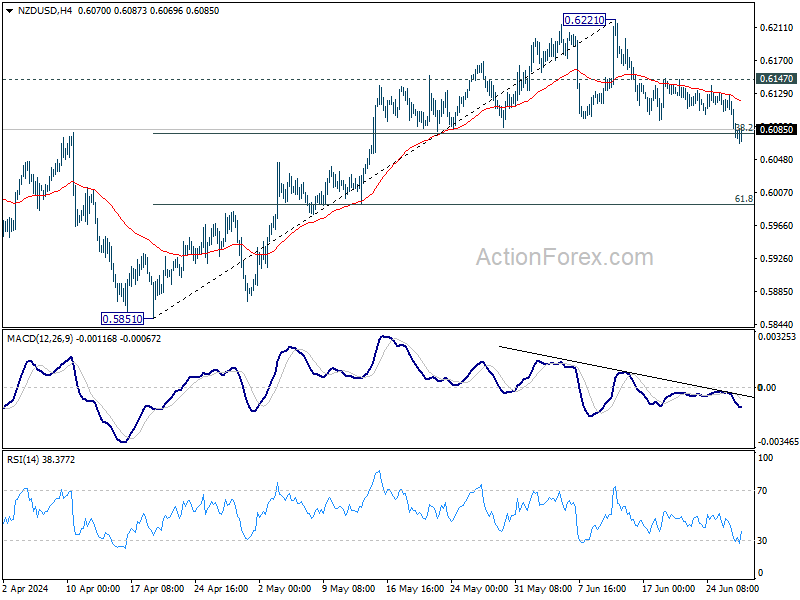
Technically, NZD/USD's fall from 0.6221 short term top extended lower today and it's now pressing 38.2% retracement of 0.5851 to 0.6221 at 0.6080. Strong bounce from current level, followed by break of 0.6147 resistance, will retain near term bullishness, and bring resumption of the rise from 0.5851 through 0.6221 at a later stage. However, sustained trading below 0.6080 will raise the chance of reversal and target 61.8% retracement at 0.5992 and possibly below.
In Asia, at the time of writing, Nikkei is down -1.06%. Hong Kong HSI is down -2.04%. China Shanghai SSE is down -0.51%. Singapore Strait Times is up 0.27%. Japan 10-year JGB yield is up 0.0441 at 1.069. Overnight, DOW rose 0.04%. S&P 500 rose 0.16%. NASDAQ rose 0.49%. 10-year yield rose 0.078 to 4.316.
NZ ANZ business confidence falls to 6.1, inflation pressure eases further
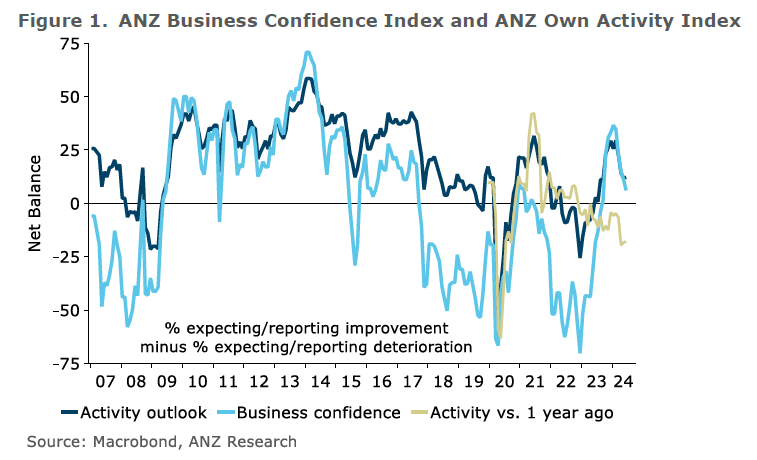
New Zealand ANZ Business Confidence fell from 11.2 to 6.1 in June. Despite this decrease in overall confidence, there was a slight improvement in the own activity outlook, from 11.8 to 12.2.
Cost expectations decreased from 72.6 to 69.2, while pricing intentions dropped significantly from 41.6 to 35.3, signaling easing price pressure in the business environment. Furthermore, inflation expectations continued their steady descent, moving from 3.59% to 3.46%.
ANZ noted that "the economy is clearly weak, as the RBNZ intended." More importantly, there appears to be "renewed meaningful progress on bringing inflation pressures down." This fosters optimism that RBNZ might be able to lower the Official Cash Rate considerably earlier than the currently projected August next year.
Looking ahead
Eurozone M3 money supply will be released in European session. Later in the day, the US calendar is busy with Q1 GDP final, durable goods orders, goods trade balance, jobless claims and pending home sales featured.
USD/JPY Daily Outlook
Daily Pivots: (S1) 160.00; (P) 160.43; (R1) 161.26; More...
Intraday bias in USD/JPY remains on the upside at this point. Sustained trading above 100% projection of 151.86 to 157.70 from 154.53 at 160.37 will pave the way to 161.8% projection at 163.97. On the downside, below 159.18 minor support will turn intraday bias neutral again first. But outlook will stay bullish as long as 157.70 resistance turned support holds.
In the bigger picture, there is no sign of long term trend reversal yet. Further rally is expected as long as 151.86 support holds. Decisive break of 160.02 will target 100% projection of 127.20 to 151.89 from 140.25 at 164.94.
Economic Indicators Update
| GMT | Ccy | Events | Actual | Forecast | Previous | Revised |
|---|---|---|---|---|---|---|
| 23:50 | JPY | Retail Trade Y/Y May | 3.00% | 2.00% | 2.40% | 2.00% |
| 01:00 | AUD | Consumer Inflation Expectations Jun | 4.40% | 4.10% | ||
| 01:00 | NZD | ANZ Business Confidence Jun | 6.1 | 11.2 | ||
| 08:00 | EUR | Eurozone M3 Money Supply Y/Y May | 1.60% | 1.30% | ||
| 09:00 | EUR | Eurozone Economic Sentiment Jun | 96.3 | 96 | ||
| 09:00 | EUR | Eurozone Industrial Confidence Jun | -9.9 | |||
| 09:00 | EUR | Eurozone Services Sentiment Jun | 6.5 | |||
| 09:00 | EUR | Eurozone Consumer Confidence Jun F | -14 | -14 | ||
| 12:30 | USD | Initial Jobless Claims (Jun 21) | 230K | 238K | ||
| 12:30 | USD | Durable Goods Orders May | -0.10% | 0.60% | ||
| 12:30 | USD | Durable Goods Orders ex Transport May | 0.10% | 0.40% | ||
| 12:30 | USD | Goods Trade Balance (USD) May P | -96.0B | -99.4B | ||
| 12:30 | USD | Wholesale Inventories May P | 0.20% | 0.10% | ||
| 12:30 | USD | GDP Annualized Q1 F | 1.30% | 1.30% | ||
| 12:30 | USD | GDP Price Index Q1 F | 3.00% | 3.00% | ||
| 14:00 | USD | Pending Home Sales M/M May | 0.60% | -7.70% | ||
| 14:30 | USD | Natural Gas Storage | 53B | 71B |
NZ ANZ business confidence falls to 6.1, inflation pressure eases further
New Zealand ANZ Business Confidence fell from 11.2 to 6.1 in June. Despite this decrease in overall confidence, there was a slight improvement in the own activity outlook, from 11.8 to 12.2.
Cost expectations decreased from 72.6 to 69.2, while pricing intentions dropped significantly from 41.6 to 35.3, signaling easing price pressure in the business environment. Furthermore, inflation expectations continued their steady descent, moving from 3.59% to 3.46%.
ANZ noted that "the economy is clearly weak, as the RBNZ intended." More importantly, there appears to be "renewed meaningful progress on bringing inflation pressures down." This fosters optimism that RBNZ might be able to lower the Official Cash Rate considerably earlier than the currently projected August next year.
GBP/USD Faces Downside Risk: What Traders Should Watch
Key Highlights
- GBP/USD faced rejection near 1.2700 and declined heavily.
- A major bearish trend line is forming with resistance at 1.2670 on the 4-hour chart.
- EUR/USD is also trading in a bearish zone below 1.0700.
- The US Gross Domestic Product could grow by 1.3% in Q1 2024.
GBP/USD Technical Analysis
The British Pound failed to recover above the 1.2700 resistance against the US Dollar. GBP/USD started another decline and traded below the 1.2665 support.
Looking at the 4-hour chart, the pair settled below the 1.2665 level, the 100 simple moving average (red, 4-hour), and the 200 simple moving average (green, 4-hour). It seems like the bears are aiming for a move below the 1.2600 support.
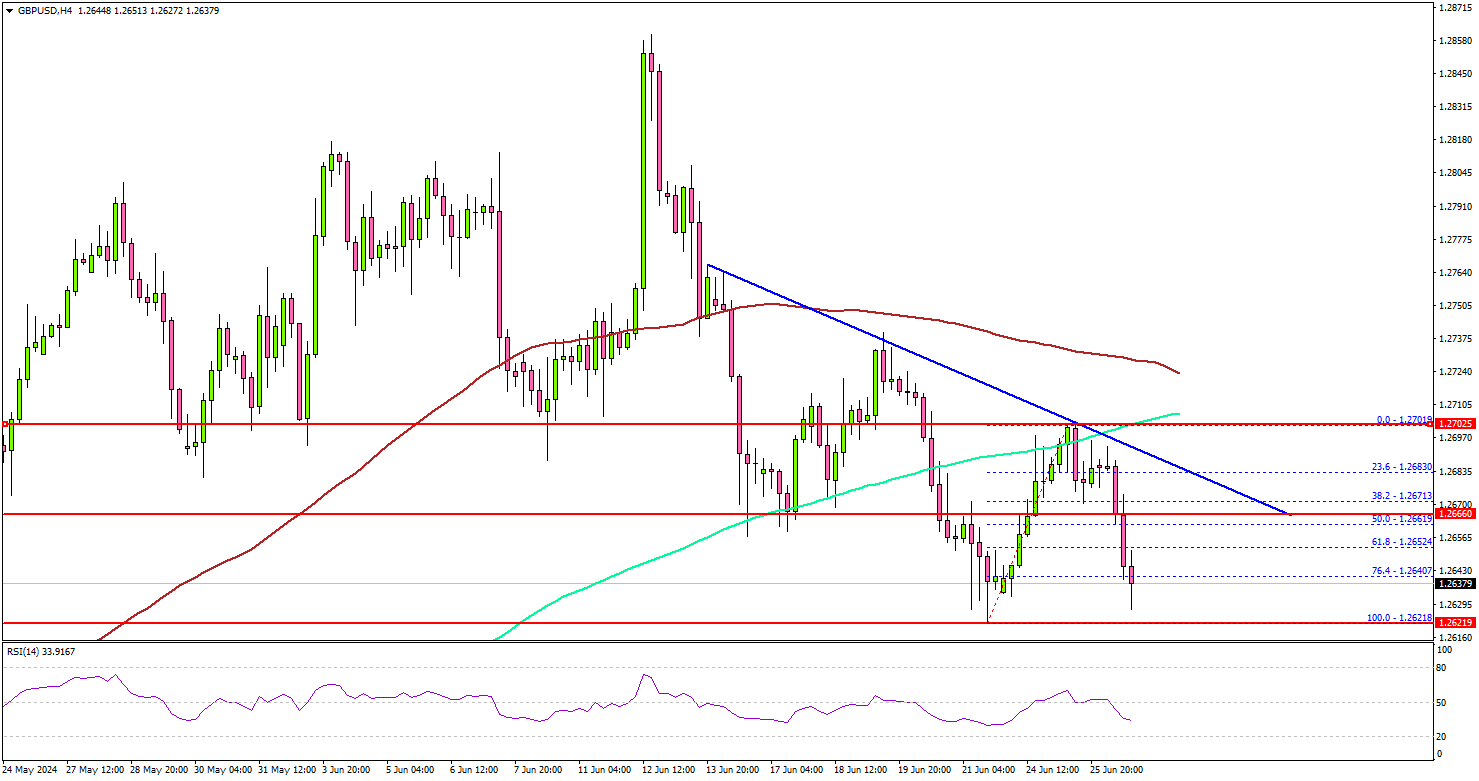
On the upside, the pair is facing resistance near the 1.2655 level. The next resistance sits at 1.2670. There is also a major bearish trend line forming with resistance at 1.2670 on the same chart.
The first major resistance is near the 1.2700 level and the 200 simple moving average (green, 4-hour). A clear move above the 1.2700 resistance might send it toward the 1.2725 level and the 100 simple moving average (red, 4-hour).
The main resistance is now near 1.2780. Any more gains might call for a move toward the 1.2850 level in the near term. If not, the pair might continue to move down.
Immediate support is near the 1.2600 level. The next major support is near the 1.2565 zone. A downside break and close below the 1.2565 support zone could open the doors for a larger decline. In the stated case, the pair could decline toward the 1.2420 level.
Looking at EUR/USD, the pair gained bearish momentum below the 1.0720 level and there are chances of more downsides below 1.0675.
Economic Releases
- US Initial Jobless Claims - Forecast 236K, versus 238K previous.
- US Durable Goods Orders for May 2024 – Forecast 0% versus +0.6% previous.
- US Gross Domestic Product for Q1 2024 – Forecast 1.3% versus previous 1.3%.
What Could UK General Election Mean for Pound?
- UK citizens head to the ballots on July 4
- Opinion polls point to a Labour Party victory
- Political stability could initially benefit the pound
- But BoE rate cut bets could prove negative in the longer run
How it works
On July 4, Britons will head to the ballots to vote in a general election, with opinion polls suggesting that they will end 14 years of Conservative rule.
The United Kingdom is divided into 650 constituencies. In each of them, voters choose a local candidate for a seat in Parliament, and typically those candidates represent a political party. There are two Houses in the UK Parliament: The House of Commons and the House of Lords. Voters are electing members of the House of Commons as members of the House of Lords are appointed by the government as life peers.
The party with the most seats wins the election but to run the government, they need 326 of the 650 seats or negotiate with other parties to build a coalition. They could still try and govern with a minority, but they could face huge obstacles in passing their agenda. The leader of the winning party becomes prime minister.
Who is leading?
Opinion polls have been consistently showing the Labour Party is leading the race, with Nigel Farage’s Reform UK overtaking Conservatives in some of the latest polls. It is also projected that the Labour party could win more than 400 seats in Parliament.
So, what does a Labour victory mean for the economy, the Bank of England, and consequently, the pound?
Labour victory, economy and BoE policy
Conservatives are focusing on tax cuts to reignite economic growth, while the Labour Party is portraying itself as the party of fiscal responsibility. Although the center-left party promised not to raise income tax, national insurance or corporation tax, they have not ruled out raising other taxes. What’s more, even though it is highly unlikely they would cut spending significantly, they said they cannot rely on using government funds to spur growth. They want to adopt a different strategy where finances are raised by companies.
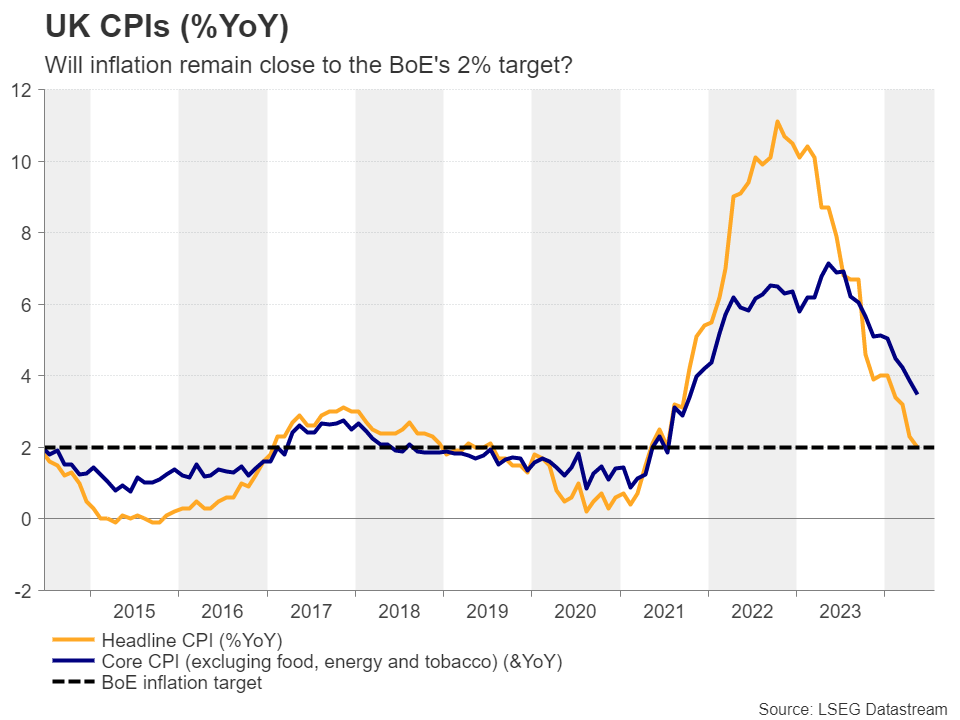
But managing to make the corporate mechanism to work could take time, which means that a potential economic boost will be delayed, thereby keeping inflation close to the BoE’s target of 2% and allowing policymakers to start cutting interest rates sooner and faster.
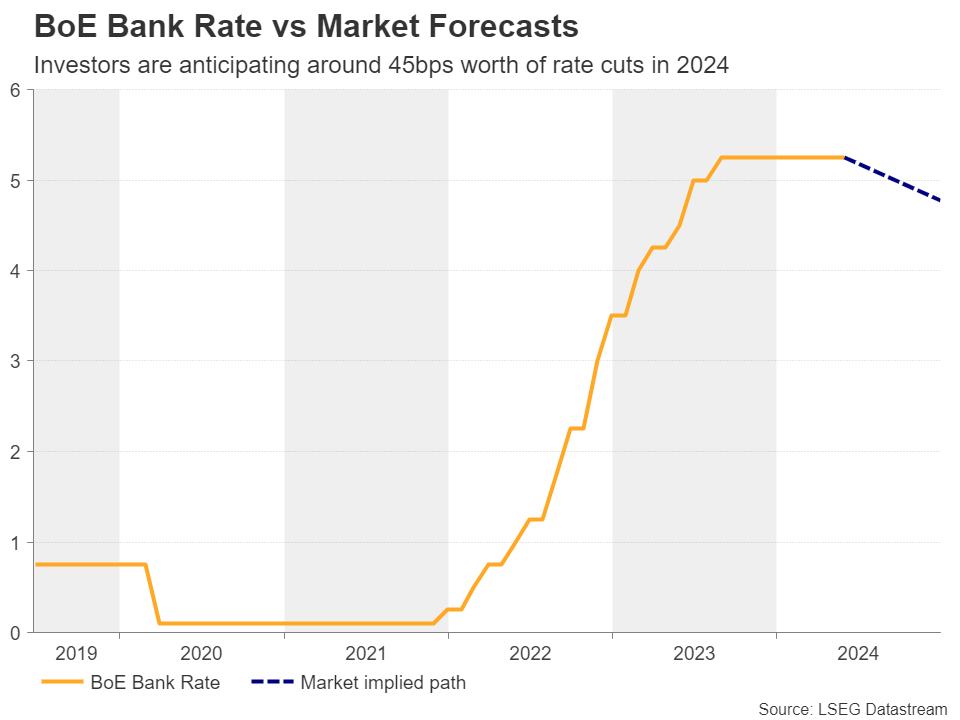
At last week’s gathering, the BoE kept interest rates unchanged, but the meeting minutes revealed that the decision was “finely balanced”, raising the probability for an August rate cut to around 50%. Taking that into account, a Labour victory on July 4 could increase that probability and perhaps encourage investors to add to the total number of basis points worth of reductions expected by the end of the year. Currently, there are nearly two quarter-point cuts penciled in for 2024.
Pound could benefit, but only temporarily
As for the pound, expectations of more rate cuts by the BoE could prove negative, but the initial reaction to a Labour victory may be positive as investors may view this as the beginning of a period of political stability amid a less divided party and amid Labour’s pledge to improve ties with the European union.
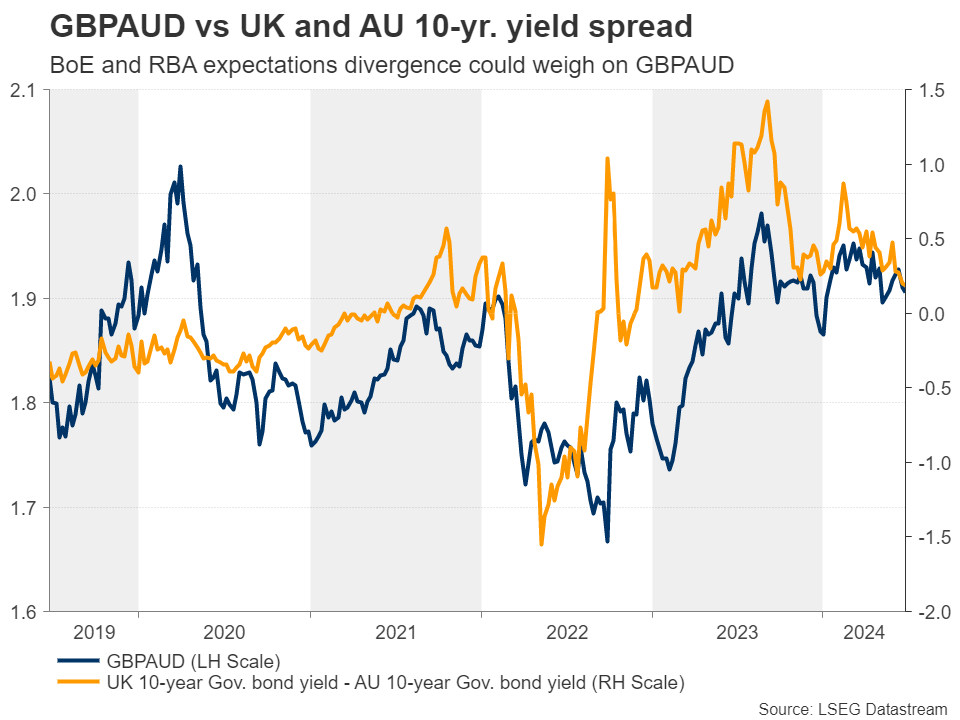
Having said that though, any reaction to a potential Labor victory may not have a huge market impact as this is the outcome already expected. If the pound is set to drift south in the post-election era due to increasing BoE rate cut bets, the currency against which it could lose the most ground may be the aussie. Remember that last week, the RBA maintained its neutral stance, while Governor Bullock revealed that they discussed the option of raising rates.
Pound/aussie remains in downtrend
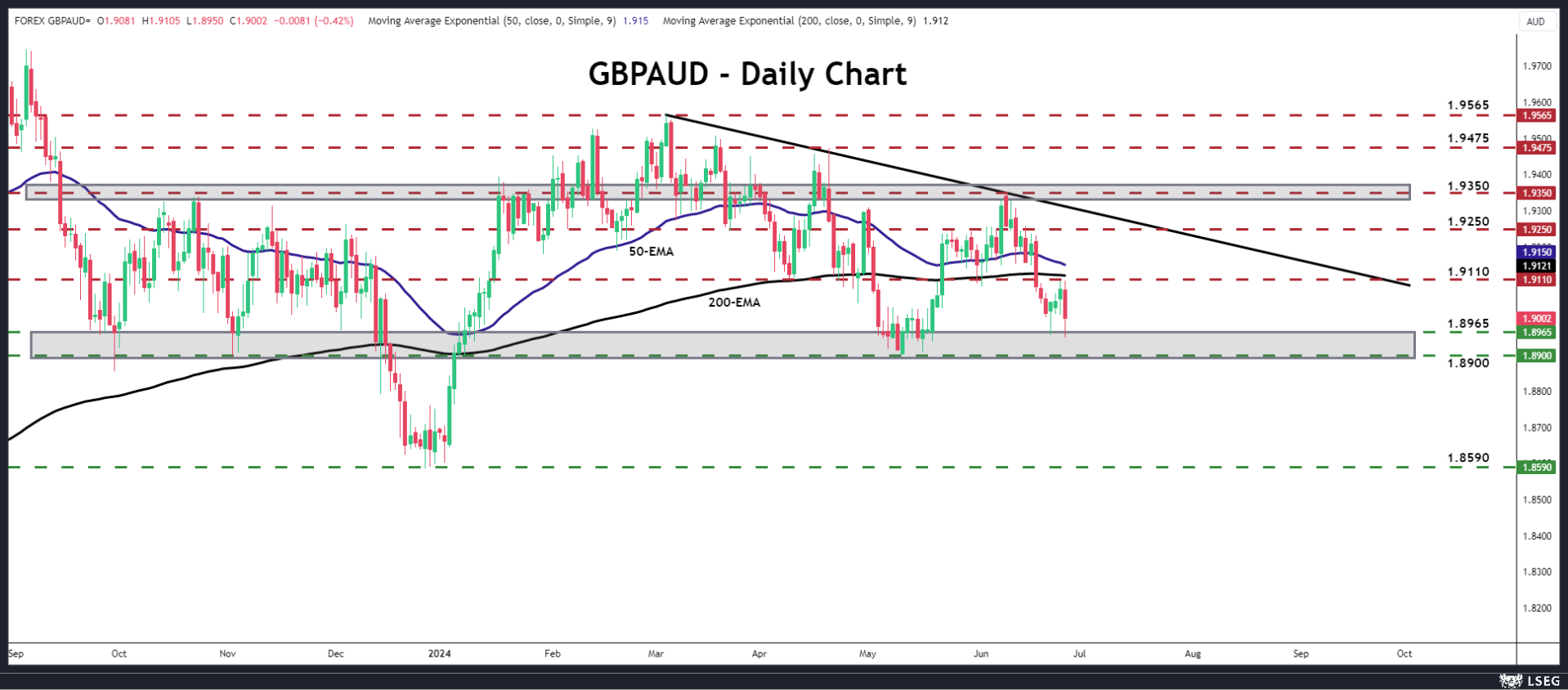
From a technical standpoint, pound/aussie entered a recovery phase on June 21, but on June 26, it hit strong resistance at around 1.9110 and slid. In the bigger picture, the pair remains below a downward sloping trendline drawn from the high of March 3. Therefore, if the pair recovers again on the election outcome, the rebound may be considered a corrective phase within a larger downtrend.
The bears could take charge again at some point and the pair may slip towards the 1.8965 zone again or the 1.8900 barrier, which provided support between May 7 and 15. A break lower would confirm a lower low on the daily chart and perhaps pave the way towards the low of December 27, at around 1.8590. For the outlook to change to positive, the bulls may need to clearly overcome the 1.9350 territory.
Will Core PCE Inflation Persuade Fed to Cut Rates?
- US core PCE inflation index could resume downtrend
- Fed may ask more evidence before cutting interest rates
- EURUSD trades near key support zone. Is it time for an upside reversal?
Inflation could hit a new low in May
Friday will see the release of the Fed’s favorite core PCE inflation measure at 12:30 GMT as the world’s largest central bank keeps looking for signs of sustained price stability around its 2.0% target almost a year after it paused its hiking cycle.
Forecasts point to a weaker reading of 2.6% year-on-year in May from 2.8% previously. If analysts are correct, the news could be meaningful to the Fed as this would be the lowest level reached since inflation accelerated from 1.9% to 3.1% in May 2021. The monthly increase could be a relief as well if it softens from 0.2% to 0.1%.
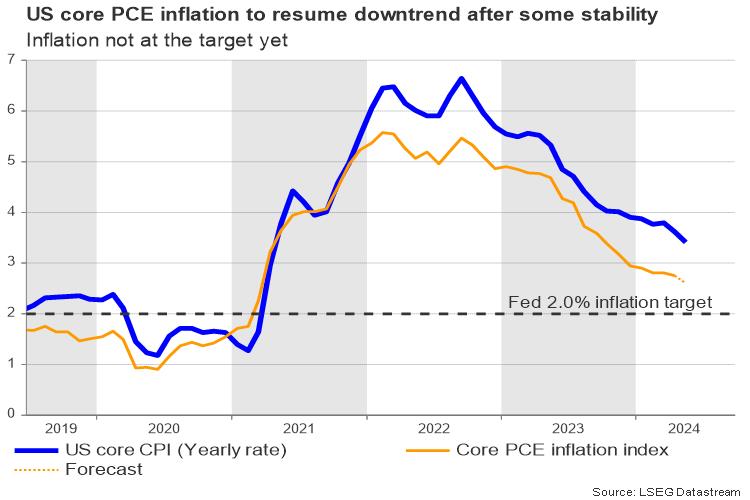
Will the data push for a rate cut?
The short answer is no. Recall that the latest CPI inflation report surprised slightly to the downside, increasing the chances of a September rate cut, but the details showed that there are still some areas such as the house/rental market which are stuck. Although the acceleration in interest rates sapped momentum in the house market and pushed housing inventory to the highest in two years recently, the house price index continued to rise at an unacceptable rate of 6.3% y/y.
Hence, even if the core PCE gauge resumes its downward pattern, policymakers would like to see one or two softer releases to consider a rate cut in September. Falling personal spending and income data could provide more incentives to lower borrowing costs, but analysts estimate a slight pickup to 0.3% m/m and 0.4% m/m, respectively.
Note that Fed policymakers lowered their rate projections from three rate cuts in March to only one for 2024, and some policymakers, including the board member Michelle Bowman, insist that reductions will not happen this year as upside inflation risks persist.
How will the data influence market sentiment?
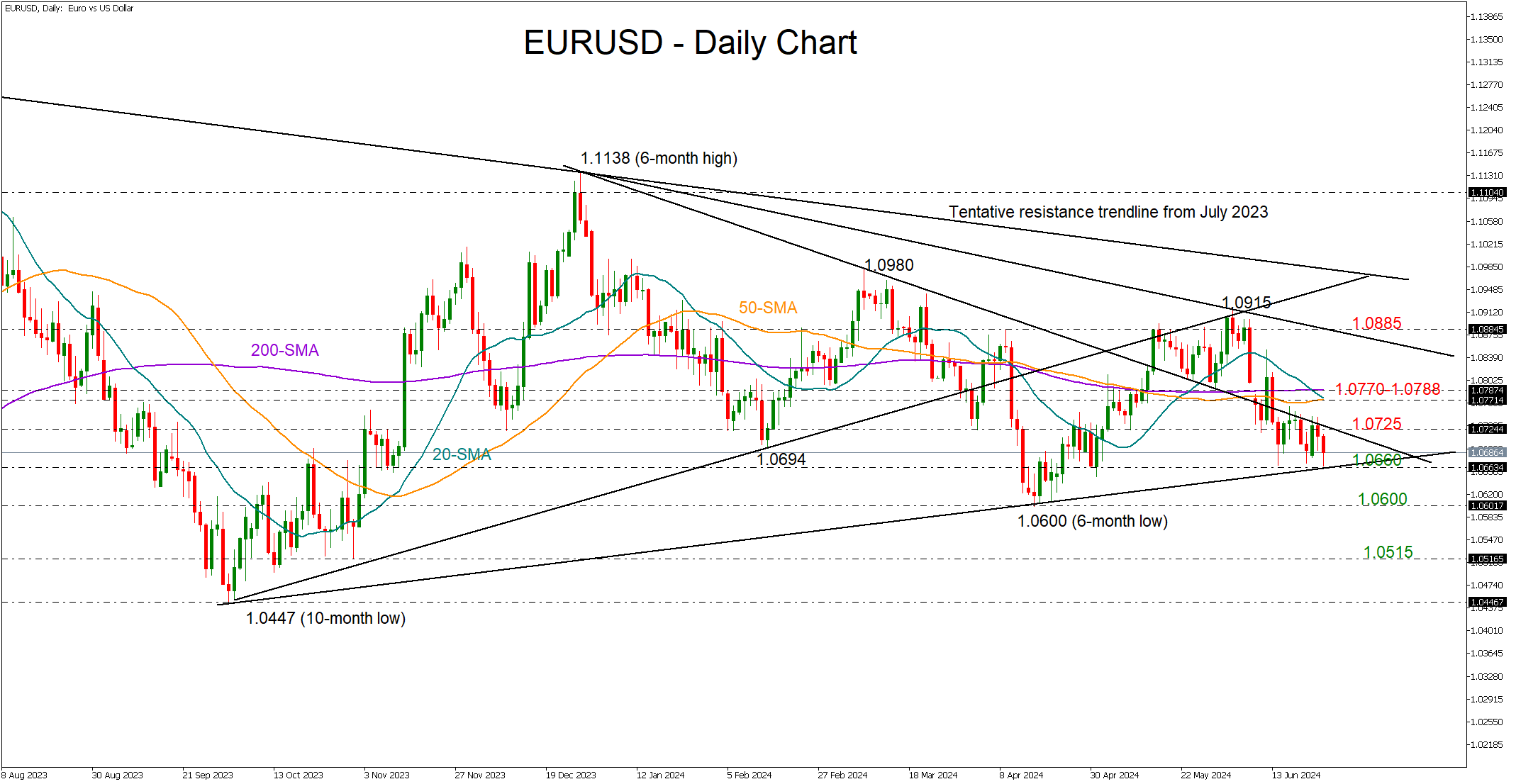
Some volatility is expected following the release of the data as investors have downgraded their rate forecasts to 45 bps of monetary easing, and are currently thinking that a reduction in September could be a close call. Therefore, a negative surprise in the core PCE inflation data and signs of decelerating consumption could see more investors backing a September rate cut, especially as November’s general election approaches. In this case, EURUSD could set a strong footing near the key support trendline at 1.0660 and head towards its simple moving averages (SMAs) located within the 1.0770-1.0788 zone if the 1.0725 constraining zone gives the green light on the upside.
Alternatively, hotter-than-expected readings might increase fears that policy divergence between the Fed and other major central banks could widen in the coming months. As a result, the US dollar could benefit from the news, pressing EURUSD below 1.0660 and towards the 1.0600 round level. A more aggressive decline could lead the pair into the 1.0500-1.0515 support region.
Yen Weaker Every Day, USDJPY Breaks 1990 Highs
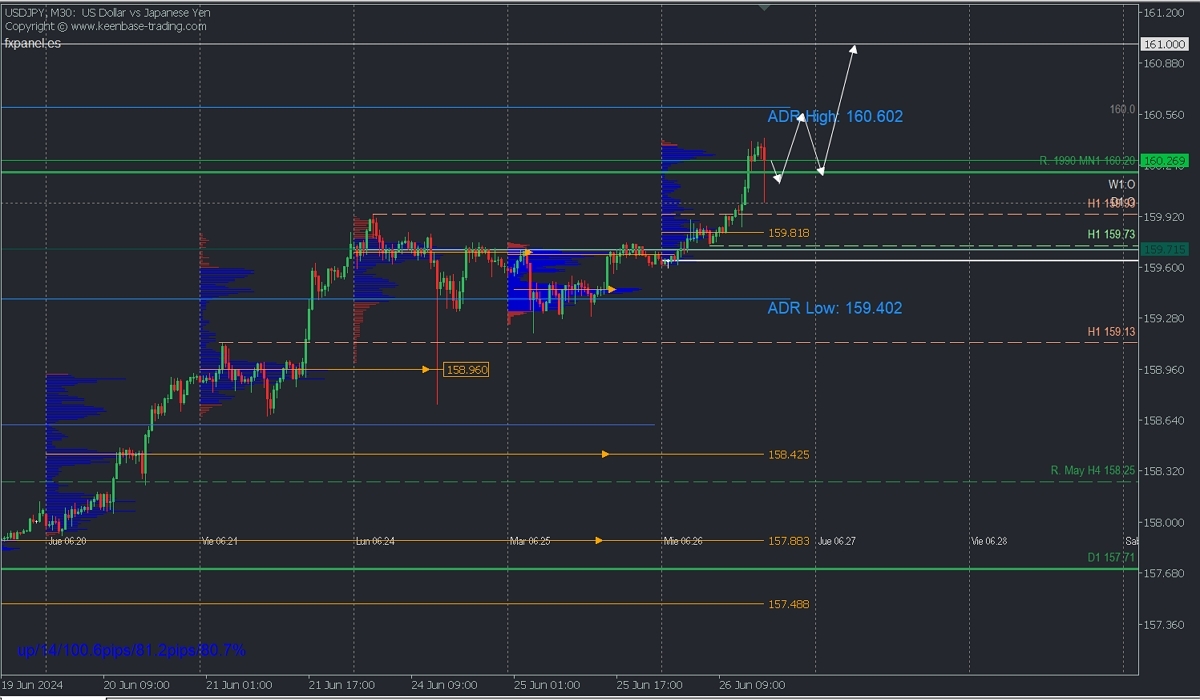
Intraday Bullish Scenario: Wait for a pullback to 160.12 with TP1 at 160.60 and TP2 at 160.80, with an S.L. below 159.90 or at least 1% of the account capital. Apply Trailing Stop.
Bearish Scenario: Sell below 160.60 (if a PAR forms) with TP1 at 159.81, TP2 at 159.73, and TP3 at 159.40 with S.L. at 160.70 or at least 1% of the account capital.
Fundamental Analysis
This week, the USDJPY pair has experienced significant movements driven by various economic and political factors. The Japanese yen has shown weakness against the US dollar due to several events.
- Weakness of the Japanese Yen: The yen has been on a nearly 10-day losing streak, with traders watching for possible interventions by the Japanese Ministry of Finance. Authorities have hinted that they will not intervene until after the US Personal Consumption Expenditures (PCE) report, which has kept volatility high.
- Strength of the US Dollar: The US Dollar Index (DXY) has risen thanks to hawkish comments from the Federal Reserve and the yen depreciation. Political uncertainty in Europe, especially due to the snap elections in France and low consumer confidence in Germany, has also contributed to the dollar's strength.
Key Ideas
The intervention of the Japanese Ministry of Finance is likely if US economic data is stronger than expected.
Technical Analysis, H4
USDJPY
- Supply Zones (Sells): 160.00
- Demand Zones (Buys): 159.46, 158.96
The pair surpassed the key resistance of 1990 at 160.20 today, challenging the BoJ's tolerance levels. However, the pair has an average bullish range to 160.60, which is expected to extend the day's rise, with attention to the round level of 161.00 for the rest of the week ahead of the US PCE data on Friday.
The important pullback zone is the round level at 159.99, the broken resistance at 158.90, and the POC of the initial sessions at 159.81, from where a new rally towards 160.80 or 161.00 is expected, as long as the last relevant intraday support at 159.73 is not decisively broken.
Selling below the key support zone will pave the way for more extended sales towards the high volume node around 159.45 and the average daily bearish range at 159.40.
POC Explained: POC = Point of Control: It is the level or zone where the highest concentration of volume occurred. If a bearish movement originated from it previously, it is considered a sell zone and forms a resistance area. Conversely, if a bullish impulse occurred from it previously, it is considered a buy zone, usually located at lows, thus forming support zones.
USDCHF Wave Analysis
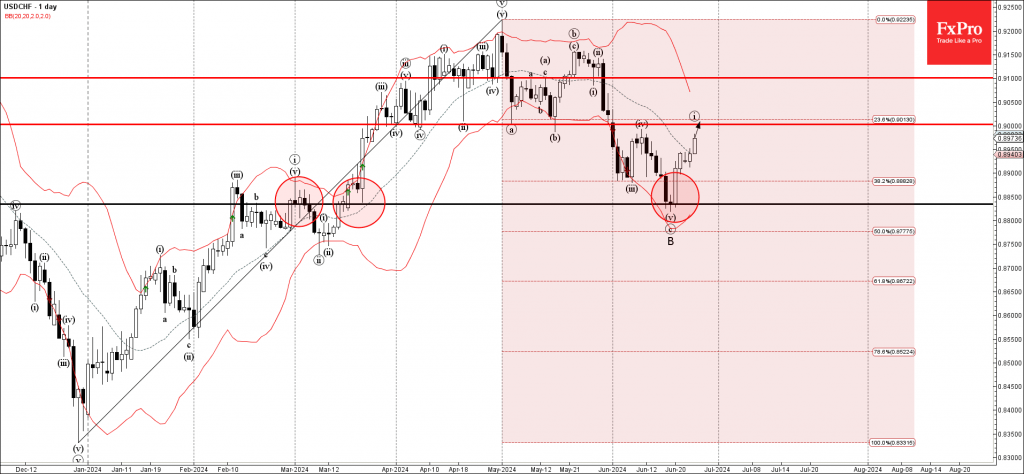
- USDCHF rising inside impulse wave i
- Likely to reach resistance level 0.9000
USDCHF continues to rise inside the minor impulse wave i, which started earlier, when the pair reversed up from the key support level 0.8835, standing near the lower daily Bollinger Band and the 50% Fibonacci correction level of the previous upward impulse from December.
The upward reversal from the support level 0.8835 created the perfectly formed Japanese candlesticks reversal pattern Morning Star.
Given the continuation of the Swiss franc sales and USD bullish sentiment seen today, USDCHF can be expected to rise toward the next round resistance level 0.9000 (former strong support from April and May).