Sample Category Title
EUR/USD Sees Green as USD/JPY Gains Bullish Traction
EUR/USD is slowly gaining traction above the 1.0800 level. USD/JPY trimmed almost all losses and showing positive signs above 156.20.
Important Takeaways for EUR/USD and USD/JPY Analysis Today
- The Euro started a decent increase above the 1.0750 pivot level.
- There is a key bullish trend line forming with support near 1.0800 on the hourly chart of EUR/USD at FXOpen.
- USD/JPY climbed higher above the 155.95 and 156.50 levels.
- There is a connecting bullish trend line forming with support near 156.20 on the hourly chart at FXOpen.
EUR/USD Technical Analysis
On the hourly chart of EUR/USD at FXOpen, the pair started a fresh increase from the 1.0725 zone. The Euro cleared a few key hurdles near 1.0750 to move into a positive zone against the US Dollar.
The pair settled above the 1.0800 level and the 50-hour simple moving average. A high was formed at 1.0830 and the pair is now consolidating gains. Immediate support is near the 23.6% Fib retracement level of the upward move from the 1.0775 swing low to the 1.0827 high at 1.0815.
The first major support on the EUR/USD chart is near 1.0800. There is also key bullish trend line forming with support near 1.0800 and the 50% Fib retracement level of the upward move from the 1.0775 swing low to the 1.0827 high.
The next key support is at 1.0790. If there is a downside break below 1.0790, the pair could drop toward 1.0750. The next support is near 1.0725, below which the pair could start a major decline.
On the upside, the pair is now facing resistance near the 1.0830 zone. The next major resistance is near 1.0850. An upside break above 1.0850 could set the pace for another increase. In the stated case, the pair might rise toward 1.0920.
USD/JPY Technical Analysis
On the hourly chart of USD/JPY at FXOpen, the pair started a decent increase from the 155.25 zone. The US Dollar gained bullish momentum above 155.95 against the Japanese Yen.
It settled above the 50-hour simple moving average and 156.20. A high was formed near 156.78 and the pair is now correcting gains. There was a move below the 23.6% Fib retracement level of the upward move from the 155.68 swing low to the 156.78 high.
On the downside, the first major support is near the trend line at 156.20 and the 50-hour simple moving average. The trend line is close to the 50% Fib retracement level of the upward move from the 155.68 swing low to the 156.78 high.
The next major support is near 155.95. If there is a close below 155.95, the pair could decline steadily toward 155.25. In the stated case, the pair might drop toward 154.80. The next major support sits at 154.20.
Immediate resistance on the USD/JPY chart is near 156.50. The first major resistance is near 156.80. If there is a close above the 156.80 level and the RSI moves above 60, the pair could rise toward 157.50. The next major resistance is near 158.00, above which the pair could test 160.00 in the coming days.
Trade over 50 forex markets 24 hours a day with FXOpen. Take advantage of low commissions, deep liquidity, and spreads from 0.0 pips. Open your FXOpen account now or learn more about trading forex with FXOpen.
This article represents the opinion of the Companies operating under the FXOpen brand only. It is not to be construed as an offer, solicitation, or recommendation with respect to products and services provided by the Companies operating under the FXOpen brand, nor is it to be considered financial advice.
GBP/JPY Daily Outlook
Daily Pivots: (S1) 196.12; (P) 196.59; (R1) 197.45; More...
Intraday bias in GBP/JPY stays on the upside at this point. Rebound from 191.34 is seen as the second leg of the corrective pattern from 200.53. Break of 197.40 will target 200.53 high. But upside should be limited there. On the downside, break of 194.74 minor support will turn intraday bias neutral first.
In the bigger picture, a medium term top could be in place at 200.53 after breaching 199.80 long term fibonacci level. As long as 55 W EMA (now at 183.41) holds, fall from there is seen as correcting the rise from 178.32 only. However, sustained break of 55 W EMA will argue that larger scale correction is underway and target 178.32 support.
EUR/JPY Daily Outlook
Daily Pivots: (S1) 168.65; (P) 169.00; (R1) 169.61; More...
Intraday bias in EUR/JPY stays on the upside at this point. Rebound from 164.01 is seen as the second leg of the corrective pattern from 171.58. Further rise should be seen to 171.58 high, but upside should be limited there. On the downside, below 167.49 minor support will turn intraday bias neutral first.
In the bigger picture, a medium top could be formed at 171.58 after brief breach of 169.96 (2008 high). As long as 55 W EMA (now at 157.89) holds, fall from there is seen as correcting the rise from 153.15 only. However, sustained break of 55 W EMA will argue that larger scale correction is underway and target 153.15 support.
EUR/GBP Daily Outlook
Daily Pivots: (S1) 0.8581; (P) 0.8598; (R1) 0.8608; More...
Intraday bias in EUR/GBP stays neutral and outlook is unchanged. On the downside, below 0.8585 minor support will argue that rebound from 0.8529 has completed, and larger fall might be ready to resume. Intraday bias will be back on the downside for 0.8529 support first.
In the bigger picture, outlook remains bearish as EUR/GBP is capped below medium term falling trendline. That is, down trend from 0.9267 (2022 high) is still in progress. Firm break of 0.8491/7 will target 100% projection of 0.8764 to 0.8497 from 0.8643 at 0.8376.
EUR/AUD Daily Outlook
Daily Pivots: (S1) 1.6305; (P) 1.6338; (R1) 1.6358; More...
Intraday bias in EUR/AUD remains neutral for the moment. While stronger recovery might be seen, further decline is expected as long as 1.6494 resistance holds. Fall from 1.6742 is seen as the third leg of the corrective pattern from 1.7062. Break of 1.6216 will turn bias back to the downside to 1.6127 support, or further to 100% projection of 1.7062 to 1.6127 from 1.6742 at 1.5807.
In the bigger picture, fall from 1.7062 medium term top is seen as a correction to the up trend from 1.4281 (2022 low). In case of deeper fall, strong support is expected around 1.5846 and 38.2% retracement of 1.4281 to 1.7062 at 1.6000 to bring rebound. Break of 1.7062 is in favor as a later stage.
EUR/CHF Daily Outlook
Daily Pivots: (S1) 0.9792; (P) 0.9803; (R1) 0.9819; More...
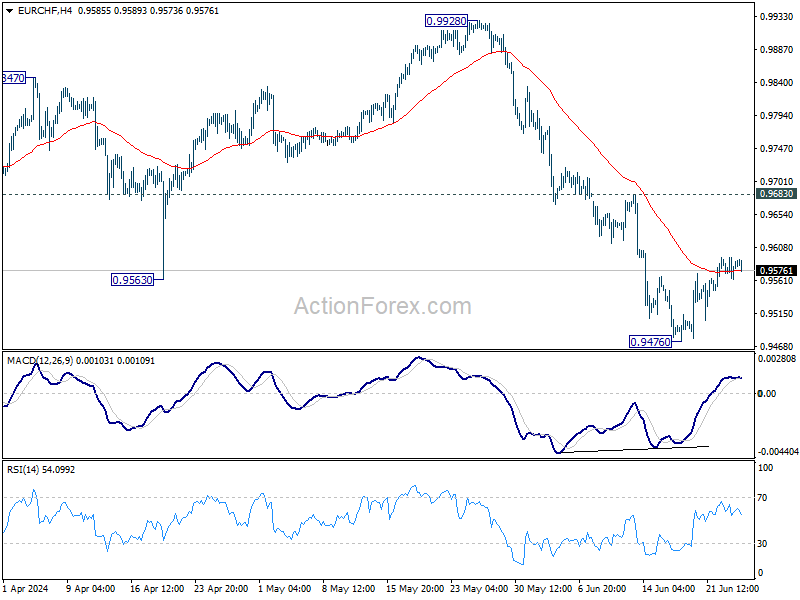
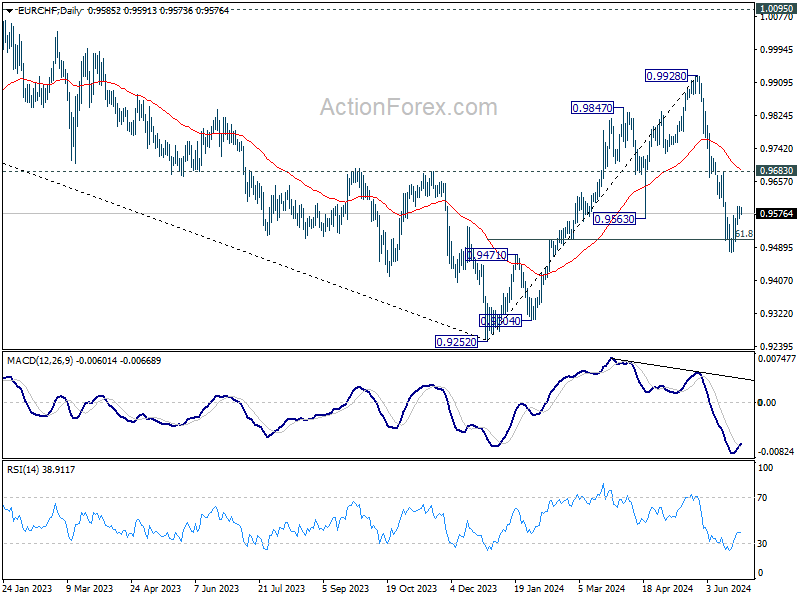
Intraday bias in EUR/CHF remains neutral for the moment. On the upside, decisive break of 0.9835/47 resistance will resume larger rally from 0.9252. On the downside, however, break of 0.9728 will extend the corrective pattern from 0.9847 with another fall, back to 0.9563 support.
In the bigger picture, as long as 0.9563 support holds, rise from 0.9252 medium term bottom is still in favor to continue. Break of 0.9847 resistance will target 38.2% retracement of 1.2004 (2018 high) to 0.9252 (2023 low) at 1.0303, even as a correction to the down trend from 1.2004.
New Sticky Inflation Evidence Wasn’t Start of Profound UST Sell-off or USD Rally
Markets
Significantly accelerating monthly US producer price inflation (April) triggered the obvious initial sell-off in US Treasuries and spike in the dollar. Producer prices rose by 0.5% M/M on the headline and on the core level. Services costs rose by 0.6%, the most since July, while goods prices increased by 0.4% mainly because of fuel costs. The new sticky inflation evidence this time wasn’t the start of a profound UST sell-off or USD rally though (US yields ended 4 to 5 bps lower; EUR/USD close at 1.0819) with markets rapidly returning to pre-PPI levels. US stock markets gained up to 0.75% with Nasdaq rallying to a new all-time closing high. Splitting hairs over downward March revisions and easing price pressures in certain individual categories (relevant to PCE like airlines and insurance) offered some backward looking explanation but we don’t really buy into that narrative. Fed Chair Powell after European close repeated his post-FOMC message. He thinks it’s still more likely that the Fed will be at a place where they holds the policy rate where it is rather than that the next move would be a hike. He downplayed the just-released PPI report as being sort of mixed rather than labelling it hot. He referred to upcoming inflation reports to determine whether inflation will soon fall back to the Fed’s 2% target or not. The first evidence comes this afternoon as the government publishes April consumer prices. Consensus expects a similar (to March) 0.4% M/M pace for headline prices and a slightly slower one for the core series (0.3%). Yesterday’s market reaction suggests that anything apart from an upward beat should keep US interest rates and the dollar in check or even prompt a return to levels seen ahead of the previous, hot, March, CPI report (US 2-y: 4.7%, US 10-y: 4.4% and EUR/USD 1.0885). US retail sales (April) and the Empire Manufacturing business survey (May) will be released simultaneously with the inflation numbers though carry a smaller weight from a market perspective. A final interesting feature of yesterday’s Powell comments was him noticing that the restraining effect of the current restrictive monetary policy on the economy could be smaller than expected given that so many American households and businesses locked in very low rates for a long time ahead of the pandemic.
News & Views
China is supposedly considering a proposal to have local governments across the country to buy millions of unsold homes in an attempt to address an ongoing property crisis. The State Council is said to seek feedback from several provinces and government entities on what is currently a preliminary plan. Local state-owned enterprises would be asked to help purchase unsold homes from distressed developers at steep discounts using loans provided by state banks. Many of the properties would then be converted into affordable housing, the Bloomberg report says. For now, officials are said to still debate the details and the feasibility of the plan and it still can take months for the plan to be finalized if Chinese leaders would decide to go ahead. The plan comes as the value of house sales declined about 47% in the first quarter and as the inventory of unsold houses reached the highest level in 8 years.
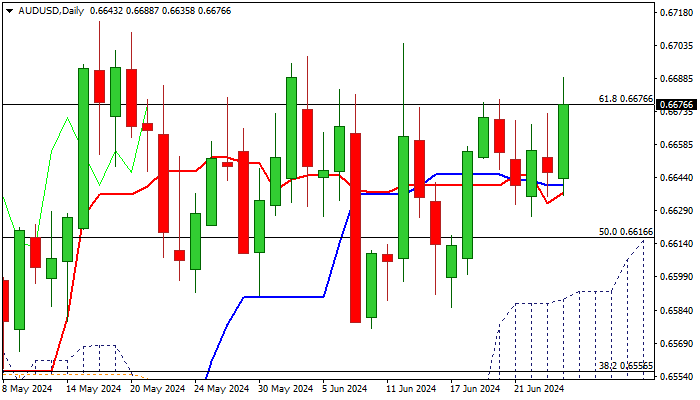
The Australian Bureau of Statistics showed wage growth easing in Q1 to 0.8% Q/Q and 4.1% Y/Y from 1.0% Q/Q in Q4 of last year. In the March quarter, the private sector was the main contributor to the overall increase in wages, rising 0.8%, while public sector wages rose 0.5%. In Y/Y-termers, private sector wage growth at 4.1% was still close to peak levels recorded over the last two quarters of 2023. Public wage growth eased to 3.8% in Q1 down from 4.3% Y/Y in the December quarter. Across both the public and private sector there was a fall in the proportion of jobs receiving a wage change in the March quarter 2024 compared to March quarter 2023. In terms of real income growth, the wage data should be put against a 3.6% Y/Y inflation in Q1. The easing of the wage growth dynamics should give some comfort to the Reserve Bank of Australia as it still kept all options open in its attempt to bring inflation sustainably back to its 2-3% target. The reaction on the Australian interest rate markets was limited this morning (3-y yield +1.5 bps to 3.97%). The market reaction to a stimulative budget announced yesterday might be in play. The Aussie dollar remains well bid. At AUD/USD 0.665, the currency is nearing the early March top of 0.6668.
Graphs
GE 10y yield
ECB President Lagarde clearly hinted at a summer (June) rate cut which has broad backing. EMU disinflation continued in April and brought headline CPI closer to the 2% target. Together with weak growth momentum, this gives backing to deliver a first 25 bps rate cut. A more bumpy inflation path in H2 2024 and the Fed’s higher for longer strategy make follow-up moves difficult. Markets have come to terms with that.
US 10y yield
The Fed in May acknowledged the lack of progress towards the 2% inflation objective, but Fed’s Powell left the door open for rate cuts later this year. Soft US ISM’s and weaker than expected payrolls supported markets’ hope on a first cut post summer, triggering a correction off YTD peak levels. Sticky inflation suggests any rate cut will be a tough balancing act. 4.37% (38% retracement Dec/April) already might prove strong support for the US 10-y yield.
EUR/USD
Economic divergence, a likely desynchronized rate cut cycle with the ECB exceptionally taking the lead and higher than expected US CPI data pushed EUR/USD to the 1.06 area. From there, better EMU data gave the euro some breathing space. The dollar lost further momentum on softer than expected early May US data. Some further consolidation in the 1.07/1.09 are might be on the cards short-term.
EUR/GBP
Debate at the Bank of England is focused at the timing of rate cuts. Most BoE members align with the ECB rather than with Fed view, suggesting that the disinflation process provides a window of opportunity to make policy less restrictive (in the near term). Sterling’s downside turned more vulnerable with the topside of the sideways EUR/GBP 0.8493 - 0.8768 trading range serving as the first real technical reference.
PPI Data Didn’t Feel ‘Right’
Yesterday was one of those days when investors insisted on seeing a glass that was one-tenth full as completely full.
- The US producer price data came in higher than expected. The US factory-gate prices jumped 0.5% on a monthly basis instead of 0.3% penciled in, the yearly figures increased in line with expectations.
- US President Joe Biden announced eye-watering tariffs on Chinese imports as he accused Chinese companies of ‘stealing, cheating and dumping underpriced goods to the international markets’. He wouldn’t say it, but I am sure Donald Trump was proud of him. Semiconductor tariffs for example will double from 25% to 50% and tariffs on Chinese EVs will almost quadruple to above 100%! Tariffs on Chinese goods won’t necessarily bring jobs back to the US – as confirmed by a recent study on Trump’s tariffs - they will however boost inflation in the US and maybe – but just maybe – bring Biden some votes at November’s
- Federal Reserve (Fed) President Jerome Powell called for patience, again yesterday, and said that they did not expect the inflation battle ‘to be a smooth road’ but that the numbers ‘were higher than anybody expected’, and that it will probably take them ‘longer… to become confident that inflation is coming down to 2%’. Indeed, Biden is throwing a wrench in the works of the Fed with his China trade policy.
Overall, the inflation, Fed and China news weren’t supportive. But the market was quick to shrug off the bad news because some components of the PPI number that feed into the PCE – the Fed’s favourite gauge of inflation that’s due later in the month – were more muted. These components include the cost of hospital outpatient care for example that fell 0.1%, and airfares that dropped 3.8%. Yet, the same PPI report showed that services costs increased 0.6% - at the highest pace since last July - and the latter accounted for three-fourths of the overall increase in the PPI last month. Goods prices also rose on higher fuel prices. There is no right or wrong in the market, but yesterday’s reaction to the PPI data didn’t feel ‘right’.
All eyes are on the US CPI update today. Both headline and core inflation are expected to have moderated last month. If that’s the case, the risk rally will likely continue. And if it’s not the case, the risk rally could continue, as well. Until when? Until it doesn’t.
Questionable optimism
The US 2-year yield fell to 4.80% after, yet, a strong PPI read, hawkish comments from the Fed President Powell and increased tariffs on Chinese imports. The S&P500 and Nasdaq 100 gained. Yesterday’s rally was fueled by technology stocks. Meme stocks extended their rally to a second day. GameStop gained 60% while AMC added more than 30%. Cocoa futures tanked nearly 20%.
In the FX, the US dollar index slipped below a minor Fibonacci retracement. The EURUSD jumped above the 1.08 mark and as such, cleared the major 38.2% Fibonacci retracement on ytd decline and stepped into a medium term bullish consolidation zone. But the ‘diverging US / EZ inflation’ narrative and the widening gap between the Fed/ECB policy outlooks doesn’t support the positive breakout above the 1.08 level. Hence, the recent gains in the EURUSD are vulnerable to a ‘emperor is naked’ moment, if investors realize that the latest rise in the US inflation may not be a blip. Similarly, Cable is testing its 50-DMA, near 1.26, to the upside, but the gains are driven by a questionable decline in the US dollar.
Good news for inflation is the subdued oil prices. The barrel of US crude remains offered below the $80pb which distinguishes the current bearish trend (building since April) from a bullish reversal. A 3-mio-barrel decline in US weekly inventories versus a mio-barrel build expected could’ve given a boost to the bulls, but the news that some OPEC countries exceeded their quotes in April and OPEC opening the door a crack for potential quota increases gave a boost to the oil bears yesterday. The next critical support stands a touch below the $78pb level, the 50% retracement, if broken will pave the way to a deeper decline toward the $75pb mark. A higher-than-expected US inflation data could support a further oil selloff – if it fuels hawkish Fed expectations, of course.
Will Today’s CPI Echo the PPI Print?
In focus today
In the US, the focus will be on April CPI. We forecast headline inflation at +0.4% m/m SA, as energy inflation has been boosted by rising oil prices. Core inflation is likely to tick slightly lower to 0.3% m/m SA, driven especially by further disinflation in housing services. Recently, leading data has painted a mixed picture, with PPI and ISM pointing towards accelerating inflation, while PMIs and NFIB neglect this notion.
In the euro area, industrial production data for March and employment growth for Q1 are scheduled for release. The current strong labour market gives upside risks to wage growth and thereby domestic inflation.
In Sweden, today is all about inflation. We expect the April figures to continue printing well below the Riksbank's current inflation forecast. Hence, we see both CPIF and CPIF excl. energy being 0.4 p.p. below the Riksbank, at 2.3% y/y and 2.9% y/y.
Overnight, the first estimate of the Japanese Q1 national accounts are to be released. Stagnation will likely remain the headline as both spending and export data has been to the weak side.
Economic and market news
What happened overnight
In China, PBOC left the medium-term lending facility rate unchanged at 2.5%, as widely expected. This underscores the notion that China is likely waiting for the Fed to ease before cutting rates further.
Japanese equities were higher this morning - strongly fuelled by Sony. The Japanese firm saw its shares surging 12% in early trading after the company's robust earnings report, a stock split, and a share buyback of approximately USD 1.6 billion. Additionally, Sony raised its outlook.
What happened yesterday
In the US, PPI was higher than expected in April, with the final demand excl. food and energy measure at 0.5% m/m (cons: 0.2%). The uptick was driven primarily by strong gains in costs of services. Notably, the March figure was revised down to -0.1% from 0.2%. Although the report was hotter than expected, Fed Chair Powell described it as more "mixed" than "hot" as prior data was revised lower. Moreover, Powell stated while he expects inflation to move back down, his confidence has waned, indicating that the Fed is likely to hold the policy rate where it is.
The NFIB small business sentiment recovered somewhat in April, coming in at 89.7 (prior: 88.5). Interestingly, there was a notable downtick in companies' 3m price plans, reaching the lowest level since last April. Additionally, some companies continued to report labour shortages, but overall hiring plans remain below pre-pandemic levels.
On the political front, the Biden administration officially unveiled steep tariffs on a range of imports from China, including EVs and solar cells. The White House announced that USD 18 billion worth of Chinese goods would be affected by the increases, which are carefully targeted at strategic sectors to protect American jobs ahead of the US election. Starting this year, among many rates, tariffs on Chinese imported EVs will be quadrupled from 25% to 100%. Additionally, the tariff on Chinese chips will be doubled starting in 2025.
In the UK, the labour market report for March/April indicated that the labour market is still tight but remains well in line with forecasts from the BoE. The unemployment rate in March was 4.3%, up from 4.2% (BoE forecast: 4.3%). Wage growth excl. bonus stood unchanged at 6.0% 3m y/y (cons: 5.9%). That said, the private sector is key as stressed by the BoE. Private sector wage growth was 5.9% 3m y/y for March, fairly in line with BoE's forecast of 6.0%, while the momentum dampened slightly to 0.6% m/m. The vacancies-to-unemployment ratio is now back at 2019 average. Overall, in our view the data batch supports the notion of a June cut.
In Germany, the ZEW survey was released. Assessment of the current economic situation rose to -72.3 (cons: -75.9, prior: -79.2), marking the largest increase in more than a year, while the expectations component climbed to 47.1 (cons: 46.4, prior: 42.9). Coupled with PMI above 50 and high-frequency indicators moving up, this could signal that the worst is over in the German economy. Thus, we expect the economy to grow throughout the year but at a modest pace as the manufacturing sector is still struggling.
In the commodity space, OPEC's forecast for global oil demand in 2024 remains unchanged from last month, with expectations of an increase by 2.25 million bpd in 2024 and 1.85 million bpd in 2025. The cartel also announced a shift in focus to towards projected demand for OPEC+ crude, indicating that the broader group is now the primary forum for market cooperation. The report was the final one before OPEC+ convenes on 1 June, where the extension of voluntary oil output cuts into the second half 2024 will be discussed. Brent crude fell roughly 1.20% during yesterday's trading session.
Market movements
Equities: Global equities were higher yesterday lifted by the US, cyclicals, growth and small cap stocks. It was yet another quiet low volume session where indices ended close to day-high as bond yields ended close to day-low. There were many stories about meme stock frenzy taking off again, which is partly a story of exuberance but also a story of very few other talking points. In the US yesterday, Dow +0.3%, S&P 500 +0.5%, Nasdaq +0.8%, Russell 2000 +1.1%. Asian markets are mostly lower this morning while both European and US futures are higher.
FI: The general theme in yesterday's trading session was a gradual drift higher for yields, in what can best be described as a parallel shift of the curves. While the knee-jerk reaction to the stronger than expected US PPI in the afternoon sent yields a couple of bp higher, it was however quickly reversed. The sell-off theme got renewed strength following hawkish messages from Powell and Knot. Knot was accompanied by Wunsch in their call for not doing a July cut after the June cut. Markets are pricing 68bp of ECB rate cuts by year end, which is 3bp less than yesterday. 10y Bunds ended 4bp higher at 2.55%.
FX: EUR/USD has consolidated above the 1.08 mark. USD/JPY stabilised above 156. EUR/SEK and EUR/NOK are hovering just below 11.70. EUR/GBP ended the day broadly unchanged after the labour market report for March/April delivered a mixed bag of news and the Bo'’s Pill delivered a speech with a dovish twist.
EUR/USD Daily Outlook
Daily Pivots: (S1) 1.0783; (P) 1.0804; (R1) 1.0842; More...
EUR/USD's rise from 1.0601 resumed by breaking through 1.0810 and intraday bias is back on the upside. Further rise should be seen to 1.0885 resistance next. For now, further ally is expected as long as 1.0765 support holds, in case of retreat.
In the bigger picture, price actions from 1.1274 are viewed as a corrective pattern. Fall from 1.1138 is seen as the third leg and could have completed. Firm break of 1.1138 will argue that larger up trend from 0.9534 (2022 low) is ready to resume through 1.1274 high. On the downside, break of 1.0601 will extend the corrective pattern instead.