Sample Category Title
Can Oil Prices Climb Further Higher? Analyzing the Upward Potential
Key Highlights
- Crude oil prices gained pace for a move above the $80.00 resistance zone.
- A key expanding triangle is forming with resistance at $82.50 on the 4-hour chart.
- Bitcoin is attempting a recovery wave from the $58,500 zone.
- Gold prices are grinding lower from the $2,365 resistance.
Crude Oil Price Technical Analysis
In the past few days, Crude oil prices saw a major increase above the $78.00 resistance. The price even broke the $80.00 resistance before it faced resistance.
Looking at the 4-hour chart of XTI/USD, the price settled above the 200 simple moving average (green, 4-hour) and the 100 simple moving average (red, 4-hour). It tested the $82.20 zone before there was a minor pullback.
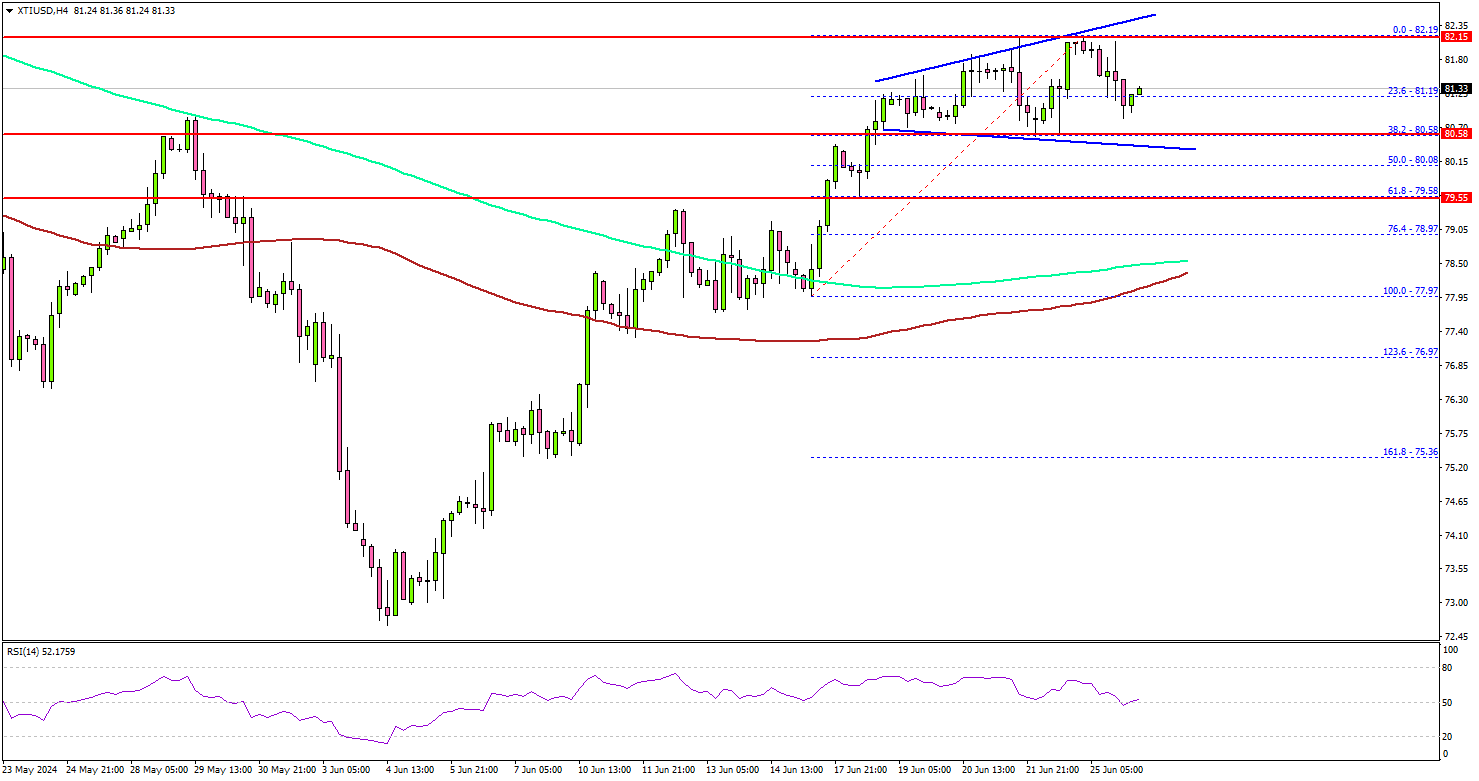
There was a drop below the $81.80 level and the price tested the 23.6% Fib retracement level of the upward move from the $77.97 swing low to the $82.19 high.
On the upside, the price is facing hurdles near the $82.20 level. There is also a key expanding triangle forming with resistance at $82.50 on the same chart. The next major resistance is near the $83.20 zone, above which the price may perhaps accelerate higher. In the stated case, it could even visit the $84.50 resistance.
If not, the price might start a steady downside correction. The first major support on the downside is near the $80.50 level. The next major support is at $79.60 or the 61.8% Fib retracement level of the upward move from the $77.97 swing low to the $82.19 high.
Any more losses might send oil prices toward $78.50 or the 100 simple moving average (red, 4-hour) in the coming sessions.
Looking at Bitcoin, there was a sharp decline below the $60,000 level, and now the bulls are attempting a recovery wave from $58,500.
Economic Releases to Watch Today
- US New Home Sales for May 2024 (MoM) – Forecast -2.9% versus -4.7% previous.
GBPCHF Wave Analysis
- GBPCHF reversed from support level 1.1220
- Likely to rise to resistance level 1.1450
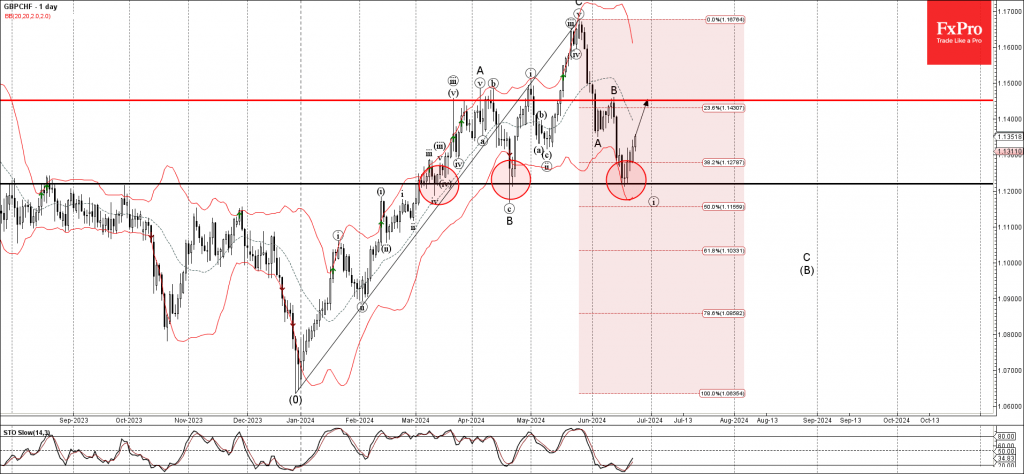
GBPCHF currency pair continues to rise after the earlier upward reversal from the pivotal support level 1.1220 (which stopped the two previous corrections iv and B).
The upward reversal from the support level 1.1220 created the daily Japanese candlesticks reversal pattern Morning Star Doji.
Given the predominant daily uptrend and the continuation of the bearish Swiss franc sentiment across the FX markets, GBPCHF currency pair can be expected to rise further to the next resistance level 1.1450 (top of the previous wave B).
USDCAD Wave Analysis
- USDCAD reversed from key support level 1.3620
- Likely to rise to resistance level 1.3700
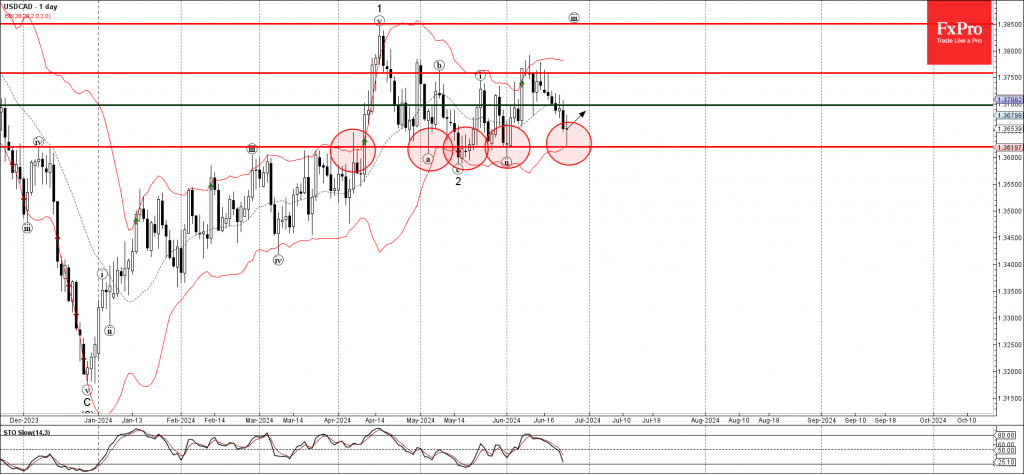
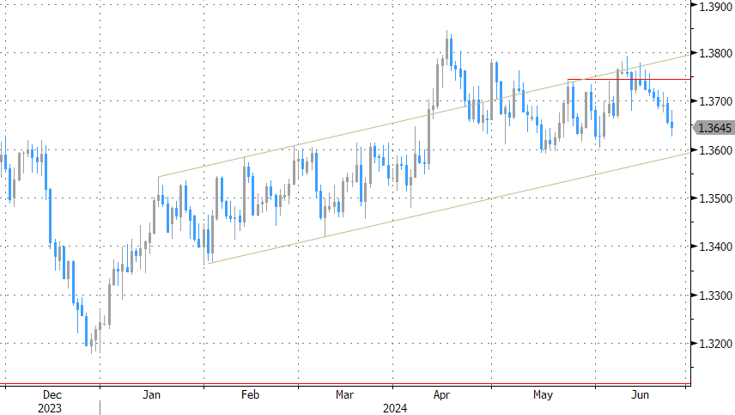
USDCAD currency pair today reversed up with the long-legged Doji from the key support level 1.3620 (which has been steadily reversing the price from the start of May, as you can see below).
The support level 1.3620 was strengthened by the intersecting lower daily Bollinger Band.
Given the strength of the support level 1.3620 and the clear daily uptrend, USDCAD currency pair can be expected to rise further to the next resistance level 1.3700.
Could Tokyo CPI Make the July BoJ Meeting a Live One?
- BoJ meeting minutes summary keep the door open to a July rate hike
- Key data due this week, especially Friday’s Tokyo CPI
- Retail sales data to show consumer appetite
- Yen remains under pressure as officials avoid verbal intervention
The BoJ is still willing to hike rates
On June 14, the Bank of Japan kept its interest rate unchanged and failed to surprise the market. Despite reaching an agreement to reduce the current bond buying programme, BoJ members opted to announce the reduced amount at the July meeting, disappointing the growing expectations for another hawkish move by the BoJ.
It looks like the Nikkei article highlighting that the BoJ is indeed considering scaling back the purchases, published before the meeting, caught Governor Ueda et al off guard. One would have expected better preparation from the BoJ, but at least they now appear to be heading in the right direction as BoJ officials are scheduled to hold meetings with main Japanese bond market players on July 9-10, ahead of the July 31 gathering.
The July meeting could be a massive one
Interestingly, the Summary of Opinions from the last BoJ meeting was released earlier this week and it was a touch more hawkish than anticipated. There seems to be good support for further action on the rates front and for significantly curtailing the bond buying programme. But, at the end of the day, economic data releases during July should dictate the new size of the bond programme and the realistic possibility of another rate hike. The market is currently pricing in 19bps of rate hikes until year-end, while it is currently looking for 48bps of rate cuts by the Fed by end-2024.
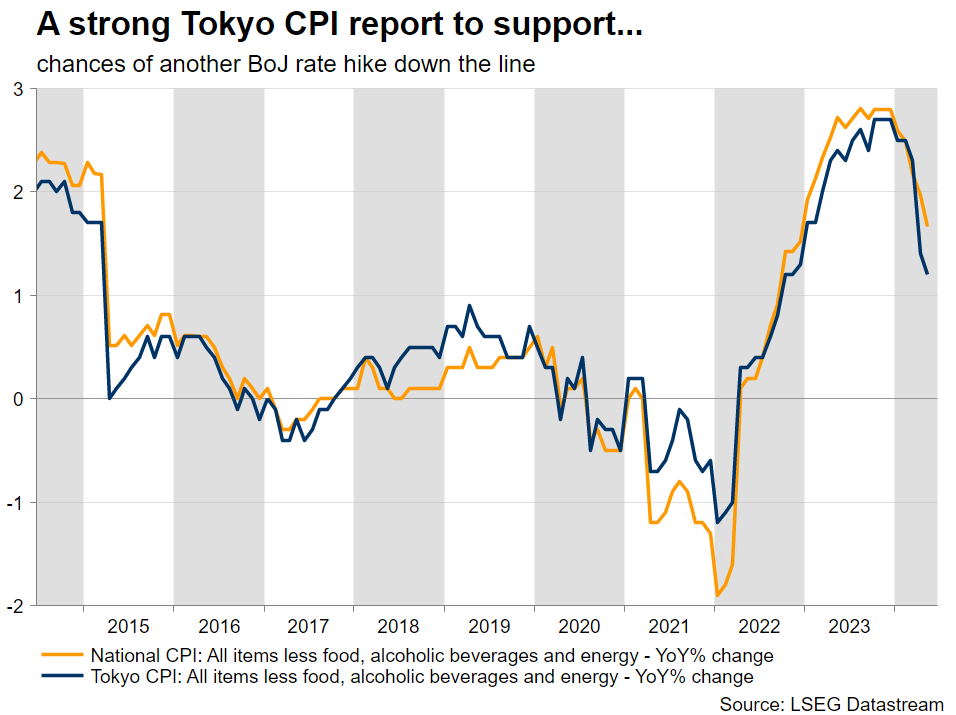
Tokyo CPI released on Friday
On Friday, the Tokyo CPI for the month of June will be published. There will be another release of this inflation report on July 30, a day before the actual BoJ meeting, but Friday’s print is important for sentiment. The market is looking for a small uptick across the board, albeit nothing worthwhile to affect the chances for a rate hike in July. The BoJ hawks would probably appreciate an upside surprise on Friday following the recent relatively weaker prints seen in the national inflation rates.
Retail sales key for the BoJ outlook
What is more crucial for the BoJ though is the demand side of the economy. Governor Ueda has repeatedly talked about the need for demand-led inflation and thus raising the importance of the annual wage negotiations. However, despite the positive developments recorded on this front earlier in 2024, these strong pay increases have yet to translate into higher consumer spending.
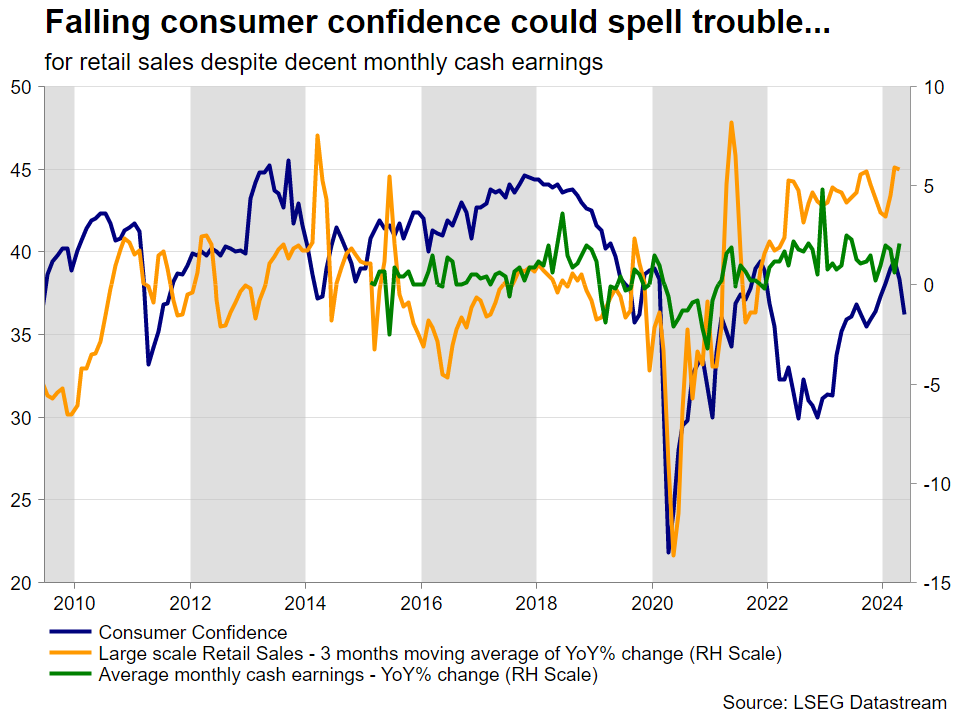
More specifically, consumer confidence is getting weaker, and the annual pace of retail sales has eased considerably since the latter part of 2023. Part of the reasons for this situation is the public’s frame of mind after almost 30 years of deflation and the aggressive depreciation of the yen.
The BoJ might not be overly negative about the ongoing yen weakness as it is probably boosting exports and should, down the line, benefit the domestic industrial sector. The preliminary industrial production data for May will be published on Friday, ahead of next week’s key quarterly Tankan survey, and it would be interesting to see any impact from April’s yen move.
Dollar/yen close to intervention levels
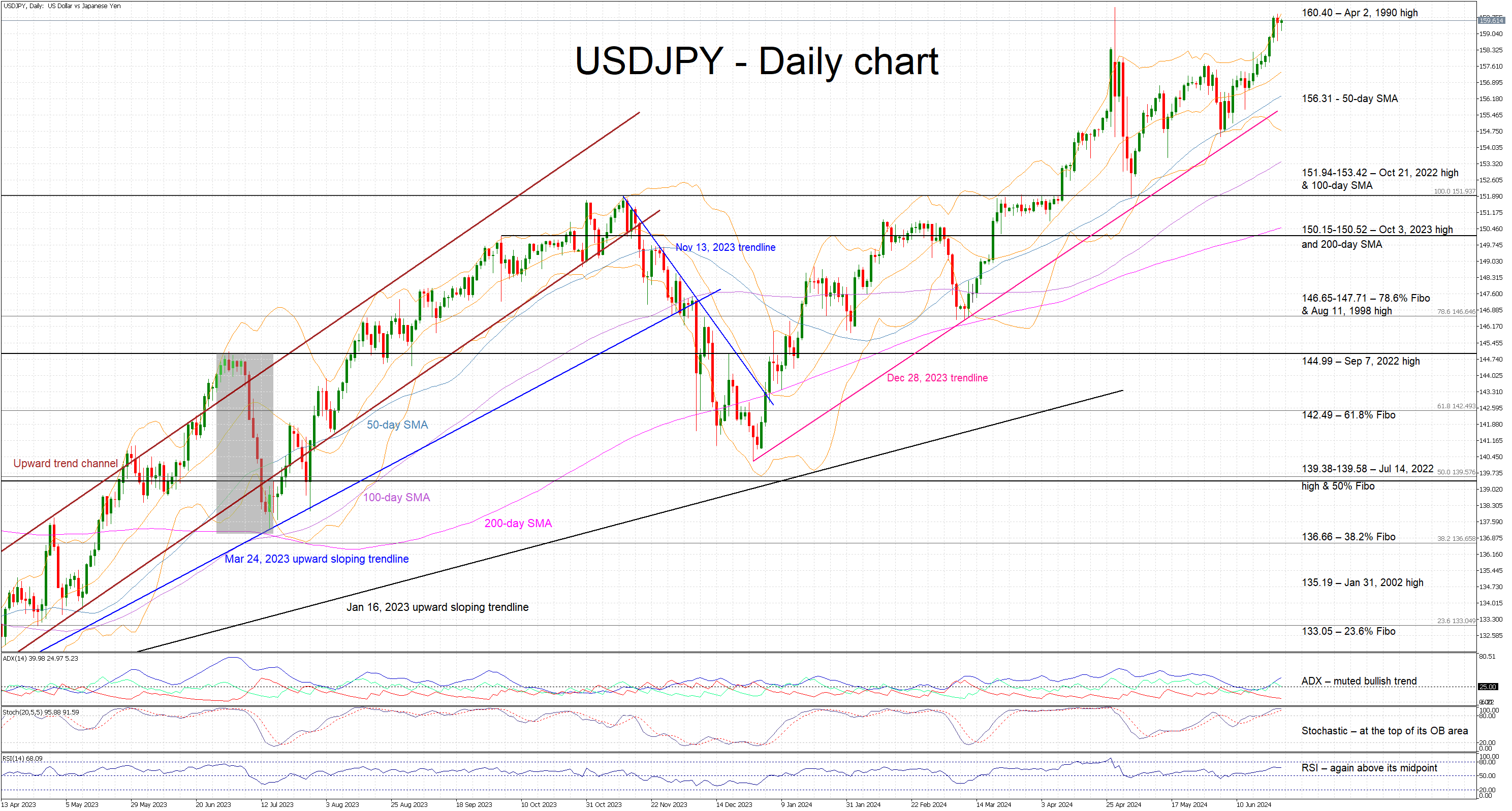
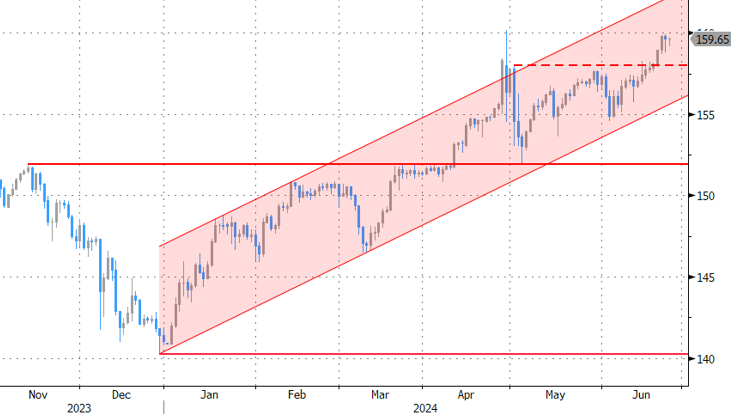
In the meantime, dollar/yen is trading a tad below 160-yen level and sounding an alarm at the trading floors of the big investment houses. The last time this pair traded at similar levels was in late April when the BoJ intervened twice and pushed it lower. That correction proved short-lived though as the chances of a Fed rate cut ahead of the November US presidential election remain low.
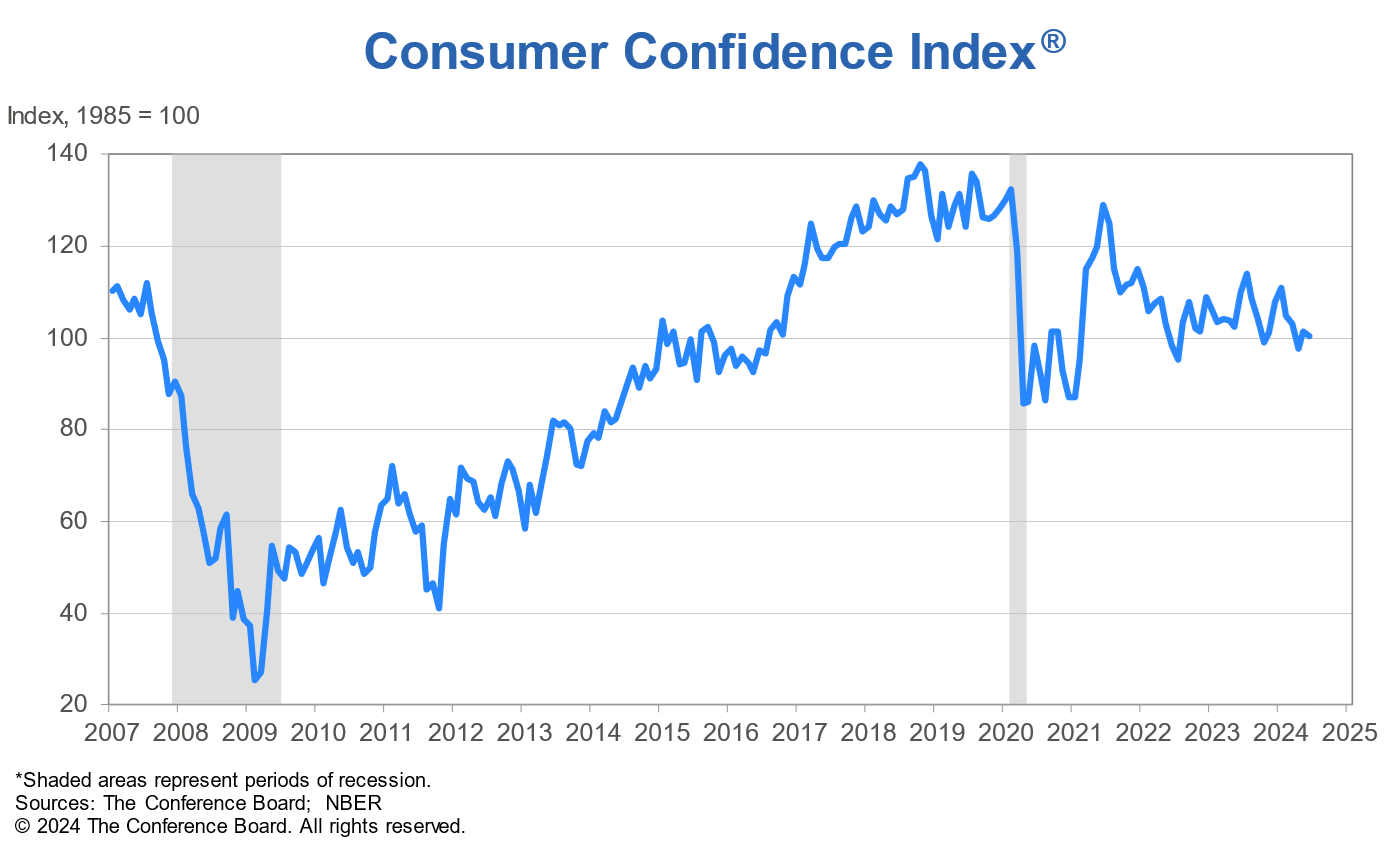
US consumer confidence falls to 100.4, within the same narrow range
US Conference Board Consumer Confidence fell from 101.3 to 100.4 in June, slightly above expectation of 100.2. Present Situation Index rose from 140.8 to 141.5.
Expectation Index fell from 74.9 to 73.0. The Expectations Index has been below 80 (the threshold which usually signals a recession ahead) for five consecutive months.
"Confidence pulled back in June but remained within the same narrow range that's held throughout the past two years, as strength in current labor market views continued to outweigh concerns about the future. However, if material weaknesses in the labor market appear, Confidence could weaken as the year progresses," said Dana M. Peterson, Chief Economist at The Conference Board.
Canada: Inflation Accelerates in May
Headline CPI inflation edged higher in May to 2.9% year-on-year (y/y), above expectations for a 2.6% y/y print.
The acceleration was led by services, which were up 4.6% y/y, as Canadians were paying up for travel tours (+6.9% y/y) and flights (+4.5% y/y). This continues a trend where Canadians have been increasingly willing to spend on experiences rather than physical goods.
Shelter inflation also remained hot, coming in at 6.4% y/y (same as April). Rents were up an eyewatering 9.0% y/y, while mortgage interest cost inflation remained sky high at 23.3% y/y.
Goods inflation held steady at 1.0% y/y. This has been kept low by falling durable goods prices, which clocked in at -0.8% y/y (same as April). Discounting at furniture and home improvement stores continues to support easing price pressures.
In other disappointing news, the Bank of Canada's preferred "core" inflation measures rose to 2.9% y/y in May, up from 2.7% y/y in April. On a three-month annualized basis, the average moved from 1.6% in April to 2.5% in May. The BoC's former preferred measure, CPIX, went from 0.8% on the three-month basis to 2.1%. While these figures are still within the BoC's target range, they aren't moving in the right direction.
Key Implications
While this wasn't as big of a letdown as the Oilers' game last night, today's CPI print was a disappointment. Not only did the headline print unexpectedly rise, the average of the BoC's core inflation rates increased for the first time in 2024! This was driven by big price swings in a number of services categories. Big increases were seen in areas related to housing and travel – two sources of unrelenting price pressures over the last year.
Today's report won't instill any added confidence for the Bank of Canada. The central bank cut interest rates in early-June because it gained sufficient conviction that it had inflation under control. Just yesterday, Governor Macklem said in a speech, "since January, inflation has been below 3%, and our measures of underlying inflation have eased steadily. This has increased our confidence that inflation will continue to move closer to the 2% target this year." Now, one bad inflation print doesn't make a trend, and inflation remained below 3%. But it does speak to the unevenness of the path back to 2%. For this reason, we think the BoC will likely pause at its July meeting, before cutting rates again in September.
Sunset Market Commentary
Markets
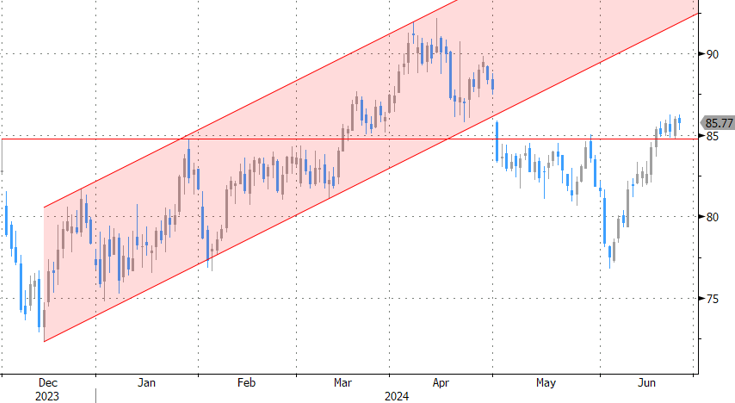
US and EMU (interest rate) markets today are holding tight ranges with trading mostly technical in nature. If anything markets still err to rather dovish bias, with yields on both sides of the Atlantic hold with reach of recent lows. There were no data in EMU. In the US, the Philly Fed non-manufacturing index and the Chicago Fed national activity index printed on the better side of expectations. US S&P Corelogic house prices also were slightly stronger than expected. Fed’s Bowman, one of the hawkish members within the Fed FOMC, understandably still warned on upside inflation risks. She reiterated that rates will have to be kept high for some time. She still sees no room for interest rate cuts this year and as such shifted the expected cuts to next year. Amongst others, she also warned a fiscal stimulus and on a loosening of financial conditions as potential risks to the inflation outlook. The comments were no surprise. Still, US yields gradually reversed a tentative decline to currently add between 1.0 and 2.0 bps. Later today, the US consumer confidence (Conference Board) and a 2-yr $ 69 bln auction of US Treasuries still are worth looking at. Bunds slightly outperform Treasuries with yields easing about 1 bp across the curve. After some modest narrowing yesterday, spreads of France (10-yr +1 bp) and peripheral bond markets (Italy+3 bps) again widened slightly as investors are counting down the first round of the French elections this weekend. European equities couldn’t hold on to yesterday’s constructive start of the week. The EuroStoxx 50 is ceding about 0.5%. US indices, after yesterday’s setback in AI relates stocks today open mixed to marginally stronger (S&P + 0.15%). Recent rebound in oil shows tentative signs of running into resistance (Brent $ 85.75 p/b).
On FX markets, the dollar slightly outperforms today. DXY trades near 105.62. EUR/USD struggles not the fall back below the 1.07 handle (1.0705). The market focus remains on the USD/JPY cross rate. At 159.65, it still trades only a whisker away from the 160 area that trigger BoJ interventions end-April/early May. However, looking at the USD/JPY price pattern, markets apparently have little confidence that Japanese authorities will be able to change fortunes for the yen in a sustainable way. EUR/GBP also show no clear directional trend trading marginally weaker at 0.8445, probably due to euro softens rather sterling strength.
News & Views
Canadian inflation unexpectedly accelerated in May. Coming in at 0.6% m/m – double the 0.3% expected – the yearly figure increased from 2.7% to 2.9% (2.6% anticipated). Statistics Canada said the quickening was largely due to higher prices for services (4.6% y/y, up from 4.2%). Prices for goods (+1%) rose at the same rate as in April. The Bank of Canada’s core inflation gauges snapped a four-month y/y decline with the average picking up from 2.7% to 2.85%. The central bank earlier this month lowered the policy rate a first time to 4.75% amidst “continued evidence that underlying inflation is easing”, agreeing that monetary policy “no longer needs to be as restrictive” as it was. Today’s CPI reading is the first of two in total that the BoC will have at its disposal at the next policy meeting July 24. For now, though, they significantly raise the bar for a follow-up rate cut. Canadian money markets have pared odds for a July move from 62% to about 40%. The Canadian dollar quickly erased a kneejerk strengthening move with USD/CAD currently trading unchanged around 1.365.
Three people familiar with the Bank of Japan’s thinking said a rate hike would be on the table at each policy meeting, including July’s. One of the sources said that given what’s happening with inflation, interest rates are clearly too low. Governor Ueda in recent appearances also highlighted the possibility of that to happen, not surprisingly in the wake of recent JPY weakness. If the BoJ would indeed hike rates from 0-0.1% currently, it would come as a surprise to some 50% of the market. Moreover, it may come in tandem with a detailed plan on how the central bank plans to trim bond buying (currently JPY 6tn per month) and reduce the size of its $5tn balance sheet. Given the re-weakening of the Japanese yen to historical lows, any QT plan needs to be ambitious enough, creating the potential of the BoJ announcing bigger-than-expected buying cuts on July 31.
Graphs
USD/CAD: Loonie gains a few ticks as unexpected jump in inflation questions room for BOC follow-up rate cuts anytime soon.
USD/JPY: markets testing Japanese authorities’ preparedness to stem the decline of the yen.
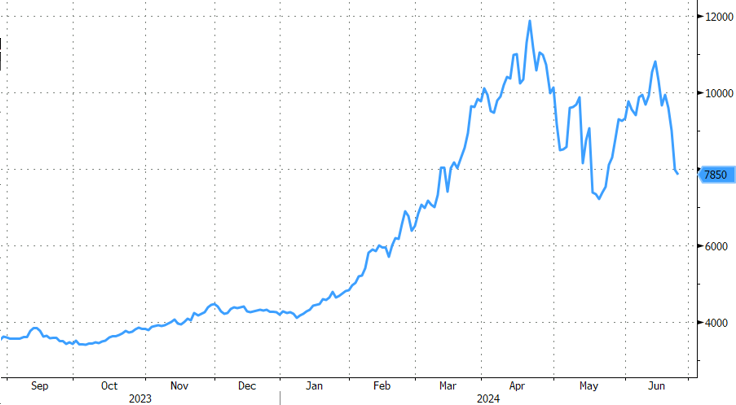
Cocoa prices extends decline on rumoured exit of long positions both of commercial parties and funds.
Brent oil ($ p/b): rebound running into resistance
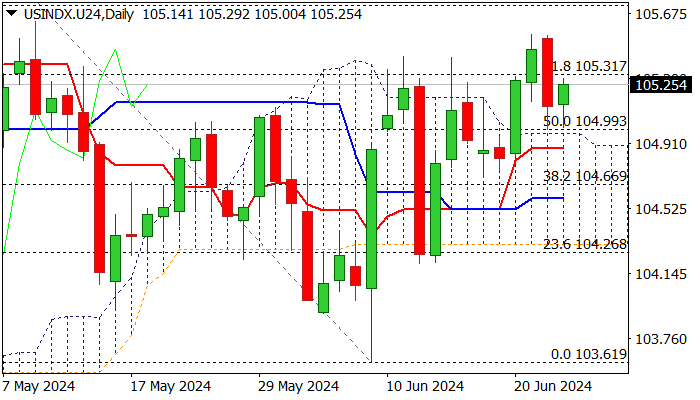
Dollar Index: Bullish Bias Above Daily Cloud, US Inflation Data in Focus
The dollar index regained traction on Tuesday and ticked higher after dropping 0.4% on Monday.
Pullback was contained by daily cloud top and marked a light correction of a larger uptrend, which remains intact.
Technical picture on daily chart remains bullish, as MA’s are in bullish setup, positive momentum is strong and price action underpinned by daily cloud.
Markets await release of US inflation data (PCE) on Friday, to get more clues about Fed’s rate path, which is expected to strongly influence dollar’s performance.
Focus will be also on the first debate of US presidential candidates, French election, as well as on geopolitics, especially after the latest signals that the conflict may spread on Lebanon.
Bullish near term bias is expected above 105.00 support (cloud top / 10DMA) for renewed attempt towards 105.71 (Fibo 76.4% of 106.36/103.61), while loss of 105 handle would weaken the structure and risk deeper drop towards 104.47/28 (100 / 200DMA’s respectively.
Res: 105.54; 105.71; 106.00; 106.36.
Sup: 105.00; 104.78; 104.47; 104.28.
USD/JPY Mid-Day Outlook
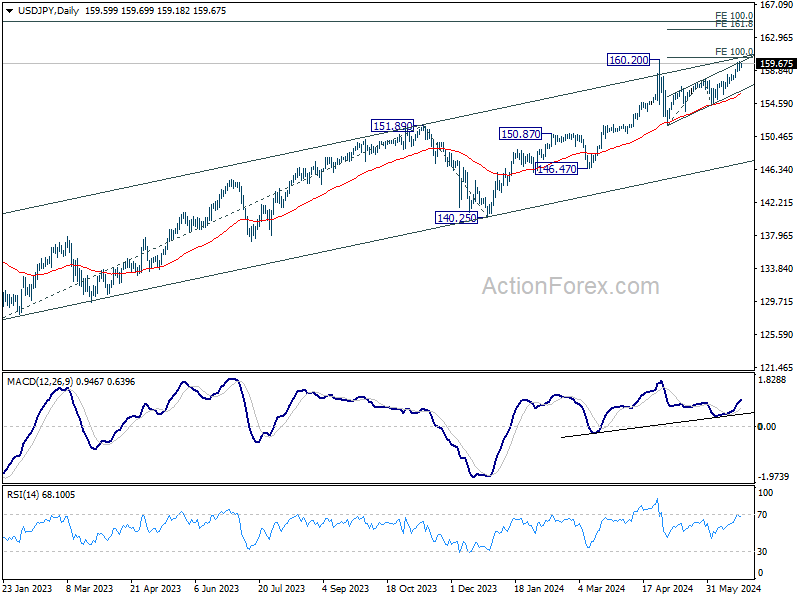
Daily Pivots: (S1) 158.95; (P) 159.43; (R1) 160.11; More...
Intraday bias in USD/JPY remains neutral for the moment. Further rise will remain in favor as long as 157.70 resistance turned support holds. Sustained break of 106.20 and 100% projection of 151.86 to 157.70 from 154.53 at 160.37 will confirm long term up trend resumption, and pave the way to 161.8% projection at 163.97. Nevertheless, firm break of 157.70 will turn bias back to the downside for channel support (now at 156.26) first.
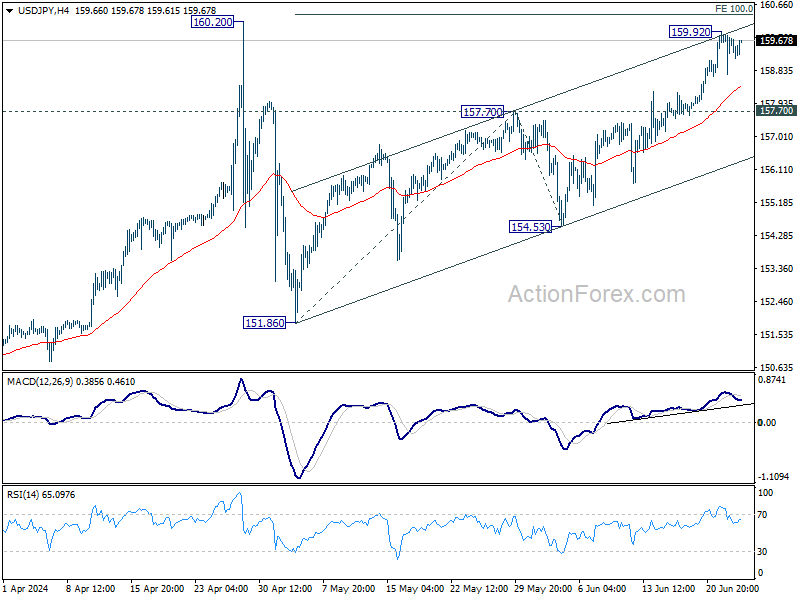
In the bigger picture, there is no sign of long term trend reversal yet. Further rally is expected as long as 150.87 resistance turned support holds. Decisive break of 160.02 will target 100% projection of 127.20 to 151.89 from 140.25 at 164.94.