Sample Category Title
USD/CAD Daily Outlook
Daily Pivots: (S1) 1.3575; (P) 1.3618; (R1) 1.3646; More...
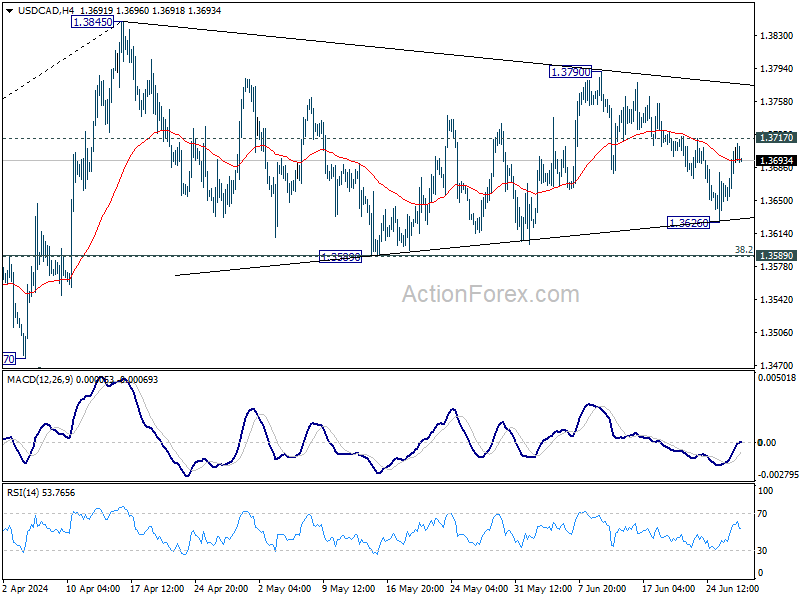
USD/CAD's fall from 1.3845 resumes with break of 1.3608 support. Intraday bias is back on the downside, and further fall would be seen to 100% projection of 1.3845 to 1.3608 from 1.3761 at 1.3524. Sustained trading below 55 D EMA (now at 1.3631) will argue that whole rise from 1.3176 has completed already. For now, risk will stay on the downside as long as 1.3689 resistance holds, in case of recovery.
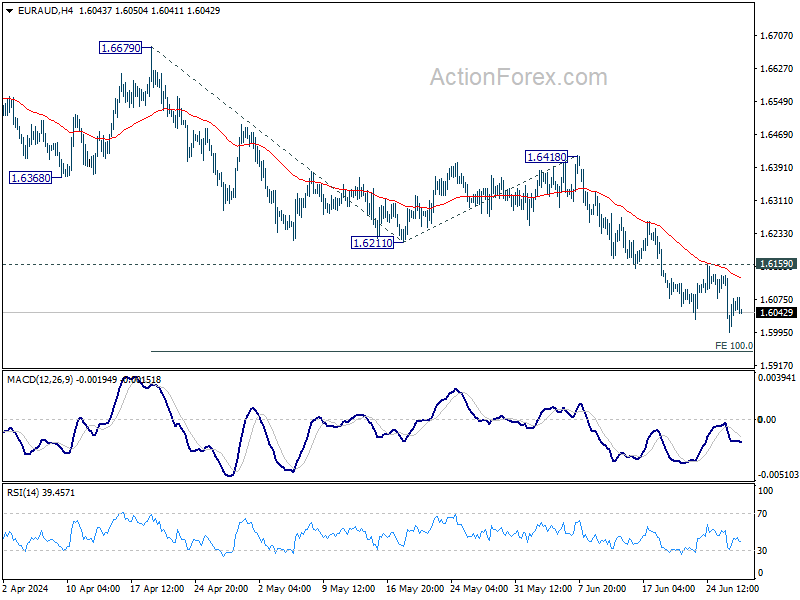
In the bigger picture, price actions from 1.3976 (2022 high) are viewed as a corrective pattern. In case of another fall, strong support should emerge above 1.2947 resistance turned support to bring rebound. Firm break of 1.3976 will confirm up resumption of whole up trend from 1.2005 (2021 low). Next target is 61.8% projection of 1.2401 to 1.3976 from 1.3176 at 1.4149.
AUD/USD Daily Report
Daily Pivots: (S1) 0.6645; (P) 0.6670; (R1) 0.6720; More...
Intraday bias in AUD/USD remains on the upside at tis point. Sustained break of 61.8% projection of 0.6464 to 0.6645 from 0.6578 at 0.6690 will target 100% projection at 0.6759. On the downside, below 0.6645 will turn intraday bias neutral first. But further rally is expected as long as 0.6578 support holds, in case of retreat.
In the bigger picture, price actions from 0.6169 (2022 low) are seen as a medium term corrective pattern to the down trend from 0.8006 (2021 high). Fall from 0.7156 (2023 high) is seen as the second leg, which could have completed at 0.6269 already. Rise from there is seen as the third leg which is now trying to resume through 0.6870 resistance.
Loss of Interest Rate Support Put Dollar in the Defensive
Markets
US CPI inflation contrasted with the PPI shocker (+0.5% M/M) from Tuesday. Price pressures eased slightly in April (0.3% M/M for headline and core; down from 0.4% M/M for both in March) but the CPI report was in line with expectations. Flanked by disappointing US retail sales (flat M/M) and a weaker May Empire Manufacturing business survey (-15.6 from -14.3), it triggered an outsized relief rally on markets. US Treasuries were already well bid in the run up to the data and extended gains afterwards. US yields eventually dropped 8.6 bps (30-yr) to 10.9 bps (5-yr) across the curve. From a technical point of view, they fell back to or even below the levels from before the previous (March) inflation report which triggered the opposite market reaction. We consider these levels as first important support which should be able to hold into this week’s close. For the US 2-yr and 10-yr yield, these levels are respectively 4.7% and 4.35%. The loss of interest rate support put the dollar in the defensive with EUR/USD currently testing a similar reference at 1.0885. US stock markets cheered at the outcome, rallying 0.9% to 1.4% with new all-time highs for the Dow Jones, S&P 500 and Nasdaq. While we don’t expect yesterday’s data to alter current Fed thinking – on hold for longer -, they did influence US money markets. 25 bps rate cuts are now discounted for the September and December meetings with January (50%) coming into play for a third move. Today’s eco calendar is again well-filled in the US with weekly jobless claims, housing data (starts & permits), the Philly Fed business outlook, industrial production figures and import/export prices. Fed speakers include Goolsbee, Barkin, Harker, Mester and Bostic. We don’t expect them to bring a July rate cut back into play, suggesting a slowing in this week’s trends.
Yesterday’s US Treasury rally had global repercussions with European and UK bond yields facing more or less similar losses. An avalanche of ECB members hits the wires today as well, but they won’t alter their common message. A June rate cut is a done deal, but the central bank won’t pre-commit to a specific rate path in H2 2024. Next week’s Q1 wage data could already be a first complicating factor in embarking on a genuine cutting cycle.
News & Views
Japanese GDP growth contracted by 0.5% Q/Q (-2% Q/Qa) in Q1.The outcome was worse than expected. Making the picture even less compelling, Q4 2023 growth faced a downward revision from 0.4% Q/Qa to 0%. Private consumption declined for a fourth consecutive quarter (-0.7% Q/Q), illustrating the impact of negative real income growth on spending. Private investment fell by 0.8% Q/Q. Net exports also subtracted a net 0.3 ppts from growth as exports declined more than imports. Some of the factors weighing on growth (earthquake in January, lower production in the automobile sector) might have been temporary in nature, but still the picture looks unconvincing. The price deflator of the series slowed less than expected from 3.9% to 3.6%. Weak data don’t make it easier for the BoJ to continue policy normalization. However, in this process the focus will probably be on wage growth with persistent yen weakness also being in play. The Japanese currency this morning extends yesterday’s rebound, but this is mainly driven by USD-weakness in the wake of yesterday’s data.(USD/JPY 154).
After slightly softer than expected Q1 wage data published yesterday, Australian April jobs data this morning added to evidence that the labour market is cooling. Employment rose a bigger than expected 38.5k, but this didn’t suffice to cope with an even more pronounced rise in the labour force. This caused the unemployment rate to rise from 3.9% to 4.1%, matching the ST peak level from January. The combination of slower wage growth and a higher unemployment rate might give some comfort to the RBA as it still looks for more convincing signs that inflation is heading back to its 2-3% inflation target. Australian yields this morning declined further, reinforcing yesterday’s global trend (3-yr: -13 bps). After briefly trading above AUD/USD 0.67 this morning, the Aussie dollar reversed initial gains (currently 0.668). Still the picture turned more constructive after yesterday’s break above the 0.667 area.
Graphs
GE 10y yield
ECB President Lagarde clearly hinted at a summer (June) rate cut which has broad backing. EMU disinflation continued in April and brought headline CPI closer to the 2% target. Together with weak growth momentum, this gives backing to deliver a first 25 bps rate cut. A more bumpy inflation path in H2 2024 and the Fed’s higher for longer strategy make follow-up moves difficult. Markets have come to terms with that.
US 10y yield
The Fed in May acknowledged the lack of progress towards the 2% inflation objective, but Fed’s Powell left the door open for rate cuts later this year. Soft US ISM’s and weaker than expected payrolls supported markets’ hope on a first cut post summer, triggering a correction off YTD peak levels. Sticky inflation suggests any rate cut will be a tough balancing act. 4.37% (38% retracement Dec/April) already might prove strong support for the US 10-y yield.
EUR/USD
Economic divergence, a likely desynchronized rate cut cycle with the ECB exceptionally taking the lead and higher than expected US CPI data pushed EUR/USD to the 1.06 area. From there, better EMU data gave the euro some breathing space. The dollar lost further momentum on softer than expected early May US data. Some further consolidation in the 1.07/1.09 are might be on the cards short-term.
EUR/GBP
Debate at the Bank of England is focused at the timing of rate cuts. Most BoE members align with the ECB rather than with Fed view, suggesting that the disinflation process provides a window of opportunity to make policy less restrictive (in the near term). Sterling’s downside turned more vulnerable with the topside of the sideways EUR/GBP 0.8493 - 0.8768 trading range serving as the first real technical reference.
Phew, Risk Rally On Post-US CPI
All’s well that ends well. US inflation came in line with expectations yesterday; core CPI fell for the first time in six months and the monthly CPI figure was a bit lower than expected. Cherry on top, retail sales stagnated in April and came to cement the idea that the US economy could be finally slowing along with the first insight from Home Depot, earlier this week, that missed revenue expectations and warned of slowing consumer demand due to the high-rate environment. Other big US retailers will be revealing their results in the coming hours and days, and they might reinforce the slowing demand narrative.
The combination of slowing growth and softer inflation is a godsend for equity markets who needed this boost; there is nothing more appetizing for investors than the smell of lower future rates.
The US 2-year yield retreated to 4.70% to reflect this 50bp cut expectation, activity on Federal Reserve (Fed) funds futures now give around 75% chance for the first cut to arrive in September, regardless of the fact that September could be a politically sensitive month for the Fed to start cutting the rates.
The S&P500, Nasdaq 100 and the Dow Jones, all renewed record yesterday. Across the Atlantic Ocean, the sky was as sunny – at least in the market – the Stoxx 600 and the FTSE 100 renewed record, and the Swiss SMI reached the highest levels in two years. What a blast!
In the FX markets, not seeing a 4th straight month of hotter inflation sent the US dollar index tumbling to below its 200-DMA. The dollar index slipped below the major 38.2% retracement on ytd rally and has officially stepped into the bearish consolidation zone. Even though the latest inflation numbers prove to be far from the Fed’s 2% policy target especially considering the slowing pace of easing, the possibility that the acceleration in the first three months of the year could be temporary keeps the Fed doves in a sweet spot for a while. I revise my USD outlook to neutral-bearish for the weeks to come.
But
The EURUSD is flirting with the 1.09 level this morning, and is now comfortably above its own 38.2% Fibonacci retracement on ytd decline, and could extend gains to 1.0930. Clearing the 1.10 resistance will take more than just a sigh of relief. The European Central Bank (ECB) is preparing to cut rates in June – before the Fed, the Fed members continue to call for patience until they are convinced that inflation is on a solid path toward the 2% target and despite yesterday’s satisfactory inflation read, that’s not the case for now. So the fact that the ECB is still one step further in its ambition to ease policy will likely keep the euro’s upside potential capped.
Cable is set to retest the 1.28 peak of the start of the year, but here as well, the dovish shift in Bank of England (BoE) expectations may not allow a rise above the 1.28 mark.
Elsewhere, the softer dollar lifts some of the burden off the USDJPY, especially after the latest GDP data – released today - warned that growth in Japan shrank more than expected in Q1 and lowered the chances of seeing the Bank of Japan (BoJ) normalize its policy soon. Happily for the BoJ, the USD dollar is being sold across the board, otherwise we would’ve seen another spike in the USDJPY. The trend and momentum indicators remain supportive of a further decline and the downside correction could continue toward the 152.85 without the need to change the narrative. But the BoJ’s reluctance to act could make a move below this 152.85 level complicated. The USDCHF, on the other hand, could see its rally slowdown, but a slower depreciation of the Swiss franc is not bad for inflation in Switzerland and will allow the SNB to continue cutting the rates later this year. Therefore, the USDCHF outlook remains positive, regardless. Support is seen near the 0.90 level.
In metals and commodities, gold bulls eye a fresh record on the back of softening US yields and a broadly softer US dollar. The barrel of US crude rebounds above the 100-DMA after tipping a toe below the $77pb level yesterday. Yesterday’s satisfactory US inflation data keeps the perspective of major central bank rate cuts wide-open and supports the continuation of the reflation trade. In this reflation context, US crude could reclaim an advance to $80pb.
Copper futures hit record highs, also boosted by the growing demand from EV makers and data centers. The latter could help Anglo American cement and extend gains after they rejected BHP’s second offer this week and announced to exit their diamond, platinum and coal mining to focus on copper and iron ore.
Scandi Inflation Expectations on Today’s Menu
In focus today
In the US, April industrial production data is due for release.
In the euro area, industrial production data for March and employment growth for Q1 are scheduled for release. The current strong labour market gives upside risks to wage growth and thereby domestic inflation.
In Denmark, the government will publish an update on the budget for 2024. For more detail, please see our Fixed income morning comment.
In Sweden, the monthly Prospera survey is published at 08.00 CET. Inflation expectations are at 2.0% on all horizons. Vice governor Martin Flodén is scheduled for his last speech as he steps down on 21 May, after eleven years in the Board.
In Norway, GDP for Q1 is released. There has been a clear pick-up in Norwegian growth in Q1, as the manufacturing sector is lifted by higher demand from abroad as well as the oil sector. We expect mainland-GDP grew 0.3 % q/q in Q1 with risk fairly balanced from seasonality around Easter. Also, Norges Bank will publish the Expectations Survey for Q2, where we expect inflation expectations to be moving lower but wage expectations to remain elevated.
Overnight, China will release the monthly batch of data for retail sales, home sales, home prices, industrial production etc. Focus is still on retail sales and home sales as proxies for how the housing crisis and the domestic economy is doing.
Economic and market news
What happened overnight
In Japan, national accounts for Q1 were released, showing GDP declining faster than expected at -0.5% q/q (cons: -0.4%). Private consumption, which accounts for more than half of Japan's GDP, fell by 0.7% q/q (cons: -0.2%) as consumers reduced spending amid a weaker yen driving up food and energy costs. This marks the fourth consecutive quarter of decline in private consumption. Additionally, capital spending decreased by 0.8% q/q (cons: -0.7%), while external demand was -0.3% q/q, in line with expectations.
What happened yesterday
In the US, April inflation was slightly lower than expected on headline level at 0.3% m/m SA (cons: 0.4), while core inflation was close to expectations, printing 0.29% m/m SA (cons: 0.3%). Modest core goods deflation continued, while shelter and health care prices saw moderating inflation pressures - for more detail please see Global Inflation Watch - April US CPI signals cautious relief for the Fed, 15 May.
US retail sales came in markedly lower than expected at 0.0% m/m SA (cons: 0.4%), while the control group sales (measure which strips out the most volatile components) declined some 0.3% m/m SA (cons: 0.1%). The seemingly large downtick can mainly be attributed to a less favourable seasonal adjustment factor, although the downside miss also gives hints about some underlying weakness as well. Overall, this supports our case that the Fed will still cut rates this year, where we call for the first cut in September.
In Europe, Slovak Prime Minister Robert Fico was shot multiple times in an assignation attempt. According to Slovak government officials, he is no longer in life-threatening condition.
In Sweden, April CPIF and core inflation (CPIF excluding energy) stood at 2.3% and 2.9%, respectively, 0.4 percentage points below the Riksbanks's forecasts - positive news for the Riksbank. Consequently, as previously expressed by the Riksbank, further rate cuts are anticipated this year. Decomposing the print reveals that rent price increases were lower than expected, which is puzzling given the recent discussion about the dramatic upcoming increases in rents and condominium association fees. Additionally, the volatile components of electricity prices, charter and plane tickets dragged the figure down, while hotel and restaurant prices rose slightly.
On the commodity scene, the International Energy Agency (IEA) pared its 2024 oil demand growth forecast, projecting that global demand will increase by 1.1m bpd this year, down 140k bpd from its previous forecast. The IEA attributed the lower forecast to weak industrial activity and a mild winter, which reduced gasoil consumption, particularly in Europe, where the declining share of diesel cars had already been affecting consumption. This downward revision contrasts with the forecast presented by OPEC on Tuesday, widening the divergence between the two projections compared to earlier this year. Brent crude oil concluded yesterday's session somewhat higher at USD82.75/bbl.
Market movements
Equities: Global equities rallied following a softer than expected CPI print. However, the sum of macro data was much more favourable for bonds as we observed some softening signs elsewhere, which equity investors basically ignored yesterday. This was in line with our expectations, and inflation figures will continue to dominate financial markets in the coming period. Note the significant number of new all-time high in equity indices reached yesterday, including those of the S&P500 and Nasdaq. This mention is noteworthy because of the bearish investors who, a month ago, were warning of an overdue correction. One month later, most major equity indices are 5-10% higher, and no one really discussed the risk of missing out on a rally... US indices yesterday, Dow +0.9%, S&P 500 +1.2%, Nasdaq +1.4% and Russell 2000 +1.1%.
FI: The soft bag of US data released yesterday provided significant tailwinds to FI Markets throughout the session as G7 curves bull-flattened and markets added to rate cut expectations for 2024. 10Y UST/Bund yields dropped 12bp to 4.31% and 2.42% respectively. Hence, long-end EUR and USD rates are now back at our 12M targets after trading substantially above for most of the past month. And with US macro obviously losing steam, risks seem tilted towards a prolongation of the current momentum. German ASW spreads ticked marginally up throughout the session, while credit spreads were close to unchanged.
FX: In yesterday's session, EUR/USD rose to the upper end of the 1.08-1.09 range, driven by a slightly lower-than-expected US April CPI and significantly softer US April retail sales. This generally resulted in lower global yields and a broadly weaker USD, which helped USD/JPY decline toward 154. The decline in global yields provided some tailwind to risk sentiment, benefiting the Scandies, with both EUR/NOK and EUR/SEK declining toward 11.60. EUR/DKK has risen this week and has reached the April peak again around 7.4615-20.
USD/JPY Daily Outlook
Daily Pivots: (S1) 154.21; (P) 155.38; (R1) 156.08; More...
Intraday bias in USD/JPY remains on the downside at this point. Fall from 156.78 is seen as the the third leg of the corrective pattern from 160.20 high. Deeper decline would be seen to 151.86 support and possibly below. For now, risk will stay on the downside as long as 156.78 resistance holds, in case of recovery.
In the bigger picture, a medium term top might be formed at 160.20. But as long as 150.87 resistance turned support holds, fall from there is seen as correcting rise from 150.25 only. However, decisive break of 150.87 will argue that larger correction is possibly underway, and target 146.47 support next.
USD/CHF Daily Outlook
Daily Pivots: (S1) 0.9001; (P) 0.9036; (R1) 0.9057; More....
USD/CHF's fall from 0.9223 resumed by breaking 0.9005 and intraday bias is back on the downside. Deeper decline should be seen to 38.2% retracement of 0.8332 to 0.9223 at 0.8883 next. For now, risk will stay on the downside as long as 0.9101 resistance holds, in case of recovery.
In the bigger picture, price actions from 0.8332 medium term bottom are tentatively seen as developing into a corrective pattern to the down trend from 1.0146 (2022 high). Rejection by 0.9243 resistance, followed by sustained break of 38.2% retracement of 0.8332 to 0.9223 at 0.8883 will strengthen this case, and maintain medium term bearishness. However, decisive break of 0.9243 will argue that the trend has already reversed and turn medium term outlook bullish for 1.0146.
GBP/USD Daily Outlook
Daily Pivots: (S1) 1.2610; (P) 1.2648; (R1) 1.2725; More...
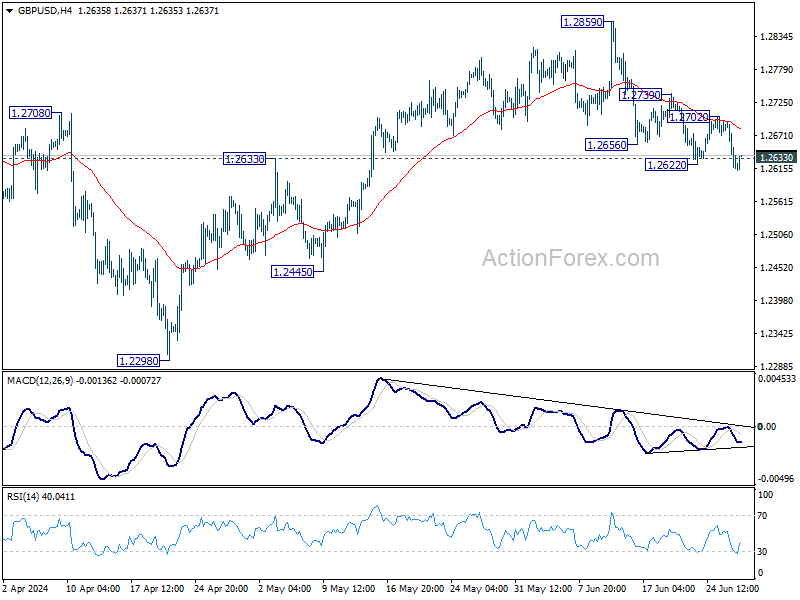
Intraday bias in GBP/USD remains on the upside as rise from 1.2298 is in progress. Firm break of 1.2780 will pave the way to 1.2892 resistance next. On the downside, below 1.2624 minor support will turn intraday bias neutral first. But further rally will remain in favor as long as 1.2445 support holds in case of retreat.
In the bigger picture, price actions from 1.3141 medium term top are seen as a corrective pattern. Fall from 1.2892 is seen as the third leg which might have completed already. Break of 1.2892 resistance will argue that larger up trend from 1.0351(2022 low) is ready to resume through 1.3141. Meanwhile, break of 1.2298 support will extend the corrective pattern instead.
EUR/USD Daily Outlook
Daily Pivots: (S1) 1.0783; (P) 1.0804; (R1) 1.0842; More...
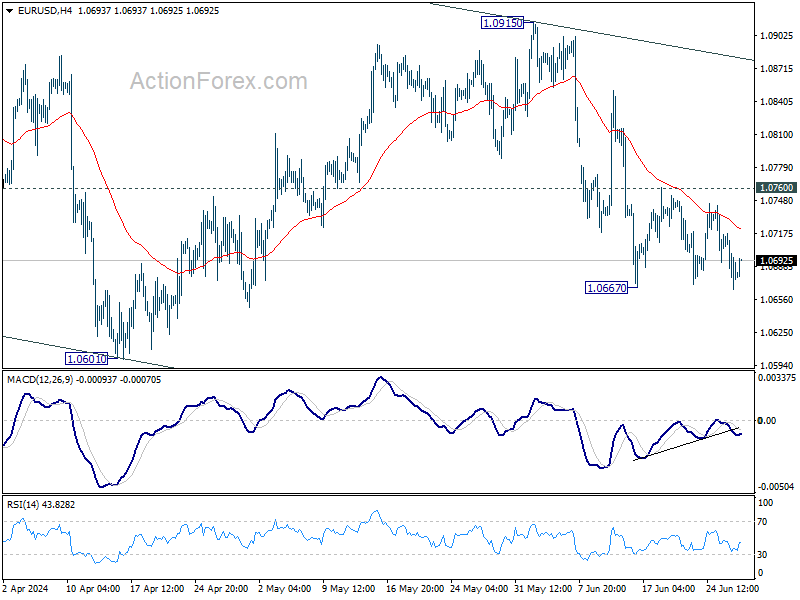
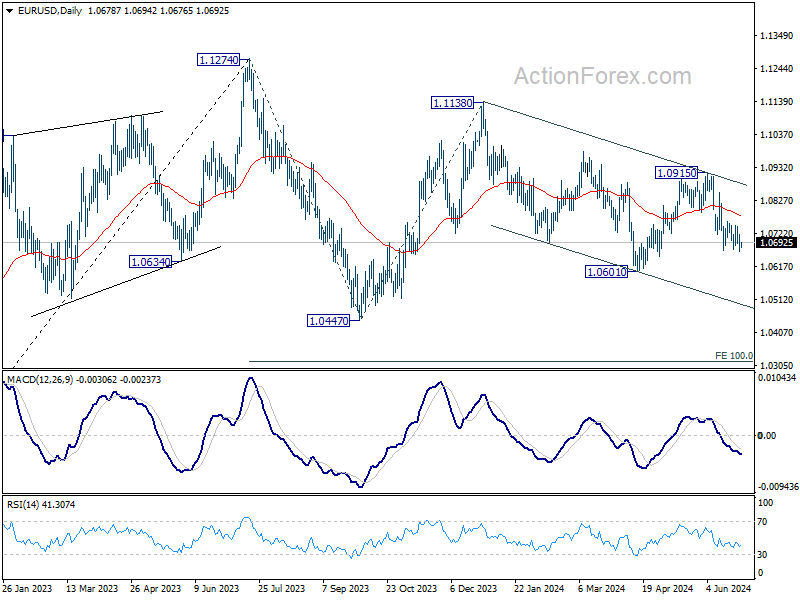
EUR/USD's rally from 1.0601 continues today and intraday bias stays on the upside. Next target is 1.0980 resistance. Decisive break there will confirm that whole fall from 1.1138 has completed already. On the downside, below 1.0833 minor support will turn intraday bias neutral first. But further rally is expected as long as 1.0765 support holds, in case of retreat.
In the bigger picture, price actions from 1.1274 are viewed as a corrective pattern. Fall from 1.1138 is seen as the third leg and could have completed. Firm break of 1.1138 will argue that larger up trend from 0.9534 (2022 low) is ready to resume through 1.1274 high. On the downside, break of 1.0601 will extend the corrective pattern instead.
Dollar Selloff Continues as Risk-On Sentiment Drives US Stocks to New Highs
Dollar faced broad sell-offs overnight and continued to weaken in Asian session. Investors breathed a sigh of relief after US CPI data indicated that disinflation is progressing, which has reignited speculation about near-term rate cuts by Fed. Or at least, another rate hike is now highly unlikely, as repeated by Chair Jerome Powell. Fed fund futures now show nearly 74% chance of a rate cut in September. Additionally, the probability of two total cuts this year has risen to around 70%. This optimism propelled NASDAQ to lead major US stock indexes to new record closes, while 10-year Treasury yield plummeted, breaking below 4.4% mark.
In the currency markets, New Zealand Dollar emerged as the strongest performer for now, further boosted by its rebound against Australian Dollar. Although Aussie also saw notable gains, its upside was capped by mixed employment data that revealed a rise in unemployment rate. British Pound is currently the second strongest currency, supported by robust wage growth data released yesterday. On the other hand, Canadian Dollar is the second weakest, following the greenback. Swiss Franc is also weak, ranking as the third worst performer. currency. Meanwhile, Euro and the Japanese Yen are positioned in the middle of the pack.
Technically, NZD/USD's strong break of falling channel resistance suggests that corrective fall from 0.6368 has completed with three waves down to 0.5851. Rise from 0.5851 is probably the third leg of the pattern from 0.5771. For now, further rise is expected as long as 55 D EMA (now at 0.6019) holds. Firm break of 0.6125 resistance will reinforce this view and should pave the way through 0.6368 to 100% projection of 0.5771 to 0.6368 from 0.5851 at 0.6448.
In Asia, at the time of writing, Nikkei is up 0.90%. Hong Kong HSI is up 1.68%. China Shanghai SSE is up 0.48%. Singapore Strait Times is up 0.82%. Japan 10-year JGB yield is down -0.030 at 0.924. Overnight, DOW rose 0.88%. S&P 500 rose 1.17%. NASDAQ rose 1.40%. 10-year yield fell -0.0890 to 4.356.
Fed's Kashkari: Current rates might be one foot on the brake, not two
Minneapolis Fed President Neel Kashkari stated overnight that Fed likely needs to keep interest rates at the current level for "a while longer," raising questions about how much they are restraining the US economy.
He highlighted that the "biggest uncertainty" is understanding the exact amount of "downward pressure" monetary policy is putting on the economy. This uncertainty means Fed "probably need[s] to sit here for a while longer" until there is more clarity on where "underlying inflation is headed" before drawing any conclusions.
He remarked on the surprising "resilience" of the economy, suggesting that current interest rates might mean "we're putting one foot on the brake and not two."
Fed's Goolsbee stresses need for housing inflation drop to reach 2% target
Chicago Fed President Austan Goolsbee, in a Marketplace interview, emphasized the importance of a significant decline in housing inflation to achieve the Fed's 2% overall target.
"It would be hard for me to see that we could get to the 2% overall target unless house prices, inflation comes down substantially from where it is right now," Goolsbee stated.
Despite the current challenges, Goolsbee remains optimistic, noting, "I'm still both optimistic and my read of the evidence is that that is going to happen." He pointed to yesterday's CPI numbers, which show some decrease in housing costs, as a positive sign.
However, he cautioned that if this trend does not continue, Fed will need to delve deeper to understand the underlying issues.
Japan's Q1 GDP contracts -0.5% qoq, weak consumption and capital spending
Japan's GDP contracted by -0.5% qoq in Q1, slightly worse than the expected -0.4% qoq decline. On annualized basis, GDP fell by -2.0%, missing forecast of -1.5% drop.
Private consumption, which makes up over half of the Japanese economy, decreased by -0.7%, exceeding anticipated -0.2% decline. This marks the fourth consecutive quarter of decline, the longest streak since 2009.
Capital spending fell by -0.8%, slightly more than the expected -0.7% decrease. This was the first decline in two quarters.
Exports declined by -5.0%, despite ongoing support from inbound tourism, while imports fell by -3.4% amid reduction in energy imports. The trade figures reflect a broader slowdown in global demand, which is impacting Japan's export-driven economy.
Australia's employment grows 38.5k in Apr, unemployment rate rises to 4.1%
Australia employment grew 38.5k in April, well above expectation of 25.3k. Full-time jobs fell -6.1k while part-time jobs rose 44.6k. Unemployment rate rose from 3.9% to 4.1%, above expectation of 3.9%. participation rate rose from 66.6% to 66.7%. Monthly hours worked was unchanged. Number of unemployed rose 30.3k or 5.3% mom.
Looking ahead
Italy's trade balance is a feature in European session. Later in the day, US will release jobless claims, building permits and housing starts, import price, Philly Fed survey, and industrial production.
EUR/USD Daily Outlook
Daily Pivots: (S1) 1.0783; (P) 1.0804; (R1) 1.0842; More...
EUR/USD's rally from 1.0601 continues today and intraday bias stays on the upside. Next target is 1.0980 resistance. Decisive break there will confirm that whole fall from 1.1138 has completed already. On the downside, below 1.0833 minor support will turn intraday bias neutral first. But further rally is expected as long as 1.0765 support holds, in case of retreat.
In the bigger picture, price actions from 1.1274 are viewed as a corrective pattern. Fall from 1.1138 is seen as the third leg and could have completed. Firm break of 1.1138 will argue that larger up trend from 0.9534 (2022 low) is ready to resume through 1.1274 high. On the downside, break of 1.0601 will extend the corrective pattern instead.
Economic Indicators Update
| GMT | Ccy | Events | Actual | Forecast | Previous | Revised |
|---|---|---|---|---|---|---|
| 23:50 | JPY | GDP Q/Q Q1 P | -0.50% | -0.40% | 0.10% | |
| 23:50 | JPY | GDP Deflator Y/Y Q1 P | 3.60% | 3.30% | 3.90% | |
| 01:30 | AUD | Employment Change Apr | 38.5K | 25.3K | -6.6K | |
| 01:30 | AUD | Unemployment Rate Apr | 4.10% | 3.90% | 3.80% | 3.90% |
| 04:30 | JPY | Industrial Production M/M Mar F | 3.40% | 3.80% | ||
| 09:00 | EUR | Italy Trade Balance (EUR) Mar | 4.77B | 6.03B | ||
| 12:30 | USD | Initial Jobless Claims (May 10) | 219K | 231K | ||
| 12:30 | USD | Building Permits Apr | 1.48M | 1.46M | ||
| 12:30 | USD | Housing Starts Apr | 1.43M | 1.32M | ||
| 12:30 | USD | Import Price Index Y/Y Apr | 0.20% | 0.40% | ||
| 12:30 | USD | Philadelphia Fed Survey May | 7.7 | 15.5 | ||
| 13:15 | USD | Industrial Production M/M Apr | 0.20% | 0.40% | ||
| 13:15 | USD | Capacity Utilization Apr | 78.40% | 78.40% | ||
| 14:30 | USD | Natural Gas Storage | 76B | 79B |