Sample Category Title
Is Fed Still on Track for a 2024 Rate Cut?
Mood among investors is not cheery into the Federal Reserve’s (Fed) latest monetary policy decision due later today. And it’s understandable. The Fed must respond to three straight month jump in inflation and probably take a step back in its plans to cut the interest rates this year. There is even a risk that the Fed drops the expectation of a rate cut in 2024; that’s the most dovish statement that could reasonably be expected from the Fed at this point, and in the light of the latest economic data.
Speaking of data, figures released yesterday came to back the idea that the Fed’s inflation battle doesn’t necessarily continue to move toward the right direction. The employment cost index rose more than expected in the Q1. The consumer confidence on the other hand sank below 100, it should yet result in slowing spending to help inflation tame – a thing that we haven’t seen yet. The S&P500 fell more than 1.5% yesterday and posted the worse performance this year, the US 2-year yield – which best tracks the Fed rate bets – advanced past the 5% level ahead of the Fed decision and the US dollar extended gains for the fourth month. Investors will watch the ADP, JOLTS and PMI numbers today, but it won’t change the fact that the first quarter of the year was marked with strong jobs data and a notably rise in US inflation. The Fed must address the inflation issue by keeping its rates higher for longer.
Holly AI
If the first few months of the year ended in tears for the Fed doves, the AI-related stocks lived up to very high expectations in the Q1. All the Maginficent 7 stocks that reported earnings so far – except from Tesla – surpassed high market expectations. Amazon posted the best beat among them, as its AWS cloud platform grew 17% compared to the same time last year thanks to sustained AI demand and its advertising services jumped 24% over the same period thanks to new ads on Prime Video.
All in all, Amazon added another piece to the AI puzzle revealing that demand for AI remained robust in the first three months of the year, but the stock price rose less than 2% in the afterhours trading as a weak sales forecast for the current quarter tempered optimism regarding the Q1 results. So maybe – but just maybe – we will see AI growth level out in Q2, and trigger a certain profit taking tech stocks?
Regardless, Amazon remains a strong AI play. They not only benefit directly from AI investments through the AWS unit, but AI also enhances the company’s ad business, as well as automated operations and logistics.
Eurozone exits recession
Eurozone grew at the fastest pace in 18 months and exited recession in the Q1. Germany, France, Italy and Spain – all - exceeded forecasts. Core inflation also slowed in April, though it slowed less than expected. Yesterday’s better-than-expected growth and hotter-than-expected inflation figures could’ve weighed on European Central Bank (ECB) doves, but traders were too busy pricing in the Fed expectations that yesterday’s minor surprises from the Eurozone couldn’t help the euro counter the increased bullish pressure in the dollar. The EURUSD slipped to 1.0650, and risks are tilted to the downside at today’s FOMC announcement.
In energy, US crude cleared the 50-DMA and slipped below the $82pb level after the latest AI report posted an almost 5-mio-barrel build in US oil inventories last week. Hope of easing geopolitical tensions keep the bears in a dominant position while the fading expectations of a Fed rate cut threatens the reflation boost. That also explains why we saw such a sharp drop in copper futures yesterday. Back to oil, the next natural target for the oil bulls stands at $80pb level, that shelters the 200-DMA and the major 38.2% Fibonacci retracement on ytd rise.
USD/CAD Daily Outlook
Daily Pivots: (S1) 1.3694; (P) 1.3739; (R1) 1.3824; More...
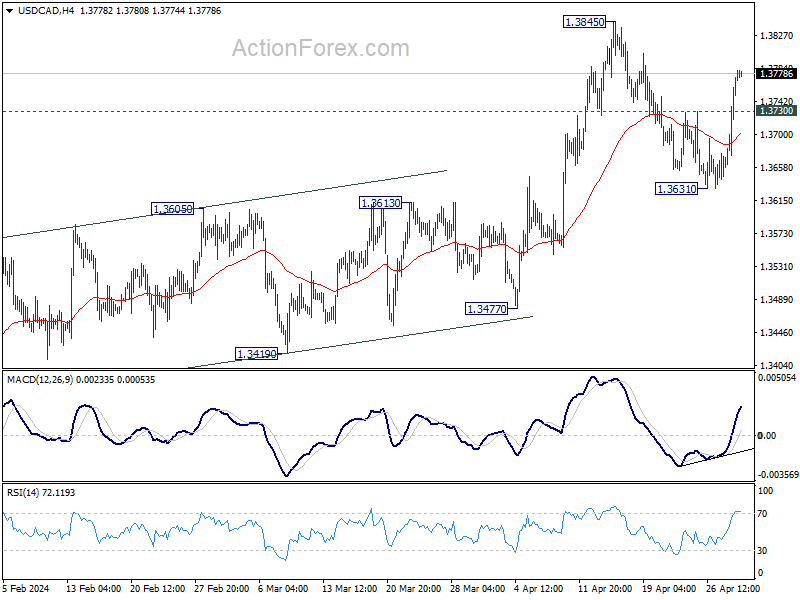
USD/CAD's break of 1.3730 minor resistance suggests that pullback from 1.3845 has completed at 1.3613. Intraday bias is back on the upside for retesting 1.3845 first. Firm break there will resume larger rise from 1.3176 towards 1.3976 key resistance next. For now, risk will stay on the upside as long as 1.3613 support holds, in case of retreat.
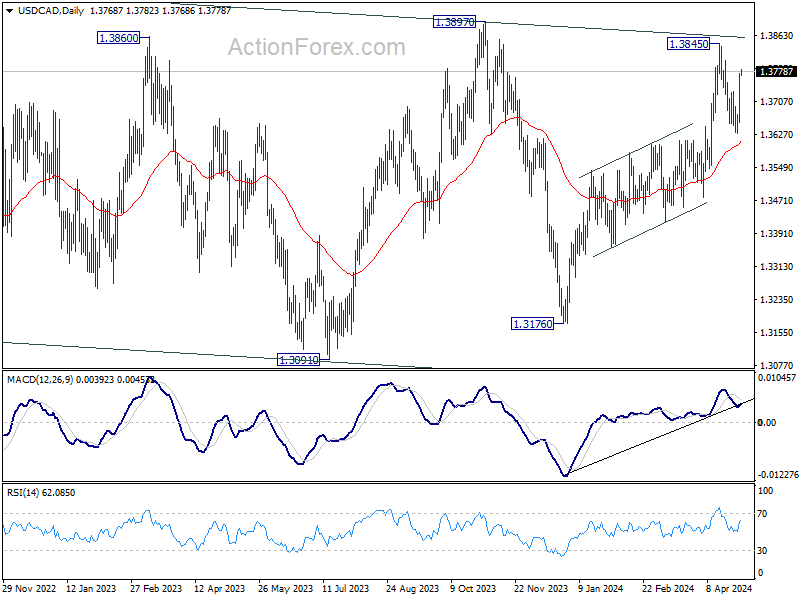
In the bigger picture, price actions from 1.3976 (2022 high) are viewed as a corrective pattern only. In case of another fall, strong support should emerge above 1.2947 resistance turned support to bring rebound. Firm break of 1.3976 will confirm up resumption of whole up trend from 1.2005 (2021 low). Next target is 61.8% projection of 1.2401 to 1.3976 from 1.3176 at 1.4149.
AUD/USD Daily Report
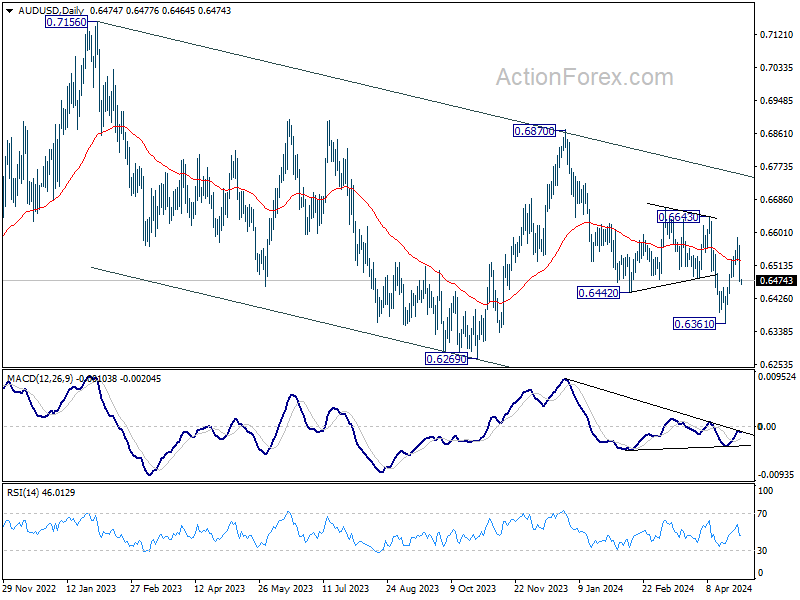
Daily Pivots: (S1) 0.6439; (P) 0.6504; (R1) 0.6537; More...
Break of 0.6482 minor support argues that rebound from 0.6361 has completed importantly, fall from 0.6870 might not be over yet. Intraday bias is back on the downside for retesting 0.6361 low next. On the upside, above 0.6513 minor resistance will turn intraday bias neutral again first.
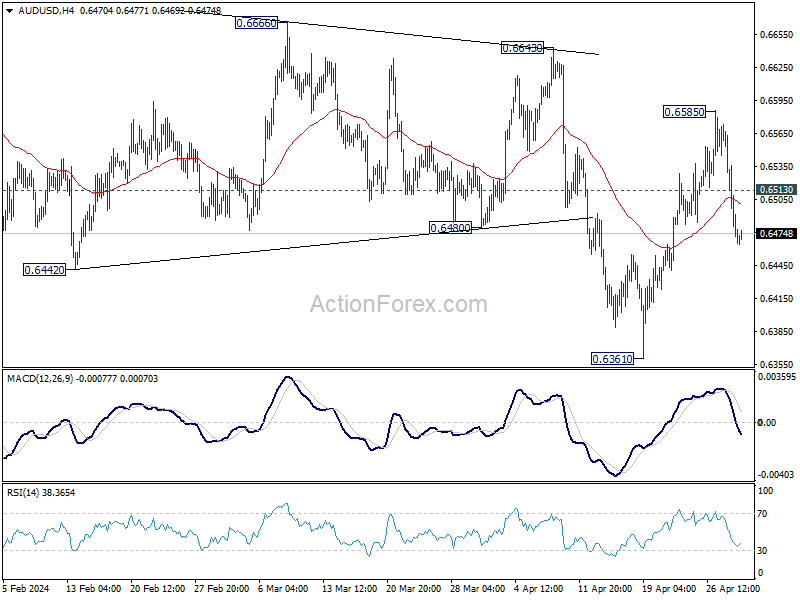
In the bigger picture, price actions from 0.6169 (2022 low) are seen as a medium term corrective pattern to the down trend from 0.8006 (2021 high). Fall from 0.7156 (2023 high) is seen as the second leg, which is still in progress. Overall, sideway trading could continue in range of 0.6169/7156 for some more time. But as long as 0.7156 holds, an eventual downside breakout would be mildly in favor.
EUR/USD Daily Outlook
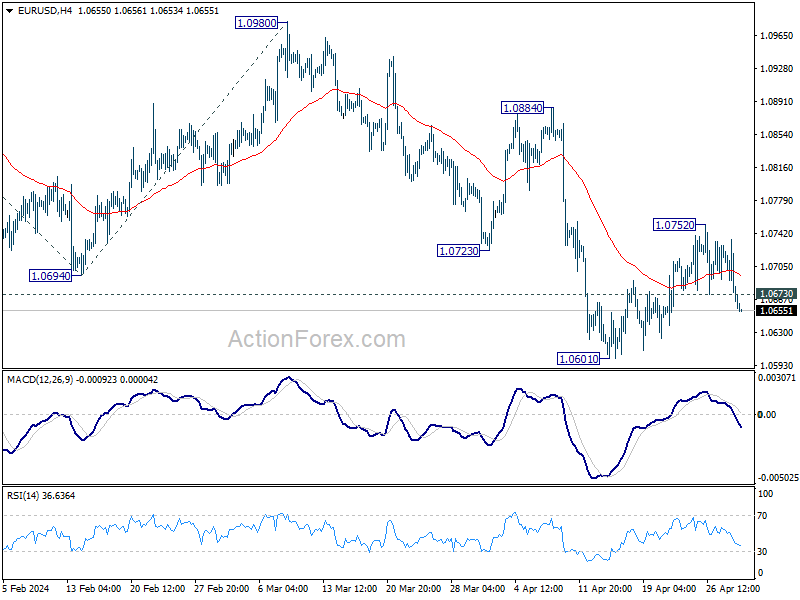
Daily Pivots: (S1) 1.0642; (P) 1.0688; (R1) 1.0713; More...
Break of 1.0673 minor support argues that EUR/USD recovery from 1.0601 has completed at 1.0752 already. Intraday bias is back on the downside for retesting 1.0601 first. Firm break there will resume larger fall and target 100% projection of 1.1138 to 1.0694 from 1.0980 at 1.0536. For now, risk will stay on the downside as long as 1.0752 resistance holds, in case of recovery.
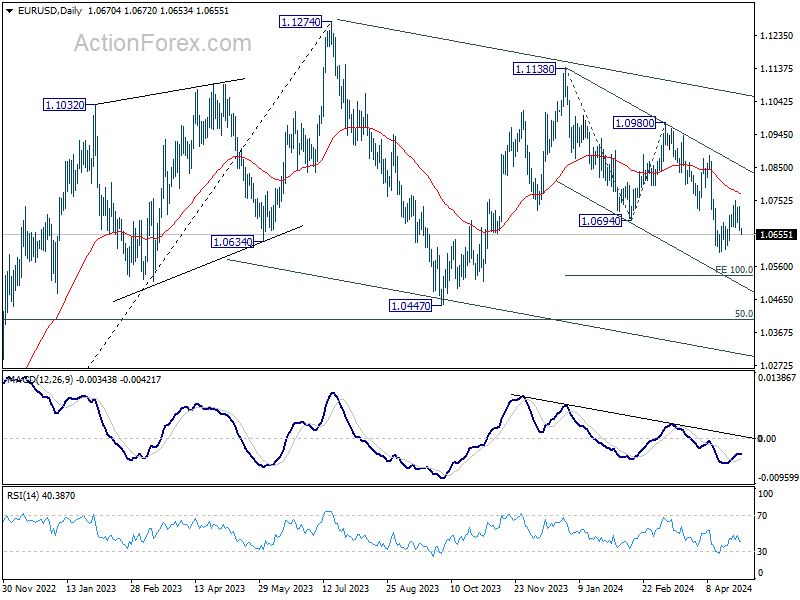
In the bigger picture, price actions from 1.1274 are viewed as a corrective pattern to rise from 0.9534 (2022 low). Current fall from 1.1138 is seen as the third leg. While deeper decline is would be seen to 1.0447 and possibly below, strong support should emerge from 61.8% retracement of 0.9534 to 1.1274 at 1.0199 to complete the correction.
GBP/USD Daily Outlook
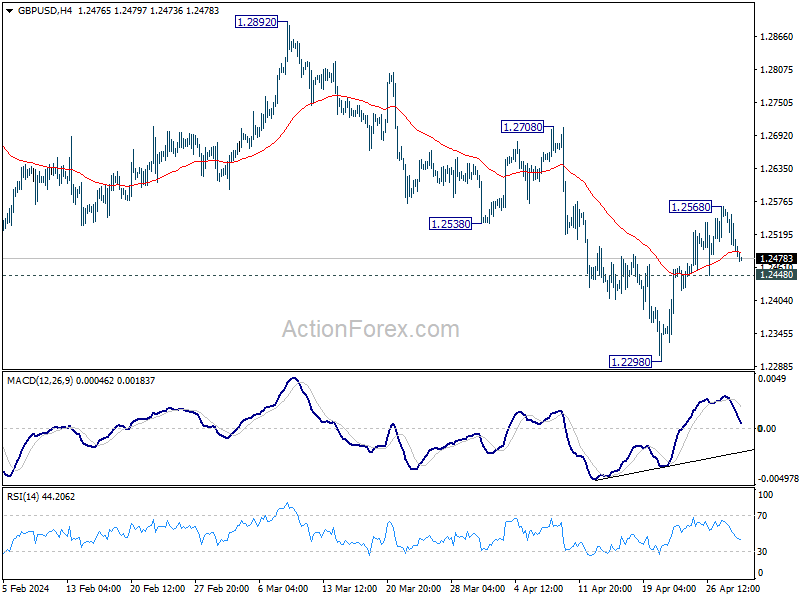
Daily Pivots: (S1) 1.2465; (P) 1.2517; (R1) 1.2544; More...
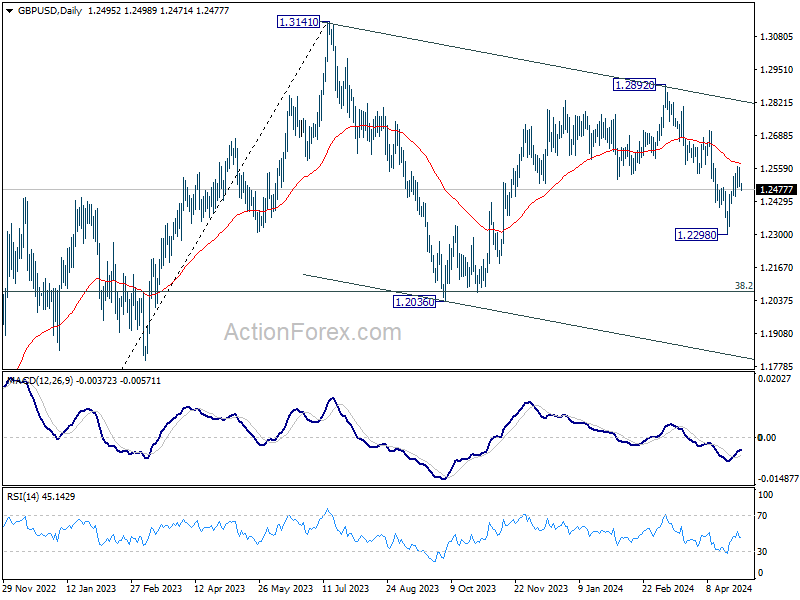
Intraday bias in GBP/USD remains neutral for the moment. On the upside, above 1.2568 will resume the rebound from 1.2298 to 55 D EMA (now at 1.2580). Sustained break there will argue that fall from 1.2892 has completed already, and bring further rise to this resistance. Nevertheless, on the downside, break of 1.2448 minor support will indicate that rebound from 1.2298 has completed, and turn bias back to the downside for this low.
In the bigger picture, price actions from 1.3141 medium term top are seen as a corrective pattern to up trend from 1.0351 (2022 low). Fall from 1.2892 is seen as the third leg. Deeper decline would be seen to 1.2036 support and possibly below. But strong support should emerge from 61.8% retracement of 1.0351 to 1.2452 at 1.1417 to complete the correction.
USD/JPY Daily Outlook
Daily Pivots: (S1) 156.64; (P) 157.25; (R1) 158.42; More...
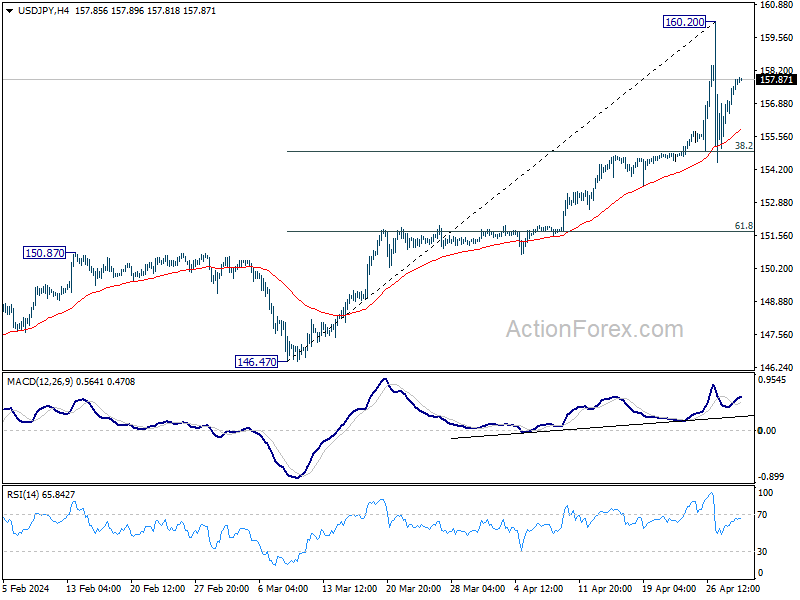
Intraday bias in USD/JPY stays neutral at this point, as consolidation from 160.20 is extending. In case of another fall, downside should be contained by 38.2% retracement of 146.47 to 160.20 at 154.95 to bring recovery. For now, break of 160.20 is not envisaged in the near term. Meanwhile, firm break of 154.95 will turn bias to the downside for deeper correction to 55 D EMA (now at 152.04).
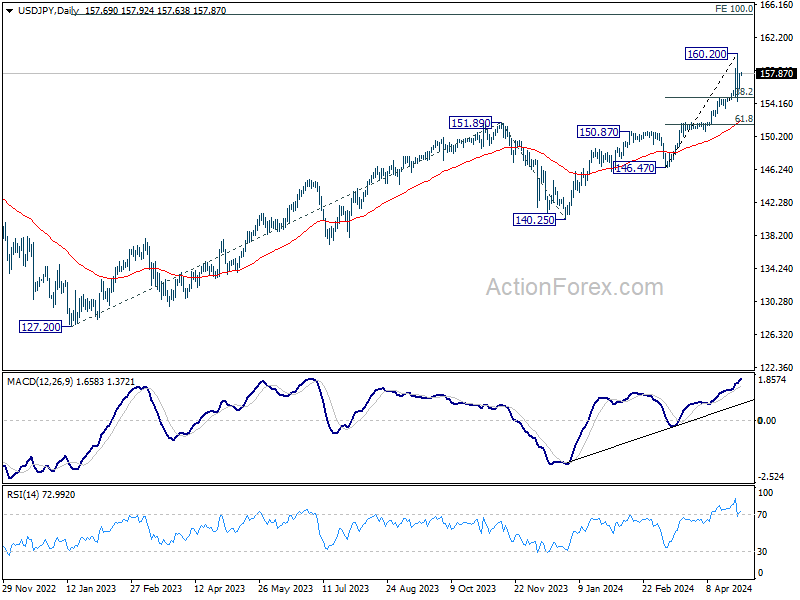
In the bigger picture, current rise from 140.25 is seen as the third leg of the up trend from 127.20 (2023 low). Next target is 100% projection of 127.20 to 151.89 from 140.25 at 164.94. Outlook will remain bullish as long as 150.87 resistance turned support holds, even in case of deep pullback.
USD/CHF Daily Outlook
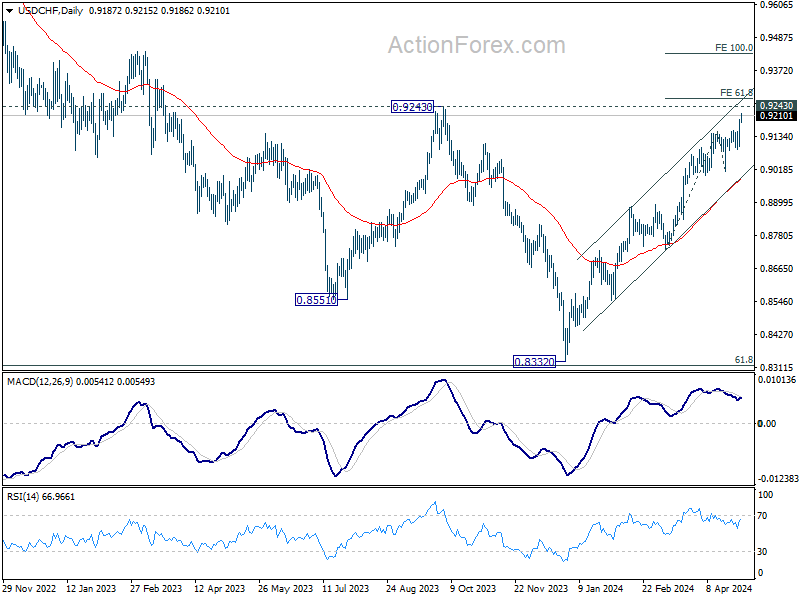
Daily Pivots: (S1) 0.9128; (P) 0.9162; (R1) 0.9231; More....
USD/CHF's rally from 0.8332 resumed and hit as high as 0.9215 so far. Intraday bias is back on the upside for 0.9243 resistance next. Decisive break there will carry larger bullish implications. Next target will be 61.8% projection of 0.8728 to 0.9151 from 0.9009 at 0.9270. For now, near term outlook will stay bullish as long as 0.9087 support holds, in case of retreat.
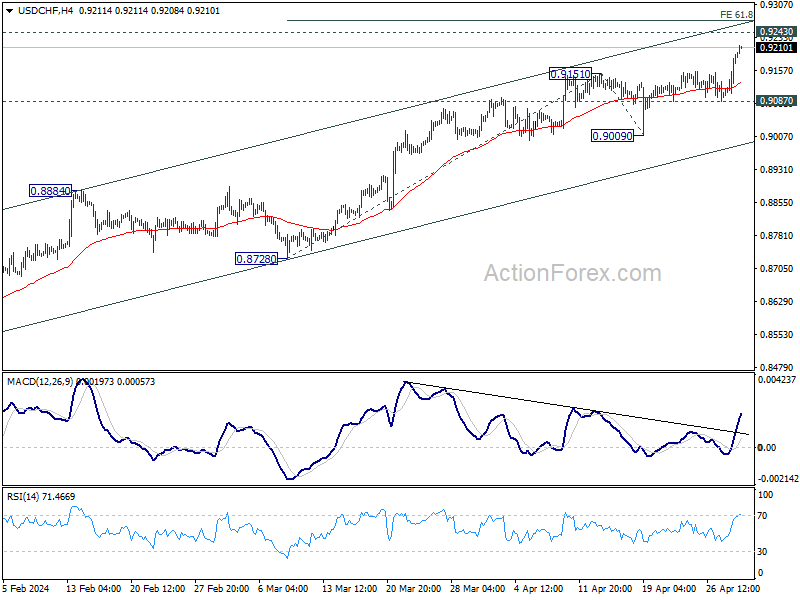
In the bigger picture, price actions from 0.8332 medium term bottom as tentatively seen as developing into a corrective pattern to the down trend from 1.0146 (2022 high). Further rise would be seen as long as 0.8884 resistance turned support holds. But upside should be limited by 0.9243 resistance, at least on first attempt. However, decisive break of 0.9243 will argue that the trend has already reversed and turn medium term outlook bullish for 1.0146.
Dollar Firms as Markets Brace for Hawkish Fed Shift, Swiss Franc Under Pressure
Dollar rebounded broadly overnight and stayed generally firm in Asian session. Stock investors were apparently adopting a cautious stance and lightening up positions ahead of Fed's rate decision and subsequent press conference today. With recent data pointing to persistent inflationary pressures, expectations are mounting that Fed would adopt a more hawkish tone. It's a minimum that Fed will indicate that rate cuts would only be considered once inflation consistently moves towards the target. The central question now is the extent of this hawkish shift.
For now, the selloff in the currency markets seemed to be concentrated most in Swiss Franc primarily due to diverging monetary path with other major central banks. While SNB has already begun policy easing, other central banks, including even ECB, may not ease as aggressively as previously anticipated. This disparity in central bank policies is contributing to Franc's weakness.
Elsewhere, New Zealand Dollar softened slightly following significantly weaker than expected employment data. Although this did not trigger extended selling, Kiwi remains one of the week's weaker performers, only outdone by Australian Dollar and followed closely by Canadian Dollar. Conversely, Yen stands out as the strongest performer, with Dollar and Sterling also showing resilience. Euro and Swiss Franc are positioned in the middle of the pack, with the Franc appearing particularly vulnerable.
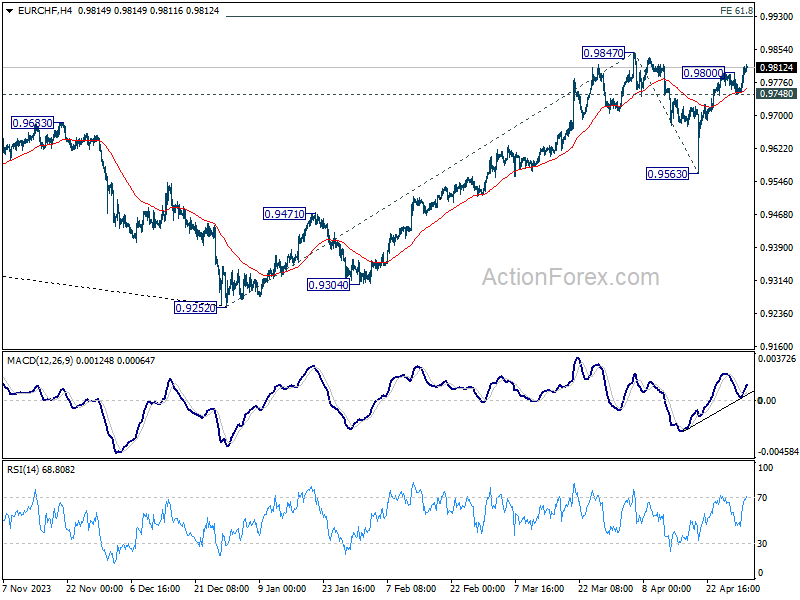
Technically, EUR/CHF's rebound from 0.9563 resumed by breaking through 0.9800. Retest of 0.9847 should be seen next. Firm break there will resume whole rally from 0.9252 and target 61.8% projection of 0.9252 to 0.9847 from 0.9563 at 0.9931 next.
In Asia, at the time of writing, Nikkei is down -0.14%. Japan 10-year JGB yield is up 0.0195 at 0.893. Hong Kong, China, and Singapore are on holiday. Overnight, DOW fell -1.49%. S&P 500 fell -1.57%. NASDAQ fell -2.04%. 10-year yield rose 0.072 to 4.686.
US stocks plunge as market braces for hawkish Fed pivot
US stocks tumbled sharply overnight, concluding a turbulent April as traders anticipated a hawkish pivot from Fed Chair Jerome Powell in his upcoming post-FOMC meeting press conference today. DOW recorded -5% loss for the month, marking its worst monthly performance since September 2022. Similarly, S&P 500 and NASDAQ fell by -4.2% and -4.4%, respectively, ending their five-month streaks of gains.
Amidst this backdrop, Fed is widely expected to maintain federal funds rate at its current level of 5.25-5.50%. With no new economic projections or dot plot updates, all eyes are on Powell's statement and subsequent press conference. Market speculation suggests Powell might confirm that a rate cut in June is unlikely and could adjust expectations to reflect fewer than three rate cuts for the year.
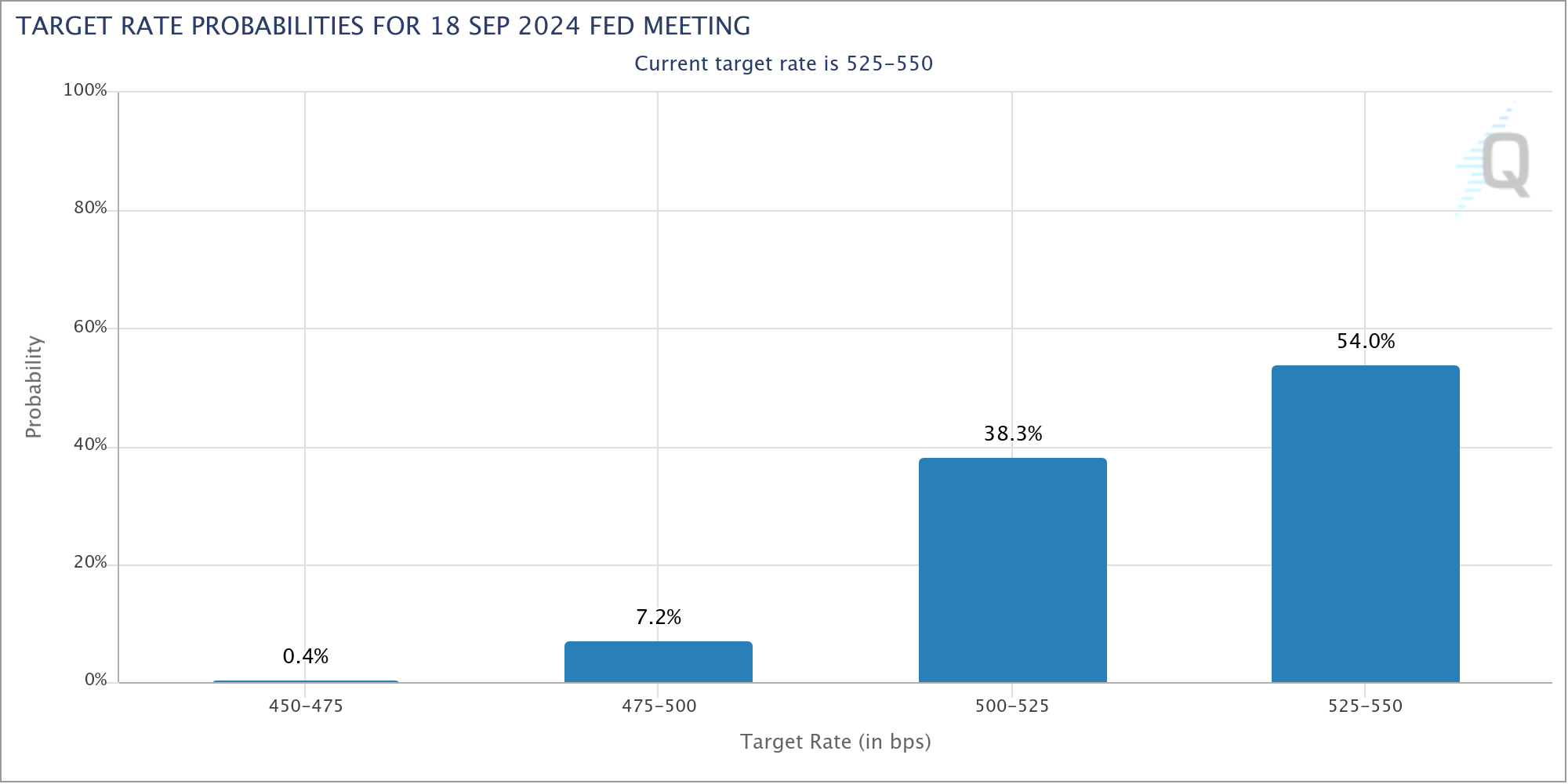
Powell's comments will be crucial for investors, as any indication towards maintaining higher rates for longer, or even hinting at the possibility of a rate hike, could signal a more aggressive stance than previously anticipated. Currently, Fed fund futures reflect a 54% probability that rates will remain at the current level after the September meeting.
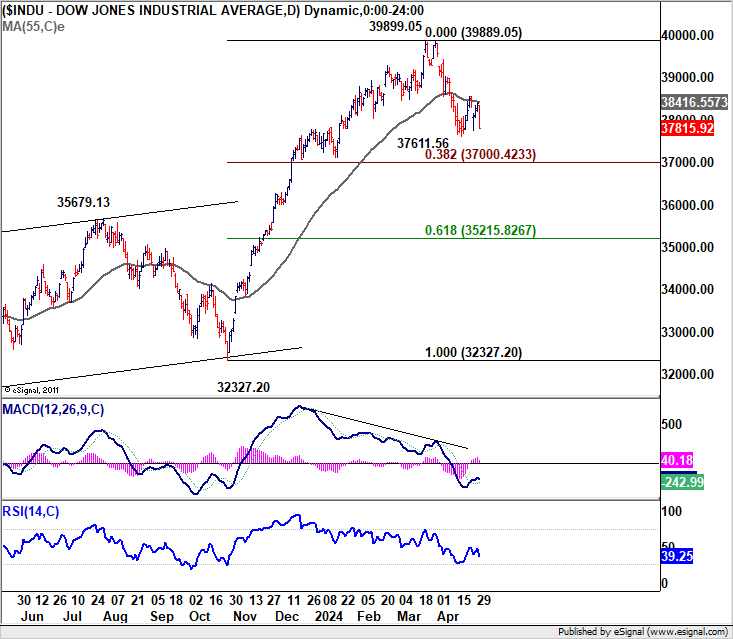
Technically, near term bias in DOW is kept on the downside after be rejected by 55 D EMA twice. Further decline is in favor through 37611.56 support. Nevertheless, fall from 39899.05 is currently seen as developing into a corrective pattern to rise from 32327.20 only. Hence, strong support would be seen from 38.2% retracement of 32327.20 to 39899.05 at 37000.42 to bring rebound. However, sustained break of 37000.42 will argue that larger scale correction could be underway.
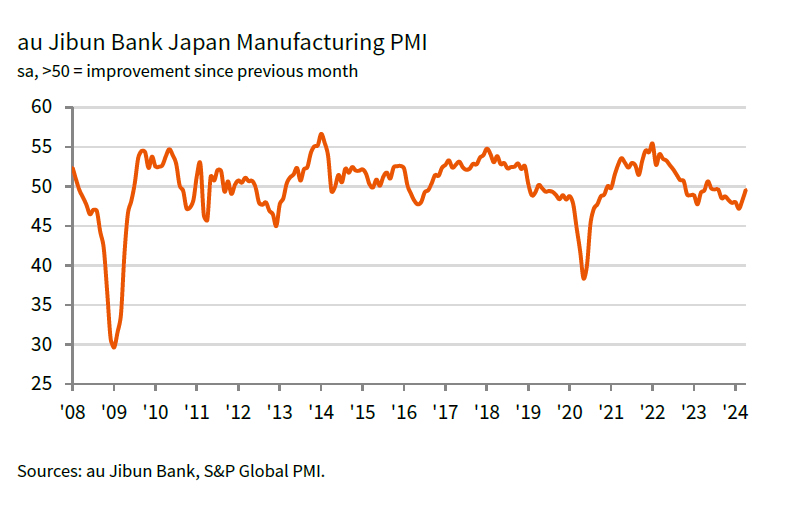
Japan's PMI manufacturing finalized at 49.6, moving towards stabilization
Japan's PMI Manufacturing was finalized at 49.6 in April, marking an increase from March's 48.2 and reaching its highest level in eight months. While the index remains below the pivotal 50.0 mark, which distinguishes expansion from contraction, the latest data suggests that the sector is moving towards stabilization in the near term.
Paul Smith from S&P Global Market Intelligence noted that the April PMI "continued to paint a fairly subdued picture of the Japanese manufacturing sector," but also pointed out that "another rise in the headline PMI points to a sector heading towards at least stabilization in the near-term."
The report also highlighted concerns about inflation, with a broad-based increase in input prices contributing to heightened cost pressures for manufacturers. Notably, the strength of market demand is allowing firms to pass these increased costs onto consumers, with the extent of charge hikes reaching the steepest level in nearly a year.
New Zealand employment falls -0.2% qoq in Q1, unemployment rate jumps to 4.3%
New Zealand employment fell -0.2% qoq in Q1, much worse than expectation of 0.3% qoq growth. Unemployment rate rose from 4.0% to 4.3%, above expectation of 4.0%. Underutilization rate rose 0.5% to 11.2%. Employment rate fell -0.6% to 68.4%. Labor force participation rate fell -0.3% to 71.5%.
For wages, average ordinary time hourly earnings growth slowed from 6.9% yoy to 5.2% yoy. All sector unadjusted labor cost index slowed slightly from 4.3% yoy to 4.1% yoy.
"Although wage cost inflation eased and average hourly earnings growth started to slow this quarter, annual growth remained high for the two surveys," business employment insights manager Sue Chapman said.
RBNZ cautions on persistent inflation risks and financial market volatility
RBNZ the decline in global inflation from previously elevated levels. At the same time, financial markets are currently anticipating lower policy rates over the next year.
However, "there remains a risk that new or persistent inflation pressures could mean global interest rates remain restrictive for longer, placing continued pressure on households, businesses and the financial system," RBNZ warned in its semi-annual Financial Stability Report.
The report also observed that expectations for monetary policy easing have spurred rallies in equity markets across major economies. Yet, RBNZ cautioned that these gains could be vulnerable to a swift reversal.
"An abrupt reversal in sentiment arising from weaker-than-expected earnings or inflation remaining elevated could drag stock prices down, which would generate economic and financial risks from a market-driven tightening in financial conditions," it warned.
Looking ahead
UK PMI manufacturing final is the only feature in European session. Later in the day, Canada PMI manufacturing and US ISM manufacturing will be released. But main focus is on Fed rate decision and post-meeting press conference.
USD/CHF Daily Outlook
Daily Pivots: (S1) 0.9128; (P) 0.9162; (R1) 0.9231; More....
USD/CHF's rally from 0.8332 resumed and hit as high as 0.9215 so far. Intraday bias is back on the upside for 0.9243 resistance next. Decisive break there will carry larger bullish implications. Next target will be 61.8% projection of 0.8728 to 0.9151 from 0.9009 at 0.9270. For now, near term outlook will stay bullish as long as 0.9087 support holds, in case of retreat.
In the bigger picture, price actions from 0.8332 medium term bottom as tentatively seen as developing into a corrective pattern to the down trend from 1.0146 (2022 high). Further rise would be seen as long as 0.8884 resistance turned support holds. But upside should be limited by 0.9243 resistance, at least on first attempt. However, decisive break of 0.9243 will argue that the trend has already reversed and turn medium term outlook bullish for 1.0146.
Economic Indicators Update
| GMT | Ccy | Events | Actual | Forecast | Previous | Revised |
|---|---|---|---|---|---|---|
| 22:45 | NZD | Employment Change Q1 | -0.20% | 0.30% | 0.40% | |
| 22:45 | NZD | Unemployment Rate Q1 | 4.30% | 4.30% | 4.00% | |
| 22:45 | NZD | Labour Cost Index Q/Q Q1 | 0.80% | 0.80% | 1.00% | |
| 00:30 | JPY | Manufacturing PMI Apr F | 49.6 | 49.9 | 49.9 | |
| 08:30 | GBP | Manufacturing PMI Apr F | 48.7 | 48.7 | ||
| 12:15 | USD | ADP Employment Change Apr | 180K | 184K | ||
| 13:30 | CAD | Manufacturing PMI Apr | 50.2 | 49.8 | ||
| 13:45 | USD | Manufacturing PMI Apr F | 49.9 | 49.9 | ||
| 14:00 | USD | ISM Manufacturing PMI Apr | 50.1 | 50.3 | ||
| 14:00 | USD | ISM Manufacturing Prices Paid Apr | 55.6 | 55.8 | ||
| 14:00 | USD | ISM Manufacturing Employment Index Apr | 47.4 | |||
| 14:00 | USD | Construction Spending M/M Mar | 0.30% | -0.30% | ||
| 14:30 | USD | Crude Oil Inventories | -2.3M | -6.4M | ||
| 18:00 | USD | Fed Interest Rate Decision | 5.50% | 5.50% | ||
| 18:30 | USD | FOMC Press Conference |
US stocks plunge as market braces for hawkish Fed pivot
US stocks tumbled sharply overnight, concluding a turbulent April as traders anticipated a hawkish pivot from Fed Chair Jerome Powell in his upcoming post-FOMC meeting press conference today. DOW recorded -5% loss for the month, marking its worst monthly performance since September 2022. Similarly, S&P 500 and NASDAQ fell by -4.2% and -4.4%, respectively, ending their five-month streaks of gains.
Amidst this backdrop, Fed is widely expected to maintain federal funds rate at its current level of 5.25-5.50%. With no new economic projections or dot plot updates, all eyes are on Powell's statement and subsequent press conference. Market speculation suggests Powell might confirm that a rate cut in June is unlikely and could adjust expectations to reflect fewer than three rate cuts for the year.
Powell's comments will be crucial for investors, as any indication towards maintaining higher rates for longer, or even hinting at the possibility of a rate hike, could signal a more aggressive stance than previously anticipated. Currently, Fed fund futures reflect a 54% probability that rates will remain at the current level after the September meeting.
Technically, near term bias in DOW is kept on the downside after be rejected by 55 D EMA twice. Further decline is in favor through 37611.56 support. Nevertheless, fall from 39899.05 is currently seen as developing into a corrective pattern to rise from 32327.20 only. Hence, strong support would be seen from 38.2% retracement of 32327.20 to 39899.05 at 37000.42 to bring rebound. However, sustained break of 37000.42 will argue that larger scale correction could be underway.
Japan’s PMI manufacturing finalized at 49.6, moving towards stabilization
Japan's PMI Manufacturing was finalized at 49.6 in April, marking an increase from March's 48.2 and reaching its highest level in eight months. While the index remains below the pivotal 50.0 mark, which distinguishes expansion from contraction, the latest data suggests that the sector is moving towards stabilization in the near term.
Paul Smith from S&P Global Market Intelligence noted that the April PMI "continued to paint a fairly subdued picture of the Japanese manufacturing sector," but also pointed out that "another rise in the headline PMI points to a sector heading towards at least stabilization in the near-term."
The report also highlighted concerns about inflation, with a broad-based increase in input prices contributing to heightened cost pressures for manufacturers. Notably, the strength of market demand is allowing firms to pass these increased costs onto consumers, with the extent of charge hikes reaching the steepest level in nearly a year.