

Sample Category Title
BoJ’s Takata urges policy shift, time to exit ultra-accommodative stance
In a significant speech today, BoJ board member Hajime Takata emphasized the need for a "nimble and flexible response" to the nation's monetary policy strategy, and called for the moves away from the current "extremely accommodative monetary policy".
He outlined several measures for consideration, including exiting yield curve control, moving away from negative interest rates, and revising the BoJ's commitment to expanding its monetary base until inflation consistently exceeds the 2% target.
Takata's remarks come at a time when Japan appears to be on the cusp of meeting its long-sought-after inflation target of 2%. He noted, "While there are some economic uncertainties, I feel that we're finally seeing prospects for achieving our 2% inflation target."
Furthermore, Takata highlighted the positive momentum in spring wage negotiations, with many companies proposing wage hikes surpassing those of 2023. This trend towards higher wages, coupled with the corporate sector's growing resilience to yield increases upon the exit of current monetary policies, underscores a strengthening economic foundation.
Japan faces steepest industrial decline in nearly four years, -7.5% mom drop in Jan
Japan's industrial production faced a significant downturn in January, recording a -7.5% mom decline in production, marking the sharpest drop since May 2020. This downturn was slightly more severe than the anticipated -7.3% mom, with a widespread decrease across 14 of the 15 surveyed industries. Motor vehicles sector experienced the most substantial fall, plummeting by -17.8% mom, driven by declines in regular passenger cars and electrical drive systems.
Manufacturers remain somewhat optimistic, anticipating a rebound with of 4.8% in output for February and a further 2.0% rise in March, as surveyed by the Ministry of Economy, Trade and Industry. However, these forecasted gains are deemed insufficient by METI officials to fully counterbalance the steep January decline.
In contrast to the industrial sector's struggles, Japan's retail sales presented a brighter picture, rising 2.3% yoy in January, surpassing the expected 2.0% increase.
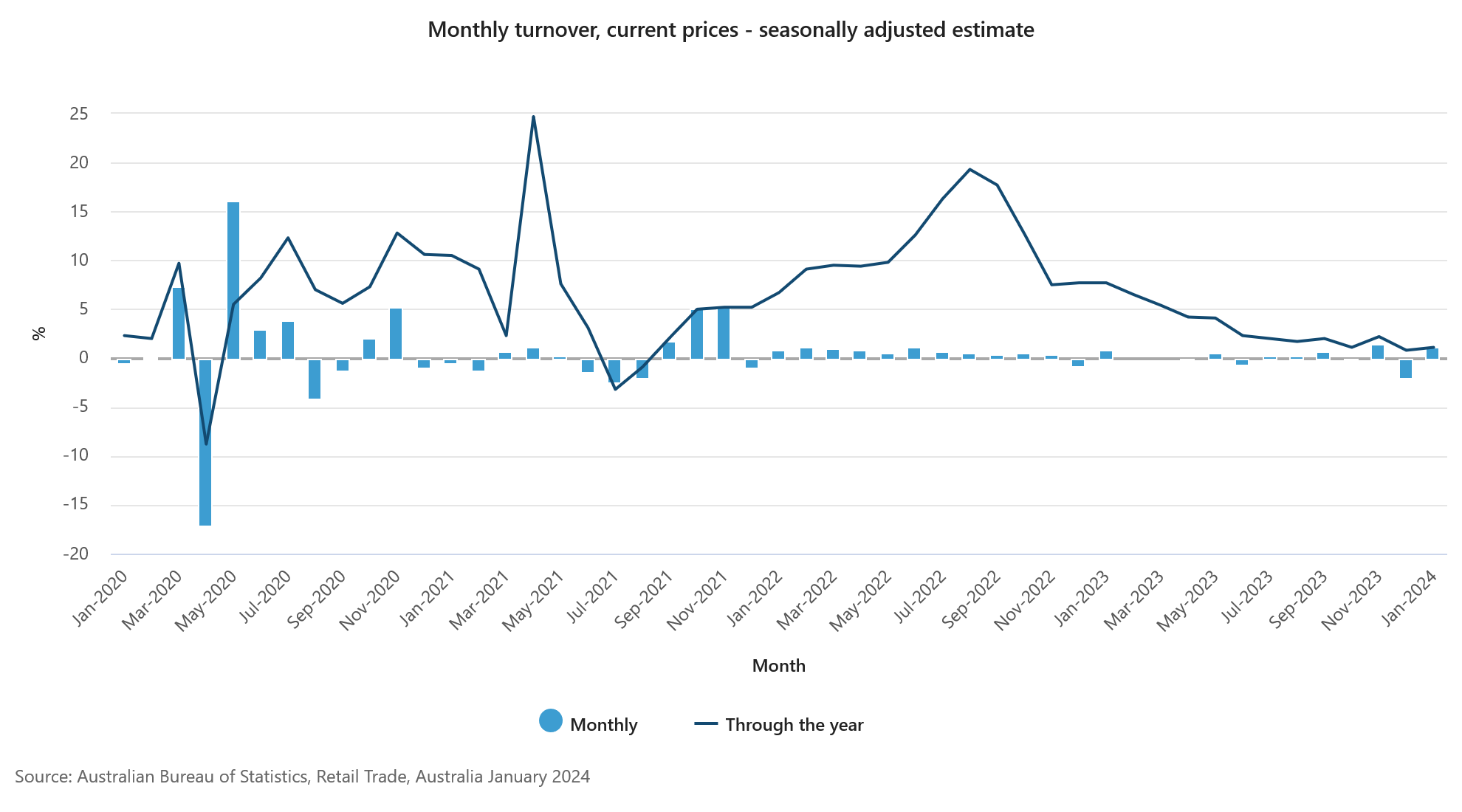
Australia’s retail sales rises 1.1% mom in Jan, stagnates in trend terms
Australia's retail sales rose 1.1% mom in January, below expectation of 1.7% mom. This increase marks a recovery from December's significant -2.1% mom decline, where consumer spending retracted following the Black Friday sales rush in November.
According to Ben Dorber, ABS head of retail statistics, retail turnover has effectively returned to the levels observed in September 2023. Additionally, "retail turnover was unchanged in trend terms in January," indicating that, despite the month's positive performance, the broader trend reflects a period of stagnation in retail sales when considering the volatility of the past few months.
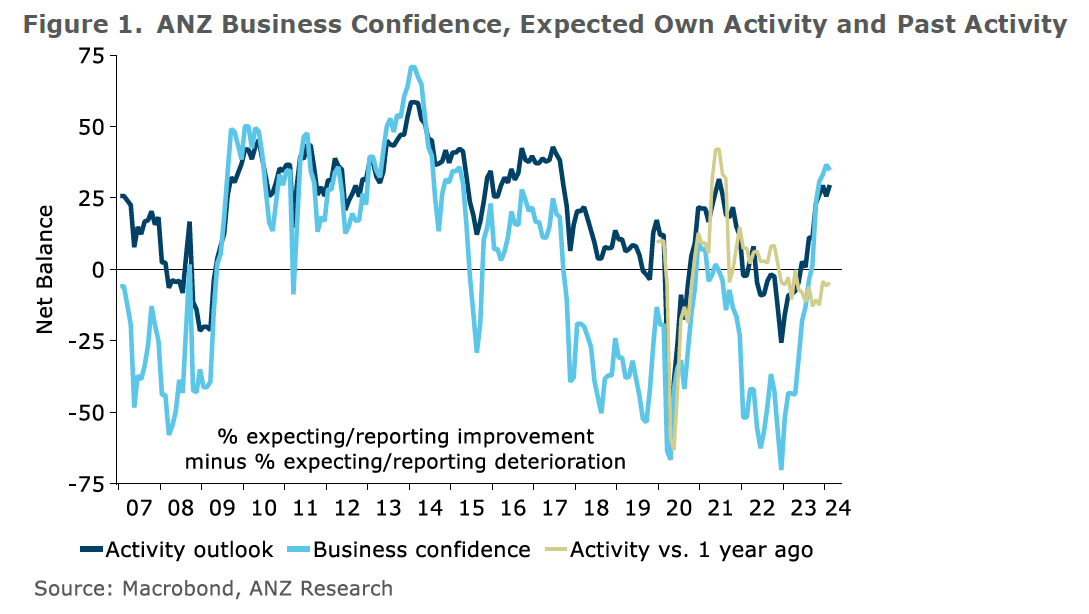
NZ ANZ business confidence falls to 34.7, patchy economy
New Zealand ANZ Business Confidence fell from 36.6 to 34.7 in February. Own activity outlook rose from 25.6 to 29.5. Inflation expectations fell from 4.28% to 4.03%. Pricing intentions eased from 50% to 48%, continuing their sideways trend of recent months. Cost expectations fell from 75.6 to 73.5. Wages expectation fell from 81.4 to 78.9.
ANZ's describes the economy as "patchy," with visible "green shoots" in some sectors, yet acknowledges the "ongoing challenges" facing other segments. The survey does not imply the "economy is rolling over" or that "inflation has been beaten".
RBNZ’s Orr confident on bringing down inflation, highlights global risks
RBNZ to said in a conversation with Radio New Zealand that the central bank RBNZ's very confident on returning inflation to target band of 1%-3% by the second half of 2024, with a goal to hit near 2% midpoint in 2025.
Highlighting the broader context, Orr pointed out that key risks to this positive outlook are mostly global. Domestic economy aligns with RBNZ's expectations. Orr noted the current "subdued spending" and "declined" inflation levels as outcomes of the existing monetary policy settings and trade conditions.
Later in the day, Orr told a parliamentary committee the importance of "retaining a restrictive stance with the official cash rate," as a pivotal factor for ensuring the forecasted return to target inflation levels.
ECB’s Nagel eyes next week’s economic projections as important policy milestone
Bundesbank President Joachim Nagel highlighted the critical need for "reliable data on wage developments" before commencing rate cuts. With ECB's updated economic projections on the horizon next week, Nagel described the forthcoming report as an "important milestone".
Nagel took a moment to reflect on the successes achieved through current policy in reducing inflation. However, he was quick to caution against complacency, emphasizing "we can't make any mistakes in the final stretch of the journey."
His warning against premature rate cuts was stark, labeling such a move as "fatal." Nagel's concern is that an ill-timed easing of monetary policy could lead to a resurgence of inflation, thereby damaging the ECB's credibility and triggering financial market instability.
Fed’s Williams labels three rate cuts this year a reasonable starting point
In an event overnight, New York Fed President John Williams provided said the economy remains robust, with expectations for continued positive growth and a gradual decrease in inflation. His asserted that three rate cuts within the year could serve as a "reasonable starting point".
Williams highlighted the significant decline in inflation over the past year and a half, emphasizing the "broad-based" reductions across various components of inflation measurements. Despite the positive trend, Williams candidly acknowledged "we still have a ways to go on the journey to sustained 2% inflation."
Fed’s Collins methodical, forward-looking approach to rate cuts
Boston Fed President Susan Collins suggested that it may become "appropriate to begin easing policy later this year," highlighting the importance of a "methodical, forward-looking approach" to gradually reduce rates.
Collins anticipated further inflation deceleration would might necessitate further slowdown in economic activity. However, she noted the "considerable uncertainty" surrounding the magnitude and timing of this slowdown. The path ahead, as Collins notes, is expected to be "bumpy," as suggested by hotter-than-expected employment and price increase readings.
In this context, it will be important to focus on seeking "sustained, broadening signs" of progress towards its dual mandate goals, acknowledging that such progress may unfold unevenly. Collins cautions against setting overly stringent expectations for the data, indicating that "expecting all data to speak uniformly is too high a bar."
What To Trade In March
The month of February saw markets make several instinctive moves as well as create opportunities for proper leveraging of fundamental releases. Despite being a leap-year, there wasn’t any real impact on price delivery in the course of the month. As we await the opportunities that lie ahead in the month of March, here are a few thoughts to consider.
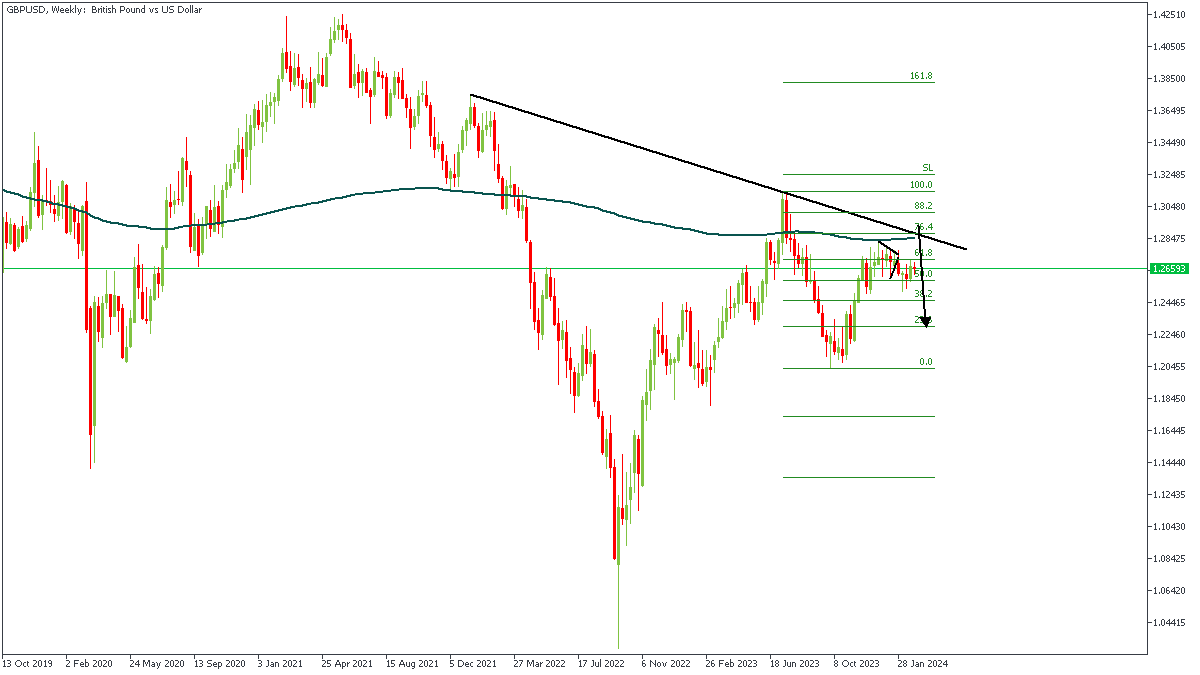
GBPUSD - W1 Timeframe
GBPUSD is currently stalling in a consolidation move that could see prices shoot up to the resistance trendline, then followed by a proper bearish confirmation. This sentiment is sponsored by the confluence of the resistance trendline, supply zone, 200-period moving average resistance, and the Fibonacci retracement levels.
Analyst’s Expectations:
- Direction: Bearish
- Target: 1.23078
- Invalidation: 1.31568
EURCHF - W1 Timeframe
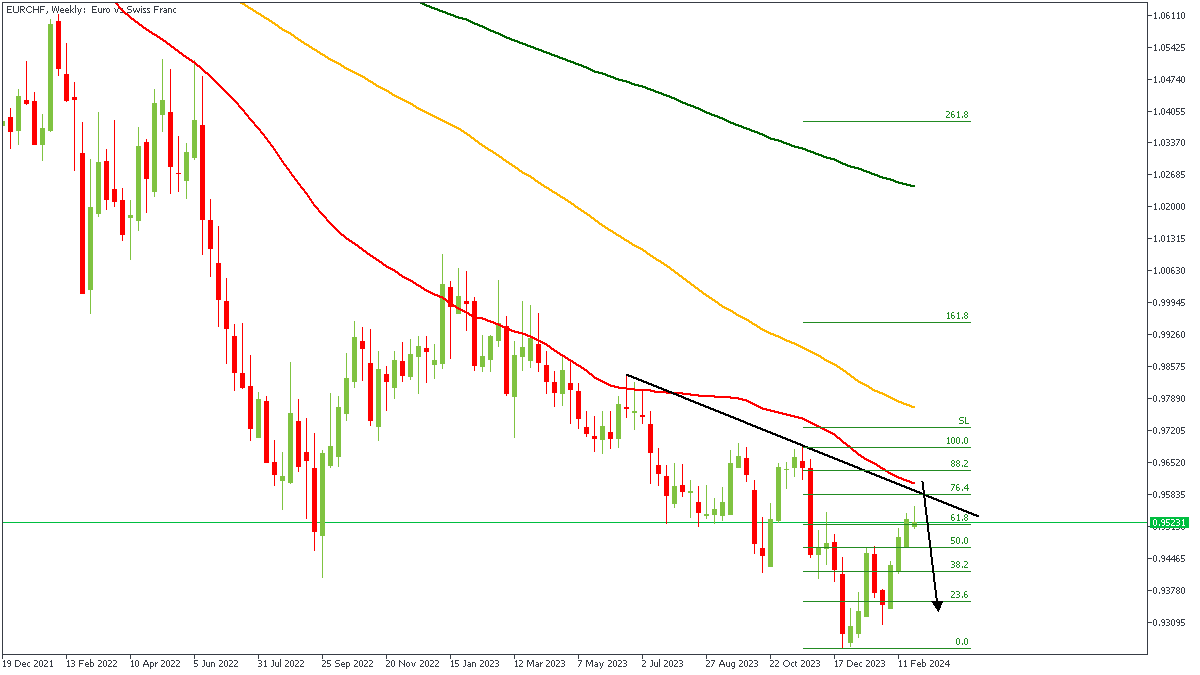
The overall trend on this weekly timeframe chart of EURCHF is clearly bearish, with a recent break below the previous low. Following this, I have plotted the Fibonacci retracement levels in order to identify my key areas for a reversal; the 76% and 88% being the prime levels I consider. The trendline resistance, supply zone, 50-period moving average, and the bearish array of the moving averages are my confluence for this sentiment.
Analyst’s Expectations:
- Direction: Bearish
- Target: 0.93824
- Invalidation: 0.96920
EURNZD - W1 Timeframe
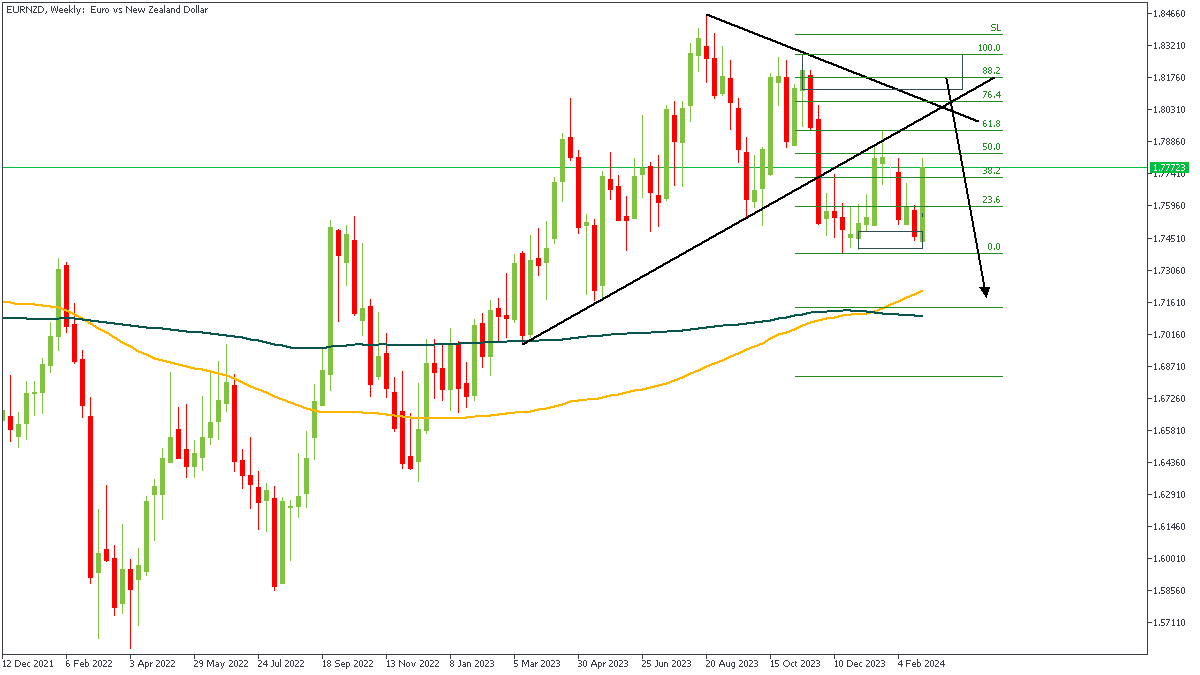
EURNZD is currently retracing back to the previous high in a move that I consider to simply be a correction of the momentum that broke below the previous low. That said, I expect to see a completion of the correction move around the 76% and 88% Fibonacci levels. The confluence of resistance trendlines, supply zone, and the Fibonacci levels lend credence to my bearish sentiment in this case.
Analyst’s Expectations:
- Direction: Bearish
- Target: 1.76090
- Invalidation: 1.82956
CONCLUSION
The trading of CFDs comes at a risk. Thus, to succeed, you have to manage risks properly. To avoid costly mistakes while you look to trade these opportunities, be sure to do your due diligence and manage your risk appropriately.
CHF: Key Zone Could Yield Strong Reactions
USD/CHF saw a rebound after declining for two days straight, climbing towards the important psychological level of 0.8800 during Wednesday's early Asian trading session. There's some pressure on the Swiss Franc (CHF) as traders await the Swiss ZEW Survey – Expectations report scheduled for later today. Moreover, investors are keeping an eye on Thursday's release of the Gross Domestic Product (GDP) data by the Swiss State Secretariat for Economic Affairs (SECO), with expectations for a decline in the fourth quarter of 2023.
EURCHF - D1 Timeframe
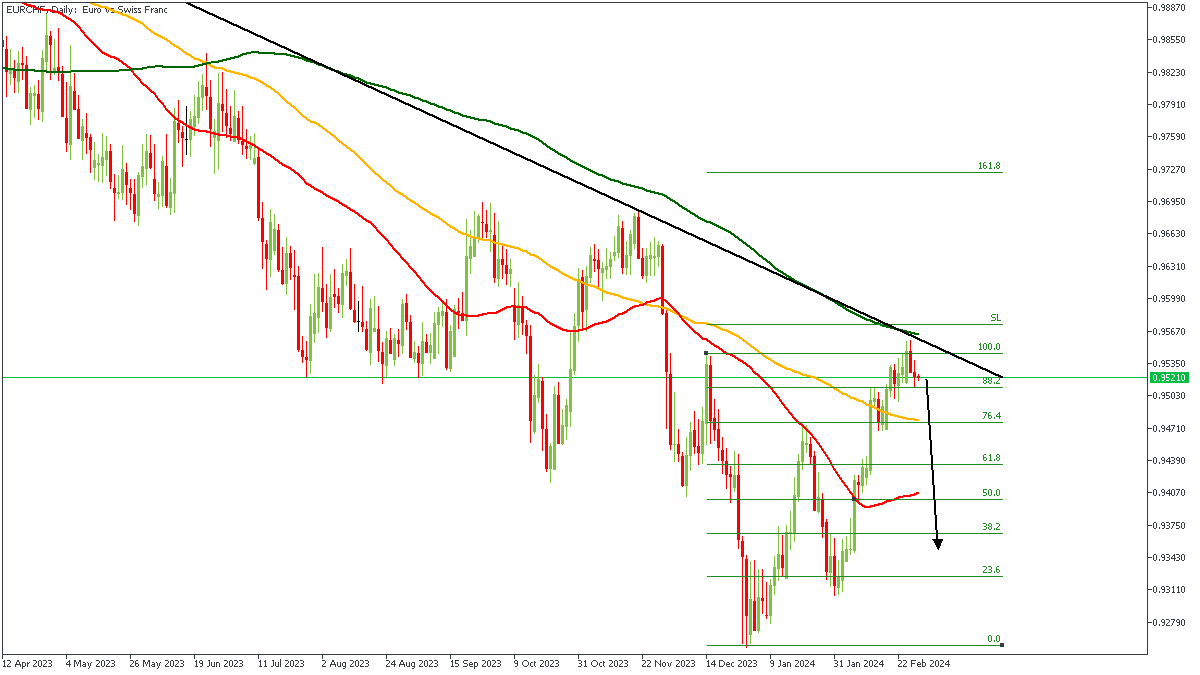
EURCHF on the daily timeframe can be seen reacting under pressure from the trendline and moving average resistance. The bearish array of the moving averages lends another credible confluence in favour of a bearish sentiment on EURCHF, leading me to expect a drop with the 50-day moving average as my target
Analyst’s Expectations:
- Direction: Bearish
- Target: 0.94451
- Invalidation: 0.95628
GBPCHF - D1 Timeframe
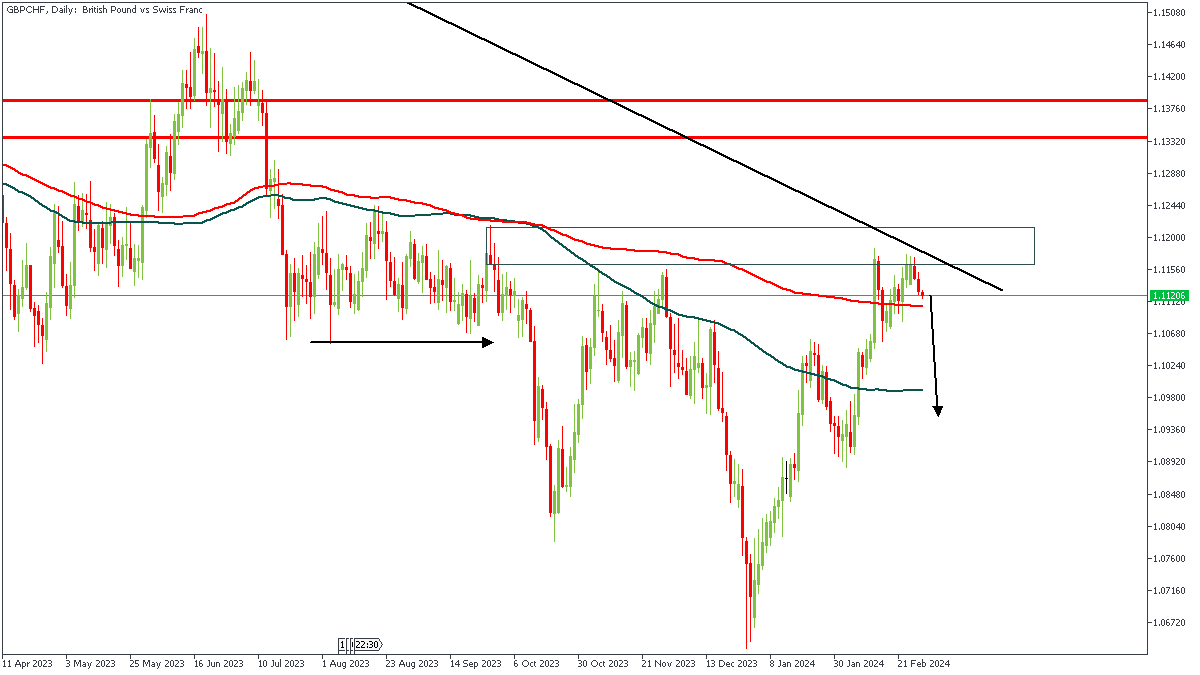
GBPCHF on the daily timeframe has created a double-top pattern right inside the daily supply zone; a resistance trendline adding to the likely reasons for the rejection. Based on the bearish positioning of the moving averages, I expect to see a bearish price action going forward till the 1.12150 target area is reached.
Analyst’s Expectations:
- Direction: Bearish
- Target: 1.09934
- Invalidation: 1.12119
USDCHF - D1 Timeframe
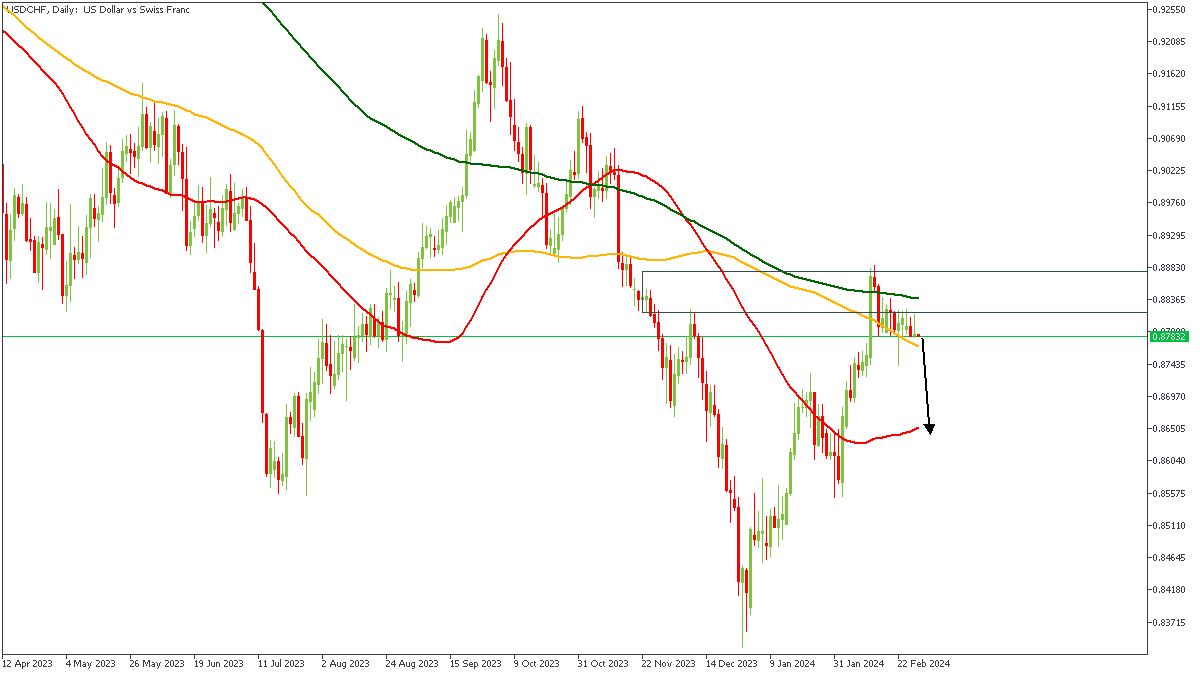
Dropping from a confluence of the 200-day moving average, and the supply zone, USDCHF seems to be having a hard time climbing beyond the supply zone. In light of this, and considering the bearish array of the moving averages as a confluence, I will sustain a bearish sentiment in the meantime.
Analyst’s Expectations:
- Direction: Bearish
- Target: 0.87072
- Invalidation: 0.88341
CONCLUSION
The trading of CFDs comes at a risk. Thus, to succeed, you have to manage risks properly. To avoid costly mistakes while you look to trade these opportunities, be sure to do your due diligence and manage your risk appropriately.