Sample Category Title
USD/CAD Mid-Day Outlook
Daily Pivots: (S1) 1.3496; (P) 1.3518; (R1) 1.3550; More...
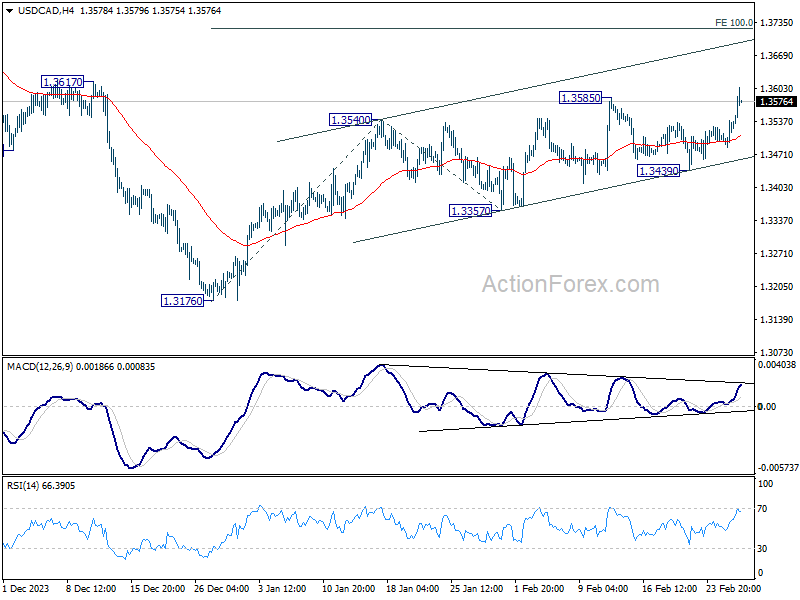
USD/CAD's rally from 1.3176 is resuming today by breaking 1.3585 resistance. Intraday bias is back on the upside for 100% projection of 1.3761 to 1.3540 from 1.3357 at 1.3721 next. For now, near term outlook will stay bullish as long as 1.3439 support holds, in case of retreat.
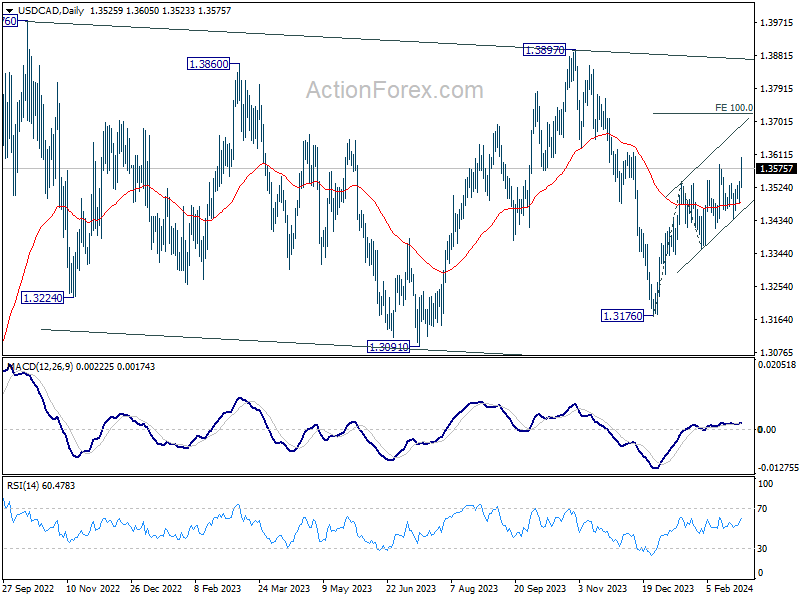
In the bigger picture, price actions from 1.3976 (2022 high) are viewed as a corrective pattern only. In case of another fall, strong support should emerge above 1.2947 resistance turned support to bring rebound. Overall, larger up trend from 1.2005 (2021 low) is still expected to resume through 1.3976 at a later stage.
Dollar and Safe Havens Surge, Bitcoin Soars Past 60K
Dollar, Yen, and Swiss Franc emerge as the predominant winners as markets enter into US session, amidst a backdrop of mild risk-off sentiment. Nevertheless, momentum of these safe-haven currencies remains relatively tempered, holding off major range breakouts across the most traded currency pairs. Traders, particularly those focusing on Dollar, seem poised on the sidelines, awaiting tomorrow's PCE inflation data from US. This upcoming release is anticipated to shed light on whether the disinflationary trend has stalled, as indicated by the latest CPI data.
Conversely, New Zealand Dollar languishes as the day's most significant underperformer, following RBNZ's decision to maintain interest rates unchanged. Australian Dollar trails closely, dampened by CPI reading that fell short of expectations, while Canadian Dollar also faces downward pressure. Euro and Sterling find themselves in mixed positions, though Euro slightly edges out with a modest advantage.
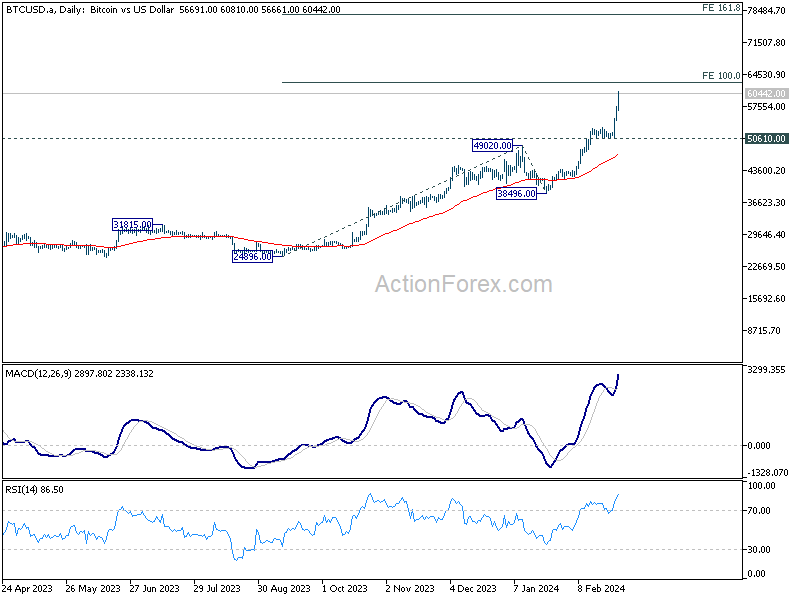
Technically, Bitcoin entered a phase of full upside acceleration this week, and breaks above 60k psychological level. Next target is 100% projection of 24896 to 49020 from 38496 at 62620. Decisive break there will pave the way to 68986 record high, or even further to 161.8% projection at 77528 next. In any case, outlook will now stay bullish as long as 50610 support holds.
In Europe, at the time of writing, FTSE is down -0.69%. DAX is up 0.23%. CAC is down -0.03%. UK 10-year yield is down -0.034 at 4.098. Germany 10-year yield is down -0.020 at 2.447. Earlier in Asia, Nikkei fell -0.08%. Hong Kong HSI fell -1.51%. China Shanghai SSE fell -1.91%. Singapore Strait Times fell -0.58%. Japan 10-year JGB yield rose 0.0022 to 0.698.
US goods trade deficit widens to USD -90.2B in Jan
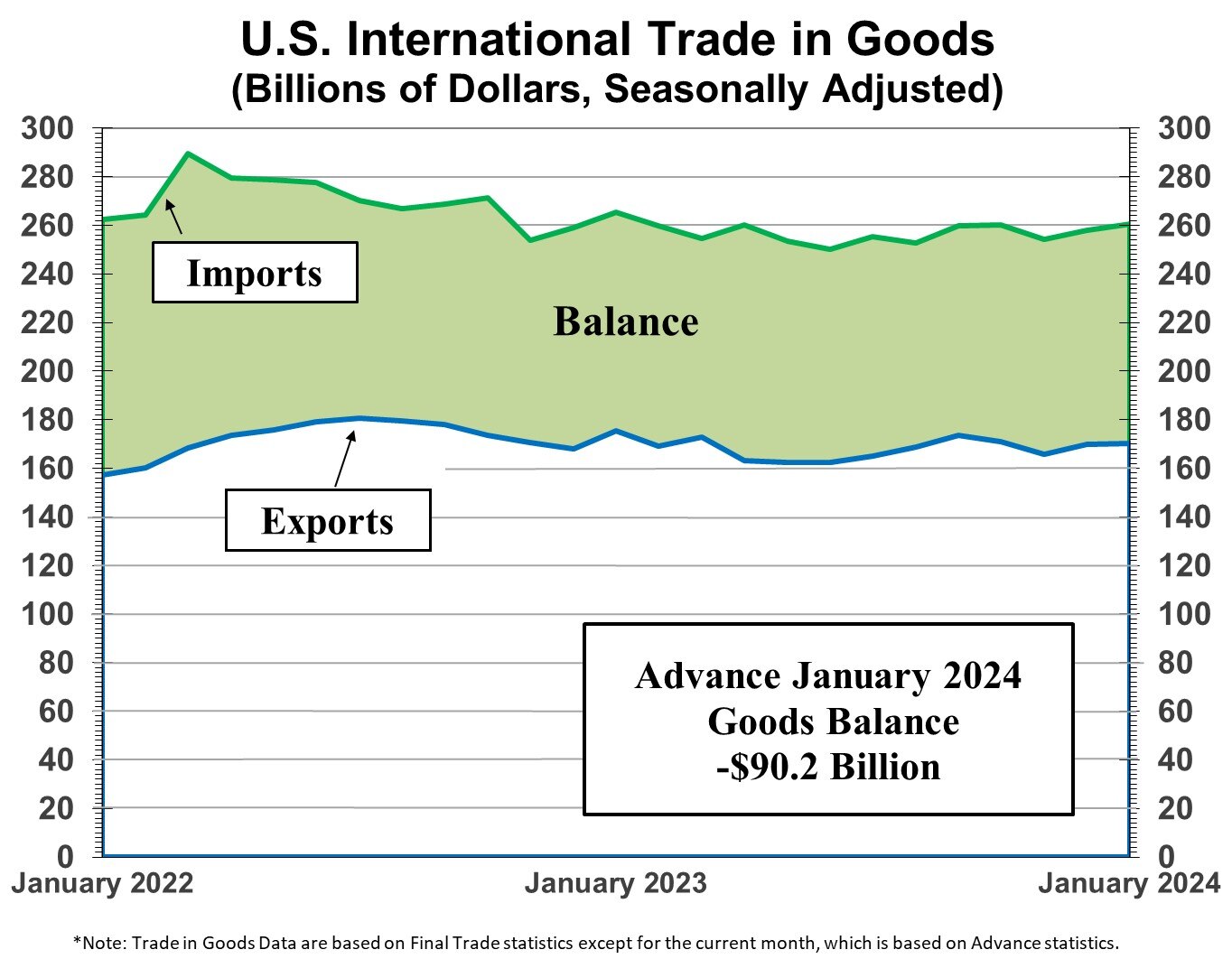
US goods exports rose 0.2% mom to USD 170.42B in January. Goods imports rose 1.1% mom to USD 260.62B. Goods trade deficit widened to USD -90.2B, larger than expectation of -88.1B.
Wholesale inventories fell -0.1% mom to USD 896.8B. Retail inventories rose 0.5% mom to USD 804.8B.
ECB's Kazimir on rate cut: June preferred, April a surprise, March a no go
In a Reuters interview, ECB Governing Council member Peter Kazimir emphasizd a cautious approach toward rate cuts. Kazimir explicitly stated, "There is no reason to rush a rate cut," pinpointing June as his "preferred date". "April would surprise me and March is a no go," he added.
His comments reflect a strategic desire for a "smooth and steady cycle of policy easing," contingent on a thorough assessment of the initial steps toward loosening monetary policy.
Kazimir highlighted the rapid disinflation observed at the "headline level", albeit with remaining uncertainties around core inflation "because wage developments remain unclear." The upcoming collective bargaining deals are deemed pivotal in clarifying this outlook.
Market forecasts now anticipating a 90bps reduction in interest rates by the year's end, starting in June. Kazimir acknowledged this revised market sentiment as "more realistic."
Eurozone economic sentiment falls to 95.4 in Feb, EU down to 95.4
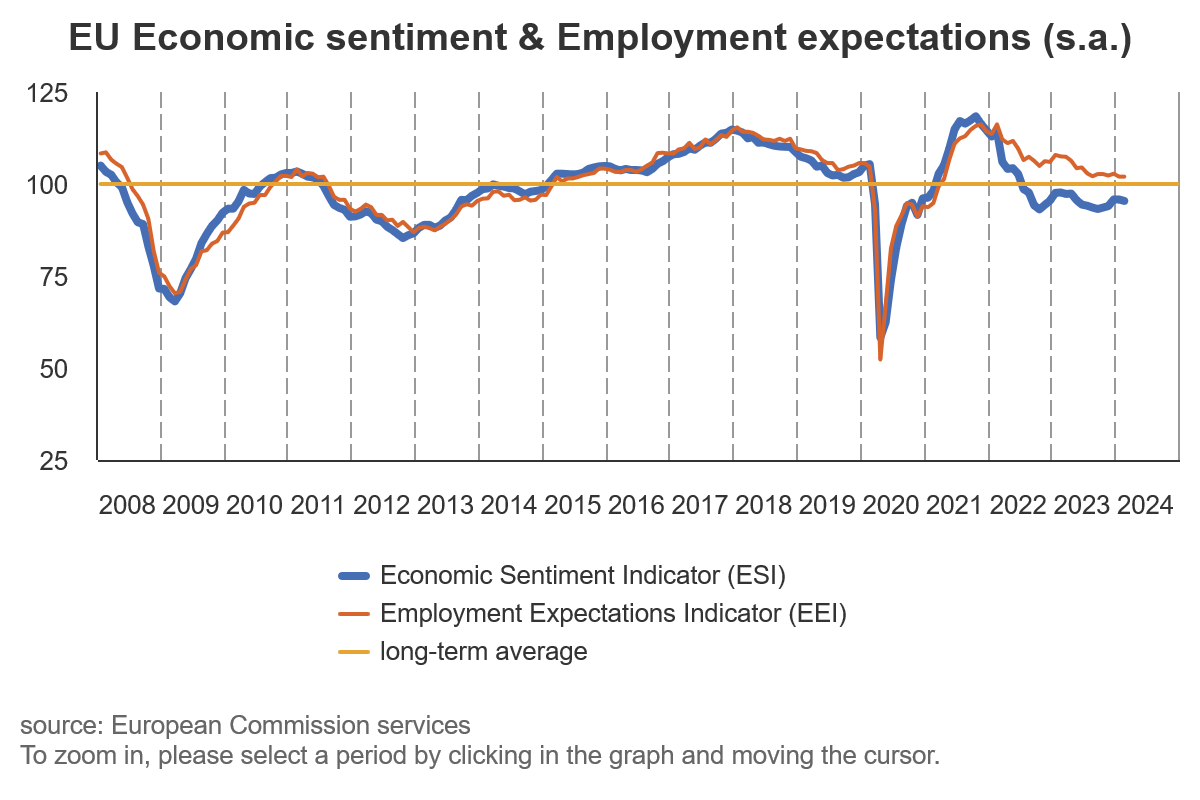
Eurozone Economic Sentiment Indicator fell from 96.1 to 95.4 in February. Employment Expectations Indicator rose from 102.3 to 102.5. Economic Uncertainty Indicator fell from 21.3 to 20.1.
Eurozone industry confidence fell from -9.3 to -9.5. Services confidence fell from 8.4 to 6.0. Consumer confidence rose from -16.1 to -15.5 Retail trade confidence fell from -5.6 to -6.7. Construction confidence fell from -4.6 to -5.4.
EU Economic Sentiment Indicator fell from 95.8 to 95.4. Amongst the largest EU economies, the ESI deteriorated markedly in Italy (-1.6) and slightly in Germany (-0.6) and Poland (-0.5), while it improved strongly in the Netherlands (+1.7) and remained broadly stable in France (-0.3) and Spain (-0.2).
RBNZ keeps OCR at 5.50%, door still open for another hike
RBNZ decided to hold Official Cash Rate unchanged at 5.50%. The central bank expressed its confidence that the current OCR level is effectively restraining demand. However, it underscored the need for a "sustained decline in capacity pressures" to ensure that inflation re-aligns with 1 to 3% target range. This necessitates maintaining OCR "at a restrictive level for a sustained period of time".
The updated economic forecasts in the MPS projects that CPI inflation will return to the target band by Q3 this year, then falls further to 2% midpoint by Q4 2025. These projections indicate a "slightly lower" inflation rate over the forecast period compared to previous estimates made in November.
Regarding future movements, the central bank anticipates OCR path to echo the trajectory outlined in the November MPS. It suggests OCR could peak at 5.6% in Q2 this year, leaving room for a marginal possibility of another rate hike.
Absent further increases, interest rate reductions are expected to commence in the Q2 2025, with OCR gradually decreasing to 3.2% by Q1 of 2027.
Australia monthly CPI unchanged at 3.4% in Jan, trimmed mean CPI down to 3.8%
Australia monthly CPI was unchanged at 3.4% yoy in January, below expectation of a rise to 3.6% yoy. CPI excluding volatile items and holiday travel slowed from 4.2% yoy to 4.1% yoy. Trimmed mean CPI also slowed from 4.0% yoy to 3.8% yoy.
The detailed breakdown reveals that the main inflationary pressures came from specific sectors: Housing costs rose by 4.6%, food and non-alcoholic beverages by 4.4%, alcohol and tobacco by a significant 6.7%, and insurance and financial services saw the highest increase at 8.2%.
These increases were somewhat mitigated by a decrease in the recreation and culture sector, notably a -1.7% drop, primarily driven by a -7.1% fall in Holiday travel and accommodation, which provided a counterbalance to the overall annual inflation rate.
USD/CAD Mid-Day Outlook
Daily Pivots: (S1) 1.3496; (P) 1.3518; (R1) 1.3550; More...
USD/CAD's rally from 1.3176 is resuming today by breaking 1.3585 resistance. Intraday bias is back on the upside for 100% projection of 1.3761 to 1.3540 from 1.3357 at 1.3721 next. For now, near term outlook will stay bullish as long as 1.3439 support holds, in case of retreat.
In the bigger picture, price actions from 1.3976 (2022 high) are viewed as a corrective pattern only. In case of another fall, strong support should emerge above 1.2947 resistance turned support to bring rebound. Overall, larger up trend from 1.2005 (2021 low) is still expected to resume through 1.3976 at a later stage.
Economic Indicators Update
| GMT | Ccy | Events | Actual | Forecast | Previous | Revised |
|---|---|---|---|---|---|---|
| 00:30 | AUD | Monthly CPI Y/Y Jan | 3.40% | 3.60% | 3.40% | |
| 00:30 | AUD | Construction Work Done Q4 | 0.70% | 0.80% | 1.30% | |
| 01:00 | NZD | RBNZ Interest Rate Decision | 5.50% | 5.50% | 5.50% | |
| 09:00 | CHF | Credit Suisse Economic Expectations Feb | 10.2 | -19.5 | ||
| 10:00 | EUR | Eurozone Economic Sentiment Indicator Feb | 95.4 | 96.6 | 96.2 | 96.1 |
| 10:00 | EUR | Eurozone Industrial Confidence Feb | -9.5 | -9.2 | -9.4 | -9.3 |
| 10:00 | EUR | Eurozone Services Sentiment Feb | 6 | 9 | 8.8 | 8.4 |
| 10:00 | EUR | Eurozone Consumer Confidence Feb F | -15.5 | -15.5 | -15.5 | |
| 13:30 | CAD | Current Account Q4 | -1.6B | -1.9B | -3.22B | -4.7B |
| 13:30 | USD | GDP Annualized Q4 P | 3.20% | 3.30% | 3.30% | |
| 13:30 | USD | GDP Price Index Q4 P | 1.60% | 1.50% | 1.50% | |
| 13:30 | USD | Goods Trade Balance (USD) Jan P | -90.2B | -88.1B | -87.9B | |
| 13:30 | USD | Wholesale Inventories Jan P | 0.20% | 0.40% | ||
| 15:30 | USD | Crude Oil Inventories | 3.1M | 3.5M |
US goods trade deficit widens to USD -90.2B in Jan
US goods exports rose 0.2% mom to USD 170.42B in January. Goods imports rose 1.1% mom to USD 260.62B. Goods trade deficit widened to USD -90.2B, larger than expectation of -88.1B.
Wholesale inventories fell -0.1% mom to USD 896.8B. Retail inventories rose 0.5% mom to USD 804.8B.
NZ Dollar Slides after RBNZ holds rates
- RBNZ holds cash rate at 5.25%
- New Zealand dollar declines 1.2%
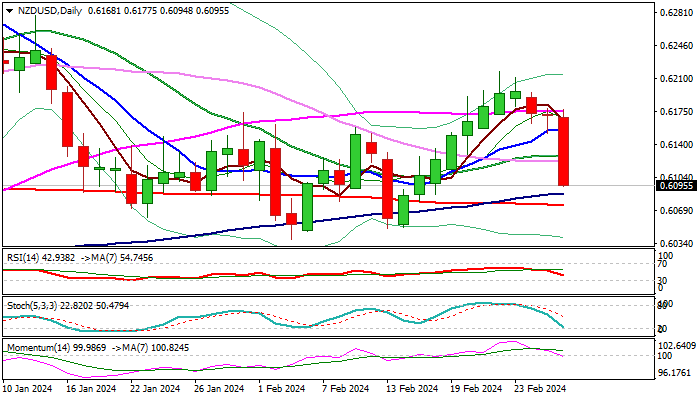
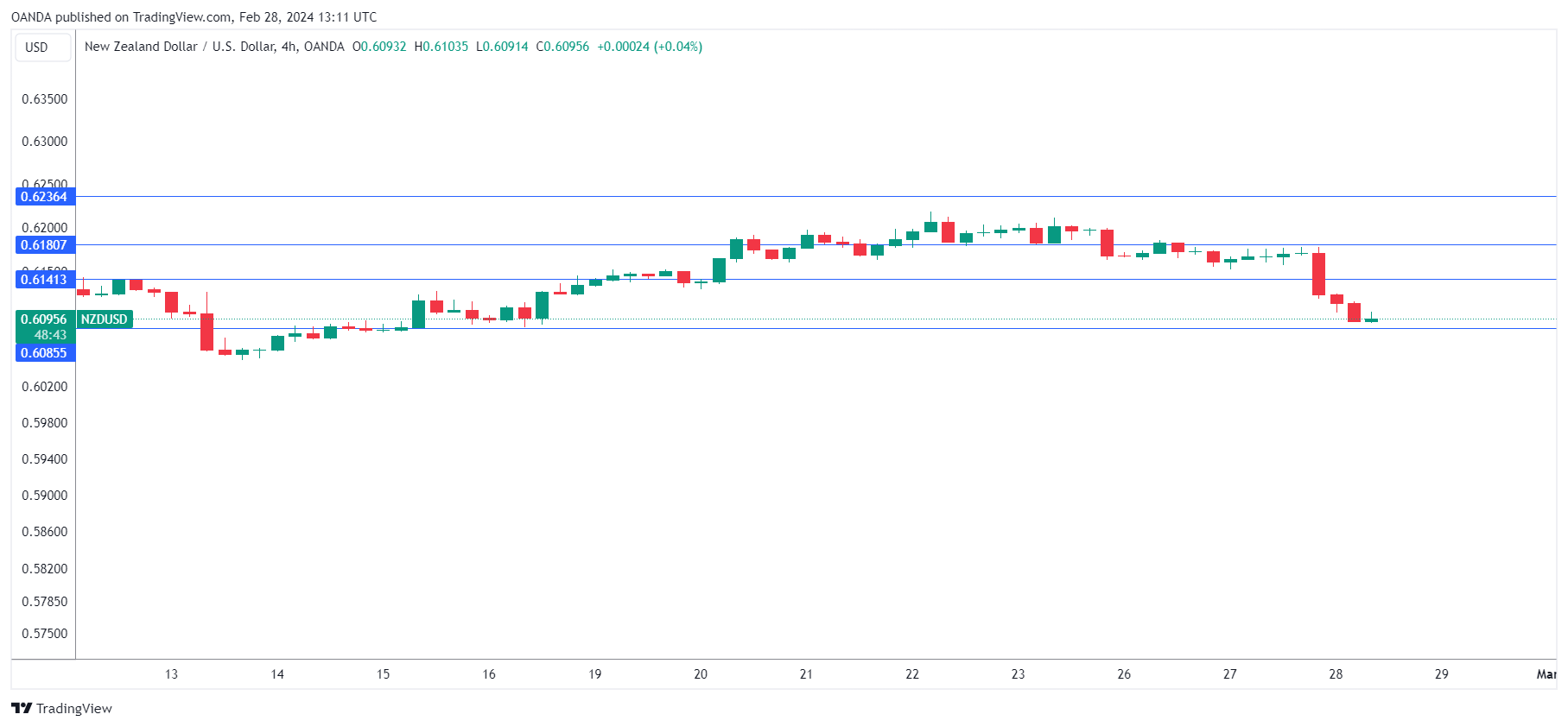
The New Zealand dollar is sharply lower on Tuesday. In the European session, NZD/USD is trading at 0.6095, down 1.22%. Earlier, the New Zealand dollar dropped to a low of 0.6092, its lowest level since February 13.
RBNZ less hawkish than anticipated
There was no surprise as the Reserve Bank of New Zealand paused rates for the fifth straight time on Wednesday, as the “higher for longer” stance remains in force. The markets had priced in a pause at today’s meeting at 75%. What was unexpected and sent the New Zealand dollar tumbling was the tone of the meeting, which was less hawkish than what we’ve been hearing lately from the RBNZ.
At the meeting, the RBNZ expressed satisfaction with the inflation outlook. The rate statement noted that “core inflation and most measures of inflation expectations have declined, and the risks to the inflation outlook have become more balanced”. This was a departure from Governor Orr’s warning two weeks ago that inflation expectations remained too high.
Orr has been pushing back against rate cut expectations and has said that rate hikes remain on the table. At today’s meeting, however, Orr said that “there was very strong consensus that the official cash rate right now is sufficient”.
In addition to Orr’s strong hint that he would not raise interest rates, the RBNZ lowered its forecast of a peak cash rate to 5.6%, down from 5.7% in the previous forecast. This was not only a more dovish stance of the central bank’s expected rate path, but greatly reduce the likelihood of further rate hikes, given that the current cash rate stands at 5.5%.
The RBNZ may be moving away from a rate hike, but a rate cut does not look likely in the near term. The central bank has projected that it will not lower rates until 2025, which could mean that its “higher for longer” stance will be in place for the foreseeable future.
NZD/USD Technical
- NZD/USD easily broke below support at 0.6141 and is putting pressure on support at 0.6085
- There is resistance at 0.6180 and 0.6236
Dollar Index: Dollar Edges Higher Ahead of Release of Key US Economic Data on Thursday
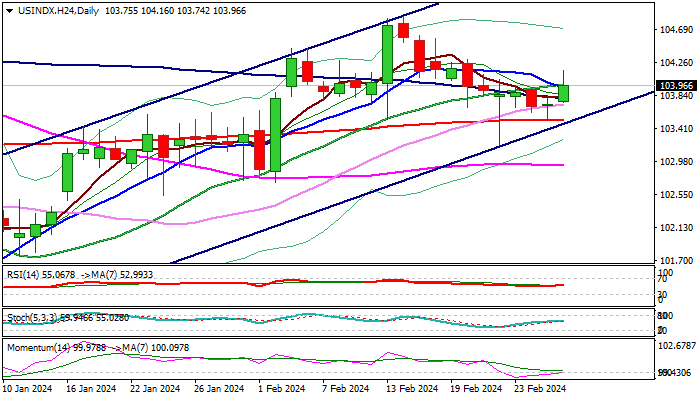
The dollar index bounced on Wednesday, after 200DMA (103.52) repeatedly contained dips in recent sessions.
Reversal pattern is forming on daily chart and 14-d momentum is ascending from negative territory and pressuring the centreline, contributing to positive signals, which will still look for additional confirmation on daily close above cracked Fibo barriers at 104.00/02 (converged 10/20DMA’s / 50% retracement of 104.85/103.19 bear-leg).
However, firmer direction signals are expected to come from releases of inflation data from the US on Thursday, which will give more details about Fed’s plans to start cutting interest rates.
Near-term action is expected to keep bullish bias while holding above 103.80 zone (broken Fibo 38.2% / daily Tenkan-sen).
Res: 104.02; 104.22; 104.46; 104.85.
Sup: 103.80; 103.52; 103.19; 102.93.
ECB’s Kazimir on rate cut: June preferred, April a surprise, March a no go
In a Reuters interview, ECB Governing Council member Peter Kazimir emphasizd a cautious approach toward rate cuts. Kazimir explicitly stated, "There is no reason to rush a rate cut," pinpointing June as his "preferred date". "April would surprise me and March is a no go," he added.
His comments reflect a strategic desire for a "smooth and steady cycle of policy easing," contingent on a thorough assessment of the initial steps toward loosening monetary policy.
Kazimir highlighted the rapid disinflation observed at the "headline level", albeit with remaining uncertainties around core inflation "because wage developments remain unclear." The upcoming collective bargaining deals are deemed pivotal in clarifying this outlook.
Market forecasts now anticipating a 90bps reduction in interest rates by the year's end, starting in June. Kazimir acknowledged this revised market sentiment as "more realistic."
Gold Tumbles Below Short-Term Uptrend Line
- Gold meets 200-period SMA, which acted as strong support line
- Stochastic dives to oversold region and MACD falls below trigger line
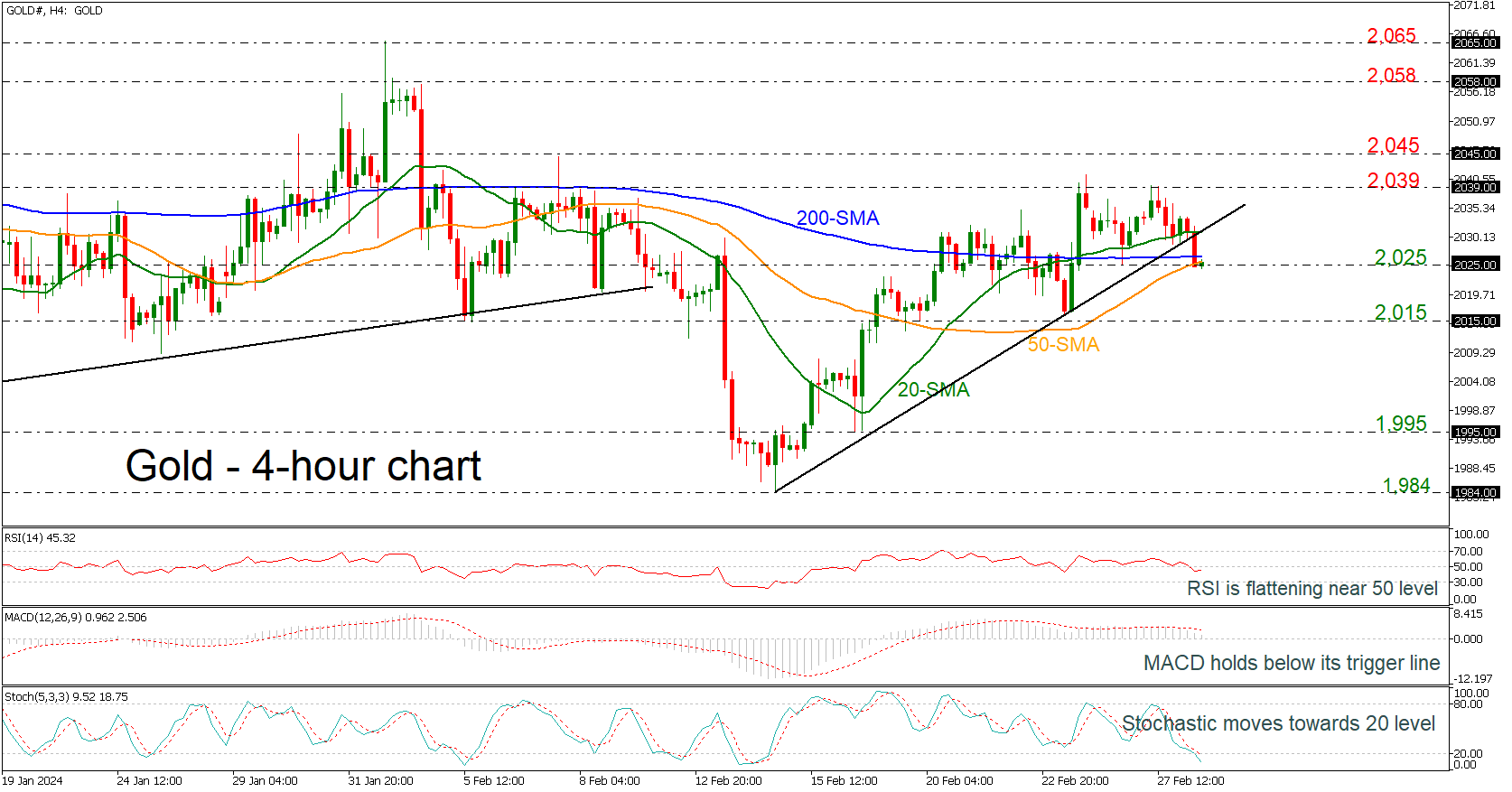
Gold prices are edging lower, beneath a short-term ascending trend line, meeting the 200-period simple moving average (SMA) at 2,026.60, which is ready to post a bullish cross with the 50-period SMA in the 4-hour chart.
If there is an attempt below the aforementioned lines and the 2,025 support, then the commodity could battle with the 2,015 region before tumbling towards the 1,995 barricade.
The technical oscillators are endorsing the negative momentum in the price. The MACD is standing beneath its trigger line, the stochastic is diving in the oversold area and the RSI is moving horizontally below the neutral threshold of 50.
However, in case of a move above the 20-period SMA near 2,030, then the price could rest around the previous peak of 2,039. Moving higher, gold may challenge the 2,045 resistance, taken from the peak on February 7.
Summarizing, the precious metal shifted the positive outlook to a negative one in the very short-term timeframe, but the bigger outlook is still in a neutral phase within 1,974-2,088.
Eurozone economic sentiment falls to 95.4 in Feb, EU down to 95.4
Eurozone Economic Sentiment Indicator fell from 96.1 to 95.4 in February. Employment Expectations Indicator rose from 102.3 to 102.5. Economic Uncertainty Indicator fell from 21.3 to 20.1.
Eurozone industry confidence fell from -9.3 to -9.5. Services confidence fell from 8.4 to 6.0. Consumer confidence rose from -16.1 to -15.5 Retail trade confidence fell from -5.6 to -6.7. Construction confidence fell from -4.6 to -5.4.
EU Economic Sentiment Indicator fell from 95.8 to 95.4. Amongst the largest EU economies, the ESI deteriorated markedly in Italy (-1.6) and slightly in Germany (-0.6) and Poland (-0.5), while it improved strongly in the Netherlands (+1.7) and remained broadly stable in France (-0.3) and Spain (-0.2).
EURGBP Consolidates above 20-day SMA
- EURGBP looks for resistance at 50-day SMA
- RSI confirms sideways move
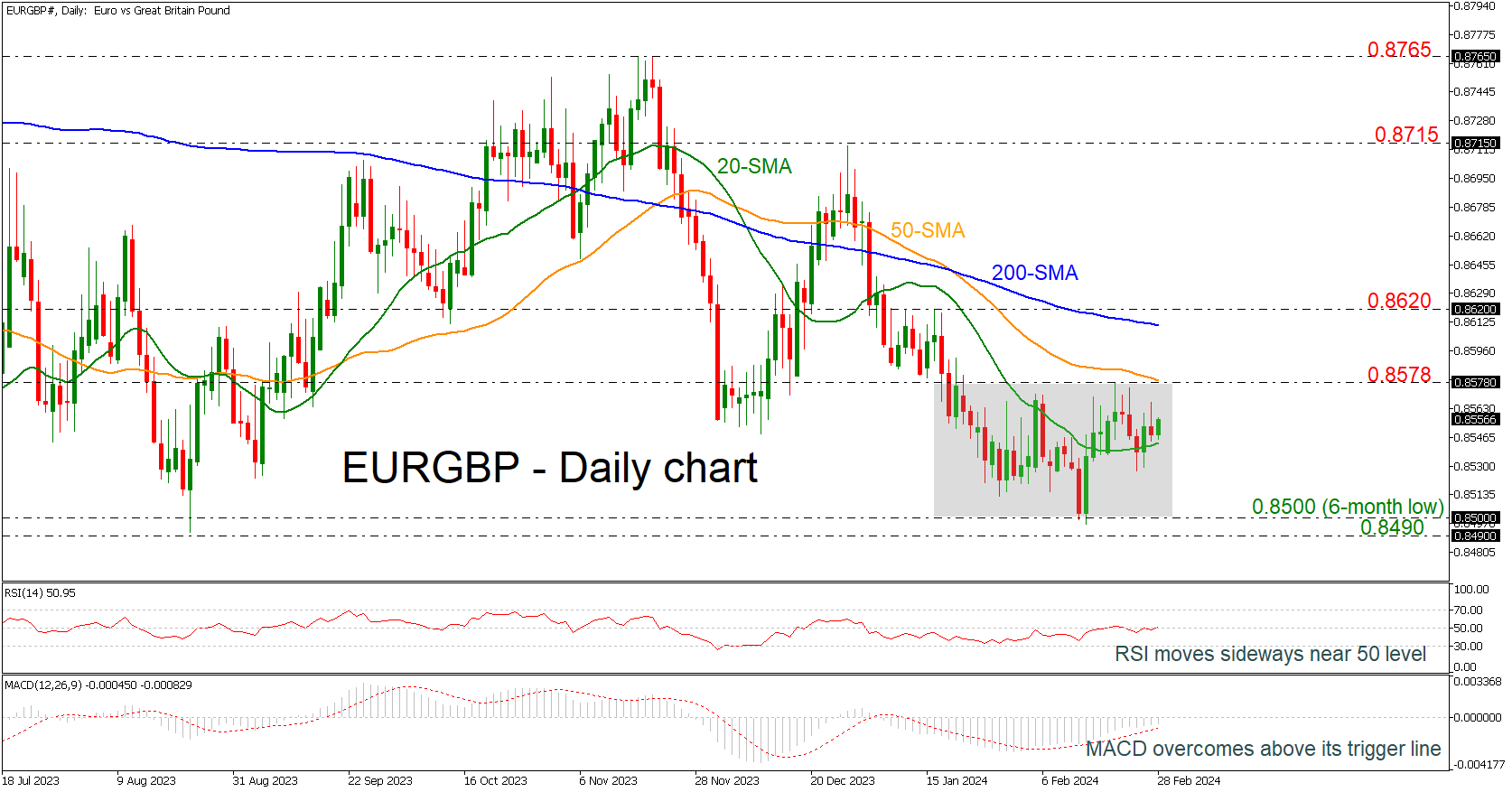
EURGBP has been consolidating beneath the 50-day simple moving average (SMA), which overlaps with the 0.8578 resistance level and the six-month low of 0.8500 since January 18.
According to technical oscillators, the RSI is confirming the sideways movement as it is holding near the neutral threshold of 50, while the MACD is standing above its trigger line but still beneath the zero level.
If the market remains above the 20-day SMA then the next target could come from the upper boundary of the current short-term trading range at 0.8578 ahead of the 200-day SMA at 0.8610. Marginally higher, the 0.8620 resistance may halt bullish actions, acting as a turning point for more losses.
On the other hand, a decline could last until the 0.8500 critical level, while a dive below 0.8490 could open the way for steeper bearish movements.
All in all, EURGBP is looking neutral in the near-term but the medium-term timeframe is still negative and only a successful attempt above the 200-day SMA may switch the outlook to a bullish one.
NZD/USD Accelerates Sharply Lower on Unchanged Policy and More Dovish Than Expected Comments from RBNZ
The Kiwi dollar was sharply down vs its US counterpart (losing 1.1%) in early trading of Wednesday, after the Reserve Bank of New Zealand left interest rates unchanged (in line with expectations) but delivered more dovish comments and forward guidance, which sparked heavy sales of NZ dollar.
Fresh drop retraced the most of 0.6049/0.6217 bull-leg and weakened a technical structure on daily chart, as the price fell below the base of daily cloud and falling momentum indicator is nearing the border line of negative territory.
Bears pressure pivotal supports at 0.6089/86 (Fibo 76.4% / 100DMA) and nearby 200DMA (0.6074), which guard key short-term supports at 0.6049/38 (Feb 13/5 double-bottom and a higher base).
Expect a partial profit-taking on oversold conditions soon, with limited upticks to provide better selling levels.
Caution on return above 10DMA (0.6154) which would sideline bears.
Res: 0.6116; 0.6127; 0.6154; 0.6177.
Sup: 0.6086; 0.6074; 0.6049; 0.6038.