Sample Category Title
FOMC Anticipation Keeps Dollar in Check; Yen Halts Slide on Verbal Intervention
The forex markets displayed a calm demeanor during Asian session today, with traders eagerly anticipating FOMC rate decision. After experiencing a tumultuous selloff, Yen found some semblance of stability, courtesy of verbal intervention by Japan. Nonetheless, it remains the week's laggard, pausing momentarily with the possibility of further decline on the horizon. This weakening Yen has inadvertently boosted Nikkei, contributing to its impressive rally these two days. In the same vein, Swiss Franc trails Yen as the second weakest, with Aussie and Canadian Dollar displaying softness too.
Dollar, on the other hand, holds its ground, maintaining its strength alongside Euro and Sterling. The widely anticipated Fed hold and Chair Jerome Powell's expected non-committal tone suggest that FOMC policy decision might not stir major waves. On the other hand, Treasury's quarterly refunding announcement has the potential to be a game-changer, impacting bond markets and subsequently influencing stocks and currencies. Additionally, US ISM manufacturing data presents another variable that could introduce unexpected dynamics. Without significant developments, Dollar might remain in a holding pattern the European majors until Friday's non-farm payroll provides more direction.
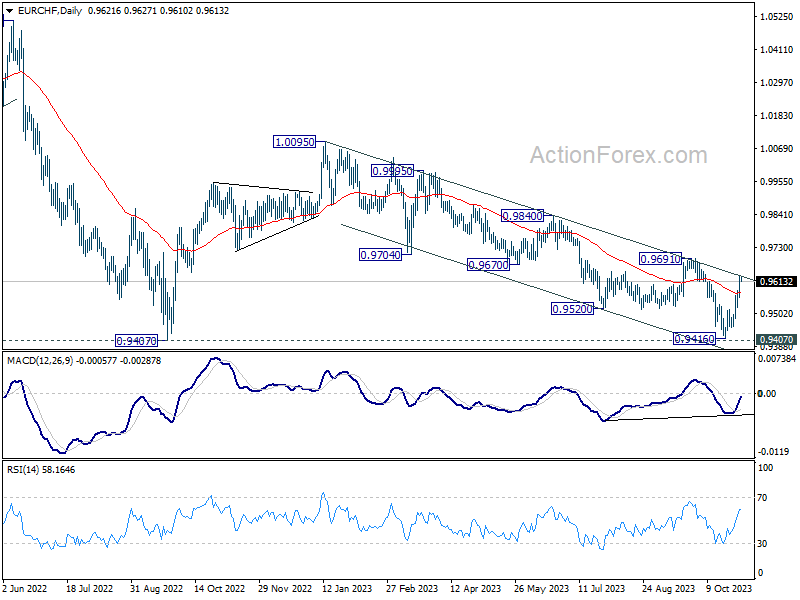
On the technical front, other than Dollar pairs, EUR/CHF is also an interesting one to watch. The strong rebound from 0.9416 continues this week, strengthening the case of medium term bottoming just ahead of 0.9407 key support. Focus for the next few days will be on 0.9691 resistance. Decisive break there argue that whole choppy decline from 1.0095 has completed, and turn outlook bullish. But of course, rejection by 0.9691 will maintain bearishness for at least another take on 0.9407 low.
In Asia, Nikkei closed up 2.41%. Hong Kong HSI is down -0.06%. China Shanghai SSE is up 0.29%. Singapore Strait Times is up 0.20%. Japan 10-year JGB yield rose 0.0121 to 0.961. Overnight, DOW rose 0.38%. S&P 500 rose 0.65%. NASDAQ rose 0.48%. 10-year yield was flat at 4.875.
Kanda announces Japan is on "standby" as Yen plunges past 151 to Dollar
Amid the resumed selloff of Yen, which broke 151 level against Dollar overnight, Japan's top currency official, Masato Kanda, has issued a stern verbal warning. The Vice Finance Minister for International Affairs emphasized that Japan remains vigilant and "on standby" to mitigate the excessive volatility observed in the currency markets.
However, Kanda refrained from divulging specific details on potential interventions. "But I can't say what we'll do, and when — we'll make judgments overall, and we're making judgments in a state of urgency," he added.
Kanda voiced significant concern over the rapid and one-sided shifts in currency values, stressing the importance of calibrated responses against overblown foreign exchange movements. He emphasized that fundamental economic indicators don't justify such abrupt currency shifts, hinting at other factors at play. "Speculative trading seems to be the biggest factor behind recent currency moves," Kanda observed.
"The yen has weakened close to 25 yen against the dollar from the start of the year, and it's also moved a few yen in a short amount of time," he noted, highlighting the dramatic shift in the currency's value.
Japan PMI manufacturing: Slump continues, yet optimism shines for 2024
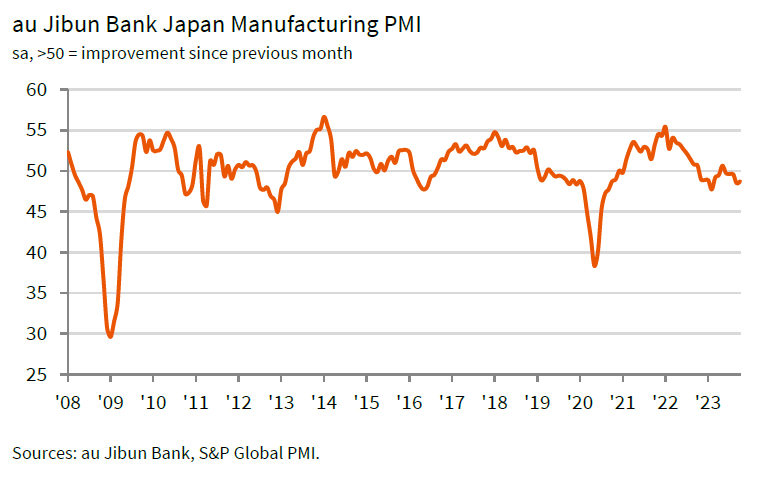
Japan's PMI Manufacturing for October was finalized at 48.7, a slight uptick from 48.5 in September. Despite the improvement, the index languished below the critical 50 threshold for the fifth consecutive month.
S&P Global's analysis revealed that a significant decline in output occurred due to persisting sales reductions. This challenging environment also led to the first drop in employment figures since the beginning of 2021. On the brighter side, confidence remains robust regarding a potential return to growth in 2024.
IMF to RBA: More tightening needed to curb inflation
In a report on Australia's economy, IMF highlighted concerns about persistent inflation levels in the country. Even though inflation is "gradually declining", it continues to hover "significantly above" RBA's target, with the country's output "remains above potential."
The IMF staff "recommend further monetary policy tightening". They believe this approach will realign inflation with RBA's target range by 2025 and "minimize the risk of de-anchoring inflation expectations."
In terms of economic momentum, the IMF predicts a further slowdown in the near future, coinciding with a steady decrease in inflation. While risks to growth appears "broadly balanced", the potential for inflation to surpass expectations remains a cause for concern.
NZ employment down -0.2% in Q3, unemployment rate jumps to 3.9%
New Zealand's employment figures for Q3 came in weaker than anticipated. Employment contracted by -0.2%, sharply diverging from the forecasted growth of 0.40%.
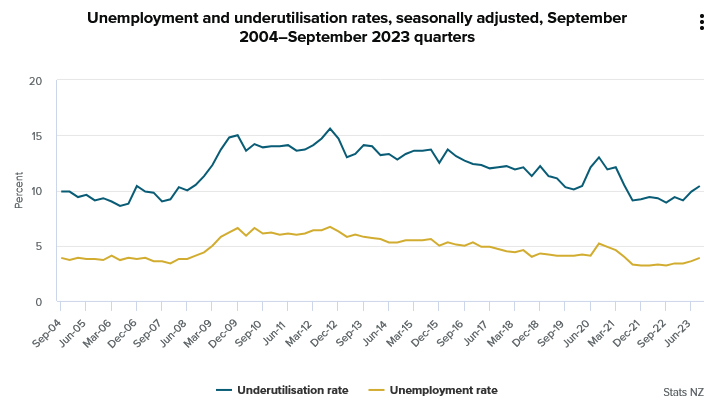
Unemployment rate made a noticeable leap, rising from 3.6% to 3.9%, a figure that met market expectations. Additionally, both employment rate and labor force participation rate registered declines, moving from 69.8% to 69.1% and from 72.5% to 72.0% respectively.
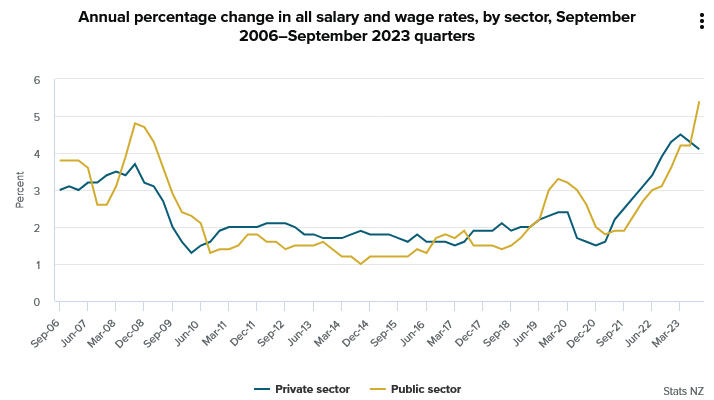
Wage data presented a mixed picture. The all-sector wage inflation stood firm at 4.3% yoy.
The public sector experienced a particularly sharp uptick in salaries and wages, registering a 5.4% yoy increase. This significant rise is notable for being the steepest since the data series commenced in 1992, surpassing 4.2% yoy growth observed in Q2.
In contrast, the private sector saw wage cost inflation moderating to 4.1% yoy in Q3, slightly down from the 4.3% recorded in the previous quarter.
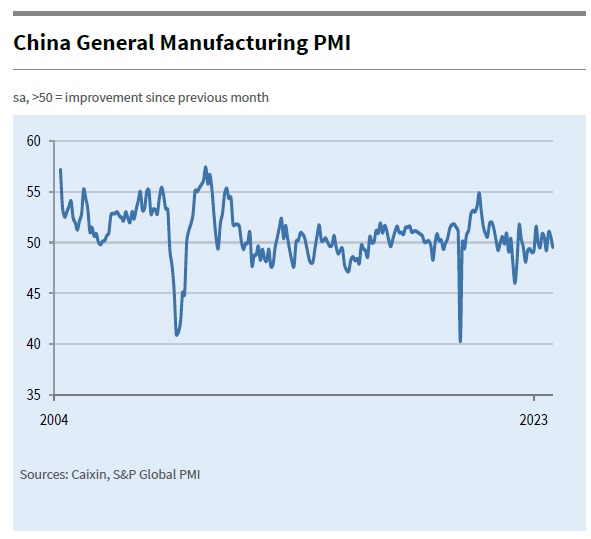
China's Caixin PMI manufacturing slips to 49.5, business optimism continues to wane
China's Caixin PMI Manufacturing index slipped from 50.6 in September to 49.5 in October, falling below market expectations set at 50.8. This marks a renewed contraction in the nation's manufacturing sector.
Wang Zhe, Senior Economist at Caixin Insight Group, highlighted several challenges facing the manufacturing industry. "Overall, manufacturers were not in high spirits in October," he said. The decline in the sector was multifaceted - supply, employment, and external demand all experienced reductions, while domestic demand saw a slower pace of expansion.
The manufacturing environment was further complicated by rising costs and output prices. This was coupled with decrease in purchases and accumulation of inventories of finished goods. Reflecting the various pressures, "business optimism continued to wane".
Market eyes treasury refunding ahead of FOMC hold
Fed is widely expected to interest rates unchanged at 5.25-5.50% today, a second consecutive pause. The accompany and Fed Chair Jerome Powell's press conference will likely leave the door open to further hikes. The question is how firm Powell could maintain his hawkish stance, which could reflect the chance of another hike in December.
Fed policymakers have in recent weeks cited the rise in longer-term borrowing costs and the consequent tightening of financial conditions as reasons for lowering the need for more tightening. Powell's comments on this will be closely watched too.
However, Powell will likely hold off any substantial comments for now, given that the next set of economy projections will be prepared and released in December. That's what Fed policymakers would decide what to do next. Hence, today's FOMC could turn out to be a non event.
A more market moving event could be the quarterly treasury refunding announcement before the FOMC decision. Investors got a preview of the Treasury's direction Monday, when the department said it will be auctioning off USD 776B of debt in the final quarter of 2023. The key variables markets will be watching are the actual sizes of the auction as well as the maturities mix. There is a supply-demand mismatch in the treasury market, and that is what has led to the sharp rise bond yields this year.
Looking ahead
Swiss PMI and UK PMI manufacturing final are the highlights of European session. Later in the day, US will also release ISM manufacturing before FOMC rate decision.
USD/JPY Daily Outlook
Daily Pivots: (S1) 149.87; (P) 150.80; (R1) 152.56; More...
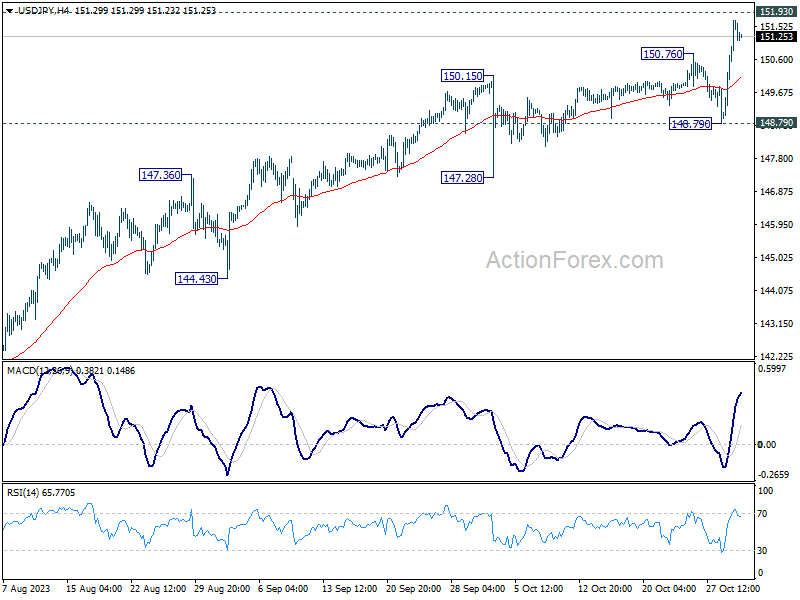
Intraday bias in USD/JPY remains on the upside for 151.93 key resistance. Firm break there will target 100% projection of 129.62 to 145.06 from 137.22 at 152.66. For now, break of 148.79 support is needed to indicate short term topping. Otherwise, outlook will stay bullish in case of retreat.
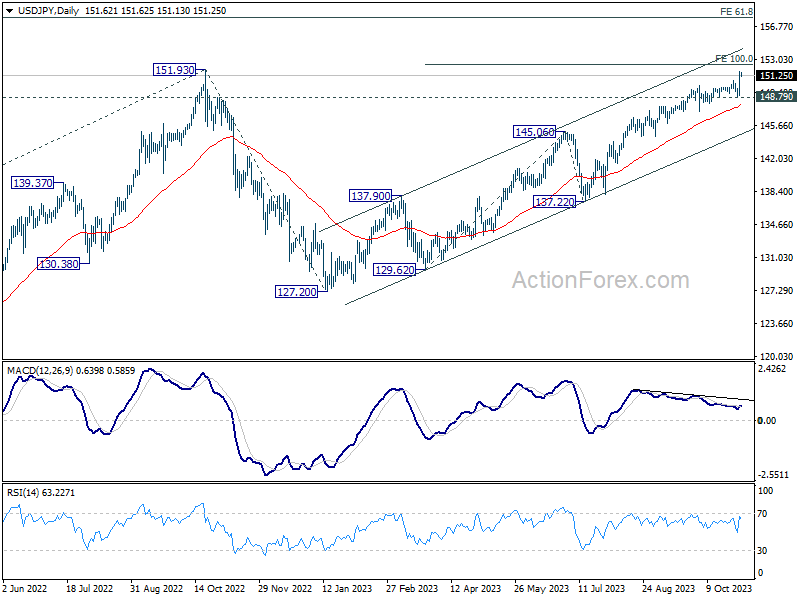
In the bigger picture, immediate focus is now on 151.93 resistance (2022 high). Rejection by 151.93, followed by sustained break of 145.06 resistance turned support will argue that rise from 127.20 has completed, and turn outlook bearish for 137.22 support and below. However, sustained break of 151.93 will confirm resumption of long term up trend. Next target will be 61.8% projection of 102.58 to 151.93 from 127.20 at 157.69.
Economic Indicators Update
| GMT | Ccy | Events | Actual | Forecast | Previous | Revised |
|---|---|---|---|---|---|---|
| 21:45 | NZD | Employment Change Q3 | -0.20% | 0.40% | 1.00% | |
| 21:45 | NZD | Unemployment Rate Q3 | 3.90% | 3.90% | 3.60% | |
| 21:45 | NZD | Labour Cost Index Q/Q Q3 | 0.80% | 1.00% | 1.10% | |
| 00:30 | AUD | Building Permits M/M Sep | -4.60% | 2.60% | 7.00% | 8.10% |
| 00:30 | JPY | Manufacturing PMI Oct F | 48.7 | 49 | 48.5 | |
| 01:45 | CNY | Caixin Manufacturing PMI Oct | 49.5 | 50.8 | 50.6 | |
| 08:30 | CHF | Manufacturing PMI Oct | 45 | 44.9 | ||
| 09:30 | GBP | Manufacturing PMI Oct F | 45.2 | 45.2 | ||
| 12:15 | USD | ADP Employment Change Oct | 135K | 89K | ||
| 13:30 | CAD | Manufacturing PMI Oct | 47.5 | |||
| 13:45 | USD | Manufacturing PMI Oct F | 50 | 50 | ||
| 14:00 | USD | ISM Manufacturing PMI Oct | 49 | 49 | ||
| 14:00 | USD | ISM Manufacturing Prices Paid Oct | 44.5 | 43.8 | ||
| 14:00 | USD | ISM Manufacturing Employment Index Oct | 51.2 | |||
| 14:00 | USD | Construction Spending M/M Sep | 0.40% | 0.50% | ||
| 14:30 | USD | Crude Oil Inventories | 1.5M | 1.4M | ||
| 18:00 | USD | Fed Interest Rate Decision | 5.50% | 5.50% | ||
| 18:30 | USD | FOMC Press Conference |
GBPJPY Looking For Acceleration As Elliott Wave Nest
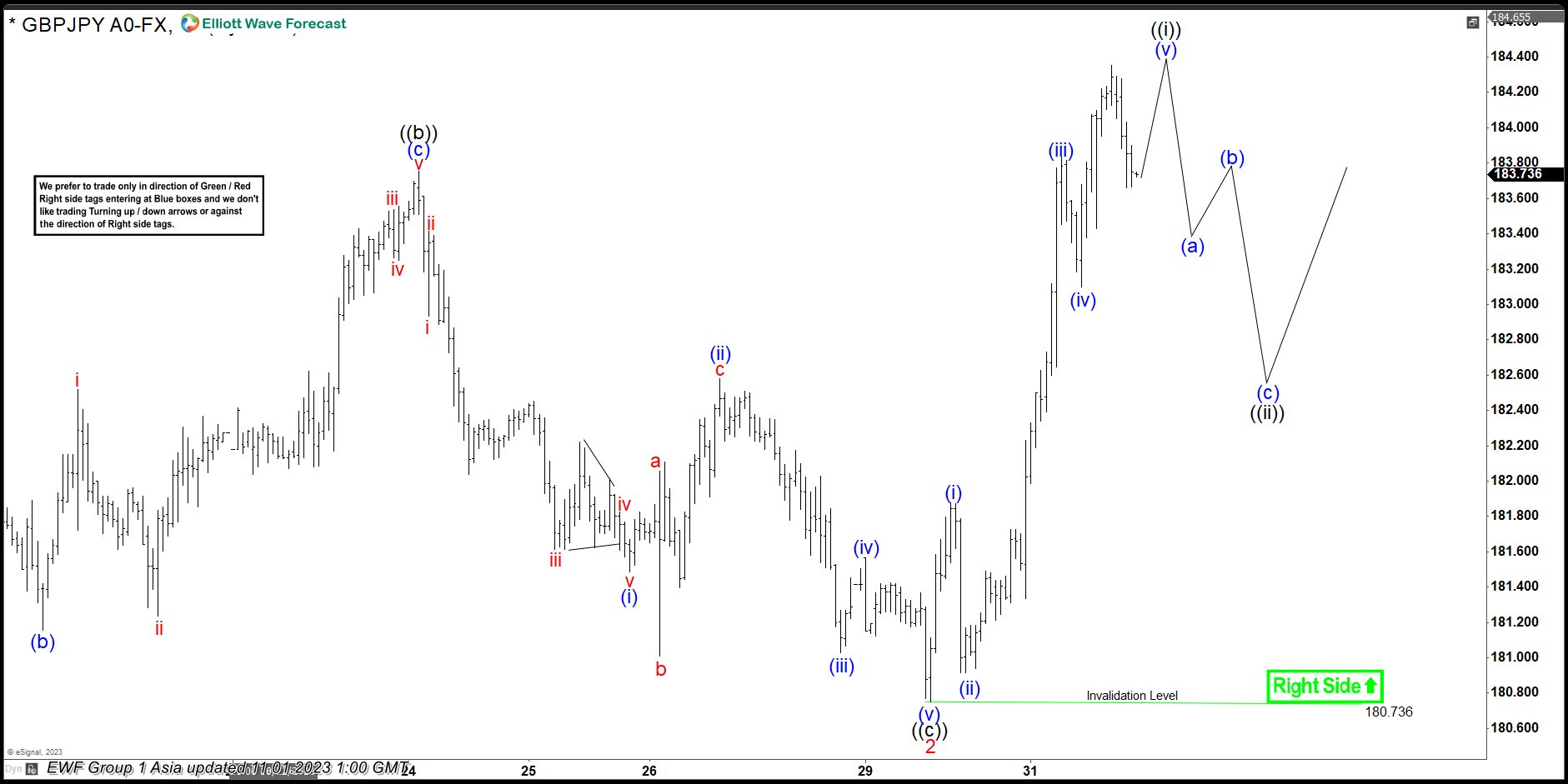
The short-term Elliott wave view in the GBPJPY suggests that the cycle from 03 October 2023 low is nesting higher & expected to accelerate higher. Up from there, the rally to 183.81 high ended wave 1 & then made a pullback in wave 2. The internals of that pullback unfolded as Elliott wave flat correction. Whereas the first leg of the flat ended in wave ((a)) at 180.93 low. Wave ((b)) bounce ended at 183.75 high and wave ((c)) completed at 180.73 low thus completed the wave 2 pullback.
From there, the pair made a rally higher in an impulse sequence & showed a higher high sequence supporting the nest in wave 3 higher. The first leg of the rally to 181.87 high ended wave (i). Wave (ii) ended at 180.91 low, wave (iii) ended at 183.83 high, wave (iv) ended at 183.09 low. Then a rally to 184.35 high ended wave (v) & completed wave ((i)). Below from there, the pair is doing a short-term pullback in wave ((ii)), which is expected to hold in 3, 7, or 11 swings. Looking for more upside extension towards 186.55- 190.13 area next as far as dips remain above 180.73 low. Don’t recommend selling the pair.
GBPJPY 1-Hour Elliott Wave Chart From 11.01.2023
GBPJPY Elliott Wave Video
https://www.youtube.com/watch?v=7QBTG0jrDH8
Nasdaq 100 Technical: Counter Trend Rebound at Risk of Exhaustion as Key Risk Events Loom
- The ongoing rally from last Friday, 27 October low has taken on the form of an impending “bearish flag” formation.
- Coupled with a weak market breadth condition (less than 50% of Nasdaq 100 component stocks are trading above 200-day MA), the rally is likely to be a counter trend rebound within its short and medium-term downtrend phases.
- Watch the 14,590 key short-term resistance ahead of today’s FOMC decision and Apple’s earnings announcement on Thursday, 2 November.
The price actions of the US Nas 100 Index (a proxy for the Nasdaq 100 futures) have shaped the expected slide and traded close to the key 200-day moving average that was acting as a support at 13,960 as highlighted in our report.
It printed an intraday low of 14,060 last Friday, 27 October, and staged a rebound of +2.6% to hit a high of 14,430 in yesterday’s (31 October) US session ahead of key risk events; the FOMC’s monetary policy decision and Fed Chair Powell’s press conference later today followed by Apple (biggest weightage component stock in Nasdaq 100) earnings announcement on Thursday, 2 November after the close of the US session.
There are several key technical elements that suggest the current rebound seen in the Nasdaq 100 from its 27 October 2023 low is likely a counter trend rally within a medium-term downtrend phase in place since the 19 July 2023 high of 15,349.
Weak market breadth condition
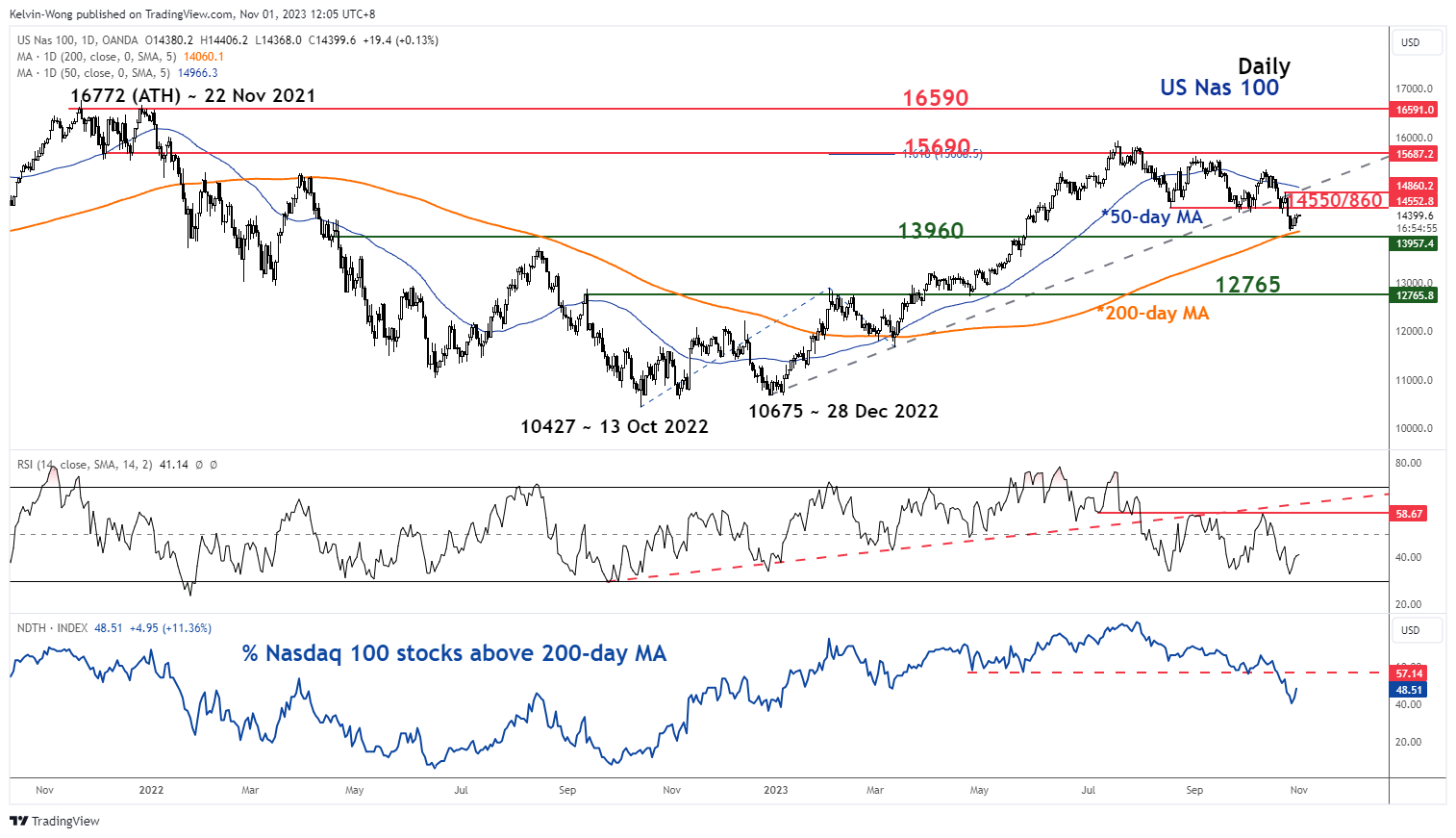
Fig 1: US Nas 100 medium-term trend as of 1 Nov 2023 (Source: TradingView, click to enlarge chart)
Even though the US Nas 100 Index is still holding above the key 200-day moving average, the number of component stocks of the Nasdaq 100 that are still above their respective 200-day moving averages has remained below 50% as of yesterday, 31 October.
A sign of a deteriorating market breadth condition. Also, the daily RSI momentum indicator is still hovering above the oversold region without any bullish divergence signal that indicates a likelihood that medium-term momentum is still bearish.
Formation of a minor “bearish flag”
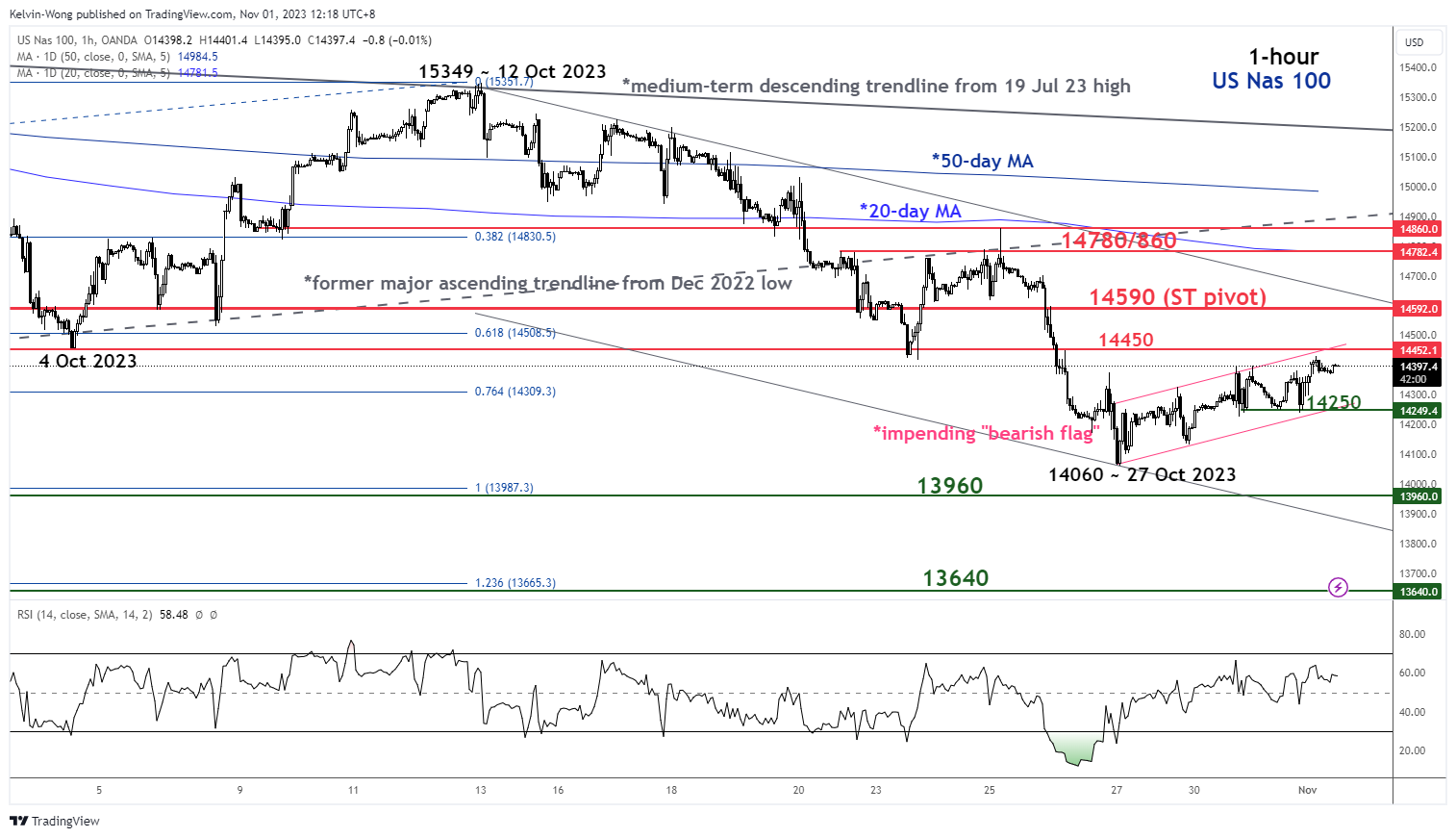
Fig 2: US Nas 100 minor short-term trend as of 1 Nov 2023 (Source: TradingView, click to enlarge chart)
In the short term as seen on the 1-hour chart, the price actions of the Index have formed an impending minor “bearish flag” configuration with its upper limit acting as a near-term resistance at 14,450.
The potential minor “bearish flag” configuration in place since the 27 October 2023 low of 14,060 suggests that it is likely that the ongoing rebound is skewed towards a corrective counter trend rebound within its short-term downtrend phase from the 12 October 2023 high.
Hence, from the lens of technical analysis, the next probable move is likely to be a potential continuation of its bearish impulsive down move sequence.
Watch the 14,590 key short-term pivotal resistance (upper boundary of the short-term descending channel from 12 October 2023 high & close to 38.2% Fibonacci retracement of the recent decline from 12 October high to 27 October 2023 low) and a break below 14,250 (lower limit of the “bearish flag) may ignite another round of decline towards the 13,960 intermediate support (around the 200-day moving average) follow by 13,640 (16/17 August 2022 swing high area & Fibonacci extension) in the first step.
On the flip side, a clearance above 14,590 invalidates the bearish scenario for an extension of the counter trend rebound towards the next intermediate resistance at 14,780/14,860 (former major ascending trendline from the December 2022 low & 20-day moving average).
Market eyes treasury refunding ahead of FOMC hold
Fed is widely anticipated to keep interest rates steady at 5.25-5.50%, marking a second consecutive pause. While the accompanying statement and Chair Jerome Powell's press conference are expected to keep options open for future rate hikes, the focus will be on how firmly Powell adheres to his hawkish stance, hinting at the likelihood of an additional hike in December.
Recent comments from Fed policymakers have pointed to the rise in longer-term borrowing costs and the subsequent tightening of financial conditions as factors reducing the urgency for further tightening. Powell's insights on this matter will be of particular interest to market participants.
However, substantial comments from Powell may be scarce at this juncture, given that the next set of economic projections, crucial for determining future policy, are set to be prepared and released in December. As a result, today's FOMC decision might not deliver significant revelations.
In fact, a potentially more market-moving event could be the quarterly treasury refunding announcement preceding the FOMC decision. Investors already received a glimpse into the Treasury's plans on Monday, with the announcement of a USD 776B debt auction for the last quarter of 2023. Key aspects that markets will scrutinize include the actual sizes of the auction and the mix of maturities.
The treasury market is currently grappling with a supply-demand mismatch, a significant factor contributing to the sharp rise in bond yields this year. Understanding how the Treasury plans to address this imbalance will be critical for investors, potentially overshadowing the FOMC decision in terms of immediate market impact.
China’s Caixin PMI manufacturing slips to 49.5, business optimism continues to wane
China's Caixin PMI Manufacturing index slipped from 50.6 in September to 49.5 in October, falling below market expectations set at 50.8. This marks a renewed contraction in the nation's manufacturing sector.
Wang Zhe, Senior Economist at Caixin Insight Group, highlighted several challenges facing the manufacturing industry. "Overall, manufacturers were not in high spirits in October," he said. The decline in the sector was multifaceted - supply, employment, and external demand all experienced reductions, while domestic demand saw a slower pace of expansion.
The manufacturing environment was further complicated by rising costs and output prices. This was coupled with decrease in purchases and accumulation of inventories of finished goods. Reflecting the various pressures, "business optimism continued to wane".
Crude Oil Price At Risk of Major Decline, Fed Decision Next
Key Highlights
- Crude oil prices saw swing moves in tense times and the Israel-Hamas war.
- A key bearish trend line is forming with resistance near $84.70 on the 4-hour chart.
- Gold prices could extend gains toward the $2,050 level.
- The Fed interest rate decision is scheduled today (forecast 5.5%, versus 5.5% previous).
Crude Oil Price Technical Analysis
In the past few days, Crude oil prices saw bearish moves amid the Israel-Hamas war. There was a steady decline below the $86.50 and $85.00 support levels. On the war front, Netanyahu ruled out ceasefire on day 25. Besides, Israel escalated attacks on Hamas terrorists within the Islamists’ extensive network of tunnels beneath Gaza.
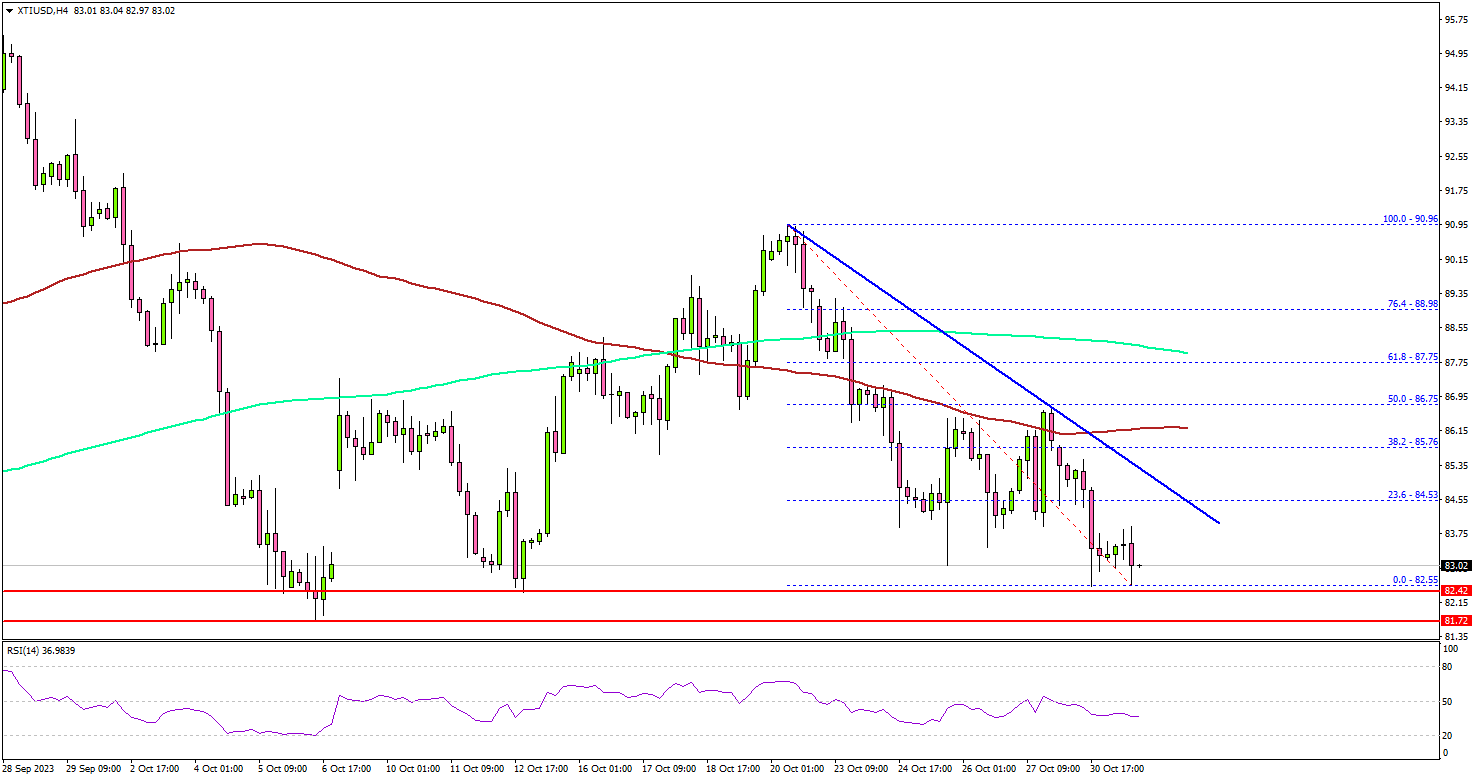
Looking at the 4-hour chart of XTI/USD, the price settled below the $85.00 pivot level, the 200 simple moving average (green, 4-hour), and the 100 simple moving average (red, 4-hour).
It seems like the bulls are struggling to protect the key support at $82.50. The next support is at $81.70, below which there is a risk of a sharp decline. In the stated case, the price could dive toward the $78.50 support. Any more losses might call for a test of the $76.50 support zone.
On the upside, the price might face resistance near the $84.50 level. There is also a key bearish trend line forming with resistance near $84.70 on the same chart.
The next major resistance is near the $85.00 zone, above which the price may perhaps accelerate higher. In the stated case, it could even visit the $87.75 resistance.
Looking at gold prices, there was a consolidation phase near the $2,000 level and the bulls might now aim for more upside.
Economic Releases to Watch Today
- US ISM Manufacturing Index for Oct 2023 – Forecast 49.0, versus 49.0 previous.
- Fed Interest Rate Decision - Forecast 5.5%, versus 5.5% previous.
Kanda announces Japan is on “standby” as Yen plunges past 151 to Dollar
Amid the resumed selloff of Yen, which broke 151 level against Dollar overnight, Japan's top currency official, Masato Kanda, has issued a stern verbal warning. The Vice Finance Minister for International Affairs emphasized that Japan remains vigilant and "on standby" to mitigate the excessive volatility observed in the currency markets.
However, Kanda refrained from divulging specific details on potential interventions. "But I can't say what we'll do, and when — we'll make judgments overall, and we're making judgments in a state of urgency," he added.
Kanda voiced significant concern over the rapid and one-sided shifts in currency values, stressing the importance of calibrated responses against overblown foreign exchange movements. He emphasized that fundamental economic indicators don't justify such abrupt currency shifts, hinting at other factors at play. "Speculative trading seems to be the biggest factor behind recent currency moves," Kanda observed.
"The yen has weakened close to 25 yen against the dollar from the start of the year, and it's also moved a few yen in a short amount of time," he noted, highlighting the dramatic shift in the currency's value.
Japan PMI manufacturing: Slump continues, yet optimism shines for 2024
Japan's PMI Manufacturing for October was finalized at 48.7, a slight uptick from 48.5 in September. Despite the improvement, the index languished below the critical 50 threshold for the fifth consecutive month.
S&P Global's analysis revealed that a significant decline in output occurred due to persisting sales reductions. This challenging environment also led to the first drop in employment figures since the beginning of 2021. On the brighter side, confidence remains robust regarding a potential return to growth in 2024.
Usamah Bhatti, representing S&P Global Market Intelligence, commented on the situation, emphasizing the continued hardships faced by the manufacturing sector. He mentioned the strategic measures companies are adopting to counter these challenges, including curtailed purchasing, optimal inventory management, and not filling vacancies created by departing employees.
However, the silver lining seems to be the positive outlook for the future. Bhatti noted that there's optimism about finding a turning point soon, with many companies expecting a shift in the inventory cycle after extended destocking periods. Moreover, demand from Japan's primary industrial sectors is projected to pick up in the coming year, potentially heralding better days for the nation's manufacturing realm.
IMF to RBA: More tightening needed to curb inflation
In a report on Australia's economy, IMF highlighted concerns about persistent inflation levels in the country. Even though inflation is "gradually declining", it continues to hover "significantly above" RBA's target, with the country's output "remains above potential."
The IMF staff "recommend further monetary policy tightening". They believe this approach will realign inflation with RBA's target range by 2025 and "minimize the risk of de-anchoring inflation expectations."
In terms of economic momentum, the IMF predicts a further slowdown in the near future, coinciding with a steady decrease in inflation. While risks to growth appears "broadly balanced", the potential for inflation to surpass expectations remains a cause for concern.
NZ employment down -0.2% in Q3, unemployment rate jumps to 3.9%
New Zealand's employment figures for Q3 came in weaker than anticipated. Employment contracted by -0.2%, sharply diverging from the forecasted growth of 0.40%.
Unemployment rate made a noticeable leap, rising from 3.6% to 3.9%, a figure that met market expectations. Additionally, both employment rate and labor force participation rate registered declines, moving from 69.8% to 69.1% and from 72.5% to 72.0% respectively.
Wage data presented a mixed picture. The all-sector wage inflation stood firm at 4.3% yoy.
The public sector experienced a particularly sharp uptick in salaries and wages, registering a 5.4% yoy increase. This significant rise is notable for being the steepest since the data series commenced in 1992, surpassing 4.2% yoy growth observed in Q2.
In contrast, the private sector saw wage cost inflation moderating to 4.1% yoy in Q3, slightly down from the 4.3% recorded in the previous quarter.