Sun, Apr 12, 2026 02:23 GMT
More

    Sample Category Title

    Gold Price Breaks Above $4,400 for the First Time

    As the XAU/USD chart shows, gold has climbed above $4,400 today, setting a new all-time high.

    On Friday, when analysing the gold chart, we highlighted a triangle formation and noted strong selling pressure near the previous record high around $4,380, set in October.

    However, over the weekend geopolitical tensions intensified following reports that the United States detained an oil tanker linked to Venezuela. At the turn of the week, this resulted in a clear triangle breakout (as indicated by the arrow):

    → during the second half of Friday’s session, gold moved above the upper boundary of the pattern;

    → at the Asian open, the price turned higher after retesting that level, with former resistance acting as support.

    As a result, concerns about a potential armed conflict involving the US have shifted the balance of supply and demand decisively higher.

    The bullish momentum has justified the construction of an ascending channel. It is worth noting that the RSI indicator is currently in overbought territory. Intraday trading during the US session could therefore bring some corrective pullback, with potential support coming from:

    → the lower boundary of the newly formed channel;

    → the area between the previous peak at $4,380 and the psychological $4,000 level.

    According to Goldman Sachs analysts, structural demand from central banks combined with falling interest rates could drive gold prices towards $4,900 by the end of 2026.

    Start trading commodity CFDs with tight spreads. Open your trading account now or learn more about trading commodity CFDs with FXOpen.

    This article represents the opinion of the Companies operating under the FXOpen brand only. It is not to be construed as an offer, solicitation, or recommendation with respect to products and services provided by the Companies operating under the FXOpen brand, nor is it to be considered financial advice.

    Gold Breaks to Record High as WTI Crude Seeks Rebound

    Gold price started a fresh surge above $4,350 and traded to a new all-time high. Crude oil is recovering and might rise toward the $58.50 resistance zone.

    Important Takeaways for Gold and WTI Crude Oil Prices Analysis Today

    • Gold price rallied to a new all-time high and traded above $4,395 against the US Dollar.
    • A key bullish trend line is forming with support at $4,334 on the hourly chart of gold at FXOpen.
    • WTI Crude oil is recovering losses and trading above $56.20.
    • There was a break above a major bearish trend line with resistance at $56.00 on the hourly chart of XTI/USD at FXOpen.

    Gold Price Technical Analysis

    On the hourly chart of Gold at FXOpen, the price formed support near $4,240. The price remained in a bullish zone and started a fresh increase above $4,300, as mentioned in the previous analysis.

    The bulls pushed the price above $4,360 level and the 50-hour simple moving average. Finally, it traded to a new all-time high at $4,397. The price is still showing bullish signs above $4,380, and the RSI is above 70.

    Initial support on the downside is near the 23.6% Fib retracement level of the upward move from the $4,271 swing low to the $4,397 high at $4,365. The next area of interest might be near a key bullish trend line at $4,335 and the 50% Fib retracement.

    A downside break below the trend line might send the price to $4,300. If the bulls fail to protect $4,300, the price could start a larger downside correction. In the stated case, Gold could drop toward $4,240.

    The next area for the bulls might be $4,220. A daily close below $4,220 could spark bearish moves and send the price to $4,150.

    If there is a fresh increase, the price could face resistance at $4,400. The next sell zone might be $4,420. An upside break above the $4,420 resistance could send Gold price toward $4,465. Any more gains may perhaps set the pace for an increase to $4,500.

    WTI Crude Oil Price Technical Analysis

    On the hourly chart of WTI Crude Oil at FXOpen, the price found support near $54.85 against the US Dollar. The price formed a base and started a recovery wave above $55.50 and the 50-hour simple moving average.

    The bulls were able to push the price above the 23.6% Fib retracement level of the downward move from the $58.80 swing high to the $54.84 swing low. Besides, there was a break above a major bearish trend line with resistance at $56.00.

    The hourly RSI is above the 60 level, and the price is attempting to close above the 50% Fib retracement. The next hurdle could be $57.85. A clear move above $57.85 could send the price toward $58.50. Any more gains might open the doors for a test of $58.80.

    Conversely, the price might start a fresh decline from $57.30 or $57.85. Immediate support sits near $56.45 or the 50-hour simple moving average. The key breakdown zone on the WTI crude oil chart might be $55.55.

    If there is a downside break, the price might decline toward $54.85. Any more losses might encourage the bears for a push toward $54.00.

    Start trading commodity CFDs with tight spreads. Open your trading account now or learn more about trading commodity CFDs with FXOpen.

    This article represents the opinion of the Companies operating under the FXOpen brand only. It is not to be construed as an offer, solicitation, or recommendation with respect to products and services provided by the Companies operating under the FXOpen brand, nor is it to be considered financial advice.

    Gold Breaches $4400/oz, Silver Up 2.75%, Nikkei Rises 1.9% & FTSE 100 Eyes Short-Term Pullback

    Asia Market Wrap - Nikkei Rises 1.9% as Global Equities Rise

    Stock markets around the world are rising as investors feel optimistic about a strong finish to the year, encouraged by recent gains in the US.A key index that tracks global stocks has gone up for three days in a row, reaching its highest level since mid-December, and is predicted to grow nearly 20% in 2025.

    In Asia, Japan's Nikkei climbed 1.9% because a cheaper currency is expected to help companies that sell goods abroad make more money. Similarly, Chinese stocks saw gains, while Singapore's market reached a new record high.

    European Session - European Shares On Course to Open Lower

    European stock markets are expected to open with small losses on Monday, pausing after last week's rally as trading slows down for the short Christmas holiday week.

    Even with lighter trading activity expected, investor confidence remains high due to renewed excitement about AI companies and hopes that the US Federal Reserve will lower interest rates next year. Traders are also less worried about the European Central Bank raising rates in the future.

    However, there is still some caution as investors watch the war in Ukraine, following comments from Russia that recent peace proposals haven't improved the situation. In economic news, the UK is set to release its final growth figures later today, while early trading shows major European indexes down by roughly 0.1% to 0.2%.

    On the FX front, the Japanese yen remained very weak on Monday, hovering near record lows against the Euro and Swiss Franc.

    Traders feel confident betting against the yen because the Bank of Japan hasn't signaled any plans to raise interest rates, even though government officials have warned they might step in to support the currency.

    The yen also sat near an 11-month low against the US dollar and a 17-month low against the Australian dollar. While the US dollar dipped slightly to 157.37 yen, it remains close to recent highs.

    Meanwhile, the Swiss franc reached a new record against the yen, and the Australian dollar climbed to its strongest level since last July.

    Currency Power Balance

    Source: OANDA Labs

    Silver was the standout performer in commodities, hitting a new record high of $69.44/oz, which brings its total gains for the year to nearly 140%. Gold also increased in value, rising 1.5% to breach $4400/oz.

    In the energy market, oil prices went up after the US stopped a Venezuelan oil tanker and began chasing another, marking the third such incident in under two weeks. As a result, Brent crude rose 0.8% to $60.96 a barrel, and US crude increased by the same percentage to $56.99 a barrel.

    Economic Calendar and Final Thoughts

    It is a quiet day on the calendar for European data releases but there are a few ECB policymakers who will be speaking during the session.

    The US session is equally quiet from a data perspective with Canadian PPI the only major data release during the session. Markets may focus on rising geopolitical risk as the US ramps up pressure on Venezuela.

    For all market-moving economic releases and events, see the MarketPulse Economic Calendar. (click to enlarge)

    Chart of the Day - FTSE 100

    From a technical standpoint, the FTSE 100 index is eyeing a pullback this morning.

    However, given the mood around global equity futures in the Asian session, i wonder whether such a move will prove sustainable?

    The index is approaching support at the 9850-9860 area with a break below opening up a deeper correction toward the 9800 and 9760 support areas.

    The period-14 RSI does remain comfortably above the 50 neutral level which hints at bullish momentum remaining strong at the present time.

    FTSE 100 Index Daily Chart, December 22. 2025

    Source: TradingView.com (click to enlarge)

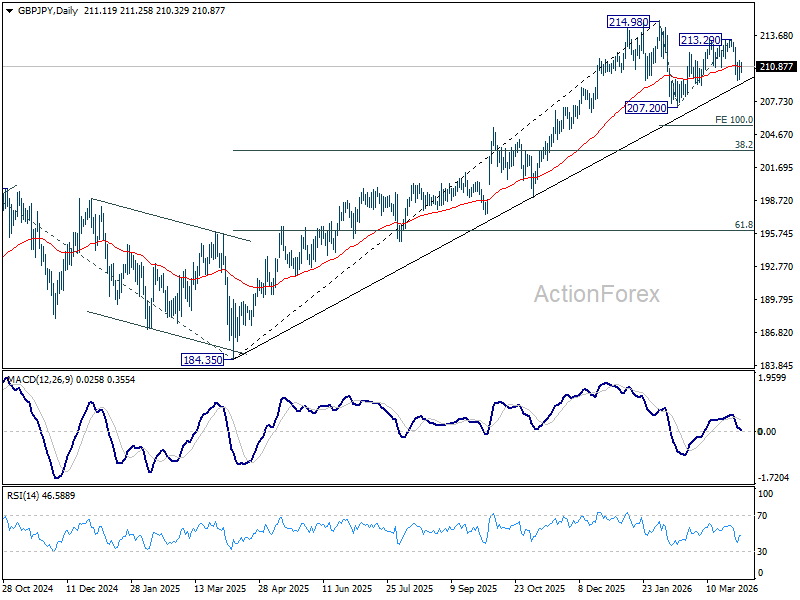
    GBP/JPY Daily Outlook

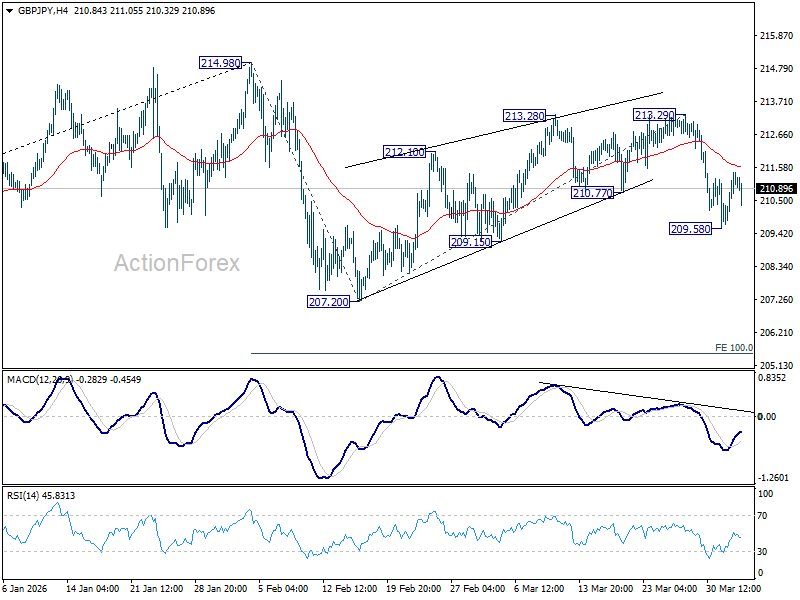
    Daily Pivots: (S1) 208.94; (P) 210.01; (R1) 212.03; More...

    Intraday bias in GBP/JPY remains on the upside for 61.8% projection of 184.35 to 205.30 from 199.04 at 211.98. Firm break there will extend current up trend to 100% projection at 219.99 next. On the downside, below 210.00 minor support will turn intraday bias neutral and bring consolidations first, before staging another rally.

    In the bigger picture, up trend from 123.94 (2020 low) is in progress. Next target is 61.8% projection of 148.93 to 208.09 from 184.35 at 220.90. On the downside, break of 199.04 support is needed to indicate medium term topping. Otherwise, outlook will stay bullish even in case of deep pullback.

    Yen Finds Temporary Footing on Verbal Intervention, Precious Metals Break Away

    Global markets opened the final full trading week of 2025 on a mixed footing, with price action shaped more by thin holiday liquidity than fresh conviction. Asian equities leaned modestly higher, led by a strong surge in Japanese stocks after Friday’s firm close in the U.S., where technology shares again drove gains. Elsewhere in the region, equities also firmed, but advances were far more restrained, reflecting limited follow-through rather than renewed risk appetite.

    The real focus has shifted decisively toward precious metals. Gold and Silver both pushed to new record highs, pulling attention away from equities and currencies alike. With positioning light and liquidity thin, the outsized moves in metals are more of a function of defensive demand amplified by year-end conditions.

    That broader theme is visible across markets. Volatility remains elevated in pockets, but without the kind of cross-asset confirmation typically associated with durable trends. This pattern is likely to persist through the remainder of the year, with more meaningful repricing deferred until liquidity normalizes in early 2026.

    In FX markets, Yen is attempting to stabilize against Dollar after a sharp selloff, but the effort remains tentative. There is little evidence of broad-based support for the currency, and gains have failed to spill over into crosses.

    Japanese officials have stepped up verbal intervention, warning against rapid and one-sided currency moves. Top currency diplomat Atsushi Mimura said authorities were concerned and ready to take “appropriate actions” against excessive moves, while Chief Cabinet Secretary Minoru Kihara echoed concerns about speculative pressure and stressed the need for stability reflecting fundamentals.

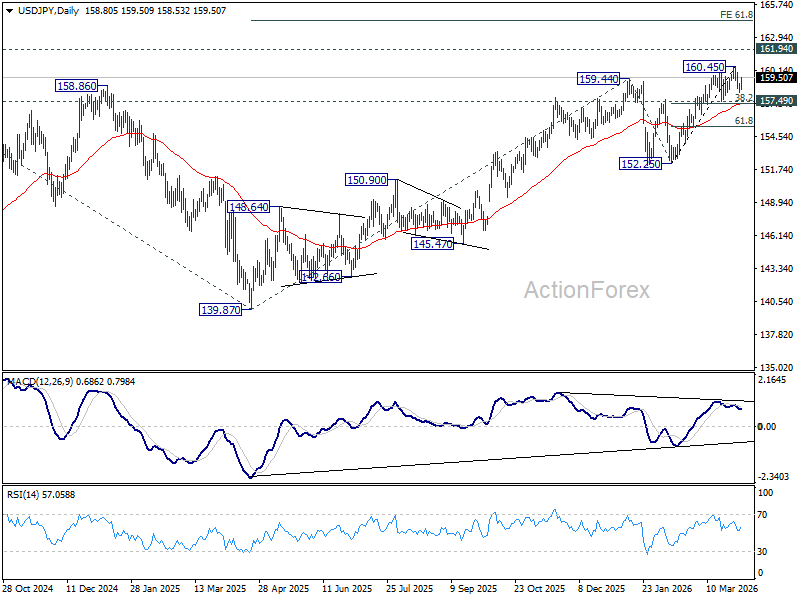
    Despite the firmer rhetoric, markets remain unconvinced. The key test will be whether Tokyo delivers concrete measures if USD/JPY pushes higher again and approaches the 160 area, or whether officials continue to rely solely on verbal warnings.

    For now, Kiwi is the strongest currency on the day, followed by Aussie and Sterling. Dollar sits at the bottom of the table, trailed by Swiss Franc and Loonie, while Euro and Yen are holding middle ground amid the broader holiday drift.

    In Asia, Nikkei rose 1.81%. Hong Kong HSI rose 0.43%. China Shanghai SSE rose 0.69%. Singapore Strait Times is up 0.68%. Japan 10-year JGB yield rose 0.058 to 2.082.

    Gold breaks above 4,400 as geopolitics ignite late-year surge, Silver nears 70

    Gold surged to a fresh record high above 4,400 today, finally breaking out after weeks of subdued momentum. Though, Silver is still taking the lead, extending its powerful rally toward the psychologically important 70 level.

    Thin holiday trading conditions amplified the reaction, but the underlying driver is a sharp escalation in geopolitical risk. Safe-haven demand accelerated after US President Donald Trump and senior aides refused to rule out military conflict with Venezuela, jolting markets that had largely discounted further escalation in Latin America.

    Washington is now intensifying pressure on Venezuelan oil exports, tightening what traders increasingly see as a de facto blockade. Multiple vessels have reportedly been seized off Venezuela’s coast in international waters, with another currently being pursued. The move adds further strain on the government of Nicolás Maduro, heightening fears of miscalculation and retaliation.

    At the same time, optimism around a diplomatic breakthrough in Ukraine fades. Markets are reassessing the likelihood of a durable ceasefire as negotiations drag on without tangible progress. Comments over the weekend suggested talks remain focused on aligning positions rather than finalizing concrete outcomes, reinforcing skepticism over near-term resolution of Russia’s war in Ukraine.

    Against that backdrop, Gold’s technical breakout arrived earlier than expected. The decisive break above 4,381.22 suggests that consolidation from that peak had already completed at 3,997.73. Near-term outlook will stay firmly bullish as long as 4,271.41 holds as support on any pullback.

    Attention is now on whether price can push cleanly through the rising channel ceiling, a move that would signal further upside acceleration. If that ceiling gives way, the next target comes in at the 61.8% projection of the 3,267.90 to 4,381.22 advance from 3,997.73 at 4,685.76.

    As for Silver, outlook will remain bullish as long as 64.43 support holds. 4H MACD suggests that it's likely now in an upside re-acceleration phase. Next target is 138.2% projection of 36.93 to 54.44 from 48.50 at 72.68. Break there will target 161.8% projection 76.83.

    China holds lending rates, leans on fiscal push for growth

    China kept benchmark loan prime rates unchanged for a seventh consecutive month, in line with expectations. The one-year loan prime rate was held at 3.0%, while the over-five-year LPR, a key reference for mortgage pricing, remained at 3.5%.

    The decision reinforces the view that near-term monetary easing is not a priority. While lower LPRs would help reduce financing costs and support investment and consumption, authorities appear comfortable maintaining current settings as they assess the impact of earlier stimulus and targeted support measures across the economy.

    Nevertheless, policy guidance from the Central Economic Work Conference earlier points to a broader strategic tilt. Officials signaled that China will pursue a more proactive fiscal stance alongside a moderately loose monetary policy in 2026, suggesting growth support will increasingly come from government spending and structural measures rather than immediate rate cuts.

    Fed’s Hammack downplays CPI drop, backs steady rates into Spring

    In an interview with Beth Hammack published by the Wall Street Journal, the Cleveland Fed president argued there was no urgency for the Fed to adjust interest rates, saying policy could remain unchanged at 3.50–3.75% at least until Spring. Hammack said that timeframe would allow policymakers to better judge whether goods price inflation is truly easing as tariffs work their way through supply chains.

    Hammack framed her outlook around patience rather than reaction. Her base case is for rates to stay at current levels "for some period of time", until there is clearer evidence that "either inflation is coming back down to target or the employment side is weakening more materially."

    She was notably skeptical of last week’s November CPI report, which showed a sharp drop in headline inflation to 2.7% from 3.1%, with a similar decline in core inflation. Hammack said she takes the data “with a grain of salt,” pointing to distortions linked to Autumn’s government shutdown. Her own estimates place inflation closer to 2.9–3.0%.

    While describing the current policy rate as roughly neutral, Hammack signaled she would actually prefer a slightly more restrictive stance to apply additional pressure on inflation.

    GBP/JPY Daily Outlook

    Daily Pivots: (S1) 208.94; (P) 210.01; (R1) 212.03; More...

    Intraday bias in GBP/JPY remains on the upside for 61.8% projection of 184.35 to 205.30 from 199.04 at 211.98. Firm break there will extend current up trend to 100% projection at 219.99 next. On the downside, below 210.00 minor support will turn intraday bias neutral and bring consolidations first, before staging another rally.

    In the bigger picture, up trend from 123.94 (2020 low) is in progress. Next target is 61.8% projection of 148.93 to 208.09 from 184.35 at 220.90. On the downside, break of 199.04 support is needed to indicate medium term topping. Otherwise, outlook will stay bullish even in case of deep pullback.


    Economic Indicators Update

    GMT CCY EVENTS ACT F/C PP REV
    01:00 CNY 1-Y Loan Prime Rate 3.00% 3.00% 3.00%
    01:00 CNY 5-Y Loan Prime Rate 3.50% 3.50% 3.50%
    07:00 GBP GDP Q/Q Q3 F 0.10% 0.10% 0.10%
    07:00 GBP Current Account (GBP) Q3 -12.1B -19.1B -28.9B
    13:30 CAD Industrial Product Price M/M Nov 0.30% 1.50%
    13:30 CAD Raw Material Price Index Nov 0.60% 1.60%


    Gold breaks above 4,400 as geopolitics ignite late-year surge, Silver nears 70

    Gold surged to a fresh record high above 4,400 today, finally breaking out after weeks of subdued momentum. Though, Silver is still taking the lead, extending its powerful rally toward the psychologically important 70 level.

    Thin holiday trading conditions amplified the reaction, but the underlying driver is a sharp escalation in geopolitical risk. Safe-haven demand accelerated after US President Donald Trump and senior aides refused to rule out military conflict with Venezuela, jolting markets that had largely discounted further escalation in Latin America.

    Washington is now intensifying pressure on Venezuelan oil exports, tightening what traders increasingly see as a de facto blockade. Multiple vessels have reportedly been seized off Venezuela’s coast in international waters, with another currently being pursued. The move adds further strain on the government of Nicolás Maduro, heightening fears of miscalculation and retaliation.

    At the same time, optimism around a diplomatic breakthrough in Ukraine fades. Markets are reassessing the likelihood of a durable ceasefire as negotiations drag on without tangible progress. Comments over the weekend suggested talks remain focused on aligning positions rather than finalizing concrete outcomes, reinforcing skepticism over near-term resolution of Russia’s war in Ukraine.

    Against that backdrop, Gold’s technical breakout arrived earlier than expected. The decisive break above 4,381.22 suggests that consolidation from that peak had already completed at 3,997.73. Near-term outlook will stay firmly bullish as long as 4,271.41 holds as support on any pullback.

    Attention is now on whether price can push cleanly through the rising channel ceiling, a move that would signal further upside acceleration. If that ceiling gives way, the next target comes in at the 61.8% projection of the 3,267.90 to 4,381.22 advance from 3,997.73 at 4,685.76.

    As for Silver, outlook will remain bullish as long as 64.43 support holds. 4H MACD suggests that it's likely now in an upside re-acceleration phase. Next target is 138.2% projection of 36.93 to 54.44 from 48.50 at 72.68. Break there will target 161.8% projection 76.83.

    China holds lending rates, leans on fiscal push for growth

    China kept benchmark loan prime rates unchanged for a seventh consecutive month, in line with expectations. The one-year loan prime rate was held at 3.0%, while the over-five-year LPR, a key reference for mortgage pricing, remained at 3.5%.

    The decision reinforces the view that near-term monetary easing is not a priority. While lower LPRs would help reduce financing costs and support investment and consumption, authorities appear comfortable maintaining current settings as they assess the impact of earlier stimulus and targeted support measures across the economy.

    Nevertheless, policy guidance from the Central Economic Work Conference earlier points to a broader strategic tilt. Officials signaled that China will pursue a more proactive fiscal stance alongside a moderately loose monetary policy in 2026, suggesting growth support will increasingly come from government spending and structural measures rather than immediate rate cuts.


    Fed’s Hammack downplays CPI drop, backs steady rates into Spring

    In an interview with Beth Hammack published by the Wall Street Journal, the Cleveland Fed president argued there was no urgency for the Fed to adjust interest rates, saying policy could remain unchanged at 3.50–3.75% at least until Spring. Hammack said that timeframe would allow policymakers to better judge whether goods price inflation is truly easing as tariffs work their way through supply chains.

    Hammack framed her outlook around patience rather than reaction. Her base case is for rates to stay at current levels "for some period of time", until there is clearer evidence that "either inflation is coming back down to target or the employment side is weakening more materially."

    She was notably skeptical of last week’s November CPI report, which showed a sharp drop in headline inflation to 2.7% from 3.1%, with a similar decline in core inflation. Hammack said she takes the data “with a grain of salt,” pointing to distortions linked to Autumn’s government shutdown. Her own estimates place inflation closer to 2.9–3.0%.

    While describing the current policy rate as roughly neutral, Hammack signaled she would actually prefer a slightly more restrictive stance to apply additional pressure on inflation.

    Moore Threads Takes Aim at Nvidia’s H200

    Friday’s rally in technology stocks came as a much-needed relief for global financial markets and was sparked by a single, straightforward piece of news: Oracle will host TikTok’s US user data under a new US–China arrangement that allows the app to continue operating in the United States. The deal is yet to be approved.

    But if it does, under the deal, Oracle will store and secure US user data on its cloud infrastructure and help oversee cybersecurity and algorithm-safety measures. It is a big responsibility given that roughly half of the US population uses TikTok. In return, Oracle is expected to take a meaningful equity stake of around 15% in the newly structured US TikTok business, while the broader investor consortium secures majority control. But above all, Oracle gains – with this deal - a strategic foothold in a high-growth digital platform via its cloud services — and that’s a golden narrative for its growth profile.

    Oracle shares rebounded more than 6% on Friday, after having fallen over 45% from their September peak. The rally spread across the broader AI and tech complex, as investors reassessed the monetisation potential of data-centre infrastructure and computing power. Nvidia rose nearly 4%, while the Nasdaq gained 1.3%, reclaiming its 50-day moving average.

    That said, the pressure on tech stocks is unlikely to be over. First, the TikTok deal remains modest relative to the scale of Oracle’s business, its heavy debt load and ongoing investment needs. On its own, it is unlikely to reverse the recent deterioration in appetite for leveraged debt, nor does it fully answer the question of how revenues will grow fast enough to justify rising leverage and capital spending.

    Second, developments in China highlight how quickly competitive dynamics can shift. Chinese chipmaker Moore Threads, founded by a former Nvidia executive and recently listed, announced plans to release new AI chips aimed at competing with Nvidia’s Hopper-generation products. The company claims its upcoming chips rival Nvidia’s H20 and H200, and narrow the gap with the Nvidia’s next-generation Blackwell platform. This is an important development in the context of the US–China chip war.

    Only weeks ago, Nvidia received approval to resume sales of its H200 chips to China, at a time when those chips were widely seen as being well ahead of domestic Chinese alternatives. Moore Threads now says it could begin producing these chips as early as next year and claims energy-efficiency gains of up to 10× versus its own previous GPU generation. If realised, this would reduce Chinese buyers’ dependence on Nvidia hardware — particularly as Beijing weighs how much to encourage domestic alternatives. The closer Chinese chips move toward US peers in performance and efficiency, the stronger the incentive for state support.

    Still, several red flags remain. First, designing advanced chips is one challenge; manufacturing them at scale is another. Moore Threads cannot go to TSMC after being placed on the US Entity List in 2023, meaning it must turn to domestic foundries. SMIC, China’s leading chip manufacturer, has the capability to produce such chips using the country’s most advanced available processes, but those technologies remain one to two generations behind TSMC, implying potential limits on performance, yields and efficiency. Second, much of the AI ecosystem is built around Nvidia’s software stack, and switching to Moore Threads’ platform would involve transition costs, integration challenges and reliability risks that are yet to be fully tested.

    Nevertheless, if Beijing decides this is the strategic path forward, Chinese companies may ultimately have little choice but to adapt. On Monday, Moore Threads shares rose 1.9% in Shanghai, while SMIC gained more than 6% in Hong Kong.

    The broader message is clear: China has not said its last word in the global tech race.

    Elsewhere in Asia, tech-heavy indices started the week higher. South Korea’s Kospi gained more than 2%, while Japan’s Nikkei initially advanced before giving back gains amid a sharp sell-off in Japanese government bonds that briefly pushed the 10-year yield to 2.10%. The USDJPY retreated as Japanese officials warned that positioning against the yen remains heavy and one-sided, reviving the risk of intervention — even if such action would not necessarily reverse the broader trend.

    The yen’s strength weighed on the US dollar, while gold surged to a fresh all-time high above $4’400 per ounce, supported by rising geopolitical tensions involving the US and Venezuela. Oil prices also moved higher, with WTI crude above $57pb and Brent clearing $60pb, though the move may prove short-lived.

    Looking ahead, the week will be shortened by the Christmas holiday in Western markets. Before liquidity fades, the US will release its latest GDP update, expected to confirm 3.2% growth in Q3, alongside signs that price pressures may have firmed.

    After that, markets are likely to slow as investors head into year-end mode.

    AUDJPY Elliott Wave: Buying the Dips in a Blue Box

    As our members know we have had many profitable trading setups recently. In this technical article, we are going to talk about another Elliott Wave trading setup we got in AUDJPY. The pair has completed its correction exactly at the Equal Legs zone, also known as the Blue Box Area. In this article, we’ll break down the Elliott Wave forecast, explain the trading setup in detail, and provide the upside target.

    AUDJPY Elliott Wave 1 Hour Chart 12.15.2025

    AUDJPY is forming a 3 waves pullback against the 101.521 low. The price structure looks incomplete at the moment. We believe the correction is still in progress and expect another leg lower toward the 102.824-102.072 area , where we are looking to re-enter as buyers. We recommend that members avoid selling AUDJPY. The pair is expected to make at least a three-wave bounce from the Blue Box area. Once the price reaches the 50% Fibonacci retracement against the black (X) connector, we will make the position risk-free by moving the stop loss to breakeven and booking partial profits.

    Official trading strategy on How to trade 3, 7, or 11 swing and equal leg is explained in details in Educational Video, available for members viewing inside the membership area.

    AUDJPY Elliott Wave 1 Hour Chart 12.19.2025

    The pair has made extension toward our buying zone- Blue Box area. AUDJPY found buyers as expected, making decent reaction. The rally from from the buying zone has exceeded 50 fibs against the (b) blue connector. Consequently, any long positions from the Blue Box should now be risk-free. We’ve set our stop loss at breakeven and have already secured partial profits. While price holds above 102.312, we consider the wave ((iv)) correction complete and see potential for wave ((v)) to be in progress toward new highs. The pair is targeting 104.86-105.64 area next.